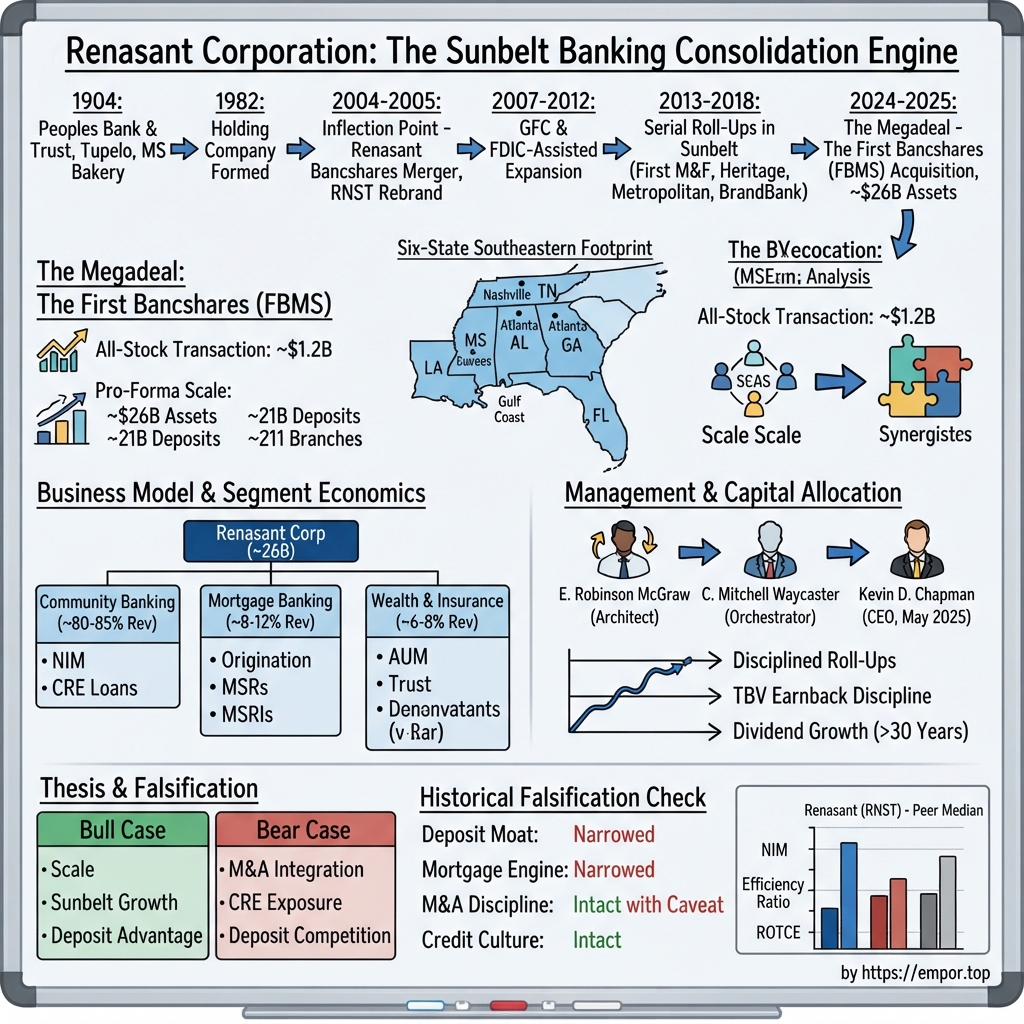
Renasant Corporation: The Sunbelt Banking Consolidation Engine
I. Introduction & Episode Roadmap
In February 1904, a group of Lee County merchants in Tupelo, Mississippi, pooled $100,000 to open a bank in the back room of a local bakery.1 At the time, the town lacked paved highways, cotton served as the primary collateral, and a lender's competitive moat amounted to knowing which local farmers were dependable borrowers. Elvis Presley would not be born in Tupelo for another three decades.
One hundred and twenty-two years later, that bakery-born lender has expanded into a $27.0 billion Southeastern institution operating roughly 277 banking, lending, and mortgage offices, alongside a nationwide factoring subsidiary, with a market capitalization exceeding $3.5 billion.3724 It is neither a household brand nor a technology innovator. Yet Renasant Corporation offers an instructive case study in regional banking, illustrating how a mid-sized institution addresses an increasingly difficult industry question: what purpose does a $25 billion regional bank serve?
That question carries substantial strategic stakes. A regional bank of Renasant's scale sits in a difficult middle tier. It lacks the technology budget of JPMorgan Chase or Bank of America to spend heavily on mobile applications, fraud analytics, or artificial intelligence. At the same time, it lacks the personal touch of a two-branch community bank whose executives know local borrowers socially. To succeed, it must generate competitive returns on tangible common equity while absorbing the compliance costs of a larger enterprise and managing the deposit-gathering operations of a smaller institution. Industry observers call this predicament the "mid-tier chasm," and the standard path out is scale achieved through acquisitions.
Renasant pursued that consolidation strategy with conviction. Its pivotal transaction occurred on July 29, 2024, when the company announced an all-stock merger with Hattiesburg, Mississippi-based The First Bancshares, Inc., valued at approximately $1.2 billion at announcement on a one-for-one share exchange ratio.4 As the largest transaction in Renasant's history, the deal added roughly $8.0 billion in assets and 111 branches, expanding the combined franchise to approximately $25 billion in assets, $18 billion in loans, and $21 billion in deposits on a pro forma basis while extending its footprint into Louisiana as a sixth state.4 The transaction closed on April 1, 2025.5
By the summer of 2026, the operational integration was complete and initial financial results had taken shape. Following core systems conversion in the third quarter of 2025 and targeted cost reductions, Renasant reported a first-half 2026 adjusted return on average assets of roughly 1.3% and an adjusted return on average tangible common equity exceeding 16% — metrics that exceeded its performance profile from two years earlier.162
While these metrics support the bullish narrative, historical performance highlights notable offsetting factors. Renasant's quarterly dividend remained flat at $0.17 for nearly nine years following the 2008 financial crisis and stayed frozen at $0.22 for another six years, resuming growth only after the First Bancshares integration.72 Immediately following its largest acquisition, the company reported GAAP earnings of just $0.01 per share in the first quarter after closing.15 Rather than building out an in-house platform, it sold its insurance agency unit outright in 2024.19 Commercial real estate concentration also remains elevated, with investor CRE accounting for approximately 42% of total loans.6 Furthermore, in January 2026, Chief Executive Officer Kevin D. Chapman noted to analysts that even after hitting management's key eighteen-month operational targets, the bank placed "right in the middle" of its regional peer group rather than in the top quartile.15
Six thematic areas frame this analysis. First, the 1904 origin story provides context for the bank's enduring credit and operating culture. Second, an examination of Renasant's acquisition track record — covering five bank acquisitions over twelve years alongside two FDIC-assisted transactions — evaluates purchase multiples and earnback periods. Third, an analysis of the First Bancshares transaction details its financial mechanics and initial investor scrutiny. Fourth, segment breakdown analyzes profit drivers, including the structural rationale for divesting its insurance unit. Fifth, an assessment of capital allocation evaluates leadership under Kevin D. Chapman, who assumed the CEO role on May 1, 2025.20 Finally, an evaluation of Renasant's competitive moat tests how its business model holds up during periods of industry stress.
The central thesis is straightforward: Renasant's competitive advantage does not stem from proprietary products, technology, or brand power, but from disciplined operational execution — acquiring institutions at manageable valuations, retaining customer deposits during integration, and extracting planned cost efficiencies. While this capability is valuable, its benefits depend entirely on seamless execution in each deal cycle and yield little compounding growth during interim periods between transactions.
Understanding that execution model requires examining the foundational culture that shaped it.
 Subscribe on LinkedIn
II. From a Mississippi Bakery to the Southeastern Corridor (1904–2004)
The bakery origin detail is charming, but the more revealing facts about the bank's early decades involve simple survival.
Three years after The Peoples Bank & Trust Company opened its doors, the Bankers' Panic of 1907 forced roughly a hundred Mississippi banks to close. Peoples survived. In 1929, the wave of failures that culminated in the National Bank Holiday closed sixty-eight more Mississippi institutions. Peoples survived that too.1 For a lender in an agricultural cotton economy operating without deposit insurance, an effective Federal Reserve backstop, or diversified customer income, navigating two systemic crashes reflected strict underwriting discipline rather than good fortune.
That history forms the foundational narrative Renasant highlights today, and it produced a tangible operational outcome: the institution grew very slowly for decades. Assets reached $3 million in 1954 — half a century after founding. By 1973, riding the post-war industrial expansion, assets had grown to $73 million.1 During those years, Tupelo transformed from an agricultural county seat into a regional manufacturing hub, eventually becoming a centerpiece of America's upholstered furniture industry. The bank's loan book shifted accordingly, moving from seasonal crop loans to working capital for small manufacturers and commercial real estate. That transition established a recurring operational habit: Renasant followed its local economy's evolution rather than attempting to forge new markets.
Structural modernization followed in deliberate stages. In 1981, the bank opened the downtown Tupelo corporate headquarters it still occupies today.1 In 1982, it reorganized as a bank holding company — The Peoples Holding Company — establishing the legal structure needed to issue holding-company debt, operate non-bank subsidiaries, and acquire other institutions rather than relying solely on organic branch expansion.7 Throughout the 1980s and 1990s, the entity executed a series of in-market rollups, absorbing smaller community banks across northern Mississippi, including institutions in West Point, Pontotoc, Aberdeen, Calhoun City, Amory, Water Valley, Coffeeville, Iuka, Southaven, Grenada, Louisville, New Albany, DeSoto County, and Batesville.1 In 1999 and 2000, the company acquired insurance agencies in Tupelo and Corinth, generating fee income streams that it would later divest.1
This expansion strategy was standard practice for successful Mississippi institutions consolidating adjacent rural markets. The inflection point arrived when management decided to expand across state lines.
The Memphis Decision
In 2004, Peoples acquired Renasant Bancshares of Memphis, Tennessee, marking its initial out-of-state entry.1 Memphis provided entry into its first major metropolitan economy — a commercial hub driven by logistics, healthcare, and middle-market manufacturing, offering commercial lending opportunities far larger than those in Lee County. Crossing into West Tennessee also required competing against established regional institutions with dedicated credit committees, formal treasury management platforms, and entrenched corporate networks.
The integration strategy revealed how leadership viewed the company's trajectory. Rather than absorbing the Memphis bank into the legacy Peoples brand, management adopted the acquired entity's name. In 2005, The Peoples Holding Company was renamed Renasant Corporation, and its banking subsidiaries were unified under Renasant Bank.17 The name — derived from concepts of renewal and growth — carried no geographic markers. While "Peoples Bank & Trust" signaled a rural Mississippi community bank, "Renasant" offered a neutral, adaptable identity suitable for multi-state expansion.
Renaming a century-old institution after an acquisition one-twentieth its size signaled a clear strategic shift: management had committed to an aggressive, multi-state consolidation strategy.
The execution of that strategy accelerated quickly. On January 1, 2005, the company acquired Heritage Financial Holding Corporation of Decatur, Alabama, entering the state with eight banking offices across Decatur, Huntsville, and Birmingham.7 In 2006, it acquired Capital Bancorp, adding seven locations in Nashville.1 These transactions transformed the balance sheet: by 2007, Renasant's total assets expanded from roughly $1 billion to $3.4 billion.1
It took a century for the institution to reach its first billion dollars in assets, but only three years to more than triple that figure.
For investors, this historical arc illustrates two distinct operational regimes within Renasant's corporate history. The first was a century of strict conservatism that ensured survival but limited scale. The second was a multi-year acquisition drive that rapidly expanded its footprint across the Mid-South. The ongoing tension between these two forces — a conservative credit culture rooted in its agricultural origin and an aggressive expansion mandate initiated in Memphis — remains a defining feature of the modern enterprise as it faced its next major stress test: the 2008 financial crisis.
III. The Serial Roll-Up Engine: Building Scale Across the Sunbelt (2004–2023)
In the summer of 2010, in Jasper, Georgia — a Pickens County town an hour north of Atlanta — Crescent Bank and Trust Company collapsed after a decade of aggressive construction and land-development lending. On Friday, July 23, 2010, state and federal regulators closed the institution, and Renasant Bank assumed its deposits.[^8] The transaction illustrated how Renasant established its footprint in metropolitan Atlanta: not through organic branch expansion, but by deploying capital when the Federal Deposit Insurance Corporation (FDIC) sought buyers for failed lenders.
Phase One: Buying Failure at a Discount (2010–2011)
The Crescent transaction brought Renasant approximately $1.0 billion in assets — comprising roughly $600 million in loans and real estate alongside $50 million in securities — and roughly $900 million in assumed deposits.[^8] Crucially, Renasant and the FDIC executed a loss-sharing agreement covering nearly all acquired loans and real estate, under which the FDIC absorbed 80% of eligible losses from the first dollar.[^8]
Unlike standard bank mergers where the acquirer absorbs full credit risk, the loss-share structure insulated Renasant from four-fifths of potential loan write-downs. In effect, the bank acquired a deposit base and a northern Atlanta branch network while shifting the bulk of legacy asset risk to the federal government. On February 4, 2011, Renasant completed a similar transaction for American Trust Bank of Roswell, Georgia. That deal added roughly $248 million in fair-value assets — including $74 million in loans — and $223 million in assumed deposits, with loss sharing on $94.3 million of assets under identical 80% terms.7 Combined, the two distressed acquisitions established a 13-branch footprint in Georgia.1
This distressed expansion represented counter-cyclical capital deployment, allowing Renasant to enter the Georgia market at depressed valuations with government-subsidized credit protection.
However, the loss-share deals masked underlying balance sheet pressure during the downturn. Renasant did not emerge from the Great Recession unscathed; it maintained just enough solvency to act as an opportunistic buyer. Company disclosures show nonperforming assets climbing from 1.38% of total assets in September 2008 to 2.64% a year later, while quarterly net income declined by roughly half over the same period.7 Capital constraints were also reflected in dividend policy: after rising to $0.17 per share in 2007, the quarterly payout remained frozen at that level through the first quarter of 2016.7 A nine-year dividend freeze highlighted the lingering operational drag from the crisis.
Phase Two: Buying Health at Full Price (2013–2018)
As distressed opportunities receded, Renasant pivoted to unassisted, open-market bank acquisitions at full valuations, accelerating transaction size and geographic scale.
On September 1, 2013, Renasant closed its acquisition of First M&F Corporation, parent of Merchants & Farmers Bank, for approximately $156.8 million. The transaction added roughly $1.6 billion in assets and 42 branches across Mississippi, Alabama, and Tennessee.17 Rather than opening new territories, the deal focused on market overlap, achieving efficiency by eliminating duplicate branches in rural Mississippi.
On July 1, 2015, Renasant acquired Heritage Financial Group, parent of HeritageBank of the South, for approximately $295.4 million, expanding its footprint into southern Georgia and northern Florida.71 Two years later, on July 1, 2017, the company purchased Metropolitan BancGroup for roughly $219.5 million. Founded in 2008, Metropolitan brought approximately $1.2 billion in assets, $918 million in loans, and $888 million in deposits, with a strong focus on commercial and private banking across Jackson, Mississippi, and Memphis.7118
The Metropolitan acquisition illustrated Renasant's M&A underwriting template. Management paid approximately 201.5% of Metropolitan's tangible book value, projected cost savings of roughly 38% against the target's expense base, accepted estimated tangible book value dilution of 2.9%, and targeted an earnback period of under three years.8 Executive leadership framed the purchase around credit quality and client relationships; Chairman and CEO E. Robinson McGraw praised Metropolitan's commercial franchise, while Metropolitan CEO Curt Gabardi transitioned to president and chief banking officer of Renasant Bank.8
The transaction also carried significant regulatory consequences by pushing Renasant past the $10 billion asset threshold. Crossing that threshold triggered the Durbin Amendment's cap on debit interchange fees and subjected the bank to heightened supervisory oversight. Management projected an annual pre-tax revenue loss of approximately $10 million starting in the third quarter of 2018, asserting that planned cost synergies would more than offset the reduction.8
Crossing the $10 billion mark illustrated the financial pressures of the mid-tier chasm. Because the regulatory milestone imposed immediate compliance costs and capped interchange fee revenue, management was compelled to continue expanding asset scale to dilute fixed overhead.
BrandBank: The Atlanta Bet
On March 28, 2018, Renasant announced its largest acquisition to date: the $452.9 million cash-and-stock purchase of Brand Group Holdings, parent of Lawrenceville, Georgia-based The Brand Banking Company.109 The deal closed on September 1, 2018.
Brand operated 13 branches in metropolitan Atlanta with $2.4 billion in assets, $1.8 billion in loans, and $1.9 billion in deposits, merging into a $9.8 billion acquirer.9 Renasant paid 224% of Brand's tangible book value, a valuation higher than the multiple paid for Metropolitan.9 In announcing the deal, McGraw emphasized access to Atlanta's commercial market and local talent.9
To limit risk, Renasant required Brand to clean its balance sheet prior to closing by divesting roughly $55 million in classified assets and selling its BrandMortgage subsidiary, with the final purchase price adjusting dollar-for-dollar based on net sale proceeds.9 To preserve commercial lending relationships, three Brand executives joined Renasant's leadership team and two Brand directors joined its board.9
Management projected double-digit earnings-per-share accretion following cost synergies and expected tangible book value dilution to recover within three years.9
The Brand acquisition fundamentally altered Renasant's risk profile. Expanding into metropolitan Atlanta shifted the loan portfolio away from conservative rural Mississippi commercial lending toward cyclical urban commercial real estate and middle-market business loans. By year-end 2024, commercial real estate comprised 48.40% of Renasant's total loan portfolio, followed by residential real estate at 27.07%, commercial and industrial loans at 14.64%, and construction lending at 8.5%.1718
The Non-Bank Bolt-Ons
Alongside whole-bank mergers, Renasant expanded into national specialty finance. Effective December 30, 2022, Renasant Bank acquired Republic Business Credit, a New Orleans commercial finance firm founded in 2011 that specialized in factoring and asset-based lending, with average earning assets exceeding $100 million and cumulative originations over $8 billion.12 Then-CEO Mitch Waycaster described the purchase as deepening existing specialty lines, operating Republic as a distinct subsidiary under its existing brand and management.12 Renasant expanded the unit on April 30, 2026, acquiring the factoring assets and operations of REV Capital for $76.4 million, comprising $70.0 million in cash and up to $6.3 million in contingent earnout payments tied to two-year receivables growth.3
Specialty finance offered higher asset yields than traditional commercial real estate and operated nationwide without regional branch constraints. However, factoring and asset-based lending carry elevated credit risk tied to borrower receivables, and acquiring outside platforms required Renasant to record goodwill to buy specialized lending capabilities rather than developing them organically.
What the Deal Record Actually Shows
Renasant's acquisition record demonstrates clear operational strengths. Since 2010, the company has completed at least five whole-bank transactions and two FDIC-assisted assumptions without major integration disruptions. Across these deals, management applied consistent underwriting guidelines: explicit earnback targets, aggressive cost-reduction goals, retention of local lending teams, and pre-closing resolution of problem loans. Purchase multiples — ranging between 2.0 and 2.2 times tangible book value on its primary open-market transactions — aligned with prevailing Southeastern regional banking valuations.89
Conversely, serial consolidation created structural capital drag. Each acquisition added non-earning goodwill and intangible assets to the balance sheet. By June 2026, Renasant carried $1.42 billion in goodwill and $138 million in intangible assets against $3.87 billion in total equity, meaning intangibles accounted for roughly 40% of total book value and left tangible common equity at approximately $2.3 billion.3 In its July 21, 2026 credit rating affirmation, KBRA noted that Renasant's tangible common equity ratio of 9.1% and Common Equity Tier 1 (CET1) ratio of 11.2% were consistent with its historical profile but trailed higher-rated regional peers.6
Furthermore, deal integration temporarily depressed reported earnings. Reported earnings per share fell to $1.96 in 2017 during the Metropolitan integration before recovering to $2.79 in 2018 and $2.88 in 2019 following the BrandBank integration.7 Serial acquisition strategies rarely produce linear earnings growth; instead, they generate a volatile pattern where upfront transaction costs and share dilution periodically suppress near-term results.
That recurring integration cycle set the stage for Renasant's largest transaction to date.
IV. The Megadeal: Acquiring The First Bancshares & Hitting $26B (2024–2025)
Monday, July 29, 2024 was a busy day at Renasant's Tupelo headquarters. Before the market opened, the company announced the largest merger in its history. After the close, it priced an equity offering to help pay for the consequences.
That sequencing tells you most of what you need to know about how the deal was structured, and about what management was worried about.
The Transaction
The First Bancshares, Inc. — parent of The First Bank, headquartered in Hattiesburg, Mississippi, and founded in 1996 — agreed to merge into Renasant in an all-stock transaction valued at approximately $1.2 billion based on Renasant's closing price on July 26, 2024.413 Each First Bancshares share converted into one Renasant share. There was no cash component and no collar disclosed in the announcement; the price would float with Renasant's stock, and it did — the final consideration recorded at closing was $1.05 billion, roughly 13% below the announcement-day figure.3
The scale change was the point. The First brought approximately $8.0 billion in total assets, $5.3 billion in loans and $6.6 billion in deposits as of June 30, 2024, along with 111 branches across Mississippi, Louisiana, Alabama, Florida and Georgia.4 Combining the two created a six-state Southeastern franchise with roughly $25 billion in assets, $18 billion in loans and $21 billion in deposits on the announcement-date arithmetic — and, by the time the deal actually closed on April 1, 2025, about $26.3 billion in assets, $18.0 billion in loans and $21.2 billion in deposits.421
There is a nice symmetry here that neither company emphasized: Renasant was buying another roll-up. The First had itself been assembled through acquisition, most recently absorbing Southwest Georgia Financial Corporation in 2020 and Heritage Southeast Bancorporation at the start of 2023. Renasant was not buying a pristine single-culture community bank. It was buying a partially digested stack of them, which is a materially harder integration problem — and one that showed up later in the loan book.
Geography: Why Louisiana Mattered
Strategically, The First did three things for Renasant. It thickened the company's presence in south Mississippi and along the coastal Alabama–Florida panhandle corridor, where Renasant was underweight. It added density in Gulf Coast metros. And it opened Louisiana, a state Renasant had never banked in.4
The Gulf Coast logic is demographic. Coastal Mississippi, Mobile, Pensacola and Baton Rouge are markets with in-migration, tourism-linked service economies, and — critically — a lot of small businesses that need a bank with a real lending limit but a local decision-maker. That is precisely the niche a $25 billion regional is supposed to occupy.
The Gulf Coast logic is also a risk. These are hurricane markets. In January 2026, Renasant's own management opened its fourth-quarter earnings call apologizing for being scattered across locations because of a storm, noting branches without power and employees working to reopen them.15 Concentration in coastal Mississippi, Louisiana and the Florida panhandle is a genuine catastrophe-exposure question for a lender whose collateral is real estate, and it is not one that management discusses with any regularity.
The Financing: A Tell
The equity raise priced the same day. Renasant sold 6,250,000 shares at $32.00 for $200.0 million gross, with underwriters granted an option for 937,500 more; the option was exercised in full and the offering closed July 31, 2024 with 7,187,500 shares sold for $230.0 million gross and roughly $217 million net.14 Stephens Inc. led the book, with Raymond James as joint book-runner.14 The stated use of proceeds was general corporate purposes to support growth, including investments in Renasant Bank and future strategic acquisitions.14
This is the second-layer detail worth pausing on. An all-stock merger, by definition, does not require cash. Raising $230 million of common equity on top of an all-stock deal means management wanted a thicker capital cushion going into the transaction than the pro forma math produced on its own — which is a form of self-assessment. It also means existing shareholders absorbed dilution twice: once from the merger shares, once from the raise. Renasant's weighted average diluted share count went from roughly 59.7 million in 2024 to 95.2 million in 2025.7 The company nearly doubled its share count in a single year.
For that dilution to have been worth it, the earnings had to more than double. That is the whole test.
The Synergy Math
Management's stated assumption was cost savings equal to 30% of The First's 2025 noninterest expense base, with 40% of the savings realized in the second half of 2025 and 100% thereafter. Excluding one-time transaction costs, the merger was expected to be immediately accretive to earnings per share and to improve Renasant's key profitability and operating ratios over the long term.4 The specific accretion percentage and tangible-book-value earnback period were not stated in the announcement release; management noted only that the earnback was calculated on the crossover method and that projections assumed 5% annual net income growth for both companies after 2025.4
Thirty percent is a moderate assumption by regional bank standards — below the roughly 38% Renasant had modeled for Metropolitan, which makes sense given that The First's branches were largely in markets where Renasant had no overlapping infrastructure to eliminate.8
Execution: The Ugly Quarter
The merger closed April 1, 2025, and the second quarter of 2025 was the first full combined period. It was, in GAAP terms, a disaster — and management said so plainly.
Reported earnings were $1 million, or one cent per diluted share. Adjusted earnings were approximately $66 million, or $0.69.15 The gap was purchase accounting: $20.5 million of merger and conversion expenses, plus the day-one credit loss provision that acquisition accounting requires a buyer to book against non-purchased-credit-deteriorated loans. Net charge-offs of $12.1 million in the quarter were concentrated in two previously identified problem C&I credits.15
Chief financial officer James Mabry laid out the purchase accounting in unusual detail on that call: fair value of assets acquired totaled $7.9 billion including $5.2 billion of loans; liabilities assumed totaled $6.9 billion including $6.4 billion of deposits; core deposit intangibles came to $159.6 million and preliminary goodwill to $428.7 million.15 Roughly half of The First's securities portfolio was sold.15
The one-cent quarter is worth dwelling on because it is the most honest possible illustration of what serial acquisition costs. A shareholder holding Renasant on June 30, 2025 owned a company that had just reported essentially no earnings, had nearly doubled its share count, and had not yet converted a single customer onto its core system. Everything about the thesis at that moment was a promise.
Analyst Scrutiny
The Q&A on those 2025 calls is where the real information sits, and the pressure points were consistent.
Analysts pushed hardest on expenses and timing. Matt Olney of Stephens asked directly when the fully loaded cost saves would appear; Mabry's answer was specific and falsifiable — some efficiencies in Q3 2025, more in Q4, with the first quarter of 2026 the target for "a clean income statement that reflects all the efficiencies that we sought in the deal," plus roughly $25 million of additional merger expense in the second half of 2025, most of it in Q3.15 Michael Rose of Raymond James pressed on whether the previously stated strategic goals — a 1.25%–1.30% return on assets and an efficiency ratio near 56% — still held. Chapman said there was "no real update other than to say we're tracking right in line with what we laid out a year ago."15
On capital, Catherine Mealor of KBW asked why buybacks were not more aggressive given the pace of capital accretion. Mabry ranked the priorities out loud: organic growth first, then specialty-finance bolt-ons, then talent, then securities repositioning, then buybacks, with capital held in reserve for future bank M&A.15 Stephen Scouten of Piper Sandler asked when whole-bank M&A might return to the table; Chapman was emphatic that it would not while the conversion was pending — "we don't want to do things that would self-inflict an error."15
Credit questions focused on whether the elevated provision reflected deterioration or accounting mechanics. David Meredith, who fields credit on Renasant's calls, attributed the Q2 2025 provision to model dynamics — the two charge-offs feeding historical loss factors, a quarterly reassessment of qualitative factors, and the sheer volume of loan growth — rather than portfolio-wide weakness.15
Did It Work?
The systems conversion took place in the third quarter of 2025.[^18] By the fourth quarter, the answer started to arrive. Net income was $78.9 million, or $0.83 per diluted share; adjusted for $10.6 million of merger charges, $86.9 million or $0.91. Adjusted return on assets reached 1.29% and adjusted return on tangible common equity 16.18%, the latter an improvement of 196 basis points in a single quarter.15[^17]
For full-year 2025, adjusted earnings per share were $3.06, up 11% year over year; adjusted return on assets rose from 94 basis points to 110; the adjusted efficiency ratio improved roughly 900 basis points to 57.46%; and adjusted return on tangible equity climbed from 11.5% to 13.79%.15 GAAP net income for the year was $181.3 million, or $2.07 per diluted share — below 2024's $195.5 million and $3.27 — because of $37.6 million of after-tax merger and conversion expense and the day-one provision.721
Then came the clean quarter management had promised. In the first quarter of 2026, adjusted EPS was $0.93, up 41% year over year; adjusted return on assets was 1.33% against 0.95% a year earlier; adjusted return on tangible common equity was 16.3% against 10.3%; and the efficiency ratio was 55.7% against 65.5%.15 Chapman's framing was that the results "exceed our goals."15
Headcount tells the same story from the cost side. Combined full-time equivalents were just under 3,400 in June 2024. By March 31, 2026 the number was roughly 2,950 — about 420 positions removed — and Chapman was explicit that not all of it was merger-related, since Renasant had been running an internal accountability program before the deal.15
So: the deal delivered what management modeled, on roughly the schedule management gave. That is a genuine credibility win, and it is the strongest single piece of evidence in the bull case. It also came with a permanent cost — a near-doubling of the share count, $1.42 billion of goodwill, and an eighteen-month stretch of GAAP earnings that told investors almost nothing.
And it left one question unanswered, which Chapman himself raised on the January 2026 call. Having hit the targets set eighteen months earlier, was Renasant now a top-quartile bank? "Today, we're not in that top quartile," he said. "The peer has moved. I think we find ourselves right in the middle, which isn't where we want to be."15
Hitting your own model is not the same as beating the field. To understand why the gap persists, you have to look at what the company actually sells.
V. Inside the Business Model & Segment Economics
Strip away the promotional branch collateral, and a regional bank is fundamentally a credit-spread business with an attached service suite. Renasant is an unusually pure example of this structure. Its segment disclosures highlight the reality: as of its 2024 annual report, the company operated three reporting segments — Community Banks, Insurance, and Wealth Management — with Wealth Management generating just 2.4% of gross revenues.17
In practice, the community bank segment represents virtually the entire enterprise.
The Core Engine
The operating mechanics are straightforward: Renasant gathers deposits from households, small businesses, municipalities, and school districts, pays interest on those funds, and lends them out at higher rates. The net interest margin measures this spread against average earning assets. Fee-generating activities — including mortgage originations, wealth management, treasury services, card interchange, and factoring — remain secondary contributors.
Results from the second quarter of 2026 illustrate this dynamic. Net interest income reached $228 million compared to noninterest income of $51.2 million, generating roughly $4.50 of net interest spread for every dollar of fee income.16 Reported net interest margin stood at 3.83%, while the adjusted margin — which excludes purchase accounting accretion from the First Bancshares transaction — was 3.61%.2 That 22-basis-point variance reflects the accounting lift from marking the acquired loan portfolio to fair value and accreting that discount into income over time. While this accretion provides tangible cash flow, it is temporary; tracking the adjusted margin provides a clearer view of underlying core profitability.
On the funding side, total deposit costs rose two basis points sequentially to 1.96% in the second quarter of 2026, with the end-of-June spot rate matching the quarterly average — indicating that deposit repricing had stabilized.16 Average loan yields reached 6.03%.16 Ultimately, generating a net spread of roughly 400 basis points on a $27 billion asset base drives the institution's earning power.
The Deposit Franchise, Examined
Executive leadership maintains that Renasant commands a granular, relationship-driven, low-cost deposit base. Credit rating agency KBRA concurred in July 2026, pointing to a "granular, relationship-based deposit franchise" spanning six Southeastern states, low-to-mid 90% loan-to-core-deposit ratios, and minimal dependence on wholesale market funding.6
The underlying data presents a more nuanced picture. Noninterest-bearing deposits — the primary indicator of core banking relationships — comprised 23.2% of total deposits in the second quarter of 2026.2 While solid, this ratio sits below the mid-to-high 20% range recorded by many Southeastern regional peers prior to the 2022–2024 monetary tightening cycle.
More compelling evidence appeared in account-opening metrics disclosed by CEO Kevin Chapman in July 2026. Renasant added over 10,000 new customer accounts in the second quarter from clients without prior bank relationships, bringing in approximately $380 million in new deposits split evenly between certificates of deposit and transaction checking accounts. That momentum continued through July, with more than 2,000 net new accounts yielding an additional $86 million as customers migrated direct deposits and automated bill payments.16 Chapman emphasized that checking balances were secured through relationship strength rather than rate promotions, with new capital pricing at prevailing market rates in the high 2% to low 3% range.16
This distinction matters operationally. Attracting promotional deposits with above-market rates compresses net interest margins, whereas capturing core checking accounts yields sticky market share gains. Management attributed this inflow to regional market disruption, displaying internal mapping that tracked footprint overlap against competing institutions undergoing major integrations — a target market Chapman estimated at over $90 billion in total deposits.15
This dynamic creates a notable historical parallel. After spending 2024 and 2025 navigating system conversions and integration friction, Renasant in 2026 began capitalizing on similar operational disruptions at rival banks. However, capturing displaced customers reflects temporary timing advantages during competitor integration windows rather than an enduring competitive moat.
The Loan Book and Its Concentration
Renasant's loan portfolio remains heavily concentrated in real estate. As of the 2024 annual report, commercial real estate represented 48.40% of total loans, residential real estate accounted for 27.07%, commercial and industrial lending made up 14.64%, and construction stood at 8.5%.17 KBRA's July 2026 assessment highlighted investor commercial real estate specifically at 42% of total loans — including multifamily properties at 7% and construction at 10% — identifying it as the bank's primary credit risk.6
This exposure represents a central risk factor for the franchise. Maintaining 42% of the loan portfolio in investor CRE ties credit performance directly to Southeastern commercial property values and borrowers' capacity to refinance maturing debt at interest rates substantially higher than original origination levels.
Asset quality metrics have remained stable. Net charge-offs totaled $2.8 million, or an annualized six basis points, in the second quarter of 2026, following $2.3 million in the first quarter.1615 KBRA noted that Renasant's annualized net charge-offs averaged approximately 0.10% in recent years.6 The allowance for credit losses stood at 1.54% of total loans.616
However, early credit indicators showed mild upward movement. Nonperforming loans rose to 0.97% of total loans in the second quarter of 2026, with criticized loans reaching 2.66%.2 Chief Credit Officer David Meredith reported $69 million in new nonperforming loan additions against $45 million in resolutions during the quarter, driven by a small group of larger exposures — including $19 million in commercial and industrial loans, $7 million in commercial real estate, and select construction loans.15 Meredith noted that credit migration was spread across asset classes rather than concentrated in specific geographies, that early-stage 30-to-89-day delinquencies remained low, and that historical resolution efforts typically minimized ultimate principal loss.15
Management's decision to maintain loss reserves rather than release allowance capacity offers insight into executive risk management. Chapman pointed to broader macroeconomic headwinds impacting commercial and consumer cash flows — noting a 30% to 40% surge in regional fuel costs over a thirty-day span in March 2026 — and stated that lingering economic uncertainty justified holding reserve levels constant.15 While maintaining elevated reserves temporarily reduces reported return on assets, it reflects a conservative provisioning stance over short-term earnings optimization.
Commercial Real Estate Runoff: The Growth Problem
Loan balances exhibited shifting momentum in early 2026. Total loans contracted by $71.8 million in the first quarter before expanding by $220.9 million — or 4.7% annualized — in the second quarter.152 Elevated commercial real estate payoffs dampened net balance sheet expansion across both quarters.
Chapman clarified in July 2026 that portfolio runoff was concentrated in office and multifamily sectors, driven primarily by borrowers selling underlying assets or operating businesses rather than refinancing with competing commercial banks. He noted that Renasant positioned itself to capture liquid proceeds from these asset sales for future deposit deployment.16 Meredith added that as commercial real estate facility terms mature, select borrowers transition debt structures to private credit platforms or long-term private placement markets — capital sources outside traditional regional banking frameworks.15
This trend highlights structural competition from non-bank lenders. Private credit platforms rarely displace primary deposit relationships, but they increasingly absorb mature, stabilized commercial real estate assets that traditional regional banks seek to retain. In response, Renasant expanded construction commitments — which typically draw down over a six-to-nine-month lag — while increasing origination activity in commercial and industrial lending and national specialty finance.15 Whether this portfolio rotation shifts the bank's long-term risk-adjusted returns remains an open question.
Mortgage: The Line Nobody Defends
Renasant originates residential mortgage loans through its retail branch network, selling the majority into secondary markets to capture gain-on-sale fee income while retaining loan servicing rights. While this model generates substantial noninterest revenue during low-rate refinancing cycles, higher rate environments since 2022 have constrained volume and profitability.
Executive commentary underscores these ongoing headwinds. During the April 2026 earnings call, Chapman noted that leadership looked forward to a market environment where mortgage operations required less explanation.15 In July, CFO James Mabry described mortgage banking performance as persistently subdued, projecting muted near-term activity.16 Second-quarter 2026 rate lock volume reached $611.6 million, with total mortgage banking revenue declining $0.3 million sequentially.2
A temporary demand surge occurred in February 2026 when 30-year fixed mortgage rates briefly declined toward 6%, prompting an immediate increase in application volume.15 This response demonstrates that retained origination capacity offers operational leverage during rate rallies, though realization remains dependent on broader macroeconomic rate trends.
Wealth, Insurance, and What Got Sold
Wealth management services operate through dedicated trust and financial services divisions, providing estate planning, custodial services, asset management, and retirement plan administration. The unit generated 2.4% of total gross revenues in 2024.17 Management highlighted wealth management as a target area for strategic recruitment and client acquisition amidst regional bank consolidation, with Mabry forecasting mid-single-digit baseline growth and potential upside.15 Specific trust assets under management were not detailed in available filings.
In contrast, Renasant no longer operates an insurance brokerage. On July 1, 2024, the company completed the sale of Renasant Insurance assets to Sunstar Insurance Group of Memphis, advised by Piper Sandler with legal counsel from Phelps Dunbar. Operational personnel, branch locations, and leadership transferred to the buyer under the Sunstar Insurance Services brand.19 Renasant retained commercial banking relationships with the buyer alongside an ongoing customer referral agreement,19 while formally eliminating its Insurance reporting segment.17
The transaction significantly impacted 2024 financial comparisons. Noninterest income rose 80.11% to $203.66 million in 2024, elevated primarily by the one-time gain recorded on the agency divestiture.17 Evaluating multi-year fee income trends requires adjusting for this non-recurring gain.
The divestiture reflects clear strategic priorities. Sub-scale insurance agencies within regional banking structures often face competitive pressures, and prevailing market valuations offered an opportunity to monetize the asset. However, after expanding the agency through acquisitions in 1999 and 2000, Renasant chose to divest rather than commit capital to scale the platform.1 This exit illustrates management's willingness to prune non-core operations when standalone return profiles lag broader strategic goals.
Additional operating units complement the core franchise. Subsidiary Republic Business Credit maintains four offices across California, Illinois, Louisiana, and Texas, expanding Renasant's commercial factoring and asset-based lending nationwide.17 Meanwhile, asset management arm Park Place Capital operates alongside Renasant Bank under the parent holding company structure. Across all operating units, the combined enterprise maintained 277 banking, lending, and mortgage offices throughout the Southeast as of the 2025 annual report.7
Ultimately, Renasant's corporate structure supports a straightforward business model: a spread-dependent regional lender backed by a commercial real estate book, a cyclical mortgage unit, a focused wealth practice, and a specialized national factoring platform. As the franchise operates at a $27 billion asset scale, capital allocation discipline and executive oversight remain pivotal factors in determining future performance.
VI. Management & Capital Allocation Record: The Chapman Era
On May 1, 2025 — one month after closing the largest merger in its history and two months ahead of core systems conversion — Renasant transitioned to a new chief executive.20
The timing reflected either disciplined succession planning or substantial operational confidence, though leadership had telegraphed the transition years in advance.
The Three Regimes
E. Robinson McGraw served as the architect of the modern institution, guiding Renasant through its initial expansion beyond Mississippi, its corporate renaming, entry into Alabama and Tennessee, FDIC-assisted acquisitions during the Great Recession, and a series of open-market bank purchases culminating in BrandBank. Across those transactions, his public commentary consistently emphasized credit culture, local talent, and market fundamentals over financial engineering.89 He continues to serve as Chairman of the Board for both the holding company and the bank.20
C. Mitchell Waycaster succeeded McGraw as chief executive, overseeing the BrandBank integration, navigating pandemic disruptions and rapid interest rate increases, acquiring Republic Business Credit, divesting the insurance unit, and structuring The First Bancshares merger.1219 On May 1, 2025, Waycaster stepped into the role of Executive Vice Chairman, retaining responsibility for strategic planning, investor relations, M&A, and board oversight.20
Kevin D. Chapman represents the third operational regime, bringing a background steeped in financial controls. Joining the bank during its 2005 renaming, he served as Corporate Accounting Officer and Chief Strategy Officer before becoming Chief Financial Officer in October 2011, adding Chief Operating Officer duties in May 2018, and stepping up to President in May 2023 prior to becoming CEO.20 A licensed CPA in Alabama holding an MBA and an accounting degree from Troy University, Chapman began his career at Ernst & Young in Birmingham and served as corporate controller at a regional bank before joining Renasant.20
This leadership progression mirrors the company's evolution: McGraw built the expansion framework, Waycaster managed operational integration, and Chapman — an executive who managed balance sheet accounting throughout the growth era — now oversees total enterprise performance. For an institution that doubled its asset base and needed to capture cost efficiencies, placing a financial controller at the helm aligned with corporate priorities. Chapman's executive messaging has focused primarily on operating efficiency, internal accountability, and capital optionality rather than immediate dealmaking.
Alongside Chapman, James C. Mabry IV serves as chief financial officer, presenting balance sheet strategies, net interest margin trends, and capital allocation plans on investor calls; Kelly Hutcheson serves as executive vice president and chief accounting officer; and David Meredith leads credit discussions.1516 While select third-party leadership summaries list alternate names for the CFO role, conference call transcripts from 2025 through July 2026 confirm Mabry presented the institution's financial performance.1516
How Chapman Talks — and Whether It Holds Up
Management credibility rests on execution against stated commitments, and Renasant's call record provides a clear test because leadership set specific, time-bound financial targets.
In mid-2024, management projected that the First Bancshares merger would generate a return on assets between 1.25% and 1.30% and an efficiency ratio near 56%, designating the first quarter of 2026 as the benchmark for a fully integrated income statement.15 Guidance remained consistent throughout 2025. In the second quarter of 2025, Chapman noted integration was tracking on target, and by the fourth quarter Mabry affirmed performance remained on pace with eighteen-month projections.15 By the first quarter of 2026, adjusted return on assets reached 1.33% and the efficiency ratio improved to 55.7% — landing within projected ranges on both metrics in the precise quarter identified two years prior.15
Delivering on those explicit targets demonstrates effective forecasting and operational integration.
However, two contextual nuances complicate the picture. First, while Renasant hit its internal targets, peer performance also elevated. As Chapman acknowledged to analysts, reaching projected metrics placed the bank in the middle of its regional peer group rather than in the top quartile.15 Meeting internal models does not automatically translate to industry-leading returns. Second, executive visibility remains limited in volatile expense areas. When pressed in July 2026 for specific third-quarter expense guidance, Mabry committed only to figures moderately below second-quarter levels of $161.5 million, citing variable health insurance claims and opportunistic hiring while acknowledging the guidance lacked explicit precision.16
Capital deployment priorities also shifted with changing market conditions. In July 2025, Mabry ranked share repurchases below organic growth, specialty finance acquisitions, talent recruitment, and balance sheet repositioning.15 Yet over the first half of 2026, Renasant repurchased 1.92 million shares for $75.8 million in the first quarter and 1.53 million shares for $60.5 million in the second quarter at an average price of $39.54, reducing total outstanding shares from 94.6 million at year-end 2025 to 91.4 million.32 Management adapted to conditions as loan growth slowed and excess capital built up, declaring repurchases attractive relative to internal valuation metrics.15 While this demonstrates operational flexibility, it highlights that capital allocation priorities communicated on calls remain subject to near-term recalibration.
Incentives and Governance
Renasant's executive compensation structure links cash incentives to adjusted diluted earnings per share and long-term equity awards to total shareholder return, benchmarking performance against the S&P U.S. BMI Banks – Southeast Region Index.2122 For 2025 performance evaluations, management utilized an adjusted diluted EPS metric of $3.06, excluding $37.6 million in after-tax merger and systems conversion expenses.21
Excluding transaction charges from bonus calculations insulates executive compensation from the immediate financial costs of acquisitions. In an institution pursuing serial expansion, this structure reduces management's direct exposure to deal-related expenses. Conversely, stock ownership requirements provide governance alignment, mandating that directors hold equity equal to five times their annual cash retainer. According to the 2026 proxy statement, all directors met this guideline except one appointed in April 2023 who remains within the standard phase-in window.21
The board of directors consists of seventeen members, thirteen of whom are independent. The four non-independent directors are Chapman, McGraw, Waycaster, and M. Ray Cole — the former chief executive officer of The First Bancshares who joined following the merger.21 McGraw serves as Chairman, balanced by John M. Creekmore as Lead Director, a structure common among regional institutions with non-independent chairs.21 BDO USA, P.C. serves as independent auditor.21
Shareholder voting demonstrates strong institutional backing, with the advisory vote on 2025 executive compensation receiving approval from 76,201,345 shares against 970,393 dissenting votes — representing less than 1.3% opposition.21 Despite high approval ratings, corporate governance features notable concentration: a seventeen-member board is larger than average, four non-independent seats retain substantial legacy representation, and combining a non-independent chairman with the active CEO on the board concentrates executive influence. Additionally, Renasant filed an amended Form 10-K to rectify an auditor consent omission and append supplemental executive retirement documentation for Cole — a technical correction rather than a financial restatement, but a reminder of administrative compliance detail.[^29]
The Dividend Record: Correcting the Story
Although market commentary occasionally characterizes Renasant as a consistent dividend growth stock, historical payout patterns reveal a different operating history.
Management raised the quarterly dividend to seventeen cents per share in 2007 and maintained that payout level through the Great Recession, crisis-era FDIC transactions, and open-market acquisitions of First M&F and Heritage, keeping it fixed for nine years until 2016.7 The payout increased incrementally to twenty-two cents by mid-2019, where it remained frozen for another six years through the COVID-19 pandemic, interest rate spikes, and the execution of the First Bancshares merger.7 Dividend growth resumed only after merger synergies materialized, with increases to twenty-three cents declared in October 2025 and twenty-four cents declared alongside first-quarter 2026 results.2 Total dividend distributions for the first half of 2026 reached $43.8 million, or forty-seven cents per share.3
Capital Position and the Regulatory Tailwind
Renasant targets a Common Equity Tier 1 (CET1) ratio in the low 11% range, closing 2025 at approximately 11.25%.15 KBRA's July 2026 rating affirmation reported a tangible common equity ratio of 9.1% and a CET1 ratio of 11.2% — levels aligned with historical averages but trailing higher-rated regional peers.6 KBRA affirmed senior unsecured debt at BBB+, subordinated debt at BBB, and short-term debt at K2 for Renasant Corporation, while rating Renasant Bank A- for deposits and senior debt, BBB+ for subordinated debt, and K2 for short-term obligations, maintaining a Stable outlook across all ratings.6 The agency maintained coverage across pre- and post-merger integration periods.[^28]
Two capital actions shaped the balance sheet in 2026. In the second quarter, Renasant issued $300 million in subordinated debt featuring a 6.25% fixed-to-floating coupon, expanding total long-term debt from $500 million to $796 million.23 Because subordinated debt qualifies as total regulatory capital rather than CET1, the issuance strengthened overall capital buffers and liquidity rather than common equity ratios, adding interest expense relative to core deposit funding below 2%. On the regulatory front, Mabry informed analysts in July 2026 that proposed Basel III endgame rules were expected to lower risk-weighted assets by $1.0 billion to $1.3 billion, equivalent to a 55 to 65 basis point improvement in CET1 ratio, though management maintained its baseline capital targets.16
Choosing not to expand balance sheet leverage in response to potential regulatory relief reflects conservative capital management. Whether that discipline persists upon final regulatory adoption remains a key test for executive leadership.
However, maintaining capital discipline addresses only internal risk controls. The broader strategic question is whether Renasant's operating model secures a defensible competitive advantage.
VII. Moat Analysis: 7 Powers & Porter's 5 Forces
Bank economic moats are inherently difficult to maintain. Deposits represent a commodity liability, loans function as a commodity asset, and chartered competitors can enter new markets by hiring local lending teams and leasing office space. Renasant's own leadership has described encountering this competitive dynamic while also using it to recruit talent from rival institutions.
An evaluation using standard business strategy frameworks indicates that Renasant possesses a narrow economic moat defined by one primary operational strength, a moderate secondary advantage, and notable structural exposures.
Process Power: The Real Advantage, and Its Limit
Under Hamilton Helmer's 7 Powers framework, Process Power represents an operational advantage embedded within an organization's internal activities that competitors cannot easily replicate even if they understand the methodology. Renasant's M&A integration framework serves as its closest operational equivalent.
The acquisition track record provides evidence: seven bank transactions since 2010 — comprising five whole-bank mergers and two FDIC-assisted failed-bank assumptions — alongside two specialty finance acquisitions, executed using a standardized playbook. This includes requiring targets to clean up nonperforming assets prior to closing, such as BrandBank's mandatory $55 million divestiture of classified assets.9 Management established explicit cost-reduction and earnback targets publicly prior to closing,8 retained key commercial lending leaders and added target directors to the board,9 and, in its largest transaction, delivered on financial targets set eighteen months earlier.15
Crucially, Renasant expanded both sides of its balance sheet during integration. In the first full quarter following the transaction, loans grew by $312 million and deposits increased by $361 million — representing an annualized growth rate of roughly 7% on each side before realizing initial cost synergies.15 Because acquiring banks often experience customer attrition during core system conversions, maintaining account growth during integration demonstrates genuine process execution.
However, Process Power in serial bank consolidation offers limited compounding benefits. M&A execution creates economic value only when viable targets are available at reasonable valuations. It operates episodically and yields little organic compounding between deal cycles. Furthermore, this capability relies heavily on institutional knowledge, which introduces risk following executive transitions. While CEO Kevin Chapman previously oversaw integrations as chief financial officer and chief operating officer, he had not yet led a major merger integration as chief executive prior to 2025.
Switching Costs: Moderate, and Real Where It Counts
For retail depositors, switching costs remain low. Account transfers and direct deposit updates can be executed quickly, which enabled Renasant to capture more than 10,000 new accounts from competitors undergoing operational disruptions in a single quarter.16
For commercial clients, switching costs create meaningful friction. A business managing payroll, remote deposit capture, positive-pay fraud controls, sweep accounts, and credit facilities through one institution embeds that bank directly into its daily operations. Switching institutions requires updating payment plumbing, retraining administrative personnel, and undergoing new credit underwriting. Renasant targeted these relationships following its latest merger, migrating commercial clients onto its treasury platform while cross-selling asset-based lending, factoring, and equipment leasing capabilities that the acquired entity lacked.15
Yet switching costs operate with limitations, as reflected in portfolio runoff metrics. Renasant continues to lose stabilized commercial real estate loans to private credit providers and long-term private placement markets — capital sources operating under structural models that traditional banks cannot match.15 Treasury relationship stickiness on the liability side does not fully insulate the asset side against non-bank lenders with distinct funding advantages.
Scale Economies: Necessary, Not Sufficient
At $27 billion in total assets, Renasant distributes regulatory, cybersecurity, and core operating expenses across a balance sheet roughly 50% larger than its 2024 footprint. The reduction in its adjusted efficiency ratio from the mid-60% range down to the mid-to-high 50% range provides empirical evidence of scale efficiencies.152
However, achieving this scale represents a baseline operational requirement rather than a defensible competitive moat. Regional banking features no definitive scale limit below the megabank tier, meaning a $60 billion institution benefits from superior unit economics relative to a $27 billion peer. Renasant has not achieved a durable scale advantage; rather, it has expanded to address a historical cost disadvantage. CEO Kevin Chapman acknowledged this reality when noting that despite meeting internal integration targets, the institution remained in the middle of its regional peer group on overall profitability.15
Counter-Positioning and Branding: Weak
Renasant operates in a middle-tier market position: offering faster credit decisions than national megabanks alongside larger lending limits and broader treasury services than smaller community banks. While this defines a clear market role, it does not constitute counter-positioning under Helmer's framework, as established competitors are not restricted from copying the model. Regional institutions such as Regions Financial, Cadence Bank, Synovus Financial, Hancock Whitney, and SouthState pursue identical positioning across the same Southeastern markets. Furthermore, brand equity provides minimal pricing power when the core product is a standardized interest rate.
Management demonstrated awareness of these scale constraints during its July 2026 analyst call. When addressing potential expansion into major Texas markets, Chapman stated that the bank would require substantial scale to achieve market relevance in metropolitan centers like Dallas, Houston, or San Antonio, reaffirming that near-term priorities focused on building market density across existing footprints.16 Recognizing that out-of-market expansion without local scale yields limited competitive advantage reflects a disciplined assessment of market dynamics.
Porter's Five Forces
Rivalry is intense. Renasant competes across six Southeastern states against major regional institutions — including Regions Financial, Cadence Bank, Synovus Financial, Pinnacle Financial Partners, Hancock Whitney, SouthState, and Truist — alongside numerous community banks and credit unions. Chief Credit Officer David Meredith noted that competitors frequently compete on loan terms and credit structure, such as guarantor requirements, advance rates, and covenant flexibility — lending behaviors typical of late-cycle credit competition.16 Renasant's strategy of adhering to underwriting criteria at the expense of loan volume maintains asset quality but limits overall portfolio growth.
Supplier power — meaning depositors — is moderate to high and structurally rising. Enhanced rate transparency and digital banking platforms enable depositors to reallocate funds rapidly in response to rate changes. CFO James Mabry noted that Renasant's five-month promotional certificate of deposit rate remained near 4% for approximately eighteen months through early 2026, highlighting persistent deposit cost pressures as a primary factor influencing net interest margin outlooks.15
Buyer power — borrowers — is moderate to high. Commercial borrowers routinely shop credit facilities across competing lenders. In mid-2026, new and renewed loan pricing averaged in the low 6% range, comparing closely to the existing portfolio yield above 6% and indicating that new originations were being priced near or slightly below the back book.16
Threat of new entrants is low. Bank charter requirements, regulatory capital mandates, and compliance overhead create high barriers to de novo entry. However, these barriers protect the banking sector generally rather than Renasant specifically. The primary operational threat comes from established banks entering adjacent markets by recruiting local lending teams, an expansion method requiring no new charter.
Threat of substitutes is the most underappreciated force, and it is rising. Private credit funds increasingly disintermediate traditional commercial real estate and middle-market lending. Meanwhile, fintech platforms compete for cash management services, and money market funds compete directly for client deposits. This structural shift poses an ongoing risk to regional bank returns and is reflected in Renasant's loan payoff trends.1516
The Honest Verdict
Renasant's economic moat remains narrow and partially cyclical. Its most defensible operational capability lies in transaction integration, which yields substantial value during deal cycles but remains episodic. Commercial treasury services generate customer friction on the deposit side, but scale benefits remain necessary rather than differentiating. Furthermore, deposit growth momentum in 2026 relies significantly on temporary operational disruptions at merging competitors — a short-term market window rather than a permanent structural advantage.
Ultimately, the company's most reliable historical defense rests on a conservative credit culture spanning over a century, maintaining annualized net charge-offs near ten basis points across multiple economic cycles.6 While this underwriting discipline provides stability, its long-term value depends on sustained credit execution as the franchise navigates an evolving competitive landscape.
VIII. Skeptical Investor Stress Test & Historical Falsification Pass
Every bank thesis is a claim about behavior under stress. The only way to test one is to find the periods when the stress actually arrived and see what the company did.
Renasant offers four such windows: the financial crisis, the 2022–2024 rate shock, the mortgage collapse, and the integration cycle itself. Here is what each does to the four claims that matter most.
Test 1 — The Low-Cost Deposit Moat
The claim: Renasant's granular, relationship-driven deposit franchise across non-metro Mississippi, Alabama and the Gulf Coast provides a structural funding-cost advantage that protects net interest margin through rate cycles.
The strongest disconfirming evidence: The 2022–2024 tightening cycle. As the Federal Reserve raised rates at the fastest pace in four decades, Renasant's customers did exactly what the theory of a sticky deposit base says they should not: they moved money out of low-yielding checking into certificates of deposit and money market accounts. The company's interest expense tells the story with brutal clarity — it rose from $60.5 million in 2022 to $278.0 million in 2023 and $375.6 million in 2024, a more than six-fold increase in two years23, while net interest income was essentially flat across the same span at $481 million, $519 million and $512 million.7 Every dollar of the higher asset yields the bank earned was handed to depositors.
The residue persists. Noninterest-bearing deposits stood at 23.2% of the book in mid-2026, and Renasant's five-month CD special was stuck at 4% for roughly eighteen months, with management saying it would like to lower it and could not.215 Mabry named funding costs as the primary vulnerability in the 2026 margin outlook.15
Verdict: narrowed, not rejected. The franchise did not break — Renasant never lost deposits in a run, never became wholesale-dependent, and KBRA's assessment of loan-to-core-deposit ratios in the low-to-mid 90% range confirms funding self-sufficiency.6 But the claim of structural margin protection is falsified. What Renasant actually has is a deposit base that stays, at a price. The honest, smaller version of the claim: relationship depth buys retention, not pricing power.
What would confirm or falsify the revised claim: total cost of deposits relative to Southeastern peers through the next easing cycle. If Renasant's funding cost falls faster than peers' as rates decline, the relationship claim holds. If it lags — because customers who moved to CDs stay in CDs — the franchise is stickier in name than in economics.
Test 2 — Mortgage as Countercyclical Diversification
The claim: Mortgage banking diversifies revenue and smooths earnings across rate cycles, with retained servicing providing an annuity that offsets origination declines.
The strongest disconfirming evidence: Management no longer makes this claim, and has not for years. The most damning evidence is its own language — a sitting CEO in April 2026 telling analysts he looks forward to the day the company does not "have to apologize for mortgage and for being in the mortgage industry," and a CFO in July 2026 describing the business as weak with no expected improvement and possible further deterioration.1516 Renasant had already cut its mortgage headcount by roughly 30% from December 2021 levels in response to the volume collapse.
The countercyclical servicing argument also fails on its own terms here. Renasant's servicing book is not large enough to offset origination declines at the segment level, and the company sold mortgage servicing rights during 2025 — an action that monetizes the asset rather than holding it for the hedge.15
Verdict: rejected in its stated form, retained as rate optionality. Mortgage is not a stabilizer. It is a leveraged bet on the thirty-year rate that has been losing for four years. The one piece of genuine information supporting a smaller claim is the February 2026 episode, when a brief dip below 6% caused the pipeline to jump immediately — evidence that the retained capacity still has operating leverage if rates cooperate.15
What would confirm the revised claim: mortgage banking income re-accelerating within one or two quarters of a sustained move in the thirty-year rate below 6%. Absent that, mortgage is a cost line with a lottery ticket attached.
Test 3 — Disciplined M&A That Compounds Tangible Book Value
The claim: Renasant is an expert serial acquirer whose capital discipline compounds tangible book value per share.
The strongest disconfirming evidence: The record contains real dilution, real goodwill accumulation, and real earnings suppression — repeatedly. BrandBank was bought at 224% of tangible book with management projecting three years to earn back the dilution.9 Metropolitan was 201.5% of tangible book with roughly 2.9% dilution.8 The First Bancshares produced $428.7 million of preliminary goodwill and $159.6 million of core deposit intangibles, and was accompanied by a $230 million equity raise that diluted existing holders a second time.1514 Weighted average diluted shares went from 59.7 million in 2024 to 95.2 million in 2025.7
The cumulative result is a balance sheet where roughly 40% of book equity is intangible and tangible common equity sits at 9.1% — which KBRA explicitly flags as lagging higher-rated peers.36 And the earnings path is genuinely jagged: GAAP EPS of $3.27 in 2024 fell to $2.07 in 2025, the year the transformative merger closed.7
The strongest confirming evidence: the outcomes, when they arrive, have matched the model. Metropolitan's under-three-year earnback and BrandBank's three-year reversal were the stated targets, and by 2019 — the first clean post-BrandBank year — Renasant produced $167.6 million of net income against $92.2 million in the Metropolitan year of 2017.7 The First delivered its promised profitability metrics in the exact quarter management named eighteen months in advance.15
Verdict: intact, with a material caveat that changes how it should be used. Renasant does convert acquisitions into earnings on roughly the schedule it promises. But the mechanism is earnings accretion, not tangible book value compounding — the tangible book is repeatedly diluted and then rebuilt through retained earnings. Investors should evaluate this company on adjusted earnings power per share across full deal cycles, not on the smoothness of tangible book growth, which the strategy structurally prevents.
What would falsify it: the next deal. A transaction where cost saves come in materially below target, where the conversion slips, or where credit marks prove inadequate would break a record that currently rests on consistent delivery. Chapman has said M&A remains in the playbook and that Renasant is "fully ready to deploy" when the right partner appears.15
Test 4 — Superior Credit Culture
The claim: Renasant's local underwriting culture produces credit performance better than peers through cycles.
The strongest disconfirming evidence: the financial crisis. Nonperforming assets rose from 1.38% of total assets in September 2008 to 2.64% a year later, quarterly net income roughly halved, and the dividend was frozen for the following nine years.7 Whatever the culture was worth in 2007, it did not prevent a serious impairment of earnings power. Renasant was a survivor with a strong enough balance sheet to buy failed banks — but it was not immune.
More recently, the drift in leading indicators deserves weight. Nonperforming loans reached 0.97% of loans and criticized loans 2.66% by mid-2026, with roughly $69 million of new nonperforming inflows in a single quarter.215 And the Q2 2025 charge-offs of $12.1 million on two C&I credits showed that even identified problem loans can resolve expensively.15
The confirming evidence is stronger and more recent. Net charge-offs have averaged roughly 0.10% annually in recent years, with 0.06% annualized in the second quarter of 2026 — an exceptionally low loss rate for a book with 42% investor CRE.62 Renasant resolved $45 million of nonperforming loans in a single quarter with minimal charge-offs.15 The allowance has been held at roughly 1.54%–1.56% of loans despite pressure to release, because management judged macro uncertainty unresolved.15 And the underwriting discipline is visible in behavior, not just outcomes: Meredith described declining new deals where competitors were loosening guarantor support and covenants.16
Verdict: intact but unproven for the current portfolio. The crisis-era evidence tests a bank that was one-fifth the current size with a very different loan mix; the remediation since is credible. But the specific claim that matters — that this credit culture holds up in a commercial-real-estate-concentrated, Atlanta-and-Gulf-Coast book — has never been tested through a full downturn, because that book did not exist before 2018.
What would confirm or falsify it: the trajectory of criticized and nonperforming loans over the next four to six quarters. Charge-offs are a lagging indicator; criticized migration is the leading one. If criticized loans stabilize near 2.66% while payoffs continue, the culture claim survives. If they climb toward 4% with nonperformers following, the CRE concentration is doing what CRE concentrations do.
The Activist's Case
What would a skeptical long-short investor press on?
First, the share count. A company that nearly doubled its shares to buy a bank, then spent $136 million buying shares back within twelve months at prices well above the $32.00 it issued at, invites the question of whether the equity raise was necessary or merely comfortable.1432
Second, incentive design. Adjusting merger expenses out of the compensation metric in a serial acquirer means executives never bear the cost of their own transactions in their own scorecard.21
Third, board composition. Seventeen directors, four of them non-independent, including two former chief executives and the CEO of the most recently acquired company, with a non-independent chairman.21
Fourth, the strategic question. Renasant's stated ambition is top-quartile performance. Its own CEO says it is mid-pack.15 If the answer to mid-pack performance is another acquisition, shareholders face the same dilute-then-rebuild cycle again — and each round adds goodwill that permanently depresses tangible returns.
Fifth, the reserve. Holding the allowance at 1.54% while charge-offs run at six basis points is either prudence or an earnings-smoothing reservoir, depending on who is asking. Chapman's explanation has been consistent and macro-based, which argues for prudence — but it is a judgment, and judgments are where accounting discretion lives.15
Against all of that, the bear must contend with one stubborn fact: management said what it would do, and then did it, on schedule, through the largest and most disruptive transaction in the company's history.
IX. The Investment Thesis: Bull vs. Bear & Key KPIs to Watch
By the summer of 2026, Renasant had completed its major integration milestones, leaving open the question of its next strategic catalyst. The balance sheet stood at $27.0 billion at the end of June, funded by $21.7 billion in deposits against $19.2 billion in loans held for investment and $3.87 billion in total equity.3 The first six months of 2026 generated $175.3 million in net income, up sharply from $42.5 million during the integration-heavy first half of 2025.3 With a market capitalization in the mid-$3 billion range, the stock trades at a premium to tangible book value, reflecting investor valuation based on post-merger earning power rather than underlying tangible assets.24
The Bull Case
Scale finally earning its keep. The efficiency ratio improved from the mid-60% range down to 55.7% in the first quarter of 2026 and 57.9% in the second, while adjusted return on tangible common equity exceeded 16% across both periods.152 These metrics offer concrete evidence that cost synergies materialized as modeled. If Renasant maintains an efficiency ratio in the mid-to-high 50% range while expanding its balance sheet at a mid-single-digit pace, earnings per share can compound without requiring additional share issuance.
Capturing market share during competitor disruption. Adding over 10,000 new customer accounts in a single quarter, accelerating producer recruitment — with 18 revenue producers hired in the first quarter of 2026, five in the second quarter, and seven by early in the third quarter — and targeting $90 billion in deposit pools at merging regional rivals illustrate how management has capitalized on competitor integration friction.1615 Operational stability provides a temporary commercial advantage, and Renasant is currently deploying it to capture displaced accounts.
Balance sheet flexibility. Capital and reserve buffers remain solid, characterized by a Common Equity Tier 1 (CET1) ratio in the low-11% range, potential regulatory relief from proposed Basel III rules that could add 55 to 65 basis points, and an allowance for credit losses of 1.54% against annualized net charge-offs of six basis points, alongside a commitment not to reduce capital targets.162 Chief Executive Officer Kevin Chapman's assessment — that the bank is well positioned to act defensively in a downturn or opportunistically in a favorable market — is supported by these balance sheet metrics.15
Favorable regional demographics. Operating across six Southeastern states benefiting from net in-migration provides structural tailwinds, while management's decision to avoid expanding into major Texas markets without sufficient local density reflects disciplined market selection over geographical expansion.16
The Bear Case
Elevated commercial real estate concentration. Holding investor commercial real estate at 42% of total loans — alongside 10% in construction and 7% in multifamily — exposes the bank to refinancing headwinds as borrowers face higher interest rates or transition assets to private credit platforms.615 While nonperforming loans at 0.97% and criticized loans at 2.66% remain manageable, both metrics have trended upward, and this expanded portfolio structure has not been tested by a full economic downturn.2
Dependence on external market disruption. Loan balances contracted in the first quarter of 2026 before recovering to 4.7% annualized growth in the second quarter amid elevated commercial real estate payoffs.152 Although management reaffirmed mid-single-digit loan growth guidance for the full year, that outlook relies on origination pipelines rather than demonstrated balance sheet expansion.16 While recent deposit gains are tangible, competitor integration windows offer only temporary growth opportunities.
Limited structural margin expansion. Chief Financial Officer James Mabry noted in April 2026 that room for further deposit repricing was largely exhausted.15 Remaining margin tailwinds are primarily mechanical, including approximately $1.2 billion in loans maturing over twelve months with average yields around 4.95%, alongside $50 million to $60 million per month in low-yielding securities rolling over into higher market rates.16 These adjustments offer temporary support, but purchase accounting accretion will decline over time.
Re-exposure to transaction integration risk. Management confirmed that future bank acquisitions remain an active strategic option.15 Pursuing another whole-bank merger would initiate another dilution and earnback cycle, add goodwill to a balance sheet where intangibles already comprise 40% of total equity, and test executive leadership's integration capabilities.
Stagnant noninterest income. Noninterest revenue has hovered between $50 million and $51 million quarterly across three consecutive periods, constrained by weak mortgage originations, subdued capital markets activity, and moderating Small Business Administration gain-on-sale revenue.1615 Without a strong fee-generating engine, earnings remain heavily dependent on net interest income.
The Frameworks, Applied
When evaluated against Southeastern regional peers — including Regions Financial, Cadence Bank, Synovus Financial, Pinnacle Financial Partners, Hancock Whitney, SouthState, and Truist — Renasant is not the lowest-cost deposit gatherer, the fastest grower, or the most efficient operator. As Chief Executive Officer Kevin Chapman acknowledged, the bank ranks in the middle of its peer group.15 Under Hamilton Helmer's 7 Powers framework, Renasant possesses one primary capability in transaction integration process power, a secondary advantage in commercial switching costs, and baseline scale without structural differentiation. Under Porter's Five Forces, the bank operates against intense regional rivalry, rising depositor supplier power, strong borrower buyer power, low barriers to team recruitment, and growing substitution threats from private credit platforms actively absorbing mature loan assets.
This profile characterizes a disciplined operator in a competitive market whose financial performance depends on consistent execution rather than a durable economic moat.
The Three KPIs That Matter
Three key performance indicators provide the clearest measure of Renasant's ongoing execution:
Adjusted net interest margin and total deposit costs. Tracking adjusted margin — which excludes non-recurring purchase accounting accretion — provides a clear view of core funding strength. The adjusted net interest margin held at 3.61% for three consecutive quarters through mid-2026, supported by deposit costs of 1.94% to 1.96%.152 Maintaining margin stability across changing rate environments will test the durability of the deposit franchise.
The efficiency ratio. The long-term success of the merger depends on whether management can maintain an efficiency ratio in the mid-to-high 50% range while absorbing ongoing hiring and compensation expenses. After reaching 55.7% in the first quarter of 2026, the ratio rose to 57.9% in the second quarter due to annual merit increases, deferred compensation, and higher healthcare claims.152 The trend over subsequent quarters will indicate whether structural operating efficiency has been permanently established.
Criticized and nonperforming loans as a percentage of total loans. Given that investor commercial real estate accounts for 42% of the loan portfolio, asset quality trends represent a primary risk factor. The mid-2026 levels of 2.66% for criticized loans and 0.97% for nonperforming loans serve as the benchmark for evaluating loan migration over coming quarters.2
Short-term earnings beats, share repurchase pacing, and headline asset growth remain secondary to these underlying operational trends.
X. Epilogue & Playbook Lessons
There is a photograph that does not exist but should: the corner of a Tupelo bakery in 1904, featuring a desk, a ledger, and $100,000 in local capital. Everything Renasant became evolved from decisions about how to deploy the trust that initial capital represented.
Three core lessons emerge from the institution's 122-year history.
The roll-up is an operating discipline, not a strategy. Any bank can acquire a rival. What distinguishes Renasant's record from regional peers that destroyed capital through acquisitions is an unglamorous, repeatable process: announce cost-savings targets publicly before closing, require sellers to resolve classified assets with purchase-price adjustments, retain key commercial lending teams, convert core systems on an established schedule, and measure post-merger performance directly against initial projections. Renasant has executed this playbook seven times since 2010.[^8]7915 The resulting advantage is not a classic economic moat, but an operational process that converts acquired capital into earnings provided suitable targets remain available. However, because each transaction dilutes tangible book value and adds goodwill, the strategy must be evaluated on earnings performance across full economic cycles rather than short-term reported metrics.
Deposits are the core business; fee lines are secondary. The 2022–2024 rate tightening cycle underscored a fundamental reality of regional banking. While Renasant's asset yields expanded during that period, rising interest expenses surged six-fold and absorbed those gains.7 Long-term value was demonstrated elsewhere: capturing more than 10,000 new accounts in a single quarter from customers displaced by competitor system conversions, priced at prevailing market rates without reliance on promotional specials.16 Operational stability builds deposit franchises account by account. Consequently, fee-generating business units must justify their capital allocation — explaining why Renasant divested its insurance agency rather than funding its expansion, while keeping mortgage operations under strict performance scrutiny.1915
The mid-tier chasm imposes real costs. Renasant crossed the $10 billion asset threshold knowing it would forfeit roughly $10 million in annual pre-tax income to interchange fee caps and regulatory oversight, and later expanded past $25 billion by nearly doubling its share count and recording $429 million in goodwill.815 That expansion eventually produced an efficiency ratio in the mid-50% range and a return on tangible common equity exceeding 16%. While the strategic tradeoff achieved scale efficiencies, it required an 18-month integration period during which GAAP earnings reflected substantial transaction friction. Regional banks pursuing a similar consolidation path must account for the full operational lag.
Renasant's most notable achievement is not its asset size, but its ability to establish explicit financial targets, execute a major core systems conversion, and meet its 18-month projections while completing a chief executive transition one month after deal close.1520
Yet long-term execution risks remain. Initial merger synergies have been realized, deposit gains from rival bank integrations will taper as competitor conversions conclude, and the expanded commercial real estate portfolio has not yet navigated a full recession in its current structure. Meanwhile, executive leadership has confirmed that future bank acquisitions remain an active strategic option.15
The original Tupelo bank survived systemic panics in 1907 and 1929 through strict conservatism, expanding very little over its first half-century. The modern institution expanded from $1 billion to $27 billion in 19 years through serial acquisitions. Renasant's next chapter depends on whether its historical underwriting discipline can effectively balance an aggressive M&A strategy across a $1.4 billion goodwill base and a multi-state commercial portfolio.
References
-
Renasant Corporation Announces Earnings for the Second Quarter of 2026 — GlobeNewswire, 2026-07-28 ↩↩↩↩↩↩↩↩↩↩↩↩↩↩↩↩↩↩↩↩↩↩
-
Renasant Corp Form 10-Q for the quarter ended June 30, 2026 — SEC / StockTitan, 2026-08-05 ↩↩↩↩↩↩↩↩↩↩↩
-
Renasant Corporation and The First Bancshares, Inc. Announce Merger Agreement — Business Wire, 2024-07-29 ↩↩↩↩↩↩↩↩
-
Renasant Corporation Announces Completion of Merger with The First Bancshares, Inc. — Renasant Investor Relations, 2025-04-01 ↩
-
KBRA Affirms Ratings for Renasant Corporation — Kroll Bond Rating Agency, 2026-07-21 ↩↩↩↩↩↩↩↩↩↩↩↩↩
-
Renasant Corporation SEC filing index (CIK 0000715072) — U.S. Securities and Exchange Commission ↩↩↩↩↩↩↩↩↩↩↩↩↩↩↩↩↩↩↩↩↩↩↩↩
-
Renasant to buy Metropolitan BancGroup in Mississippi — American Banker, 2017-01-18 ↩↩↩↩↩↩↩↩↩↩
-
Renasant takes big leap in Atlanta with $453M acquisition — American Banker, 2018-03-28 ↩↩↩↩↩↩↩↩↩↩↩↩↩
-
Renasant Corporation Announces Agreement to Merge with Brand Group Holdings, Inc. — Business Wire, 2018-03-28 ↩
-
Renasant Corporation Announces Agreement to Merge with Metropolitan BancGroup, Inc. — Business Wire, 2017-01-18 ↩
-
Renasant Bank Acquires Republic Business Credit — GlobeNewswire, 2023-01-03 ↩↩↩
-
Renasant Corp Form 8-K: Agreement and Plan of Merger with The First Bancshares, Inc. — SEC, 2024-07-29 ↩
-
Renasant Corporation Announces Pricing of $200 Million Offering of Common Stock — GlobeNewswire, 2024-07-29 ↩↩↩↩↩
-
Renasant Corporation quarterly earnings webcasts, conference calls and press releases — Renasant Investor Relations ↩↩↩↩↩↩↩↩↩↩↩↩↩↩↩↩↩↩↩↩↩↩↩↩↩↩↩↩↩↩↩↩↩↩↩↩↩↩↩↩↩↩↩↩↩↩↩↩↩↩↩↩↩↩↩↩↩↩↩↩↩↩↩↩↩↩↩↩↩↩↩↩↩↩↩↩
-
Earnings call transcript: Renasant Q2 2026 — Investing.com, 2026-07-29 ↩↩↩↩↩↩↩↩↩↩↩↩↩↩↩↩↩↩↩↩↩↩↩↩↩↩↩↩
-
Renasant Corp SEC 10-K Report (fiscal year 2024) — TradingView News ↩↩↩↩↩↩↩
-
Renasant Corporation Form 10-K for the year ended December 31, 2024 — SEC, 2025-02-26 ↩
-
Renasant Announces Sale of Renasant Insurance to Sunstar Insurance Group — GlobeNewswire, 2024-07-02 ↩↩↩↩↩
-
Chapman Becomes Chief Executive Officer of Renasant — GlobeNewswire, 2025-05-01 ↩↩↩↩↩↩↩
-
Renasant Corp Definitive Proxy Statement (DEF 14A) — SEC / StockTitan, 2026-03-16 ↩↩↩↩↩↩↩↩↩↩↩
-
Renasant Corporation 2024 Proxy Statement (Form DEF 14A) — SEC, 2024-04-17 ↩
-
Renasant Corporation Form 10-K for the year ended December 31, 2023 — SEC, 2024-02-28 ↩
-
Renasant Corp (RNST.N) Company Profile & Market Data — Reuters ↩↩
 LinkedIn
 WhatsApp
 Reddit
 Hacker News
 Email
Email Kindle
 RSS Feed
 Spotify
 Apple Podcasts
 Amazon Music
 Audible
 YouTube