FB Financial Corporation: The Country Bank That Conquered Nashville
I. From Scotts Hill to Broadway
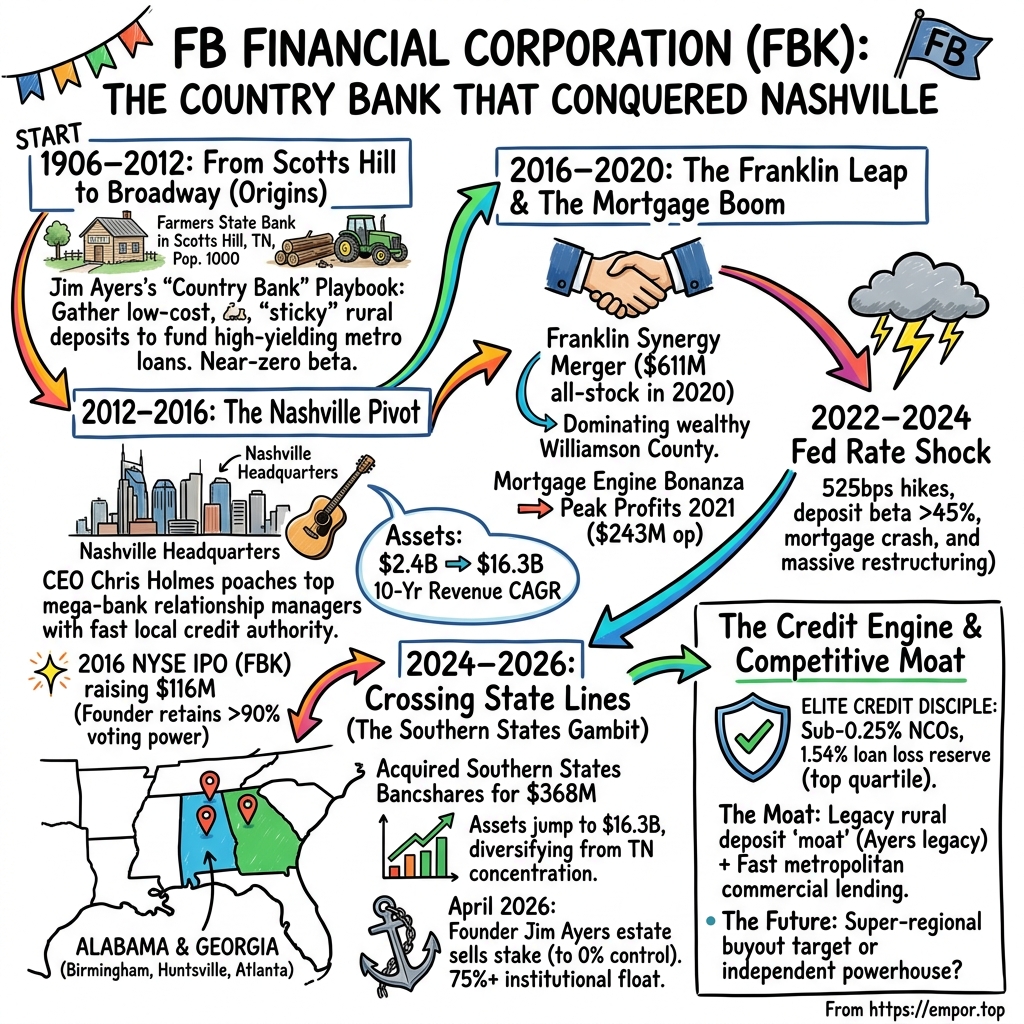
In September 2016 a West Tennessee banker named James W. Ayers brought a company to the New York Stock Exchange that most Wall Street analysts had never heard of. The bank was called FirstBank, its holding company was FB Financial Corporation, and its ticker was FBK.1 The roots of the bank ran back to 1906 and to Scotts Hill, a small town in the river country between Nashville and Memphis, where a local bank had spent most of the twentieth century taking deposits from farmers and small-town merchants.1 Ayers had turned that bank into a network across rural Tennessee and then pointed it at Nashville. On listing day he sold only a slice of it. Through the offering, he kept the overwhelming majority of the shares, so the company that rang the bell was public in name and still very much his in practice.1
Ten years later the bank looks almost unrecognisable. Total assets were about $2.4 billion at the end of 2014; by the end of 2025 they were about $16.3 billion, close to seven times larger.23 Revenue compounded at roughly 16% a year over the decade, which for a bank in a mature industry is a fast clip, and it reached about $1.0 billion over the twelve months to June 2026.4 Headquarters moved from the river counties to Nashville, and the branch map now reaches across Tennessee into Alabama and Georgia.5
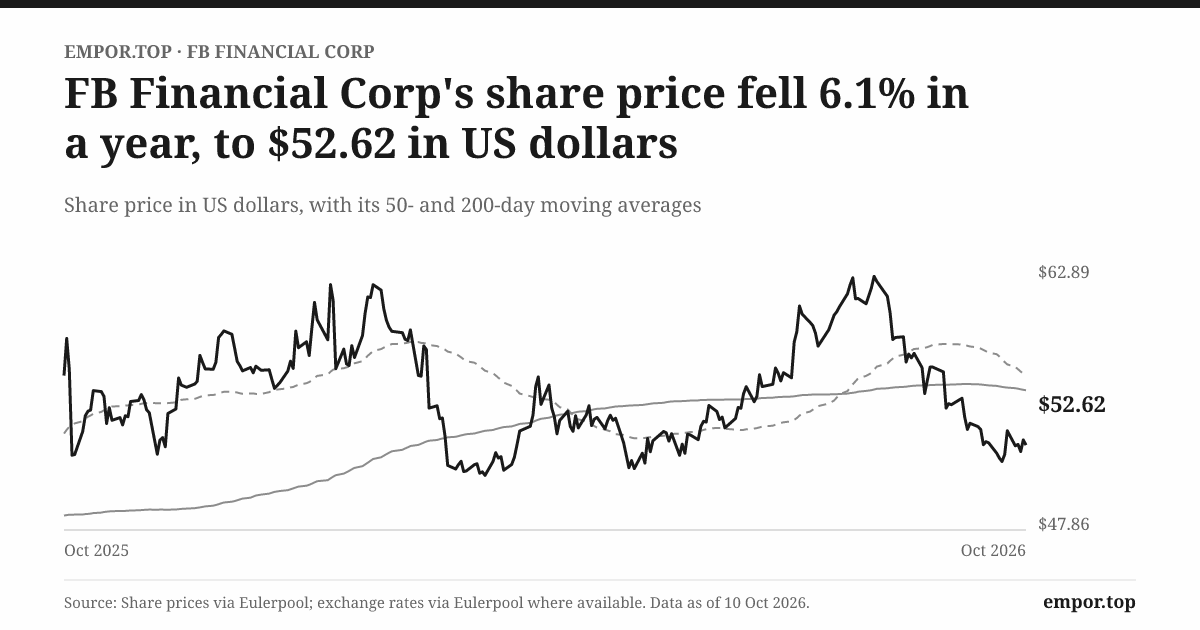
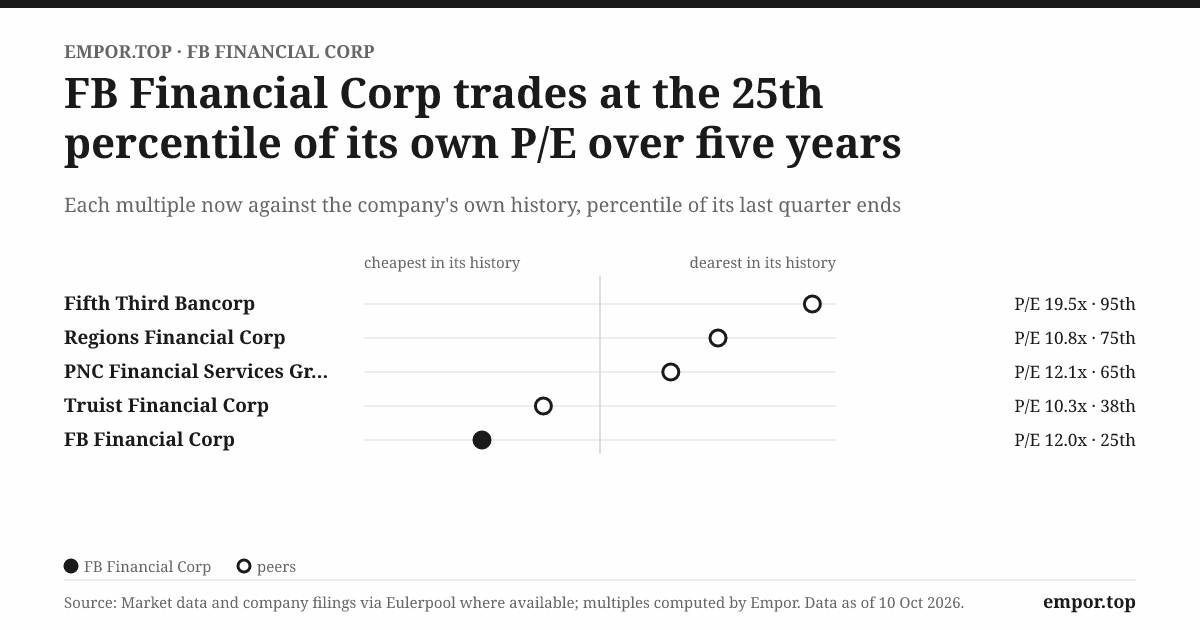
That growth is the obvious part of the story. The interesting part is what the market thinks of it now. On October 10, 2026, FBK shares closed at $52.62, giving the company a market value of about $2.7 billion.6 That price is about 12 times the last twelve months of earnings, against a five-year median closer to 15 times, and about 1.4 times book value.64 In other words, investors pay a premium to the balance sheet but a discount to the bank's own recent history. Something has made them more cautious about the earnings than about the assets.
Three things changed in the last eighteen months, and each one is a question this story has to answer. The first is geography. On July 1, 2025, FirstBank closed its acquisition of Southern States Bancshares, which carried the bank into Birmingham, Huntsville, Auburn and the Atlanta area.7 FirstBank's method has always been local: bankers with real authority, lending to people they know. Can that be exported to Alabama and Georgia, through bankers it bought rather than bankers it raised, without loosening the credit discipline that made it?
The second question is about a business line that has made and unmade FBK's earnings. Mortgage banking turned 2021 into the most profitable year in the company's history, then turned into a burden when the Federal Reserve raised rates.2 Management cut the mortgage operation back hard. The question is whether falling rates can bring that profit back, or whether the cutbacks capped the upside for good.
The third is ownership. Jim Ayers died on April 1, 2025.8 Over the following year his estate sold, sold back to the company, and finally distributed the shares that had anchored FBK since the IPO.910 For the first time, no one person can say no to a takeover. Is FBK still the buyer in Southeastern banking, or has it quietly become the target?
The answer to all three starts where the bank did: with cheap deposits in places most bankers had stopped caring about.
 Subscribe on LinkedIn
II. Jim Ayers and the Country Bank Syndicate (1906–2012)
Picture the bank Jim Ayers took over in the mid-1980s. It was a small-town institution in Henderson County, West Tennessee, with a few million dollars of deposits, a handful of employees, and customers who knew the tellers by name.1 It had been chartered in 1906 and had lived through the Depression and decades of rural decline by doing the dull things well: lending to farmers against land, to timber operators against equipment, to the hardware store on the square against its inventory.1
Ayers was not a career banker. He had made his money as an entrepreneur in healthcare and real estate, and he approached banking the way an owner-operator approaches any business: what does this thing produce that is hard to get anywhere else?1 His answer was deposits. In a town of a few hundred households, people kept their checking accounts at the bank down the road for decades. They did not shop for rates. They did not move money when a bank in Memphis advertised a better certificate of deposit. In banking language, those deposits had a very low "beta", meaning the bank barely had to raise what it paid on them when market interest rates went up.
That is worth slowing down on, because it is the foundation of everything FirstBank became. A bank makes money on the gap between what it pays for money and what it earns lending it out. Most banks fight over the same urban depositors and pay up to keep them. A rural bank with loyal checking customers buys its raw material at a discount, permanently. It is a bit like a bakery that owns a wheat farm: it can match competitors on bread prices and still make more on every loaf.
So Ayers bought more of them. Over the following decades he assembled community banks across rural West and Middle Tennessee and brought them under the FirstBank name.1 He ran them less like branches and more like a syndicate of partners, with local presidents who kept real say over local credit. When most of the industry was centralising decisions in a head office, FirstBank deliberately kept them in the towns where the borrowers lived. The prospectus that accompanied the 2016 listing described that community-bank heritage as the base of the franchise.1
The model had a ceiling, and by the start of the 2010s the bank had hit it. Rural Tennessee generated deposits faster than it generated creditworthy borrowers. Population in many river counties was flat or shrinking. The bank was gathering more money than its home markets could sensibly borrow, which left it with excess liquidity earning very little.1 Meanwhile, two hours east, Nashville was turning into one of the fastest-growing metropolitan areas in the country, with healthcare companies, music businesses and real-estate developers all hungry for credit.
The logic was almost too neat. Take cheap deposits gathered in the countryside, and lend them in the city at city prices. The difficulty was that city lending is a different trade. A country banker knows every borrower personally; a Nashville developer arrives with a pro forma, a land option and three competing term sheets. Ayers understood capital and real estate. What he needed was someone who could build a big-city commercial bank on top of his country one without losing what made it valuable.
III. The Nashville Pivot and the Hired Gun (2012–2016)
The man he chose was Christopher T. Holmes, who has served as FirstBank's president and chief executive since 2013.8 Holmes is in many ways Ayers's opposite. Ayers was the self-made owner who bought a bank; Holmes is a professional banker, steady and numbers-driven, the kind of executive who speaks in returns on tangible common equity rather than in stories. The pairing worked because each supplied what the other lacked. Ayers owned the franchise and the patience. Holmes brought the institutional machinery that a metropolitan commercial bank needs: credit policy, treasury management, risk committees, recruiting.
The timing was a gift. After the 2008 crisis, the big regional and national banks that dominated Nashville spent years shrinking risk, consolidating offices and centralising credit decisions. That left a lot of good middle-market borrowers and a lot of experienced relationship bankers frustrated. A developer who had banked with the same lender for a decade found that approvals now went through a committee in another state. The banker who had brought him in found that her judgment counted for less than a model.
FirstBank's pitch to both was simple. Come to a bank where decisions are made locally, quickly, by people who know the market, and where the banker has a stake in the outcome. That is the same decentralised idea Ayers had used in the countryside, rebuilt for the city. FirstBank moved its executive centre of gravity to Nashville and pushed into Knoxville and Chattanooga as well.1
The results showed up fast in the revenue line. Reported revenue rose from about $143 million in 2014 to about $265 million in 2016, an 85% increase in two years.12 Some of that came from commercial lending as hired teams brought their books with them. A good deal of it came from somewhere else: mortgage banking. FirstBank built a sizeable operation to originate home loans and sell them on to the secondary market, earning a fee on each one.1 Mortgage fees were attractive because they did not need capital; the bank made the loan, sold it within weeks and booked the gain. They were also, as later years would show, the most volatile income a bank can have.
Here it is worth testing the founding claim that FirstBank's growth came from a superior lending model. Revenue nearly doubled, but net profit barely moved: about $47 million in 2015 and about $40 million in 2016.12 Part of that was tax, because as a private company FirstBank had been taxed as an S corporation and its effective tax rate jumped to the ordinary corporate level around the listing.1 Even so, the gap is a reminder that the 2014–2016 growth was built partly on fee income and hiring costs, not just on cheap deposits lent out at wide spreads. The country moat was real. The metro machine on top of it was still expensive and still unproven through a downturn.
The constraint that pushed the bank to the public markets was capital. A bank can only lend a multiple of its equity, and a privately held bank can only grow its equity as fast as it earns it or its owner contributes it. Nashville was offering more good loans than retained earnings could support. The answer was to sell shares.
IV. The Public Listing and the Franklin Leap (2016–2020)
The IPO priced in September 2016 at $19 per share.1 It raised a modest amount of new capital, by Wall Street standards, and left Ayers in control.1 Shareholders' equity rose from about $237 million at the end of 2015 to about $330 million a year later and nearly $600 million by the end of 2017, as the bank used its new public currency for capital and for a pair of acquisitions.2 For investors, the deal on offer was unusual: a fast-growing Nashville commercial bank with a rural deposit base, run by a professional CEO, but controlled by one man who could not be outvoted.
For the next three years the strategy was mostly organic. Assets grew from about $3.3 billion at the end of 2016 to about $6.1 billion at the end of 2019, and net profit rose from about $40 million to about $83 million.2 Return on equity settled around 11%, respectable for a bank but not spectacular.2 Nashville's construction cranes and healthcare sector kept loan demand strong. The question that was building in the background was scale. Pinnacle Financial Partners, the Nashville bank FirstBank was most often compared with, had grown much bigger on the same playbook. In community banking, scale buys a lower cost of technology and compliance per dollar of assets, and FBK was behind.
Then, in August 2020, with markets still shaking from the pandemic, FBK closed its all-stock acquisition of Franklin Financial Network for about $611 million.2 Franklin Synergy Bank was based in Williamson County, the affluent suburban county south of Nashville that holds Franklin and Brentwood and many of the region's corporate headquarters and wealthiest households. The deal added about $3.9 billion of assets, and by year-end FBK's balance sheet had jumped to about $11.2 billion.2
The strategic logic was obvious. Franklin had the best address in Middle Tennessee. It also had a reputation for a funding base that leaned on more expensive deposits and for a loan book that had worried investors in the years before the deal. FBK's case was that its cheaper funding and its credit culture would fix both. In effect, FirstBank was buying a great location with a leaky roof, betting that its own building crew would do better than the previous owners.
The cost showed up immediately. 2020 was the first full year of CECL, the accounting rule that forces banks to reserve for the losses they expect over the whole life of a loan the moment they make it, rather than waiting for problems to appear. Combine CECL with a pandemic and with a big acquired loan book that needed its own reserves, and provisions surged. FBK's operating margin fell to about 13% in 2020, from about 26% the year before, and EPS halved to $1.33.2
The fair verdict on Franklin, six years on, is that it did what it was meant to do. It made FBK a credible second force in Middle Tennessee community banking and gave it a presence in the most attractive suburban market in the state. It also concentrated the bank further in commercial real estate and construction lending in one metro area, just before the fastest rise in interest rates in four decades. Whether that bet would hold depended less on the deal than on the cycle that followed. And the cycle that followed started with the best year FBK had ever had.
V. The Refinancing Bonanza and the Rate-Hike Hangover (2020–2024)
In early 2021 the American mortgage market was a gold rush. Thirty-year mortgage rates had fallen to around 3%, and almost every homeowner with a loan had a reason to refinance. Lenders that had built big origination operations could barely keep up. FBK was one of them, and the earnings showed it.
For 2021 FBK reported net profit of about $190 million, three times the year before, on revenue that was roughly flat.2 Net margin hit about 31% and diluted EPS reached $3.97, still the company's all-time high.2 Some of that jump was the release of the reserves built up in 2020, as the feared pandemic losses never arrived. Much of it was mortgage banking: gains on selling loans into a market that wanted all it could get.2
It is tempting to read 2021 as the bank showing its true earning power. The record says otherwise. When the Fed began raising rates in 2022, and kept raising them until it had added about five and a quarter percentage points, mortgage volumes collapsed across the industry. FBK's net profit fell from about $124 million in 2022 to about $116 million in 2024.2 Return on equity slid from about 13% to about 7%.2 The 2021 peak had not been a new level. It had been a windfall.
The rate shock hit the other side of the bank too. Depositors who had accepted near-zero rates for years suddenly had alternatives paying 5%. Even FirstBank's loyal customers started to move money into higher-yielding accounts, and the bank had to pay up to keep them. That is the moment the rural low-beta moat was tested, and the honest answer is that it narrowed the damage without preventing it. Funding costs rose sharply across the industry, and KBRA later named "structural exposure to higher deposit funding costs" as one of FBK's main constraints.11
Management's response was to shrink the problem rather than wait for rates to fall. Holmes and Michael Mettee, who became CFO in 2020, cut back the mortgage operation, pruning sub-scale retail origination offices and focusing the business where it could break even at lower volumes.28 That was a credible decision, because it accepted a smaller upside in exchange for a lower fixed cost. It was also an admission that the mortgage machine built in the 2010s had been sized for a rate environment that no longer existed.
March 2023 brought a different kind of test. The failure of Silicon Valley Bank set off a scramble among regional bank depositors with balances above the federal insurance limit. FBK came through without a run. Its balance sheet shows why: a large base of small, insured retail and business accounts, many in rural branches, and a deposit franchise that was not dependent on a handful of very large corporate customers.1211 It is the clearest piece of evidence in the record that Ayers's country deposits are worth more than their cost: in a panic, they stayed put.
The quarterly figures across 2023 and 2024 tell the rest. Earnings bounced around, with one quarter in late 2024 almost wiped out as the bank repositioned its securities portfolio at a loss to reinvest at higher yields.2 Underneath the noise, the core business was earning less than it had in 2019 on a much bigger balance sheet. By 2024 FBK had the scale it had paid for in Franklin, a cheaper cost base after the mortgage cuts, and no obvious engine for the next leg of growth. The catalyst, when it came, was another acquisition, and this time across the state line.
VI. Crossing State Lines: The Southern States Gambit (2024–2026)
On July 1, 2025, FirstBank signs went up over branches in Alabama and Georgia for the first time.7 The acquisition of Southern States Bancshares, based in Anniston, Alabama, had closed with each Southern States share swapped for 0.800 FBK shares, a transaction valued at about $368 million.7 The deal added a franchise reaching across Alabama, including Birmingham, Huntsville and Auburn, and into the Atlanta area.75
The strategic reasoning was that Tennessee had become crowded. Pinnacle, regional giants like Regions and First Horizon, and a crowd of smaller banks were all fighting over the same Nashville developers. Alabama and north Georgia offered a similar profile, fast-growing Southern metros with strong in-migration, with fewer local banks of FirstBank's size and style. Huntsville in particular, with its aerospace and defence industries, has been one of the fastest-growing cities in the region.
Financing the deal entirely with stock had two effects. It preserved capital, because no cash left the bank, and it diluted existing shareholders by issuing roughly 7.4 million new FBK shares.7 Whether that dilution was a good trade depends on what the acquired earnings are worth relative to the shares issued, and that is exactly what the following quarters began to show.
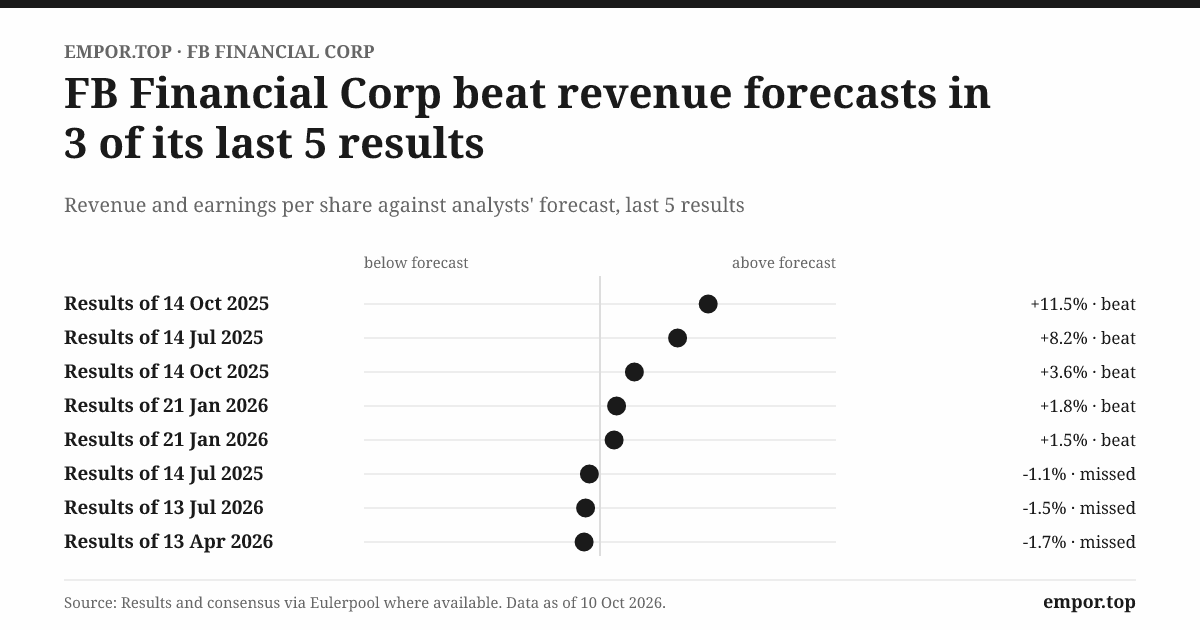
The first thing they showed was the cost. In the second quarter of 2025, just before the deal closed, FBK reported an operating loss of about $10 million and net profit of under $3 million, as it took losses repositioning securities and booked merger charges.43 In the third quarter, the first with Southern States inside, revenue jumped from about $148 million to about $264 million, but merger-related costs and the reserves CECL requires on acquired loans held operating profit to about $30 million.3 Only from the fourth quarter did the combined bank start producing the earnings the deal was meant to deliver: operating profit of roughly $70 million a quarter and net profit of around $57 million.313
By the second quarter of 2026 the twelve-month EPS had climbed back to $3.74, close to the 2021 peak and well above the 2024 low of $2.48.4 Return on equity over the same twelve months was about 10%, up from about 6% for calendar 2025.4
Here the obvious objection needs to be heard. Did FBK buy growth because its own engine had stalled? The record supports that worry. Between 2021 and 2024, FBK's revenue grew slowly and its earnings fell. Southern States arrived with its own loans, deposits and earnings, so the headline jump in revenue mostly reflects consolidation, not new customers. FBK does not publish organic loan growth in the acquired Alabama and Georgia markets separately from purchased loans, which makes it hard for an outside investor to see whether the FirstBank model is actually taking root there.4
The rebound is real, and it is visible in earnings per share, not just in total profit, which means the dilution has so far been more than paid for. The harder claim, that FirstBank can grow organically in Birmingham and Atlanta the way it did in Nashville, remains unproven. In community banking, loans follow bankers. The test will be whether the bankers FirstBank acquired are still there, and still lending, two years from now. And how well they lend matters even more than how much.
VII. The Credit Engine: Underwriting Commercial Real Estate in the New South
Every year, the audit committee of FB Financial sits down with its auditors at Crowe LLP to go over the single most judgment-heavy number on the balance sheet: the allowance for credit losses.2 Crowe flagged it as the critical audit matter in its report, singling out the qualitative adjustments management makes on top of the economic models.2 That is not a red flag. It is a statement about the nature of banking. The bank's biggest asset is a promise from thousands of borrowers to pay it back, and how much of that promise to doubt is ultimately a human decision.
FirstBank's loan book is large and real-estate heavy. Loans held for investment reached about $12.9 billion by June 30, 2026.4 They span non-owner-occupied commercial real estate, such as warehouses, shopping centres and medical offices; construction and land development loans, which fund projects before they produce any income; owner-occupied business properties and commercial and industrial loans to operating companies; and home mortgages the bank keeps rather than sells.4
Construction lending deserves its own explanation, because it is both FirstBank's most profitable kind of lending and its most dangerous. A construction loan funds a building that does not yet exist. If the project is finished and leased or sold on time, the bank is repaid with a healthy margin. If the market turns mid-build, the bank can end up owning half a building with no tenants. In the 2008 crisis, construction loans were where Southeastern banks failed. Regulators watch banks whose construction lending exceeds their capital by a wide margin, and KBRA noted that FBK's management had deliberately reduced its construction concentration from earlier cyclical peaks.11
Against that risk, FirstBank holds an unusually thick cushion. Its allowance for credit losses stood at about 1.54% of loans in early 2025, which KBRA placed in the top quartile of the banks it rates, and it has stayed above 1.45% through mid-2026.114 Net charge-offs, the loans actually written off after recoveries, have stayed below about a quarter of a percent a year.11 The bank has put aside more for future losses than it has historically been losing, which is what a prudent lender in a cyclical asset class should do.
Why did FirstBank escape the commercial real estate pain that hit so many banks after 2022? Part of the answer is geography. The national stress was concentrated in big-city office towers emptied by remote work, and FirstBank's exposure tilts toward Southeastern industrial, retail and residential development rather than downtown office.2 Part of it is timing: Nashville's population growth kept absorbing new supply.
A claim that FirstBank's underwriting is superior needs a harder test than the last three years. The bank's history before the IPO includes the 2008–2010 downturn, and FirstBank came through without failing or needing a rescue, but with elevated problem loans like most Tennessee banks.1 And in 2020 FBK had to build large reserves, partly because of the Franklin book.2 So the record supports a narrower version of the claim. FirstBank has been a careful real-estate lender that keeps more reserves than most, not one that is immune to a real estate cycle. The thing that would break it is a sustained fall in Southeastern property values hitting construction loans in Nashville and Atlanta at once. The number that would show it first is net charge-offs rising above the reserve build.
Those reserves were set by a board that, until very recently, answered to one man. That changed in 2025.
VIII. The Founder Passes: Dissolving the Ayers Dynasty (2025–2026)
In November 2025 FB Financial did something unusual for a public bank: it bought shares directly from the estate of its founder. It agreed to repurchase 1,717,948 shares from the Estate of James W. Ayers at $51.50 each, about $88.5 million, alongside a registered offering in which the estate sold more shares to institutional investors.98
Jim Ayers had died on April 1, 2025.8 He had spent four decades turning a small West Tennessee bank into one of the largest banks headquartered in the state, and he had become well known in Tennessee as a philanthropist. His stake had already come down a long way since the IPO, from the overwhelming majority he held before listing to about 24% by early 2025, but that was still enough to make him the decisive voice on any sale.141
His death raised a practical problem. An estate has taxes to pay and beneficiaries to satisfy, and a block of several million shares in a stock that trades a few hundred thousand shares a day cannot be dumped into the market without crushing the price. The co-executors, his son James Jonathan Ayers and James Austin McPherson, worked with the company on a coordinated exit.9 After the November transactions the estate held about 7.09 million shares, about 13.7% of the company.9 In April 2026 it disclosed that the remaining shares had been distributed out of the estate to beneficiaries.10 The single controlling holder was gone.
The related-party ties that came with a founder-controlled bank are small in money but worth a look, because they are the kind of thing an activist or a regulator always asks about. FirstBank leases several branch and office properties from Ayers family entities, at a cost of about $403,000 in 2025.8 It also had aircraft arrangements over the years, including a lease with Hawker Aviation Services, an entity owned by Jim Ayers and his son, and through its subsidiary FBK Aviation it maintains non-exclusive aircraft leases with directors.28 These arrangements are disclosed and subject to the Federal Reserve rules that govern banks' dealings with insiders.2 Measured against a bank earning around $200 million a year, they are immaterial. The more meaningful governance question is not the leases but the vacuum the founder left.
The buyback itself deserves a fair reading. Buying stock at $51.50 when book value per share was in the mid-$30s meant paying around one and a half times book, which reduces book value per share rather than raising it in the short term. What the company bought was an orderly exit: removing an overhang that would otherwise have hung over the stock for months. Shares now trade near that price, so the company neither won nor lost much on timing.6
For investors the change cuts both ways. A controlling founder protected management from activists and hostile bids. He also blocked any sale that he did not like, which may have kept a takeover premium out of the stock for years. Now FBK is owned mainly by index and institutional funds.8 That frees the valuation from founder control, and it puts management under a different kind of scrutiny, which brings the spotlight to the people running it.
IX. Executive Management and Capital Allocation Architecture
On October 1, 2025, Michael Mettee, CFO since 2020, added the title of Chief Operating Officer.8 With Holmes now chairman as well as CEO, the bank is run by a tight pair: a CEO who has led it for thirteen years and a finance chief who now also runs operations.8 That concentration has advantages in speed and consistency. It also means the board is the main check, and that board is now independent of any controlling holder for the first time.
Pay is a reasonable place to test whether the pair is rewarded for building value or for building size. Holmes's total compensation was about $3.0 million in 2023, about $4.0 million in 2024, and about $3.8 million in 2025, including a base salary around $790,000 and stock awards around $1.65 million.814 Performance awards are tied to return on tangible common equity and earnings measures rather than to asset size.8 That is the right design for a bank, because a CEO paid on assets has a reason to buy banks whatever the price, while one paid on returns has to make the deals earn their keep. Shareholders approved the pay plans by wide margins.8
The balance sheet tells a consistent story. Borrowings, mostly holding-company subordinated debt and advances from the Federal Home Loan Bank, peaked at about $495 million in 2022 when the bank leaned on wholesale funding during the rate shock, and fell to about $283 million by the end of 2025.23 Debt to equity is now about 0.15.3 For a bank, that ratio understates true leverage, because deposits are the real borrowing; the more meaningful measure is regulatory capital, and FirstBank's common equity tier 1 ratio sits above 11.5%, comfortably above the level regulators treat as well capitalised.3
Dividends started only in 2018 and have grown steadily since, to about $38 million in 2025, a payout of roughly 31% of profit.23 In January 2026 the board raised the quarterly dividend by 11% to $0.21 per share.3 Buybacks have been used sparingly, most visibly to absorb the estate's shares.
Is this a disciplined capital allocator? The honest answer is mostly yes, with two caveats. The first is that the two biggest capital decisions of the decade, Franklin and Southern States, were both paid for in shares, so existing holders have been diluted twice. Earnings per share in mid-2026 are only modestly above where they were in 2021, despite a much larger balance sheet.42 The second is the 2021–2024 earnings slide, which showed that the bank's profitability depended on a mortgage business management had built and then had to dismantle. Neither is reckless. Together they suggest a management team that has been good at protecting the balance sheet and less consistent at compounding per-share earnings. Which brings the question every bank investor eventually asks: what, exactly, stops a competitor from doing the same thing?
X. Frameworks and the Moat: Competitive Dynamics in the Mid-South
Imagine a downtown Nashville developer with a mixed-use project and a construction loan to place. FirstBank will bid. So will Pinnacle Financial Partners, the city's other home-grown commercial bank, ServisFirst from Birmingham, and Regions, the big Alabama-based regional. Each has bankers who know the developer. Each can price the loan within a quarter of a point of the others. The developer will pick based on speed, structure and relationship, and will happily switch next time. That scene is the clearest way to understand where FBK's edge lies and where it does not.
Start with Hamilton Helmer's seven powers, the framework that asks which durable advantages let a company earn more than its cost of capital. FirstBank's strongest claim is to a cornered resource: its rural branch network across dozens of Tennessee counties, gathering deposits that no new entrant could economically replicate.25 The evidence for it is the bank's survival of the 2023 deposit scare. The evidence against is that funding costs still rose sharply during the rate cycle. So the claim holds in a narrower form: the rural deposits lower FirstBank's funding costs and stabilise them in a crisis, but they do not exempt it from market rates.
The second power is process: local credit authority that lets FirstBank say yes faster than a national bank. That edge is real against the Wells Fargos and Truists of the world. It is much weaker against Pinnacle and ServisFirst, which run the same playbook. Switching costs are moderate for businesses whose treasury and operating accounts sit at the bank, and close to zero for retail savers and mortgage borrowers. Scale economies and network effects are essentially absent: at $16 billion of assets, FBK cannot match the technology budgets of the biggest banks.
Michael Porter's five forces point the same way. Buyers have real power, because commercial borrowers in Nashville, Birmingham and Atlanta can choose among many banks. Suppliers, which for a bank means depositors, gained power when rates rose and held onto it. Substitutes are growing, as private credit funds take over a share of middle-market and real-estate lending. New entrants are rare, because forming a new bank is slow and heavily regulated. Rivalry is intense.
The market's price reflects that picture. FBK trades at about 1.4 times book value.6 Pinnacle has traded around one times book, and Renasant around 0.9 to one times.4 That premium is a vote of confidence in FBK's deposit base, its reserves and its Southeastern footprint. It is not unlimited: return on equity of about 10% over the last twelve months is good but not elite, and the KBRA upgrade in June 2025, to BBB+ for senior debt and A- for FirstBank's deposits, reflected a bank that was improving rather than one that had pulled away from its peers.411
The verdict on the moat is that it is genuine but thin. FirstBank's cheap, stable deposits are a real and hard-to-copy advantage, and its local decision-making is a real advantage against big banks. Neither stops another good regional bank from winning the same loan. That means FBK's returns will be decided mostly by execution, which sets up the competing cases.
XI. The Stress Test: Bull vs. Bear Case
On the second-quarter 2026 earnings call, the question every bank analyst was circling was whether net interest margin had peaked: whether the bank's earning spread would hold as loan yields fell with rate cuts while deposit costs lagged.13 That question sits in the middle of both cases for FBK.
The bull case starts with geography. Tennessee, Alabama and Georgia have been among the leading destinations for American population and corporate relocation, which keeps loan demand growing faster than the national average. It adds the mortgage business: after the cutbacks, FirstBank's mortgage operation is leaner, so if rates fall and volumes return, more of the extra revenue should fall to profit. KBRA named that earnings leverage to lower mortgage rates as a strength.11 It adds Southern States: if the acquired franchise can be cross-sold FirstBank's treasury and wealth products, returns could keep rising. And it adds valuation: at 12 times earnings against a five-year median of 15, a return to the historical multiple would be worth a meaningful re-rating, especially with the estate overhang gone.6
The bear case runs through the same items in reverse. A serious downturn in Southeastern construction or apartment markets would test reserves that look thick today. Acquired bankers in Birmingham and Atlanta could leave for local rivals and take their clients with them. Deposit costs could stay high as loan yields fall, squeezing the spread. And without a controlling founder, management could be tempted toward size for its own sake.
Weighing the two, the evidence points somewhere in between. The bull points about geography and capital are well supported by the record. The mortgage optionality is real but smaller than it once was, because management deliberately shrank that business. The re-rating argument depends on earnings staying near current levels, and the stock is already about 15% below its 52-week high of $62.08, which shows the market is pricing in some of the bear risks.6 The most important bear risk is credit, because it is the one that can turn a good year into a bad decade, and that is where the investor should keep watching.
Two indicators carry most of the signal. The first is net interest margin, the spread the bank earns on its balance sheet, which tells whether the deposit advantage is still working. The second is net charge-offs relative to the allowance, which tells whether the real estate engine is still sound. If both hold, FBK's earnings rebound is durable. If either cracks, the 12-times multiple will look less like a discount than a warning.
XII. Epilogue: The Next Inflection Points
FirstBank marks 120 years in 2026.1 It does so as a three-state regional bank that has absorbed its biggest acquisition, buried its founder and cleared its ownership. Over the next six quarters, three tests will decide which kind of company it becomes.
The first is whether it grows in its new markets on its own. FBK's FY2026 and FY2027 filings will show loan and deposit growth in Alabama and Georgia. If the bank can grow those books organically, not just hold on to what it bought, the Nashville playbook has been exported. If loans run off and bankers leave, Southern States will have been a one-time earnings bump.
The second is mortgage banking. Management has rebuilt it smaller. If falling rates bring mortgage revenue back toward roughly $25 million a quarter, or $100 million a year, the operating leverage KBRA described will be visible in earnings. If it stays stuck below that level as home affordability in Southern metros remains tight, investors will have to accept that the 2021 boom was a one-off.
The third is control. With no Ayers block, FBK's future is now up to its institutional holders. Any 13D filing from an activist, or approach from a super-regional bank such as Regions or First Horizon, would change the story overnight. Management has positioned FBK as a buyer. The market will decide whether it stays one.
XIII. Outro
In Scotts Hill, the FirstBank branch still takes deposits from local customers, as it did before most of today's management was born. Two hours east, the same name sits on offices among Nashville's office towers and construction cranes. The thread between them is the oldest idea in the story: money gathered patiently in small towns can fund the building of big cities, if the bank lending it is careful enough not to lose it.
FB Financial is, in the end, a bank that gathered the patient pennies of rural Tennessee and used them to underwrite the building of the modern American South. Its founder built that machine and protected it for forty years. The question now is whether the machine can protect itself.
References
-
Form 424B4 IPO Prospectus — SEC EDGAR, 2016-09-15 ↩↩↩↩↩↩↩↩↩↩↩↩↩↩↩↩↩↩↩
-
Form 10-K Annual Report for Fiscal Year 2024 — SEC EDGAR, 2025-02-25 ↩↩↩↩↩↩↩↩↩↩↩↩↩↩↩↩↩↩↩↩↩↩↩↩↩↩↩
-
Q4 2025 Earnings Release and Investor Presentation — FB Financial Corporation, 2026-01-21 ↩↩↩↩↩↩↩↩↩
-
Form 10-Q Quarterly Report for Period Ended June 30, 2026 — SEC EDGAR, 2026-08-07 ↩↩↩↩↩↩↩↩↩↩↩↩
-
FirstBank Official Banking Portal & Footprint Overview — FirstBank ↩↩↩
-
FB Financial Corporation Profile & Stock Overview — New York Stock Exchange ↩↩↩↩↩↩
-
Form 8-K Completion of Merger with Southern States Bancshares — SEC EDGAR, 2025-07-01 ↩↩↩↩↩
-
Schedule 14A Definitive Proxy Statement — SEC EDGAR, 2026-04-06 ↩↩↩↩↩↩↩↩↩↩↩↩↩
-
Schedule 13D/A Amendment No. 2 (Estate of James W. Ayers) — SEC EDGAR, 2025-11-20 ↩↩↩↩
-
Schedule 13D/A Amendment No. 3 (Estate of James W. Ayers) — SEC EDGAR, 2026-04-10 ↩↩
-
KBRA Upgrades Ratings for FB Financial Corporation and FirstBank — Kroll Bond Rating Agency, 2025-06-20 ↩↩↩↩↩↩↩
-
Form 10-K Annual Report for Fiscal Year 2023 — SEC EDGAR, 2024-02-27 ↩
-
Q2 2026 Financial Results Announcement — BusinessWire, 2026-07-20 ↩↩
-
Schedule 14A Definitive Proxy Statement — SEC EDGAR, 2025-04-07 ↩↩
 LinkedIn
 WhatsApp
 Reddit
 Hacker News
 Email
Email Kindle
 RSS Feed
 Spotify
 Apple Podcasts
 Amazon Music
 Audible
 YouTube