NETSTREIT Corp.: The Rent Checks, the Share Count and the Next Deal
The 24 Million Shares Behind a $273 Million Quarter
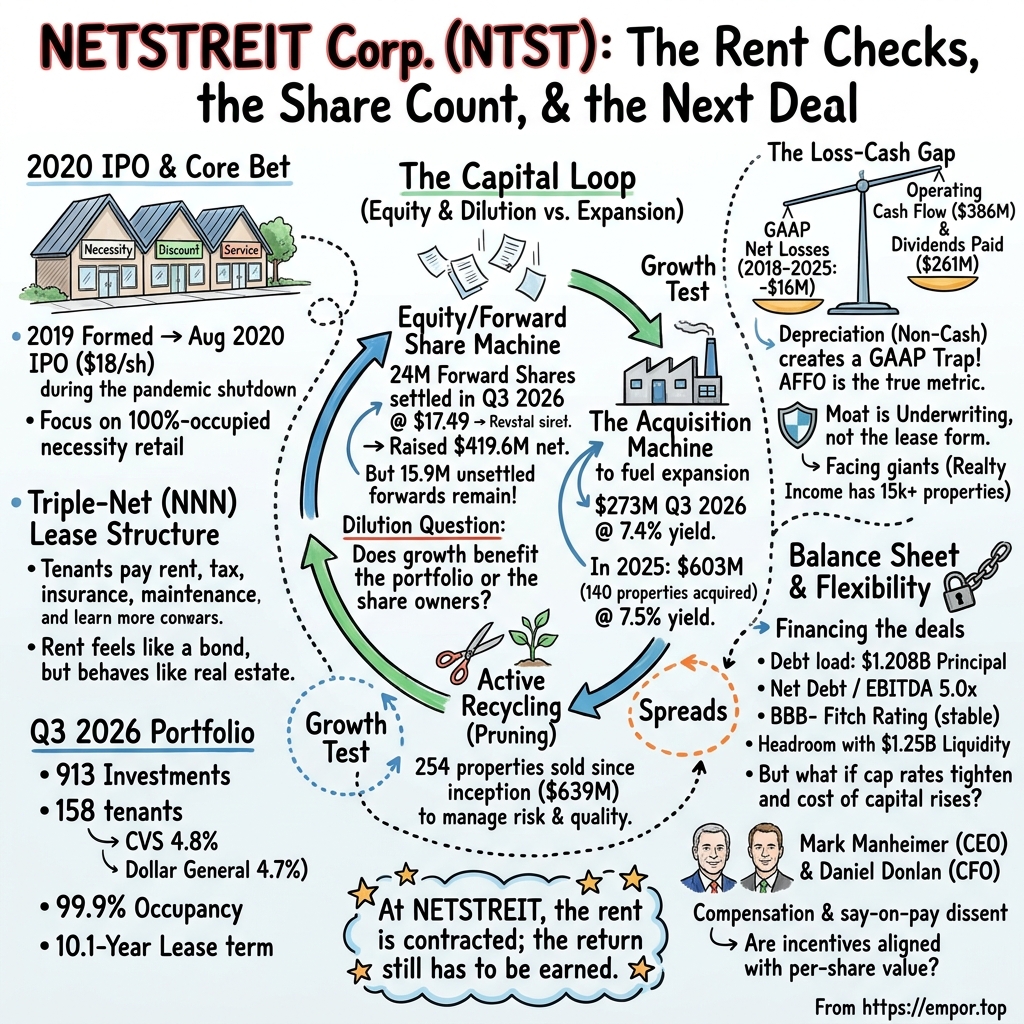
Some time in the third quarter of 2026, a set of contracts that NETSTREIT had signed months earlier came due. They were forward sale agreements: promises by banks to buy newly issued NETSTREIT stock at a price fixed when the deals were struck, with the company free to decide when to hand over the shares and collect the cash. NETSTREIT decided the time had come. It delivered 24 million new shares at a weighted average price of $17.49 and received about $419.6 million, net of costs.1 For a company whose entire stock market value was then in the low billions, that was a lot of new ownership arriving in a single quarter.
The money did not sit still. In those same three months NETSTREIT made $273.1 million of gross investments, mostly buying buildings already leased to retailers and service businesses, at a blended cash yield of 7.4%.1 Over the first nine months of the year, the total came to about $811 million.1 By the end of September the company owned or financed 913 investments leased to 158 tenants, and only one of those buildings was vacant, which put occupancy at 99.9%.12 Even after that settlement, banks still held forward contracts for another 15.9 million shares, waiting to be delivered.1
That is the shape of this story. NETSTREIT is a machine that turns two kinds of capital, borrowed money and newly issued shares, into buildings, and turns buildings into rent checks. The rent checks are about as predictable as anything in public equities: long contracts with grocers, pharmacies, dollar stores and home-improvement chains. The harder question is what all that activity does for the person who already owns a share. Each new building adds rent. Each new share adds a claim on that rent. If the second grows faster than the first, the portfolio gets bigger while its owners get no richer.
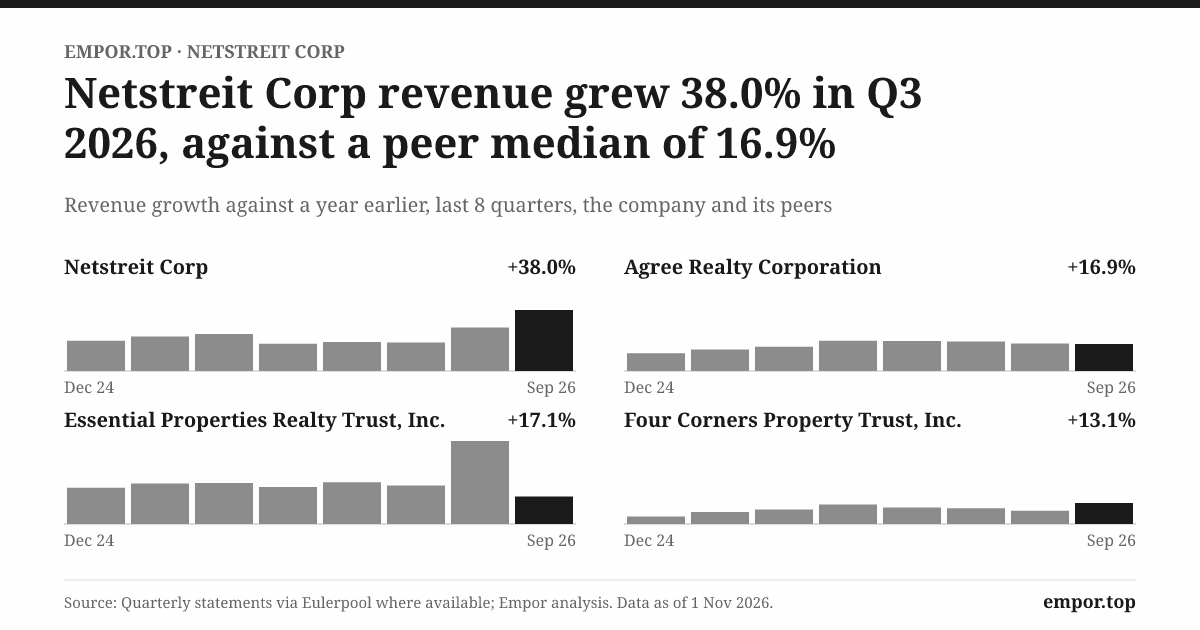
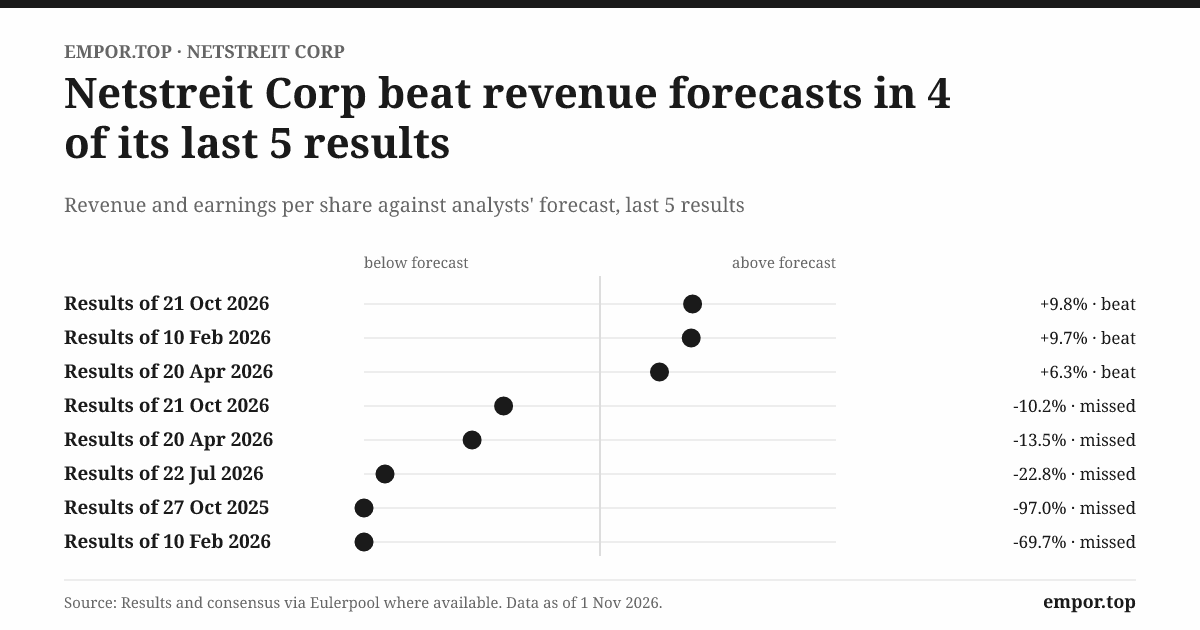
The third quarter of 2026 showed both forces at once. NETSTREIT's adjusted funds from operations, the cash-flow measure REITs use to approximate distributable earnings, rose about a third from a year earlier, to roughly $37.5 million. But the diluted share count rose by about a quarter, from roughly 86 million to 108 million, so AFFO per share went from $0.33 to $0.35, a gain of about 6%.1 Most of the growth in dollars went to the new shares. What remained for the old ones was real but modest.
So this episode asks four questions. Can the acquisition engine produce growth per share, not just growth in size? How sturdy is the rent behind the leases? What cash can actually support the dividend? And how much room does the balance sheet leave for the next deal?
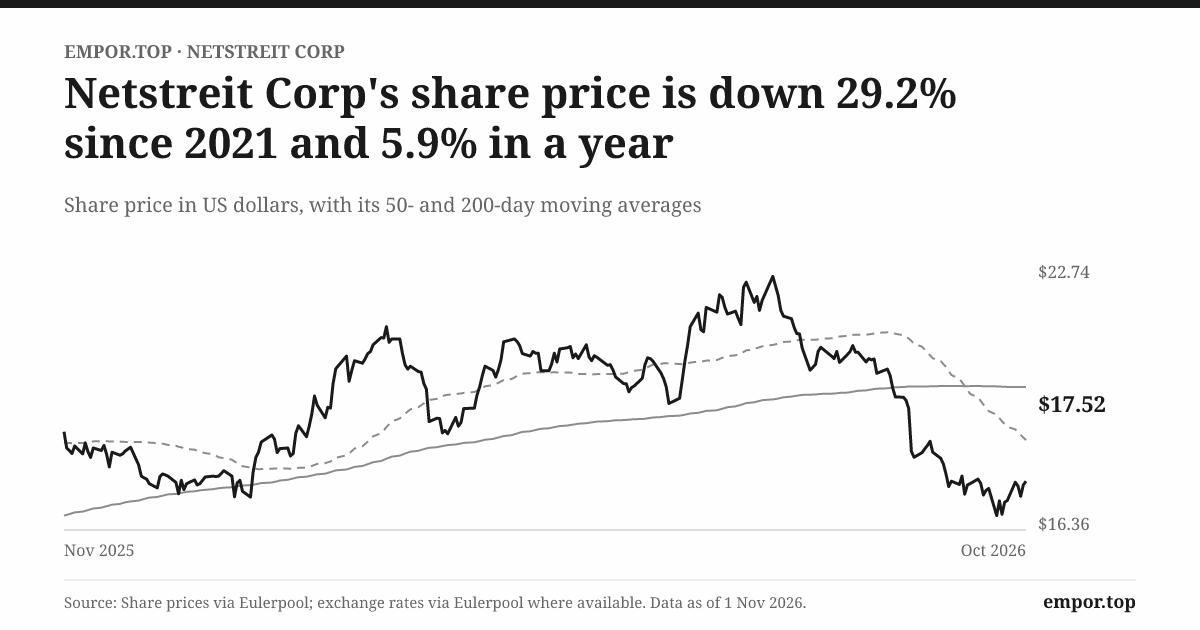
The stakes are easy to state. NETSTREIT was formed as a Maryland corporation in October 2019 and listed on the New York Stock Exchange in August 2020, which makes it one of the younger REITs of its kind.3 As of November 1, 2026, its shares stood at $17.52, about 22% below their 52-week high of $22.40.4 The quarterly dividend of $0.225 a share works out to about 5% a year at that price.1
Look closely at that share price. It sits almost exactly where the third-quarter forward shares were settled, a little below the $18 at which the company went public, and below the $19.75 paid by private investors who backed it before the IPO.5 Six years of growth have not translated into a higher price for the stock. The question is whether the business underneath has grown more than the price suggests.
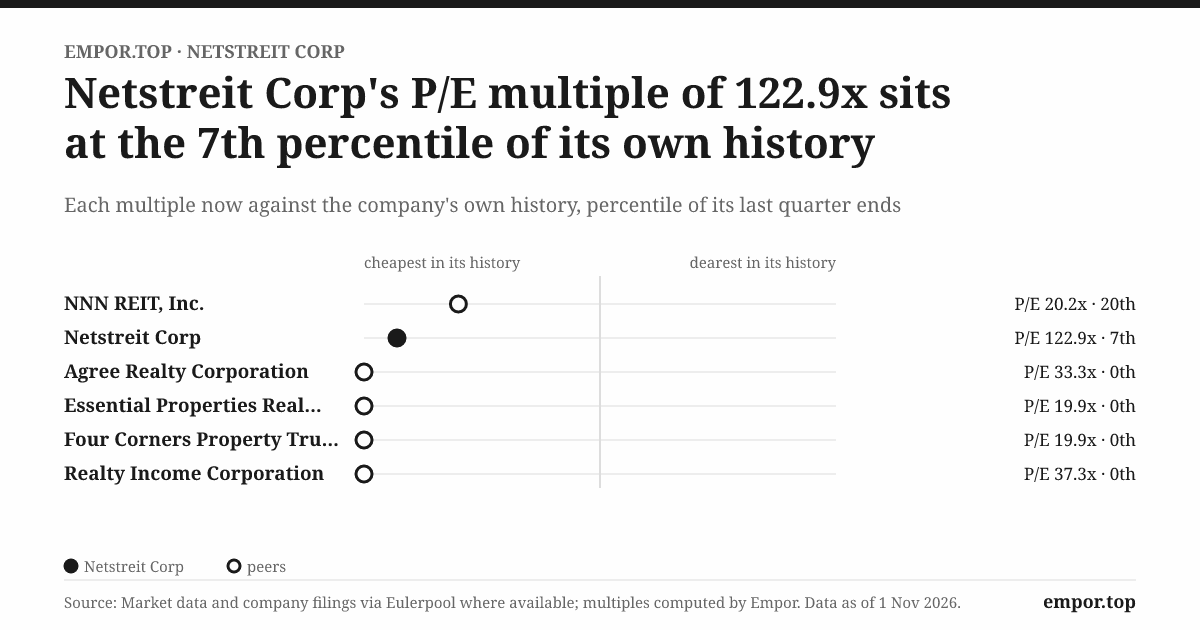
Start with the standard investment screens, which mislead here. On trailing GAAP earnings of about $0.21 a share, NETSTREIT trades at more than 120 times earnings.6 On a conventional free cash flow screen, which subtracts property purchases from operating cash, the company appears to burn a sum equal to about a quarter of its market value every year. Both figures are real arithmetic. Neither says much about a REIT. GAAP earnings for a landlord are dragged down by depreciation on buildings that often hold or gain value, and they bounce around with impairments and gains on property sales.
Free cash flow, as conventionally defined, treats every acquisition as if it were maintenance spending, when for NETSTREIT acquisitions are the business plan. The useful numbers live elsewhere: in AFFO per share, in the spread between what a building yields and what the money to buy it costs, and in how many new shares each year's growth requires.
Management guided 2026 AFFO to between $1.37 and $1.39 a share.1 Measured against the midpoint, the stock trades at about 12.7 times this year's AFFO, an AFFO yield of nearly 8%. Hold onto that number. It will matter a great deal when we get to the price at which NETSTREIT can sell new shares, because a company that issues stock at an 8% AFFO yield to buy buildings at a 7.4% cash yield has to make up the difference somewhere. To see why the company was built to work this way, go back to the summer of 2020, when shopping malls were shuttered and almost nobody wanted to bet on physical stores.
 Subscribe on LinkedIn
A 2020 IPO in the Middle of a Shutdown
In August 2020, much of American retail was either closed, half-open or nervously reopening behind plexiglass. Restaurants were serving from parking lots. Department stores were filing for bankruptcy. The question every retail landlord faced was brutally simple: which stores could keep paying rent when the shoppers stopped coming? Into that market, NETSTREIT asked public investors for $225 million.
It priced its initial public offering on August 13, 2020, selling about 12.2 million new shares itself while a few early holders sold about 255,000 more.5 The company kept roughly $203.5 million after underwriting costs, and the underwriters later bought additional shares through their over-allotment option.57 At listing, it had a little over 24 million shares outstanding.5 It is worth pausing on that count, because by late 2026 a single forward settlement delivered nearly as many shares as the entire company had when it rang the bell.
The pitch rested on a portfolio and a person. The portfolio, as of the end of July 2020, was 163 single-tenant retail properties across 34 states, all of them leased. Its tenants had an average of 11.2 years left on their leases, and 88.5% of the rent came from businesses classed as necessity, discount or service-oriented: grocers, drug stores, dollar stores, home-improvement chains, auto service, quick-service restaurants.5 Around 64% of the rent came from tenants with investment-grade credit ratings.5 The company told investors it believed those characteristics made its tenants "e-commerce resistant and resilient through all economic cycles."5 It also set itself hard limits: no single tenant or property above 5% of rent, no sector or state above 15%, the top ten tenants below 50%, and more than 60% of tenants investment grade.5
The person was Mark Manheimer, the chief executive. He had spent about 14 years underwriting, buying, leasing, financing and selling net-leased buildings, including a stretch at Spirit Realty Capital, where he sat on the investment committee, oversaw the acquisition of more than 1,500 properties and played a role in Spirit's 2012 IPO; he had also worked at Realty Income, the largest company in the field.5 He was, in other words, a career net-lease operator who had watched one of the sector's bigger platforms get built and had a strong opinion about how to build another. His first chief financial officer, Andrew Blocher, brought more than two decades of REIT finance experience, including CFO roles at Federal Realty and First Potomac.5
The company did not appear from nowhere. Its roots ran through EB Arrow Holdings, where Manheimer had been chief investment officer of a net-lease portfolio, and through a private fund, EverSTAR Income & Value Fund V, which became NETSTREIT's accounting predecessor.5 In December 2019, NETSTREIT sold about 8.9 million shares in a private placement at $19.75 each, followed by another 2.9 million in February 2020, raising about $220 million net.5 At the same time, the predecessor fund merged into NETSTREIT's operating partnership, bringing 93 properties valued at about $256 million, paid for in partnership units and cash.5 So when the IPO came, there was already a portfolio, a credit facility and a base of institutional backers.
That history explains the shape of the early numbers. The long revenue series that analysts sometimes quote begins before the listing, when the business was a fund's collection of properties being assembled into a company. Revenue was about $20 million in 2019 and nearly $200 million by 2025, but growth from a base that small, with formation transactions in the middle, says more about assembly than about the listed company's organic record.3 The clean public-company story starts in August 2020, which gives investors a little over six years of evidence. That is long enough to test whether the original promises held. It is not long enough to see the strategy survive a full real-estate cycle, with a recession that pushes several large tenants into bankruptcy at once.
The private placement price deserves a second look, because it tells you something about how the public market received the idea. The private investors paid more than the public IPO price, leaving them with a markdown on day one.5 By late 2026, anyone who had held since then had dividends as the main return.4 None of that proves the business has failed. It does show that the market has never been willing to pay a premium multiple for NETSTREIT's growth, which is the single most important constraint on a REIT that funds itself by selling shares.
The pandemic served as the company's first stress test, and the prospectus was candid about its limits. It conceded in its risk factors that "businesses previously thought to be internet resistant, such as the retail grocery industry, have proven to be susceptible to competition from e-commerce."5 That sentence is a useful corrective to the marketing language a few pages earlier. A drug store or a dollar store may be harder to replace with a website than a shoe shop, but resistance is a matter of degree, not immunity. The real protection in a net lease is not that the tenant's industry is safe. It is that the tenant has signed a long contract, and that the building has value even if this particular tenant leaves.
Some of the original promises have aged well. The portfolio remained essentially fully occupied, and diversification improved enormously. The investment-grade target, more than 60% of rent from rated, investment-grade tenants, was not met in late 2026: rated investment-grade tenants made up about 40% of rent, with another 18% from tenants the company describes as having an "investment-grade profile" without a rating.8 That is a meaningful redefinition, not a scandal, and management had said in early 2025 that it was "not dogmatic about whether something is investment-grade or not."9 But it shows the strategy evolving away from the most bond-like tenants towards ones that pay more rent per dollar of building. Whether that trade is wise depends on the rent itself, and on how a lease actually behaves when things go wrong.
Why a Store’s Rent Can Look Like a Bond—and Behave Like Real Estate
Picture a Dollar General in a small Texas town: a metal-roofed box beside a state highway, a parking lot, a sign. The company that runs the store does not own the building. NETSTREIT does. Every month, Dollar General sends rent. It also pays the property taxes, the insurance and most of the maintenance, because the lease says so. NETSTREIT's job, most months, is to receive the check. That arrangement is called a triple-net lease, and it is the beating heart of this business.
Seen from a distance, a portfolio of these leases resembles a bond portfolio. Each lease is a long contract with a fixed payment schedule, often with built-in increases. The tenant bears most operating costs, so the landlord's income is close to pure contracted rent. At the end of September 2026, NETSTREIT's leases had a weighted average of 10.1 years remaining, and annualized base rent across the portfolio was about $246 million.8 Only about 7.5% of rent was scheduled to expire across 2026, 2027 and 2028 combined, before any renewal options were exercised.3 A company with that profile has, in effect, pre-sold most of its next decade of revenue.
The business is not entirely rent. NETSTREIT also lends money against real estate, usually short-term mortgage loans secured by the property, sometimes as seller financing. In 2025 it put about $46 million into such loans at stated interest rates between 7% and 10.25%, and earned about $12.6 million of interest income across its loan book.3 It is a secondary activity, a few percent of the balance sheet, but it lets the company earn a higher yield and sometimes secure a property it may later buy outright.
Diversification is where the portfolio changed most since the IPO. In August 2020, 7-Eleven alone paid 12.7% of the rent, and the top ten tenants together paid 56.8%.5 By the end of 2025, no single tenant was above 5%. CVS was the biggest at 4.8%, Dollar General was next at 4.7%, then the Ahold Delhaize grocers Food Lion and Stop & Shop at 4.3%, Home Depot at 3.8% and Hobby Lobby at 3.6%. The top ten together paid 34.5%.3 On the third-quarter 2026 call, management said the top ten had fallen further, to about 29%.2 That is a real accomplishment. A portfolio in which one tenant's bankruptcy cuts rent by an eighth is a different animal from one where the worst single loss is under 5%.
The portfolio by late 2026 spanned 158 tenants in 28 industries and 46 states, with Texas the largest state at roughly 19% of rent.8 Most rent still came from the categories promised at the IPO: necessity businesses produced about 43%, service businesses about 35% and discount retailers about 11%.8
Then there is rent coverage, which is the number a net-lease landlord watches most closely. It measures how comfortably a store's own profits cover the rent it pays: a coverage ratio of 4 means the store earns four dollars of operating cash flow for every dollar of rent. NETSTREIT reported weighted unit-level coverage of 3.9 times, with about 84% of rent coming from stores covering their rent more than twice and only 0.2% from stores below one times.8
Those are strong numbers on their face. There is an important footnote, though. Only about 37% of the rent comes from tenants that report actual store-level results; the coverage on the rest is estimated.8 So the 3.9 times figure is part measurement and part model. That is common in the industry, because many large tenants refuse to share store-level data, but it means the most reassuring statistic in the portfolio is less precise than it looks.
Here is where the bond analogy breaks. A bond portfolio with 158 issuers loses a little when one defaults, and recovers some value through the bankruptcy process. A single-tenant building is binary. If the tenant leaves, the rent from that building goes from 100% to zero overnight, and the landlord, who had been paying almost none of the operating costs, suddenly owns an empty box and all its bills.
NETSTREIT's own risk factors warn that a single tenant's default can eliminate all rental income from a property.3 Recovery depends not on a court but on real estate: whether the box sits on a good corner, whether another retailer wants it, how much it costs to re-tenant, and how long it stays dark. That is why a REIT like this is a real-estate business wearing a bond's clothing. The contract governs the ordinary years. The building governs the bad ones.
Lease expiry is the other way the bond analogy fails. When a bond matures, the issuer pays back the principal. When a lease expires, the tenant either renews, usually through options written into the original contract at pre-agreed rents, or walks away. NETSTREIT's near-term expiry schedule is light, and management said coverage on leases expiring through 2029 averaged a reassuring 4.9 times, which suggests those tenants have every reason to stay.8 But the further one looks, the more the question shifts from whether tenants pay to whether the landlord can re-lease at the same rent.
There is one more set of numbers worth getting right, because a naive screen gets it wrong. Conventional ratios show NETSTREIT with "debtor days" above 300, as if customers took most of a year to pay. That would be alarming for a manufacturer. For a landlord, most of the figure is deferred rent, an accounting entry rather than an unpaid invoice. When a lease has fixed rent increases, accounting rules require the landlord to average the total rent across the lease term and recognize that average each year, which is called straight-line rent.
In the early years, the recognized amount exceeds the cash actually due, and the difference accumulates as a "deferred rent receivable." At the end of September 2026, NETSTREIT carried about $23.5 million of deferred rent and about $11.1 million of ordinary accounts receivable, a combined $34.6 million, up from $26.3 million at the end of 2025.63 The deferred portion grows naturally as the portfolio grows and adds leases with escalators.
That explanation is reassuring but incomplete. NETSTREIT reserves against doubtful receivables, including straight-line balances, using portfolio-level and tenant-specific reserves, but it does not publish an ageing table showing how much of the ordinary receivable is overdue and by how long.3 Investors are therefore asked to take some comfort on trust. What the record does show is reassuring in the aggregate: management said on the third-quarter call that it was watching only "one or two assets" and saw no material tenant-credit concerns.2 Rent, in short, looks sturdy. The more interesting question is whether NETSTREIT has any special ability to find that rent, or whether any well-funded buyer could assemble the same portfolio.
The Moat Is the Underwriting, Not the Lease Form
Imagine a broker emails a deal to a dozen buyers on a Monday morning. It is a freestanding pharmacy on a busy suburban corner, with a fresh 15-year lease to a national chain, priced at around $4 million. By Wednesday there are bids from a non-traded REIT, two family offices, a 1031 exchange buyer who must reinvest sale proceeds before a tax deadline, a private-equity fund and NETSTREIT. Each of them can read the same lease. Each can look up the same tenant's credit rating. The only real questions are what each buyer thinks the building is worth if the tenant leaves, how much each is willing to pay for the rent stream, and how cheaply each can fund the purchase.
That scene captures the competitive problem in net lease. The lease form itself is a commodity. Any lawyer can draft a triple-net lease, and every buyer in the room is offering roughly the same product to the tenant: capital in exchange for long-term rent. NETSTREIT cannot claim a patented process, a network effect or a customer that cannot leave. So if it has an edge, it must lie in something less visible: which deals it finds, which it declines, and how accurately it prices the risk of the building outliving its tenant.
The field is crowded and dominated by giants. Realty Income, where Manheimer once worked, reported 15,511 properties at the end of 2025.10 NNN REIT owned 3,692.11 Agree Realty, the closest strategic cousin with its focus on investment-grade retail tenants, owned 2,674.12 NETSTREIT had 913 investments in September 2026.1 Measured by property count, Realty Income is about seventeen times bigger and NNN about four times. Behind the listed REITs sits a much larger pool of private capital, from wealthy individuals buying single buildings to institutional funds, all bidding for the same leases. Nobody publishes a reliable market share for a market this fragmented, and NETSTREIT does not claim one.
Run the competitive forces through this market and the picture is clear. Rivalry among buyers is intense, because the product is standardized and the capital is abundant whenever interest rates are low. Tenants have meaningful bargaining power when they sign a sale-leaseback, because a creditworthy chain can choose among dozens of landlords; once the lease is signed, that power fades, because switching landlords means moving a store. It returns at renewal, and it returns with a vengeance in a default, when a bankrupt tenant can reject leases on its weakest stores and renegotiate rents on the rest.
The threat of substitution comes mainly from the tenant's own business: if a pharmacy chain closes stores because prescriptions move online, the lease does not stop that decision; it only prices the exit. New entrants face low barriers, because buying one building requires only capital and a broker relationship. In short, this is an industry where the economics flow to whoever has the cheapest money and the best judgment, and where nobody is protected by structure.
Hamilton Helmer's 7 Powers framework helps to sharpen that point. Scale economies exist in net lease, but they mainly show up in the cost of capital: Realty Income's size and long record let it borrow and issue equity more cheaply than a smaller rival, which allows it to pay more for the same building. NETSTREIT is on the wrong side of that power. Switching costs are real once a lease is signed, but they protect every landlord equally. There is no network effect, no brand that tenants pay extra for, and no cornered resource, because NETSTREIT's 29 full-time employees at the end of 2025 were skilled, but they were not irreplaceable in the way a patent is.3
The power NETSTREIT can plausibly claim is a process power: a way of sourcing smaller deals through relationships and underwriting them better than rivals. Process power is real when it exists, but it is the hardest to prove from the outside, because it shows up only as superior returns over a long period, and six years is not long.
What would that process power look like in practice? NETSTREIT's average building was small, around $3 million at the IPO.5 That deal size is too small for the largest institutions to bother with one at a time and too big for many individual buyers. In that middle ground, a team with good relationships and fast underwriting can sometimes buy at a better yield than the giants accept for big portfolio deals, while choosing better real estate than the 1031 buyer who must close by a deadline. Management also argues it has become more selective: on the third-quarter call it said it had no plans to loosen its investment criteria or move into new property types in search of higher yield.2
The proof points are worth taking seriously. Near-full occupancy after six years of active buying is excellent. Lower top-tenant concentration shows that the company could add tenants without diluting quality badly. And Fitch, in assigning an investment-grade rating at the end of 2025, cited low credit losses relative to peers and solid unit-level rent coverage, according to the company's summary.13
But the strongest evidence against a pricing edge is the price itself. NETSTREIT's 2025 investment activity, about $657 million in total, carried a blended cash yield of 7.5%.14 NNN reported a weighted average initial cap rate of 7.4% on its 2025 acquisitions.11 If NETSTREIT had a large sourcing advantage, one might expect its yields to stand well above those of a bigger, cheaper-funded rival buying broadly similar retail properties. Instead they are almost identical. That does not prove NETSTREIT overpaid; a 7.5% yield on a portfolio with more investment-grade tenants could be a better deal than 7.4% on a riskier one, and the two companies define their yields somewhat differently. But nothing in the public record shows matched, deal-by-deal comparisons that would establish a premium or a discount. The honest conclusion is that NETSTREIT buys at market prices, roughly.
There is also an irony in the tenant quality story. The IPO pitch emphasized investment-grade tenants. That share has since fallen, with the company leaning on unrated tenants it judges to have an investment-grade profile.8 That shift could be precisely the underwriting skill the company claims: finding tenants whose credit is better than their rating, and getting paid more rent for them. It could also be the slow drift toward riskier tenants that happens when a growing platform needs to deploy capital at yields its cost of funds demands. The way to tell the difference is credit losses over a downturn, and that test has not yet come.
So the moat verdict is narrow. The record supports competent portfolio selection, high occupancy and a credible effort to diversify. It does not yet show a durable advantage in cost, scale or bargaining power, and the largest rivals beat NETSTREIT on cost of capital, the one power that matters most in this industry. The edge, if there is one, is in underwriting, and underwriting proves itself in only one place: the returns on the deals the company actually made. So follow the money into the acquisition machine.
The 7.5% Yield Behind the Acquisition Machine
In February 2025, NETSTREIT sounded almost reluctant to grow. On the fourth-quarter 2024 call, Manheimer told investors "we will not grow for the sake of growth, and we will remain patient with our cost of capital."9 His chief financial officer, Daniel Donlan, who had succeeded Blocher in the role, said the company needed "a more attractive cost of equity" before getting more aggressive, and noted that the spread between acquisition yields and its cost of capital was "less than 100 basis points."9 The 2025 guidance reflected that caution: net investment of just $75 million to $125 million.9
Then the year happened. NETSTREIT acquired 140 properties for about $603 million in 2025, sold 78, and ended with about $657 million of gross investment activity at a 7.5% blended cash yield.314 In 2026 it accelerated again. By the second quarter, management had raised its net investment guidance from $550 million–$650 million to $700 million–$800 million.15 By the third quarter, it raised it again, to at least $800 million.1 A company that began 2025 planning to grow its portfolio by around a tenth was, by late 2026, buying several times that.
That reversal is not, by itself, a breach of promise. Management had said it would grow when its cost of capital allowed, and during 2025 and early 2026 the stock rallied.4 The forward contracts still outstanding at the end of September were priced at a weighted average net settlement price of about $19.57 a share, well above where the stock traded on November 1.1 In other words, NETSTREIT sold a good deal of stock when its price was high and locked it in through forwards. That is exactly what a disciplined REIT should do. The test is what it does now that the price is lower.
To understand why that matters, walk through the arithmetic of a single deal. Suppose NETSTREIT buys a $10 million building at a 7.4% cash yield. The first year's rent is $740,000. Now ask how it pays for it. In the third quarter of 2026, the company's debt carried a weighted average all-in interest rate of about 4.26%, after interest-rate swaps.8 If it funds 40% of the purchase with debt, that $4 million costs about $170,000 a year in interest, leaving about $570,000 for the $6 million of equity.
That is a cash return on equity of roughly 9.5%. If the company issued that equity at an AFFO yield of about 8%, which is roughly where the stock trades on 2026 guidance, the deal earns about one and a half points more on the new equity than the new shares cost, before overhead. That is accretive, but thinly. If the equity came from the forward contracts priced near $19.57, the cost was lower and the deal looks better. If new shares had to be sold at today's price, the margin narrows.
Management's own framing confirms the squeeze. On the third-quarter call, Donlan said new equity would need investment spreads above 100 basis points, while current spreads were around 60 to 70.2 That is an important admission. It means that, at late-2026 share prices, issuing new stock to buy buildings at 7.4% would not clear management's own hurdle. Manheimer's response was a market call: "Cap rates need to move up unless interest rates move down and everybody's equity price gets a lot better really fast."2 He said the company had revisited pricing on ten late-quarter deals and won an average improvement of about 30 basis points, nudging the quarter's yield from 7.3% to 7.4%.2
So how does NETSTREIT plan to keep growing without new stock? It says it has about $550 million of net investment capacity over the next five quarters, funded by the remaining forward shares and debt, before net leverage reaches 5 times EBITDA.2 Management told investors that capacity could support mid-single-digit AFFO growth in 2027 without new equity through the end of that year.2 That is a claim, not yet an outcome, and it rests on debt doing more of the work. Using more debt raises the return on each deal but also raises leverage, which is why the balance sheet section later in this story matters.
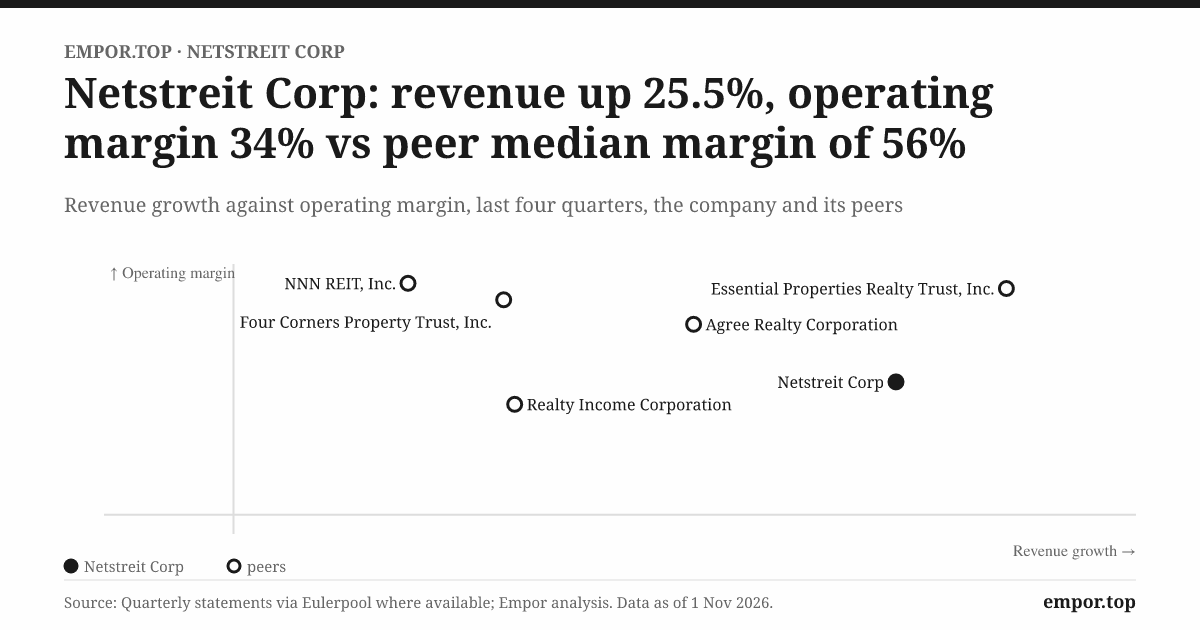
The peer comparisons above put NETSTREIT's yields and scale in context.101112 What determines whether it creates value is not the yield but its cost of funds.
The hard evidence on underwriting quality is impairments, which record when a property's value has fallen below its book cost. In 2024, NETSTREIT took about $30 million of impairments on 63 properties; that year also included a $2.8 million loss from a fraudulent payment transfer, net of insurance recoveries.3 In 2025, impairments fell to about $17.3 million on 36 properties and three mortgage loans.3 In the first nine months of 2026 they were about $8.1 million, compared with $13.5 million a year earlier.1
Most of these charges related to properties that were held for sale or already sold, which means they partly reflect a deliberate decision to exit buildings below cost rather than surprises in the portfolio. Still, $30 million in a year against a portfolio then worth roughly $2 billion is not trivial. It shows that some purchases, particularly earlier ones, did not work out as underwritten. It is wrong to assign every impairment to recent acquisitions, but equally wrong to pretend they say nothing about past judgment.
The picture that emerges is of a machine that has improved. Impairments have trended down, deployment has accelerated, yields have held steady, and AFFO per share has risen: from $1.26 in 2024 to a 2026 guidance range of $1.37–$1.39.91 That is roughly 4% to 5% a year. It is respectable. It is not the kind of growth that justifies issuing shares at a heavy pace forever. The accretion is real but modest, and it depends on a cost of capital that has just moved against the company.
What management does not emphasize is that buying is only half of the strategy. NETSTREIT also sells, and the buildings it lets go reveal as much about its underwriting as the ones it buys.
The Properties It Sold Tell the Other Half of the Strategy
Somewhere in 2025, a broker listed a NETSTREIT-owned building for sale. Perhaps it was a store whose tenant's sales had been slipping, or a property in a state where the company had too much exposure, or simply a building that a private buyer was willing to pay more for than NETSTREIT thought it was worth. Multiply that decision by 78, and you have NETSTREIT's 2025 disposition program: 78 properties sold for about $169 million, producing a net gain of about $7.7 million.3 By September 2026, the company said it had sold 254 properties since inception, for about $639 million in total.14
That scale of selling deserves its proper weight. For every two buildings NETSTREIT acquired in 2025, it let go of more than one. This is not a buy-and-hold portfolio. It is an actively traded one, and the selling is part of the strategy, not an afterthought.
The company's stated logic runs as follows. Its asset-management team monitors tenant credit, store-level rent coverage and local real-estate conditions. When a property no longer fits, because the tenant looks weaker, because coverage is falling, because one tenant or state is too large a share of rent, or because the buyer pool will pay a price that makes selling more attractive than holding, the company sells and redeploys the proceeds into new properties. Done well, that loop continuously upgrades the portfolio. Done poorly, it is just churn that pays brokers and transaction costs.
The pricing data offers a useful clue. In the third quarter of 2026, NETSTREIT sold 15 properties for about $40 million at a cash yield of 7.2%, while buying at 7.4%.1 In the second quarter, it sold 16 properties for about $49 million at 6.8%, while buying at 7.4%.15 Selling at a lower yield than you buy means selling at a higher price per dollar of rent. That spread is the arithmetic signature of a portfolio manager who can find buyers willing to pay more for certain assets than NETSTREIT thinks they are worth, and then reinvest in assets it believes are better value. Over many trades, that can add up.
There is a second clue that is less flattering. The assets sold in the third quarter had an average 13.7 years of lease term remaining, longer than the portfolio average.1 That suggests NETSTREIT was not just dumping short-lease or troubled buildings; it was also harvesting long-lease properties that private buyers prize, likely because they had become concentration problems or simply commanded attractive prices. Selling your longest leases at a premium is reasonable portfolio management. It also means some dispositions are capital-raising in disguise: a way to fund new purchases without issuing stock.
The impairments complicate the story. Some disposition sales involved buildings sold for less than book cost, as reflected in impairment charges.3 So the $7.7 million net gain in 2025 is a net figure, combining gains on assets sold at a premium with losses already recognized as impairments on assets sold at a discount. Investors should not mistake the net gain for evidence that every sale was a success. A fair reading is that NETSTREIT sold some assets at a profit, pruned others that had disappointed, and booked the losses on those before the sales closed.
There is also an important accounting distinction. Gains on property sales are not part of FFO or AFFO; REITs strip them out, precisely because they do not recur. So the gains do not flatter the per-share cash-flow measures. They do, however, flatter GAAP net income in years with large disposals, which is one reason NETSTREIT's GAAP earnings swing so much from year to year.
Is the recycling improving the book? The evidence leans yes, with caveats. Falling concentration, steady occupancy, high rent coverage and fewer impairments point toward genuine pruning. But the company does not publish a before-and-after analysis of tenant quality for the specific assets sold and bought, and some of the improvement in concentration would have happened anyway as the portfolio grew. The strongest version of the claim, that selling has measurably raised returns, remains unproven. The weaker version, that selling has reduced concentration and helped fund growth on reasonable terms, is well supported.
All this buying and selling produces a confusing set of financial statements. To understand whether the rent actually pays for the dividend, you have to read past a GAAP loss and a deeply negative free cash flow figure, both of which say something different from what they appear to say.
The GAAP Loss That Still Produced Operating Cash
Here is a puzzle that would confuse anyone who learned accounting on industrial companies. Add up NETSTREIT's reported results from 2018 through 2025, including its pre-IPO years, and the business lost about $16 million in total. Over the same eight years, it generated about $386 million of cash from operations.3 Then do the conventional free cash flow calculation, subtracting capital spending, and the business consumed about $2.6 billion. Yet it paid out about $261 million in dividends. A business that loses money, burns billions and pays generous dividends sounds like a Ponzi scheme. It is actually just a REIT, and decoding those three numbers is the key to understanding what supports the dividend.
Start with the loss. When NETSTREIT buys a building, accounting rules require it to depreciate most of the purchase price over the building's useful life, as if the structure were wearing out like a delivery truck. In 2025, real-estate depreciation and amortization came to about $86 million.3 That charge reduces reported profit, but no cash leaves the company. Meanwhile, well-located commercial land and buildings often hold their value or rise with inflation. So GAAP earnings for a landlord systematically understate the cash the portfolio throws off.
Two other items swing the bottom line. Impairments, which record a fall in a property's value, reduce earnings without any cash cost in the year they are booked; in 2025, the company added back about $15.9 million of them in its FFO calculation.3 Gains on property sales do the opposite, lifting earnings by about $7.7 million in 2025 without representing recurring income.3 Strip out depreciation, impairments and gains, and you get funds from operations, or FFO, which was about $101 million in 2025.3
AFFO goes a step further. It removes non-cash rent adjustments, including straight-line rent adjustments, which totaled about $4.8 million in 2025, and adds back other non-cash items such as stock compensation.3 The result, about $110 million in 2025, is NETSTREIT's best estimate of the recurring cash its portfolio earns for shareholders.3 It lines up closely with the $109 million of operating cash flow that year, which is reassuring: the non-GAAP measure and the audited cash-flow statement tell a similar story.
Now the dividend. In 2025, NETSTREIT paid about $70 million in dividends, against about $110 million of AFFO.3 So rent covered the dividend comfortably, with roughly 64% of AFFO paid out. In the third quarter of 2026, the payout was about 64% again.8 The commonly quoted payout ratios based on GAAP net income, which run between roughly 500% and more than 1,100% in recent years, are meaningless for this business because the denominator has been crushed by depreciation and impairments. On the cash measure that matters, the dividend looks secure, as long as tenants keep paying.
That leaves the negative free cash flow. Here the trap is in the definition. Conventional free cash flow subtracts "capital expenditure," and for NETSTREIT the data providers count property acquisitions as capital spending. But buying new buildings is not maintenance; it is expansion. A triple-net landlord spends relatively little to maintain its existing buildings, because tenants pay most upkeep. The billions of negative free cash flow are almost entirely the cost of growth, funded by new debt and new equity.
So what is the honest version? The dividend is funded by rent. Growth is funded by capital markets. Those two statements can be true at the same time, and the company's own numbers show the gap clearly. After paying the dividend in 2025, NETSTREIT retained about $40 million of AFFO. Against roughly $650 million of investment that year, internally generated cash covered only about 6% of growth. The other 94% came from borrowing, selling shares and selling properties. That is the defining feature of the model: the dividend is not at the mercy of the stock market, but the growth is.
There are two cautions. First, AFFO is a non-GAAP measure that companies define themselves. NETSTREIT explicitly warns that AFFO does not measure whether cash is sufficient to cover debt service, property improvements or distributions.3 It is a useful lens, not an audited fact. Second, AFFO payout looks healthy partly because NETSTREIT's leases push most property costs onto tenants. If a tenant fails, the landlord inherits taxes, insurance and maintenance on a dark box, and those costs hit AFFO directly. Low current costs are a feature of a full building, not a permanent condition.
The dividend itself has grown slowly. It was raised to $0.225 a quarter in the second half of 2026, an annualized $0.90, up from $0.85 declared across 2025.1513 Raising the dividend more slowly than AFFO, as NETSTREIT has done, is a conservative choice: it increases the cash retained for growth and the cushion against tenant losses.
Management's commentary has been consistent on this point across calls. In early 2025, it built its guidance without assuming any new equity.9 By late 2026, it talked of funding 2027 growth without issuing more stock.2 Both statements emphasize that the dividend and the existing portfolio do not depend on new shares. They also implicitly acknowledge the flip side: growth beyond what retained cash and debt can fund does. Which brings us to the shares themselves.
The Forward Equity That Made the Growth Possible
Think of a forward sale as a layaway plan for stock. A REIT agrees today to sell shares to a bank at roughly today's price. The bank borrows and sells shares in the market to hedge itself, and the REIT can wait months, sometimes more than a year, before delivering its own new shares and collecting the cash. The REIT locks in a price while the stock is high, but avoids holding idle cash and avoids the dilution until it actually needs the money to close a deal. For a company that buys buildings on an irregular schedule, it is an elegant tool. It also means the dilution is pre-committed: the shares are coming, whether or not the next deal turns out to be good.
NETSTREIT has used almost every form of equity financing available to a REIT. There was the private placement before listing, and then the IPO at $18. There were follow-on offerings and at-the-market programs, through which the company sells shares into the market gradually. In 2025, it issued about 3.2 million shares at an average price of about $16.47, for about $52.4 million gross.3 In February 2026, it launched a follow-on offering structured as a forward sale. In the first half of 2026, as the stock rallied, it sold millions more shares on a forward basis through its ATM.1 Then came the third-quarter settlement of 24 million shares that opened this story. Even after that, banks held contracts for about 15.9 million more shares, worth about $312 million at a weighted average net price of $19.57.1
That last figure is a point in management's favor. Forward contracts priced near $19.57 sit more than $2 above where the stock traded on November 1. NETSTREIT sold stock when its price was high, which reduced the dilution per dollar raised. During the third quarter, it also sold about 1 million shares through the ATM at an average gross price of about $21.39.1 That is the market timing a REIT is supposed to exercise, and NETSTREIT exercised it.
But issuing equity at good prices does not by itself make growth accretive. The test is per-share, and here the record is mixed. In the second quarter of 2026, management raised its AFFO guidance only slightly, from $1.36–$1.39 to $1.37–$1.39, while nearly doubling its estimate of dilution from the outstanding forward shares, to between 5 and 8 cents a share.15 It raised its investment target in the same breath. Put simply, the company planned to buy much more property, but expected only a sliver more AFFO per share, because the extra properties would be paid for largely with extra shares.
The third quarter refined that picture rather than changing it. Settling 24 million forwards earlier than planned meant 2026's weighted average share count would be about 2 million higher than expected, costing roughly another 2.5 to 3 cents a share, even as the estimated dilution from the remaining forwards fell.1 Donlan explained the early settlement as improving the company's position with the rating agencies, increasing the public float and allowing NETSTREIT to delay drawing its new term loan.2 Those are legitimate reasons. They also show that balance-sheet goals sometimes take precedence over squeezing every cent of AFFO per share in a given year.
Step back and the pattern becomes clear. From 2024 to the 2026 guidance midpoint, AFFO per share grew at around 4% to 5% a year. Over the same period, the share count rose much faster, and AFFO in dollars rose faster still. Each new share has, so far, been worth issuing, because AFFO per share has gone up. But the margin is not large, and it was earned at a time when NETSTREIT's stock was rallying toward its highs.
The skeptic's test is simple: if equity is still available but at a price that makes deals dilutive, does management slow down, or does it chase volume? The early-2025 record suggests patience: when the stock was weak, NETSTREIT guided to very modest growth. The late-2026 record is still being written. Management says new equity requires spreads above 100 basis points, and current spreads are around 60 to 70.2 It says it can fund about $550 million of growth with existing resources and debt through 2027.2 If the next stock sale happens before spreads widen, that would be a meaningful departure from what management told investors in October 2026.
How aligned is management with shareholders in this choice? Insider ownership is modest relative to the company's size. As of March 17, 2026, Manheimer held 410,260 shares and Donlan 48,259.16 At $17.52, Manheimer's stake was worth about $7 million, a meaningful sum for an individual but a small fraction of a company with more than 100 million shares. The largest holders are institutions, including Principal Real Estate Investors, BlackRock and Vanguard.16 Management has real money at stake, but most of its economic exposure is in the form of pay, which is where the next part of the story turns.
The public record is too short to declare that NETSTREIT has proven itself as a compounding machine through a full cycle. It is long enough to show that the IPO strategy, buying and diversifying a portfolio of long leases, has largely been executed, at a cost of meaningful dilution, some impairments and a share price that has gone nowhere. Whether that cost was worth paying depends on judgment, and judgment is ultimately a question about the people making the decisions.
Mark Manheimer’s Growth Test
Mark Manheimer has spent his career in a narrow corner of finance: buying, leasing and selling buildings occupied by single tenants. His career ran through Realty Income and Spirit Realty, where he helped oversee the acquisition of more than 1,500 properties and helped take the company public, before landing at EB Arrow and, from December 2019, running NETSTREIT.5 It is a résumé built around one skill set. He is not a deal promoter from outside the industry; he is a specialist who knows how these leases fail. That cuts both ways. Specialists can avoid the obvious mistakes. They can also assume that the cycle they know is the cycle they will face.
His pay has grown with the company. His reported total compensation rose from about $4.08 million in 2023 to $4.92 million in 2024 and $5.17 million in 2025.16 Of the 2025 figure, about $3.19 million was stock awards and $1.25 million non-equity incentive pay, so the cash salary is the smaller part.16 Donlan's total compensation rose from about $1.5 million in 2023 to about $2.0 million in 2025.16
Set that pay against results. Over the same three years, GAAP net income went from about $6.9 million, to a loss of about $12.0 million in 2024, back to about $6.9 million in 2025.16 GAAP income is a poor measure of a REIT's performance, for the reasons explained earlier. AFFO per share is better, and it rose from $1.26 in 2024 toward the $1.37–$1.39 range guided for 2026.91 So the CEO's pay rose about 27% over two years, while AFFO per share rose at a mid-single-digit annual pace. That is not egregious for a growing REIT, but it does mean pay has grown faster than per-share results.
The 2024 loss is worth examining, because it is the closest thing in NETSTREIT's public history to a bad year. It came mainly from $30 million of impairments on 63 properties, plus a $2.8 million loss from a fraudulent payment transfer, net of insurance recoveries, and about $1.6 million of non-recurring executive transition and severance costs.3 The fraud loss is small in dollars but notable, because payment-diversion schemes are an internal-control risk that a lean 29-person company must manage carefully. The company has not reported a recurrence, and its auditor issued an unqualified opinion on internal controls for 2025 with no material weakness identified.3
Management's explanations across calls have generally been consistent. It said in early 2025 that it would be patient with its cost of capital and initially guided to modest investment.9 When its share price improved, it accelerated. When the cost of capital rose again in late 2026, it said publicly that new equity no longer cleared its hurdle and that it would rely on existing resources.2 That is a coherent narrative. Its guidance practice has been to raise AFFO ranges modestly while raising investment ranges sharply, which suggests that management is careful not to promise per-share growth it cannot deliver.
The governance structure is conventional for a REIT of its size. NETSTREIT has a separate non-executive chair and six independent directors on a seven-member board.16 At the May 2026 annual meeting, the advisory say-on-pay proposal passed, with about 2.43 million votes cast against.17 That is a minority, not a revolt, but it is a signal that some shareholders want pay more closely tied to per-share outcomes.
The audit record contains one item worth understanding. The auditor's critical audit matter for 2025 was the valuation of land and buildings in certain acquisitions.3 When NETSTREIT buys a property, it must split the price among land, building and lease intangibles, and that split determines how much is depreciated and how fast. A critical audit matter is not a qualification or a criticism; it simply flags where the accounting requires the most judgment. For an acquisitive REIT, that is exactly where one would expect it.
The fair verdict is that management's behavior has broadly matched its words, but its record is short and has been made in mostly favorable conditions. There have been course corrections after the 2024 impairments: lower impairments since, sharper concentration targets and more disposition activity. Nothing in the record amounts to a scandal. But the real test of whether a growth-minded management team is disciplined comes when capital gets expensive, and that test began only in late 2026. The balance sheet determines how long management can wait.
A BBB− Rating Meets a Higher Cost of Capital
On December 30, 2025, NETSTREIT announced that Fitch Ratings had assigned it a BBB− issuer rating with a stable outlook, the lowest rung of investment grade.13 For a company only five years past its IPO, that mattered. An investment-grade rating opens the door to cheaper unsecured borrowing, and in a business where returns are measured in the spread between building yields and funding costs, every fraction of a percentage point counts. In the company's summary, Fitch pointed to a solid portfolio, occupancy above 99%, solid rent coverage, low credit losses relative to peers, staggered debt maturities and liquidity flexibility.13 That summary is the issuer's account of the rating, not Fitch's full rationale, so the agency's constraints and concerns are not reproduced there.
Ten months later, in October 2026, NETSTREIT announced $550 million of additional financing commitments and amendments to existing facilities, including a new $400 million seven-year delayed-draw term loan due in 2033.1 It also said it had no major debt maturities until 2029.1
At the end of September 2026, NETSTREIT owed about $1.21 billion of principal, almost entirely in bank term loans, with a small mortgage.8 It reported total liquidity of about $1.25 billion.1 That sounds like a company with as much spare capacity as debt. But look at what makes up the liquidity. About $500 million is undrawn capacity on its revolving credit line, $400 million is the undrawn 2033 term loan, about $312 million is the expected net proceeds of the unsettled forward shares, and only about $42 million is actual cash.1 In other words, almost all of the liquidity is the ability to borrow or to deliver shares. That is perfectly normal for a REIT. It also means the liquidity is conditional: borrowing adds leverage, and forward shares add dilution.
The covenants offer plenty of room. Total leverage, as defined by the lenders, was about 30% against a 60% limit, and fixed-charge coverage was 3.2 times against a 1.5 times minimum.8 Those are comfortable margins. The more market-relevant measure is net debt to EBITDAre, which compares debt with annual cash earnings. It stood at 5.0 times in the third quarter, or 3.7 times if the unsettled forward equity is counted as cash.1 Management described its comfort zone as 4.5 to 5.5 times.2 So NETSTREIT sits in the middle of its range, with room to borrow more but not much room to borrow a lot more without issuing equity.
The maturity schedule is well laddered. The first big repayment is a $250 million term loan due in January 2029; then come two $175 million term loans and the revolver in January 2030, a $300 million loan in 2031 and another in 2032, with the undrawn 2033 loan behind them.8 During the third quarter, the company repaid a $200 million term loan due in 2028 using draws on the 2031 and 2032 loans, moving its swaps across.8 The weighted average maturity was about four years.8
The hidden risk is not maturity but interest rates. Most of NETSTREIT's debt is floating-rate bank debt, much of it converted to fixed rates through interest-rate swaps. Those swaps were worth about $38 million to the company at the end of September, because they lock in rates below today's market.6 Its all-in weighted average borrowing cost was about 4.26%.8 Some of the oldest debt is very cheap, including a term loan swapped to about 2.4% that runs to 2030.8 As those swaps expire and the loans are refinanced at market rates, the cost of the existing debt will rise, even if nothing else changes. That is a slow-motion headwind to AFFO, and it lands exactly when the company is trying to grow per share.
The broader leverage trend tells the same story from a different angle. Measured simply as debt divided by book equity, leverage rose from about 0.5 in 2023 to about 0.8 at the end of 2025.3 That ratio uses historical book values, depressed by depreciation, so it overstates leverage relative to market values. But the direction is clear: NETSTREIT has leaned more heavily on debt as it accelerated growth.
Currency risk is irrelevant here; the portfolio is entirely American and reported in dollars.3 The treasury questions are about rates, spreads and timing.
So what happens if acquisition cap rates do not widen enough to offset higher financing costs? Management's answer on the third-quarter call was that the market would adjust: cap rates must rise unless rates fall or equity prices recover.2 It also argued that higher costs were squeezing smaller, more leveraged private buyers and that larger institutions had less capital available, which could leave better deals for a well-capitalized REIT.2 That is a plausible view, but it is a forecast. If the adjustment does not come, NETSTREIT's growth will slow to what its existing liquidity and debt capacity can support. The balance sheet can withstand a period of expensive capital. What it cannot do is make expensive capital produce cheap growth.
Analysis & Bear vs. Bull Case
At $17.52, a NETSTREIT share costs about 12.7 times the midpoint of 2026 AFFO guidance and pays about 5% in dividends.41 The conventional screens say something else entirely. They show a P/E of about 123 times, which looks expensive, but also well below the stock's own five-year median of about 297 times. They show a price-to-book ratio of about 0.9 and an enterprise value of about 14 times EBITDA. None of these figures settles the debate. The P/E has fallen only because GAAP earnings recovered from the 2024 loss, not because the shares got cheaper. Book value is depressed by depreciation. The useful valuation measures for a REIT are price to AFFO and net asset value, and a fair comparison with peers requires their AFFO multiples on matching definitions, which differ from company to company.
What does the current price seem to assume? An AFFO yield of nearly 8% is higher than NETSTREIT's acquisition yields of around 7.4%. In effect, the market values the existing portfolio at a higher yield than the company pays for new properties. That gap is the market's way of saying that it does not yet trust the growth engine to create value, or that it worries about the risk in the rent. It is also why issuing new shares has become difficult: when your shares are priced as if your buildings are worth less than you pay for new ones, selling stock to buy more buildings is hard to justify.
The bull case rests on the strengths already described: long leases, near-total occupancy, improved tenant diversification, and a dividend covered by AFFO. NETSTREIT has an investment-grade rating and enough committed capacity to fund more than a year of growth without new stock. It has also sold a large amount of equity at prices well above today's, committing the near-term dilution at favorable prices. If interest rates fall or cap rates rise, the spread between acquisition yields and funding costs widens, and NETSTREIT can resume growth at a better rate.
The bear case rests on the limits already described: NETSTREIT has no demonstrated durable moat, and larger rivals can fund themselves more cheaply. Its growth has required heavy issuance, absorbing most of the gain in AFFO dollars. Another 15.9 million forward shares are still to come. Principal debt of about $1.2 billion will cost more as old swaps expire. The investment-grade share of rent has fallen well below the IPO target, and coverage figures for most of the portfolio are estimates. The impairment record shows past purchases that disappointed. And the business model itself requires a stock price that makes issuing equity sensible, which is not the case at today's price.
Go back to the bidding war for that suburban pharmacy, and the conclusion is clear: the only power that matters in net lease is cost of capital, and NETSTREIT does not have the advantage. Its potential edge is process power in underwriting smaller deals, but that is plausible rather than proven. Helmer's 7 Powers framework would classify NETSTREIT as a well-run competitor without a structural moat, and the evidence supports that view.
A skeptical investor would ask one question above all others: if external growth requires recurring issuance, what per-share return justifies continuing to expand? The current spread of 60 to 70 basis points, by management's own reckoning, does not clear its hurdle for new equity.2 An activist-minded holder might argue that, at an 8% AFFO yield, the best investment available is NETSTREIT's own portfolio, and that selling properties at 6.8% to 7.2% yields and buying back stock would create more value per share than buying new buildings. The company has disclosed no buyback program.3 That argument has its limits, because shrinking the company could hurt its rating and its access to capital, but it is the right question to put to management while the stock trades more than $2 below the price of the forwards still waiting to be delivered.
Three numbers will decide which case wins. The first is AFFO per share after all forward dilution. It was $0.35 in the third quarter, up about 6% from a year earlier.1 If that growth holds as the remaining forwards are delivered, the engine is working. The second is the spread between acquisition cash yields and the all-in cost of capital, which management put at roughly 60 to 70 basis points, against a hurdle of 100 basis points for new equity.2
If that spread widens, growth can resume; if it narrows, it should not. The third is rent credit: impairments have fallen from about $30 million in 2024 to about $8 million in the first nine months of 2026, rent coverage stands at 3.9 times, and management is watching only one or two assets.3182 A deterioration in any of those would be the first sign that the rent is less durable than it looks.
Management's own stated triggers for slowing down have been consistent: wait for a better cost of capital, as it said in early 2025, and rely on existing resources when equity no longer clears the hurdle, as it said in late 2026.92 The question for the next year is whether action follows words when the market tests them.
Playbook: Business & Investing Lessons
Go back to the August 2020 prospectus and its promise that discount, drug and grocery tenants were "e-commerce resistant and resilient through all economic cycles."5 Between then and the quarter in which NETSTREIT delivered 24 million shares to fund building purchases lies a small set of lessons that belong to this company more than any other.
The first lesson is that a rent check is only as durable as the tenant and building behind it. NETSTREIT's long-run fate will be decided by how well it underwrites the building, not just the lease.
The second lesson is that a good yield is not yet a good return. The lesson for investors is to stop asking what a REIT is buying and start asking what each share is getting.
The third lesson is that selling is part of the underwriting. NETSTREIT sold 78 buildings in 2025 and booked impairments on dozens of others over two years.3 The discipline worth admiring is not avoiding mistakes, which no landlord can do, but selling the mistakes early, at an acceptable loss, before they become vacancies. A REIT that never sells is telling you less about its judgment, not more.
The fourth lesson is that a dividend paid from rent can still depend on capital markets for growth. Investors who buy the rent collector should know that the acquirer sets the share price.
The final lesson is about time. NETSTREIT is young. The strategy has been executed. It has not yet been tested. A long lease, in the end, only buys time. Whether that time compounds value depends on the tenant, the building and the cost of the money that bought them.
Epilogue
Tonight, NETSTREIT owns 913 investments, nearly all of them leased, generating about $246 million of annual base rent.18 It has about 15.9 million forward shares still to deliver, roughly $1.25 billion of liquidity, most of it in the form of borrowing capacity, and a public promise to fund growth through 2027 without new equity.12 Its stock sits near the price at which it settled its last forward sale, below its IPO price and well below the price at which its remaining forwards will be settled.
The next few months will test the story in specific ways. The first test arrives with fourth-quarter results in early 2027. Management raised its 2026 net investment target to at least $800 million, from a $700 million–$800 million range set in July, and said fourth-quarter purchases would be concentrated late in the quarter as sellers adjusted prices.1152 If NETSTREIT hits that target at yields above 7.4%, it will show that sellers are indeed adjusting. If it hits the target at lower yields, it will suggest that volume is being prioritized over spread. If it falls short, it will show discipline, at the cost of growth.
The second test is 2027 guidance. Management has said existing resources can support mid-single-digit AFFO growth next year without new equity.2 That figure must include all remaining forward dilution and the gradual expiry of cheap swaps. If 2027 guidance meets that bar, the per-share engine is intact. If it falls short, the market's skepticism will look justified.
The third test is credit. A retail downturn, a pharmacy restructuring or a dollar-store retrenchment would show up first in rent collection, deferred rent and impairments, and only later in occupancy. Watching those signals at the largest tenants and at the small share of stores with weak coverage is the best early warning investors have.
The fourth test is the balance sheet. As the 2033 term loan is drawn, which management expects to happen in 2027, leverage will rise toward the top of its comfort range unless equity is issued or properties are sold.2 How management manages that tension, and whether it sticks to its own hurdle for new stock, will be the clearest evidence of discipline the company has yet provided.
None of those tests requires a new strategy. NETSTREIT's next chapter turns on execution: spreads, per-share AFFO and rent that keeps arriving. The tension that remains is the one the story began with. The portfolio can keep growing. The question is whether its owners will.
Outro
Go back to that third quarter. The new shares arrived; the money quickly became buildings, each leased to a single tenant for a decade or more. From there, each rent check must cover debt service and the dividend before anything can fund the next purchase.
That chain is what makes NETSTREIT unlike a bond portfolio. Each share's value depends on whether every new lease earns more than the capital it consumes. At NETSTREIT, the rent is contracted; the return still has to be earned.
References
-
NETSTREIT Reports Third Quarter 2026 Financial and Operating Results — NETSTREIT Corp., 2026-10-21 ↩↩↩↩↩↩↩↩↩↩↩↩↩↩↩↩↩↩↩↩↩↩↩↩↩↩↩↩↩↩↩↩
-
NETSTREIT Q3 Earnings Call Highlights — MarketBeat, 2026-10-22 ↩↩↩↩↩↩↩↩↩↩↩↩↩↩↩↩↩↩↩↩↩↩↩↩↩
-
2025 Form 10-K — NETSTREIT Corp., 2026-02-10 ↩↩↩↩↩↩↩↩↩↩↩↩↩↩↩↩↩↩↩↩↩↩↩↩↩↩↩↩↩↩↩↩↩
-
IPO Prospectus, Form 424B4 — NETSTREIT Corp., 2020-08-13 ↩↩↩↩↩↩↩↩↩↩↩↩↩↩↩↩↩↩↩
-
NETSTREIT Corp. Announces Closing of IPO Over-allotment Option — NETSTREIT Corp., 2020 ↩
-
Q3 2026 Supplemental Financial and Operating Information, Form 8-K Exhibit — NETSTREIT Corp., 2026-10-21 ↩↩↩↩↩↩↩↩↩↩↩↩↩↩↩↩↩↩↩
-
NETSTREIT Q4 2024 Earnings Call Transcript — Stock Analysis, 2025-02-25 ↩↩↩↩↩↩↩↩↩
-
NETSTREIT Corp. Achieves BBB− Credit Rating From Fitch Ratings — NETSTREIT Corp., 2025-12-30 ↩↩↩
-
NETSTREIT Reports Second Quarter 2026 Financial and Operating Results — NETSTREIT Corp., 2026-07-22 ↩↩↩↩↩
-
2026 Annual Meeting Voting Results, Form 8-K — NETSTREIT Corp., 2026-05-14 ↩
 LinkedIn
 WhatsApp
 Reddit
 Hacker News
 Email
 Kindle
 RSS Feed
 Spotify
 Apple Podcasts
 Amazon Music
 Audible
 YouTube