Four Corners Property Trust: The Landlord That Escaped Olive Garden
I. Starboard's Breadstick Revolution
In September 2014, an activist hedge fund published what may be the most widely mocked corporate critique in American restaurant history. Starboard Value, led by Jeffrey Smith, released a presentation of nearly 300 slides on Darden Restaurants, the Orlando company behind Olive Garden and LongHorn Steakhouse.1 Most of Wall Street remembers the part about food. Starboard complained that Olive Garden servers handed out breadsticks too freely, so they went stale on the table and the free bread spoiled appetite for paid food. It said the kitchens stopped salting the pasta water because salt voided the warranty on the pots. It held up the menu, the portion sizes and the wine list as evidence that management had stopped caring about the guest.
The breadsticks made headlines. The real argument was buried further back in the deck, and it was about dirt. Darden owned the land and buildings under hundreds of its restaurants. Starboard argued that this real estate was hidden inside a restaurant company the market valued at a low multiple, when the same properties, leased back to the restaurants under long contracts, would be worth far more inside a real estate investment trust.1 A REIT is, in plain terms, a company that owns property, passes most of its income through to shareholders as dividends, and pays no corporate income tax at the company level. Investors value a steady rent stream from a creditworthy tenant much more like a bond than like a restaurant. Starboard's pitch was that Darden was sitting on a bond portfolio and pricing it like a plate of pasta.
Darden's board had already resisted. Earlier that year it had sold Red Lobster over the objections of shareholders, and the anger from that sale gave Starboard its opening. In October 2014, shareholders voted the entire twelve-person board out and installed Starboard's slate.1 It was a rare event in American corporate governance: an activist taking every seat at a large, well-known company. The new board had a mandate, and the mandate included the real estate.
The answer arrived about a year later. On November 9, 2015, Darden completed the spin-off of a new company called Four Corners Property Trust, handing its shareholders one FCPT share for every three Darden shares they held.23 Into the new company went 418 restaurant properties, most of them Olive Gardens and LongHorn Steakhouses, each leased straight back to Darden.3 FCPT was organised as an UPREIT, meaning the properties sit in an operating partnership controlled by the listed company, a structure that lets future sellers swap property for partnership units rather than cash and defer their taxes.4
Look at what the new company owned on its first day and the problem becomes obvious. Its property was carried at roughly $829m.4 Every dollar of rent came from one tenant. It had no acquisition history, no relationships with other restaurant chains, and a landlord's version of a captive's identity: it existed because an activist had decided Darden's real estate should be monetised, not because anyone had dreamed of building a property business. Four Corners was born as a piece of financial engineering, and financial engineering produces a valuation gap more reliably than it produces a business.
So the question this story has to answer is whether that engineered company ever became something more. Three questions run through it. The first is whether buying hundreds of properties from other tenants protected FCPT from the slow decline of casual dining, or swapped the best tenants in its portfolio for weaker ones. The second is what happens when the original Darden leases run toward their ends, given that Olive Garden's restaurants earn many times their rent. The third, and the most uncomfortable, is whether a decade of selling new shares to fund those purchases built a bigger company without building a richer shareholder.
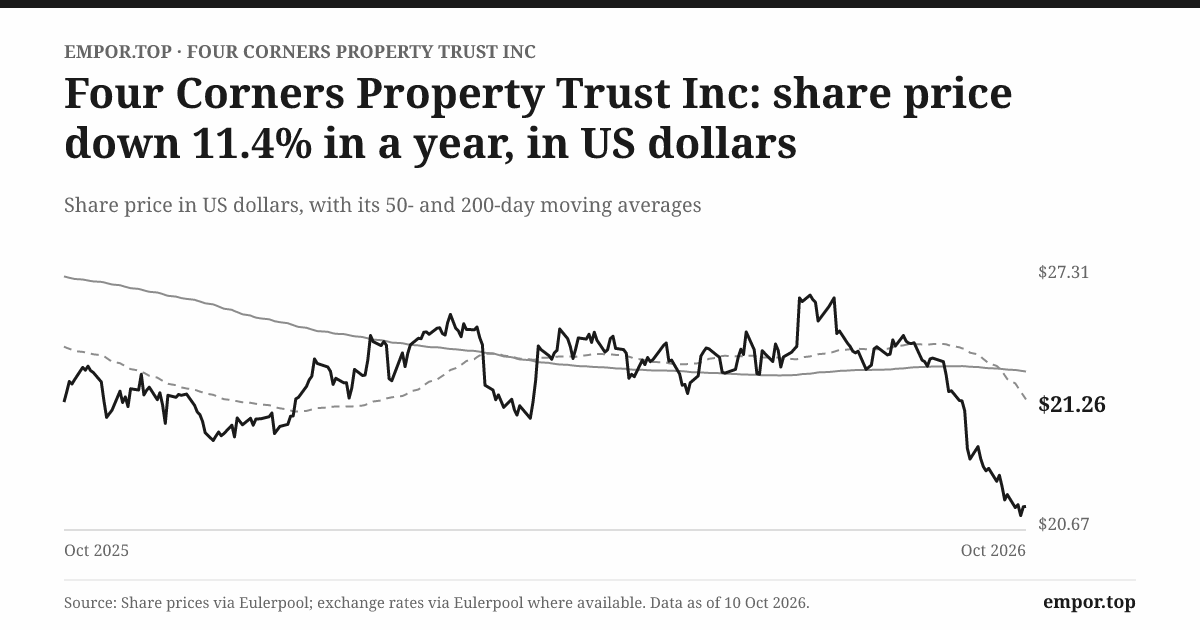
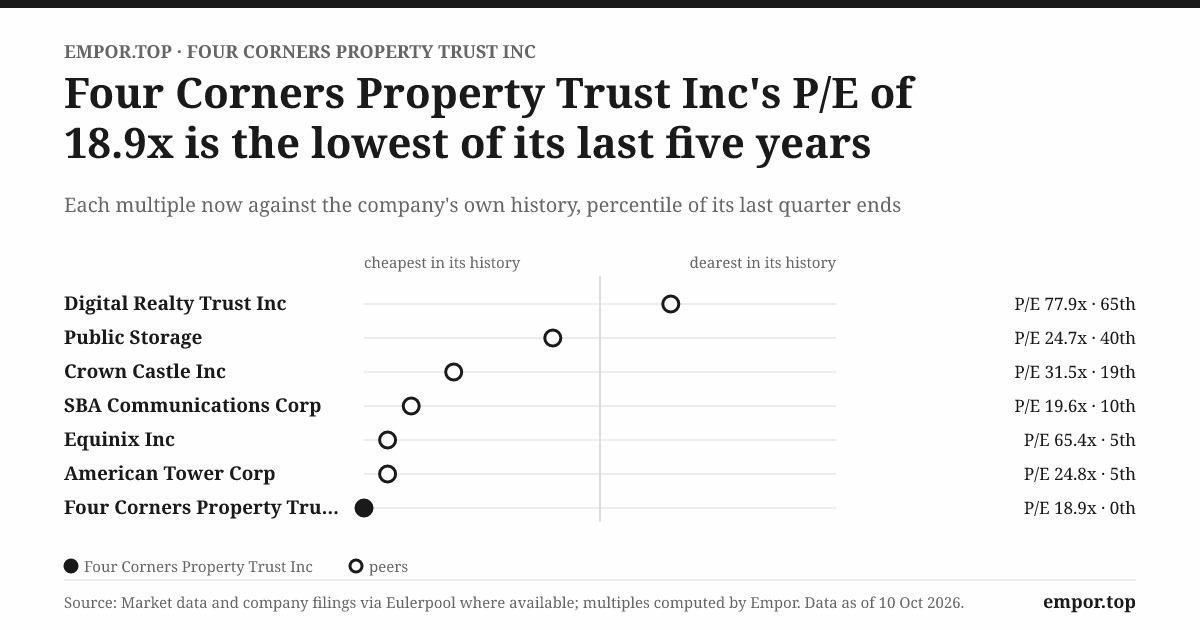
Tonight, Four Corners owns 1,303 properties in 48 states, they are 99.6% occupied, and the enterprise is worth about $3.4bn including debt.45 Yet the stock closed at $21.26 on October 10, 2026, which is about 18.9 times trailing earnings, far below the roughly 27 times it averaged over the past five years.5 The market is telling the company something. To hear it, start in a small office in Marin County, a long way from Orlando.
 Subscribe on LinkedIn
II. Bill Lenehan and the 45-Person Empire in Mill Valley
Mill Valley, California, is a town of redwoods and expensive coffee at the foot of Mount Tamalpais, north of the Golden Gate Bridge. It is not where anyone would look for the landlord of hundreds of Olive Gardens. Four Corners put its headquarters there anyway, roughly 2,500 miles from Darden's campus in Orlando.4 The geography was a statement. The new company was meant to be run by real estate investors, not restaurant operators, and it was meant to be visibly separate from its former parent.
The man running it was William H. Lenehan, known as Bill. Before Four Corners he had spent years at Farallon Capital Management, the San Francisco investment firm, working on real estate and special situations, the corner of finance that deals in complicated property, restructurings and assets nobody else wants to underwrite.3 He was not a restaurateur, and he did not need to be. A triple-net landlord needs someone who can price a lease, judge a tenant's ability to pay, and raise money cheaply. Lenehan had been involved with Darden from the activist side, and when Four Corners was formed he became its chief executive, a post he still holds a decade later.35 His mandate was simple to state and hard to execute: prove that FCPT could buy property from tenants other than Darden, at prices that made sense, so that it would stop being priced as a Darden derivative.
What Lenehan built to do that is notable mostly for how small it is. At the start of 2026, Four Corners had 496 employees, but 451 of them worked in restaurants. The corporate team that buys, finances and oversees the portfolio was just 45 people.4 That team runs a property base with a gross cost of about $3.5bn.4 General and administrative costs were $26.8m in 2025, about 9% of revenue.4 In other words, a team about the size of one restaurant's dinner shift oversees a continent-wide portfolio, and the overhead is a small slice of the rent coming in.
That operating leverage is the first real advantage this story will test, and it is real in a narrow sense. Because a triple-net tenant pays for the roof, the taxes and the insurance, the landlord does not need maintenance crews, regional property managers or a building operations department. Each new property adds rent and very little cost. The limit is that every other triple-net REIT enjoys exactly the same structure, so lean overhead is a hygiene factor in this industry rather than a weapon. It matters more for a small REIT, because fixed costs weigh more on a smaller rent roll, and FCPT has kept them in check.
The steakhouses nobody expected
Then there are the 451 restaurant workers. When Darden spun off the real estate, it also handed Four Corners seven working LongHorn Steakhouse restaurants in the San Antonio area, which FCPT runs through a taxable subsidiary called Kerrow Restaurant Operating Business.34 The logic was tax and structure: the spin-off had to meet tax rules for an active trade or business, and a REIT cannot earn much income from operating businesses without paying tax on it, so the restaurants sit inside a subsidiary that pays tax like an ordinary company.3 The result is a REIT that also cooks steaks. In 2025 those seven restaurants brought in about $31.5m, or roughly 11% of FCPT's revenue.4
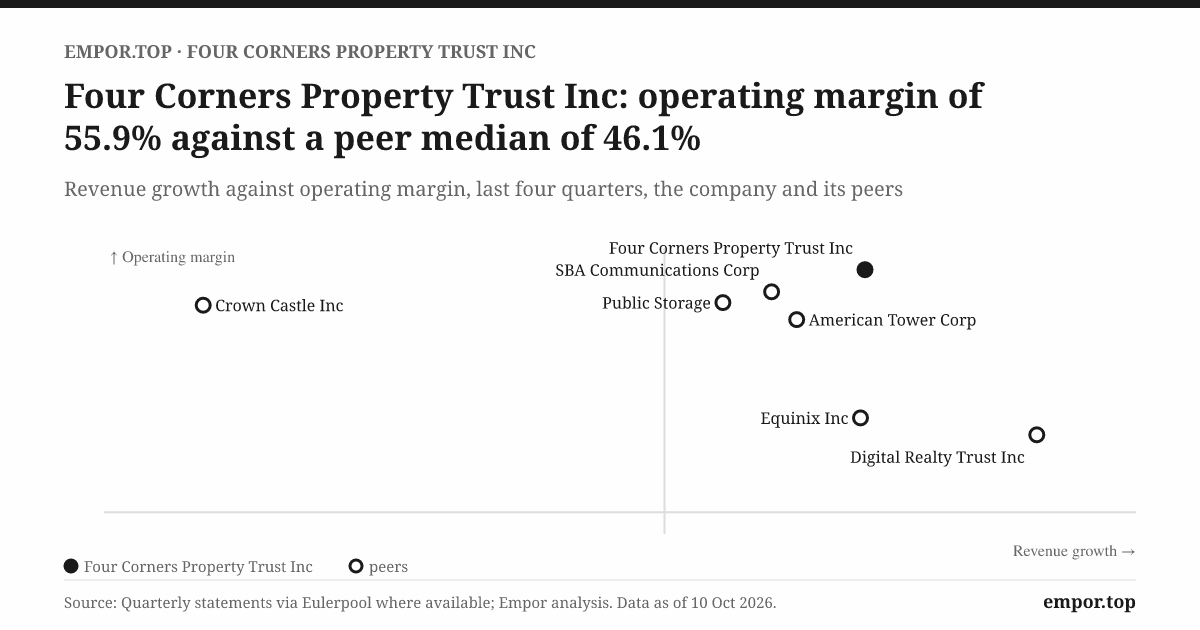
Kerrow is less a risk than an oddity, but it matters to how the numbers read. Restaurant revenue comes with restaurant costs, food, labour and franchise royalties, so it carries far thinner margins than rent. That drags down FCPT's reported operating margin and inflates its headcount. It also means a slice of the business is exposed directly to beef prices and kitchen wages, the very costs triple-net leases are designed to push onto tenants. Kerrow runs the restaurants under franchise agreements signed with Darden at the spin-off, paying franchise fees and royalties.5
That raises the obvious governance question. Is Four Corners still quietly tied to Darden? The record says no. Darden holds no equity in FCPT, the two companies share no directors or officers, and Four Corners reported no related-party transactions above disclosure thresholds in 2023, 2024 or 2025.5 The relationship today is commercial: Darden is a tenant and a franchisor, and a large one, but not an owner.
Pay, ownership and the vote
An investor's next question about a small management team is whether its incentives point in the right direction. Lenehan earned about $5.7m in 2025, most of it in stock awards rather than salary.5 He owns about 770,000 shares, worth roughly $16m at today's price, and directors and officers together hold about 1.2% of the company.5 At the June 2026 annual meeting, shareholders approved the pay plan with about 97% support and re-elected Lenehan with about 99%.6 Those votes say the big institutional holders, led by BlackRock with about 15% of the shares, are content.5
Contentment is not the same as alignment, though. Pay that rises with the size of the portfolio can reward growth in the total, while the shareholder cares about growth per share. That tension, between building a bigger landlord and building a better one, is the hinge of this entire story, and it begins with the leases themselves.
III. Anatomy of a Triple-Net Fortress
Picture an Olive Garden by an interstate exit in Ohio. The roof starts to leak. The county reassesses the land and the property tax bill jumps. The insurer, nervous about storms, raises the premium. In most businesses that own buildings, each of those events is a cost. At Four Corners, none of them is. The tenant fixes the roof, pays the tax and buys the insurance. FCPT collects the rent.
That is what "triple-net" means: the three "nets" are taxes, insurance and maintenance, all netted off the landlord and onto the tenant. In 2025, about 89% of FCPT's revenue came from leases built that way, with the rest coming from the Kerrow steakhouses.4 The consequence is a business that looks, from the shareholder's side, a lot like a corporate bond with a small inflation kicker. The tenant promises fixed payments for many years. The landlord's main job is to pick tenants who will keep paying and buildings that someone else will want if the tenant leaves.
The unit of pricing is rent per square foot. Across the portfolio, FCPT collects about $30 a square foot a year.4 Olive Gardens pay about $31 and LongHorns about $36, while the non-restaurant retail properties it has bought average closer to $24.4 Those differences are not trivia. A restaurant earns a lot of money from a relatively small building, so it can afford high rent per foot; a tire shop or a clinic generally cannot. The newer, more diversified part of the portfolio is cheaper per foot, and, as the coverage numbers will show, also thinner in how comfortably its tenants can pay.
How the rent grows
Leases at FCPT typically start with terms of ten to fifteen years. Across the whole portfolio, the weighted average time left on the leases was 6.9 years at the end of 2025, while properties bought in the first half of 2026 came with about 10.2 years.47 Built into the contracts are rent increases averaging about 1.5% a year through 2030.4
Here is where the bond analogy bites. A 1.5% annual bump is comfortable when inflation runs at 2%, and painful when it runs at 5% or more, as it did in 2022. In a high-inflation year, the landlord's real income shrinks while the tenant's sales, which rise with menu prices, grow faster than its rent. That is good for tenant health and bad for landlord returns. Triple-net leases protect FCPT from rising costs at the building, but they do not protect it from rising prices in the economy at large. The protection is against cost inflation, not against inflation in general, and investors who treat the shares as an inflation hedge are buying something the contracts do not deliver.
There is also an accounting wrinkle that investors should understand. Under the lease accounting rules, a landlord reports rent evenly over the whole lease, averaging the future bumps into today's revenue. That creates an asset called straight-line rent receivable, which is income booked but not yet billed. At FCPT it stood at about $72m at the end of 2025 and $73m by mid-2026.47 It is not a sign of trouble; there are no past-due amounts in it. But it means a slice of reported revenue is a promise about the future rather than cash today, and in 2025 the straight-line adjustment trimmed about $3m from cash relative to reported profit.4
Paid before it is due
Cash in the actual collection sense is close to frictionless. Receivables were about $6m at the end of 2025, about a week of revenue, and many tenants pay rent in advance, which brought in about $11m of prepaid rent during 2025.45 In practical terms, FCPT's working capital runs negative: it holds its tenants' money before it has to deliver anything.
Put together, profit converts to cash well. In 2025, operating cash flow was about $192m against net income of about $112m.4 The gap is mostly depreciation, the accounting charge that writes buildings down over time, which reduces reported profit without costing any cash. Over the twelve years to 2025, operating cash flow came to about 127% of cumulative net profit.4 That is the right shape for a landlord, and it is why REIT investors use cash-based measures like funds from operations rather than earnings per share.
The fortress is real at the building level. The question is what it is defending. When FCPT was created, the answer was one tenant. The next phase of the story is a decade-long attempt to change that answer.
IV. Escaping Darden: The $2.7 Billion Diversification Run
The deals that changed Four Corners were small. A Caliber Collision body shop in a suburban strip. A Take 5 oil change. A Chick-fil-A on a pad site. An urgent care clinic in a growing Sun Belt suburb. Each might cost a few million dollars. None would make the business news. But Lenehan's team kept buying them, year after year, and by 2025 the cumulative effect was a different company.
The numbers trace the arc. Gross real estate investments rose from about $829m at the spin-off to about $3.5bn at the end of 2025.4 In 2025 alone, FCPT bought 105 properties for about $325m; in 2023 it spent about $341m, and in 2024 about $273m.4 Cash spent on investing activities ran between roughly $200m and $330m every year from 2018 onward.4 This was not a single transformative deal. It was a steady, repeated habit, which is both its strength and its risk.
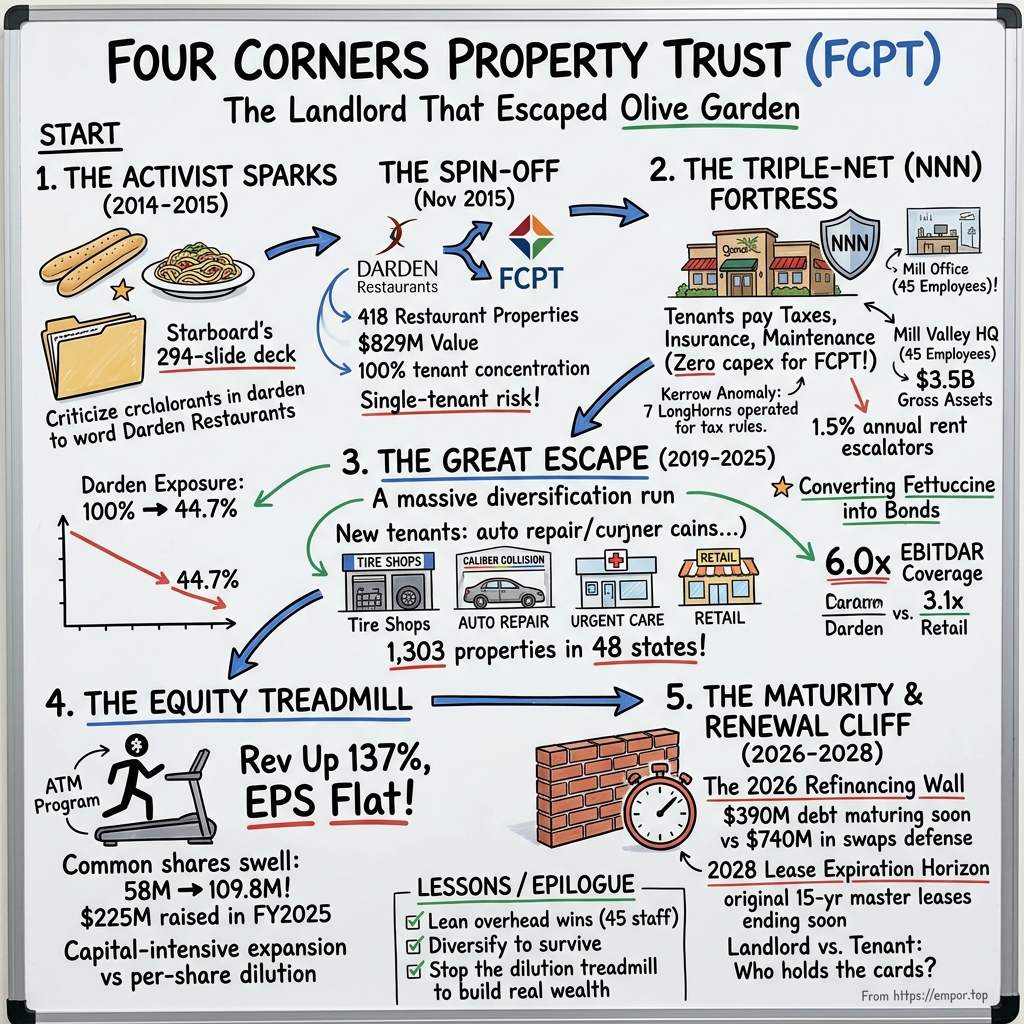
The point of all that buying was to dilute Darden. It worked. Darden's share of rent fell from 100% at the spin to about 45% at the end of 2025, with Olive Garden alone at about 32%, LongHorn at 9% and other Darden brands at 4%.4 The remaining 55% came from two new pools: about 459 restaurants run by other brands, providing roughly 29% of rent, and 379 non-restaurant retail properties, mostly auto service and medical uses, providing about 26%.4 The company that once lived or died by one tenant now has its fate spread across hundreds.
What the diversification actually bought
Here is the version most investors believe: FCPT took a risky, concentrated landlord and turned it into a diversified, safer one. The record supports half of that.
The half that holds is concentration. A Darden bankruptcy on day one would have been an existential event; today it would be a severe blow but not a fatal one. That reduced tail risk is a large part of why FCPT earned investment-grade credit ratings in 2022.89
The half that does not hold as neatly is quality. The best way to measure a restaurant tenant's ability to pay is rent coverage: the restaurant's earnings before rent, interest, taxes, depreciation and amortisation, divided by its rent. A coverage of 6 times means the restaurant earns six dollars for every dollar of rent it owes, so it could suffer a severe fall in sales before the rent became a burden. Olive Garden covers its FCPT rent about 6.0 times, and LongHorn about 5.9 times.4 Those are very strong figures. The properties FCPT bought from other restaurant brands average about 3.5 times, and the retail properties about 3.1 times.4
So the trade is plain. Every new dollar of rent from outside Darden has been, on average, a dollar from a tenant with roughly half the cushion of the legacy Olive Gardens. Coverage above 3 times is still healthy by industry standards, and FCPT has not suffered a material impairment from a tenant failure since its spin.4 But the record has only been tested by one real stress event, the 2020 shutdowns, when federal support propped up many small businesses. The diversified portfolio has not yet lived through a long consumer recession without government help.
Small checks, deliberate choices
FCPT's discipline shows up in the size of its bets. The average property costs a few million dollars, so no single failure can do much damage, and the team has avoided office buildings and big-box anchors that have hurt other net-lease landlords. Lenehan's team has also leaned toward national brands with corporate guarantees and toward properties in strong locations, on the theory that if a tenant fails, a well-located pad site can be re-let. That theory is sensible, but it is a theory: the company has not been forced to re-let large numbers of second-generation boxes at once.
The verdict, then, is that diversification narrowed FCPT's risk rather than eliminating it. The company swapped a single catastrophic risk, Darden, for many smaller ones, with tenants who earn less relative to their rent and who will feel a consumer downturn faster. That is probably a better trade than staying captive. It is not a free lunch. And it was paid for with shares.
V. The Equity Treadmill: Growth vs. Dilution
Every quarter, FCPT's earnings calls tend to sound the same. Analysts ask about acquisition volume, cap rates and the pipeline. Management reports another quarter of steady buying. The rent roll grows. The tone is calm, almost dull, which is how a landlord should sound. Yet a long-term shareholder who looks at the per-share numbers could be forgiven for asking what all that activity has done for them.
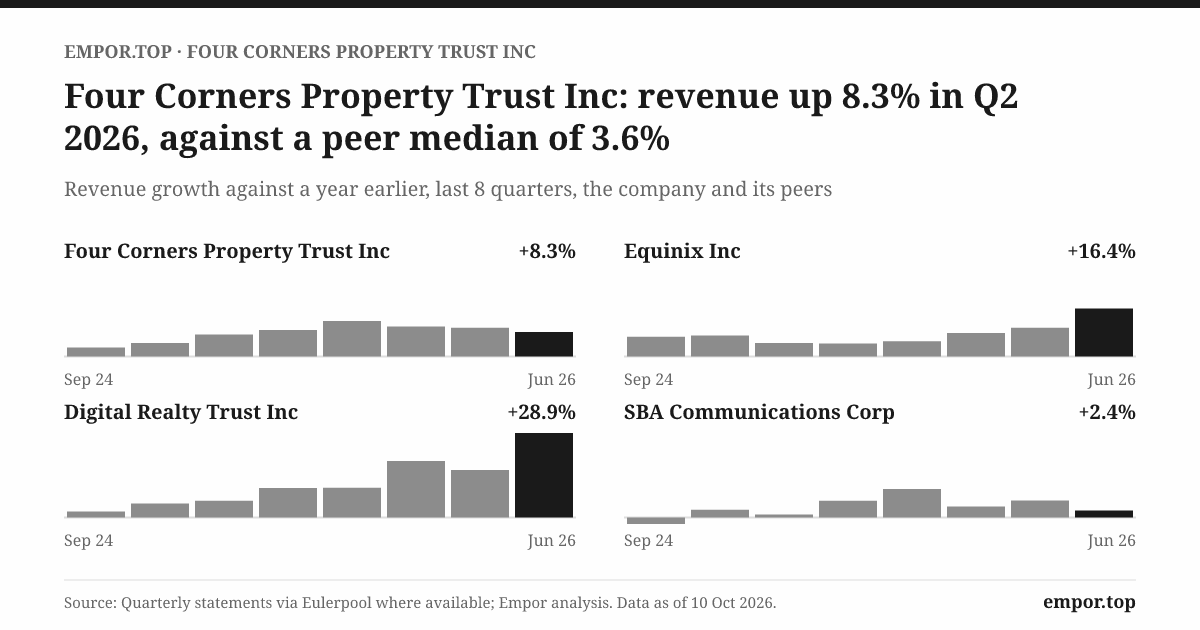
Here is the puzzle in one sentence. Revenue rose from $124m in 2016 to about $305m over the twelve months to June 2026, nearly two and a half times, while diluted earnings per share went from $1.16 in 2018 to about $1.10 today.47 The company more than doubled. The slice owned by each share did not grow at all.
Where the growth went
The answer is the share count. FCPT funds its buying in roughly equal parts from debt and from new shares. It sells those shares through an at-the-market program, which lets a company drip new stock into the market a little at a time rather than in one large offering. In 2025, FCPT sold about 8.2m shares this way at an average price near $28, raising about $225m, and it agreed forward sales of another 6.1m shares.4 It sold about 8.1m shares in 2024 and 5.8m in 2023.4 In October 2025 it opened a fresh $500m program.4 Shares outstanding rose from about 86m at the end of 2022 to about 110m by June 2026, up from roughly 58m in the years after the spin.47
Selling shares is not bad in itself. It is how REITs grow, because they must pay out most of their income and cannot retain much cash. The test is whether each new share buys more income than it dilutes. That depends on a spread: the yield on the property bought, called the cap rate, versus the cost of the money raised. If FCPT buys a building at a 7% yield and funds it with equity that costs, in effect, 5.5% and debt that costs 5.5%, the deal adds a little income per share. If the cost of equity rises toward the acquisition yield, the accretion vanishes.
A worked example
Take the simple arithmetic. Suppose the shares trade at $21, as they did in October 2026. The number that matters for a REIT issuing stock is the AFFO yield, adjusted funds from operations, which strips out depreciation and non-cash items. AFFO was $1.78 a share in 2025, so at $21 the stock offers an AFFO yield of about 8.5%.4 That is the cost of issuing new equity at today's price, in the sense that each new share must earn $1.78 to avoid diluting existing holders. Buying property at around 7% with equity costing around 8.5% would be dilutive. At $28, where the 2025 shares were sold, the AFFO yield was closer to 6.4%, and buying at 7% made sense.
In other words, the treadmill works when the stock is expensive and stops when it is cheap. The 2026 share price, about 20% below its 52-week high, has made the machine harder to run.5
The management defense, tested
Management's answer is that earnings per share is the wrong yardstick for a REIT, because depreciation on buildings, which mostly hold their value, distorts it. On AFFO, the company's preferred measure, the picture is better: it rose from $1.67 a share in 2023 to $1.78 in 2025.4 That is growth of about 3% a year, and over the long run AFFO per share has risen. The defense is legitimate, and AFFO is the right measure.
But even on management's terms, the growth is modest. Roughly 3% a year in cash per share, plus a dividend yield, is a respectable bond-like return. It is not compounding. Fees are not the issue here, since FCPT is internally managed and pays no external manager; the cost of growth is the dilution itself. The verdict is that the acquisition engine has preserved per-share value and edged it higher, but its main output has been size. A skeptical shareholder would ask management to show that each year's buying lifted AFFO per share by more than inflation, and to slow the buying when the stock is cheap.
The other half of the funding is debt, and that is where the interest-rate cycle comes in.
VI. The 2026 Refinancing Wall and Swaps Defense
On January 31, 2025, FCPT signed its Fourth Amended and Restated Credit Agreement, refreshing its bank facilities.10 For CFO Patrick Wernig, who had stepped up from inside the finance team after the retirement of his predecessor Gerald Morgan, the deal was housekeeping with a purpose: lock in bank capacity before a stack of maturities arrived.5
The debt itself is straightforward. At the end of 2025, FCPT owed about $1.2bn in principal. Roughly $590m was unsecured bank term loans, and about $625m was senior unsecured notes sold privately to institutional investors, with maturities spread from late 2026 through 2033.4 The $350m revolving credit line was undrawn at year-end, though about $49m was borrowed by June 2026.47 There is no secured mortgage debt of note, and more than 95% of the real estate is unencumbered, meaning lenders could be offered collateral in a crisis.4
The swaps shield
Term loans float with interest rates, which would normally leave a borrower exposed when rates jump. FCPT neutralised that with interest-rate swaps, contracts that exchange a floating rate for a fixed one. At the end of 2025, it had 22 swaps with about $740m of notional value, of which $560m was active and $180m set to start later, fixing rates at levels from about 1.5% to 4.4%.4 As a result, about 96% of its debt was fixed or swapped to fixed.4 Several of those swaps were struck when rates were near zero, which is why they show up as an asset on the balance sheet.7
The hedge has worked. When the Federal Reserve raised rates sharply in 2022 and 2023, FCPT's interest bill rose far less than it would have otherwise. But swaps defer the cost of higher rates; they do not abolish it. Each swap expires, and each note matures.
The wall
The maturity schedule is what matters now. A $100m term loan matures in November 2026, and $50m of notes at 4.63% come due in December.4 Two more term loans totalling about $175m fall due in 2027, and $90m in 2028, alongside notes.4 Further out sit notes issued during the cheap-money years at 2.74% and 2.99%, maturing in 2029 and 2031, which will reprice much higher when they roll; the 2033 notes, issued more recently, carry 6.44%.4 That last coupon is a fair guide to what new money costs.
The direction is clear even if the exact numbers are not: FCPT's average cost of debt will rise as cheap debt and cheap swaps roll off. The investment-grade ratings from Fitch (BBB) and Moody's (Baa3) help, because they keep the doors to the bond market open.89 Leverage is moderate, with net debt at roughly five and a half to six times EBITDA, and covenants have wide headroom: debt at about 40% of capitalisation against a ceiling of 60%.4
The dividend boundary
Then there is the dividend. In 2025, operating cash flow of about $192m covered the $144m cash dividend comfortably.4 Against AFFO, the payout was about 79%.4 Against GAAP net income, the payout was about 129%, which looks alarming but mostly reflects depreciation.4
What the arithmetic leaves is about $40m to $50m a year of retained cash. That is not enough to repay maturing debt or to fund acquisitions, so FCPT must keep borrowing and issuing shares. That is normal for a REIT, but it ties the dividend's growth to the capital markets. If refinancing pushes interest costs up by a few million dollars a year, the dividend remains covered, but the room to raise it shrinks. The dividend is safe under the current evidence; its growth is not guaranteed.
Debt, though, is the predictable part of the cost side. The bigger unknown sits on the revenue side, in the leases signed when the company was born.
VII. The 2028 Lease Expiration Horizon
Somewhere in Orlando, Darden's real estate team keeps a spreadsheet listing every restaurant it leases from Four Corners, with the remaining term beside each. At the end of 2025, the weighted average remaining term on the Olive Gardens was 4.8 years, and on the LongHorns 3.6 years.4 Those numbers are ticking down by a year every year. For FCPT, that spreadsheet is the single most important document it does not control.
The scale is large. Olive Garden occupies 316 FCPT properties and pays about $84m a year in cash rent, about 32% of the portfolio total.4 When those leases reach their initial-term ends, Darden will decide, restaurant by restaurant or in packages, whether to exercise its renewal options, negotiate new terms or leave. The bulk of that decision falls in the late 2020s and early 2030s, which makes it the largest rent re-pricing event in the company's history.4
Who holds the cards
The case for the landlord is store economics. A restaurant that earns six times its rent is a very good restaurant, and a tenant does not walk away from a very good restaurant. Moving an Olive Garden means building a new one, reopening, retraining staff and hoping the regulars follow. In nearly every case, renewing is cheaper. That is the strongest argument in FCPT's favour, and it rests on the tenant's own profitability rather than management's claims.
The case for the tenant is scale. Darden is FCPT's largest tenant by a wide margin and can negotiate in bulk. If it asks for flat renewals, or swaps a modest rent cut on weaker locations for extensions on strong ones, FCPT has limited room to say no, because re-letting dozens of large casual dining buildings at once would be slow and probably cheaper. Second-generation restaurant buildings often go to lower-rent users or need conversion. FCPT's 99.6% occupancy tells you it has handled small vacancies well; it does not tell you what happens with dozens at once.4
There is also a quieter signal. The renewal options embedded in the original leases are set out in the spin-off filings, and they typically let Darden extend at contracted rents, with the same escalators.3 Options are the tenant's right, not the landlord's. If the restaurants stay strong, Darden will most likely renew, and rents will continue to rise at the contracted pace, a modest but stable outcome. If any restaurants weaken, Darden can let those leases lapse.
What the market is waiting for
The verdict is that the renewal risk is real but narrower than the bears suggest. Darden is very unlikely to abandon highly profitable sites, so the probable outcome is extension at roughly current rents rather than a wave of vacancies. What FCPT is unlikely to get is a big rent increase, because the tenant holds most of the leverage. That makes the first large tranche of Darden renewals the event that will tell the market whether this landlord's legacy income is a bond that rolls over cleanly or one that rolls over at a discount.
Before that tranche arrives, it is worth asking a broader question: in a crowded market for exactly these kinds of properties, does Four Corners have anything competitors cannot copy?
VIII. Frameworks: Moat, Powers, and Competitive Stress Test
Imagine an auto repair property for sale in suburban Texas, leased to a national chain for fifteen years. A broker sends the package out. Bids arrive from Realty Income, the giant of the sector, from Agree Realty, from private buyers using 1031 exchanges, the tax rule that lets people roll real estate gains into new property, and from Four Corners. The winner will be whoever accepts the lowest yield. That auction is the competitive reality of the net-lease business, and it frames every claim about a moat.
FCPT's enterprise value is about $3.4bn.5 Its larger peers are many times bigger, and size matters because a bigger, more diversified landlord borrows more cheaply and can accept lower yields on the same building while still adding to its earnings. Against that backdrop, the market prices FCPT at about 14.6 times EBITDA and below its own history.5
Seven Powers, one by one
Hamilton Helmer's framework asks what gives a company both higher returns and a defence against rivals. Run FCPT through it and most of the boxes stay empty.
There is no cornered resource. Net-lease properties are bought in open markets, and FCPT holds no exclusive land rights, patents or unique relationships; anyone with capital can buy a similar building. There are no network effects, since one more property does not make the others more valuable. Brand plays no part: tenants do not pay higher rent to have FCPT as their landlord.
Scale economies cut against FCPT. Its smaller size means a higher cost of capital than the biggest peers, which is the one input that decides who wins auctions. Its lean staff partly offsets that, but overhead is a small cost compared with the cost of money.
Switching costs are where FCPT has something. A tenant signed to a ten- to fifteen-year lease, often with a corporate guarantee, cannot leave. That lock-in is real but temporary; it ends at renewal, which is exactly the Darden question.
Process power is the most interesting claim. FCPT's small team specialises in single properties costing a few million dollars, often from tenants without credit ratings, deals large REITs find too small to bother with. The evidence for that edge is the record: steady buying, few impairments, no material tenant disasters since the spin.4 The limit is that it has been tested in a benign decade, and the coverage gap between Olive Garden and the newer tenants shows where the risk sits. The honest verdict is that FCPT has a modest underwriting edge in a niche, not a durable moat.
Five Forces, in practice
Michael Porter's five forces point in the same direction. Tenant power is high where it matters most: Darden provides almost half the rent and can negotiate in bulk, while the newer franchisees are smaller and have less sway. Seller power is high too, because so many buyers chase the same properties that prices get bid up and yields squeezed. Substitutes for investor capital are everywhere, from industrial REITs to corporate bonds, which keeps FCPT's cost of equity tied to the wider market. Barriers to entry are low for buying property and higher for building an investment-grade borrowing record. And rivalry is intense, because the product, a long lease on a building, is largely a commodity.
The bull and the bear
The bull case is simple. Occupancy at 99.6% is excellent, Darden's coverage is strong, the leases push costs onto tenants, and at about 19 times earnings, or roughly 12 times AFFO, the market is pricing FCPT well below its own history while it pays a dividend yield of about 5%.5 If refinancing is orderly and Darden renews, the gap to history could close.
The bear case is equally simple. Share issuance keeps per-share growth slow, the cost of debt is going up, and Darden holds the leverage in renewals. On that view, the low multiple is a fair price for a slow-growing bond proxy with a renewal cliff.
The verdict is that FCPT is a well-run, small, commodity capital provider with one real asset, an unusually profitable anchor tenant, and one real liability, the same tenant's bargaining power. Two indicators matter most for tracking it: AFFO per share, which rose to $1.78 in 2025, and the share of rent from Darden, which fell to about 45%.4 A third, rent spreads on Darden renewals, does not exist yet.
That leaves the question of what this decade-long story teaches beyond FCPT itself.
IX. Playbook: Business & Investing Lessons
By now Starboard has long since moved on from Darden. The activists won their seats, got their spin-off and left behind a landlord that had to learn to stand on its own. It did, and the evidence came in 2020. When restaurants across the country closed their dining rooms, FCPT kept paying its dividend and the total paid that year rose, from about $78m in 2019 to about $86m in 2020.4 Over twelve years, operating cash flow ran at about 127% of net profit.4 Those facts belong to a sturdier business than a spin-off designed by an activist was expected to become. They also point to the lessons this company teaches.
The first lesson is about the illusion of size. Four Corners more than doubled its revenue and quadrupled its asset base, and its per-share earnings barely moved, because every step of growth was paid for partly with new shares. A landlord that grows by selling stock is running on a treadmill: the scenery changes, the position does not. The question for any capital-hungry company is never "how big did it get?" but "how much did each share get?"
The second is about overhead. Forty-five people overseeing about $3.5bn of property means that when tenants struggle, the landlord has little fat to cut and little need to cut it. Lean costs did not create FCPT's returns, but they protected them during the one real test. In a commodity business, the cheapest way to survive a bad year is never to have built the cost base that a good year tempts you into.
The third is about what actually protects a landlord. A tenant's credit rating and parent-company guarantee matter, but the thing that keeps an Olive Garden open is that the restaurant earns six times its rent. Coverage is the landlord's real collateral. A lease is only as good as the shop that pays it.
The fourth is about spin-offs. FCPT was a financial-engineering product, and if it had stayed captive to Darden it would be priced today as a derivative of casual dining. What turned it into an investable REIT was the decision to start buying from other tenants from the first years. Engineering creates the opportunity; operating turns it into a company.
Those lessons look backward. The verdict on whether FCPT is a patient compounder or a slow-motion value trap will come from three events still ahead.
X. Epilogue: The Three Tests of 2026–2028
Tonight, in October 2026, Four Corners stands at roughly $21 a share, with a 52-week low just below that and a dividend that the market prices at a yield above 5%.5 Over the next two years, three tests will decide which version of the story is true.
The first is the debt test. In the last weeks of 2026, a $100m term loan and $50m of 4.63% notes come due.4 The rate at which FCPT replaces them will show the market how fast the company's interest bill is rising. A refinancing close to the coupon of the recent 2033 notes would mean a few million dollars of extra annual interest, manageable against a dividend covered by cash flow. A much higher rate, or a delay, would tell the market the cost of growth has risen further.
The second is the renewal test. The first meaningful tranche of Darden renewals will arrive over the next few years. If Darden extends at contracted rents with escalators intact, the biggest overhang on the stock shrinks. If Darden extracts flat rents or cuts on weaker sites, the market will treat the remaining legacy leases as a slowly shrinking bond.
The third is the accretion test. Can management grow AFFO per share above roughly $1.85 without selling large amounts of stock at today's lower price? If it can, the treadmill becomes a ladder. If it cannot, the bear case that FCPT grows mainly in size will have been confirmed by its own numbers.
The tension that remains is the one this company was born with. It owns very good real estate under a very strong tenant, and it pays for its growth with its own shares. The next two years will tell investors which of those facts matters more.
XI. Outro: The Last Breadstick
Walk back into an Olive Garden today, and the breadsticks are still on the table, still free, still refilled. The activist presentation that mocked them in 2014 has become a piece of business folklore. The real estate it pointed to has become a public company that has paid out about $1bn in dividends since its spin and owns about $3.5bn of property across the country.4
The breadsticks were free, but the land under them turned out to be worth billions. That is FCPT's achievement and its limit at the same time. Four Corners Property Trust proved that you can make a fortune owning the ground beneath America's favourite chain restaurants, but true compounding only begins when you stop issuing shares to pay for the dirt.
References
-
Starboard Value Presentation on Darden Restaurants Transformation — Starboard Value LP, 2014-09-11 ↩↩↩
-
Form 10-12B/A (Registration Statement under Section 12(b)) — Four Corners Property Trust, Inc., 2015-10-21 ↩
-
Form 10-12B/A Exhibit 99.1 (Information Statement regarding Spin-off from Darden) — Four Corners Property Trust, Inc., 2015-10-21 ↩↩↩↩↩↩↩
-
Form 10-K (Annual Report for Fiscal Year Ended December 31, 2025) — Four Corners Property Trust, Inc., 2026-02-12 ↩↩↩↩↩↩↩↩↩↩↩↩↩↩↩↩↩↩↩↩↩↩↩↩↩↩↩↩↩↩↩↩↩↩↩↩↩↩↩↩↩↩↩↩↩↩↩↩↩↩↩↩↩↩↩↩
-
Definitive Proxy Statement on Schedule 14A — Four Corners Property Trust, Inc., 2026-04-16 ↩↩↩↩↩↩↩↩↩↩↩↩↩↩↩
-
Form 8-K (Results of 2026 Annual Meeting of Stockholders) — Four Corners Property Trust, Inc., 2026-06-08 ↩
-
Form 10-Q (Quarterly Report for Period Ended June 30, 2026) — Four Corners Property Trust, Inc., 2026-07-30 ↩↩↩↩↩↩
-
Fitch Affirms Four Corners Property Trust at 'BBB'; Outlook Stable — Fitch Ratings, 2022-03-24 ↩↩
-
Moody's Assigns Baa3 Issuer Rating to Four Corners Property Trust; Outlook Stable — Moody's Investors Service, 2022-05-18 ↩↩
-
Form 8-K (Fourth Amended and Restated Credit Agreement) — Four Corners Property Trust, Inc., 2025-02-03 ↩
 LinkedIn
 WhatsApp
 Reddit
 Hacker News
 Email
Email Kindle
 RSS Feed
 Spotify
 Apple Podcasts
 Amazon Music
 Audible
 YouTube