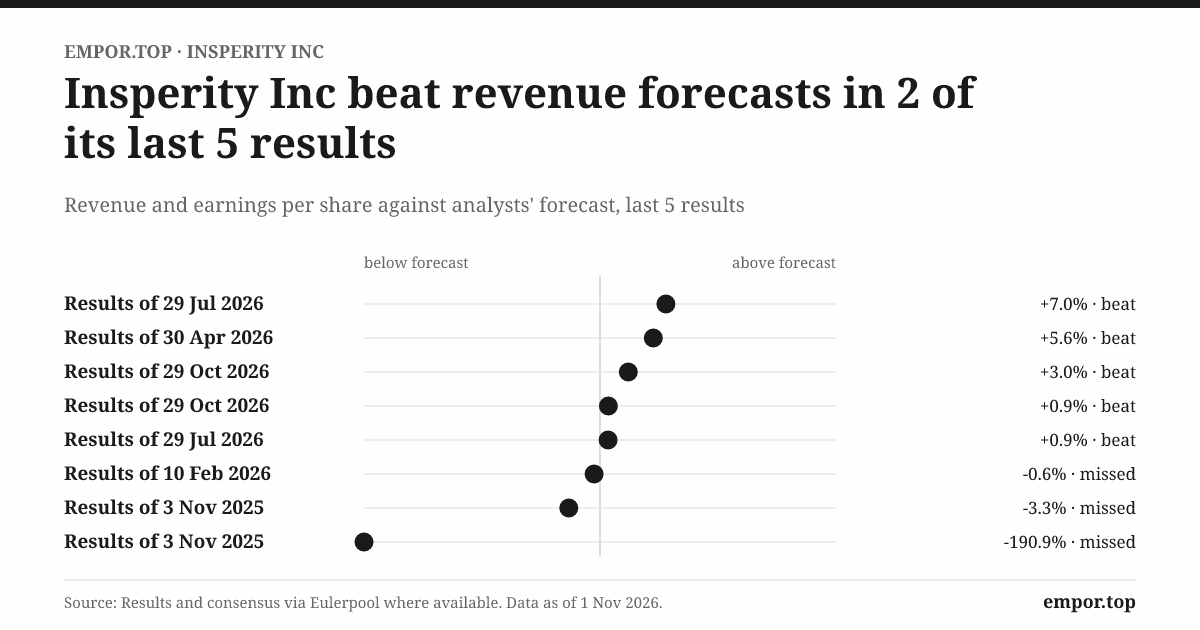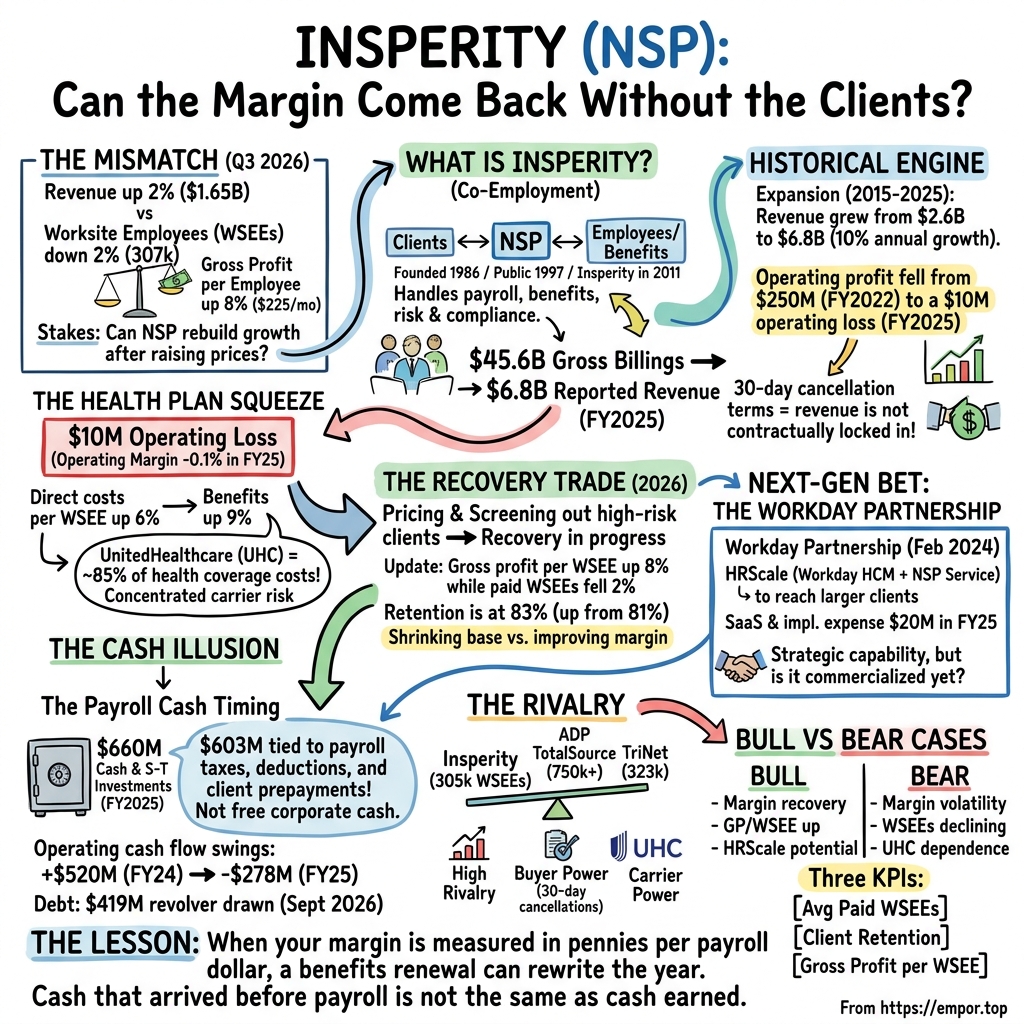
Insperity: Can the Margin Come Back Without the Clients?
I. The Quarter When Price Rose and People Left
Every other Friday, somewhere in the United States, a restaurant manager, a dental practice owner or the finance lead at a 90-person engineering firm watches a payroll run clear. The paychecks land. The withholding taxes go to the government. The health premiums go to the carrier. The workers' compensation coverage stays in force. And for several hundred thousand of those employees, the employer whose name sits beside the client's on the paperwork is a company in Kingwood, Texas, that most of them have never thought about: Insperity.
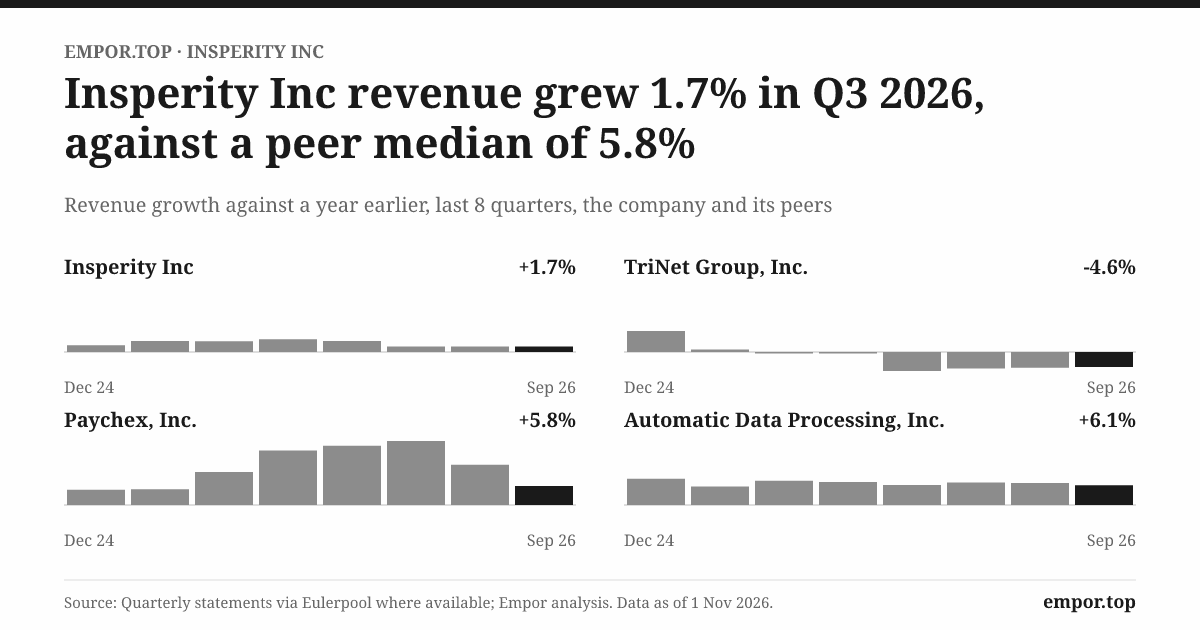
On October 29, 2026, Insperity reported its third quarter, and the numbers carried a quiet contradiction. Revenue rose about 2%, to roughly $1.65 billion.12 Yet the number of people flowing through the system went the other way. Insperity averaged 307,265 paid worksite employees in the quarter, about 2% fewer than a year earlier.1 The company was earning more from a smaller crowd. Gross profit per worksite employee, the single figure that best captures what Insperity keeps after paying the benefits, payroll taxes and insurance bills attached to each person, rose about 8%, to $225 a month from $208.12
Do that multiplication and the shape of the quarter becomes clear. Roughly 307,000 people at $225 a month is about $207 million of gross profit for the three months. A year earlier, about 313,000 people at $208 produced roughly $196 million. So gross profit grew around 6% even though the headcount shrank, because each employee became meaningfully more profitable. That is what repricing looks like from the inside. It is also what a business looks like when it is choosing margin over volume.
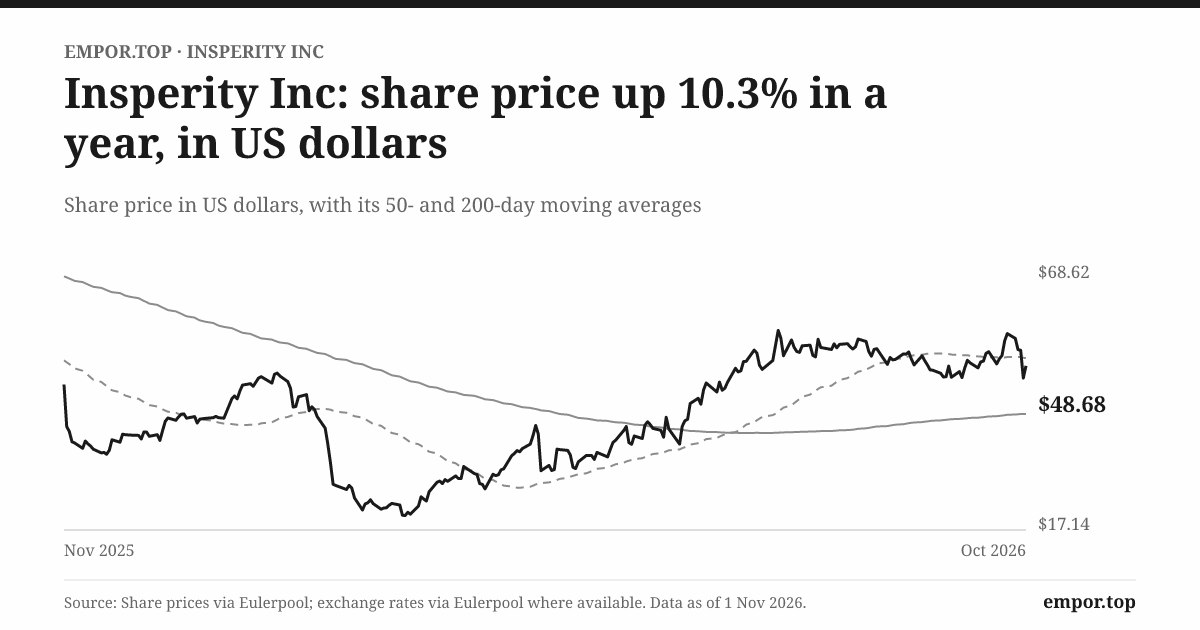
Why would a company make that choice? Because a year earlier it had no margin to speak of. In fiscal 2025, Insperity generated about $6.8 billion of revenue and still posted an operating loss of about $10 million.34 The year before, it had earned $117 million of operating profit.3 For a company that had compounded profitably for most of its public life, that loss was a shock, and the market treated it as one. At its worst point over the past year the stock traded below $20; by the start of November 2026 it was back near $49, still about 12% below its 52-week high. Over five years, the deepest drawdown from peak to trough was about 85%.
So the third quarter of 2026 is the moment to ask the question this story turns on. Can Insperity restore its earnings power by charging more, without losing the clients and worksite employees that create the business in the first place?
That question breaks into four smaller ones, and each will get its own chapter. The first is whether the margin collapse was a temporary shock from medical and insurance costs, or a sign that something in the model itself had weakened. The second is whether Insperity has an edge strong enough to keep clients when prices rise, given that most of them can walk away on a month's notice. The third is whether the company's partnership with Workday, the enterprise software giant, can open a new growth engine among larger employers, or whether it remains a promise. The fourth is about money in the bank: Insperity's balance sheet shows hundreds of millions of dollars of cash, but how much of it actually belongs to the company?
Before any of that, it helps to understand the scale of what passes through Insperity's hands, because the scale is both the business and the trap. In fiscal 2025, Insperity billed its clients about $45.6 billion.3 That is not a typo, and it is not revenue in the usual sense. Most of that money was the clients' own payroll: wages that Insperity collected from clients and paid out to their employees. After stripping out about $38.8 billion of worksite employee payroll costs, Insperity's reported revenue was about $6.8 billion.3 Out of that $6.8 billion came the health premiums, the payroll taxes, the workers' compensation costs, and only then the gross profit that funds Insperity's own salespeople, service teams, technology and shareholders.
Think about what that means. For every $100 a client sends Insperity on payday, roughly $85 goes straight out the door as wages. Most of the remaining $15 goes straight out again to carriers, tax authorities and insurers. The slice Insperity keeps as gross profit is closer to two dollars. Its operating profit, in a good year, is well under a dollar. In fiscal 2025 it was below zero.
That is why the third quarter matters so much and settles so little. An 8% improvement in gross profit per employee is enormous in a business that lives on pennies per payroll dollar. But it was bought alongside a shrinking client base, and a recovery that depends on fewer, more profitable clients is a different company from the one that spent three decades growing headcount year after year. The visible repair is in the unit economics. The open question is whether growth can come back after the price and cost repair is done.
To answer that, the story has to start with what Insperity actually sells, and why a business owner would hand a stranger the job of being their co-employer.
 Subscribe on LinkedIn
II. A Co-Employer in Every Payroll
In 1986, Houston was in the middle of an oil bust. Office towers emptied, banks failed, and the small businesses that survived did so by keeping overhead brutally low. That was the year Paul Sarvadi and Gerald McIntosh founded Administaff, betting that small companies would pay a specialist to take on the parts of being an employer they were least equipped to handle: payroll, benefits, insurance, compliance and the endless paperwork of human resources.3 The bet sounds obvious now. It was less obvious then, when the idea of a third party sharing employer responsibilities with a ten-person firm was a novelty that regulators and insurers barely knew how to classify.
Sarvadi became the company's defining figure. He has led it through its public listing on the New York Stock Exchange in 1997, through the renaming to Insperity in 2011, and through every cycle since; in 2025 he remained both chief executive and chairman.35 Few listed American companies have had the same leader for so long. That continuity is an asset when the business depends on a culture of service, and a question when the business needs a change of direction. Both sides of that will matter later.
What the client actually buys
The legal heart of the business is co-employment. When a company signs with Insperity, its employees become, for certain purposes, Insperity's employees too. Insperity becomes the employer of record for payroll and tax administration. It sponsors the health and welfare benefits plans the employees join. It provides workers' compensation coverage. It supplies human-resources advice, compliance support and a technology platform for the paperwork. The client, meanwhile, keeps running the actual business: hiring, firing, directing the work, setting pay.3
The simplest analogy is a shared lease on the employer's chair. The client sits in it for everything to do with the work itself. Insperity sits in it for the administrative and insurance machinery behind the work. A 40-person firm cannot negotiate health insurance like a company with 300,000 employees, cannot afford a full HR department, and cannot easily track employment law across every state where a remote worker might live. By pooling hundreds of thousands of worksite employees, as the industry calls them, a professional employer organization, or PEO, offers small and midsize firms something closer to big-company benefits and big-company compliance.
That is the promise. The economics behind it are where the story lives.
Insperity bills clients on each payroll cycle. The bill covers the payroll itself, plus a markup designed to cover payroll taxes, benefits and workers' compensation, and then leave a margin on top.3 The markup is effectively Insperity's price, and it is set in advance. Contracts generally fix pricing for 12 months, and for most clients either party can cancel on 30 days' notice. Some contracts with middle-market clients set pricing for two years.3
That structure creates a peculiar kind of recurring business. The activity recurs relentlessly: every payroll run generates an invoice, and as long as a client stays, revenue arrives like clockwork. But the contract does not lock anything in. A software company might hold a three-year subscription with cancellation penalties. Insperity holds a client relationship that can end with a month's notice. The company does not disclose a recurring-revenue share or any minimum commitment, because the model does not really have one. Recurring payroll is not the same as recurring contracted revenue, and investors who treat it that way are pricing in a stickiness the contracts do not guarantee.
The pricing structure also explains why this business is so sensitive to cost surprises. Insperity sets its price for a year based on its best estimate of what benefits and insurance will cost. If health claims come in higher than expected, the company eats the difference until it can reprice at renewal. It is, in part, an insurance business with a payroll front end. The customer pays a known price; Insperity carries the risk that the true cost turns out to be higher.
How Washington gave the industry a name
For years, PEOs operated in a gray zone. Clients worried about whether payroll taxes remitted through a third party would really count as paid, and about who the Internal Revenue Service would hold responsible if a PEO failed. Congress addressed that in 2014 with legislation that created a voluntary certification program for professional employer organizations, under which a certified PEO takes on federal employment-tax liability for the wages it pays. Insperity received IRS certification in 2017.3
That mattered for the industry's legitimacy. It gave a skeptical CFO a reason to believe the arrangement was safe, and it raised the bar for fly-by-night operators. But certification is a license to compete, not a guarantee of winning. Every serious competitor can obtain the same status, and nothing in the certification itself confers pricing power or makes clients harder to lose.
It is also worth being precise about what Insperity is not. It reports a single operating segment.3 There are add-on services, and there is the newer Workday-based offering called HRScale, but the filings do not show any of them as a separate, material business. Insperity is a PEO. Its fortunes rise and fall with the core service it calls PEO HR Solutions, and in fiscal 2025 that service covered about 310,000 average paid worksite employees.3
So the verdict on what Insperity sells is clearer than its marketing sometimes suggests. This is a service and risk-management relationship wrapped around payroll, not a software company with payroll attached. The payroll cycle gives it rhythm and a steady stream of transactions. The short cancellation terms mean that rhythm can stop.
For most of its history, though, the rhythm only accelerated. For three decades the formula was simple: add more worksite employees, keep each one profitable, and let the operating leverage do the rest. That growth engine is the next chapter.
III. When Each Worksite Employee Became the Growth Engine
In February 2017, Insperity reported its results for 2016, and they read like a company hitting its stride. Revenue rose about 13%, to roughly $2.9 billion.6 Operating profit jumped from about $66 million to about $106 million, and net income rose by roughly two-thirds, to about $65 million.6 Management credited the formula that had become the company's signature: double-digit growth in paid worksite employees, combined with operating leverage, meaning that each additional employee added more gross profit than it added overhead.6
That was the engine in its purest form. Insperity's corporate costs, from its service centers to its sales force to its technology, did not need to grow as fast as the number of worksite employees it served. So when the employee count grew quickly and the gross profit per employee held steady, profit grew much faster than revenue. A business earning thin margins on a huge flow of payroll could still compound earnings at a remarkable pace, as long as the flow kept widening.
And it did widen. Revenue climbed from about $2.6 billion in fiscal 2015 to about $6.8 billion in fiscal 2025, a compound growth rate of roughly 10% a year over the decade.3 Operating profit peaked at about $250 million in fiscal 2022.3 For a long stretch, Insperity was one of the cleaner growth stories among American business services companies: no transformational acquisitions, no conglomerate sprawl, just more clients, more employees and steady improvements in what each employee contributed.
That point deserves emphasis because it shapes how the current trouble should be read. Insperity's historical growth was organic. The company did not buy its way to scale. It sold its way there, one small business at a time, through a direct sales force that pitched owners on the value of outsourcing the employer's burden. Which means its growth always depended on three things working at once: winning new clients, keeping existing ones, and those clients hiring more people.
The 2011 rebrand and additional HR services did not change the core PEO economics, which still turn on worksite employees.3
The pandemic test, and what it did not prove
The pandemic should have been a catastrophe for a business whose volume depends on client employment. In fiscal 2020, revenue dipped only slightly, by less than 1%, and operating profit actually rose a little, to about $195 million.3 Then fiscal 2021 and 2022 brought a burst: revenue grew about 16% and then about 19%.3
The bullish reading of that period is that small businesses discovered, in a crisis, how much they needed a partner who understood emergency loan programs, shifting public-health rules and remote-work compliance. There is truth in that. But the pandemic also scrambled the normal signals. Hiring rebounded sharply after lockdowns, which flattered volume. Government relief programs, temporary payroll-tax deferrals and unusual claims patterns moved cash and costs around in ways that were not repeatable. Demand for HR help was real. Treating the pandemic years as proof of a permanent new growth rate would be a mistake, and the years that followed show why.
The slowdown that came before the loss
After the fiscal 2022 peak, the topline kept rising but the pace fell away. Revenue growth slowed to about 9% in fiscal 2023, then to less than 2% in fiscal 2024, before recovering slightly to about 3.5% in fiscal 2025.3 Over the three years from fiscal 2022 to fiscal 2025, revenue grew only about 5% a year, roughly half the decade's rate.
Meanwhile, profit did not merely slow. It collapsed. Operating profit fell from its fiscal 2022 peak to a $10 million loss in fiscal 2025.3 Revenue grew by nearly $1 billion over those three years. Operating profit fell by about $260 million.
That divergence is the most important fact in Insperity's recent history. It says the old engine did not simply run out of fuel. Something started moving in the wrong direction inside each unit of revenue. Fewer new employees would have produced slower growth. What happened instead was that each employee became less profitable, and with margins this thin, a small deterioration per head overwhelmed everything else.
Then, in early 2024, Insperity reached for something new. It announced an exclusive partnership with Workday to build an offering for larger, more complex employers.7 That move will get its own chapter, because it is the closest thing Insperity has to a new growth engine. For now, it is enough to note its timing. It arrived just as the old engine was faltering, and it is a recent strategic turn rather than the next step in a proven diversification story. Insperity has not, in its own record, built a second business of material size alongside the PEO.
So the verdict on the growth years is a split one. The decade of expansion was real, organic and impressive, built on adding employees and keeping each one profitable. But the recent slowdown means the topline can no longer be read as a continuation of that run, and the profit collapse means the old formula, on its own, stopped working. To understand why it stopped, the story has to follow the money to the place where most of it went: the health plan.
IV. The Health Plan That Swallowed the Margin
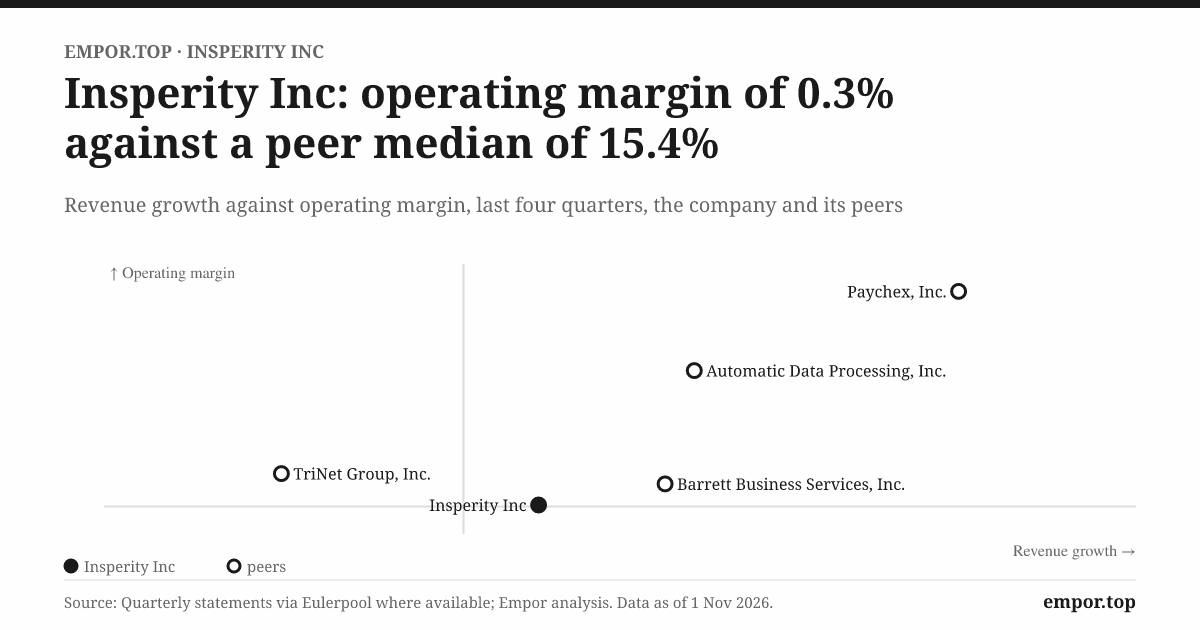
Picture the moment Insperity's finance team closed the books on fiscal 2025. Revenue had grown.34 By the usual instincts of a growth company, that should have been a decent year. Instead the income statement ended in an operating loss after a profitable year.34 Operating margin, which had been about 1.8%, turned slightly negative.3
The mystery is not where the revenue went. It went where it always went. The mystery is where the profit went, and the answer sits in a single comparison. In fiscal 2025, Insperity's pricing per worksite employee rose about 3%. Its direct costs per worksite employee rose about 6%. Inside those direct costs, benefits costs per participant rose about 9%.3
That is the whole collapse in miniature. Insperity's price is set in advance, mostly for a year at a time. Its costs are discovered in arrears, as claims come in. When costs outrun price by three percentage points on a cost base that consumes the overwhelming majority of revenue, the gross profit cushion shrinks fast. And because Insperity's operating margin had never been wide, that shrinkage did not merely trim profit. It erased it.
A chain of small gaps
The causal chain runs in three links. The first is health care. Insperity, as the sponsor of health plans covering a large share of its worksite employees, absorbs the claims those employees generate, so when the cost of care per participant jumped, the company felt it directly rather than passing it to an insurer. The second link is workers' compensation, the insurance that pays for workplace injuries, where costs also rose faster than the pricing built into client contracts. The third is Insperity's own operating expenses, the cost of its people and systems, which did not shrink to match the weaker gross profit.3
Each of those links, on its own, would have been manageable. Together, in a business keeping two dollars of gross profit from every hundred billed, they were enough to turn a profitable year into a loss.
It helps to put the swing in dollars a business owner would recognize. The move from a 1.8% operating margin to a slightly negative one, on roughly $6.8 billion of revenue, works out to about $130 million of lost operating profit in a single year. Spread across about 310,000 worksite employees, that is roughly $35 a month per person. That is the whole difference between a solidly profitable Insperity and a loss-making one: about the price of a modest lunch out, per employee, per month. No client would notice a $35 monthly increase buried in an invoice covering thousands of dollars of wages and benefits. Insperity's shareholders noticed its absence very clearly.
The consensus explanation is that 2025 was a medical-cost shock, an industry-wide event that hit every employer and every PEO. That is partly true. Health inflation was real and widespread, and Insperity did not cause it. But the record also shows that the problem built over several years, not one. Operating profit had already fallen by more than half between fiscal 2022 and fiscal 2024, before the worst of the 2025 cost surge. A pure one-year shock would not produce a three-year slide. The more accurate reading is that Insperity's pricing and risk selection lagged its cost trend for a sustained period, and 2025 was the year the lag became impossible to absorb.
The carrier on the other side of the table
There is a second, structural reason the health plan matters so much: concentration. UnitedHealthcare accounts for about 85% of Insperity's health-insurance coverage costs.3 The primary contract with United runs through December 31, 2028, but either side can terminate it on 180 days' notice.3 In the third quarter of 2026, about 61% of Insperity's worksite employees were covered under its health plans.1
Think about the bargaining position that creates. Insperity's single most important input is health coverage, and the vast majority of it comes from one carrier. If United changes its pricing, its network or its appetite for the relationship, Insperity has limited room to shop elsewhere quickly, because moving tens of thousands of covered employees to a new carrier is slow, disruptive and risky for client satisfaction. The contract term offers some stability. The six-month termination right means that stability is less firm than a 2028 end date implies.
The arrangement is also more complicated than a simple premium. Insperity bears a large share of the claims risk on its United plan, which is why the company's reported health costs depend on estimates. When a worksite employee visits a doctor in December, the claim might not be submitted and paid until months later. At year-end, Insperity must estimate how much it owes for care already delivered but not yet billed. These are called incurred-but-not-reported claims.
Insperity's auditor singled out exactly that estimate as the critical audit matter in the 2025 audit: the estimation of incurred-but-not-reported United health-insurance claims, which depends on judgments about claims completion rates and loss trends.3 The audit opinion was clean, with no material weakness reported.3 But the flag is a useful reminder. The cost trend investors see is partly an actuarial judgment. If those estimates prove too low, future quarters absorb the correction; if too high, future quarters get a release. Either way, a reported improvement in medical costs is not entirely an observed fact until the claims fully mature.
For 2026, Insperity elected a $500,000 per-claimant annual limit on its exposure, a form of stop-loss protection that caps how much any single catastrophic claim can cost the company.1 That reduces the risk from a handful of extremely expensive cases, though it does nothing about broad-based cost inflation across the whole covered population.
What the third quarter does and does not show
By the third quarter of 2026, health costs per covered employee were running about 3.7% above the prior year.1 That is a far gentler pace than the 9% surge of 2025, and it explains much of the gross profit recovery. Management also pointed to continuing pressure from claims severity and workers' compensation costs.18
So the improvement is real, but it would be a mistake to describe it as the end of medical-cost risk. A slower increase is still an increase. And the gross profit recovery depends heavily on Insperity having priced its 2026 contracts for a cost trend that is now coming in lower than feared. If the next renewal season brings another spike, the same mechanism that crushed 2025 will turn against the company again.
One risk that is notably absent is customer concentration. No client accounted for 10% or more of revenue in the 2025 annual report or the third-quarter 2026 filing, and Insperity does not disclose top-five or top-ten client shares.31 The geographic exposure it does flag includes Texas, its home market, which leaves it sensitive to regional economic conditions but not dependent on any single customer.3 The concentration that matters for Insperity is on the supply side, not the demand side.
The verdict, then, narrows the comfortable story. The margin collapse came from health and workers' compensation costs rising faster than pricing, compounded by operating expenses that did not flex down, rather than from any collapse in revenue. Insperity has the tools to fix that, chiefly the ability to reprice at renewal. But concentrated carrier exposure and the judgment embedded in claims reserves mean the recovery depends partly on risks Insperity does not control. The next chapter is about how hard it pulled the one lever it does control, and what that cost.
V. Pricing Bought Back Profit—and Cost Volume
On the third-quarter call in late October 2026, Paul Sarvadi had a familiar job and an unfamiliar message. For most of his three decades as a public-company chief executive, the message had been growth: more clients, more worksite employees, a bigger sales force. This time the priority was margin recovery, and he described progress on it alongside the fall selling and renewal season, the period each year when Insperity signs the bulk of its new business and resets pricing with existing clients.8 The average worksite employee count was still falling.18
That is the trade at the center of 2026. To repair the damage of 2025, Insperity did two things. It raised prices, pushing its markup up to reflect the higher cost of benefits and insurance. And it got more selective about whom it served, screening out categories of clients whose risk profile, in health claims or workplace injuries, made them unprofitable at any price clients would accept.13 Both moves improve unit economics. Both also shrink the client base, at least at first, because some clients leave rather than pay more and some prospects are turned away.
The results show exactly that pattern. Gross profit per worksite employee rose about 8% in the third quarter, while average paid worksite employees fell about 2%.1 For the first nine months of 2026, adjusted EBITDA, management's preferred measure of operating earnings before noncash and certain other items, rose about 18%.2 Net income for those nine months reached about $36 million, up from about $26 million a year earlier.1 The third quarter alone still showed a GAAP net loss of about $1 million, though that was a sharp improvement from a $20 million loss a year earlier.1
Management has also been candid that the cure carries side effects. In its own filings, the company said its margin recovery efforts hurt new-client sales and retention.1 That is an important admission, because it confirms that the volume decline is at least partly self-inflicted. Insperity is not losing employees only because small businesses are hiring less. It is losing some because it chose to charge more and to say no more often.
What retention actually tells you
The best evidence for Insperity's competitive strength is client retention, and it improved. In fiscal 2025, the company retained about 83% of its clients, up from about 81% in 2024 and close to its five-year average of about 84%.3 Given that 2025 included the start of aggressive repricing, holding retention near its historical level is a credible sign that many clients value the service enough to absorb a higher price.
But retention is an incomplete moat signal, and the numbers bound it. An 83% retention rate means roughly one client in six leaves every year. Those clients can cancel on 30 days' notice. They leave, by the company's own account, for reasons including price or service, competition from other providers, and a decision to bring HR back in-house.3 The improvement from 81% to 83% is welcome, but it returns Insperity to its normal level rather than lifting it above. And the 2026 repricing, which bit harder than 2025's, has not yet produced a full-year retention figure.
That leaves the retention argument intact but unproven. It shows Insperity can hold most clients through a price increase. It does not yet show the company can hold them through a sustained one while still adding enough new clients to stop the shrinkage.
Prepared remarks versus the Q&A
The difference between what a management team emphasizes and what analysts ask about is often revealing, and the October call was no exception. In prepared remarks, the emphasis was margin recovery: gross profit per employee, adjusted EBITDA, the improving cost trend.8 When analysts pressed on the sales picture and on HRScale, the answers moved to pipeline and lead flow, the early indicators of business to come, rather than signed clients and revenue already booked.8
That distinction matters. A healthy pipeline is necessary for growth, but it is not growth. Pipeline converts into worksite employees only after contracts are signed, onboarding completes and the first payroll runs. Until Insperity reports that conversion, the claim that volume is about to turn rests on management's reading of leading indicators, not on results.
The founder, the pay and the scorecard
Management credibility here is mixed but testable. Sarvadi has run the company for decades, and that tenure includes many years of profitable growth that few PEOs matched. The margin program he is now leading is producing reported gains. At the same time, fiscal 2025 ended in a loss after years of profit, and the strategy has explicitly shifted to recovery over growth. A long-tenured founder deserves credit for building the business; the same tenure means the pricing lag of 2023 to 2025 happened on his watch.
Pay offers a sharper lens. Sarvadi's reported total compensation for 2025 was about $16.8 million, up from about $9.4 million in 2024.5 The increase came mostly from stock awards of about $14.6 million, which included special performance awards granted as the company pursued growth and margin recovery; his non-equity incentive pay was about $1.0 million.5 Over the same year, GAAP net income swung from about $91 million to a loss of about $7 million.3 Performance-based equity can be aligned with shareholders if the hurdles are demanding, but the optics of the largest pay package in years arriving in the company's worst year are hard to miss.
Sarvadi is also a large owner. The 2026 proxy showed him holding about 1.47 million shares, or 3.86% of the company, making him the largest disclosed individual holder.5 At the share price in early November 2026, that stake was worth roughly $70 million, which gives him meaningful exposure to the outcome. BlackRock, with about 13.6%, was the largest institutional holder.59
Shareholders largely went along. At the May 2026 annual meeting, say-on-pay passed with about 30.9 million votes for and 1.9 million against. A plan amendment adding about 1.62 million shares to the long-term incentive plan also passed, but with more visible dissent, about 2.5 million votes against.10 That is not a revolt, but it shows some investors were more comfortable with this year's pay than with expanding the pool for future awards while earnings were depressed.
There is one older trust check worth noting, kept in proportion. In 2021, Insperity resolved a class action brought on behalf of participants in its worksite employee 401(k) plan, which alleged excessive fees and imprudent investment options.11 Retirement-plan fee suits were common across corporate America in those years, and the settlement says nothing directly about whether the current recovery plan is working. It is a reminder, though, that the trust Insperity sells to clients extends to how it manages their employees' benefits, and lapses there carry reputational cost.
The verdict on the recovery plan, then, is precise. The first evidence says pricing and client selection are restoring unit economics, with retention steady enough to suggest the service holds value. It does not yet show that volume has stabilized. The accurate claim is recovery in progress, not growth engine restored. Three numbers will settle which it becomes: average worksite employees, client retention and gross profit per worksite employee. If all three move in the right direction together, the repricing worked. If the last improves while the first two deteriorate, Insperity is getting more profitable by getting smaller.
Which brings the story to the part of Insperity's plan that is meant to make it bigger again.
VI. Workday Offers a Bigger Client—But Can It Deliver?
On February 8, 2024, Insperity and Workday announced their partnership.7 On paper, it was a striking pairing. Workday is one of the dominant providers of human capital management software to large enterprises, the systems that run hiring, payroll, performance and workforce planning for many of the world's biggest companies. Insperity is a high-touch service business built for small and midsize firms. The idea was to combine the two: Workday's technology with Insperity's HR service model, aimed at businesses that had outgrown basic tools but did not want to build a full HR department.7
For Insperity, the logic was compelling. Its traditional sweet spot is smaller businesses. As clients grow, they often outgrow a PEO's standard technology and want something more powerful and configurable. Some leave. Others never sign up in the first place because they already run enterprise software. A Workday-based offering could, in principle, let Insperity keep growing clients longer and reach bigger ones it previously could not serve.
The resulting product is called HRScale. It pairs Workday's human capital management platform with Insperity's implementation work and ongoing HR support.12 It is an extension of the core service proposition, the same co-employment-adjacent expertise delivered through a more sophisticated technology layer, not a separate business with its own disclosed segment or revenue line.312
Capability is not commercialization
Here the story needs discipline, because partnership announcements are easy to overread. A press release with a famous partner is a capability. A product page is a capability. Neither is revenue.
What can be measured is cost. Insperity's Workday-related software licensing and implementation expense fell from about $29 million in fiscal 2024 to about $20 million in fiscal 2025.3 Amortization of capitalized implementation costs also fell, from about $11 million to about $5 million.3 Capital expenditure overall was about $31 million in fiscal 2025, down from about $40 million in 2023.3 Insperity does not report research and development as a separate line, so there is no clean way to measure how much it is investing in product versus running existing systems.3
Falling technology spending in a year of financial strain can be read two ways. The optimistic reading is that the heavy build phase is over and the product is moving to commercial deployment. The skeptical reading is that the company is rationing investment in its main growth bet because its core business can no longer afford it. The filings do not settle which. What they do show is a company exercising restraint across the board while making a selective bet, which is a reasonable posture, but not one that signals confidence in a fast commercial ramp.
The more important gap is on the revenue side. Insperity's filings do not establish material HRScale revenue, signed client counts or any measurable contribution to worksite employees or gross profit. Average paid worksite employees were about 305,000 for the first nine months of 2026, down about 1%.1 If HRScale were bringing in large numbers of employees from bigger clients, that would be hard to see in a declining total.
What the call revealed
When analysts asked about HRScale on the third-quarter call, management's description stayed early-stage: interest and pipeline, rather than reported client wins at scale.8 Compare that with the launch language of February 2024, which promised to provide best-in-class HR service and technology to small and midsize businesses.7 More than two and a half years later, the gap between that ambition and disclosed commercial results remains wide.
The same caution applies to artificial intelligence. Insperity has launched AI-oriented messaging, and management argues that the workforce changes AI brings could increase employers' need for HR guidance. But on the third-quarter call, management said it was too early to judge the effect on sales or retention.8 That is an honest answer, and it should be taken at face value. AI is a possible change in the market Insperity serves, not a current Insperity advantage.
There is also a risk inside the opportunity. HRScale aims at larger, more complex employers, which demand more from implementation and service. If Insperity stretches its service teams to support those clients without matching revenue, it could raise costs ahead of income, exactly the pattern it is trying to escape. And bigger clients have more bargaining power over price, which is a different dynamic from the small-business core.
The verdict is that HRScale is strategically relevant and commercially unproven. It could extend Insperity's reach to larger clients, and the partnership gives it a credible technology foundation it could not easily build alone. But the record so far is one of technical integration and sales messaging. Signed clients, worksite employees and gross profit will determine whether it matters, and until Insperity reports those, it belongs in the optionality column, not the earnings model.
If HRScale is the part of the story most likely to be overrated by optimists, the next part is most likely to be misread by everyone: the cash.
VII. The Cash Balance That Belonged to Payroll
At the end of fiscal 2024, Insperity's cash flow statement looked spectacular. Operating cash flow was about $520 million, more than five times net income of about $91 million.3 A year later, the same line read negative $278 million.3 The company had swung by about $800 million in operating cash flow while its operating profit moved by roughly $127 million. Something other than earnings was driving the cash.
That something is payroll timing. Because Insperity collects payroll before paying employees, tax authorities and benefit providers, the timing of those payments can swing its reported cash. If a payroll date falls just before a reporting period ends, Insperity may be holding withheld taxes it has not yet remitted, which inflates cash and the matching liability. If the timing falls the other way, it has already paid out, and cash looks thin.
The cash flow statement shows the swing directly. In fiscal 2024, the line for payroll taxes and other payroll deductions payable contributed an inflow of about $335 million.3 In fiscal 2025, the same line was an outflow of about $357 million.3 Those two movements alone account for most of the reversal between the two years. Neither one says much about how profitable Insperity actually was. They are the business equivalent of checking a bank balance the day before rent is due versus the day after.
How much of the cash is really Insperity's
The balance sheet makes the same point more starkly. At the end of fiscal 2025, Insperity reported about $660 million of cash and marketable securities. Of that, about $603 million was associated with payroll tax withholdings, deductions and client prepayments, money Insperity was holding on behalf of clients and their employees.3 The company's own adjusted cash measure, which strips those amounts out, was about $57 million.3 By September 30, 2026, reported cash was about $599 million, including about $480 million of payroll-associated funds, leaving adjusted cash of about $119 million.1
So the headline cash figure overstates freely available corporate liquidity by a wide margin. An investor who looks at $600 million of cash against a market value of about $1.8 billion might conclude that a third of the company is backed by money in the bank. In reality, the cash Insperity could use for its own purposes was closer to a tenth of that headline figure at year-end 2025.
None of this is hidden. Insperity discloses the adjusted figure itself. But the distinction matters for how the long-run cash record should be read. Over the twelve years from fiscal 2014 to fiscal 2025, operating cash flow totaled about $2.3 billion, nearly twice net income of about $1.2 billion. Some of that gap is genuine: depreciation and stock-based compensation are real noncash charges, and in fiscal 2025 they alone added back about $45 million and $61 million respectively.3 Some of it reflects the float-like character of collecting payroll ahead of paying it out as the business grew. What it does not establish is that every year's accounting profit converts smoothly into cash. Some years overshoot; some, like 2025, fall far short.
Dividends, buybacks and the revolver
The capital-return record looks generous at first glance. Over those twelve years, free cash flow of about $1.9 billion funded about $800 million of dividends, and cash and short-term investments still rose by about $388 million across the period. Insperity also bought back stock, though at a slowing pace, from about $131 million in fiscal 2023 to about $19 million in 2025.3
But the recent years tell a tighter story. Dividends were about $90 million in fiscal 2025, roughly level with the prior two years.3 In fiscal 2024, the payout ratio was about 98% of net income, meaning nearly every dollar of reported profit went to shareholders.3 In fiscal 2025, with a net loss, the dividend was paid entirely from something other than that year's earnings.
That something includes debt. Insperity's borrowings are real revolving-credit debt, not just lease accounting. It had about $369 million drawn on a $750 million revolving facility at the end of fiscal 2025 and about $419 million at September 30, 2026.31 The facility matures in December 2028 and carries covenants on funded debt, interest coverage and leverage, all of which the company reported meeting.31 One detail deserves attention: a 2025 amendment to the facility excluded dividends from the interest coverage test and raised the maximum leverage ratio.3 In plain terms, the lenders loosened the rules in a way that made room for the company to keep paying its dividend through a loss year.
An activist looking at this would ask a pointed question. Is a dividend of about $90 million a year, yielding around 4.9% at the November 2026 share price, being funded by a recovering business or by a rising revolver balance? The honest answer, as of the third quarter, is partly both. The borrowing increased during 2026 even as earnings improved, and adjusted cash rose too. Dividend safety should be judged against three things together: adjusted cash rather than headline cash, the trajectory of GAAP earnings, and how much the revolver is being used.
The arithmetic makes the point concrete. At the end of fiscal 2025, Insperity's adjusted cash of about $57 million would not have covered a single year of its roughly $90 million dividend. By September 2026, adjusted cash had roughly doubled, to about $119 million, but the revolver had grown by about $50 million over the same nine months.1 Some of that improvement in free liquidity, in other words, was borrowed. That is not a crisis. The facility has room, the covenants were met, and borrowing against a revolving line to smooth payroll timing is a normal tool for a business like this. But it does mean the dividend's comfort now rests on the recovery continuing. If 2027 brought another cost shock, the board would face a choice it has not had to make in recent memory: borrow more to sustain the payout, or cut it.
Acquisitions, notably, are not part of this story. Insperity has not made material acquisitions in recent years, and its biggest strategic move, the Workday partnership, was a partnership and an investment rather than a purchase.37 There is no large deal price to benchmark. The capital allocation test is narrower and more immediate: dividends, buybacks, debt and whether technology spending eventually earns a return.
The verdict on the cash is that the long-run record is stronger than accounting profit, but payroll timing explains much of the annual swing and most of the reported cash is not free corporate liquidity. A strong cash record built partly on float is less reassuring when the float reverses and the dividend leans on the revolver. That leaves the remaining question of whether the business underneath can earn its way back, and that depends on whether it can win clients against rivals that are, in one case, more than twice its size.
VIII. The Service Moat Meets a 750,000-Employee Rival
Picture the decision from the other side of the table. A 60-person software company in Austin is shopping for HR help. On its list are Insperity, ADP's PEO business called TotalSource, TriNet, a payroll platform with bolt-on benefits, a local benefits broker, and the option of hiring an HR manager and doing it all in-house. What makes Insperity win that deal?
Start with scale. Insperity averaged about 305,000 paid worksite employees in the first nine months of 2026.1 TriNet reported roughly 323,000 at the end of 2025, putting it in the same weight class.13 ADP TotalSource served more than 750,000, well over twice Insperity's size, as part of a far larger payroll and HR empire.14 Paychex also competes in PEO and insurance services alongside its core payroll business. These companies differ in service mix and in how they account for revenue, so comparing company-wide revenue is not a clean measure of market share. But the worksite-employee figures make the basic point: Insperity is a significant player, not the largest one.
Scale matters in this business for a specific reason. A bigger pool of covered employees gives a PEO more leverage with insurance carriers, spreads fixed technology and compliance costs over more people, and makes claims experience more predictable. ADP, with its enormous payroll customer base, also has a natural funnel of small businesses that might upgrade to a full PEO. Insperity cannot match that funnel. Its case has always rested on something else: service quality, the high-touch relationship between its HR specialists and the business owner.
Five forces around a thin margin
Frame the industry the way Michael Porter would, and the pressure points become clear. Rivalry is intense, coming from giant platforms like ADP, similarly sized specialists like TriNet, and a long tail of smaller PEOs competing on price and niche expertise. Buyer power is meaningful, given clients' short cancellation terms and regular churn. Substitutes are abundant, from in-house HR teams to payroll software to benefits brokers who can replicate parts of the offering. The barrier to entry is real but not insurmountable: running a credible PEO requires compliance infrastructure, insurance relationships and IRS certification, which keeps out casual entrants but not well-funded ones. And supplier power is high, because UnitedHealthcare, which covers the bulk of Insperity's health costs, is far larger than Insperity and holds a termination right.
That is a structurally tough neighborhood. It does not mean Insperity cannot earn good returns, as its history proves. It does mean those returns depend on execution rather than on a protected market position.
Testing the moat through Helmer's lens
Hamilton Helmer's framework of seven powers asks what durable advantage lets a company earn returns above its cost of capital. Run through them, and Insperity's case narrows.
Scale economies favor ADP more than Insperity. Network effects are essentially absent, since one client's presence does not make the service more valuable to another, apart from the indirect benefit of a larger insurance pool. Counter-positioning does not obviously apply. Cornered resource would be relevant if Insperity had exclusive access to something rivals could not get; the Workday partnership is exclusive, but it is not yet proven commercially. Process power, the embedded organizational know-how that is hard to copy, is perhaps Insperity's strongest claim, rooted in decades of refining a service model. Brand carries some weight with business owners who value Insperity's reputation for service. And switching costs exist but are modest, given 30-day cancellation and annual churn of roughly one client in six.
Now test the claimed service moat through the mechanism that would break it. A real service moat should show up in two places: clients who stay at higher rates than at rivals, and price increases that clients accept without leaving. On the first, Insperity's retention remained near its historical level, and the company does not publish a comparable figure that proves it retains better than competitors.3 On the second, the 2026 repricing did hold up gross profit per employee, but the shrinking worksite employee count shows that a share of clients rejected the higher price. Clients cite price or service, competing providers and in-house HR as reasons for leaving.3
The history, in other words, narrows the moat claim without rejecting it. Insperity has a meaningful service operation and evidence of steady retention through a difficult repricing. The public record does not show a scale advantage over larger rivals or a switching-cost barrier strong enough to protect it from price competition. Its case rests on service quality translating into unit economics, and that case must keep proving itself through the numbers.
Which numbers? Not slogans about high-touch support. The proof is in four figures moving together: retention, new-client sales, average worksite employees and gross profit per worksite employee. When retention and gross profit per employee rise while worksite employees fall, the service is commanding a premium but not winning enough new business to replace those who leave. When all four rise, the moat is real.
AI remains a potential change in the market, not a current Insperity moat; management said on the third-quarter call that it was too early to measure its effects on sales or retention.8
So the competitive picture comes down to this: a well-run service company in a crowded, buyer-friendly market, facing a rival more than twice its size and a supplier that dwarfs it. Whether the market has priced that correctly is the next question.
IX. Bull and Bear Cases
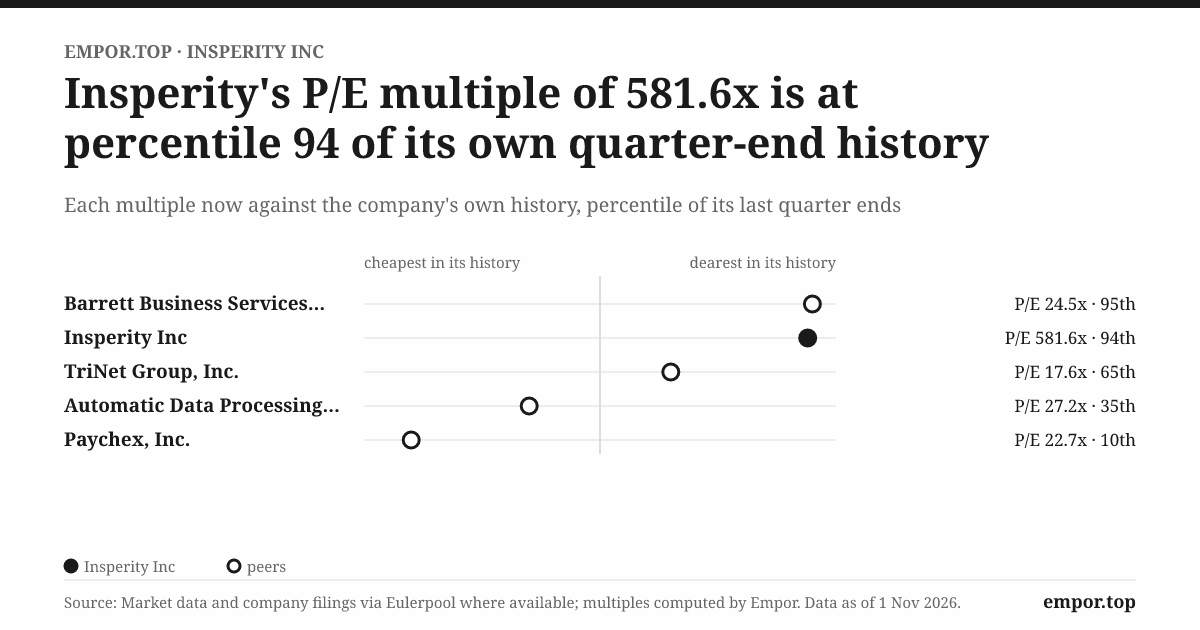
Pull up Insperity's stock quote in early November 2026 and the first valuation number on the screen is absurd. The price-to-earnings ratio reads about 582 times. That is not a sign of wild optimism. It is a sign of a broken denominator. Earnings per share over the last twelve months came to only about eight cents, because the period still included the losses of late 2025. Meanwhile, the third quarter of 2026 alone produced adjusted earnings per share of about 22 cents.2 A multiple built on a depressed earnings base tells an investor almost nothing about what the business is worth.
Strip out the noise and the market's pricing becomes more interesting. Over the past five years, Insperity's median P/E was about 27 times. Its enterprise value, the market value plus debt minus cash, was about $1.7 billion, roughly 22 times trailing EBITDA. Its price-to-sales ratio was about 0.3, which sounds cheap until you remember that reported revenue still includes the pass-through costs of benefits and taxes. And the stock itself had more than doubled from its 52-week low of about $20, to about $49.
That last fact frames the debate. The market is not pricing a company in terminal decline; at the lows, perhaps, it was. By November 2026, it was pricing a recovery that had visibly begun. The question for a long-term investor is whether that recovery is durable and large enough to justify the rebound, or whether the easy part has already happened.
A skeptical long-short investor would frame the debate around accountability rather than valuation. The pricing lag that produced the 2025 loss built up over three years under a management team that has been in place for decades. The board responded with the largest chief executive pay package in years, a looser credit agreement that protected the dividend, and a request for more incentive-plan shares. None of those decisions is improper on its own. Together, they invite a pointed question: what would have to go wrong before this leadership changed course on capital return or pay? A bull would answer that the founder's large shareholding and the visible repair in 2026 are the best evidence that incentives already point the right way. Both readings are defensible, and the next year of results will favor one over the other.
The case for recovery
The bull case starts with the unit economics. Pricing, client selection and cost action are lifting gross profit per worksite employee, and adjusted EBITDA for the first nine months of 2026 rose about 18%.2 Retention improved in 2025, which suggests that many clients accepted higher prices rather than leave. Health-cost inflation per covered employee slowed from about 9% in 2025 to about 3.7% in the third quarter of 2026, and the $500,000 per-claimant cap reduces the danger of a few catastrophic claims.31
If those trends hold, the bull would argue, Insperity is simply returning toward its historical profitability. Before the recent slide, operating margins of 3.5% to 4.5% were normal.3 On about $6.9 billion of trailing revenue, even a partial return toward that range would mean operating profit many times the current level. The strong service proposition and long track record give clients a reason to stay. And HRScale, if it gains traction, could stabilize or extend the client base among larger employers that Insperity historically could not serve.
The case against
The bear case starts with the same fiscal 2025 loss and draws the opposite lesson. That year showed how quickly health and workers' compensation costs can consume a margin this thin, and nothing about the business model has changed to prevent it happening again. Worksite employees declined through 2026, and management itself acknowledged that the margin push was costing new sales and retention.1 Clients can still cancel on a month's notice. UnitedHealthcare's dominance of the cost base and the judgment embedded in claims reserves remain exactly as they were.
The cash picture adds to the bear's concerns. Reported cash includes hundreds of millions of dollars of payroll-associated funds, operating cash flow was negative in fiscal 2025, and revolver borrowings rose during 2026 while the dividend continued.31 The headline free-cash-flow yield of about 15% on trailing figures looks generous, but it rests on a period that includes payroll-timing swings and should not be read as a clean measure of sustainable cash generation. Shareholders' equity was only about $46 million at the end of fiscal 2025, leaving debt at roughly nine times equity.3 That is less alarming than it sounds for a business that holds client funds and carries little physical capital, but it leaves limited cushion for another bad year.
The competitive structure, finally, gives the bear one more argument. As the industry's forces show, Insperity faces a larger rival in ADP, a peer of equal size in TriNet, abundant substitutes and a powerful supplier. A recovery driven by repricing works only if competitors do not undercut the new prices. In a buyer-friendly market, that is not guaranteed.
What the multiple assumes
Peer multiples offer context but not proof. In late October 2026, Paychex traded at about 14.9 times EV to EBITDA and Paylocity at about 20.9 times.1516 Insperity, at about 22 times, sat above both. Read naively, that suggests Insperity is expensive. But Insperity's trailing EBITDA is depressed, while Paychex's and Paylocity's are not, and the business mixes differ: Paychex earns much of its money from payroll processing, Paylocity is primarily a software company. Comparing multiples across those differences can mislead.
What the current price seems to assume is that Insperity's earnings recover meaningfully, but not all the way to their 2022 peak. That is a reasonable expectation if gross profit per employee keeps rising and worksite employees stabilize. It is a generous one if the shrinkage continues.
Weighing all of it, the P/E is not a useful standalone yardstick on such a depressed earnings base. The recovery case has early evidence in unit economics, but a shrinking workforce base, concentrated medical-cost exposure and still-low GAAP earnings leave little proof yet of what normalized value looks like.
Three numbers will settle the thesis. The first is average paid worksite employees, the volume of the business, which stood at about 307,000 in the third quarter and was falling about 2% a year.1 The second is client retention, the clearest test of the service moat, which last read about 83% for fiscal 2025 and was improving.3 The third is gross profit per worksite employee, the unit economics of the repricing, at about $225 a month in the third quarter and rising about 8%.1 Paired with claims-cost growth and GAAP operating profit, those figures distinguish a healthy repricing from a slow shrinkage.
X. Business & Investing Lessons
Go back to the moment Insperity closed fiscal 2025. Revenue had grown about 3.5%. Operating margin had fallen from about 1.8% to slightly below zero. A company that had earned $117 million of operating profit the year before reported a $10 million loss, without any collapse in sales, without a lost client of note, without a scandal.3 What it had instead was a few percentage points of difference between what it charged and what it paid. Then, in 2026, the same small numbers ran the other way: gross profit per employee rose about 8%, while the number of employees fell about 2%.1 Those two moments, the collapse and the repair, contain most of what Insperity has to teach.
The first lesson is about margin thinness. When your margin is measured in pennies per payroll dollar, a benefits renewal can rewrite the whole year. Insperity's fiscal 2025 was not destroyed by a bad strategy or a lost market. It was destroyed by health costs rising about 9% per participant against pricing that rose about 3%.3 In most businesses, a three-point cost overrun is a disappointing quarter. In a business that keeps about two dollars of gross profit from every hundred it bills, it is an existential year. The broader point for founders and investors is that thin-margin businesses with large pass-through flows carry hidden leverage. Their revenue looks stable, their customers look sticky, and their earnings can vanish in a single pricing cycle. Underwriting them requires watching the spread between price and cost, not the topline.
The second lesson is about what growth actually means. A bigger payroll file is not growth if each employee costs more to serve than the client will pay. For years, Insperity's growth was measured in worksite employees, and the market rewarded every percentage point. But the employees added in 2023 and 2024 were, on average, less profitable than the ones that came before, because pricing lagged the cost of covering them. The company was growing its exposure faster than its earnings. The 2026 repricing corrected that, at the cost of shrinking the base. The wider lesson is that volume growth in a risk-bearing business is only valuable when the price per unit covers the risk carried per unit. A company that grows by underpricing risk is not compounding; it is accumulating a bill.
The third lesson is about cash. Cash that arrived before payroll is not the same thing as cash the business earned. Insperity's fiscal 2024 operating cash flow of about $520 million looked like a triumph. A year later, the same line was negative $278 million, because the payroll-tax liability that had inflated 2024 reversed in 2025.3 Most of the $660 million on the year-end 2025 balance sheet belonged, in effect, to payroll obligations, leaving adjusted cash of about $57 million.3 For any business that handles other people's money on its way somewhere else, whether a payroll processor, a payments company or an insurer, the honest measure of liquidity is what remains after those obligations are set aside. A float is a timing gift, not an earnings stream.
The fourth lesson is about repricing as a strategy. Raising prices in a service business with 30-day contracts is a test of the moat in real time. Insperity's 2026 results show the test running: unit economics improved, and some clients left. The lesson is that pricing power is not a fixed attribute a company owns. It is revealed by how many customers stay when the price goes up, and it can only be measured afterward. Investors who treat pricing power as a permanent trait rather than a recurring experiment will be surprised when the experiment fails.
Taken together, these lessons belong to Insperity and no other company: scale in payroll is only valuable when the price per employee covers the risks carried on that payroll. The recovery deserves credit for improved unit economics. Its success depends on holding clients as the price resets.
XI. Epilogue
On the evening of November 1, 2026, Insperity stands at an awkward midpoint. The worst of the margin collapse appears to be behind it. Gross profit per worksite employee is rising, adjusted EBITDA is up, and the health-cost trend has cooled from its 2025 peak.12 But the client base is still shrinking, GAAP earnings remain thin, and the revolver balance is higher than it was at the start of the year.1 Management says its emphasis is shifting, carefully, from margin recovery toward rebuilding growth.8 Whether that shift succeeds will be decided by a handful of moments over the coming year.
The first is the end of the fall selling and renewal season, which will show up in the first-quarter 2027 numbers. January is when many clients start new contracts and when renewals reset pricing. If Insperity's worksite employee count stabilizes or grows in early 2027 while gross profit per employee holds its gains, the repricing will have done its job without permanent damage to volume. If the count falls again as clients reject a second round of higher prices, the company will have optimized itself into a smaller business.
The second is the next medical-cost cycle. UnitedHealthcare's contract runs through 2028, but each year brings new claims experience, new reserve estimates and new decisions about pricing.3 A cost trend that stays near the 3.7% seen in the third quarter of 2026 would let the margin rebuild. A return to 2025's pace would test whether the company has learned to price ahead of its costs rather than behind them. Any change in the United relationship, whether renegotiation, amendment or termination notice, would reshape the risk profile overnight.
The third is HRScale. The Workday partnership will matter only when Insperity reports paying client adoption and a measurable contribution to worksite employees or profit. Until then, each quarterly call is a chance to ask the same question: what has moved from partnership to paying client, not just what has been built?
The fourth is the cash. The next annual cash flow statement should be read with payroll liabilities and associated funds alongside operating cash flow. A recovery that shows up in adjusted cash, not just headline cash, and that allows the revolver to shrink while the dividend continues would be the strongest possible signal that the repair is real. A recovery that coexists with a growing revolver would raise harder questions about how the dividend is funded.
The central tension remains whether Insperity can improve per-employee economics without a continuing decline in client volume, supported by cash generation that survives payroll timing. If gross profit per employee rises while worksite employees stabilize, the margin plan may be turning into a durable recovery. If pricing improves margins but employees keep leaving, Insperity will have patched the margin, not rebuilt the model.
XII. Outro
Go back to that Friday payroll run. The restaurant manager watches the paychecks clear. The withholding goes to the government, the premiums to the carrier, the coverage stays in force. Somewhere in Kingwood, Texas, money moves through Insperity's accounts in an enormous river, most of it passing straight through.3
That river is the business, and it is also the illusion. The dollars flowing through look like scale, but the value of Insperity was never in the flow. It is in the people behind it: the HR specialists who answer the owner's call, the actuaries who estimate the claims, the salespeople who convince a 40-person firm to share its employer's chair. Insperity stands between a client's payroll and the risks of being an employer. Its future depends on proving that this position earns a durable margin, not merely a larger flow of dollars. Every payroll cycle is both its product and its test.
References
-
Third Quarter 2026 Form 10-Q — Insperity, Inc., 2026-10-29 ↩↩↩↩↩↩↩↩↩↩↩↩↩↩↩↩↩↩↩↩↩↩↩↩↩↩↩↩
-
Q3 2026 Earnings Release — Insperity, Inc., 2026-10-29 ↩↩↩↩↩↩
-
2025 Form 10-K — Insperity, Inc., 2026-02-10 ↩↩↩↩↩↩↩↩↩↩↩↩↩↩↩↩↩↩↩↩↩↩↩↩↩↩↩↩↩↩↩↩↩↩↩↩↩↩↩↩↩↩↩↩↩↩↩↩↩↩↩↩↩↩↩↩↩↩↩↩↩↩↩↩↩↩
-
Q4 and Full Year 2025 Earnings Release — Insperity, Inc., 2026-02-11 ↩↩↩
-
Fourth Quarter and Full Year 2016 Results — Insperity, Inc., 2017-02-13 ↩↩↩
-
Workday and Insperity Announce Exclusive Strategic Partnership — Workday, 2024-02-08 ↩↩↩↩↩
-
Q3 2026 Earnings Call Transcript — Stock Analysis, 2026-10-29 ↩↩↩↩↩↩↩↩↩
-
Annual Meeting Results, Form 8-K — Insperity, Inc., 2026-05-20 ↩
-
Insperity 401(k) Plan Class Action Disclosure, Form 10-K — Insperity, Inc., 2021 ↩
-
2025 Form 10-K — Automatic Data Processing, Inc., 2025-08-08 ↩
 LinkedIn
 WhatsApp
 Reddit
 Hacker News
 Email
 Kindle
 RSS Feed
 Spotify
 Apple Podcasts
 Amazon Music
 Audible
 YouTube