TriNet: The Benefits Bill Behind the $5 Billion Business
I. The Company That Looks Bigger Than Its Economics
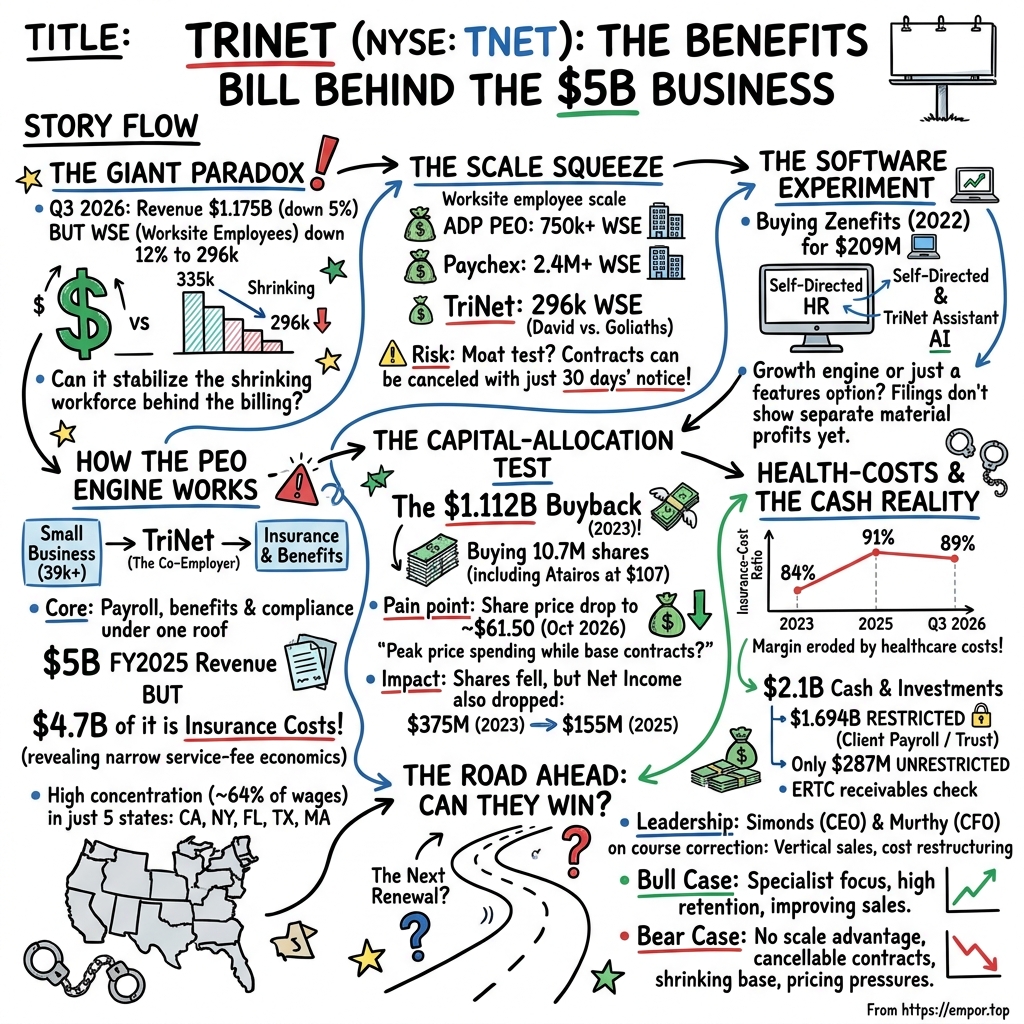
On the evening of October 29, 2026, TriNet Group told the market how its summer had gone, and the headline looked like the report of a large and steady enterprise. Revenue for the third quarter came to $1.175 billion.1 That is the kind of number that puts a company in the same sentence as household-name industrials, the kind of number that pays for a downtown headquarters and a sales force in every major American city. Over a full year, TriNet's top line runs to roughly five billion dollars.2
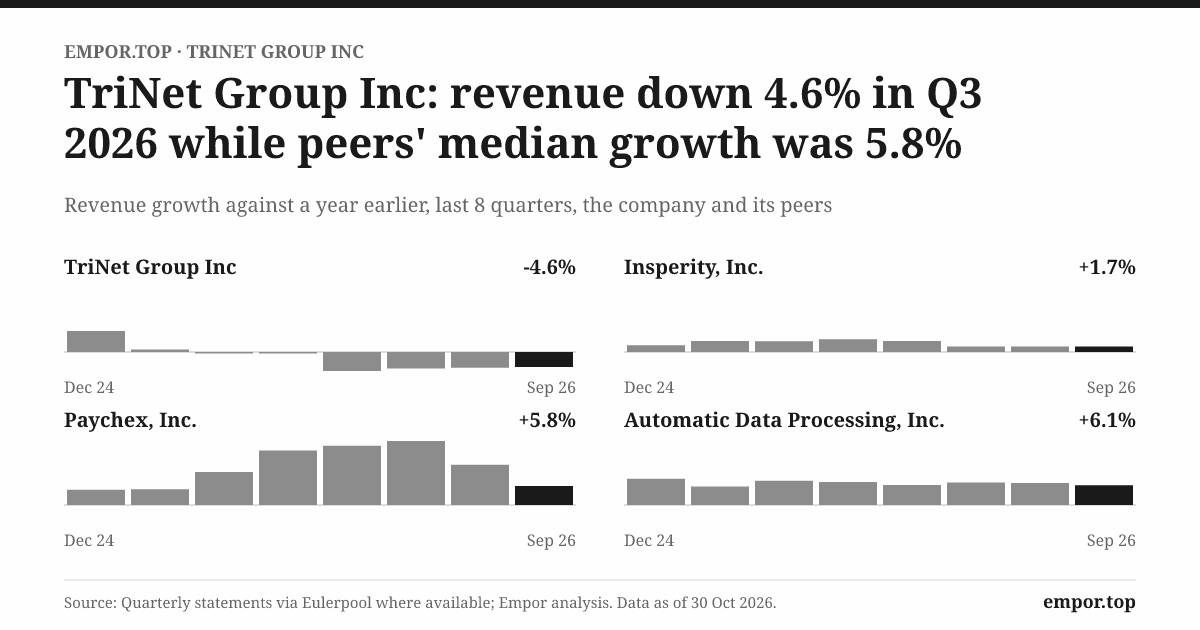
Then came the number underneath it. In the same quarter, TriNet served an average of 296,372 worksite employees, the people on its clients' payrolls who are formally co-employed by TriNet. A year earlier the figure had been 335,235.1 So the population of workers that TriNet's whole business is built around had shrunk by about 12% in twelve months, while revenue had slipped by only about 5%.1 Net income for the quarter was $31 million, down from $34 million a year before.1 Out of more than a billion dollars of revenue, the shareholders kept roughly two and a half cents on the dollar.
Those three figures, side by side, are the riddle this story sets out to solve. How does a company report more than a billion dollars a quarter and earn so little of it? Why did revenue fall so much more slowly than the workforce it serves? And what does it mean that the gap between those two lines has become the most important fact about the business?
The short answer is that TriNet is not quite what its revenue line makes it look like. Most of that $1.2 billion is not a fee for TriNet's services. It is the bill for health insurance and workers' compensation coverage that TriNet arranges for small employers and then passes, mostly, to insurance carriers. TriNet stands in the middle of that money, takes a slice for administration and for the risk it bears, and earns a separate, much smaller stream of fees for running payroll, benefits and human-resources compliance. The headline revenue number is real money moving through TriNet's accounts. It is a poor guide to how much economic value TriNet itself creates.
That distinction matters more now than at any point since the company listed, because the past three years have tested every part of the model at once. Health costs rose faster than TriNet had priced for. TriNet responded by raising what it charged clients for benefits, which protected the insurance economics but pushed some clients out the door. Small employers in technology and professional services, once the heart of TriNet's franchise, cut staff. Earnings fell by more than half from their 2023 peak.2 And in the middle of all of it, in 2023, the company spent more than a billion dollars buying back its own stock, a portion of it from its largest shareholder at a price far above where the shares trade today.2
The questions that follow from that record are concrete. Can TriNet's sales and retention recover after years of benefit repricing and client shrinkage, so that the worksite-employee count stops falling and starts growing again? Can the company protect its earnings when healthcare costs move against it, without pricing itself out of its customers' budgets? How much of the cash sitting on TriNet's balance sheet belongs, economically, to its clients rather than to its shareholders? And do the buybacks that have shrunk the share count serve the minority shareholder as well as they serve the large holder whose percentage stake rises every time TriNet retires stock?
One clarification belongs at the start, because it shapes everything after. TriNet Group, Inc. is the operating company listed on the New York Stock Exchange under the ticker TNET. It is not the subsidiary of anyone. Atairos, the investment firm founded by former Comcast finance chief Michael Angelakis, owns about 39% of the shares and has a seat on the board through Angelakis himself, which makes it by far the most influential shareholder.3 But Atairos is an owner, not a parent, and the economics in this story are TriNet's own.
The quarter that opened this story ended with management saying it now expected to deliver earnings at the top end of its guidance range for the year.1 Investors therefore heard two messages on the same night: profit is holding up better than feared, and the customer base is still shrinking. Which of those messages describes the future depends on understanding what TriNet actually sells, and to whom. That begins with a small business owner and a payroll deadline.
 Subscribe on LinkedIn
II. A PEO Makes Small Companies Look Larger to Insurers
Picture a software startup with forty employees in San Francisco, or an architecture practice with twenty-five people in Boston. Payroll is due on Friday. The health-insurance renewal letter arrived last week, and the premium increase is in double digits. The office manager who handles benefits is also the person who orders supplies and books travel. Somewhere in the inbox sits a reminder about a state labor-law change that nobody has had time to read.
This is the customer TriNet was built for. A professional employer organization, or PEO, offers that owner a deal. Hand over the payroll, the benefits administration, the workers' compensation coverage and much of the compliance burden, and the PEO will become the co-employer of the company's staff. The client still hires, fires, sets pay and directs the work. TriNet takes on the employer-of-record duties for payroll and taxes, administers benefits, and supplies human-resources expertise.2 The forty-person startup now buys its health insurance not as a forty-person company but as a sliver of a pool of hundreds of thousands of workers.
That last point is the heart of the PEO idea, and it explains why the industry exists at all. A small employer buying health insurance on its own is a poor risk to an insurer: one employee with a serious illness can blow through the group's premiums, so the insurer prices defensively and the coverage options are thin. A PEO aggregates thousands of small employers into something that looks, to a carrier, like a large corporation. The pool is more predictable, the plans can be richer, and the administrative paperwork is handled once rather than ten thousand times. A PEO makes small companies look larger to insurers. That is the product.
TriNet also sells a lighter version. Under its administrative services offering, known as ASO, employers get payroll and HR software and support without the co-employment arrangement.2 At the end of 2025, TriNet counted about 323,200 co-employed worksite employees in its PEO and roughly 39,700 users of its ASO services.2 The PEO is the business that matters for the economics, and it is the one this story mostly follows.
Following a dollar through TriNet
The way TriNet reports revenue makes the business look larger than its fee base. When the architecture practice pays TriNet for a month of service, the payment carries several different things. Some of it is a professional-services fee, which pays for payroll processing, HR services and the technology platform. A much larger piece is insurance-services revenue: the billings TriNet collects from clients for health and workers' compensation coverage arranged with third-party carriers, along with administrative fees attached to that coverage.2 A third, smaller stream is interest income earned on client funds that sit with TriNet between the moment a client pays and the moment the payroll and tax obligations clear.2
The salaries themselves do not count as TriNet's revenue. The insurance billings do, and they dwarf the fees. That is why, out of roughly $5.0 billion of revenue in 2025, TriNet's total costs and operating expenses absorbed all but about $273 million, leaving an operating margin of around 5%.2 The figure that tells an investor how the insurance side is going is the insurance cost ratio: the share of insurance-services revenue that goes out again to pay for coverage and claims. In 2025, that ratio reached about 91%.2 Put plainly, for every $100 a client paid TriNet for benefits, about $91 went to the cost of providing them. The remaining $9 had to cover the administration of those benefits, the risk TriNet bears when claims run hot, and a contribution to profit.
Interest income is the quiet third leg, and it is worth more than its size suggests. TriNet earned about $67 million of interest in 2025, mostly on funds held for clients and on interest from tax refunds.2 Against profit before tax of $217 million, that was nearly a third of the pre-tax result.2 In 2023, when profits were much fatter, the same kind of interest income was only about a seventh of pre-tax profit.2 As the core business shrank, the float became a larger share of what was left, and that float depends on interest rates and on how much client money passes through TriNet's accounts.
Revenue moves with a handful of levers. The first is the number of co-employed average worksite employees, which is why the 12% decline in the third quarter of 2026 matters so much. The second is wages, because some fees scale with payroll. The third is the price TriNet charges for its services and its insurance. The fourth is mix, which products clients buy. The fifth is the interest earned on client funds.2 In 2025, monthly revenue per co-employed average worksite employee rose about 8%.2 That is the clearest signature of the past two years: TriNet raised what it charged each worker even as the number of workers it served fell. Price did the work volume could not.
A one-month promise
What does a client actually commit to? Less than an outsider might assume. TriNet's PEO contracts generally renew annually, but most can be cancelled on 30 days' notice. ASO contracts are monthly or annual and are also typically cancellable on 30 days' notice. Some annual PEO contracts carry an early-termination fee if notice lands inside the 30-day window before the anniversary.2 TriNet does not publish the share of its revenue that is contractually recurring, a pricing schedule, or any minimum commitments.2 The relationship behaves like a subscription, with repeat billing every payroll cycle, but it is a subscription a customer can leave in a month.
There is no dangerous concentration on any single client. No client accounted for 10% or more of revenue in any of the past three years.2 The concentration that does exist is geographic and sectoral. California, New York, Florida, Texas and Massachusetts together accounted for about 64% of the wages TriNet's PEO paid out in 2025.2 Those are the states where technology start-ups, financial firms, life-science labs and professional-services boutiques cluster, the kinds of venture-backed and knowledge-economy employers that offer rich benefits to compete for talent. TriNet built its franchise in these industry verticals, and when hiring in those verticals turned down, TriNet felt it directly.
So the business, stripped to its core, is a bundle of administration, benefits access and risk support sold to small employers who can walk away on short notice. The revenue line inflates the size of the fee pool. The insurance cost ratio decides how much of the benefits bill becomes TriNet's margin. And because nothing contractually locks clients in for long, TriNet has to keep earning the renewal through service quality, benefits pricing and execution. Which raises the obvious competitive question: if a client can leave in thirty days, where does it go?
III. The Scale Giants Set the Price of the Promise
Go back to the business owner with the renewal letter, and this time imagine that the decision is open. There are at least four doors. One leads to TriNet. Another leads to ADP, the payroll giant whose name appears on tens of millions of American pay stubs and which runs one of the country's largest PEOs. A third leads to Paychex, the other heavyweight of small-business payroll, which also offers PEO and administrative services. A fourth leads to a combination of a modern HR software provider for payroll and a local insurance broker for benefits, with no co-employer at all.
Each door offers a different trade-off, and the scale behind each is very different. In the third quarter of 2026, TriNet served about 296,000 average worksite employees.1 ADP reported more than 750,000 worksite employees in its PEO business in its 2025 fiscal year.4 Paychex reported about 2.46 million worksite employees across its HR-solutions offerings in its own 2025 fiscal year, a figure that spans PEO and administrative-services clients.5 By that crude measure, ADP's PEO alone is roughly two and a half times TriNet's co-employed base, and Paychex's broader HR-solutions population is roughly eight times as large.
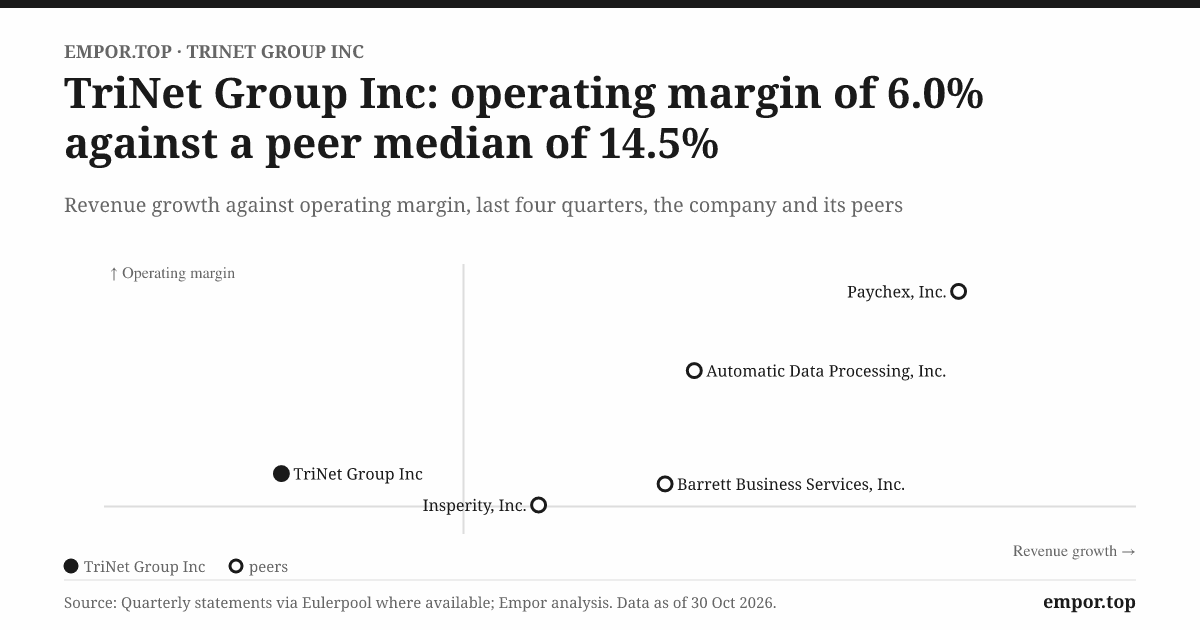
Those comparisons are imperfect, and it is worth saying why. ADP and Paychex are not PEO companies with a payroll sideline; they are payroll and human-capital-management platforms that also run PEOs. Their revenue mixes, client sizes and accounting for insurance differ, so comparing TriNet's revenue or margins with theirs line by line mostly measures accounting differences. Insperity, the closest pure-play listed PEO, is a nearer analogue in model, though its recent earnings have been so depressed that its trailing valuation multiples are distorted.6 What the worksite-employee counts do establish is the order of magnitude. TriNet is a focused specialist competing against firms that are much larger in the exact population of workers it serves.
The war game
Run the competitive forces one at a time, starting with the customer. A small employer has real bargaining power, not because any single client is large, but because each one can compare offers every renewal cycle and leave on short notice. Brokers who advise small companies on benefits routinely shop the market. That means price, especially the price of health coverage, is visible and contestable every year.
Now the rivals. ADP and Paychex have larger technology budgets, larger sales forces and established relationships with millions of small businesses through payroll. They can cross-sell a PEO to a payroll client they already serve. TriNet has to win most of its clients through its own distribution and reputation in its verticals. Scale also matters on the insurance side, since a bigger pool can, in principle, deliver more stable claims experience and more leverage with carriers, though none of the companies publishes enough to prove how much that advantage is worth.
Then the suppliers. TriNet's benefits offering depends on its relationships with insurance carriers, and the cost of the coverage they provide is the single largest determinant of whether TriNet's offer looks attractive. TriNet does not disclose how concentrated its carrier relationships are.2 What it cannot do is control the underlying trend of medical costs, which in 2025 pushed upward through outpatient care, professional services and specialty drugs.2
Substitutes are the fourth force, and they are growing. A company that does not want co-employment can buy payroll and HR software from a specialist, buy benefits through a broker, and keep the employer relationship entirely in-house. Software keeps getting easier to use, and automated assistants can now answer routine HR questions that once required a human specialist. The PEO's value proposition rests partly on making complexity disappear, and complexity is exactly what software vendors are trying to eliminate on their own terms.
Finally, operating complexity sets a barrier to entry. Running payroll and benefits for hundreds of thousands of workers across many states, filing taxes, managing workers' compensation and staying compliant with labor law is hard, regulated work that punishes mistakes. A new entrant cannot simply spin up a PEO and expect to win; but against incumbents like ADP and Paychex, that barrier protects the whole incumbent group, not TriNet in particular.
Testing the switching costs
The usual bull argument for a PEO is that switching is painful. A client that leaves has to move its payroll without missing a cycle, transfer its employees to new health plans, often mid-year, and rebuild the compliance knowledge it outsourced. Those frictions are real, and they almost certainly explain why many clients renew rather than shop every year.
But the public record does not prove how strong those frictions are at TriNet. The company does not publish a long series of client or worksite-employee retention rates that would let an investor see how sticky the base has been through good and bad cycles.2 What it does publish tells a less comfortable story. When TriNet raised benefits prices in 2024 and 2025, worksite employees left in meaningful numbers, which is the market's own test of switching costs.7 Clients did switch when the price got high enough. Switching costs, in other words, exist but are bounded, and the bound appears to be set by the price of health insurance.
TriNet's brand in its industry verticals, its technology platform and its personal service model are plausible sources of advantage. The company does not disclose any peer comparison demonstrating that its retention is superior or that its unit economics beat ADP's or Paychex's. So the brand and service claims sit at the level of potential advantages, not proven pricing power.
This leads to a subtler point about how TriNet could lose. The usual nightmare for a mid-sized competitor is a price war, with a giant cutting fees to take share. That is possible. But TriNet's more immediate exposure is different: if healthcare renewals rise sharply, TriNet's offer becomes less attractive even if its software works perfectly and its service team is excellent. A small employer comparing a TriNet renewal with an ADP or Paychex quote is looking first at the benefits price. The quality of the payroll experience matters, but it is not what makes a forty-person company's owner gasp at the renewal letter.
So the hard competitive question is not whether TriNet does good work. It is whether a focused specialist can keep winning on service and benefits access without the scale of the giants. One answer TriNet tried, in 2022, was to stop being only a PEO.
IV. The Acquisition That Tried to Make TriNet a Software Company Too
In February 2022, TriNet closed its purchase of Zenefits from the private-equity firm Francisco Partners.8 Zenefits had been one of the most talked-about start-ups of the previous decade, a cloud-based HR software provider built for small and medium-sized businesses, and TriNet described it as "a leading SaaS-based human capital management (HCM) solution purpose-built for SMBs."8 The deal became TriNet Zenefits, a wholly owned subsidiary.8
The pitch was clear, and it addressed exactly the weakness the competitive war game exposes. TriNet sold co-employment. Many small businesses did not want co-employment: they wanted to keep their own benefits broker, or they were not yet big enough to need the full bundle, or they simply preferred to remain the sole employer of their staff. With Zenefits, TriNet said, it would become "the leading human resources services provider for SMBs with or without the PEO structure."8 Burton Goldfield, TriNet's chief executive at the time, said the plan was to create "a unique HR solution not available in today's market," with the software and PEO offerings eventually running "within the same technology cloud environment."8
TriNet paid about $209 million: roughly $192 million in cash and $17 million in stock.9 For a company that had earned well over $300 million of net income in 2021, that was a meaningful but not reckless bet.9 It was, in effect, an option on a second growth engine.
Software is a different business
The logic of the option was sound. A self-directed software platform can reach employers who will never sign up for co-employment. It can serve as a first step that later converts into a PEO relationship when a client grows. And it gives TriNet a product that does not depend on the insurance cost cycle at all.
The trouble is that software is a different business with different competitors. A self-directed HR platform competes against software-native providers whose whole company is the product, many of them well-funded, fast-moving and willing to spend heavily on user experience and features. A PEO wins on service, benefits access and risk support. A software tool wins on product quality, integrations and price per seat. Running both under one roof is possible, but it means fighting two very different wars at once.
The more important question for an investor is whether the option has paid off. Here, TriNet's disclosures give little to work with. The company does not report Zenefits' revenue, customer count or growth as a separate line, and the filings do not show the self-directed platform as a financially material standalone growth engine.2 TriNet's ASO business, roughly 39,700 users at the end of 2025, is small next to the co-employed base.2 An investor cannot see from the outside whether the acquired software is growing, shrinking or mainly serving as a technology foundation for the PEO.
The purchase price cannot be judged cheap or expensive from the disclosed evidence alone. TriNet has not reported a write-down specific to Zenefits that would mark the deal as a failure. The 2024 restructuring included impairments, but they were part of a broader transformation, not a disclosed verdict on the acquisition.2 Equally, it has not published the metrics that would mark it as a success. The verdict, for now, is that the deal bought a capability and a route into self-directed HR software, but has yet to demonstrate it as a separate earnings engine.
What the platform spending reveals
Since the acquisition, TriNet has kept investing in technology. TriNet says it is building a combined PEO and ASO cloud platform and has said it is exploring artificial-intelligence and machine-learning features, including a tool called TriNet Assistant.2 These investments could make TriNet's service team more efficient, so that each specialist supports more clients, and could expand what the product offers. They also carry execution risk, and there is an irony in them: the same automation that helps TriNet answer routine HR questions more cheaply could, in a competitor's hands, help small businesses do without a PEO entirely.
The size of that investment is modest. TriNet does not break out research and development spending.2 The nearest line, systems development and programming, rose from about $65 million in 2023 to about $71 million in 2025, a broad category that includes running existing systems, not just building new ones.2 Capital expenditure on property, equipment and software actually fell, from about $78 million in 2024 to about $69 million in 2025.2 Set against ADP's and Paychex's far larger technology budgets, this is not a company outspending its rivals on product. It is a company trying to spend smartly within tight limits.
The workforce tells a similar mixed story. TriNet ended 2025 with about 3,400 colleagues, roughly 200 fewer than a year earlier.2 At the same time it opened an Atlanta corporate center and expanded operations in India.2 The pattern is familiar from many services businesses in transformation: shift work to lower-cost locations, consolidate offices, and redirect some savings into the platform. It can produce a leaner, better company. It can also produce service disruptions in the years of transition, exactly when clients are already angry about benefit price increases.
What would validate the Zenefits thesis? Two kinds of evidence. The first would be disclosed customer and revenue growth for the non-PEO platform, showing that the software reaches employers TriNet could not otherwise serve. The second would be a clear link between software investment and the things that drive the PEO's economics: better client retention, lower service costs per worksite employee, or faster sales. Until one of those appears, the acquisition remains an option the company has not yet proven it can exercise.
And there was a far larger capital decision waiting just a year after Zenefits closed, one that would involve not a start-up but TriNet's own shares.
V. The Buyback at $107 Became the Capital-Allocation Test
TriNet's capital story begins long before 2023, and its early chapters explain why the 2023 decision was so striking. The company priced its initial public offering in March 2014 at $16 per share.10 It came to market carrying significant debt from a leveraged recapitalization, and the offering documents set out a plan to use proceeds to pay down borrowings.11 In the years before listing, TriNet had grown partly by acquisition, buying other PEOs including Strategic Outsourcing, a North Carolina-based PEO founded in 1995 that TriNet agreed to acquire from Clarion Capital Partners in September 2012, and Ambrose.12 11 TriNet described the Strategic Outsourcing deal as creating "the largest independent PEO in terms of employees served."12 Neither deal came with enough disclosed financial detail to judge, from the outside, whether TriNet overpaid.
For most of the next decade, the strategy worked. Revenue compounded at about 6.5% a year between 2015 and 2025, and net profit grew far faster, from tens of millions of dollars to a peak of $375 million in 2023.2 Operating margins climbed from around 3% in 2015 to about 10% by 2021 and 2022.9 By the start of 2023, TriNet was a highly profitable, cash-generative company with a strong balance sheet and a dominant shareholder in Atairos, which had arrived in 2017.2
The year TriNet bought itself
Then came 2023. That year TriNet repurchased about 10.7 million of its own shares for about $1.112 billion.2 The program had several parts. TriNet ran a tender offer to public shareholders. It also bought about 3.36 million shares directly from Atairos at $107 per share, a block worth about $360 million.2 Atairos agreed to sell additional shares so that its stake would remain around 36% immediately after the transactions, rather than rising as the share count fell.2 To fund the program, TriNet borrowed, drawing on its revolving credit facility and issuing new unsecured notes.2 S&P Global rated those new notes BB, a sub-investment-grade rating.13
The scale of this decision deserves a moment. A billion dollars was close to three years of TriNet's net income at its then-record level. It was more than the company's entire shareholders' equity at the end of 2022.2 After the buyback, equity fell to about $78 million, while borrowings roughly doubled to about $1.1 billion.2 TriNet had chosen to turn itself from a lightly leveraged company into one carrying meaningful debt, on the bet that its own shares were the best investment available.
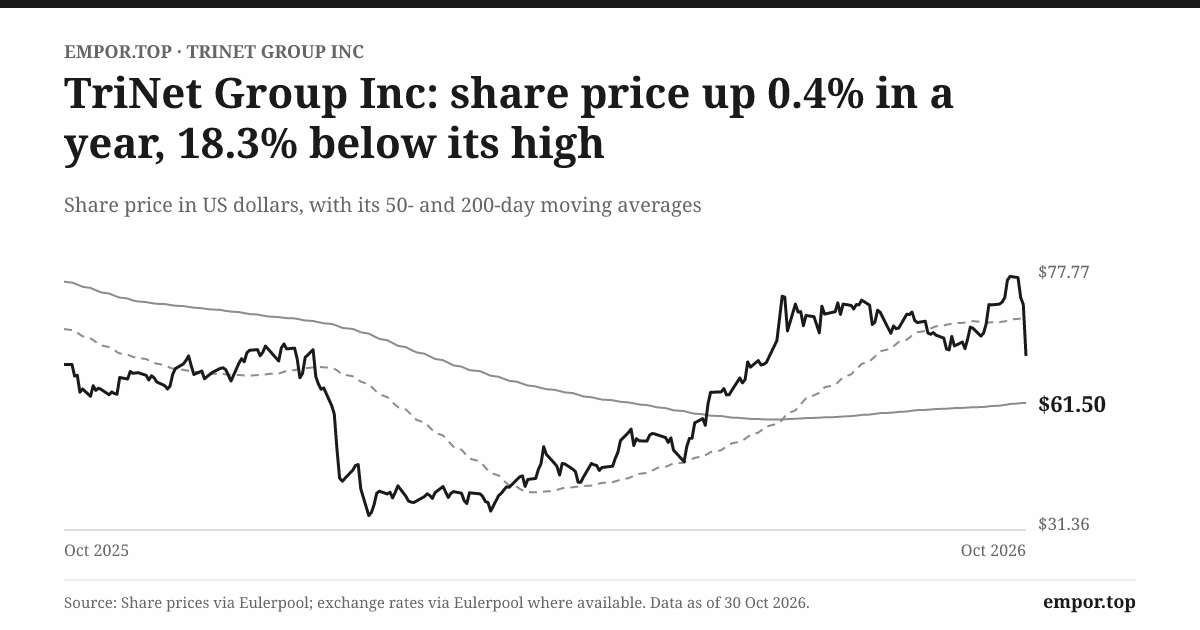
The share price at the end of October 2026 was $61.50.14 That is roughly 43% below the $107 TriNet paid Atairos. Hindsight is a cheap tool, and the comparison does not prove the 2023 repurchase was irrational when it was made. At the time, TriNet had just reported record earnings, and the shares were priced off those earnings. Whether the buyback was an overpayment depends on what the business was worth then, and that in turn depends on whether the earnings power of 2023 was sustainable.
It was not. Net income fell from $375 million in 2023 to $173 million in 2024 and $155 million in 2025.2 Earnings per share fell less steeply because the share count kept shrinking, from about 60.6 million at the start of 2023 to about 47.4 million by the end of 2025.2 That is the buyback doing exactly what buybacks do: each remaining share owns a larger slice of the company. But a larger slice of a smaller pie is not automatically a better deal. Diluted earnings per share were about $7.35 in 2023 and $3.23 in 2025.2
The burden of proof
TriNet did not stop. It repurchased about $182 million of stock in 2024 and another $182 million in 2025.2 It started paying a dividend in 2024.2 In February 2026, the board authorized another $336 million of repurchases, and at the end of June about $329 million of that remained available.7
A skeptical investor would ask a simple set of questions. Why keep buying back stock while the core workforce base is contracting, earnings are down by more than half from their peak, and the company carries about $900 million of unsecured notes?2 What valuation framework did the board use in 2023, and has it changed? Is the buyback a considered capital allocation decision, or a habit that persists regardless of price?
TriNet has an answer available to it, and it is not a weak one. The company still generates meaningful free cash flow, about $306 million in 2025 on the consolidated statement.2 Its trailing free cash flow yield, on the current share price, is around 11.6%.14 If those cash flows are durable and largely belong to shareholders, buying stock at today's price is a very different proposition from buying it at $107. The question of whether they are durable, and whose they are, is where this story is heading.
The buyback also has an ownership consequence that deserves daylight. Atairos's proxy-reported stake was about 39.3% in early 2026, when it held about 18.1 million shares.3 Its reported percentage has crept up from around 36% in 2023 to about 38% in early 2026 and higher on later share counts.2 3 That rise is largely a denominator effect: as TriNet retires shares, Atairos's unchanged holding becomes a larger fraction of a smaller total. The filings do not show that Atairos has increased its absolute share count. But the effect is real. Every buyback edges the largest shareholder closer to outright control without it spending a dollar, and public investors have no comparable voting block.3
Compared with the acquisitions that preceded it, the 2023 buyback stands out. Strategic Outsourcing, Ambrose and Zenefits were bets on growth whose prices TriNet did not disclose in enough comparable detail to judge.12 9 The buyback is the one capital decision whose price is fully visible, and it is the one where hindsight is least kind. That makes it management's live credibility test. Shrinking the share count was a choice to bet on TriNet's own earnings. The years that followed revealed what was eating them.
VI. The Health-Cost Cycle Took the Margin Away
In July 2026, TriNet reported a second quarter that looked like a turn. The insurance cost ratio, the metric that had been crushing the business, had improved to about 86%.15 Management raised its earnings guidance for the year.15 For investors who had watched the ratio climb for two years, this was the first sign that repricing had worked.
There was a detail in the numbers, though. The improvement included a $21 million recovery of prior-year insurance costs.15 7 In other words, part of the better quarter came from money flowing back from claims and costs booked in earlier periods, not from the current quarter's claims experience. That does not make the improvement fake. It makes it harder to read.
How the margin disappeared
To understand why that detail matters, go back to 2023. That year, TriNet's insurance cost ratio was about 84%.2 By 2025, it had reached about 91%.2 Seven percentage points may not sound dramatic. Applied to a stream of insurance billings measured in billions of dollars, it is the difference between a highly profitable business and a marginal one. Operating profit fell from about $469 million in 2023 to about $273 million in 2025, and the operating margin roughly halved, from about 9.5% to about 5.4%.2
TriNet's own explanation of the decline has three parts. The first and largest was higher health insurance costs. In 2025, the company pointed to rising outpatient costs, professional-service costs and specialty drugs as drivers.2 The second was higher interest expense, a direct consequence of the debt taken on for the 2023 buyback.2 The third was restructuring: in 2024, TriNet recorded about $49 million of restructuring costs, including impairments, as part of its transformation.2 The fourth quarter of 2024 actually ended in a net loss of about $23 million.2
What makes this cycle so instructive is the timing mismatch at the core of a PEO's insurance business. TriNet sets benefit prices for a client at renewal, based on its forecast of what claims will cost over the coming year. If medical inflation runs ahead of that forecast, TriNet absorbs the gap until the client's next renewal, when it can reprice. That means a cost surprise can hit earnings for many months before pricing catches up. It also means the catch-up arrives as a sharp increase on a client's renewal letter.
TriNet's pricing caught up, with monthly revenue per co-employed worksite employee rising about 8% in 2025.2 And the clients responded the way price-sensitive customers do. In the second quarter of 2026, the company said worksite-employee declines in its Technology, Professional Services and Main Street verticals were partly related to health-benefit repricing.7 The company also discontinued a technology fee and a product called Clarus R+D, which reduced professional-services revenue.2
The ratio and the headcount
The third quarter of 2026 gives the cleanest recent read. TriNet's insurance cost ratio was about 89%, one point better than the 90% of a year earlier, without the prior-year recovery that flattered the second quarter.1 That is a modest but genuine improvement. In the same quarter, average worksite employees were down 12% and revenue down 5%.1
Management told investors that new sales had returned to year-on-year growth and that worksite-employee retention had improved.1 16 Those are encouraging claims, and they may well mark a turn. But they need to be weighed against the volume itself. If new sales are growing and retention is improving, the decline in worksite employees should narrow over the coming quarters. A 12% year-on-year drop in the third quarter means the base was still shrinking through the period; improving rates of change are not the same as growth. The company's explanation for the losses, that clients in Technology, Professional Services and Main Street reduced headcount or left after repricing, is consistent with the evidence, but it also confirms that pricing power has limits.7
This is the trade-off TriNet has to navigate. If it prices benefits aggressively to protect the insurance margin, it loses clients. If it prices them gently to keep clients, it risks another cycle of margin compression when medical costs rise. The ideal outcome is a ratio stable in the high 80s, with no one-time recoveries, alongside stable or growing worksite employees. The second quarter's 86% included help; the third quarter's 89% did not, and it came with a shrinking base.
The verdict, then, is narrower than either the bulls or the bears would like. Repricing and claims discipline appear to be improving the insurance economics. But the evidence is not yet clean, because the nine-month improvement depends partly on a one-time recovery, and because the falling worksite-employee count shows that price has damaged the customer proposition. Several quarters of a lower ratio without one-time help, alongside stabilizing worksite employees, would show whether pricing has restored the business without breaking it.
And that brings the story to the cash that, through all of this, kept flowing through TriNet's accounts, and to the question of how much of it TriNet actually owns.
VII. The Cash Looks Abundant Until You Ask Whose It Is
Open TriNet's balance sheet at the end of 2025 and the first impression is of a company swimming in liquidity. Cash, cash equivalents and investments, restricted and unrestricted together, totaled about $2.1 billion.2 For a company with a market value around $3 billion, that looks like a fortress.14
Then read the labels. About $1.694 billion of that pile was restricted: cash and investments held for specific purposes, mostly to meet payroll, payroll-tax and insurance obligations on behalf of clients.2 Unrestricted cash and equivalents, the money TriNet could freely deploy, came to about $287 million.2 The bulk of the fortress belongs, economically, to someone else.
This is the puzzle at the center of TriNet's cash flow, and it has to be solved before anyone can judge the buyback or the dividend. TriNet sits in the middle of an enormous river of other people's money. Every payroll cycle, clients send TriNet the funds to pay their employees, the taxes due on those wages and the premiums for their benefits. For a short time, that money sits in TriNet's accounts before going out again. Among the entities consolidated on TriNet's books is TriNet Trust, which holds the payroll funds of ASO clients; its assets are restricted and designated for client-related payments.2 All of this flows through the consolidated cash-flow statement.
A clue, not a conclusion
Over the long run, TriNet looks like an excellent converter of profit into cash. Across the twelve years from 2014 through 2025, operating cash flow added up to about $3.9 billion against about $2.4 billion of net profit, or roughly 166% of reported earnings.2 In 2025 alone, cash from operations was about $303 million against net income of about $155 million.2 Part of the gap is ordinary and healthy: depreciation and amortization, stock-based compensation and deferred taxes are expenses that reduce profit without consuming cash in the year, and together they added back well over $100 million in 2025.2
But the long-run ratio should be treated as a clue, not a conclusion. Because client funds move through the consolidated statements, the timing of payrolls, tax remittances and insurance payments can swing operating cash flow sharply from year to year. In 2018, operating cash flow was negative; in 2017, it was roughly three times net profit.2 TriNet itself says year-to-year operating cash flow varies with the timing of collections and payments.2 An investor who treats the consolidated operating cash flow as pure corporate cash generation will overstate how much money is available to buy back stock, pay dividends or repay debt.
The cleaner way to think about it is that TriNet's corporate cash generation is roughly its earnings plus non-cash charges, with year-to-year noise from client-fund timing laid on top. That is still a respectable business. It is not a business with $2 billion of spare cash.
The IRS claim
The most unusual item on TriNet's books is a receivable from the US government. During the pandemic, Congress created the Employee Retention Tax Credit, a payroll-tax credit for employers that kept people on the payroll through the disruption. As the employer of record for its clients' payroll taxes, TriNet filed claims for eligible clients. If claims are disallowed, TriNet can seek reimbursement from clients for amounts it has already distributed to them.7 That phrase reveals the mechanism: in at least some cases, TriNet passed credits through to clients before the IRS had paid them.
The balance was large. ERTC receivables stood at about $831 million at the end of 2024.2 They fell to about $384 million by the end of 2025 and about $310 million by the end of June 2026, as the IRS paid out claims.2 7 The direction is reassuring. But the IRS was examining certain claims as of the second-quarter filing.7 If the IRS disallows some, TriNet will have to collect the money back from small businesses, some of which may have shrunk, been sold or closed since the pandemic. TriNet's right to seek reimbursement is a real mitigant. Whether it can collect in full is not proven.
Ordinary credit risk, by contrast, is tiny. TriNet requires clients generally to fund payroll by the payroll date, and from certain clients it can require a letter of credit, a bond or a deposit.2 Ordinary accounts receivable were about $20 million at the end of 2025 and about $3 million at the end of June 2026.2 7 Bad-debt expense, net of recoveries, was about $3 million in each of 2023, 2024 and 2025, a rounding error on a $5 billion revenue base.2
There is one exception to the prefunding model worth knowing. Some contracts allow certain payroll-tax components to be paid ratably over as long as twelve months.2 That is a form of credit extended to clients, and in a deteriorating economy it is the kind of term that can turn into a collection problem. TriNet does not disclose the aging of its trade receivables, unbilled revenue or contract assets.2 But with bad debts this low over three years that included rising prices and client losses, the evidence suggests ordinary collections are not where the risk lives.
The other side of the corporate ledger is debt, and it is where the 2023 decision still echoes. At the end of 2025, TriNet owed $900 million of unsecured notes: $500 million carrying a 3.5% coupon and due in 2029, and $400 million carrying a 7.125% coupon and due in 2031.2 The gap between those two coupons tells its own story. The cheaper notes were raised when money was nearly free; the expensive ones were raised in 2023, when rates had risen and TriNet was borrowing to buy back its stock.2 13 The company repaid the remaining $90 million drawn on its revolving credit line during 2025 and reported that it was in compliance with its covenants at year-end.2 Nothing in that structure is alarming. There is no maturity until 2029, and the corporate cash flow comfortably covers the interest. But against unrestricted cash of about $287 million, the notes mean TriNet carries net corporate debt of roughly $600 million, and every dollar of interest on the 2031 notes is a dollar that, before 2023, flowed to shareholders instead.
The rest of the balance sheet is quiet in the ways that matter. The auditor gave an unqualified opinion on the 2025 accounts and on internal controls, with no material weakness reported, and TriNet describes its ordinary-course legal, regulatory and client disputes as immaterial individually and together.2 Its unrecognized tax benefits were about $9 million, with federal and significant state tax years from 2019 onward still open to examination.2 The one government review that could move the numbers is the ERTC examination.
So the cash story has two layers. The ordinary business converts profit into cash reliably, with almost no bad debts, because clients pay in advance. On top of that sits a vast float of client money that inflates the balance sheet and makes the cash-flow statement noisy, plus an unusual government receivable whose collection depends on IRS examinations still under way. Investors who want to know how much cash truly belongs to shareholders need to watch three things: unrestricted cash, the progress of ERTC collections, and a reconciliation that separates client and trust movements from corporate cash generation. The man responsible for explaining all of that arrived just after the buyback year.
VIII. The CEO Inherited the Buyback—and the Earnings Recovery
Michael Simonds joined TriNet in February 2024, taking the chief executive's chair and a board seat after Burton Goldfield's long tenure.3 He arrived from Unum Group, the Fortune 500 workplace-benefits insurer, where he had spent more than two decades and finished as executive vice president and chief operating officer, responsible for all of Unum's active businesses serving nearly 40 million workers and their families.3 Before that he had run Unum US, the group's largest business unit, and before Unum he had been a consultant at McKinsey.3 He holds an economics and anthropology degree from Bowdoin College and an MBA from Harvard Business School.3
The background matters. TriNet's board did not hire a payroll-software executive or a growth-at-all-costs salesperson. It hired an insurance operator, someone who had spent a career pricing workplace benefits and managing claims risk, at precisely the moment the insurance cost ratio was blowing out. That choice was itself a diagnosis: the problem at TriNet was the benefits book, and it needed someone who understood underwriting.
Simonds inherited a company that had just borrowed to complete its billion-dollar buyback and whose earnings were about to fall by more than half. In his first year, TriNet recorded about $49 million of restructuring costs, including impairments.2 It reorganized its sales efforts by industry vertical, cut expenses, reduced its office footprint, kept investing in its platform, and shifted work to India and the new Atlanta corporate center.2 It also repriced the benefits book hard, which is what drove both the margin recovery and the client losses.7
In November 2025, a new chief financial officer arrived. Mala Murthy came from Teladoc Health, where she had been CFO since 2019, after seven years as CFO of American Express's Global Commercial Services business and a long career at PepsiCo.3 She succeeded Kelly Tuminelli, who left in March 2026.3 Like Simonds, Murthy brings experience from healthcare-adjacent businesses, which suggests the board wants finance leadership comfortable with health-cost dynamics.
Pay and the scorecard
Simonds' compensation reflects the incentive design a board uses when it wants the CEO's fortunes tied to the share price. His reported total pay was about $10.55 million in 2025, made up of a $1 million salary, about $8.25 million of stock awards and about $1.27 million of non-equity incentive pay, with no cash bonus.3 In 2024, his first year, the total was about $18.32 million, including a $3 million bonus and about $13.6 million of stock awards, much of which reflected the sign-on package.3 The decline from 2024 to 2025 is partly the absence of sign-on items and partly the absence of a bonus in a year when earnings fell again.
Shareholders supported the arrangement. At the May 2026 annual meeting, the advisory say-on-pay vote passed with about 38.45 million votes for and 0.90 million against, so roughly 2.3% of votes cast opposed it.17 That is a strong result, but it also needs context: with Atairos holding almost two-fifths of the shares, a large share of any vote reflects a single holder's view.3 The board determined that every director other than Simonds is independent under NYSE rules.3 Atairos's Michael Angelakis serves on that board, and Atairos is also a modest customer of TriNet, paying it about $1.34 million in 2025, including pass-through amounts for worksite employees.3 Total revenue from related parties was about $4 million in 2025, roughly 0.08% of revenue, on terms the company describes as comparable to arm's-length dealings.2 These amounts are immaterial to the economics, though they are worth noting in a company where one holder is so influential.
Credibility, tested
How should an investor judge whether this management team has earned confidence? By comparing what it said with what happened. The record before Simonds is cautionary: the 2023 buyback was executed on the confidence of record earnings, and those earnings then fell by more than half within two years.2 That decision belongs to the prior regime, but the current team has continued buying back stock at a steady pace.2 7
Under Simonds, the scorecard is mixed but improving. Revenue was roughly flat across 2024 and 2025 while net income kept falling.2 In 2026, the company raised guidance after the second quarter, then said after the third that it expected earnings at the top end of its range.15 1 Yet third-quarter earnings per share fell year on year, to about $0.65 from $0.71, and net income slipped to about $31 million.1 The guidance language is constructive; the quarterly numbers are still going down, if slowly.
The questions that should dominate any analyst session follow directly. Why are worksite employees still down 12% if retention is improving and new sales are growing? How much of the 2026 insurance-cost improvement is recurring, and how much came from the prior-year recovery? Why does the buyback continue at all while debt remains substantial and the base is shrinking? Concrete answers to those questions, and results that match them over several quarters, would be worth more than any statement about brand strength or momentum.
Two pieces of unfinished business remain for minority holders. The first is Atairos's influence, which is substantial and growing as a percentage with every buyback.3 The second is the lack of a clear annual reconciliation of Atairos's share count against company repurchases and a stated buyback rationale. Both are within the board's power to address. Simonds has made the changes an insurance operator would be expected to make. Whether they add up to a company that wins from here is the question everything has been building toward.
IX. What Would Make TriNet Win From Here?
Imagine, in the same quarter, a client renewal decision and a healthcare-cost update landing on desks at TriNet. A forty-person biotech in Massachusetts is deciding whether to stay. Actuaries are updating their view of what claims will cost next year. If the renewal price is too high, the biotech leaves. If it is too low, TriNet eats the difference next year. That small scene, repeated thousands of times a year, is the whole investment case.
The long record frames it. Between 2015 and 2025, TriNet's revenue grew about 6.5% a year.2 Between 2022 and 2025 it grew less than 1% a year.2 Net income fell sharply from its 2023 peak.2 Operating profit did the same from its 2022 peak.9 2 The company is no longer a compounder in its recent record; it is a recovery candidate.
Start with the optimist's version. TriNet is a focused specialist in small and medium-sized businesses, with a bundled service aimed at knowledge-economy employers. Ordinary bad debt is negligible because clients prefund payroll.2 The insurance cost ratio is improving.1 Management reports that new sales have returned to growth and retention has improved.1 The share count has shrunk by roughly a fifth since early 2023, so any recovery in earnings will be spread over fewer shares.2 If worksite employees stabilize and the insurance ratio holds in the high 80s without one-time help, earnings could recover meaningfully from a depressed base.
The skeptic's version is just as direct, and it has more evidence behind it so far. PEO contracts are generally cancellable on 30 days' notice.2 Average worksite employees fell 12% in the third quarter of 2026.1 Healthcare repricing has already driven clients away, and medical inflation shows no sign of reversing.7 2 ADP and Paychex are materially larger in the very population TriNet serves, with deeper technology budgets and cross-selling advantages.4 5 Zenefits has not been shown to be a material growth contributor.2 Earnings are down by more than half from their peak while the company has added substantial debt.2
Where the moat really stands
Michael Porter's five forces, the same ones the business owner with four doors to choose from was weighing, give a sobering picture in verdict form. Buyer power is high and rivalry intense; supplier pressure is significant, and substitutes are growing. Compliance and payroll complexity protect incumbents collectively.
Hamilton Helmer's seven powers framework, which asks what structural advantage lets a company earn persistent above-normal returns, sharpens the picture. Scale economies favor ADP and Paychex, not TriNet. Network economies are weak in a PEO: one client's presence does not make the service more valuable to another, except through the size of the insurance pool, where TriNet is again smaller. Counter-positioning was arguably TriNet's original power, a specialist PEO for high-growth knowledge companies that generalist payroll firms did not serve well, but the giants have long since built PEOs of their own. Switching costs exist but, as the client losses showed, are bounded by the benefits price. Brand matters in TriNet's verticals, but there is no disclosed evidence that it supports a price premium. TriNet holds no cornered resource, and its process power, the institutional skill of pricing and servicing small-group benefits, is plausible but unproven against the evidence of the recent ratio blowout.
The conclusion is that TriNet has a franchise but not a demonstrated moat. Compliance and payroll complexity support retention, and the business is valuable. But the public disclosures do not prove pricing power or exceptional retention, and the recent record, in which clients left as prices rose, narrows the claim to a smaller version: TriNet can keep clients when its benefits price is competitive, and loses them when it is not.
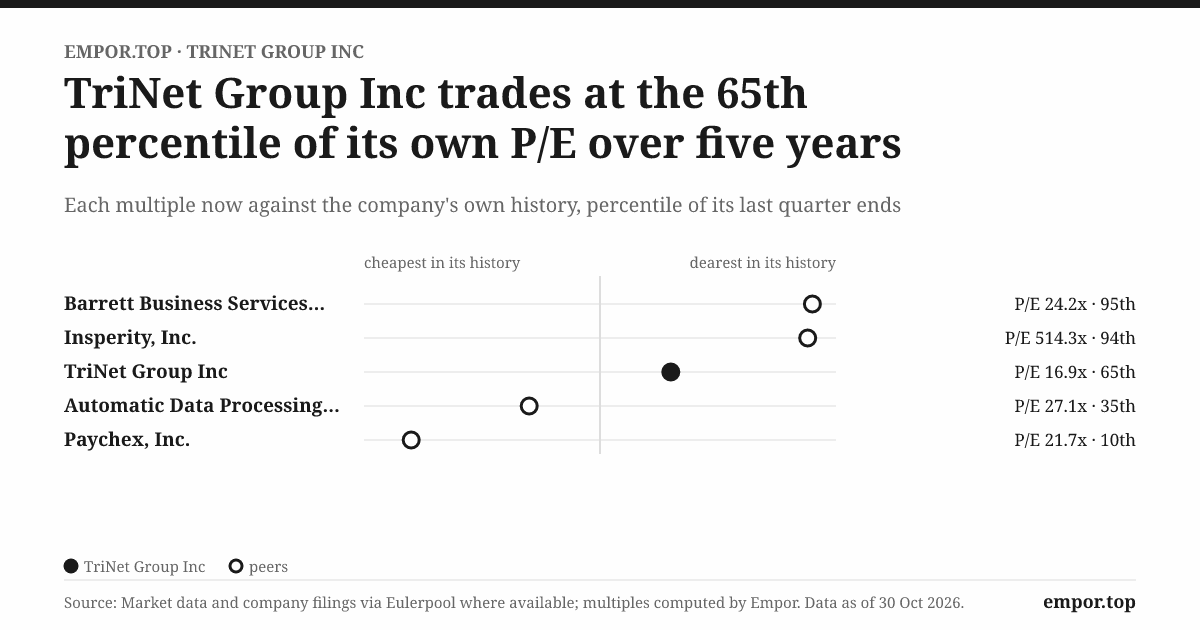
The valuation reflects that uncertainty. At $61.50, TriNet traded at about 16.9 times trailing earnings, against a five-year median of about 15.3.14 That is only modestly above its own history and does not by itself signal that investors are pricing in a strong recovery. On enterprise value, which adds debt and subtracts cash, TriNet traded at about 9.7 times EBITDA and about 0.7 times sales.14 The sales multiple is nearly meaningless for comparisons, because TriNet's revenue includes insurance billings that payroll processors do not report the same way. Paychex, by contrast, traded at about 21.4 times earnings and 13.9 times EBITDA in late October 2026, a premium that reflects its scale and less volatile mix.18 Insperity's trailing multiples were distorted by very low earnings, so they offer no stable anchor.6
The share price itself has been on a violent ride. Over the past year, the stock has traded between about $33.85 and $75.28, and over five years it suffered a peak-to-trough fall of nearly 75%.14 The market, in other words, has been repeatedly repricing its view of whether TriNet's earnings power is closer to 2023 or 2025.
Three numbers to watch
The case reduces to three indicators. The first is the average count of co-employed worksite employees, along with retention, which remain under pressure.1 The second is the insurance cost ratio, which improved modestly in the third quarter without a prior-year recovery.1 The third is operating cash flow reconciled for restricted client-fund movements, so that investors can see true corporate cash generation.
Valuation, read neutrally, appears to assume something between the two cases: neither a return to the 2023 earnings peak nor a further collapse. What would confirm the bull case is multiple consecutive quarters of worksite-employee stabilization, a lower insurance cost ratio without one-off help, and disclosed proof that platform investment improves sales, retention or unit economics. What would confirm the bear case is another round of ratio blowouts, continued double-digit worksite-employee declines, or a meaningful write-down of the ERTC receivable.
TriNet's story, though, is bigger than one stock. It offers lessons for anyone who owns or builds a business like it.
X. Lessons From a Business Built Around Other People's Payroll
Go back to the small employer facing payroll day, and follow the money. On Thursday, the client sends TriNet the funds for salaries, taxes and benefits. On Friday, TriNet pays the employees. Over the following weeks, it remits taxes to governments and premiums to insurers. For a few days, all of that money sits in TriNet's accounts, earning interest. Then most of it is gone, and what remains is a fee and a thin slice of the benefits bill. Four lessons follow, and each belongs to TriNet in particular.
The first lesson is that a billion-dollar line can be a pass-through before it is a profit pool. TriNet's revenue line is dominated by insurance billings that flow to carriers; in 2025, about $91 of every $100 of insurance revenue went straight back out.2 The investor who values TriNet on its revenue is valuing other companies' premiums. The founder who builds a business that touches large flows of money should know the difference between controlling a flow and owning it. A company is only as large as the slice it keeps.
The second lesson is that the renewal is the real product. A PEO contract can generally be cancelled on thirty days' notice, so every client is effectively re-sold every year, at renewal, when the benefits price arrives.2 When TriNet raised prices to protect its margins, the clients that left were telling the company exactly what the product was worth to them. Companies with short contracts learn their true pricing power at the renewal desk, not in the strategy deck. For TriNet, the product is not payroll software. It is the decision to stay.
The third lesson is that cash is only yours after you ask whose payroll it is. TriNet's balance sheet held about $2.1 billion of cash and investments, of which only about $287 million was freely available.2 Its receivable from the IRS is real money, but it depends on government examinations and, if claims fail, on collecting back from small businesses.7 Investors in intermediaries, from payroll processors to brokers to payment companies, should always ask the same question: if every client asked for its money back tomorrow, what would be left?
The fourth lesson is that a shrinking share count cannot rescue a shrinking business forever. In 2023, TriNet paid $107 a share to its largest holder, betting on its own earnings.2 Over the next three years, the share count fell by about a fifth, but net profit fell by more than half and worksite employees kept declining.2 1 Buybacks amplify what the business does. When the business grows, they magnify the gain; when it shrinks, they cannot cover the loss. The price paid for a company's own shares is the purest test of management judgment, because it is the one capital decision whose result is visible every trading day.
XI. The Next Renewal Decides the Story
Tonight, TriNet stands at a hinge. The third quarter showed an insurance cost ratio modestly better than a year ago without one-time help, new sales growing again by management's account, and management saying it expected earnings at the top of its range.1 It also showed a worksite-employee base still shrinking at a double-digit rate.1 The next benefits renewal cycle is beginning, and with it the season when small employers decide whether to stay.
The first thing to watch is average worksite employees and retention, ideally by client size and industry vertical. If the decline narrows from 12% to single digits and then to stability over the next few quarters, the claim that retention has improved and new sales have turned will be confirmed. If the decline persists, the story becomes one of a business that restored its margins by shrinking its customer base. Revenue per worksite employee is a poor substitute: it can rise for the wrong reasons, as it did when price increases pushed clients away.
The second thing to watch is the insurance cost ratio across multiple quarters, with recurring claims performance separated from prior-year recoveries. A ratio holding in the high 80s or better, without help, would suggest TriNet has finally priced the medical cost trend correctly. A ratio drifting back toward 91% would suggest the 2024–2025 squeeze was not a one-off.
The third is the IRS. The roughly $310 million of ERTC receivables at mid-2026 will either be collected, disallowed or partly clawed back from clients.7 The pace of collections, any examination outcomes and the trajectory of unrestricted cash and debt will show how much financial flexibility TriNet really has. The fourth is capital returns: whether buybacks continue at their recent pace, at what valuation, and how they move Atairos's share of the company.
There is a rhythm to how the answers will arrive. The fourth-quarter report, due early in 2027, will show whether management delivered the top end of its earnings range, and the full-year filing that follows will carry the updated ERTC balance, the year-end restricted and unrestricted cash, and the share count that lets investors recompute Atairos's percentage.1 2 The first quarter of 2027 matters even more, because it will be the first full read on how clients greeted the prices set for the new year. The first quarter has consistently carried TriNet's widest margins; in the first quarter of 2026, operating profit was about $136 million, nearly as much as the second and third quarters combined.15 1 A strong first quarter with a narrowing worksite-employee decline would be the most persuasive evidence yet that repricing is complete. A strong first quarter with another double-digit decline would say the opposite: that TriNet is harvesting a shrinking book.
Each outcome points somewhere different. Stable worksite employees with a disciplined ratio would show TriNet is a recovering specialist. A falling base with a stable ratio would show a smaller, more profitable but shrinking business. Rising costs and a falling base would revive the bear case in full. The story turns on whether client volume stabilizes without sacrificing pricing or claims discipline. The IRS outcome and the buyback are consequential, but secondary.
XII. The Payroll Still Has to Clear
Friday morning, somewhere in Massachusetts or California or Texas, a small business pays its people. The architect gets her salary. The lab technician's health insurance premium is paid. The payroll taxes are on their way to the government. None of those employees thinks about TriNet. Most have never heard of it. Yet the money that keeps their paychecks arriving and their coverage active passed through its accounts.
That is TriNet's particular place in the economy: a small slice of a large flow, with the risk that the slice turns out too thin.
The opening contradiction holds. Whether TriNet compounds value from here depends on reclaiming the balance it lost in 2024 and 2025.
TriNet's business is the promise behind payroll—and every quarter, it has to make that promise worth renewing.
References
-
TriNet Announces Third Quarter 2026 Results and Now Expects to Deliver Earnings at the Top End of EPS Guidance Range — TriNet Group, Inc., 2026-10-29 ↩↩↩↩↩↩↩↩↩↩↩↩↩↩↩↩↩↩↩↩↩
-
2025 Form 10-K — TriNet Group, Inc., 2026-02-12 ↩↩↩↩↩↩↩↩↩↩↩↩↩↩↩↩↩↩↩↩↩↩↩↩↩↩↩↩↩↩↩↩↩↩↩↩↩↩↩↩↩↩↩↩↩↩↩↩↩↩↩↩↩↩↩↩↩↩↩↩↩↩↩↩↩↩↩↩↩↩↩↩↩↩↩↩↩↩↩↩↩↩↩↩↩↩↩↩↩↩↩↩↩↩↩↩↩↩↩
-
2026 Proxy Statement — TriNet Group, Inc., 2026-04-15 ↩↩↩↩↩↩↩↩↩↩↩↩↩↩↩↩
-
FY2025 Form 10-K — Automatic Data Processing, Inc., 2025-08-08 ↩↩
-
Q2 2026 Form 10-Q — TriNet Group, Inc., 2026-07-30 ↩↩↩↩↩↩↩↩↩↩↩↩↩↩
-
TriNet Completes Acquisition of Zenefits — TriNet Group, Inc., 2022-02-15 ↩↩↩↩↩
-
TriNet Prices Initial Public Offering — TriNet Group, Inc., 2014-03-26 ↩
-
Amendment No. 1 to Form S-1 — TriNet Group, Inc., 2014-01-10 ↩↩
-
TriNet to Acquire Strategic Outsourcing, Inc. — TriNet, 2012-09-14 ↩↩↩
-
New Senior Unsecured Notes Rating — S&P Global Ratings, 2023-08-01 ↩↩
-
TriNet Announces Second Quarter 2026 Results, Raises FY26 Earnings Guidance — TriNet Group, Inc., 2026-07-30 ↩↩↩↩↩
-
TriNet Group Q3 2026 Earnings Call Transcript — Benzinga, 2026-10-29 ↩
-
2026 Annual Meeting Results — TriNet Group, Inc., 2026-05-27 ↩
 LinkedIn
 WhatsApp
 Reddit
 Hacker News
 Email
 Kindle
 RSS Feed
 Spotify
 Apple Podcasts
 Amazon Music
 Audible
 YouTube