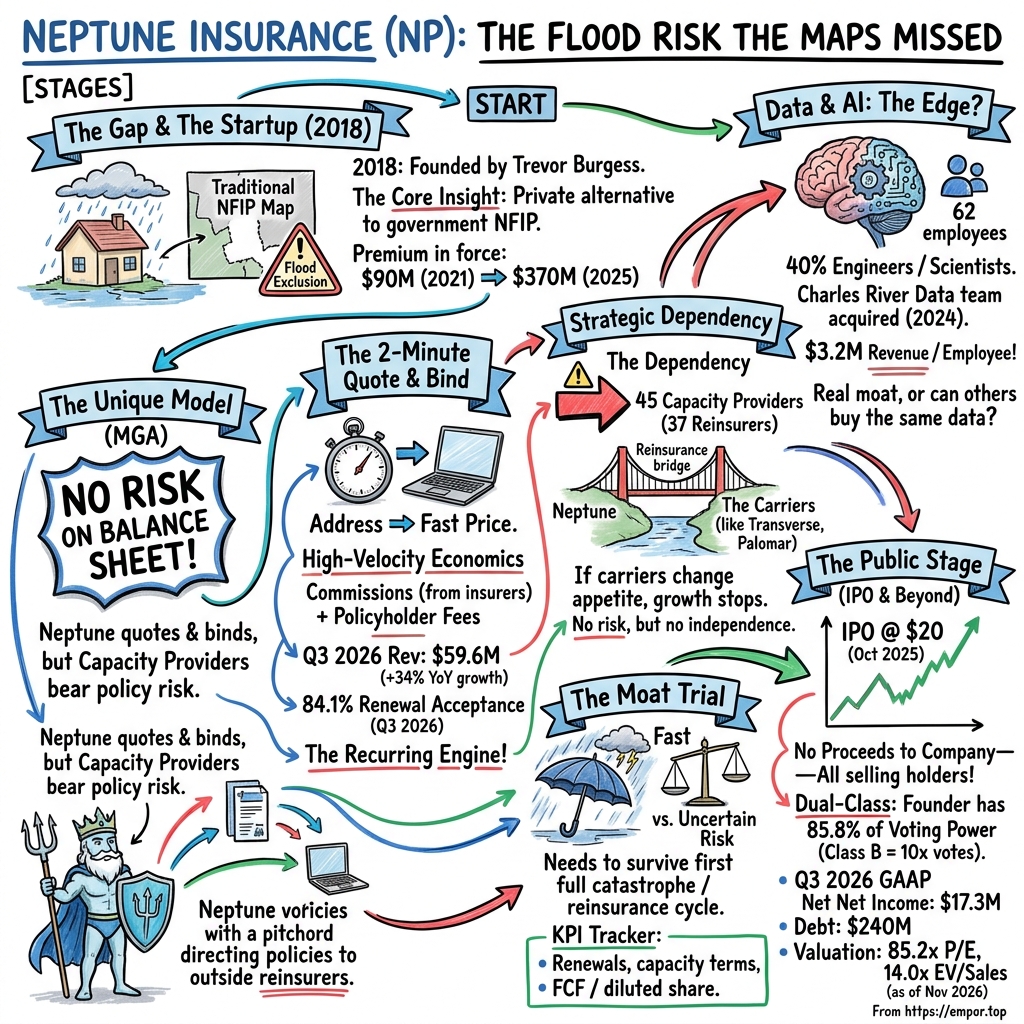
Neptune Insurance: The Flood Risk the Maps Missed
I. A Flood Insurer That Doesn’t Insure the Flood
Most homeowners discover the gap at the worst possible time. The water has already come in under the door, the carpet is ruined, the drywall is wicking brown up from the floor, and the homeowners policy they have paid for faithfully for years turns out to say, in language nobody read, that flood is not covered.
Standard homeowners and renters policies in the United States exclude flooding, and so do most commercial property policies.1 Flood is the peril that sits outside the ordinary insurance contract, handled instead by a separate policy that most people never buy.
Now picture a different homeowner, one whose agent did the awkward thing and raised the subject before the storm. The agent typed the address into a screen, and within a couple of minutes a price came back for a private flood policy. The paperwork that followed carried a name: Neptune Flood. That homeowner would reasonably assume Neptune is the insurer, the company that will write the check if the river rises.
It is not. Neptune quotes the policy, underwrites it, binds it and services it, but the insurance risk itself sits on the balance sheets of the insurers and reinsurers behind the program. Neptune says plainly that it does not assume the insurance risk of the policies it writes and does not handle the claims.2
That is the strange, elegant and slightly vertiginous business at the centre of this story. Neptune Insurance Holdings, listed on the New York Stock Exchange under the ticker NP, is a managing general agent, an MGA in insurance shorthand: a firm that has been handed the pen by risk-bearing carriers and allowed to write business on their behalf.
It earns commissions from those carriers and fees from policyholders. It does not hold reserves against hurricane losses, does not need statutory capital to absorb a catastrophe, and does not wake up after a landfall wondering whether its own solvency has just been tested.
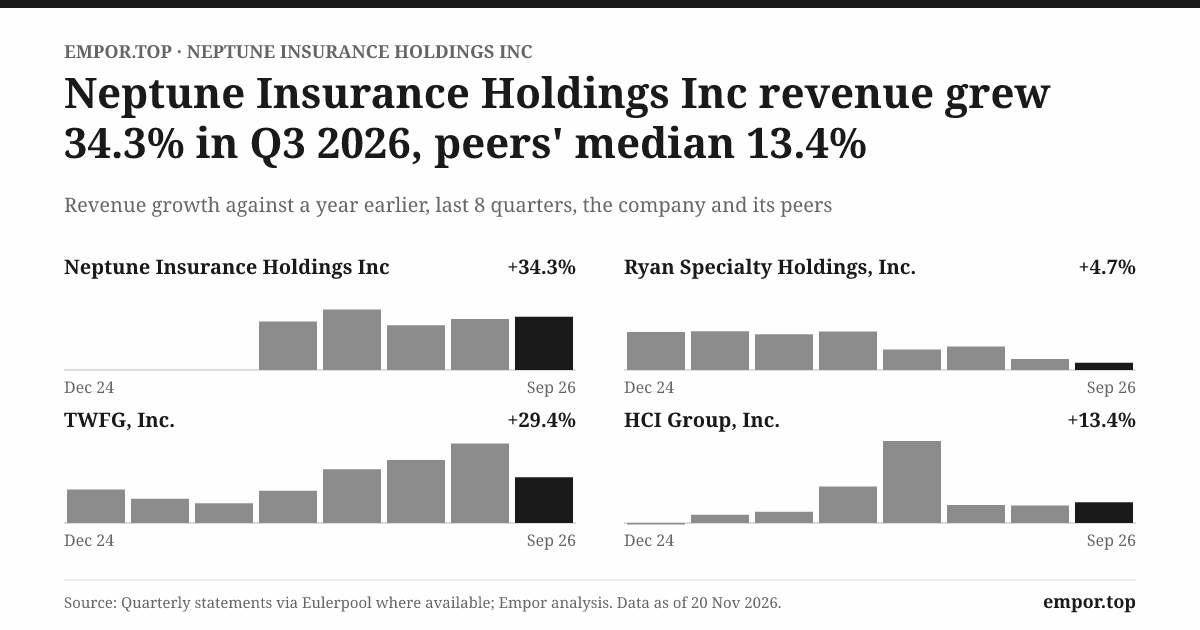
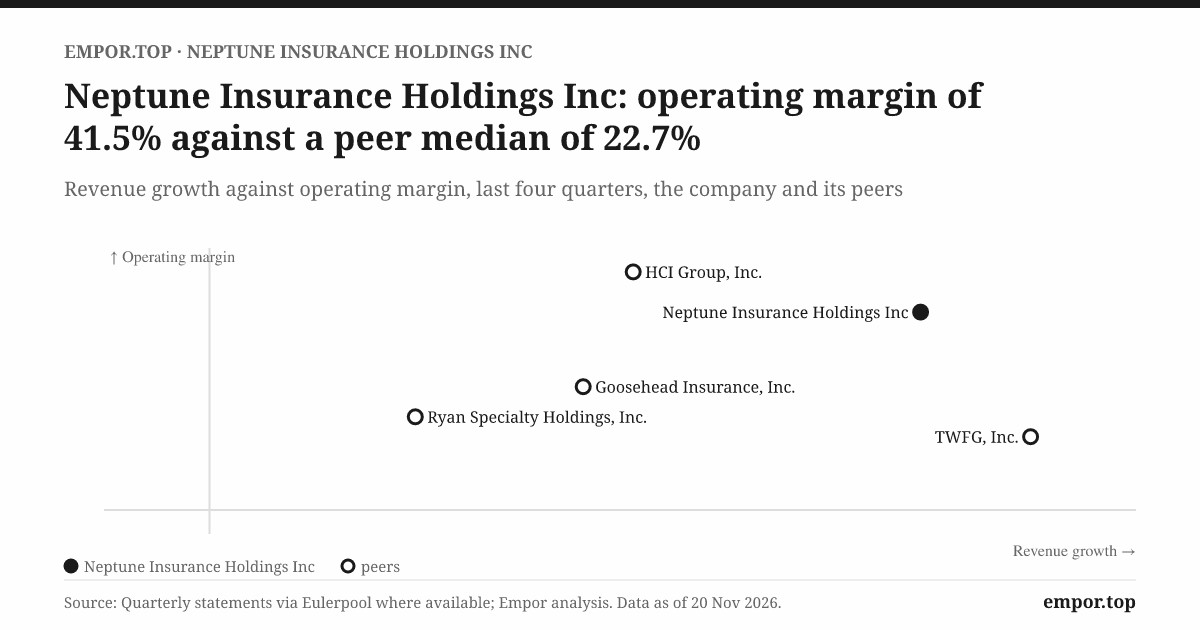
The numbers that came out of that model in the third quarter of 2026 looked more like a software company than an insurer. Revenue was $59.6 million, about 34% higher than a year earlier.3 Management reported an adjusted EBITDA margin of 61.7%, meaning that of every $100 of revenue, roughly $62 was left before interest, taxes, depreciation and the noncash cost of stock awards.4
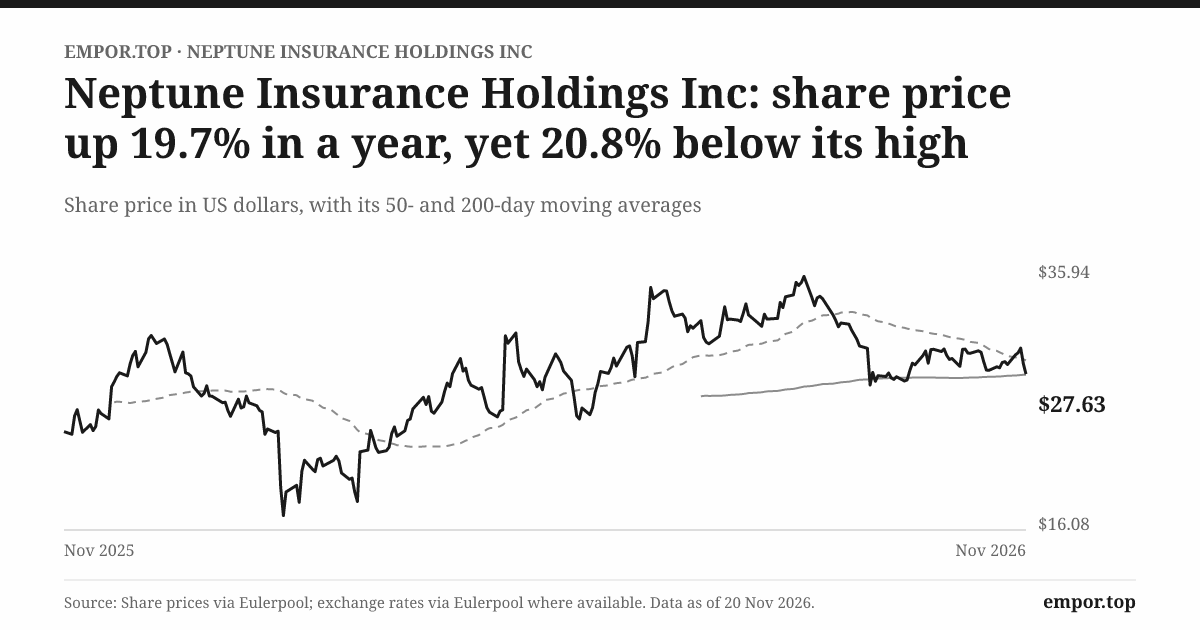
On November 20, 2026, the market valued the whole company at about $3.8 billion, at a share price of $27.63.5 For a firm that employed fewer than seventy people at the end of 2025, that is a lot of value per desk.6
The stakes are larger than the company. The National Flood Insurance Program, run by the federal government, remains the dominant flood insurer in America, and private coverage has been a growing but still minority alternative. Neptune says it held 8.2% of the U.S. primary residential flood market in 2025, which, if accurate, makes it one of the most significant private players in a market that the government has owned for most of living memory.6
Management likes to frame the opportunity as a gap between roughly four million flood policies in force and about twenty-five million properties it judges to be at meaningful flood risk.4 Whatever one thinks of that estimate, the direction is not in dispute: far more homes face flood risk than carry flood insurance.
So the story poses four questions, and they will follow Neptune all the way to the last page. The first is whether its growth is durable through the insurance cycle, or simply the product of a long run of carriers and reinsurers being willing to lend it their balance sheets.
The second is whether its data and automation constitute a real competitive edge, or merely a polished interface on a commodity product. The third is whether the earnings it reports actually become cash for shareholders after the company pays its lenders and its employees' equity awards. The fourth is a quieter one: when a public investor buys a share of NP, how much say do they actually get?
One boundary needs to be fixed before going further. The company examined here is Neptune Insurance Holdings, the Delaware parent formed in 2025, and its operating subsidiary Neptune Flood.6 It is not the carriers that back its policies and not the reinsurers that stand behind those carriers.
When a flood comes, the people who pay are, in the first instance, someone else. That fact is the source of Neptune's margins. It is also, as the story will show, the source of its most important dependency. To see why that bargain exists at all, the story has to go back to a market the maps left open.
 Subscribe on LinkedIn
II. When the Maps Left a Market Open
For half a century, American flood insurance was less a market than a public utility. Private insurers had largely abandoned the peril because floods are the kind of risk that breaks the basic arithmetic of insurance. Insurance works when many people pay a little and a few people suffer a lot, independently of each other. Floods do the opposite.
When a river overtops its banks or a hurricane pushes a wall of seawater ashore, it does not damage one house on a street; it damages the street, and the next one, and the town. The losses arrive all at once and concentrate in exactly the places where policyholders cluster. So the federal government stepped in with a national program, and for decades the NFIP sold most of the flood insurance in the country.
The program solved one problem and created another. Because it was public, it could keep coverage available where private capital would not go. But its policies came with standardized limits, its prices were long criticized as disconnected from the risk of individual properties, and its take-up remained thin. Policy counts peaked at about 5.7 million in 2009 and drifted down to roughly 4.95 million by August 2021.1
Triple-I survey data put the share of homeowners who said they had flood insurance at 27% in 2020, and found far lower figures in earlier years; academic work cited in the same research suggests only about 30% of homes in the highest-risk areas carried flood coverage.1
Neptune's management has argued that nearly half of NFIP policies are priced below full risk, a subsidy it puts at about $2.6 billion a year.4 Whether one accepts that framing or not, the practical result was a vast protection gap and a federal incumbent whose pricing was, at least in parts of the map, not set by private-market economics.
What changed was the map itself, or more precisely the ability to see beyond it. The old approach to flood risk leaned heavily on government flood zones, broad lines that sorted properties into high-risk and moderate-risk categories. Two houses on opposite sides of a line could be treated very differently, while two houses in the same zone, one perched on a rise and the other in a hollow, could be treated the same.
Better elevation data, satellite imagery, hydrological modeling and cheap computing made it possible to price individual properties more finely. A private insurer that could see that the house on the rise was a good risk could offer it a price the program could not match, and leave the house in the hollow to the program. That is the opening private flood insurance walked through, and it is the opening Neptune was built to exploit.
The man who built it came from banking, not insurance. Trevor Burgess, Neptune's chief executive and chairman, had previously led C1 Bank, a Florida bank he built and later sold.74 The experience mattered in two ways.
A banker's instinct is to think in terms of origination and balance sheets, and Burgess designed Neptune to be an originator without a balance sheet: a firm that would find, price and service risk, then pass it to institutions whose business is holding it. And a Florida banker knows, in a way that someone in Hartford or New York might not, what water does to collateral. Neptune's disclosed operating history begins in 2018, its first full year of operations.6
It is worth pausing on that date, because it cuts against a tempting misreading. A long series of financial figures circulates for NP's ticker that reaches back to 2013, showing revenue near a billion dollars and dividends paid every year. None of that is Neptune.
The company did not exist in its current form for most of that span, and the figures belong to some other business attached to the ticker in data feeds. Neptune's record is short and young, and the honest version of the story is a startup story, not a heritage story.
That startup story is a story of compounding from a small base. Premium in force, the total annual premium on all the policies Neptune has written and that remain active, was about $90 million in 2021. By 2025 it was about $370 million, roughly a fourfold increase in four years.8 Revenue followed, rising from about $85 million in 2023 to $160 million in 2025, with growth of roughly a third in the most recent year.6
The expansion came from more products, more states and, above all, more agents. Every new agent who decided that Neptune's screen was the easiest way to offer flood coverage became a new channel into homes the program had never reached, or homes the program had reached at a price Neptune could beat.
Burgess's role in that build is unusual even by founder standards. He runs the company as chief executive, chairs its board and, through a class of high-vote shares, controls it, a structure the story returns to when it reaches the boardroom.9
Neptune's operating company is older than the public entity: the listed holding company, Neptune Insurance Holdings, was formed in April 2025 and placed above Neptune Flood ahead of the IPO.6 The distinction matters for anyone reading the history. What the public owns is a holding company less than two years old, wrapped around an operating business less than a decade old.
So the evidence supports a strong early position. Neptune moved early into a market the government had dominated, built distribution quickly and grew premium in force several times over. What the evidence does not yet support is a claim to a long record. Neptune has not lived through a full insurance cycle as a large company: the hard reinsurance market that followed a run of major catastrophes tested it, but a severe, sustained withdrawal of capacity from flood risk has not.
That matters because of the dependency Burgess designed into the business on purpose. Neptune can see a flood risk and price it. It still needs someone else to be willing to carry it. And before getting to who those someones are, it is worth looking at what Neptune actually sells, and why the money keeps coming back.
III. A Quote in Two Minutes—and a Commission When It Binds
The workflow is almost anticlimactic. An insurance agent somewhere in Florida, Texas or New Jersey is sitting with a client who is buying a house, or renewing a homeowners policy, or simply worried after watching the news. The agent opens Neptune's platform and enters the property address. There is no long questionnaire, no request for an elevation certificate that costs the homeowner money and takes days to arrange, no human underwriter reviewing the file.
The system pulls in what it knows about the property and its surroundings, prices the risk, and returns a quote. If the client agrees, the agent binds the policy on the spot. Neptune says its platform underwrites without human underwriters, and the company describes the whole thing as a quote-and-bind experience measured in minutes.7
That speed is the product, at least as far as the agent is concerned. An agent is paid to place insurance, and flood is the awkward add-on: a separate policy, a separate carrier, historically a separate stack of paperwork. Anything that makes flood as easy to sell as the homeowners policy it sits beside has a chance of getting sold more often.
Neptune's cumulative quote count had reached about 38.7 million by the third quarter of 2026, a figure that includes a large volume of quotes generated automatically through software integrations with agency systems.4 Most quotes never bind. But every one of them is a moment when flood insurance appeared on a screen where it might otherwise have been forgotten.
When a quote does bind, two streams of money begin to flow. The larger is commission income. Neptune's capacity providers, the insurers backing each program, pay it a negotiated percentage of the premium on each policy it writes. The smaller is fee income: flat charges paid by policyholders, which vary by product, risk and location.7
In the third quarter of 2026, commissions brought in $45.9 million and fees $13.7 million, so roughly three-quarters of the company's revenue depended on the size of the premiums Neptune writes and the commission rate its providers agree to pay on them.2 That split is the first thing a listener should hold onto. Neptune's revenue grows not only when it writes more policies, but when premiums per policy rise and when the commission rate holds. Policy count alone does not tell the story.
Revenue is recognized when coverage binds, which gives Neptune's income statement a front-loaded character. Commissions are generally received up front for the full policy year, with reserves set aside for cancellations.7 In plain English, Neptune books and collects most of its money at the start of the policy, not month by month over its life. That is pleasant for cash flow, and it is one reason the business has historically turned profit into cash efficiently.
There is a wrinkle on the fee side: deposits paid by policyholders before Neptune has completed its obligations are held as a liability and recognized later. Those premium deposits reached $38.7 million at the end of September 2026, up from $18.9 million at the end of 2025, a seasonal build that reflects money already collected but not yet earned.2
Receivables, by contrast, were small, about $4.9 million against a quarter's revenue of nearly $60 million.2 Neptune does not have a meaningful problem with customers paying late, because the money mostly arrives before the service is complete.
The recurring engine is the annual renewal. Flood policies run for a year, and each year the homeowner, usually guided by the agent, decides whether to renew. Neptune measures this with a metric it calls renewal acceptance on eligible offers: of the policies it offered to renew, the share whose owners accepted.
In the third quarter of 2026, that figure was 84.1%, and for the first nine months of the year it was 85.2%.2 Measured differently, the IPO prospectus reported first-quarter 2026 retention of 86.2% on policies and 92.9% on premium.7 On the third-quarter call, management put revenue retention over the trailing twelve months at about 89%.4
These numbers reward a moment's thought. The gap between policy retention in the mid-eighties and premium retention in the low nineties says that the policies that renew tend to renew at higher premiums, through rate increases, rising property values or higher coverage, enough to more than offset some of the policies lost. That is the signature of a product customers keep using and are willing to pay more for each year.
It is not yet proof of pricing power in the strong sense, because the premium is set in negotiation with capacity providers and filed against regulatory and competitive constraints, and because homeowners in mortgage-required flood zones often have little choice but to keep some coverage.
A homeowner who must carry flood insurance to keep a mortgage is retained by the bank's requirement as much as by the product. And the roughly one in six eligible policyholders who do not accept the renewal offer are a reminder that a cheaper quote from the program or a rival is a phone call away.
The right way to use renewal acceptance, then, is as a testable gauge rather than a trophy. If Neptune raises prices and acceptance holds, the product has more pricing latitude than critics assume.
If acceptance slips when premiums rise, or when the program cuts its own prices in a particular market, the gauge will say so before the revenue line does. The slight decline from the nine-month average to the third-quarter reading is too small to be a trend, but it is the number to watch.
There are three parties in this machine, and it pays to keep them distinct. Agents and brokers are the distribution: they choose whether to put Neptune in front of a client. Policyholders are the end customer: they pay the fees and the premium, and they decide whether to renew. Capacity providers are the risk-bearers: they pay Neptune commissions and carry the losses.
Neptune reported more than 65,000 verified agent accounts on its platform and about 43,000 active in the third quarter, up from about 39,000 in the second.4 Its 2025 annual report warns that losing key agent relationships could hurt policy volume, but it does not disclose how concentrated its distribution is among its largest agencies.6
Growth, finally, is not only a function of renewals. New policies depend on the housing market, because home purchases are when many people first confront the flood question; on flood events, which sharpen fear; on agent productivity; on the program's pricing; and on the appetite of the carriers behind Neptune.
In the third quarter of 2026, management said new business premium rose about 51% despite a housing market it described as weak and a hurricane season that had, in its words, not done the company any favors.4
That is a striking claim of momentum in a soft environment, and a fair question is how much came from expanded capacity and new programs rather than organic demand. Which brings the story to the uncomfortable truth hiding in the elegant model. Neptune's revenue is its own. Its ability to write a policy, though, is borrowed.
IV. Forty-Five Capacity Providers, One Unavoidable Dependency
At the end of September 2026, the roster behind Neptune's pen ran to 45 capacity providers backing eight programs, and 37 of those providers were reinsurers.2 It is worth translating what that sentence describes. A program is an arrangement in which one or more insurance carriers agree to let Neptune write policies on their paper, within agreed limits, at agreed commission rates.
The carriers, in turn, pass much of the risk to reinsurers, the insurers of insurers, who spread it across global capital. When Neptune binds a policy, it is drawing on that layered stack of promises. Premium in force across all of it was about $450 million, up 32% in a year, across more than 336,000 policies.4
The breadth of that roster is genuinely reassuring in one respect. A capacity provider network of 45 names is far less fragile than a program that depends on a single carrier, because no one withdrawal by itself shuts the business down. If one reinsurer decides it has too much Gulf Coast exposure, others can take its share. But breadth is not the same as diversification, and the company's disclosure stops at the headline count.
Neptune does not disclose how much of its premium or revenue comes from its largest program or its largest provider, how much capacity is contractually committed for future years, or what commission rates each program pays.2 Forty-five names could mean forty-five roughly equal partners. It could also mean one or two programs doing most of the work, with a long tail of reinsurers taking small slices. A reader cannot tell which.
The distinction between Neptune and its providers also matters for the market-share claim. Neptune's 8.2% share of the U.S. primary residential flood market is a measure of the premium it writes, not of its own revenue.6 Comparing Neptune's MGA revenue with an insurer's premium totals would be like comparing a real-estate broker's commissions with the value of the houses it sells. The NFIP remains the far larger competitor across flood coverage as a whole.
The private side of the market has its own shape. Regulatory data on private flood writers show the premium spread across a set of insurers and their programs, with large writers including Transverse Specialty, Indian Harbor, Federal and Palomar entities.10 Indian Harbor is part of AXA XL; Federal belongs to Chubb. These are risk-carriers, the kinds of companies that might sit behind an MGA's programs or write flood directly, not like-for-like rivals to Neptune's business of distributing and underwriting on someone else's paper.
Triple-I's analysis of the same data shows private flood is a small market measured in hundreds of millions of dollars of net premium, with the top writers each holding low-teens shares of direct premium.1
The real MGA competition comes from firms such as Wright Flood, Aon Edge and other private programs, which compete for the same agents and the same homeowners. Public data does not provide comparable market shares for those MGA competitors, so Neptune's relative position among MGAs cannot be pinned down with precision.
Here is where the downside mechanism lives, and it is not the obvious one. The obvious fear for any flood business is a giant flood. For Neptune, a giant flood is mainly someone else's loss; the claims fall on the providers. The real danger is what a run of large losses does to those providers' appetite afterward. If reinsurers lose money on flood, they can raise their prices, shrink their exposure or leave the line.
Carriers facing higher reinsurance costs can tighten underwriting guidelines, demand higher premiums or cut the commission they pay Neptune. Any of those moves can slow the policies Neptune writes or squeeze the revenue it earns per policy, even if homeowners' demand for coverage is undiminished, or even higher, after the storm. A capital-light intermediary insulated from the loss can still be choked by the aftermath of the loss.
The same squeeze can arrive from the distribution side. If rival MGAs or carriers decide to buy market share by paying agents larger commissions, Neptune would have to match them or watch its agents place business elsewhere. Either response would compress margins. Neptune's economics look so good partly because both of its counterparties, the providers above and the agents below, have been content with the current split. The arrangement depends on neither side deciding it deserves more.
What management says on the subject is encouraging, but it is management saying it. On the third-quarter 2026 call, the company said a capacity program had been renewed on improved terms, and that from December 1, 2026, none of its active capacity programs would include contingent commissions.4 That second change is subtle and important. A contingent commission is a bonus paid to an MGA when the business it writes turns out to be profitable for the carrier.
It aligns the MGA with underwriting quality, but it also ties the MGA's revenue to loss experience, which means a bad hurricane year can claw back revenue. Removing contingent commissions makes Neptune's revenue less sensitive to the losses its providers suffer, which is exactly what an investor in a capital-light model would want.
It also raises a question a skeptic should ask: if Neptune no longer shares in the upside of good underwriting, what keeps its interests aligned with the providers', other than the providers' ability to walk away at renewal?
Management's prepared remarks were confident about expansion. The analytical posture should be to compare that confidence with the conditions the company itself described: a housing market it called weak, two years without a major hurricane to push demand, and a 2027 plan that assumes neither of those conditions improves.4 Strong renewal of capacity during a benign loss period is the expected outcome; it is not much of a test. The test comes after a bad season.
So the verdict on this act is straightforward. Neptune has built a broad network of capacity providers, and it has been renewing them on terms it describes as improving. That breadth reduces the risk of a single point of failure.
But capacity remains an external constraint that Neptune does not control, and the company does not disclose the details that would let an outsider judge how secure it is: how much capacity is committed beyond the next renewal, at what economics, and how those terms would change after a difficult catastrophe or reinsurance cycle.
Until those terms have been tested in a bad year, the capacity network is a strength, not a moat. Which raises the obvious counterargument, the one Neptune's management makes most forcefully: that its real advantage is not who carries the risk but how well Neptune can see it.
V. The Data Bet—and the Acquisition That Bought More of It
Neptune has never looked like an insurance company from the inside. At the end of 2025, it had 62 employees, and about four in ten of them were engineers or data scientists.67 By the third quarter of 2026, management put headcount at 59, even as revenue grew by a third.4
A traditional insurer of comparable premium volume would employ underwriters, claims adjusters, actuaries and customer-service staff by the hundreds. Neptune runs on a small team and a great deal of software, and the company's pitch to investors is that the software is the business.
The operating claim goes like this: each policy written adds to the data.7 Each year of claims experience on those policies, shared back by the providers, sharpens the model. In theory, the more Neptune writes, the better it prices, and the better it prices, the more providers want to back it and the more agents want to use it. That is the flywheel management describes.
The economics are where the claim first becomes visible. Neptune reported revenue per employee of about $2.8 million over the twelve months to March 2026, and its third-quarter 2026 presentation put the trailing figure at about $3.2 million.711 Those are extraordinary numbers in any industry.
They imply that each employee supports revenue that, in most service businesses, would require ten or twenty people. Management added more color on the third-quarter call: engineering output about two and a half times that of a year earlier with roughly the same headcount, and a customer-service ratio of about one representative for every 30,000 policies.4
The company's newest tool for agents is called Atlas+. About 7,000 agents used it in the third quarter, exchanging more than 75,000 messages, and management said quotes that involved Atlas+ bound at three and a half times the rate of quotes that did not.4 That is the kind of statistic that sounds decisive and deserves a careful reading.
Agents who choose to use a new tool may already be the most engaged and most productive agents, the ones most likely to close any quote. A bind-rate gap of that size can reflect who uses the tool as much as what the tool does. Until Neptune shows that agents improved after adopting Atlas+, the figure is evidence of correlation with productivity, not proof of cause.
The most concrete data bet Neptune has made was a small one. In May 2024, it hired all of the employees of Charles River Data through individual employment arrangements, bringing in a team to strengthen its data science, artificial intelligence and machine learning work.7 The company has not disclosed a purchase price or any deal multiple, so the transaction cannot be measured against acquisition comparables.
It is best understood as a team acquisition, a way of buying talent quickly, rather than as evidence of an acquisition-led growth strategy. Neptune has made no large acquisitions, and on the third-quarter call management indicated that few targets had met its screening criteria, though it said the balance sheet could support a deal.4
What the company does disclose about its technology spending is thin. Internally developed software sat on the balance sheet at about $6.0 million net at the end of 2025, barely changed from $5.8 million a year earlier.6 Neptune does not report research and development as a separate line, and it publishes no series showing technology investment as a share of revenue. That makes the data advantage hard to measure from the outside.
A company with a genuine modeling edge would ideally be able to show it in outcomes: loss ratios on its programs better than the market's, commissions higher than peers', or conversion and retention rates that rivals cannot match. Neptune does not disclose a peer comparison of loss performance, and it does not show that its models allow it to command higher commission rates than competing MGAs.
There is also a falsification built into Neptune's own filings. Among the risks it lists is that rapid advances in artificial intelligence may disrupt its platform.7 This is not boilerplate for a company whose edge is described as data and automation.
If the tools that once required a specialized team—property-level flood modeling, automated underwriting, conversational assistants for agents—become cheap and widely available, then a rival MGA, a large carrier or a new entrant could reproduce much of what Neptune built in a fraction of the time.
The third-quarter call turned to this directly when Elyse Greenspan of Wells Fargo asked how AI might affect expense levels and margins over time. Burgess answered that the shift would take a long time and pointed to the U.K. comparative-rater market, where price-comparison platforms reshaped how insurance is bought, as an example of how distribution can change.4 It was a thoughtful answer, and it implicitly concedes that the way flood insurance is sold could look very different in a decade.
The fairest verdict is that automation and accumulated data are plausible advantages, and the operating evidence supports them more than marketing alone would. A company that runs this much revenue through this few people is doing something efficiently.
But efficiency is not the same as a moat. The moat question is whether Neptune's data makes it better at selecting risk, converting quotes and keeping customers in ways competitors cannot copy, and that remains unproven. A data advantage only compounds if it improves outcomes faster than others can reproduce it.
The forward test is visible in numbers Neptune already reports. If policy growth continues, renewal acceptance holds in the mid-eighties, revenue per employee keeps rising and margins hold up as competitors adopt similar tools, the software story is real.
If any of those start to soften as rivals catch up, the market will have priced a data moat that turned out to be a head start. And the market, as it happens, began pricing it only recently, in a listing that was less of a fundraising event than its headlines suggested.
VI. The IPO Put a Price on a Young Record
On October 1, 2025, Neptune's shares began trading on the New York Stock Exchange, and the headlines were the kind founders frame and hang on the wall. Axios reported that the flood insurer had raised hundreds of millions of dollars in its IPO.12 The IPO priced at $20 a share, and 21.2 million shares changed hands.7 It was, by the measure of a small company with a few dozen employees, a large event.
The tempting headline was also slightly wrong. The money did not go to Neptune. Every share sold in the IPO was sold by existing stockholders, and the company received no proceeds.7 That is not a scandal, and it is not unusual for a profitable company whose owners want liquidity. But it changes how the listing should be read.
Most IPOs are, at least in part, capital-raising events: the company sells new shares to fund growth. Neptune's was a transfer of ownership from early backers to public investors. The company already generated enough cash to fund itself; what its owners wanted was a market price and an exit route.
The path to that listing had been prepared for some time. In April 2025, Neptune Flood was reorganized beneath a newly formed Delaware holding company, Neptune Insurance Holdings, which became the listed entity.6 Two years earlier, in 2023, Neptune had raised $230 million in a preferred-stock financing from BSIV, an affiliate of the private-equity firm Bregal Sagemount.7
Those preferred shares carried a liquidation preference of about $249.6 million at the end of 2024, meaning the holders would be paid that much ahead of common stockholders in a sale.6 At the IPO, the preferred converted into common stock, folding that claim into ordinary ownership.6
There was another, less visible capital story beneath the IPO: dividends. Neptune's filings describe historic dividends totaling about $605 million since inception, a staggering sum for a company whose cumulative net income over its short life has been a small fraction of that.6
In 2025 alone, Neptune paid about $175 million in dividends, while borrowings rose from about $134 million at the end of 2024 to about $240 million a year later.6 The mechanism is familiar from private-equity-owned businesses: borrow against the cash flows and pay the proceeds out to the owners.
It explains why Neptune's shareholders' equity on the balance sheet was negative, at about minus $227 million at the end of 2025, and why measures such as return on equity are meaningless for this company.6 Neptune's equity is negative not because it lost money but because it returned more to its owners than it had accumulated. The listing did not reverse that recapitalization; it left public shareholders owning a business that carries the debt used to pay the earlier owners.
Around the listing, employees also became owners. In August 2025, 2.835 million shares were issued on the exercise of employee options, for about $15.6 million.6 That kind of event is normal for a company preparing to go public, and it ties staff to the stock. It is also a reminder that equity compensation is part of how Neptune pays its people, a cost that appears in share count as much as on the income statement.
The second liquidity event came in May 2026. Selling holders offered about 9.84 million shares in a secondary offering, and Neptune planned to repurchase 984,140 shares as part of the transaction.13 The company again received no proceeds from the sale itself.13 The buyback was a modest gesture: it absorbed about a tenth of the shares on offer, slightly reducing the dilution public holders bore and signaling that the company considered the price reasonable.
Management told investors on the third-quarter call that it had repurchased about $32 million of stock over the prior year.4 Yet the structure of both events tells the same story. The public market has been, so far, mainly a place where Neptune's early owners sell and new owners buy.
What price have those new owners paid? On November 20, 2026, at $27.63 a share, Neptune traded at about 85 times trailing earnings and 14 times enterprise value to sales.5 The stock had ranged between about $17 and $35 over the previous year, closing about a fifth below its high, with volatility near 60% annualized.5
For context, an investor paying 85 times earnings is paying for profits that, on current numbers, would take most of a century to add up to the price. The multiple only makes sense if earnings grow rapidly for many years. Because Neptune has been public for only about fourteen months, there is no five-year history of its valuation to call normal, and no long-run average against which to judge whether today's multiple is high or low by its own standards.
The listing, then, gave Neptune a price and its backers a way out. It did not give the company new money, and it did not remove the need to judge Neptune on the fundamentals that decide whether that price is earned: cash generation, debt and dilution. It also introduced public shareholders into a company whose control did not change hands at all. Owning a share of Neptune and having a voice in it, it turns out, are two very different things.
VII. The Founder Has the Votes—and the CEO Award Was Mostly Stock
The 2026 proxy statement put the matter in a single line of arithmetic. Neptune's executives and directors as a group held about 11.6% of the Class A common stock, but 85.8% of the company's total voting power.14 In the same proxy cycle, the company reported that its chief executive and chairman, Trevor Burgess, had received total compensation of about $40.5 million for 2025.9 Both numbers are startling. Neither means quite what it seems to at first glance.
Start with control. Neptune has two classes of common stock. Class A carries one vote per share and is what public investors buy. Class B carries ten votes per share.7 At the IPO, the prospectus said Burgess and the Class B holders would control about 82.1% of the voting power after the offering.7
By the 2026 proxy supplement, the executive and director group's share of voting power had risen to 85.8%, mostly through those high-vote rights.14 In practical terms, Burgess and his fellow insiders decide who sits on the board, whether a takeover offer is accepted and how the company's capital is used. Public shareholders can vote, but they cannot change the outcome.
The economic ownership is spread differently. Entities affiliated with Bregal Sagemount held about 19.5 million Class A shares, or 20.6% of the class, and affiliates of FTV Capital held about 22.4 million, or 23.6%.14 Those two private-equity firms own more of the company's economic value than the insiders do, yet they, like retail holders, sit beneath the Class B control.
The structure makes the private-equity owners likely sellers over time, as the May 2026 offering already showed, while Burgess's control remains intact. Neptune also says certain officers had share pledges that predate the IPO, with no new officer or director pledges since.9 Pledged shares can be a concern if a falling price forces sales; the company's disclosure limits that worry to pre-IPO arrangements.
Now the pay. Of Burgess's $40.5 million in 2025 compensation, about $39.7 million was a stock award.9 That is the grant-date value of equity, calculated under accounting rules at the time the award was made, not cash paid to him in 2025.
The value he ultimately realizes depends on the share price and the award's vesting terms; if the stock falls, so does the realized value. The other named executives, chief financial officer Jim Steiner at about $12.1 million and president and chief risk officer Matt Duffy at about $17.4 million, also received mostly equity.9
The company discloses no employment agreements for these executives and no outsized discretionary cash bonuses.9 That structure aligns pay with the stock. It also means the year of the IPO produced a large grant of equity that public shareholders fund through dilution, and the nine-month 2026 cash flow statement's $20.8 million of share-based compensation shows that cost continuing.2
Shareholders did register some discomfort, and it is worth reading carefully. At the May 2026 annual meeting, Burgess received about 4.75 million withhold votes, and director Jonathan Carlon about 4.72 million.15 In a company where insiders control the outcome, a withhold vote cannot unseat anyone. But it is the main channel a public holder has for saying something, and several million shares saying it is a signal worth tracking.
It is not evidence of a broad revolt; the auditor's ratification, by contrast, drew only a few thousand votes against.15 Neptune's governance has other features that a skeptic would note: Burgess combines the chief executive and chair roles, and the company has no permanent lead independent director, though it says its audit and compensation committees are independent.9
The related-party arrangements, often a source of concern in founder-controlled companies, turn out to be small. Neptune paid rent of about $144,000 a year to an affiliate of Burgess for office space, under a month-to-month arrangement of $12,000 a month.62 It also paid an affiliate for software development and data analytics, about $194,000 in 2025, down from $945,000 in 2023.6
Together the 2025 payments came to about 0.2% of revenue, and the trend has been sharply downward. The filings identify the parties and amounts but do not describe the arrangements as arm's-length or give a pricing benchmark. At this scale, they are a disclosure detail rather than a drain.
The executive bench is also changing. On October 19, 2026, Steiner told the company he would step down as chief financial officer after the 2026 annual report was filed, staying on as chief operating officer. The board appointed Cristián Melej, a Neptune director who had chaired the audit committee, as his successor, effective at that point.3
The filing states that Steiner's decision did not arise from any disagreement with the company.3 Moving an audit-committee chair into the finance chief's seat will be efficient, because Melej knows the company's books, and unusual, because it will shift a key independent board voice into management. Investors will want to see who replaces him on the audit committee and how the transition affects the clarity of reporting.
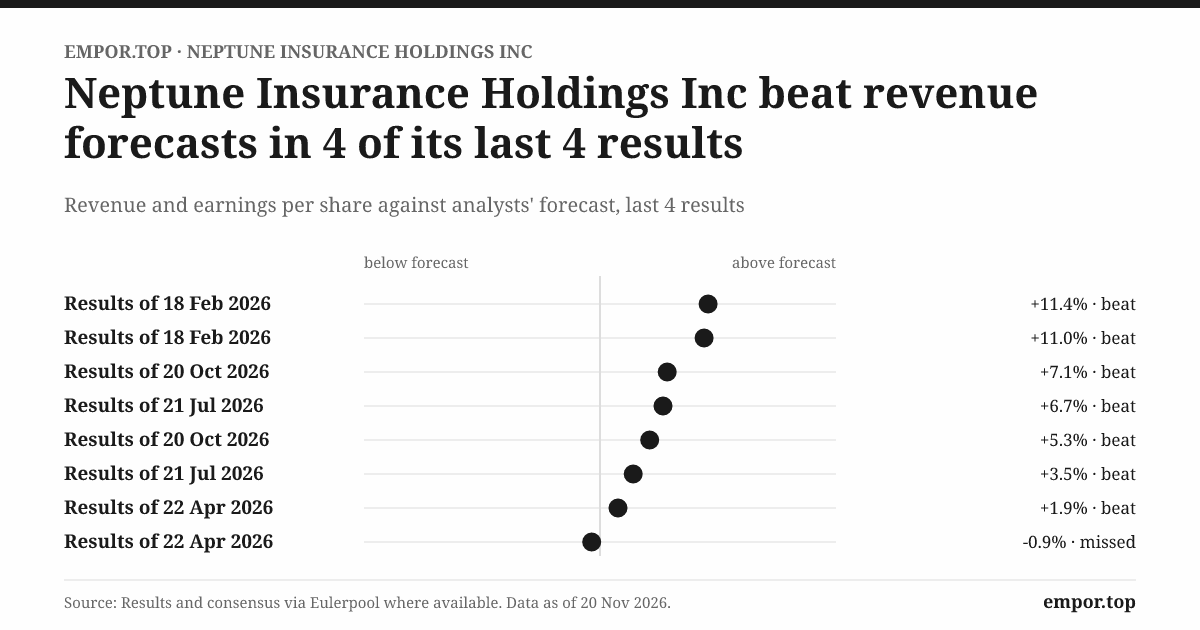
The credibility question can be tested, though only over a short window. Neptune's public guidance history began with its first full year as a listed company. It set its initial 2026 revenue range at about $186 million to $189 million, then raised it four times, most recently to about $204 million, around 28% growth, with adjusted EBITDA margin above 61%.4
That is a record of under-promising and over-delivering, the classic pattern of a new public company keeping its first guidance comfortably conservative. The more revealing test is the first 2027 outlook: about $238 million in revenue, roughly 17% growth, at an adjusted EBITDA margin of about 61%.4
Management said that plan assumes no housing recovery, no above-average hurricane season, no change to the NFIP and no contribution from acquisitions or substantial new products.4 Two things follow. A deceleration from the low thirties to the high teens is a meaningful slowdown, and the market's multiple has to absorb it.
And management has been explicit that it is blaming neither the housing market nor the quiet weather for any shortfall; it has built them into the base case. That is a concrete, testable plan, and it is the kind of explanation investors should demand more of, not less.
The tension remains intact. Concentrated founder control can give a young company the consistency to pursue a long-term strategy without being whipsawed by quarterly sentiment. The same structure means that if Burgess makes a poor capital-allocation decision, outside shareholders cannot stop him. Which makes the question of what Neptune does with its money, and how much of its profit actually becomes cash, more important than it would be at a company where shareholders could vote the board out.
VIII. Profit Is Growing; So Are the Claims on It
In the third quarter of 2026, Neptune reported GAAP net income of about $17.3 million, up roughly half from a year earlier.3 That is the number on the headline. Below it, in the cash-flow statement for the first nine months of the year, sits a quieter figure: share-based compensation added back as a noncash expense.2
Both are real. The first says the business is profitable. The second says some of the cost of running it is being paid in shares rather than dollars, which is a cost shareholders bear through dilution even if it never leaves the company's bank account.
Start with the valid record. Neptune's first full operating year was 2018, so the ticker's older financial history does not describe this company. The recent record is the one that matters.
Net income rose from about $17.9 million in 2023 to $37.4 million in 2025, while operating cash flow rose from about $18 million to $51.7 million over the same period.6 In 2024 and 2025, cash from operations ran comfortably ahead of reported profit. In the first nine months of 2026, operating cash flow reached about $69.3 million.4
The reason cash has outrun profit is partly structural and partly timing. Those timing features mean cash tends to arrive before revenue is fully recognized.
They also mean that working-capital swings, such as the seasonal build in premium deposits, can flatter or depress a given period's cash flow. The underlying conclusion holds: Neptune turns its earnings into cash efficiently. The caveat is that any one period's conversion rate should not be extrapolated.
There is a second distinction investors must keep in mind: not all of the cash on Neptune's balance sheet belongs to Neptune. At the end of September 2026, the company reported about $60.5 million of fiduciary cash and about $17.4 million of corporate cash.2
Fiduciary cash is money Neptune holds on behalf of others, premiums collected that belong to its capacity providers. It is not available to pay dividends, buy back stock or repay debt. The cash Neptune can actually use is the smaller figure.
After taxes, Neptune's lenders have the largest claim on its earnings. At the end of 2025, Neptune had about $240 million drawn on a $260 million revolving credit facility, maturing in November 2030 and secured by substantially all of its assets.6 Interest expense in 2025 was about $18.2 million against pretax income of about $53.6 million, which means that net interest consumed roughly a third of what the business earned before tax.6
The facility's stated rate was 6.1% at the end of September 2026, and because the rate floats, every percentage-point move in rates would have shifted annual pretax costs by about $2.4 million on the 2025 balance.26 The refinancing into a revolver in late 2025 pushed maturity out to 2030, which removes near-term refinancing pressure.
Management said net leverage had fallen to about 1.7 times from 2.9 times a year earlier, as earnings grew into the debt.4 That is a healthy trajectory. But the debt funded payouts to pre-IPO owners, and public shareholders now carry its cost.
So the counterpoint has to be weighed honestly. Neptune's nine-month operating cash flow of about $69 million is real money, and it is a strong result for a business of this size. But the share-based compensation added back to cash flow represents real dilution, and management flagged a further $14.2 million of tax payments on vested restricted stock due in the fourth quarter.4
Those payments are a cash cost of equity compensation that sits just outside the operating figures. The right measure for a long-term owner is not operating cash flow but cash flow per diluted share after the cost of stock compensation, and Neptune's public history is too short to show how that number trends.
The capital-allocation record is short, too. Neptune has no large disclosed acquisition program; its most visible deployment of capital beyond the business was the Charles River Data team hire. Its other uses of cash have been the pre-IPO dividends, debt repayment and a modest buyback. There is not yet enough history to judge whether management allocates capital well over a full cycle, only that it has avoided large, risky deals so far.
The market, for its part, is not paying for cash today. At the November 20 close, Neptune's free-cash-flow yield was about 2.1%, alongside the 85-times earnings multiple.5 A 2% yield is roughly what an investor would earn on a short-term deposit without any business risk at all.
The price makes sense only if the cash flow grows substantially for years. Which is why the final verdict on Neptune depends less on the profit already reported than on the question that has run through the whole story: can this business keep growing when the conditions around it turn less kind?
Analysis & Bear vs. Bull Case
A year after its IPO, Neptune reported record revenue and raised its full-year outlook for the fourth time. Revenue grew about 34% in the third quarter, premium in force reached about $450 million and adjusted EBITDA margin was about 61.7%.34 On November 20, 2026, the market valued the company at about 85 times earnings and 14 times enterprise value to sales.5
The stock's public history is barely a year long. The question is whether Neptune has earned the right to be valued as a durable technology platform, or whether the market is pricing a growth path that depends on continued good fortune with capacity and competition.
The bull case is not hard to articulate. America has a large and persistent flood protection gap, with far more properties at risk than policies in force, and private flood insurance has been taking share from a federal program that critics say misprices much of its book.
Neptune got there early, built a quoting experience that agents seem to like and has grown premium in force several times over in a few years. Its renewal acceptance in the mid-eighties and premium retention in the low nineties suggest a product that homeowners keep.
Its revenue per employee and margins suggest operating leverage of a kind few insurance businesses ever achieve. Management says it wins about 20% to 30% of new standalone flood policies and estimates that around a fifth of its policies came from customers switching away from the NFIP, though those are management's own figures and are not independently verified.4
If the protection gap narrows even modestly, and if Neptune's data keeps improving its underwriting and agent productivity, the policy base can keep expanding for years, and the multiple could look less extreme in hindsight.
The bear case starts from the nature of the risk. Flood is hard to diversify, because losses arrive in clusters. Capacity providers that have been happy to back Neptune through two years without a major hurricane may tighten terms after a severe season.
NFIP pricing or policy changes, from Congress or the Federal Emergency Management Agency, could alter demand in ways Neptune cannot predict; management said on the third-quarter call that it does not expect significant changes in the near term.4 Competition could raise the commissions agents demand or the marketing cost of acquiring each policy. And an 85-times multiple leaves very little room for any of that.
Michael Porter's five forces frame the battle neatly. The threat of substitution is real and well-funded: the NFIP is a government-backed incumbent with the largest book in the market, and homeowners can always return to it. Supplier power is the heart of the case.
Carriers and reinsurers control the capacity Neptune needs to write a policy, and while 45 providers is a broad roster, the company does not disclose the concentration or committed terms that would show how much bargaining power those suppliers hold. Buyer power is split.
Agents influence distribution and can place business with alternatives, so they have leverage over commissions; policyholders can compare coverage, price and eligibility, especially outside mortgage-mandated zones. The threat of new entrants is moderate and possibly rising: private flood is a growing market, and if modeling tools commoditize, new MGAs or large carriers can expand into it.
Management told analysts that no carrier had gained material traction in flood, but that is a claim about the present, not the future.4 Rivalry among existing MGAs such as Wright Flood and Aon Edge is real but hard to measure, because public data does not show their market shares.
Hamilton Helmer's seven powers ask a sharper question: what, specifically, would let Neptune earn above-normal returns for a long time? The candidates are three. The first is a cornered resource in accumulated data, the claims and property history that grows with every policy written.
The second is process power, the automation that lets Neptune run a business of this scale with about sixty people. The third is a modest form of switching costs and network effects in its distribution: agents who have built Neptune into their workflow, and providers who value the volume of business it sends them.
The evidence for each is suggestive rather than conclusive. Retention, provider breadth and revenue per employee are consistent with these powers. But there is no disclosed peer comparison proving that Neptune's data produces better loss outcomes, that its process cannot be copied or that its agents would not switch for a better offer. On Helmer's terms, the honest verdict is that Neptune has plausible candidate powers that have not yet been tested against a determined competitor or a hostile capacity market.
That leads to the historical test. Neptune's record runs from 2018 to 2026, a period that includes difficult reinsurance markets and some major hurricanes, and the company kept growing through it. That record rejects the claim that the business is fragile in ordinary conditions.
But it does not include a full cycle of the kind that would truly test the model: a severe flood season followed by a sustained withdrawal of reinsurance capacity, with competitors bidding aggressively for agents at the same time.
The absence of such a test is not proof of resilience. The fair conclusion is that the growth thesis is intact but narrowed: Neptune has shown it can grow fast in a favorable or neutral environment, and has not yet shown how it behaves in a hostile one.
The material risks run through specific mechanisms. Reduced capacity would directly constrain the policies Neptune can write. A slower housing market reduces the moments when homeowners confront the flood question, and management has already acknowledged that headwind. Advances in AI could erode the differentiation of Neptune's platform, a risk the company itself names. Floating-rate debt makes financing costs sensitive to interest rates. And concentrated voting control limits the ability of public shareholders to respond if management makes mistakes.
A skeptical long-short investor would focus on a handful of questions. Why does the company not disclose provider concentration, committed capacity or commission rates, the very figures that would let investors judge its biggest dependency? How much of the growth in new business premium came from new programs or capacity rather than organic demand?
What is the true cost of equity compensation, and how fast is the diluted share count growing? And how much of the business's value accrues to public holders when the debt that funded pre-IPO payouts still absorbs roughly a third of pretax income?
At 85 times earnings and 14 times sales, the market is valuing Neptune as though it will sustain exceptional growth and durable margins for many years. The company's own 2027 outlook implies growth slowing to the high teens. There is no five-year valuation median to compare against, because the stock has only been public since October 2025. The price, in other words, embeds a great deal of optimism about the very things that cannot yet be proven.
Three measures will tell the story as it unfolds. The first is eligible-offer renewal acceptance, which stood at 84.1% in the third quarter of 2026 and 85.2% for the first nine months, a slight dip worth watching.2 The second is premium in force set against provider capacity and commission terms, which at about $450 million was growing about 32% a year, though the terms behind it are not disclosed.4
The third is cash flow per diluted share after stock compensation, the number that will show whether the business's profitability is reaching its owners. Management's raised 2026 revenue outlook of about $204 million is the near-term test; whether the assumptions behind it hold, and whether the 2027 plan proves conservative or optimistic, will say a great deal about the credibility of the people setting it.
Business & Investing Lessons
Neptune's story offers a handful of lessons that belong to it and no other company. The first comes from the agent's screen.
Its mid-eighties renewal acceptance is the most honest number it reports, because it is the one customers set. For founders building in regulated, intermediated markets, the lesson is that speed of acquisition gets attention, but it is retention that compounds.
The second lesson is about the risk Neptune does not own. Burgess designed a business that would never have to write a claims check, and that design is the source of its margins. But it also means that every policy depends on a carrier and a reinsurer agreeing to stand behind it.
The removal of contingent commissions is a clever move, but it does not change who holds the power at renewal. An MGA can avoid the claims balance sheet and still depend on the people who carry it. Investors in capital-light intermediaries should always ask who owns the scarce resource, and what happens to the intermediary when that owner changes its mind.
The third lesson concerns the data. Neptune's data and automation story, and its revenue per employee, suggest real substance.
The moat remains unproven: the data must produce outcomes competitors cannot match. Until Neptune shows those outcomes against peers, its data is an asset, not yet a moat.
The fourth lesson is the one written into Neptune's share classes. The IPO gave the company a public price and its early backers an exit, while Class B shares kept control with Burgess and the insiders.
A public ticker gives investors a price; it does not guarantee them a vote. Investors in founder-controlled companies are not buying a say in the business. They are buying a bet on the founder's judgment, and they should price it that way.
Epilogue
Neptune enters its second year as a public company with a lot going right and several things still unresolved. Its latest outlook is about $204 million in revenue for 2026.4 The finance handover from Jim Steiner to Cristián Melej remains ahead, and the company is still reporting its first full year as a listed company.3 The story is far from finished.
The first decisive moment will come with the full-year 2026 results. Investors will see whether Neptune meets or exceeds its raised outlook, and whether that growth comes with stable commissions, steady renewal acceptance and strong cash conversion. A miss on any of those would suggest that the third quarter's momentum was more fragile than it looked. A beat that comes with rising renewal acceptance and widening cash flow per share would strengthen the case that the business compounds on its own momentum.
The second test is the finance handover. Melej's move from the audit committee to the chief financial officer's chair will be watched for continuity in how Neptune explains its debt, its stock compensation and its cash. A company with an 85-times multiple and a short public record cannot afford any loss of clarity in its reporting. The first annual report under the new arrangement will show whether the transition has been as smooth as the filing promised.
The third test is the one nobody can schedule: a hard catastrophe or reinsurance cycle. Neptune has renewed its capacity on improving terms through a benign period, while nine-month renewal acceptance remained about 85.2%.2 What happens when a severe hurricane season or a sustained reinsurance retreat arrives is the real proof of its model.
If providers keep backing Neptune on sound terms after a bad year, the capacity network is closer to a moat than anyone can yet claim. If they pull back, Neptune's growth could stall regardless of how good its software is. Its revolving credit facility does not mature until 2030, giving the company time, but not immunity.6
The fourth thread to follow is ownership. As Bregal Sagemount and FTV Capital continue to sell, and as Class B shares are converted or transferred, the public float will grow and liquidity will improve. But conversions and registered sales will not change who controls the company unless the Class B structure itself erodes. Investors should watch the voting-power table in each proxy, because it is the clearest sign of whether control is shifting or staying exactly where it is.
The tests are clear: capacity and renewals after a bad season, data outcomes against rivals, and per-share cash flow after stock compensation and interest.
And the question of shareholder voice is already answered, for as long as the Class B shares remain. What remains is the tension that has run through the whole story: Neptune can see and price a risk faster than almost anyone, but it cannot hold that risk itself, and the people who can will decide how far it goes.
Outro
Go back to the agent's screen and the homeowner sitting beside it. An address goes in, a price comes out, and within minutes a policy carries Neptune's name. It is a small marvel of modern insurance: a risk that once required inspectors and paperwork is now priced by software in the time it takes to pour a coffee.
But the water does not move at the speed of the quote. When it comes, it comes all at once, to whole streets and towns, and the promise on that policy is kept not by Neptune but by the insurers and reinsurers behind it.
Neptune's achievement is to have built a technology business at the edge of a risk it can model with remarkable precision and cannot carry alone. Its future depends on whether the partners who carry that risk keep trusting the screen when the water rises.
References
-
Spotlight on Flood Insurance — Insurance Information Institute ↩↩↩↩
-
Q3 2026 Quarterly Report on Form 10-Q — SEC, 2026-10-22 ↩↩↩↩↩↩↩↩↩↩↩↩↩↩
-
Q3 2026 Results and CFO Transition, Form 8-K — SEC, 2026-10-20 ↩↩↩↩↩↩
-
Q3 2026 Earnings Call Transcript — The Motley Fool, 2026-10-20 ↩↩↩↩↩↩↩↩↩↩↩↩↩↩↩↩↩↩↩↩↩↩↩↩↩↩↩↩↩
-
2025 Annual Report on Form 10-K — SEC, 2026-02-26 ↩↩↩↩↩↩↩↩↩↩↩↩↩↩↩↩↩↩↩↩↩↩↩↩
-
2025 IPO Prospectus (424B4) — SEC, 2025-10-01 ↩↩↩↩↩↩↩↩↩↩↩↩↩↩↩
-
Flood Insurer Neptune Raises $368 Million in IPO — Axios, 2025-10-01 ↩
-
May 2026 Secondary Offering Prospectus (424B4) — SEC, 2026-05-14 ↩↩
 LinkedIn
 WhatsApp
 Reddit
 Hacker News
 Email
 Kindle
 RSS Feed
 Spotify
 Apple Podcasts
 Amazon Music
 Audible
 YouTube