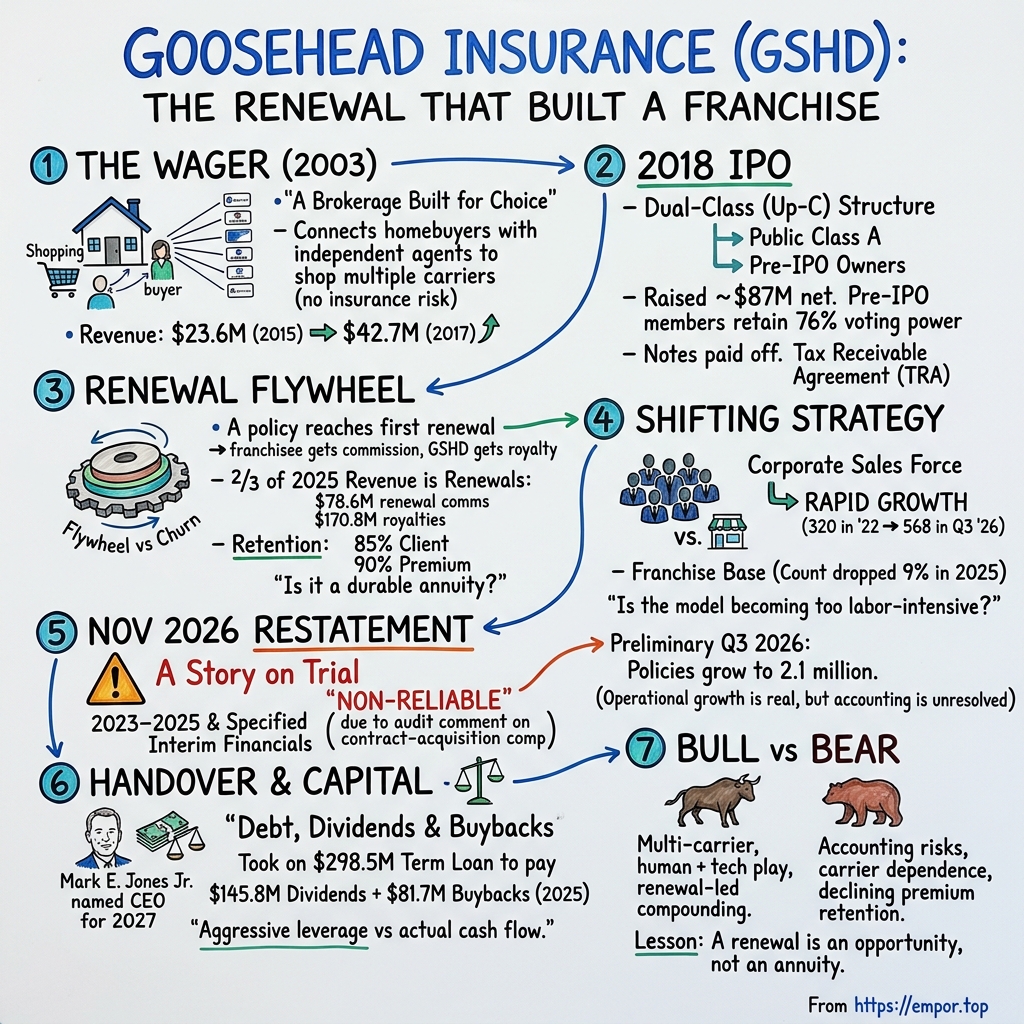
Goosehead Insurance: The Renewal That Built a Franchise
I. The policy renews. The books do not.
On the evening of November 9, 2026, Goosehead Insurance put out two documents that seemed to describe two different companies. One was a preliminary third-quarter results release with the usual numbers of a growth business. Policies in force had reached about 2.1 million, up roughly 14% from a year earlier, and written premium had grown about 11% to some $1.3 billion. Management still expected total revenue to grow by somewhere between 12% and 19% for the year.1 Read on its own, the release looked like the latest quarter in a long run of quarters in which a Texas insurance agency had quietly signed up more American households.
The other document took that reassurance away. Goosehead told the Securities and Exchange Commission that its audited financial statements for 2023, 2024 and 2025, and its quarterly statements from 2023 through the first half of 2026, "should no longer be relied upon" and would have to be restated.1 It could not file its third-quarter Form 10-Q on time, and it expected to report one or more material weaknesses in internal control over financial reporting.2 The review had started with an SEC comment letter on the 2025 annual report.1 Three years of audited profit, margin and cash flow, the very record that had supported a large dividend, an aggressive buyback and a $300 million loan, now carried the accounting equivalent of a "do not use" label.
That contradiction sits at the centre of this story. Goosehead's customers do not care about ASC 340-40. A family in Dallas or Denver whose homeowners policy renews next spring will get a renewal notice, an agent's call or email, and perhaps a quote from a cheaper carrier. The policy count therefore measures something real: demand for the company's service and the willingness of households to keep using it. But a policy count is not a profit and loss statement, and the economics of each of those 2.1 million policies run through accounts that are now being reopened. For the next several months, investors in Goosehead are being asked to judge an operating story while the financial record behind it is still being revised.
Five questions run through what follows. The first is whether the renewal machine makes the model durable, or whether "recurring revenue" is a generous description of millions of separate annual decisions. The second is whether Goosehead's distribution scale, an unusual blend of corporate agents and franchise owners, has become a real competitive advantage or is simply a large sales force. The third is whether the current leadership can restore trust after a restatement that reaches back three years. The fourth is whether shareholder returns paid partly with borrowed money can last once the cash numbers are trustworthy again. The fifth is whether the founding family's continuing control helps the next chapter or complicates it, now that the founder's son is about to become chief executive.
One piece of housekeeping keeps the story honest. The company that trades on Nasdaq under the ticker GSHD, Goosehead Insurance, Inc., is a Delaware holding company. Its main asset is control of Goosehead Financial, LLC, the partnership that owns the agency and franchise business. The listed corporation is GF's sole managing member and consolidates it fully, so the revenue, debt and policy counts discussed here belong to the business that public shareholders actually own. Public shareholders do not own all of the economics, however. At the end of 2025 the corporation held about two-thirds of GF's units and the remaining third sat with legacy holders, mainly the founding family and other pre-IPO members, on the books as a noncontrolling interest.34 That split, as later sections show, matters for who controls the company, who gets the tax benefits and who bears the restatement.
The story itself begins with an idea about distribution. More than two decades ago, a couple in Texas bet that an independent insurance agency could be built at national scale. It would sell many carriers' products rather than one, and it would combine salaried, company-trained agents with local franchise owners who paid for the privilege of using the brand and the back office. Whether that bet has worked depends on what happens each time a policy comes up for renewal.
 Subscribe on LinkedIn
II. A brokerage built around the next renewal
Buying a house in America usually means a pile of paperwork, a closing date that keeps moving and a lender asking for proof of homeowners insurance before it releases the money. For most buyers, insurance is the last item on that list and the one they understand least. They have a few days to choose coverage on what is probably the largest asset they will ever own. They have to decide on deductibles, wind and hail exclusions, replacement cost and liability limits, and they are usually comparing quotes from carriers whose names they recognise from television advertising.
Goosehead was founded in 2003 to sit inside that moment.5 Its headquarters sit in Westlake, Texas, in the Dallas–Fort Worth area.5 It was founded by Mark and Robyn Jones, the husband and wife who would later lead its board.5 The idea was not complicated. Most personal insurance in the United States was sold in one of three ways. A household could go to a captive agent, the local office of a single large insurer that could only offer that insurer's products, or it could buy directly from a carrier by phone or online. A third channel, the independent agency, could shop the same household across several carriers, but independent agencies were overwhelmingly small, local and run by owners who saw technology as a cost rather than a weapon. Goosehead set out to be an independent agency at a scale that small agencies could not reach.
The distinction between a broker and a carrier explains nearly everything about Goosehead's economics, so it deserves a moment. A carrier such as a large property insurer writes the policy, sets the coverage terms and price, holds the capital and pays the claims when a hailstorm tears off a roof. A broker like Goosehead takes none of that risk. It finds the customer, matches the customer to a carrier, helps place and service the policy, and in return receives a commission that is generally a percentage of the premium.3 Goosehead has no float to invest, no claims reserves to estimate and no underwriting losses to absorb. The trade-off is that it controls neither the product nor the price. When carriers raise rates, commissions rise with premiums. When carriers pull back from a state or stop writing new homeowners business, the broker loses supply that it cannot replace on its own.
From early on Goosehead ran two channels. The corporate channel employed sales agents directly, trained them in-house and kept the full commission on what they sold. The franchise channel signed up local owners who opened Goosehead-branded agencies, used the company's carrier appointments, technology and centralised service team, and paid the company a royalty out of their commissions. At the time of its listing, the franchise royalty was 20% of a franchisee's new-business revenue and 50% of its renewal revenue.5 That 50% detail is the most important number in the early design. Goosehead took a modest share of the first-year sale, which left the franchise owner with the reward for hustling. It took half of every renewal, because the renewal was where the company's central service team did most of the work. The arrangement turned the first sale into the franchisee's payoff and the renewal into Goosehead's.
That design carried a tension that has never fully gone away. A centralised model, in which corporate agents work from company offices, a single service centre handles renewals and endorsements, and software routes leads, gives management control of quality and the customer experience. A franchise model gives local reach and entrepreneurial energy without the company paying for every salary and lease, but it hands part of the brand to owners whose skill varies. Goosehead decided early that it could have both: the franchise as a way to plant flags quickly across the country, and the corporate agency as the training ground, the quality benchmark and a business in its own right.
The early numbers suggested the idea was catching on. Revenue rose from about $24 million in 2015 to nearly $43 million in 2017, almost doubling in two years.5 By the end of 2017 the company counted 411 franchise locations, including 119 that had signed contracts but had not yet opened, along with seven corporate sales offices.5 Those 119 unopened locations show what the business looked like in that period. A large part of the network existed on paper before it existed on the street, and Goosehead's growth depended on turning signed franchise agreements into producing agencies.
Profits were a different matter. Rapid franchise recruitment meant paying to support agencies before their books produced renewals, and the company's reported earnings jumped around accordingly. That pattern of top-line growth with an uneven bottom line continued after the IPO, and later sections return to it. It is enough for now to note that the founding insight was never about squeezing margin out of each policy. It was about producing policies that stay on the books, because the second, third and fourth years of a policy are where an agency earns its money.
By 2017 the Joneses had a growing network, a model that rewarded patience and a business that needed capital to keep recruiting and building technology. They also had something they did not want to give up, which was control. The question was how to go to public markets without handing over the company.
III. The IPO sold shares, not the steering wheel
In the spring of 2018, Goosehead's bankers set out a price range of $14 to $16 a share for about 8.5 million Class A shares.5 The roadshow did not go to plan. When the offering priced, the shares went out at $10, well below the bottom of the range, and the company sold more of them, about 9.8 million Class A shares, raising roughly $87 million net.6 The IPO closed on May 1, 2018.3 For a company that went on to become one of the better-performing insurance-distribution listings of the following years, the start was humble: investors needed a substantial discount before they would buy into a Texas franchisor of home and auto insurance agencies.
The money's destination says even more about the deal. Roughly $77 million of the net proceeds went to repaying notes that the company had issued to its historical owners in exchange for their ownership interests.6 The IPO, in other words, was not mainly a war chest for acquisitions or a large technology build. It was mostly a partial reset of the balance sheet, with public shareholders' money used to retire obligations owed to the people who had built and owned the business. That is not unusual for a founder-controlled listing, and it is not inherently a red flag. It does mean that the 2018 offering funded the transition to public ownership more than it funded the next phase of growth, which came from the business's own cash flow and, later, from borrowing.
Two classes of owner, one set of controls
The legal design of the listing explains why the founders could sell shares without selling control. Goosehead went public as what bankers call an "Up-C." In plain terms, the listed corporation sat above the operating partnership described earlier. Public investors bought Class A shares in the top layer. The pre-IPO owners, led by the Jones family, kept their interests directly in the bottom layer as LLC units and received matching Class B shares in the corporation. Class B shares carried votes but no separate economic claim. After the offering, these pre-IPO LLC members held 76% of the combined voting power.5 Public shareholders could buy into Goosehead's growth, but they had no realistic way to direct it.
The Up-C also carried a tax bargain that continues to pay out today. Whenever a legacy holder exchanges LLC units for Class A shares, the corporation can step up its tax basis in the partnership's assets, which produces tax deductions in later years. Goosehead agreed in a tax receivable agreement to pay the pre-IPO members 85% of the tax savings it actually realises from those step-ups and related benefits, keeping 15% for itself.3 The arrangement means that an accounting benefit created when founders sell down flows mostly back to those founders, in cash, over many years. At the end of 2025 the company reported a TRA liability of about $172 million and had paid about $7 million under the agreement that year.3 That balance sits inside the restated period, so the exact figure may move. The structure itself remains.
The Up-C has one more feature that makes it easy to misread in headlines. Over time, legacy members exchanged LLC units for Class A shares, so the listed corporation's economic stake in the operating partnership grew steadily. It owned about 37% of GF at the IPO and about 67% by the end of 2025.53 Each exchange moved economics from the private layer to the public one, increased the Class A float and reduced the Class B votes attached to the exchanged units. The founders' voting majority therefore shrank over the years, from about three-quarters of the vote at the IPO to around a third today, as later sections describe. Yet a third of the vote, held in a coordinated block with a voting agreement, remains the decisive voice in a company whose other shareholders are spread among institutions.
From a minority shareholder's point of view the trade-off was clear and has lasted. Public investors gained access to a fast-growing distribution business on a discounted IPO price. In exchange they accepted that the family steering the business could not be removed by ordinary shareholder pressure, and that a slice of the company's future tax savings would flow to the pre-IPO members rather than to the corporation. Whether that bargain looks good depends on what the family did with the steering wheel.
The IPO made Goosehead investable. The next test was whether the machine it funded could turn each new placement into years of recurring economics, and whether those economics would hold once someone looked closely at how they were counted.
IV. The franchise gets paid again when the policy renews
Picture a franchise owner in a suburban Texas office park a year after she opened. Twelve months ago she wrote a homeowners policy for a young couple who had just closed on a house. She found them through a mortgage loan officer she had spent months cultivating, shopped their coverage across several carriers and placed it with the one offering the best mix of price and terms. She kept most of the first-year commission and Goosehead took its smaller cut. Now the policy is coming up for renewal. The couple does not visit her office. A Goosehead service team handles the renewal notice, answers their question about a premium increase and, if the price has jumped, may shop the policy again. The franchisee still earns her renewal commission, and Goosehead now takes a much larger share of it as a royalty. That handoff from local salesperson to central service desk is the core of the Goosehead machine.
The arithmetic of a policy that stays
The model has two mechanisms. When a corporate agent places a policy, the carrier pays Goosehead a commission, generally a percentage of the premium, and Goosehead pays its employee. When a franchisee places a policy, the carrier pays the franchisee, and the franchisee pays Goosehead a royalty that is a percentage of that commission. Renewal royalties are set higher than new-business royalties.3 The franchise agreement runs ten years, and Goosehead recognises the initial franchise fee gradually over that term.3 The underlying insurance policies, however, typically run for a year or less.3 This mismatch is easy to overlook. A ten-year franchise agreement sounds like a long-term contract, but the cash it produces depends on thousands of one-year contracts that each have to be renewed.
On the company's published 2025 numbers, which now carry the non-reliance warning, the renewal engine was most of the business. Goosehead reported total revenue of about $365 million. Of that, renewal commissions from the corporate channel were about $79 million and renewal royalties from franchisees about $171 million.3 Together that is roughly $250 million, or about two-thirds of revenue, earned from policies that had been sold in earlier years and stayed on the books. The restatement will add revenue through the franchise-fee reclassification and may shift some lines, but there is no sign that it overturns the basic shape: most of the money arrives at renewal time.
That shape explains why the franchise channel was so attractive in the early years. When a new franchise opens, Goosehead spends money supporting it for a year or more and earns only a modest new-business royalty. If the franchisee keeps selling and the policies keep renewing, the renewal royalties pile up on top of each other. Year five's royalty income includes renewals from policies written in years one through four, plus whatever is new. A franchise that writes the same amount of new business every year therefore produces growing revenue for Goosehead every year, as long as customers do not leave faster than they arrive. This is the flywheel management has described for years, and the arithmetic behind it holds up.
The flywheel has a leak, though, and the size of the leak decides everything. Two measures track it. Client retention is the share of customers who stay from one year to the next. Premium retention compares this year's premium on the retained book with last year's premium on the whole book, so it captures both customers leaving and carriers raising or cutting prices. Goosehead's reported client retention hovered around 85% from 2023 through the third quarter of 2026.371 Premium retention fell from above 100% in 2023 to about 87% in the third quarter of 2026, down from 93% a year earlier.371
Those two series tell different stories, and both need to be read carefully. The steady client retention says that roughly one customer in seven leaves each year and that this rate has not worsened. For a personal-lines agency, that is respectable evidence that customers value the service, though it is far from an annuity. The sliding premium retention says something else. During 2023, carriers were raising homeowners rates aggressively, so the same book of customers produced more premium each year. That tailwind inflated renewal revenue for the whole industry. As pricing cooled, and as carriers in some markets began cutting rates, the same customer base produced less premium. On the third-quarter call, CFO John Martin pointed to tougher comparisons, rate declines in Texas and more pricing pressure than the company had expected as reasons that core revenue growth had slowed to 13%.8 In other words, part of what looked like the renewal engine's strength in 2023 was the insurance pricing cycle, and Goosehead has no control over that cycle.
A skeptic would put it this way: Goosehead's renewal revenue is recurring in the sense that a restaurant's regulars are recurring. Most come back, but each visit is a fresh decision, and the bill depends partly on the price of the ingredients. A renewal is an opportunity the company earns each year. It is not a contractual payment.
The bonus that depends on the weather
One more revenue line sits on top of commissions and royalties, and it behaves very differently. Carriers pay contingent commissions to agencies whose books meet growth and profitability targets. In effect they are bonuses for sending the carrier customers whose claims cost less than expected. Goosehead's reported contingent commissions rose from about $14 million in 2023 to about $31 million in 2024 and $38 million in 2025.3 That growth helped headline revenue, but the company itself describes these payments as unpredictable and sensitive to weather and carrier underwriting results.3 A year of severe hail in Texas or hurricanes along the Gulf coast can sharply reduce them even if Goosehead's agents do everything right. Investors should treat contingent commissions as a variable supplement. They are not a base on which to build an earnings multiple.
The network producing all of this has also been changing shape in a way the headline growth figures hide. Operating franchises fell about 9% in 2025 to 1,009, while the number of franchise producers, the licensed people actually selling inside those agencies, rose to 2,113.3 By the third quarter of 2026, franchise producers had reached about 2,270.1 Fewer storefronts with more sellers per storefront can be read two ways. The optimistic reading is consolidation: weaker franchise owners leave, stronger ones hire more producers and the network becomes more productive. The pessimistic reading is that a meaningful number of franchisees could not make the economics work and closed or sold, which is a warning about the franchise proposition for new owners. Goosehead does not disclose the full economics of a typical franchise, such as average revenue, margin or payback on the owner's investment. Investors therefore cannot tell from the outside which reading is right, although both are probably partly true.
What is clear is that the renewal engine has two dependencies it cannot control. Carriers must remain willing to appoint Goosehead and to keep writing business in its markets, and customers must keep valuing an intermediary when a carrier's website is a click away. The next part of the story is about who else is competing for that customer and what, exactly, Goosehead has that they lack.
V. Big brokers, captive agents and a human in the digital flow
A homeowner types an address into a quote form late on a weeknight. In a few minutes, Goosehead's online system has pulled property data, run the address against several carriers and shown a set of prices side by side. This is the company's Digital Agent platform, and on paper it is the kind of tool that is supposed to make human agents unnecessary. Yet according to management, that is not usually how the journey ends. On the November 2026 call, Mark Jones Jr. said that because the funnel leads with homeowners insurance, "the vast majority" of people using the digital tools "somewhere throughout the process, want to kick out and talk to a human being."8 At that point the quote stops being a web form and becomes a conversation with a licensed Goosehead agent, who explains why one policy has a 2% wind deductible and another does not.
That moment, a digital start that hands off to a human, is Goosehead's answer to the question every intermediary eventually faces: why should anyone pay a middleman? To test the answer, it helps to set out the alternatives a household has.
The first is the captive agent, the neighbourhood office of one of the big national insurers. Captive agents are numerous, have strong brands and often have long relationships with their customers, but they can offer only one company's products. If that carrier raises rates or decides it no longer wants to insure homes with old roofs, the captive agent's customer must either accept the new terms or leave. The second alternative is the direct channel, where a carrier sells through its own website, app or call centre. Direct sellers dominate personal auto insurance, a standardised product people are happy to buy on price, and Goosehead itself says that the risk of direct online selling has been concentrated in single-line auto.7 The third is the traditional independent agency. There are thousands of them across the country, mostly small, and they can shop several carriers but rarely have Goosehead's technology, service centre or recruiting machine. The fourth, comparison websites and lead aggregators, sells clicks and leads more than it services policies.
Then there are the giants of insurance brokerage, which are where many investors instinctively look for comparisons. Marsh, Aon, Gallagher, Brown & Brown and WTW each earn brokerage revenue measured in billions of dollars a year, many times Goosehead's roughly $365 million of reported revenue.93 They are imperfect comparisons. Their revenue comes mainly from commercial insurance, risk consulting and reinsurance for businesses, which is a different trade from selling homeowners and auto policies to families. Industry rankings of the largest U.S. brokers even exclude companies that earn most of their revenue from personal lines, which shows how different the two activities are.9 Rating agencies make the same point from another angle. S&P's peer comparison of insurance brokers placed Goosehead among much larger, more diversified firms and rated it B+ with a stable outlook, a deeply speculative-grade rating that reflects its small size and narrow focus as much as its growth.[^10] Goosehead does not compete with Marsh for a Fortune 500 company's property program. It competes with the State Farm office down the road and with a carrier's direct-sales app.
What Goosehead can actually defend
Against that field, Goosehead's case comes down to two claims. The first is breadth of choice. The company says it represented more than 200 carriers in 2025, of which 76 offered national coverage.3 For a household whose home has an old roof, sits in a hail corridor or has a claims history, that breadth can mean the difference between getting coverage and being told no. Captive agents cannot match it, and most small independents cannot match it in every state. The second claim is that the service is a hybrid: digital tools speed up the quote, local or corporate agents handle the parts that need judgment, and a central service team keeps the policy on the books at renewal. Jones Jr. described Goosehead on the call as the only choice-shopping model that takes a customer from quote to issued policy, and said that although carriers are seeing AI bot activity, that activity "does not replace independent agent distribution."8
The renewal book's retention record suggests customers value service, though its falling premium retention shows that the business moves with carrier pricing like everyone else's. Carrier concentration also remains significant despite the 200-carrier panel. In 2025 two carriers each accounted for more than 10% of revenue, one about 19% and the other about 13%, so roughly a third of revenue depended on two relationships.3 A year earlier, three carriers had each been above the 10% threshold.7 Goosehead does not disclose the share of its top five or top ten carriers, so outsiders cannot see how much of the "more than 200" is a long tail of carriers that rarely get used. A broad panel is an option. The concentration figures show how much of the business depends on a few appointments.
Digital Agent and artificial intelligence belong in proportion. They matter strategically because they sit directly in the customer journey, where a better quote experience could raise conversion and lower the cost of each policy sold. Management told analysts it was building a server that would let AI assistants query its quoting tools by the end of 2026, and that it was working on how its products appear in AI-generated search answers.8 When asked whether carriers had been added to the Digital Agent platform, the answer was "not as of today."8 None of this is yet a separate business, and Goosehead has not published unit-cost data showing that technology lowers its cost to acquire or service a policy. For now, Digital Agent is a promising front end to a labour-based sales operation, not proof of a technology moat.
A simple version of Michael Porter's five forces helps clarify the position. Carriers, the suppliers of the product, have real leverage: they decide whether to appoint Goosehead, what commission to pay and whether to keep writing homeowners business in Texas, Florida or California at all. Customers have alternatives at every step and can compare prices more easily each year, which limits Goosehead's ability to charge more for its service. Rivalry with local independents is fragmented. That helps a scaled agency recruit talent and win carrier attention, but it also means there are always low-cost competitors. Digital tools lower search costs for everyone, which threatens intermediaries in simple products while possibly helping those who can turn digital leads into human conversations on complex ones. New entrants face low formal barriers, because a licence and a carrier appointment are enough to open an agency, but reaching Goosehead's scale requires years of recruiting and a service operation that takes time to build.
The moat, on this evidence, is narrow. Multi-carrier choice combined with a human-assisted channel probably helps Goosehead win complex personal-lines placements, especially homeowners policies at the time of a home purchase. Its durability depends on three things that can be measured and can deteriorate: retention, carrier access and agent productivity. There is no structural lock-in. A customer can switch at renewal, a carrier can cut commissions, and a rival can hire away a good agent.
That leaves management with a practical question that is also the key strategic choice of the past four years: if the advantage lives in agents and carrier access, where should the next dollar of growth investment go?
VI. From franchise expansion to a larger corporate sales force
For most of its public life, Goosehead was described as a franchise story. The pitch was asset-light: franchisees paid to open agencies, carried their own rent and salaries, and paid Goosehead royalties that grew with every renewal. The corporate channel looked like a supporting act, a training academy and quality benchmark.
By the early 2020s, though, the corporate channel was being given a new job. Starting in 2022, the company began moving some of its best corporate sales agents into franchise ownership, using the corporate operation as a pipeline for experienced owners rather than recruiting franchisees mostly from outside.10 At the same time, corporate headcount kept rising. Corporate sales agents numbered 320 at the end of 2022, about 417 at the end of 2024 and 489 at the end of 2025, and reached about 568 in the preliminary third-quarter 2026 figures.1031 Over the same period the franchise base got smaller in storefronts even as it gained producers. The result was a company building both channels at once, with salaried corporate sellers becoming a much larger part of the distribution system than the original asset-light pitch suggested.
There are good reasons for that shift. A corporate agent's commission goes entirely to Goosehead, not just a royalty share. Corporate agents can be trained, measured and directed more tightly than independent franchise owners, which matters when the company wants to push a new technology tool or a particular carrier's product. And the corporate operation produces trained people who can later become franchise owners with a better chance of success than outside recruits. Management's case is that the two channels reinforce each other.
The cost is that the business becomes more labour-intensive. Every additional corporate agent is a salary, benefits, a desk and a ramp-up period before the agent's book produces renewals. On a reported basis, Goosehead spent about $19 million on capitalised software and property and equipment in 2025, about 5% of revenue, up from about $12 million in each of the two previous years.3 The company does not report research and development as a separate line, so technology spending is spread across compensation, general and administrative costs and capitalised software. The restatement makes this harder still, because the accounting change concerns exactly how the company recognises compensation paid to the people who win customer contracts. The mix of expense and asset on Goosehead's statements is precisely what is being revised.
Productivity, not headcount
The right way to judge the strategy is productivity, not headcount. Goosehead reports new-business productivity by tenure and channel, essentially how much new business an agent writes after one, two or more years in the job. That is the evidence worth watching: if corporate agents ramp faster and write more as the company adds technology, the larger sales force is an investment; if productivity falls as headcount grows, the company is buying growth with salaries. Those figures, however, change with the channel mix. A wave of new hires lowers average productivity even if each cohort performs well, and the restatement will change the reported cost of each agent. A clean answer requires restated operating income alongside productivity by cohort, and that answer does not yet exist.
The company's own history warns against assuming the profit base compounds alongside revenue. Goosehead's revenue grew every year from its IPO, from about $60 million in 2018 to about $209 million in 2022.610 Net income followed a very different path: the company reported a loss in 2018, profit of about $19 million in 2020 and under $3 million in 2022, even as revenue kept climbing.61110 That decline came during a period of heavy investment in hiring and franchise support, which management presented as building for future renewals. Some of it did pay off: reported profits recovered in 2023 and 2024. But the episode shows that Goosehead's reported margins depend heavily on how fast it is hiring, and that a growth push can swallow most of the profit for years. The restatement adds another layer of uncertainty, because it concerns the accounting for exactly that kind of investment in sales people.
Acquisitions are a minor part of the story. Goosehead reported about $5 million of acquisition consideration in 2025.3 That is tiny compared with a business with revenue of hundreds of millions and with the capital the company returned to shareholders the same year. Goosehead does not disclose the revenue or earnings of the acquired businesses, so the price cannot be compared with the multiples paid in broker deals. What matters is the direction: unlike the big commercial brokers, which have grown largely by buying agencies, Goosehead has grown organically through recruiting and placements. That means its growth record measures its own sales machine, not its dealmaking.
Whether technology changes the equation is the most important open question in this part of the story. If Digital Agent and the AI tools management described let each agent handle more quotes, close more of them and spend less time on service tasks, the larger corporate sales force could become more productive each year, and the investment in technology would show up as rising revenue per agent and falling service cost per policy. If the tools mainly add technology spending on top of an operation that still depends on people making calls, the company will have the costs of a software company and the economics of a sales firm. Goosehead does not yet publish the unit data that would settle this, such as cost to service a policy, conversion rates from digital quotes, or revenue per agent after deployment.
So the strategic shift can be judged only after the company publishes reliable operating income and cash flow under its revised compensation accounting. That brings the story to the November disclosure and to the reason so much is now waiting on it.
VII. The restatement puts the growth story on trial
Comment letters are routine, and most end with an exchange of explanations and perhaps clearer disclosure in the next filing. This one did not. After reviewing the questions and examining how Goosehead had accounted for certain costs, its Audit Committee concluded that the affected financial statements should no longer be relied upon.1 The company announced the decision on November 9, the same day it released preliminary third-quarter numbers instead of a filed 10-Q.12
There are two separate accounting problems, and they matter in very different ways.
The first, and less serious, is a matter of presentation. Goosehead charges franchisees fees for technology and errors-and-omissions coverage. It had been recording those fees as a reduction of general and administrative expense rather than as revenue. Under the correct treatment, the fees will be booked as revenue and the related costs as G&A. The company expects this to raise both 2025 revenue and G&A by about $11 million to $16 million each, with no effect on income or cash flow.1 This change makes Goosehead look slightly larger and its margins slightly lower as a percentage of revenue. It does not change how much money the company makes.
The second problem goes to the core of the business. It concerns what accountants call the costs of obtaining a contract. On the November call, Martin explained that Goosehead had expensed certain agent compensation as it was incurred, and that this approach "does not conform" with the applicable accounting standards.8 Under the rules, when a company pays a salesperson specifically to win a customer contract and expects to recover that cost over the life of the relationship, it generally has to record the payment as an asset and spread the expense over the period the customer is expected to stay. A gym offers a simple analogy. If it pays a salesperson a bonus for signing a member who is expected to stay for four years, the accounting spreads that bonus over the four years instead of charging it all in the month the member joined. For Goosehead, this means part of the compensation that had been hitting the income statement immediately will instead become an asset on the balance sheet and be expensed gradually as customers renew.
The direction of the change is therefore counterintuitive. Goosehead preliminarily expects 2025 employee compensation expense to fall and operating income to rise by somewhere between 0.5% and 5.5% of employee compensation and benefits, with a similar effect expected for the first half of 2026.1 The restatement, in other words, is expected to make past profits look somewhat higher, not lower. Management reaffirmed its 2026 revenue and premium growth guidance "considering the expected range of impact of the restatement."1
That should not be mistaken for good news. The width of the range is itself informative: a correction anywhere from half a percent to five and a half percent of compensation means management could not yet say how large the effect is. A higher reported profit created by capitalising costs is not more cash. The same money was paid to the same agents. What changes is when the expense is recognised, how large the new contract-cost asset is and how quickly it has to be amortised. If customers leave faster than assumed, the asset has to be written down faster. The accounting change therefore ties reported earnings more closely to retention assumptions, precisely the measure the previous section showed to be steady for clients and weakening for premium.
What a clean audit opinion did and did not mean
The chronology matters for the trust question. In February 2026, Deloitte & Touche issued unqualified opinions on Goosehead's 2025 financial statements and on the effectiveness of its internal control over financial reporting.3 Nine months later, the company concluded those statements could not be relied upon and said it expected to identify one or more material weaknesses in internal control, with disclosure controls not effective for the affected periods.2 The later finding does not erase the earlier opinions as historical documents, but it changes what they mean. An internal-control opinion is supposed to give investors comfort that errors like this would be caught, and for at least three years one was not. That is why the remediation plan, and whether the auditor signs off on it, now matters as much as the restated numbers.
The Q3 call shows the gap between what management could explain and what it could not yet quantify. In prepared remarks, Martin described the cause, both accounting issues and the preliminary ranges. The release said the company intended to file amended reports, a 10-K/A and amended 10-Qs, "as soon as practicable," without giving a date.1 Neither the release nor the prepared remarks set out a remediation timetable for the expected material weaknesses, and the company gave no date for the amended filings.18 The analyst questions that opened the Q&A were about operations, including slower core revenue growth and pricing pressure in Texas, rather than the accounting.8 That focus is understandable. It also means the market is being asked to carry the restatement as an unknown for now.
Investors need to separate what is known from what is not. It is known that the franchise-fee change is presentation only. It is known which direction the compensation change pushes reported profit. It is not known how large the contract-cost asset will be, how it will be amortised, how the restated net income and operating cash flow will compare with the published figures, or how quickly the control weaknesses will be fixed. Until that is settled, the published 2025 figures, including net income of about $45 million, operating cash flow of about $92 million and stock-based compensation of about $23 million, cannot be treated as a dependable measure of normalised earnings or cash conversion.3 The cash-flow figure in particular may be reclassified in ways that move it between operating and other categories even if the bank balance is unchanged.
Credibility will be measured by behaviour over the next several months: how precisely the company quantifies the revisions, whether the operating story told in the amended reports matches the one told on earnings calls, whether the filings arrive when promised and whether the auditor confirms the control fixes. A company that restates once, explains clearly and fixes its controls can recover trust. A company whose ranges keep changing or whose deadlines slip will find it much harder.
The timing makes this particularly sensitive. The restatement arrived just as leadership and capital allocation were both changing, which means the next chief executive will start with an unusually heavy first assignment.
VIII. The founder's son inherits the next scorecard
In February 2024, Goosehead announced that Mark Jones, the co-founder who had run the company since 2003, would hand the chief executive role to Mark Miller.12 Miller took over on July 1, 2024, and Jones moved to executive chairman.12 For a company so closely identified with its founders, it looked like a step toward a more conventional public-company structure. The handover did not last long. In July 2026 the board announced that Miller would retire at the end of the year and that Mark E. Jones Jr., the founder's son, would become chief executive on January 1, 2027.13
Jones Jr. is not an outsider. He was Goosehead's chief financial officer through April 2026, became chief operating officer in August 2025 and was named president in April 2026.1314 On the November call, he fielded the questions about technology and the customer journey, and Miller used the occasion as his last call as CEO.8 Jones Jr. therefore arrives with deep knowledge of the business, the carriers and the numbers. He also arrives as someone who was chief financial officer when the 2025 annual report, now subject to restatement, was filed. That is not evidence of personal wrongdoing, and the company has attributed the issue to an accounting interpretation flagged by the SEC rather than to misconduct. It does mean that the executive who now has to restore confidence in the financial record was responsible for that record during the period being corrected. Investors are entitled to weigh that.
The family's control remains intact through the transition. The Jones group reported 34.2% beneficial ownership in an August 2026 amendment to its Schedule 13D, and the 2026 proxy showed Mark and Robyn Jones holding about 35% of the combined vote.[^16]14 Robyn Jones serves as vice chair, and a son-in-law, P. Ryan Langston, is also listed among the family members who received equity compensation.14 Because the family still owns LLC units in the operating partnership, it also continues to benefit from the tax receivable agreement. Five of the eight directors were deemed independent in the 2026 proxy.14 The rest of the register is institutional. The latest filings show Wasatch Advisors at about 10%, Kayne Anderson Rudnick at about 8% and T. Rowe Price at about 7%.[^17]15[^19] None of those holders comes close to the family's coordinated block.
Pay has been substantial but less extravagant than the headline totals suggest. Miller's reported 2025 compensation was about $4.85 million, much of it in option awards rather than cash.14 The proxy also shows that the annual bonus program did not pay out in full: the company said its financial targets had been set too high, and executives earned about three-quarters of the revenue-based component and nothing for the revenue and expense-growth component.14 A bonus plan that pays less when targets are missed is working as intended. Total compensation numbers that include option grants valued at the time of grant should not be confused with cash taken out of the business.
Shareholders did send a signal at the May 2026 annual meeting. About 22.7% of the votes cast for or withheld on two director nominees, Robyn Jones and William Wade, were withheld.16 In a company where the family votes about a third of the shares, that means a large share of the non-family vote declined to support those nominees. Say-on-pay passed easily, with about 7% of votes cast against.16 The pattern suggests shareholders were not objecting to pay so much as expressing concern about board composition and independence. That concern was registered before the restatement, which makes the next annual meeting a more meaningful test.
Related-party dealings are disclosed and small. In 2025, the company reimbursed N5B, the Jones family investment office, about $66,000 for the founder's executive assistant's expenses.14 The more important economic link to the family is the tax receivable agreement, which will continue paying out as long as the company realises the relevant tax savings, not this reimbursement. A 2022 Delaware stockholder suit that challenged Goosehead's governance documents moved toward a non-monetary settlement, and management did not expect the remaining fee dispute to be material.3 Even so, the case shows that some shareholders have been willing to contest the governance structure the family built at the IPO.
Family ownership is not itself the issue. Plenty of family-controlled companies have outperformed precisely because owners with a long horizon could ignore quarterly pressure. The question is whether the incoming chief executive can do three things at once: explain the restatement in terms investors can verify, keep the sales machine focused through a period of distraction and set a capital policy that matches the company's true cash generation. The last of these is where the family and the board made their boldest move, and it is where reliable numbers matter most.
IX. Borrowed money, buybacks and the dividend
In January 2025, Goosehead signed a new credit facility: a $300 million term loan due in 2032 and a $75 million revolving credit line due in 2030.3 During the same year, the board turned that borrowing capacity toward shareholders. Over the course of 2025 the company paid about $146 million in dividends and bought back about $82 million of its own shares.3 By the end of the year it reported about $299 million of notes payable and only about $34 million of cash.3 For a company whose IPO had partly been about repaying the founders' notes, 2025 was a reversal of sorts: the balance sheet that the listing had partly cleaned up was used again, this time to fund distributions to all shareholders, including the family.
The loan was not unusual for a company of Goosehead's profile. S&P had rated the company B+ with a stable outlook when the financing was proposed, giving the same rating to the term loan and revolver and projecting leverage slightly above four times earnings after the deal.[^21] The term loan carries a floating rate that, after a July 2025 repricing, was set at the Secured Overnight Financing Rate plus 3 percentage points.3 It is secured by substantially all of the company's assets, including its rights to future commissions and royalties.3 Lenders, in other words, have a claim on the renewal stream that this story has described. The amortisation is light, about $0.7 million a quarter, which leaves a balloon of about $280 million due in 2032.3
The scale of the distributions relative to profit is the central issue. The $146 million dividend plus $82 million of repurchases add up to about $228 million returned to shareholders in a single year. Reported 2025 net income was about $45 million.3 Even reported operating cash flow, about $92 million, covered well under half of what went out.3 The rest came from the new loan. Supporters would argue that this was a deliberate recapitalisation: a business with steady renewals can carry more debt, and returning cash to shareholders is better than holding idle balances. That argument has some force. A skeptic would answer that the company effectively borrowed against future commissions to pay a large one-time dividend, a sizeable share of which went to the controlling family, and did so on the basis of financial statements that have since been declared unreliable.
Separating liabilities
Not every liability on Goosehead's balance sheet behaves the same way, and it is worth separating them. The term loan is true borrowing, with interest due every quarter and principal due in 2032. Lease liabilities of about $60 million at the end of 2025 represent office rent commitments and are not debt in the ordinary sense, though they are fixed costs.3 The tax receivable agreement is a third kind of obligation: the company pays only when it actually realises the tax savings, so the payments fall if profits fall. Combined, these obligations are manageable as long as cash flow holds up, and the maturities are comfortably distant. A maturity date is not the same thing as the ability to repay, however.
The capital story continued into 2026. By the end of September, the company's preliminary figures showed notes payable of about $322 million, with about $26 million drawn on the revolver and cash of about $33 million.1 The board had also expanded the buyback authorisation, and about $145 million remained available at the end of the third quarter.13 Debt therefore rose during 2026, even before the restatement was announced. The company did not say on the third-quarter call how it would balance dividends, buybacks and debt reduction while the restatement was under way.8
A skeptical investor's test is straightforward. Suppose restated operating cash flow, after paying agents and funding working capital, turns out to be close to the published figures. Then the company can service its debt and keep returning some cash, though another dividend on the 2025 scale would still require more borrowing. Suppose instead that restated cash flow is meaningfully lower, or that premium retention keeps falling and squeezes renewal revenue. Then a company with floating-rate debt, thin cash and a lender claim on its commissions would be wise to stop buying back stock and start paying down the loan. Which world Goosehead lives in will not be clear until the amended filings arrive.
The 2025 distribution was aggressive relative to reported cash and debt. That verdict does not require the restatement to reveal bad news. It rests on the arithmetic of paying out roughly five times reported net income in a single year, financed with a loan secured against the company's future revenue. Whether it looks bold or reckless in hindsight depends on what is truly recurring once compensation, working capital and debt service are counted correctly.
X. Analysis & Bear vs. Bull Case
Imagine an investor in early 2027 with two documents open side by side. One is the fourth-quarter results release, with another quarter of policy growth and a new chief executive's first prepared remarks. The other is the amended 2025 annual report, with restated profit, a new contract-cost asset and a description of the control weaknesses. Everything in the Goosehead investment case comes down to whether those two documents tell the same story.
The bull case has a real mechanism: renewals, carrier choice and the two-channel system give each year's new policies a base on which to compound.3 Policy growth continued into the third quarter of 2026,31 and client retention held in the mid-80s through a severe homeowners market.1 If retention, producer productivity and cash conversion hold up after the restatement, this is a system in which each year's new policies add to a base of renewals that also grows, and that can compound for a long time.
The bear case is just as specific. Customers make a fresh decision at each annual renewal; carriers control prices and where they write business, and revenue remains concentrated among a few of them.3 Premium retention has fallen as the pricing cycle turned,13 and contingent commissions depend on the weather. The company has borrowed against its commissions while paying out far more than it earned in 2025, and is restating three years of accounts amid expected material weaknesses.12
Testing the moat
Hamilton Helmer's 7 Powers framework helps test which advantages are real. Scale economies are limited. Goosehead is far smaller than the national brokers, and its costs rise largely with its headcount; S&P's main criticisms were its small scale, narrow personal-lines focus and concentration in a few states, with three states accounting for more than 60% of written premium in 2023.[^21] Network economies are weak, because one customer's policy does not make another customer's policy more valuable, although a larger book does give Goosehead more leverage with carriers. Switching costs are modest: households can move their policies at renewal, as the client retention rate suggests. Counter-positioning is the most interesting power. A captive carrier cannot offer its rivals' products without undermining its own agency force, and a small independent cannot easily build Goosehead's service centre and recruiting machine. That gives Goosehead a position incumbents find awkward to copy, but not one they cannot answer. Brand matters mainly to franchise recruits and referral partners such as loan officers, not to consumers, most of whom buy the carrier's name rather than the agency's. Cornered resources and process power are the remaining candidates: the carrier appointments, the training system and the service operation. They are real assets, but appointments can be withdrawn, and a process advantage would show up in higher agent productivity and lower service costs that Goosehead has not yet published.
Taken together, the evidence narrows the moat rather than rejecting it. Goosehead has a credible edge in complex personal-lines placements, especially homeowners, where choice and advice matter. It does not have the lock-in, pricing power or cost advantage that would justify treating renewals as a fortress. The edge lasts only as long as carriers keep it supplied and customers keep coming back.
Management is the third leg of the case. The family's long horizon and Jones Jr.'s experience inside the business are genuine assets, and the company has tied executive pay to measurable targets. Against that, the restatement, expected material weaknesses, a succession that keeps the top job inside the founding family and meaningful vote withholding on directors all raise the burden of proof. The capital leg is the simplest: the 2025 distributions were justified only if restated free cash flow confirms that the business can carry the debt and still grow. A distant maturity date does not settle that.
The S&P rating should be read as a snapshot taken before the restatement. Its December 2024 assessment balanced a differentiated, technology-enabled model and a strong growth record against small scale and concentration.[^21] Nothing in the subsequent record has removed those concerns, and the restatement adds a new one.
The case can be falsified, and investors should know in advance what would do it. The thesis weakens materially if the amended accounts show recurring earnings or cash conversion well below what was published; if client retention slips below the mid-80s while premium retention keeps falling; or if productivity data show that the larger corporate workforce is not producing enough new business to justify its cost. Three measures will carry most of the weight. The first is client and premium retention, most recently about 86% and 87%, respectively.1 The second is new-business productivity by channel and tenure, which will show whether hiring is building future renewals. The third is restated operating cash flow after compensation and debt service, which will show whether the 2025 distributions were paid out of recurring cash or borrowed against it.
Until those measures can be read from reliable filings, the investment answer remains provisional, which is an uncomfortable but accurate place for a long-term investor to stand.
XI. Playbook: Business & Investing Lessons
Go back to the franchisee writing that first homeowners policy. Most of her reward came on day one. Goosehead's reward was supposed to arrive later, in year two, year three and year ten, as long as the customer stayed and the carrier kept writing the business. Everything that has happened since, good and bad, follows from that division of time.
The first lesson is that a renewal is an opportunity, not an annuity. Goosehead built a business in which about two-thirds of revenue comes from customers who chose it before, and that is a powerful design. But, as the renewal book shows, customers can leave and premium can swing with a pricing cycle the company does not control. Founders who build on repeat purchases should measure the decision to come back as carefully as the first sale. Investors who pay for "recurring revenue" should ask whether anything actually forces the recurrence.
The second lesson is that a franchise can scale a brand, but it cannot outsource accountability. Goosehead's franchise channel planted flags across the country faster than a corporate sales force could have. Yet the channel mix has shifted toward salaried agents even as franchise storefronts have fallen. A franchisor can let local owners carry the rent, but it still owns the customer's experience, the carrier relationship and, in the end, the proof that each channel earns its keep. A growth strategy that switches between channels needs channel-level evidence to be believed, not just a larger total headcount.
The third lesson is that capital returns are only as durable as the statements behind them. In 2025 Goosehead borrowed against its future commissions to fund aggressive shareholder returns. Ten months later it told investors that the profits on which that decision rested could not be relied upon. The restatement may even raise reported earnings. That does not change the lesson: a board that distributes aggressively takes on an obligation to be certain about the numbers, because shareholders cannot get the money back once it has gone out.
The fourth lesson is that family ownership can keep the horizon long, but it also makes succession a governance question. The Jones family's third of the vote let Goosehead go public without bowing to short-term pressure, and it let the company take long-term bets on recruiting and technology. It also meant that a CEO transition outside the family lasted two and a half years before the job returned to the family, and that minority shareholders had only a withheld vote to express concern. When the owners and the managers are the same people, investors have to judge the family as well as the business.
XII. Epilogue
As of November 22, 2026, Goosehead is an operating business with a clear pulse and a financial record under repair. Operations continue. The amended annual and quarterly reports have not been filed, the third-quarter 10-Q is late and the company has not given a date for either.12 Mark Miller has six weeks left as chief executive. On January 1, the job passes to Mark Jones Jr.13
The first decisive moment will be the amended 10-K/A and 10-Qs. Investors will be looking for exact figures where the November release gave ranges: the size of the new contract-cost asset, the restated compensation expense, operating income, net income and operating cash flow for each year from 2023. If the revisions land within the guided range and the narrative is consistent with what management said in November, much of the immediate uncertainty lifts. If the ranges widen, the scope expands or other issues emerge, the trust problem moves from accounting to management.
The second moment will be the remediation of the material weaknesses and the timeliness of the filings that follow. A company that misses its first post-restatement deadline will find it much harder to argue that its controls are fixed. A clean auditor opinion on internal control, when it comes, would be the strongest single signal that the episode is over.
The third set of signals will come from the operating business, and these will matter long after the accounting has been forgotten. Client retention is holding in the mid-80s, but premium retention has fallen below 90% as homeowners pricing has softened. If premium retention stabilises, the renewal engine will look less cyclical than it does now. If it keeps falling, revenue growth will slow even as policy counts rise. Productivity by channel will show whether the corporate hiring wave is producing new business. The company should explain its definitions and any changes in them, because a restatement year is exactly when investors need to know that one year's numbers mean the same thing as the previous year's.
Then there is capital. Once reliable free cash flow is available, the board will have to decide whether to keep paying dividends and buying back stock, pause, or put cash toward the term loan. That choice will be the clearest statement of how the new chief executive and the family see the company's risks.
And finally there is Jones Jr. himself. His first year will be measured by whether he delivers on these points, and by how he explains them. His prepared remarks will show what he wants to emphasise. The analysts' questions, and whether he answers them with specific numbers and dates, will show whether the company has learned from the November disclosure.
The tension is simple to state. Goosehead's customers are telling it, one renewal at a time, that the service is worth keeping. Its own financial statements have not yet shown investors the same thing.
XIII. Outro
Go back to the kitchen table. A couple who have just bought their first house sit with a laptop and a Goosehead agent on the phone, comparing two homeowners policies. One is cheaper, the other covers the roof at full replacement cost. The agent explains the difference, they choose, the policy is issued, and a renewal date one year away appears in a system somewhere in Texas.
That date is the whole company in miniature. Every year, Goosehead has to earn the renewal again: by being there when the premium rises, by finding another carrier when the first one pulls back, and by being more useful than an app. For more than two decades it has done that well enough to build a business of two million policies. Now it has a second renewal to earn, from investors rather than homeowners, and this one depends on its own numbers. A company built on being there when the policy comes up again must now show that its accounts can hold up just as long.
References
-
Preliminary Q3 2026 Results and Restatement Disclosure — Goosehead Insurance, Inc., SEC, 2026-11-09 ↩↩↩↩↩↩↩↩↩↩↩↩↩↩↩↩↩↩↩↩↩↩
-
Notice of Late Filing (Form 12b-25) — Goosehead Insurance, Inc., SEC, 2026-11-09 ↩↩↩↩↩
-
2025 Form 10-K — Goosehead Insurance, Inc., SEC, 2026-02-19 ↩↩↩↩↩↩↩↩↩↩↩↩↩↩↩↩↩↩↩↩↩↩↩↩↩↩↩↩↩↩↩↩↩↩↩↩↩↩
-
Form 10-Q for the quarter ended June 30, 2026 — Goosehead Insurance, Inc., SEC, 2026-07-23 ↩
-
Preliminary Form S-1/A — Goosehead Insurance, Inc., SEC, 2018-04-17 ↩↩↩↩↩↩↩↩↩
-
2024 Form 10-K — Goosehead Insurance, Inc., SEC, 2025-03-03 ↩↩↩↩
-
Q3 2026 Earnings Call Transcript — Stock Analysis, 2026-11-09 ↩↩↩↩↩↩↩↩↩↩
-
2022 Form 10-K — Goosehead Insurance, Inc., SEC, 2023-02-27 ↩↩↩↩
-
CEO Transition Announcement — Goosehead Insurance, Inc., SEC, 2024-02-21 ↩↩
-
CEO Succession Form 8-K — Goosehead Insurance, Inc., SEC, 2026-07-22 ↩↩↩
-
2026 Proxy Statement — Goosehead Insurance, Inc., SEC, 2026-03-25 ↩↩↩↩↩↩↩
-
Kayne Anderson Rudnick Schedule 13G/A — Goosehead Insurance, Inc., 2026-11-12 ↩
-
2026 Annual Meeting Voting Results — Goosehead Insurance, Inc., SEC, 2026-05-04 ↩↩
 LinkedIn
 WhatsApp
 Reddit
 Hacker News
 Email
 Kindle
 RSS Feed
 Spotify
 Apple Podcasts
 Amazon Music
 Audible
 YouTube