HCI Group: The Hurricane Insurer’s Best Year Was the Year Without a Hurricane
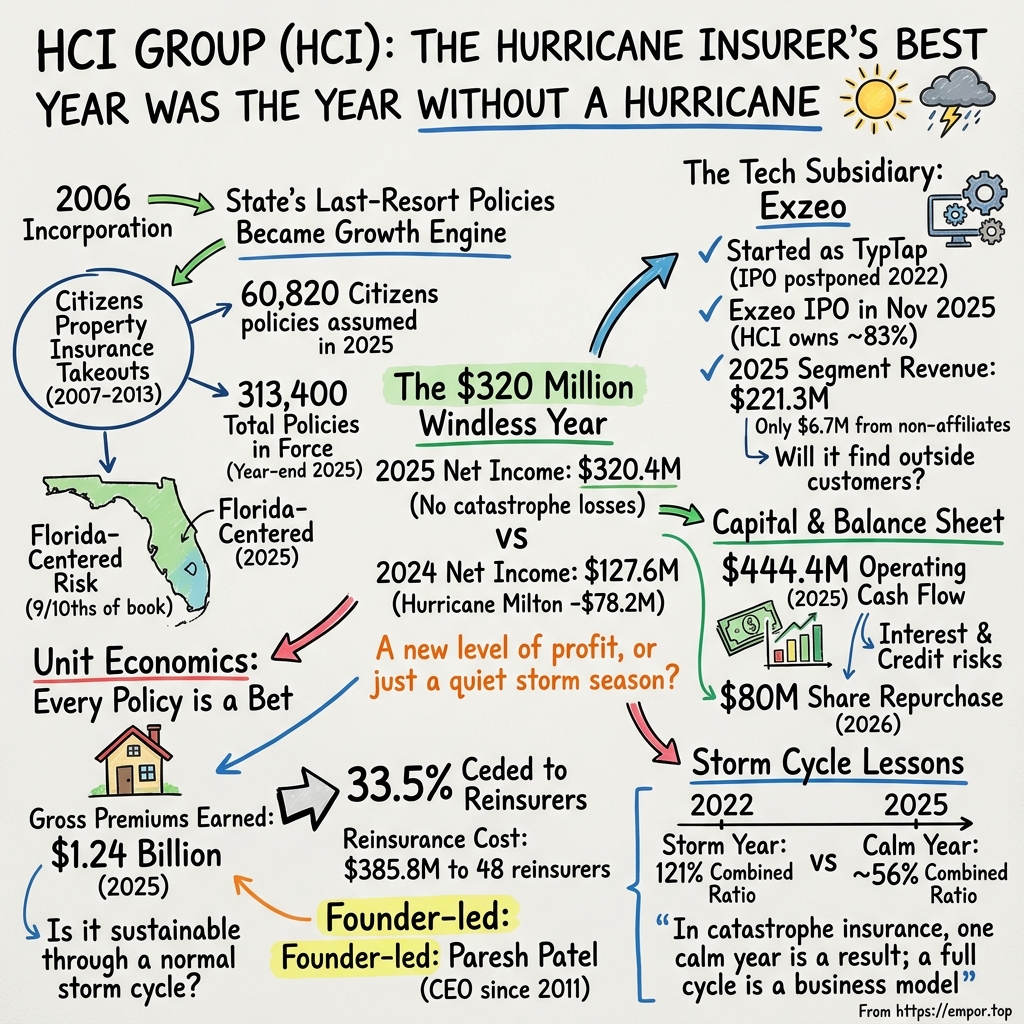
I. The $320 Million Windless Year
Picture the hurricane-tracking map that every Florida insurer keeps on a screen somewhere in the building. In the autumn of 2024, the map at HCI Group's offices in Tampa was crowded with names. Debby came ashore in August, Helene tore up the Big Bend in September, and Milton crossed the peninsula in October, with Tampa Bay itself in the cone. A year later, the same map was nearly blank, at least as far as HCI's books were concerned. When the company closed its 2025 accounts, it recorded no catastrophe losses at all.1
Then came the numbers. In February 2026, HCI reported net income of $320.4 million for 2025, against $127.6 million the year before.2 Diluted earnings per share went from $8.89 to $22.72.2 Pre-tax income was about $429 million, roughly two and a half times the 2024 figure.2 Book value per share had nearly doubled in twelve months, from about $42 to about $80.2 Paresh Patel, the founder who has run the company as chief executive since 2011, called 2025 "a very successful year for HCI, delivering record earnings and shareholder returns."2
The headline invites one reading: a Florida homeowners insurer has reached a new level of profitability. There is a second reading, and it begins with an awkward fact. HCI's central product is protection against Florida windstorms, and in its best year ever, Florida windstorms cost it nothing. The prior year's three hurricanes had cost about $128 million after reinsurance, with Milton alone accounting for $78.2 million.3 Remove that single line from 2024 and much of the year-on-year leap disappears. Add the fact that HCI also released large amounts of estimated reinsurance-covered losses from those same 2024 storms during 2025, and the record starts to look like a combination of genuine growth and an unusually kind calendar.
This is the puzzle at the centre of the HCI story. A hurricane insurer's income statement is not a smooth line that tilts upward. It is a series of good years punctuated by bad ones, and the bad ones arrive without notice. A calm year is the reward the business is designed to earn. It is not proof that the business has changed.
That is not to say the growth is illusory. HCI reported $900.9 million of revenue in 2025, up from $750.1 million in 2024.2 It ended the year with about 313,400 policies in force, up from 271,300 a year earlier.3 Those are the dimensions of a substantial regional insurer, not a startup riding one lucky season. But a $320 million profit year is not the same as a $320 million earnings base, and the gap between the two is where an investor's judgment has to work.
The case for HCI, and the case against it, turns on four questions that run through the rest of this story. The first is whether its underwriting and reinsurance can keep earning money through a normal storm cycle, which in Florida means a cycle that includes a bad year. The second is whether its technology subsidiary, now a separately listed company called Exzeo, has customers beyond the HCI family. The third is whether HCI can keep growing without concentrating ever more risk on a single, hurricane-exposed peninsula. The fourth is whether a founder-led company, whose chief executive also runs the subsidiary that sells it software, allocates capital and manages conflicts in the interest of all its shareholders.
None of those questions can be settled by one blank map. To see why HCI got here, and why its best year raises as many questions as it answers, the story has to go back to a Florida market that had just been broken by wind.
 Subscribe on LinkedIn
II. The State’s Last-Resort Policies Became HCI’s First Growth Engine
In the middle of the 2000s, Florida's property insurance market looked like a town after an evacuation. The hurricane seasons of 2004 and 2005 had battered the state, national carriers had pulled back, and homeowners who could not find private coverage were landing in the one place that had to take them: Citizens Property Insurance Corporation, the state-created insurer of last resort. Citizens was never meant to be the market. It was a safety net, and when a safety net becomes the largest insurer in the state, every taxpayer and policyholder is exposed to the next storm.
Florida's answer was a program that sounds bureaucratic and turned out to be an incubator. Under legislatively mandated "take-out" programs, private insurers could apply to assume blocks of Citizens policies, taking on the risk and the premium in exchange for relieving the state.4 For a startup insurer, that was an extraordinary shortcut. Building a homeowners book one policy at a time requires agents, brand and years of patience. A takeout delivers thousands of policies at once, already priced and already in force.
HCI was built to use that shortcut. The company, originally called Homeowners Choice, Inc., was incorporated in Florida in 2006, and its main insurance subsidiary, Homeowners Choice Property & Casualty Insurance Company, began operating in 2007.4 Its first business came from Citizens. Between July 2007 and November 2013, it completed ten separate assumption transactions with the state insurer.4 Some were enormous relative to the company's size: about 60,000 policies in November 2012, and roughly 34,000 more, carrying about $78 million in annualized premium, in November 2013.4 In November 2011, it also acquired the Florida policies of HomeWise Insurance Company.4 By the end of 2013, HCI had about 160,000 policies in force and roughly $390 million in annualized gross premiums.4
The man behind it was not a career insurance executive. Paresh Patel trained as an electronic engineer at the University of Cambridge, earning bachelor's and master's degrees, and spent most of the 1990s as an independent software and systems consultant to large international telephone companies.5 From 1998 to 2000 he ran customer care and billing at Global Crossing, where his job was stitching together billing systems after acquisitions.5 He had also founded NorthStar Bank in Tampa and ran a software company, Scorpio Systems.5 He has been a director of HCI since its inception, chairman since May 2007 and chief executive since 2011, and he personally developed and continues to oversee the company's policy administration systems.5
That background matters more than a résumé line usually does. Patel came to insurance as a systems builder: a person whose instinct is to treat an insurance company as a set of data flows to be engineered, priced and automated. That instinct would later produce TypTap and Exzeo. In the early years, it produced something simpler and very profitable. HCI grew so fast that Fortune ranked it second on its 2014 list of the 100 fastest-growing companies, citing average annual revenue growth of 58% over the three years to mid-2014.5 By then the stock had already moved from the Nasdaq, where it traded as HCII, to the New York Stock Exchange under the ticker HCI, in October 2012.4
A long tenure under one leader is useful to an investor because it allows a real test: promises made by the same person can be checked against outcomes delivered by the same person. The caution is that HCI in 2026 is not HCI in 2013. Its product mix, its reinsurance structure, its legal environment and the frequency of severe storms have all changed, and so have the vehicles it uses to write business.
The long-run record shows the scale of that change. In 2016, HCI reported revenue of $264.4 million and net income of $29.0 million.6 By 2025, revenue was $900.9 million and net income $320.4 million.2 Revenue roughly tripled over nine years, and profit rose about elevenfold. It would be tempting to annualize those numbers and call it a compounding machine. That would be a mistake, because the path between the endpoints was anything but straight. In 2022, the year Hurricane Ian struck southwest Florida, HCI lost $54.6 million.7 In 2024, three hurricanes trimmed results sharply. The endpoints describe a company that got much bigger. They do not describe a steady growth rate, and the profit endpoint is the calm year this story opened on.
And then the story came full circle. The source of HCI's original scale came back into fashion as Citizens shrank again after Florida's legal reforms. In 2025, HCI assumed 60,820 Citizens policies carrying about $216.7 million of annualized gross premium, following 52,805 policies and about $315.1 million of premium in 2024.8 Notice the difference: more policies in 2025, but much less premium attached to each, which says something about the blocks being offered and the pricing on them. On the fourth-quarter call, management said about 47,000 of those policies, with more than $175 million of in-force premium, arrived in the fourth quarter alone, and described the October assumption as a way to "prefund growth for 2026."9
That phrase is revealing. A takeout is not a sale won in the open market. It is a transfer of risk that the state wants to shed, and the insurer gets to choose which policies to accept. It can be a smart way to grow quickly with known data on each property. It also depends entirely on Florida's market structure and on the size of Citizens, which policymakers can change. Citizens takeouts are an opportunity HCI has used with skill for nearly two decades. They are not a guaranteed pipeline. And every one of those policies, however it arrives, eventually becomes the same thing: a promise HCI has to price, keep and renew.
III. Every Policy Is a Bet on the Next Renewal
Imagine an underwriter looking at a single house in Pinellas County. The screen shows its address, its distance from the water, the year it was built, the age and shape of its roof, its wind-mitigation features, the value it would take to rebuild it and the claims history attached to the property. Each of those facts changes the answer to three questions. Will HCI quote this house at all? If it does, at what price? And when the policy comes up for renewal next year, will HCI want to keep it?
That is the whole business, repeated a few hundred thousand times. HCI sells homeowners insurance and collects a premium in advance for a year of protection. If claims over that year cost less than the premium after expenses and reinsurance, it makes money on underwriting. Meanwhile, the premium cash sits on its balance sheet before claims are paid, and HCI earns investment income on it. The revenue engine is premium per policy, shaped by the number of policies, the insured value of each home, the rate charged per dollar of value, and how many policies renew.3
The scale of that engine in 2025 was large. Gross premiums earned reached about $1.24 billion, up from about $1.08 billion in 2024.8 Of that, about $1.15 billion came from HCI's insurance operations and about $95.6 million from the reciprocal exchanges it manages.3 Florida generated about $1.12 billion, roughly nine dollars of every ten.3 HCI writes some business in other states in the southeast and northeast, but this remains, overwhelmingly, a bet on Florida.8
Policy growth was strong.3 But not all of those policies were won in the ordinary way. The Citizens assumptions supplied a large block, and Tailrow Insurance Exchange, a new reciprocal that began operating in February 2025, ended its first year with about 33,000 policies and about $115.9 million of annualized premium.8 An investor trying to understand demand should separate two very different kinds of growth: policies that a homeowner or agent chose in a competitive market, and policies that arrived in bulk from the state. HCI does not publish a full split of its year-end count between those two channels. The distinction matters because voluntary growth is evidence of pricing and distribution strength, while assumed growth is evidence of underwriting selection and opportunism.
Then there is the cost of sleeping at night. No Florida homeowners insurer can carry the full force of a major hurricane on its own balance sheet, so each one buys reinsurance: insurance for insurers, paid for by handing over part of the premium. HCI ceded about $414.5 million of premium to reinsurers in 2025, equal to about 33.5% of gross premiums earned.8 Its 2025 program involved 48 reinsurers.3 The plain-English version is that about a third of every premium dollar HCI collects goes straight out the door to other companies that agree to pay if a big storm hits.
That is not free protection, and it is not a fixed cost either. Reinsurance prices rise after expensive storm years and fall when capital floods back into the market. The reinsurance renewal each June 1 is therefore one of the most important days in HCI's year. For the 2026–2027 season, management said it bought more and better coverage while cutting ceded premium by more than 10%, saving more than $10 million a quarter, and expected third-quarter ceded premium of about $96 million.10 That is a meaningful tailwind. But on the same call, management said its Florida rate filings would incorporate the new reinsurance costs, likely in a filing late in the year.10 In a regulated market, a cheaper reinsurance program can flow through to lower rates for policyholders. Some of the saving may stay with shareholders, and some may be passed on.
That brings the customer into the picture. HCI's policyholders are numerous and dispersed, so no single homeowner has bargaining power in the way a large corporate customer would. But every homeowner can shop at renewal, and so can the independent agents who place many of the policies. Florida regulates rates and coverage forms, so HCI cannot simply raise prices when its costs rise, and regulators can push back when it tries. The changing size of Citizens also shapes the competitive floor: under Florida's 2022 reforms, Citizens policyholders cannot renew with the state insurer if they receive a private offer within 20% of their Citizens premium, which pushes some customers into the private market whether they like the new price or not.11
HCI says its renewals are sticky. On the second-quarter 2026 call, chief operating officer Karin Coleman said retention was consistently above 90%.10 That is a useful number, and it is the kind of evidence that matters more than any technology claim. But it is a management statement on a call, not an audited disclosure with a history, and it describes a period when the market was hardening and alternatives were scarce. Retention in a softening market, when rivals start cutting prices, will be the better test.
And the market was softening. On the February call, Patel said the Florida market was "very competitive" and that rate increases were "a thing of the past." HCI itself filed a 3.5% rate reduction on its Homeowners Choice book in Florida, effective in January 2026, which management said would not materially affect consolidated results.9 In the second quarter, Coleman acknowledged that industry rates were softening while saying HCI had not chased rates up or down.10
So the economics of a single policy come down to a chain of variables, most of which HCI controls only partly. Premium per policy depends on regulators and competitors. The share kept depends on reinsurers. The claims cost depends on weather, building costs and the legal system. HCI's skill lies in managing that chain better than its rivals. Whether it truly does is a competitive question, and Florida's competitors are not small.
IV. A Florida Market Where the Leaders Are Much Bigger
Open any of the Florida Office of Insurance Regulation's residential market-share reports and HCI is a recognizable name, but not the biggest one.12 The larger books belong to carriers such as State Farm Florida, Universal, Slide and Tower Hill, alongside a still-sizable Citizens.12 Some of these rivals are Florida specialists like HCI; State Farm Florida sits inside the largest homeowners insurance group in the country. Any claim that HCI enjoys a durable advantage has to start from the reality that it competes against companies with more policies, more data and, in some cases, much deeper parent balance sheets.
The comparison needs care. HCI's figure of about 313,400 policies covers its whole group, including its reciprocal exchanges and business outside Florida.3 The state counts Florida residential policies by company. Lining up a group total against a single state-level company number would overstate or understate HCI's position, so the honest conclusion is directional rather than precise: HCI is a meaningful mid-sized player, not the market leader.
Think of the Florida homeowners market as a war game with five pressure points. Customers can switch at renewal, so the threat of defection is always present, especially once rates start falling. Regulators set the boundaries on price and coverage, which caps how much any carrier can capture in good years. Independent agents control much of the distribution, and they move business toward whichever carrier offers the best combination of price, commission and service. Reinsurers sit upstream as the most powerful supplier, because without their capacity a Florida carrier cannot write much business at all. And new entrants keep arriving, because the market has repeatedly shown that a few calm years can make a young carrier look brilliant. Those forces push hard against durable pricing power.
HCI's own record shows how those pressures play out in practice. The same company that cut its Homeowners Choice rates by 3.5% at the start of 2026 had, a few years earlier, been buying reinsurance in a market hardened by industry losses and operating under a legal regime that made every disputed claim more expensive.911 Neither shift was a decision HCI made alone. The rate cut reflected a competitive market and a cheaper cost base; the earlier squeeze reflected the reinsurers' reaction to industry losses. A carrier with real pricing power would set its prices more independently of the cycle. HCI, like its rivals, mostly rides it, and its skill shows up in how well it positions the book before each turn.
HCI's answer to this crowd is technology. The company says its platform, now sold through Exzeo, helps identify profitable underwriting opportunities, automate policy administration and improve claims workflows.3 It is a credible tool. A carrier that can evaluate a property more accurately than its rivals can select better risks from a Citizens block, price its renewals more precisely and avoid the houses that tend to generate the worst claims. But a tool is not a moat by itself. A moat would show up in outcomes: retention that stays high when competitors cut prices, rate adequacy that holds across cycles, an expense ratio meaningfully lower than peers', and catastrophe losses smaller than peers' for the same storm. The filings support the claim that HCI runs a capable operation. They do not yet prove, with peer-adjusted numbers across a full storm cycle, that it has a lasting advantage.
The counterparties behind the promise
The reinsurance side of the war game carries its own concentration risk. At year-end 2025, about 65.3% of HCI's reinsurance recoverables were due from just four counterparties, one of them the Florida Hurricane Catastrophe Fund, the state's reinsurance backstop.3 HCI says it targets reinsurers rated A- or better by AM Best, or requires full collateral.8 That is sensible discipline. It is still a reminder that, after a large storm, a substantial share of the money HCI expects to collect will come from a handful of sources.
HCI has already lived through a counterparty failure, though in the opposite direction. It had provided quota-share reinsurance and related administration to United Property & Casualty, a fellow Florida insurer, until United entered receivership. HCI stopped providing that quota-share and administration in March 2023, then paid $1.2 million in October 2025 to commute one remaining contract.3 The financial damage was small. The lesson is larger: in Florida, the companies on either side of a reinsurance contract can fail, and United was a carrier that had once looked like a peer.
On financial strength, the current evidence is reassuring as far as it goes. Demotech affirmed an A Financial Stability Rating for Homeowners Choice Property & Casualty Insurance Company in March 2026.13 HCI reported that its U.S. insurance subsidiaries exceeded their applicable risk-based capital minimums and required no corrective action.3 Those facts describe a company with present capacity to pay claims and to satisfy regulators. They do not describe immunity. Demotech's own rating assumptions include the accuracy of catastrophe models and the reliability of the data it is given, which is to say the rating is only as good as the models of the next storm.13
The verdict on competition is therefore a narrowed one. HCI has evidence of a disciplined underwriting operation and a genuinely useful technology stack, and its recent results are excellent. But the claim of a durable moat is not yet supported by the kind of evidence that would settle it. The forward test is simple to state and hard to pass: profitable policy growth, at adequate rates, across more than one storm cycle. And the technology that HCI points to as its edge has its own story, one that began with a far bigger ambition than writing software for its parent.
V. The Technology Business That First Tried to Become an Insurer
In January 2022, HCI made an announcement that most founders hate to make. It was postponing the initial public offering of TypTap, its technology-driven insurance subsidiary, because, in Patel's words, current market pricing "does not accurately reflect TypTap's value."14 The board, he said, would "move forward with a TypTap IPO when and if conditions are appropriate," and HCI could fund TypTap's growth plan without the proceeds.14
It was a striking moment because TypTap had been the vehicle for the most ambitious version of Patel's vision. The idea was a technology-led insurer: a carrier that would use HCI's in-house systems to underwrite homes and flood risks faster and more precisely than traditional insurers, and grow beyond Florida into other states. HCI formed TypTap in 2016, reorganized the business in 2020, and filed to take it public in 2021.15 In March 2021, Centerbridge Partners had invested $100 million in TypTap at a post-money valuation of about $850 million.14 The plan was a listing on the New York Stock Exchange under the ticker TYTP.14
The numbers in the filing explain why public investors were less enthusiastic than Centerbridge. TypTap was growing fast: gross premiums earned rose from $30.9 million in 2019 to $78.8 million in 2020, and reached $119.4 million in the first nine months of 2021.14 But it was losing money, with net losses of $6.9 million in 2019, $12.4 million in 2020 and $14.7 million in the first nine months of 2021.14 Growth plus losses plus a hurricane-exposed book was not a combination the market wanted to pay a premium for in early 2022. Ian arrived later that year.
What happened next is a strategic reversal, and it is worth saying so plainly. The original vision, a technology company that is also an insurer, gave way to a cleaner split. In July 2024, the TypTap insurance company moved under HCI itself, leaving the former TypTap holding company as a pure technology business.8 That company, incorporated in 2020 as TypTap Insurance Group, renamed itself Exzeo Group in February 2025, reclaiming the name of the technology division HCI had established back in 2012.16 Then, in November 2025, Exzeo completed its own NYSE listing under the ticker XZO, selling 8.0 million shares at $21 each for about $168 million of gross proceeds.16
What Exzeo sells, and to whom
Exzeo describes its product as "Insurance-as-a-Service": a set of nine software and data-analytics applications that handle underwriting, policy administration and claims for property and casualty insurers.16 A useful analogy is a restaurant that has spent years perfecting its kitchen systems and now wants to sell those systems to other restaurants. The kitchen clearly works, because it feeds the original restaurant every night. The question is whether other restaurants will buy it, and whether they will trust a competitor's kitchen.
The prospectus answered the first part bluntly. Substantially all of Exzeo's revenue to date had come from customers affiliated with HCI.16 It had one unaffiliated customer, and did not expect significant revenue from that customer in the current fiscal year.16 Its managed premium exceeded $1.2 billion across 13 states and four insurance companies, but those were the HCI family's insurers.16 By HCI's segment accounting, Exzeo generated about $221.3 million of revenue in 2025, of which about $6.7 million came from non-affiliates.3 Roughly 97 cents of every Exzeo revenue dollar came from its parent's family of insurers.
The prospectus also named the obstacle that the restaurant analogy predicts. Some potential customers, it warned, may view HCI as a competitor and be reluctant to work with Exzeo.16 That is not a small risk. An insurer that licenses Exzeo's platform would be running its underwriting and claims through software whose majority owner competes for the same Florida homeowners.
Behind the product is a team that looks more like a software company than an insurer. Exzeo said it employed more than 175 developers and data scientists to build and maintain the platform, and it runs a development subsidiary in India, Exzeo Software Private Limited.16 The platform was licensed in 29 states and served 13 at the time of the IPO.16 HCI as a whole had 594 full-time employees at the end of 2025, a small headcount for a company managing well over a billion dollars of premium, which is itself an argument for the automation Patel has spent two decades building.8 The Indian operation carries a small currency footprint: HCI reported no material foreign-currency exposure, used the U.S. dollar as the subsidiary's functional currency, and booked remeasurement losses of only about $172,000 in 2025.3
HCI does not report research and development as a separate expense line. It capitalizes qualifying internal-use software costs during development, but does not break those amounts out, and its purchases of property and equipment were only about $3.6 million in 2025.3 The technology investment is real, but it is woven into personnel costs rather than displayed as a line an investor can track.
The fee model links Exzeo's fate to insurance volume. Exzeo typically charges a percentage of the premium managed through its platform, plus some claim, policy and technology fees.16 That design scales naturally: as the insurers on the platform write more premium, Exzeo earns more. It also means that Exzeo's revenue rises and falls with the insurance book it serves, and that the affiliate contracts setting those percentages are central to its economics. When the parent and the subsidiary negotiate fees with the same person at the head of both, the terms matter enormously.
Exzeo's most recent results show steady but unspectacular growth. In the second quarter of 2026, it reported revenue of $57.8 million, against $56.1 million a year earlier, and net income of $23.3 million.17 Managed premium reached about $1.40 billion, up from about $1.22 billion.17 Patel said the results highlighted "the growing traction of the Exzeo Platform."17 HCI reported that its consolidated other revenue in the first half of 2026 was driven by new carrier customers on the Exzeo platform.18 Exzeo, however, did not report a count of outside customers or an unaffiliated revenue figure in its second-quarter release; its closest metric, "Adjusted Revenue," strips out claims services outsourced to an HCI subsidiary, which is not the same thing.17
Control, and the bet that remains
HCI remains firmly in control. It owned about 82.5% of Exzeo at the end of 2025 and about 83% at June 30, 2026.819 Patel is chairman and chief executive of both companies, and the prospectus described him as the architect of the proprietary policy-administration and underwriting technology.16 The prospectus warned that HCI's interests may conflict with those of Exzeo's other shareholders, and that HCI can determine the outcome of shareholder votes, including director elections.16 Exzeo said it would not use the "controlled company" exemptions from governance rules available to it, which is a modest but real concession.16
The financial weight of the subsidiary is significant. On the February call, management valued HCI's stake at nearly $1.2 billion following the IPO.9 Against HCI's market value of about $2.5 billion in October 2026, that would make the Exzeo stake a large share of what HCI's shareholders own, at least at the market price prevailing when management made the estimate.20 HCI's management uses this to argue that its book value understates its worth: on the second-quarter call, chief financial officer Mark Harmsworth said pro forma book value would exceed $150 per share if Exzeo and the real estate portfolio were marked at fair value.10 That is management's calculation, built on a market price for a stock whose customers are almost entirely its parent's subsidiaries.
So how should the history inform the bet? The record narrows the claim rather than rejecting it. HCI has shown that it can build software that runs a large insurance operation, and that is not trivial. What it has not yet shown is the commercial half: winning outside carriers at scale. The first attempt to monetize the technology through TypTap's IPO stalled on its own losses, and the second attempt has produced a public listing with almost no outside revenue. Certification is not commercialization, and an IPO is not a customer. The KPI that will settle this is the non-affiliate share of Exzeo's revenue and managed premium over the next several annual reports. And Exzeo's affiliate income, like the parent's insurance profit, depends on one thing neither company controls: what the weather does to the book underneath.
VI. The Storm Years That Refused to Behave Like the Plan
Lay 2024 and 2025 side by side and they look like two different companies. In 2024, HCI recorded net catastrophe losses of $78.2 million from Milton, $43.0 million from Helene and $6.5 million from Debby.3 Its net loss ratio, claims and claim-handling costs as a share of net premiums earned, was about 55.3%.8 In 2025, it recorded no catastrophe losses at all, and the net loss ratio fell to about 29.4%.8 The gross loss ratio, before reinsurance, fell from about 34.6% to about 19.6%.2
To see what that means for profitability, it helps to build a rough combined ratio, the measure insurers use to judge underwriting: every cost of running the insurance business divided by the premiums it earned. A reading under 100% means the insurer made money on underwriting before investment income. Taking all operating expenses except interest and dividing by net premiums earned gives about 56% for 2025, about 83% for 2024, and roughly 120% for 2022, the Ian year.27 Those are simple calculations from the income statement, not figures the company reports in that form, but they capture the swing. In the calm year, HCI kept 44 cents of each net premium dollar before investment income. In the Ian year, it paid out about $1.20 for every dollar it earned.
The extremes are the point. A long-term investor is not buying the 56% year or the 120% year. They are buying the average of a cycle that includes both, and the average depends on how often the bad years come and how bad they are.
The second swing factor
The calm sky was not the only thing flattering 2025. HCI also derecognized $122.5 million of ceded losses during the year, after favourable revisions to its estimates for Milton and Helene, partly offset by adverse development on Ian.3 In plain terms, the company had booked estimates of what those 2024 storms would ultimately cost, including the portions its reinsurers would cover, and then revised them down as claims came in lower than feared.
Reserve revisions are not new premiums earned, and they are not repeatable in the way an underwriting margin can be. They are evidence about the accuracy of old estimates. Favourable development is better news than unfavourable development, because it suggests the company reserved conservatively. But it also means a portion of 2025's reported strength came from correcting 2024's numbers rather than from 2025's business. Management itself drew the distinction: on the February call, Harmsworth gave a normalized gross loss ratio of about 20% for the full year after adjusting for favourable prior-period development, and called that development "modest."9 He also said the fourth-quarter combined ratio of under 45% contained "noise" from the Citizens assumptions booked in the quarter, and that the normalized figure was under 60%.9
The auditor, too, treated reserves as the place where judgment lives. HCI's independent auditor identified loss and loss-adjustment-expense reserves as a critical audit matter, because the estimates depend on actuarial assumptions and carry significant uncertainty, and it used an actuarial specialist to test them.3 The opinion was unqualified, and the auditor reported that internal control over financial reporting was effective.3 Nothing there suggests a problem. It does remind the reader that the most important number on an insurer's balance sheet is an estimate, and that estimates for a single storm, such as Ian, can still move years later.
A strong half, and the backdrop that changed
The first half of 2026 carried the strength forward. HCI reported net income of $167.9 million for the six months, against $144.5 million a year earlier, and diluted earnings of $11.05 a share.18 The gross loss ratio was about 21.1% for the half.18 On the second-quarter call, Harmsworth said the quarter's combined ratio was about 61%, within the 60% to 65% range management had discussed, and noted it was the sixth consecutive quarter of more than $100 million in pre-tax income.10 That consistency matters. It suggests that 2025 was not a one-quarter fluke. It does not settle the storm-cycle question, because the first half of the year is mostly outside hurricane season.
Part of the improvement is structural, or at least legal. Florida's 2022 reforms, passed in a December special session, ended one-way attorney fees that had required insurers to pay policyholders' lawyers when they won lawsuits, and barred the assignment of property-insurance benefits to third parties such as contractors.11 The same law shortened the window to file claim notices from two years to one, required a breach-of-contract ruling before a bad-faith suit could proceed, and created a temporary state-funded program of about $1 billion to help insurers buy reinsurance.11 For years, Florida's insurers had blamed litigation, not hurricanes, for their worst losses. If the reforms durably reduce litigation costs, a structural chunk of the old cost base has gone.
But reforms are a change in one cost line, not a change in the weather. They do not stop a Category 4 hurricane, and they do not guarantee that rates stay adequate, that homeowners keep affording coverage, or that reinsurers keep offering capacity at current prices. They can also be revisited by the legislature. The fair reading is that HCI's recent results reflect a genuinely improved operating backdrop and a well-run book, plus an unusually calm year and favourable reserve releases. The test of durability is the combined ratio after the next material Florida storm. Until then, what investors can examine is what HCI does with the cash the calm years throw off.
VII. The Money on the Balance Sheet Has More Than One Job
At the end of 2025, HCI's balance sheet looked like a vault. It held about $1.21 billion of cash and about $789.7 million of investments.3 Operating cash flow for the year was $444.4 million, comfortably above net income.3 And within days of the fourth-quarter call in February 2026, the company announced an $80 million share-repurchase program, which Coleman called "internal M&A."918
The image of a vault is tempting and misleading. An insurer's cash is not like a software company's cash. Much of it belongs, in an economic sense, to policyholders who have prepaid for coverage, and to claimants whose storms have already happened but whose claims are not yet settled. Some of it sits in regulated insurance subsidiaries that cannot freely send it upstream to the parent. The question is not how much cash HCI has. It is how much of that cash could leave without weakening the promise HCI sells.
Start with the cash flow. Operating cash flow of $444.4 million against net income of $320.4 million is a healthy relationship, and it is not evidence of a cash-conversion problem.3 But for an insurer, operating cash flow mixes several streams: premiums received in advance, reinsurance recoveries arriving after the 2024 storms, claim payments, interest and non-cash items such as $11.0 million of stock-based compensation.3 HCI said its operating cash primarily reflected premiums written and reinsurance recoveries, less operating costs, claims and interest.3 A year after three hurricanes, when recoveries flow in, operating cash is flattered. A year in which a major storm hits, when claims go out before reinsurers pay, can look very different. Management said cash from operations exceeded $750 million over two years, a fairer window, though still one that includes the calm year.9
The investment portfolio is the second engine. HCI's net investment income rose from about $46.2 million in 2023 to about $65.4 million in 2025.8 Its fixed-income holdings include U.S. Treasury and government-agency securities, corporate bonds and commercial mortgage-backed securities.3 That income is real and growing, but it ties results to interest rates and credit quality. In the first half of 2026, HCI moved meaningfully from cash into securities: cash fell to about $872 million by June 30 while investments rose to about $1.27 billion.18 Locking in yields is sensible; it also adds duration and credit exposure to a balance sheet whose first job is liquidity after a storm.
What the parent can actually spend
The most important distinction is between the consolidated balance sheet and the parent company. Florida law limits how much an insurer can pay its parent in dividends; larger distributions need prior approval from the state regulator or a notice and certification under certain conditions.8 In 2025, HCI's insurance subsidiaries paid $14.0 million of dividends to the parent.8 Set that against $1.21 billion of consolidated cash, and the gap is the whole story: most of the money is inside the regulated perimeter. Management put holding-company liquidity at about $175 million at year-end, excluding Exzeo shares, and at just over $160 million after the second quarter.910
That is the pool that funds buybacks and dividends, and it is much smaller than the headline cash. HCI used it with conviction. It completed the $80 million repurchase on July 17, 2026, buying back 504,330 shares, about 4% of the shares outstanding.1810 It kept paying a quarterly dividend of $0.40 a share.18 Shares outstanding fell to about 12.5 million by June 30, from about 13.0 million a year earlier.18
The share count has not only moved one way. In 2025, holders of HCI's $172.5 million of 4.75% convertible notes converted them into about 2.19 million new shares.3 Converting debt into equity strengthened the balance sheet and eliminated the interest cost, but it also issued shares, and the 2026 buyback retired fewer than a quarter as many as the conversion created. Debt is now modest: about $36.0 million drawn on a revolving credit facility and about $31.9 million of mortgage notes secured by HCI's real estate, with covenants in compliance.3
On acquisitions, the record calls for proportion rather than praise. HCI's insurance growth has come mainly from underwriting, Citizens assumptions and new reciprocals, not from buying other carriers at negotiated prices. Its real-estate arm bought a property for roughly $19 million in 2025 and has previously sold retail properties at gains.3 There is no large insurance acquisition against which to measure whether management overpays or buys bargains. Patel addressed this on the February call, describing a "bid-ask spread" in which sellers treat 2025 as an average year while buyers want multi-year averages given hurricane uncertainty, and saying patience was required.9 That is a sensible instinct, and it is consistent with the central argument of this story: a calm year should not be capitalized as a normal one. It is, however, a statement of intent rather than a tested record.
Harmsworth framed the buyback in valuation terms on the second-quarter call, saying the stock traded below 1.2 times adjusted book value, the figure that marks Exzeo and real estate at fair value, and that management still saw the shares as attractive even with no active authorization left.10 Whether a buyback creates value depends on the price paid relative to normalized intrinsic value, and that normalization is precisely what one calm year makes hard. The $80 million was meaningful. It was also funded from a holding-company pool that has to stand behind the insurance subsidiaries if a storm erodes their capital. That pool, in turn, depends on money HCI is owed by others.
VIII. The Receivables Behind the Hurricane Promise
When a hurricane claim is paid, the cash leaves HCI quickly. The money it expects back from reinsurers arrives later, sometimes much later, after the claims have been tallied, the treaties have been triggered and the counterparties have checked the bills. In between sits a line on the balance sheet that most readers skip: amounts recoverable from reinsurers. For a Florida insurer after a storm year, that line can be larger than a year's profit.
At the end of 2024, HCI's total net amounts recoverable and receivable from reinsurers stood at about $558.4 million, a legacy of Milton, Helene and Debby.3 By the end of 2025, the figure had fallen to about $289.9 million.3 Part of the decline reflected collections. A large part reflected the favourable reserve revisions that boosted 2025 earnings, which also reduced what HCI expected reinsurers to pay.3 The receivable shrank because the underlying estimate of covered losses shrank.
The detail behind those totals shows where the risk sits. Premiums receivable from policyholders were about $57.5 million, with an allowance for expected credit losses of about $4.47 million.3 Recoverables from reinsurers on unpaid losses were about $262.0 million, with an allowance of just $97,000.3 The small allowance on the reinsurance balance reflects HCI's judgment that its reinsurers are good for the money, consistent with its counterparty standards.8
That judgment is reasonable today. It is also concentrated: the recoverables were concentrated among four counterparties, including the Florida Hurricane Catastrophe Fund, the state's reinsurance backstop.3 That is not evidence of any impairment, and the state fund is a statutory backstop rather than a private balance sheet. It does mean that after a severe storm, the speed and reliability of HCI's collections will depend on a handful of counterparties and on the health of the catastrophe-reinsurance system as a whole, a system that would itself be under stress in exactly the scenario where HCI needed it most.
One question HCI's filings do not answer is how old its premium receivables are. The company does not disclose the aging of premium receivables or the share of balances that are overdue.3 The premium receivable is small relative to the business, and homeowners policies that go unpaid are typically cancelled, so the omission is not alarming. But it means investors cannot see who pays late or whether that is changing, and the honest statement is simply that HCI does not publish it.
The receivables, in other words, are a mirror of the reserves. When the reserve estimates are right, the recoverables are collected and nobody notices them. When estimates move, both lines move together. That puts the people making those estimates, and the incentives they work under, at the heart of the investment case.
IX. Patel’s Bet on HCI—and the Vote That Asked for More
Paresh Patel is the rare public-company chief executive who is also one of its largest owners and the architect of its core software. The 2026 proxy put his beneficial ownership at about 12.18% of HCI's shares.21 For comparison, BlackRock, the largest institutional holder, held about 9.90%, and Hood River Capital Management about 5.82%.21 On the February call, Patel said he had exercised stock options to increase his ownership.9 When the founder's personal fortune rises and falls with the share price, the most basic alignment problem in public companies is largely solved.
But alignment with the share price is not the same as alignment with every shareholder on every decision. Patel leads HCI as chairman and chief executive, and Exzeo as chairman and chief executive.16 The two companies do business with each other constantly: Exzeo charges HCI's insurers for its platform, HCI's subsidiaries provide services back to Exzeo, and costs are shared between them. In the first half of 2025 alone, Exzeo recorded about $7.36 million of per-claim fees connected with Tailrow, about $1.00 million for field-adjuster services, about $0.77 million of lease expense paid to an HCI affiliate and about $1.75 million of corporate cost allocations that reduced its own administrative expense.16 The prospectus set out the fee bases and settlement terms for each.16 The amounts are not large relative to either company, but they are exactly the kind of transactions where a dual-role leader's judgment needs independent checking.
That is why HCI's proxy emphasis on an independent lead director and an independent compensation committee matters.21 It is also why minority shareholders in either company should read the related-party notes rather than the press releases.
There is another related party worth naming. HCI paid about $1.03 million of annual premium to Oxbridge Re on a reinstatement-premium-protection contract, a form of reinsurance that covers the cost of restoring coverage after a storm.3 An HCI director, Jay Madhu, is Oxbridge's chairman and chief executive, and an investor in it.213 HCI's management said the premium was competitive with market rates, and the contract was collateralized through a trust.3 That is management's representation, not an independent price test. At the 2026 annual meeting, Madhu received about 3.9 million withheld votes in his director election, a notable level of dissent for an uncontested seat.22
The pay, and the vote
Patel's reported compensation was about $8.24 million in 2025, including a cash bonus of about $6.95 million.21 In 2024, his reported total was about $20.2 million, inflated by about $15.8 million of stock awards, and in 2023 it was about $3.66 million.21 Those years are not directly comparable, because stock awards are reported at their grant-date value when they are made, not when they vest or when their cost runs through the income statement. The fairer reading is that 2024 included a large multi-year equity grant, and 2025 was dominated by a cash bonus paid in the company's best year.
That grant is worth understanding. Under his 2024 employment agreement, Patel received a performance-based equity award tied to HCI's stock reaching $200 a share for a defined period.21 On October 23, 2026, HCI closed at $204.06.20 A target that looked ambitious when it was set in 2024 now sits just below the market price, helped along by the calm year and the reserve releases that this story keeps returning to. Whether the award's measurement terms are met depends on the specific period defined in the agreement, but the point for shareholders is broader: a price hurdle rewards the price, and the price in 2026 reflects a year without hurricanes.
Shareholders noticed. At the June 2026 annual meeting, the say-on-pay proposal passed with about 7.12 million votes in favour, but about 2.67 million votes opposed it.22 Roughly a quarter of the votes cast on that question went against the company, a meaningful signal for a resolution that most companies pass with overwhelming support, and all the more so given that Patel's own 12% stake votes as well.
The record of promises
Judging management by behaviour over time gives a mixed but useful picture. On the side of the ledger that favours Patel: he built an insurer from a Citizens takeout platform into a public company with more than $1 billion of gross premium, and HCI has remained profitable in most years through several brutal Florida seasons.2 He also showed discipline in early 2022 by pulling the TypTap IPO rather than selling shares at a price he considered too low, and he has spoken publicly about the danger of treating 2025 as normal when discussing acquisitions.149
On the other side: the TypTap vision as originally pitched, a fast-growing tech-led insurer worth a premium valuation, did not survive contact with the market. Losses, a postponed IPO and a restructuring later, the technology business reached the public markets in a different form, with almost no external revenue. The new listing should be tested against that earlier commercialization shortfall rather than treated as proof that the vision has succeeded.
The verdict is that Patel's ownership and tenure provide genuine alignment, and the operating record through difficult years deserves credit. The large cash bonus, the dual leadership of two related companies and the sizeable opposition on pay mean governance and affiliate economics are part of the investment case, not a footnote to it. Which brings the story to the central question an investor has to answer: what, exactly, is all of this worth?
X. Frameworks & Bull vs. Bear Case
On October 23, 2026, HCI's shares closed at $204.06, giving the company a market value of about $2.54 billion.20 On trailing earnings of about $23.21 a share, that was roughly 8.8 times earnings.20 For a company whose earnings had nearly tripled in a year, that looks cheap. For a company whose earnings in 2022 were negative, it looks like a market being careful. Both readings are correct, which is why the multiple is a clue rather than a verdict.
The problem is the denominator. The trailing twelve months include the calm 2025, the favourable reserve revisions and a strong first half of 2026 with no material storm.18 If an investor believes that is roughly what a normal year looks like, 8.8 times is undemanding. If an investor believes a normal Florida cycle includes an Ian-like year every few seasons, the average earnings power is much lower than the trailing figure, and the multiple on normalized earnings is correspondingly higher. On book value, the stock traded at about 2.4 times the reported $86.60 per share at June 30, though management argues that marking Exzeo and real estate at fair value would lift book above $150.1810 The market price, in short, already assumes HCI is much more than a reserve-and-premium machine, but it does not assume that 2025 repeats every year.
The bull case has a credible structure. HCI combines a Florida underwriting operation with proprietary technology built by its own founder, which lets it evaluate properties, select risks from Citizens blocks and manage claims with its own systems.3 It has grown its policy count by more than 15% in a year and generated six consecutive quarters of pre-tax income above $100 million.310 Florida's legal reforms have structurally reduced a major cost of doing business, and the reinsurance market softened enough in 2026 for HCI to buy more coverage for less money.1110 New distribution could help: management said it signed GEICO in July 2026 to distribute a new product, though it called the volume too early to quantify.10 Its condo reciprocal, CORE, pivoted toward standard homeowners policies and was writing about $6 million a month of new business.10 And Exzeo, if it wins outside carriers, could become a valuable asset whose growth no longer depends on HCI's insurance book.
The bear case has the weight of geography. About nine-tenths of HCI's gross premium comes from Florida, so a single severe storm can overwhelm a year or more of favourable loss experience.3 Rebuilding costs can rise faster than rates, and in a regulated market HCI cannot reprice instantly. Policyholders can leave at renewal, and larger competitors have much bigger books. Rates are now falling across the market, which management itself acknowledged, and HCI's own rate cut shows the direction of travel.910 Reinsurance has been cheap in 2026; it will not be cheap after the next big loss year. And the Exzeo story rests mostly on promise.
The forces and the powers
Run the industry through Michael Porter's five forces and the picture is consistent. Buyer power is moderate rather than low: individual homeowners are small, but they can switch at renewal, agents steer business, and regulators act as a collective buyer by approving or denying rates. Supplier power is high, because reinsurers and the state catastrophe fund provide the capacity without which a Florida carrier cannot operate, and HCI cedes about a third of its premium to them.8 The threat of new entrants is real, because Florida keeps attracting new capital in calm periods, and Citizens takeouts let new entrants buy scale quickly. Substitutes are limited, since mortgage lenders require coverage, but Citizens itself functions as a substitute of last resort. Rivalry is intense and, by management's own account, intensifying.9
Hamilton Helmer's 7 Powers framework asks a sharper question: which, if any, durable advantages does HCI possess? Scale economies are limited, because HCI is smaller than the market leaders. Network effects do not apply to a homeowners policy. Switching costs are modest; changing insurers at renewal is a form and a phone call. Brand matters in insurance mostly as a proxy for financial strength, where HCI's Demotech A rating is adequate rather than distinctive.13 Cornered resource is the closest candidate if one counts the Citizens takeout channel, but that channel is open to every qualified Florida insurer. Counter-positioning was the original TypTap idea, a technology-led insurer that incumbents would struggle to copy, but the restructuring that followed suggests that edge was smaller than hoped. Process power, the accumulated know-how of underwriting and claims handling embedded in HCI's systems, is the most plausible power HCI has. The evidence for it is indirect: better-than-average results in recent years and retention above 90%, as reported by management.10 It needs a full cycle, and peer comparisons through a storm year, to be confirmed.
The tests that matter
The technology test is clear. Exzeo becomes valuable beyond HCI only if outside-carrier revenue and managed premium rise meaningfully. The counterevidence is the 2025 affiliate dependence and the earlier TypTap plan that did not reach a listing on its first attempt.314
The capital-allocation test is also clear. The buyback can create value if the shares were bought below normalized intrinsic value, but $80 million has to be judged against storm reserves, statutory capital needs and a holding-company liquidity pool of about $160 million.10 Without a major insurer acquisition, there is no purchase-price record to benchmark management's discipline as an acquirer.
A skeptical activist would push on four things. Why does Patel lead both companies, and should Exzeo's affiliate fee contracts be priced by independent directors with outside benchmarks? Why does management present a pro forma book value that marks a majority-owned, affiliate-dependent subsidiary at its public market price? Should a calm year fund a $6.95 million cash bonus? And does buying back stock at a premium to reported book make sense before a full storm season has tested the reinsurance program? None of these questions imply wrongdoing. They are the questions a concentrated, founder-led structure invites.
Three KPIs carry most of the signal. The first is HCI's net combined ratio through a year with material Florida catastrophe losses; the latest reading was about 61% for the second quarter of 2026, within management's 60% to 65% range, but in a quiet period.10 The second is the split of policy and premium growth between Citizens assumptions and voluntary business; HCI assumed about 60,820 Citizens policies in 2025 and has not quantified voluntary growth in the same way.8 The third is Exzeo's share of revenue from unaffiliated customers, which was about 3% in 2025.3 Those three numbers, more than the trailing multiple, decide whether HCI's earnings deserve to be called high quality.
XI. Playbook: Business & Investing Lessons
The gap between HCI's Ian-year loss and its windless 2025 margin captures almost every lesson HCI teaches.72
The first lesson is about time horizons: a full cycle, not a calm year, is the business model. For founders in any cyclical or catastrophe-exposed business, the discipline is to report and pay yourself as if the bad year is coming, because it is. For investors, the discipline is to refuse to capitalize the best year in the record, however cleanly it is presented.
The second lesson is about technology. A platform is not a moat until customers outside the family pay to use it. HCI built genuinely useful software, but its attempts to commercialize it through TypTap and Exzeo have yet to prove demand beyond its insurance group.143 The broader point applies to every company that spins out an internal tool. The proof is not the listing, the product count or the managed premium. It is the first serious competitor that chooses to run its business on your code.
The third lesson is about dependence. A disciplined underwriter can still be a hostage to the price of reinsurance. HCI's reinsurance dependence, including its reliance on a handful of counterparties, shows how supplier pricing and capacity shape earnings.83 In a soft reinsurance market, that relationship looks like a cost line. After a big loss year, it can look like a ceiling on growth. The wider lesson for any business with a dominant supplier is that the supplier's pricing cycle is part of your earnings, whether you report it that way or not.
The fourth lesson is about capital. Buybacks are a capital-allocation decision, not a proof of value. HCI's buyback drew on a much smaller holding-company pool than its consolidated cash figures suggest.1098 A buyback after a record year signals confidence. Whether it was wise depends on the price relative to normalized earnings, which is the one number a calm year makes hardest to see.
And the fifth lesson ties the others together: in a business that sells protection against rare events, the most dangerous number is the one that looks most impressive.
XII. Epilogue
Now, in late October 2026, HCI stands in the quiet stretch between the end of another hurricane season's peak and its next set of results. The company reported its second-quarter numbers on August 6, and its next earnings release, covering the third quarter, is the first report that will include the heart of the 2026 season.18 When HCI's management steps onto that call in early November, analysts will be listening for one thing above all: what, if anything, the season cost.
The order in which evidence will arrive is almost a script. First come catastrophe losses and reserve development: how much gross loss the season produced, how much reinsurance absorbed, and whether the 2024 storms continue to develop favourably or begin to reverse. If HCI reports another quarter with a combined ratio near the low 60s while absorbing a real storm, the bull case gains its most important proof point. If a storm pushes the ratio sharply higher, the market will learn how much of 2025's earnings was weather.
Next comes the economics of renewal. Florida's rate environment is softening, and management has said its next rate filing will incorporate the cheaper 2026 reinsurance program.10 The interplay between those two forces, lower costs on one side and lower prices on the other, will show whether the reinsurance saving stays with shareholders or flows to policyholders. The next June 1 renewal will then reset the cost of risk transfer for the following year, and its tone will depend on what the 2026 season did to reinsurers across the industry.
Then comes growth. Citizens is shrinking, which means the old engine of HCI's scale has less fuel. Management told analysts in August that Citizens assumptions are not part of its outlook, which shifts the burden to voluntary sales, the GEICO distribution relationship and expansion beyond Florida.10 Management has said it is watching California but waiting on timing and rate changes.10 Watch whether policies won in the open market, and premiums from states outside Florida, start to show up in numbers large enough to change the concentration of the book.
The slowest-moving evidence concerns Exzeo. Its next annual report will show whether non-affiliate revenue has grown from a rounding error into a business line. A larger public valuation, a new product or another state license would not be a substitute for that conversion. Neither would rising managed premium, if the premium being managed still belongs to HCI's own insurers.
And finally, governance. The next say-on-pay vote will show whether that dissent was a one-off protest or a lasting signal, and the next proxy will show how his bonus responds to a year that is not calm.22 Read it alongside the next set of affiliate disclosures between HCI and Exzeo, because the more Exzeo matters to HCI's valuation, the more those contracts matter to HCI's minority shareholders.
Each of those moments maps onto one of the four questions this story began with. Together they will say whether HCI is a high-quality compounding insurer that happened to have a calm year, or a well-run Florida carrier whose calm year happened to make it look like one. The evidence for the first is real. The evidence for the second has not yet been delivered by the weather.
XIII. Outro
Go back to that map in Tampa, the one that was so crowded in the autumn of 2024 and so empty a year later. The blank space on it produced HCI's best year, and a founder's bonus.221 It also produced the hardest question about the company, because a year without storms is the one year that tells you least about how an insurer handles storms.
HCI has built something real, and it has survived Florida volatility that broke companies once seen as its peers. Its weakness is not that it lacks skill. It is that the skill it sells is tested only by the events nobody can schedule. HCI's defining asset may be its ability to price the storm—but the storm still gets the final vote.
References
-
HCI Group's Q4 Gross Loss Ratio More Than Halves as Earnings Surge — The Insurer, 2026-02-25 ↩
-
HCI Group Reports Fourth Quarter and Full Year 2025 Results — HCI Group, Inc., 2026-02-25 ↩↩↩↩↩↩↩↩↩↩↩↩
-
HCI Group, Inc. 2025 Annual Report and Form 10-K — HCI Group, Inc., 2026 ↩↩↩↩↩↩↩↩↩↩↩↩↩↩↩↩↩↩↩↩↩↩↩↩↩↩↩↩↩↩↩↩↩↩↩↩↩↩↩↩↩↩↩↩↩
-
Behind the Wheel of HCI Group — Association for Corporate Growth Tampa Bay ↩↩↩↩↩
-
HCI Group Reports Fourth Quarter and Full Year 2022 Results — HCI Group, Inc., 2023 ↩↩↩
-
2025 Form 10-K — HCI Group, Inc., 2026-02-26 ↩↩↩↩↩↩↩↩↩↩↩↩↩↩↩↩↩↩↩
-
HCI Group Q4 2025 Earnings Call — Yahoo Finance, 2026-02 ↩↩↩↩↩↩↩↩↩↩↩↩↩↩↩
-
Second Quarter 2026 Earnings Call Transcript — Equibles, 2026-08-06 ↩↩↩↩↩↩↩↩↩↩↩↩↩↩↩↩↩↩↩↩↩↩
-
Ten Big Issues Addressed During Florida's Insurance Overhaul — WLRN, 2022-12-16 ↩↩↩↩↩
-
Florida Residential Market Share Reports — Florida Office of Insurance Regulation ↩↩
-
Rating Information Disclosure Form: Homeowners Choice Property & Casualty Insurance Company — Demotech, 2026-03-23 ↩↩↩
-
HCI Postpones Home and Flood Insurer TypTap's IPO Until "Conditions Are Appropriate" — Insurance Journal, 2022-01-13 ↩↩↩↩↩↩↩↩↩
-
TypTap Form S-1 — TypTap Insurance Group, Inc., 2021-11-12 ↩
-
Exzeo Group Final Prospectus — Exzeo Group, Inc., 2025-11-05 ↩↩↩↩↩↩↩↩↩↩↩↩↩↩↩↩
-
Exzeo Announces Second Quarter 2026 Financial Results — Exzeo Group, Inc., 2026-08-06 ↩↩↩↩
-
HCI Group Reports Second Quarter 2026 Results — HCI Group, Inc., 2026-08-06 ↩↩↩↩↩↩↩↩↩↩↩
-
Second Quarter 2026 Form 10-Q — HCI Group, Inc., 2026-08-07 ↩
-
HCI Group (HCI) Stock Price and Overview — Stock Analysis, 2026-10-23 ↩↩↩↩
-
2026 Annual Meeting Vote Results — HCI Group, Inc., 2026-06-12 ↩↩↩
 LinkedIn
 WhatsApp
 Reddit
 Hacker News
 Email
 Kindle
 RSS Feed
 Spotify
 Apple Podcasts
 Amazon Music
 Audible
 YouTube