MongoDB: The Database That Turned Developer Adoption into a Cloud Business
I. The CEO Leaves Before Investor Day
Investor Day is the most choreographed event in a public company's calendar. The slides are drafted months ahead, the long-term targets are argued over by the finance team, and the chief executive rehearses the story until it sounds effortless. MongoDB had one of those days set for the end of September 2026. The day before it, the story got a new narrator.
On September 28, 2026, the company disclosed that Chirantan "CJ" Desai, its chief executive for less than a year, was resigning. The board named Dev Ittycheria, the man Desai had replaced, as interim CEO.1 Desai was leaving for Meta, which had hired him to drive its push to sell artificial intelligence to businesses.2 Investors who had booked a day to hear a new leader's long-range plan would now hear it from the old one.
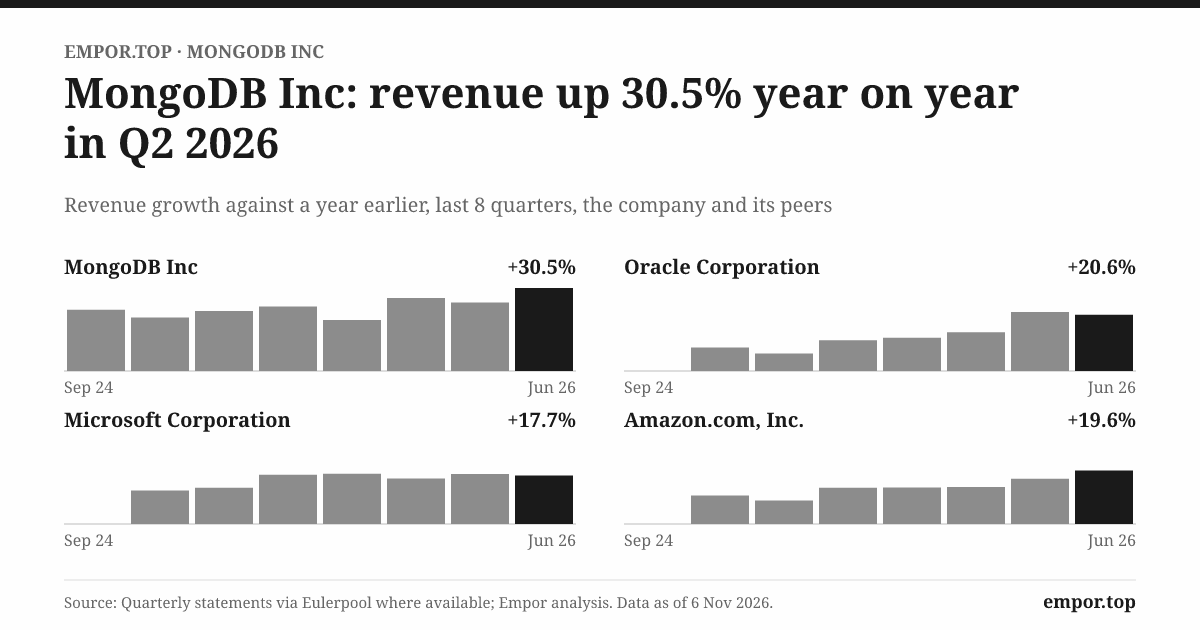
The timing was awkward because the business was finally working the way bulls had hoped. In the quarter to July 31, 2026, revenue grew 30.5% from a year earlier, to about $771 million, the fastest growth in more than two years.[^3] For a company that had spent 2024 explaining a slowdown, that was a real turn. MongoDB also posted a small operating profit on a standard accounting basis, which it had rarely managed in its history as a public company.[^3]
The company was careful about what the departure did not mean. In its filing, MongoDB said Desai's resignation did not stem from any disagreement with the company on its operations, policies or practices.1 That statement is worth taking at face value: a rival recruiting a sitting CEO for a high-profile AI role is a plausible enough story on its own. Yet it leaves a gap that no filing can close. Desai's team delivered the reacceleration, and his team now has no track record of its own to test, because he left before any of his long-term plans could succeed or fail.
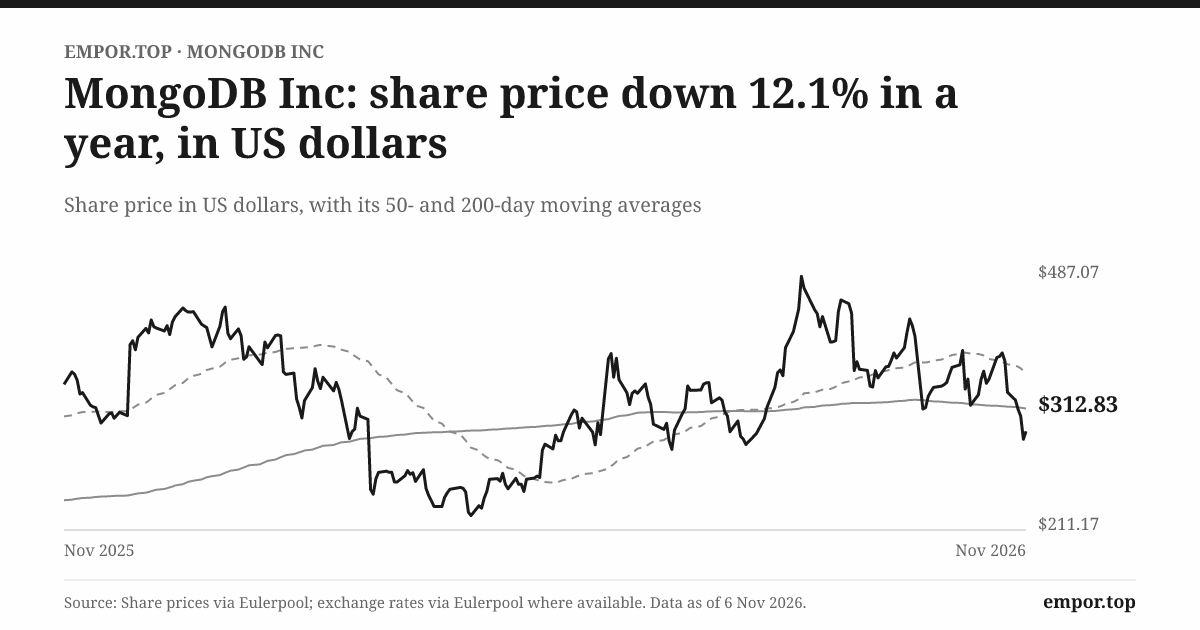
The market had already been nervous. On November 2, 2026, the shares traded at about $353, roughly a quarter below their high of the previous year.[^4] That price valued MongoDB at about $28.7 billion.[^4] Something in between enthusiasm and doubt is being priced in, and the rest of this story is an attempt to say what.
Start with the shape of the business, because it contains a paradox. In the fiscal year that ended January 31, 2026, MongoDB took in about $2.5 billion of revenue.3 It generated about $500 million of free cash flow, the cash left after running the business and paying for equipment.3 And it still reported an operating loss of about $137 million.3 How does a company produce half a billion dollars of spare cash and lose money at the same time? The short answer is that it pays a large share of its people in stock, which costs shareholders real money but does not leave the bank account. The longer answer runs through the whole history of the company.
MongoDB, Inc. trades on the Nasdaq Global Market under the ticker MDB.3 Its story turns on four linked tests. The first is whether developers' affection for its database converts into lasting customer economics. The second is whether Atlas, its cloud service, can keep growing through swings in customer usage and pressure from the largest technology companies on earth. The third is whether its artificial-intelligence products become revenue rather than demos. The fourth is whether leadership, now in flux, can deliver all of that without letting stock-based pay swallow the cash the business throws off.
Each test has a history behind it. The database was born inside a different company plan. The cloud service was a bet on running software for customers rather than selling it to them. The licence the company uses today was a defensive move against the same cloud giants it partners with. And the leadership question is not new either: Ittycheria spent a decade turning an open-source project into a business, then handed it to a successor who left within a year.
To see why the developer, the cloud and the CEO all matter, go back to a small office in New York in 2007, where three people who had built one of the internet's first giant advertising systems were trying to build something else entirely.
 Subscribe on LinkedIn
II. The Database Hiding Inside a Platform Company
The founders of what became MongoDB were not database people by ambition. They were people who had been hurt by databases.
Dwight Merriman and Kevin Ryan had helped build DoubleClick, the online advertising company that, in the late 1990s and early 2000s, served billions of ad impressions across the web. Merriman was a co-founder and its chief technology officer; Ryan ran the business. Eliot Horowitz, a younger engineer, had also worked in DoubleClick's technology group before founding a shopping-search start-up.4 Running an ad server at internet scale taught all three the same lesson: the relational databases of the day, built around neat tables and rigid schemas, struggled when data arrived in huge volumes and changed shape constantly. Engineers spent their nights sharding tables by hand and coaxing systems to keep up.
In 2007, the three founded a company called 10gen.4 Its first ambition was large and fashionable: a platform-as-a-service, a cloud environment where developers could write and run applications without worrying about servers. Think of it as an early, more ambitious relative of what Heroku and Google App Engine would become. A platform like that needed a place to store data, and the team kept bumping into the same wall. None of the available databases fitted the way modern web applications were built.
So they wrote their own. That database was a component, a piece of plumbing for the bigger product. But as the founders worked, the plumbing kept attracting more attention than the house. Developers who saw the database wanted to use it on its own, without the rest of the platform. In 2009, 10gen released the database as open-source software and shifted the company's energy to developing and supporting it.4 The platform faded. The component survived.
It is worth pausing on what the founders had actually built, because everything that follows depends on it. A traditional relational database stores information the way an accountant would: in tables of rows and columns, with every row in a table following the same layout. A customer record lives in one table, the customer's orders in another, the items in each order in a third, and the database stitches them back together on demand. This works beautifully for consistency and for accounting-style questions. It can feel clumsy to a programmer, whose code already holds a customer as a single object with orders and items nested inside it. Every time the program saves or reads that object, it has to be broken apart into tables and reassembled.
MongoDB took a different approach, called the document model. It stores each record as a self-contained document in a format resembling JSON, the text format that web applications already used to pass data around.3 A customer and her orders can live together in one document, shaped like the object in the program. If the application needs a new field next week, developers can add it without first redesigning a table. The analogy is a filing cabinet in which each folder can hold whatever papers belong to that customer, instead of a ledger where every page must have identical columns.
The trade-off was real. Flexibility made it faster to build and change applications, but it asked companies to trust a young database with data they had always kept in relational systems from Oracle, IBM and Microsoft. Early versions were criticised for weak guarantees around data durability and for behaviour that experienced database administrators found surprising. The product's appeal ran through developers, who could download it free and have something working in an afternoon, rather than through the database administrators and purchasing departments who usually decided what enterprises ran.
That route to market shaped the company. MongoDB's first customers were not won in boardrooms; they were won on laptops. A developer at a start-up, a bank or a media company would try it for a side project, the side project would become a product, and only then would anyone in procurement notice that the company was running a new database. The strategic insight was not "NoSQL will win", the slogan that hung over the whole category at the time. It was narrower and more durable: developers would choose the tool that let them build and change applications with the least friction, and the market might follow them.
Free downloads, however, do not pay salaries. By the end of 2009, MongoDB 1.0 had shown that developers would try a new database.4 The harder question was whether any enterprise would pay to rely on it.
III. The Company Learns to Sell the Database
Open-source companies have a well-known problem. The product spreads precisely because it is free, and the more it spreads, the harder it becomes to explain why anyone should pay. In the early 2010s, 10gen tried the classic answers: paid support, training and consulting for companies that wanted someone to call when something broke. It worked well enough to keep raising venture money, and not well enough to make a large business.
The first symbolic change came in 2013, when 10gen renamed itself MongoDB, Inc.4 It was an admission of what everyone already knew: the company's value lived in one product, and that product had a far better-known name than the firm. Around the same time, the company packaged a commercial edition called MongoDB Enterprise Advanced, which added security features, monitoring and management tools and support for organisations running the database on their own servers.4 Enterprise Advanced gave the sales team something to sell to banks, insurers and governments: not the database itself, which remained free, but the confidence to run it in production.
The second change was a person. In September 2014, MongoDB appointed Dev Ittycheria as chief executive.4 Ittycheria was not a database engineer either. He was a builder and seller of enterprise software: he had co-founded BladeLogic, a data-centre automation company that went public and was later bought by BMC Software, and had spent time as a venture investor.4 His reputation was for operating discipline, for building sales organisations that could sell complex software to large companies, and for an almost relentless focus on metrics. Where the founders had a developer's instinct, Ittycheria had a quota-carrier's. MongoDB needed both.
Within months, he made a technical acquisition that told engineers the company was serious about the core product. In December 2014, MongoDB bought WiredTiger, a small company founded by veterans of the Berkeley DB storage engine, whose technology handled how data was physically written to and read from disk.5 WiredTiger became the default storage engine in later versions of the database, bringing better compression and concurrency, starting with MongoDB 3.0.5 The company did not disclose what it paid, so there is no way to say whether the price was a bargain. What can be said is that the acquisition fixed a product weakness that critics had pointed to for years, and the engine stayed at the heart of the database.
The third and most consequential change was Atlas. In June 2016, MongoDB launched MongoDB Atlas, a fully managed version of the database that MongoDB itself would run in the cloud.6 Customers no longer had to install, patch, back up or scale the database. They could click a few buttons, pick a size, and pay as they went. Atlas launched on Amazon Web Services, with Microsoft Azure and Google Cloud Platform to follow, which made it available on all three of the largest public clouds.6
Why was this the more important move? Because it changed what MongoDB sold. Enterprise Advanced sold a licence and support for software customers ran themselves. Atlas sold an outcome: a working database, operated by the people who wrote it. That meant MongoDB could charge for the labour customers would otherwise do, and it meant revenue would grow as customers stored more data and ran more queries. It also meant MongoDB would have to pay the cloud providers for the computers underneath, which turned a pure software business into something closer to a reseller of infrastructure with a lot of software on top.
The company that went public in October 2017 was still early in that transition. In the fiscal year that ended January 2017, revenue was about $101 million, and the company lost about $86 million at the operating line.4 It was growing quickly, at more than 50% a year, but every new dollar of revenue still cost more than a dollar to win. MongoDB priced its shares at $24, above the range it had marketed, and on its first day of trading the stock finished up about 34%.7 The offering brought in a couple of hundred million dollars of fresh capital, enough to fund a far larger sales force than a support-contract business could ever have paid for.
The first-day pop drew the headlines. The more durable question was buried in the prospectus: Atlas was then a small slice of revenue, and the company had to prove that a developer favourite could become an expanding cloud business. A year after the listing, a decision about a legal document showed just how seriously MongoDB took the threat to that plan.
IV. The License Change That Put MongoDB's Cloud Strategy on Display
In October 2018, MongoDB did something that made a part of the open-source world furious. It changed the licence for new releases of its free Community Server from the GNU Affero General Public License, a well-established open-source licence, to a new one it had written itself: the Server Side Public License, or SSPL.8
The change sounds like legal housekeeping. It was a declaration of war, aimed carefully at a small number of very large companies. Under the old licence, anyone could take the database and offer it to the public as a cloud service. Under the SSPL, a company that offered the software as a service had to release, under the same licence, the source code of everything it used to run that service: the management software, the monitoring, the backup systems, the whole operational machinery.8 For an ordinary company using MongoDB inside its own application, nothing much changed. For a cloud provider that wanted to sell "MongoDB as a service" without contributing back, the condition was effectively prohibitive.
MongoDB's stated concern was straightforward. The company bore the cost of developing and maintaining the database; a cloud provider could commercialise that work, keep the customer relationship and the margin, and contribute little.8 Atlas was MongoDB's answer to the cloud, and the licence was a way to make sure MongoDB, not Amazon, would be the main company selling a managed version of its own product.
Critics objected that the SSPL did not meet the definition of open source maintained by the Open Source Initiative, and several Linux distributions stopped shipping new versions of the database. MongoDB now describes current releases as source-available under SSPL, while the older releases distributed under the AGPL remain under their original terms.8 That is a meaningful shift in identity. A company that rose on open-source goodwill had decided that the economics of the cloud mattered more than the label.
Did it work? The answer is subtler than either side of the 2018 argument predicted. The licence did stop the most direct form of free-riding: no major cloud provider sells the current MongoDB server as its own managed service. But it could not stop compatibility. Amazon's DocumentDB, for example, is a managed document database that AWS describes as compatible with many MongoDB application programming interfaces, drivers and tools, so that applications written for MongoDB can often run against it with few changes.9 AWS did not need MongoDB's code; it needed MongoDB's interface. MongoDB, for its part, has argued publicly that DocumentDB is not truly compatible and fails a large share of its own compatibility tests.10
The substitution pressure has since widened. In 2025, Microsoft's open-source DocumentDB project, a document database built on top of PostgreSQL and designed to speak the MongoDB interface, moved to the Linux Foundation with support from other large technology companies.11 That kind of project does not take Atlas customers by itself. It does show that the industry's largest players see value in an open, vendor-neutral way to run MongoDB-style workloads without MongoDB.
This is why the licence should be read as a strategic trade-off, not as proof of a moat. It protected MongoDB's right to monetise its own managed service, and it was paired with a product, Atlas, good enough that customers chose it. By FY2026, Atlas made up roughly 73% of revenue.3 The licence did not create that mix; a better product and a great deal of selling did. But the licence clarified who would control the most important version of the database, and that control is now the centre of the business.
There is an irony that runs through the rest of the story. AWS, Microsoft and Google are Atlas's distribution partners, its infrastructure suppliers and its competitors, all at once. They sell MongoDB through their marketplaces, rent it the servers it runs on, and offer their own databases to the same customers. The licence settled who could sell the official product. It did not settle who captures the value when a customer chooses a document database, and that question leads straight into how MongoDB actually gets paid.
V. Atlas Changes the Way MongoDB Gets Paid
Picture a developer at a mid-sized retailer on a Tuesday afternoon. She signs up for Atlas, spins up a tiny database cluster for a new loyalty-points feature, and connects her code. The cost is trivial. Six months later the feature is live in every store, the cluster has been resized twice, a second team has built a recommendations service on the same platform, and the retailer's cloud bill has a MongoDB line large enough for the finance department to notice. Then, in a budget review, an engineer is told to cut costs, and she spends a week tuning queries and archiving old data. The bill falls.
That small drama is the whole Atlas business model in miniature. It explains why Atlas compounds, and why it can wobble.
MongoDB has two main ways to sell its product. Atlas is the MongoDB-run cloud service, priced mostly on consumption: customers pay for the computing, storage and features they use.3 Enterprise Advanced is a subscription for customers who run the database themselves, in their own data centres or cloud accounts, and who pay for the software, tools and support.3 Together these subscriptions made up 97% of revenue in the quarter to July 2026; professional services such as consulting and training made up the remaining 3%.[^3] For a company that started life selling support contracts around a free download, that mix is the clearest sign of how far the business has moved.
What customers buy from Atlas is, in large part, the absence of chores. Running a database well means provisioning machines, applying security patches, monitoring performance, keeping backups, recovering from failures, and scaling up before the Black Friday traffic arrives. Atlas does those things. A useful analogy is the difference between buying a car and using a chauffeured car service. With Enterprise Advanced the customer owns and drives the car, and MongoDB sells the manual, the warranty and the mechanic's phone number. With Atlas, MongoDB drives, and the customer pays by the mile.
Paying by the mile is what makes the model compound. MongoDB's own measure of that compounding is the net ARR expansion rate, which compares the annualised revenue from existing customers today with what the same customers paid a year earlier, netting expansion against shrinkage and lost customers. At July 31, 2026, that figure was 122%.12 Put simply, the installed base of customers was spending about 22% more than a year before, before counting a single new logo.
That figure is useful proof that customers keep adding workloads. It is not a contract, and it is not a guarantee of future spending. Because Atlas is billed on use, customers can turn it down as easily as they turn it up. The 10-K is explicit that consumption can fall as customers optimise their workloads, and that this exposes revenue to their budgets and behaviour.3 The flexibility that makes Atlas easy to start is the same flexibility that makes it easy to trim.
There are some anchors. MongoDB reported $1.47 billion of remaining performance obligations at the end of FY2026, a measure of contracted revenue not yet recognised, and expected about half of that to be recognised within twelve months.3 But the disclosure excludes contracts of twelve months or less, and the company does not state a standard minimum commitment or contract length, so the figure captures only part of what customers will spend.3 It is a floor under some of the business, not a forecast of all of it.
The economics of running other people's databases on rented computers show up in the margin. In FY2026, MongoDB's subscription gross margin was about 76%, meaning that for every $100 of subscription revenue, about $24 went to the direct cost of delivering it, a large part of that to the cloud providers whose servers Atlas runs on.3 Self-managed software has far lower delivery costs because the customer pays for the hardware. As Atlas has become the larger part of the business, the company has swapped some gross margin for a faster-growing, stickier product.
The cloud bill is not optional. At the end of FY2026, MongoDB had $897.9 million of non-cancellable purchase commitments, including a $300 million renewal commitment with a cloud provider covering October 2025 to October 2028.3 The company does not name the provider in that note. The commitment is a reminder of who sits upstream: MongoDB has to promise large, fixed amounts of spending to its infrastructure suppliers, while its own customers can flex their usage. That asymmetry helps explain why more Atlas revenue does not automatically mean more margin.
Billing also shapes the cash. MongoDB generally invoices subscriptions annually in advance with 30-day payment terms, extending credit without collateral.3 Customers who prepay hand the company cash before it recognises revenue, which is why deferred revenue rose by about $112 million in FY2026 and helped lift operating cash flow.3 Receivables were about $499 million at year-end, with a modest allowance for bad debts, and collection times have shortened over the past decade from more than four months of revenue to about two and a half.3 There is no sign in the filings of a collections problem, though the company does not publish an ageing schedule.
The shift to Atlas has quietly changed how the business is financed, too. A decade ago, when most revenue came from annual software subscriptions paid upfront, customers were effectively lending MongoDB money: the company held far more in customer prepayments than it was owed, so working capital funded the business. As consumption billing has grown, much of it charged as customers use the service rather than a year ahead, that cushion has thinned to roughly neutral.3 Nothing about that is alarming. It does mean that a future dollar of growth brings less free financing from customers than a past dollar did, which is one more reason why reported cash flow and underlying earning power should not be confused.
Step back and the profit-and-loss account tells a story of a company still investing. FY2026 revenue grew about 23%, yet MongoDB remained loss-making at the operating line.3 Research and development consumed about 29% of revenue, down only slightly from 31% two years earlier.3 Headcount, meanwhile, grew far more slowly than revenue, from about 5,040 people at the start of FY2025 to about 5,640 two years later.3 That combination suggests a company that has found operating leverage in its sales and administrative machinery while still spending heavily on product.
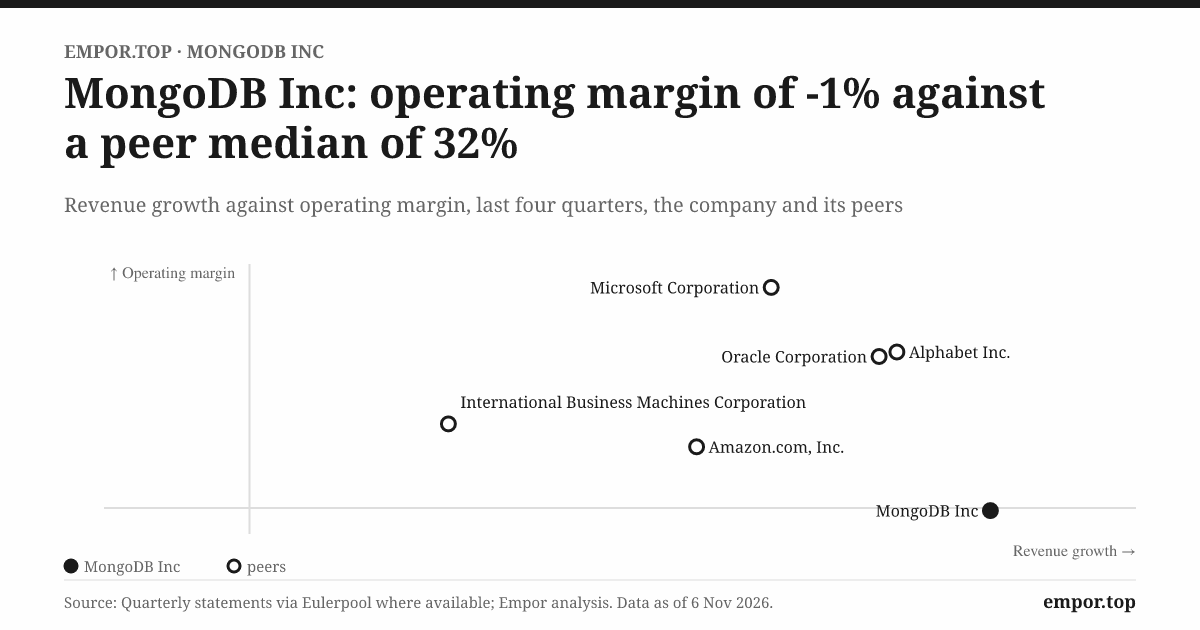
The direction of travel is clear. Operating margin improved from minus 27% in FY2023 to minus 5.6% in FY2026.3 In the fourth quarter of FY2026, operating profit was almost exactly zero, about $50,000 on nearly $700 million of revenue, as if the company had decided to stand precisely on the line before crossing it.3 In the quarter to July 2026, it crossed: operating margin reached about 3.7%.[^3]
Here is the paradox from the opening, resolved. The gap between a $137 million operating loss and $500 million of free cash flow is mostly stock-based compensation, which was $550.5 million in FY2026, plus the timing benefit of customers paying in advance.3 Stock compensation is not a cash cost, but it is a cost. When employees receive shares, existing shareholders own a little less of the company. Any honest assessment of MongoDB's cash generation has to set that $550 million beside the $500 million and ask how much cash per share is really being produced. Over the eleven years to FY2026, the company's cumulative net losses were about $1.8 billion, while its cumulative operating cash flow was about $530 million: a record of a business that funded itself with equity far more than with profits.3
So Atlas is a better business model than the one MongoDB started with: recurring, expanding and hard to dislodge once applications are built on it. It is also a model in which revenue moves with customer usage, the cloud providers take their cut first, and growth can slow suddenly when customers tighten belts. In the spring of 2024, MongoDB discovered how suddenly.
VI. The 2024 Slowdown Was a Sales and Consumption Problem
At the end of May 2024, MongoDB reported the first quarter of fiscal 2025, and on the surface the numbers looked fine. Revenue was about $451 million, up 22% from a year earlier.[^15] Then came the outlook. Management cut its full-year revenue guidance to between $1.88 billion and $1.90 billion.[^15] For a company priced as a growth compounder, a guidance cut in the first quarter of the year is the equivalent of a pilot announcing turbulence before the seatbelt sign has gone off. The shares fell sharply the next day.
The consensus narrative at the time was simple: macroeconomic caution, enterprises tightening cloud budgets, a sector-wide hangover after the spending boom of the pandemic years. There was some truth in that. But the record shows something more uncomfortable, because management itself pointed to causes inside the company.
In his prepared remarks, Dev Ittycheria described a slower start to the year for Atlas consumption than the company had expected, and fewer new workloads won than planned, with knock-on effects for the rest of the year.[^15] The consumption story is the one sketched in the retailer's budget review: when customers are optimising, the meter runs slower. The workload story was different. Early in the year, MongoDB had changed how it directed and paid its sales force, shifting emphasis away from some kinds of upfront commitments and toward winning new workloads. On the call, management acknowledged that the transition had affected results.[^15] Morningstar's analysts summed up the moment in a headline: execution and macro were both to blame.13
That distinction matters for an investor because the two causes have different cures. If customers are spending less because the economy is soft, the usage comes back when budgets loosen. If the sales organisation is winning fewer new applications, the damage compounds: a workload not won this year is consumption not billed next year, and the year after. The 2024 cut was a reminder that in a consumption model, sales execution shows up in revenue with a lag, which makes it easy to miss until it is already in the numbers.
Then the story reversed. In late August 2024, MongoDB reported its second quarter and raised its full-year revenue outlook to between $1.92 billion and $1.93 billion, citing Atlas consumption that had come in better than expected.14 Atlas was already 71% of revenue that quarter and growing 27%.14 Within three months, the company had gone from cutting guidance to raising it, on the strength of the same metric that had triggered the cut. FY2025 eventually closed with revenue of about $2.0 billion, up 19%, comfortably above the reduced range.3
Read one way, that is a story of a resilient product and a management team that guided conservatively once burned. Read another way, it shows how hard it is for anyone, including management, to forecast a business whose revenue depends on thousands of customers' daily usage decisions. Both readings are correct. Consumption is a growth engine and a forecasting problem in the same breath.
The episode left a legal residue. A securities class action, filed after the guidance cut, alleges that MongoDB made misleading statements about its sales strategy and results between June 2023 and May 2024.3 As of the FY2026 annual report, a motion to dismiss was pending, related shareholder derivative suits were stayed, and the company said it could not estimate a reasonably possible loss.3 The allegations are unproven, and cases of this kind often follow sharp share-price falls. Still, the existence of the suit puts the company's own explanation of 2024 under formal scrutiny, and investors should treat its resolution as an open item.
The longer view puts the slowdown in context. Revenue compounded at about 44% a year over the ten years to FY2026, about 33% over five years, and about 24% over the last three.3 The deceleration is partly the arithmetic of getting bigger, and partly what 2024 revealed: a large company selling usage cannot simply be pushed forward by hiring more salespeople. FY2026 growth of about 23% was a solid recovery but not a return to the old pace.3
That is why the most recent quarter landed with such force. In the three months to July 2026, Atlas grew about 29%, and Enterprise Advanced also grew.[^3] On the September 1, 2026 call, management credited strength in enterprise workloads and early momentum in AI-related use, while analysts pressed on the durability of Atlas growth, the health of the self-managed business and the logic of the raised guidance.[^18] The tone was the opposite of May 2024: management explaining upside rather than shortfall, analysts probing whether the good news would last.
Set side by side, the two calls are a lesson in how much this business turns on a single number that management cannot fully control. In May 2024 it was consumption coming in below plan. In September 2026 it was consumption, and workload wins, coming in above. One strong quarter is meaningful, but it is too recent to rewrite a three-year record of growth in the low-to-mid twenties. The question that hangs over the reacceleration is not whether customers like the product. It is why they choose it over the alternatives, and how secure that choice is.
VII. A Developer Moat Meets Database Substitutes
Every application begins with an argument in a small room. A team of engineers has an idea, a deadline and a whiteboard, and someone asks which database they should use. The choice feels small. It is not: once an application has been built, tested and deployed on a database, moving it to another is slow, expensive and risky. The first choice tends to stick.
MongoDB's commercial strategy is built around winning that first argument and then winning a second, harder one months or years later, when the enterprise asks which databases it should standardise on, which workloads it should migrate, and whether it wants to run more than one platform. The first decision is made by developers. The second is made by architects, procurement teams and chief information officers, who care about cost, risk and vendor leverage as much as convenience.
Draw the competitive map by workload rather than by brand, because MongoDB does not compete with every database company everywhere. For core transactional systems, it competes with relational incumbents such as Oracle and Microsoft SQL Server, which enterprises have trusted for decades.3 It competes with PostgreSQL, the open-source relational database that has become the default choice for many new applications and that cloud providers offer as managed services. It competes with the cloud providers' own non-relational services: AWS's DocumentDB and DynamoDB, Microsoft's Azure Cosmos DB, and Google's offerings.3 And at the edges, it meets data-platform companies such as Snowflake and Databricks, which compete for analytical and AI workloads more than for the operational databases that run applications.
The hyperscalers are the most complicated rivals because they are also partners. Atlas runs on their infrastructure and is sold through their marketplaces, which lets a customer buy MongoDB against an existing cloud spending commitment. At the same time, each provider can bundle its own database into a wider cloud relationship, offering discounts, integration and a single bill. Atlas's answer is that it runs on all three clouds, which matters to large companies that want to avoid locking every application to one provider.3 That is a real advantage with multi-cloud customers. It is less useful with a customer that has already standardised on one cloud and would rather keep its database inside that provider's console.
What evidence supports the idea that MongoDB wins these arguments? The strongest is the net expansion rate described earlier: existing customers are spending more each year, which means they are adding applications rather than leaving.12 The second is breadth. No customer accounted for 10% or more of revenue in any of FY2024 through FY2026, which means MongoDB's growth does not depend on a handful of giant accounts.3 The third is the market MongoDB says it addresses. At its September 2026 Investor Day, the company cited a data-management software market of about $123 billion in 2026, an estimate supported by IDC research.[^19]
Each piece of evidence has limits. The expansion rate measures what existing customers spend, not how many competitive evaluations MongoDB wins or loses. The company does not publish win rates, gross customer churn, or its share of new applications. The $123 billion figure is a company-published estimate of the whole data-management software market; it includes analytics, data warehouses and other categories in which MongoDB is not a serious contender, so it is not a measure of what MongoDB can realistically capture. Database popularity rankings, which MongoDB has often featured near the top of, measure developer interest rather than revenue, and are not comparable to market share.
There is also historical evidence that tests the moat directly. The strongest disconfirming signal is the rise of PostgreSQL, which over the past decade added support for storing and querying JSON documents, so that many teams can get much of the flexibility of a document model inside a relational database they already know. The second is the compatibility strategy described in the licence fight, which can lower switching costs for customers most worried about cost.911 The third is 2024 itself, when fewer new workloads were won than planned, a reminder that the first argument in the small room is not always won.[^15]
Weighed together, the record narrows the moat claim rather than rejecting it. MongoDB's advantage is strongest where developer productivity, operational simplicity and deployment choice matter together: a company building many new applications quickly, across clouds or in its own data centres, with teams that already know the tool. It is weaker where a workload is a natural fit for relational tables, or where a customer has standardised on one cloud provider's bundled services. The switching costs are real once an application is built, but compatibility layers mean they are not absolute. The test that would confirm the stronger version of the claim is simple to state: net expansion holding above roughly 120% while new-workload growth stays healthy, through a period when customers are trying to cut costs. The test that would falsify it would be expansion slipping while MongoDB-compatible alternatives gain visible enterprise adoption.
The newest front in that argument is artificial intelligence. Every database company now claims that AI applications need its product. MongoDB made a specific bet on how to prove it.
VIII. Voyage AI: A Product Bet, Not Yet a Revenue Segment
In February 2025, MongoDB announced that it was acquiring Voyage AI, a small company that built embedding and reranking models.15 To most investors those words meant little. To engineers building AI applications, they described one of the hardest parts of the job.
Here is the problem in plain terms. A large language model knows a lot about the world in general but nothing about a particular company's contracts, products or customers. To answer questions about them, an application has to find the right pieces of the company's own data and hand them to the model. Doing that well requires turning text, images or records into lists of numbers, called embeddings, that capture meaning, so that a search for "late delivery complaints" finds documents about delayed shipments even if they never use those words. A reranking model then sorts the candidates so that the most relevant pieces go first. If retrieval is poor, the AI answers confidently and wrongly.
MongoDB's argument was that this retrieval step belongs close to the operational data, inside the database where the application's records already live, rather than in a separate specialist system. It had already added vector search to Atlas, letting customers store and search embeddings alongside their documents. Buying Voyage AI brought the models that generate those embeddings and rank the results into the same company.15 The pitch to customers is fewer moving parts: one platform to store the data, find the relevant pieces and feed them to the model.
The price was modest by the standards of AI deals. MongoDB reported an acquisition-date fair value of about $160.9 million, partly paid with roughly 484,000 MongoDB shares.3 That is about 6.5% of FY2026 revenue and a small fraction of the company's roughly $2.4 billion of cash and short-term investments at the end of that year.3 Against MongoDB's market value, it barely registers. Against its annual product budget, it is a meaningful bet on one capability.
What cannot be measured is whether the price was attractive. MongoDB does not disclose Voyage AI's revenue, so there is no acquisition multiple to compare with other deals, and it does not report a separate AI revenue line or say how much customers pay for embedding, reranking or vector search.3 The honest framing is that Voyage AI is strategically adjacent to Atlas and plausibly makes the database more useful for AI applications, but the evidence for commercialisation is not yet in the numbers.
The company's history offers a partial guide. WiredTiger, the storage engine bought in 2014, is the best example of MongoDB buying a technical capability and folding it into the core product, and that integration lasted.5 Because that price was never disclosed either, there is no way to compute a return; the evidence is the product's longevity, not a claimed bargain. The difference is that WiredTiger improved something every customer already paid for. Voyage AI's value depends on customers adopting a new kind of workload and paying for it.
At Investor Day in September 2026, management described AI momentum as early and presented new products, including Atlas Agent Engine, as future growth vectors.[^19] On the second-quarter call weeks earlier, it cited early AI momentum as one contributor to the acceleration.[^18] That is a reasonable claim and an unfalsifiable one until the company discloses something more specific. Launches, model benchmarks and customer pilots are not revenue. The test is paid workload expansion: AI applications showing up in Atlas consumption, net expansion and, ideally, a disclosed metric.
There is also a risk hiding inside the opportunity. AI raises demand for databases in general, but it does not automatically raise demand for MongoDB in particular. The 10-K itself warns that AI intensifies competition and could change application architectures in ways that are hard to predict.3 Every major database vendor, relational and otherwise, has added vector search, and the cloud providers sell their own embedding models alongside their own databases. If retrieval becomes a standard feature of every data platform rather than a reason to choose one, Voyage AI will have been a defensive purchase: necessary to keep up, not sufficient to pull ahead. That would still be a reasonable use of capital. It would not be the growth vector the Investor Day slides describe.
For now, the AI story is optionality attached to a real business, not a business in its own right. And the person who had been chosen to turn that optionality into a strategy had just left to pursue enterprise AI somewhere else.
IX. The CEO's Sudden Exit Turns Execution into a Governance Test
Succession at MongoDB was supposed to be the orderly part of the story. After more than a decade in charge, Dev Ittycheria handed the chief executive role to CJ Desai in November 2025.16 Desai arrived with a résumé built for exactly the job the board wanted done. He had been president of Cloudflare and, before that, had run product and engineering at ServiceNow, two companies that sold technical infrastructure to large enterprises at scale.16 The finance seat had been refreshed months earlier: Mike Berry became chief financial officer in May 2025, after the departure of the interim CFO, Srdjan Tanjga.16 A new chief executive, a new finance chief, a business reaccelerating. The handover looked textbook.
Ten months later, the textbook was torn up the night before the company's biggest presentation of the year. The September 28 filing put Ittycheria back on stage as interim chief.1 The board moved fast, which is to its credit; leaving the company leaderless before a major investor event would have been worse. The company reaffirmed its outlook and kept its long-range targets on the slide.[^19]
Those targets were ambitious. At Investor Day, MongoDB set out a long-term model calling for revenue growth of 20% or more a year, growth of 10% or more in Enterprise Advanced annual recurring revenue, and GAAP profitability beginning in FY2027.[^19] The last point is significant, because it commits the company to a measure that includes stock compensation, not the adjusted figures software companies prefer. The analysts' questions that followed were the natural ones: who will own those targets, and how much of the plan was Desai's?[^19]
The company's statement that Desai's departure involved no disagreement over operations, policies or practices deserves to stay in view.1 It rules out the most alarming explanations. It does not explain why a chief executive chose to leave a company he had just been paid handsomely to join, and nobody outside the boardroom can supply that answer. Meta's recruitment for a prominent AI role is the obvious reason on the public record.2
That handsome pay is part of the governance story. Desai's reported total compensation for FY2026 was about $53.6 million, most of it appointment-related equity.16 It included a performance-share award with a target value of $17.5 million that would vest only if MongoDB's stock price cleared and sustained a series of hurdles over as long as five years.16 The design was reasonable on paper: pay the new leader for lasting share-price gains, not for showing up. In practice he left before the record could be judged, which meant the award was never really tested. The lesson for the board is that the incentive structure, however well built, did not secure the one thing it most needed: time.
Shareholders had already been sending mixed signals about pay. At the 2026 annual meeting, the advisory vote on executive compensation passed with about 52.4 million votes for and 6.3 million against, roughly 89% support among votes cast for or against.17 That was an improvement on about 82% the year before.16 All directors are classified as independent under Nasdaq rules, yet between about 11.5 million and 16.2 million votes were withheld from the 2026 nominees, with the highest withhold against director Hope Cochran.1617 Those are not rebellion-level numbers, but they show a minority of investors willing to register discomfort.
Who owns MongoDB? There is no controlling shareholder. The 2026 proxy listed BlackRock at about 5.8% and two Vanguard entities at about 5.6% and 5.3%.16 Co-founder Dwight Merriman held about 1.9%, while the company's current executive officers and directors together held about 2.6%.16 These are beneficial-ownership disclosures under U.S. rules, so they show the largest holders rather than the full register. The picture is of a widely held, index-heavy company in which management owns a small slice and institutional investors hold most of the votes. In practice that gives the board wide latitude, and it means the main discipline comes from the share price.
Dilution belongs in the same conversation. In December 2024, MongoDB settled about $1.1 billion of convertible notes due in 2026, almost entirely by issuing about 5.66 million new shares.3 That cleaned up the balance sheet, leaving the company with essentially no funded debt, but it paid for the clean-up with equity rather than cash. Add annual stock compensation of more than half a billion dollars and the shares issued for Voyage AI, and the company has been a steady issuer of shares even as it bought some back.3 An activist looking at MongoDB would not start with the debt, because there is almost none. It would start with the share count, where dilution and stock compensation converge.
Ittycheria's return brings continuity. He knows the customers, the sales organisation and the product roadmap better than any external candidate could. But his past tenure is not a new management track record, and an interim CEO is, by definition, a bridge. The questions that matter now are concrete: how quickly the board finds a permanent successor, whether that person inherits or rewrites the Investor Day targets, and whether guidance discipline survives the next few quarters. Those questions set up what founders and investors can learn from MongoDB's path so far.
X. Business & Investing Lessons
Go back to 2007 and the platform-as-a-service that 10gen set out to build. The company that endured was not that platform. It was one component of it, and then, nine years later, a cloud service built around that component. From the founders' first plan to Atlas supplying about three-quarters of revenue, MongoDB's history is a sequence of discoveries about which part of the business actually mattered.34 Five lessons come out of that history that belong to this company and no other.
The first is about where products come from. The 10gen founders did not set out to build a database company; they set out to build a platform and kept finding that the database was the part developers wanted.4 The lesson for founders is to watch what users pull out of the product, not what the pitch deck says they will buy. Start with the pain developers already feel, and the market may follow the tool that gets out of their way. For investors, it is a reminder that the most valuable asset in an early company is sometimes the thing the founders consider plumbing.
The second is about who captures value. The free download made MongoDB ubiquitous, but it did not make MongoDB rich. It was Atlas, the decision to run the database for customers, that turned adoption into a large recurring business.6 And it was the licence fight, and AWS's compatible alternative, that showed distribution does not guarantee control.89 A free download can open the door; the cloud service decides who captures the value. Any open-source company that has not answered the question of who runs its software at scale has not yet answered the question of how it will make money.
The third is about the meter. In May 2024, consumption came in below plan and the company cut its outlook. In August 2024, consumption came in above plan and it raised its outlook. In 2026, consumption and workload wins drove the fastest growth in years.[^15]14[^3] Usage is a growth engine and a forecasting problem. Investors who buy consumption businesses for their compounding have to accept that they are also buying a revenue line that responds to every customer's cost-cutting meeting, and that management can be surprised in either direction.
The fourth is about what counts as cost. MongoDB's operating cash flow in FY2026 was about $505 million.3 Its stock-based compensation was about $550.5 million.3 Count stock compensation as a cost of winning. A company can be cash-generative and still transfer more value to employees than it produces for owners in a given year, and the only way to tell is to measure cash per share, not cash. For founders, the lesson is that equity is the most expensive currency there is, even when it does not show up on the bank statement.
The fifth is about acquisitions. WiredTiger became the engine of the database; Voyage AI's value is still to be proved.515 A technical acquisition is only as good as its integration and sales. The announcement is the cheapest part of the deal. What makes it worth the price is customers using the new capability and paying for it, and MongoDB has not yet shown the second half of that equation for AI.
There is one more lesson hiding inside those five, and it concerns leadership. Building a developer product, an enterprise sales machine and a cloud operation required three different temperaments: the founders' engineering instinct, Ittycheria's operating discipline, and a successor's appetite for a new platform cycle. MongoDB found the first two. Its attempt at the third lasted less than a year.1 The ability of a company to pass the baton is part of its moat, and MongoDB's has just been tested.
These lessons describe how MongoDB got here. Whether the price investors pay today makes sense depends on what happens next, and that requires putting the bull and bear arguments side by side.
XI. Analysis & Bull vs. Bear Case
Put three numbers on one page and the debate about MongoDB comes into focus. The latest quarter showed strong revenue growth.[^3] The last full year still showed a GAAP operating loss.3 And the market values the company at about $28.7 billion, with an enterprise value, after subtracting net cash, of about $26.3 billion.[^4] The market is paying for a durable database platform. The question is whether the proof has arrived or is still being priced in advance.
Start with the case for. Developers can build quickly on the document model, and Atlas takes the operational burden off their teams. Multi-cloud availability gives MongoDB a route into customers whichever provider they use, and the net expansion rate shows that customers who adopt the product keep adding to it.12 Growth in both Atlas and Enterprise Advanced in the latest quarter suggests that the self-managed business is not simply being cannibalised by the cloud.[^3] Operating profitability has improved, and the company crossed into GAAP operating profit in its most recent quarter.3[^3] The balance sheet holds about $2.4 billion of cash and short-term investments with essentially no funded debt; the small borrowings figure reported for FY2026 reflects finance leases rather than bank or bond debt.3
Then the case against. The database market has powerful incumbents in Oracle and Microsoft and a formidable open-source alternative in PostgreSQL, which has steadily absorbed document-style features. The cloud providers own the infrastructure, the customer relationship and the bill, and they offer MongoDB-compatible services. Atlas usage can slow when customers optimise, as 2024 showed. Stock compensation exceeds free cash flow. And leadership is in transition at the very moment the company is trying to prove a new growth phase.
Michael Porter's five forces framework helps show where the pressure comes from. Buyer power is moderate: customers are dispersed, with none above 10% of revenue, but each can reduce consumption without renegotiating a contract.3 Supplier power is high and unusual: MongoDB's main suppliers, the cloud providers, are also its strongest competitors, and the company has committed hundreds of millions of dollars to them in advance.3 The threat of substitutes is real, from relational databases with document features to compatible services like DocumentDB.911 The threat of new entrants is lower, because building a trusted operational database takes many years, but the open-source compatibility projects lower that barrier. Rivalry among established players is intense and well funded.
Hamilton Helmer's seven powers give a sharper view of what MongoDB's advantage actually is. Switching costs are its strongest power: once an application and its tooling are built around MongoDB, moving is costly and risky, which is what the expansion rate reflects. Scale economies exist in research and development, since MongoDB can spread a large engineering budget over a broad customer base, but the hyperscalers have far larger budgets. Network effects are weak in the classic sense, though the large population of developers who know MongoDB creates a self-reinforcing hiring and skills pool. A cornered resource, such as exclusive technology, is limited, because the interface can be imitated. Brand among developers is real but does not let MongoDB charge more on its own. Counter-positioning was strong in the early years against incumbents who could not easily embrace the document model, and has faded as they have. Process power, in the sense of the operating know-how to run a database service at scale across three clouds, is plausible but hard to measure. The honest conclusion is that MongoDB's moat rests mainly on switching costs and developer familiarity, which are meaningful but not impregnable.
The cash and profit picture deserves a closer look, because it is where the bull and bear cases meet. FY2026 operating margin was minus 5.6%, while the latest quarter reached about 3.7%.3[^3] Over the last twelve reported months, the company was still slightly loss-making at the operating line, but earned a pre-tax profit because of other income, mostly interest on its cash pile, which came to about $81 million in FY2026.3 That detail matters for valuation: MongoDB's earnings per share over the last twelve months, about $0.72, are largely interest on cash rather than profit from selling databases.[^3]3 That is why the price-to-earnings ratio, about 504 times, is close to meaningless as a guide; a tiny earnings base makes any multiple of it enormous.[^4]
Free cash flow is the better measure, and the free-cash-flow yield was about 1.7% on November 2, 2026, meaning that a buyer of the whole company at its current market value would receive about $1.70 a year in free cash for every $100 paid.[^4] That figure flatters the business, because it ignores the $550.5 million of stock compensation that does not pass through cash.3 It also includes the timing benefit of customer prepayments, which can reverse if billing patterns change.3 On a per-share basis, after accounting for dilution, the cash being produced for owners is meaningfully lower than the headline yield suggests.
How does the market's price compare with history and peers? At about 9.7 times sales, MongoDB trades below its own history: one market-data series put the five-year average enterprise-value-to-sales multiple at about 13.7 times in mid-October 2026, though that series is approximate.18 It trades at less than half the multiple of Snowflake, which was about 20.7 times sales on a comparable measure in October.19 Snowflake has different growth and margin characteristics, so the comparison is context rather than a verdict. What the multiple appears to assume is that MongoDB will keep growing at around 20% a year for a long time and convert a much larger share of revenue into profit than it does today. The stock's history shows how sensitive that assumption is: over the past five years the shares fell as much as about 76% from peak to trough, and one-year volatility was about 73%.[^4]
Imagine a skeptical long-short investor reading the same filings. The questions would be pointed. Why has a company with roughly $2.4 billion of cash and short-term investments, earning interest on most of it, not returned more of that money or used it to offset the share issuance that stock compensation creates? Why does research and development still absorb close to 30% of revenue at a company of this size, and what is the return on that spending, given that the company capitalises none of it?3 Why was a chief executive's appointment package worth more than $50 million in a single year, and what did shareholders get for it?16 And why should a company whose largest suppliers are also its largest competitors trade at a premium multiple at all? MongoDB has partial answers to each: buybacks have appeared in its equity statement, the R&D builds the product that drives expansion, and the pay package was designed to vest only with sustained share-price gains.316 The skeptic's point is that none of those answers has yet been proved by per-share results.
A risk radar for this company is short but serious. Demand risk runs through consumption: if enterprises cut cloud spending, Atlas feels it within weeks. Technology risk runs through AI: new application architectures could favour different data systems, or the cloud providers' integrated AI stacks. Currency risk is modest but present, since about 46% of revenue came from customers outside the United States in each of the last three years and the company does not hedge.3 Cybersecurity risk is inherent in running other companies' data. Execution risk now includes a leadership transition. None of these is unusual for a cloud software company; the combination with a premium multiple is what makes them matter.
Three measures will tell investors most about whether the case is strengthening or weakening. The first is Atlas growth together with net ARR expansion, which stood at about 29% and 122% in the latest quarter: the engine and the evidence of compounding.[^3]12 The second is GAAP operating margin read alongside stock compensation and the diluted share count, with the margin at about 3.7% in the latest quarter and stock compensation at about $550 million in the last full year: the test of whether profits arrive per share.[^3]3 The third is growth in Enterprise Advanced ARR, which management has now targeted at 10% or more a year: the evidence that the self-managed business is healthy rather than simply migrating to a lower-margin cloud.[^19] If those three improve together, the bull case is gaining ground. If they diverge, the market will notice.
XII. Epilogue
Tonight, on November 2, 2026, MongoDB is a company in an unusual position. Its business is growing faster than at any point in more than two years. Its chief executive is gone. Its interim leader is the man who built it and who had already handed it over once. And its share price sits roughly a quarter below its high, reflecting a market that believes in the product but is not yet sure about the next chapter.[^4]
The next earnings call will open with interim leadership answering for a business whose second-quarter momentum was delivered under the CEO who has now left. MongoDB's full-year guidance calls for revenue between $2.99 billion and $3.03 billion.[^3] Hitting or beating that range would show that the reacceleration was a property of the business, not of one leader. Missing it, in the first quarter after a sudden CEO departure, would invite the uncomfortable question of whether the momentum was more fragile than it looked.
Four other moments will shape the story over the next year. The first is the Atlas line. If Atlas growth and net expansion hold up over the next four quarters, the compounding argument strengthens; a high retention figure with slowing new-workload growth would tell a different story, one of a mature installed base and a harder fight for new applications. The second is profitability. Management has targeted GAAP profitability beginning in FY2027.[^19] Watching quarterly GAAP operating margin against stock compensation and the diluted share count will show whether cash generation is improving per share, or only in total.
The third is Enterprise Advanced. The Enterprise Advanced ARR target is a commitment that the self-managed business remains healthy.[^19] Renewed growth would show that MongoDB is not just shifting value from a high-margin product into a lower-margin cloud service. A stall would suggest the opposite. The fourth is AI. A new feature, a model integration or a set of pilots will not settle the question. Paid usage and customer expansion will.
There is also a courtroom date to watch. The securities class action over the 2023–2024 period is still unresolved, and a ruling on the motion to dismiss would either close the chapter or extend it into discovery, where internal sales forecasts from that year could become public.3 Neither outcome is likely to threaten the balance sheet, but the second would keep the 2024 slowdown in the headlines just as new leadership tries to move past it.
Over all of it hangs the search for a permanent chief executive. The board's choice will say a great deal about what it thinks MongoDB needs: another enterprise operator in the Ittycheria mould, a product visionary for the AI cycle, or someone who can be both. The best measure of the leadership team in the meantime is simple. Does it preserve guidance discipline, and when it misses, does it explain the miss plainly, as Ittycheria eventually did in 2024, or does it reach for the macro?
The central questions of this story have near-term answers. Can MongoDB sustain faster growth after the slowdown? The next four quarters of revenue and net expansion will say. Is the cash flow durable once stock compensation is counted? FY2027's free cash flow per diluted share will say. Can the new leadership expand the AI opportunity while improving margins? That depends on who the new leadership is. And does the valuation leave room for execution risk and dilution? Only if the first three answers come back well. The tension that remains is that the business has rarely looked better, and the company's direction has rarely been less certain.
XIII. Outro
MongoDB twice found its future in a component: first the database inside its original platform, then Atlas, which now supplies about three-quarters of revenue.43
That is what makes MongoDB unusual among database companies. It won first through the people writing applications, before purchasing departments had heard of it, and then through the service that runs the database behind those applications, against the very cloud providers that host it. The product that escaped its original platform became a platform of its own. The next chapter turns on whether the company can keep its developers, its customers and its leadership moving in the same direction, and whether all that growth can finally produce growth per share.
References
-
CEO resignation and interim appointment, Form 8-K — MongoDB, Inc./SEC, 2026-09-28 ↩↩↩↩↩
-
Meta taps MongoDB CEO Desai to lead enterprise AI push — Reuters, 2026-09-28 ↩↩
-
Form 10-K for FY2026 — MongoDB, Inc./SEC, 2026-03-11 ↩↩↩↩↩↩↩↩↩↩↩↩↩↩↩↩↩↩↩↩↩↩↩↩↩↩↩↩↩↩↩↩↩↩↩↩↩↩↩↩↩↩↩↩↩↩↩↩↩↩↩↩↩↩↩↩↩↩
-
MongoDB IPO registration statement, Form S-1/A — MongoDB, Inc./SEC, 2017-10-17 ↩↩↩↩↩↩↩↩↩↩↩↩
-
WiredTiger acquisition announcement — MongoDB, 2014-12-16 ↩↩↩↩
-
MongoDB finishes up 34% in database IPO — TechCrunch, 2017-10-19 ↩
-
AWS DocumentDB is not MongoDB-compatible, says MongoDB Inc — The Register, 2021-12-06 ↩
-
Linux Foundation says yes to NoSQL via DocumentDB — The Register, 2025-08-25 ↩↩↩
-
Form 10-Q for quarter ended July 31, 2026 — MongoDB, Inc./SEC, 2026-09-01 ↩↩↩↩
-
MongoDB Earnings: Slashing Valuation as Execution and Macro to Blame for Lower Guidance — Morningstar, 2024-05-31 ↩
-
MongoDB, Inc. Announces Second Quarter Fiscal 2025 Financial Results — MongoDB, Inc. via TipRanks, 2024-08-29 ↩↩↩
-
Voyage AI acquisition announcement — MongoDB, 2025-02-24 ↩↩↩
-
2026 Proxy Statement — MongoDB, Inc./SEC, 2026-05-19 ↩↩↩↩↩↩↩↩↩↩↩
-
Form 8-K: Annual meeting results — MongoDB, Inc./SEC, 2026-07-06 ↩↩
 LinkedIn
 WhatsApp
 Reddit
 Hacker News
 Email
 Kindle
 RSS Feed
 Spotify
 Apple Podcasts
 Amazon Music
 Audible
 YouTube