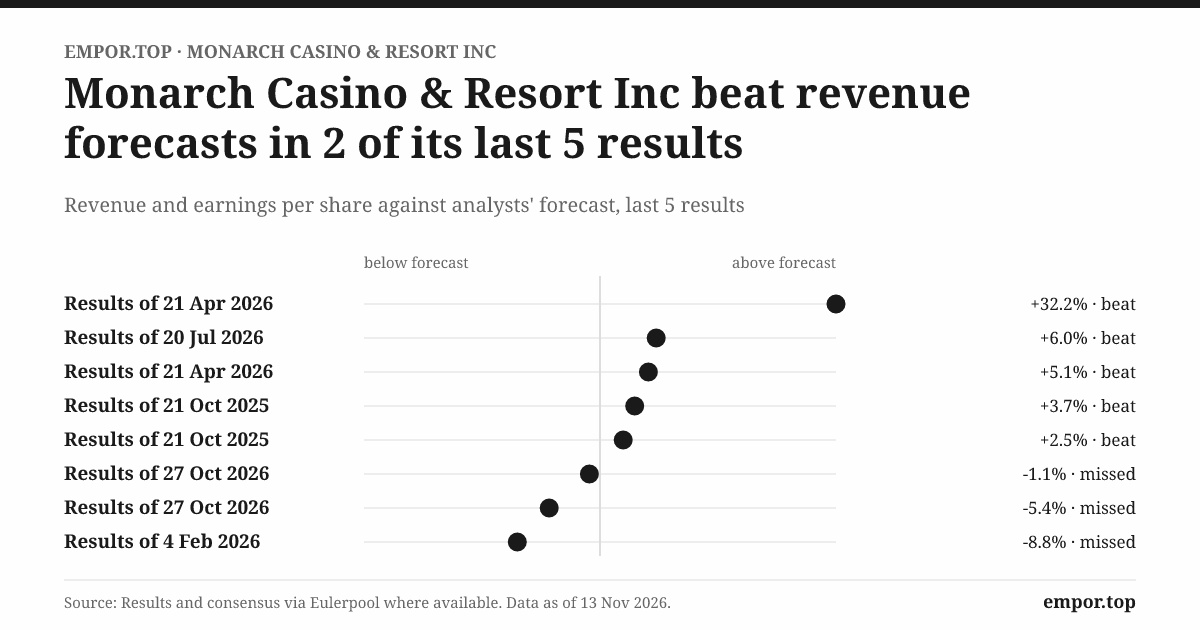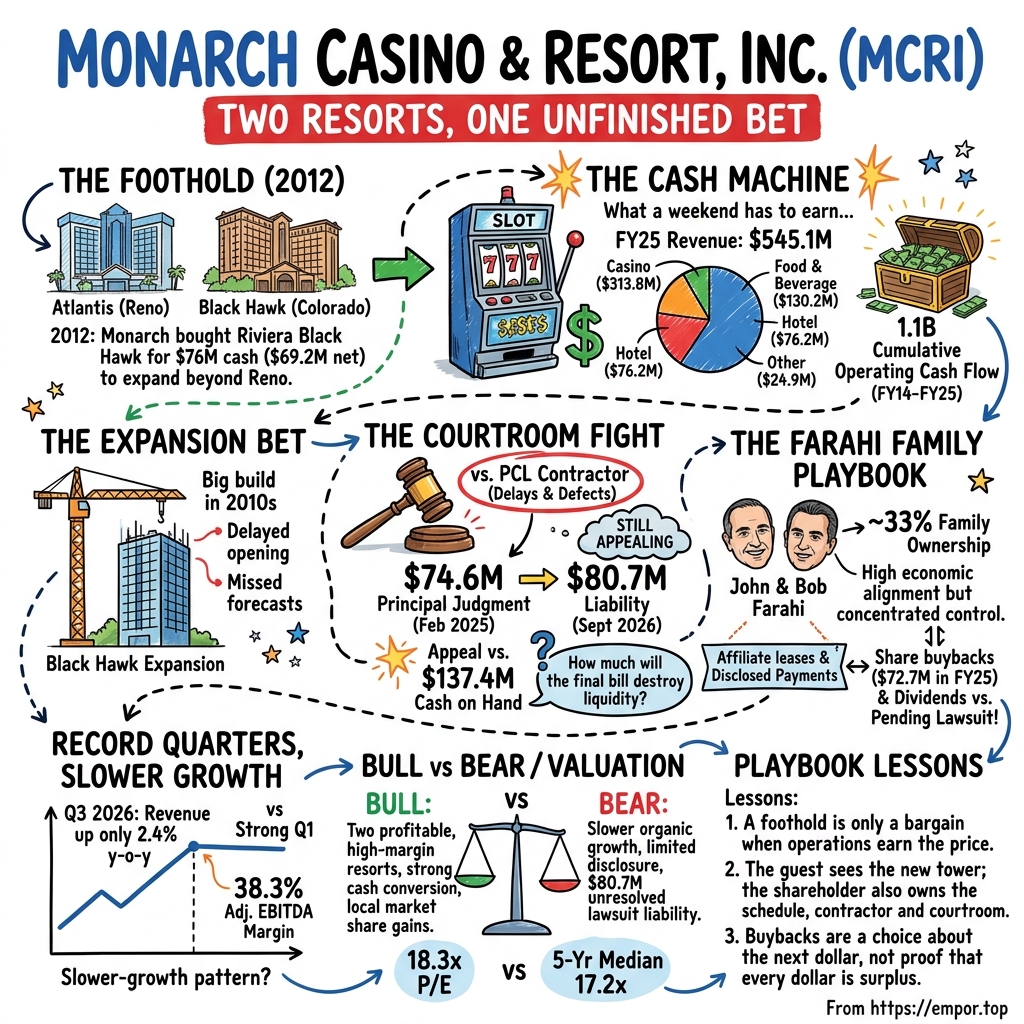
Monarch Casino & Resort: Two Resorts, One Unfinished Bet
I. The judgment beside the jackpot
On the last day of September 2026, Monarch Casino & Resort sat on $137.4 million of cash.1 It was a comfortable number for a company that owns two casino resorts, carries almost no bank debt and had just finished one of the strongest summers in its history.
A few lines further down the balance sheet sat a second number that made the first look less comfortable: $80.7 million of liability tied to PCL Construction Services, the general contractor that built the company's expansion in Black Hawk, Colorado.1 Monarch was still fighting that claim. Its brief in the appeal against the judgment was filed on October 28, 2026, two days before the quarterly report reached the public.1
Put the two figures side by side and the tension of this story arrives in one line. For every $100 of cash in Monarch's bank accounts, roughly $59 was spoken for, at least on paper, by a contractor with a court judgment in its hand. The money is not gone. The appeal may shrink the bill, or it may not. But the largest unresolved claim on the company's cash came from the largest project its management ever undertook, the building that was supposed to turn a small mountain casino into a destination resort.
Meanwhile, the resorts kept working. In the third quarter of 2026, Monarch reported revenue of $146.3 million, up 2.4% from a year earlier, a quarterly record for a company whose story has mostly been one of records lately.2 Guests kept checking into the towers in Reno and Black Hawk, kept ordering steak and sushi, kept feeding slot machines and sitting down at blackjack tables. Each dollar the casino floor kept after paying out winners flowed through a cost structure that, at the company's adjusted operating level, retained about 38 cents of every revenue dollar in the quarter.2
So this is a story about two things happening at once. One is a cash machine, built on two physical places and the habits of the people who visit them. The other is an unfinished argument about what that machine cost to build.
Monarch is a small company by casino-industry standards, and that smallness is the key to understanding it. It owns and operates exactly two properties: the Atlantis Casino Resort Spa in Reno, Nevada, and Monarch Casino Resort Spa in Black Hawk, Colorado.3 There is no portfolio of regional casinos to average out a bad year, no online sportsbook, no management contracts in faraway jurisdictions. There is not even a segment report that splits Reno from Black Hawk. The company presents one consolidated set of accounts, so an investor sees the combined result of two very different places and must infer the rest.3
That design shapes every question the story has to answer. The first is whether the two resorts can go back to growing quickly, or whether they have matured into a slower, high-margin pattern. The second is whether the Black Hawk expansion created enough value to justify its cost, its delays and the courtroom bill it produced.
The third is about the people at the top. Monarch is run by members of the Farahi family, who together own roughly a third of the shares. That concentration means the people deciding how to spend the cash are among its largest owners, which is both reassuring and a reason to ask who checks them.
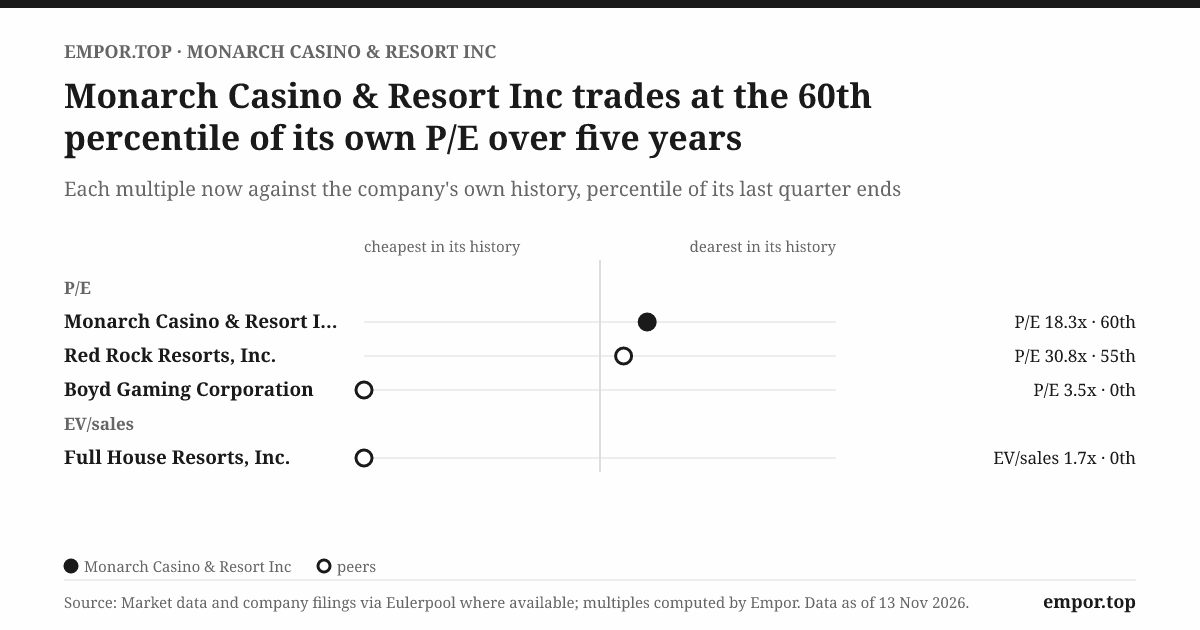
The market's answer, for now, is a price of about 18 times trailing earnings, slightly above the company's own five-year median. That is not the price of a distressed company, nor of a darling. It is the price of a business investors broadly trust to keep producing cash, with a discount for doubt that is neither large nor absent.
The way to judge whether that trust is earned is to go back to the moment Monarch stopped being a single Reno casino and bet on a second market a thousand miles east. That bet is where both the cash machine and the courtroom fight began.
 Subscribe on LinkedIn
II. The $76 million foothold in Colorado
For most of its life as a public company, Monarch was the Atlantis. The Reno resort, sitting along South Virginia Street beside the Reno-Sparks Convention Center, was the business, the brand and the balance sheet.3
It was a well-run local resort in a city that had spent decades watching Las Vegas take the national spotlight, and it competed for the same pool of Northern Nevada residents, Northern California drive-in visitors and convention guests as every other big property in town. A company with one resort has one fate. A slow winter in Reno, a new competitor down the road or a ceiling on how many more rooms the site could hold all landed on the same set of shareholders.
In September 2011, Monarch announced that it would change that. It agreed to buy the Riviera Black Hawk, an operating casino in the old Colorado mining town of Black Hawk, about an hour's drive into the mountains west of Denver, for $76 million in cash.4 The company framed the price net of the acquired working capital and expected tax benefits at roughly $69.2 million.4 The deal closed the following spring, and for the first time Monarch had a second engine.
What did it actually buy? It bought a licence to operate in one of the most concentrated gaming markets in the United States, a working casino with an existing customer base, and land on which something larger could be built. It also bought exposure to a place unlike Reno. Colorado's commercial casinos are confined by the state constitution to three historic towns: Black Hawk, Central City and Cripple Creek.
Black Hawk dominates the trio. In 2025 it generated about 76% of the state's commercial gaming revenue, against about 17% for Cripple Creek and just 7% for Central City.5 For a casino operator, that concentration is the attraction. Denver's metropolitan area is the main pool of customers, and Black Hawk is where most of them go.
It is worth being precise about what those figures mean, because they are easy to misread. Black Hawk's 76% is the town's share of the state, not Monarch's. Monarch's own share of Black Hawk is a number the company does not publish in its annual report, and because it reports Reno and Black Hawk together, there is no clean way to work out from its filings how much revenue or profit the Colorado property contributes.3 The state's gaming regulator publishes detailed town-level figures and market statistics, which tell an investor how the pond is growing, but not exactly how big Monarch's fish has become.6
Was $76 million a good price? The honest answer is that the record does not let anyone say. There is no clean, same-date set of comparable casino acquisitions in the public material to produce a multiple, and the company did not publish the Riviera's earnings in a form that would allow a like-for-like valuation at the time of the deal.4 Calling it a bargain would be a guess. Calling it an overpayment would be a guess too.
The better test is what Monarch did with the property afterward, and here the numbers tell a striking story about scale. The purchase price was the cheap part. Over the next several years the company decided that the casino it had bought was a platform, not a finished product, and committed to turning it into a full resort with a hotel tower, a parking structure, restaurants and a spa. The consolidated balance sheet shows how big that decision was.
Monarch's net property, plant and equipment rose from about $251 million at the end of 2017 to about $573 million at the end of 2020, an increase of more than $320 million in three years.3 Not every dollar of that went to Colorado, and depreciation muddies the figure, but the order of magnitude is unmistakable: the company spent several times the original purchase price building the Black Hawk it wanted.
That changes the question. The $76 million foothold was a modest, measurable bet. The expansion that followed was a large, less measurable one, financed partly with debt that peaked near $195 million at the end of 2019.3 Monarch had gone from a single-resort company with a clean balance sheet to a two-resort company in the middle of a build that consumed more cash than the business produced for several years.
Seen with hindsight, the strategic logic was sound in outline. A Denver customer heading to Black Hawk chooses among a cluster of casinos lined up along the same few streets. A new, upscale resort with a hotel tower can capture a bigger slice of a dominant market. The risk was in the execution, which is where control matters. Monarch could choose its design and its contractor, but once construction began, many of the variables that determined the project's cost and timing were in the hands of people outside the company.
Reno, by contrast, offered a lesson in how hard it is to grow a single property in a mature market. The Atlantis could renovate, add restaurants and refresh rooms, and it did, but its customer base was bounded by geography: the residents of Northern Nevada, the drive-in traffic from Sacramento and the Bay Area, and the convention business next door. A resort in that position can win share from its neighbours, yet it cannot easily make the pond bigger.
Colorado offered a different shape of opportunity. Denver was a large, growing metropolitan area with a single dominant gaming destination within driving distance, and a newer, better resort in that destination could plausibly pull customers both from rival casinos and from people who had not previously made the trip. That is the strategic case that made a $76 million entry fee look reasonable, and the case that later justified a much larger cheque.
So the question that carries forward from 2012 is not whether Monarch should have gone to Colorado. A second market in the largest town of a concentrated state was a rational way to stop being a one-resort company. The question is whether management bought a platform it could improve on budget, or took on a project whose risks exceeded its control. To answer it, the story first has to understand what a resort like Monarch's actually sells, and what makes a guest choose one over the one next door.
III. What a weekend at the resort has to earn
Picture a Friday night in Black Hawk. A couple drives up the canyon from Denver, hands the car keys to a valet and walks into a gaming floor bright with slot machines. They might play for an hour, eat at the steakhouse, play again, and then take the elevator to a room with a view of the mountains.
In the morning there is breakfast, a spa appointment, maybe one last session at the tables before the drive home. Every step of that weekend is a separate sale. None of it is guaranteed. There is no subscription to a casino resort, no contract that obliges the couple to come back next month, and no penalty if next time they turn into the parking garage across the street.
That is the essential economics of Monarch. In 2025, the company's net revenue was $545.1 million.3 About $313.8 million, or roughly 58%, came from the casino. Food and beverage brought in $130.2 million, nearly a quarter of the total. Hotel rooms contributed $76.2 million, and spa, retail and other services added $24.9 million.3 Gaming is the heart of the business, but a resort that sells nearly a quarter of its revenue as dinners and drinks is also, in a real sense, a restaurant company with a casino attached.
It helps to understand what "casino revenue" actually measures, because it is not what most people imagine. When a guest feeds $100 into a slot machine and walks away with $90, the casino does not book $100 of revenue. It books the $10 it kept, the "net win," after adjusting for promotional credits and loyalty rewards.3
The total amount wagered, which the industry calls the handle, is far larger than the revenue line and never appears on the income statement. That is why casino revenue can move for reasons that are hard to see from outside: more visitors, the same visitors betting more, a change in how lucky the house happened to be, or a shift in how much of the win is handed back as free play.
Loyalty points complicate the picture slightly further. Monarch rewards repeat guests with points they can redeem for play, meals or rooms, and it defers part of the revenue until those points are used or expire.3 The program is the industry's main tool for turning a one-time visit into a habit, and it explains why a casino will "comp" a dinner for a valuable slot player. The meal is not free. It is a marketing cost booked against the gaming relationship.
Where the 2025 growth came from
Seen through this lens, 2025 was revealing. Casino revenue grew 6.8%, faster than the company as a whole, and management attributed the improvement to gains in market share and lower labour costs.3 The hotel told a different story. Room revenue slipped 0.2% as occupancy fell to 81.6%, even though the average daily rate rose to about $188.3 In other words, Monarch charged more for each room it sold but sold a smaller share of the rooms available.
Those two lines, side by side, show why a headline revenue number can hide the important operating question. A resort can grow because more people come, because the same people spend more, because rooms are fuller, or because prices are higher. Each of those has a different meaning. Growth from more gaming activity and market share suggests the property is winning customers from rivals. Growth from room rates on falling occupancy suggests pricing power at the top end but softer demand at the margin. In 2025 Monarch had a bit of both, and an investor needs to watch which one dominates next.
The share claim deserves particular scrutiny because it is the core of management's case. The company says it gained share. What its filings do not provide is a published series of its share in each market, its visitation, or how many guests return year after year.3 Colorado's gaming regulator publishes the town totals, so an investor can see whether Black Hawk as a whole is growing and loosely compare it with Monarch's direction, but the property-level share must be taken partly on trust.6 The claim is plausible. It is not proven to the standard a long-term investor would want.
Two local wars
Each resort fights in a local arena. In Black Hawk, Monarch's principal large rival is Ameristar Black Hawk, a big hotel-casino on the same short stretch of road, alongside the other licensed casinos that line the town's streets.3
In Reno, the Atlantis competes with established local resorts such as the Peppermill and the Grand Sierra Resort, plus the downtown properties and the tribal casinos of Northern California that intercept some of the drive-in traffic before it ever reaches Nevada.3 These are not national battles. They are fights for the same pool of regional customers, often the same individual players, who can compare comps, rooms and restaurants within a few minutes' drive.
That is the honest frame for Monarch's competitive edge. It is not a national brand moat. Very few people outside Northern Nevada and the Denver area would recognise the Atlantis or the Monarch name, and the company does not claim otherwise.
The edge it claims is local execution: an upscale physical experience, attentive service, good food and a well-maintained property in a market where many rivals are older or less polished. That edge is real if guests keep choosing Monarch when the rival across the street is offering a similar comp. It can erode if a rival renovates, if service slips, or if a competitor opens a newer tower.
The forces acting on the business can be described quickly, though their full weight becomes clearer in the bull and bear cases. Gaming licences and the cost of building a resort keep new entrants rare, which is a genuine barrier. Guests, however, have plenty of choice among existing venues, so they hold real bargaining power in the form of loyalty offers and free play.
Labour, food and energy costs press on margins, and a casino resort is a labour-intensive business with roughly 2,740 employees at the end of 2025.3 Online gaming and sports betting compete for some of the same entertainment dollars, but they do not replicate a steak dinner, a spa day or the feel of a busy casino floor on a Saturday night.
That last point matters for a question many investors now ask of every business: what does artificial intelligence do to it? For Monarch the direct risk of substitution looks low. Nobody books a weekend in Black Hawk because a chatbot cannot provide one. Technology may help with labour scheduling, marketing and the targeting of comps, and management has talked about technology-driven efficiency. But aspirations about cost savings are not yet evidence of material new revenue, and they should be judged by margins, not by press releases.
Food and beverage is worth a moment of its own, because it is easy to overlook in a casino story. At about $130 million in 2025, it was the second-largest revenue stream, nearly twice the hotel.3 Restaurants serve two roles in a resort. They are a business in their own right, selling meals to hotel guests, locals and convention visitors. They are also a tool of the casino: comped meals reward valuable players and keep them on the property longer.
That dual role makes the economics hard to read from outside, because part of the food revenue is effectively a marketing cost for the gaming floor. It also makes restaurants a source of labour intensity, since kitchens and dining rooms require large staffs. When management talks about lower labour expense, the restaurants are one of the places where those savings, or the pressures that reverse them, will show up first.
All of which brings the story back to Colorado. In a business built on repeat visits, polish and service, the obvious way to grow is to give customers a better place to visit. That was the promise of the Black Hawk expansion: a larger, more luxurious resort that would pull more of the Denver crowd up the canyon and keep them there overnight. The construction would test whether management could deliver that promise on time and on budget.
IV. The expansion that became a courtroom fight
In February 2025, a Colorado court entered a judgment against Monarch in favour of PCL Construction Services, the contractor that had built the Black Hawk expansion. The principal amount was $74.6 million.7 For a company that reported about $137 million of operating profit for the full year 2025, it was a bill equal to more than half a year's operating earnings, delivered not by a competitor or a regulator but by the builder of its own flagship project.3
How did a resort expansion end in a judgment that large? The answer stretches back almost a decade, to a construction site in a narrow mountain valley.
The plan was ambitious for a company of Monarch's size. It would turn the original Riviera casino into a full resort on a constrained site in a town built into steep canyon walls. The balance sheet absorbed well over $300 million of new property during the build years, and borrowings rose sharply to fund it.3
For several years, free cash flow turned negative. Between 2017 and 2020, the company's cash from operations fell short of its capital spending by a cumulative total of roughly $200 million.3 The resort was being built partly on the cash flow of the Atlantis and partly on the bank's money.
By early 2019, the project was running late. Trade reporting from February of that year described a delayed opening of the Black Hawk expansion, arriving in the same quarter that Monarch missed analysts' revenue and earnings forecasts.8 Delays in casino construction are not unusual, but they are expensive in a particular way. Every month a tower stays closed is a month of interest, carrying costs and lost revenue, and a month in which competitors keep the customers the new building was meant to win.
Two stories about the same building
By September 2019, the delay had become a lawsuit. Monarch sued PCL, alleging defective and nonconforming work and failures in the contractor's performance; PCL, for its part, pursued claims against Monarch for amounts it said it was owed for its work and for the costs of delays and changes.9 Each side told a story in which the other bore responsibility for the problems. To Monarch, the contractor had failed to deliver what it promised. To PCL, the owner had changed the scope and was refusing to pay for the consequences.
Construction disputes of this kind often settle quietly. This one did not. It went through years of litigation, while the resort itself opened in phases and began operating as a complete property. The parking structure, the hotel and the expanded casino came into service, guests arrived, and the consolidated revenue line began to climb. The courtroom and the casino floor ran on parallel tracks.
Then, in February 2025, the court ruled. The $74.6 million principal judgment went to PCL, and Monarch disclosed it in a regulatory filing shortly afterward.7 The company said it would appeal.10 It also needed a waiver from its bank, because the judgment could otherwise have tripped a default under its credit agreement; the lenders granted one, subject to continued compliance.3
It helps to picture the dispute the way a homeowner would picture a renovation gone wrong. The owner says the builder installed the wrong materials, did shoddy work and blew through the schedule. The builder says the owner kept changing the plans, demanded extras and then refused to pay for them. Both sides keep invoices, emails and engineers' reports, and a judge eventually has to decide whose version of hundreds of small decisions is more credible.
Scale that up to a hotel tower in a mountain canyon, add years of interest, and the result is a legal claim large enough to show up on a public company's balance sheet as a separate line of risk. The decisive point for shareholders is that the court, at least at trial, found PCL's version more persuasive.
The accounting followed. At the end of 2025, Monarch carried an accrued estimate of $77 million for the loss.3 By the end of September 2026, the related liability on its balance sheet had grown to $80.7 million, made up of about $47.0 million recorded in construction accounts payable and $33.7 million in accounts payable.1 Deloitte, the company's auditor, singled out the 2025 estimate as a critical audit matter, which is the auditor's way of telling shareholders that this number required significant judgment and close scrutiny.3
It is worth reading that signal correctly. A critical audit matter is not a qualification or a warning that the accounts are wrong. Deloitte issued clean opinions on both the financial statements and the company's internal controls.3 It is a flag that the size of this liability depends on assumptions about a legal process that has not finished.
How big is the bill, really?
The scale is easier to grasp in three comparisons. The September 2026 liability equalled about 59% of the cash Monarch held on the same date.1 It was a little more than half of the company's 2025 operating profit.3 And spread across the roughly 17.6 million shares outstanding in late October 2026, it came to around $4.60 per share, roughly 4% of the stock price in mid-November.1
That last comparison is a useful corrective. The judgment is material, and it can reshape how much cash the company returns in a given year, but it does not threaten the company's survival. It is large enough to matter and small enough to absorb.
It is also different from conventional debt, and the difference matters. At the end of 2025, Monarch had nothing drawn on its $100 million bank credit facility.3 It had lease obligations, mostly modest, and it had the PCL liability. That liability does not carry the covenants or refinancing risk of a bank loan, but it is just as real as a claim on cash.
If the appeal fails, the money goes to PCL. If the appeal succeeds in part, some of it stays with shareholders. Either way, an investor should treat the $80.7 million as a claim against the cash pile until a final ruling says otherwise.
There is a further subtlety in the timing. The liability has risen from the principal of the judgment toward the larger figure on the balance sheet, as interest and related amounts accrue. A long appeal is not free. The longer the case runs, the larger the eventual bill becomes if Monarch loses, which means the appeal is itself a bet with a cost attached.
So did the expansion strengthen Monarch's competitive position enough to justify all this? The evidence points in two directions, and neither is conclusive. On one side, the company's consolidated revenue more than doubled between 2019 and 2025, from about $249 million to about $545 million, and operating profit more than tripled.3
Part of that came from the pandemic's collapse and rebound, and part from the Atlantis, but a resort that added a hotel tower and an expanded casino in the largest gaming town in Colorado is a natural candidate for much of the gain. On the other side, the company does not report Black Hawk's revenue or profit separately, so no outsider can calculate the expansion's return on the money invested, and the final cost of the project, including the judgment and legal fees, is still unknown.3
The fair verdict is that the expansion enlarged the resort and, on the available evidence, probably enlarged the company's earnings. But the delays, the dispute, the legal costs and the judgment are material execution failures, not footnotes. Calling the project a proven value creator overstates what the public record shows. Calling it an overpayment overstates the other way. What the record does show is that a company whose competitive pitch is flawless execution struggled to execute the single biggest project in its history.
The next pieces of evidence are concrete: the appellate ruling, the amount ultimately paid, and whether Black Hawk's share and profits keep supporting the investment as the building ages. Who will make those decisions, and in whose interest, is the subject the story turns to next.
V. The Farahi family runs the resorts and owns a third
The proxy statement Monarch filed in late May 2026 contains a short table that explains more about the company than most of the annual report. It lists the people who beneficially own the most shares. At the top is John Farahi, Co-Chairman and Chief Executive Officer, with about 19% of the company.11 His brother Bob Farahi, Co-Chairman and President, holds a further stake, and Ben Farahi, a brother who earlier served in the company's leadership, holds another significant block.11 Together, they hold that roughly one-third stake.11
At the November 2026 share price, John Farahi's stake alone was worth something in the region of $370 million. His total compensation for 2025, as reported in the proxy, was $3.61 million.11 In plain terms, a 10% move in the stock changes his wealth by about ten times his annual pay. That arithmetic is the strongest argument that the family is aligned with outside shareholders. When the Farahis decide to buy back stock, extend an appeal or spend on a new restaurant, they spend their own money alongside everyone else's.
The family has also been at the company for a very long time. John and Bob Farahi have shared the top jobs for decades, and the Atlantis has been the family's business for most of that time.
Their style, visible in the company's filings and in the physical product, is that of owner-operators rather than professional managers: a tight focus on two properties, a preference for spending on the guest experience rather than on acquisitions, and a reluctance to say more than necessary in public. Monarch does not even employ a Chief Financial Officer by that title; its senior finance executive is Edwin Koenig, the Chief Accounting Officer and Treasurer.11
Pay against performance
Executive pay at Monarch is not extravagant by casino-industry standards, but it has risen. John Farahi's total compensation rose from $3.21 million in 2023 to $3.66 million in 2024, then eased to $3.61 million in 2025; Bob Farahi's rose from $1.46 million in 2023 to $1.68 million in 2024, then eased to $1.62 million in 2025.11 Over the same three years, net profit went from about $82 million to about $72.8 million and then $101.4 million.11
Pay stayed broadly flat while profit dipped and recovered, which is not the pattern of an executive team extracting more as performance weakens. It is also not the pattern of a tightly variable incentive plan. Salary, cash bonus and equity awards all feature, and the proxy describes them in detail, but the largest incentive in the system is the ownership stake itself.11
The awkward part of the governance picture is the property arrangements around the Atlantis. The resort sits next to a shopping center owned by Biggest Little Investments, a partnership in which John, Bob and Ben Farahi hold interests.3 Monarch leases parking, a driveway, billboard space and storage from entities connected to the family. In 2025, those payments added up to about $1.29 million: about $775,000 for a parking-lot lease, about $775,000 for the driveway lease including operating costs, and a little over $500,000 for billboard, storage and other parking arrangements.3 Against $545 million of revenue, that is roughly a quarter of one percent.3
Two points need to sit next to each other. First, the amounts are small, and the company says that John and Bob Farahi do not have management or operational control over the shopping-center partnership.3 Second, the filings do not provide an independent benchmark showing that the lease terms match what an unrelated landlord would charge, nor a denominator against which to judge them, such as the company's total occupancy costs.3
There is no evidence here of misconduct. There is a structural reason for an independent board to keep testing the terms every time they come up for renewal, because the family sits on both sides of the relationship in economic terms.
The board's independent directors, including Paul Andrews, Yvette Landau and Craig Sullivan, are the formal check.11 At the annual meeting at the end of May 2026, shareholders elected the slate of directors and approved executive compensation in an advisory vote, alongside an extension of the company's equity plan.12 With a third of the votes held by the family, those outcomes were never in much doubt. The meaningful signal in such a vote is the level of opposition among outside holders, which tells a reader whether institutions are uncomfortable. The results did not amount to a rebellion.
Credibility, tested
The best way to judge a management team is not to read its proxy but to compare what it said with what happened. On the Black Hawk expansion, the record is mixed at best. The project opened late, missed the market's expectations in 2019, and led to a dispute that the company lost at trial.87
That is a clear execution setback, and it happened on the leadership's own initiative. On the operating business, the record is better. The resorts kept growing after the expansion opened, margins rose, and the company paid down the debt it had taken on for the build. The Farahis have been more convincing as operators than as builders.
Their communication style deserves a note too. Monarch's earnings releases are brief, and its calls are short compared with larger gaming companies. That restraint can read as discipline, but it also leaves investors with less to test. On the appeal, on property-level performance and on the long-term maintenance budget, the company has said relatively little in public beyond what accounting rules require. An investor who wants to hold management to account will need to listen for specific numbers on the coming calls, not reassuring adjectives.
Which brings up the question a skeptical outside shareholder would put directly to the Co-Chairmen. Monarch spent more than $70 million buying back its own stock in 2025, with a judgment of comparable size still unresolved.3 A family that already owns a third of the company becomes a slightly larger owner every time the company buys back shares from everyone else. Is that the best use of the next dollar, or should the company wait until it knows the size of the PCL bill? That is not a governance accusation. It is a capital-allocation question, and the answer lies in the cash flow statement.
VI. The cash machine meets the buyback machine
In 2025, Monarch generated about $165 million in cash from its operations.3 It spent about $37 million maintaining and upgrading its resorts, leaving roughly $128 million of free cash flow.3 Then it did two things with that money. It repurchased $72.7 million of its own shares and paid $21.9 million in dividends.3
Together, the two returns absorbed about $95 million, or roughly three-quarters of the year's free cash flow. The rest stayed on the balance sheet, which helps explain why cash climbed from about $59 million at the end of 2024 to about $97 million a year later, and then to $137.4 million by September 2026.31
That is the cash machine at work. The question is whether it is running too hot.
Profit that turns into more cash than profit
Start with the longest view available. Across the twelve years from 2014 to 2025, Monarch reported about $581 million of cumulative net profit and generated about $1.1 billion of cash from operations, or roughly 182% of its profit.3 For a business owned through a public stock, that is the most important financial fact on the page, and it is easy to misread.
It does not mean the profits were understated, nor that the company has some hidden source of cash. It reflects the nature of a casino resort. The company owns hundreds of millions of dollars of buildings and equipment, and accounting rules require it to spread their cost over their useful lives as depreciation, which reduces reported profit without costing any cash in the year.
In 2025, depreciation and amortisation came to about $54 million.3 Working capital also helps: casinos are paid in cash at the time of play, while they pay many of their suppliers later. In 2025, rising payables added a few million dollars to operating cash flow, while receivables and taxes used a little.3
The trap is to treat all that cash as surplus. Depreciation is non-cash this year, but the buildings it represents do wear out, and the company has to spend money replacing carpets, slot machines, kitchens and hotel rooms. The better measure is free cash flow, after capital spending, and here the long record is more sobering. Across the same twelve years, free cash flow totalled about $357 million.3
That is far less than the $1.1 billion of operating cash, because the Black Hawk build consumed so much. Split the record in two and the picture sharpens. From 2017 to 2020, free cash flow was negative by about $200 million in total. From 2021 to 2025, after the build was done, it was positive by about $525 million.3 The post-expansion business is a powerful cash generator. The pre-expansion business was paying for a building.
Capital spending in 2025 was $37.2 million, down from $43.9 million in 2024, and went to the Atlantis room redesign, routine maintenance and new gaming equipment.3 Those figures are about 7% to 8% of revenue. What the company does not publish is a separate, multi-year estimate of how much it needs to spend each year simply to keep the two resorts competitive.3 That matters because the definition of free cash flow depends on it. If the true maintenance requirement is higher than recent spending, today's free cash flow flatters the business; if it is lower, the company has more room than it appears.
Dividends, then buybacks
Monarch did not pay a dividend for most of its history. It began in 2023, initiating an annual dividend of $1.20 per share.3 The first year's cash distributions were unusually large, about $112 million, more than the company earned that year, and in 2024 and 2025 dividends settled at about $22 million a year, roughly a fifth to a third of net profit.3 Across the full twelve years, dividends consumed about 44% of cumulative free cash flow, which looks heavy until one remembers that they all came in the last three years, from a business that had finished its big build.3
Buybacks have since become the more important lever. The company repurchased $60.0 million of stock in 2024 and $72.7 million in 2025, and continued buying in 2026.31 The effect is visible in the share count: diluted shares fell from about 19 million in the early 2020s to about 17.6 million outstanding in October 2026.1 That steady shrinking is why earnings per share have grown faster than net profit, and why shareholders' equity has barely moved since 2022 even as the company earned about $100 million a year. The profits are leaving through the front door as dividends and buybacks.
Buybacks have a quieter consequence that matters in a family-controlled company. When Monarch buys shares from outside holders, the Farahis' percentage ownership rises without their spending a dollar. A family that owns roughly a third of a company with a shrinking share count will, over enough years, own a larger and larger fraction of it. That is not sinister; every holder who does not sell gains the same proportional benefit. But it does mean that buybacks gradually strengthen the influence of the largest owners, which raises the importance of the independent board that sits alongside them.
There is nothing wrong with that in principle. A company with two mature resorts, no compelling acquisition and a high return on its existing capital should return cash rather than hoard it. The question is about order and timing. Buybacks are discretionary. A company that buys back shares at around 18 times earnings is betting that its stock is a better use of money than holding cash against an uncertain bill.
If the appeal fails and Monarch must pay the full liability, the company can afford it; cash at September 2026 covered the liability with about $57 million to spare.1 But the buybacks of 2025 and 2026 would, in hindsight, have reduced the cushion against a known claim.
The bank facility provides a backstop. Monarch has a $100 million credit line that was undrawn at the end of 2025, with $99.4 million of available capacity, and its covenants allow leverage up to 1.5 times earnings before interest, taxes, depreciation and amortisation.3 On the bank's own measure, leverage was zero and fixed-charge coverage was nearly 150 times, far above the minimum of 1.1 times.3 That is a fortress by most standards. But the facility matures on January 1, 2028, so it is a liquidity tool with an expiry date, not a substitute for capital discipline.3
The questions for the coming calls follow naturally. Will management state a durable maintenance budget for the two resorts? Will it describe a clear order of priority among reinvestment, the PCL payment, buybacks and dividends? So far, the company's actions have spoken louder than its words: it has kept returning cash, which suggests confidence about the appeal or comfort with paying the bill. Either is a defensible position. Neither has been explained in full.
The answer depends in turn on the growth of the cash flow itself. If the resorts keep growing, today's capital returns look sensible. If growth is fading, the cushion against the PCL bill matters more. And the most recent quarters suggest that growth has become harder to come by.
VII. Record quarters, slower growth
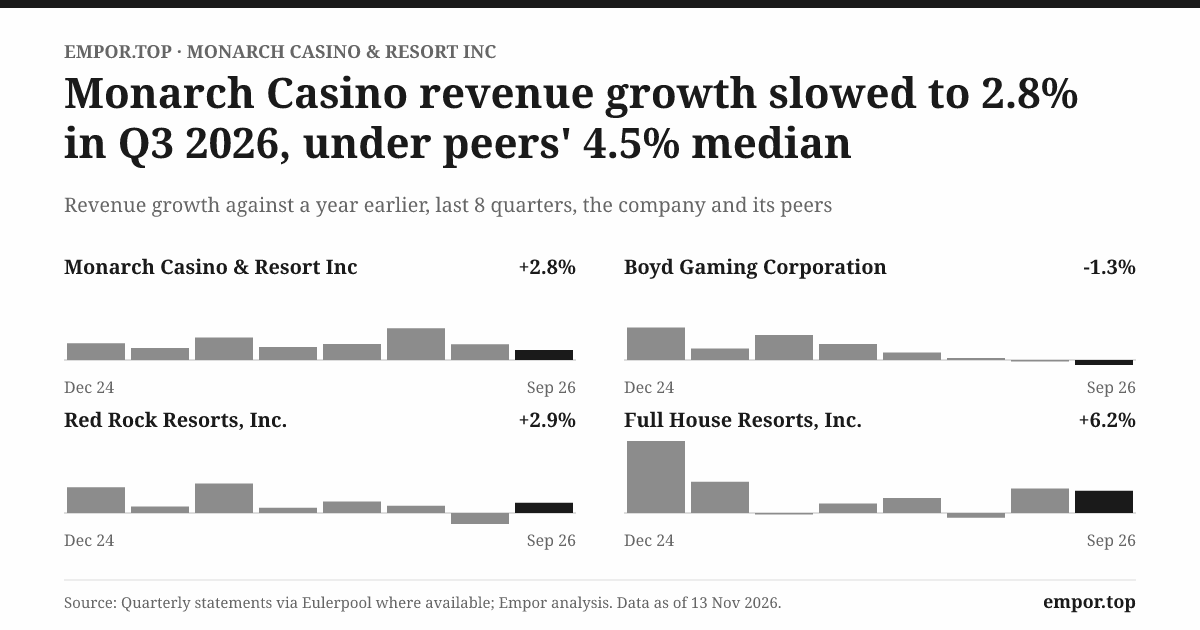
The first quarter of 2026 was the kind of quarter casino operators put in their slide decks. Monarch reported record first-quarter revenue and record adjusted earnings before interest, taxes, depreciation and amortisation, the measure the industry uses to compare operating performance without the noise of financing and depreciation.13 Revenue grew nearly 9% from a year earlier, the fastest pace in more than two years.13 The second quarter kept the momentum, with revenue rising a little over 4%.14
Then came the third quarter. Revenue reached $146.3 million, another record in absolute terms, but growth slowed to 2.4%.2 Adjusted EBITDA grew just 2.1% and net income 1.4%.2 The resorts were still bigger and more profitable than ever, yet each additional quarter was adding less. "Record" and "slowing" were both true at once, and a careful reader needs to hold both.
The long view, and why it misleads
Over the decade to 2025, Monarch's revenue grew about 10% a year and its net profit about 18% a year.3 Those are excellent numbers for a two-resort company, and they are frequently cited by bulls. They also deserve an asterisk, because they include two extraordinary events: the opening of the expanded Black Hawk resort, and the pandemic, which shut casinos in 2020 and then produced a sharp rebound.
Revenue fell about a quarter in 2020 and then more than doubled in 2021.3 Any growth rate that spans that period is partly measuring a one-time step change in the size of the company and partly measuring recovery from a collapse.
The more recent pace tells a different story. From 2022 to 2025, revenue grew about 4.5% a year and net profit about 5% a year.3 That is not stagnation. It is respectable growth for mature physical resorts, well above inflation in some years. But it is less than half the decade's headline rate, and the third quarter of 2026 sat below even that slower pace. The step change from the expansion appears to be over. What remains is a high-margin business growing at a mid-single-digit rate, with some quarters stronger and some weaker.
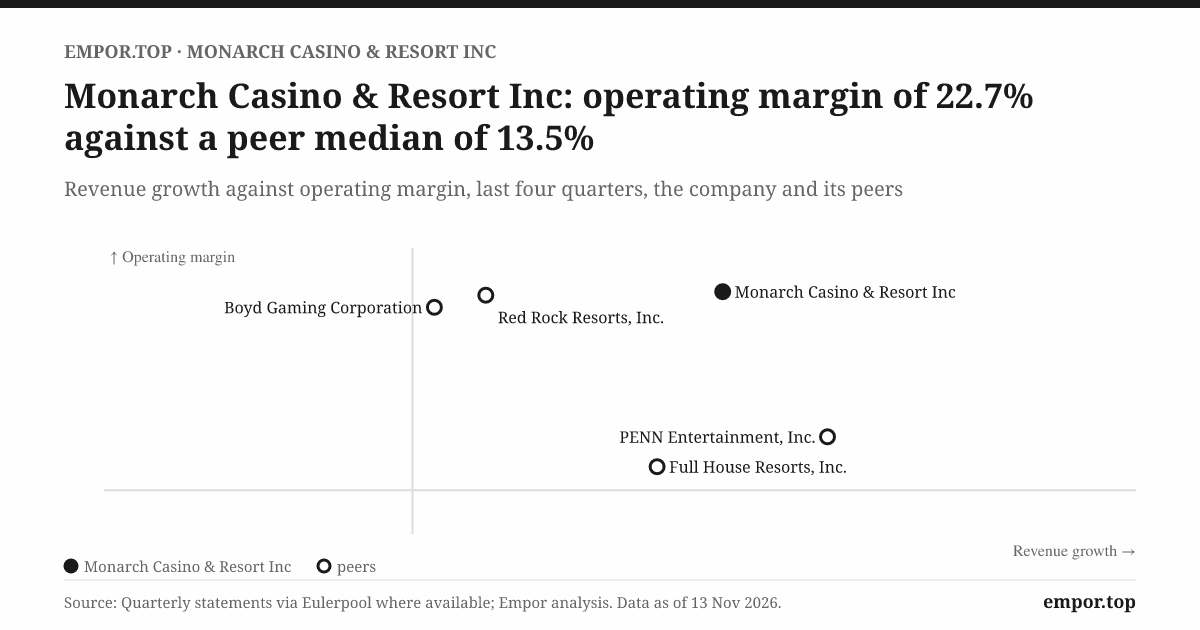
Margins are the bright spot. In 2025, operating profit was about a quarter of revenue, up from about 18% in 2024, and in the third quarter of 2026, adjusted EBITDA was about 38% of revenue.32 For a resort business carrying the costs of restaurants, hotels and thousands of employees, that is unusually profitable. It suggests either strong pricing, lean costs, or both. Management has pointed to lower labour expense and efficiency gains as part of the explanation.3
It is worth decomposing that jump in 2025 margins, because it looks larger than the underlying improvement. Operating profit rose from about $92 million in 2024 to about $137 million in 2025, while revenue rose only about $23 million.3 Most of the gain did not come from extra sales. It came from the comparison base: 2024's fourth quarter carried an unusually small operating profit of about $4 million, which depressed the full-year margin.10 Strip out that quarter's distortion and the 2025 margin improvement looks real but more modest, consistent with management's account of lower labour costs and a better casino mix.3
Quarterly figures need care, though, because specific items can make them swing. Reported operating profit fell to about $4 million in the fourth quarter of 2024, a quarter that closed just before the PCL judgment was entered, and dropped to about 15% of revenue in the second quarter of 2026 before rebounding to about 28% in the third.10141 The company presents adjusted figures precisely to strip out items of that kind, and an investor should use both, keeping the definitions straight: adjusted EBITDA shows the operating machine; reported net income shows what shareholders actually earned after everything, including litigation.
Three dials on the dashboard
With no property-level breakdown, three indicators matter most. The first is casino revenue and the market-share trend at each resort, which together show whether Monarch is still taking customers from rivals; casino revenue grew 6.8% in 2025, and state data allow a rough check for Black Hawk.35
The second is hotel occupancy and average daily rate, which together reveal whether the resorts are filling their rooms or merely charging more for fewer; occupancy fell to 81.6% in 2025 while rates rose.3 The third is the adjusted EBITDA margin, read alongside labour and operating costs, which shows whether the company can keep growth flowing into profit as wage pressure builds; it stood at about 38% in the third quarter of 2026.2
The calls through the first three quarters of 2026 are the place to test management's story. The first-quarter call was a victory lap. The third-quarter results required a different conversation: why did growth slow, how much did the litigation cost, how much of the efficiency story is durable? Investors should listen for whether management answers those questions with measurable evidence, such as share figures, room statistics or a maintenance budget, or with broad claims about the quality of the product. A company that attributes its success to market share should be able to show it.
The fair reading is that Monarch has become a highly profitable, slower-growing business. That is not a bad thing to be. But it is a different business from the one that compounded so quickly through the expansion and the rebound, and it deserves a different set of expectations. The question is whether the stock price reflects that shift.
VIII. The case for the stock, and the case against it
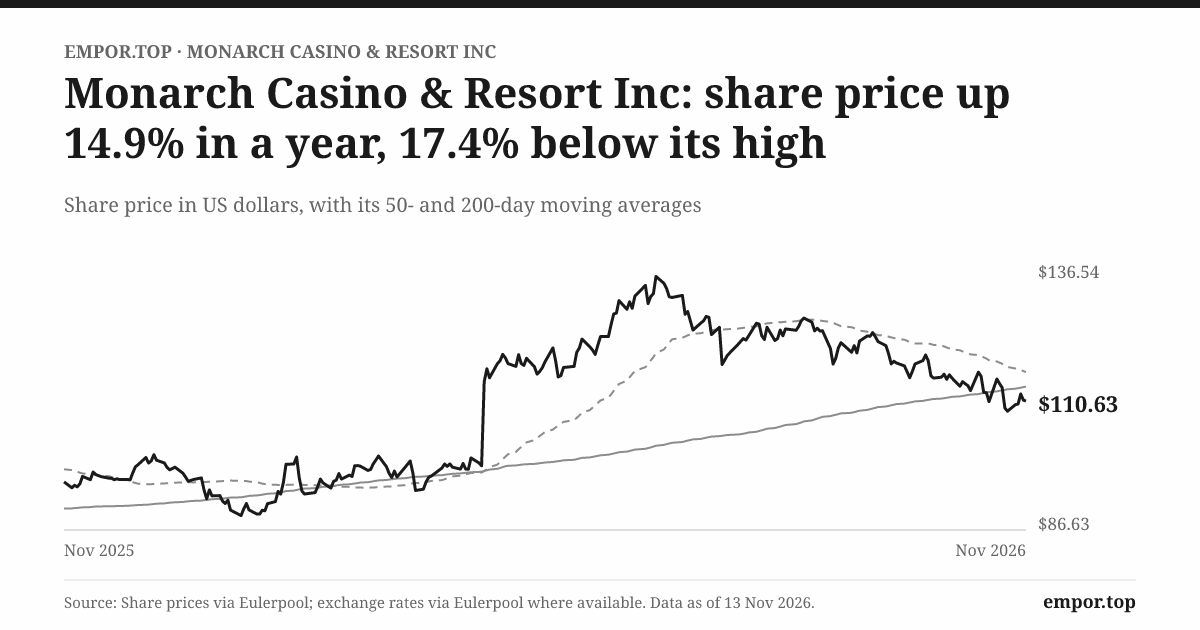
On November 13, 2026, Monarch's shares closed at about $110.63. At that price the market valued the company at roughly $2 billion, or about 18.3 times the last twelve months of earnings. Over the previous five years, the stock had typically traded at a median of about 17.2 times. So the market was paying a little more than usual for each dollar of Monarch's profit, at a moment when that profit was growing more slowly than usual.
Put differently, an investor buying the whole company at that price would receive an earnings yield of about 5.5% and a free-cash-flow yield of about 6.9%. The stock was about 17% below its 52-week high of roughly $134 and well above its low of about $89, and over the previous five years it had suffered a peak-to-trough fall of about 42% at its worst. This is not a sleepy utility. It is a volatile small-cap whose price swings with sentiment about regional gaming, interest rates and, lately, the PCL appeal.
What does that price assume? Roughly, that the two resorts will keep producing cash at around today's level and grow it modestly, with the judgment absorbed rather than catastrophic. A multiple slightly above its own history suggests the market gives Monarch credit for its margins and balance sheet, and does not demand a large discount for the slowdown or the appeal. Whether that is generous or fair depends on which of two cases an investor finds more convincing.
The bull case starts with the quality of the assets. Monarch owns two established resorts in two markets that are hard to enter. In 2025, it earned about 25 cents of operating profit on every dollar of revenue, and over the last twelve months it earned about 21% on the capital employed in the business.3 For a company that owns its buildings and has to keep refreshing them, those are strong returns. They are the returns of a business that is not overbuilt and is not competing on price alone.
The balance sheet supports the case. It can absorb the PCL liability, and cash generation has been strong.13 The company says it gained share in both markets.3
Family ownership and the shrinking share count add to the bull's case for compounding.
Testing the moat
The bull's argument rests on a moat, so it has to be tested properly, and Hamilton Helmer's framework of seven sources of lasting advantage is a useful way to do it.
The most obvious power is a form of cornered resource: a gaming licence in a market where licences are limited and the land suitable for a large resort is scarce. In Black Hawk, the town's geography and Colorado's constitutional limits on where casinos can operate make it hard for a new player to arrive; in Reno, licences are easier to obtain, but building a resort of the Atlantis's size takes years and hundreds of millions of dollars.63 This is real, but it protects the incumbents as a group, not Monarch specifically. Ameristar and the Peppermill have the same licences and the same sunk investment.
Scale economies are modest. Monarch is far smaller than national operators that spread marketing, technology and purchasing costs across dozens of properties. Its scale is local: in each town it is one of the larger, newer resorts, which helps with fixed costs, but it does not have a national cost advantage.
Switching costs are weak. A loyalty programme creates some friction, because points and status are lost when a player moves, but a rival can match comps quickly, and players commonly hold cards at several casinos. Network effects are essentially absent; a casino does not get more valuable to one guest because another guest joins. Counter-positioning does not fit either. Branding exists locally, in the sense that the Atlantis and Monarch names signal a particular experience in their markets, but it is not a brand with pricing power beyond them.
That leaves process power, the advantage of doing ordinary things better through accumulated know-how. This is where Monarch's real claim lies: service, food, design and the management of comps and labour. It is the hardest power to prove from outside, because it shows up only in outcomes. The evidence for it is the high margin and the claimed share gains. The evidence against is the expansion, the largest process test in the company's history, which ran late and ended in a lost lawsuit.
Michael Porter's five forces point in the same direction. The threat of new entrants is low, thanks to licences and capital costs. The bargaining power of buyers, the guests, is meaningful, because each can choose among nearby venues and negotiate through their play. Supplier power is moderate, with labour the most important input and wage pressure a constant feature of the industry. Substitutes are real, from online betting to concerts and restaurants, although none replicates the whole resort experience. Rivalry among existing casinos is intense and local.
Weighing all of that, the history narrows the moat claim rather than rejecting it. Monarch has a strong position in two concentrated markets, protected collectively by licences and capital and individually by execution. That is a defensible business, not an impregnable one. The metric that would confirm the stronger version is a published, sustained market-share gain at each property. The event that would falsify it is a rival's major renovation or new tower that pulls share back.
The bear's argument
The bear case is built not on generic casino risks but on what has actually happened at Monarch.
Growth has slowed, as recent results show.32 Hotel occupancy also remains a concern.3 The company is concentrated in two local economies; a downturn in the Denver area or Northern Nevada, or a new competitor in either market, would hit Monarch harder than a diversified operator.
Disclosure is thin. Without segment reporting, investors cannot tell whether Reno or Black Hawk is driving growth, which makes it harder to judge the expansion's return or to notice early if one property is weakening.3 The Black Hawk expansion remains a costly execution failure, and the appeal is unresolved.1
A few further risks belong on the list because they bear directly on the economics. Labour and operating costs can squeeze margins, especially if the efficiency gains of recent years have been fully harvested. Gaming is a licensed industry, and the regulators in Nevada and Colorado can change taxes, rules and approvals.6 The bank facility matures in January 2028, which is not an immediate threat given the absence of borrowings but is a date that needs a plan.3
Online sports betting deserves precise treatment. It competes for a share of gambling spending and draws in younger players who might once have visited a casino floor. Monarch's filings do not describe a material online gaming operation of its own, so the company participates in that trend mainly as a bystander.3 It is a competitive substitute and a regulatory variable, not a growth engine for this company.
A skeptical activist, looking at Monarch with fresh eyes, would probably push on four points. The first is disclosure: a company of this size could easily publish revenue and operating profit for each resort, and the refusal to do so makes it harder for shareholders to hold management accountable for the Black Hawk investment. The second is capital allocation: buying back stock at a premium to its own history while an $80 million judgment is unresolved is a choice that deserves an explicit rationale.
The third is governance: with the CEO and President both members of the controlling family, and related-party leases connecting the company to family interests, the independent directors carry an unusually heavy load, and the activist would want to see them visibly test the lease terms and the appeal strategy. The fourth is the appeal itself: is the company spending legal fees and accruing interest in pursuit of a better outcome, or delaying an inevitable payment? None of those questions implies wrongdoing. Each asks management to show its work.
Neither case is fanciful. The bull is right that the resorts are profitable and that the balance sheet can carry the judgment. The bear is right that growth has slowed and that the company's single largest bet produced a costly dispute. The modest premium to the stock's own history does not settle which argument is stronger. It suggests the market leans slightly toward the bull while discounting a measure of the bear.
What would change the view? Repeated, evidence-backed share gains at both resorts would support the moat. Stabilising hotel occupancy alongside rising rates would show that pricing power is not costing volume. Margins that hold up after normal maintenance spending would confirm that the cash machine is not being flattered by a holiday in reinvestment. And a final PCL outcome that preserves liquidity would remove the largest uncertainty. Each of those is observable. None has been fully settled.
IX. Playbook: Business & Investing Lessons
Go back for a moment to the construction site in Black Hawk in 2019. The tower was rising against the canyon wall, the opening date had slipped, the analysts had just been disappointed, and the owner and the builder were heading toward court.89 Everything that made Monarch's story distinctive was visible in that scene: a family-run company betting big on a second market, a building meant to make the guest experience better, and a chain of decisions that put the outcome partly in other people's hands.
The first lesson comes from the purchase that started it all: the $76 million foothold was only the beginning.43 The headline price was never the real price. A foothold is only a bargain when the next decade of operations earns the price.
Investors tend to judge acquisitions on the day they close, by the multiple paid. Monarch's Colorado bet shows why that is the wrong moment to judge. The meaningful test of the purchase came years later, when the expanded resort either did or did not lift consolidated earnings enough to justify the full investment. The evidence suggests it helped; the bill is still being totalled.
The second lesson comes from the courtroom. The tower that guests see is only half of what a resort company builds. The other half is a set of contracts, schedules, change orders and claims, and every one of them belongs to the shareholder as well. The guest sees the new tower; the shareholder also owns the schedule, the contractor and the courtroom.
A company that wins on service and polish can still lose money on the project that delivers that polish. For founders and operators, the wider point is that a business's core competence does not automatically extend to the adjacent skill of managing a large construction project. For investors, it is that a capital project should be judged on its all-in cost, including disputes, not on the opening-day photographs.
The third lesson comes from the cash flow statement: the capital returns made while the claim remained open show that each dollar returned was a choice.31 Buybacks are a choice about the next dollar, not proof that every dollar is surplus.
A strong cash generator can still make a poor choice about timing. The useful habit for an investor is to ask, every year, what the company is choosing not to do with each dollar it returns, and whether it has told shareholders clearly how it ranks reinvestment, liabilities and distributions.
The fourth lesson is about concentration. Two resorts can produce a fortune of steady cash, but they also mean that one project, one market or one lawsuit can dominate the whole story. In a two-asset company, there is no such thing as a side project. That is the defining risk of owning a business like Monarch: there is nowhere for a mistake to hide, and nowhere for it to be diluted.
Taken together, the lessons support measured confidence in the operating model and caution about the capital record. Monarch has shown that it can run good resorts. It has not yet shown, beyond dispute, that it can build them on time and on budget, and the final PCL bill will decide how much of its strong cash generation truly belongs to shareholders.
X. Epilogue
Tonight, the slot machines are humming in Reno and Black Hawk, and the appeal is in the hands of a Colorado appellate court. Monarch's brief was filed at the end of October 2026; the court will now consider the arguments of both sides, and its decision, whenever it comes, will be the first piece of news in years that could change the size of the company's largest liability.1 The company still carries $80.7 million against the claim, and it held $137.4 million of cash at the end of September.1
The legal path has several possible endings. The appellate court could uphold the judgment, in which case Monarch will pay the full amount plus whatever has accrued, and the cash cushion will shrink accordingly. It could reverse or reduce it, releasing some of the accrued liability back into earnings and cash.
It could send the case back for further proceedings, which would extend the uncertainty and the legal bill. Related disputes connected to the same construction project also remain part of the picture, and investors should keep in mind the difference between a court development and cash actually changing hands. A ruling is news; a payment is economics.
The operating test runs in parallel, one quarter at a time. The fourth-quarter 2026 results, expected early in 2027, will show whether the third quarter's slowdown was a blip or a trend. Investors will want to see casino revenue and market-share disclosures for both resorts, hotel occupancy and room rates, and the adjusted margin set against labour and operating costs. If the resorts return to mid-single-digit growth with margins intact, the slower pattern looks durable and healthy. If growth continues to fade while costs rise, the bear's case gains weight.
Capital returns will tell their own story. Every quarter, management chooses how much to buy back, how much to pay out, how much to spend on the properties, and how much to hold against the appeal. Those choices will be easier to judge once the company sets out a clearer maintenance budget and an explicit order of priorities.
Before long, it will also need to decide what to do about the bank facility that matures on January 1, 2028.3 With no borrowings outstanding, renewal should not be difficult, but it is the kind of quiet deadline that matters more if the PCL bill arrives at the same time.
It helps to translate the appeal's possible outcomes into per-share terms, because the market thinks in per-share terms. If Monarch loses and pays the full liability, the cost is around $4.60 a share, much of which is already reflected in the balance sheet and therefore, in principle, in the stock price.
If it wins a substantial reduction, part of that liability would flow back to equity, a modest but meaningful gain. The larger effect is likely to be on capital allocation: a resolved claim, whichever way it goes, would free management to plan buybacks and dividends against a known cash position rather than a contingent one.
The last thing to watch is the conversation itself. On the next calls, will management explain the slowdown with specifics, give a clearer view of the appeal's financial exposure, and talk about each property's performance with numbers rather than adjectives? A company that has spent years saying little may decide it can afford to say a bit more. Or it may not.
So the story ends where it began, with two tests running side by side. One is operational: can the two resorts keep attracting guests and converting them into high-margin cash? The other is legal: how much of that cash will the Black Hawk dispute ultimately consume? Both answers will arrive in the coming quarters. Neither is in yet.
XI. Outro
Most casino companies are portfolios. They own dozens of properties across many states, and a bad year in one market disappears into the average. Monarch is something else: two buildings in two towns, run by one family.
That is what makes this company unusual, and what makes it a story rather than a spreadsheet. The resorts have proven they can generate real cash; the building meant to make one of them great has shown how a single decision can test the whole company. Monarch's fortunes are not a portfolio's. They are the fortunes of two places and the choices of the people who run them.
References
-
Q3 2026 Form 10-Q — Monarch Casino & Resort, Inc., 2026-10-30 ↩↩↩↩↩↩↩↩↩↩↩↩↩↩↩↩
-
Q3 2026 Results — Monarch Casino & Resort, Inc., 2026-10-27 ↩↩↩↩↩↩↩
-
2025 Form 10-K — Monarch Casino & Resort, Inc., 2026-02-24 ↩↩↩↩↩↩↩↩↩↩↩↩↩↩↩↩↩↩↩↩↩↩↩↩↩↩↩↩↩↩↩↩↩↩↩↩↩↩↩↩↩↩↩↩↩↩↩↩↩↩↩↩↩↩↩↩↩↩↩↩↩↩↩↩↩↩↩↩↩↩↩↩↩
-
Black Hawk Acquisition Announcement — Monarch Casino & Resort, Inc., 2011-09-19 ↩↩↩↩
-
Colorado Gaming Update, December 2025 — Colorado Division of Gaming ↩↩
-
Colorado Gaming Fact Book & Abstract 2024 — Colorado Division of Gaming ↩↩↩↩
-
PCL Judgment Disclosure, Form 8-K — Monarch Casino & Resort, Inc., 2025-02-14 ↩↩↩
-
2019 Black Hawk Expansion Delay — CDC Gaming, 2019-02-07 ↩↩↩
-
Black Hawk Expansion Contractor Dispute — Law Week Colorado, 2019-09-13 ↩↩
-
2024 Form 10-K — Monarch Casino & Resort, Inc., 2025-02-25 ↩↩↩
-
2026 Proxy Statement — Monarch Casino & Resort, Inc., 2026-05-27 ↩↩↩↩↩↩↩↩↩
-
2026 Annual Meeting Voting Results, Form 8-K — Monarch Casino & Resort, Inc., 2026-05-29 ↩
-
Q1 2026 Results — Monarch Casino & Resort, Inc., 2026-04-21 ↩↩
-
Q2 2026 Results — Monarch Casino & Resort, Inc., 2026-07-20 ↩↩
 LinkedIn
 WhatsApp
 Reddit
 Hacker News
 Email
 Kindle
 RSS Feed
 Spotify
 Apple Podcasts
 Amazon Music
 Audible
 YouTube