PENN Entertainment: The Casino Company That Kept Rewriting Its Digital Bet
I. The $1 Sale and the $2 Billion Bet
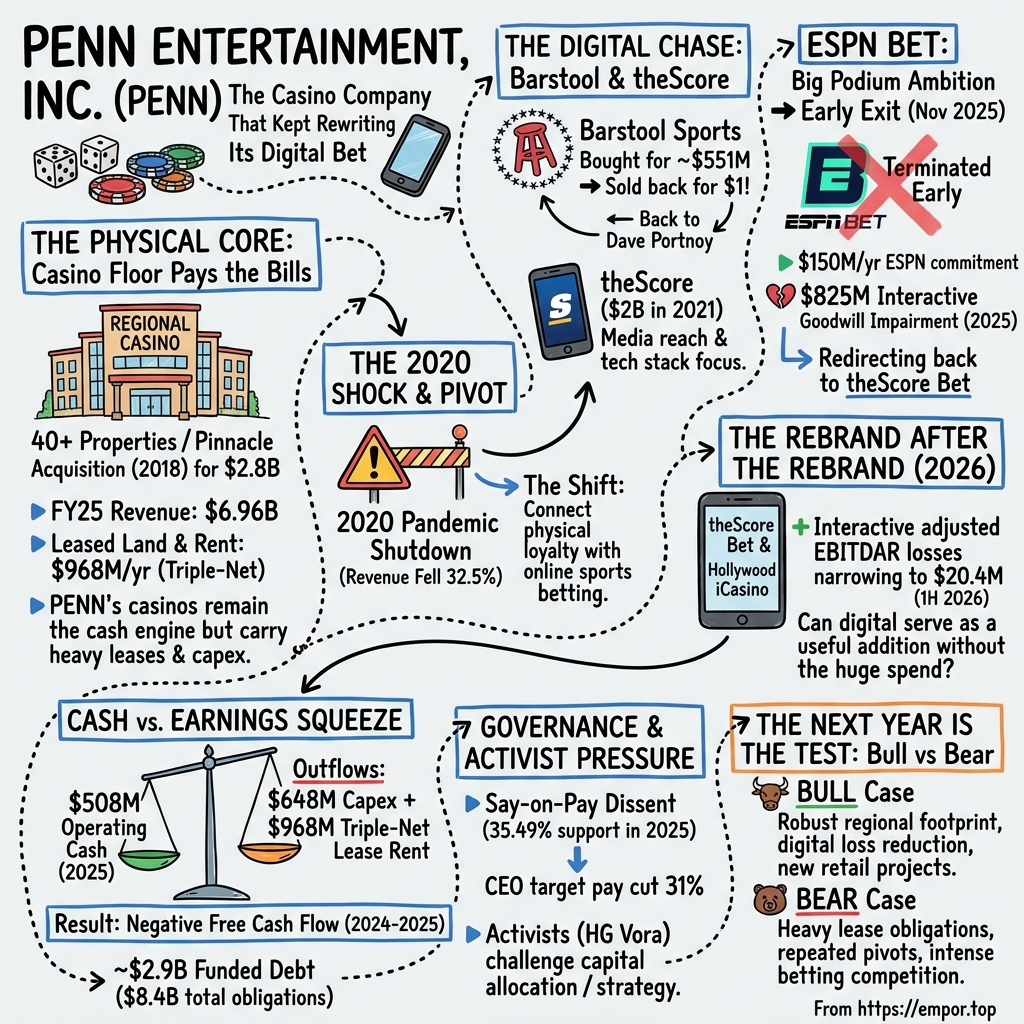
In the summer of 2023, a regional casino company did something that sounded like a typo. In February, PENN Entertainment had finished buying all of Barstool Sports, the brash, Dave Portnoy-led sports and comedy empire it had been acquiring in stages since 2020. Across the two purchases it had spent about $551 million on the brand.12 Six months later it sold Barstool back to Portnoy for nominal cash.1 The sticker price people kept repeating was one dollar.
The same day it announced the sale, PENN signed a new marriage. ESPN, the most famous name in American sports media, would license its brand to PENN's online sportsbook for ten years. In return PENN agreed to pay ESPN $150 million a year in cash, or $1.5 billion over the decade, and gave the Disney-owned network warrants to buy a meaningful slice of PENN itself.1 Barstool's loud, irreverent audience was out. ESPN's mainstream, everyone-watches-SportsCenter audience was in.
So the opening puzzle of this story is the strangest round trip in modern gaming. PENN paid heavily to own a sports-media brand, then paid heavily again to rent a different one. And by December 2025, little more than two years into a ten-year agreement, that second brand was gone too. PENN and ESPN agreed to end the deal early, and PENN switched its American sportsbook to theScore Bet, the app it had owned since buying the Canadian media company theScore in 2021.34
It would be easy to tell PENN's story as a digital soap opera, with three brands in five years, a famous founder buying his company back for pocket change, and a TV giant walking out to sign with DraftKings. That version misses the part that matters most. PENN's digital business has always been the smaller part of the company. The engine is a portfolio of more than forty regional casinos and racetracks spread across some twenty states, places like Hollywood Casino in Columbus, Ameristar in East Chicago, L'Auberge in Baton Rouge and the M Resort outside Las Vegas.5 Those properties produced the bulk of PENN's roughly $7 billion of revenue in 2025.5 They are where most of the cash comes from. They are also, in a sense, what paid for the digital experiments.
That is why the digital detour matters, even though it is not the whole story. Management's theory, repeated in different costumes since 2020, has been that online betting could do two things at once. It could create a new profit pool in a market that states were legalizing one by one, and it could feed customers into PENN's physical casinos through a shared loyalty program. A sports fan who bets on an app might, the theory goes, book a weekend at a Hollywood Casino. Nobody doubts the theory's appeal. The open question is whether PENN can make the arithmetic work in a market where FanDuel and DraftKings already own most of the customers.
Three questions run through the episode. First, can the regional casinos compound value while funding heavy property investment and a very large rent bill to the landlords who own much of the real estate? Second, can theScore Bet make digital economics work where Barstool and ESPN BET did not? And third, can the management team led by chief executive Jay Snowden rebuild credibility after a series of costly reversals, a shareholder revolt over pay, and an activist campaign?
The story runs from 2018, when PENN bought Pinnacle Entertainment and became one of the largest regional casino operators in the country, through the pandemic shutdown that nearly emptied the business overnight, through the digital land-grab of 2020 to 2023, the ESPN break, and into the current effort to grow retail earnings, narrow digital losses and pay down debt. It is a story about what a casino company is really worth once the landlord, the builder and the lender have each taken their share. And it starts with the deal that made PENN big.
 Subscribe on LinkedIn
II. From Penn National to a National Casino Portfolio
The company began as a racetrack. Penn National Race Course opened in 1972 in Grantville, a small town east of Harrisburg, Pennsylvania, and the Carlino family turned that one track into a gaming company that went public in 1994.6 For two decades it was a patient acquirer of second-tier regional assets: racinos, riverboats, and casinos in states that legalized gambling to fill budget holes. In 2013 it did something that would shape everything after. It spun its real estate off into a separate real-estate investment trust, Gaming and Leisure Properties, and began leasing the buildings back.6 PENN became an operator that rented most of its own casinos.
That choice explains the deal that came next. On December 18, 2017, PENN agreed to buy Pinnacle Entertainment, a peer that ran casinos from Louisiana to Iowa, in a cash-and-stock transaction valued at about $2.8 billion.[^7] It was not a simple purchase. To win antitrust approval and to fund the deal, PENN arranged to sell four properties, including Ameristar St. Charles and Belterra, to Boyd Gaming, and to sell real estate to Gaming and Leisure Properties, which already owned much of Pinnacle's land.[^7] Once divestitures, real-estate sales and expected cost savings were netted out, PENN said it was paying about 6.6 times Pinnacle's trailing earnings before interest, taxes, depreciation and amortization.[^7]
That multiple deserves a careful reading. It was PENN's own pro forma estimate, built on synergies that had not yet been delivered, so it described the price of admission, not the return earned. Even so, Pinnacle stands apart from what followed for one simple reason: it was a deal about tangible properties with an earnings base PENN could point to. Investors could argue about whether 6.6 times was cheap, but at least there was a number to argue about. When the transaction closed on October 15, 2018, PENN had become a company with roughly 40 properties and a national footprint across regional America.[^8]
The scale changed the balance sheet. PENN's revenue climbed from about $3.6 billion in 2018 to about $5.3 billion in 2019, the first full year with Pinnacle.5 Property, plant and equipment on the books jumped from well under $3 billion before the deal to about $10 billion by 2019, largely because leases now sat on the balance sheet as assets.5 What a casino customer saw as a PENN property often belonged to a landlord, and the landlord expected its rent whether or not the slot floor was busy.
Pinnacle therefore left behind the tension that still defines the company. PENN built a large physical footprint, much of it on leased land, which meant the business had to earn a return after paying interest on its debt, rent on its buildings and the steady capital spending that keeps a casino from looking tired. A regional casino is a little like a hotel that also prints money on the ground floor, and the printing press needs new carpet, new slot machines and periodic renovation to keep regulars coming back. In good years the arrangement looks efficient. Rent replaced debt, and the operator could grow without tying up capital in buildings.
The weakness of that arrangement is that rent does not care about the weather. Nobody in 2018 expected the next test of PENN's model to arrive less than eighteen months later, when every casino it operated would go dark at once.
III. The Shutdown That Changed the Bet
In March 2020, state governors began ordering casinos closed as COVID-19 spread. For a company whose entire retail business depended on people driving to a building, sitting next to strangers and touching shared machines, the effect was immediate. PENN's slot floors went quiet, its hotel rooms emptied and its restaurants shut. Revenue for the year fell by about a third, from roughly $5.3 billion to about $3.6 billion, and PENN reported a net loss of about $669 million.57
Then came the snapback. Casinos reopened in stages through 2020 and into 2021, often with capacity limits, and customers flush with stimulus checks and few other entertainment options came back in force. Revenue rose about 65% in 2021 to roughly $5.9 billion, and operating margin recovered to almost 18%, about where it had been before Pinnacle.5[^10] PENN finished 2021 with net income of about $420 million, the best since the Pinnacle deal closed.5
Those two years make PENN's long-run growth rates look better and worse than they are. Over ten years, revenue grew about 9.4% a year; over five years, measured from the depressed 2020 base, it grew more than 14% a year; over the most recent three years, from 2022 to 2025, it grew less than 3% a year.5 None of these is a clean organic number, because the history mixes Pinnacle, the pandemic, Barstool, theScore and a series of small property deals. A listener should take one thing from them: the rapid growth came from acquisitions and the reopening, and the underlying retail business, left to itself, grows slowly.
The shutdown taught management something else. While the casinos were closed, a new business was being legalized around them. A 2018 Supreme Court decision had struck down the federal ban on sports betting, and states were rushing to authorize it, often with online wagering attached.7 Investors were rewarding any company with a credible digital story. In January 2020, just weeks before the shutdown, PENN had agreed to buy 36% of Barstool Sports for about $163 million, mostly in cash, and to make Barstool its exclusive gaming partner.2 Barstool Sportsbook launched in Pennsylvania that September, and PENN's stock became one of the pandemic's great rallies as retail traders bet that a regional casino operator had found a shortcut into online betting.7
That raised the question that would define the next five years. Could PENN's customer reach and loyalty program make it a better digital competitor than a stand-alone sportsbook, or would it have to fight FanDuel and DraftKings on their terms, paying for every new customer with promotions and advertising? FanDuel and DraftKings had spent years in daily fantasy sports building customer databases, technology and brand recognition. PENN had casinos, a loyalty program with millions of members and, now, a famous media partner.7
Management answered with action. In 2021 it agreed to buy theScore, a Toronto sports-media app company with its own betting technology, and in August 2022 it changed its name from Penn National Gaming to PENN Entertainment. The company said the new name reflected its evolution into a provider of integrated entertainment, sports content and casino gaming, and Snowden tied it to the growth of Barstool Sportsbook and theScore Bet.8 The racetrack company from Grantville was trying to become something else. The question was what it was willing to pay for that transformation.
IV. A Sports App Bought for $2 Billion
Picture the person PENN wanted to reach. A fan in Ontario or New Jersey opens theScore on a Sunday to check scores and fantasy stats, scrolls through highlights, and sees a betting line beside the game. In theory it takes one tap to go from watching to wagering, and from wagering to a loyalty account that might eventually bring that fan to a Hollywood Casino. That was the picture PENN bought when it agreed in August 2021 to acquire Score Media and Gaming for approximately $2 billion in cash and stock.[^12]
TheScore was founded by John Levy, a Canadian entrepreneur who had built a sports television network and then reinvented it as one of North America's most-used sports apps. It brought three things. The first was an audience, millions of monthly users who already opened the app for scores. The second was technology: theScore had built its own sportsbook platform rather than renting one, which meant PENN could control its product rather than rely on a third-party vendor. The third was a home market in Canada, where Ontario was about to open a regulated online market.[^12] When the deal closed on October 19, 2021, Snowden presented it as the foundation of an integrated platform combining media, betting and casino loyalty.[^12]
Put theScore beside Pinnacle and the difference in evidence is stark. Pinnacle came with properties, a stated earnings base and a multiple. TheScore came with users and code, and its price depended on what those users might eventually become. There is no honest way to calculate a like-for-like earnings multiple for the deal, because theScore was not earning meaningful profits. It was a growth thesis bought at a price set in one of the frothiest markets for online-gaming stocks in history.
The thesis rested on conversion, and that is where the evidence gets thin. An audience reading scores is not the same as a customer depositing money, and a customer making a first bet is not the same as one who keeps betting after the sign-up bonus runs out. PENN does not publish how many theScore media users became paying bettors, how many of those remained active a year later, or how many ever visited a casino. It does not disclose a recurring-revenue share or a cohort history.4 The proof of conversion investors can actually see is the segment profit line, and for years that line was red.
The technology claim held up better. PENN migrated its sportsbook onto theScore's platform, which gave it control of product development and reduced reliance on outside providers.4 That was a real asset. But owning the kitchen does not guarantee customers will choose the restaurant. FanDuel and DraftKings kept spending heavily on promotions and marketing, and PENN's share of American online betting stayed in the low single digits through the Barstool era.3
Then the write-down arrived. After the ESPN agreement ended in late 2025 and PENN revised its forecasts for the Interactive segment, it recorded an $825 million impairment of Interactive goodwill.4 Goodwill is the accounting residue of paying more for a business than the value of its identifiable assets; it represents the hopes embedded in the price. Writing down $825 million of it is management's formal acknowledgment that the future cash it had expected from the digital business is smaller than it once believed.
Two cautions keep that number in proportion. The impairment does not prove theScore's platform is worthless; the app, the technology and the Canadian business still exist and still generate revenue. And it is not a cash charge; the cash left the building years earlier, when PENN paid for the deal and funded the losses. What the impairment does show is that prior expectations were too high, and that the people who set them were the same management team now asking investors to believe in theScore's next chapter.
The comparison with the launch-era story is the most telling test. In 2021 management framed theScore as the engine of a media-led customer funnel. Four years later, the impairment disclosure tied the write-down to the end of the ESPN alliance and lower Interactive forecasts.4 The platform survived; the valuation of the dream did not. And before theScore could get its own turn in the spotlight, PENN made one more expensive detour, this time with Barstool and ESPN.
That detour is a story for later. First comes the part of PENN that has paid for all of this, the casinos themselves.
V. The Casino Floor Still Pays the Bills
It is a Saturday evening in Columbus, Ohio. A couple who visit Hollywood Casino a few times a year pull into the garage, swipe their loyalty card at a slot machine, eat at the steakhouse, and decide on a whim to stay the night in the property's new hotel tower, which opened in June 2026.9 They will lose some money at the machines, which is the point, and they will leave with a few loyalty points and maybe a free-play offer for next month. Multiply that visit by millions, across more than forty properties, and that is PENN's core business.
The revenue engine is simple to describe. Most of the money comes from gaming: the difference between what customers wager and what they win back, mostly on slot machines and table games. Hotels, food, beverages and entertainment add the rest, and in regional markets those amenities exist mainly to keep gamblers on the property longer. In 2025 PENN's revenue was about $6.96 billion, up from $6.58 billion the year before.4 The customers are numerous and diffuse. PENN does not report any customer above 10% of revenue, and there is no top-customer concentration schedule, because no single gambler matters to a company of this size.4
What a property keeps from each dollar the couple loses is a different matter. The state takes its cut first, through gaming taxes that in some regional markets claim a large share of gross gaming revenue. Then come the dealers, cocktail servers, security staff and surveillance teams, because a casino is one of the most labor-intensive businesses in hospitality. Then marketing, which in regional gaming mostly means the free play, discounted rooms and comped meals mailed to loyal customers to bring them back. Only after all of that does the property produce the earnings figure management likes to quote, and that figure is still measured before rent. A casino can be busy and still be an ordinary business; what separates a good one is how much of the loss on the floor survives the trip to the bottom line.
That diffusion is both a strength and a limit. No customer can squeeze PENN on price. But no customer is locked in either. The couple in Columbus can drive to another casino, gamble online in states that allow it, or spend the money on something else entirely.
What a local license is worth
Regional gaming is a business of local monopolies and duopolies, shaped by state law. A state may allow a handful of licenses, cap the number of casinos in a metro area, or grant exclusive rights in a region. That makes supply scarce in a way that ordinary hospitality is not. A new competitor cannot simply buy land across the street and build. PENN's peers in this world are other regional operators, chiefly Caesars Entertainment and Boyd Gaming, along with locally strong properties and tribal casinos.4 Online, FanDuel and DraftKings are the scale benchmarks, and they are much larger than PENN in sports betting.3
PENN is one of the largest regional operators by number of properties, but it does not publish a national casino market share, and comparing scale across operators requires stitching together state gaming-revenue reports market by market. The honest framing is that PENN's position is strong in some local markets and contested in others. Its competitive advantage, where it exists, is local.
So what kind of moat is this? The best version of the argument goes like this. Licensing and site scarcity limit new supply, which protects returns. A portfolio of properties across many states, connected by one loyalty program, may encourage customers to play at multiple PENN casinos and online, which builds a modest network across the portfolio. And the company has decades of experience running regional casinos efficiently, managing labor, slot mix and marketing offers.
The test is whether PENN publishes evidence that these advantages produce superior economics, and the answer is mostly no. It does not disclose customer retention rates, spend per visitor, pricing trends or property-level returns on investment.4 Its operating margin in the years before the digital push, in the mid-to-high teens, was respectable but did not stand out as unusually strong.5 What the record supports is an advantage that is local and operational. It does not support a national brand moat. The Hollywood Casino name is widely recognized, but customers choose a regional casino largely on convenience, and convenience is a property's advantage, not a brand's.
The landlord's share
Now follow the money from the casino floor to the landlord. Because PENN leases many of its properties from real-estate investment trusts, chiefly Gaming and Leisure Properties and VICI Properties, a large slice of what the casinos earn goes out the door as rent. In 2025, cash rent under PENN's triple-net leases was about $968 million.4 Triple-net means PENN also pays the taxes, insurance and maintenance on buildings it does not own. To put that number in proportion: it is nearly twice the cash PENN generated from operations in 2025, and it is paid before the lenders or shareholders see a dollar.45
That arrangement was a choice, not an accident. Spinning off the real estate in 2013 and leasing it back let the company and its investors unlock value from the buildings and redeploy capital. But it means PENN operates with ongoing fixed charges. In a good year, rent looks like a sensible cost of doing business. In a bad year, it behaves like debt that never matures.
The other claim on the casinos' cash is reinvestment, and it has been rising fast. PENN's capital expenditure rose from about $360 million in 2023 to about $648 million in 2025.4 As a share of revenue, that is a move from about 5.7% to about 9.3% in two years, which is a significant step up for a business whose revenue grew only a few percent a year. Strikingly, only about $4.3 million of 2025's capital spending went into the Interactive segment.4 The digital business was burning cash through operating losses, not through building things. The bricks and mortar were all on the retail side.
Much of that spending went to four growth projects PENN announced in October 2022: relocating its riverboat casinos in Aurora and Joliet, Illinois, onto land; building a hotel tower at Hollywood Casino Columbus; and adding a second tower at the M Resort near Las Vegas.10 Gaming and Leisure Properties agreed to fund part of the cost in exchange for higher rent.10 The Joliet casino and the M Resort tower opened in 2025, and the Columbus hotel and the Aurora casino followed in June 2026.4911
Management's case is that these projects will lift earnings, because riverboat casinos are cramped and outdated and modern land-based properties draw bigger crowds. That is plausible. Riverboat relocations in other states have often lifted revenue. But a construction budget is not growth by itself. The test is whether each project delivers the earnings run-rate management projected, after the higher rent owed to the landlord that funded it. PENN has given guidance on the projects in its earnings materials, but property-level returns are not separately disclosed in the annual report, so investors will have to judge mostly from the retail segment's aggregate results and management's commentary over the next several quarters.12
The early signs are encouraging but incomplete. In the second quarter of 2026, Snowden said nine properties set second-quarter records for revenue and adjusted earnings, and PENN raised its retail guidance for the year.1213 That is evidence the core business has momentum. It is not yet evidence that the projects have earned back their cost, because the newest properties had been open for only days when the quarter ended.
A few things the company does not publish limit any confident verdict about the moat. PENN does not quantify vendor concentration, although its digital business depends on third parties for geolocation, identity checks, payment processing and sports data.4 It does not provide customer-level retention or switching data that would show whether its loyalty program changes customer behavior. Receivables are small, about two weeks of revenue, which is what one would expect from a business that is mostly paid in cash at the time of play.5
So the verdict on the core is clear, with one hedge. PENN owns a large, tangible operating business with scarce local licenses and customers who come back out of familiarity and convenience. The moat argument has little evidence of unusually strong pricing power or retention, and the combination of nearly $1 billion of rent and rising capital spending narrows the cash left for debt reduction and shareholders. The casino floor pays the bills. The question that followed was how many digital bills it could be asked to pay, and the most expensive of them carried the ESPN logo.
VI. ESPN BET: From Podium Ambition to Early Exit
In November 2023, an app called ESPN BET went live, with the network's on-air talent promoting it and odds woven into the world's biggest sports-media platform.114 It was meant to be the moment PENN finally had the distribution to compete with FanDuel and DraftKings. Two years later, on November 6, 2025, PENN and ESPN announced they had agreed to end the agreement early.314 On December 1, 2025, PENN's exclusive right to the ESPN BET name in the United States ended, and its American sportsbook became theScore Bet.3 On the same day, ESPN named DraftKings as its official sportsbook and odds provider.15
How did a company end up there?
Why Barstool had to go
Start with Barstool. The 2020 investment had worked as a marketing machine: Barstool's audience was young, male and sports-obsessed, the exact demographic sportsbooks chase. But the brand also came with controversy, and some regulators and advertisers kept their distance. PENN completed its purchase of the remaining Barstool stake in February 2023, bringing its total spend to about $551 million.12 Within months it concluded that the ceiling on Barstool's reach was too low and the cost of owning a polarizing media company was too high. In August 2023 it sold the business back to Portnoy for nominal consideration, taking an impairment and a loss on the sale.1 The company also retained some obligations: a tax indemnification liability of about $40 million related to the sale still sat on the balance sheet at the end of 2025.4
The ESPN contract was a bold piece of financial engineering. PENN agreed to pay ESPN $150 million a year in cash for ten years, and issued ESPN warrants to buy roughly 31.8 million PENN shares, which would vest over the life of the deal.1 The structure gave ESPN an ownership interest in PENN's success and gave PENN the rights to the brand, ESPN's marketing integration and access to its audience. Both sides could exit early under certain conditions, including if PENN failed to hit market-share targets.1
Management's ambition was explicit. On the August 2023 call, Snowden said the goal was to make ESPN BET a top-tier player, describing the deal as a chance to reach a podium position in the American market.1 It was a very different kind of bet from Barstool. Instead of a niche brand with fierce loyalty, PENN had a mass brand with enormous reach, and it was paying a fixed price for that reach regardless of how many bettors it actually converted.
The launch produced a burst of downloads, and then the familiar problem returned. Sports bettors are promiscuous. Many hold accounts with several books and move money to whichever offers the best odds or promotions. ESPN's brand brought attention, but FanDuel and DraftKings had better-established products, deeper parlay offerings and larger marketing budgets, and they responded aggressively. ESPN BET never became a durable top-three contender.314 The economics of that fight are worth spelling out, because they explain why famous brands disappoint in this market. A sportsbook typically pays to acquire a customer up front, in advertising, sign-up bonuses and free bets, and then earns the money back slowly, through the small margin it keeps on each wager. If the customer stays for years, the math works. If the customer takes the bonus, places a few bets and drifts back to FanDuel, the acquisition cost is simply lost. A brand like ESPN can lower the cost of getting someone to download an app. It cannot by itself make that person stay, and staying depends on product: the speed of the app, the depth of the betting menu, the quality of live odds, the ease of withdrawing winnings. The leaders had spent years and billions perfecting those things. PENN was buying the front door and hoping the house behind it would be good enough.
PENN's Interactive segment kept losing money, and the fixed fees to ESPN kept coming. In 2025 alone, PENN recognized about $156 million of expenses related to its sportsbook agreement with ESPN and $57 million related to the investment agreement.4
The way management's explanation changed over time is revealing. In 2023 the story was reach and integration. Through 2024, as the market-share numbers disappointed, the emphasis moved to product improvements and patience. By late 2025, after the termination, the language shifted to focus and discipline: Snowden described the end as a mutual and amicable decision and said PENN would put more emphasis on iCasino, the online casino business, where the economics are better and the customers overlap more naturally with its retail casinos.1416 What management did not provide, at any stage, was the evidence investors most needed to judge the bet: customer acquisition cost, active users, retention by cohort, or how many ESPN BET customers became casino visitors. Analysts asked about market share and spending on several calls; the answers leaned on product roadmaps and future integration rather than measurable conversion.16
The exit terms
The termination was cheaper than living with the contract, which is the best thing that can be said about it. Under the termination, PENN paid about $38.1 million for remaining fees through the termination date and agreed to $5 million for later media support, and it stopped further payments to ESPN.34 Compared with the roughly $1.2 billion in cash fees that would have remained over the rest of the ten-year term, the exit was a sensible way to stop the bleeding.
The $825 million Interactive goodwill impairment followed.4 As with theScore, it is important to keep that number in proportion. It is not $825 million of cash that left in 2025. It is a write-down of the expected value of the digital business, recorded once management concluded that its forecasts, which had assumed the ESPN partnership, were no longer realistic. But the impairment matters for the future in a practical way. It tells investors that the digital business, which PENN funded with years of losses, is now expected to produce substantially less cash than management once thought. That lowers the return on the capital already spent, and it raises the bar for any future digital investment.
ESPN's quick move to DraftKings drove home PENN's distribution challenge.15 The brand PENN paid to borrow ended up with the competitor PENN was trying to catch. Whatever else ESPN's choice says, it shows that in American online betting the most powerful media partnerships flow to the market leaders, not to the challengers.
So the verdict is plain. The ESPN partnership bought brand access and promotion, but it did not produce the position PENN expected in a market led by FanDuel and DraftKings. PENN exited before the contract consumed much more cash. Whether that exit marks the start of a disciplined digital strategy or simply another reset depends on what PENN does next with an app it already owned.
VII. The Rebrand After the Rebrand
The latest reset left theScore Bet as PENN's American sportsbook.3 For investors, the question was whether it would prove more disciplined.
The first step in answering is to separate three businesses that are often lumped together. Online sportsbook is the business PENN has struggled in, a market dominated by two leaders, where promotions are expensive and customers shop around. iCasino, the online version of slots and table games, legal in only a handful of states, has very different economics: margins are more stable because there are no swings from game outcomes, and the customers overlap more naturally with people who visit casinos. TheScore's media app is a third thing again, an audience business whose value depends on how well it feeds the other two. Treating them as one growth engine hides more than it reveals.
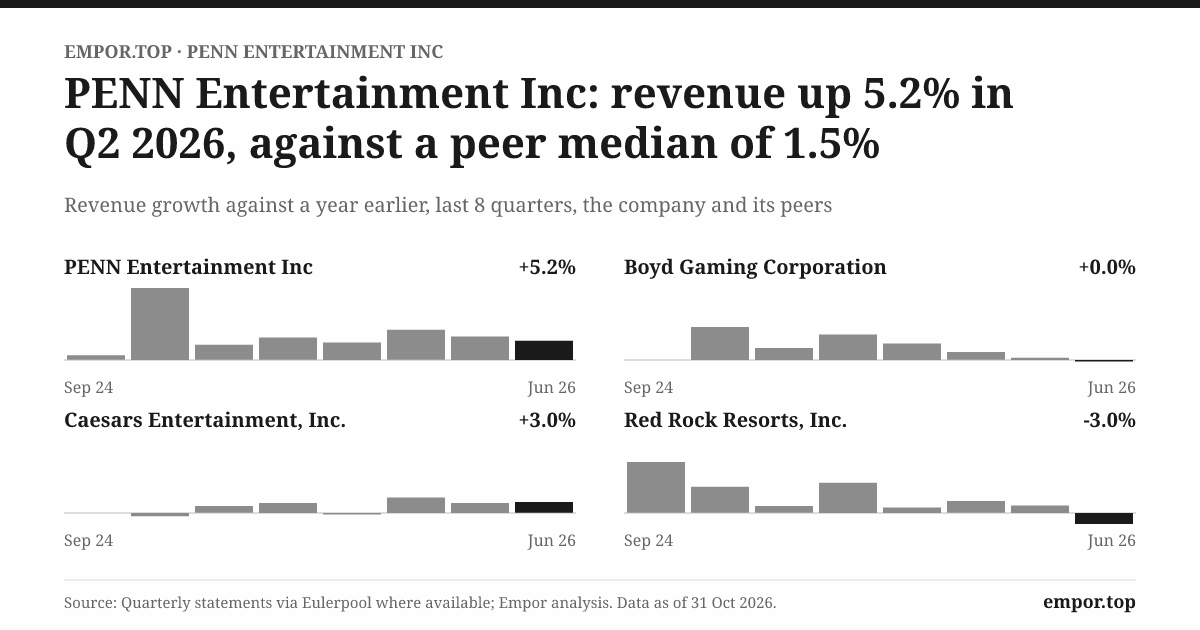
The numbers since the ESPN exit are genuinely better. In the second quarter of 2026, the Interactive segment's adjusted earnings loss narrowed to about $9.5 million from about $62 million a year earlier.13 For the first half of 2026, the loss was about $20.4 million, compared with about $151 million in the first half of 2025.5 Management said its standalone Hollywood iCasino app posted record quarterly revenue, growing both from the prior quarter and from a year earlier.1213
What changed? Part of the improvement is mechanical: the ESPN fees disappeared. Part reflects management's stated new approach. On the calls after the termination, Snowden and his team described a shift toward marketing discipline, with less spending to acquire sports-betting customers who would leave after the bonus, more focus on iCasino, and an effort to use the loyalty program to steer online players toward retail properties and vice versa.1617 Those claims are plausible, and the loss trend is consistent with them. But a sharp improvement after removing the ESPN fee is what one would expect from cost removal alone, so it does not yet prove the business has better customer economics.
Even with the improvement, Interactive remains a small part of PENN's earnings. In the second quarter of 2026, its revenue was about $349 million, but that figure includes about $186 million of tax gross-up, an accounting convention in which gaming taxes paid on behalf of the business are recorded as both revenue and expense.13 Without it, Interactive is a much smaller business than the headline suggests. Consolidated adjusted earnings were about $313 million that quarter, nearly all of it from retail.13 Digital is strategically relevant. It is not yet economically material to the whole company's profits.
PENN also kept its full-year guidance for an Interactive adjusted loss of about $20 million in 2026, while cutting its Interactive revenue guidance to about $1.57 billion. On the second-quarter call, management said the third quarter would bring the largest quarterly loss of the year because of investment in launching theScore in Alberta, Canada's newest regulated online market.1317 That is a candid signal: the digital business is still spending to enter markets, and the loss line will not improve in a straight line.
What investors cannot see remains the problem. PENN does not publish customer acquisition costs, monthly active users, hold-adjusted revenue by product, or the share of online customers who also play at its casinos.45 Without those, investors cannot tell whether theScore Bet is acquiring customers who stay, or simply spending less and shrinking. A business that cuts marketing will often see losses fall fast at first and revenue growth slow later. The revenue guidance cut is a reminder that both forces can be at work.
Reading the 2026 calls in sequence sharpens the picture. In the first-quarter call in April, the prepared remarks emphasized a smooth transition from ESPN BET and the growth of iCasino.[^22] In the August call, analysts pressed on competitive position, the Alberta spending and whether the sportsbook could ever reach meaningful scale; management's answers emphasized profitability over share, which is a coherent strategy but also a quiet admission that the podium ambition of 2023 is gone.17
The verdict on the reset is that lower losses and iCasino growth are encouraging operating signs, but they have not yet established sustained segment profitability. The right confirmation would be a full year of improved economics without a new, costly brand or partnership. Until then, the digital business remains a plausible source of future value rather than a secured one. And while that test plays out, a more basic question sits underneath the whole company: why, after years of reporting cash from operations, do shareholders have so little free cash to show for it?
VIII. More Operating Cash Than Earnings, Yet No Free Cash
Here is a puzzle to hand a first-year accounting student. Across the twelve years from 2014 to 2025, PENN reported a cumulative net loss of about $1.2 billion. Over the same years, it generated about $6.0 billion of cash from operations.5 How can a company lose money on paper for over a decade and still pull in billions in operating cash?
The answer is that accounting profit and operating cash measure different things, and PENN's history is full of large expenses that never touched the bank account. Impairments are the biggest; they record earlier spending as a current loss. Depreciation is another: the cost of a casino building or slot machine is spread across years of income statements even though the cash went out up front. Add those back, and operating cash looks far healthier than earnings.
Walking through 2025
The latest year makes the point vividly. PENN reported a net loss of about $845 million in 2025.4 Yet cash from operations was about $508 million.4 The bridge between those two numbers includes about $945 million of impairments and about $447 million of depreciation and amortization.4 There was also a non-cash lease expense of about $372 million, stock compensation of about $61 million and, pulling the other way, a non-cash gain of about $215 million on a financing arrangement, which made the reported loss smaller than it would otherwise have been.4
That reconciliation explains the paper loss. It does not make the cash available to shareholders. Operating cash already reflects lease payments of about $357 million that are classified within operations, but PENN then spent about $648 million on capital projects.4 Subtract the capex from the operating cash, and free cash flow was negative: somewhere between about $140 million and $180 million below zero, depending on the precise definition.45 It was the second straight negative year after 2024.5 The cumulative comparison is real, but it is not a claim that the losses were harmless. Every impairment marks a deal or investment that returned less than its price.
Debt figures for PENN can be confusing, because different measures include different things. Some data providers report total borrowings of about $8.4 billion at the end of 2025.5 That number includes lease obligations and financing arrangements with landlords, not just loans. The company's funded debt, the principal it owes to banks and bondholders, was about $2.9 billion at year-end 2025.4 Both figures matter, but they mean different things. Funded debt is what PENN must refinance. Lease obligations are what it must pay every month to keep the doors open.
That is why the fixed-charge burden is the right lens. Triple-net lease cash payments were about $968 million in 2025, more than double the roughly $406 million of interest expense the company recorded that year.4 An analogy helps. Imagine a family that owes a modest mortgage on a vacation cottage but rents its main home on a lease that rises every year and runs for decades. A bank judging that family's finances by the mortgage alone would badly misread its risk. That is roughly the position of anyone who looks at PENN's funded debt and stops there. The leases with Gaming and Leisure Properties and VICI run for long terms, include rent escalators, and in many cases bundle several properties together, so PENN cannot simply hand back the keys to a weak casino while keeping the strong ones. Those master leases protect the landlords. They also mean that a struggling property in one state can keep drawing cash from the healthy ones. A lender looking at PENN sees not just a borrower but a tenant, and the landlord's claim comes first in practice, because without the building there is no business.
PENN has made real progress on the debt side in 2026. It refinanced its term loans due in 2027 with new facilities maturing in 2031 and 2033, and in May 2026 it repaid the remaining $106.7 million of convertible notes.5 By June 2026, long-term debt was about $2.8 billion and cash was about $887 million.5 Those moves pushed out the refinancing wall and reduced near-term risk. They did not remove rent, and they did not make a negative free-cash-flow year self-funding. Deleveraging still has to come from cash the business actually generates.
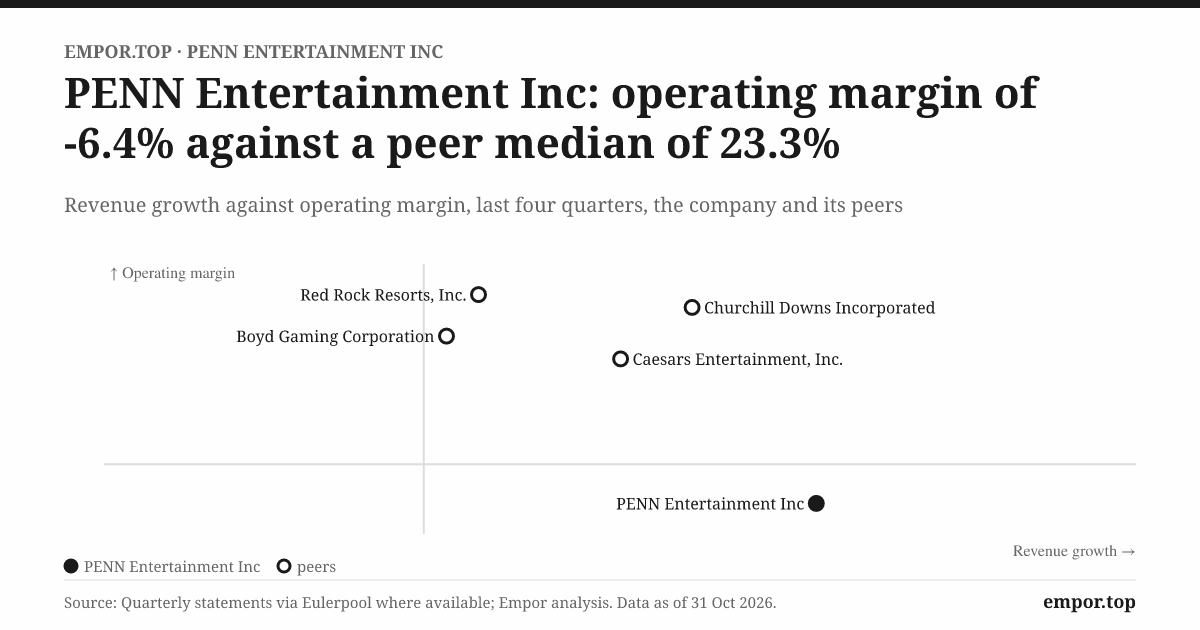
The quarterly trend gives some hope. Operating profit improved steadily through the first half of 2026, from about $97 million in the first quarter to about $132 million in the second, and operating margin reached about 7.1%, the highest since the middle of 2023.5 If capex falls as the four growth projects finish, as management has signaled and as S&P expects, more of that improvement should reach free cash flow.1218 That is the bull case's central mechanism, and it is a testable one.
The 4.7-times mirage
A careless glance at PENN's valuation figures could mislead. One widely quoted price-to-earnings ratio, about 4.7 times, looks extraordinarily cheap. But it is based on earnings for the twelve months to June 2023, before the ESPN impairment and the subsequent losses.5 Over the twelve months to June 2026, PENN's earnings per share were negative, about minus $6.78.5 There is no meaningful current P/E. The more useful measures are price-to-sales of about 0.3 times and price-to-book of about 1.1 times, and even those describe what the market is paying for revenue and accounting equity, not for normalized earnings.5 The real valuation question is what PENN's free cash flow will be once the growth projects are finished and the digital losses settle, and that number has not been demonstrated yet.
The money trail ends at a human question. A company with negative free cash flow, a large rent bill and a record of expensive reversals needs a management team investors trust to allocate capital. In 2025 a large share of shareholders signaled they did not.
IX. Snowden's Reset Meets the Activist's Scorecard
At PENN's 2025 annual meeting, shareholders delivered an unusually blunt message. The advisory vote on executive pay received only about 35.5% support.19 Most say-on-pay votes at large American companies pass with more than 90%. A vote that low is not a quibble; it is a broad rebuke. The board later said that, in response, it reduced CEO Jay Snowden's 2026 target direct compensation by 31% from 2025.19
Snowden is a casino operator by training. A Harvard graduate with an MBA from Washington University in St. Louis, he spent more than a decade at Harrah's and Caesars, rising to senior vice president and general manager of Caesars and Harrah's Atlantic City, before joining PENN in October 2011 to run regional operations.20 He became chief operating officer in 2014, president in 2017, and then chief executive, the job he has held since 2020.20 He was, in other words, the operator who helped integrate Pinnacle and who then led PENN's digital push. That history cuts both ways. He knows the regional casino business intimately, and the digital bets that cost PENN so much were his strategy.
The pay story is easy to state. Snowden's reported compensation was about $15.5 million in 2023, $26.7 million in 2024 and $24.1 million in 2025, years in which the company reported net losses each time, including about $845 million in 2025.194 Most of the pay came in equity awards and incentive compensation. Shareholders objected not just to the size but to the disconnect between rewards and results.
The board's response was meaningful. After the 2025 vote, it cut the CEO's target pay and, according to the 2026 proxy, adjusted the incentive design to tie more of the awards to performance measures.19 At the 2026 meeting, say-on-pay received about 90.1 million votes for and 12.8 million against, a clear recovery in support.21 That is a genuine course correction. The test that remains is whether the redesigned incentives reward durable returns, such as free cash flow per share and return on capital, or near-term milestones that management can reach without changing the underlying economics. Adjusted earnings targets are useful, but they are not the same as cash returned on capital, and a pay plan built mostly on the former can be satisfied while shareholders still wait for the latter.
CFO Felicia Hendrix, a former gaming analyst, remained in her role, which offers continuity on the financial side.4 The company also disclosed a separation agreement in January 2026 with Todd George, a long-serving operations executive.19
HG Vora comes calling
The pay revolt did not happen in a vacuum. HG Vora Capital Management, a New York investment firm, had built a stake of about 9.5% in PENN by September 2024 and became one of its loudest critics.22 In its 2025 proxy campaign, HG Vora argued that PENN's board had overseen value destruction through the Barstool and ESPN deals, overpaid management and failed to hold executives accountable.23 It nominated three directors. PENN cut the number of board seats up for election from three to two, a move HG Vora challenged in court, and at the June 2025 meeting shareholders elected HG Vora's nominees Johnny Hartnett and Carlos Ruisanchez.24 HG Vora's reported common-stock position had fallen to about 4.8% by January 2025 after it restructured its holdings, but it secured board representation through the contest and a later cooperation agreement.22
The specific arguments deserve to be tested. HG Vora said PENN had spent heavily on digital without a path to profit; the $825 million impairment and the ESPN exit later supported that point. It said management was overpaid relative to performance; the 35.5% say-on-pay vote showed that many shareholders agreed. PENN's response was that it had already exited ESPN, cut costs and focused on retail growth and iCasino, and that its board included strong gaming and digital expertise.23 Both sides had a point. The more important fact is that the activist's critique was largely vindicated by later events, and the board changed course only after the pressure was public.
Put the record on one page. Pinnacle expanded the physical portfolio at a disclosed multiple and remains the backbone of the business. TheScore was bought for about $2 billion and has since been marked down. Barstool cost about $551 million and was sold back for nominal cash. ESPN BET cost hundreds of millions in fees and ended in an early termination. And in 2025, a year of negative free cash flow, PENN spent about $186.5 million buying back its own stock and about $224 million repurchasing convertible notes.4
The buyback deserves scrutiny. Repurchasing shares when they trade well below intrinsic value can be smart. Doing it while free cash flow is negative and the company carries high fixed charges means the money effectively came from the balance sheet, not from surplus earnings. That is a judgment call, but it is not the behavior of a company that has set capital discipline as its first priority.
On the calls, management's tone has shifted. In 2025, prepared remarks promised that Interactive would reach profitability and that retail growth projects would contribute. After the ESPN exit and impairment, the fourth-quarter 2025 call acknowledged that the partnership had not delivered and outlined a more modest goal of narrowing losses.16 In 2026, PENN has so far met or beaten its own Interactive loss guidance and raised retail guidance, which is the right direction.13 Where management acknowledged controllable execution problems, such as the product shortcomings of ESPN BET, it did so mostly after the fact.
One more piece of governance evidence is bounded but useful. PwC gave an unqualified opinion on PENN's 2025 financial statements and found no material weakness in internal controls.4 That supports the reliability of the accounts. It says nothing about whether each strategic decision was wise.
So has management earned the credibility to make another strategic bet? The fair answer is that it responded to dissent in a meaningful way, and that credibility now depends on delivery: promised retail growth, positive free cash flow and lower digital losses, sustained over a full year without a new reversal. Which brings the story to the case for and against the company itself.
X. Analysis & Bear vs. Bull Case
At the end of June 2026, PENN's latest quarter looked better than anything in years. Revenue was about $1.9 billion, operating profit about $132 million and net profit about $33 million.5 Operating margin was about 7.1%.5 And yet the trailing twelve months still showed a loss per share, and free cash flow remained negative.5 The company had about $887 million of cash, after spending about $648 million on capital projects in 2025.54 Both sides of the debate can find what they need in those numbers. The task is to weigh them.
Why PENN could win from here
The bull case begins with the properties. PENN operates locally established venues in regulated markets where new supply is limited by law. Its four growth projects are now open, and the transition from riverboats to land-based casinos in Aurora and Joliet is the kind of upgrade that has historically lifted revenue in regional markets. If capital spending falls from its 2025 peak as projects finish, more of the retail segment's improving earnings will reach free cash flow. The company said nine properties set second-quarter records in 2026, and it raised retail guidance, both of which suggest the core business has demand behind it.13
The digital side adds an option rather than a burden. The Interactive loss narrowed, iCasino set a revenue record, and the business is no longer paying ESPN $150 million a year.513 If theScore Bet and Hollywood iCasino can reach break-even or modest profitability, the digital business would stop draining the retail segment and start adding to it. S&P's decision in May 2026 to move PENN's outlook to positive reflects this view: the agency expects lower Interactive losses, earnings from the development projects and lower capex to bring leverage below its 6.5 times threshold.18
Why it might not
The bear case is just as specific. There is no published evidence that PENN's casinos have superior customer retention or pricing power; the advantage is local, not national. The company carries nearly $1 billion of annual rent and a decade-long habit of heavy reinvestment. It has made two costly digital strategy changes in three years, and consolidated profitability has been weak for most of the past four years. Moody's, looking at the same company in March 2026, affirmed its B3 rating but moved the outlook to negative.25 Both agencies rate PENN deep in speculative-grade territory.
A skeptical long-short investor would push the bear case further, and the questions write themselves. Why did a company with negative free cash flow buy back stock in 2025? Why should investors trust a third digital brand when the first two were marked down? Why does PENN not publish customer acquisition cost, active users or property-level returns, when those are the numbers that would settle the debate? And how much of the improvement in 2026 comes from removing ESPN's fees rather than from a better business? None of these questions proves the bear case. Each one identifies a place where PENN asks investors to accept management's framing without the data to check it.
There are also risks that sit outside management's control. States can raise gaming taxes, and online betting has been an attractive target for budget-strapped legislatures because it is new, visible and politically easy to tax. A consumer slowdown would hit regional casinos, whose customers are mostly local and middle-income. Tax disputes can cut both ways: in June 2026, the Indiana Supreme Court ruled in PENN's favor on a wagering-tax dispute covering 2015 to 2017, allowing the company to reverse prior reserves, though reserves for later years remained.5 And the company carried about $40 million of unrecognized tax benefits at the end of 2025, a reminder that tax positions are judgments, not certainties.4
The credit disagreement is useful precisely because it turns on testable assumptions. S&P's positive view depends on Interactive losses continuing to shrink, the new projects ramping as planned and capex falling. Moody's more cautious stance amounts to a bet that those improvements will arrive more slowly, or be absorbed by leases and reinvestment, before they show up as lower leverage.1825 So far, the reported numbers support S&P on Interactive and retail earnings and support Moody's on free cash flow. The next two quarters will show which assumption is closer to reality.
Michael Porter's framework helps explain why regional gaming returns tend to be decent rather than spectacular. The threat of new entrants is low in most local markets, because licenses are scarce and states control supply; that is PENN's strongest structural protection. Buyer power is moderate: individual customers have no negotiating leverage, but they have plenty of alternatives, including nearby casinos, tribal properties, online gaming where legal and every other form of entertainment. Supplier power is meaningful in two places. Landlords, chiefly Gaming and Leisure Properties and VICI, hold long-term leases with escalating rent, and they hold the buildings; PENN cannot easily walk away. Digital service providers and slot manufacturers also have leverage, though PENN does not quantify its concentration with any of them.4 Substitutes are significant and growing, especially online. And rivalry is intense online, where FanDuel and DraftKings can outspend challengers, and moderate offline, where competition is local.
Hamilton Helmer's 7 Powers, which asks what lasting structural advantage protects a business's profits, gives a narrower verdict. PENN has something like a cornered resource in its local licenses and sites, which may sustain local advantage. It may have modest counter-positioning or scale benefits in managing a multi-state loyalty program. But the evidence does not establish a national network effect: more PENN customers in Ohio do not make PENN more valuable to a customer in Louisiana. Switching costs for customers are low; loyalty points are a nudge, not a lock. There is no demonstrated cost advantage over Caesars or Boyd, and the brand power that PENN tried to buy through Barstool and ESPN turned out to be rented, not owned. The moat is real, but it is a series of local moats, and each one has to be maintained with capital.
For investors trying to follow the story, three measures carry most of the weight. The first is retail adjusted earnings before rent, the profit the casinos generate before paying their landlords, which tells whether the core and the new projects are growing; it rose in the first half of 2026 and management raised guidance for the year.13 The second is the Interactive segment's adjusted earnings, which tell whether the digital reset is working; its loss narrowed in the first half of 2026.5 The third is free cash flow after capex and cash lease payments, which tells whether any of this reaches shareholders and lenders; it was negative in both 2024 and 2025.5
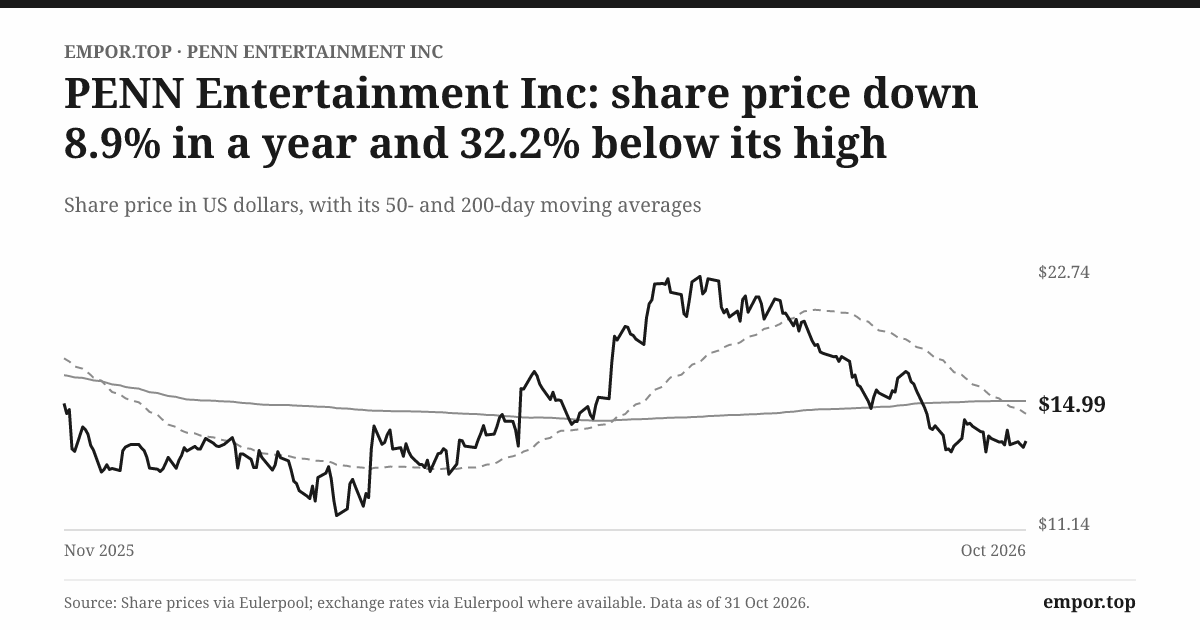
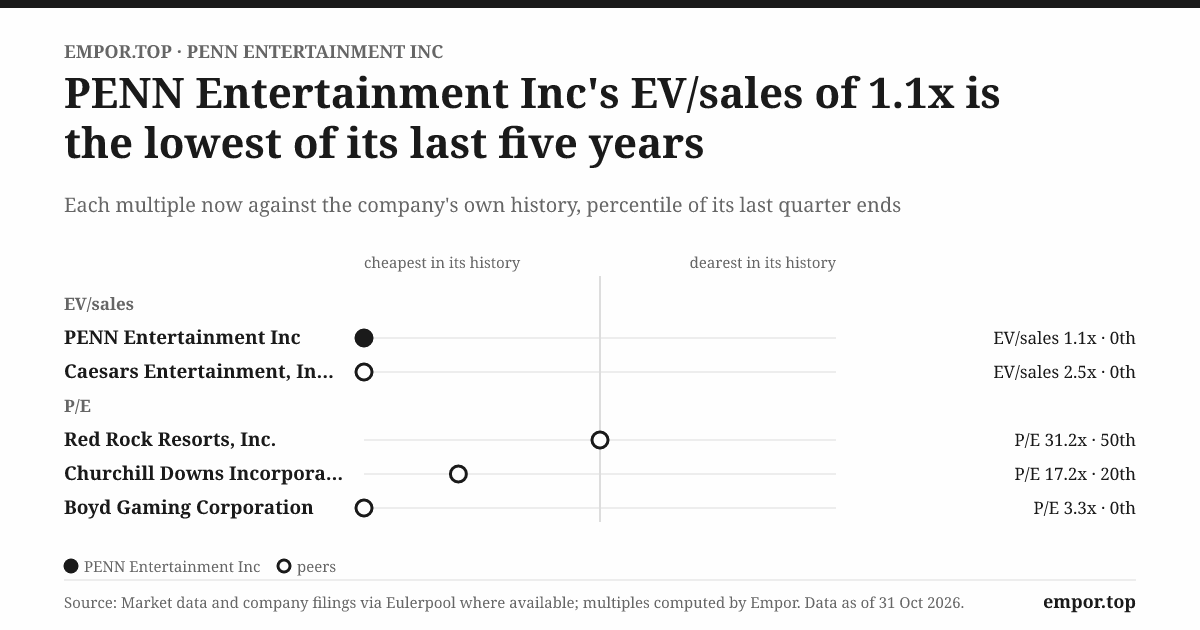
At the end of October 2026, PENN's shares traded at about $15, about 32% below their 52-week high, for a market value of about $2.2 billion.5 Price-to-sales was about 0.3 times, below PENN's own long-run median of roughly 0.6 times, and enterprise value to sales was about 1.1 times.526 MGM Resorts, a larger peer that owns some of its real estate and operates premium destination resorts, traded at about 3.6 times enterprise value to sales on one provider's measure.27 Those comparisons need care: PENN's enterprise value includes large lease obligations, its mix of regional properties earns lower margins, and the peer set differs in geography and ownership structure.
The valuation conclusion has to be conditional. The low sales multiple suggests the market is pricing PENN as a business whose revenue does not reliably reach shareholders, which is a fair description of its last two years. The headline P/E is not a valid current anchor. If retail earnings grow, capex falls and digital losses keep shrinking, free cash flow could turn positive and the multiple would look too low. If any of those three fails, the market's skepticism would look justified. The price, in other words, is a bet on whether the story's fixes become numbers.
XI. Playbook: Business & Investing Lessons
Lay three deals side by side and the whole story fits on a single desk. On the left, the Pinnacle agreement, priced at an announced 6.6 times earnings after synergies.[^7] In the middle, the Barstool sale, roughly $551 million in and nominal cash out.12 On the right, the ESPN contract, $1.5 billion of planned payments, ended barely two years in.13 Same company, same management lineage, three entirely different ways to spend capital. The lessons are written in the gap between them.
The first lesson is that scale is useful when the assets can earn their carrying cost. Pinnacle made PENN a national operator, and its properties still produce most of the company's cash. But, as the lease and fixed-charge burden shows, a bigger portfolio is only a better portfolio if each property clears that bar. For PENN, scale bought resilience and ate returns in the same motion.
The second lesson is the one PENN paid the most to learn: an audience is not a customer, and a customer is not yet a return. TheScore, Barstool and ESPN each brought reach; none, by itself, produced the economics PENN needed. For founders, the line is simple: attention is a raw material, not a product. For investors, the right question about any media-meets-commerce deal is what share of the audience will pay, and at what cost.
The third lesson is that a pivot only earns credibility when the next plan changes the numbers. Exiting ESPN was the right decision. The Interactive loss has shrunk sharply since. But PENN has pivoted before, and the market has learned to wait for proof. A rebrand is cheap; a year of profitable digital economics is not. Management's credibility will come back the way it left, one reported quarter at a time.
The fourth lesson belongs to every regional casino, and PENN makes it vivid: cash is what remains after the property is ready for the next guest. Operating cash looks generous until the slot machines are replaced, the carpet is cleaned, the new hotel tower is finished and the full rent bill is accounted for. The gap between accounting profit and cash available to investors is the lesson. The number that matters is the one at the bottom, after the property has been restored and the rent has cleared.
Put together, PENN's history argues for judging strategy by realized returns and cash economics, not by the size of the addressable market or the fame of a partner's brand. A company can own memorable names and still need a hard accounting of what each customer is worth, what each property earns and what each dollar of capital costs. PENN learned that the expensive way. The next year will show whether the lesson stuck.
XII. The Next Year Is the Test
Tonight, PENN stands at a hinge. The four growth projects are open. The ESPN contract is gone. The convertible notes are repaid, the term loans run to the next decade, and the second quarter was strong. What PENN has not yet shown is a full year in which all of that becomes durable free cash flow and lower leverage. The next annual report, the first to capture the new Aurora and Columbus properties for a full season and a full year of theScore Bet without ESPN, will be the closest thing to a verdict.
The first thing to watch is whether the retail growth projects deliver the earnings run-rate management projected. Riverboat-to-land relocations have a good track record in regional gaming, but the added rent owed to the landlord that helped fund them means the earnings must clear a higher bar. If retail adjusted earnings keep growing and capex falls from its 2025 peak, the bull case's central mechanism works. If earnings flatten while rent rises, the projects will have mostly shifted value to the landlord.
The second is the digital pair, followed separately. TheScore Bet's sportsbook and Hollywood iCasino have different economics, and investors should judge them that way. Continued loss reduction, or a first year of positive segment earnings, would support the reset. A renewed impairment, an escalation in marketing spend, or another brand or partnership shift would weaken it badly. The Alberta launch, which management said would make the third quarter of 2026 the largest Interactive loss of the year, is the near-term test of whether the new discipline survives a new market.17
The third is debt and fixed charges together: principal debt, cash, capex and cash lease payments, not headline leverage alone. A falling leverage ratio driven by higher adjusted earnings is less convincing than one driven by real free cash flow paying down principal.
The last is management's own words. On the next earnings call, the useful comparison is with the second-quarter 2026 prepared remarks and Q&A. Were the targets met, revised with clear reasons, or quietly displaced by new ones? PENN's credibility problem was never that it changed its mind. It was that it changed its mind expensively, and often. The answer to whether that pattern has ended will arrive one quarter at a time.
XIII. The House With a Rent Bill
Go back to the casino floor. The lights are on in Columbus and Joliet and Baton Rouge. The slot machines chime, the dealers shuffle, a bachelor party cheers at a craps table, and a retiree feeds a machine she has played every Tuesday for years. It looks like the house always wins.
But behind the spectacle sit quieter claims: rent, upkeep and debt service. Through every digital rebrand, the casino portfolio was asked to fund the experiment. That is PENN's particular bargain with investors: a regional casino operator trying to build a digital future, with the house's cash expected to cover its costs and leave enough for shareholders.
References
-
PENN Entertainment Form 10-Q, Barstool Acquisition and ESPN Agreement — SEC, 2023-08-09 ↩↩↩↩↩↩↩↩↩↩↩
-
Penn National Gaming and Barstool Sports Announce Strategic Partnership, Form 8-K Exhibit 99.1 — SEC, 2020-01-29 ↩↩↩↩
-
PENN and ESPN Mutually Agree to Early Termination of Sportsbook Agreement — SEC, 2025-11-06 ↩↩↩↩↩↩↩↩↩
-
PENN Entertainment, Inc. 2025 Form 10-K — SEC, 2026-02-26 ↩↩↩↩↩↩↩↩↩↩↩↩↩↩↩↩↩↩↩↩↩↩↩↩↩↩↩↩↩↩↩↩↩↩↩
-
PENN Entertainment, Inc. Q2 2026 Form 10-Q — SEC, 2026-07-30 ↩↩↩↩↩↩↩↩↩↩↩↩↩↩↩↩↩↩↩↩↩↩↩↩↩↩↩↩↩↩↩↩↩
-
PENN National Gaming, Inc. 2015 Annual Report — CompaniesMarketCap, 2016 ↩↩
-
PENN Entertainment Name Change, Form 8-K — SEC, 2022-08-04 ↩
-
PENN Opens Hotel at Hollywood Casino Columbus — Hotel Management Network, 2026-06 ↩↩
-
PENN Entertainment to Pursue Four New Growth Projects — Business Wire, 2022-10-10 ↩↩
-
The Brand-New Hollywood Casino and Hotel Aurora Is Officially Opening — Time Out Chicago, 2026-06-24 ↩
-
PENN Entertainment Q2 2026 Investor Presentation — PENN, 2026-08-06 ↩↩↩↩
-
PENN Entertainment Inc. Reports Second Quarter Results — Business Wire, 2026-08-06 ↩↩↩↩↩↩↩↩↩↩
-
ESPN BET Ends Partnership With PENN Entertainment — Associated Press, 2025-11-06 ↩↩↩↩
-
ESPN Inks Major Gambling Pact With DraftKings After Ending Deal With Penn Entertainment — Variety, 2025 ↩↩
-
PENN Entertainment Q4 2025 Earnings Call Transcript — The Motley Fool, 2026-02-26 ↩↩↩↩
-
PENN Entertainment Q2 2026 Earnings Call Transcript — Stock Analysis, 2026-08-06 ↩↩↩↩
-
S&P Alters Outlook to Positive, Affirms B — Credit Take, 2026-05-04 ↩↩↩
-
PENN Entertainment 2026 Proxy Statement — SEC, 2026-04-27 ↩↩↩↩↩
-
PENN Entertainment 2026 Annual Meeting Results, Form 8-K — SEC, 2026-06-16 ↩
-
PENN Entertainment 2025 Proxy Contest Materials — PENN, 2025-05-07 ↩↩
-
HG Vora Nominees Johnny Hartnett and Carlos Ruisanchez Elected to PENN Entertainment's Board — Business Wire, 2025-06-17 ↩
-
Moody's Revises PENN Outlook to Negative, Affirms B3 — Cbonds, 2026-03-02 ↩↩
 LinkedIn
 WhatsApp
 Reddit
 Hacker News
 Email
 Kindle
 RSS Feed
 Spotify
 Apple Podcasts
 Amazon Music
 Audible
 YouTube