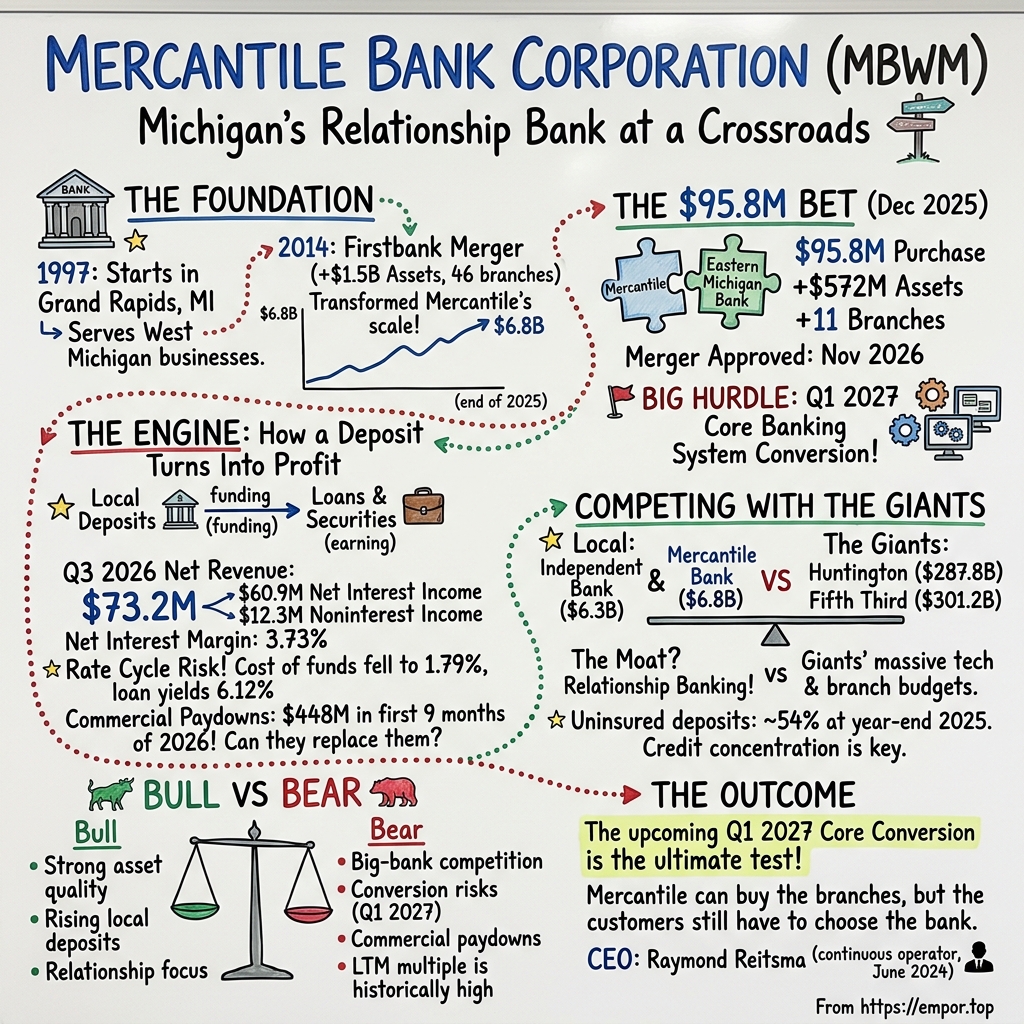
Mercantile Bank Corporation: Michigan’s Relationship Bank at a Crossroads
I. Two Banks, One Coming Conversion
On the last day of 2025, while most of Michigan was getting ready for New Year's Eve, a Grand Rapids bank holding company quietly became a little bigger. Mercantile Bank Corporation closed its purchase of Eastern Michigan Financial Corporation, the parent of Eastern Michigan Bank, for about $95.8 million in cash and stock.12 The press release was short. The work it set in motion was not.
The odd thing about the deal is what happened the next morning. Nothing changed for customers. Eastern Michigan Bank kept its own name, its own branches and its own computer systems, and it kept operating as a separate bank, sitting alongside Mercantile Bank inside the same holding company.23 That is not unusual in American banking, but it tells a listener something important about how these deals really work. Signing the merger agreement and paying the money is the easy part. The hard part is the day a customer in a small Eastern Michigan town logs into online banking and finds that the screen looks different, the debit card has a new logo, and the person who answers the phone works for a company headquartered on the other side of the state. That is the day the acquisition either becomes a franchise or starts to leak.
For most of 2026, that day was something on a project plan. Then, in November, it moved closer. Mercantile told investors that the bank regulators had approved the merger of Eastern Michigan Bank into Mercantile Bank, with the combination of the two banks and the conversion onto a single core banking system planned for the first quarter of 2027.1 Two banks, one coming conversion. This story is about that hinge, and about whether a bank that built its identity on knowing its customers can carry that identity across a bigger map.
The scale of the move needs to be held in proportion. Eastern Michigan brought roughly $572 million of assets and 11 branches into a company that finished 2025 with about $6.8 billion in assets.3 That is meaningful, but it is not transformational in the way Mercantile's last big merger was. It adds a new region, a new pool of local deposits and a set of communities where Mercantile had no presence. It does not change what kind of bank Mercantile is. What it does change is the question investors have to ask about it.
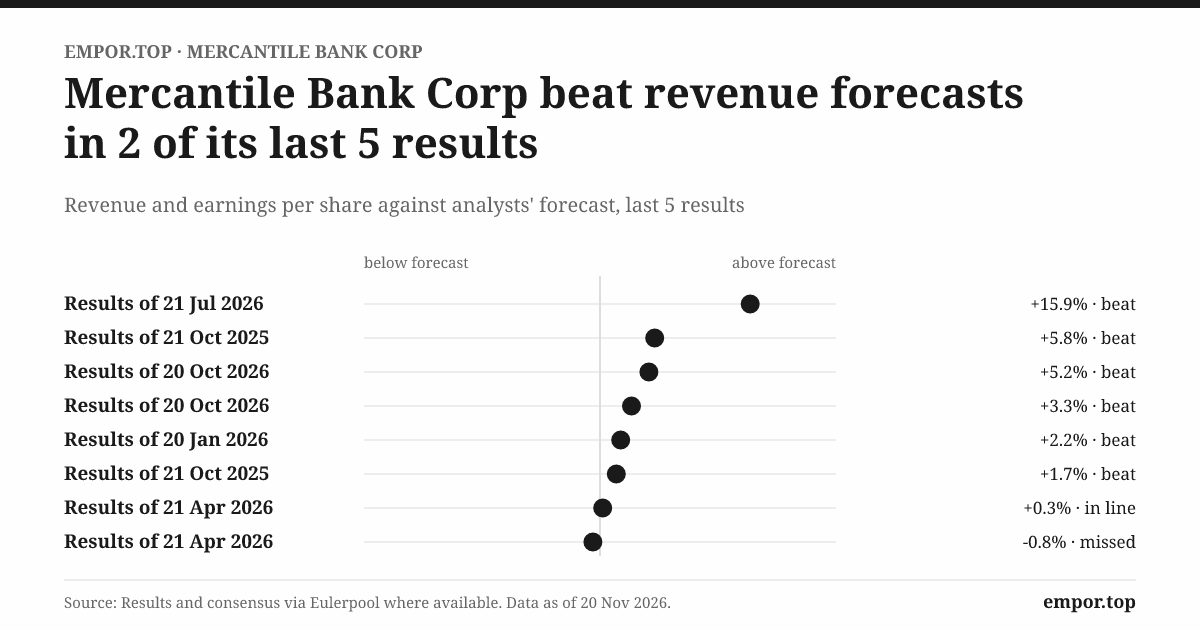
Look at the most recent quarter and the tension is already visible. In the three months to September 2026, Mercantile earned $24.1 million, more than it had earned in the same quarter a year before.4 Yet diluted earnings per share were $1.39, down from $1.46.4 The bank got bigger, and the profit pie got bigger, but each slice got a little thinner. Some of that is simple arithmetic: Mercantile issued close to a million new shares to pay for Eastern Michigan, so there are more owners sharing the earnings.3 Some of it is the cost of running two banks while preparing to merge them. And some of it is the open question at the center of every bank acquisition, which is whether the acquired business will ever earn enough to justify what was paid for it.
That gives the story three questions to carry. The first is competitive. Mercantile is a mid-sized Michigan bank competing every day against national and super-regional banks with balance sheets forty or fifty times larger. Can a local bank hold its ground against much larger competitors, or does "relationship banking" simply describe how a smaller bank survives? The second is about the machinery of banking itself. Mercantile is, at heart, a commercial lender, and commercial lending needs funding. Can its deposit base fund that lending without weakening liquidity or credit quality? The third is about the deal. Will the Eastern Michigan acquisition and the system conversion earn back their cost, or will they become another case of a bank buying growth and calling it strategy?
The answers are not yet known, and anyone who says otherwise is guessing. But the evidence is far from blank. Mercantile has nearly three decades of history, one previous merger that reshaped the company, a balance sheet that tells a clear story about where its money comes from, and a credit record that, for now, looks clean. This is a story about geography and relationships, tested by the colder economics of deposits, loans and integration. To understand why the 2027 conversion matters so much, it helps to go back to the moment Mercantile first decided to grow by buying another bank.
 Subscribe on LinkedIn
II. A Local Bank Becomes a Michigan Franchise
Grand Rapids in the late 1990s was a confident city. The furniture makers, the auto suppliers and the family-owned manufacturers of West Michigan had come through a long industrial restructuring, and the region was full of mid-sized private companies that needed a bank. Many of the banks that had served them were being swallowed by larger out-of-state institutions in the great consolidation wave of that decade. A group of local bankers saw an opening in that disruption: a business bank that would answer the phone, know the owner and make decisions in Grand Rapids rather than in Columbus or Chicago.
Mercantile Bank began operating in December 1997, raising its starting capital through a public offering rather than from a handful of wealthy backers.5 That is a detail worth pausing on. Most community banks start private and list later, if ever. Mercantile was a public company almost from its first day, which meant that from the beginning it answered to outside shareholders and published its numbers every quarter. Michael Price, part of the founding team, has remained the chairman of the board.6 The bank's early pitch was simple: serve West Michigan businesses and the households connected to them, with commercial bankers who stayed in their jobs long enough to learn a customer's business.
For its first decade and a half, Mercantile was a Grand Rapids story. It grew alongside the regional economy, took its share of commercial real-estate and business loans, and like nearly every bank in Michigan, it was battered by the financial crisis and the collapse of the state's auto-dependent economy at the end of the 2000s. It came out of that period smaller in ambition and acutely aware of the risks of concentrated commercial lending. By the early 2010s it was profitable again, but it was still a single-region bank in a state where scale was increasingly the price of admission.
The Firstbank bet
Then came the move that changed the company. In 2014, Mercantile merged with Firstbank Corporation, a holding company based in Alma, in the middle of the state, with a network of community banks spread across Michigan's smaller towns.7 It was structured as a stock merger: Mercantile issued about 8.1 million shares to Firstbank's owners rather than paying cash.7 Firstbank brought roughly $1.5 billion of assets and 46 branches, and the combination made Mercantile the third-largest bank holding company incorporated in Michigan.78
The logic was clear enough. Mercantile had a strong commercial lending culture but relatively few branches. Firstbank had branches and the stable retail deposits that come with them, but operated in markets with slower loan growth. Put the two together and, in theory, the deposit gatherer funds the lender. The cost of paying in stock was that Mercantile's existing owners had to share the company with a large new group of shareholders. That is the trade-off at the heart of every bank merger: more deposits and more geography, in exchange for a thinner slice of the earnings.
What happened next is the strongest piece of evidence for Mercantile's ability to grow. Around the merger, the company had about $2.9 billion in assets; by the end of 2025, including the newly acquired Eastern Michigan, it had about $6.8 billion.38 Net profit grew from $27 million in 2015, the first full year after the deal, to $88 million in 2025, a compound rate of about 12.5% a year.38 More revealing, because it adjusts for the shares issued to Firstbank's owners, diluted earnings per share went from $1.65 in 2015 to $5.46 in 2025, more than tripling.38 Each share of Mercantile owned a lot more earnings a decade after the merger than it did the year after.
That per-share record is worth more than the asset growth, and it is worth being clear about why. Asset growth by itself proves almost nothing about a bank. Any bank can get bigger by buying another bank, by paying up for deposits, or by lending into a boom. What matters is whether the owners are better off. On a per-share basis, Mercantile's owners were, across a period that included a pandemic, near-zero interest rates and then the fastest rate increases in four decades.
But the record has limits, and they matter for how much confidence it should give anyone about the Eastern Michigan deal. Mercantile does not separate how much of its decade of growth came from the Firstbank branches and how much came from new customers won in Grand Rapids, Detroit, Lansing and elsewhere. Mercantile's ten-year revenue growth of about 11% a year includes acquired scale, and much of the earnings growth after 2022 came from rising interest rates, which lifted almost every bank's income regardless of strategy.3 Revenue jumped by more than 40% in 2023 alone, which was the rate cycle at work, not a sudden burst of commercial genius.8 So the Firstbank history shows something narrower than "Mercantile integrates acquisitions well." It shows that Mercantile has absorbed a sizable acquisition before without wrecking its per-share earnings, and that the combined company kept growing afterward. It does not establish the return on the Firstbank deal itself, and it does not predict whether a modern core-system conversion, one of the most operationally dangerous things a bank does, will go smoothly. Technology in 2027 is not technology in 2014, and the people who ran the last integration are not all the people running this one.
A new hand on the wheel
That last point is the change in the story. The Firstbank merger happened under an earlier generation of leadership. The Eastern Michigan deal belongs to Raymond Reitsma, who became chief executive on June 1, 2024, succeeding Robert Kaminski Jr.6 Reitsma had spent more than two decades inside Mercantile, much of it in commercial lending and operating roles, before taking the top job.6 He is not an outsider brought in to shake things up; he is a product of the culture he now leads. That gives continuity, and it also means his first major strategic bet will be judged on its own merits rather than against a predecessor's plan. Mercantile has grown by buying scale before. Now it has to prove, under new leadership and in reported results, that it can do it again. And before judging whether the latest expansion was worth it, it helps to understand exactly how a bank like this turns a customer's deposit into a dollar of profit.
III. How a Deposit Turns Into a Dollar of Profit
Picture a family-owned manufacturer outside Grand Rapids, a supplier of metal parts with a hundred or so employees. Every two weeks it runs payroll. Every month it pays suppliers and collects from customers. Between those dates it holds a few million dollars of operating cash, and it needs somewhere safe to put it. It also has a line of credit, a borrowing facility it can draw when a big order requires buying steel ahead of payment and repay when the customer's cheque arrives. The interest rate on that line floats, rising and falling with market rates. The company uses its bank to send wire transfers, to manage who in the finance team can approve a payment, and perhaps to run payroll itself.
That one customer contains almost the whole Mercantile business model. The operating cash is a deposit, which for the bank is funding: money it borrows from the customer, often at a low rate or no rate at all. The credit line is an earning asset: money the bank lends out at a higher rate. The difference between what Mercantile earns on its loans and securities and what it pays for its deposits and borrowings is called net interest income, and it is the engine of the company. The wire transfers, the payroll processing and the treasury tools generate fees on top.
An analogy helps. Think of the bank as a shop that buys money wholesale and sells it retail. Deposits are the stock it buys in. Loans are what it sells. The markup is the spread. If the shop can buy its stock cheaply, because customers leave money in low-cost checking accounts, and sell at a good price, because businesses need credit, it makes money. If it has to pay more for stock, because depositors demand higher rates or shift to time deposits, the markup shrinks.
In the third quarter of 2026, Mercantile's revenue in the sense that matters for a bank, its net interest income plus its fees, was about $73.2 million.4 Of that, about $60.9 million was net interest income, and about $12.3 million came from fees and other noninterest income.4 Roughly five dollars out of every six, in other words, came from the spread. Everything else is supplementary.
That is why it is important not to read a bank's "revenue" the way one would read a factory's. The fact sheet lists Mercantile's revenue at about $103 million for the quarter, but that figure includes gross interest income, before subtracting what the bank paid its depositors.8 For a bank, gross interest income is less like sales and more like the till receipts of a shop before paying for stock. The number that tells the real story is the margin.
Mercantile's net interest margin, the spread measured as a percentage of its earning assets, was 3.73% in the third quarter of 2026.4 That is a healthy figure for a commercial bank, and the story of how it got there is the story of the rate cycle. The bank's cost of funds, the average rate it paid for all its deposits and borrowings, fell to 1.79% from 2.25% a year earlier.4 Over the same period, the yield on its loans fell too, from 6.35% to 6.12%.4 Both sides of the shop's prices fell, but the cost of stock fell further than the selling price. Lower funding costs, more than higher loan yields, lifted the margin.
That relationship is the key to understanding Mercantile's earnings in the near term. When the Federal Reserve cut rates, the floating-rate commercial loans that make up much of Mercantile's book repriced downward fairly quickly. A credit line tied to a benchmark rate moves when the benchmark moves. But deposits also repriced, as Mercantile lowered the rates it paid on money-market accounts and time deposits came due and rolled into cheaper ones. For a while, the bank managed to cut its funding cost faster than its lending yield fell. That is a sign of pricing discipline on the deposit side, and perhaps of a growing base of operating accounts that do not chase the highest rate. It is not a permanent state of affairs. Funding costs cannot fall forever, and once most deposits have repriced, further rate cuts would hit loan yields without a matching benefit on funding.
The fees around the spread
The fees deserve their own look, because they are not all the same kind of money. In 2025, Mercantile's noninterest income totaled about $41.6 million.3 The biggest piece, about $13 million, came from mortgage banking: originating home loans and selling many of them to investors.3 Card fees brought in about $9.2 million, service charges on deposit and sweep accounts about $8.1 million, payroll processing about $3.5 million, bank-owned life insurance about $3.3 million and interest-rate swap fees about $2 million.3
Those lines behave very differently. Treasury-management charges, card fees and payroll processing reflect a customer relationship that exists month after month. A business that runs its payroll through Mercantile and sweeps its excess cash every night is not likely to move banks on a whim. Mortgage income, by contrast, rises and falls with how many people are buying and refinancing homes, which depends on mortgage rates far more than on anything Mercantile does. Swap fees are lumpier still. When a commercial borrower wants to fix the rate on a floating loan, Mercantile enters a swap with the customer and an offsetting swap with a larger bank, earning a fee in the middle; at the end of 2025 the customer swaps had a notional value of about $961 million, matched by nearly identical offsetting positions.3 Those fees arrive when deals close, not on a schedule.
So the fee mix diversifies Mercantile's income but does not change its nature. The bank is a spread business with useful relationship fees attached.
Not every dollar of deposits goes out as a loan, and the part that does not is its own small story. At the end of September 2026, Mercantile held about $628 million in cash and equivalents, most of it parked at the Federal Reserve Bank of Chicago, and about $1.10 billion of securities available for sale.5 That pool is the bank's shock absorber: money it can reach quickly if depositors withdraw or borrowers draw on their lines. It also carries a cost of its own. Bonds bought when rates were low lose market value when rates rise, and those unrealized losses flow into shareholders' equity even when the bank has no intention of selling. In 2026, movements in those unrealized losses reduced Mercantile's equity.5 A bank's liquidity is safety, but it is safety with a price tag that moves with the bond market.
It is also, as far as its accounts are concerned, one business. Mercantile reports a single operating segment.3 There is no separately disclosed wealth management arm, no mortgage company with its own profit line, no division whose margins can be compared with another's. Any story that talks about Mercantile's "commercial business" and "retail business" as if they were separate profit centers is inventing a split the company does not publish. What can be said is that commercial lending dominates the loan book. At the end of 2025, commercial and industrial loans plus owner-occupied commercial real estate, loans to businesses secured by the buildings they work in, made up about 55% of commercial loans.3 Commercial credit lines typically run 12 to 24 months and float with market rates.3
That design has a built-in vulnerability, and it is the right place to end this part of the story. Variable-rate commercial loans are wonderful when rates rise: the bank's income goes up almost immediately while deposit costs lag. In falling-rate periods the same feature becomes a headwind. And rates are only one of three forces pulling on the engine. The second is deposit competition: if larger banks or online banks start paying more for deposits, Mercantile has to match them or lose funding. The third is loan demand: if customers have excess cash, they draw less on their lines and pay down what they owe. These three forces can move in opposite directions at the same time. Rates fall, which helps funding costs but hurts loan yields; competitors push deposit rates up, which offsets the help; customers pay down loans, which shrinks the earning asset base. A bank's earnings are the net result of that tug-of-war. Which brings the story to the competitors pulling on the other end of the rope.
IV. The Relationship-Banking Claim Meets Bigger Rivals
Imagine the owner of that metal-parts company deciding where to bank. On one side of the table sits a Mercantile commercial banker who has visited the factory floor, knows the owner's daughter is taking over the business, and can get a credit decision made in Grand Rapids. On the other sits a banker from one of the giant regional banks with a large Michigan presence. That bank has a slicker app, a sprawling branch network, a full suite of international payment and capital-markets products, and a funding base so large it can afford to price a loan aggressively to win the account. The owner has to decide which matters more: the person, or the platform.
That is the competitive question Mercantile faces every day, and the scale gap is stark. After acquiring Eastern Michigan, Mercantile had 54 offices and about $6.8 billion in assets.31 The closest Michigan-based peer in size, Independent Bank Corporation, headquartered near Grand Rapids, had about $6.3 billion in assets at the end of September 2026.[^9] Then there are the giants. Huntington Bancshares, which has a very large Michigan footprint, reported total assets of about $287.8 billion at the same date.9 Fifth Third Bancorp, another major Michigan competitor, reported about $301.2 billion.10 Each is more than forty times Mercantile's size.
Those comparisons need care. Huntington and Fifth Third operate across many states, and their total assets say nothing about how much of the Michigan commercial market they hold. Mercantile does not publish its local market share, and asset size is not market share. But the comparison does make one thing clear. When it comes to technology budgets, product breadth and the ability to absorb a bad quarter, Mercantile is not competing on equal terms.
The forces on a mid-sized bank
It helps to think about the pressures on a bank like Mercantile using the classic framework of competitive forces. Start with customers. A business can move its deposits with a few weeks of paperwork, and it can refinance a loan at another bank if the price is better. Buyers have real power, especially large commercial borrowers who are courted by every bank in town. Next, rivals. The Michigan market has national banks, super-regionals, other community banks and credit unions, which do not pay federal income tax and compete hard for household deposits. Then substitutes: private credit funds lend to mid-sized businesses, online banks and money-market funds compete for deposits, and fintech payment tools nibble at treasury services. Suppliers, in a bank's case, are mostly its depositors, which means the supplier and the customer are often the same company; when depositors can demand higher rates, the bank's cost of goods rises. And the threat of new entrants is muted by regulation: it is hard to start a bank, and capital rules constrain every player. That last force protects Mercantile somewhat, but it protects every incumbent equally.
Against all of that, what does Mercantile actually have? The claim, repeated in its strategy, is relationships: local decision-making, bankers who stay, a service model that larger banks cannot easily replicate. There is a plausible mechanism behind the claim. When a business runs its payroll, its payments and its cash management through one bank, moving is painful. The treasury staff has to learn new software, vendors have to be told about new account numbers, approval workflows have to be rebuilt. That friction is a genuine switching cost, and it is strongest precisely in the operating accounts that provide a bank's cheapest funding.
But the evidence for the moat is thinner than the claim. Mercantile does not publish customer retention rates. It does not disclose how its deposit pricing compares with that of its competitors, its share of the local commercial market, or how concentrated its deposits are among its largest customers.35 Without those numbers, "relationship banking" cannot be distinguished from "the way a smaller bank competes because it has no other choice."
What the operating record shows
The best evidence Mercantile has comes from its recent deposit growth. In the first nine months of 2026, local deposits grew by about $438 million.4 Management credited new commercial customers and expanded use of treasury-management products.4 At the same time, the bank's cost of funds fell. Growing local deposits while paying less for them is exactly what a bank with a real franchise should be able to do. It suggests that customers are choosing Mercantile for something other than the highest rate.
That signal is useful. It is not proof. Nine months of deposit growth in a falling-rate environment can reflect timing, the arrival of a few large customers, or the fact that every bank's deposit costs were falling at once. The deposits from the Eastern Michigan acquisition also complicate year-over-year comparisons, although the $438 million figure refers to growth within the year. What would turn the signal into proof is persistence: several years of local deposit growth, a stable or rising share of noninterest-bearing accounts, and evidence that the bank keeps its customers through the systems conversion and through the next period of rising rates.
The strategy that rides on that deposit growth is coherent. The company says it wants to attract more local deposits and use them to replace higher-cost funding: brokered deposits gathered through intermediaries, out-of-area deposits and advances from the Federal Home Loan Bank.54 It also says it wants to expand in Southeast Michigan, including the Detroit metropolitan area, where the commercial market is large and where Eastern Michigan's footprint gives it a closer presence.2 The company says it wants to manage its loan-to-deposit ratio, the share of deposits that are lent out, so that loan growth does not run ahead of funding. These are the right goals for a mid-sized commercial bank. They are also exactly the goals every mid-sized commercial bank in America has, which is a reminder that the strategy alone is not the edge. Execution is.
The historical record, read honestly, narrows the moat claim rather than rejecting it. Mercantile's earlier growth shows that its model can win and keep business against larger competitors. It does not show that it wins because of superior relationships rather than because of competitive pricing, the Firstbank deposit base, or a favorable rate cycle. The moat is plausible and unproven. The numbers that would confirm it, retention and pricing relative to peers, are numbers the company does not publish.
So the competitive test is precise. Can Mercantile acquire and keep profitable business relationships without matching the technology and branch budgets of banks forty times its size? Its answer so far has been to grow by adding geography where its bankers can compete on knowledge rather than scale. The latest piece of geography cost $95.8 million. Whether that was a sensible price is the next question.
V. The $95.8 Million Bet on Eastern Michigan
When Mercantile announced its agreement to buy Eastern Michigan Financial Corporation in 2025, it was buying a bank of a very different character from itself. Eastern Michigan Bank was a community bank with 11 branches across the eastern side of the state, a long-established local deposit base and a relatively modest loan book.112 Mercantile was a commercial lender hungry for deposits. On paper, the fit was the Firstbank logic again, in miniature: a deposit-rich partner for a loan-heavy acquirer.
The price, once the deal closed on December 31, 2025, came to about $95.8 million.3 Mercantile paid in two currencies. It issued 924,999 new shares, valued at about $44.9 million, and paid about $50.9 million in cash.3 Mixing cash and stock was a compromise. All stock would have diluted existing owners more heavily; all cash would have drained capital that a bank needs to absorb losses and fund growth.
What the money bought
The clearest way to understand any bank acquisition is to open the box and look at what came out of it. Under acquisition accounting, the buyer marks everything it receives to fair value on the closing date. Mercantile recorded about $201 million of acquired loans, about $198 million of securities and about $475 million of deposits.3 That ratio is the whole story of Eastern Michigan. It was a bank that held almost as much in securities as it did in loans and had a lot more deposits than either. For Mercantile, which had been leaning on wholesale funding to support its lending, those deposits were the prize.
After subtracting liabilities from assets at fair value, Mercantile valued the net identifiable assets it bought at about $72.6 million.3 Within that figure was a $20.4 million "core deposit intangible," an accounting estimate of how much the acquired depositor relationships are worth because they are likely to stay at below-market cost.3 The difference between the price paid and the net assets, about $23.2 million, was recorded as goodwill.3
Goodwill is a word worth translating for a listener. It is the premium a buyer pays above the measurable value of what it bought, the price of expectations. In this case, the core-deposit intangible and the goodwill together represented about $43.6 million of value that exists only if the deposits stay and the combined bank earns more than the two banks would separately. If the depositors leave, the intangible shrinks. If the combined bank disappoints badly, the goodwill can be written down. Those are the two places where a poor integration would eventually show up in the accounts.
Cheap or expensive?
Was $95.8 million a sensible price? The honest answer is that it depends on the comparison, and the comparisons point in different directions.
The merger proxy, the document sent to Eastern Michigan's shareholders before they voted, included a set of selected regional bank deals as a benchmark.11 Against that group, Mercantile's offer valued Eastern Michigan at about 165% of its tangible book value, the equity left after removing intangible assets, and at about 11.6 times its earnings over the previous twelve months.11 The median deal in the comparison group was priced at about 152% of tangible book and about 17.4 times earnings.11 So Mercantile paid a modestly higher premium to book value than the typical deal, but a noticeably lower price for each dollar of earnings.
Those two numbers usually say the same thing, and here they diverge, which hints at what kind of bank Eastern Michigan was: profitable relative to its equity. A buyer paying a book premium above the median but an earnings multiple well below it is buying a bank whose earnings already exceed what its book value would typically produce. On this benchmark, it is hard to call the deal an obvious overpayment.
But benchmarks are chosen, not given. A different, narrower set of 2025 Midwest bank deals showed higher price-to-book and earnings multiples for Mercantile's offer relative to that sample, which is a reminder that the verdict on "cheap or expensive" is partly an artifact of which deals are put next to it.11 Selected comparison sets in merger proxies are assembled by financial advisers to support a fairness opinion; they are evidence, but they are not neutral. The safest conclusion is the modest one: the price was within the normal range for regional bank deals of that period, not a bargain and not a reach.
What the deal cost existing owners is clearer. Mercantile estimated that the acquisition would dilute its tangible book value per share by about 5.8%, with a projected "earnback" period of about 3.6 years.11 Earnback is a banker's term for the time it takes for the extra earnings from a deal to rebuild the tangible book value lost on day one. A period under four years is generally considered acceptable in the industry. But it is a projection, built on assumptions about cost savings and revenue that have not yet been tested.
The early scorecard
The reason for the deal was strategic as much as financial. Eastern Michigan gave Mercantile entry into a part of the state it did not serve, a base of local deposits to fund its commercial lending, and a way to reduce its reliance on higher-cost wholesale money.2 Whether it is working is starting to show up in the numbers, and the early readings are mixed in the way early readings usually are.
In the third quarter of 2026, Eastern Michigan contributed about $5.8 million of net interest income and about $0.5 million of fee income to the combined company, while adding about $4.1 million of expenses.45 Before credit costs and taxes, that leaves roughly $2.2 million a quarter of pre-tax contribution. Put that against the price and the shape of the bet is visible. The acquired bank pays for its own operating costs, but its contribution is small relative to the $95.8 million paid, and the cost savings that usually justify a bank merger cannot fully arrive until the two banks run on one system and share one back office. Until then, Mercantile is paying for two sets of technology, two sets of regulatory reporting and the conversion project itself.
That is the sense in which the third-quarter EPS decline matters: the expected gains have not yet caught up with dilution. That is normal for a deal at this stage. It would become a problem only if the gap persisted after the conversion.
The Firstbank precedent is relevant, but limited: Mercantile has done this before, though its record does not settle whether the deal met its original projections or generated an attractive return.
Which leaves the deal hanging on an operational hurdle. The two banks still need to convert onto one core system, consolidate their operations and, above all, keep the depositors whose loyalty the $20.4 million intangible is betting on. Only then will the 3.6-year earnback be something investors can judge rather than take on trust. In the meantime, the bank has to keep lending, and its commercial customers have been doing something unexpected.
VI. When Commercial Relationships Pay Down
There is a peculiar kind of bad news in commercial banking that looks like good news. A customer sells a building and repays its mortgage. Another refinances its debt into the bond market or with a private lender. A third has had a strong year and uses its cash to pay down its credit line. Each of those customers is healthy, and none of them has defaulted. But each repayment takes an earning loan off Mercantile's books, and the bank has to make a new one just to stand still.
Through 2025 and 2026, Mercantile was living with an unusual amount of this good news. Commercial loan payoffs and partial paydowns totaled about $312 million in 2025, up from about $194 million in 2024.3 In the first nine months of 2026 they reached about $448 million, including about $147 million in the third quarter alone.4 Management attributed the repayments to asset sales, refinancing and customers using excess cash to reduce their borrowing.4
That explains a puzzle in the numbers. Mercantile reported strong commercial loan originations through 2026, yet loan growth was modest. At September 30, 2026, total loans were about $4.95 billion.5 The bank was running fast to stay roughly in place. The lesson is that origination volume, the number most banks like to highlight, does not automatically translate into a bigger loan book. A commercial lender's growth is the difference between what it lends and what its customers repay, and the second figure is much harder to predict.
Aggregated paydowns also hide something. Mercantile does not disclose whether the repayments were concentrated among a few large relationships or spread across many smaller ones.3 A bank where several large customers walk away for a cheaper refinancing is in a different position from one where hundreds of small customers are simply flush with cash. The first would raise questions about the relationship model; the second would be a cyclical blip.
A quiet credit book
Where the commercial book looks undeniably strong is credit quality. At the end of 2025, nonperforming loans, the loans where borrowers have stopped paying or are unlikely to pay in full, were about $7.9 million, or 0.16% of total loans.3 Net charge-offs, the loans actually written off after recoveries, were about $1.9 million for the year, or 0.04% of average loans.3 Those are very low figures by the standards of any period. To put them in perspective, a bank losing 0.04% of its loans in a year loses four cents on every hundred dollars it lends.
By September 2026, nonperforming loans had risen modestly to about $9.7 million, while the allowance for credit losses, the reserve the bank sets aside for expected future losses, stood at about $56.4 million, or about 1.1% of loans.5 That allowance covered nonperforming loans almost six times over.5 In plain terms, Mercantile has reserved far more than its currently troubled loans would cost even if every one of them went to zero.
The favorable picture needs its counterweights, and they belong right next to it. At the end of September 2026, Mercantile had about $266 million of unfunded commercial construction commitments: money it has promised to lend to developers as their projects progress.5 Construction lending is historically where commercial banks get hurt in a downturn, because a half-finished building is worth much less than a finished one and the borrower's ability to repay depends on a sale or lease that has not yet happened. In the third quarter, the bank also extended the terms of about $7.2 million of commercial and industrial loans to borrowers in financial difficulty.5 That is a small sum against a nearly $5 billion book, but it is a reminder that the quiet credit quarter has some noise underneath it.
Where the money comes from
The other half of the commercial story is funding. At September 30, 2026, deposits were about $5.61 billion.5 Wholesale funding, the out-of-area deposits and Federal Home Loan Bank advances that a bank uses when local deposits are not enough, was about $325 million, roughly 5% of total funds, down from about 8% at the end of 2025.5 Federal Home Loan Bank advances made up about $305 million of that, and Mercantile still had about $929 million of borrowing capacity available against its collateral.5 Noninterest-bearing checking accounts, the cheapest and most relationship-driven funding a bank has, made up about 25.8% of deposits.5
This is the part of the picture that best supports the relationship-banking claim. Local deposits rising, wholesale funding falling and a quarter of deposits paying no interest at all is what a healthy commercial franchise should look like.
The vulnerability sits inside the same funding base. At the end of 2025, about 54% of Mercantile's deposits were uninsured, meaning they exceeded the federal deposit insurance limit.3 That is typical of a commercial bank, because a business's operating account easily runs above that threshold. But uninsured deposits are the ones that leave fastest in a scare, as the bank failures of 2023 showed. KBRA, the credit rating agency that affirmed Mercantile's ratings in November 2026, cited the bank's stronger local deposit generation as a positive, but also flagged its concentration in Michigan commercial credit, its uninsured deposits, its regulatory capital ratios that are comparatively lower than those of its rated peers, and its sensitivity to deposit competition.12 That is a balanced verdict from an outside party with no stake in the story: a good franchise with a thinner cushion than some peers.
A note on the cash-flow statement is worthwhile here, because it can mislead anyone used to reading industrial companies. In 2025, Mercantile's reported cash from operations was only about $17 million, against net profit of about $88 million.38 For a manufacturer, that gap would be alarming. For a bank, it mostly reflects timing movements in other assets and liabilities, while the real flows of the business sit elsewhere: loans made and repaid and securities bought and sold are investing activities, while deposits and borrowings are financing activities.3 Mercantile's cash flow statement is a map of funding movements, not a measure of how much profit turns into spare cash.
The forward tests are therefore clear and concrete. Watch the classified and nonperforming commercial loans each quarter, and whether charge-offs stay near the current very low level. Watch whether construction loans migrate into problem categories as the $266 million of commitments are drawn. Watch the noninterest-bearing share of deposits and the coverage of uninsured deposits by available liquidity. All of these will be tested while the bank is also going through the most demanding operational project in its recent history, under a chief executive who has held the job for little more than two years.
VII. A New CEO Inherits an Acquisition-and-Conversion Test
Raymond Reitsma did not arrive at the top of Mercantile from outside. When he became chief executive on June 1, 2024, he had already spent more than two decades inside the bank, much of it in commercial lending and later in broader operating leadership.6 He had joined Mercantile's board in 2017.6 He is, in the language of the industry, a banker's banker, someone who learned the business by underwriting loans and managing the people who make them, rather than by running a strategy department or arriving from an investment bank.
That background shapes how to read his first big decision. An insider CEO usually inherits a culture rather than imposing one. He knows which customers matter, which lenders are good and where the bodies are buried in the loan book. What he may not have, at least on day one, is a record of leading the kind of large, technical, all-hands project that a systems conversion demands. Within eighteen months of taking the job, Reitsma was steering the Eastern Michigan acquisition to close. The integration and conversion, the bigger test, are still ahead of him.
He does not do it alone. Charles Christmas, the long-serving chief financial officer, has remained in the role through the transition, and the filings for 2025 and 2026 show no change in the CFO seat.36 In a conversion year, continuity in finance matters more than it might seem. Someone has to keep the regulatory reporting, the accounting for the acquired loans and the capital planning straight while the operations teams move customers from one system to another.
Paid on the scorecard
The way Mercantile pays its senior executives tells investors what the board wants them to focus on. Reitsma's total compensation in 2025 was about $1.77 million, including stock awards and performance-based pay.6 His annual incentives and equity awards were tied to earnings per share, return on assets, net interest margin, efficiency and asset quality, with clawback provisions allowing the company to recover pay in certain circumstances.6 That set of measures is sensible for a bank: it rewards profit per share rather than size, efficiency rather than empire-building and credit quality rather than growth at any cost. An incentive plan that measures EPS directly should, in principle, discourage acquisitions that dilute shareholders without earning it back.
Reitsma also owns Mercantile stock. The 2026 proxy reported his ownership at 89,537 shares.6 At recent share prices, that stake is worth about $5 million, several times his annual pay. It is meaningful personal alignment. It is also, of course, a small fraction of a company with around 17 million shares outstanding and no controlling shareholder.6 The largest holders are index and quantitative fund managers: BlackRock held about 7.1%, Dimensional Fund Advisors about 6% and Vanguard about 6%, as of the proxy's record date in March 2026.6 No activist or concentrated value investor appears in the disclosed register, which means accountability runs mainly through the board and the annual vote.
Promises against outcomes
The early record under Reitsma is good, though it should be read carefully. Net income rose to $88.8 million in 2025 from $79.6 million in 2024.3 But that improvement came from several sources, not all of them under management's control. Higher net interest income and fee income helped. So did lower provisions for credit losses and a lower tax bill; the effective tax rate dropped to about 12.7% in 2025 from about 18.4% the year before.38 Because Eastern Michigan closed on the final day of the year, it had no effect on 2025's earnings at all.3 So the 2025 rebound shows that the core bank ran well in Reitsma's first full year. It does not yet show that his acquisition strategy works.
Governance signals are steady rather than dramatic. The board reported that 92% of its directors were independent.6 At the May 2026 annual meeting, shareholders approved executive pay by a wide margin, with about 10.54 million votes in favor and about 323,000 against.13 Among the directors, David Ramaker had the most votes withheld, about 404,000, still a small fraction of the votes cast.13 These are monitoring signals, not evidence of a governance crisis; they are worth tracking in the next vote rather than reading as a verdict.
One area where small banks sometimes give skeptics something to chew on is lending to insiders, because a community bank's directors are often prominent local business owners who also borrow. At Mercantile, the amounts are small. Loans to directors, executive officers, their families and related businesses were about $6.3 million at the end of 2025, against about $11.3 million of commitments, down from the year before.3 Part of the earlier decline came from changes in who counted as a related party rather than from repayments, which makes the year-to-year trend a poor guide, but against a loan book of nearly $5 billion the exposure is immaterial.3
The auditor's opinion was similarly clean. For 2025, the outside auditor issued an unqualified opinion on the financial statements and found Mercantile's internal controls over financial reporting effective, with the allowance for credit losses identified as the critical audit matter, the area requiring the most judgment.3 There was one boundary on that clean bill of health, and it matters for the story: Eastern Michigan Financial was excluded from management's assessment of internal controls for 2025, a normal treatment for a business acquired in the final days of a year.3 Integrating the acquired bank's controls, its loan systems, its reporting processes, its access permissions, is part of the conversion work still ahead. It is a future execution test, not a past failure.
What to listen for
For anyone tracking whether management's narrative holds together, the quarterly earnings calls are the place to test it. The calls for the third and second quarters of 2026 are the most relevant recent checks, the fourth-quarter 2025 call brackets the deal's completion, and the 2024 calls capture the leadership transition.1415 The useful exercise is to compare what management says in its prepared remarks with how it answers analysts. The questions that matter are the same ones this story has been asking. How much further can deposit costs fall, and what happens to the margin when they stop? Are the commercial paydowns slowing, and are they concentrated among a few large relationships? How fast are expenses growing, and how much of that growth is temporary conversion cost versus permanent? What is Eastern Michigan contributing, and is it running ahead of or behind the merger plan? And how confident is the team about the conversion timeline?
A management team that answers those questions with specific numbers, and whose numbers line up from one call to the next, earns credibility. A team that answers with adjectives does not. Reitsma's record is short enough that every call over the next year adds a meaningful chunk to it. The alignment is in place; the execution record is still being written. And that is exactly where the market's valuation of the stock becomes interesting, because the share price is already making a judgment about how that record will read.
VIII. Analysis & Bear vs. Bull Case
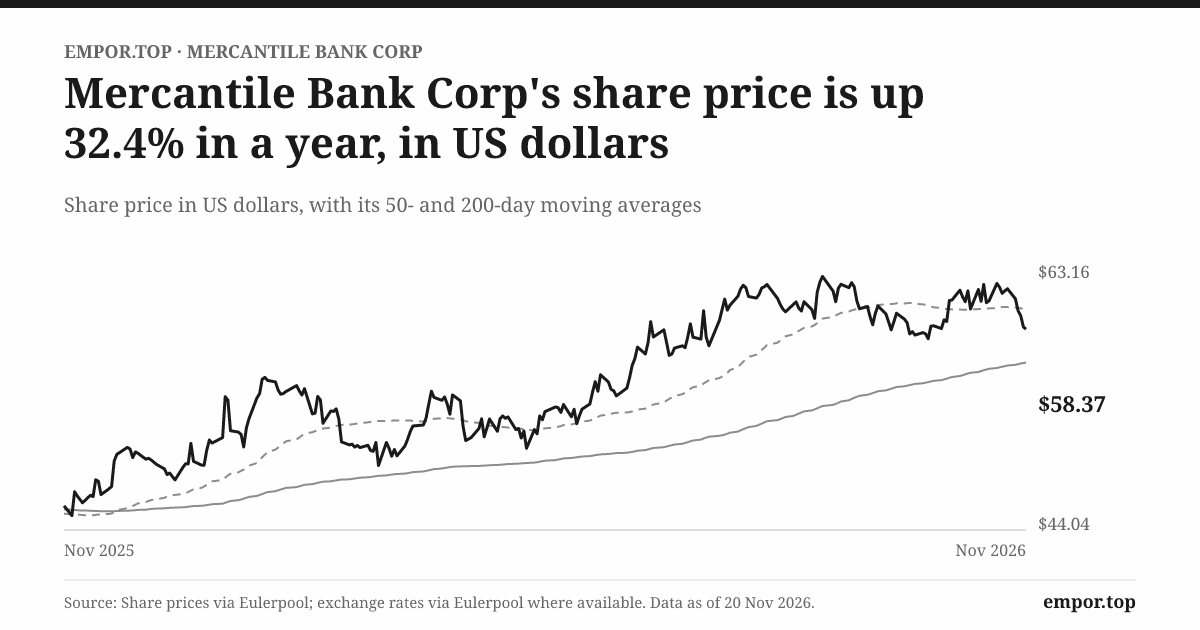
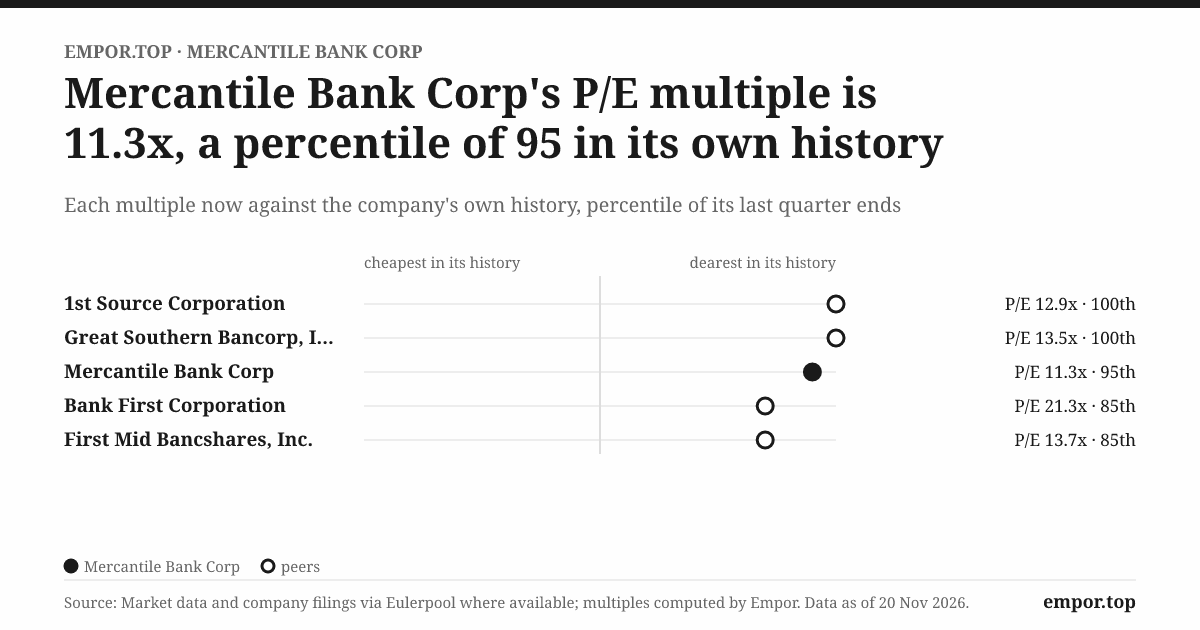
On November 20, 2026, Mercantile's shares closed at about $58.37, roughly 6% below their 52-week high and well above the low of about $44 reached in the previous twelve months.16 The company was worth about $1 billion on the stock market. At that price, investors were paying about 11.3 times the bank's trailing twelve-month earnings and about 1.4 times its book value.165 The dividend yield was about 2.7%.16
Those numbers only mean something against a benchmark. Over the past five years, Mercantile's median price-to-earnings multiple was about 9.8 times.16 The November multiple was about 15% higher than that. For a Michigan peer, Independent Bank Corporation was trading at about 9.8 times analysts' forward earnings estimates for 2026 and about 1.3 times book value in November 2026.17 Because those are forward multiples and Mercantile's is trailing, the comparison is not exact; forward multiples are typically lower when earnings are expected to grow. But the broad shape is clear. At that price, the market was paying a little more for Mercantile than it usually had, and a little more than for its closest in-state peer.
One clarification is essential for anyone reading bank valuations. Enterprise-value ratios, which add debt to a company's market value and subtract its cash, are close to meaningless for a bank. Mercantile's calculated enterprise value is actually negative, because the bank's cash and securities exceed its market value plus borrowings, but that is an accounting artifact.16 For a bank, deposits and cash are the raw material of the business, not spare money sitting on the balance sheet. The right anchors are price-to-earnings, price-to-book, capital strength, credit quality and returns.
On those anchors, Mercantile's foundations look sound. At the end of September 2026, its common equity tier 1 ratio, the core regulatory measure of loss-absorbing capital, was about 11.4%, and tangible common equity, the shareholders' stake after stripping out goodwill and intangibles, was about 9.2% of tangible assets.12 KBRA estimated that the bank's available liquidity covered its uninsured and uncollateralized deposits about 2.3 times over.12 Return on equity over the trailing twelve months was about 12.5%.16 Those are respectable numbers for a mid-sized commercial bank, though KBRA's own judgment is that the capital ratios sit below those of its rated peers.12
The moat, tested once
This is the place to argue the competitive advantage properly, using Hamilton Helmer's framework of seven sources of lasting power: scale economies, network effects, counter-positioning, switching costs, branding, a cornered resource and process power.
Scale economies work against Mercantile, not for it. Banking technology, compliance and marketing costs are largely fixed, and the larger banks spread them over balance sheets forty times the size. Network effects are minimal in commercial banking; one customer's presence does not make the bank much more valuable to the next. Counter-positioning, the advantage of a business model that incumbents cannot copy without harming themselves, is the most interesting candidate. Large banks have spent years centralizing credit decisions and standardizing products to cut costs. A local bank offering judgment-based, relationship-driven credit is doing something a big bank could do, but only by unwinding its own cost model. That is a real, if modest, form of counter-positioning, but it is the same positioning every community bank claims.
Switching costs are the strongest candidate, given the friction of moving an operating account. Branding is local at best. A cornered resource could be the bank's experienced commercial lenders, but talent can be poached, and Mercantile does not disclose lender retention. Process power, the hard-to-copy operating discipline of a business like Toyota's, might show up in Mercantile's unusually low loss rates, though one strong credit cycle is not enough to prove it.
Put that together and the verdict is a narrow one. Mercantile has one plausible power, switching costs in operating accounts, and one partial one, counter-positioning against centralized large banks. Neither is proven by published retention or pricing data. Relationship banking may help win operating deposits and treasury business, but public evidence does not establish that Mercantile keeps customers longer or prices them better than its peers. The recent fall in funding costs alongside rising local deposits is the best evidence in its favor. Several more years of it, through a conversion and a rate cycle, would make the case.
The bull case
The optimistic reading starts with the franchise. Mercantile's history of per-share growth, low credit losses and rising local deposits supports the view that it can extend its model into Eastern Michigan. If the conversion goes smoothly and the expected cost savings arrive, the combined bank should earn more per share than either could alone, and the 3.6-year earnback would be on track. In that world, a premium to the bank's own historical multiple could be justified by a bigger, better-funded franchise with the same credit discipline.
The bear case
The pessimistic reading starts with execution and valuation. Mercantile's scale, limited disclosure of retention and market share, commercial concentration and funding risks leave the relationship moat unproven. The Eastern Michigan integration adds execution risk as the rate tailwind fades, and the current share price already sits above the bank's five-year median multiple, which means some of the good outcome is already priced in.
A skeptical investor would press on three points. First, whether Eastern Michigan can meet its earnback projection: Mercantile's prior deal shows acquisition experience, not proven returns, and management has not published a look-back on either. Second, the relationship claim remains difficult to test without retention and deposit-pricing data. Third, KBRA's observation that regulatory capital is comparatively lower than that of peers is the kind of concern that becomes important only in a downturn, which is exactly when it matters most.
Three numbers to watch
Out of everything Mercantile reports, three measures will say the most about whether the bull or the bear case is unfolding. The first is the net interest margin and the cost of deposits behind it, which improved in the third quarter as funding costs fell.4 If the margin holds after the conversion, the deposits held. The second is credit: nonperforming loans edged up during 2026, while recent nonperformers and charge-offs remained very low.53 The third is the integration itself: conversion expenses and, once the banks are combined, the return on the larger balance sheet. That third measure has no clean reading yet, which is precisely why it is the most important.
The live question for any investor is therefore not whether Mercantile is a good bank today. On current credit and funding measures, it is a solid one. The question is what evidence would justify paying a premium to its own historical multiple. The honest answer is the evidence that does not yet exist: a clean conversion, retained deposits and a combined bank that earns more per share than the two did apart. History offers some lessons about how likely that is.
IX. Business & Investing Lessons
The Firstbank merger in 2014 and the Eastern Michigan deal in 2025 put the same strategic choice on stage twice, eleven years apart. Each time, Mercantile decided that the fastest way to strengthen its funding and widen its map was to buy a bank rather than build branches one at a time. Firstbank added about $1.5 billion of assets and 46 branches; Eastern Michigan added about $572 million and 11.73 Each time, the acquisition was only the first act. The second act, turning bought geography into a stronger franchise, is where value is made or lost. Mercantile's story offers a handful of lessons that belong to this company more than to any other.
The first lesson is about deposits. A relationship is an asset only when the customer keeps bringing the deposits back. Mercantile's strongest recent evidence is that local deposits grew by more than $400 million in nine months while its funding costs fell. That is what a relationship looks like when it shows up in a bank's accounts. But the company does not publish the retention data that would prove the relationships are durable rather than cyclical. For founders building any relationship business, the point is that a relationship is not a feeling; it is a behavior that can be measured, and the companies that measure it, and publish it, earn the right to call it a moat. For investors, the absence of that measurement is itself information.
The second lesson is about acquisitions. Scale bought is not scale earned. When Mercantile paid $95.8 million for Eastern Michigan, it bought deposits, branches and customers on paper. The $20.4 million core-deposit intangible on its balance sheet is a bet that those customers will stay. The 3.6-year earnback projection is a bet that the combined bank will earn more than the parts. Neither bet is settled by closing the deal. The Firstbank history shows that Mercantile can come through a merger with growing per-share earnings, which is better than many acquirers manage. But it never published the receipt. For investors in any serial acquirer, the lesson is simple: the scorecard is per-share earnings and returns years after closing, not assets the day after.
The third lesson is about reading a bank. A bank's cash flow is a map of funding movements, not a factory's cash register. Mercantile's 2025 operating cash flow of about $17 million against profit of about $88 million would terrify an industrial analyst. For a bank, it says almost nothing about earnings quality, because loans and securities flow through investing activities and deposits through financing activities. The lesson travels well beyond Mercantile. Every analytical tool has a domain where it works and a domain where it misleads, and the most dangerous errors come from applying the right tool to the wrong business. A bank is understood through its margin, its credit, its funding and its capital.
The fourth lesson is about credit. The quiet credit quarter is built in the underwriting years before it. Mercantile's charge-offs of four cents per hundred dollars lent in 2025 are the result of loans made in 2021, 2022 and 2023, not of anything done in 2025. By the same logic, the $266 million of construction commitments on its books today will be tested in 2027 and 2028, when the buildings are finished and the leases signed, or not. A bank that went through the Michigan collapse of the late 2000s knows this better than most, and its current loss record suggests the memory lingered. The lesson for investors is to give a bank credit for its underwriting discipline only after a full cycle has tested it.
Taken together, Mercantile's story argues that local banking can scale, and that a relationship bank does not have to stay small to stay relevant. But it also argues that purchased geography becomes shareholder value only when deposits stay, customers deepen their use of the bank, and returns outlast the conversion costs. Which brings the story to the months that will decide it.
X. Epilogue
Tonight, Mercantile Bank Corporation is two banks waiting to become one. The regulatory approvals are in hand.1 The Eastern Michigan branches still carry their own name, their own systems and their own customer habits. Somewhere in Grand Rapids, a conversion team is working through data mappings, test runs and customer communications for a weekend in the first quarter of 2027 when the two banks are scheduled to merge onto a single core platform.1 For most customers, the event will be a letter, a new card and a different login screen. For Mercantile's shareholders, it is the moment the $95.8 million bet starts to be scored.
The first thing to watch is the conversion itself, measured through four lenses. Do customers stay? A successful conversion should see deposit balances in the acquired branches hold steady in the quarters after the switch, not drift away to competitors who take the opportunity to court unsettled customers. Do the systems work? A smooth conversion is invisible; a bad one becomes local news, with frozen cards, missing payments and long lines at branches. Do expenses behave? Conversion costs should peak around the switch and then fall, and the combined bank's operating expenses should begin to reflect the savings of running one system rather than two. And do the acquisition-related costs stop recurring? A merger that is still generating "one-time" costs a year after closing is a merger that is not finished.
The second thing to watch is the deposit franchise as the balance sheets combine. If the cost of funds keeps falling or holds steady, and the share of noninterest-bearing deposits rises from its current level of roughly a quarter, the relationship model is doing its job. If funding costs climb while competitors are cutting theirs, or if noninterest-bearing balances shrink as business customers move cash to higher-yielding accounts, the moat is narrower than the strategy assumes.
The third is growth and credit. For the first time, investors will be able to compare a full year of the combined bank with the year before, and the important exercise will be separating organic commercial loan growth from the acquired base. If the paydowns of 2025 and 2026 subside and originations keep their pace, the loan book should start to grow on its own. At the same time, the construction commitments will be drawn and tested, and the quarterly readings of nonperforming and classified loans will show whether the quiet credit years have continued.
Each outcome has a clear meaning. A clean conversion with retained deposits and falling costs would turn the Eastern Michigan deal from a projection into a proof point, and give Mercantile a stronger case for doing it again. A rough conversion, with customer attrition and rising costs, would not sink a well-capitalized bank, but it would stretch the earnback, put pressure on per-share earnings and raise questions about the next acquisition before it is announced.
The deal's promise was local relationships at a larger scale. The numbers that matter in 2027 are not the ones that show Mercantile got bigger. They are the ones that show the relationships survived the move.
XI. Outro
Mercantile can buy the branches; the customers still have to choose the bank.
References
-
Approval of Eastern Michigan Bank Merger — Form 8-K, Mercantile Bank Corporation / SEC, 2026-11-17 ↩↩↩↩↩
-
Completion of Merger with Eastern Michigan Financial Corporation — Mercantile Bank Corporation, 2025-12-31 ↩↩↩↩↩
-
Form 10-K for fiscal 2025 — Mercantile Bank Corporation / SEC, 2026-02-27 ↩↩↩↩↩↩↩↩↩↩↩↩↩↩↩↩↩↩↩↩↩↩↩↩↩↩↩↩↩↩↩↩↩↩↩↩↩↩↩
-
Mercantile Bank Corporation Announces Third Quarter 2026 Results — Mercantile Bank Corporation, 2026-10-20 ↩↩↩↩↩↩↩↩↩↩↩↩↩↩
-
Form 10-Q for the quarter ended September 30, 2026 — Mercantile Bank Corporation / SEC, 2026-10-30 ↩↩↩↩↩↩↩↩↩↩↩↩↩↩↩↩↩
-
2026 Proxy Statement — Mercantile Bank Corporation / SEC, 2026-04-02 ↩↩↩↩↩↩↩↩↩↩↩↩
-
Firstbank Merger Completion — Form 8-K, Mercantile Bank Corporation / SEC, 2014-05-30 ↩↩↩↩
-
Form 10-K for fiscal 2014 — Mercantile Bank Corporation / SEC ↩↩↩↩↩↩↩↩
-
Form 10-Q for the quarter ended September 30, 2026 — Huntington Bancshares, 2026-10-27 ↩
-
Fifth Third Bancorp Reports Third Quarter 2026 Earnings — Fifth Third Bancorp, 2026-10-20 ↩
-
Eastern Michigan Merger Proxy Statement/Prospectus — Mercantile Bank Corporation / SEC, 2025-10-20 ↩↩↩↩↩↩
-
KBRA Affirms Ratings for Mercantile Bank Corporation — KBRA, 2026-11-10 ↩↩↩↩
-
2026 Annual-Meeting Voting Results — Form 8-K, Mercantile Bank Corporation / SEC, 2026-05-21 ↩↩
 LinkedIn
 WhatsApp
 Reddit
 Hacker News
 Email
 Kindle
 RSS Feed
 Spotify
 Apple Podcasts
 Amazon Music
 Audible
 YouTube