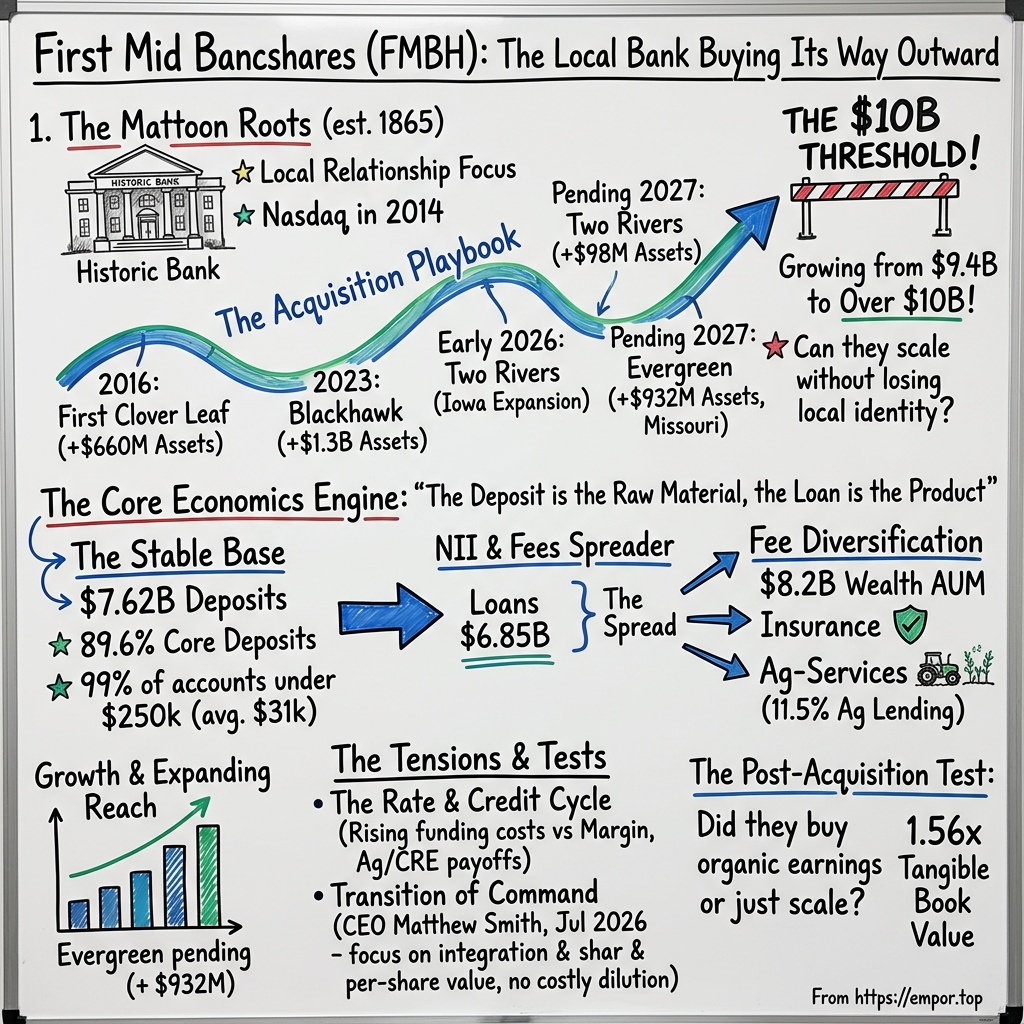
First Mid Bancshares: The Local Bank That Keeps Buying Its Way Outward
I. A $9.4 Billion Bank at the Edge of Its Next Chapter
On October 29, 2026, Matthew Smith had two pieces of news to deliver, and they pulled in opposite directions. The first was a record: First Mid Bancshares had just earned $33.3 million in a single quarter, or $1.25 a diluted share, more than the downstate Illinois bank had ever made in three months.1 The second was a purchase. On the same day, First Mid announced that it had agreed to buy Evergreen Bancshares, the Missouri parent of American Bank of Freedom, a lender that traces its roots to 1880.2
The record told investors what First Mid already was. The purchase told them what it wanted to become.
Smith had been chief executive for less than four months. He was describing a company of about $9.4 billion in assets, $6.85 billion in loans and $7.62 billion in deposits.1 Evergreen would add roughly $932 million of assets, $712 million of loans and $727 million of deposits, spread over ten banking centers around St. Louis, along the Interstate 70 corridor, and out to Rochester, Illinois and Westfield, Indiana.2 Put the two together and the arithmetic lands on a number every American banker watches: $10 billion.
Crossing $10 billion in assets is not a trophy. It is a toll booth. Above that line, a bank's debit-card interchange fees become capped under the Durbin Amendment, and supervisory expectations for risk management, compliance and stress testing rise. Many banks approach the threshold, pause, and decide whether they are big enough to pay the toll. First Mid's own deal presentation said the company had already invested in "the people, technology, risk management, compliance, and governance infrastructure required to operate above $10 billion," and that Evergreen's earnings and synergies would "more than offset" the cost of the crossing.3 Management estimated the deal would lift 2028 earnings per share by about 5% even after the modeled Durbin hit, and by about 7% without it.3
That is the management case. The independent question is harder and more interesting. Can a relationship bank keep growing by buying other relationship banks without wearing away the very local franchise that makes it worth owning?
The stakes come in three parts. The first is how much of First Mid's growth is its own. Over the past decade the company has completed ten transactions and agreed to an eleventh, eight of them whole-bank acquisitions, adding roughly $7 billion of assets in total once Evergreen is included.3 A bank that grows mostly by acquisition can report rising earnings for years while its underlying franchise stands still.
The second is credit. First Mid advertises a 20-year average net charge-off rate of just 0.14% of loans, against an industry average of 0.83% over the same span.3 Yet in the year to September 2026, the share of its loans that regulators would call adversely classified climbed from about 1.3% to about 2.0%, with agricultural borrowers prominent among the downgrades.3 A long clean record is reassuring. It is not a promise about the next cycle.
The third is funding. A community bank is, at bottom, a machine for turning cheap, sticky local deposits into loans. If those deposits stop being cheap, or stop being sticky, the machine slows down no matter how many new branches are bolted on.
It helps to be precise about what an investor actually owns here. First Mid Bancshares, Inc. is a Delaware holding company listed on Nasdaq. Underneath it sit First Mid Bank & Trust, an insurance agency, a wealth-management and trust company, a farm-management and agricultural-services arm, and a brokerage operation.4 All of those businesses report into one set of consolidated numbers, and no outside parent or controlling owner sits above them.45 But the center of gravity is unmistakable. In 2025 the bank's net interest income, the spread it earned between loans and deposits, was $256.2 million, against $93.1 million of all other income combined.4 The fee businesses are real, and they matter. The bank is the business.
Scale frames everything that follows. Old National Bancorp, the Evansville, Indiana lender that is one of the Midwest's largest regional banks, held about $74 billion of assets at the end of September 2026, nearly eight times First Mid's size.6 There is a small irony in the comparison. One of First Mid's earliest modern growth steps, in 2015, was buying twelve branches with about $441 million of assets from Old National itself.3 First Mid is now big enough to be the buyer in most community-bank conversations in Illinois, Missouri, Indiana, Iowa and Wisconsin. It is nowhere near big enough to spread technology and compliance costs the way a $74 billion bank can.
That middle position, too big to be a sleepy local thrift and too small to be a national platform, is where First Mid has chosen to live. The verdict that frames the rest of the story is straightforward. First Mid is a regional community bank with deposit-gathering and lending at its core and a ring of fee businesses around it. Whether its acquisitions are extending genuine local relationships or simply adding scale, shares and integration work is the question every following chapter tries to answer.
To answer it, the story has to go back to a small city in east-central Illinois, and to the habit of patient expansion that began there.
 Subscribe on LinkedIn
II. The Bank That Grew One Community at a Time
Mattoon, Illinois, is a railroad town of the prairie, set among corn and soybean fields roughly halfway between Chicago and St. Louis. In 1865, the year the Civil War ended, a national bank opened there. First Mid describes it today as the oldest nationally chartered bank in Illinois, and it has paid dividends since 1879.3 The holding company still lists a post office box in Mattoon as its investor-relations address.3
That longevity is part of the brand, and it deserves a careful hearing rather than a celebration. A bank that has survived the Panic of 1893, the Great Depression, the farm crisis of the 1980s and the financial crisis of 2008 has clearly done something right in credit. But age alone does not compound shareholder capital. Plenty of century-old banks have been sold at modest prices because they never found a way to grow. What makes First Mid's history relevant to an investor is not the founding date. It is what the company did with its name in the last dozen years.
For most of its life, First Mid was a downstate Illinois bank with a long community-banking tradition, not a technology platform and not a national lender. It traded publicly for decades, but only moved its shares to Nasdaq in 2014.3 At the end of that year, its total assets were about $1.6 billion.3 By September 2026, they were about $9.4 billion.1 Almost six times larger in under twelve years is not something a Mattoon bank achieves by opening branches one at a time.
The modern expansion is better understood as a series of deliberate, nearby steps. In 2015, First Mid bought the twelve Old National branches. In 2016, it acquired First Clover Leaf, a whole bank with about $659 million of assets and seven branches in the Metro East area across the river from St. Louis.3 That deal arrived partway through the year, which is why the 2016 annual report showed only a slice of its contribution. That year First Mid reported net interest income of $71.2 million, other income of $26.9 million, and net income of $21.8 million.7
Then the cadence picked up. SCB Bancorp in 2018 brought about $458 million of assets and ten branches. LINCO Bancshares and its Providence Bank, a Missouri franchise of about $1.2 billion, followed in 2021. Delta Bancshares and Jefferson Bank, with about $718 million, closed in February 2022.3 Along the way First Mid also bought loan books and banking teams from Stifel in 2020 and 2021.3 Then came the two larger deals that define the recent era: Blackhawk Bancorp in Beloit, Wisconsin, about $1.3 billion of assets, which closed in August 2023, and Two Rivers Financial Group in Burlington, Iowa, about $1.2 billion, which closed on February 28, 2026.3 Evergreen, pending, would be the ninth whole bank.
The pattern is consistent enough to describe as a playbook. Find a community bank in a market adjacent to an existing First Mid footprint, often one whose leaders the company already knows. Pay mostly in stock. Keep the local lenders and customer-facing staff. Then convert the systems, consolidate overlapping branches and back-office functions, and offer the acquired customers First Mid's wealth, insurance and farm-management services. The Blackhawk deck stated that the two banks had had a lending relationship since 2013.8 In the Evergreen announcement, Smith said First Mid had "known the organization and its leadership for many years."2 In community banking, a decade of shared loan participations and conference dinners is how deals get sourced, and that familiarity is a genuine advantage in buying banks that are not formally for sale.
The acquisitions also needed capital, and First Mid has been willing to go to the market for it. It raised $29.3 million in a private placement in June 2015, launched a $20 million at-the-market equity program in August 2017, raised $36 million in an overnight common-stock offering tied to the SCB deal in June 2018, and sold $96 million of subordinated debt tied to the LINCO acquisition in October 2020.39 None of that is unusual for an acquisitive bank. It simply establishes that the growth was financed, in part, by asking shareholders and bondholders for more money, and that the 2017 program was a routine capital-raising tool rather than a listing event or a sign of distress.
So what is First Mid actually buying each time? The cynical answer is balance sheet: loans and deposits that can be stacked on a shared cost base. The generous answer is relationships: local depositors and borrowers who stay because they trust their banker, plus the right to sell them a farm-management contract, a crop-insurance policy or a trust account. The truth will sit somewhere between, and the long history cannot settle where. The heritage is a real source of local identity and of acquisition introductions. It is not, on its own, proof of a moat. That proof has to come from how the machine makes money today, and from whether the customers it buys behave like customers it earned.
III. The Loan Is the Product; the Deposit Is the Raw Material
Picture a business owner in Decatur, Illinois, who wants to finance a new warehouse. She has banked with the same lender for fifteen years, and she has a relationship manager who knows her receivables, her seasonal cash swings and her children's names. She also has a phone, and on it are three competing term sheets.
That is the whole economics of First Mid in one decision. The bank has to price her loan high enough to cover what it pays for the deposits that fund it, the losses it expects if the warehouse business stumbles, and the cost of the people and systems that serve her, while staying low enough that she does not walk to the bank down the street. Multiply that decision by tens of thousands of borrowers and hundreds of thousands of depositors, and the result is a bank's income statement.
The mechanics are simple to state. A bank earns interest on loans and securities and pays interest on deposits and borrowings. The difference, net interest income, is the engine. Fees from wealth management, insurance, card transactions and service charges are the auxiliary motors.4 The engine generated most of First Mid's revenue in 2025, with fee businesses supplying the rest.4
Bankers compress the engine's efficiency into one number, the net interest margin: net interest income as a percentage of the assets that earn it. A margin of 3.76%, First Mid's reading in the third quarter of 2026, means that for every $100 of loans and securities, the bank earned about $3.76 more in interest over a year than it paid out.1 That figure is respectable for a community bank. It is also delicate, because it is the difference between two much larger numbers. In the third quarter, earning assets yielded about 5.51% and the bank's average cost of funds was about 1.85%.1
The third quarter offered a clean demonstration of how that delicate difference moves. Asset yields rose six basis points, or six hundredths of a percentage point, as older loans repriced and new ones went out at around 6.25% for new loans and 6.5% for renewals.3 But the average cost of funds rose ten basis points, and the cost of interest-bearing deposits jumped eighteen basis points to 2.16%.1 Management attributed the rise to rate movements and "deposit pricing competition."1 The result was a margin three basis points lower than in the second quarter. Three basis points sounds trivial. On roughly $8.5 billion of earning assets it is real money, and more important, it shows which side of the bargain held the power that quarter. Depositors did.
The deposit side tells the same story in its composition. Total deposits grew by $44.2 million in the quarter, but the growth came almost entirely from money-market accounts, which jumped by about $199 million after a product refresh and marketing push earlier in 2026.3 Money-market accounts pay competitive rates. Meanwhile, interest-bearing checking fell by about $98 million and non-interest-bearing deposits, the cheapest money a bank can have, slipped by about $21 million.1 First Mid kept its deposit base growing, but it paid up to do it.
The rate cycle of 2022 to 2024 had already shown how much that matters. In 2022, First Mid paid about $31.6 million in total interest expense. By 2024, after the Federal Reserve's fastest tightening in a generation and the addition of Blackhawk's balance sheet, it paid $128.7 million, roughly four times as much.3 Interest income rose too, but net interest income went from $184.3 million in 2022 to $193.5 million in 2023 and $228.7 million in 2024, far less than the growth in the balance sheet would suggest, before improving to $256.2 million in 2025 as assets repriced.3 The engine kept running through the shock. It did not run free.
Around the engine sit the fee businesses, and they deserve proportion rather than either dismissal or hype. First Mid Insurance Group is the largest community-bank-affiliated insurance agency in Illinois, according to the company, and it earned a record $32.3 million of revenue in 2025, up about 13% from 2024.34 It has kept buying, too, adding Downs Insurance Agency in January 2026 and assets from AAdvantage Insurance in July 2025.3 First Mid Wealth Management earned $22.9 million in 2025 and managed about $8.2 billion of assets by September 2026, with brokerage offered through a partnership with Raymond James.34 The agricultural-services unit calls itself the largest farm manager in Illinois, overseeing about 290,000 farmland acres across eight states, and in the third quarter it agreed to acquire Winship Farm Management, which is expected to add more than 8,600 acres over three years.3
Those businesses do three useful things. They diversify revenue away from interest rates. They deepen customer relationships, because a farmer whose land is managed by First Mid and whose crop is insured by First Mid is less likely to move his operating line to a rival. And they are capital-light compared with lending. Over the twelve months to September 2026, noninterest income was about 26% of total revenue, with insurance about a third of fee income, wealth management about 27% and debit-card revenue about 17%.3
But each comes with its own cycle. Insurance commissions include contingent payments from carriers that arrive heavily in the first half, which is why insurance revenue fell by $1.3 million from the second quarter to the third.1 Wealth fees track the market value of client assets, so a bear market shrinks them automatically. The company's own materials say fee income has "historically" represented about 30% of total revenue, while the trailing figure is closer to 26%.3 Fees cushion the bank. They do not replace it.
There is also a forward wrinkle buried in that debit-card slice. Card revenue is exactly the line the Durbin Amendment cuts when a bank crosses $10 billion. In the third quarter, ATM and debit-card revenue was about $4.9 million.1 The Evergreen deal model already assumes part of that income will shrink as the cap phases in, which is why management quotes two accretion figures rather than one.3 Crossing the threshold converts a growing fee stream into a regulated one.
So the economics come down to a plain sentence. First Mid makes most of its money on the spread between what borrowers pay and what depositors receive, and its fee businesses smooth the ride without changing the destination. That leaves the central puzzle of any community bank. When a depositor can move money with two taps and a borrower can collect three term sheets in an afternoon, how much pricing power does a local bank really have?
IV. The Moat Is a Deposit Relationship, Not a Branch Count
One statistic in First Mid's investor presentation is worth more than any slogan about community banking. Ninety-nine percent of the bank's deposit accounts hold less than $250,000, and the average account balance is about $31,000.3
That matters because $250,000 is the federal deposit-insurance limit. A depositor below it has little reason to fear for her money, which is why she is unlikely to stampede out the door during a panic. Silicon Valley Bank's collapse in March 2023 was, among other things, a lesson in what happens when a bank's deposits are concentrated in a small number of large, uninsured, well-informed accounts. First Mid's are the opposite: a very large number of small balances belonging to households, farmers and small businesses. Only about 22% of its deposits are uninsured.3 KBRA, the rating agency, described the base as granular and listed core deposits and liquidity among the bank's strengths when it affirmed First Mid's ratings in September 2026.10
Granularity is real protection against a run. It is a different thing from pricing power, and the distinction is the heart of this chapter.
Think of First Mid's competitive position through the forces that actually press on a bank. Depositors are buyers of safety and convenience, and they can split balances across institutions or chase a better money-market rate online without closing their checking account. Borrowers are buyers of credit, and a creditworthy business can refinance with a larger bank, a credit union, an insurance-company lender or a private-credit fund. Larger rivals, like Old National, spread the fixed costs of digital banking, cybersecurity and compliance over a balance sheet many times larger. Regulators cap how much risk any bank can take, which limits how aggressively a smaller lender can buy growth. Against all that, First Mid's defenses are local presence, long tenure with customers and smaller, relationship-heavy accounts that larger banks often serve less attentively.
The way to test those defenses is through the numbers a relationship bank should be able to show, not through the language in its brochures. The first is the share of deposits that are core, meaning ordinary checking, savings, money-market and smaller time deposits rather than brokered or very large certificates. At September 2026, that share was 89.6%.3 It sounds high, and it is respectable. But the trend runs the wrong way. Core deposits fell from 93.5% of the total in 2023 to 88.8% in the first quarter of 2026, before recovering to 89.6% by September.3 KBRA explicitly flagged increasing use of brokered deposits.10 Brokered money is the opposite of a relationship: it comes through intermediaries, pays market rates and leaves when someone else pays more.
The second test is the loan-to-deposit ratio, which shows how fully the bank lends out its deposit base. First Mid's has moved between roughly 90% and 94% in recent years, and KBRA put it at 92% at mid-2026.310 That is not alarming. It does mean the bank has less spare deposit capacity than a lender with a ratio in the 70s, so loan growth has to be funded either with new deposits, which cost more at the margin, or with wholesale borrowing. That is exactly what Blackhawk's appeal was in 2023: its loan-to-deposit ratio was about 65%, so it brought surplus funding along with its branches.8
The third test is the cost of deposits, which moved against First Mid in the third quarter.1 A bank with genuine deposit pricing power holds its funding costs below the market when rates rise. First Mid's deposit costs have trailed the market in the past, but in the latest quarter they rose faster than its asset yields.
The other half of the franchise is credit, and here First Mid's record is genuinely strong. The two-decade loss record remains strong.3 Its current allowance for credit losses, $86.5 million, is almost twice the $45.1 million it charged off in total over those twenty years.3 That is not a marketing claim that can be waved away. It is a long, cycle-spanning record, and it suggests that the bank's lenders have known their borrowers well.
Agricultural lending is where that local knowledge should matter most, and it is a real specialty. At the end of September 2026, First Mid's agricultural loans totaled $791 million, about 11.5% of all loans.3 Roughly 54% of that portfolio is secured by farmland, at an estimated 45% loan-to-value ratio, meaning the land behind the loans was worth, on the bank's estimate, more than twice what was owed.3 From 2000 through 2025, First Mid's agricultural real-estate net charge-offs totaled only about $5 million.3 Combined with the farm-management and insurance businesses, the bank has a credible claim to understand Midwestern agriculture better than a generalist lender.
But a specialty is not a separate growth thesis. Ag lending is about a tenth of the book, and the share is roughly stable. It also brings concentration: "other grain farming" alone accounted for nearly 10% of loans at September 2026.11 And the specialty is precisely where the current strain is showing. Adversely classified assets rose from about 1.3% of loans in the third quarter of 2025 to 2.1% in the second quarter of 2026, before easing to about 2.0% in the third quarter.3 First Mid itself said agricultural credit metrics "continue to normalize from historically low levels amid a challenging operating environment," while adding that it does not currently anticipate significant losses because of conservative underwriting, collateral values, borrower balance sheets and guarantor support.3 KBRA tied the downgrades to strained borrower cash flows as commodity prices and input costs squeezed farm margins.10
Put the evidence side by side and the claim narrows. The history does not reject First Mid's relationship-bank advantage. Granular, mostly insured deposits and a two-decade loss record well below the industry are hard evidence of a durable franchise. What the history does not establish is strong switching costs or superior pricing. The core-deposit share has drifted down, brokered funding has crept up, and in the latest quarter competitors forced the bank to pay more for money than it could earn back on assets. The moat is best described as a good, granular deposit base and a disciplined credit culture, not as a fortress. The proof will be three readings over a full cycle: whether the core-deposit share stabilizes near 90% rather than sliding further, whether deposit costs stop outrunning asset yields, and whether classified agricultural credits migrate back toward upgrades or forward into losses.
That narrower moat is the asset First Mid has been multiplying through acquisitions. The obvious next question is what it has paid for each copy.
V. Three Deals, One Test: Did First Mid Buy Earnings or Just Assets?
In the last week of October 2026, First Mid's board signed a definitive agreement to buy Evergreen. Each Evergreen shareholder would receive 0.4081 First Mid shares plus $5.20 in cash for every share they owned. At First Mid's closing price of $51.01 on October 27, that valued the whole company at about $70.7 million, paid roughly 80% in stock and 20% in cash.2 Eight months earlier, First Mid had issued about 2.54 million new shares to close the Two Rivers deal.11 Two and a half years before that, it had issued about 3.29 million to close Blackhawk.4
Three deals in three and a half years, each one announced with a slide promising accretion and a short earnback. This chapter asks whether they created value, and the honest answer requires separating what was promised from what can be measured.
Start with the playbook, because it explains the economics. The playbook is familiar: buy in an adjacent market, pay largely in stock, consolidate operations and cross-sell services. When it works, earnings per share rise because the acquired profits, plus the cost savings, grow faster than the share count.
There is a vocabulary to learn here, and it is worth a minute. When a bank pays more than the target's tangible book value, meaning its equity minus goodwill and intangibles, the acquirer's own tangible book value per share usually falls at closing. The "earnback" is the number of years of extra earnings it takes to climb back to where tangible book would have been without the deal. "Accretion" is how much higher earnings per share will be with the deal than without it. Both are management forecasts built on assumptions about cost savings, loan marks and the acquirer's share price. Neither is a result.
Blackhawk, announced in the shadow of a bank run
On March 21, 2023, ten days after Silicon Valley Bank failed, First Mid announced it would buy Blackhawk Bancorp of Beloit, Wisconsin, whose bank traced its roots to 1881 and operated ten branches across southern Wisconsin and northern Illinois.8 The timing was bold. Bank stocks were in free fall and depositors everywhere were questioning their banks. Blackhawk offered something scarce in that moment: a loan-to-deposit ratio of about 65%, which meant surplus funding, and a core-deposit-heavy base.8
The terms were all stock: 1.15 First Mid shares per Blackhawk share, or about $90.3 million at First Mid's price of $27.13.8 That was 138.1% of Blackhawk's tangible book value, and only about 6.7 times its expected 2023 earnings.8 Management projected cost savings of 31% of Blackhawk's expenses, fully realized in 2024; about $14.2 million of one-time merger costs; and EPS accretion of about 22% in 2024 with a 1.9-year earnback, against tangible book dilution of 7.7% at closing.8
One line in that deck deserved more attention than it got. Excluding purchase-accounting rate marks, the projected 2024 accretion fell from 22.4% to 9.7%.8 In plain English, more than half of the forecast boost came from an accounting effect. When interest rates rise, the fixed-rate loans and securities a target holds are worth less than their face value, so the acquirer books them at a discount and then "accretes" that discount back into income as the assets mature. Blackhawk's loan book alone carried a $19.9 million interest-rate mark to be accreted over five years.8 That income is real cash in the sense that the loans pay off at par. But it is a one-time harvest of a rate move, not a recurring earnings stream from the franchise. Even in the third quarter of 2026, First Mid still recognized about $3.8 million of accretion income, across its acquired books, in a single quarter.1
Blackhawk also carried a pay-to-trade ratio, the deal's price-to-tangible-book multiple divided by First Mid's own, of about 116%.8 First Mid was paying a richer multiple for Blackhawk than the market was paying for First Mid. That is not fatal, because a high-growth, low-cost deposit franchise can justify it. It does mean the deal had to work operationally to avoid diluting existing owners.
Two Rivers and Evergreen, bought closer to book
Two Rivers came next. On October 30, 2025, First Mid agreed to buy Two Rivers Financial Group, the parent of Two Rivers Bank & Trust of Burlington, Iowa, which began life in 1904 as Burlington Bank & Trust and operated fourteen branches in central and southeastern Iowa, including Des Moines suburbs.12 It brought about $1.1 billion of assets, $988 million of deposits and $1.2 billion of trust and wealth assets under management.12 The deal was all stock again, at 1.225 First Mid shares per Two Rivers share, worth about $94.1 million at First Mid's price of $36.80.12 The deal presentation put the price at about 104% of tangible book and 8.5 times expected 2026 earnings, with merger expenses of about $14.5 million.13 Management projected cost savings of about 27%, EPS accretion of about 12.3% in 2027 and a 2.1-year earnback.12
Then came Evergreen, priced at 1.10 times tangible book with a 67% pay-to-trade ratio, meaning First Mid was paying roughly two-thirds of its own market multiple.3 Management projected cost savings of about 33% of Evergreen's expenses plus about $0.9 million a year from branch consolidation, tangible book dilution of only about 0.5%, and an earnback of roughly half a year.2 That is an unusually short earnback, and it follows directly from the low price: when a buyer pays little above tangible book, there is little dilution to earn back.
How do those prices compare with the market? Olsen Palmer, a bank M&A advisory firm, counted 183 whole-bank deals announced in 2025. The national median price was 1.43 times tangible book, and the median pay-to-trade ratio was about 0.9 times.14 In the Midwest, which saw 71 deals, the median was lower, at 1.31 times.14 Against those benchmarks, Two Rivers and Evergreen look modestly priced, and Evergreen's 67% pay-to-trade ratio is well below the 2025 norm. Blackhawk's 138% sat slightly above the 2025 Midwest median and slightly below the national one, although it was struck two years earlier in a very different market.
That is where most deal commentary stops, and it is exactly where the analysis should keep going. A price-to-book multiple is a starting point, not a verdict. Book value says nothing about what the deposits cost, how much of the loan book will default, or whether the cost savings materialize. Evergreen is a useful example. Its bank earned a return on assets of about 0.72% in the third quarter of 2026, half First Mid's 1.45%, and ran an efficiency ratio of about 69%, meaning it spent 69 cents to earn each dollar of revenue.31 Its nonperforming assets were about 1.06% of total assets, roughly twice First Mid's 0.51%.3 Some of the discount to the market, in other words, is a discount for weaker profitability and somewhat weaker credit. First Mid believes it can fix the first through cost savings. It will have to absorb the second. And Evergreen is privately held, so its financial history has not been subject to public-company reporting, a risk First Mid flagged in its own announcement.2
The ultimate test of an acquisition strategy is not any single deal. It is whether owners end up with more earnings and more tangible book value per share than they would have had otherwise. The counterfactual can never be observed, but the per-share record can.
In 2021, First Mid earned $51.5 million, or $2.87 per diluted share, on about 17.9 million diluted shares.3 By 2025, it earned $91.7 million, or $3.83 per share, on about 24.0 million shares.3 Net income rose about 78%. Earnings per share rose about 33%. The difference is dilution: the share count rose by roughly a third as First Mid issued stock for Jefferson, Blackhawk and others. By the third quarter of 2026, after Two Rivers, the diluted count stood at about 26.6 million.1
The path between those endpoints is also instructive. Diluted EPS was $3.60 in 2022, then fell to $3.15 in 2023 and $3.30 in 2024 before recovering to $3.83 in 2025.3 The Blackhawk deck had promised 22% accretion in 2024, and EPS that year was still below 2022's level. The fairest reading is that the rate shock, which quadrupled interest expense, swamped the deal's contribution, and that without Blackhawk's low-cost deposits the decline might have been worse. But that is a judgment about an unobservable alternative, and First Mid's quarterly reporting tracks acquisition expenses rather than a running tally of realized savings against each deal's original target.1 Shareholders have been asked to trust that the forecasts came true without being shown a scorecard.
On the other side of the ledger sits tangible book value. First Mid says its tangible book value per share, adjusted to exclude unrealized securities losses, compounded at about 7.4% a year from the end of 2014 through September 2026, and that total shareholder returns averaged about 11.1% a year over the same period.3 That is a solid record for a bank that issued stock repeatedly, and it suggests the acquisitions, on balance, have not destroyed value. It is not yet evidence of exceptional value creation, and a long-term investor would want to see the per-share earnings line pull ahead of the dilution line consistently, not only in one strong year.
The 2026 nine-month figures offer the first clean data on Two Rivers. Net income was $87.4 million, versus $68.1 million a year earlier.11 On a pro forma basis that assumes Two Rivers was part of First Mid from the start of both periods, the comparison was $87.0 million against $68.5 million, a gain of roughly 27%.11 That is encouraging, because it implies the improvement is not merely the acquired bank's earnings being added. It includes margin recovery and growth in the combined franchise. But the integration bill was also real: about $7.1 million of acquisition costs in the second quarter alone, falling to $0.4 million in the third.1
So the verdict on the three deals is mixed, and it should be stated plainly. The disclosed prices were not expensive relative to the market, and the two most recent were cheap. The long-run tangible book record is respectable. But the forecasts leaned heavily on cost savings and accounting accretion, the per-share earnings record through the rate shock was flat-to-down before it improved, and First Mid has not given investors a deal-level accounting of promises against outcomes. The test from here is concrete: realized cost savings, integration costs, the performance of acquired loans, tangible-book earnback, and diluted EPS, deal by deal.
That test now falls to a new chief executive, who inherited the machine just as it was about to make its biggest leap.
VI. A New CEO Inherits the Acquisition Machine
On July 1, 2026, Joseph Dively stepped back from the chief executive's office to become executive chair, and Matthew Smith, who had been President and Chief Financial Officer, became Chief Executive Officer and President.15 Smith had joined First Mid in 2016, the year of First Clover Leaf, and spent the following decade inside the company's finance function as it bought bank after bank.3 His employment agreement set his base salary at $425,000, with participation in the company's incentive and long-term plans.15
That background matters. An acquisitive bank's CFO is the person who builds the merger models: the cost-savings assumptions, the credit marks, the accretion and earnback arithmetic. Smith was, in effect, an author of the playbook he now runs. That is reassuring about continuity and familiarity. It also means he is now grading his own homework, which raises the importance of how plainly he reports results.
The succession was orderly rather than dramatic. Dively, who had been the face of the Two Rivers deal as recently as October 2025, when he described it as an expansion "into a neighboring state," stayed as executive chair.12 Jordan Read, who joined in 2021, became Chief Financial Officer and also holds the title of Chief Risk Officer.3 Combining the two roles is not unusual at banks of this size, but it is worth noting. The executive responsible for presenting earnings is also responsible for overseeing the risks that might threaten them, which puts more weight on the board's risk committee as an independent check. Michael Taylor, the chief operating officer, has been at First Mid since 2000, and the chief lending and credit officers have tenures stretching back to 1999 and 2011.3 The bench is deep and long-serving. Continuity is the point.
Within four months, Smith had his first signature move: the Evergreen deal. That speed can be read two ways. Bulls will say it shows a management team with a pipeline and the confidence to execute. Skeptics will note that the Two Rivers integration was still in its first year, with the systems conversion only recently behind it, when the next acquisition was announced.
The claim that First Mid is ready for $10 billion can at least be checked against what it has spent. The company completed a core banking system conversion and upgraded its retail online and mobile banking in 2025, and it says it is now evaluating AI-enabled tools to raise employee productivity.3 Gross capitalized software rose to about $7.2 million at the end of 2025 from about $3.2 million a year earlier.4 Purchases of premises and equipment ran at about $5.7 million in the first nine months of 2026, up from about $4.8 million a year before.11 Those are modest sums for a bank of this size, which cuts both ways: the investment has not been reckless, but it is also not the kind of spending that makes a $10 billion bank look like a $74 billion one.
Headcount tells a similar story. First Mid ended 2025 with about 1,170 full-time-equivalent employees, slightly fewer than the 1,198 a year earlier, which suggests the core conversion and earlier integrations delivered real efficiency.4 By September 2026 the figure was about 1,313, almost entirely because Two Rivers' staff joined the payroll.1 Staff growth in 2026, in other words, was bought, not hired, and the test of the Two Rivers cost-savings promise will be whether that number drifts down as the integration matures.
How are the executives paid to behave? The 2026 proxy describes annual cash and equity incentives tied to adjusted earnings, asset quality, efficiency, the profitability of individual business lines and loan growth.5 The design is sensible. Loan growth alone would reward a banker for writing riskier loans; pairing it with asset-quality measures and efficiency targets puts a counterweight on the scale. The pay itself rose with results. Dively's total compensation went from about $1.18 million in 2023 to $1.60 million in 2024 and $2.11 million in 2025, while net income rose from $68.9 million to $78.9 million and then $91.7 million.5 Smith's 2025 compensation, as President, was about $1.01 million.5 Those figures are moderate for a bank of First Mid's size, and they moved in the same direction as profits.
Ownership tells a quieter story. The proxy identified only two holders above 5% as of February 2026: BlackRock, at 7.3%, and EPL LINCO Trust, at 5.2%.5 Directors and executive officers as a group held less than either. There is no controlling shareholder, no founding family with a blocking stake and no activist on the register. That makes First Mid a widely held company in which management's alignment with owners comes mainly through incentive pay rather than large personal stakes.
The board's independence is formally strong: every director other than Dively was judged independent in the proxy.5 At the April 2026 annual meeting, shareholders approved executive pay with about 18.0 million votes in favor and about 0.5 million against, broad support by any standard.16 One director stood out, though. Mary Westerhold, who chairs the audit committee, received about 2.05 million withheld votes.163 First Mid's vote-results filing offered no explanation for the dissent, and in proportion it was a minority protest rather than a revolt. But withheld votes against an audit chair at an acquisitive bank, where purchase accounting and credit marks require judgment, are the kind of signal worth watching rather than ignoring.
The best test of management credibility is the gap between what is promised and what is delivered, and the language used when they diverge. Here the record is incomplete rather than damning. Blackhawk's promised 2024 accretion cannot be verified from published results, because the rate cycle overwhelmed the comparison and First Mid's quarterly releases do not reconcile realized savings against the original target. Two Rivers' 12.3% accretion target applies to 2027, so the evidence is not yet in.
The third-quarter results offer a smaller test of tone. Smith described "a record high quarter of earnings," and the release said asset quality "was strong with lower classifieds and negligible net charge-offs."1 Both statements were accurate for the quarter: criticized loans fell by about $45.9 million from June to September, and net charge-offs were only about $0.2 million.1 But the same release showed that nonperforming loans rose again, to $43.1 million, and the investor presentation showed adversely classified assets nearly 50% higher, as a share of loans, than a year earlier.13 On loans, Smith said growth was "pressured due to higher payoff activity from customer collateral sales," which was also accurate: one large borrower sold part of its collateral and paid down its loan.1 The framing was consistently the most favorable accurate framing available. That is normal for a bank press release. It is also why an investor should read the tables before the headline.
The verdict on management, then, is coherence without a long track record. Smith inherits a strategy that is internally consistent, a capital base strong enough to keep using it, and an incentive plan that rewards credit discipline alongside growth. What he does not yet have is a record as CEO of delivering an announced deal's economics. Evergreen will be the first. The credibility test is whether he reports its outcomes, including the misses and the costs of crossing $10 billion, as plainly as he reports its promise.
That reporting will happen against a backdrop that is getting harder, not easier, as the rate cycle and the credit cycle begin to overlap.
VII. The Rate Cycle Meets the Credit Cycle
Somewhere in First Mid's footprint during the summer of 2026, the owner of a multi-location business decided to sell part of the real estate underneath it. The sale went through, the proceeds went to the bank, and a large commercial real-estate loan disappeared from First Mid's books.1 It was, by any measure, a good outcome for a lender: the borrower repaid in full. It was also a big reason total loans fell by $85.8 million in the third quarter, with commercial real estate alone shrinking by about $107 million.1
That single payoff captures the strange position First Mid occupied in the autumn of 2026. The bank was being squeezed from two directions at once, and the two squeezes had nothing to do with each other.
The first squeeze was the rate story. Depositors who had been content with modest yields began demanding more as rates moved and competitors marketed aggressively, so First Mid's cost of funds rose faster than the yield on its assets.1 That is a funding problem, and it shows up in the margin.
The second was the credit story. Agricultural borrowers, caught between soft commodity prices and stubborn input costs, saw their cash flows tighten, and First Mid downgraded a number of them into criticized categories.10 Meanwhile, commercial real-estate borrowers with healthy properties were selling or refinancing elsewhere, which shrank loan balances. Those are loan-book problems, and they show up in classifications and volumes.
A careless reading blends them into a single narrative of a bank under pressure. A careful one keeps them apart, because they have different cures. Funding pressure eases when rates stabilize or when the bank finds cheaper deposits. Credit pressure eases only when borrowers' businesses recover, or gets resolved when the bank takes losses.
What the credit numbers actually say
Consider the problem loans first. Nonperforming loans, meaning loans that have stopped accruing interest or are more than ninety days past due, totaled about $22.2 million in the third quarter of 2025. They climbed to about $31.9 million at year-end, then to about $44.1 million in the first quarter of 2026, and then hovered between $41 million and $44 million.3 So the sharp rise happened in the six months around the turn of the year, and the level has been roughly flat since. The Two Rivers acquisition, which closed on February 28, 2026, also changed the consolidated balance sheet during that stretch, which makes year-over-year comparisons less clean than they look.3
At $43.1 million, nonperforming loans were about 0.63% of the loan book.1 That is not a distressed level for a commercial bank. But the cushion against them has thinned. A year earlier, First Mid's allowance for credit losses covered nonperforming loans more than three times over. By September 2026, coverage had fallen to about two times, at 201%.3 The allowance itself stood at about 1.26% of loans, up a hair from the prior quarter.1
Two facts lean the other way. Net charge-offs in the third quarter were only about $0.2 million, compared with an average of about $1.2 million a quarter over the prior four quarters.3 And criticized loans, the broader watch list, fell by about $45.9 million during the quarter, as some borrowers were upgraded, paid down debt or refinanced elsewhere.1 First Mid even released a small amount of reserves, about $0.3 million, citing lower loan balances and minimal charge-offs.1
So which is it, improving or deteriorating? Both, depending on the time frame. Over the quarter, the watch list shrank. Over the year, the share of adversely classified assets rose by about half. Losses so far are negligible, and the allowance is a real buffer. But an allowance is an estimate, not a forecast that can be audited in advance. First Mid's auditor named the allowance for credit losses as its critical audit matter for 2025, which is standard for banks and reflects how much judgment the estimate requires rather than any reported problem.4
One more clue sits in how borrowers are using the credit they already have. Overall line utilization, the share of committed credit lines that borrowers had actually drawn, rose to about 55% in September 2026 from about 52% a year earlier, and commercial line utilization edged up from 42% to 43%.3 Rising utilization can mean healthy demand, as businesses invest. It can also mean borrowers leaning on their banks because cash is tight. On its own, the number is a reason to keep watching rather than a conclusion.
Concentration is the other half of the credit picture. Loans to "lessors of non-residential buildings," the category that captures much of investor-owned commercial real estate, made up about 18% of First Mid's book at September 2026.11 KBRA estimated investor commercial real-estate exposure at about 279% of risk-based capital at mid-2026.10 Banking regulators have long treated 300% as a threshold that invites closer scrutiny of risk management. First Mid sits below it, but not far below.
Capital, borrowings and a deliberate loss
Against those risks, First Mid's capital is substantial. Its common equity tier 1 ratio, the measure regulators care most about, was about 13.9% at September 2026, and its total capital ratio was about 15.8%.1 Both are well above the levels required to be considered well capitalized. KBRA noted that capital had rebuilt quickly after the Two Rivers deal, and affirmed the holding company's BBB+ senior unsecured rating with a stable outlook, while rating the bank's deposits A-.10 KBRA also named the conditions that could change its view: deterioration in funding, liquidity, credit quality or capital.10
The funding structure is worth understanding, because bank balance sheets are easy to misread. Deposits of $7.62 billion are the core of First Mid's funding and should not be treated as corporate debt. Separately, the bank had about $604 million of borrowings at September 2026.3 At the end of 2025, those borrowings consisted of about $197 million of customer repurchase agreements, which are essentially secured deposits from business customers; $270 million of Federal Home Loan Bank advances; $60 million of subordinated debt; and about $25 million of junior subordinated debentures.4 Operating leases added another $13 million of obligations.4
The subordinated debt line has been shrinking deliberately. Since 2024, First Mid has retired about $77.5 million of subordinated debt ahead of schedule, including $10 million repaid with cash in the third quarter of 2026, leaving about $22.8 million outstanding.31 That is capital allocation in the quiet register: paying down relatively expensive holding-company debt rather than buying back shares. It reduced interest expense, and it means the holding company has less leverage sitting above the bank as it heads into the $10 billion transition.
Then there is the bond portfolio, which is where the rate cycle left its most visible scar. Like most banks, First Mid bought securities when rates were low. When rates rose, those bonds lost market value. At September 2026, accumulated unrealized losses in other comprehensive income totaled about $137.1 million, which reduced tangible book value per share to $31.09 from about $36.24 on an adjusted basis that excludes those losses.1 In the third quarter alone, rising unrealized losses knocked about $1.21 off tangible book per share, offsetting nearly all of that quarter's retained earnings.1
On October 26, 2026, First Mid did something about it. It sold securities yielding about 1.51%, realizing a loss of about $14.8 million and generating about $175.8 million of cash to reinvest at higher yields.1 Management expects to earn back the loss in under two years.1 The decision is measurable in a way most strategy is not. The loss will hit fourth-quarter earnings, but it was already embedded in tangible book through the unrealized loss account, so the economic cost was largely recognized. What changes is the future income stream: money that earned 1.51% will now earn something closer to the bank's current asset yields. If the earnback holds, the trade will have converted a frozen, low-yielding asset into earning power. If rates fall sharply, the gain from reinvesting will shrink. Either way, it is an honest, testable bet.
The material risks, then, are tied to mechanisms rather than to vague macro worry. Deposit repricing can keep compressing the margin if competitors keep paying up. Commercial real-estate payoffs can keep shrinking the loan book if strong borrowers find cheaper financing, which is the paradox of a good credit culture: the best borrowers have the most options. Agricultural cash-flow strain can turn classified loans into losses if commodity prices stay soft long enough to erode the equity farmers have in their land. And crossing $10 billion adds cost just as Evergreen's integration will demand attention.
None of those risks is currently showing up as large losses. Capital and allowance coverage provide a genuine cushion. But the trend is not risk-free, and an investor deciding whether the shares are fairly priced has to decide how much of that cushion to count on.
VIII. Analysis & Bear vs. Bull Case
At the end of September 2026, First Mid's shares closed at $48.74. Its investor presentation printed that price next to a price-to-tangible-book multiple of 1.56 times, a market capitalization of about $1.3 billion and a dividend yield of about 2.1%.3 Those three numbers summarize what the market is paying for, and they set up the question this chapter has to answer. What must go right for First Mid to justify that price?
Start with the price in context. Olsen Palmer's early-2026 survey found that the median publicly traded U.S. bank traded at about 1.16 times tangible book and about 12.1 times trailing earnings.14 First Mid's 1.56 times is meaningfully higher, though the dates and peer sets differ and the comparison is a reference point rather than a precise measure. The premium has a straightforward justification. First Mid earned an adjusted return on average tangible common equity of about 16% in the third quarter of 2026.1 A bank that earns 16% on its tangible equity can reasonably trade above that equity's value, because each dollar of tangible book produces more profit than it would at a median bank. On the record quarter's earnings, annualized, the share price was under ten times earnings per share, a simple calculation from the $1.25 reported for the quarter.1
What does the price seem to assume? Roughly, that First Mid sustains returns in the mid-teens on tangible equity, that credit losses stay near their long-run lows, and that acquisitions keep adding earnings faster than they add shares. Each of those assumptions can be tested.
Where the power really lies
Hamilton Helmer's framework of seven powers asks which durable advantages let a business earn returns above its cost of capital. Applied to First Mid, most of the seven are absent or weak, which is normal for a bank. There are no network effects: one depositor's presence does not make the bank more valuable to another. Scale economies favor First Mid's much larger rivals, not First Mid itself, although each acquisition modestly improves its own position by spreading fixed costs, and the company's projected Evergreen savings of about a third of the target's expenses illustrate that mechanism at work.2 There is no counter-positioning against incumbents, because First Mid is an incumbent.
Three powers are plausible in smaller form. Switching costs exist for operating businesses and farmers who bank, insure and manage land through First Mid, because unwinding all of those relationships at once is a nuisance. They are moderate rather than high, as the drift in core deposits shows. Branding, in the sense of local trust built over 160 years, helps in acquisition conversations and in small towns. And process power, the hardest to copy, is the best candidate: a credit culture that produced a twenty-year loss rate about one-sixth of the industry average is not something a rival can buy off the shelf.3 If First Mid has a genuine moat, that is where it lives: in underwriting discipline and agricultural expertise, not in its branch count.
The competitive forces discussed earlier sharpen the picture. Depositors and creditworthy borrowers have real bargaining power. Substitutes, from online savings accounts to private credit, are plentiful. Rivalry among Midwest banks is intense, as the third quarter's deposit-pricing competition showed. Barriers to entry in banking are high because of charters and regulation, which protects incumbents in general, but that protection is shared with every other bank in First Mid's markets.
The two cases
The bull case is coherent. First Mid's relationship franchise and credit record are strong, and its fee businesses diversify earnings. Capital is strong, and holding-company debt has been reduced. Its recent acquisitions were modestly priced against market benchmarks, with the company's projected short earnback for Evergreen limiting dilution.314 On this view, First Mid is a well-run consolidator in a fragmented region, and its premium valuation is earned by its returns.
The bear case is equally coherent. Loan balances and core deposits are weakening, credit classifications have risen, and funding costs are outrunning asset yields.3 Each acquisition adds shares and integration risk, and the per-share earnings record shows how much dilution can absorb: net income grew about 78% from 2021 to 2025, while earnings per share grew about a third.3 Crossing $10 billion will cut debit-card income and raise compliance costs. On this view, the premium multiple assumes a smooth ride that the credit and funding trends do not guarantee.
A skeptical investor, or an activist, would press on one question above all. If acquisitions are required to keep reported growth going, what evidence shows the franchise can also grow loans, deposits, fees and diluted EPS on its own? The pro forma nine-month earnings comparison, up about 27%, is the best evidence for organic progress.11 But a large part of that gain reflects margin recovery as assets repriced after the rate shock, which is a one-time catch-up rather than a durable growth rate. The activist would also ask for a deal-by-deal scorecard, would question the speed of moving from Two Rivers to Evergreen, and would want to know why the CFO also carries the chief risk officer title at a bank about to cross into heavier supervision.
Three measures will settle most of these arguments, and each has a current reading. The first is the core-deposit share, still trending down.3 The second is the net interest margin, which slipped in the third quarter.1 The third is adversely classified assets, down quarter over quarter but up year over year.3 If the first stabilizes, the second holds, and the third keeps falling without turning into charge-offs, the bull case will have earned its multiple. If the first keeps sliding and the third turns into losses, the bear case will have been right.
Weighing the evidence, the investment claim should be stated at the confidence it supports. First Mid's relationship-bank advantage is plausible and historically well supported, especially in credit. Its present-day pricing power on deposits is not demonstrated, and in the latest quarter the evidence ran against it. Its ability to grow per share, organically and after acquisitions, is promising but not yet proven through a full cycle. The valuation asks investors to believe the stronger version of each claim.
IX. Lessons from the Mattoon Playbook
Picture the three deal decks side by side on a conference-room table: Blackhawk from March 2023, Two Rivers from October 2025, Evergreen from October 2026. Each opens with a map, where a new cluster of dots extends First Mid's footprint into Wisconsin, Iowa or the I-70 corridor. Each closes with a page of forecasts: cost savings, accretion, earnback. The maps are facts the day the deal closes. The forecasts become facts only years later, if anyone checks. That gap is where First Mid's lessons live.
The first lesson is that a community bank's moat has to show up in its funding. Every community bank says it is a relationship bank. First Mid can actually point to evidence: an average deposit account of about $31,000, 99% of accounts below the insurance limit, and a core-deposit share near 90%. But the same evidence revealed the moat's limits in the summer of 2026, when competitors pushed deposit costs up faster than First Mid's asset yields and money-market balances had to be bought with a product refresh. A relationship is worth exactly the discount a customer will accept to stay. The wider lesson for investors in any bank is to read the deposit-cost line before the mission statement. Trust that does not lower the cost of money is goodwill, not a moat.
The second lesson is that cheap is a multiple and value is what survives integration. Evergreen at 1.10 times tangible book looks like a bargain next to a 2025 Midwest median of 1.31 times. But Evergreen also earned half First Mid's return on assets and carried twice its ratio of problem assets. Blackhawk's forecast accretion was more than half accounting marks. The disciplined acquirer's real edge is not the price on the announcement slide. It is the willingness to publish, three years later, whether the savings arrived, whether the acquired loans performed, and whether earnings per share beat the share count. For founders and bank boards, the lesson is that an acquisition strategy earns trust by keeping score in public.
The third lesson is that a clean credit history is a starting point, not a guarantee. First Mid's twenty-year charge-off rate of 0.14% is one of the most impressive numbers in the story, and it is the product of real underwriting discipline. Yet the downgrades of 2026 came precisely in agriculture, the specialty the bank knows best, as farm cash flows tightened. Expertise does not repeal a commodity cycle. It only improves the odds of getting through it with low losses. Investors should treat a long loss record as evidence about a culture, and watch the watch list to see whether the culture is still working.
The fourth lesson belongs to the per-share line. Between 2021 and 2025, First Mid's profits rose by about four-fifths and its earnings per share by about a third. Both facts are true, and the distance between them is the price of growing by issuing stock. A serial acquirer is not judged by how large it becomes. It is judged by how much larger each existing share becomes.
X. Epilogue
Tonight, First Mid is nearing the $10 billion threshold, and the story's central questions are still open. The next twelve months will start to close them.
The first moment comes with Evergreen's regulatory and shareholder approvals, which First Mid expects to complete in time for a first-quarter 2027 close, with the bank merger and systems conversion following in the second quarter.2 The final share count and the final consideration will depend on First Mid's stock price at closing, so a rising share price makes the deal more expensive in dollars while leaving the share issuance unchanged. Management's projections call for accretion, minimal tangible-book dilution and a short earnback.2 If those numbers appear in reported results, Evergreen will be one of First Mid's most successful acquisitions. If integration costs run over, or if Evergreen's higher problem-asset ratio turns into losses, the short earnback will lengthen quickly.
The second moment is the first full year above $10 billion. Durbin's cap on debit interchange will begin to bite, compliance costs will rise, and the market will see whether First Mid's claim that it had already built the infrastructure holds up in the expense line. Banks that cross the threshold often report a year of flat or falling efficiency. A First Mid that crosses without one would be a genuine proof point for the playbook.
The third is Two Rivers' 2027 accretion test. Management's forecast will be tested that year.12 By early 2028, investors will be able to compare diluted EPS against that promise, net of the integration costs already spent and the shares already issued. That comparison is the first chance in years to grade an acquisition directly, and First Mid's willingness to show the work will say as much about management as the result.
The fourth is credit. Watch the agricultural and investor commercial real-estate books through 2027, and watch net charge-offs, not just the allowance ratio. A bank can keep its allowance steady while losses quietly rise; it cannot hide charge-offs. If classified agricultural loans keep migrating back toward upgrades as they did in the third quarter, the 2026 deterioration will look like a normalization from unusually low levels, exactly as management described it. If they migrate into nonaccrual and losses, the twenty-year record will acquire its first serious blemish.
The fifth is the quietest and perhaps the most telling: the consistency of management's explanations from one quarter to the next. If loan payoffs, deposit pricing and agricultural downgrades are described next quarter in terms that match this quarter's framing, and the numbers bear it out, credibility compounds. If each quarter brings a new reason for the same pressure, it erodes.
The tension that remains is simple to state and hard to resolve. First Mid is about to become bigger. Whether it becomes better per share is the question no announcement can answer.
XI. Outro
Back in Mattoon, the bank founded in 1865 still keeps its mailing address in the small prairie city where it started.3 From that address, it now runs a franchise that stretches from Beloit to Burlington to the edge of St. Louis, and soon into Indianapolis. The map has grown faster than almost anyone in that town could have imagined a dozen years ago.
But maps are the easy part. Any bank with a decent share price can buy a bigger one. First Mid's identity is a wager that local trust can be scaled without being diluted. Each new deal raises the stakes on that wager, and only the customers, the credit book and the per-share results will show whether First Mid has won it.
References
-
Q3 2026 Results (Exhibit 99.1) — First Mid Bancshares, 2026-10-29 ↩↩↩↩↩↩↩↩↩↩↩↩↩↩↩↩↩↩↩↩↩↩↩↩↩↩↩↩↩↩↩↩↩↩↩↩↩
-
Evergreen Acquisition Announcement (Exhibit 99.1) — First Mid Bancshares, 2026-10-29 ↩↩↩↩↩↩↩↩↩
-
Q3 2026 Investor Presentation — First Mid Bancshares, 2026 ↩↩↩↩↩↩↩↩↩↩↩↩↩↩↩↩↩↩↩↩↩↩↩↩↩↩↩↩↩↩↩↩↩↩↩↩↩↩↩↩↩↩↩↩↩↩↩↩↩↩↩↩↩↩↩↩↩↩↩↩↩↩↩↩↩↩
-
2025 Form 10-K — First Mid Bancshares, 2026-02-27 ↩↩↩↩↩↩↩↩↩↩↩↩↩
-
2026 Proxy Statement — First Mid Bancshares, 2026-03-17 ↩↩↩↩↩↩
-
Blackhawk Acquisition Presentation — First Mid Bancshares, 2023-03-21 ↩↩↩↩↩↩↩↩↩↩
-
Prospectus Supplement, At-the-Market Offering — First Mid-Illinois Bancshares, 2017-08-16 ↩
-
KBRA Affirms Ratings for First Mid Bancshares, Inc. — KBRA, 2026-09-04 ↩↩↩↩↩↩↩↩
-
Q3 2026 Form 10-Q — First Mid Bancshares, 2026-11-06 ↩↩↩↩↩↩↩
-
Two Rivers Acquisition Announcement (Exhibit 99.1) — First Mid Bancshares, 2025-10-30 ↩↩↩↩↩↩
-
First Mid Bancshares (FMBH) Investor Presentation Summary — Quartr, 2026 ↩
-
The M&A Monitor: 2025 Year in Review — Olsen Palmer, 2026 ↩↩↩↩
-
Leadership Transition Form 8-K — First Mid Bancshares, 2026-04-29 ↩↩
-
2026 Annual Meeting Vote Results Form 8-K — First Mid Bancshares, 2026-05-01 ↩↩
 LinkedIn
 WhatsApp
 Reddit
 Hacker News
 Email
 Kindle
 RSS Feed
 Spotify
 Apple Podcasts
 Amazon Music
 Audible
 YouTube