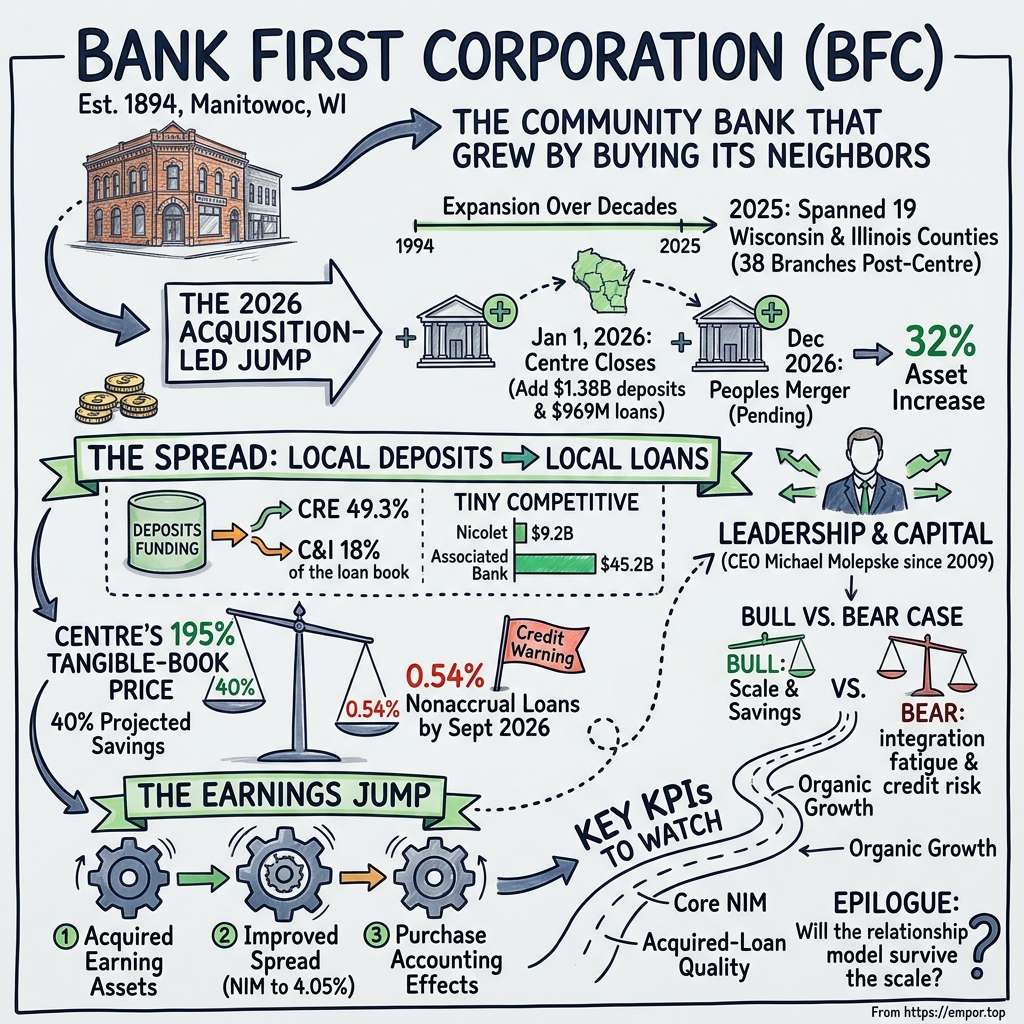
Bank First Corporation: The Community Bank That Grew by Buying Its Neighbors
The quarter the bank got a third larger
On New Year's Day 2026, while most of Wisconsin was asleep or watching football, a bank in Beloit stopped being independent. The First National Bank and Trust Company had been chartered in 1882, had stayed in the hands of one family for generations, and had grown into a lender of about $1.55 billion in assets on the Illinois border.1 At midnight it became a division of Bank First, a bank from Manitowoc, two and a half hours north on the shore of Lake Michigan.23
Nothing dramatic happened in the lobbies that morning. The signs stayed the same for a while, the tellers were the same people, and the computer systems were not switched over until spring.3 But on paper the change was enormous. Bank First had ended 2025 with about $3.6 billion of loans and $3.7 billion of deposits.4 By the end of September 2026 it was carrying roughly $4.6 billion of loans and $5.0 billion of deposits, and its total assets had climbed to about $5.95 billion.25 A bank that took more than 130 years to reach its old size had grown by about a third in a single closing.
The income statement followed the balance sheet. In the first nine months of 2026, Bank First earned $68.5 million, up from $53.1 million a year earlier, a jump of nearly 30%.2 Management was candid about why: Centre's added scale was the primary reason.2 Centre had brought about $1.38 billion of deposits and roughly $969 million of loans, recorded at fair value, the accounting term for what those loans were worth on the day they changed hands rather than what the borrowers originally owed.26
That is the attractive half of the picture. The other half sits in the footnotes of the same quarter. Nonaccrual loans, the ones where the bank has stopped booking interest because it doubts it will be paid, had risen to 0.54% of all loans by September, and nonperforming assets to 0.50% of total assets.2 Nine months earlier, before Centre, nonaccrual loans had been about 0.2% of the book.4 The company itself attributed the increase primarily to relationships that came over with Centre.2 Meanwhile Bank First had spent $12.5 million on transaction costs tied to Centre and to a second deal still waiting to close.25
So the growth is real, but it is mostly bought. And the purchase came with a handful of loans that the acquirer would not have made itself. That tension frames the whole story of Bank First Corporation, the Nasdaq-listed holding company that owns Bank First, N.A.
There is a second, quieter clue in the per-share numbers. Net income rose almost 30%, but diluted earnings per share for the nine months rose from about $5.40 to $6.14, closer to 14%.2 The gap is the price of paying for Centre with shares. Roughly 1.38 million new Bank First shares went to Centre's owners, so the bigger pie is now cut into more slices.2 For a shareholder, the per-share figure is the one that counts, and it tells a more modest story than the headline.
Two tests will decide whether this growth becomes value. The first is whether the lending franchise can still grow on its own, without a new acquisition every couple of years to lift the totals. The second is whether the acquisitions can earn what Bank First paid for them, through cost savings, cleaner credit and new customers, rather than merely through larger numbers on the balance sheet.
Those tests are about to get harder. In May 2026, before Centre's integration had even been completed, Bank First agreed to buy PSB Holdings, the parent of Peoples State Bank of Wausau, in another all-stock deal.7 That transaction was expected to close on December 4, 2026, less than a month from today.85 A bank that started 2026 at roughly $4.5 billion in assets will, if Peoples closes on schedule, end it at around $7.5 billion.5
How did a hometown bank from a lakeside manufacturing city end up in this position, buying neighbors at a pace that would have seemed reckless to its founders? The answer starts with what made Bank First worth expanding in the first place: a particular way of doing small-market banking that the company has spent more than a century refining.
 Subscribe on LinkedIn
The Manitowoc bank that kept its independence
Manitowoc is a city that builds things. Shipyards, aluminum cookware, cranes and frozen food plants have all, at various points, defined its skyline along the Manitowoc River. In 1894, a bank opened downtown to serve that economy, and it is still there.47 The holding company that owns it today was organized in April 1982, long after the bank had established its name in the county.4
For most of its history, Bank First was a single-county story. It lent to local businesses, took deposits from local families and grew roughly as fast as the communities around it. That is the ordinary life of an American community bank, and thousands of them have lived it. What separates Bank First from most of those thousands is that it neither stayed small nor sold out.
The person most responsible for that choice is Michael Molepske, known to everyone in the region as Mike. A University of Wisconsin-Madison graduate with an MBA from UW-Milwaukee, he was named chief executive of Bank First in 2008, just as the financial crisis was ripping through American banking.9 Over the years he has also taken the titles of president and chairman of the board, later handing the presidency to Timothy McFarlane.910 That makes him one of the longest-serving bank CEOs in the state, with nearly two decades at the helm of the same institution.
Molepske's early tenure set a pattern that would recur. Rather than run every line of business itself, Bank First merged its insurance subsidiary, the Vincent Group, with A.N. Ansay & Associates, forming an insurance agency in which the bank kept a minority stake.9 That stake has stood at 40%.4 It matters for understanding what Bank First is, and what it is not. Ansay is an investment that pays Bank First a share of its profits; it is not a parent company, and nobody above Bank First controls it. The listed company is the holding company, the holding company owns the bank, and the bank's economics are what shareholders are buying.
The first real leap outward came in 2017. On October 27 of that year, Bank First completed its merger with Waupaca Bancorporation, the owner of the First National Bank in Waupaca, a lender founded in 1885 in the lake country west of the Fox Valley.11 Bank First paid $78.1 million, more than two-thirds of it in cash and the rest in about 650,000 shares.11 The deal added six offices and turned a lakeshore bank into something with genuine regional reach.
From there, the map filled in steadily. Partnership Community Bancshares of Cedarburg joined in July 2019, pushing Bank First into Ozaukee, Monroe and Jefferson counties.11 Timberwood, a Tomah-based bank, followed in May 2020 for about $29.8 million in stock.12 Denmark Bancshares, just a few miles from Manitowoc, closed in August 2022.13 Hometown Bancorp of Fond du Lac followed in February 2023, for about $130.5 million.14 Each deal was a neighbor, or a neighbor's neighbor. None was a leap into an unfamiliar state or business line.
By the end of 2025, Bank First's branches sat in nineteen counties across Wisconsin and Winnebago County, Illinois, and it ranked in the top three by deposit market share in seven of them.4 After Centre and its systems conversion, the network numbered 38 branches across Wisconsin and the Illinois "Stateline" region around Beloit and Rockford.3 And it was still run from Manitowoc, by a chief executive who had been in the job since the Bush administration.
Why did so many of those neighbors say yes? The answer says something about the economics of small-town banking. A bank of a few hundred million dollars carries nearly the same burden of compliance, cybersecurity and core-system costs as one many times its size, and spreads it over far less revenue. Many of these institutions were family-controlled, and when a generation of owners approached retirement, the choice narrowed to selling to a large regional, selling to a neighbor, or finding a successor willing to carry the regulatory load. Bank First positioned itself as the neighbor: a buyer that paid in a liquid, dividend-paying stock, kept local names on the door for a while and talked about relationships rather than branch closures. The Centre and Peoples announcements both leaned on exactly that pitch, promising the selling bank's customers bigger technology and product sets without the loss of local decision-making.17
That positioning also has a cost the selling banks' owners rarely see. When Bank First pays in stock, the sellers become Bank First shareholders, and their payoff depends on the acquirer's share price holding up long after the ceremony. Peoples' board explicitly sold its shareholders on "increased liquidity through a publicly traded partner with a long history of uninterrupted quarterly dividends."7 The pitch works only as long as Bank First's own stock stays a currency people want to hold.
That continuity is the real asset in this origin story, and it is worth stating precisely. What has persisted is local presence and a style of banking built on knowing borrowers personally. What has changed is that, increasingly, the growth has come from buying other banks that practiced the same style. History shows the model survived. It does not show the model is immune to competition, and it says nothing yet about whether the acquired banks will behave like the original one.
The bank calls its approach "relationship banking," a phrase every community bank in America uses.17 To find out whether it means anything more at Bank First, the place to look is the most basic transaction a bank performs: a dollar coming in as a deposit and going out as a loan.
The spread between a local deposit and a local loan
Picture the owner of a machine shop in Manitowoc County who wants to buy the building next door and expand. The shop needs, say, a few million dollars. The owner walks into a Bank First branch, or more likely calls a lender they have known for years, and asks for a commercial real estate loan.
Behind that conversation sit three decisions the bank must make. It has to set a price, an interest rate that covers its funding cost and the risk of not being repaid. It has to find the money, which mostly means the deposits sitting in checking and savings accounts across its branches. And it has to decide how much risk to accept: how much the building is worth, how much cash the shop generates, and whether the owner will still be paying if a big customer leaves.
That is the whole business, in miniature. A bank earns interest on its loans and its securities, pays interest on its deposits and borrowings, and keeps the difference, which bankers call net interest income. It adds fees from services. It subtracts the cost of running branches, paying staff and maintaining technology. And it subtracts credit losses, the loans that go bad. What remains is profit.
The single most important ratio in this machine is the net interest margin: net interest income divided by the assets that earn it. Think of it as the bank's gross margin, the markup between what money costs and what it can be lent for. At Bank First, that margin was 4.05% over the first nine months of 2026.2 By the standards of American banks that is a healthy markup, and how the bank got there is a story for later.
Fees are the supporting cast. Bank First collects service charges on accounts, earns money servicing mortgages it has originated and sold, and, since Centre arrived, runs a meaningful trust and wealth management business. Trust and wealth fees reached $4.8 million in the first nine months of 2026, up from almost nothing the year before, because Centre brought the business with it.2 That is a welcome addition, but against more than $160 million of net interest income over the same period it is a side dish, not a new center of gravity.2 Bank First is a spread lender, and it lives or dies by the spread.
Who else wants the machine shop's business
The owner of that machine shop has options, and that is where Bank First's competitive position gets tested. Wisconsin is crowded with banks. At the top sits Associated Banc-Corp of Green Bay, with about $45.2 billion of assets at the end of 2025.15 In the middle is Nicolet Bankshares, also from Green Bay, at about $9.2 billion and itself a serial acquirer of community banks.16 Bank First, at roughly $4.5 billion before Centre, was half Nicolet's size and a tenth of Associated's.4 Around all of them swarm smaller local banks, credit unions with tax advantages, and nonbank lenders and fintech platforms that the company itself identifies as competitors.4
Michael Porter's five forces are a useful way to see the pressures, as long as they are applied to evidence rather than vibes. Start with depositors, who are the bank's suppliers of raw material. They can compare rates on their phones in seconds, and when interest rates rose sharply after 2022, many did. Their bargaining power is real, and it rises with every improvement in digital banking. Then consider borrowers, the customers. A business with good credit can shop its loan among half a dozen banks, and a well-capitalized competitor can always undercut on price. Their power is real too.
Against those pressures, Bank First's claimed advantages are local knowledge and personal service: lenders who know the borrower's business, decisions made locally, and the kind of trust that keeps a customer from switching over a quarter-point. Those advantages can be genuine. But the company does not publish the numbers that would prove them. It does not disclose customer retention rates, how often it wins deals against larger banks, or how its loan pricing compares with competitors. So local relationships are best treated as a plausible advantage, not a demonstrated one.
There are two pieces of evidence worth weighing. The first is market share: Bank First has real weight in some counties but is a smaller player in others.4 The second, and more telling, is the deposit mix. Noninterest-bearing demand deposits, checking accounts that pay no interest at all, made up about 28% of core deposits in 2024.17 By September 2026 they stood at about $1.48 billion of roughly $5.0 billion of total deposits, close to 30%.2
Why does that matter so much? Because free money is the cheapest raw material a bank can get, and people only leave significant sums in a checking account that pays nothing when they use the bank for something else: payroll, operating accounts, the daily plumbing of a business. A high share of noninterest-bearing deposits is about the closest thing a bank has to evidence of sticky relationships. On this measure, Bank First looks solid rather than spectacular, and the measure held up after the Centre merger.
Technology is the force most likely to change the game over the next decade, and Bank First's own disclosures acknowledge it, naming fintech companies alongside national, regional and community banks as competitors.4 Digital banking lowers the cost of switching accounts, and software is steadily automating the underwriting of small business and consumer loans, which erodes some of the information edge a local lender once enjoyed. Bank First's answer has been to keep investing in both bricks and bytes. It spent about $11.4 million on premises and equipment in 2025, after $7.2 million in 2024, and its property and equipment on the balance sheet grew from about $56 million in 2022 to about $79 million in 2025.4 It did all this with only about 380 full-time-equivalent employees at the end of 2025, a lean staff for a bank of $4.5 billion.4 The company does not break out technology spending, so investors cannot judge whether it is keeping pace with larger rivals or falling behind. That is precisely the kind of fixed cost that pushes community banks to merge.
Regulation is the final force, and it cuts both ways. Starting a bank requires a charter, capital and a great deal of supervisory patience, which keeps new entrants rare. But the same rules cap how much risk an incumbent can take and how much capital it must hold, which caps returns. Barriers to entry protect the industry; they do not single out Bank First.
Half the book on property
Now go back to the machine shop's building. Real estate makes good collateral, and bankers like it because a building cannot drive away in the night. But collateral is a backstop, not a source of repayment. The loan gets repaid from the shop's cash flow, and if that falters, the bank ends up owning a specialized industrial building in a small city, which is not a liquid asset.
That matters because commercial real estate is Bank First's biggest concentration by far. At the end of 2025, CRE loans totaled about $1.78 billion, or 49.3% of the loan portfolio.4 Commercial and industrial loans, the operating lines and equipment loans made against a business's cash flow, were about 18%.4 Management said it was actively working to manage the CRE concentration and that its policies were sufficient to meet regulators' concentration guidance.4 The company reports no particular industry or customer concentration inside the CRE book.4
The honest reading is that Bank First is not a "diversified bank" in any strong sense. It is a bank that lends heavily against property in mid-sized Wisconsin markets, which means its credit results depend on local property values and on the cash flows of the businesses that occupy those properties. That has worked well for a long time. Its auditor flagged the judgment involved in setting the qualitative part of the loan-loss allowance as a critical audit matter, which is common for banks but is a reminder that the reserve rests on estimates, not certainties.4
So the spread machine is sound, and the evidence for local relationships in the deposit base is respectable. What is not established is a moat in the strict sense: an advantage that competitors cannot copy. Bank First's model is a well-run version of a widely practiced one. Four numbers will reveal whether it is more than that: the mix and cost of deposits, the pace of organic loan growth, the net interest margin, and whether loans migrate from healthy to troubled. That last test brings the story back to how Bank First chose to grow, because the bank has spent the better part of a decade adding other banks' loan books to its own.
When buying banks became the growth plan
Walk into the old First National Bank in Waupaca in late October 2017 and the moment would have felt less like a takeover than a family wedding. Two Wisconsin banks, both more than a century old, both run by people who knew their customers by name, were becoming one.11 For Bank First, though, the Waupaca deal was something more consequential. It was proof of concept. If a lakeshore bank could absorb a lender from the lake country, keep its customers and make the combined business more profitable, then buying banks could be a repeatable way to grow.
That is what it became. Bank First kept buying nearby banks over the next six years.11121314 Then came Centre in 2026, with Peoples still pending. Management describes its strategy as selectively seeking acquisitions while strengthening existing relationships, and the record shows this was not a sudden pivot.4 Acquisitions have been the dominant growth engine for nearly a decade.
The headline results look superb. From 2015 to 2025, revenue grew about 18% a year and net profit about 18.5% a year, which over a decade means each roughly multiplied by five.4 For a community bank, whose natural growth rate is usually tied to the economies of slow-growing towns, that is an extraordinary record.
But the record is not what it first appears to be, and the reason matters. Those growth rates combine two very different things. One is organic growth: the existing branches making more loans, gathering more deposits and earning more fees. The other is bought growth: the earnings of acquired banks simply being added to the total. A bank that buys a competitor the same size as itself will "double" its earnings overnight without any of its lenders working harder. The decade-long compounding rate captures both, and the company does not publish a clean split of how much came from each.
The year that was not a peak
There is one more distortion buried in the record, and it shows up as a sudden spike. In 2023, Bank First's net profit jumped to about $74 million from $45 million the year before.14 Then, in 2024, it fell 12.2%, before rising 9.2% in 2025.4 Read naively, that looks like a peak followed by a stumble. It was neither.
The spike came from a one-time sale. For years Bank First had owned 49.8% of UFS, a data processing company that served banks, including Bank First itself.14 On October 1, 2023, it sold that stake and booked a gain of $38.9 million.14 That gain is why 2023 looks so strong. Remove it, and the "decline" in 2024 was simply earnings returning to their underlying level, which then kept rising. The core bank did not collapse in 2024; it never peaked in 2023.
The UFS sale is also a small window into how Bank First treats capital. Selling the stake was not free: the bank had been paying UFS about $5.5 million a year for data processing, and it kept using outside processors after the sale.14 What it gained was cash, and in 2025 it chose to hand much of that cash back. In April 2025 the board declared a special dividend of $3.50 a share, about $35 million in total, explicitly tied to the capital built up after the UFS gain.18 That is why the dividend payout ratio for 2025 looks so oddly high, at about three-quarters of earnings: it includes a one-off return of a one-off gain.418 Returning capital that the bank could not deploy well is a sign of discipline, not of generosity.
The falsification test for a serial acquirer
How should an investor judge a decade of deals? The right test is not whether the bank got bigger, which is guaranteed when you buy things. It is whether the acquired loans, deposits and branches kept contributing after the celebration ended, without an outbreak of bad loans or an endless trail of "one-time" integration costs.
On that test, the pre-Centre record is broadly encouraging. Through the acquisitions of 2017 to 2023, Bank First's return on equity stayed in a range of roughly 10% to 14%, never collapsing as deals piled up.4 Its return on assets, a cleaner measure for a bank, edged up from about 1.1% in 2015 to about 1.6% in 2025.4 And as late as December 2025, after absorbing five banks in six years, nonaccrual loans were about 0.2% of the book.4 Whatever credit problems the earlier deals brought, the bank had either avoided them or worked them out.
There is an important limit to that comfort, though. Every one of those earlier deals was smaller than Bank First, and most were much smaller. Waupaca cost $78 million; Hometown, the largest before Centre, cost about $130 million.1114 Centre and Peoples are a different scale of bet: two banks of about $1.5 billion each, acquired within a year, together adding well over half the assets Bank First had before.17 The record supports a narrower claim than "Bank First is a proven integrator." It supports "Bank First has successfully integrated a series of small neighbors." Whether that skill scales to large ones is exactly what 2026 is testing.
So the decade of growth is real but blended. Strip away the UFS gain and the acquired earnings, and what remains is a healthy core bank whose own growth rate the company does not quite let investors see. That makes the price of each new acquisition the critical variable. And with Centre, the price was the most demanding in Bank First's history.
Centre's 195% tangible-book price
On July 18, 2025, Bank First and Centre 1 Bancorp announced that they had agreed to combine.1 On the stage, so to speak, stood two chairmen. One was Mike Molepske, who called the deal a union of "two long-standing, community-focused institutions" with a shared commitment to relationship-based banking.1 The other was Steven Eldred, chairman and CEO of Centre, the family-owned holding company for First National Bank and Trust of Beloit, who said joining Bank First would let his bank "build on a legacy of trust and service."1 Eldred joined Bank First's board when the deal closed.1
The logic was geographic. Beloit sits on the Wisconsin-Illinois line, and First National Bank and Trust served southern Wisconsin and the northern Illinois market around Rockford. For Bank First, which had been expanding south from its Lake Michigan base for years, it was a jump into a new region with an established franchise, about $1.29 billion of deposits and nearly $1 billion of loans.1
The terms were simple. Centre shareholders would receive 0.92 of a Bank First share for each of theirs, all in stock.1 At Bank First's closing price the day before the announcement, that valued the deal at about $174 million.1 By the time it closed on January 1, 2026, the final consideration was about $168.8 million: roughly 1.38 million Bank First shares and a few hundred thousand dollars in cash.2
Three ways to measure one price
Bank deals are priced against three yardsticks, and Centre looked very different depending on which one you picked up.
The first is tangible book value: the bank's equity minus intangible assets such as goodwill, roughly what would be left for shareholders if the bank were wound up at its stated values. Bank First paid about 195% of Centre's tangible book, close to double.19 Paying a premium to book is normal for a healthy bank, because a franchise with loyal depositors is worth more than its balance sheet. But near-double is a full price, a statement that Bank First valued Centre's franchise well above its assets.
The second is earnings. The price was about 25 times Centre's trailing earnings.19 That is demanding. For comparison, Bank First itself trades at about 21 times its own earnings today.20 Taken at face value, Bank First paid a richer multiple for Centre's profits than the market pays for its own.
The third measure is the one management emphasized. Including the cost savings it planned to extract, Bank First estimated that the price was only about 6.7 times Centre's expected 2026 earnings.19 Those savings were large: Bank First forecast cutting about 40% of Centre's cost base, through combined systems, overlapping functions and back-office consolidation.19 It also measured the premium paid over tangible book against Centre's core deposits, the stable checking and savings money that is the real prize in a bank deal, and that premium came to about 7.7%.19
Look at how far apart those numbers are. The arithmetic implies that Centre's annual earnings would go from roughly $7 million, as an independent bank, to roughly $26 million in Bank First's hands. That is nearly a fourfold increase, and it rests mostly on the savings and partly on purchase accounting, the bookkeeping that comes with acquisitions. The gap between 25 times and 6.7 times is not a disagreement about Centre. It is a forecast. The deal is cheap if the forecast comes true and expensive if it does not.
There is a simpler cross-check that requires no forecasts at all. At the end of June 2025, Centre's stockholders' equity was about $112.6 million.1 Against a $174 million price, that is about one and a half times book value including intangibles, and closer to double once Centre's own intangible assets are removed. Either way, Bank First was paying a meaningful premium for a bank that, on its trailing profits, earned a low return on that equity. The deal was a bet that Bank First could make Centre's balance sheet far more productive than Centre had made it on its own. On the day of announcement, the two banks together were expected to hold about $5.9 billion of assets, $4.6 billion of loans and $4.9 billion of deposits.1
The investor presentation added one more framing: a "pay-to-trade" ratio of about 70%.19 The idea is that Bank First's own stock traded at a high multiple of its tangible book, and Centre's price, measured the same way, was only about 70% of Bank First's own. Because Bank First was paying in its own richly valued shares, it was, in effect, swapping expensive currency for a cheaper asset. That is a reasonable point about the mechanics of an all-stock deal. But it compares Centre with Bank First, not with what similar banks fetched in the market. It shows the deal looked attractive relative to Bank First's own stock, not that Centre was cheap relative to peers.
What the first nine months showed
Integration went to schedule. The deal closed on the first day of 2026, and on May 18, 2026, Bank First announced it had completed the system conversion of the eleven former First National Bank and Trust locations, calling it "the final phase" of the acquisition.3 Mechanically, Centre was absorbed on time.
The savings appear to be arriving, but slowly and without a public scoreboard. On the second-quarter call, management said full realization of Centre's cost savings was "expected in future quarters."6 By the third quarter, it said full realization had begun in that quarter.5 Neither update attached a dollar figure to what had been achieved against the 40% target. Investors can see the direction of travel; they cannot yet check the arithmetic.
Then there is credit, and here the story gets more interesting. The company attributed the rise in nonaccrual loans to Centre relationships.2 Foreclosed property also appeared on the balance sheet for the first time in a while, about $2.4 million of "other real estate owned" at September 30, against none at year-end.2 Management's stated response was to exit certain acquired loans in the Stateline market that did not fit its lending philosophy.2
That response is either a sign of discipline or a sign of a problem, and it may be both. Exiting loans you would not have made yourself is what a careful acquirer should do. But it also means some of what Bank First bought will not stay. Every loan exited is interest income that disappears, and some of those exits may come with losses. The fair-value marks Bank First applied at closing, writing the loans down to what they were judged to be worth, were meant to absorb exactly this kind of problem. Whether those marks were deep enough is a question only the next few quarters can answer.
A rough look at the balance sheet sharpens the point. Loans grew by about $991 million in the first nine months of 2026, and Centre contributed about $969 million at closing.2 That leaves something like $20 million of growth across the rest of the bank, close to flat. Deposits rose by about $1.31 billion, against $1.38 billion that came with Centre, which implies the combined deposit base actually shrank a little apart from the acquisition.2 Those are crude calculations, because acquired balances run off naturally and some of the shrinkage is deliberate loan exits, but they are the only view the company allows. It does not report organic growth separately.
So the Centre deal sits at an honest midpoint. The mechanics went smoothly, the systems are converted and savings have begun. But the price required savings that have not yet been quantified, the acquired credit has proved worse than the legacy book, and the combined bank does not appear to be growing much on its own. The premium was a promise. To see whether it is being kept, look at how the bank's earnings actually rose in 2026.
The earnings jump has three engines
When Bank First reported its third quarter on November 6, 2026, the numbers looked like a bank firing on every cylinder. Net income was $23.8 million, up from $18.0 million a year earlier, and adjusted for deal costs it was $26.1 million, or $2.35 a share.5 Net interest income for the quarter was about $55 million, up from about $38 million.5 Management talked about acquired scale, about loans repricing higher and about deposits costing less. All three are true. The question is how much of each will last.
The first engine is the simplest: more earning assets. Centre added roughly a billion dollars of loans and a third of a billion dollars of securities.221 More loans at similar spreads means more interest income. This engine is real for as long as the acquired loans stay on the books and keep paying. But it is not growth in the sense investors usually mean. It is addition.
The second engine is the spread itself. Over the first nine months of 2026, the net interest margin rose to 4.05%, from 3.75% in the same period of 2025.2 In plain terms, for every $100 of earning assets, Bank First kept about 30 cents more a year. The company explained the improvement in two parts. On the asset side, new and renewed loans were being priced at higher rates than the older loans they replaced.2 On the liability side, the average cost of interest-bearing deposits and borrowings fell to 2.27% from 2.59%, as deposit rates reset lower with the broader rate environment.2
That second engine is the one most worth crediting, because it reflects how a bank manages its own balance sheet. Loans written in 2020 and 2021 at very low rates have been rolling off and being replaced by loans at today's rates, a tailwind every bank enjoys as long as rates stay well above the pandemic lows. Deposit costs falling, though, depends on whether competition for deposits stays calm. Neither half is fully in Bank First's control, but both are a credible operating improvement rather than an accounting artifact.
The third engine is the tricky one: purchase accounting. When a bank buys loans and marks them down to fair value, it then gradually recognizes the discount as extra interest income as the loans are repaid. That "accretion" boosts reported margin, and it rose by about $1.5 million in the third quarter compared with a year earlier.2 It is real money, in the sense that it reflects loans bought at a discount being repaid at par, but it shrinks as the acquired loans pay off. It will not last forever.
A smaller example shows the mechanism vividly. In the first quarter, Bank First repaid early $65 million of advances from the Federal Home Loan Bank that it had inherited from Centre.21 Those borrowings had been marked to fair value at the acquisition, and repaying them early triggered a $1.3 million purchase-accounting adjustment that reduced interest expense and lifted the margin that quarter.21 It was a sensible balance-sheet move, cutting relatively expensive borrowings. It was also a one-time lift to the margin, not a recurring improvement.
What happens if rates move? Bank First's interest-rate modeling, discussed around the second quarter, projected that a 200-basis-point rise in rates would lift the economic value of its equity by about 3%.6 Economic value of equity is a model of what the bank's assets and liabilities would be worth if revalued at new rates; a positive reading on a rate rise suggests the balance sheet is modestly asset-sensitive, with assets repricing faster than deposits. The flip side is that falling rates would gradually compress the loan yields that drove 2026's margin gains, though deposit costs would also fall. The bank is not making a large bet on rates in either direction, which is reassuring, but it also means the margin tailwind of 2026 cannot be assumed to keep blowing.
The other side of the ledger
Acquisition-related transaction expenses also contributed; those should fade once integration ends, though a bank that keeps buying other banks will keep incurring them.25 Total noninterest expense rose to about $108 million for the nine months, from about $62 million a year earlier.2 And Centre created a new core deposit intangible, the accounting value placed on its customer relationships, which lifted the intangible on Bank First's balance sheet to about $40 million from about $16 million and will be amortized as an expense for years.2
The fee businesses deserve to be kept in proportion. Noninterest income for the nine months was $30.6 million.2 Within it, trust and wealth management brought $4.8 million, and Bank First's share of Ansay's earnings came to about $2.6 million, down from about $3.6 million a year earlier.2 Those are useful contributors, and trust and wealth is a high-quality fee stream because it tends to be sticky and grows with clients' assets. But together they account for a modest slice of the bank's revenue. They do not change what kind of business this is.
So what does the earnings jump actually tell an investor? It tells them that Bank First's underlying spread business improved meaningfully as loans repriced and deposits got cheaper, which is genuine and creditable. It also tells them that a large part of the step-up came from adding Centre, and that some of it came from accounting effects that will fade. What it does not tell them is the bank's normalized earning power once the purchase marks have run off, the merger costs have stopped and Peoples has been absorbed.
The measure that will settle the question is core net interest margin and fee income after purchase accounting and merger costs are stripped away. Bank First's adjusted figures remove transaction costs, but the company does not separately strip out accretion in a way that makes the clean number easy to see. Until it does, or until enough quarters pass that the accretion has largely run off, the true level of earnings remains an estimate. And estimates, in a bank about to absorb a second large acquisition, depend heavily on the people making them.
Molepske's long tenure meets a second merger
By the spring of 2026, Mike Molepske's team had a choice. Centre's systems conversion was weeks from completion, the acquired loan book was still being sorted, and the savings had not fully shown up. A cautious management team would have paused, digested and waited for a clean year. Molepske's team did the opposite. On May 19, 2026, the day after Centre's conversion was announced, Bank First agreed to buy PSB Holdings, the parent of Peoples State Bank of Wausau.37
The terms echoed Centre's. Peoples shareholders would receive 0.347 of a Bank First share for each of their shares, a package valued at about $202.9 million on the day before announcement.7 Peoples had about $1.50 billion of assets, $1.12 billion of net loans and $1.19 billion of deposits, with twelve locations across North Central Wisconsin and the greater Milwaukee area, markets Bank First described as long identified for strategic growth.7 The announcement said Peoples shareholders were receiving a market premium of more than 80%.7
Set the price beside Peoples' balance sheet and a familiar shape appears. Peoples had about $134 million of stockholders' equity, so Bank First was paying roughly one and a half times book value, a premium of a similar order to Centre's.7 Like Centre, the deal would be paid in Bank First stock. By the third quarter, Bank First said the deal had received its required regulatory and shareholder approvals and was planned to close on December 4, 2026.25
The people running the machine
Molepske is the constant in all of this, and the case for confidence in another integration rests largely on him and his lieutenants. His style is that of a lifelong community banker: plainspoken in his announcements, focused on culture and relationships, and comfortable describing deals in terms of "shared values" rather than spreadsheets.17 Alongside him are President Timothy McFarlane, who joined the board in 2023, and Chief Financial Officer Kevin LeMahieu, who took the finance role in 2024.10
That track record has been built on small acquisitions, executed well. It also includes a willingness to say no, at least rhetorically. On the second-quarter call, management said it was "not targeting asset thresholds at the expense of acquisition standards."6 By the third quarter, it was describing leadership hires and investments to prepare the bank to exceed $10 billion in assets.5 Those statements are not contradictory, but the direction is unmistakable. Ten billion dollars is a meaningful line in American banking, because above it federal rules cap the debit-card interchange fees a bank can charge and bring heavier supervision. A bank planning for that line is planning to keep buying.
Pay and ownership tell part of the alignment story. Molepske's total compensation was about $1.8 million in 2025, up from $1.7 million in 2024 and $1.4 million in 2023, against net income of about $71.5 million in 2025.10 That is modest by bank-CEO standards and small relative to the company's profits. Ownership requires more care. The 2026 proxy lists Richard S. Molepske as an about 5.2% beneficial owner, separately from the directors and executive officers, who as a group held about 5.0%.10 In other words, the single largest individual holding carrying the Molepske name sits outside the management group, and the chief executive's own stake is counted within that 5.0%. The broader picture is of a company with no controlling shareholder, where BlackRock at about 6.2% and Vanguard at about 5.3% are the largest holders.10
The register has been shifting at the margin. A year earlier, the 2025 proxy had shown Richard Molepske at about 5.8% and BlackRock at about 7.3%, so both stakes have drifted lower while Vanguard's edged up from about 5.2%.1022 Some of that is simply the dilution of new shares issued to Centre's owners, who now form a fresh group of holders with their own views. The company had about 1,650 shareholders of record in early 2026, a reminder that much of this stock is still held by people who live near the branches.4
Governance also includes the bank's dealings with people close to it. Bank First lends to its own directors, executives and their affiliates, as most community banks do, and those loans totaled about $90.3 million at the end of 2025; the company says they were made on terms comparable to those offered to unrelated borrowers.4 The most notable related party is Ansay itself. Beyond the 40% stake, Bank First had lent the agency about $16.8 million in term loans and $7.9 million drawn on a revolving line, and paid it a small amount for insurance and consulting services.4 None of this is unusual in scale for a bank of Bank First's size, and the proxy reports no other related-person transaction requiring disclosure in 2025.10 But it is the kind of interconnection an investor should keep an eye on as the bank grows, because the bank is both an owner of and a lender to the same business.
Shareholders mostly approve. At the June 2026 annual meeting, about 5.1 million shares voted for the executive pay package and about 343,000 against, roughly 94% support among those votes.23 Directors won between about 95% and 97% of votes cast.23 That is a comfortable margin, but not a unanimous one; a few percent of opposition to pay is common and often reflects institutional voting policies more than specific objections. The proxy reports salary, incentive and stock awards without an unusual one-off bonus, which makes the package relatively easy to follow.10
Capital, spent three ways at once
The more revealing evidence of management's priorities is what it did with capital in 2026. It issued about 1.38 million shares to buy Centre.2 It paid its regular dividend. And over the same nine months, it bought back $23.9 million of its own stock.2 Issuing shares to buy one bank, buying back shares on the market, and then preparing to issue more shares to buy another is not inherently contradictory. A bank might reasonably think its stock is undervalued on the open market even as it uses that stock as currency in deals. But it is a lot of moving parts for a team also running an integration.
There is a real tension here, and a skeptical investor would press on it. Buying back shares at around twice book value and three times tangible book, while paying about one and a half times book for acquired banks, implies management sees better value in its own stock than in acquisitions. If that is true, why do the acquisitions? If the acquisitions are better value, why buy back stock? The likely answer is that the buybacks partly offset dilution and the acquisitions buy markets the bank could not build itself. But Bank First has not laid out a clear capital-return framework that would let shareholders judge the trade-off.
The Peoples deal stress-tests all of this at once. It adds another share issuance, roughly 1.4 million new shares at the announcement price, before the Centre savings have been fully quantified or the acquired credit has been resolved.7 It doubles the integration workload in the same year. And it extends the bank into yet another set of markets, from Wausau to the Milwaukee suburbs. If Molepske's team executes Peoples as cleanly as it converted Centre's systems, the case for management as a skilled integrator strengthens materially. If credit problems surface at Peoples too, it weakens just as fast.
What the calls have not provided is specificity. Management has described Centre's savings as being realized without stating how much has been captured. It has not given a public earn-back period for the dilution to tangible book value from either deal, and it has not offered a target for organic loan growth. The Stateline loan exits have been disclosed in the filings but not sized. A team with a long record and a big stake in the outcome has earned some benefit of the doubt. The live test is happening right now. The final judgment depends on what investors are paying for the stock while that test runs.
Analysis & Bear vs. Bull Case
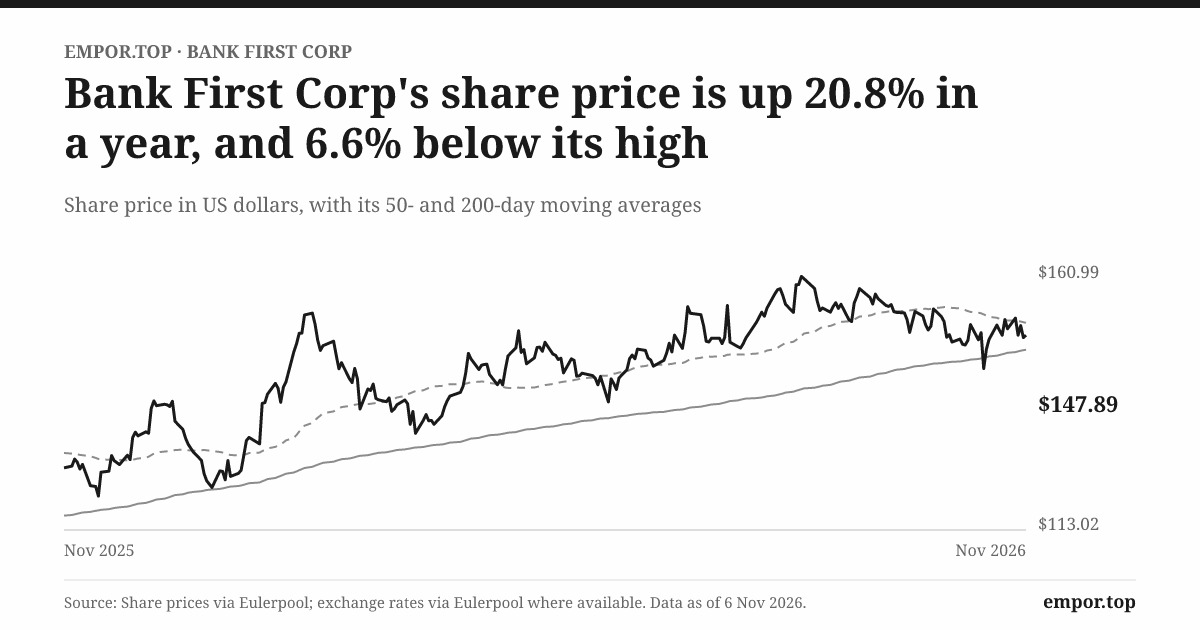
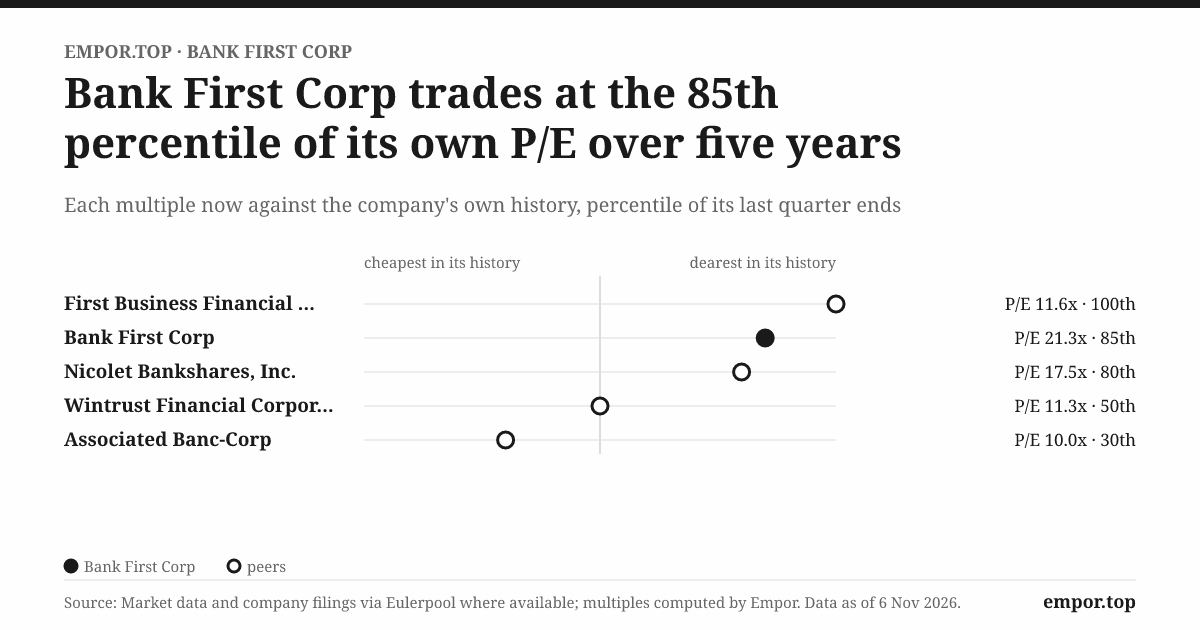
On November 6, 2026, Bank First's stock closed at about $147.89, within about 7% of its 52-week high and roughly 24% above its low of the past year.20 At that price, the market valued the company at about $1.7 billion, or about 21.3 times its trailing earnings and about 2.0 times its book value.20 Its five-year median P/E has been about 19.3.20 The market, in other words, is paying a little more than usual for a bank that has just become much bigger.
Book value flatters the picture slightly. Strip out the goodwill and core deposit intangibles that acquisitions created, about $285 million in total at September 30, and Bank First's tangible book value works out to roughly $49 a share.2 On that basis the stock trades at about three times tangible book. That is a high multiple for a bank, and it explains why Bank First's stock was such a useful currency for buying Centre and Peoples. A buyer whose shares trade at three times tangible book can pay a seller double its tangible book and still see the deal look accretive on paper. That mechanism works beautifully, until the stock price falls.
Return on equity, over the last twelve months, was about 10.3%.20 That figure deserves attention, because the multiple and the return sit in tension. A bank earning around 10% on its equity is being priced at twice that equity, which means investors are implicitly expecting either a meaningfully higher return in future or sustained growth. Neither is unreasonable, but both need to happen.
Why it may win
The bull case starts with a profitable franchise run by people who know their markets. Bank First has built a regional footprint across nearly twenty Wisconsin counties and into Illinois, it earns a net interest margin above 4%, and its pre-Centre credit record was very clean.24 Its deposit base includes a healthy share of noninterest-bearing money, which suggests real operating relationships with businesses.2 It has consistently returned to profitability after deals, and its return on assets has improved over a decade of acquisitions.4
The integration savings are the second leg. If Bank First does take out 40% of Centre's costs, and something similar at Peoples, the combined bank will earn substantially more than its parts did separately.19 Scale also matters more in banking than it used to. Technology, compliance and cybersecurity are largely fixed costs, so a $7.5 billion bank can spread them across far more revenue than a $4.5 billion one. A bull would argue that Bank First is building precisely the scale it needs to keep investing in digital banking while preserving local decision-making.
The third leg is deepening the markets it now owns. Bank First's trust and wealth business, newly acquired with Centre, can be offered across the whole footprint. Treasury management, the services that keep business operating accounts at a bank, can be offered to Peoples' customers.7 Each cross-sell deepens relationships and adds fees without new branches.
Why it may not
The bear case is that acquired growth is masking weak organic momentum. The rough evidence from 2026, near-flat loan growth outside the Centre addition and a slightly shrinking deposit base, is consistent with that view, though some of it reflects deliberate exits.2 Because the company does not separately report organic growth, the long-run compounding rate cannot be validated, and an investor paying 21 times earnings is effectively paying for growth that may be mostly acquired.
Credit is the second bear argument. Half the legacy loan book is commercial real estate, and the first large acquisition brought a cluster of troubled loans.24 Nonaccrual loans more than doubled as a share of the book within nine months.2 The allowance for credit losses stood at $56.8 million, about 1.24% of loans, at September 30.2 That cushion is reasonable for a bank with a clean book, but it covers a portfolio that now includes Centre's acquired loan book and could include Peoples' before year-end; much of the increase in the allowance came over with Centre rather than from new provisions, which were only $0.75 million over nine months.25
Funding, at least, is not the weak point. Bank First relies overwhelmingly on deposits. At the end of September 2026, its borrowings from the Federal Home Loan Bank were down to about $55 million, staggered in maturity through 2028, and its subordinated notes totaled only about $12 million, maturing in 2030 and 2032 and callable from 2026 and 2027.24 The company reported that the bank remained well-capitalized, and management expected to stay above both the well-capitalized thresholds and the regulatory capital conservation buffer through 2026.25 A bank funded this way is not exposed to a sudden wholesale-funding squeeze. Its risks sit in its loans, not its liabilities.
Goodwill is the other balance-sheet item worth watching. It rose from about $175 million at the end of 2025 to about $245 million by September, almost entirely the residue of paying more than book value for Centre.2 Goodwill is not cash; it is an accounting record of the premium paid. If an acquired business underperforms badly, goodwill can be written down, and while that would not touch regulatory capital the way loan losses do, it would be a public admission that a deal was overpriced. After Peoples, that line will grow again.
The third bear argument is about capacity. Two large integrations in twelve months consume management attention, technology resources and staff. Bank First had about 380 full-time employees before Centre, a lean organization for a bank of its size.4 Mistakes in conversions, customer attrition after a merger, or a credit surprise at Peoples could all arrive while the team is stretched.
The moat, tested
Run the competitive frameworks against the evidence, and the conclusion is restrained. On Porter's forces, depositors and borrowers both hold real bargaining power, nonbank lenders and fintechs are credible substitutes for parts of the business, and regulation keeps new entrants out without singling out Bank First. Hamilton Helmer's seven powers offer a sharper lens. Scale economies are building, but Bank First is smaller than Nicolet and far smaller than Associated, so it has no scale advantage over its main rivals.1615 Switching costs exist, since moving a business's operating accounts is a real nuisance, and the noninterest-bearing deposit share hints at them, but Bank First does not quantify retention. Network effects, counter-positioning and cornered resources do not meaningfully apply. Brand is local and real but unmeasured. The most plausible power is process: a repeatable way of finding, buying and integrating small banks. The 2017 to 2023 record supports that power at small scale. Centre and Peoples are its first real test at large scale.
The verdict is that Bank First has a competent, well-run franchise with a plausible but unproven advantage in local relationships and a demonstrated, small-scale skill at integration. It does not have a moat that would let it earn superior returns regardless of execution.
What the price assumes
Valuation discipline means comparing what the market pays for Bank First with what it pays for comparable banks, while respecting that the comparisons are imperfect. Nicolet traded around 20.4 times earnings and about 1.6 times book on the same date, and First Business Financial Services, a Madison-based commercial bank, around 10.9 times earnings and about 1.6 times book.2425 Those figures come from different data providers using different definitions, so they are directional. Still, the direction is clear: Bank First's book multiple is higher than both, and its earnings multiple is roughly in line with the acquisitive Nicolet and nearly double that of the more commercial-lending-focused First Business. The market is paying a premium for Bank First's record of growth and its relationship franchise.
That premium is justified only if three things come true, and those are the KPIs that will carry the story from here. The first is organic loan and deposit growth, the measure that would prove the franchise still compounds on its own; the company does not report it separately, and the rough 2026 evidence points to roughly flat balances outside acquisitions. The second is core net interest margin, which stood at 4.05% for the first nine months of 2026, up from 3.75%, though it is partly flattered by purchase accounting.2 The third is acquired-loan nonaccruals and charge-offs, which rose to 0.54% of loans by September, primarily from Centre.2
A skeptical investor's question to management would be direct. Why pursue Peoples before Centre's credit and cost outcomes are fully visible? What measurable return on the capital spent on each deal justifies the next one? Neither question has been answered in numbers. Until they are, the bull and bear cases rest on the same facts read with different levels of trust.
Playbook: Business & Investing Lessons
Go back to Beloit in May 2026, the week the old First National Bank and Trust signs came down and its customers' accounts moved onto Bank First's systems. That moment captures everything this story has been about. A local bank had bought another local bank, and now had to make it work: convert the systems, keep the customers and decide which of the inherited loans still belonged. The lessons of Bank First come out of that week.
The first is that a relationship is an asset only when it survives a rate quote, a credit cycle and a system conversion. Bank First's noninterest-bearing deposits are the closest thing it has to evidence of relationships that last, and the Centre conversion is the first time thousands of acquired customers have been asked to prove their loyalty to a new name. For any founder or investor, the lesson is that a relationship you have not tested is a hypothesis.
The second is that a premium is a promise the buyer has to keep. Bank First's Centre price depended on savings and credit outcomes that are still being tested. A buyer's spreadsheet is a contract with its own shareholders. Investors should judge a deal not by its announcement but by its second and third years.
The third is that scale can widen the map faster than it improves the business. Bank First's quarterly revenue ran more than 40% above the prior year through 2026, a spectacular number that says almost nothing about whether the bank got better.2 The original engine still has to grow.
The fourth is that independence is not free; it has to earn its cost. For Bank First, that cost is visible in the premiums and share issuance behind its acquisitions. Staying independent makes sense only if the combined bank earns more for its shareholders than they would have gotten by selling. Every all-stock deal is a bet that Bank First's shares are worth more inside a bigger Bank First than outside it.
Epilogue
Tonight, Bank First is a roughly $6 billion bank waiting for a December closing. Its Centre integration is mechanically complete, its acquired loan book is still being sorted, and its third-quarter results just showed the strongest earnings in its history.235 In less than four weeks, if the schedule holds, it will absorb Peoples State Bank and its twelve locations, pushing total assets toward $7.5 billion.5
The first decisive moment is that closing on December 4.8 The first combined balance sheet after Peoples will show how many new shares were issued, how much tangible book value per share was diluted, and how large the goodwill pile has grown. If tangible book value per share holds up well and the deal closes cleanly, the case for Bank First's integration skill strengthens. If dilution is heavier than expected or the closing slips, the questions about pace get louder.
The second moment comes over the following two or three quarters, as Centre's savings either appear in the cost lines or fail to. Noninterest expense should fall as a share of revenue once the transaction costs stop and the duplicate operations are gone. Alongside it, the acquired nonaccrual loans will either be resolved through payoffs and sales, or turn into charge-offs that eat into the allowance. A stable or falling nonaccrual ratio would suggest Centre's problems were contained by the purchase marks. A rising one, especially if Peoples adds its own, would suggest the acquired books are worse than the bank priced.
The third moment is quieter but more important: the quarter when purchase-accounting accretion and merger costs have mostly washed out, and the core net interest margin can be seen clearly. That number will reveal how much of the bank's 2026 margin improvement was its own work and how much was the accounting of acquisition.
And through all of it runs the question that started this story. Will the lending franchise grow on its own? Asset growth alone cannot answer that, because Bank First can always buy more assets. Only organic loan and deposit growth can show whether the bank that opened in Manitowoc in 1894 is still compounding, or whether it has become a machine that needs to keep acquiring to keep moving. For now, the earnings growth is a mixed signal: real, but not yet proof.
Outro
The bank that opened in Manitowoc in 1894 now carries roughly $6 billion of assets, and it is about to get bigger again.3
What makes Bank First unlike most of its peers is not that it buys other banks; many do. It is that it keeps betting that the thing it is buying, a local bank's relationships, can survive being bought. Every deal is a wager that the trust a Beloit or Wausau customer had in their old bank will transfer to a new name run from a city hours away. The balance sheet has already made the journey. Whether the relationships made it too is the question the next few years will answer.
References
-
Bank First Corporation and Centre 1 Bancorp announce merger agreement, Form 8-K Exhibit 99.1 — Bank First Corporation, 2025-07-18 ↩↩↩↩↩↩↩↩↩↩↩↩↩↩
-
Q3 2026 Form 10-Q — Bank First Corporation, 2026-11-06 ↩↩↩↩↩↩↩↩↩↩↩↩↩↩↩↩↩↩↩↩↩↩↩↩↩↩↩↩↩↩↩↩↩↩↩↩↩↩↩↩↩↩↩↩↩↩↩↩
-
Bank First Completes System Conversion and Integration of Former FNBT Locations — Bank First Corporation, 2026-05-18 ↩↩↩↩↩↩↩
-
2025 Form 10-K — Bank First Corporation, 2026-02-27 ↩↩↩↩↩↩↩↩↩↩↩↩↩↩↩↩↩↩↩↩↩↩↩↩↩↩↩↩↩↩↩↩
-
Q3 2026 Earnings Call Summary and Transcript — Quartr, 2026-11-06 ↩↩↩↩↩↩↩↩↩↩↩↩↩↩
-
Q2 2026 Earnings Call Summary and Transcript — Quartr, 2026-08-07 ↩↩↩↩
-
Bank First Corporation Signs Agreement to Acquire PSB Holdings, Inc. — Bank First Corporation, 2026-05-19 ↩↩↩↩↩↩↩↩↩↩↩↩↩↩
-
Peoples Merger Form S-4/A — Bank First Corporation, 2026-07-30 ↩↩
-
Michael Molepske, CEO and chairman, Bank First — BizTimes Milwaukee ↩↩↩
-
2026 Definitive Proxy Statement — Bank First Corporation, 2026-04-24 ↩↩↩↩↩↩↩↩
-
Associated Banc-Corp Delivers Record Annual Net Income Available to Common Equity of $463 Million in 2025 — Associated Banc-Corp, 2026 ↩↩
-
Nicolet Bankshares 2025 Annual Report — Nicolet Bankshares, 2026 ↩↩
-
Bank First Announces Special Dividend — Bank First Corporation, 2025-04-25 ↩↩
-
Centre Acquisition Investor Presentation — Bank First Corporation, 2025-07-18 ↩↩↩↩↩↩↩
-
Q1 2026 Earnings Release — Bank First Corporation, 2026-04-16 ↩↩↩
-
2026 Annual Meeting Results, Form 8-K — Bank First Corporation, 2026-06-17 ↩↩
 LinkedIn
 WhatsApp
 Reddit
 Hacker News
 Email
 Kindle
 RSS Feed
 Spotify
 Apple Podcasts
 Amazon Music
 Audible
 YouTube