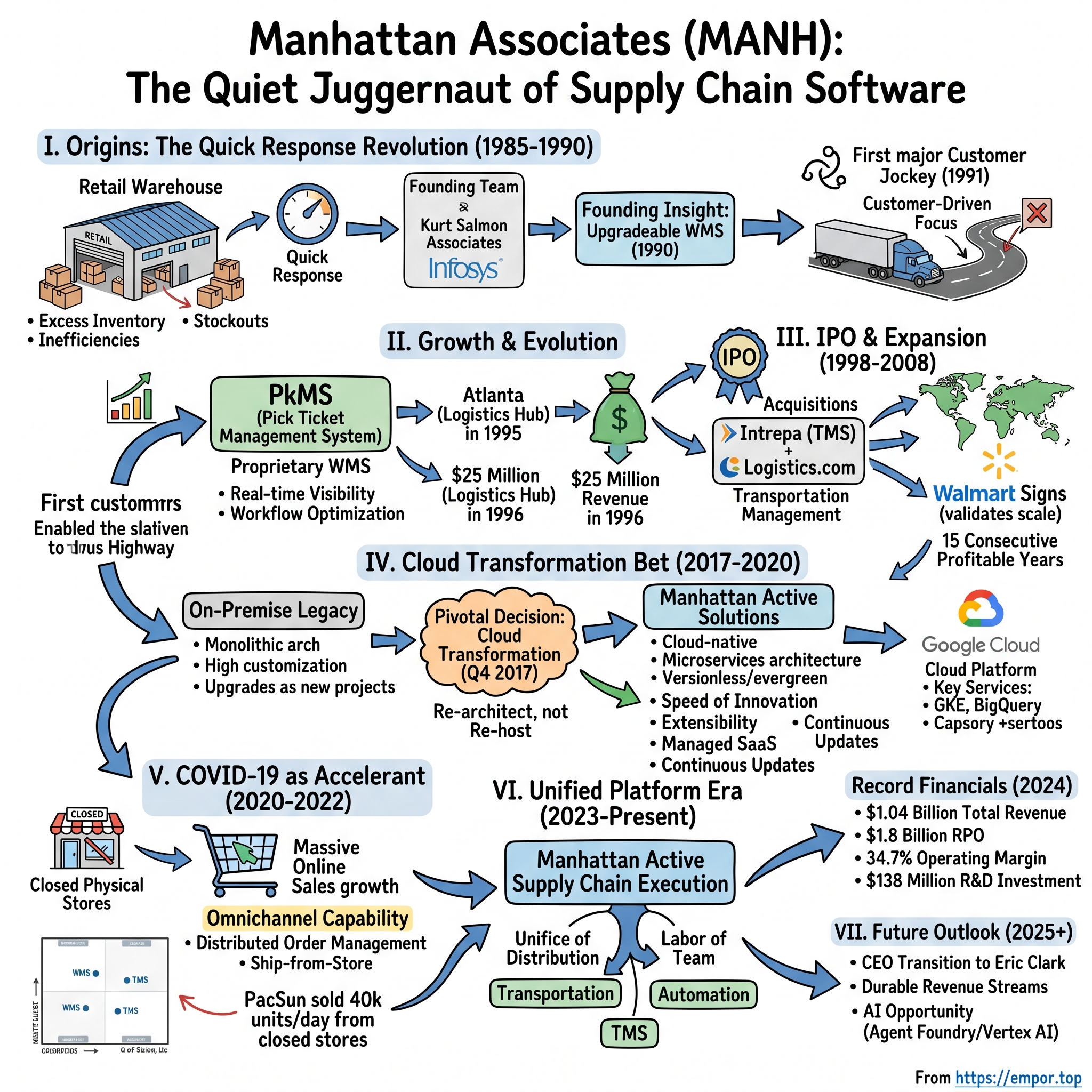
Manhattan Associates: The Quiet Juggernaut of Supply Chain Software
I. Introduction: The $13 Billion Company You've Never Heard Of
In the summer of 2024, a software company headquartered in suburban Atlanta quietly crossed a milestone that most of its peers spend decades—or forever—chasing: Manhattan Associates surpassed the one billion in total revenue milestone and extended its position as the leading innovator in supply chain and omnichannel retail end-markets. The market cap touched $13 billion. Yet ask the average tech investor about Manhattan Associates, and you'll likely draw a blank stare.
This obscurity is precisely the point. A publicly traded company (Nasdaq: MANH), Manhattan has remained debt-free since its founding in 1990 and has over 4,500 associates worldwide. While the world obsesses over consumer-facing technology darlings, Manhattan builds the invisible infrastructure that powers the supply chains of brands from Nike to Walmart, from DHL to Albertsons. Manhattan Associates solutions are used by leading companies in retail, ecommerce, distribution, manufacturing, wholesale, and logistics industries. Their customers include many Fortune 500 companies and industry leaders like Home Depot, Nike, DHL, Whirlpool, 3M, and Caterpillar, with notable companies including Walmart, Macy's, Albertsons, Neiman Marcus, Tesco, Skechers, and Levi's.
The central question this analysis seeks to answer: How did a small warehouse management software company founded in Manhattan Beach, California—not the Manhattan you're thinking of—become perhaps the crown jewel of enterprise supply chain software? And why has almost nobody heard of them?
As Manhattan's Chairman John Huntz commented when announcing the recent CEO succession, "Eddie Capel has accomplished a great deal as CEO setting our strategic direction, building our winning team and creating shareholder value. During his tenure as CEO, Manhattan solidified its position as a leading global technology provider and innovator in both supply chain and omnichannel commerce." The stock performance tells the story in numerical terms—shares have risen nearly 2,000% under Capel's leadership, a run that placed this unglamorous enterprise software company among the best-performing tech stocks of the decade.
The Manhattan Associates story touches on several themes that define modern software success: the courage to cannibalize your own revenue model, the patient execution of multi-year platform bets, the compounding value of customer relationships measured in decades rather than quarters, and the particular strength of building software so deeply embedded in customer operations that switching becomes almost unthinkable.
 Subscribe on LinkedIn
II. Origins: The Quick Response Revolution (1985-1990)
The Industry Context That Created Opportunity
Picture the American retail landscape of the late 1980s: bloated inventories, chronic stockouts, and logistics systems held together with paper, fax machines, and prayer. Large retailers like Walmart were beginning to leverage technology for competitive advantage, but the rest of the industry was drowning in inefficiency.
Alan Dabbiere participated in Quick Response pilot projects as part of his job at Kurt Salmon Associates, a management consulting firm he joined in 1986. Kurt Salmon, which specialized in consumer products manufacturing and retailing in its consultancy work, served as an instrumental contributor in developing the blueprint for Quick Response and its counterpart, Efficient Consumer Response, a system for improving efficiency in the food and grocery industry's supply chain.
Quick Response was the apparel industry's answer to a crisis: retailers were losing billions annually to inventory carrying costs, markdowns on unsold merchandise, and stockouts of hot products. The concept was deceptively simple—use technology to compress the time between a consumer purchase and the replenishment of that item. But execution required something that barely existed at the time: sophisticated warehouse management software.
The Founding Team: Where Consulting Meets Engineering
Manhattan's four founders were involved in the studies that produced Quick Response. The founding group was led by Alan J. Dabbiere, the individual who would lead the company during its first decade of existence. He was joined in founding Manhattan by three technology-oriented executives from Infosys Technologies Limited, an India-based software development company founded in 1981.
This combination proved critical. Dabbiere brought domain expertise—he understood what retailers and their suppliers actually needed. His co-founders, Deepak Raghavan, Deepak M.J. Rao, and Ponnambalam Muthiah, brought software engineering rigor from Infosys, then a small but technically excellent firm that would later become one of India's IT giants.
In 1990, five technology experts were hired by clothing retailer Jockey as part of a larger project to install an ERP (Enterprise Resource Planning) system. While working together, the five noticed gaps in Jockey's ability to ship its goods to larger retailers. An observation that sparked a new idea. They decided to start their own company and designed a new packaged Warehouse Management System (WMS) that would empower manufacturers to comply with the complex shipping and labeling requirements of large retailers.
The Founding Insight: Upgradeable Software
What separated Manhattan from the enterprise software vendors of its era wasn't just functionality—it was philosophy. Early on, the founders decided to flip the traditional way of thinking about enterprise software on its head: Manhattan Associates' WMS would be upgradeable, unlike the predominant enterprise software of the day. For Manhattan Associates, solutions for individual customer needs were viewed as opportunities for improving the features and functionality of its base offering, meaning the solution's sophistication grew as the customer base grew. This concept was a huge deviation from traditional lines of thought. It made it possible for Manhattan's customers to implement software and then upgrade every few years.
Perhaps most importantly, this WMS would also be upgradeable, with access to constant innovation that adapted to its customer's present and future supply chain needs. They named their new company Manhattan Associates, a reference to their initial location in Manhattan Beach, California.
This was radical thinking in 1990. The typical enterprise software sale involved heavy customization that welded the software permanently to a customer's particular configuration. Upgrades were essentially new implementations. Manhattan's packaged, upgradeable approach meant they could amortize R&D investment across their entire customer base while ensuring customers stayed current—a model that sounds familiar today but was heresy in the era of on-premise customization.
III. Early Years: Finding Product-Market Fit (1990-1998)
The First Customer: A Thirty-Year Relationship
Jockey becomes customer #1—and is still a Manhattan customer today. This simple statement deserves more attention than it typically receives. A software vendor's first customer remaining loyal thirty-five years later speaks to something fundamental about the company's culture and product quality. It also illustrates the remarkable stickiness of warehouse management systems—once embedded in operations, they become part of the operational DNA.
PkMS: The Product That Built the Company
The centerpiece of the company's business was a warehouse management system, Manhattan's proprietary PkMS, which was developed not long after the company was founded. PkMS, a flexible, modular software system that controlled the efficient movement of goods through the supply chain, drove Manhattan's physical and financial growth throughout the 1990s. By using PkMS, a company could manage the checklist of tasks assigned to a distribution center. PkMS managed receiving stock, locating stock, picking stock, verifying orders, and packing and shipping product, orchestrating, in an efficient manner, the complex dance of packages moving in and out of a warehouse. The benefits to the customer were as numerous as the number of tasks that fell under the purview of PkMS.
The PkMS name stood for Pick Ticket Management System—a prosaic description that belied the software's ambition. In an era when most warehouse operations ran on mainframe batch processing and paper-based workflows, Manhattan offered real-time inventory visibility and workflow optimization.
The Strategic Move to Atlanta
Key dates around Manhattan Associate's company history: 1991 – Jockey International becomes our first customer; 1994 – added our 50th customer; 1995 – entire company, including 34 of 35 employees, moves from Manhattan Beach, California to Atlanta, Georgia due to its proximity to: Customers, which were mostly along the Eastern Seaboard; A major transportation hub, Hartsfield-Jackson International Airport; Georgia Tech, a premier source of some of the world's best supply chain talent.
The move from California to Georgia crystallized the company's identity as a customer-obsessed organization. Manhattan Associates has always been very customer driven. The move from Manhattan Beach, California to Atlanta, Georgia illustrates this. After packing up the entire office into a couple of trucks and getting about 1,000 miles down the road, a customer called with a critical situation that required intervention. This was back in 1995, before today's global connectivity allowed for quick and easy access. So, what did the group do? They pulled off the highway, unpacked the servers (these were not little desktop machines, more the size of a refrigerator), connected to the customer's environment (via a pretty slow dial-up connection), and resolved the problem. Once the customer was satisfied and the issue corrected, the team loaded the servers back onto the truck, and the caravan proceeded to Atlanta. Customers were the heart of Manhattan Associates from the very beginning and that has not changed in more than 25 years.
The Atlanta location proved prescient. The city became America's logistics hub—Hartsfield-Jackson grew into the world's busiest airport, and the region developed deep expertise in distribution and transportation. Manhattan could recruit supply chain engineers from Georgia Tech's highly regarded program while staying close to the Eastern Seaboard retail customers who were its bread and butter.
Growth Trajectory
1996 – reached $25 million in revenue; 1998 – hired 250th employee. The company grew steadily through word-of-mouth and referrals within the tight-knit retail supply chain community. In six years, Manhattan had gone from a startup to a $25 million revenue business with fifty customers—an average of $500,000 per customer, a figure that would grow dramatically as the company moved upmarket.
IV. IPO and Expansion Era (1998-2008)
Going Public
1995: The company relocates to Atlanta, Georgia. 1998: The company completes its initial public offering of stock, becoming Manhattan Associates, Inc.
In 1998, Manhattan Associates went public with an initial public offering (IPO) that raised over $59 million. With this funding, the company began to expand its operations both nationally and internationally.
The IPO provided both capital and credibility. Manhattan's stock begins trading on the NASDAQ stock exchange under the ticker symbol MANH, and the company expanded into London, Paris, Amsterdam, Tokyo, Sydney, Singapore, Shanghai and Bangalore. For enterprise software buyers making mission-critical purchasing decisions, the stability implied by public company status mattered enormously.
Building the Product Portfolio Through Acquisition
Manhattan's organic warehouse management excellence gave it a platform for expansion into adjacent markets. As a result of its acquisition of Intrepa, Manhattan develops its first Transportation Management System (TMS)—thereby expanding its supply chain solution portfolio.
Manhattan acquires Logistics.com, Inc. and opens a Development Centre in India. Today, Manhattan has over 1,900 employees in India alone. The Logistics.com acquisition added transportation management capabilities, while the India development center provided engineering capacity that would prove essential for the company's later cloud transformation.
Signing Walmart as a customer, Manhattan reaches 1,000 employees and 900 customers. Landing Walmart—the world's largest retailer and among the most demanding customers in any industry—validated Manhattan's ability to handle complexity and scale that few competitors could match.
The Financial Discipline That Defined the Culture
2000 – reached $100 million in revenue; 2001 – signed our 600th customer; 2005 – reported profitable financial results for the 15th consecutive year, a mark only three publicly traded software companies in the world could claim (Microsoft among them).
Let that last statistic sink in: by 2005, Manhattan had achieved fifteen consecutive profitable years—a streak shared with only Microsoft and two other software companies globally. This wasn't a company chasing growth at all costs. From its earliest days, Manhattan demonstrated the financial discipline that would later become a core part of its identity: consistent profitability, zero debt, and steady capital returns to shareholders.
V. The Eddie Capel Era Begins (2010-2017)
Leadership Transition
Mr. Capel joined Manhattan in June 2000, and, after serving in various operations and technology roles, became its Chief Operating Officer in January 2011 and President and CEO in January 2013.
Eddie Capel's background made him an unconventional choice for a software company CEO. Prior to joining Manhattan Associates in June 2000, Mr. Capel held various positions at Real Time Solutions (RTS), including chief operations officer and vice president, operations. He also served as director, operations, with Unarco Automation, an Industrial Automation/Robotics systems integrator. Prior to joining Unarco, Mr. Capel worked as a project manager and system designer for ABB Robotics in the United Kingdom.
This robotics and industrial automation background would prove increasingly relevant as warehouses became more automated and the line between software and physical systems blurred. Capel understood not just what software should do, but how it needed to interact with the physical world of conveyors, pick-to-light systems, and eventually, autonomous mobile robots.
The E-commerce Disruption
When Capel took the CEO role in 2013, the supply chain software industry was entering a period of wrenching change. Amazon's relentless expansion was forcing retailers to rethink distribution strategies. The "buy online, pick up in store" model was emerging. Consumers expected same-day or next-day delivery. Traditional retail supply chains—designed for efficient replenishment of store inventory—were suddenly being asked to function as direct-to-consumer fulfillment networks.
Manhattan's core strength in warehouse management positioned it well for this shift. The company already had deep expertise in the most complex distribution operations. But the rise of omnichannel retail required new capabilities: order management that could span channels, inventory visibility across stores and distribution centers, and the ability to fulfill orders from wherever inventory happened to be.
Preparing for Transformation
In 2014, Manhattan acquired Global Bay Technologies, strengthening its omnichannel capabilities and aligning with the growing demand for integrated retail solutions. This acquisition brought point-of-sale expertise that would become increasingly important as Manhattan positioned itself not just as a back-office supply chain vendor, but as a platform connecting supply chain operations with customer-facing retail technology.
The stage was being set for a transformation that would define Capel's tenure: a wholesale shift from on-premise perpetual license software to cloud-native subscription services. It would be a transition that would temporarily compress revenues and test investor patience—but ultimately position Manhattan as the technology leader in its markets.
VI. Key Inflection Point #1: The Cloud Transformation Bet (2017-2020)
The Strategic Decision
"Q4 and full-year 2017 marked a pivotal beginning to our cloud transformation. Deal volume and competitive win rates were strong with better than anticipated market enthusiasm for our recently launched Manhattan Active Omni Solution."
These words from Eddie Capel in February 2018 marked the official beginning of what would become Manhattan's most consequential strategic bet. Long before 2020, Manhattan Associates, a leader in supply chain, inventory and omnichannel e-commerce technology, recognized retailers needed a platform that could help them adapt to changing market conditions and bridge the gap from brick and mortar to digital commerce. As a result, they launched the Manhattan Active Solutions portfolio for their customers in retail, manufacturing, and distribution.
The Painful Transition
Like every perpetual-license software company that transitions to cloud subscriptions, Manhattan faced the "J-curve" problem: customers paying large upfront license fees would now pay smaller recurring amounts over time, creating a temporary revenue headwind even when the underlying business was strengthening.
Total revenue for the year of $546 million to $558 million would represent further decreases of 6% to 8% from 2017 figures. Weaker operating margin figures will keep adjusted earnings moving lower as well, with a range of $1.48 to $1.52 per share working out to a roughly 20% drop from the just-ended year. That will require investors to keep being patient as Manhattan works to keep taking steps toward full cloud integration. Shareholders in Manhattan Associates didn't like that delay, and the stock was down about 5% in after-hours trading following the announcement.
The supply chain services provider's future hinges on being efficient in its transformative efforts, and it's uncertain how much more time Manhattan Associates will have to get the job done before it risks getting left behind by competitors.
The Architectural Boldness
What made Manhattan's cloud transformation different from many of its peers was the decision to re-architect rather than simply rehost. They knew lifting and shifting a monolithic architecture to the cloud would not deliver the level of agility that they—and their end-customers—would need, so they decided to go with microservices. Consequently, they re-architected Manhattan Active Warehouse Management and Manhattan Active Omni from the ground up to take full advantage of the benefits of the cloud.
Speed of innovation: Manhattan Associates strove to adopt a microservices-based, cloud-native approach so they could deliver new functionality faster than their competitors, and faster than they themselves had previously done. Extensibility: In addition to accelerating innovation in house, they also sought to ensure an open and extensible ecosystem so that their customers and partners can easily build and integrate additional capabilities without dependence on Manhattan Associates. Flexibility: With these managed SaaS versions of their flagship products, Manhattan Associates needed the flexibility to scale performance.
This wasn't a cosmetic cloud migration. Manhattan effectively rebuilt its flagship products from scratch, creating a genuinely cloud-native architecture when competitors were often wrapping legacy code in cloud infrastructure.
The Google Cloud Partnership
In order to deliver on the imperatives outlined above, Manhattan Associates teamed with Google Cloud as their cloud platform. Here's a quick look at how they are leveraging key Google Cloud services to help meet the objectives laid out in their guiding principles. Achieving agility, scalability, and resiliency with Google Kubernetes Engine: Manhattan Associates built on top of their already extensive Kubernetes experience and took advantage of Google Kubernetes Engine managed features such as regional high availability, autoscaling, node auto-provisioning, and the auto-repair functionality to help ensure scalability and resiliency for their containerized workloads.
Manhattan Active Platform utilizes an extensive array of Google cloud services, including Google Kubernetes Engine (GKE), Google Cloud SQL, Google PubSub, Google Interconnect and Google Big Query. Our joint customers can enjoy the benefits of low latency connectivity with Google services and a secure data interchange.
Manhattan Associates Inc. (NASDAQ: MANH) today announced it has been named "Google Cloud Industry Solution Technology Partner of the Year" in the Retail & CPG category. The award recognises Manhattan for its innovative thinking, outstanding customer service, and best-in-class use of Google Cloud across the globe.
The Google partnership provided Manhattan with world-class infrastructure, but more importantly, it gave customers confidence that their mission-critical supply chain operations were running on proven, scalable technology. For retailers evaluating cloud-native supply chain software, Google's imprimatur mattered.
The Versionless Vision
Solutions like Manhattan Active Warehouse Management, the cloud-native version of their flagship warehouse management system, and Manhattan Active Omni, a suite of cloud-based inventory management, point-of-sale, and customer engagement tools, are versionless so customers get continuous access to the latest features, with automated scaling for peak demand.
The "versionless" concept deserves attention. Traditional enterprise software vendors released major version upgrades every few years, requiring customers to undertake expensive, risky upgrade projects. Manhattan's cloud-native architecture delivered continuous updates—new features flowing to all customers automatically, eliminating version fragmentation and ensuring the entire customer base could benefit from ongoing innovation.
VII. Key Inflection Point #2: COVID-19 & Supply Chain Chaos (2020-2022)
The Pandemic as Accelerant
When COVID-19 shut down physical retail in March 2020, supply chains became front-page news. Retailers who had invested in omnichannel capabilities suddenly had existential advantages over those still running siloed systems. The ability to fulfill online orders from store inventory—what seemed like a nice-to-have before the pandemic—became the difference between survival and collapse.
PacSun sold roughly 40,000 units per day from all closed store locations during the Pandemic with Manhattan Active Omni's ship-from-store capabilities. Stories like PacSun's illustrated the concrete value of Manhattan's omnichannel investments. When stores closed, PacSun didn't write off their store inventory—they turned stores into fulfillment nodes.
An excellent example of this agility, flexibility and scalability in action is PVH's response to the global pandemic. One of the most admired fashion and lifestyle companies with such iconic brands as Calvin Klein, TOMMY HILFIGER, Van Heusen, and IZOD, PVH was forced to temporarily close its physical stores and, as a result, experienced a sudden massive increase in online sales. The retailer was able to quickly pivot by adjusting its business rules in Manhattan Distributed Order Management (part of Manhattan Active Omni) to expose store inventory to online consumers and reroute.
Product Portfolio Expansion
Launch of Manhattan Active® Solutions—including Manhattan Active Omni—the first cloud-native, evergreen, extensible foundation for supply chain commerce.
Manhattan Active Warehouse Management launches as the world's first cloud-native enterprise-class warehouse management system (WMS).
Manhattan named leader in the Gartner Magic Quadrant for TMS for the first of four consecutive times.
The pandemic years accelerated adoption of Manhattan's cloud solutions. Retailers who might have taken years to evaluate and implement cloud-native supply chain software compressed decision cycles to months. The urgency wasn't academic—companies needed capabilities that could be deployed quickly and scaled instantly.
Industry Recognition Accumulates
Manhattan's product leadership during this period translated into industry analyst recognition. The company began accumulating Leader positions in Gartner Magic Quadrants across multiple categories—warehouse management, transportation management, and order management. This analyst validation created a virtuous cycle: recognition improved competitive win rates, which generated customer success stories, which further strengthened analyst assessments.
VIII. Key Inflection Point #3: The Unified Platform Era (2023-Present)
Manhattan Active Supply Chain Execution
Manhattan Associates Inc. announced a landmark advancement in supply chain efficiency and optimization. With Manhattan Active® Transportation Management to the Manhattan Active Supply Chain suite, the company has unified distribution, transportation, labor and automation within a single, cloud-native application built on Manhattan Active technology. Modern demands on supply chain organizations have exceeded the ability of traditional, portfolio-based supply chain solutions.
"True convergence of supply chain execution systems has always offered a tantalising opportunity for significant efficiency, productivity, and agility improvement. Unfortunately, technology limitations have made it impossible before now," said Steve Banker, vice president, Supply Chain Management at ARC Advisory Group. "The emergence of all-microservices solutions, like Manhattan Active Supply Chain, can help an organisation achieve a more continuous and collaborative planning and execution environment. The result is a more agile and efficient supply chain."
Cross-Sell Success: The Unification Advantage
The unified platform strategy wasn't just a technology play—it was a commercial strategy that drove cross-selling success. When customers buy both warehouse management and transportation management from Manhattan, they get capabilities impossible with best-of-breed approaches from multiple vendors.
Manhattan Associates (NASDAQ: MANH) today announces Manhattan Active® Supply Chain Planning (SCP), the industry's first unified business planning platform that enables bi-directional collaboration between supply chain planning and execution systems. This groundbreaking solution enables planners to evaluate all operational factors in real-time, and align all systems, inventory, and resources to a common business objective, such as reducing total landed cost or increasing speed to market.
Record Financial Performance
Total Revenue: $256 million in Q4, up 7% year-over-year; $1.04 billion for the full year, up 12%. Cloud Revenue: $90 million in Q4, up 26%; $337 million for the full year, up 32%. RPO (Remaining Performance Obligation): $1.8 billion, up 25% year-over-year. Adjusted Earnings Per Share: $1.17 in Q4, up 14%; $4.72 for the full year, up 26%. Operating Margin: 35.3% in Q4; 34.7% for the full year, a 440 basis point improvement over 2023. Deferred Revenue: $279 million, up 17% year-over-year. Cash and Cash Equivalents: $266 million with zero debt.
The company is committed to innovation, investing $138 million in research and development in 2024, which is expanding its total addressable market.
Industry Recognition Continues
ATLANTA – Manhattan Associates Inc. (NASDAQ: MANH), a global leader in supply chain commerce solutions, today announced that it has been named a Leader in Gartner® Magic Quadrant™ for Warehouse Management Systems for the 16th time in a row. Manhattan has been a Leader in every Gartner WMS Magic Quadrant since the report's inception in 2006.
Manhattan Associates Inc. (NASDAQ: MANH), a global leader in supply chain commerce solutions, today announced that it has been named a Leader in Gartner® Magic Quadrant™ for Warehouse Management Systems for the 17th time in a row. Manhattan Active® Warehouse Management is the industry's first cloud-native WMS, 100% built on microservices to support extensibility and continuous innovation. Its scalable, composable architecture makes it ideally suited to a variety of warehouse settings: from medium complexity operations to the world's largest, most sophisticated Level 4 and 5 distribution centers.
For the sixteenth consecutive year, Manhattan Associates has secured its position as a Leader in the 2024 Gartner® Magic Quadrant™ for Warehouse Management Systems (WMS). This consistent recognition highlights Manhattan's unwavering commitment to delivering cutting-edge solutions that empower businesses to optimize their warehouse operations. But what makes Manhattan stand out year after year? Gartner's assessment places Manhattan not only as a Leader but also positions them highest on Ability to Execute and furthest on Completeness of Vision. This dual achievement speaks volumes about the company's ability to anticipate market needs and translate those insights into powerful, future-proof solutions. Manhattan Associates is recognized as a leading vendor to offer a 100% microservice cloud-native WMS.
IX. CEO Succession: The Next Chapter (2025)
Eddie Capel's Legacy
"This is an ideal time for a CEO transition. Our company is in an exceptionally strong position strategically, competitively, operationally and financially."
The Board thanks Eddie for his dedication to Manhattan over the last 25 years and for working diligently with the Board during our comprehensive CEO succession planning process over the last 24 months.
Capel's tenure represents one of the more impressive CEO runs in enterprise software. He navigated a complete technology platform transformation, steered the company through pandemic supply chain chaos that could have disrupted customer implementations, and delivered stock returns that dwarf most competitors. The fact that he remained as Executive Vice-Chairman after stepping down as CEO suggests both an orderly transition and ongoing confidence in the company's trajectory.
Eric Clark Takes Over
Mr. Capel will be succeeded by Eric Clark, who has been serving as CEO of NTT Data North America. Mr. Clark will also join the Manhattan Board. Mr. Clark joined NTT Data Services in 2018, leading the development of capabilities and insights to help clients modernize and transform their technology operations. In October 2022, he became CEO of NTT Ltd.
Clark's background at NTT brings experience with large-scale enterprise IT services—the kinds of complex transformations that Manhattan's largest customers undertake when implementing supply chain software. His elevation to the CEO role suggests the board sees opportunities in expanding Manhattan's services capabilities and potentially its customer reach.
Regarding his appointment, Eric Clark commented, "Manhattan's impact on global commerce continues to be considerable, and the greatest opportunities clearly are still in front of us. I could not be more excited to work with Eddie, the Board and the management team to build on Manhattan's prior achievements and chart the course for our future success."
Capel noted that he is "not going anywhere." He also stressed that the setup with him as executive chairman and Clark as CEO is "not a co-CEO situation. Eric is the CEO of Manhattan Associates. He has full authority and full responsibility for day-to-day operations." One responsibility Capell said he will have as executive chairman is serving as "an ambassador for our company."
X. Business Model Deep Dive
Revenue Streams
Manhattan's revenue composition tells the story of its cloud transformation:
Consolidated total revenue for the twelve months ended December 31, 2024, was $1,042.4 million, compared to $928.7 million for the twelve months ended December 31, 2023. Cloud subscription revenue was $337.2 million for the twelve months ended December 31, 2024, compared to $254.6 million for the twelve months ended December 31, 2023. License revenue was $15.1 million for the twelve months ended December 31, 2024, compared to $18.2 million for the twelve months ended December 31, 2023. Services revenue was $525.5 million for the twelve months ended December 31, 2024, compared to $487.9 million for the twelve months ended December 31, 2023.
Cloud now represents approximately 32% of total revenue and growing rapidly. License revenue continues its expected decline as customers shift to cloud subscriptions. Services—implementation, consulting, and support—remain a substantial majority of revenue, reflecting the complexity of supply chain software deployments.
Accounting for our solid RPO visibility, strong pipeline and multiple growth drivers, we expect to achieve 20% plus cloud subscription revenue growth for the next several years and we'll continue to invest in world class innovation to drive future growth.
Customer Profile
The majority of Manhattan Associates WMS's customers for the warehouse-management-system category fall in the company size of 10,000+ employees (144 companies).
1,366 companies use Manhattan Associates. Manhattan Associates is most often used by companies with >10000 employees & $>1000M in revenue.
Looking at Manhattan Associates customers by industry, we find that Information Technology and Services (16%), Retail (15%), Computer Software (8%) and Transportation/Trucking/Railroad (6%) are the largest segments.
Manhattan targets large enterprises with complex supply chains. The company has noted it primarily focuses on organizations with revenues of $250 million or more. Manhattan serves over 1,200 customers globally.
What the Software Actually Does
Of all the solutions we have seen in the market, Manhattan has perfected its processes in the tiniest details. From inventory management, warehouse management, point of sale solutions to truck loading.
As stated, the strength of Manhattan Associates is in the platform and the details. For example, we showed earlier that you can't change anything about your order after it has been placed at many retailers. With retailers using Manhattan Associates, you can. If they want to. For example, Manhattan offers the ability to change the order's contents or even the address for delivery after ordering. When you order a red sweater, but a couple of hours later, you decide to switch the red sweater to three blue sweaters, Manhatten can change that easily. The platform offers the possibility to be more flexible.
What we found even more clever are the options Manhattan Associates offers in return processes. What you see at most retailers is that all returns go to the same address. To be checked and processed and eventually, go back into general stock. Manhattan Associates offers a much smarter process by combining different supply chain solutions. Suppose someone indicates that they want to return two blue sweaters. The system will look at where those sweaters are most needed. Suppose the sweaters are still in stock in Amsterdam, but they are sold out in Frankfurt, the customer will get a return label to ship the sweaters directly to the Frankfurt store. The store staff will have to do the return checks, but they do get new stock immediately. It also saves an extra shipment, which is more sustainable.
XI. Competitive Landscape & Strategic Analysis
Key Competitors
The warehouse management system market is comparatively competitive, with the top 5 participants, namely, Manhattan Associates (US), Blue Yonder Group, Inc. (US), Körber AG (Germany), Oracle (US), and SAP SE (Germany), accounting for a 25-30% share of the market.
The top three of Manhattan Associates WMS's competitors in the Warehouse Management System category are SAP Logistics Execution with 56.22%, Oracle Warehouse Management with 17.68%, SAP Extended Warehouse Management with 15.62% market share.
Manhattan Associates leads in cloud-based WMS with its Manhattan Active platform, enabling scalable inventory optimization and e-commerce fulfillment. Blue Yonder Group, Inc. strengthens its presence through AI-driven supply chain solutions, offering predictive analytics and real-time visibility. Körber AG specializes in integrated WMS for 3PL and retail, with strong omnichannel capabilities for seamless order processing. Oracle focuses on enterprise-grade WMS with Oracle Warehouse Management Cloud, emphasizing IoT integration and automation.
Porter's Five Forces Analysis
Threat of New Entrants: LOW-MEDIUM
Barriers to entry in enterprise supply chain software remain formidable. Complex implementations require deep domain expertise accumulated over decades. Customer switching costs are substantial—warehouse management systems become embedded in operations over multi-year implementations. Manhattan's $138 million annual R&D investment creates a moving target for potential entrants. However, cloud-native architecture has lowered some technical barriers, allowing specialized startups to attack specific niches.
Bargaining Power of Suppliers: LOW
Manhattan has partnered with Google Cloud for many years to transform supply chain capabilities for businesses worldwide. Manhattan Active Platform utilizes an extensive array of Google cloud services, including Google Kubernetes Engine (GKE), Google Cloud SQL, Google PubSub, Google Interconnect and Google Big Query.
Multiple cloud providers remain available (AWS, Azure, GCP). Open-source technology components reduce vendor lock-in. Manhattan's microservices architecture, built on Docker images, provides portability.
Bargaining Power of Buyers: MEDIUM
Large enterprise customers have negotiating leverage. The majority of Manhattan Associates WMS's customers fall in the company size of 10,000+ employees. However, switching costs are exceptionally high. Multi-year implementations create deep customer lock-in. The fact that Jockey becomes customer #1—and is still a Manhattan customer today after 34 years demonstrates extraordinary customer stickiness.
Threat of Substitutes: MEDIUM
ERP vendors (SAP, Oracle) offer supply chain modules bundled with their core platforms. However, these solutions typically lack the depth and specialization of Manhattan's purpose-built products. The continued migration of customers from SAP's legacy warehouse management to Manhattan suggests ERP-bundled solutions aren't fully competitive. All 10 of the top sportswear brands—including Nike, Adidas and Lululemon—are employing Manhattan Associates' technologies.
Competitive Rivalry: HIGH
The supply chain software market sees intense competition among established players (Blue Yonder, SAP, Oracle) and specialists (Körber, Infor). However, Manhattan's cloud-native architecture differentiates it from competitors still operating legacy systems. Gartner's assessment places Manhattan not only as a Leader but also positions them highest on Ability to Execute and furthest on Completeness of Vision. This dual achievement speaks volumes about the company's ability to anticipate market needs and translate those insights into powerful, future-proof solutions. Manhattan Associates is recognized as a leading vendor to offer a 100% microservice cloud-native WMS.
Hamilton Helmer's Seven Powers Framework
Process Power: Manhattan's 34+ years of warehouse management expertise creates process advantages that cannot be easily replicated. Deep understanding of edge cases and operational nuances across industries gives the company an execution advantage.
Scale Economies: The unified platform architecture allows Manhattan to amortize R&D investment across its entire customer base. Higher customer density in its markets creates services efficiency.
Counter-Positioning: Manhattan's decision to rebuild its platform cloud-native rather than lift-and-shift created counter-positioning against legacy competitors. Incumbents with large on-premise installed bases face the dilemma of cannibalizing profitable maintenance streams to match Manhattan's cloud capabilities.
Switching Costs: Warehouse and transportation management systems integrate deeply with operational workflows. Multi-year implementations create substantial switching costs—as evidenced by customer relationships measured in decades.
Network Effects: Limited direct network effects, though the growing partner ecosystem (implementation partners, technology partners) creates some network value.
Branding: Manhattan has strong recognition within the supply chain professional community, though limited consumer awareness.
Cornered Resource: Deep domain expertise and intellectual property in supply chain execution, refined over three decades, represents a resource difficult for competitors to replicate.
XII. Investment Considerations
Bull Case
Cloud Transition Creating Durable Revenue Streams: The shift from perpetual licenses to subscription revenue creates more predictable, recurring cash flows. The company achieved a 25% increase in remaining performance obligation (RPO) to $1.8 billion, indicating strong future revenue potential.
Platform Unification Driving Cross-Sell: Manhattan's unified platform creates opportunities to expand share of wallet with existing customers. The ability to offer warehouse, transportation, order management, and point-of-sale on a single platform differentiates from competitors offering point solutions.
Industry Recognition Leadership: Manhattan Associates Inc. (NASDAQ: MANH), a global leader in supply chain commerce solutions, today announced that it has been named a Leader in Gartner® Magic Quadrant™ for Warehouse Management Systems for the 17th time in a row. Consistent analyst recognition supports competitive positioning.
Financial Strength: Zero debt balance sheet, consistent profitability, and $266 million cash position provide both resilience and optionality.
AI Opportunity: Additionally, the newly announced Manhattan Agent Foundry™ is engineered using Google Agentspace technology and the Vertex AI platform. Our customers will have the benefits of Manhattan AI Agents being available in their own Google Agentspace allowing a seamless agentic execution across their enterprise applications.
Bear Case
Services Revenue Pressure: Approximately 10% of customers with in-flight implementations have reduced their planned services work for the upcoming year, impacting services revenue. Services revenue is expected to trough in Q1 2025 due to deal pushes, reduced customization, and higher partner utilization.
Valuation: Premium valuations require continued execution. Any stumble in growth trajectory or margin expansion could pressure the stock significantly.
Competition: Large ERP vendors (SAP, Oracle) have substantial resources to invest in competing solutions. Specialist competitors like Blue Yonder continue to innovate.
Macro Sensitivity: Retail customer concentration creates exposure to retail industry health. Economic downturns that pressure retail spending could delay customer purchasing decisions.
CEO Transition: While the succession appears orderly, CEO transitions at growth companies create execution risk.
XIII. Key Performance Indicators to Watch
For investors tracking Manhattan Associates, three metrics deserve particular attention:
1. Cloud Revenue Growth Rate
Cloud revenue showed strong growth, increasing by 26% year-over-year. This metric captures the health of Manhattan's transformation. Sustained 20%+ cloud growth demonstrates continued customer adoption of the modern platform and validates the strategic bet made in 2017.
2. Remaining Performance Obligation (RPO) Growth
RPO (Remaining Performance Obligation): $1.8 billion, up 25% year-over-year. RPO provides forward visibility into revenue. Strong RPO growth indicates healthy bookings activity and customer commitment to multi-year subscriptions.
3. Adjusted Operating Margin
Operating Margin: 35.3% in Q4; 34.7% for the full year, a 440 basis point improvement over 2023. As cloud revenue scales and replaces lower-margin license revenue, operating leverage should expand. Margin trajectory reveals whether the business model transformation is delivering expected profitability improvements.
XIV. Concluding Thoughts
Manhattan Associates represents a species increasingly rare in technology: a company that has navigated multiple technology transitions over more than three decades while maintaining profitability, avoiding debt, and compounding shareholder value. From PkMS on mainframes to cloud-native microservices, from warehouse management specialist to unified supply chain platform, the company has repeatedly demonstrated the strategic judgment to evolve before disruption forced the issue.
The company's obscurity relative to its market success stems from the nature of its customers and products. Supply chain software doesn't generate consumer buzz. But the next time an online order arrives at your door on time, or a store has exactly what you're looking for in stock, or a return gets processed seamlessly—there's a meaningful probability that Manhattan's software orchestrated that experience invisibly in the background.
"In 2024, we surpassed the one billion in total revenue milestone and extended our position as the leading innovator in supply chain and omnichannel retail end-markets. We enter 2025 excited about our growing market opportunity and are executing well on our business strategy."
The story of Manhattan Associates is ultimately a story about building essential, enduring software—the kind that becomes so embedded in customer operations that it essentially becomes infrastructure. It's a reminder that some of technology's most successful companies aren't the ones that grab headlines, but the ones that quietly make global commerce work.
 LinkedIn
 WhatsApp
 Reddit
 Hacker News
 Email
Email Kindle
 RSS Feed
 Spotify
 Apple Podcasts
 Amazon Music
 Audible
 YouTube