Lindblad Expeditions: The Price of Getting to the Edge of the World
I. The voyage that has to pay twice
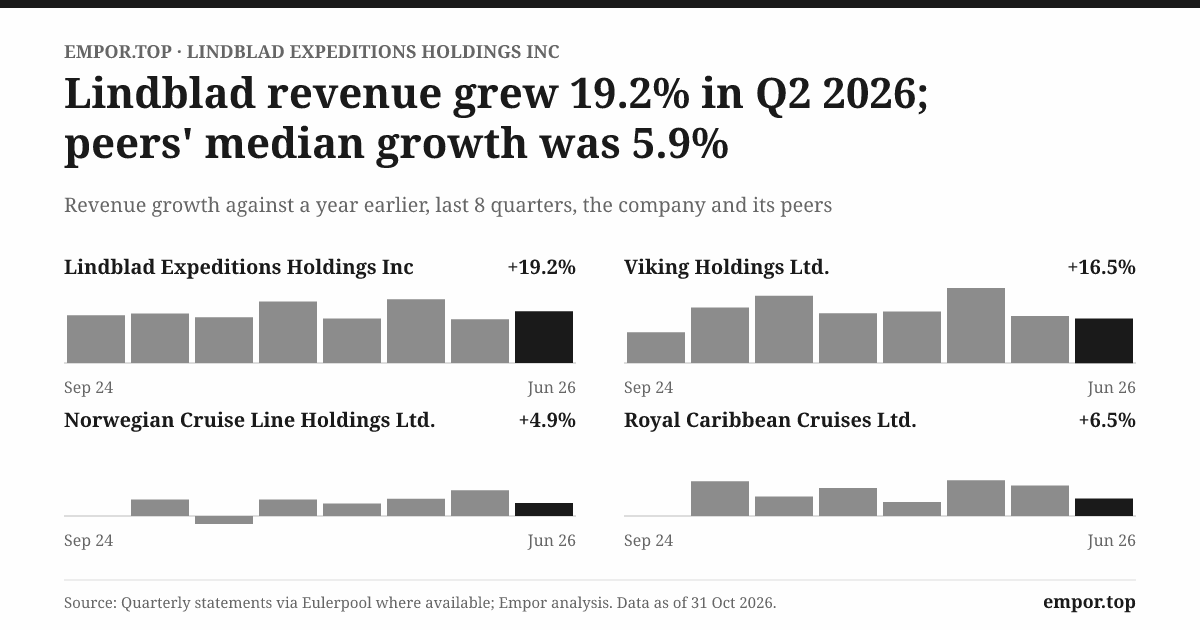
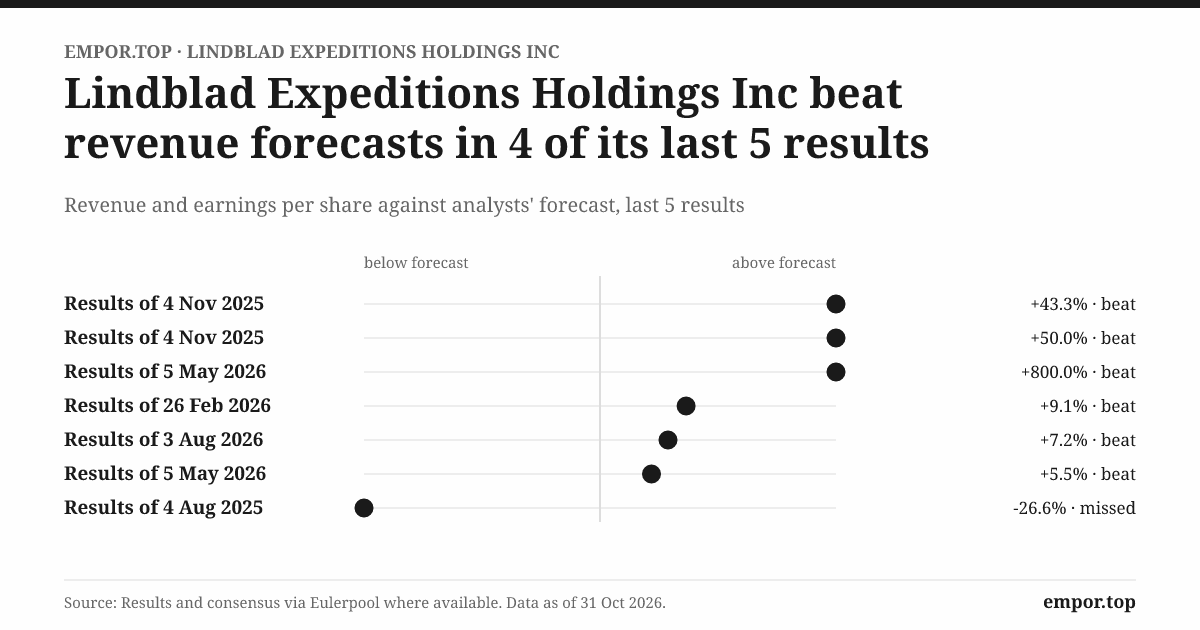
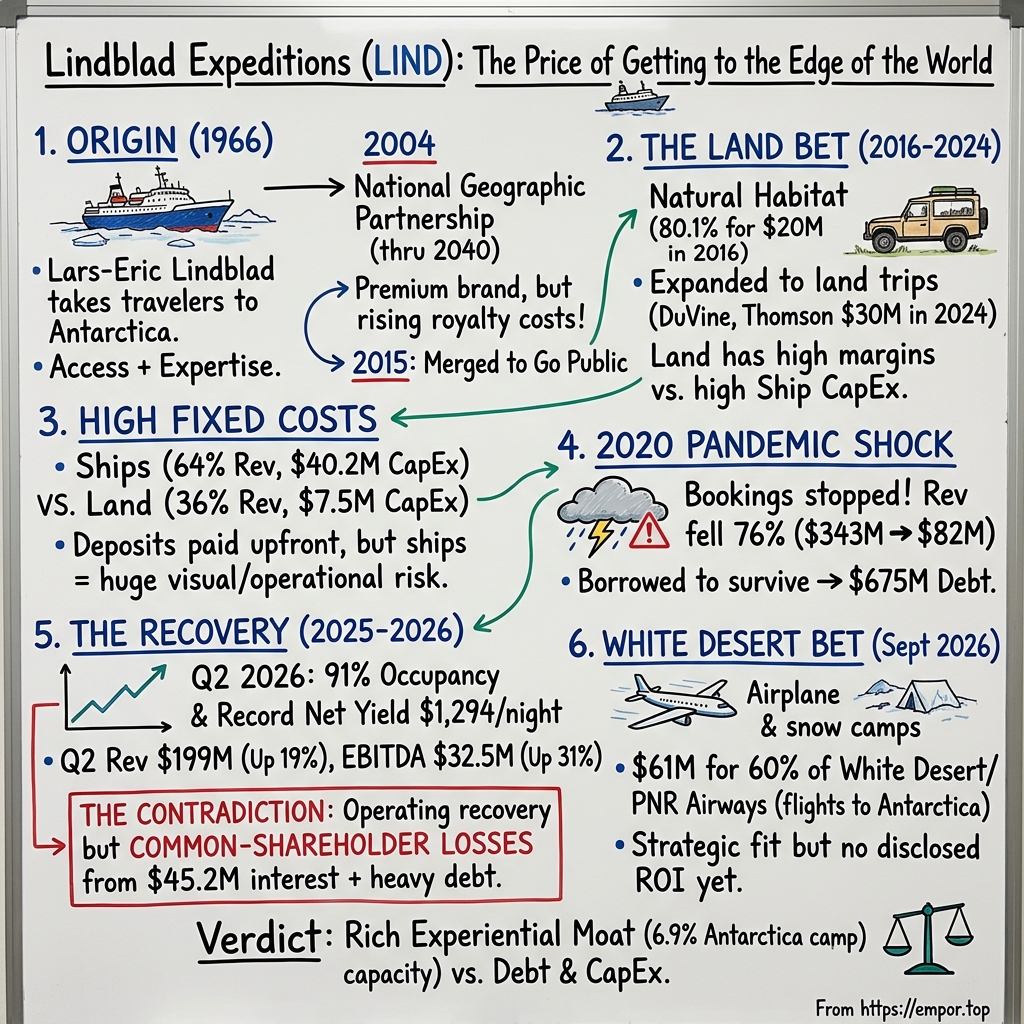
In early August 2026, Natalya Leahy had the kind of quarter a cruise executive hopes for. Lindblad Expeditions' small ships had sailed 91% full through the second quarter. Each night a berth was available for sale had brought in a net $1,294, a record for the period, so the company was filling more cabins and charging more for each of them.1 Revenue rose 19% to about $199 million, and adjusted EBITDA, management's preferred measure of operating earnings, rose 31% to about $32.5 million.1 Leahy had been chief executive for a year and a half, and on the earnings call she spoke like someone running a business with momentum. Management raised its full-year revenue and yield guidance.2
The same quarter had a second number, though, and it pointed the other way. After interest on the debt, depreciation on the fleet, payments to minority partners in the land businesses and every other claim that sits ahead of ordinary shareholders, the common stock still showed a small loss. Net profit attributable to shareholders was about minus $1 million, roughly break-even per share.3 The company owed $675 million on senior secured notes due in 2030.3 On the busiest, best-priced quarter of the year so far, nothing was left over for the owners.
That is the riddle at the centre of Lindblad, and it is why every voyage has to pay twice. The first payment is visible to the guest: the fuel, crew, naturalists, food, port fees, the Zodiac landings and the photographers who teach you to shoot a leopard seal in grey light. The second is hidden from the guest but not from the shareholder. The ship has to earn back what it cost to build or buy, then cover the interest on money borrowed to buy it and to survive the year when no ship sailed at all, and only then leave something for the people who own the equity.
A business like that can look healthy from the deck while it struggles on the balance sheet. Higher occupancy and record yields are evidence that demand is real. They do not show whether demand is strong enough, and durable enough, to carry this particular capital structure. The scoreboard is clear. Operating profit for the whole of 2025 was about $45.5 million, but interest expense alone took about $45.2 million, and a refinancing that year added a $23.5 million loss on extinguished debt.4 Common shareholders ended 2025 about $34.6 million in the red.5 The engine runs. Very little of what it produces gets past the bondholders.
Three questions will follow the story from here. The first is whether the yield gains are a permanent upgrade in what travelers will pay for remote access, or the high point of a post-pandemic rush for experiences that will fade as people take ordinary holidays again. The second is how much of the growth is Lindblad's own and how much was bought: since 2016 the company has assembled a portfolio of land-travel brands, and in September 2026 it made the largest acquisition in its history, an Antarctic aviation and camp business.6 The third is the one bondholders and shareholders both care about. Can Lindblad keep investing in ships and brands while paying down a debt load that the company's own history shows can become dangerous when travel stops?
First, it helps to be precise about what the company is. Lindblad Expeditions Holdings is the Nasdaq-listed company, and its reported numbers consolidate everything it controls: the ship business that carries the Lindblad and National Geographic names, plus a Land Experiences segment made up of Natural Habitat, Off the Beaten Path, DuVine, Classic Journeys and the Thomson Group.4 Intercompany transactions are eliminated. It is not a holding company sitting above unrelated travel brands. The ships, the safaris, the cycling tours and the minority partners' claims on them all appear in one set of accounts, and one balance sheet carries the debt for all of them.
That one balance sheet funds an expensive promise. Lindblad asks travelers to pay a premium, often well into five figures for a single voyage, to reach places most people will never see: the Antarctic Peninsula, the Galápagos, the fjords of Svalbard, Alaska's inside passages. It asks investors for something harder, which is patience while that premium is converted into earnings that survive the interest bill. The story of how a family expedition business became that wager starts with a ship heading south in 1966.
 Subscribe on LinkedIn
II. The expedition that became a business
Antarctica is easy to describe and very hard to reach. Until the mid-1960s it mostly belonged to the people who had a reason to be there: scientists, government expeditions, whalers and the navies supporting them. Lars-Eric Lindblad, a Swedish-born travel entrepreneur working out of New York, saw a different possibility. In 1966 he took paying travelers to the continent, and in doing so he turned a place reserved for researchers into a destination people could buy.7 Expedition cruising as a commercial category traces its origin to that voyage.7
The difficult part of the idea was never moving people. A strong enough ship can reach the Antarctic Peninsula. The difficult part was that putting tourists in front of an ice shelf does not make the trip an expedition. Without someone to explain what is happening, a colony of chinstrap penguins is noisy and smelly. With a naturalist who can read the colony and tell you why the chicks crowd together, which skua is waiting for a mistake, and what the guano stains say about the colony's age, the same scene becomes something a traveler remembers for the rest of their life. What Lars-Eric Lindblad sold, and what his son kept selling, was interpretation: access combined with expertise.
Sven-Olof Lindblad grew up inside that idea. He traveled with his father from childhood, then founded the company that would carry the family name, with the stated aim of offering innovative and educational travel expeditions. He served as its president and chief executive from the start until May 2021.5 Today he is co-chair of the board and still its largest shareholder, with about 16% of the common stock in April 2026.5 The company he built grew from a single family's polar ambitions into a small fleet operating on the edges of the map.
The working model took shape over decades, and it is easier to see as a set of choices than as a single innovation. Ships are small, so a landing party is a few dozen people rather than a few thousand, and they can use anchorages a large liner cannot. Itineraries follow wildlife and weather, not a fixed shopping schedule, so captains and expedition leaders have room to change a plan when a pod of orcas appears. Each voyage carries a team of naturalists, historians and photographers, and the evening recap, where the day's sightings are explained, is as much a part of the product as the cabin. The result is closer to a guided field course with good food than to a conventional cruise.
In 2004 Lindblad added the piece that would define its modern brand. It formed an alliance with National Geographic that put the yellow-bordered name on its ships, cabins and marketing, and that brought the society's researchers, photographers and writers on board as experts.7 The relationship has since been extended through 2040.4 It gives Lindblad a name recognized by the affluent, curious, older travelers who buy expedition voyages, along with co-marketing and a stream of credible experts. It also costs money. Lindblad pays a royalty calculated on substantially all of its ticket revenue, net of travel-agent commissions, and minimum royalties step up each year from 2026.4 So the partnership that helps justify a premium price also takes a share of that price, a tension that runs through the whole investment case.
The family company became a public one in 2015. A special-purpose acquisition company, Capitol Acquisition Corp. II, merged with Lindblad Expeditions, Inc., paying $90 million in cash and 20 million shares of common stock, and the combined company listed on Nasdaq.8 That was not an IPO in the usual sense. The listed shell acquired the operating business, and the business inherited a shareholder base, a reporting calendar and access to capital markets. Mark Ein, the financier who sponsored the acquisition vehicle, still owned about 5% of the company in 2026.5
What the company did with that access frames the decade that followed. It ordered and bought ships, so property and equipment on the balance sheet roughly quadrupled between 2015 and 2020.4 It survived a pandemic that stopped all sailing. And it built a portfolio of land operators, betting that the people who pay to see Antarctica from a small ship will also pay to see polar bears from a tundra vehicle or Tuscany from a bicycle.
That bet was a strategic change. A ship has a fixed number of berths and a fixed number of sailing days, so growth at sea means building or chartering more hull. Land trips grow differently. They need guides, lodges, vehicles and good relationships with local operators, but not a $100 million steel asset. If the Lindblad customer could be served on land, the company's growth would no longer be limited by its shipyard orders. The first test of that idea arrived in 2016, carried by a small company that took travelers to see polar bears.
III. The land business started as a $20 million bet
Every autumn, polar bears gather on the shore of Hudson Bay near Churchill, Manitoba, waiting for the sea to freeze so they can hunt seals on the ice. For decades one of the best ways to watch them was from a tundra vehicle, a high-wheeled, heavily built bus that lets travelers see the animals at eye level while staying out of reach. Natural Habitat Adventures had made that kind of experience its specialty, alongside safaris and nature trips across six continents. In May 2016 Lindblad bought control of it.9
The price was modest. Lindblad paid $20 million for 80.1% of Natural Habitat.9 The target had produced about $41 million of revenue and about $3.7 million of EBITDA in 2015.9 That works out to roughly $25 million for the whole equity, or about 6.8 times the prior year's EBITDA, before any adjustment for debt, cash or deal terms. For a profitable specialist operator with a recognizable name in nature travel, that is not an extravagant multiple. It was a measured bet with an earnings base the buyer could see.
The founder came with the business. Ben Bressler, who had built Natural Habitat, stayed on to run it and kept a minority stake, so Lindblad got an operating partner who still owned part of what he managed, along with the brand.10 That structure became the template for the land portfolio. Lindblad bought control, left founders or management with a meaningful piece, and gave both sides put and call options that set out how the rest would eventually change hands.4 It is a sensible way to keep an entrepreneur committed after a sale. It also means the listed company carries a long tail of future payments to minority holders whose size depends on how well the business performs.
Those future payments show up on the balance sheet. At the end of 2025, Lindblad carried about $47.9 million of redeemable noncontrolling interests, the accounting value of the minority stakes that holders can eventually require the company to buy.4 That is not debt in the usual sense, and it does not pay interest. But it is a claim on cash ahead of common shareholders, and it grows when the land brands do well. The better the founders perform, the more expensive it becomes to buy them out. That is fair, and it is also easy to overlook when adding up what a company owes.
Over the next eight years Lindblad kept adding specialists. Off the Beaten Path brought small-group trips through the American West and national parks. DuVine added cycling holidays through European wine country. Classic Journeys offered guided walking and cultural tours. In 2024 the Thomson Group, known for family safaris and Kilimanjaro climbs in Tanzania and Kenya, joined as well.4 Lindblad's reporting currencies now include the Tanzanian and Kenyan shillings, a small sign of how far the business had moved from its polar ships.4
The brands share a customer profile, affluent travelers who want guided, small-group experiences in places that are hard to arrange alone, but they do not form a single standardized product. A Tuscan bicycle tour and a Serengeti migration safari share little operationally besides a booking engine and a type of client. That is both the strength and the risk of the strategy. Each operator keeps the specialist knowledge that makes it valuable, and the parent has to manage a collection of businesses rather than one machine.
Measuring what Lindblad paid for each brand becomes harder after Natural Habitat. The Thomson Group cost about $30 million in 2024, including roughly $6 million paid in 682,593 newly issued shares.4 The company does not publish Thomson's revenue or EBITDA before the acquisition, so investors cannot compare that price with the transparent benchmark set in 2016. The outcome may have been good, cheap or expensive. Shareholders cannot judge it from what the company discloses.
There is a more recent clue about how Natural Habitat itself has done. In March 2026 Lindblad paid $16.6 million for a further 5% of the business, taking its ownership to about 95%.3 If 5% cost $16.6 million, the implied value of all of Natural Habitat was about $330 million, roughly thirteen times what Lindblad implicitly paid for the whole company in 2016. Two caveats matter. The price came out of the put and call arrangement agreed in the original deal, not a fresh negotiation, so it reflects a formula rather than a market auction. And the business has grown over a decade of ownership. Even so, the number says something. Either Natural Habitat became a far more profitable business inside Lindblad, or the formula is generous to the minority holder, and the company's disclosures do not give enough detail to say how much of each.
If the first explanation is true, it raises a question about the shape of the whole company: do the two segments have similar economics, or has the land business, the one without ships, quietly been doing a disproportionate share of the profit work?
IV. The ship is the product—and the fixed cost
Imagine a retired couple in Colorado planning a trip south. They do not book "a cruise." They pick a destination, Antarctica, then a season, then a ship and an itinerary, and finally a cabin category, which sets the price. They pay a deposit to hold the cabin and pay the balance before departure, usually months ahead.4 By the time the ship leaves Ushuaia, Lindblad has had their money for a long time.
That sequence explains the cash dynamics of the business. Lindblad commits most of its costs before it knows whether every berth will sell. The ship is owned or chartered for the season, the crew is hired, fuel is contracted, permits and port calls are arranged, and naturalists are scheduled. The marginal cost of one more guest on a sailing that is already going is small: food, a few consumables and some commission. The marginal revenue is the whole ticket. So filling the last 10% of berths contributes far more to profit than filling the first 10%, and charging a little more for each berth falls almost entirely to the bottom line.
That is why the two most important numbers in the ship business work as a pair. Occupancy is the share of available berths filled. Net yield per available guest night is the revenue, after commissions and similar costs, that Lindblad earns for every night a berth could have been sold, whether or not it was. Yield therefore captures both price and fullness. In 2025 both moved sharply. Occupancy rose from about 78% to about 88%, and net yield rose from about $1,169 to about $1,335 per available guest night.11 Ship revenue rose 17% with only 2% more capacity, so almost all of the growth came from selling existing berths better and at a higher price.4
The ship segment, which the company simply calls Lindblad, is still the larger business. In 2025 it generated about $496 million of revenue and $79.8 million of adjusted EBITDA. Land Experiences generated about $275 million of revenue and $46.5 million of adjusted EBITDA.11 On those measures the sea business was about 64% of revenue and 63% of operating cash earnings before depreciation, and the two segments looked broadly similar in profitability.
The picture changes once depreciation is included, which is the cost of wearing out ships. The ship segment produced about $7.1 million of operating income on $496 million of revenue, a margin of a little over 1%. Land Experiences produced about $38.4 million of operating income on $275 million, a margin near 14%.4 For every $100 a guest spent on a Lindblad voyage, about a dollar was left after operating costs and the cost of the ships. For every $100 spent on a land trip, about $14 was left. So the answer to the question at the end of the Natural Habitat story is clear: in 2025 the land business, which owns no ships, earned more than five times as much operating profit as the larger business at sea.
That does not make the ships the weak part of the company, and here the analysis needs care. The National Geographic ships are the brand. They are where the partnership's experts work, where the photography and the expedition leaders appear, and where the company's reputation was built over half a century. Many land guests probably found Natural Habitat or Classic Journeys because they first knew Lindblad, though the company does not publish how much cross-selling occurs. The ships also absorb most of the capital. In 2025 Lindblad spent about $40.2 million on capital expenditure in the ship segment and about $7.5 million in Land Experiences.4 Total capital spending on property and equipment was about $47.7 million, roughly 6% of revenue.4
The workforce shows the same split between a heavy sea operation and a lighter land one. At the end of 2025 Lindblad employed about 1,550 people: roughly 520 aboard its ships, about 160 guides and field staff on land trips, and about 870 in shoreside offices and land operations.4 The shipboard teams are a fixed cost of each sailing, because a ship needs its full crew and expedition staff whether it sails 70% full or 95% full. Land trips use more local partners and contract guides, so more of their cost moves with the number of travelers. That difference is another reason the land margin is higher, and another reason a weak season would hurt the ships first.
That capital bill is how the margin difference should be read. The land business looks better because it rents what it needs: lodges, vehicles, guides and local partners. The ship business owns or charters steel built for ice, and that steel needs regular overhaul, refits and eventually replacement. A 1% operating margin on a segment carrying that much capital is not a sustainable return. The 2025 result was the first positive one after years of losses, but the segment still has to show that a more normal year, without a booking surge, can earn back what the fleet costs.
The customer's position in this model is unusual. Most businesses deliver first and collect later. Lindblad collects first. At the end of 2025 it held about $361.5 million in guest deposits and unearned passenger revenue, money paid for trips not yet taken.4 That is a large source of free financing, and it is a big reason operating cash flow is consistently higher than reported profit. It is also an obligation. Until a guest passes the cancellation deadline, a deposit can be refundable, and after that the company still owes a voyage.4 In a normal year the obligation is routine: the ship sails, the deposit becomes revenue and new deposits arrive for next season. The year when that cycle stopped is where the story goes next.
V. The year the bookings stopped mattering
On February 25, 2020, Lindblad's management held its fourth-quarter earnings call and sounded confident about 2020. The company said bookings already covered about 86% of projected ticket revenue for the year, a strong head start for a travel business.12 A new coronavirus had been spreading in China for weeks, and analysts asked about it. Management's view was that the direct effect on Lindblad would be limited: its destinations were remote and its guests mostly North American, and the itineraries most exposed were a small share of the year.12
Within weeks, that view was overtaken by events. Borders closed, ports refused ships, and cruise ships became one of the most visible symbols of the pandemic. Lindblad stopped sailing. The bookings that had looked like a guarantee became a liability: guests wanted refunds or credits for trips that could not happen, and the company had to decide how much cash to return while its costs continued.
The numbers show the scale. Revenue fell from about $343 million in 2019 to about $82 million in 2020, a drop of 76%.13 Operating profit went from about $33 million to a loss of about $88 million.13 And that was not the bottom, because 2021 was only a partial restart, with an operating loss of more than $110 million, before the company returned to operating profit in 2023.4
It would be unfair to say management should have predicted a global pandemic in February 2020; almost nobody did. The useful lesson is narrower and more lasting. A strong order book feels like protection, and in ordinary bad years, when a ship has a mechanical problem or a destination has a political scare, it is. But advance bookings protect a travel operator from its own problems, not from a shutdown of the whole travel system. When every ship in the world is told to stay in port, a full order book becomes a list of people owed refunds or rebookings. The idea that Lindblad's deposits made its business resilient was tested and, for that kind of shock, rejected.
The survival plan had three parts, and each left a lasting mark. The first was cutting costs and pausing operations to reduce cash burn. The second was borrowing. Total debt roughly doubled in 2020, from about $224 million to about $488 million, and the company raised more than $340 million through financing activities that year.13 The third was equity of a particular kind. In August 2020 Lindblad sold $85 million of Series A redeemable convertible preferred stock.4
The preferred stock was not a free bridge. It ranked ahead of common shares, accrued dividends and carried the right to convert into common stock. For more than five years it sat between operating profit and common holders, which is part of why net loss available to common shareholders stayed worse than the consolidated net loss even after recovery. In February 2026 it converted into about 9 million common shares.4 That conversion removed the preferred dividend, but it spread future profits across a larger share count. The cost of keeping the company alive through 2020 is still visible on the equity line.
Meanwhile, the fleet kept growing. Lindblad had ordered new polar-class expedition ships before the pandemic, and they arrived during the shutdown years, National Geographic Endurance and then National Geographic Resolution, purpose-built for ice.4 Property and equipment rose from about $364 million at the end of 2019 to about $547 million by the end of 2021.4 The company was paying for new ships, an expensive bet on the future of polar travel, at the same time as it had no revenue to pay for them. Accumulated losses pushed shareholders' equity from about $123 million at the end of 2019 to negative territory by 2022, and it has stayed there.4
By the March 2021 call, the discussion had moved to restart planning: which itineraries could resume, which destinations would reopen first, and how guests who had held credits for a year would be rebooked. The company had survived, but the shutdown left it with heavier debt, a preferred stock ahead of common holders and a larger fleet to fill; accumulated losses later erased its equity cushion.13
This is the starting point for the recovery that came next. The present balance sheet, including the $675 million of notes and the larger share count, is partly the bill for 2020. When the recovery does show up in earnings, it has to pay that bill first.
VI. The recovery reached the ships before common earnings
From 2020 through 2024, the ship segment lost money at the operating line; in 2025 it turned positive.4 A segment that had been the source of the company's prestige and its losses was, for the first time since the pandemic, covering its own costs, including depreciation.
The consolidated numbers looked even better. Revenue reached about $771 million in 2025, up about 20%, and operating profit about $45.5 million.4 Revenue had grown about 22% a year from 2022 to 2025. That rate needs context, because 2022 was still a partial recovery year. Across the 12 reporting years from 2014 through 2025, including the collapse and rebound, revenue grew about 14% a year. That is still a strong rate for a travel company, but it is less dramatic and more realistic as a long-term base.
The sources of the 2025 growth matter, because they show what kind of growth it was. In the ship business, revenue rose 17%, capacity rose only 2% and net yield per available guest night rose 14%.4 Lindblad did not add many ships. It filled the ones it had and charged more for them. That is high-quality growth, the kind that comes from demand rather than spending, and it explains why profit rose much faster than revenue. Land Experiences revenue rose 24%, but that included a full year of Thomson Group after a partial year in 2024.4 Part of the land growth was bought, and the company does not split organic land growth from acquired revenue in a way that lets investors measure underlying demand separately.
Here the gap between operating improvement and earnings becomes the whole story. That operating profit was almost exactly matched by interest expense.4 Depreciation and amortization, about $62.8 million in 2025, had already been deducted before operating profit.4 Then came the refinancing. In August 2025 Lindblad replaced its 6.75% and 9.00% notes with $675 million of 7.00% senior secured notes due in 2030, which pushed out the maturity and reduced the blended interest rate by about three-quarters of a point.4 Repaying the old notes early cost about $23.5 million, including a $7.1 million write-off of financing costs that did not involve cash.4 The result was a consolidated net loss of about $24.2 million, and after preferred dividends and minority interests, a loss of about $34.6 million for common shareholders.4
The refinancing was a sensible move, and the credit market saw improvement. S&P raised Lindblad's rating from B- to B in August 2025, citing strong forward bookings, recovering occupancy and EBITDA from the land acquisitions, and expected leverage in the mid-5x range.14 But a B rating is still speculative grade. The agency was saying Lindblad's position had improved from fragile to merely highly leveraged. The fixed interest bill of roughly $47 million a year at 7% on $675 million will stay until the debt is repaid or refinanced.
The near-term liquidity position, at least, is comfortable. At the end of June 2026 Lindblad held about $319 million of cash, plus about $46 million of restricted cash, and its $60 million revolving credit line, which matures in 2030, was undrawn.3 The company was in compliance with its covenants.3 Against $675 million of notes, that leaves net debt of roughly $355 million before counting deposits, which is a much less frightening figure than the gross amount. The catch is that a large part of that cash is the guests' money, held for trips they have already paid for. In a crisis it would be the first cash to go. It is a cushion against bad luck, not a fund for paying off bonds.
The accounts themselves give little cause for alarm. Ernst & Young issued a clean audit opinion on the 2025 statements and concluded that internal controls over financial reporting were effective.4 The filing records a $3.0 million legal settlement expense in 2024 but none comparable in 2025, and it does not identify a tax demand, regulatory action or lawsuit large enough to require a reserve.4 The judgment calls that matter most are the ordinary ones for a cruise operator, mainly the useful life assumed for each ship, which sets the depreciation charge, and when a deposit counts as revenue. Neither looks aggressive on the disclosed numbers.
Cash flow tells a more encouraging story, with a caveat. Operating cash flow was about $111.6 million in 2025, and after capital spending, free cash flow was about $64 million.4 Across the 12 reporting years from 2014 through 2025, Lindblad reported cumulative net losses of about $392 million while generating about $449 million of operating cash, a gap of more than $800 million. Depreciation, stock compensation and deposits explain most of it. Over 2023 to 2025 alone, depreciation and amortization totaled about $162 million and stock compensation about $37 million.4 And in 2025, operating cash flow benefited from higher guest deposits and changes in the timing of payables and accrued expenses.4
That last point is the important one. When bookings grow, deposits grow faster than revenue, because guests pay for trips further ahead. A growing pile of deposits feels like cash generation, and it is cash, but it is cash for voyages not yet delivered. If bookings level off, that boost disappears, and if they fall, it reverses. Some of the 2025 free cash flow was the result of the business growing, not a repeatable return from a business at steady state.
So the unresolved question is not whether the recovery is real. It is. The question is how much cash the company generates in a year without a deposit tailwind, after the fleet's maintenance spending and after a full year of interest. The company does not split capital spending into maintenance and growth, which makes that answer hard to calculate. Lindblad has an answer in mind, though, and in September 2026 it put about $61 million behind it.
VII. The $61 million decision to go deeper into Antarctica
Most Antarctic travelers see the continent from its edge. Ships cross the Drake Passage, reach the peninsula and send Zodiacs ashore for a few hours at a time. Antarctica's interior, the high polar plateau, the mountains rising through the ice sheet and the South Pole itself, is far beyond the range of any ship. White Desert built its business on getting people there.
Polar explorer Patrick Woodhead founded White Desert in 2005 to make the interior accessible. The company flies guests from Cape Town to blue-ice runways on the continent, and its itineraries include the Geographic South Pole and an emperor penguin colony of more than 20,000 birds.6 It employs more than 150 people from 18 nationalities.6 Woodhead also leads a younger business, Echo Charlie, which flies groups of 12 guests on a fully refurbished vintage DC-3 to places such as Colombia, Patagonia, the Faroe Islands and Greenland.6 On September 14, 2026, Lindblad agreed to buy 60% stakes in White Desert, its sister company PNR Airways and Echo Charlie.1516
Leahy called it the largest transaction in the company's history.6 Lindblad paid about $61 million in cash, plus about $6 million for the cash on the targets' balance sheets, subject to the usual adjustments for working capital, cash and debt.15 To put the price in context, $61 million is close to half of the adjusted EBITDA Lindblad's two segments generated in 2025, and more than all the capital spending in the ship segment that year. Woodhead joined Lindblad as a strategic innovation adviser while staying in charge of the businesses.6
The two parts of the deal are very different, and the distinction matters. White Desert is an established specialist with two decades of operating history in one of the most demanding environments any tourism company works in. Running aircraft and camps on the ice sheet requires safety systems, permits, logistics and expertise that are hard to replicate, and Lindblad's polar experience at sea is genuinely adjacent to it. Echo Charlie is something else: a new aviation travel brand with a vintage aircraft, an evocative concept and no public track record of commercial scale. The first looks like an acquisition of a capability. The second is closer to a venture investment.
The deal materials talked about a new era in experiential travel, with sea, land and now air.17 That language describes ambition, not results. Neither the press release nor the presentation disclosed White Desert's or Echo Charlie's revenue or EBITDA.6 So the most basic question an investor can ask, what multiple of earnings did Lindblad pay, cannot be answered. The company raised its 2026 guidance to $850 million to $880 million of revenue and $140 million to $148 million of adjusted EBITDA, attributing the increase to the new brands and to the strength of the existing business, but it did not say how much came from each.6
The structure does offer some protection. Lindblad holds options to buy the remaining 40% in two equal tranches, exercisable around the end of 2030 and the end of 2031, at prices based on the acquired companies' EBITDA at that time.15 If the businesses grow, Lindblad pays more for the rest but buys something more valuable. If they disappoint, the price falls. That links future payments to performance. It also means the total cost of the deal is open-ended, and the bill for the second half arrives at almost exactly the time the $675 million notes are due.
The comparison with 2016 makes the shift in disclosure clear. When Lindblad bought Natural Habitat, it told shareholders the target's revenue and EBITDA, so anyone could calculate that the company paid roughly seven times earnings. A decade later, for a deal about three times larger in cash, it disclosed neither. That is a change from transparent to opaque, and it happened as deals grew larger.
The timing matters too. In the months before the White Desert agreement, Lindblad had paid $16.6 million to increase its Natural Habitat stake, and by July 2026 it had spent about $23 million buying back shares and warrants under a $35 million authorization.2 It carried $675 million of secured notes due in 2030. Each of those uses of cash may be defensible on its own. Together they amount to a company spending in several directions at once, buying back stock, buying out minority partners and buying new businesses, while its debt stands well above its annual operating cash flow.
There is also a new kind of operating risk. Lindblad knows how to run ships in ice and land trips in the bush. It has not run an airline. White Desert's guests reach the interior on aircraft landing on ice runways thousands of kilometers from any hospital, and Echo Charlie operates an aircraft type that first flew in the 1930s, however carefully it has been rebuilt. Those businesses have operated safely under Woodhead's leadership, which is a large part of what Lindblad paid for, and the company kept him and other key staff under employment agreements for that reason.15 But the reputational exposure now sits with a listed company whose brand promise is getting people back safely. An aviation incident would affect the whole company, not just a 60% subsidiary.
That combination raises the central capital-allocation question. White Desert may prove to be an excellent acquisition, a rare asset in a destination where Lindblad already has expertise. But shareholders will only know if Lindblad reports what it earns. Without target-level revenue, EBITDA and cash needs, the next purchase, whether the remaining 40% or another brand, will be judged on management's word. And management's ability to sell the Antarctic dream to its guests depends heavily on one partner whose name is painted on the ships.
VIII. The National Geographic name has a price
Walk the deck of a Lindblad ship and the partnership is everywhere. The vessels are named National Geographic Endurance, National Geographic Resolution, National Geographic Islander II. The photographer leading the evening workshop may have shot for the magazine. The yellow rectangle appears on the luggage tags, the brochures and the parkas. For many guests that rectangle is part of the promise: this is not a cruise with a lecture program but an expedition associated with a century of exploration.
The partnership was renewed and extended through 2040.4 Its core terms are clear. National Geographic contributes its name, co-marketing, distribution through its own channels and access to its scientists, photographers and writers. Lindblad contributes the operation: the ships, the itineraries, the crews and half a century of knowing how to put a small group ashore safely in difficult places. Lindblad also gets exclusivity. In the United States and Canada, the agreement covers expedition ships carrying 295 passengers or fewer.4 A competitor cannot sell a small-ship expedition under the National Geographic name in Lindblad's core market.
The best evidence that this matters is price. In its February 2026 investor presentation, Lindblad cited its 2025 net yield of $1,335 per available guest night against $545 for Viking's expedition product.7 On those figures Lindblad earns more than twice as much per berth per night as one of the most successful cruise brands of the past decade.
That comparison needs care, and investors should hold it loosely. It is the company's own presentation, comparing different products, different ship sizes, possibly different measurement periods and different definitions of yield. Viking's expedition ships are larger and more conventionally luxurious, and its pricing strategy is built on including more in a lower headline fare. The difference does not prove the National Geographic partnership is worth $790 a night. It suggests that the combination of small ships, expert staff and a respected name supports a substantially higher price than larger competitors achieve. That is a premium niche, not proof of a monopoly.
The cost side is harder to see. The royalty is a percentage of substantially all ticket revenue, net of agent commissions, with minimums rising each year from 2026.4 As Lindblad's prices rise, National Geographic's take rises with them. In the second quarter of 2026, the company cited the final step-up in National Geographic royalties as one reason selling and marketing costs grew.1 In 2025, commissions and royalties together rose about $13.9 million year over year, alongside higher revenue.11 But Lindblad does not disclose the royalty itself as a dollar figure or share of revenue, so investors cannot measure what the name costs.
There is also dependence. The agreement contains early termination provisions, and Lindblad's own filings say that termination or adverse changes could materially affect its results.4 The partnership has lasted more than 20 years and runs for another 14, which suggests both sides value it. But Lindblad does not own the asset that its ships are named after. A brand that you license is a source of advantage only as long as the licensor wants to keep licensing it on similar terms, and the minimum royalty schedule shows that the price is already rising.
So the partnership is plausibly a real advantage: a scarce name, an exclusive franchise in the company's largest market and a pricing premium that is at least consistent with differentiation. But its net value is unproven, because the company does not disclose the cost or the bookings it brings in. The evidence that would settle it is specific: the annual royalty as a share of ticket revenue, the share of guests who arrive through National Geographic channels, and Lindblad's yield against comparable small-ship operators rather than large-ship brands. Without that, the partnership is a strong story rather than a measured advantage. And the market Lindblad sells into is getting more crowded every season.
IX. A premium product in a crowded expedition market
Stand in Ushuaia, the Argentine port at the bottom of South America, on a December morning, and Lindblad's competitive problem is visible from the pier. A National Geographic ship may be tied up next to a Ponant vessel with a French chef, an HX ship from the Norwegian Hurtigruten tradition, a Quark Expeditions vessel built for polar specialists, a Silversea ship offering butler service and a Viking ship with Scandinavian design and a lower fare. A dozen companies sell the same destination to the same small pool of affluent, adventurous travelers.
The numbers confirm what the pier suggests. In projected Antarctic expedition capacity for the 2025–26 season, Lindblad held about 6.9% of berths. HX had about 15.7%, Ponant 10.1%, Silversea 9.0%, Viking 7.2% and Quark 7.1%.18 Lindblad was one of several similarly sized operators, behind the two largest and close to the rest. That is a view of one destination market rather than all of expedition travel, and capacity share is not the same as revenue share, which would favor premium-priced operators. But it rules out one idea: Lindblad does not dominate the Antarctic expedition market.
The competitive set is wide. Direct rivals include Ponant, HX, Quark, Silversea, Viking, Seabourn and smaller specialists. Beyond them, luxury ocean cruise lines, high-end safari operators and land-based adventure companies compete for the same discretionary budget. A couple deciding between Antarctica, an African safari and a private villa in Italy is choosing between categories, not only between operators, and Lindblad sells two of those three.
The competitive forces are easy to name. Travelers can switch easily, because there is no contract and no loyalty program that locks them in, so buyer power is significant in any individual purchase. Distribution runs through travel agencies and preferred-agent consortiums as well as direct sales, and those intermediaries take commissions and can steer clients.4 Entry barriers are real but not prohibitive: ice-class ships, polar permits, experienced expedition staff and safety systems take years to build. But large cruise groups with deep pockets have shown they can fund new expedition ships and enter the category. Seabourn, where Leahy was president before joining Lindblad, is a part of one such group.5
On the 2026 second-quarter call, management offered an important clue about where growth comes from now. It said occupancy of about 90% was a likely norm for its small ships and that yield growth in 2027 would depend more on pricing than on filling more berths.2 That is a significant statement. The easiest gains of the recovery, filling berths left empty after the pandemic, are mostly over. From here, the yield story depends on whether guests will pay more each year for the same voyage.
What sustains a price premium in a market where buyers can switch? Repeat bookings, guest satisfaction and pricing that holds up when demand softens. Lindblad reports record guest satisfaction, and its incentive plan measured a 93.2% guest-satisfaction score in 2025.5 But it does not publish comparable retention rates, the share of guests who book again, or how many bookings it loses to competitors. Satisfaction is a good sign. Repeat purchase at a rising price would be proof.
Technology could cut both ways. Artificial intelligence cannot steer a ship through pack ice or explain a penguin colony on the beach, so the core product is about as hard to replace with software as any in travel. But the way travelers find and compare trips is changing. If AI travel assistants make it easier to compare a Lindblad voyage with a Ponant or Quark sailing on price and itinerary, the advantage of a familiar name may narrow, and the agents and consortiums that now steer affluent clients may lose some influence.4 For a premium brand, easier comparison is a mild threat. How much it matters depends on how much of Lindblad's business comes from repeat and referred guests, who need less persuading, and Lindblad does not publish that share.
The downside follows directly from the ship economics. If more expedition capacity enters the market, fuel costs rise or affluent travelers become more cautious, prices will be the first thing to move, because a ship that is going to sail anyway is better filled at a discount than left empty. Fuel was already elevated in 2026 and was a recurring topic on the second-quarter call.2 Vessel costs, crew and depreciation do not fall when prices do. Lindblad's high operating leverage makes rising yields very profitable and falling yields very painful. A premium niche is defensible, but it is not a protected market, and the people who decide how well Lindblad defends it now sit in its executive offices.
X. Leahy's scorecard: EBITDA, guests and capital
Natalya Leahy arrived at Lindblad in January 2025 with a résumé built in large-ship cruising and corporate finance rather than polar expeditions. She had most recently been president of Seabourn, the ultra-luxury brand, and before that chief operations officer and chief financial officer of Holland America Group.5 She had spent about a decade at Procter & Gamble and held finance and operations roles at the United Nations, Coca-Cola and a Le Méridien hotel in Uzbekistan. She holds an MBA from Michigan State University and a master's degree in banking and finance from Tashkent Financial University.5 It is an operator's and a finance executive's background, which is what a leveraged company needs, though it is a different profile from the founder-explorer who led the company for its first decades.
Her chief financial officer, Frederick "Rick" Goldberg, took the role at the end of 2024.5 He had been CFO of Founders Table Restaurant Group, owner of Chopt and Dos Toros, and before that CFO of Jackson Hewitt; he had also co-founded a small travel company, City Wine Tours, and started his career as a strategy consultant at Monitor Group.5 Together they represent a clear shift from founder leadership to professional management focused on operations and finance.
How they are paid shows what the board wants. Leahy's 2025 annual cash bonus was tied entirely to adjusted EBITDA, with adjustments for net yield, guest satisfaction and vessel safety. The company reported adjusted EBITDA of about $119.5 million for compensation purposes against a target of $114.5 million; with the yield modifier, her bonus paid out at 127% of target, about $572,000.5 Her total 2025 compensation was about $6.29 million, including a one-time retention payment of $1.125 million and about $3.97 million of stock awards.5
The design has merit. Guest satisfaction and vessel safety are the right things for an expedition operator to measure, because a single serious accident could cost far more than any quarter's earnings. But adjusted EBITDA has an obvious limit for this company. It excludes interest, depreciation and many one-time costs, which are exactly what separate Lindblad's operating success from its common shareholders' losses. A chief executive can hit every EBITDA target while net loss to common holders barely changes, which is roughly what happened in 2025, when that loss narrowed only from about $35.8 million to about $34.6 million.5 Leahy is also not listed among the proxy's principal holders, so most of her equity exposure comes through awards rather than a large personal stake.5
Behavior matters more than targets, and here the record is short but reasonable. After the second quarter of 2026, management raised revenue and yield guidance while holding adjusted EBITDA guidance, and it explained why: fuel was costing more than planned, and the National Geographic royalty step-up added cost.2 Raising the top line without raising profit guidance is a more honest kind of guidance than claiming everything is improving at once. On the call, management also gave a clear order for using capital: invest in the existing business first, then make disciplined acquisitions, then reduce debt or repurchase shares opportunistically.2
That order is the standard to judge them by. By July 2026 the company had spent about $23 million on shares and warrants under its $35 million repurchase plan, while carrying $675 million of debt and preparing the largest acquisition in its history.2 Repurchases make sense when the shares are cheap relative to their value. At the prices Lindblad paid earlier in 2026, before the stock more than tripled from its 52-week low, those buybacks may look smart in hindsight.19 But each dollar used for buybacks is a dollar not used to reduce 7% secured debt, and a company with negative book equity and a speculative-grade rating has a narrower margin for error than most companies that buy back stock.
Shareholders broadly supported the pay program. At the June 2026 annual meeting, about 49 million votes were cast for the 2025 executive pay and about 1 million against.20 That is a strong endorsement, but a pay vote is not a verdict on capital allocation. The founder remains a significant shareholder, and a supportive vote mostly shows that no large shareholder was unhappy enough to protest.
The ownership structure explains why that is unsurprising. Of about 65.5 million shares eligible to vote in April 2026, about 55 million were represented at the meeting.20 The founder holds about 16%, Mark Ein about 5% and director L. Dyson Dryden about 2%, and no one holds a majority.5 The proxy does not disclose any pledge of shares by a controlling holder.5 That is a board with a meaningful founder influence but no controlling shareholder, which leaves room for outside investors to push for better disclosure if they want it.
The real test of this management team is disclosure. Shareholders need three things they do not now receive: the revenue and EBITDA of White Desert and Echo Charlie as they are integrated, organic growth separated from acquired growth in each segment, and cash flow after maintenance capital spending. With those, investors could check whether the team's capital choices earn more than their cost. Without them, investors are relying on the same trust Lindblad asks of its guests when they step into a Zodiac.
Playbook: Business & Investing Lessons
Go back to 1966, to the first paying travelers stepping onto Antarctic ice with Lars-Eric Lindblad. They were not paying for transportation. A navy ship could have taken them. They were paying for the confidence that someone knew how to get them there, show them something worth seeing, and bring them home. That remains Lindblad's product six decades later. A remote destination is a product only if the guest trusts you to get there, and bring them back. For founders, the lesson is that the scarce asset in experiential travel is competence the customer cannot judge until it is too late, so reputation is worth more than any ship. For investors, it means the true value of a brand like Lindblad lies in its safety and operating record, which is why one serious incident would matter more than any quarter's yield.
Then go to February 2020, when management said 86% of the year's ticket revenue was already booked, a few weeks before the whole fleet stopped. Bookings had felt like a moat. They turned out to be a queue of people waiting for refunds. Deposits move cash forward; they do not move the voyage obligation away. Any business that collects before it delivers looks strongest when it is growing and becomes most fragile when it stops. The cash from guest deposits is real, but it belongs to future trips; an investor who values it like earned profit is counting the same money twice.
The National Geographic name helps fill Lindblad's cabins, but it also comes at a cost. A brand partnership can help fill the ship and still take a rising share of the ticket. Borrowed brands are powerful and leased. The question is whether the partner adds more than it takes, and only the licensee knows the answer if it chooses not to disclose the cost.
Finally, compare the 2016 Natural Habitat deal with the 2026 White Desert and Echo Charlie deal: the first came with target earnings disclosure; the second did not. An acquisition is only a new growth engine when the returns are visible beside the price paid. For a company with growing ambitions and a leveraged balance sheet, transparency is not just good governance. It is the only way the market can price acquisitions as investments rather than as hope.
Analysis & Bear vs. Bull Case
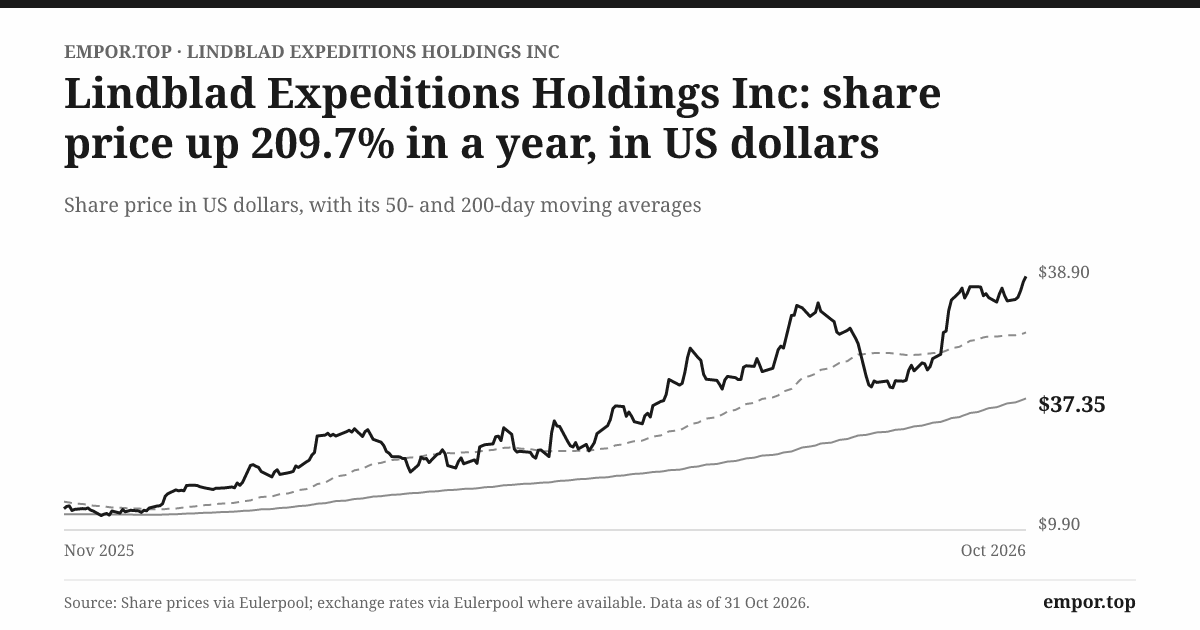
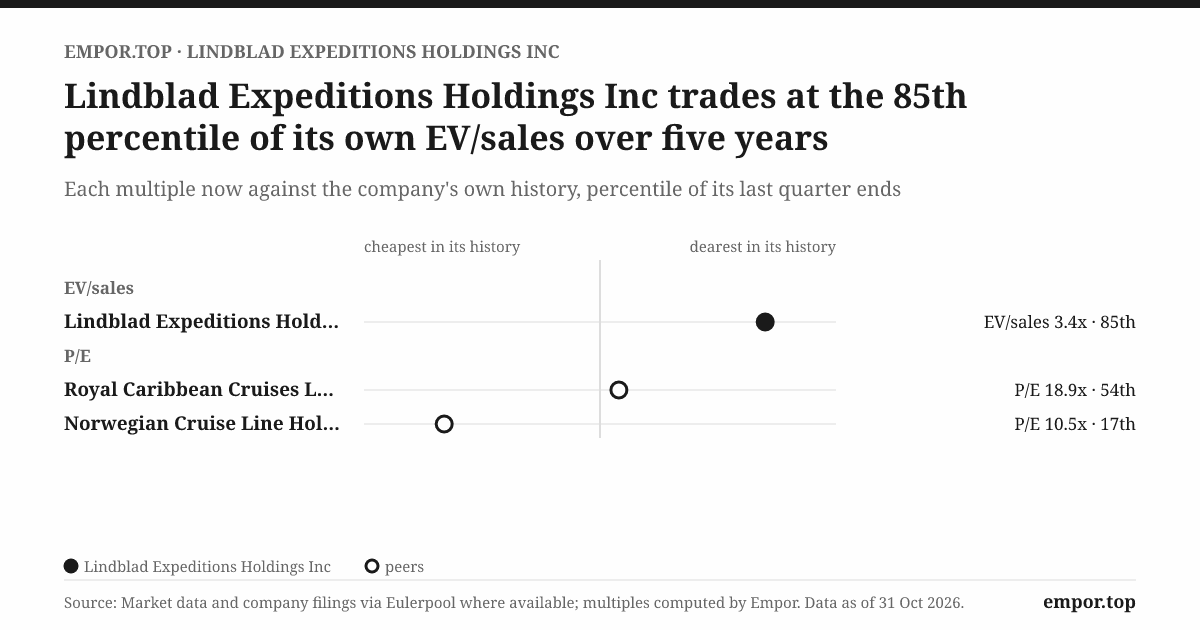
At the end of October 2026, Lindblad's shares closed at about $37.35, the highest price of the past year and more than three times the 52-week low of about $11.45.19 The market value was about $2.1 billion, and including debt net of cash and other claims, enterprise value was about $2.4 billion.19 That is about 3.4 times sales, about 23 times EBITDA and about 41 times operating profit, and the company's earnings per share over the previous twelve months were still negative.19 The stock is priced for success, and it has had a year of good news to justify that.
The bull case starts with demand. Ship occupancy was near management's stated norm in the second quarter of 2026, while yield hit records.1 Both segments grew. Land Experiences adds a higher-margin, lighter-capital business. The National Geographic partnership supports a premium price. The 2025 refinancing bought time and earned a credit upgrade. Free cash flow has been positive for two years. The company raised guidance twice in 2026, the second time to adjusted EBITDA of $140 million to $148 million.6 If yield keeps growing at mid-single digits on a fleet that is already nearly full, most of the increase will fall to operating profit, and interest will become a smaller share of a larger total.
The bear case starts with the same income statement read from the bottom. Common shareholders have not seen a profit for the full year since 2019. Interest consumed almost all of the 2025 operating profit, and the ship business barely cleared operating break-even. Shareholders' equity is negative, and the preferred stock that kept the company alive has converted into 9 million new shares. At 41 times operating profit, the valuation leaves little room for a year of flat yields, high fuel or a soft travel market.
Two stress tests decide which reading is right. The first is the deposit story. Strong 2025 operating cash flow came partly from growing deposits, which fund future trips and can be refundable. A company that converts cash at that rate in a growing year might convert much less in a flat one. Free cash flow yield of about 5.3% looks solid, but how much of that is repeatable after maintenance spending is not something the company currently reports.19
The second is the acquisition story. Natural Habitat had a clear entry price, and its 2026 buy-in suggests it has grown far beyond it. Investors cannot compare Thomson's or White Desert's and Echo Charlie's prices with their earnings. Land Experiences has been the more profitable part of the company, so the strategy has worked at least once. But each deal has come with less disclosure, and the most recent one was the largest.
A skeptical activist would focus on a few points. Why does a company with negative equity, speculative-grade debt and no common-shareholder profit buy back shares while also buying businesses? Why did deal disclosure decline as the deals grew? Why is the CEO's bonus tied to adjusted EBITDA rather than to a measure that includes the cost of ships and debt, such as operating profit or free cash flow? And would the land business, with its higher margins and lighter capital needs, be valued more highly if it were reported, or even owned, separately from the fleet? None of those questions implies wrongdoing. Each is a request for evidence the company could provide, and the answers would tell investors more about management's discipline than any guidance figure.
The competitive forces were set out with the Antarctic capacity numbers: buyers can switch, agents take a share, entry is hard but not impossible, and well-funded cruise groups keep adding expedition ships. Seen through Hamilton Helmer's seven powers, which ask what lets a company earn more than its cost of capital over time, Lindblad's case rests on two. The first is branding, the National Geographic name and Lindblad's own reputation, which plausibly let it charge more for an objectively similar voyage. But it is partly leased, and its cost is rising. The second is a form of cornered resource: the exclusive small-ship franchise in North America, expedition staff, polar permits and now White Desert's interior access, which is genuinely scarce. Scale economies are limited, since Lindblad is smaller than several rivals in its key destination. Network effects and switching costs are weak, because a satisfied guest can still choose Ponant next time. Counter-positioning applies only partly: larger cruise companies can build small ships but may not want to give up large-ship economics. The honest verdict is that Lindblad has a real but narrow moat, strong enough to support premium prices in good times and not yet proven in a demand downturn with more competitors.
Three numbers will show which way it is going. Ship occupancy is near the level management calls normal. Net yield per available guest night is at records and, management said, was expected to depend more on pricing in 2027. The third is free cash flow after maintenance capital spending, which the company does not yet define, but which investors can approximate from operating cash flow minus capital spending, about $64 million in 2025, read against changes in deposits. Alongside those, net debt and organic segment growth will show whether the business is deleveraging and whether growth is earned or bought.
The risks that would change the economics are specific. Discretionary travel demand among affluent older travelers can fall quickly when markets or health scares hit. Fuel is a major cost that cannot be fully passed on mid-season. A serious vessel or aviation accident, now including aircraft over Antarctica, could damage the brand and bring regulatory consequences. The National Geographic agreement could change. Integrating a founder-led aviation business is new territory for a ship and tour operator. And the $675 million of notes must be refinanced by 2030, when the options on White Desert's remaining equity also come due.
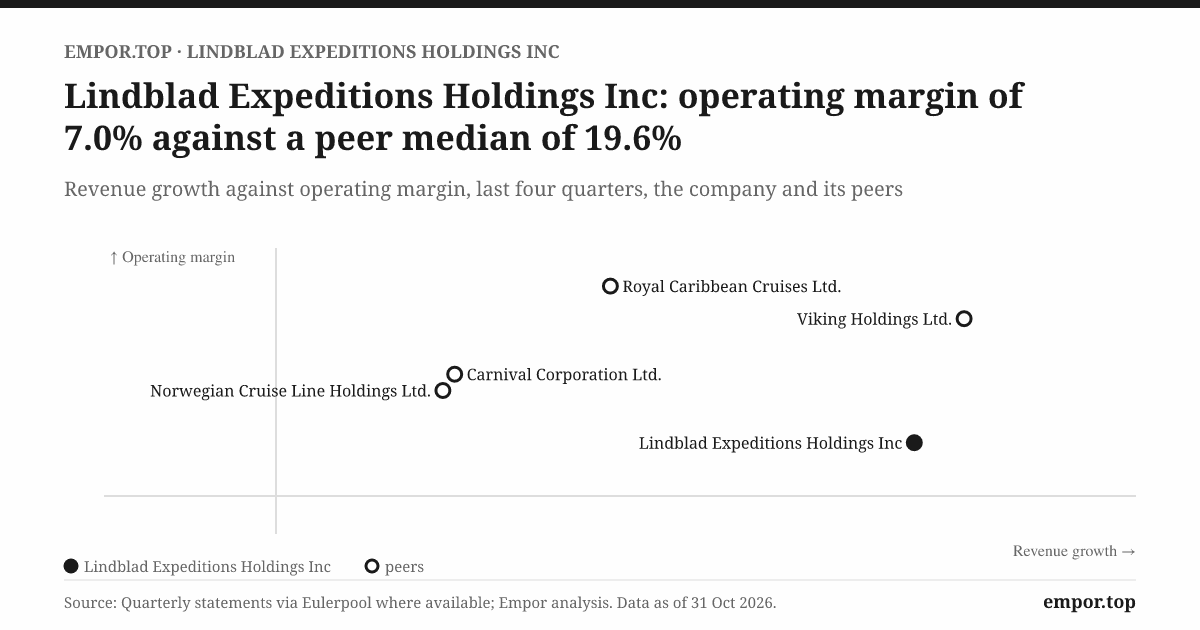
The valuation is easiest to read through sales, because earnings multiples mean little while net income is negative. At 3.4 times sales, investors are paying for a company with a mid-single-digit operating margin as if it will reach a much higher one. That is possible if yields rise and interest falls. It is a bet on continued execution, and a stock at its 52-week high has already priced in much of the good news.
Epilogue
Tonight, Lindblad is a company in the middle of an integration. Its teams are combining White Desert's interior camps and flights with a fleet of small ships and a group of land brands, all on one public balance sheet. The Antarctic summer season is starting, the busiest time for both the ships and the new aviation business. The company expects revenue of $850 million to $880 million this year.6 The $675 million of notes remain outstanding, due in 2030, while options to buy the rest of White Desert and Echo Charlie are exercisable in 2030 and 2031.15
The next few results days will matter more than the vision in the deal presentation. The first test is whether the company reports what White Desert and Echo Charlie actually contribute: revenue, EBITDA, cash needs and integration costs. If it does, investors can judge the deal on its merits. If it reports them only inside a consolidated land or "other" line, the market will have to assume the deal is working because management says it is.
The second test is the ship yield in 2027. Management has said occupancy is close to its natural ceiling and that pricing must drive yield from here. If yields keep rising at mid-single digits with occupancy steady, the premium is real and durable. If yield growth stalls or depends on discounting, the gains of 2025 and 2026 were recovery, not a new normal.
The third is cash. Investors will be watching operating cash flow after capital spending, how much goes to repurchases rather than debt reduction, and whether the company makes visible progress before 2030 on a debt load that has shaped its choices since 2020.
Each result points to a different future. Strong, disclosed acquisition results and steady pricing would make Lindblad look like a premium travel platform that can grow on land and in the air with a lighter capital load. Weak or undisclosed results and slowing yield would make it look like a leveraged operator adding new ventures before its core business has fully covered its costs. The question that remains is simple: can Lindblad keep reaching new horizons without asking shareholders to pay for every one of them?
Outro
Picture the moment it all comes down to. A small ship lies at anchor in a quiet bay. A Zodiac reaches a stony beach, and a traveler steps out onto a shore few people will ever see, while a naturalist who knows the place explains what is happening around them. That moment is why someone pays a premium, why National Geographic lends its name and why a company has spent sixty years and hundreds of millions of dollars reaching places like this.
Every voyage starts as a promise of access and ends as a test of execution, first for the guest and then for the shareholder. Lindblad has proved it can deliver the first. Whether the money that guests pay can carry the ship, the brand and the balance sheet is the test still underway. The edge of the world is Lindblad's product; getting the economics right is the expedition.
References
-
2026 Second Quarter Results — Lindblad Expeditions Holdings, Inc., 2026-08-03 ↩↩↩↩
-
Q2 2026 Earnings Call Transcript — Earnings Whispers, 2026-08-03 ↩↩↩↩↩↩↩
-
2026 Second Quarter Form 10-Q — Lindblad Expeditions Holdings, Inc., 2026-08-03 ↩↩↩↩↩
-
2025 Form 10-K — Lindblad Expeditions Holdings, Inc., 2026-02-26 ↩↩↩↩↩↩↩↩↩↩↩↩↩↩↩↩↩↩↩↩↩↩↩↩↩↩↩↩↩↩↩↩↩↩↩↩↩↩↩↩↩↩↩↩
-
2026 Definitive Proxy Statement — Lindblad Expeditions Holdings, Inc., 2026-04-28 ↩↩↩↩↩↩↩↩↩↩↩↩↩↩↩↩
-
White Desert and Echo Charlie Acquisition Press Release — Lindblad Expeditions Holdings, Inc., 2026-09-15 ↩↩↩↩↩↩↩↩↩↩
-
February 2026 Investor Presentation — Lindblad Expeditions Holdings, Inc., 2026-02-27 ↩↩↩↩
-
2015 Form 424B3 Prospectus — Lindblad Expeditions Holdings, Inc., 2015-09-17 ↩
-
Lindblad Expeditions Holdings, Inc. Acquires Control of Natural Habitat, Inc. — Lindblad Expeditions, 2016-05-05 ↩↩↩
-
Lindblad Acquires Majority Stake in Adventure Tour Operator — Travel Weekly, 2016-05-05 ↩
-
2025 Fourth Quarter and Full Year Results — Lindblad Expeditions Holdings, Inc., 2026-02-26 ↩↩↩
-
Q4 2019 Earnings Call Transcript — Stock Analysis, 2020-02-25 ↩↩
-
Q4 2020 Earnings Call Transcript — Stock Analysis, 2021-03-09 ↩↩↩↩
-
S&P Global Ratings Upgrades Lindblad Expeditions — Cbonds, 2025-08-06 ↩
-
White Desert and Echo Charlie Acquisition, Form 8-K — Lindblad Expeditions Holdings, Inc., 2026-09-15 ↩↩↩↩↩
-
Lindblad Acquires Majority Stake in Bespoke Antarctica Operator — Travel Weekly, 2026-09-15 ↩
-
White Desert and Echo Charlie Investor Presentation — Lindblad Expeditions Holdings, Inc., 2026-09-15 ↩
-
2025 Expedition Market Report — Cruise Industry News, 2025 ↩
-
Investor Relations — Lindblad Expeditions Holdings, Inc. ↩↩↩↩↩
-
2026 Annual Meeting Results, Form 8-K — Lindblad Expeditions Holdings, Inc., 2026-06-11 ↩↩
 LinkedIn
 WhatsApp
 Reddit
 Hacker News
 Email
 Kindle
 RSS Feed
 Spotify
 Apple Podcasts
 Amazon Music
 Audible
 YouTube