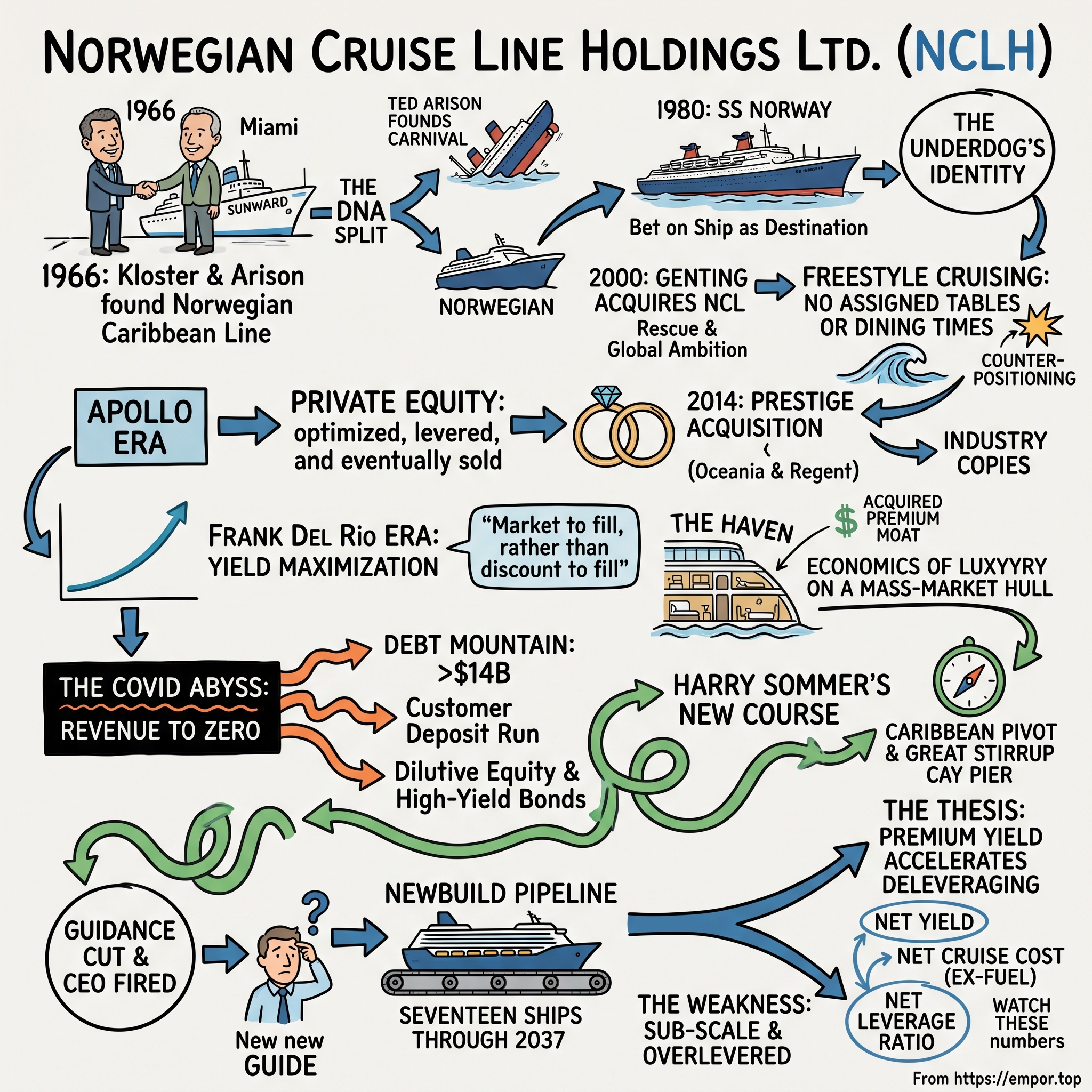
Norwegian Cruise Line Holdings Ltd. (NCLH): The Premium Yield Underdog
I. Introduction & Episode Roadmap
Picture Miami in 1966. The port is not yet the cruise capital of the world; it is a working harbor where a handful of aging ocean liners still ferry the wealthy across the Atlantic. Into this scene walk two men who could not be more different: Knut Kloster, a soft-spoken heir to a Norwegian shipping dynasty who has an underused passenger ferry named the Sunward and no obvious market for it, and Ted Arison, a restless Israeli-American operator in Miami with the customers but no ship. They shake hands, form Norwegian Caribbean Line, and — almost by accident — invent the modern Caribbean cruise vacation.[^1]
Six years later they would hate each other, and one of them would walk down the dock to found Carnival, which grew into the largest cruise company on earth. That founding split is the DNA of the story we are telling today. Norwegian Cruise Line Holdings has spent six decades as the perennial underdog of an industry it helped create — the smallest of the "Big Three" global cruise operators that together control the vast majority of ocean-cruise capacity, forever chasing the scale of Carnival and the operating machine of Royal Caribbean.
So here is the central question this article tries to answer, and to test rather than assume: how does the smallest of three giants survive — and occasionally thrive — in a business defined by billion-dollar ships, brutal fixed costs, and an oligopoly where your two rivals are simply bigger than you? NCLH's answer has always been the same word: yield. If you cannot be the biggest, be the most premium. Charge more per passenger, per night, than anyone else, and let pricing power do the work that scale does for your competitors.
That thesis will get stress-tested hard by the end of this piece, because as of mid-2026 the company is a study in tension. It generated roughly $9.8 billion of revenue in 2025 and record-adjacent profitability, yet it carries a debt load north of $14 billion that cost it nearly a billion dollars in interest in a single year.6 It set bold three-year targets, then abruptly fired the CEO who set them, cut its own 2026 guidance, and installed a former fast-food executive to fix the machine.78 This is not a company at rest.
Before we start, it is worth naming the shape of the business, because cruising is a genuinely strange industry that most investors never look at closely. A cruise line is three businesses stacked on one hull. It is a real-estate developer that builds billion-dollar floating hotels on multi-year lead times. It is a hospitality operator running restaurants, bars, casinos, and spas at sea. And it is a yield-management machine that behaves more like an airline than a hotel — every berth is a perishable inventory unit that earns nothing the moment the ship leaves the dock, so the entire commercial game is filling those berths at the highest price the market will bear before departure. Understand that a cruise ship is a depreciating asset that must sail full every single week, and you understand why leverage, pricing, and demand are the only three variables that ever really move this stock.
Here is the roadmap. First, the genesis — the Kloster-Arison split and the birth of modern cruising. Then the identity pivot: "Freestyle Cruising," a textbook counter-positioning move in 2000. Then the financial-engineering era of Star Cruises, Apollo Global Management, and the $3.025 billion acquisition of Prestige Cruises. Then Frank Del Rio's yield-maximization masterclass and "The Haven." Then the COVID abyss and the debt mountain it left behind. Then the whiplash of the current management transition. And finally the playbook, the strategic stress test, and the small handful of numbers that actually matter for anyone watching this company from here. A quick grounding for scale before we sail: in mid-2026 NCLH traded around $20 a share for a market capitalization of roughly $9 billion — a fraction of the enterprise value once you add back the debt, which is the entire point of the story.12
 Subscribe on LinkedIn
II. The Split That Built an Industry
The Sunward was supposed to sail between England and Spain, ferrying tourists and their cars to the Costa del Sol. Political friction with Franco's Spain and a British fuel tax killed the economics before she ever settled into the route.[^1] Kloster, sitting in Oslo with a brand-new ship and no business for her, got a phone call that changed maritime history. On the other end was Ted Arison, a hustling travel entrepreneur in Miami whose own cruise venture had just collapsed, leaving him with a book of eager customers and no vessel to carry them. Kloster had the boat; Arison had the demand. In December 1966, the Sunward sailed her first three- and four-day cruise out of Miami to the Bahamas, and Norwegian Caribbean Line was born.[^1]
What these two actually invented was more important than any single ship. Transatlantic ocean travel had been a means to an end — a stately, formal, often tedious way to get from New York to Southampton. Kloster and Arison flipped the logic. The voyage was the vacation. Short, standardized, affordable round-trips departing on a reliable weekly schedule from a single convenient port, aimed squarely at middle-class American families rather than the tuxedo-and-steamer-trunk elite. It was the mass-market cruise product, and essentially every cruise sold today is a descendant of that Miami blueprint.
The partnership was combustible from the start. Arison ran sales and marketing in Miami; Kloster owned the ships from Norway. As the business boomed, so did the disagreements over money and control. In 1972, the relationship detonated. Arison walked away, and in a move that still reads like a screenwriter's invention, he took his customer relationships, chartered an aging ocean liner he renamed the Mardi Gras, and founded Carnival Cruise Lines — which ran aground on a sandbar on its very first voyage and then proceeded to become the most profitable name in the industry.1 The two founders of one company became the founders of the two companies that would dominate cruising for the next half-century.
From that divorce, two philosophies diverged and never reconverged. Carnival under Arison chased the mass market with religious devotion: absolute scale, "The Fun Ships," relentless cost containment, and the insight that you make your money not on the cheap ticket but on everything the passenger buys once aboard.1 Norwegian, left with Kloster's ships and sensibility, leaned the other way — toward the onboard experience, product innovation, and a slightly more premium posture. It is a temperamental split that echoes to this day in how the two companies price and position themselves.
It is worth dwelling on the two temperaments, because they set the strategic clock for the whole industry. Kloster was a shipowner by inheritance and disposition — a Norwegian who thought about vessels as beautiful, long-lived assets and who was drawn to the romance of the great liners. Arison was a merchant of experiences who thought about customers, cash flow, and turnover. Put crudely, Kloster fell in love with the ships and Arison fell in love with the business. When they were bolted together, that tension produced explosive creativity; once separated, each pursued his instinct to its logical extreme, and the industry got both a scale-and-cost champion in Carnival and an experience-and-product champion in Norwegian. Neither man could have built what he built without first fighting the other.
Kloster spent the 1970s and 80s proving that a smaller player could out-innovate a bigger one. In 1977, Norwegian bought an uninhabited slip of Bahamian coral called Great Stirrup Cay and turned it into the first private-island cruise destination — a controlled, high-margin beach day that competitors would spend the next forty years scrambling to copy.13 Then, in 1980, Kloster made his defining bet: he bought the SS France, the retired French transatlantic liner, and spent roughly $80 million rebuilding her as the SS Norway — at the time the largest passenger ship in service.[^1] The gamble established that the ship itself, not merely the destination, could be the reason people booked. That instinct — sell the vessel as a floating resort — is precisely the logic that would eventually justify billion-dollar newbuilds. It also foreshadowed the addiction to capital that defines the company's balance sheet today.
The Norway deserves a moment of appreciation as a strategic artifact, because she encoded a bet that still shapes the company. Buying a defunct liner and pouring tens of millions into her conversion was, on paper, financially reckless — the kind of move a spreadsheet-driven operator like Arison would never have made. But Kloster grasped something the spreadsheet missed: passengers would pay a premium not merely to reach a destination but to inhabit a ship that felt like an event in itself. The Norway turned the Caribbean cruise into a destination-plus-vessel product, and she made money for years. The lesson NCLH internalized — that the ship is the draw, that lavish onboard product commands pricing power — is the direct ancestor of The Haven and of every amenity-stuffed newbuild the company orders today. So is the risk: the belief that you can always spend your way to a better yield is exactly the reflex that, uncontrolled, produces a fleet financed to the hilt. The genius and the vulnerability came from the same place.
III. Freestyle Cruising & The Underdog's Identity
By the late 1990s, the innovator was in trouble. Carnival had gone public and turned itself into a scale machine; Royal Caribbean had consolidated into a formidable number two. Norwegian, by contrast, cycled through ownership changes and financial distress as the Kloster family gradually lost its grip on the company it had founded.[^1] The underdog was no longer charming; it was undercapitalized, out-scaled, and running out of options.
The mechanics of that decline are worth understanding, because they are the mechanics of the whole industry compressed into one company's misfortune. Cruising rewards scale ruthlessly. A larger fleet spreads fixed costs — marketing, reservations systems, port infrastructure, corporate overhead, and above all the cost of capital for newbuilds — across more berths, so the biggest operator earns a structurally lower unit cost on almost everything. Carnival understood this in its bones and grew relentlessly, using its public-market currency after its 1987 IPO to acquire and build. Royal Caribbean followed. Norwegian, cycling through owners and starved of cheap capital, simply could not keep pace on ship count, and every year it fell further behind on the one metric — scale — that the industry pays for most reliably. By the late 1990s the company that had invented the modern cruise was at risk of becoming a footnote to the giants it had spawned.
Rescue by Genting was, in that light, less an acquisition than a resuscitation. The new owners brought capital and a genuinely global ambition — the dream of a cruise brand that spanned Asian and American waters. But they also inherited the same strategic problem every prior owner had faced, and it could not be solved with money alone.
The distress was not merely financial; it was existential. A cruise line that cannot fund newbuilds is a cruise line whose fleet ages, whose product falls behind, and whose yields erode as travelers choose the newer, flashier ships of better-capitalized rivals. Norwegian in the late 1990s was caught in exactly that doom loop — too small to earn the cost of capital it needed to grow, and too starved of capital to reach the scale that would have fixed the problem. Every prior owner had bumped against the same wall. The company had brand heritage, a loyal-enough customer base, and genuine product credibility, and none of it was enough to escape the gravity of a business that punishes subscale players year after year.
Rescue came from an unexpected direction — Southeast Asia. In 2000, Star Cruises, the cruise operator controlled by Malaysia's 丽星邮轮 Genting group and its chairman Lim Kok Thay (林国泰), acquired Norwegian to stitch together a global cruise empire spanning Asia and the Americas.[^1] The new owners inherited a brand with heritage and a chronic problem: how does a distant number three get American vacationers to choose it over two larger, better-capitalized rivals offering broadly similar cruises?
The answer, launched that same year, was "Freestyle Cruising," and it is one of the cleanest examples of counter-positioning you will find in any industry. To understand why it mattered, you have to understand what a cruise felt like in 1999. It was regimented to the point of absurdity. You were assigned a dinner table and a seating — early or late — and you ate there, with the same strangers, at the same hour, every night for a week. Formal nights meant an actual dress code. The structure existed because it made the ship's single main dining room easier to run, not because anyone thought passengers loved being told when to eat.
Freestyle Cruising simply deleted all of it. No fixed seatings. No assigned tables. No mandatory formalwear. Dine when you want, where you want, with whom you want, across a dozen different onboard restaurants. To a modern traveler this sounds obvious; in 2000 it sounded, to Norwegian's competitors, like operational suicide. How do you feed several thousand people who all show up whenever they feel like it? Rivals initially ridiculed the idea.
Think about the operational problem Freestyle created and you appreciate why rivals thought Norwegian had lost its mind. A fixed-seating dining room is a factory: two shifts, known covers, predictable galley loads, staff scheduled to the minute. Freestyle replaced the factory with a restaurant district — a dozen venues of varying capacity, unpredictable arrival patterns, and guests who might eat at 6:00 one night and 9:30 the next. To make it work, Norwegian had to redesign ship layouts around multiple dining rooms, retrain crews, rebuild reservation and galley logistics, and accept lower theoretical efficiency in exchange for a product guests demonstrably preferred. It was harder and, per-cover, more expensive to run. That was precisely the point: the difficulty was the moat, because it was difficulty an incumbent wedded to fixed seatings would not willingly take on.
Here is the strategic elegance of the move, in Hamilton Helmer's language. Counter-positioning works when the incumbent can't copy the challenger without damaging its existing business. The big lines had built their entire operating model, their labor scheduling, their galley logistics, around fixed seatings. Adopting flexibility meant unwinding a system that was profitable exactly as it was — the classic incumbent's dilemma. Norwegian, with less to protect, could simply leap. And when guests loved it, the whole industry was eventually dragged into copying it, which is both the vindication and the limitation of the strategy. Freestyle won the argument so completely that flexible dining became table stakes, and a differentiator that everyone offers is no longer a differentiator at all. Norwegian kept the reputation as the flexible, informal, slightly cooler brand — a brand asset that still has value — but the moat itself dissolved into industry convention. That pattern, a genuine innovation that hardens into a commodity, is the recurring risk in this business, and it is why the next act of the story is about buying a moat that competitors can't simply imitate.
IV. The Apollo Era & The Prestige Masterstroke
By 2007, Star Cruises' parent needed liquidity, and Wall Street's most aggressive financial engineers came knocking. Private-equity firms Apollo Global Management and TPG stepped in, injecting roughly $1 billion for a 50% stake in Norwegian and taking effective operating control.4 This is the moment the company stopped being a maritime family business and became a financial asset to be optimized, levered, and eventually sold — a transformation whose fingerprints are all over the balance sheet to this day.
Apollo installed Kevin Sheehan, a numbers-driven executive with a background running Cendant's vehicle businesses, as CEO. Sheehan did what private-equity operators do: he imposed discipline, professionalized the reporting, tightened ship-level operations, and — crucially — greenlit the "Breakaway" class of larger, more amenity-dense ships designed to generate more onboard revenue per sailing. The Breakaway insight was pure yield thinking made physical: bigger ships with more paid restaurants, more bars, more entertainment, and more retail meant more surfaces on which a passenger could spend, so onboard revenue — the high-margin dollars a guest hands over after buying the ticket — climbed per sailing. This is the same logic Carnival had used for decades, now applied by financial operators who measured everything and cut what did not earn.
There is an underappreciated point here about how private equity changed the company's metabolism. Under family and Genting ownership, Norwegian had been run by people who loved ships. Under Apollo it was run by people who loved returns, and they instrumented the business accordingly — tracking net yield, net cruise cost, occupancy, and onboard spend with an intensity the company had never applied to itself. That analytical rigor is a genuine and lasting gift; it is the reason NCLH can today discuss its economics with the precision of an airline. The cost side of the ledger is a tolerance for leverage that a family owner would have found terrifying, because levering the balance sheet is how private equity manufactures equity returns. Both traits survived the sponsor's exit. The playbook worked well enough that in January 2013 Apollo took Norwegian Cruise Line Holdings public, listing the shares at $19 apiece and beginning its lucrative march toward the exit.4 For a firm that had bought in during the depths of the 2008 crisis, the IPO was a textbook private-equity round-trip.
But the defining deal of the era came in 2014, and it is the one worth slowing down on because it built the strategic asset NCLH still leans on. NCLH agreed to acquire Prestige Cruises International — the parent of Oceania Cruises and Regent Seven Seas Cruises — for $3.025 billion in cash, stock, and assumed debt, closing the transaction on November 19, 2014.3 Overnight, a single-brand contemporary operator became a three-tier portfolio spanning the mass market, the upper-premium segment, and genuine ultra-luxury.
Now, the part that should make an independent observer raise an eyebrow. Who owned Prestige? Apollo Global Management held the majority stake, alongside Prestige's chairman, a cigar-loving industry veteran named Frank Del Rio.3 So Apollo, which controlled NCLH's board, was effectively negotiating across the table with itself — using one portfolio company to buy another portfolio company at a valuation many analysts considered rich, somewhere in the low-teens multiple of EBITDA that looked expensive against industry comparables of the day. Skeptics asked the obvious question: was this strategic empire-building, or was a private-equity owner using the public company's balance sheet to engineer a graceful exit from a second investment? Both things can be true, and here they were.
Slow down on the valuation, because it is where an independent analyst earns their keep. Paying a low-teens multiple of EBITDA for a cruise operator in 2014 was full price and then some; the public cruise names traded meaningfully cheaper. When a sponsor sits on both sides of a transaction and the buyer pays top-of-market, the burden of proof shifts onto the deal to demonstrate it was not simply a bailout dressed as strategy. The counter-argument — the one that turned out to matter — is that Oceania and Regent were not commodity cruise assets being marked up; they were scarce brands in the two thinnest, highest-yielding tiers of the market, tiers that take decades and reputational capital to build and that essentially cannot be created through a newbuild order. If you believe that, the premium looks less like an overpay and more like the going rate for a genuine cornered resource. Reasonable people disagreed then, and the honest verdict is that the governance stank while the strategy aged well.
The uncomfortable footnote is that the deal, whatever its governance optics, largely worked on the merits. Oceania and Regent gave NCLH something Norwegian's contemporary ships could never generate on their own: genuine pricing power at the top of the market. Today the three brands sit in a clear hierarchy. Norwegian Cruise Line is the volume engine, roughly four-fifths of capacity, freestyle and contemporary. Oceania occupies the upper-premium tier — a boutique, foodie-forward product marketed as "The Finest Cuisine at Sea," commanding far higher daily rates. And Regent Seven Seas sits at the ultra-luxury apex: all-inclusive to an almost comical degree, bundling business-class flights, unlimited shore excursions, and premium drinks into fares that produce the highest net yields in the fleet. Put rough numbers on the portfolio and the strategy snaps into focus. The Norwegian brand accounts for the overwhelming majority of capacity — on the order of four-fifths of passenger cruise days — and functions as the volume engine that covers the shared cost base. Oceania contributes roughly a tenth of capacity but at daily rates far above the contemporary brand, and Regent, the smallest sliver at a few percent of capacity, commands the richest fares in the entire fleet because it bundles nearly everything — airfare, excursions, premium drink — into an all-inclusive price that ultra-luxury travelers will pay. The shape of that portfolio is the answer to the underdog's dilemma: a large contemporary base to absorb fixed costs, topped by two small luxury brands that pull the blended yield well above what a pure contemporary operator could ever earn. It is a barbell, and it only works because the two ends reinforce each other.
The lesson for investors is subtle but important — NCLH's premium-yield identity, the whole reason its thesis exists, was not organic. It was acquired, expensively, with borrowed money, by a private-equity sponsor with its own agenda. The moat is real; the way it was built tells you a lot about how this company thinks.
V. The Frank Del Rio Era: The Yield Maximizer
In January 2015, only weeks after the Prestige deal closed, Kevin Sheehan abruptly resigned. Into the corner office stepped Frank Del Rio — the founder of Oceania, the man Apollo had just paid billions to bring into the fold, and one of the more colorful characters in modern cruising. A Cuban-born refugee who arrived in the United States as a child and worked his way up through the industry's finance side, Del Rio ran NCLH the way a chef runs a kitchen he owns: with total conviction, a long memory for detail, and no patience for discounting his own product.
Del Rio's story is worth telling because it explains his conviction. He arrived in the United States as a child refugee from Cuba, built a career on the finance side of the travel and cruise industries, and in 2002 co-founded Oceania Cruises essentially from nothing — assembling a small fleet and a differentiated foodie positioning in a segment the giants had ignored. A man who builds a premium brand from scratch, in the teeth of scale competition, does not learn to discount. He learns that the product's perceived value is the whole ballgame, and that the fastest way to destroy a premium brand is to teach customers to wait for a sale. That hard-won instinct became NCLH's official pricing doctrine the day he took the top job.
Del Rio's philosophy can be compressed into a single phrase he repeated for years: market to fill, rather than discount to fill. Understand this and you understand the entire NCLH pricing thesis. When a competitor's ship is booking behind plan, the instinct is to slash the ticket price to put bodies in cabins — because an empty berth earns nothing and the ship sails regardless. Del Rio refused. If a sailing lagged, NCLH would layer in value instead of cutting price: free Wi-Fi, free specialty dining, free shore excursions, drink packages — the famous "Free at Sea" bundles. The headline fare held; the perceived value went up; and critically, the reported net yield — revenue per passenger per cruise day — stayed intact. Over time this produced consistently the highest net yields among the Big Three, the single statistic that justifies NCLH's existence as a premium operator.
The physical embodiment of the strategy is "The Haven." Picture a mass-market Norwegian ship carrying four thousand passengers, and then picture a keycard-only enclave at the very top of that ship — private pool, private restaurant, private sun deck, butler and concierge service — walled off from the crowds below. That is The Haven: a luxury hotel bolted onto a contemporary cruise ship. The economics are genuinely clever. Haven suites occupy prime real estate and charge three-to-five times the rate of a standard cabin, capturing luxury pricing, while riding on the operating scale and shared costs of a 4,000-berth vessel. In Helmer's framework this functions as a cornered resource of sorts — a differentiated product that competitors have struggled to replicate at the same margin, because it requires designing the premium enclave into the ship from the keel up.
Walk through the economics one more turn, because The Haven is the single cleanest illustration of the NCLH thesis. A cruise ship's cost base is overwhelmingly fixed and shared: the fuel to move the hull, the crew to sail it, the food supply chain, the port fees, the depreciation on the vessel. Those costs are broadly the same whether a given cabin sells for $1,000 or $5,000. The Haven exploits that fixed-cost structure by grafting a small number of very-high-fare suites onto a ship whose costs are already being covered by the four thousand contemporary passengers below. The incremental cost of a butler and a private restaurant for a few dozen suites is trivial against the incremental revenue those suites command, so a disproportionate share of Haven pricing drops toward profit. It is, in miniature, the same insight as the whole premium-yield strategy — extract luxury pricing while riding contemporary scale — which is why it has become the growth centerpiece of every new Norwegian-brand ship. The limitation is equally clear: The Haven is a fixed inventory of suites, so it scales only as fast as NCLH builds ships to put it on, which loops directly back to the capital intensity that both powers and burdens this company.
It is worth being precise about what "value instead of price" does and does not achieve, because it is the most misunderstood part of the NCLH story. Bundling free perks is not free — every complimentary drink package and shore excursion carries a real cost, and layering them on compresses margins on the marginal booking. What it protects is the headline yield and, more importantly, the customer's mental price anchor. A guest who books at $2,000 with $600 of "free" extras walks away feeling they got a deal; a guest who books the same cruise marked down to $1,400 learns that Norwegian's list price is a fiction and waits for the next markdown. The first customer can be charged $2,000 again next year; the second cannot. Del Rio was, in effect, defending the brand's pricing integrity against its own sales force. Whether the net economics of heavy bundling truly beat selective discounting is a legitimate analyst debate — the perks are a real cash cost, and in soft markets they can quietly erode the very yields they are meant to protect. But as brand strategy, the logic is sound, and it is why NCLH's net yields sit at the top of the sector.
Under Del Rio, the fleet grew, the luxury brands expanded, and profitability climbed to a genuine peak in 2019, the last clean year before the world changed. But here is where the independent lens has to stay clear-eyed, because the Del Rio era carried a hidden cost that had nothing to do with yield. To fund an ambitious pipeline of newbuilds and expansion, Del Rio ran the company with a persistently high leverage load. In good times, leverage is a magnifier — it juices returns on equity and makes a yield story look like a growth story. The trouble with a magnifier is that it works in both directions. NCLH entered the new decade as the most premium-priced and one of the most financially exposed operators in the sector, a ship built for calm seas. In March 2020, the seas stopped being calm.
VI. The COVID Abyss & The Debt Mountain
There has rarely been an industry so completely, instantaneously zeroed out as cruising in the spring of 2020. When the pandemic hit, cruise ships became floating symbols of contagion, and regulators grounded the entire fleet. Norwegian's revenue did not fall — it went to essentially nothing, and stayed there, with ships anchored and burning cash for more than a year while generating no fares at all.2 For a business with enormous fixed costs — crews, maintenance, insurance, financing on billion-dollar assets — a total revenue stop is close to the worst-case scenario a CFO can model.
The moment was existential in the most literal sense. In the spring of 2020, some analysts openly modeled how many months of cash NCLH had before insolvency, and the answer was measured in a small number of quarters. This was a company with essentially no revenue, a fleet of idle ships still costing money every day to maintain and crew, and billions in debt with interest that did not pause for a pandemic. Bankruptcy was not a tail scenario discussed in a footnote; it was a live outcome the market was pricing. The share price collapsed, and management was left to do the one thing that could keep the company alive — raise cash from anyone willing to provide it, at whatever price they demanded.
The survival scramble that followed was a masterclass in financial triage, and every dollar of it left a scar. With cash burning at well over a hundred million dollars a month, NCLH went to the capital markets again and again — issuing high-yield bonds at punishing double-digit coupons, exchangeable and convertible notes, and dilutive equity that expanded the share count dramatically.2 Management deserves credit for the sheer creativity that kept the company solvent when bankruptcy was a live possibility. But solvency was purchased at a steep, lasting price, and that price is the whole reason the equity story today is so binary.
Do the arithmetic on what came out the other side. Total debt roughly doubled from the pre-pandemic level to more than $14 billion, where it still sits — $14.6 billion of total debt and $14.4 billion net of cash at the end of 2025.6 The recurring cost of carrying that mountain is the number every investor in this name should have tattooed somewhere: in fiscal 2025, NCLH paid $953.5 million in net interest expense.6 Set that against roughly $2.73 billion of adjusted EBITDA for the year, and you see the vise — well over a third of the company's operating cash generation is consumed before a single dollar reaches shareholders, simply to service debt.6 That is the COVID hangover, and it is structural, not transitory.
There is a deeper structural lesson buried in the survival story, and it is the one investors most often miss. A cruise line's balance sheet has a hidden liability that behaves like debt but sits in a different line: customer deposits. Cruises are booked and paid for months in advance, so at any moment the company is holding well over $3 billion of guests' money for voyages not yet sailed — $3.2 billion in advance ticket sales sat on the balance sheet at the end of 2025.6 In normal times this is a beautiful thing: customers finance the company interest-free. In a shutdown it becomes a run on the bank. Millions of passengers demanded refunds simultaneously for cruises that would never sail, and NCLH had to fight to convert those refund demands into future-cruise credits to preserve cash. The same feature that makes the working-capital model so attractive in good times is what made the liquidity crisis so acute in bad times — a recurring theme in this company's life: the strengths and the vulnerabilities are the same traits viewed under different weather.
The comparative picture matters, because leverage is relative. NCLH went into the pandemic more levered for its size than Royal Caribbean, which recovered faster and deleveraged more aggressively, and it lacked the sheer liquidity cushion of the much larger Carnival. So when demand roared back — and it did roar back, with occupancy running above 100% as cabins filled beyond nominal capacity — NCLH found itself in a peculiar position. It was operating beautifully and drowning in interest at the same time. Revenue recovered past pre-pandemic levels, yields hit records, ships sailed full. And yet net leverage still stood at 5.3x at the end of 2025, because you cannot out-sail a $14 billion debt load in a couple of good years.6 Every subsequent chapter of this company's story is, at bottom, a race between operating recovery and the gravitational pull of that balance sheet.
VII. Harry Sommer's New Course
When Frank Del Rio announced his retirement in March 2023, the succession looked like textbook continuity. His replacement, effective later that year, was Harry Sommer — a low-key, intensely analytical company lifer who had spent more than three decades at Norwegian and had most recently run the flagship NCL brand.5 Where Del Rio was the charismatic, cigar-chomping founder who ruled by conviction, Sommer was the operator's operator: collaborative, metrics-driven, allergic to drama. The market read it as a sensible generational handoff — swap the visionary for the disciplined executor to grind the debt down.
The Caribbean pivot was the clearest expression of Sommer's operator instincts. He recognized that short, warm-weather, family-oriented Caribbean sailings out of Florida are among the most profitable itineraries in the fleet — they burn less fuel, turn over quickly, sell reliably, and lean on the highest-margin asset the company owns, its private islands. So NCLH began redeploying capacity toward the Caribbean and pouring capital into Great Stirrup Cay to remove the destination's single biggest bottleneck: for nearly fifty years, guests had reached the island by tender, a slow, weather-dependent shuttle that capped how many passengers could get ashore and how much they could spend once there.13 The new pier fixes that at the level of physics, not marketing. It is a genuinely sound, unglamorous, margin-accretive investment — exactly the sort of move a metrics-driven insider makes and a charismatic founder might overlook.
At a May 2024 Investor Day, Sommer put concrete numbers on the wall under the banner "Charting the Course," an explicit attempt to rebuild the credibility the balance sheet had cost.[^8] The 2026 targets were specific and, importantly, falsifiable: adjusted return on invested capital of roughly 12%, adjusted operating margin expansion, and — the headline — adjusted EPS growth compounding at more than 30% a year from 2024 through 2026, with net leverage marching down toward the mid-4x range. Setting hard, checkable targets is exactly what an independent observer wants to see from a management team asking for trust; it is the opposite of vague reassurance. The catch, of course, is that public targets create public accountability. You can be measured against them. And you can miss.
For a while, the plan looked like it was working. Fiscal 2025 was, by the operating numbers, a strong year: revenue rose 3.7% to $9.8 billion, net yield grew about 2.4% on a constant-currency basis, occupancy ran at 103.5%, adjusted EBITDA climbed 11% to $2.73 billion, and adjusted EPS grew 19% to $2.11.6 Alongside those results, in early 2026 the company guided to a further step up in 2026 — roughly $2.38 of adjusted EPS, about $2.95 billion of adjusted EBITDA, and net leverage improving toward 5.2x.6 On the surface, the course was being charted.
Then came the whiplash. On February 12, 2026, NCLH announced that Harry Sommer was stepping down as President, CEO, and director — effective immediately — after barely two and a half years in the top job and more than thirty years with the company. The board named John W. Chidsey, a sitting NCLH director and the former CEO of Subway and Burger King, as his permanent replacement, effective at once.8 The company gave no reason for Sommer's departure.9 When a board removes a long-tenured insider abruptly, mid-strategy, and declines to explain why, an independent analyst should treat the silence itself as information: it signals that results, execution, or boardroom confidence had deteriorated behind the scenes faster than the public numbers let on.
Pause on the choice of successor, because it is itself an argument about what the board thinks is broken. John Chidsey is not a cruise man. He is a restaurant-and-franchise operator — a lawyer and accountant by training who ran Burger King through a leveraged-buyout turnaround and later led Subway, businesses defined by unit economics, franchisee accountability, cost rigor, and systems that must run identically across thousands of locations.8 A board that promotes a long-tenured cruise insider is betting on continuity and product judgment. A board that reaches outside the industry for a franchise-operations specialist is signaling something else entirely: that it believes the company's problem is not its ships, its brands, or its market position, but its execution — its coordination, its accountability, its ability to hit the numbers it commits to. Chidsey's own early language about closing gaps and reinforcing accountability fits that reading exactly.6 The bet is that NCLH has world-class assets run by an organization that had grown slack, and that an operations disciplinarian can tighten the machine. The risk is equally plain: a fast-food operator has never managed the peculiar variables of this business — shipyard contracts, maritime regulation, itinerary geopolitics, the multi-year lead times on a billion-dollar asset — and cost discipline alone cannot manufacture the ticket-pricing demand the company actually lost in 2026. Whether the right medicine for a demand-and-leverage problem is an execution specialist is the open question hanging over the whole enterprise.
The confirmation arrived three months later. Reporting first-quarter 2026 results in May, NCLH delivered a genuinely strong quarter on the surface — revenue up 10% to $2.3 billion, adjusted EBITDA up 18% to $533 million, adjusted EPS of $0.23 that trounced guidance — and then sharply cut its full-year outlook.7 The new 2026 range for adjusted EPS was slashed to $1.45–$1.79, down from the $2.38 signaled just months earlier; adjusted EBITDA guidance fell to $2.48–$2.64 billion; and net yield was now expected to decline 3% to 5% on the year.7 Management pointed to geopolitical disruption in the Middle East that lifted fuel costs and chilled demand for European itineraries, and admitted the company had entered 2026 behind on bookings and could not close the gap.7 Chidsey's own framing was telling: the priority, he said, was to "act urgently to address these gaps by improving coordination, reinforcing accountability, and strengthening financial discipline across the organization" — the language of a turnaround executive describing a company that had lost a step, not a successor praising a well-run machine.6
Listen to the way the tone shifted across the calls and the story becomes even sharper. On the fourth-quarter 2025 call in March, the freshly installed Chidsey was already speaking the language of gaps to be closed and accountability to be reinforced rather than momentum to be extended — hardly the vocabulary of a successor inheriting a smoothly running enterprise.14 By the first-quarter call in May, the pattern was unmistakable: report a strong quarter, then cut the year. That combination — beat-and-lower — is one an experienced analyst treats with suspicion, because it suggests the near-term looked fine while the forward book had quietly deteriorated. CFO Mark Kempa leaned on the one genuinely reassuring data point he had, telling investors the company now expected full-year net cruise cost excluding fuel to come in roughly flat to the prior year, framing cost discipline as the lever management could still pull while demand and pricing slipped out of its hands.7 The subtext of a "costs are under control, revenue is the problem" message is not comforting for a premium-yield company whose entire thesis rests on pricing power.
This is the live drama of NCLH in 2026, and the neutral read is uncomfortable for the bull case. A management team set explicit multi-year targets, replaced the CEO who set them without explanation, and then walked the numbers down. The strategic assets — the private islands, the luxury brands, The Haven — remain genuinely valuable. But the "Charting the Course" credibility experiment has, so far, produced a miss and a management shake-up rather than a clean deleveraging story. What Chidsey inherits is a company still investing heavily into that headwind: a $150 million multi-ship pier at Great Stirrup Cay, completed at the end of 2025 with the Norwegian Getaway the first ship to dock there on December 28, and a fleet-expansion pipeline that grew rather than shrank.11 In February 2026, even as the outlook softened, NCLH added three more Fincantieri newbuilds — one for each brand, delivering in 2036–2037 — bringing its total order book to seventeen ships and locking in years of non-discretionary capital spending.10 Whether that is disciplined long-term positioning or leverage-era muscle memory is exactly the question the next few years will answer.
VIII. Playbook: Strategic & Investing Lessons
Step back from the quarter-to-quarter noise and four durable lessons fall out of this story — the kind an investor can carry to other companies.
The first is yield versus scale — the underdog's dilemma. NCLH is living proof that in a capital-intensive oligopoly you do not have to be the biggest to survive; you have to be genuinely differentiated on something the market will pay for. By owning the upper-premium and ultra-luxury tiers through Oceania and Regent, and by engineering high-yield enclaves like The Haven into mass-market hulls, NCLH manufactures pricing power that partly offsets its structural scale disadvantage. "Partly" is the operative word. Premium yield narrows the gap with larger rivals; it does not close it, because scale still delivers Carnival and Royal Caribbean lower unit costs on everything from fuel procurement to marketing to newbuild financing.
The second is the double-edged sword of financial leverage. This is the lesson written in blood across NCLH's decade. Leverage is a performance-enhancing drug for equity returns in an up-cycle — it made the Del Rio-era growth story look spectacular. But the same leverage turned a demand shock into a near-death experience in 2020 and left a billion-dollar annual interest bill that now caps how much of a good year ever reaches shareholders. The intelligent takeaway is not "leverage bad." It is that leverage converts a cyclical, discretionary business into a high-beta instrument whose equity value swings far more than the underlying operations do.
The third is private equity's lasting footprint. Apollo owned this company for the better part of a decade, and the ownership left permanent architecture. The Prestige acquisition — expensive, governance-conflicted, and financially engineered — is nonetheless the reason NCLH has a premium moat at all. Sometimes the deal that looks like sponsor self-dealing also happens to build the strategic asset. Investors should hold both thoughts at once rather than collapsing into either cynicism or applause.
There is a fourth-and-a-half lesson lurking in the CEO transition, worth stating plainly because it generalizes: watch what boards do, not what they say. NCLH spent 2024 asking investors to trust a specific set of three-year targets tied to a specific insider CEO. By early 2026 the board had removed that CEO without a public explanation and the company had abandoned the targets.87 For an outside investor, management transitions of this kind are among the most information-rich events a company produces — far more revealing than any prepared remark — because they expose the gap between the story a company tells and the reality its directors are privately reacting to. The absence of a stated reason is not the absence of a reason.
The fourth is Helmer's cornered resource in the travel business. A private island like Great Stirrup Cay is close to a perfect cash machine: guests love it, satisfaction scores are high, the land was bought decades ago at trivial cost, and almost every dollar spent ashore flows back to the operator with no third-party port to share it with. Premium berth access and irreplaceable brand equity in ultra-luxury behave similarly. These are the assets competitors cannot simply order from a shipyard, and they are where the durable economics of this industry actually live. Which sets up the harder question: are those assets enough to win from here, or does the balance sheet swamp them? That is the war-game.
IX. Analysis & Bear vs. Bull Case
Let us run the industry structure first, then the company-specific powers, then the stress test.
Porter's Five Forces
On threat of new entrants, the force is very low, and this is the single best structural feature of the business. A modern large cruise ship costs well over a billion dollars, the handful of qualified European shipyards carry multi-year backlogs, and the regulatory, safety, and environmental barriers are formidable. Nobody is casually launching a third global contemporary line. Rivalry, by contrast, is intense — a three-way oligopoly where NCLH, Carnival, and Royal Caribbean fight continuously over itineraries, newbuild amenities, and price, and where NCLH is the smallest combatant.
The rivalry deserves a war-gamer's eye, because the three players are not fighting symmetric battles. Royal Caribbean has spent the post-pandemic years pulling away — deleveraging faster, generating industry-leading returns, and drawing enormous demand to its newest mega-ships and its own private-destination investments, which has let it earn a premium market valuation and a lower cost of capital that compounds its lead. Carnival is the volume and liquidity heavyweight, a portfolio of brands whose sheer scale gives it purchasing and financing advantages NCLH simply cannot match. NCLH is the smallest, most premium, and most levered of the three, which means it competes least on price and most on product and yield — a defensible position, but a narrow ledge. When the whole sector is booming, all three rise together; when demand softens, the most levered player with the thinnest scale cushion feels it first and worst. The 2026 guidance cut, hitting NCLH while the sector broadly held, is a live illustration of that asymmetry.
Buyer power is moderate: individual consumers have no leverage, but they have abundant substitutes and are highly price-sensitive, which caps how far even a premium operator can push. Supplier power is high and genuinely uncomfortable — ship construction is concentrated among a few yards such as Fincantieri and Meyer Werft, and fuel is a volatile, market-priced input the operator cannot control, as the 2026 Middle East disruption just demonstrated in real time.7 And the threat of substitutes is high in the broad sense: every land resort, all-inclusive, theme park, and short-term rental competes for the same discretionary vacation dollar. The industry's counter is real value — a cruise typically undercuts an equivalent land vacation on all-in cost — but that value proposition weakens precisely when consumers tighten up.
Hamilton Helmer's 7 Powers
Applied to NCLH, the powers sort into a revealing pattern. Cornered resource is the company's strongest card: Great Stirrup Cay and the Harvest Caye destination, plus the hard-to-replicate brand equity of Oceania and Regent, are genuine and defensible. Scale economies run against NCLH — this is a weakness, not a strength, and it shows up as structurally higher unit operating and marketing costs than its two larger rivals carry. Counter-positioning, once embodied by Freestyle Cruising, has faded to nothing as the industry copied it; it is a historical power, not a current one. And switching costs are modest — loyalty programs like NCL's Latitudes create some stickiness, but a price-sensitive vacationer will happily defect for a better deal on a competing ship. The honest scorecard: one strong power, one active weakness, and two powers that are either fading or thin. That is a real but narrow moat.
The Skeptical Investor / Activist Stress Test
Here is where the 2026 developments give a short-seller genuine ammunition. The central challenge writes itself: NCLH promised a disciplined march from mid-5x leverage toward the mid-4x range while simultaneously committing to a seventeen-ship newbuild program stretching to 2037.10 Those two commitments are in tension, because newbuilds demand enormous, contractually locked, non-discretionary capital spending — and any softness in ticket pricing forces an ugly choice between delaying ships, adding more debt, or missing the deleveraging target. The Q1 2026 guidance cut and yield reversal are exactly the scenario the bears war-gamed.7 An activist would press harder on governance: why was a thirty-year insider CEO removed without explanation mid-plan, and what does installing a fast-food-industry outsider signal about the board's read on the company's operating problems?89 Incentive alignment cuts both ways here — management pay was tied to "Charting the Course" milestones that the company has now walked away from.
There is a governance question nested inside the newbuild debate that a serious activist would not let go of: the order book actually grew in the same window the deleveraging story wobbled. Adding three Fincantieri ships in February 2026, lifting the pipeline to seventeen vessels, is a multi-decade capital commitment made against a backdrop of a guidance cut and a leverage ratio stuck above five turns.107 Management's defense is that newbuilds are how a premium operator lowers unit costs and improves fuel efficiency over time, that the delivery dates stretch to 2037 and are spaced to a measured mid-single-digit capacity growth rate, and that walking away from shipyard slots is enormously expensive given multi-year backlogs. All true. But an activist would counter that "we must keep ordering ships to stay competitive" is precisely the reasoning that keeps capital-intensive companies permanently levered, and that a genuinely disciplined balance-sheet repair would show up as restraint on new commitments, not fresh ones. This is the single most legitimate line of attack on the current strategy, and it will not be resolved until the market sees whether leverage actually falls while the ships keep coming.
It is worth puncturing one consensus narrative here, because it flatters the stock in a misleading way. The lazy framing is that NCLH is simply "Royal Caribbean at a discount" — the same premium-cruise exposure at a lower multiple, therefore a bargain. The reality is that the discount is not a mispricing; it is the market correctly charging NCLH for two real differences. First, NCLH carries meaningfully more leverage relative to its size, which makes its equity structurally riskier and its earnings more volatile. Second, it lacks the scale that gives Royal Caribbean lower unit costs and a cheaper cost of capital, advantages that compound over time. A lower valuation multiple on a more levered, subscale operator is not a free lunch; it is the price of a rockier ride. The genuine bull case for NCLH is not "it's cheaper," it is "the operating recovery and refinancing can transfer value from lenders to shareholders faster than the market expects." Those are very different theses, and conflating them is how investors talk themselves into the wrong reasons for owning a high-beta security.
The bull rebuttal is not empty. Demand for the product remains strong — occupancy above 103%, double-digit Q1 revenue growth, and better-than-expected cost control that let the new CFO guide net cruise cost excluding fuel to roughly flat year-over-year.7 The premium brands still command the sector's best yields, the private-island economics are improving with the new pier, and if the consumer holds and the balance sheet grinds down, the equity is a coiled deleveraging spring where every turn of debt paid down transfers enterprise value from creditors to shareholders. That is the genuine upside case, and it is why the stock trades where it does.
Risk Radar
Three risks dominate and they are interlinked. Refinancing and cost-of-capital risk is the big one — with roughly a billion dollars of annual interest, NCLH is acutely exposed to credit-market tightening and rate moves, and refinancing walls have to be cleared on acceptable terms for the whole thesis to work.6 The mechanism deserves a plain-English walk-through, because it is where the deleveraging story either compounds or breaks. Much of the $14 billion debt stack was raised during and just after the pandemic, some of it at punishing double-digit coupons when NCLH was a distressed borrower with no revenue.2 As those maturities come due, the company must refinance them — and here is the fork in the road. If credit markets are open and NCLH's operating recovery has restored its creditworthiness, it can roll expensive crisis-era debt into cheaper paper, and lower interest expense flows straight to the bottom line, accelerating deleveraging in a virtuous circle. But if markets tighten, or if a demand stumble like 2026's spooks lenders at exactly the wrong moment, the company could be forced to refinance at rates no better — or worse — than what it is replacing, freezing the whole thesis in place. Refinancing risk is not an abstraction here; it is the specific channel through which macro conditions decide whether the premium-yield engine ever gets to keep its own profits.
Consumer-demand risk is elevated because cruising is pure discretionary spend; a broad slowdown hits yield and occupancy at exactly the moment the debt bill stays fixed. And fuel and geopolitical risk is live right now — the 2026 Middle East disruption raised fuel costs and forced yield-dilutive itinerary changes in Europe, the precise mechanism by which a distant conflict lands on a Miami-based company's income statement.7 Technology disruption barely registers here; this is not a business AI is about to reinvent. The risks that matter are financial and cyclical, and they are the ones the balance sheet makes unforgiving.
X. Epilogue & KPIs to Watch
The spine of the investment story is genuinely two-sided, and an honest telling refuses to resolve it prematurely. On one side, NCLH owns a real and defensible edge — premium brand yield, irreplaceable private-island economics, and a differentiated luxury portfolio that no competitor can quickly clone. On the other side sits a $14 billion debt mountain that turns every operating stumble into an equity earthquake and leaves the company almost no margin for error.6 The events of 2026 — a CEO fired without explanation, a self-set target abandoned, guidance cut on external shocks the company could not control — are not proof the bear case has won, but they are exactly the kind of evidence that should keep any observer from mistaking a strong product for a safe security. A great cruise experience and a fragile balance sheet can coexist in the same company, and here they do.
So what should someone actually track? Ignore the noise and watch three numbers, and understand what each one is really telling you.
The first is net yield on a constant-currency basis — revenue earned per available passenger cruise day, stripped of fuel-price and currency distortion. This is the single truest measure of whether the premium-pricing thesis is intact or eroding, because it captures both ticket pricing and onboard spend in one figure. For a company whose entire reason to exist is that it charges more than its rivals, a rising net yield is the vital sign of a healthy body and a falling one is a fever. It grew about 2.4% in 2025 and is now guided down 3% to 5% in 2026 — the most important single reversal in this whole story, and the number that will confirm whether 2026 was a passing geopolitical shock or the start of genuine pricing erosion.67
The second is net cruise cost per capacity day excluding fuel — the operating cost to run a berth for a day, with the volatile fuel line removed so you can see the controllable base. This is the clearest read on operating discipline and the metric on which the new management team has explicitly staked its early credibility, guiding it to roughly flat year-over-year.7 Fuel is exposed to war and weather and no CEO can promise it; this number is the part of the cost base management genuinely controls, so it is the fairest scoreboard for whether Chidsey's execution-and-accountability program is real or rhetorical. Watch it climb and the turnaround is talk; watch it hold or fall while yields wobble and the cost story at least is being delivered.
The third is the net leverage ratio — net debt measured against adjusted EBITDA, stalled at 5.3x. This is the scoreboard for the entire deleveraging story and the figure against which every capital-allocation decision, every newbuild deposit, and every management promise ultimately gets judged.6 It is also the number that most directly determines whether shareholders or bondholders capture the value the operating recovery creates: every turn of leverage retired shifts enterprise value from creditors to equity. The company promised a march toward the mid-4x range and has, so far, not delivered it. Whether that ratio finally starts falling — while seventeen ships remain on order and the consumer stays uncertain — is, in the end, the whole ballgame.
A final word on how to hold this story in your head, because it resists a tidy conclusion by design. NCLH is neither the value trap the bears describe nor the coiled spring the bulls promise; it is a genuinely good hospitality business wearing a genuinely dangerous balance sheet, run — for the moment — by a newly installed outsider whose track record at NCLH is a single quarter old. The bull case and the bear case are not competing readings of the same facts; they are the same facts under different assumptions about one variable, the consumer. If discretionary travel demand holds, the operating machine deleverages and the equity re-rates as debt converts into shareholder value. If it cracks, the fixed billion-dollar interest bill and the seventeen-ship order book turn a cyclical downturn into something far more punishing. An independent observer's job is not to guess which way the consumer breaks but to size the stakes on each side honestly — and here the stakes are unusually large in both directions, which is another way of saying this remains one of the higher-beta ways to express a view on the health of the global travel consumer.
Norwegian Cruise Line Holdings remains what it has been since Knut Kloster and Ted Arison shook hands in 1966: the underdog, wringing premium economics out of a scale disadvantage. The difference now is that the underdog is carrying a mountain of debt up a hill that just got steeper, with a new guide at the front who has never sailed this particular route. If the consumer holds and the deleveraging resumes, the premium-yield engine could power an extraordinary recovery in equity value. If the consumer cracks, that debt will cast a very long shadow over everything the brands have built. The market will settle the argument one net-yield print at a time.
References
-
How Cruise Lines Lean Into Pricing to Cope With Post-Pandemic Debt — Reuters, 2024-05-24 ↩↩↩
-
Norwegian Cruise Line Holdings Completes Acquisition of Prestige Cruises International — NCLH IR, 2014-11-19 ↩↩
-
Norwegian Cruise Line Holdings Announces Transition of Frank Del Rio to Harry Sommer — NCLH IR, 2023-03-20 ↩
-
Norwegian Cruise Line Holdings Reports Fourth Quarter and Full Year 2025 Financial Results — NCLH IR, 2026-03-02 ↩↩↩↩↩↩↩↩↩↩↩↩↩↩
-
Norwegian Cruise Line Holdings Reports First Quarter 2026 Financial Results — NCLH / GlobeNewswire, 2026-05-04 ↩↩↩↩↩↩↩↩↩↩↩↩↩
-
Norwegian Cruise Line Holdings Appoints John W. Chidsey as President and Chief Executive Officer — NCLH IR, 2026-02-12 ↩↩↩↩↩
-
John Chidsey replaces Harry Sommer as NCLH CEO — Seatrade Cruise News, 2026-02-12 ↩↩
-
Norwegian Cruise Line Holdings Enters Into Agreement With Fincantieri for Three New Cruise Ships — NCLH IR, 2026-02 ↩↩↩
-
Norwegian Cruise Line Is Spending $150 Million to Expand Its Bahamas Pier — Caribbean Journal, 2026-05-08 ↩
-
Norwegian Cruise Line Holdings Financials Profile & Stock Quote — The Wall Street Journal ↩
-
Norwegian Cruise Line Holdings Announces Development Plans for Private Island Destination, Great Stirrup Cay — NCLH IR ↩↩
-
Norwegian Cruise Line Holdings (NCLH) Q4 2025 Earnings Call Transcript — Platform Aeronaut, 2026-03-02 ↩
 LinkedIn
 WhatsApp
 Reddit
 Hacker News
 Email
Email Kindle
 RSS Feed
 Spotify
 Apple Podcasts
 Amazon Music
 Audible
 YouTube