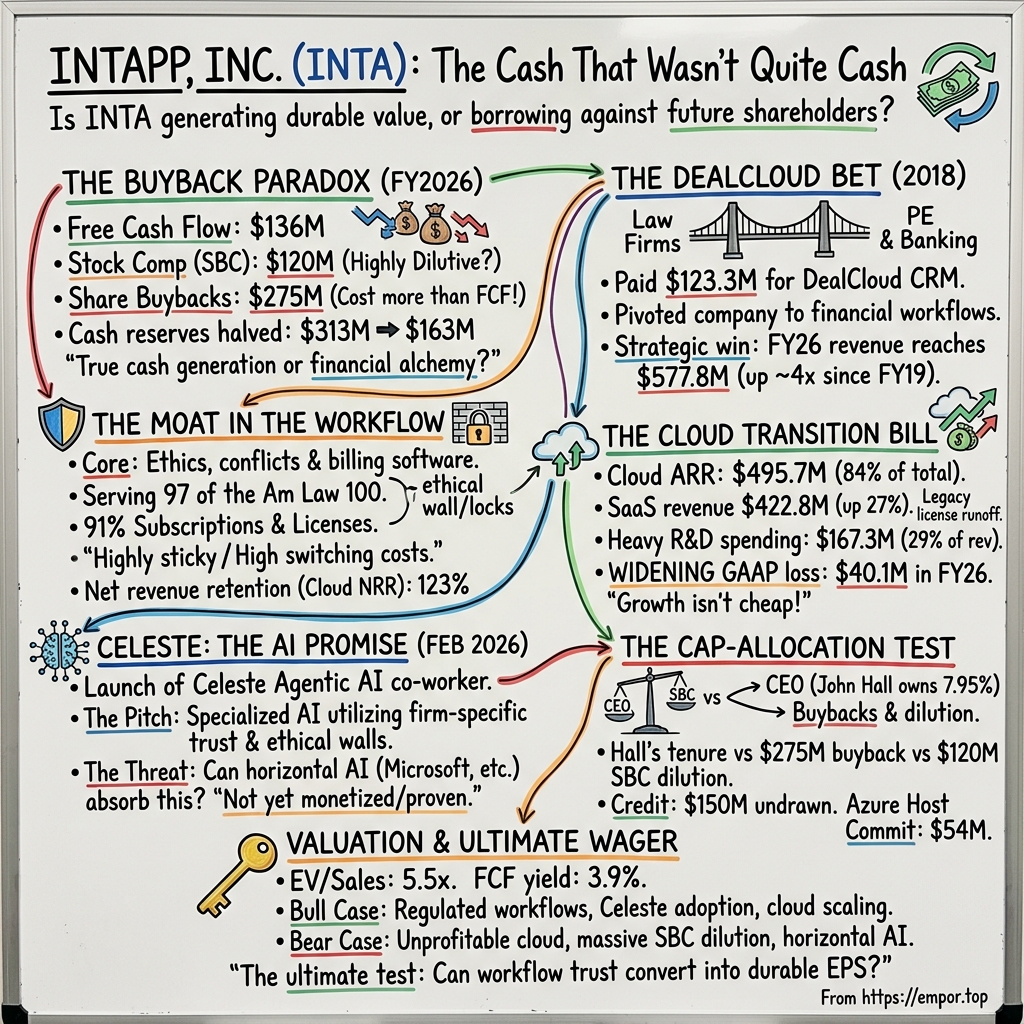
Intapp, Inc.: The Cash That Wasn't Quite Cash
I. The Buyback That Cost More Than the Cash Flow
Picture the close of Intapp's fiscal year on June 30, 2026. The company's accountants are tying out a year that, at first glance, looks like two different companies stapled together. One of them lost money. Under generally accepted accounting principles, Intapp reported a net loss of about $41 million for the year, the latest entry in a run of losses that stretches back through every year of its public life and well before it.1 The other company was a cash machine. Operating activities brought in about $147 million, and after a sliver of capital spending, roughly $136 million was left over as free cash flow.1
That contradiction is not unusual in software. It is, in fact, almost the house style of the industry. But Intapp did something in fiscal 2026 that turned a familiar accounting quirk into a genuine question about who is getting richer. Over the year, it spent about $275 million buying back its own shares, retiring roughly 8.4 million of them.1 That is more than twice the free cash flow the business produced in the same twelve months. Cash and short-term investments, which had stood at about $313 million a year earlier, fell to about $163 million.1 The company nearly halved its cash pile in a single year to shrink its share count.
So where did the gap between a $41 million loss and $147 million of operating cash come from? The answer has two big parts. The first is stock-based compensation, which reached about $120 million in fiscal 2026, or nearly 21% of revenue.1 Under the accounting rules, that is an expense, so it pushes the income statement into the red. But no cash leaves the building when an engineer is paid in restricted stock, so it gets added back on the cash-flow statement. The second part is customers paying in advance. Intapp bills most subscriptions annually up front, and deferred revenue rose by almost $59 million during the year, which means clients handed over cash for service Intapp had not yet delivered.1
Neither of those is a trick. Prepayments are a real advantage of the subscription model, and they reflect clients willing to commit a year of budget in advance. But stock compensation is a different kind of animal. It is a real cost to owners, simply paid in a different currency. When an employee receives shares, every existing shareholder owns a slightly smaller slice of the company. And when the company then spends cash to buy shares back, the circle closes: the cash that looked "free" ends up paying for the compensation that never showed up as a cash expense.
Consider the arithmetic in plain terms. Intapp's operating cash flow of about $147 million included an add-back of roughly $120 million for stock compensation.1 Strip that add-back out, treat stock pay as if it had been paid in cash, and the business generated far less surplus than the headline suggests, before even counting the boost from prepaid billings. That does not mean the cash flow is fake. It means the cash flow is not the same thing as owner earnings. Over nine fiscal years, from 2018 through 2026, Intapp booked cumulative net losses of about $367 million while generating about $363 million of operating cash flow.12 A gap of roughly $730 million between what the accountants called profit and what landed in the bank tells you how much of the story is about where costs are recorded.
Here is the verdict this opening sets up. Intapp's cash generation is real, helped by advance billing and almost no need for physical capital. But stock compensation absorbs most of the operating cash flow, and the buybacks so far have cost more than a full year's free cash. Whether those buybacks create value per share is not yet established, because that depends on whether the diluted share count actually falls over time, not on how many dollars were spent.
That is the first of three questions that run through this story. Can Intapp turn highly specialized software for law firms, accountants and dealmakers into durable profit? Can its new artificial-intelligence strategy defend that position against the giant horizontal platforms? And can its capital returns outrun its own dilution?
To answer any of them, it helps to go back to a different kind of cash outlay. In 2018, eight years before the buyback year, Intapp wrote a check for a business that would change which customers it served. That purchase was a bet on growth, not on the share count. The question is what made it different from the buyback, and whether it worked.
 Subscribe on LinkedIn
II. The DealCloud Bet Changed the Company
Intapp's founding story is less a garage legend than a long, patient grind. The operating business, Integration Appliance, Inc., was founded in 2000, and it built its early reputation selling software to law firms.2 The problems it solved were unglamorous: connecting the systems inside a firm, managing who could see which matters, and helping the firm decide whether it was allowed to take on a new client at all. That last task, the conflict check, sounds like paperwork. For a law firm it is existential, because representing a client against a former or current client can end careers and cost a firm its reputation.
John Hall, a co-founder, has led the business since 2000.3 That tenure is itself a fact worth sitting with. Very few software chief executives run the same company for a quarter of a century, through a private-equity era and into public markets. In November 2012, the company was reincorporated as LegalApp Holdings, Inc., a vehicle created to acquire the operating predecessor, and private-equity firm Great Hill Partners became the controlling owner.2 The name itself told you what the business was: a legal-software company. That is exactly what made the next move so interesting.
In August 2018, Intapp paid about $123.3 million in cash for DealCloud, a company that sold customer-relationship and deal-management software to private-equity firms and investment banks.2 Of that price, about $97.7 million was recorded as goodwill, the accounting term for the part of a purchase price that cannot be tied to identifiable assets like software code or customer contracts.2 Goodwill is, in effect, the price of a belief: that the business acquired will be worth more inside the buyer than its parts suggest. Paying four-fifths of the price for that belief is normal in software acquisitions, but it is also a sign of how much rode on strategic fit rather than on what DealCloud already earned.
Why did DealCloud fit? Think about what a private-equity firm actually does all day. It tracks thousands of companies it might buy, the bankers who might bring it deals, the executives it has met, the co-investors it has worked with, and the history of every conversation. A generic customer-relationship system, the kind built for sales teams selling widgets, does not understand that a single banker might be a source of deals, a co-investor, and an adviser on the other side of a transaction, all at once. DealCloud was built for that tangle. And the tangle looks a lot like the relationship and conflict problems Intapp already solved for law firms. A law firm needs to know who it knows, and who it must not represent. A deal firm needs to know who it knows, and which relationship to use. Same instinct, different market.
That purchase extended Intapp's reach beyond law and accounting into private capital, investment banking and, later, real assets. And it happened while Great Hill was still in control, under a holding company with heavy debt. By the time of the June 2021 initial public offering, Intapp carried about $279 million in borrowings, much of it accumulated during the sponsor years.2
The IPO itself was a clean-up operation as much as a growth financing. Intapp sold 10.5 million shares at $26 each, raising about $278.3 million in net proceeds, and used them to retire its pre-IPO debt.2 In other words, public shareholders paid for the balance sheet the private-equity era had built. That is not a criticism in itself. Sponsor-backed software companies often go public precisely to swap expensive debt for patient equity. But it means the DealCloud acquisition was ultimately financed by borrowing, and then refinanced by the shareholders who bought in at the IPO.
So how did the bet turn out? The company's revenue has roughly quadrupled since fiscal 2019, from about $143 million to about $578 million in fiscal 2026.12 It is tempting to hand DealCloud the credit for that, and DealCloud is clearly central to Intapp's growth story today, sitting alongside OnePlace as one of its flagship product families.1 But honesty requires a narrower conclusion. The fourfold growth also includes the conflicts and compliance products, the shift of customers to cloud subscriptions, and later acquisitions. Intapp does not publish a standalone revenue history for DealCloud, so there is no way to calculate what multiple of revenue the company effectively paid, or what return the $123 million earned. The fairest verdict is that DealCloud was strategically consequential, perhaps transformative, because it opened a second customer market. Whether it was cheap or expensive cannot be proved from the company's disclosure.
Intapp tried the same move again, on a smaller scale, in 2025. It bought TermSheet, a software provider for real-estate and real-assets dealmaking, for about $51.4 million, of which about $39.6 million was goodwill.4[^5] The revenue TermSheet contributed in its first fiscal year was not material, and the deal included up to $15 million in additional payments tied to performance.4 That structure is revealing. Contingent payments are what a buyer insists on when it is not sure the target will deliver. TermSheet looks like a strategic adjacency, an attempt to plant DealCloud's flag in real assets, rather than proof of a new growth engine. Its future revenue and customer adoption will decide whether it earns its price.
Around these two larger bets sit a handful of smaller technology purchases, the kind software companies make to buy a feature or a team. Taken together, the record shows a management team willing to buy its way into adjacent markets, with one clear strategic success and one bet still being tested. What it does not show is a clean deal-by-deal return calculation, because the company never published one.
To understand what those purchases were meant to build, you have to walk inside the firms that buy Intapp's software and watch what happens on an ordinary Monday morning.
III. A Firm Runs on More Than Documents
A prospective client calls a large law firm. The partner who takes the call is excited; this could be a significant engagement. But before a single hour can be billed, the firm has to answer a set of questions that have nothing to do with the law at issue. Has the firm ever represented the other side? Does any lawyer hold confidential information from a former client that would create a conflict? Are there matters behind ethical walls, the internal barriers that keep certain lawyers from seeing certain files? Who in the firm already knows this client, and through whom?
Get those answers wrong and the consequences are not a bug report. They are a disqualification motion, a malpractice claim, or a lost client. That is the world Intapp sells into. Its customers include 97 of the Am Law 100, the largest US law firms by revenue, along with 17 of the top 20 accounting networks and more than 1,700 private-capital, investment-banking and real-assets firms.1 These are not companies that buy software casually.
Intapp organizes its offering around the work these firms do. OnePlace handles intake, conflicts, risk and compliance: the gatekeeping that happens before work begins. DealCloud handles dealmaking and relationship intelligence. Intapp Time and related tools manage the operating work of professional firms, such as capturing billable hours.1 Think of it as software for the parts of a firm that are not the documents themselves. Microsoft Word holds the brief. Intapp holds the knowledge of who the firm is allowed to work for, who it knows, and how its people spend their time.
The pricing follows the people. Intapp typically charges per user and per module, on contracts that usually run one to three years and are billed annually in advance.1 That structure has two useful consequences. Revenue grows naturally as a firm hires more professionals or turns on more modules, and the firm's cash arrives before the service is delivered. The prepayment is why deferred revenue reached about $318 million at the end of fiscal 2026, and why the company's collection performance improved so sharply: receivables fell to about 74 days of revenue, down from a peak of 140 days in fiscal 2022.1 For a business still losing money on paper, that float of customer cash is an important cushion.
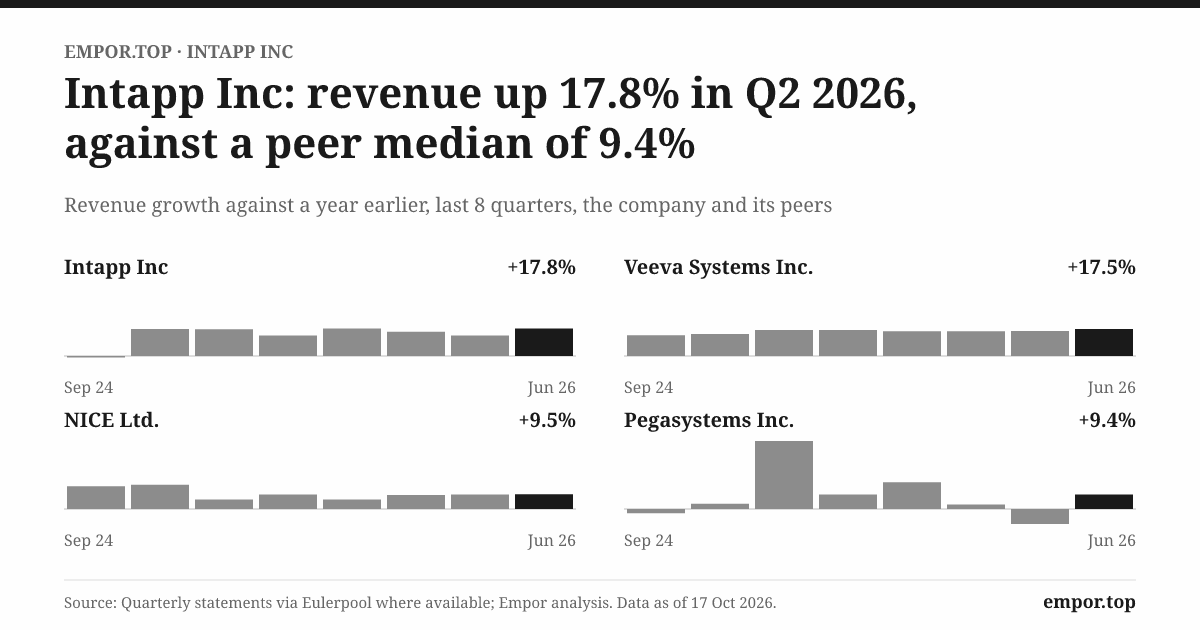
In fiscal 2026, total revenue was about $578 million, and roughly 91% of it came from subscriptions and licenses rather than one-off services.1 But that blended figure hides a transition in full swing. Cloud software-as-a-service revenue, the hosted subscription product, grew about 27% to roughly $423 million. Software license revenue, mostly from customers still running Intapp on their own servers, fell about 14% to roughly $103 million. Professional services, the implementation and migration work, brought in about $52 million.1 One engine is accelerating while another winds down.
What does recurring demand look like for a business like this? The cleanest signal is remaining performance obligations, the total value of contracted revenue not yet recognized. That figure stood at about $833 million at fiscal year-end, with 57% expected to convert to revenue within twelve months.1 Another signal is cloud net revenue retention, which was 123%.1 That metric asks a simple question: if you take every cloud customer from a year ago, how much are they paying now? A reading of 123% means that group, in aggregate, pays about 23% more than it did, after accounting for customers who shrank or left. Existing customers are buying more seats, more modules, or both.
There is also a tell in the customer tiers. Intapp reported 897 clients paying more than $100,000 a year, up about 13%, and 142 paying more than $1 million, up about 30%.1 When the biggest accounts grow fastest, it usually means the product is spreading inside large firms rather than merely winning new small ones.
So the model looks attractive: regulated use cases, recurring contracts, prepayment, and expanding wallets. But look one layer down and the economics are less tidy. Professional services lost about $8.1 million at the gross-profit level in fiscal 2026.1 In other words, Intapp spent more delivering implementation and migration work than it charged for it. Some of that reflects the cost of moving customers from on-premise installations to the cloud, which the company treats as an investment in future subscriptions. Some of it may simply be the price of complex enterprise deployments. Either way, services are a drag, and license revenue, which carries high margins, is shrinking.
That combination raises the question the next chapter has to answer. If growth depends on moving customers to the cloud while still supporting old deployments, when does the transition stop consuming margin?
IV. The Cloud Migration Has a Profitability Bill
Every software company that moves from selling licenses to selling subscriptions goes through a strange valley. In the old world, a customer paid a large sum up front for perpetual rights, and the vendor recognized much of it immediately. In the new world, the same customer pays a smaller amount every year, and the vendor also has to run the servers. For a few years, revenue looks weaker and costs look higher than they would have under the old model. Investors are asked to believe that the valley ends in a higher plateau. Intapp is somewhere in that valley now, and the interesting question is how close it is to the far side.
The cloud engine is undeniably running. Cloud annual recurring revenue, the annualized value of subscription contracts, reached about $496 million at the end of fiscal 2026, roughly 84% of total ARR, and it grew about 29% during the year.5 Total ARR grew around 22%.5 The share of revenue coming from pure SaaS has risen from about 60% in fiscal 2024 to about 73% in fiscal 2026.1
Set that against the longer base rate. Over the three years to fiscal 2026, revenue grew about 18% a year; over five years, about 22% a year.1 Fiscal 2026 growth was about 14.6%, below both.1 That slowdown is partly mechanical, since shrinking license revenue drags on the total, but it is also a reminder that Intapp is no longer a company growing in the high twenties. The cloud business is growing fast enough to offset the runoff, not so fast that it makes the runoff irrelevant.
Now follow the money into the product. Research and development expense climbed from about $114 million in fiscal 2024 to about $167 million in fiscal 2026, rising from roughly 26% of revenue to about 29%.14 That is a heavy investment rate even by software standards, and management has tied much of it to artificial-intelligence engineering. Capital spending, by contrast, is tiny: about $2 million of physical capex and about $8 million of capitalized software development in fiscal 2026.1 Almost all the product investment flows straight through the income statement as an expense. That is the conservative accounting choice, and it is one reason free cash flow conversion looks so high: there is very little capitalized spending to subtract.
Here is the operating-leverage case in its most persuasive form. Headcount rose from about 1,235 in fiscal 2024 to 1,336 in fiscal 2025 and then barely moved, to about 1,340, in fiscal 2026.1 Revenue per employee rose from about $349,000 to about $431,000 over those two years.1 If a software company can keep growing revenue in the mid-teens while holding headcount flat, its cost base eventually stops growing as fast as its revenue, and margins expand. That is the dream.
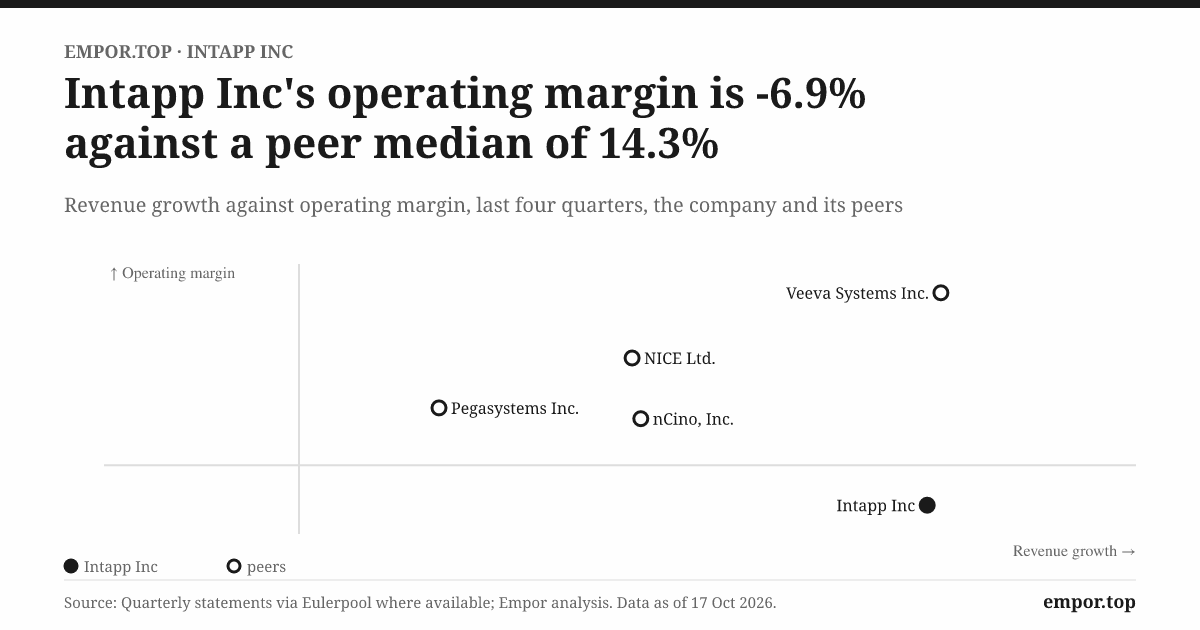
And here is the evidence that keeps the dream honest. The GAAP operating loss widened in fiscal 2026, from about $27 million to about $40 million, taking operating margin from about negative 5% to about negative 7%.1 Restructuring charges of about $8.4 million recurred during the year, following a reorganization that included operations in the Netherlands.1 Flat headcount did not translate into a narrower loss, because R&D and stock compensation rose faster than gross profit. The quarterly record tells the same story: the operating margin swung between roughly negative 3% and negative 10% through fiscal 2026, with no clear march toward breakeven.1
Then there is the quality adjustment that matters most. Because $120 million of stock compensation is non-cash, free cash flow does not reflect it.1 But stock pay is not optional; it is how Intapp competes for engineers in the same talent market as the largest technology companies. If that compensation had been paid in cash, the business would show a much thinner surplus. If it is paid in shares, owners are diluted, unless the company spends cash to buy those shares back, which is exactly what happened in fiscal 2026. Either way, the cost lands on the owner.
So the filings support a transition story, not a settled claim that profitability is imminent. Cloud adoption is real and fast. Headcount discipline is visible. But the year that should have shown operating leverage showed a wider loss instead, because the company chose to spend more on product. That is a defensible choice if the spending produces new revenue. It is a costly one if it simply becomes the new baseline.
Which raises the question of what that spending is buying. Intapp is no longer only selling a migration to the cloud. In 2026 it began selling something new: a promise that it can become the artificial-intelligence layer of a professional firm.
V. Can "Firm AI" Become a Product, Not Just a Promise?
On February 25, 2026, at its investor day, Intapp announced Celeste, which it described as agentic AI for professional firms: software agents designed to act as coworkers that can carry out tasks inside a firm's workflows, not just answer questions.67 In July 2026, the company announced Celeste was generally available, calling it an "expert AI coworker for professional firms."8 The branding is new. The bet behind it is older, and it rests on everything described in the previous chapters.
Management's argument goes like this. A professional firm is not a collection of documents. It is a web of relationships, engagement histories, client permissions and firm-specific rules. A general-purpose AI model, however capable, does not know that a particular partner is walled off from a particular matter, or that a particular banker has a history with a particular sponsor, or that a firm's policy forbids certain kinds of engagement. Intapp already sits on top of that context. Its "Walls for AI" concept is meant to extend the ethical-wall controls it already runs for humans to AI agents, so that an agent cannot surface information a lawyer is not allowed to see.76
A simple analogy helps. Imagine hiring a brilliant new associate who has read every law book ever written but has never set foot in your firm. They are fast and articulate, and they have no idea who your clients are, which files are off limits, or which partner owns which relationship. You would not let them near a client on day one. Intapp's pitch is that horizontal AI is that brilliant new associate, and Celeste is the version that has been given the firm's memory and its rulebook.
The pitch has real support in the customer base. Intapp is installed at 97 of the Am Law 100, 17 of the top 20 accounting networks, and more than 1,700 private-capital, banking and real-assets firms.1 Those firms already trust Intapp with sensitive data and already rely on its permission controls. If any vendor has the right to sell them a compliant AI layer, it is plausibly one that already guards their walls.
But the substitutes are credible, and some are enormous. Microsoft Copilot runs across the productivity tools those same firms use every day, and Microsoft is, conveniently, also Intapp's cloud host. Large firms can deploy foundation models internally, directly over their own document repositories, with their own security teams. And specialist legal AI products, Harvey being the most prominent, have raised substantial capital to own exactly the lawyer's workflow. None of these alternatives needs to replace Intapp outright to matter. They only need to capture the AI budget that Intapp hopes to add on top of its existing contracts. There is no published market-share data showing who is winning that budget, and no evidence yet that Intapp can charge a durable premium for its AI tier.
There is also a history worth remembering. A launch, a pilot, or a demonstration of technical capability is not commercialization. Intapp has not yet disclosed standalone Celeste revenue, paid customer counts, or pricing that would let anyone size it as a business.58 What the company has shown is that it is spending heavily, with R&D near 29% of revenue, and that its existing growth metrics remain healthy. Cloud net revenue retention of 123% is a strong reading, but it describes the existing product set; it cannot yet be credited to an AI product that became generally available after the fiscal year closed.58
The most useful exercise for an investor is to compare what management said at the February investor day with what it has reported since, through the second-, third- and fourth-quarter calls of fiscal 2026.7910 The question to ask of each is concrete: did management give paid adoption figures, pricing, or expansion attributable to Celeste, or did it describe interest, pipeline and capability? Through the fiscal year's end, the company's disclosures framed Celeste as a platform strategy rather than reporting it as a revenue line.5 That is not a failure. It is simply too early. But it means the AI thesis is a forward claim, not a demonstrated one.
So here is the calibrated verdict. Intapp has a plausible strategic fit for professional-firm AI, because it already sits inside the workflows where permissions, relationships and conflicts matter. The thesis remains unproven until Celeste contributes measurable expansion, retention or revenue. The next test is simple to watch: whether cloud net revenue retention holds above 120% and whether the large-customer tiers keep growing in the teens as Celeste moves from launch to paid use.
And that test leads directly to the deeper question. Strip away the AI branding, and is Intapp's position inside these firms truly durable, or merely sticky?
VI. The Moat Lives Inside the Workflow
Go back to the conflict check. When a firm considers new work, the software has to compare the prospective client against every current and former client, every adverse party, every restricted list, every ethical wall. It has to know that a subsidiary of a client counts as the client, that a lawyer who joined from a rival firm brought obligations with them, and that certain partners cannot see certain matters. The rules accumulate over decades. Once a firm has encoded all of that into one system, replacing it is not like switching email providers. It is like moving a library while people are still reading.
That is the intuition behind Intapp's moat, and it is worth testing properly, once, with the tools investors use to judge competitive position.
Start with the industry structure, Michael Porter's five forces. The threat of substitutes is the most serious: firms can choose broad platforms like Salesforce or Microsoft, specialist legal and deal software, or in-house builds. Rivalry among existing competitors is real but fragmented; many direct rivals, such as Aderant in legal practice management, are private, which makes clean public comparisons impossible. The threat of new entrants is moderated by the regulatory knowledge required, though well-funded AI startups are testing that barrier right now. Supplier power is concentrated in one place: Intapp depends on Microsoft Azure for hosting, under a minimum purchase commitment.1 And buyer power is mixed. No single customer contributed more than 10% of revenue in any of the last three fiscal years, so Intapp is not hostage to one client.1 But its customers are sophisticated, well-advised professional firms that negotiate hard and can multi-source.
Now Hamilton Helmer's seven powers, which ask what lets a business earn returns above its cost of capital. Of the seven, switching costs are the strongest candidate here. The evidence is cloud net revenue retention of 123%, and the rapid growth of million-dollar accounts.1 Those are signs that customers expand rather than leave. Counter-positioning may also apply in a quieter way: horizontal platforms built for every industry are reluctant to invest deeply in the conflict rules of a law firm, because the market is too small for them, which leaves room for a specialist. A cornered resource, in the form of decades of embedded firm data and configuration, is plausible but belongs to the customer, not to Intapp. Scale economies, network economies, brand power and process power are thin or unproven: Intapp's scale is modest next to the platforms, and relationship data does not obviously become more valuable to one firm because another firm uses the same vendor.
There is one more piece of evidence that quietly supports the switching-cost story: the quality of the money. Net receivables were about $103 million at the end of fiscal 2026, and the allowance for credit losses was only about 1.1% of gross receivables.1 Unbilled receivables fell about 45%, and deferred revenue rose about 23% to roughly $318 million.1 Customers pay on time, often in advance, and rarely default. That is how clients behave toward software they consider essential.
Now the falsification test. What would break this moat? The mechanism would be substitution or multi-sourcing: firms shifting new workflows to horizontal platforms, or carving off modules to specialists, while leaving Intapp as a legacy system of record. The record cannot rule that out. Intapp does not publish market share, competitive win and loss data, or evidence of realized price increases.1 High retention could reflect product utility, or it could reflect migration friction, the sheer hassle of moving, which protects revenue today but does not guarantee pricing power tomorrow. Net revenue retention of 123% is also an aggregate expansion figure, not a gross retention rate; it can coexist with some customers leaving if others expand enough.
So the verdict narrows the claim rather than rejecting it. Intapp has a credible switching-cost moat in its regulated workflows, supported by expansion, elite adoption and the consequences of errors. It is a moat around the system of record. Whether it extends to the new AI layer, where the budget is still up for grabs, is not yet proven. The core test is whether customer expansion and renewals hold as firms adopt horizontal AI and as Intapp moves more of their workflows into its cloud.
A moat protects the business. It does not, on its own, protect the shareholder. For that, you have to look at what management does with the cash the moat produces.
VII. The CEO's Capital-Allocation Test
In August 2025, Intapp's board authorized a $150 million share repurchase program. In January 2026, with that program fully used, it authorized another $200 million.1 By the end of June, the company had spent about $275 million retiring roughly 8.4 million shares, using $125 million of the second authorization and leaving $75 million still available.1 It was, by Intapp's standards, an enormous decision: the first time in its public life that it returned substantial capital to shareholders, and it consumed nearly half its cash in a year.
The people behind that decision are a long-serving team. John Hall, the co-founder, has run the company since 2000.3 Thad Jampol, his co-founder, remains chief product officer and central to product strategy, and Don Coleman serves as chief operating officer.3 David Morton joined as chief financial officer in 2023.3 That continuity is a genuine asset in a business whose customers value stability and deep domain knowledge. Hall's leadership has spanned the bootstrap years, the private-equity era and the public company. It also means the people who built the cost structure are the people now asked to fix its profitability.
Incentives are heavily tilted toward equity. Hall received total compensation of about $18.6 million in fiscal 2026, most of it in stock awards, up from about $14.9 million in fiscal 2025 and about $8.1 million in fiscal 2024.3 Morton received about $10.3 million.3 Chief marketing officer Dustin Sedgwick received about $10.7 million, including a $1 million cash bonus under what the proxy describes as an "AI Transformation Program."3 Across the company, stock compensation reached about 21% of revenue.1 Pay rose sharply in years when the company reported GAAP losses. Defenders would say compensation reflects share-price performance and the market for talent. Skeptics would note that the loss widened in the year pay climbed.
There is a real counterweight. Hall beneficially owns about 8% of the company, and executive officers and directors as a group own about 11.9%.3 That is meaningful skin in the game. A chief executive who owns nearly 8% of a company worth about $3.5 billion feels the share price personally, which aligns him with long-term owners in a way that salary never could.
Now trace the capital history over the whole public life. The IPO raised about $278 million and retired roughly the same amount of pre-IPO debt.2 Between May 2023 and April 2024, Great Hill and Temasek sold down shares through secondary offerings, which did not raise money for the company but did shift ownership from sponsors to public investors.1 Great Hill has now exited completely, while Temasek, through Anderson Investments, remains the largest shareholder with about 22.4%.3 Then, in fiscal 2026, the company pivoted from a business that issued shares to one that bought them back.
An activist with a skeptical eye would ask a pointed question. If the company issues roughly $120 million of stock compensation a year and then spends cash buying back shares, how much of the buyback is simply mopping up dilution, and how much is genuinely shrinking the share count? The company retired about 8.4 million shares, against about 76.7 million shares outstanding by September 2026.13 That is a real reduction. But stock compensation keeps adding shares every year, and the buybacks were funded not from surplus alone but from cash accumulated in earlier years. The decisive evidence is the diluted share count over the next two years. If it falls meaningfully, the buyback created per-share value. If it drifts back up, the cash paid for compensation.
Governance signals are mixed rather than alarming. At the November 2025 annual meeting, about 93.8% of votes supported the say-on-pay resolution.11 But about 33.8% of votes cast were withheld from director Marie Wieck, and about 19% from Beverly Allen.11 A third of shareholders declining to support a director is a notable message, though the filing does not by itself explain the reason.
Related-party dealings are limited and plainly disclosed. The company reports no commercial software sales to its sponsors or affiliates.3 Temasek holds the right to nominate one director under a stockholders' agreement.3 And director Ralph Baxter's advisory firm received $240,000 in base fees, with up to $260,000 more in incentive fees, for chairing Intapp's client advisory board.3 It is small relative to the company, but an outside director receiving incentive fees for advisory work is the kind of arrangement long-term owners should watch.
The credibility test, then, is not whether a $200 million authorization sounds shareholder-friendly. It is whether the diluted share count falls enough to justify the cash spent. And that cash had to come from somewhere, which brings the story to the balance sheet.
VIII. Cash-Rich, but the Balance Sheet Has a Job
At the close of fiscal 2026, Intapp held about $163 million in cash and short-term investments.1 It had no bank debt. A week after year-end, on July 7, 2026, it replaced its undrawn $100 million revolving credit facility with JPMorgan with a larger $150 million five-year facility led by UBS, also undrawn, with an accordion allowing up to $75 million more.1 Pricing on any borrowing would run between 1.5 and 2.25 percentage points over the benchmark rate.1 By any ordinary measure, the company is liquid.
There is one figure that can mislead a casual reader. Some data services show Intapp carrying "borrowings" of about $16 million. That is not debt in the conventional sense. It is the long-term portion of operating lease liabilities, the accounting recognition of office rent commitments; total lease obligations were about $22.8 million.1 Intapp owes its landlords, not its bankers. Net of those leases, it holds well over $100 million more cash than it owes.
The more important commitment is to Microsoft. Under an amended agreement signed in December 2021, Intapp agreed to spend at least $110 million on Azure cloud hosting through December 2028, and about $54 million of that commitment remained at June 2026.1 For a cloud software company, hosting is a core cost of goods, so this is less a burden than a structural dependency. But it has a strategic twist: Intapp's largest infrastructure supplier is also the company behind Copilot, one of the most credible substitutes for its AI ambitions.
Currency exposure is modest but real. About 32% of revenue came from outside the US in fiscal 2026, led by the UK.1 Intapp does not hedge, and while its foreign costs provide a natural offset, remeasuring foreign-currency balances knocked about $5.2 million off other income during the year.1 Combined with lower interest income as cash was spent on buybacks, other income fell from about $11 million to under $3 million.1 That is a small but direct cost of the buyback decision: cash that used to earn interest now sits in retired shares.
Tax and legal matters belong in proportion. Deloitte issued an unqualified audit opinion on the fiscal 2026 statements and found internal controls effective.1 The only critical audit matter concerned revenue recognition, specifically how management allocates price across bundled arrangements of subscriptions, licenses and services, which requires judgment about standalone selling prices.1 That is a normal area of judgment for software companies, but it is where an investor should look if revenue patterns ever shift unexpectedly. The company states it is not party to legal proceedings expected to have a material adverse effect.1 Tax provisions and uncertain tax positions are set out in the notes to the financial statements, and they deserve the usual scrutiny rather than an assumption that tax risk is absent.
Then there is the shareholder register. Temasek's 22.4% stake comes with demand registration rights, renewed in a third amended agreement dated July 1, 2026, and Intapp filed a shelf registration in May 2026.31 That apparatus makes a future secondary sale straightforward. A large block sale could weigh on the shares. Alternatively, a large holder in a cash-generative, debt-free vertical software company could be a natural partner in a take-private. Neither outcome is signaled in the filings; both are possibilities an owner should keep in view.
So the business is liquid today, with no funded debt and a fresh credit line. The tougher question is whether management should keep using that liquidity for buybacks while the core operating margin remains negative. Cash spent retiring shares cannot also fund the next DealCloud, or cushion a year in which AI spending rises faster than AI revenue. That trade-off is exactly what the stock price is now asked to judge.
IX. The Valuation Prices in a Better Ending
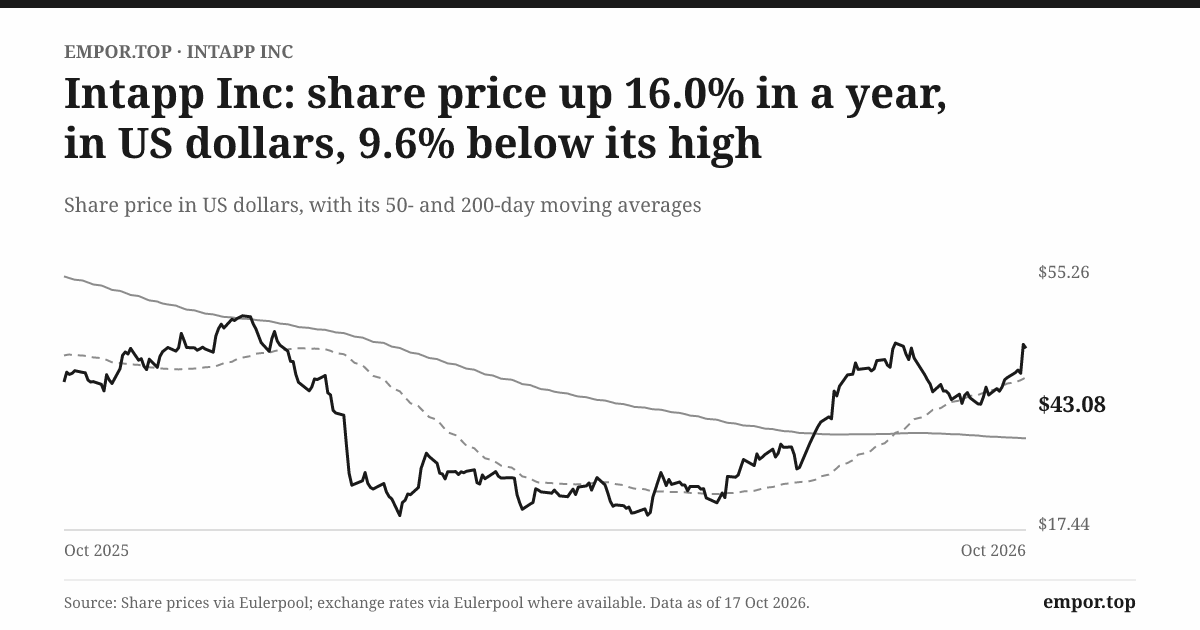
On October 17, 2026, Intapp shares closed around $43, roughly 10% below their 52-week high of about $48 and more than double their 52-week low of about $19.12 The swing tells you something before any multiple does. Investors have moved from deep skepticism to substantial optimism within a single year, and the stock has fallen about 74% at its worst point within the last five years.12 This is a company the market finds hard to price.
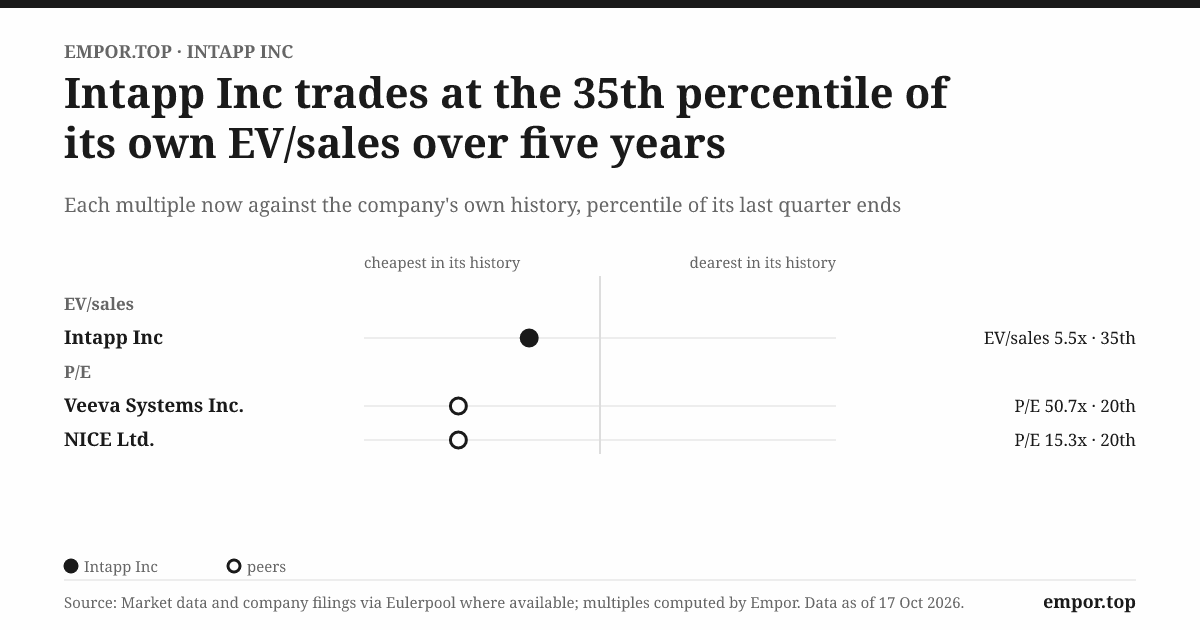
At that price, Intapp's market value was about $3.5 billion, and its enterprise value, after subtracting net cash, about $3.3 billion.12 That works out to about 5.5 times trailing revenue, or 6 times on a price-to-sales basis. Against trailing free cash flow of about $136 million, the free-cash-flow yield is about 3.9%.112 There is no meaningful price-to-earnings ratio, because there are no GAAP earnings.
What does that price assume? Here is the uncomfortable worked example. A 3.9% free-cash-flow yield looks respectable for a growing software company. But roughly $120 million of stock compensation sits underneath that free cash flow.1 If you treat stock pay as the real cost it is, the owner-earnings yield falls to a small fraction of the headline. In other words, the valuation is not paying for today's distributable cash. It is paying for a future in which revenue keeps compounding while stock compensation and R&D shrink as a share of revenue, letting the operating margin turn decisively positive.
Comparisons with peers help only loosely. nCino, which sells software to banks, has traded in a similar range of revenue multiples, while Guidewire, the insurance software leader, has commanded roughly double. Product mix, growth rates and profitability differ enough that no precise like-for-like verdict is possible. Broadly, the market treats Intapp as a credible mid-tier vertical software company, priced above the troubled names and below the proven compounders, and the gap to the premium tier is roughly the gap between a GAAP loss and a GAAP profit.
The bull case writes itself from the earlier chapters. Intapp sits inside regulated workflows where errors are costly. Its customers expand at a rate few software companies match. The cloud transition is mostly done, with license runoff approaching its tail. Headcount has flattened while revenue grows. And Celeste offers a way to sell more to the same firms without proportional hiring, turning firm-specific data and permissions into a priced AI layer. If that works, operating margins could expand sharply, and the buybacks would look like a well-timed purchase of a compounding asset.
The bear case is equally coherent. License revenue keeps eroding, professional services keep losing money, and R&D near 29% of revenue becomes the permanent cost of staying relevant in AI rather than a temporary investment. Stock compensation remains above a fifth of revenue, so the buybacks merely offset dilution. Microsoft, Harvey and in-house deployments capture the AI budget, leaving Intapp as a sticky but slow-growing system of record. In that world, cloud scale never translates into durable GAAP margins, and a 5.5 times revenue multiple looks generous.
A skeptical shareholder would press one question harder than the rest. Did spending $275 million to buy shares in a year when they traded across a wide range create more value than keeping that cash for product investment or acquisitions? The record of DealCloud shows that the right acquisition can reshape the company. The record of the buyback, so far, shows only that cash left and shares were retired. Until the diluted share count and per-share cash flow tell a clearer story, the buyback is a bet on Intapp's own stock, made at prices the market itself has priced very differently from month to month.
Three numbers settle this case, and they are worth tracking above all others. Cloud ARR growth, last reported at about 29%, measures whether the core engine keeps running.5 Cloud net revenue retention, at 123%, measures whether existing customers keep expanding, and it is the most likely early signal of AI monetization.5 And GAAP operating margin, at about negative 7% for fiscal 2026 and worse than the prior year, measures whether all of this turns into profit.1 Alongside them, track the diluted share count, which will reveal whether buybacks are beating compensation.
The next event that matters is not another slogan about Firm AI. It is evidence in the accounts that the new products expand paid usage, and that operating losses narrow. Until then, the valuation prices in a better ending than the filings have yet written.
X. Business & Investing Lessons
Put two checks side by side. In 2018, Intapp paid about $123 million for DealCloud and walked into a new market.2 In fiscal 2026, it spent about $275 million on its own shares and walked out with fewer of them, and less cash.1 Both were capital allocation. Only one of them changed what the company could become. The contrast is where the lessons of this story live.
The first lesson comes from DealCloud. Intapp took a legal-software instinct, the obsession with who knows whom and who may work for whom, and carried it into private equity and banking, where the same instinct had a different market. That purchase likely did more to shape today's company than any single product launch. But the company never published the deal's return, and its next adjacency, TermSheet, came with performance-linked payments that signal uncertainty. The lesson for founders and investors: the right acquisition can change the market you serve, but the price still needs a return, and a strategic story is not the same as a measured one.
The second lesson comes from the conflict check. Intapp sells software whose failure does not mean a slow screen but a breached wall, a disqualified firm or a lost client. That is why 97 of the largest US law firms run it, and why customers pay in advance and expand year after year. In professional services, the most valuable software is often the least glamorous: the layer that knows the rules. When a software error can block a client or breach a wall, context has economic value.
The third lesson is the paradox at the heart of this story. Intapp's cash flow is real, and so is the $120 million of stock compensation that sits underneath it.1 The company then spent more than a year's free cash buying back the kind of shares it issues to employees. Owners should not confuse a cash-flow statement with an owner-earnings statement. A non-cash expense can still cost the owner, especially when the company buys back the shares it issues.
The fourth lesson belongs to Celeste. Intapp announced its AI coworker in February and made it generally available in July, and both were genuine milestones.68 But milestones in software, like approvals in drug development, are permissions to compete, not proof of winning. The company has not yet reported paid adoption at a scale that can be measured. A product launch is a capability; recurring paid use is a business.
The fifth lesson is about judging management. Every buyback announcement is quoted in dollars: $150 million, $200 million. Dollars are the cost. The benefit is measured in shares, and specifically in whether the diluted share count falls after accounting for the stock issued to employees. Judge a buyback by the share count it retires, not the dollars announced.
XI. Epilogue
Intapp enters fiscal 2027 in an interesting position. Celeste is generally available. A new $150 million credit facility sits undrawn. Cash reserves are much thinner than a year ago, and $75 million of buyback authorization remains ready to use.18 The company has finished most of the hard part of its cloud transition, and now it must show that the finished transition is worth more than the unfinished one.
The first moment to watch is the cloud mix. Cloud ARR sits at about 84% of total ARR.5 As it passes 90%, the drag from shrinking license revenue should fade, because there will simply be less of it left to shrink. If operating losses narrow as that happens, the transition thesis will have been confirmed. If new costs, whether AI engineering, migration services or restructuring, simply replace the old ones, the thesis will need a new ending.
The second moment is the expansion signal. Cloud net revenue retention of 123% is where the AI story will first show up, or fail to.5 If it holds above 120% while the number of customers paying more than $100,000 keeps growing in the teens, Celeste is plausibly working as an upsell. If retention slides toward the low teens while R&D stays near 29% of revenue, investors will be paying for an AI product that customers are buying elsewhere.
The third moment is the share count. Over fiscal 2027 and 2028, compare total stock compensation and buyback spending with the net change in diluted shares. That single comparison will settle the question this story opened with: whether the cash that looked free was surplus or simply the second half of a compensation cycle.
The fourth is Celeste-specific disclosure: paid seats, pricing, renewal rates, anything that separates pilots and product features from revenue. Management has so far described a platform strategy; owners will need a business line.
And underneath all of it sits the GAAP operating margin, read alongside R&D as a share of revenue, restructuring costs and the economics of professional services. Those are the lines that decide whether Intapp is a growth company that will one day be profitable or a profitable-looking company that keeps choosing to grow.
The unresolved wager is simple to state and hard to win. Intapp has built a place inside the most sensitive workflows of law firms, accountants and dealmakers. Can it make that position produce durable earnings per share?
XII. Outro
Return, one last time, to the conflict check. Before a law firm accepts new work, software has to know who the client is, what the firm already knows, and who must not see it. That moment, invisible to the client and unglamorous to everyone else, is the reason Intapp exists. It is also the reason its customers pay in advance, expand year after year, and rarely leave.
Money flows through that moment. In fiscal 2026, about $136 million of free cash flowed out of the business, while about $120 million of stock compensation flowed quietly in the other direction, to the people who build it.1 The open question is whether, after both currents, anything accumulates for the owner. Intapp's product is the firm's memory; its investment case is whether that memory can earn more than it costs to keep.
References
-
Intapp, Inc. Form 10-K for the Fiscal Year Ended June 30, 2026 — SEC EDGAR, 2026-08-14 ↩↩↩↩↩↩↩↩↩↩↩↩↩↩↩↩↩↩↩↩↩↩↩↩↩↩↩↩↩↩↩↩↩↩↩↩↩↩↩↩↩↩↩↩↩↩↩↩↩↩↩↩↩↩↩↩↩↩↩↩↩↩
-
Intapp, Inc. Form 424B4 IPO Prospectus — SEC EDGAR, 2021-07-01 ↩↩↩↩↩↩↩↩↩↩
-
Intapp, Inc. Definitive Proxy Statement — SEC EDGAR, 2026-10-06 ↩↩↩↩↩↩↩↩↩↩↩↩↩↩
-
Intapp, Inc. Form 10-K for the Fiscal Year Ended June 30, 2025 — SEC EDGAR, 2025-08-20 ↩↩↩
-
Intapp announces fourth quarter and fiscal year 2026 financial results — Intapp Investor Relations, 2026-08-04 ↩↩↩↩↩↩↩↩↩
-
Intapp announces Celeste: Agentic AI for professional firms — Intapp, 2026-02-25 ↩↩↩
-
Intapp Investor Day 2026 Presentation — Intapp, 2026-02-25 ↩↩↩
-
Intapp announces general availability of Celeste, the expert AI coworker for professional firms — Intapp Investor Relations, 2026-07-15 ↩↩↩↩↩
-
Intapp (INTA) Q2 2026 Earnings Call Transcript — The Motley Fool, 2026-02-03 ↩
-
Intapp Q4 FY2026 Earnings Call Transcript — Earnings Whispers, 2026-08-04 ↩
-
Intapp, Inc. Form 8-K, Annual Meeting Voting Results — SEC EDGAR, 2025-11-21 ↩↩
 LinkedIn
 WhatsApp
 Reddit
 Hacker News
 Email
 Kindle
 RSS Feed
 Spotify
 Apple Podcasts
 Amazon Music
 Audible
 YouTube