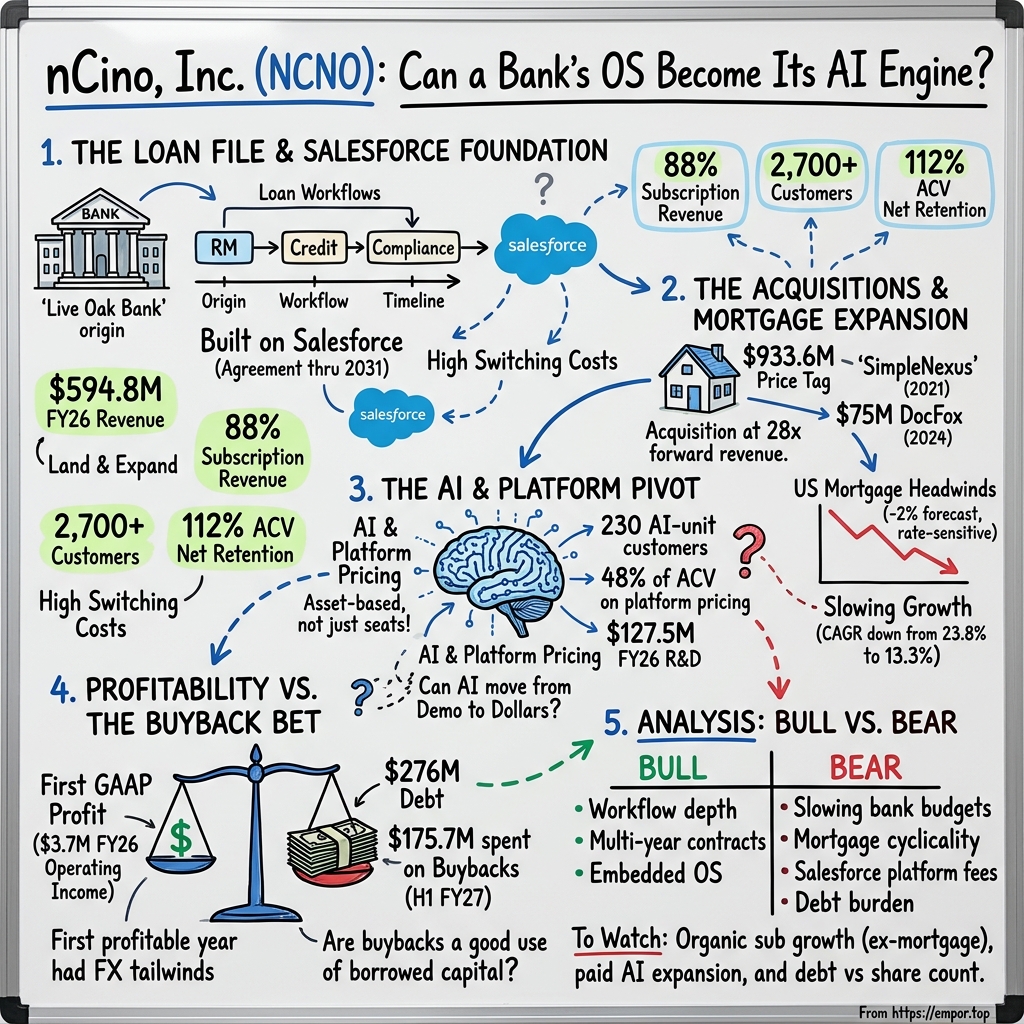
nCino, Inc.: Can a Bank's Operating System Become Its AI Engine?
I. The Buyback Behind the AI Pitch
On a late-August afternoon in 2026, nCino's chief executive, Sean Desmond, opened the company's second-quarter call with the kind of story software investors have learned to expect. Banks, he said, were expanding their use of nCino's artificial-intelligence tools. They were buying "AI units," running more of their lending and onboarding work through nCino's agents, and reporting time saved in hundreds of thousands of hours.1 It was a pitch about the future: the software that already ran a bank's loan files would now start doing some of the thinking.
Then the chief financial officer, Greg Orenstein, turned to the present. The board had authorized another $100 million share repurchase.1 By management's own count, nCino had already spent roughly $300 million buying back its stock since April 2025.1 And the balance sheet that paid for those purchases looked very different from the cash-rich software company that had listed six years earlier. At the end of July 2026, nCino owed $276 million of principal to its banks and held about $84 million of cash.2
Those two halves of the call make an odd pair. One says the company is entering a new growth phase in which AI and new pricing will lift what each bank spends. The other says management believes the shares are cheap enough to buy with borrowed money now, before that growth phase has shown up in the numbers. Both can be true. But they are different bets, and investors are being asked to make both at once.
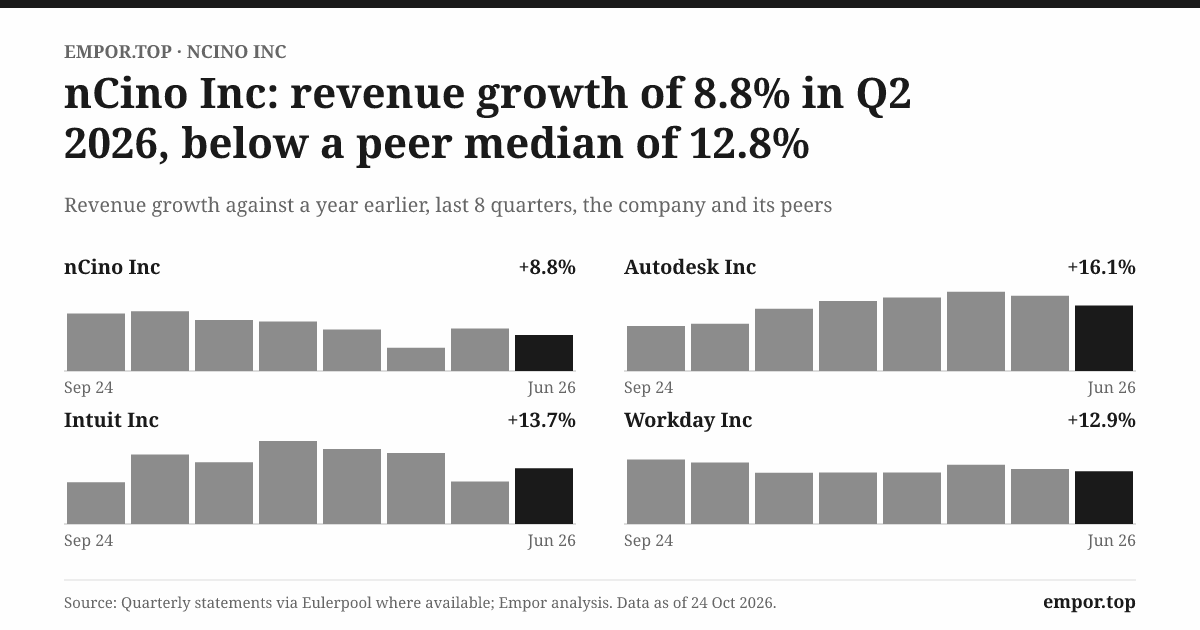
The quarter itself was decent rather than dramatic. Revenue rose 8.8% from a year earlier, to about $161 million, and subscription revenue grew 10%.21 Operating profit, which barely existed two years earlier, came to about 8.5% of revenue.2 For the twelve months to July, nCino generated about $621 million of revenue. For the full fiscal year that ended in January 2026, it reported $594.8 million, of which 88% came from subscription software that banks pay for year after year.[^3]
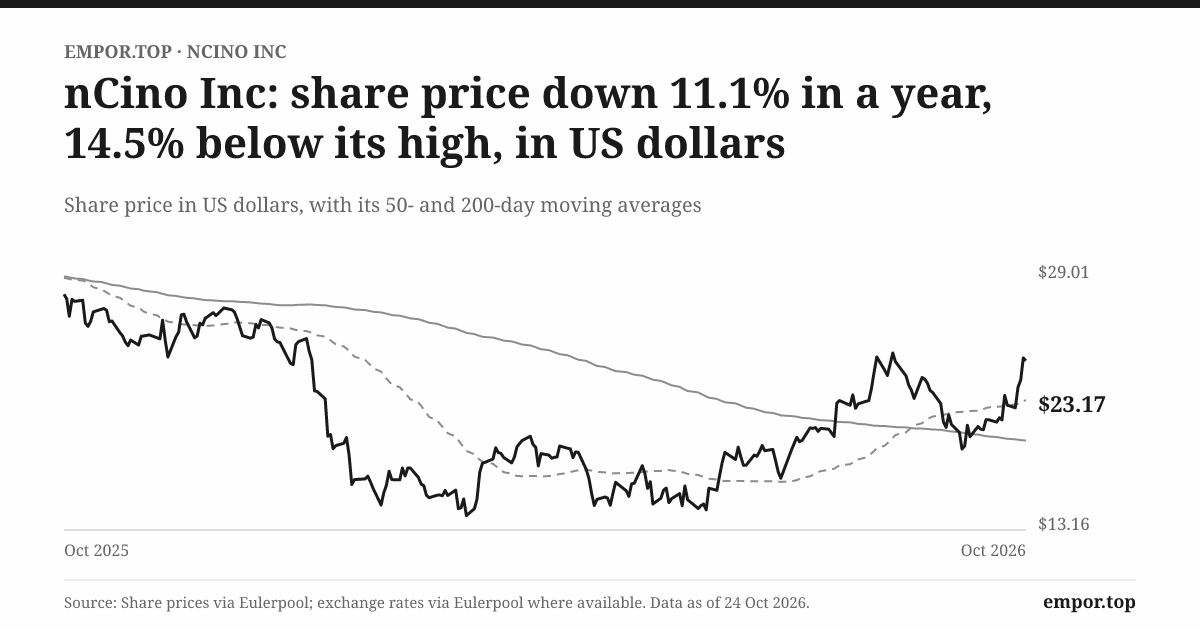
On October 24, 2026, the stock closed at $23.17, about 14.5% below its 52-week high, valuing the company at around $2.7 billion and about $2.9 billion including debt.[^4] That is an ordinary-looking price-to-sales multiple of about four times, and an extraordinary-looking earnings multiple of 83 times. The gap between those two numbers is the story. The market is paying a software-like price for a company whose profits have only just appeared.
The shareholders who own that price have had a rough ride getting there. At its worst point over the past five years, the stock fell more than 80% from its peak, and over the past year it has swung between roughly $14 and $27.[^4] That volatility is the backdrop to the buyback. Management has been buying in a market that has repeatedly changed its mind about what nCino is worth, and the timing of those purchases, low or high, will shape whether they look wise in hindsight.
It also explains why the AI pitch matters so much to the people on the call. A company growing in the high single digits with thin margins tends to be valued as a mature software vendor. A company that can show a new engine of expansion gets valued as a platform. The difference between those two descriptions, for a business with about $600 million of revenue, is measured in billions of dollars of market value. Every phrase about AI adoption on that August call was, in effect, an argument about which multiple nCino deserves.
So this episode asks four questions. Is nCino's software genuinely hard for a bank to rip out, or merely annoying? Can AI and a switch to pricing based on a bank's assets offset a mortgage business that has turned from tailwind to drag? Is the jump into profitability durable, or did it lean on one-time help? And is borrowing to buy back stock a sound use of capital for a company still asking investors to trust a new strategy?
To answer them, the story starts not on an earnings call but inside a bank, with a single commercial loan file. It follows that file as it turned into a platform, through an expensive leap into the mortgage boom, into a slowdown that management now explains business line by business line, and finally to a new CEO's first full year in charge, in which the most decisive move was not a product launch but a balance-sheet decision.
 Subscribe on LinkedIn
II. The Loan File That Became a Platform
Picture a regional bank in North Carolina, sometime around 2010. A business owner wants a loan to buy a second warehouse. A relationship manager takes the request, types the details into one system, and emails a spreadsheet to the credit team. Credit analysts rekey the numbers into their own models. Someone in compliance chases documents by phone. The closing team prints, signs, scans and files. At every handoff the loan file stops, waits and sometimes gets lost. Nobody in the bank can see where it is or why it is late.
That was the problem nCino was born to fix. The company grew out of Live Oak Bank in Wilmington, North Carolina, which wanted a modern way to run its own small-business lending and decided to build one.3 Rather than write the software from scratch, the team built it on Salesforce, using the customer-relationship platform as the foundation and adding the banking-specific workflows themselves: credit analysis, document collection, approvals, closing.3 The idea was simple enough to fit on a slide. Keep the whole loan file in one place, let every department work on it in turn, and give managers a view of the pipeline that most banks had never had.
By the time nCino filed to go public in 2020, that internal tool had become a business selling to banks and credit unions around the world, with Pierre Naudé as chief executive.3 The listing came in July 2020, at the height of the pandemic rush into cloud software. The shares were priced at $31, above an already-raised range, and raised about $250 million.4 On the first day they closed at about $79, more than two and a half times the offer price, and traded above $90 after hours.4 Investors were not paying for a loan tracker. They were paying for the hope that nCino would become the operating system for how banks make decisions.
How a bank buys, and why it rarely leaves
The economics follow the way banks buy technology. A bank typically signs a subscription contract lasting three to five years, non-cancelable, billed annually in advance.[^3] That prepayment means a customer funds its own service a year at a time, which is why nCino's balance sheet carries large deferred revenue. Around the subscription sits a smaller professional-services business: the consultants who configure the system, migrate data and train staff. Services are a lower-margin companion, about 12% of revenue in fiscal 2026, and they exist largely to get the subscription running.[^3]
"Land and expand" is the growth model, and in nCino's case it has a physical shape. A bank might start with commercial lending in one business line. Once that works, it adds small-business lending, then consumer lending, then deposit account opening and customer onboarding, then more users across more departments. Each step puts more of the bank's daily work on nCino's screens. By the end of fiscal 2026, nCino served more than 2,700 customers, including about 1,500 banks and credit unions.[^3] Some 114 of them paid more than $1 million a year in subscriptions and 14 paid more than $5 million.[^3]
The best evidence that customers expand is nCino's annual-contract-value net retention, which measures how much the same group of customers spends a year later, after losses and upgrades. In fiscal 2026 it was 112%.[^7] Put plainly, a group of customers paying $100 a year earlier was paying about $112.
That is respectable rather than spectacular for enterprise software, and it is not the same measure as the subscription-retention figure in the 2020 prospectus, which tracked a different base and showed faster expansion in an earlier era.3 The two numbers are not a continuous series, so the most anyone can say is that nCino has a long history of customers spending more, and that the current rate is a fiscal-2026 snapshot, not a trend line.
The competitive picture is easy to overstate in both directions. Q2 Holdings and Alkami are the names investors usually reach for, but they mostly sell digital banking, the apps and websites customers use to check balances and move money. In 2025 Q2 reported annual recurring revenue of roughly $0.9 billion and Alkami reported revenue of about $444 million.56
Those numbers show that bank software companies of nCino's size exist, and that bank technology budgets can support several of them, but they are context, not a market-share league table. Behind them stand the core-processing giants, Fiserv, FIS and Jack Henry, which run the ledgers of thousands of banks and have broader product sets and deeper customer relationships than nCino.[^3] They can bundle lending tools into a relationship nCino does not own.
A strategist would describe the forces this way. Banks have real bargaining power: procurement is slow, committees are large, and an implementation can take many months, which gives the buyer leverage at signing. But once the system is live, regulation and integration work slow any change, because a bank that replaces its lending platform must retrain staff, revalidate credit processes and satisfy examiners.
In Hamilton Helmer's terms, the evidence supports switching costs, and perhaps a modest scale advantage in workflow knowledge and customer references. It does not support a cost advantage over larger rivals, and nothing in the record suggests a cornered resource. nCino does not disclose its market share, its top-five customer concentration or its win rates against competitors, so the strongest version of the moat claim, dominance, cannot be tested.
It helps to imagine the switch from the bank's side. A mid-sized bank with a few hundred lenders has spent a year configuring nCino to match its credit policy, its approval limits and its document checklists. Its examiners have reviewed the process. Its staff have learned where every button is.
Replacing that system means re-creating each of those rules in a new product, migrating years of loan files, running both systems in parallel and explaining the change to regulators, all while lending continues. Few chief operating officers volunteer for that unless the incumbent fails badly or the price gap is enormous. That is the moat in its most honest form: not love, but inertia earned by being woven into how the bank works.
Inertia has limits, though. It protects the modules a bank already runs, not the ones it has not yet bought. When nCino tries to sell a second or third product, it competes on merit against vendors who may already own that part of the bank, and the switching costs that protect the first module do nothing for the next one. The growth story depends on the expansion sale, and the expansion sale is a fair fight.
The landlord problem
Then there is Salesforce. Building on Salesforce gave nCino a head start in 2012: security, hosting, a database and a user interface it did not have to invent. It also made Salesforce an ongoing partner in every sale. nCino pays Salesforce fees that rise with users and usage, and its agreement, amended in December 2023, now runs through January 2031.[^10][^3] nCino's own filings warn that Salesforce could compete directly in financial services or raise the cost of the platform.[^3] A tenant can build a beautiful shop, but the landlord still sets the rent.
The dependency cuts both ways. For banks, the Salesforce foundation is part of the appeal, because it brings a widely used, well-secured cloud platform that their IT teams already understand, and many banks use Salesforce for sales and service elsewhere in the building. For nCino, it means that a portion of every new dollar of subscription revenue is shared with a much larger company whose priorities may change.
The long contract term reduces the risk of an abrupt change in terms through the end of the decade. It does not remove the question of what the relationship looks like when the agreement next comes up, or what happens if Salesforce decides that AI agents for financial services are a market it wants for itself.
That leaves the moat with a clear test. Retention, multi-year contracts and broad workflows say nCino is embedded. Whether it is irreplaceable will show up at renewal, especially now that the company is changing what it charges for, from the number of employees using the software toward the size of the bank's balance sheet. Before that shift, though, nCino made its largest bet of all, and it made it in the hottest housing market in a generation.
III. SimpleNexus Bought nCino a Place in the Mortgage Cycle
In November 2021, American mortgage lenders were running at full tilt. Rates were near historic lows, refinancing had swept the country, and loan officers at independent mortgage companies were working weekends. On November 16, nCino announced it would buy SimpleNexus, a Utah company whose mobile app let borrowers apply for a home loan, upload documents and track their mortgage from a phone.[^11] The headline value was about $1.2 billion, paid with roughly $240 million in cash and about 13.2 million nCino shares.7
SimpleNexus was not a small app. It served more than 300 independent mortgage banks, more than 80 banks and credit unions and over 41,000 loan originators, and its platform had touched about one in every seven U.S. mortgage transactions in the first nine months of 2021.7 nCino said the deal took it into the point-of-sale mortgage market and expanded its addressable market by more than $4 billion.7 Naudé praised SimpleNexus's consumer-facing technology as the piece nCino lacked.7
One line in the pitch deserves to be remembered. nCino told investors that SimpleNexus charged per seat, by subscription, which made its revenue more predictable and "not tied to mortgage transaction volumes."7 That was technically true. But a seat is a loan officer, and loan officers are hired when mortgages boom and laid off when they slump. The cycle did not need to touch transaction fees to reach the revenue line. It only needed to shrink the customers.
Why did nCino want mortgage at all? Because a bank's relationship with a household often runs through the home loan, and because nCino's original strength was on the commercial side of the bank. Owning the borrower-facing mortgage app gave it a consumer front door and, in theory, a way into the retail banking budget. SimpleNexus had also just bought LBA Ware, a maker of compensation and analytics software for mortgage firms, so nCino was buying a small platform of its own.7 Strategically, the move made sense. The question was always the timing and the price.
The timing, in hindsight, could hardly have been worse. Within months of the closing, the Federal Reserve began the fastest run of rate increases in four decades, refinancing activity collapsed and independent mortgage banks, SimpleNexus's core customers, began a long contraction. nCino had bought the most cyclical corner of bank lending at the top of its cycle, with currency that was itself near the top of a software bubble.
The price on the tag and the price at the till
The deal closed in January 2022.[^13] By then the headline had shrunk. The final consideration at the acquisition date was $933.6 million.[^3] Because most of the price was paid in nCino shares, the value moved with nCino's own stock between signing and closing, and that is where most of the difference lies. In other words, nCino's shareholders gave up the same slice of their company that they had agreed to in November; what changed was how the market valued that slice.
Either way, the price was rich. One fintech M&A review placed the SimpleNexus deal at roughly 28 times forward revenue, against about 5.4 times revenue for the 2021 take-private of Bottomline Technologies.8 The comparison is imperfect: Bottomline was a mature payments company bought by private equity, while SimpleNexus was a fast-growing app bought partly with richly valued stock at the peak of a software bubble. But even allowing for that, nCino paid a multiple several times the benchmark. A premium is not proof of overpaying. It is proof that the acquisition had to perform unusually well, for a long time, to earn back what was paid.
The buying did not stop with SimpleNexus. In 2024, nCino acquired DocFox, a South African-founded onboarding company that helps banks open accounts for business customers, for about $74 million, after a headline closer to $75 million.[^3] It bought Integrated Lending Technologies, a consumer-lending software firm, for about $20 million, and FullCircl, a British customer-lifecycle and onboarding company, for about $135 million.[^3] Each added a piece of the journey around the loan file: verifying a business customer, opening the account, monitoring the relationship.
The strategic logic is consistent. A bank that already runs commercial lending on nCino should, in theory, be easier to sell onboarding and consumer lending to. The risk is equally clear. Every acquired product brings its own code, customers and support teams, and integrating them can consume the engineers who would otherwise build the next thing. Did these deals deepen cross-selling or merely enlarge the integration list? nCino does not report revenue or returns by acquired product, so outsiders cannot answer that directly.
What they can see is the shape of the bet. Where SimpleNexus was a leap into a new customer base, the later deals were mostly about the same customer: the bank that already runs nCino and needs to onboard a business client, verify who owns it and keep watching the relationship after the loan closes.
They also pushed nCino further abroad, with DocFox rooted in South Africa and FullCircl in Britain, which matters later in this story because foreign subsidiaries brought foreign currencies onto the books.[^3] Smaller, adjacent acquisitions are typically easier to integrate than a billion-dollar leap. They were also paid for in cash rather than richly valued stock, and the later ones partly with borrowed money, which is where the balance sheet that funds today's buybacks first started to change.
The mortgage customer who came back
The popular shorthand is that SimpleNexus was a bubble-era mistake. The record is more complicated. nCino recorded no goodwill impairment from fiscal 2024 through fiscal 2026, and its auditor signed off on that judgment.[^3] An impairment would have been an admission that the business was worth less than the price on the books. That has not happened. But the absence of a write-down is a low bar: it says the acquired businesses are not clearly worth less than their carrying value, not that they have earned an adequate return on more than $900 million.
There is also a story, told on the August 2026 call, that cuts in nCino's favor. An independent mortgage bank left nCino in August 2024 for a cheaper product. Within two years it came back, after reliability problems and a worse experience for borrowers at the replacement.1 It is a real retention win, and it suggests that in mortgage software, uptime and borrower experience can matter more than the line-item price. But it is one customer, and it describes a buyer that left in the first place on price.
The fair verdict is that SimpleNexus gave nCino a genuine doorway into home lending, and that its price set a hurdle the company has not yet shown it has cleared. The tests are observable: organic growth in the mortgage and onboarding products, expansion at customers that buy both, and cash returns from the combined suite. What followed was a mortgage market that stopped cooperating.
IV. When the Mortgage Forecast Turned Down
There is a moment in many growth stories when management stops talking about the whole company and starts talking about its parts. For nCino, that moment arrived with its fiscal 2027 outlook. Instead of a single subscription growth number, management split the business in two. Subscription revenue excluding U.S. mortgage was expected to grow 9% to 11%. U.S. mortgage was expected to shrink by about 2%.910
That split is honest, and it is revealing. It tells investors which part of the company management wants to be judged on, and which part it wants to be forgiven for. It also confirms that the mortgage business bought at the top of the cycle had become a drag on growth at the bottom of it.
Zoom out and the deceleration is unmistakable. Revenue rose from $58 million in fiscal 2018 to $594.8 million in fiscal 2026, roughly a tenfold increase in eight years.[^3][^17] Over the five years to fiscal 2026 that worked out to about 24% a year. Over the last three it was about 13%, and fiscal 2026 itself grew 10%.[^3] Each window is slower than the one before it. The latest quarters showed the same drift: growth of about 12% in mid-2025 slipped to under 9% by mid-2026.2
The low point came in the final quarter of fiscal 2026, when revenue grew less than 6% and actually dipped from the previous quarter, before rebounding to about 10% growth in the first quarter of fiscal 2027.[^3]9 A single soft quarter can reflect timing of services work or renewals, and the subsequent rebound argues against reading too much into it. But it was a reminder of how little headroom a high-single-digit grower has before the numbers turn uncomfortable.
Some of that is arithmetic. A company growing from a bigger base finds each percentage point harder to win. Some of it was the end of the acquisition boost, because the deals that added revenue in earlier years stop counting as growth once they have been owned for a year. And some of it is mortgage, where independent mortgage banks have spent years shrinking, merging and cutting loan officers as rates stayed higher than many expected.1
Where the growth actually comes from
The most useful clue sits in the 10-K's explanation of fiscal 2026. Subscription revenue rose by about $54 million, and about 88% of that increase came from existing customers.[^3] That is the land-and-expand engine working: banks that already use nCino bought more of it. But acquisitions also contributed, so the headline does not measure organic growth alone.[^3] An investor who wants to know how fast the original business is growing has to strip out deals and mortgage, and nCino gives only partial help in doing so.
On the August 2026 call, management pointed to four large enterprise renewals in the quarter, which, it said, averaged more than 10% growth in annual contract value.1 That matters because renewals are where software companies discover whether customers are trapped or delighted. A bank that renews at a higher price is telling you the product is worth more to it. Four renewals do not make a trend, and management chose which ones to highlight, but they are the right kind of evidence.
Set against that, total revenue grew 8.8% in the quarter, the mortgage forecast was trimmed because of higher-for-longer rates and churn among independent mortgage banks, and bank consolidation means some customers disappear into acquirers that may or may not run nCino.12 The bullish reading is that this is a transition between growth engines. The numbers so far support a slower but steady core, not yet a reacceleration.
It is also worth noticing how the story has been told over time. When the year began, on the fourth-quarter call in April 2026 and the first-quarter call in May, management was already separating mortgage from the rest of the business and pointing investors toward platform pricing and AI as the themes to follow.1110 By August it had lowered that forecast.1
That is consistency of narrative, which counts for something, along with a willingness to name a weak spot rather than bury it. But a mortgage forecast that had to be cut within months of being set is also a signal that management's visibility into that market is limited, and investors should weigh the next mortgage forecast accordingly.
Who owes, and who pays
A slowing software company can be tempted to push customers into larger, longer deals, which can show up as rising receivables. So it is worth asking who owes nCino money and how reliably they pay.
No customer accounted for more than 10% of revenue in fiscal 2026, and none accounted for more than 10% of receivables at January 2026 or July 2026.[^3]2 That is reassuring as far as it goes, but nCino does not disclose how much its top five or top ten customers contribute, so true concentration is unknown.
At the end of fiscal 2026, net receivables stood at about $166.5 million, made up mostly of invoiced trade balances of about $140 million and about $28 million of unbilled amounts, against an allowance for bad debts of just $2.8 million.[^3] By July 2026 the balance had fallen to about $122 million, and that collection released about $52 million of cash in the first half.2
Why does a software company have "unbilled" receivables at all? Because it has earned some money that it cannot yet invoice: professional-services work already performed, and portions of non-cancelable multi-year orders that the contract schedules for later billing.[^3] And why does the balance swing so much? Because most customers are billed annually in advance, often clustered around the January fiscal year-end, while U.S. mortgage customers are billed monthly.[^3]
The receivables peak at year-end and drain as banks pay. The first-half release was therefore partly seasonal timing rather than a structural improvement. nCino publishes no ageing table and names no overdue customers, so the filings do not establish who, if anyone, pays late. The tiny allowance and modest write-offs suggest bad debt has not been a problem, and banks, for all their faults, tend to pay their software bills.
The settling evidence for this chapter is simple to state and slow to arrive: organic subscription growth excluding acquisitions and U.S. mortgage, renewal ACV, and realized churn, quarter after quarter. Management's answer to the slowdown, however, is not just patience. It is a new way of charging, and a new product line that has dominated every call since.
V. Can AI Move from Demo to Dollars?
For most of its life, nCino priced its software like most enterprise software: per seat. A bank with 200 loan officers and credit analysts on the system paid for 200 licenses. It is a clean model and an awkward one. When banks automate work, they need fewer seats. When they shrink headcount, nCino's revenue shrinks with them. A company whose product saves labor, paid by the laborer, has a problem.
Starting in fiscal 2025, nCino began moving customers to what it calls platform pricing, an asset-based subscription linked to the size of the bank's portfolio rather than only the number of people who log in.[^3] On the August 2026 call, management said 48% of total annual contract value was now on platform pricing.1 Alongside it, nCino sells AI capacity in units, a kind of prepaid fuel for automated tasks such as spreading financial statements, drafting credit memos or answering policy questions. By the same call, 230 customers had bought AI units, and some had already come back for more.1
A toll road instead of a ticket booth
The logic of asset-based pricing is easy to explain with an analogy. Seat pricing is a ticket booth: you pay per person who walks through. Asset pricing is a toll road: you pay based on how much traffic, in this case how many dollars of loans and deposits, the bank runs over the platform. If AI lets a bank process more loans with fewer people, the toll road still collects. That is why the shift matters strategically: it decouples nCino's revenue from the very headcount reductions its AI is designed to cause.
But it also changes the negotiation. A bank that grows its balance sheet now pays nCino more without adding users, and procurement teams notice. The success of the model depends less on how many contracts migrate and more on what happens at the next renewal, when a bank compares its new bill with the value it can measure. Migration is a sales achievement. Renewal at higher value is the economic proof.
Here management's own words supply the necessary caution. On the calls this year, it said consumption of AI would not materially affect fiscal 2027 results.101 So 230 buyers and early repeat purchases show that banks are willing to try the product and pay something for it. They do not yet show that AI has become a meaningful revenue line, and nCino does not disclose AI-unit revenue, pricing or renewal economics.
The headline customer anecdote needs the same handling. Management cited one customer's estimate that nCino's tools would save around 160,000 hours a year.1 That is a large number, equivalent to the annual hours of perhaps 80 full-time employees. It is also a customer's estimate relayed by the vendor, not an audited productivity figure or a realized cost reduction on that bank's income statement. If those hours turn into fewer contractors, faster loan decisions or more loans per officer, the bank will pay more at renewal. If they turn into slightly less overtime, the savings will be harder to price.
There is a deeper question of whether AI strengthens nCino's old advantage or invites new competitors to it. nCino has always sold a unified platform plus domain expertise: it knows how a credit memo should look and what an examiner will ask. AI makes that claim stronger only if nCino's models are better because they sit inside the workflow and see the whole loan file. The substitutes are real. Large banks can build internal tools on general-purpose models. Fiserv, FIS and Jack Henry can add automation to products banks already own. And AI startups can target a single painful task, such as financial-statement spreading, and sell it cheaply to the same credit departments. That return shows that reliability carries weight in banking.1 One customer, though, does not establish broad pricing power against tools that may be good enough and far cheaper.
Consider how a bank's chief technology officer might think about it in 2026. Building an internal assistant on a general-purpose model is cheaper than ever, but it requires the bank to connect that model to its loan files, its credit policy and its document stores, and then to defend the result to examiners who want to know exactly how each decision was reached. nCino's argument is that it already holds those connections and that its AI inherits the audit trail of the workflow.
That is a real advantage for small and mid-sized banks without large engineering teams, which are the bulk of nCino's customer base. It is a weaker advantage for the largest banks, which can afford to build, and for whom nCino's AI may be one option among several.
The history offers a useful, if partial, parallel. nCino has introduced new products before, from mobile mortgage tools to onboarding, and the pattern has been gradual adoption across the installed base over years rather than quarters. Nothing in that record suggests AI will be different in pace, whatever the enthusiasm on earnings calls. A bank that takes a year to choose a lending platform does not rewire its credit process around a new AI product in a quarter.
Paying for the roadmap with fewer engineers
The investment behind the pitch has actually been tightening. Research and development spending was about $127.5 million in fiscal 2026, roughly 21% of revenue, down from about 24% the year before.[^3] Headcount fell from 1,833 to 1,684 over fiscal 2026, after a workforce reduction of about 7% announced in May 2025.[^3] Management has also said it intends to keep reducing R&D as a share of revenue.[^3]
That is cost discipline, and it helped produce the profits described in the next chapter. It also means nCino is trying to build an AI product line while running its development organization leaner than before, at a moment when its competitors, large and small, are spending heavily on the same technology. The new CEO, who had previously run product development and engineering, is betting that a smaller, more focused team can ship faster. That is plausible. It is not yet proven.
And there is a cost that rises with success. Salesforce user fees increased by about $4.2 million in the first half of fiscal 2027 as customers and product usage grew.2 More activity on the platform can mean more revenue for nCino and more rent for its landlord at the same time. If asset-based pricing grows nCino's revenue faster than usage grows Salesforce's bill, margins widen. If not, the AI story becomes a pass-through.
The test of this chapter is not product launches or unit counts. It is AI expansion revenue once nCino chooses to report it, renewal ACV and churn by business line, and evidence that customers' savings are real enough to show up in what they pay. That brings the story to the place where investors have been most pleasantly surprised: the bottom line.
VI. The First Profitable Year Had a Currency Tailwind
For almost a decade, nCino was a company that lost money on purpose. It spent heavily on engineers, salespeople and acquisitions, accepted losses as the cost of growth, and asked investors to judge it on revenue. Fiscal 2026 was supposed to be the year that changed. And, at the level of the operating line, it did.
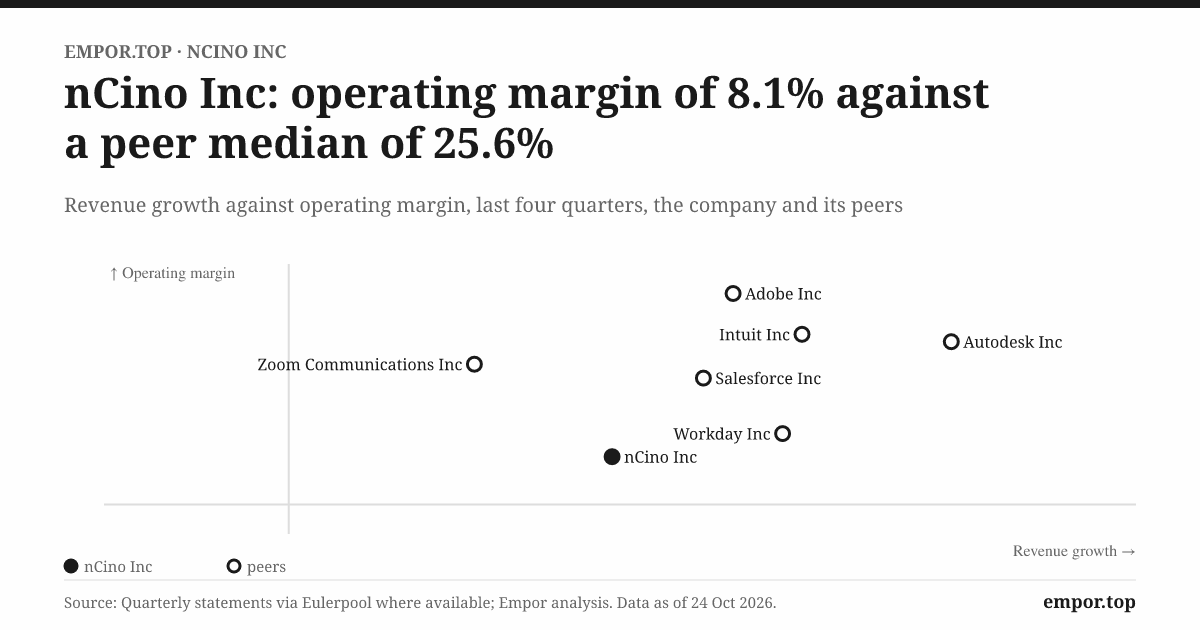
Operating income was $3.7 million in fiscal 2026, after an operating loss of $18.1 million the year before and $39.5 million the year before that.[^3] That works out to an operating margin of 0.6%. It is the thinnest of margins, but it is positive, and the trend into fiscal 2027 is stronger: operating margin reached about 14% in the first quarter and 8.5% in the second.29 The direction of travel is real.
The bottom line needs more care. Profit attributable to nCino's own shareholders in fiscal 2026 was about $5 million, while the consolidated figure was $9.7 million, and the difference is the share of profit that belongs to minority partners in subsidiaries, which is subtracted before arriving at what belongs to nCino's shareholders.[^3] Neither number is wrong. They measure different owners.
What moved the operating line? Not a surge in revenue, which grew about 10%, but a slowdown in spending. Research and development fell as a share of revenue, the workforce shrank, and the cost lines that had been growing alongside revenue for a decade finally grew more slowly than it.[^3]
In other words, fiscal 2026's profit was mostly a cost story. That is a legitimate way to reach profitability, and many software companies took the same path in the same years. But it means the margin gains so far say more about management's discipline than about the product's pricing power, and cost discipline has a natural limit that revenue growth does not.
The more important puzzle is how a company with $3.7 million of operating profit and $17.5 million of interest expense reported positive pretax income at all. The answer is a line most investors skip: other income, net, which came to $19.0 million.[^3] That figure was larger than the year's entire pretax profit of about $6.7 million.[^3] In plain terms, the business earned a little, paid its lenders a lot more than that, and was rescued into profit by a gain below the operating line.
The gain that came from currency
Most of that gain came from foreign-exchange remeasurement, the accounting adjustment that occurs when money one part of a company owes another is denominated in a different currency. nCino's foreign subsidiaries had borrowed from the parent, and when the dollar moved, the value of those loans moved with it.[^3] The swing has been large and erratic. Currency remeasurement cost about $1.2 million in fiscal 2024 and about $10.5 million in fiscal 2025, then contributed about $17.3 million in fiscal 2026.[^3] nCino does not hedge these exposures.[^3]
It did, however, settle most of the intercompany loans during fiscal 2026 to reduce the volatility.[^3] So the gain that flattered fiscal 2026 is unlikely to repeat at that size, and neither is the loss that hurt fiscal 2025. The remaining exposure is modest: a 10% currency move would have shifted the value of foreign-currency cash by about $4.5 million.[^3]
The verdict on profitability, then, is narrow but positive. The operating turn is real, and the most recent quarters show margins well above fiscal 2026's sliver. The first profitable year, however, owed its positive pretax line to currency luck. A durable earnings story needs several years of operating income comfortably larger than interest expense, without help from the exchange-rate desk.
Following the profit into cash
Cash tells a more encouraging story, and a more complicated one. Operating cash flow was $90.1 million in fiscal 2026 and free cash flow about $82.6 million, after very light capital spending.[^3] At first glance that looks like a business converting far more than its accounting profit into cash. Over nine years, from fiscal 2018 to fiscal 2026, nCino accumulated about $332 million of net losses while generating about $149 million of operating cash flow.[^3][^17]
The reason is what the income statement charges but the cash register never sees. In the three years to fiscal 2026, the bridge from profit to cash included about $204 million of stock-based compensation, about $124 million of depreciation and amortization, much of it on the intangible assets bought with acquisitions, and about $37 million of amortized sales commissions.[^3]
Stock compensation is the big one. It is a real cost to shareholders, paid in new shares rather than cash, and it explains why a company can show healthy cash flow and still dilute its owners. The acquisition amortization is the accounting echo of the SimpleNexus and later deals, a way of expensing over time a price that was paid up front.
Working capital adds its own noise. Receivables absorbed cash in each of those three years, as billings grew and the year-end invoice cycle swelled, while growing deferred revenue, the money banks prepay, added about $41 million.[^3] The first-half fiscal 2027 receivables release looks favorable, but the calendar partly explains it.
Free cash flow across those nine years summed to about $89 million, and nCino has never paid a dividend.[^3] That is worth holding in mind, because the debt-funded repurchases that came later are on a different scale from the cumulative free cash the company produced through fiscal 2026.
Two more items bound the picture. The tax line is not a guide to what a mature nCino would pay. The company carried a valuation allowance of about $152 million against roughly $226 million of deferred tax assets in fiscal 2026, an accounting judgment that it is not yet sufficiently confident of future profits to count most of its accumulated tax losses as assets.[^3] If profitability persists, that allowance may eventually be released, producing a one-time paper gain, and the tax rate would then normalize upward.
And there are no flashing red lights. Ernst & Young gave unqualified opinions on the financial statements and internal controls for the three years through fiscal 2026.[^3] The 10-K describes routine tax audits and about $166 million of non-cancelable commitments, mainly software licenses and hosting, along with a separate financing obligation on its headquarters, but management does not expect pending claims to have a material adverse effect.[^3] The risk here is not accounting. It is economic: whether a profit this thin can carry interest, dilution and a growing capital-return program. That was the decision the new chief executive made as his signature move.
VII. The New CEO's Buyback Has a Debt Footnote
Sean Desmond did not arrive at the top of nCino from outside. He joined in 2013, when the company was a few years old, as chief customer success officer, the executive responsible for getting banks live on the system.12 Over the next decade he took on more, and by 2024 he was chief product officer, running product development and engineering, a group that included about two-thirds of the company's staff.12
On February 3, 2025, nCino named him president and chief executive, and Pierre Naudé, who had led the company for 13 years, moved to executive chairman.12 His product job went to Chris Gufford, who had run the commercial banking business.12 Desmond's appointment signaled that the new leadership would come from inside the product organization rather than from sales or finance. A year later Naudé became non-employee chairman.13
That background shapes how to read him. Desmond is an operator who learned the business from the implementation trenches, the people who absorb a bank's frustration when a go-live slips. His first year emphasized efficiency, pricing changes and AI, which fits someone who has spent years watching how banks actually use the product. Greg Orenstein, the CFO since 2023, is his partner on the numbers.13 Fiscal 2026 was their first full year together under the new chief.
The 2026 proxy reported Desmond's fiscal 2026 compensation at about $9.1 million, of which about $8.1 million was stock awards; Orenstein's was about $4.2 million.13 Their cash bonuses were modest, about $486,000 and $267,000.13 Naudé, in his transition year as executive chairman, also reported about $9.1 million, including about $4.6 million of incremental value from modifying his equity awards.13 These are reported values, not cash outlays, and stock awards only pay if the shares hold up. Still, the juxtaposition is striking: the two executives at the top reported combined compensation of roughly $18 million in a year when nCino's consolidated net income was $9.7 million.13[^3]
Shareholders noticed, if not loudly. At the June 2026 annual meeting, the say-on-pay vote passed with about 75.7 million votes in favor and 7.5 million against.14 Two directors, Jon Doyle and William Spruill, received 26.5 million and 25.3 million votes against, respectively. Each figure, measured against the turnout on the pay vote, represents roughly three in ten votes cast.14 That is a meaningful protest in American proxy terms, though not a defeat. The board says most of its directors are independent, and it has been declassifying the board so that directors face election more often.13
Ownership gives outsiders influence without control. At the April 2026 record date, about 108.8 million shares were outstanding.13 HMI Capital reported about 6.2%, Kayne Anderson about 5.4% and Capital International Investors about 5.4%; directors and executive officers together held about 1.9%.13 No holder can dictate strategy, which means that if the new team stumbles, the remedy would have to come from a coalition of institutions rather than a single owner.
The balance sheet that changed shape
For most of its public life nCino was a cash-rich company. In early 2021 it held about $371 million of cash and almost no debt.[^17] Then it spent cash on SimpleNexus, and in October 2024 it signed a secured credit facility that funded acquisition activity.[^3] By January 2026 it owed $213.5 million on the revolver.[^3]
By July 2026 the debt comprised $78.5 million of revolver borrowings and a $197.5 million term loan, against about $84 million of cash, leaving net debt of roughly $192 million.2 The facility matures in October 2029, allows leverage up to four times and requires interest coverage of at least three times, and nCino reported compliance with both, with about $171 million still available to draw.2
None of that is alarming for a company producing cash. It is, however, a different company from the one that listed in 2020. Interest expense was about $17.5 million in fiscal 2026 on borrowings that averaged about $250 million, implying a cost of roughly 7%, a crude figure because the line includes other financing charges.[^3] Every dollar of debt now has to earn more than that to create value.
Buying the shares back
The buyback is where that cost meets the share price. After a $100 million accelerated share repurchase in fiscal 2026, nCino bought back about 10.8 million shares for $175.7 million in the first half of fiscal 2027, using term-loan and revolver borrowings among its sources of funds.21 In August 2026 the board authorized another $100 million.1
There is a good case for what was done. The shares bought in the first half averaged roughly $16 each, well below the $23 at which the stock traded in late October.2[^4] Judged by the market alone, the timing looks shrewd. At those prices the free cash flow yield on the shares bought back was probably higher than the interest rate on the debt used to buy them, and reducing share count lifts every remaining holder's slice of future cash flows.
A rough worked example shows the trade. Take about $176 million borrowed at roughly 7%: the annual interest is a little over $12 million before tax. The 10.8 million shares it retired represent about a tenth of the 108.8 million that were outstanding in April.213
If nCino's free cash flow over the past year was in the region of $135 million, which is what a 5% yield on a $2.7 billion market value implies, then a tenth of it is about $13 million a year, roughly the same as the interest bill.[^4] On those numbers the purchase is close to breakeven on day one, and it pays off only if free cash flow per share keeps growing. That is not a reckless trade. It is a confident one, and confidence needs to be repaid by growth.
There is also a case for caution. Stock compensation still offsets some of the repurchase, limiting the reduction in share count. It has turned a net cash balance sheet into a net debt one at precisely the moment it is asking investors to trust a new pricing model and an AI strategy that management says will not move results this year.
And repurchases are a one-way door: cash spent on stock is not available for the next acquisition, a downturn, or a sudden need to invest in AI. A skeptical activist would put the question directly. If management believes the AI opportunity is large, why borrow to buy shares rather than to build? And if it believes the shares are cheap, what does it know about the next few years of cash flow that the market does not?
Judged across the whole record, the pattern is ambitious rather than proven. SimpleNexus carried an exceptional valuation. DocFox, ILT and FullCircl broadened the product suite at more modest prices. That acquisition record remains intact, but nCino reports no deal-level returns. The buyback is the newest chapter, and its value depends on whether diluted shares fall faster than debt rises.
Two smaller items belong in a full review without deserving more weight than they carry. The 10-K reports no related-party sales, royalties, management fees or loans to a controlling holder; it did disclose a $2.5 million investment in Zest AI, an AI lending company in which entities affiliated with nCino shareholder Insight Partners held more than 10%, sold during fiscal 2026 for a $1.2 million gain.[^3] The proxy also discloses that Naudé's son and daughter were employees, paid about $335,000 and $286,000.13
And in 2023 nCino agreed to pay $2.19 million to settle a class action alleging that it, Live Oak Bank and Apiture had agreed not to hire one another's employees; nCino denied wrongdoing and said it settled to avoid the expense of litigation, and the Justice Department closed its investigation without action against the company.15 None of these is evidence of accounting failure. Together they describe a company whose founding relationships remained close long after it became a public institution, which is the kind of thing a board with a new CEO usually tidies up over time.
The new CEO's record is short, which is why the best way to judge him is by the scoreboard he has chosen: guidance met, cash generated, organic growth sustained and net debt after repurchases. With that in mind, it is time to weigh the whole case.
VIII. Analysis & Bear vs. Bull Case
On October 24, 2026, nCino's shares were about 14.5% below their 52-week high and above their roughly $14 52-week low.[^4] Over five years, the stock's largest fall from its peak was more than 80%.[^4] At the current price the market values the company at about 4.3 times sales, 83 times trailing earnings and 58 times operating profit, with a free-cash-flow yield of about 5%.[^4]
Those numbers cannot all be describing the same kind of company. A 5% cash yield and four times sales look like a reasonably priced, slower-growing software business. An 83 times earnings multiple looks like a bet on profits rising steeply from today's thin base.
What reconciles them is stock compensation and amortization. Cash flow excludes the shares handed to employees and the amortization of acquired intangibles; earnings include them. Investors buying nCino at this price are effectively assuming that GAAP margins will climb toward the cash margins, either because revenue grows faster than costs or because stock compensation shrinks as a share of revenue. That is the assumption to test.
The bull case rests on nCino's embedded bank workflows and the potential to sell more to its installed base. Asset-based pricing, if it holds at renewal, could decouple revenue from bank headcount. AI, if it is priced and adopted, could add a consumption layer. Recent margin expansion suggests operating leverage as growth investments slow.
The bear case is a slow squeeze: mortgage stays weak, consolidation removes customers, and procurement teams push back on asset-based bills at renewal. Large banks build their own AI tools on general-purpose models, while core vendors bundle automation into contracts nCino does not control. Salesforce's fees rise with usage. With growth at about 9% and thin GAAP margins, each pressure leaves little cushion. Debt taken on to buy back shares makes a slowdown a balance-sheet concern.
There is a quieter version of the bear case, too, which needs no downturn at all. Stock compensation remains a large claim on a business whose GAAP operating profit only recently turned positive.[^3] If the share price stagnates, more shares may be needed to deliver the same value to employees, leaving buybacks to offset dilution. A company can generate respectable cash flow for years while its per-share value goes nowhere, and that is the outcome a skeptical investor should most want to rule out.
Where the moat holds and where it thins
Porter's lens points to significant buyer power at signing, concentrated supplier power in Salesforce, rising substitutes from AI and rivalry from core vendors and specialists. New entrants face high barriers to selling to banks, though AI lowers the barrier to building a credible single-task product.
Helmer's seven powers point chiefly to switching costs; process power is plausible but hard to measure, while evidence for the other powers is weak. The history narrows the moat claim to a deeply embedded workflow vendor whose pricing power is still being tested. nCino discloses no market share, top-five concentration or competitive win rates that would support anything stronger.
The peer comparison adds texture rather than a verdict. One cross-company snapshot placed Q2 Holdings at about 4.4 times sales, Alkami at about 3.1 times and nCino at about 3.3 times, on a different date and basis from the late-October figures.16 Read loosely, it says the market does not award nCino a premium over its closest listed bank-software peers. That fits the evidence: investors are pricing a solid, embedded vendor, not a winner-take-all platform. If nCino's AI and asset-based pricing lift growth above those peers, the multiple has room to move; if they do not, there is no obvious reason for it to.
The company says AI will not move fiscal 2027 results, leaving paid usage, expansion revenue and realized customer savings as the tests.1
The operating turn is real but early. GAAP operating profit has improved sharply, but fiscal 2026's margin was 0.6%, and stock compensation and acquisition amortization make "adjusted" margins a flattering stand-in for what each share actually earns. The margin story is real but early.
The key risks remain mortgage demand, bank consolidation, Salesforce and hosting costs, AI substitution, cyber or privacy failure, currency and interest expense, and secured debt with covenants that narrow management's room to maneuver in a downturn.
What the price implies
There is no five-year median earnings multiple to compare against, because nCino had no earnings for most of that period. On sales, one third-party series puts nCino's five-year average price-to-sales near seven times, with a range from about 2.6 to above 31 times, as of September 2026.17 Today's multiple of about four times is below that average, but the average includes the 2020-21 bubble, when growth was nearly 50% a year. It is not a floor. A company growing at roughly 9% has, rationally, a lower multiple than one growing at 40%.
Three measures will tell investors whether the bull or bear case is winning. The first is organic subscription growth excluding U.S. mortgage and acquisitions, guided to 9% to 11% this year.9 The second is ACV net retention, last reported at 112%, together with evidence of paid AI expansion.[^7] The third is GAAP operating margin and free cash flow after stock compensation, read alongside debt and the diluted share count. The latest readings show the first steady, the second holding, and the third improving from a low base. None yet shows the reacceleration the price quietly assumes.
IX. Playbook: Business & Investing Lessons
Go back to that commercial loan file in the regional bank, passing from the relationship manager to credit to compliance to closing. Every handoff is a place where software can win a workflow. Every new module, though, has to earn its place inside an institution that hates change, answers to regulators and remembers every outage. nCino's story offers lessons for anyone building or backing software in an industry like that.
The first lesson is the simplest: in bank software, the workflow is the product, and the renewal is the proof. nCino's edge has always been that it sits where the work happens, in the daily motion of a loan file through a bank. That position earns three-to-five-year contracts and 112% net retention.[^3][^7] But retention can coexist with slowing expansion. A customer that stays but buys less each year is loyal, not lucrative. The number that separates the two is not how many customers stay, but how much more they pay when the contract comes up again. Founders selling to regulated buyers should treat the renewal, not the signing, as the moment of truth.
The second lesson is about the two speeds of capital. A platform gets wider one workflow at a time; a balance sheet gets heavier all at once. nCino widened its platform deliberately, from commercial lending into onboarding, consumer lending and mortgage, through SimpleNexus and the deals that followed it. That widening took years to integrate and still has not been separately measured. The debt that funded acquisitions and buybacks arrived in a few quarters. When a company's strategy compounds slowly and its liabilities compound quickly, investors should ask whether management has matched the two clocks.
The third lesson concerns price. SimpleNexus was bought at about 28 times forward revenue, with a pitch that per-seat pricing made the business immune to mortgage volumes.87 The cycle found the seats anyway. A model that is "not tied to transactions" can still be tied to the customers who make them. For investors, the wider lesson is that a revenue model's insulation from a cycle is only as good as its customers' insulation, and that an acquisition premium must be judged against the full cycle, not the boom in which it was paid.
The fourth lesson is the one the next two years will test: a customer using AI is a beginning; a customer paying more for it is the business. With 230 AI-unit buyers and no disclosed AI revenue, nCino today sits between those two sentences.1 Every software company in 2026 has an AI adoption number. Very few have an AI revenue number. The gap between them is where enthusiasm and value creation part ways.
The fifth lesson comes from the line below operating profit: a currency gain is a weather report, not a climate. nCino's first profitable year was carried over the line by about $17 million of exchange-rate remeasurement on loans between its own subsidiaries, a year after the same mechanism had cost it about $10 million.[^3] The company did the sensible thing and settled most of those loans. The lesson for investors is to separate the profit a business earns from the profit its accounting happens to record in a given year, and to give credit only for the first.
The investor's discipline that follows is straightforward to state and hard to keep. Measure growth organically, without the acquisitions that flatter it. Judge management on cash and on the share count, not on adjusted margins or unit counts. And always compare what an acquisition earns with what was paid for it, because the absence of a write-down is not the presence of a return.
X. Epilogue
Tonight nCino is a profitable, cash-generating bank software company growing a little under 9% a year, with almost half of its contract value on a new pricing model, a few hundred banks experimenting with AI, and about $276 million of debt on its balance sheet.21 It is neither the hypergrowth darling of 2020 nor the broken acquisition story of 2022. It is something in between, and the next few quarters will decide which way it leans.
The first moment to watch is the next earnings call, and the two or three after it. Management has asked to be judged on subscription growth excluding U.S. mortgage. If that line holds in the 9% to 11% range while mortgage stabilizes, the "transition between engines" framing earns credibility. If it slips toward the bottom of the range, or management redefines the measure, the slowdown starts to look structural. It will be worth comparing the prepared remarks with the analyst questions, because the questions about mortgage forecasts and renewal behavior are where the unvarnished version of the story usually appears.
The second is AI. If AI-unit customers turn into reported expansion revenue, higher renewal ACV and customer savings that banks confirm on their own, nCino will have converted a product launch into a business line, and the platform-pricing shift will look prescient. If unit counts keep rising while revenue remains "not material," the AI story becomes a retention tool, which is valuable, but not the growth engine the pitch implies. The 160,000-hour estimate is a starting point; the evidence that matters is what customers pay after they have measured it.
The third is margins. R&D and headcount have been cut, and operating margins have risen. The question is whether efficiency keeps improving without slowing product delivery, especially as competitors pour money into the same AI capabilities. A company that cuts its way to profit and then falls behind on product will find that the moat built on workflow depth can erode one module at a time.
The fourth is the balance sheet. Debt, interest expense, repurchases and diluted shares need to be read together. If shares outstanding fall meaningfully while net debt stabilizes and cash flow grows, the buybacks will have created value per share. If debt rises faster than the share count falls, or stock compensation quietly refills what repurchases remove, the buyback will have been a costly way to stand still.
The last is governance. The next proxy will show whether the dissent against two directors and the pay package persists, fades or grows, and whether any large holder builds a stake big enough to push. Watch, too, the quieter signals in ownership filings. The roughly 5% stakes held by a handful of institutions are large enough to matter in a contested vote and small enough to be sold quietly.13
If concentrated holders add to their positions while the buyback runs, it would suggest that patient capital shares management's view of value. If they trim, the company will be buying the shares that its most informed owners are selling. A new CEO usually gets a grace period. Desmond's ends when the results reflect his strategy rather than his predecessor's.
The tension that remains is the one Desmond and Orenstein set up in August: a company promising a new growth engine while borrowing to buy back its stock before that engine has shown up in the numbers.
XI. Outro
The loan file is still moving through the bank. It passes from relationship manager to credit analyst to compliance officer, as it did in Wilmington more than a decade ago, but now an AI assistant reads the financial statements, drafts the memo and flags the missing document. Somewhere in the background, a repurchase authorization waits for the next dip in the share price.
That image captures nCino. It is a company trying to turn a bank's most repetitive decisions into a software platform, with a place inside more than 2,700 institutions.[^3] AI is still a beginning; the debt is a commitment.12 In banking software, the workflow can be very sticky. The capital behind the platform still has to earn its keep.
References
-
Full Transcript: nCino Q2 2027 Earnings Call — Benzinga, 2026-08-25 ↩↩↩↩↩↩↩↩↩↩↩↩↩↩↩↩↩↩↩↩
-
nCino Prices IPO, Raises $250M — Crunchbase News, 2020-07-14 ↩↩
-
nCino to Acquire SimpleNexus for $1.2B — HousingWire, 2021-11-16 ↩↩↩↩↩↩↩
-
Financial Technology & Payments M&A Coverage Report — Capstone Partners, 2022-03 ↩↩
-
First Quarter Fiscal 2027 Earnings Release — nCino, 2026-05-27 ↩↩↩↩
-
Q1 FY2027 Earnings Call Transcript — The Motley Fool, 2026-05-28 ↩↩↩
-
Q4 FY2026 Earnings Call Transcript — The Motley Fool, 2026-04-01 ↩
-
nCino Announces Appointment of Sean Desmond as President and Chief Executive Officer — nCino, 2025-02-03 ↩↩↩↩
-
2026 Definitive Proxy Statement — SEC, 2026-05-08 ↩↩↩↩↩↩↩↩↩↩↩↩
-
Form 8-K: 2026 Annual Meeting Voting Results — SEC, 2026-06-22 ↩↩
-
nCino agrees to settle civil lawsuit over hiring practices — WECT, 2023-09-07 ↩
 LinkedIn
 WhatsApp
 Reddit
 Hacker News
 Email
 Kindle
 RSS Feed
 Spotify
 Apple Podcasts
 Amazon Music
 Audible
 YouTube