Harrow: The Eye-Drug Roll-Up That Has to Prove It Can Collect
I. A Record Quarter, and a Smaller Profit Promise
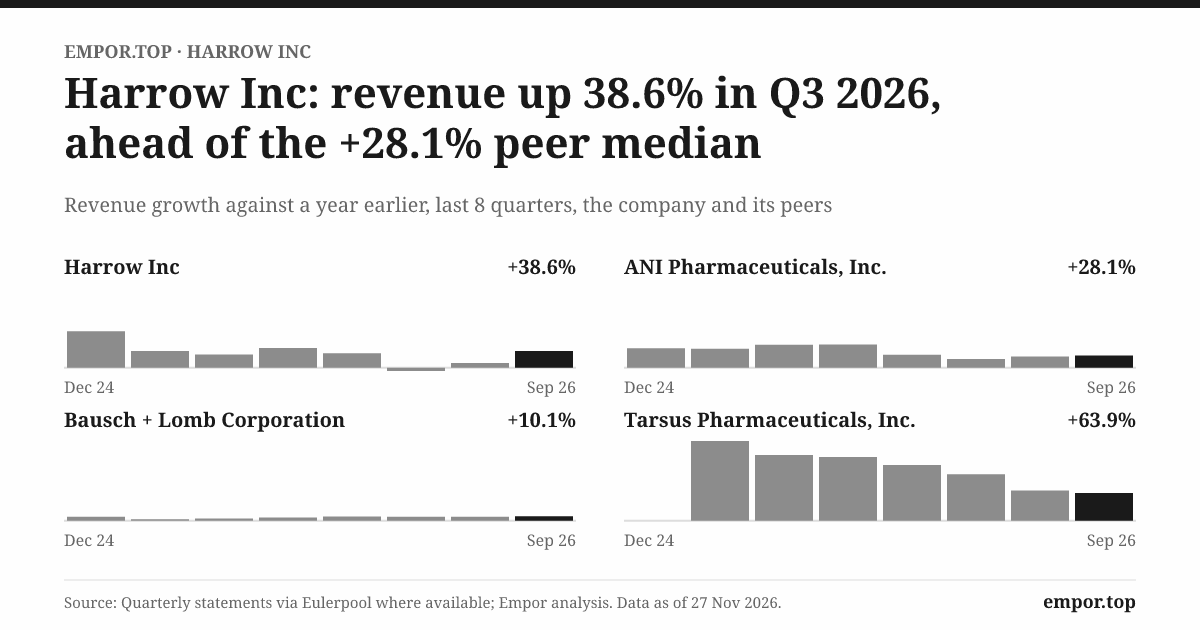
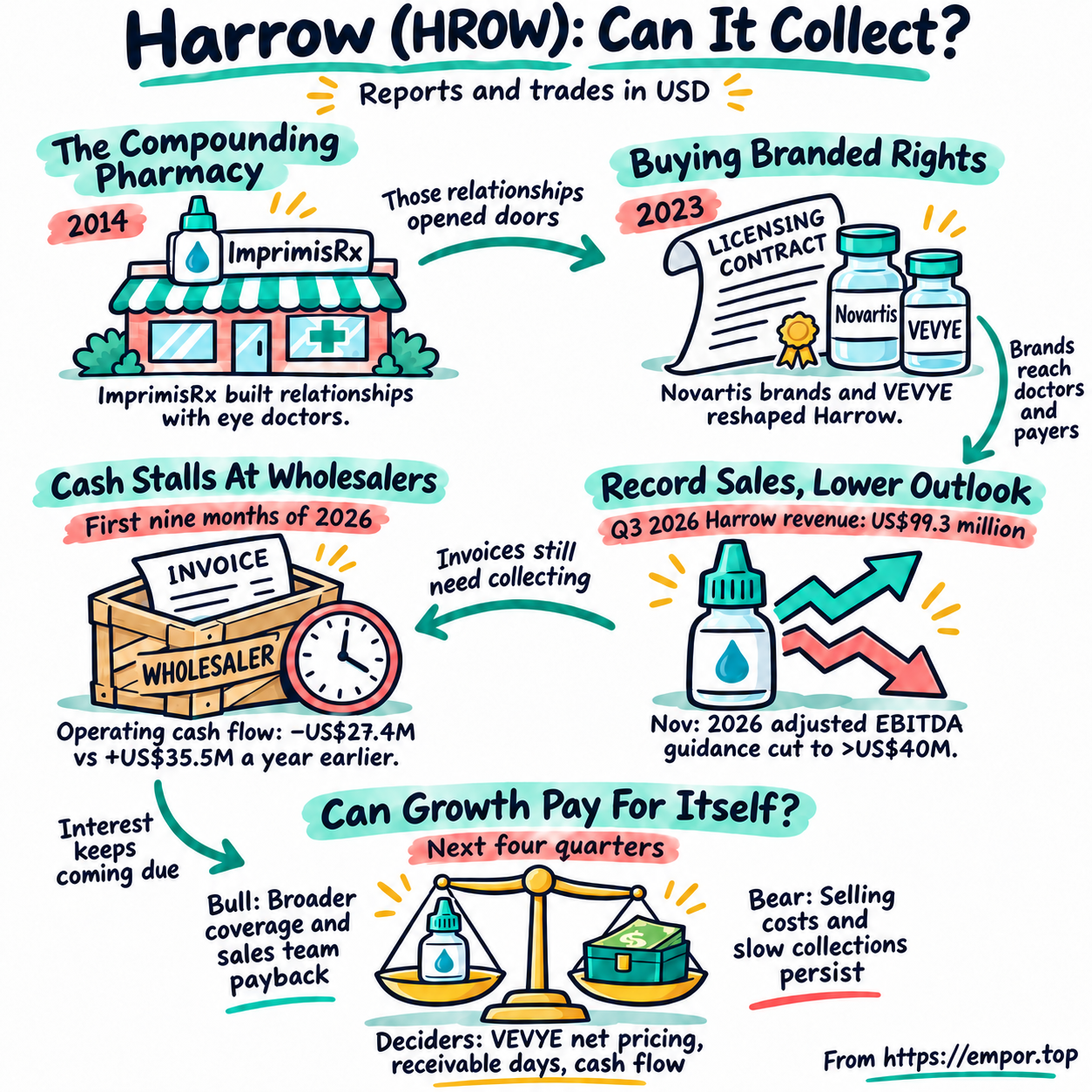
On the evening of November 9, 2026, Harrow put out the best sales number in its history and, in the same breath, took back half of what it had told investors to expect in profit. The company reported third-quarter revenue of $99.3 million, up about 39% from a year earlier, and a return to GAAP profitability with net income of $9.8 million.1 Branded drugs, the products Harrow does not invent but buys the rights to sell, brought in $83.5 million of that total.1 For a company that had spent most of its life reporting losses, it should have been a victory lap.
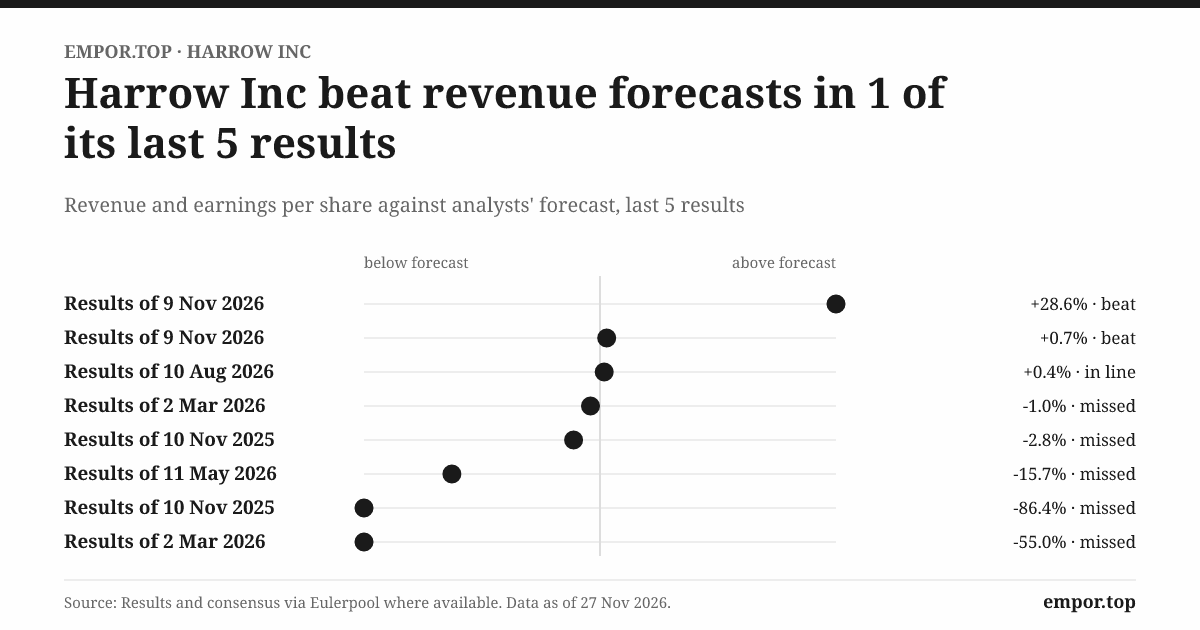
It was not, because of one line further down. Management lowered its full-year 2026 adjusted EBITDA outlook from a range of $80 million to $100 million to "more than $40 million," while keeping its revenue guidance of $350 million to $365 million in place.[^2] Revenue was holding; the profit that revenue was supposed to produce was not. And the profit Harrow did report came with an asterisk: the quarter's net income included a $5.0 million gain from a litigation settlement, a one-off that will not repeat next quarter.2
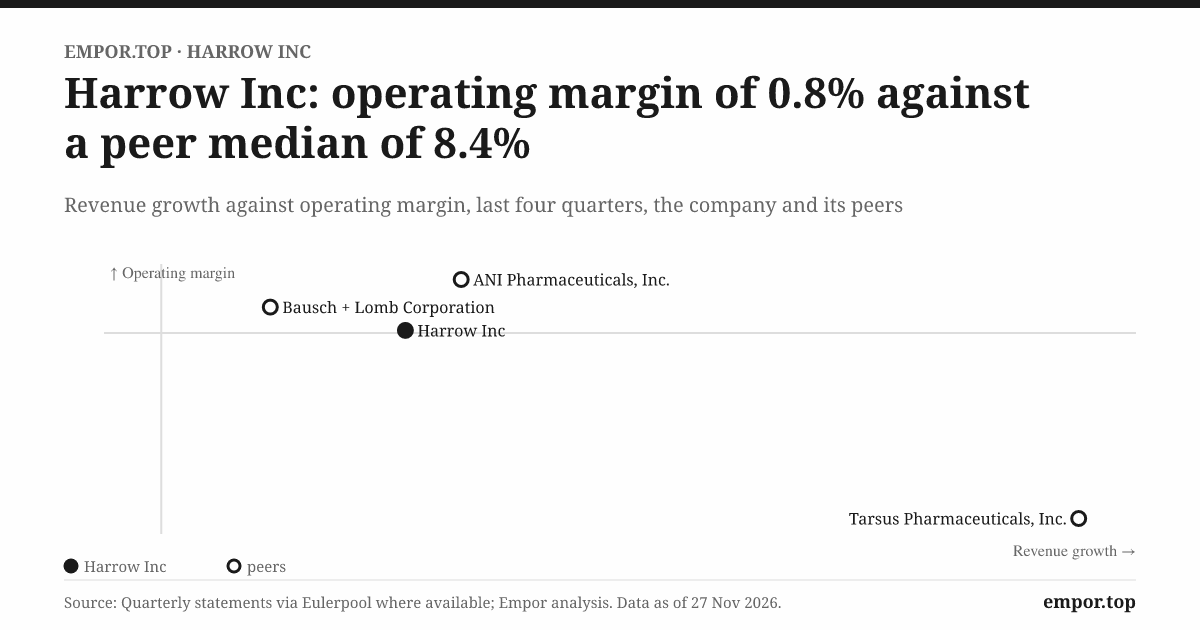
Strip the settlement out and the quarter looks different. Harrow made about $9.3 million before tax in the third quarter, so without the legal windfall pre-tax profit would have been roughly $4 million on nearly $100 million of sales.1 A year earlier, on about $72 million of revenue, the company had earned an operating profit of about $14.7 million; this time, on almost $28 million more revenue, operating profit came to about $11.5 million.1 Sales rose by more than a third, and operating profit fell by about a fifth. That is the paradox at the heart of this story. Harrow is selling more eye medicine than ever, yet each extra dollar of sales is currently bringing less profit with it, not more.
To understand why that matters, it helps to see what Harrow is trying to become. For most of its life it was a compounding pharmacy, a business that mixes custom drug formulations for doctors. Over the past four years it has turned itself into something more ambitious: a branded ophthalmology company that owns the U.S. commercial rights to a stable of eye drugs, sends its own sales force into eye surgeons' offices and dry-eye clinics, and sells those products through the nation's big drug wholesalers.3 The pitch is that one focused commercial machine can carry many products, so each new drug added to the bag rides on costs already paid.
Pharmaceutical roll-ups have been tried before, and the hard part is never buying the products. It is getting them prescribed, reimbursed, shipped and, finally, paid for. Harrow carries roughly $300 million of notes at an 8.625% coupon, and its receivables, the money customers owe it, have swung wildly from one year to the next.2 3 So the record quarter raises three questions that will run through this whole story. Are the drugs Harrow bought becoming durable franchises that doctors keep prescribing and insurers keep covering? Can the commercial platform built to sell them earn back its cost? And will the growth Harrow reports on its income statement arrive in its bank account?
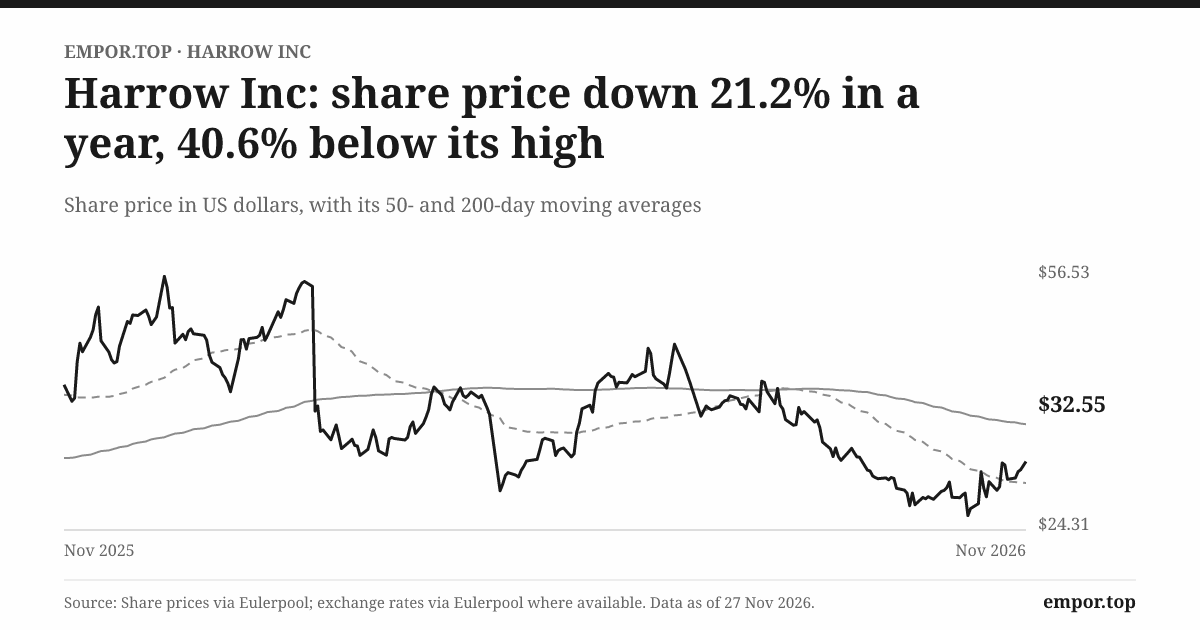
The market's answer, for now, is skeptical but not dismissive. In fiscal 2025 Harrow reported $272 million of revenue, more than double what it sold two years earlier.3 In late November 2026, its shares traded at about $32.55, giving it a market value of roughly $1.2 billion, about 40% below the high of nearly $55 reached within the previous year.[^5] Investors are still paying around four times sales for the business, which is a bet that the growth is real. The 40% drop says they are no longer willing to pay for growth alone.
There is a reason the guidance cut stung more than a normal miss would have. Harrow has told its story for years as a business on the cusp of operating leverage, the point at which a company's costs stop rising as fast as its sales and profit begins to compound. Fiscal 2025 seemed to prove the point: operating profit jumped to almost $39 million from under $9 million a year earlier, and the margin widened to about 14%.3 Over the twelve months to September 2026, operating profit shrank back to about $2 million, even as trailing revenue climbed past $300 million.1 3 The leverage that showed up in 2025 went into reverse in 2026. Whether that reversal is the temporary cost of hiring a bigger sales force and buying a new drug, or a sign that Harrow's products are more expensive to sell than it hoped, is the question every later section circles.
The rest of this story is an attempt to separate the two: the company Harrow is building, and the bills that come with building it. It begins far from the wholesalers and the high-yield bond market, in a small pharmacy that mixed eye injections by hand.
 Subscribe on LinkedIn
II. From a 2,500-Square-Foot Pharmacy to a Public Ophthalmology Company
In April 2014, a little-known San Diego company called Imprimis Pharmaceuticals started generating revenue for the first time. Its product was not a blockbuster pill. It was a compounded intraocular injection, a steroid and an antibiotic mixed together for eye surgeons to use during procedures, made in a modest 2,500-square-foot facility in Randolph, New Jersey.[^6] The company had been founded in its current form in December 2011, and that first sale was the moment an idea became a business.[^6] Fiscal 2014 revenue was about $1 million.3
The man behind the idea was Mark Baum, who has led the company since 2011 and today serves as both chief executive and chairman of the board.4 Baum came to pharmaceuticals as a lawyer and dealmaker rather than a scientist, and the company he built reflects that background: it has always been more interested in finding legal and commercial angles into a market than in discovering new molecules.4 His longtime partner is Andrew Boll, now president and chief financial officer, who has worked alongside Baum through nearly every stage of the company's transformation.4 The two have run Harrow together for well over a decade, a rare continuity in small-cap pharma, and it means the strategy investors judge today is the same team's strategy from start to finish.
The compounding idea was simple and slightly subversive. Eye surgeons often prescribe several drops after cataract surgery: an antibiotic, a steroid, an anti-inflammatory. Patients forget them, mix them up, and pay several co-pays. A compounding pharmacy can legally combine active ingredients into a single bottle prescribed for an individual patient, or, in a federally registered outsourcing facility, make larger batches for doctors' offices.3 ImprimisRx's combination drops offered surgeons convenience and patients a lower out-of-pocket cost. Revenue was tied to prescriptions and medical use, product by product and patient by patient. There was no subscription and no long-term contract, only the habit of doctors who liked the formulation and kept writing it.3
That habit turned into a real business. Revenue climbed from about $1 million in 2014 to $130 million in 2023.3 Harrow likes to describe ImprimisRx as the leading U.S. compounding business focused on ophthalmology, and it operates as a mail-order pharmacy licensed to ship prescriptions in all 50 states.[^6] In 2021, Harrow says, it became the first U.S. ophthalmic pharmaceutical company to offer both compounded and FDA-approved products, a milestone that marks the moment the two halves of today's company first sat side by side.[^6] The pharmacy has had its own leadership turnover more recently: Frank Mullery succeeded John Saharek as head of ImprimisRx in October 2025, with Saharek moving to a consulting role in 2026.4
More important than the sales figures were the relationships. A compounding pharmacy that ships eye drops to thousands of ophthalmologists and optometrists learns who prescribes what, which surgery centers buy in bulk, and how a product gets from a pharmacy shelf to an operating room. Those were the assets Harrow would later try to put to work for branded drugs.
The compounding model also had a ceiling, and a legal edge. In 2017, Allergan, one of the giants of eye care, sued Imprimis in federal court in California, arguing that its marketing of compounded products amounted to false advertising and that the company was presenting mass-produced drugs as individually compounded.5 The case went to a jury in 2019. Allergan had sought more than $7 million in damages and the disgorgement of Imprimis's profits; the jury awarded $48,500.5 Allergan technically won, and the court had earlier found some of Imprimis's claims literally false, but the business survived intact.5 The episode illustrated the boundary Harrow lived on. Competing with branded drugs through compounded alternatives was legal, but the large incumbents were willing to test exactly where the line sat.
Baum's other early habit was incubation. Rather than develop every idea inside the company, Imprimis used its capital and know-how to seed separate businesses: Eton Pharmaceuticals, focused on rare-disease and specialty drugs; Surface Ophthalmics, working on ocular-surface disease; and Melt Pharmaceuticals, developing a sedation product for eye procedures.3 Harrow kept equity stakes and, in some cases, royalties. In 2018 the strategy produced a flattering result. Harrow reported net income of about $14 million that year, its first annual profit, but the gain came largely from investment holdings rather than from selling medicine; the operating business still lost money.6 Late that year the company renamed itself Harrow Health, and in September 2023 it shortened the name again to Harrow, Inc.[^6]
Eton is the cleanest test of how this incubation strategy turned out. The stake gave Harrow a liquid asset that it could later sell to fund other priorities, which is exactly what it did; in fiscal 2024 Harrow recorded a $3.2 million loss on the change in fair value and sale of its Eton investment.3 Harrow's investment holdings, which had peaked above $30 million around 2019, had fallen to zero by the end of 2024.3 The spin-outs did not become the foundation of today's company. They became a source of funding and, in Melt's case, a related-party transaction that would return years later. What drives Harrow now was mostly bought, not built.
That is the real hinge of the story. The compounding pharmacy taught Harrow how to reach eye doctors, but its economics were limited: modest prices, regulatory scrutiny from incumbents, and products that any well-run competitor could in principle copy. The branded drug business promised something different, products with patents or exclusivity, higher prices and the chance to build franchises. To get there quickly, Harrow did not try to invent drugs. It went shopping.
III. The 2023 Rights-Buying Spree Changed the Company's Center of Gravity
Picture the inside of Harrow's finance team in 2023. In the span of a single year, the company that had once mixed eye drops in New Jersey agreed to pay well over $100 million for products it had never made. Cash used in investing activities jumped from about $1 million in 2022 to roughly $152 million in 2023, almost all of it for product rights, while the company raised money from both debt and a stock offering to pay for them.3 Before that year, Harrow was a compounding pharmacy that owned a few branded drugs. After it, Harrow was a branded drug company that also owned a compounding pharmacy.
It helps to understand what "buying a drug" means here, because it is not what most people imagine. Harrow does not acquire the factories, the scientists or, usually, the patents outright. It acquires commercial rights: the license to market and sell an already approved product in the United States, sometimes Canada too.3 In exchange it pays an upfront fee, often agrees to milestone payments that come due if sales or regulatory events happen, and pays royalties on every dollar of net sales.3 The products are still made by third-party manufacturers, often the original owner or a contract plant, and Harrow buys finished goods at a per-unit transfer price.3 Think of it less like buying a restaurant and more like signing a franchise agreement with the right to run every outlet in the country, but paying the franchisor a cut of the takings and depending on someone else's kitchen.
The biggest single bet was a portfolio of five ophthalmic products from Novartis: ILEVRO and NEVANAC, anti-inflammatory drops used around cataract surgery; VIGAMOX, an antibiotic drop; MAXIDEX, a steroid drop; and TRIESENCE, an injectable steroid used in eye surgery and treatment.3 These were familiar names to eye surgeons, products with established use but no longer central to a pharmaceutical giant's priorities. That is the classic opportunity for a specialist: older brands that a large company under-markets can sometimes be revived by a smaller one that cares about them.
The economics of mature brands like these are often misunderstood. Older eye drops of this kind typically live alongside cheaper generic or alternative products, so they are rarely growth engines on their own. Their value to a company like Harrow lies in the shelf space and the conversations they create. A sales representative who already visits a cataract surgeon to discuss a post-operative antibiotic has a reason to be in the room when a newer product needs introducing. Seen that way, the Novartis portfolio was partly a revenue stream and partly an entry ticket: a set of products that gave the young branded business something to sell on day one, while it waited for bigger launches. The risk of that logic is that entry tickets decline. If the older drops lose share over time, the newer products have to grow fast enough just to keep the portfolio's total revenue moving forward.
TRIESENCE came with a catch. It was not on the market when Harrow agreed to buy it, because supply had been disrupted. Harrow agreed to pay an additional $37 million only when the product became commercially available again, after a commercial batch was released.3 That milestone was paid in 2024.3 Note what the payment was and was not. It was not the price of the whole Novartis portfolio, most of which Harrow had already paid for. It was the price of TRIESENCE coming back to life, a bet that once supply returned, doctors would come back too.
By the third quarter of 2026, they had. TRIESENCE generated $10.7 million of revenue in that quarter alone.2 Multiply that by four and you get an annual run-rate of about $43 million, which means the $37 million milestone was roughly 0.9 times one strong quarter's annualized sales. That comparison is tempting, and it needs a warning label. It is not an acquisition multiple. Harrow still pays manufacturing costs, royalties and selling expenses out of that revenue, and one record quarter does not guarantee the next. But as a sign of whether the bet on supply recovery paid off, TRIESENCE is the clearest success in the portfolio.
The second defining deal of 2023 was VEVYE, a cyclosporine eye drop for dry eye disease developed by the German company Novaliq. In July 2023, Harrow announced it would acquire the U.S. and Canadian commercial rights for initial payments of about $8 million, plus low-double-digit royalties on net sales and potential milestones.7 Harrow paid a further $7 million milestone in 2025.3 VEVYE was a different kind of bet from TRIESENCE. It was not a lapsed product waiting for supply. It was a newly approved drug entering one of the most crowded and heavily marketed categories in eye care. Its success would depend on persuading doctors to switch patients from established dry-eye drugs, persuading insurers to cover it, and keeping enough of the list price after rebates to make money.
The third deal in this story came much later and tells you how Harrow's appetite has evolved. In 2026, Harrow acquired TYRVAYA, a nasal spray for dry eye, for $30 million in cash upfront plus up to $70 million in sales milestones.[^11] Management has projected that TYRVAYA will produce more than $30 million of revenue in 2027.8 That forecast is the number to test. A drug's approval and its patent life describe what is possible. Only prescriptions and net sales show what is real, and TYRVAYA has to earn its way to $30 million in a category where Harrow's own VEVYE is already competing.
So did Harrow overpay? The honest answer is that the record does not let an outside investor say. Harrow does not disclose product-level profitability, and it does not break out what it paid for each Novartis product against what each now earns.3 Comparable transactions for mature ophthalmic brands are rarely priced in public, so there is no clean set of deal multiples to benchmark against. What the record does show is the shape of the bet. Harrow chose to buy approved products rather than spend a decade developing them, accepted royalties and milestones that share its upside with sellers, and relied on others to make the drugs. That approach turns a scientific risk into a commercial one.
And commercial risk is the next test. Harrow now owned drugs for dry eye, surgical anesthesia, post-operative inflammation, infection and retinal disease. Each has different patients, different competitors, different reimbursement paths and different supply chains. The question that hangs over the whole spree is whether one sales and market-access organization can carry all of them at once, or whether every new product simply adds another set of costs.
IV. The Brands Meet the Doctors, Payers and Wholesalers
Walk into a busy ophthalmology practice and you can see Harrow's three most important products being used in three different rooms. In the exam room, a patient complaining of gritty, burning eyes may leave with a prescription for VEVYE. In the procedure room, a surgeon preparing for a cataract operation may numb the eye with IHEEZO, an anesthetic gel. In a retina suite or operating room, TRIESENCE may be injected to control inflammation or help a surgeon see the clear gel inside the eye. These are not one market called "ophthalmology." They are three businesses with different customers, different decision-makers and different ways of getting paid.
In the third quarter of 2026, those three products together produced about $76 million of Harrow's $83.5 million of branded revenue. VEVYE brought in $39.7 million, IHEEZO $25.3 million and TRIESENCE $10.7 million, while the remaining branded products, including the older Novartis drops, contributed the balance.2 Branded products accounted for 84% of total revenue, and branded sales grew 62% from a year earlier.[^2] ImprimisRx, the compounding business where the story began, contributed $15.8 million.2
The demand figures management highlighted were striking. VEVYE prescriptions rose 83% year over year, IHEEZO unit demand 21% and TRIESENCE unit demand 110%.[^2] Those are real signs of adoption. But prescriptions and units are not dollars, and dollars on an invoice are not dollars collected. A dry-eye prescription can be filled under a plan that pays well, under one that demands a deep rebate, or through a co-pay program where Harrow subsidizes the patient's cost. The distance between demand growth and profit growth is exactly where the 2026 guidance cut came from. For now, the useful conclusion is narrow: patients and doctors are using more Harrow products, and the evidence that this is translating into stable margins is still missing.
VEVYE is the product that matters most, because it is the largest and because dry eye is the biggest prize. Dry eye disease is chronic. A patient who responds to a drug may use it for years, which makes each new patient potentially valuable, in the way a subscription is valuable. It also makes the category ferociously competitive. VEVYE competes with Restasis, the long-established cyclosporine drop; Xiidra; Cequa, another cyclosporine formulation; Miebo, a newer drop for evaporative dry eye; and TYRVAYA, the nasal spray Harrow itself later acquired.3 Many of these are owned by companies with far larger sales forces and deeper relationships with insurers. Harrow's pitch for VEVYE rests on its formulation, which management argues is better tolerated and acts faster for some patients, but in dry eye clinical differentiation alone rarely decides the winner. Formulary position and net price often do.
Scale is the second problem. Harrow's entire fiscal 2025 revenue was $272 million.3 Alcon, the Swiss eye-care giant, reported about $10.3 billion in 2025 sales across surgical equipment, contact lenses and eye drugs.9 The comparison is not apples to apples, because much of Alcon's business is devices, but it shows the size of the companies Harrow meets when it asks a surgery center or an insurer for a place on the shelf. A company Alcon's size can bundle products, absorb rebates and fund field teams in every territory. Harrow has to win one product, one practice and one payer at a time.
A useful way to see Harrow's position is through the five forces that shape any industry's profits. Buyer power is high. Insurers and pharmacy benefit managers decide which dry-eye drugs patients can afford, and substantially all of Harrow's branded sales flow through four wholesalers: McKesson, Cencora, Western Wellness and Cardinal Health.3 Two customers each exceeded 10% of branded revenue in fiscal 2025.3 Supplier power is meaningful too, because Harrow does not manufacture its branded drugs and depends on third-party manufacturers and on licensors that collect royalties and can restrict what Harrow sells.3 Rivalry is intense in dry eye and present in surgical products, where generics and compounded alternatives compete. Substitutes are everywhere, from other prescription drugs to over-the-counter tears and procedures. The barrier to new entrants is regulatory approval and the cost of building a commercial team, which keeps out casual competitors but not determined ones. None of these forces is unusual for specialty pharma. Together, they explain why a small company in this industry has limited room to set its own prices.
Harrow's answer is its commercial platform. During 2025 and 2026, the company said it more than doubled the size of its ocular-surface sales team, the people who call on dry-eye prescribers, and tripled its surgical team.[^2] The theory is that once a sales representative is in an ophthalmologist's office talking about VEVYE, it costs little extra to mention IHEEZO or TRIESENCE, and every new product spreads the same fixed cost further. That logic is sound in principle. In practice, a larger field force is an investment, not proof of a moat. Selling expenses rise immediately; the extra prescriptions arrive later, if at all. The first nine months of 2026, when operating profit fell even as revenue grew, show that cost arriving before the payback.1
The mechanism that decides what Harrow keeps deserves a plain explanation. When Harrow ships a box of VEVYE to a wholesaler, it books the sale at a gross price. Then the deductions begin. Wholesalers earn fees and chargebacks when they sell to discounted buyers. Government programs such as Medicaid demand rebates. Commercial insurers negotiate rebates for formulary placement. Harrow pays co-pay assistance to keep patients on therapy, and some product is returned.3 Only what survives those deductions is net revenue, and Harrow's auditor flagged the estimate of government rebate accruals as a critical audit matter, which tells you how much judgment sits inside that number.3 Out of net revenue, Harrow then pays the manufacturer's transfer price and the licensor's royalty, and VEVYE's royalty runs in the low double digits.7 A product can grow quickly at the prescription level and still deliver disappointing gross profit if payer mix shifts toward the cheapest channels.
The two procedural products work on a different logic from VEVYE, and the difference matters. IHEEZO is a gel that numbs the surface of the eye before a procedure, and TRIESENCE is injected during surgery or treatment.3 Neither depends on a patient refilling a prescription at a pharmacy. The buyer is a surgery center, a hospital or a physician practice, which purchases the product, uses it on patients and seeks reimbursement afterwards. That makes the purchasing decision institutional: a clinic administrator weighs the price, the reimbursement code and the payment terms, while the surgeon weighs the clinical experience. It is also why the extended payment terms Harrow granted in 2024 matter so much to these products. Demand for procedural products follows procedure volumes, especially cataract surgery, which rises steadily as populations age. The opportunity is less about winning a war of formularies and more about becoming the default choice in a surgical routine, a habit that, once formed, surgeons tend not to change lightly.
There is one more piece of the margin puzzle that the 2026 results expose. Harrow's revenue mix changes from quarter to quarter, and each product carries its own cost and royalty structure. When the higher-margin products grow fastest, gross margin rises; when lower-margin products or deeply rebated channels grow fastest, it falls. Management said gross margins in 2026 came in lower than it had expected, alongside weaker VEVYE performance.[^2] Harrow does not publish gross margin by product, so investors cannot tell how much of the shortfall was price, how much was mix and how much was cost.2 That lack of product-level disclosure is not unusual in specialty pharma, but it does mean outside investors are being asked to trust the platform story without seeing the unit economics underneath it.
ImprimisRx belongs in this picture, but at its true size. Its $15.8 million quarter is a meaningful, steady business that keeps Harrow connected to thousands of eye-care practices.2 No customer exceeded 10% of ImprimisRx revenue in the past three years, so it is far less concentrated than the branded side.3 It is no longer the growth engine. It is the foundation the branded house was built on.
So does Harrow have a moat? The evidence supports a narrower claim: Harrow has early product traction and a focused commercial team that is gaining share in specific niches. It does not yet show the signatures of durable advantage, which would be repeat prescriptions holding up over years, widening insurance coverage, stable net pricing, uninterrupted supply and cash collected on time. A larger rival can still outspend it in dry eye, wholesalers and insurers still hold the purse strings, and the manufacturing sits in someone else's plant. That last link in the chain, getting paid, is where Harrow's numbers become most unusual.
V. The Quarter the Receivables Took the Cash Back
For most of its first decade, Harrow got paid fast. In 2014, its customers took about a month to pay, and by 2019 the figure had fallen to about two weeks, which is what you would expect from a pharmacy filling prescriptions and shipping to doctors' offices.3 Then the business changed, and so did the calendar. By fiscal 2024, Harrow's receivables equaled about 214 days of revenue, meaning that on average the company was waiting seven months to collect what it had sold.3 In fiscal 2025 the figure improved to about 149 days, still roughly five months.3 It is one of the most important numbers in the company, and one of the least discussed in its own marketing.
Part of the stretch is structural. Branded drugs sold through wholesalers have a longer revenue cycle than compounded products, and Harrow says so.3 But part of it was a choice. In 2024, Harrow extended additional payment terms to its largest distributor, so that downstream hospitals, clinics and surgery centers could take longer to pay for certain branded products.3 The logic was commercial. A surgery center deciding whether to stock IHEEZO or TRIESENCE has to buy the product before it is reimbursed for using it. Giving that customer more time to pay removes a reason to say no. In effect, Harrow became a lender to its own customers, and it was financing that loan with its own high-cost capital.
It is important to read Harrow's receivables carefully, because not every dollar that disappears is a bad debt. At the end of 2025, Harrow held $110.9 million of net trade receivables, against $116.4 million a year earlier.3 Its allowance for credit losses, the reserve for customers who may never pay, was tiny, only $884,000.3 The larger deduction was contractual adjustments of $27.0 million in 2025, up from $20.1 million in 2024.3 Those are not customers defaulting. They are expected chargebacks and other sales adjustments, the gap between the gross invoice price and what the contract says Harrow will ultimately receive. So the risk in Harrow's receivables is not mainly that wholesalers will go bust; McKesson and Cardinal Health are among the most creditworthy companies in American health care. It is that cash arrives slowly, that the net amount may be smaller than first estimated, and that a growing balance ties up money Harrow would otherwise use to pay down debt or fund new products.
The cash-flow record shows how much that matters. In fiscal 2024, as receivables ballooned, Harrow's operating cash flow was negative $22.2 million.3 In fiscal 2025, as collections caught up, operating cash flow swung to positive $43.9 million, helped by better operating results.3 It looked as though the problem had passed. Then, in the first nine months of 2026, receivables increased by $39.0 million and operating cash flow turned negative again, at minus $27.4 million, compared with plus $35.5 million in the same period of 2025.2 One year of improvement was followed by most of a year of reversal. The cash rebound of 2025 was real, but it was not yet a pattern.
Concentration makes the problem sharper. At the end of 2025, three customers accounted for 90% of Harrow's receivables, after two customers had accounted for 94% a year earlier.3 That means the timing of a few wholesalers' payments can swing Harrow's quarterly cash flow by tens of millions of dollars. Harrow does not publish an ageing schedule showing how long individual balances have been outstanding, and it does not disclose customer-level collections after the quarter ends.3 An investor therefore cannot see from outside whether the $39 million build in 2026 reflects the normal rhythm of a fast-growing third quarter, the extended terms granted in 2024, or something slower.
It is worth putting a rough price on Harrow's role as lender. At the end of 2025, about $111 million of Harrow's money was sitting with customers.3 If the company had collected on the roughly thirty-day terms of its compounding years, that balance would have been a fraction of the size, and tens of millions of dollars would have been available to retire debt. Every $39 million of extra receivables, the amount added in the first nine months of 2026, is money that Harrow effectively finances at the cost of its 8.625% notes, which works out to more than $3 million a year of carrying cost.2 That is not catastrophic for a company with $300 million of revenue. It is, however, a quiet tax on growth that never appears as a line on the income statement.
Investors who know the wholesale drug channel will recognize a paradox here. McKesson, Cencora and Cardinal Health are among the most powerful middlemen in American commerce; they typically pay manufacturers on short terms and earn their margins on volume and speed. That Harrow's receivables run to five months suggests that the extended terms granted in 2024 are doing significant work, effectively turning the wholesaler into a pass-through for credit Harrow is extending to clinics and surgery centers further down the chain.3 It also means the balance is less a measure of wholesaler credit risk than of Harrow's own commercial strategy, and the company can, in principle, change it. Shortening terms would release cash, but it might also slow adoption among the institutional customers whose purchasing decisions those terms were designed to ease.
There is a benign interpretation. Revenue in the third quarter of 2026 was the highest ever, and a big quarter naturally leaves a big receivable behind it at quarter-end. If the fourth quarter collects that money, the 2026 picture may end up looking like 2025. There is also a less comfortable one. Harrow chose to finance its customers in order to grow, and every time growth accelerates, the bill for that choice arrives in the form of working capital.
The test is straightforward and will be visible within months. If the largest distributor and the other major customers pay down the 2026 increase, and if days receivable fall as revenue grows, the extended terms were a sensible commercial tool. If receivables keep rising faster than sales, Harrow's growth is being bought with credit. And credit is the one resource Harrow cannot afford to run short of, because of what sits on the other side of its balance sheet.
VI. The Sales Ramp Has a Debt Clock Beside It
At September 30, 2026, Harrow held $75.3 million of cash.2 On the same balance sheet sat $292.7 million of notes payable.2 Between those two numbers lies the financial engineering that has made Harrow's transformation possible, and the constraint that now shapes every decision it makes.
Start with the long view, because it is sobering. Across fiscal 2014 to fiscal 2025, Harrow's cumulative net result was a loss of about $122 million.3 Its cumulative operating cash flow over the same twelve years was roughly negative $8 million, close to breakeven, because non-cash charges such as stock compensation and the amortization of acquired product rights narrowed the gap between accounting losses and cash.3 But once capital spending and product-rights purchases are included, the picture changes. Cumulative free cash flow over those twelve years was about negative $215 million. Harrow has never paid a dividend.3 In plain terms, Harrow has spent its entire history consuming capital, and the money to cover that consumption came from shareholders and lenders.
Fiscal 2025 looked like the turning point, with operating cash flow strongly positive.3 Better operating results and collections from customers drove the improvement.3 Then 2026 reversed much of it, as first-half losses and rising receivables pushed nine-month operating cash flow back below zero.2 The turning point turned out to be a single good year.
Harrow's debt has been transformed at the same time. In 2025, the company issued $250 million of senior notes carrying an 8.625% coupon and maturing in September 2030, using the proceeds to refinance earlier, more restrictive borrowing.3 Refinancing cost it a $7.75 million loss on extinguishing the old debt.3 In 2026 it sold another $50 million of the same notes.2 It also has a $40 million revolving credit line, which was undrawn at the end of September 2026.2 The revolver carries a covenant requiring a fixed-charge coverage ratio of at least 1.10 to 1, tested monthly, which means Harrow's earnings must comfortably exceed its fixed obligations to keep that safety net available.3
The structure has advantages. Fixed-rate debt that does not mature until 2030 gives Harrow four years to grow into it, and an undrawn revolver adds liquidity. But the price is high. An 8.625% coupon on $300 million of principal means roughly $26 million of interest every year. Harrow's net interest expense was $24.2 million in fiscal 2025.3 Compare that with the new adjusted EBITDA floor of a little more than $40 million for 2026, and interest alone will absorb well over half of the company's adjusted earnings before taxes, capital spending, milestone payments or any repayment of principal.[^2] Adjusted EBITDA also excludes stock compensation, which is a real cost to shareholders even if not to cash.
Equity has carried part of the load too. In fiscal 2023, the year of the big rights purchases, Harrow raised about $64.5 million of net proceeds from a public offering of common stock.3 Equity awards to employees and executives add a steady trickle of new shares on top of that.3 The company has not reported a buyback in its recent filings, and with equity worth only about $52 million on the books at the end of 2025 against more than $250 million of borrowings, its debt-to-equity ratio stood near 4.8.3 That thin equity cushion is the accumulated result of years of losses, and it means that a future misstep would most likely be financed by either more expensive debt or new shares.
The spending side keeps growing as well. Research and development expense rose from about $12 million in 2024 to about $21 million in 2025, and Harrow spent about $24 million in just the first nine months of 2026, which the company attributed to accelerated programs and clinical studies.3 2 Harrow employed 373 people as of February 2026 and said it expected to keep hiring, especially in sales.3 None of this is reckless on its own; a branded company that wants new products needs a pipeline, and a commercial platform needs people. The problem is timing. Every dollar of that investment is being made while interest runs at 8.625% and operating cash flow is negative, so the company is borrowing against its own future to build that future.
The rating agencies see the same thing. Harrow reported that, as of October 31, 2026, Moody's rated it B3 and Fitch rated it B-, both with stable outlooks; Fitch rates the 2030 notes B.2 10 Those are firmly below investment grade, the territory of companies whose ability to service debt depends heavily on things going right. The stable outlooks are a counterweight, signaling that neither agency expected an imminent change. They are not a forecast of default. They are a description of a company with little margin for error.
This is the trade-off at the center of Harrow's strategy. Buying product rights is faster than developing drugs, and it removes clinical risk. But it front-loads the cost. The upfront payment for TYRVAYA and the milestones Harrow paid for TRIESENCE and VEVYE consumed cash, and up to $70 million more for TYRVAYA may come due if sales targets are hit.[^11] 3 Meanwhile the interest bill arrives every six months regardless of how the latest launch is going. Each acquisition is meant to produce the cash that pays for the last one, which works beautifully when products ramp on schedule and becomes uncomfortable when they do not.
Three measures will tell investors whether the debt clock is winning or losing. The first is operating cash flow, which must turn reliably positive rather than alternate between good and bad years. The second is receivables days, which determine how much of each sale is tied up waiting for payment. The third is cash interest coverage, the ratio of cash earnings to interest paid, which drives both covenant headroom and the eventual refinancing in 2030. Over the longer term, the decisive figure is free cash flow after payments for acquired rights: the cash Harrow keeps once it has paid for the products that produce its growth. On that measure, the company has not yet shown a sustained positive record. And in 2026, the forecast that was supposed to show the turn came in sharply lower than promised.
VII. The 2026 Guidance Cut Tests Baum's Operating Credibility
In August 2026, Harrow's management told investors that the year was on track. Second-quarter revenue had come in at about $70.7 million, and the company kept its full-year adjusted EBITDA guidance at $80 million to $100 million.[^15] 11 The first half had been slow: first-quarter revenue of $44.2 million was actually lower than a year earlier.2 But the message was that the year would be back-loaded, as Harrow's years often are, and that the full-year targets still held.
Three months later, the targets did not hold. In the November letter, management acknowledged that first-half revenue had come in about $28 million below the midpoint of its earlier guidance.[^2] It cut adjusted EBITDA guidance to more than $40 million, less than half the old range's midpoint, while keeping revenue guidance at $350 million to $365 million.[^2] Third-quarter adjusted EBITDA was $21.2 million, and management said the fourth quarter would need to deliver more than $33 million to meet the new floor.[^2]
The explanations were specific, which counts in management's favor. Harrow cited weaker-than-expected VEVYE performance, lower gross margins than planned and the first-half revenue shortfall.[^2] It also said it was pulling forward spending into the fourth quarter on G-MELT, clinical programs and the integration of TYRVAYA.[^2] Some of that is execution; some is choice. A company that decides to spend more on clinical trials and a new product is making an investment decision, not suffering a miss. But the line between the two is exactly what investors cannot see from outside, and management controlled the timing of when they were told.
The timing is the difficult part. The first-half revenue gap of $28 million was already largely visible by early August, when second-quarter results were released. Yet the profit guidance was maintained then and cut only in November. On the third-quarter call, analysts pressed management on how the EBITDA reset was built, what gross-to-net assumptions underlay VEVYE's economics and how the TYRVAYA acquisition interacted with the VEVYE license.8 The prepared remarks emphasized record revenue and prescription growth; the questions kept circling back to margins and net price.8 That gap between what management wanted to talk about and what analysts wanted to know is itself informative. A management team confident in its unit economics usually leads with them. One still working them out tends to lead with volume.
The guidance arithmetic also deserves attention. Through nine months, Harrow had reported about $214 million of revenue.2 To meet its $350 million to $365 million revenue guidance, the fourth quarter alone would need roughly $136 million to $151 million, compared with $89.1 million in the fourth quarter of 2025, a jump of more than 50% year over year and more than a third above the record third quarter.1 Harrow's fourth quarters have historically been its strongest, but a step-up of that size is ambitious. Keeping revenue guidance while cutting profit guidance by half is a statement that sales will arrive but cost more to win.
This is not the first time Harrow's forecasts have been tested by cash. In late 2024, management told shareholders it expected operating cash flow to keep improving through 2025.[^17] It was right about 2025, which delivered strong cash flow. But the improvement did not carry into 2026. The pattern is consistent with a management team that is genuinely optimistic about its products and less precise about the timing and cost of getting there. The fourth-quarter result and the 2027 guidance, when issued, will show whether the November correction was candid and conservative, or the first of several.
The people making these calls are well rewarded, and their incentives are tied mostly to the stock. In fiscal 2025, Baum's reported total compensation was $23.6 million, of which $22.3 million was stock awards; Boll's was $10.9 million, of which $10.2 million was stock awards.4 Those totals swing enormously from year to year: in fiscal 2024 the two men's reported pay was about $1.4 million and $849,000.4 The swings reflect the timing of multi-year equity grants, and the proxy says multi-year performance stock units vested in 2025.4 Pay of this size at a company with a cumulative net loss will draw scrutiny, but ownership offsets some of it. Baum beneficially owned about 9.7% of the company in the 2026 proxy, and officers and directors as a group about 12.8%.4 The stock's 40% fall cost Baum far more than any annual bonus. The outside register includes Opaleye at about 9.9%, Private Capital Management at about 9.7% and BlackRock, whose reported stake rose to about 7.4% by September 2026.4 12
The Melt transaction is where alignment gets complicated. In November 2025, Harrow bought the remaining interests in Melt Pharmaceuticals, the sedation-drug company it had helped incubate, for about $4.3 million in cash at closing plus contingent payments in cash and Harrow stock tied to regulatory, reimbursement and sales milestones.3 Harrow already owned about 45% of Melt and held a royalty on its lead product.3 Baum and Boll were also Melt investors, and they received about $428,000 and $204,000 respectively at closing.[^19] An independent special committee of the board approved the transaction.[^19] The sums at closing are small relative to Harrow's size, and the governance process was followed. But it is the kind of related-party deal that deserves investor attention, because the contingent payments could grow if Melt's products succeed, and the executives who negotiate for Harrow also stood on the other side.
Shareholders mostly approved of the overall pay design. At the June 2026 annual meeting, the say-on-pay proposal passed with about 18.1 million votes for and 2.4 million against.13 Roughly one in nine votes cast against is not a rebellion, but it is a signal that some holders question whether pay tracks performance.
What should investors conclude about management? Baum and Boll have built a company that did not exist fifteen years ago into a $300 million revenue business, and they have explained this year's miss with specific causes. They have also set targets that slipped badly, held a profit forecast for one quarter longer than the evidence seemed to support, and accepted a debt load that leaves little room for further slips. The verdict is not that management lacks credibility. It is that management's forecasts should be treated as aspirations until the cash confirms them. Which brings the story to the central argument: is Harrow building a platform, or simply a more expensive way to grow?
VIII. Bull and Bear: A Commercial Platform, or a More Expensive Way to Grow?
In November 2026, Harrow's investor presentation made a striking promise: a new product launch every year.8 The same week, its quarterly report flagged a problem that could undercut that promise from inside. The VEVYE license with Novaliq, it warned, may restrict Harrow from selling other dry-eye products, and the TYRVAYA acquisition could require Harrow to divest or terminate those rights.2 If that happened, up to $70 million of TYRVAYA milestones might still be owed in some scenarios.2 [^11] One company, two dry-eye products, and a contract that may not allow both. It is a fitting scene for the debate, because it shows how Harrow's strategy of stacking products can collide with the agreements that brought those products in.
The bull case starts with demand. The adoption figures are measurable, not marketing claims.[^2] Harrow has expanded its field force dramatically, and if insurance coverage widens for VEVYE, the prescriptions those representatives generate should become more profitable. In this view, 2026 is the year Harrow paid for its sales force, and 2027 is when the investment starts to pay back.
The bear case starts with the same year and reads it the other way. Harrow cut its 2026 adjusted EBITDA guidance by more than half, while operating cash flow turned negative and receivables rose.[^2] 2 A company that had just completed its best cash year in 2025 went backwards on almost every cash measure in 2026. If growth needs ever-larger sales teams and ever-longer payment terms, it is not operating leverage. It is buying revenue.
The bull points to TYRVAYA as a smart extension. It is a nasal spray that stimulates the body's natural tear production, which can suit patients who struggle with eye drops, and the company says the acquisition brought experienced commercial personnel along with it.[^11] Management expects more than $30 million in 2027 revenue from TYRVAYA, a fast payback against the upfront payment if it holds.8 [^11]
The bear points to the license language. If Novaliq objects, Harrow could be forced to choose between its largest product and its newest one, and the outcome of that dispute is not something Harrow controls.2 On the third-quarter call, the issue drew analyst attention, and the company's discussion of it deserves close reading by anyone who owns the stock.8 Even without the licensing issue, TYRVAYA and VEVYE compete for the same dry-eye patients, so some of TYRVAYA's growth may come at VEVYE's expense.
The bull sees an asset-light model. Harrow owns product rights and a sales force, not factories, so in principle it can add products without heavy capital spending, and its property, plant and equipment is a trivial share of its assets.3 The bear sees what asset-light means in practice: outsourced manufacturing that Harrow cannot fully control, as TRIESENCE's supply disruption showed; four wholesalers that handle substantially all branded sales; royalties that share every dollar of upside with licensors; and payers that decide the net price.3
It is worth testing the moat claim against Hamilton Helmer's framework of seven sources of durable advantage, because Harrow's investor case implicitly leans on several of them. Scale economies are the core of the platform argument, and the evidence is mixed: revenue has grown much faster than fixed costs in good quarters, but 2026 shows that the sales force has grown faster still. Switching costs exist in a mild form in chronic dry eye, where patients who respond to a drug tend to stay on it, but Harrow does not disclose refill or persistence data that would prove it. Cornered resources, the exclusive rights to specific products, are genuine, but each comes with a license whose terms can restrict Harrow, as the Novaliq clause shows. Counter-positioning, the idea that incumbents will not copy a model because it hurts their own business, applied to the compounding era more than to the branded era. Brand, network effects and process power are not meaningfully in evidence. The honest conclusion is that Harrow has a cornered-resource portfolio and an emerging scale argument, not yet a proven moat.
Optionality deserves a sober reading. Melt's MELT-300 and G-MELT could matter, because sedation products for eye procedures fit naturally beside IHEEZO in surgical suites and could extend the procedural business.3 But they are clinical and regulatory programs, and milestones are not revenue. Harrow's own history counsels caution here: its incubated companies, Eton and Surface among them, produced investment gains and royalties rather than core franchises.3 Count Melt's products when they ship.
A skeptical activist looking at Harrow would not start with the drugs. They would start with the capital structure and the disclosure. Why does a company with thin equity, a below-investment-grade rating and negative operating cash flow keep adding products that come with upfront payments and contingent milestones, rather than pausing to prove the economics of what it already owns? Why does it not publish product-level gross margins or receivables ageing, when those are precisely the measures that would let investors judge its strategy? Why was the profit guidance held in August and cut in November? And why did executives who negotiate on Harrow's behalf also hold stakes in Melt when Harrow bought it? None of these questions implies wrongdoing; the Melt deal went through an independent committee, and the guidance cut came with specific explanations. But each one points to a place where investors are asked to trust management more than the numbers currently allow, and each would be the first line of a letter from an investor demanding more accountability.
The ownership register suggests that sophisticated holders are watching closely. Opaleye and Private Capital Management each held close to 10% in the 2026 proxy.4 Concentrated holders of that size tend to engage when strategy or capital allocation drifts. BlackRock's stake grew between the proxy record date and September 2026, though changes in the share count mean that the increase should not be read simply as fresh buying.12 4
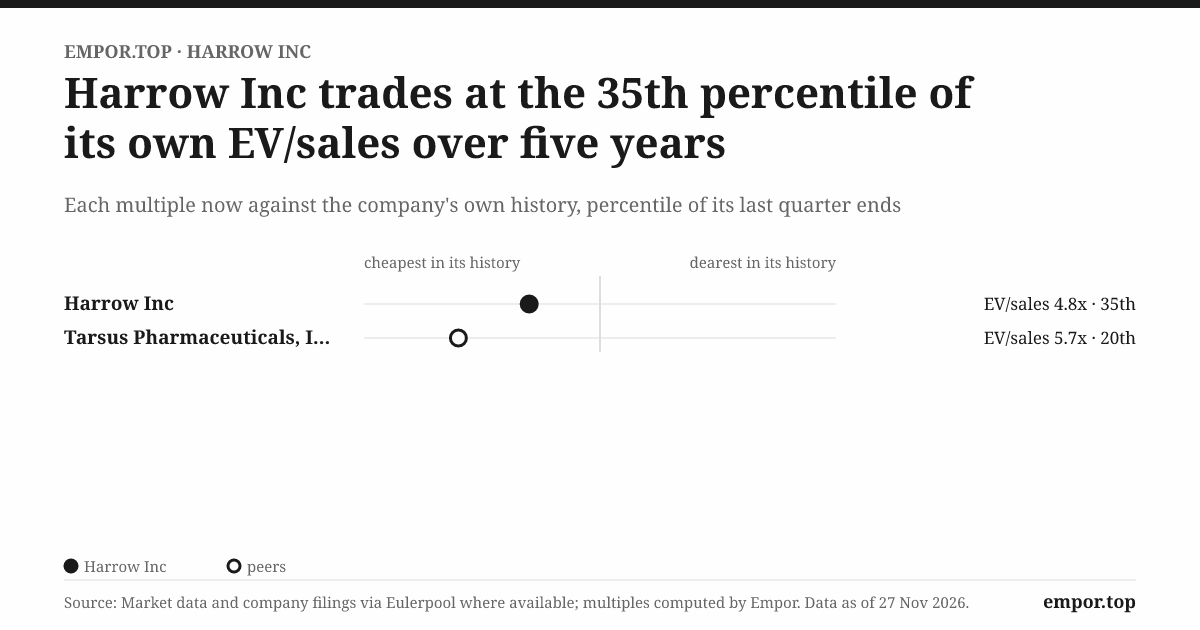
Then there is valuation, which frames the stakes without settling them. At the end of November 2026, Harrow's enterprise value was about $1.4 billion, about 4.8 times trailing sales and about 85 times trailing EBITDA.[^5] 3 The price-to-sales ratio was about 4.0, and the price-to-book ratio was over 40 because equity is so thin after years of losses and heavy borrowing.[^5] 3 Those multiples do not demand perfection for revenue, but they assume that Harrow's margins will expand well beyond today's level. If the gross-to-net economics of VEVYE do not improve, or cash keeps getting trapped in receivables, there is not much in the current price to absorb disappointment.
The debate resolves into three measures, and they are worth naming because everything else is commentary. The first is whether VEVYE's net revenue and gross margin improve, the clearest read on whether Harrow's largest bet is a franchise or a costly fight for share.2 [^2] The second is debtor days, which improved in 2025 before receivables grew again in 2026.3 2 The third is operating cash flow after interest and rights payments, which turned negative in 2026 after a positive 2025.2 If those three move the right way together, the bull case is winning. If they diverge from the revenue line, the bear has it.
IX. Lessons from the Rights-and-Royalties Playbook
When the first commercial batch of TRIESENCE was released and the product came back to market, Harrow wrote a $37 million check.3 Two years later, the same product posted a record $10.7 million quarter, with unit demand more than doubling.2 [^2] Every lesson in Harrow's story is visible in that one product: the patience it took, the money it cost, and the fact that none of it would have mattered if the supply chain had stayed broken.
The first lesson is that a license is a bet on a whole chain: supply, prescriptions, coverage and collections. Harrow bought the right to sell TRIESENCE long before anyone could buy it, and the value of that right depended entirely on a manufacturer Harrow did not own getting a production line working again. The deal was structured so Harrow paid the big milestone only once the product was available, which was smart. But the broader lesson for anyone building a pharmaceutical company on licensed products is that the weakest link sets the value. A brilliant sales force cannot sell a drug that is not on the shelf, and a full shelf is worth nothing if insurers will not pay for what is on it.
The second lesson is that the first sales curve is not the return; the net price and the cash cycle are. VEVYE is Harrow's fastest-growing product by prescriptions, and also the product management blamed when it cut its profit guidance. Prescriptions measure enthusiasm. Net price measures what payers allow Harrow to keep, and receivables measure how long Harrow waits to keep it. A company can grow its prescription count by 80% and still be disappointed by what reaches its bank account. For investors in any drug launch, the lesson is to watch the gap between gross and net, and between invoice and cash, because that gap is where small companies win or lose against large ones.
The third lesson is that buying growth costs twice: once for the rights, again for the capital that carries them. TYRVAYA's $30 million upfront payment looks modest against management's projection of more than $30 million in 2027 revenue.[^11] 8 But Harrow paid for it, directly or indirectly, with money raised at an 8.625% coupon, and that coupon keeps running whether TYRVAYA's launch goes well or badly.2 An acquisition-driven strategy has to clear two hurdles: the product has to earn back its purchase price, and it has to do so faster than the financing cost compounds. Harrow has shown it can clear the first hurdle with TRIESENCE. It has not yet shown, across the portfolio, that it can clear both.
The fourth lesson is that a payment term is a loan with a sales pitch attached. When Harrow gave its largest distributor more time in 2024, so that surgery centers and clinics could pay later, it was solving a real commercial problem: institutions are slow to adopt a product they must pay for before they are reimbursed.3 But the solution moved the problem onto Harrow's own balance sheet. Debtor days that had once been measured in weeks stretched to months, and the cash that should have followed record sales stayed with customers. Every growing company is tempted to buy adoption with generous terms. Harrow's experience shows the bill for that generosity arrives precisely when growth is fastest, which is also when a leveraged company can least afford to wait.
There is a fifth lesson hidden inside the first four, and it may be the one founders and investors remember longest. A roll-up is only as good as its contracts. The Novaliq clause that may restrict Harrow's dry-eye portfolio was signed in 2023, when VEVYE was the only dry-eye product Harrow cared about.2 7 Three years later, it may constrain the company's strategy. Every license is a promise made to a counterparty, and promises made when a company is small can bind it when it is bigger. The most valuable asset in a rights-buying strategy is not the product. It is the freedom to keep buying.
X. Epilogue: The Next Four Quarters Decide What the Platform Is Worth
Tonight Harrow stands at an uncomfortable midpoint: record sales, sharply reduced profit guidance.1 [^2] Sometime early in 2027, Baum and Boll will step onto another earnings call and report the fourth quarter. That call will answer the first of the questions this story began with, because to meet its own guidance, Harrow needs the biggest single-quarter revenue jump in its history.[^2] 2
If Harrow hits its targets, it will show that the back-loaded year was real and the November guidance was conservative. If it misses again, the market will conclude that the company's forecasts cannot be relied on, and the stock's discount to its peak will look justified rather than excessive.
The next moments that matter fall into a clear sequence. VEVYE comes first. Its payer coverage, net price after rebates and refill-driven demand will show whether Harrow's largest product is becoming a durable franchise or remaining an expensive fight for share against Restasis, Xiidra, Cequa and Miebo. The early read will come from whether management's explanation for 2026's gross-margin shortfall turns into improving margins through 2027.
IHEEZO and TRIESENCE come next. Both are procedural products with growing unit demand, but their future depends on supply continuity and stable reimbursement in surgery centers and hospitals. TRIESENCE's history of supply interruption means investors should treat its record quarter as a reason for optimism and a reminder of fragility at the same time.
TYRVAYA's first year under Harrow will be the cleanest test of the company's ability to buy a product and grow it. Management's 2027 revenue target for TYRVAYA will provide a measurable test.8 Alongside it sits the Novaliq license question. A resolution that lets Harrow keep both products would remove a meaningful overhang. A forced divestiture would cost Harrow its newest product, could leave milestone obligations behind and would raise questions about the diligence that went into the deal.2
Then come the cash measures. Operating cash flow, debtor days and fixed-charge coverage must improve together for Harrow's balance sheet to strengthen. If the fourth quarter collects the receivables built up through 2026, operating cash flow for the full year could recover meaningfully. If not, Harrow will enter 2027 with negative operating cash flow, $300 million of 8.625% notes and less margin under its revolver covenant.
Each of those outcomes maps back onto the three questions that opened this story. If VEVYE's net price stabilizes and TYRVAYA ramps without a license fight, the acquired brands will look like durable franchises. If selling costs flatten while revenue keeps climbing, the commercial platform will have started to earn back its cost, and 2026 will be remembered as the investment year management says it was. And if receivables fall back toward last year's levels while sales rise, the growth will finally have arrived as cash. It is possible for Harrow to pass one test and fail another, which is the most likely outcome of all. A company can win doctors and still lose money on the paperwork between the prescription and the payment.
There is a plausible bad scenario worth naming too, because the balance sheet makes it more consequential than it would be for a debt-free company. Suppose VEVYE's net pricing stays weak, the Novaliq dispute drags on and receivables remain elevated through 2027. Harrow would still have cash, a revolver and notes that do not mature until 2030. But it would face a choice it has faced before: raise equity at a depressed share price, borrow more at a high coupon, or slow the product-acquisition machine that defines its strategy. None of those choices would end the story. Each would make the eventual payoff smaller for today's shareholders.
Finally, new launches and clinical milestones, from G-MELT to whatever product management names as 2027's annual addition, should be treated as milestones first and growth only after they are commercialized. Harrow's record of turning incubated programs into revenue is thin, and its record of turning purchased products into revenue is better but expensive.
So the tension that remains is not whether Harrow can grow. It already has. It is whether the growth can pay for itself before the bills for buying it come due.
XI. Outro
Go back to that evening in November 2026. Harrow reported $99.3 million of sales in one quarter, more than it earned in all of 2022.1 3 It returned to GAAP profit with help from a $5 million legal settlement.2 It also cut its profit outlook while carrying debt at 8.625%.[^2] 2 All three facts are true at once, and that is what makes Harrow unlike a conventional drug company.
Most pharmaceutical stories are about science: whether a molecule works, whether a trial succeeds. Harrow's is a story about commerce and capital, and whether its commercial platform can earn back its cost. The answer will come not in a laboratory but in rebate contracts, wholesaler payment terms and quarterly cash-flow statements.
Harrow has learned how to buy a place in the eye-care market. The next question is whether it can afford to keep it.
References
-
Third Quarter 2026 Earnings Release — Harrow, Inc., 2026-11-09 ↩↩↩↩↩↩↩↩↩
-
Quarterly Report on Form 10-Q for Q3 2026 — Harrow, Inc., 2026-11-09 ↩↩↩↩↩↩↩↩↩↩↩↩↩↩↩↩↩↩↩↩↩↩↩↩↩↩↩↩↩↩↩↩
-
Annual Report on Form 10-K for FY2025 — Harrow, Inc., 2026-03-02 ↩↩↩↩↩↩↩↩↩↩↩↩↩↩↩↩↩↩↩↩↩↩↩↩↩↩↩↩↩↩↩↩↩↩↩↩↩↩↩↩↩↩↩↩↩↩↩↩↩↩↩↩↩↩↩↩↩↩↩↩↩↩↩↩↩↩↩↩↩↩↩
-
Definitive Proxy Statement — Harrow, Inc., 2026-04-24 ↩↩↩↩↩↩↩↩↩↩↩
-
Jury Awards Allergan Just $48,500 in Trial Over Imprimis False Ads — CRSToday, 2019 ↩↩↩
-
Harrow Health Announces Fourth Quarter 2018 Financial Results — Harrow Health, Inc., 2019-03-12 ↩
-
2023 VEVYE Acquisition Announcement — Harrow Health, Inc., 2023-07-18 ↩↩↩
-
Q3 2026 Earnings Call Transcript — Roic AI, 2026-11-10 ↩↩↩↩↩↩↩↩
-
Second Quarter 2026 Shareholder Letter — Harrow, Inc., 2026-08-10 ↩
-
Annual-Meeting Voting Results, Form 8-K — Harrow, Inc., 2026-06-22 ↩
 LinkedIn
 WhatsApp
 Reddit
 Hacker News
 Email
 Kindle
 RSS Feed
 Spotify
 Apple Podcasts
 Amazon Music
 Audible
 YouTube