Tarsus Pharmaceuticals: The Mite Hunters, The Dog Pill Arbitrage, and The Billion-Dollar Eyelid
I. Prologue: The Slit-Lamp Epiphany & The Invisible Epidemic
There is a familiar kind of patient every eye-care clinician recognizes: someone who arrives complaining of chronic, irritating eye itch. Their vision is sharp, the retina is pristine, and intraocular pressure is normal. Yet the lids are red and swollen, the lash bases are crusted with a waxy residue, and the irritation peaks upon waking. Many have consulted multiple clinicians and cycled through warm compresses, baby shampoo scrubs, stinging tea tree oil wipes abandoned after days of discomfort, and four-figure courses of anti-inflammatory drops that provided no relief. Clinicians have long regarded these encounters with frustration, knowing their shelves held nothing that worked and that they would spend twelve minutes explaining why.
For decades, that patient was categorized under broad clinical catch-alls: non-specific blepharitis or the vast, ill-defined bucket of dry eye disease. The standard care was largely hygiene theater: scrub harder, apply warm compresses longer, and return in six weeks.
What few clinicians looked for—because few had been trained to look—was the underlying biological cause. Demodex folliculorum and Demodex brevis are eight-legged ectoparasites, microscopic relatives of the spider measuring roughly a third of a millimeter in length. They live head-down inside human eyelash follicles and the meibomian glands along the lid margin, feeding on sebum and epithelial cells. They crawl out at night to mate and defecate inside the follicle. As they burrow, they push a collar of waxy debris up the base of the lash—a structure clinicians call a collarette, or cylindrical dandruff. Once identified, it is unmistakable and, in clinical terms, pathognomonic: if collarettes are present, Demodex mites are present.
The diagnostic blind spot was primarily a matter of clinical routine. At the slit lamp, an eye doctor's gaze moves reflexively from cornea to lens to retina—the structures associated with severe vision loss and malpractice liability. The lash line was treated as peripheral scenery. Furthermore, when a patient looks straight ahead into the slit-lamp beam, the upper eyelid fold physically conceals the base of the upper lashes, precisely where collarettes accumulate. A widespread condition was sitting just one centimeter outside the standard field of view.
This is where the clinical problem shifted into a commercial opportunity. Human ophthalmology had no targeted therapy for Demodex, but veterinary medicine had solved the equivalent problem years earlier. Dogs are susceptible to demodicosis—canine mange—and the veterinary pharmaceutical industry had addressed it with a class of compounds known as isoxazolines. These potent, selective agents block GABA-gated chloride channels in insects and arachnids, paralyzing and killing them at nanomolar concentrations while leaving mammalian nervous systems unaffected. By the mid-2010s, veterinary clinics nationwide were dispensing tens of millions of monthly flavored chewable tablets containing these molecules.
Among them was lotilaner, the active ingredient in Elanco Animal Health's canine chewable Credelio, inherited from the animal-health business that Eli Lilly spun out between 2018 and 2019. Lotilaner eradicated Demodex mites with high potency and brought an established safety profile documented across millions of dog-years of real-world exposure. Yet across human ophthalmology, no commercial drug developer had thought to adapt the compound for the human eyelid.
Two entrepreneurs saw the opening: Dr. Bobak Azamian, a physician-scientist with venture-capital experience, and Dr. Michael Ackermann, a Stanford-trained medical device inventor who had previously built and sold an ophthalmic company. The connection, by their account, emerged through veterinary dermatology: the realization that canine mange and human blepharitis shared the same pathogen, separated only by host species and an arbitrary industry boundary.
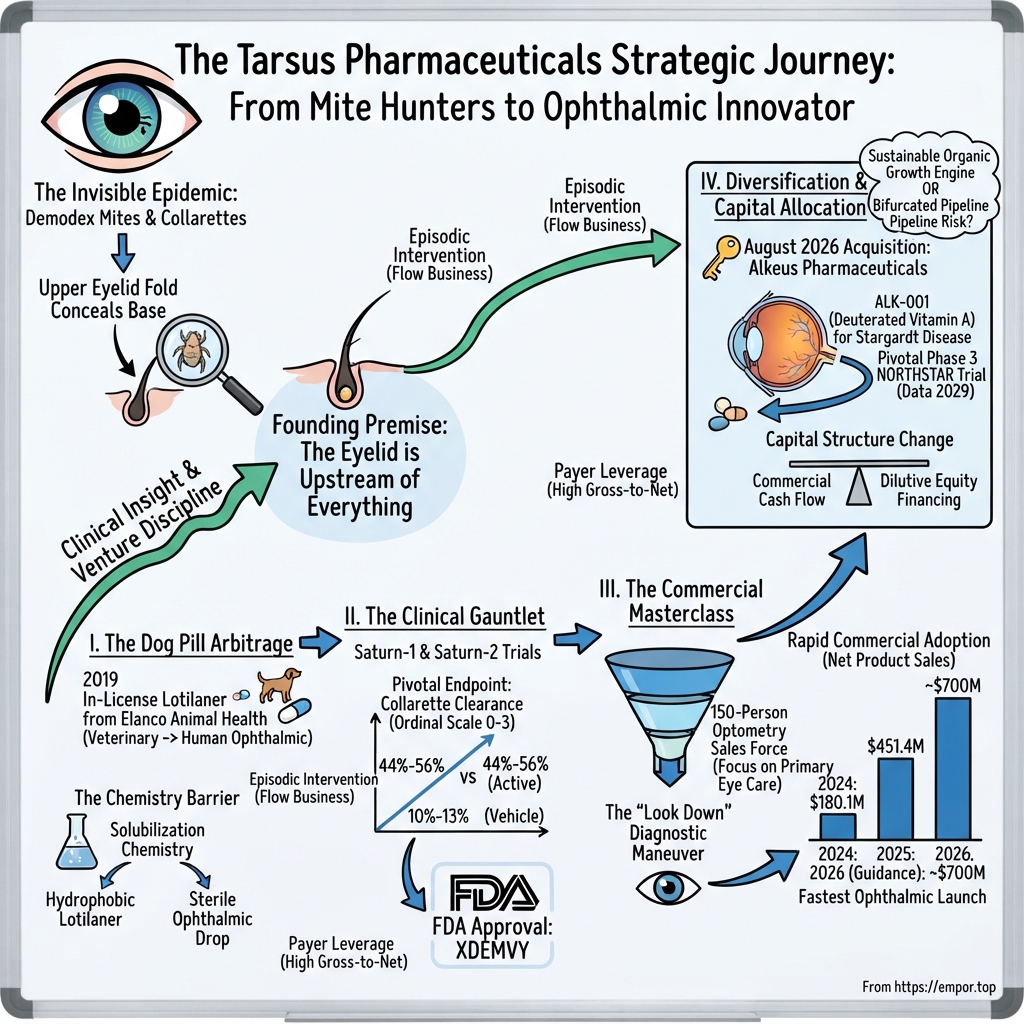
That insight became the founding premise of Tarsus Pharmaceuticals. The central operational question was how a small startup based in Irvine, California could take an unheralded veterinary molecule, engineer a gentle twice-daily topical formulation, establish a novel regulatory endpoint with the FDA, and build a commercial category around an underdiagnosed condition. The resulting commercial rollout became one of the fastest specialty launches in ophthalmology: advancing from zero revenue to $180.1 million in net product sales in 2024, rising to $451.4 million in 2025, and generating management guidance of $685 million to $705 million for 2026.[^1]1
That operational success sets up a sharper capital-allocation question. Just as that commercial engine approached self-funding status—putting Tarsus within reach of positive GAAP net income, a milestone rarely achieved by commercial-stage biotechs—management committed $270 million in cash and issued $125 million in dilutive equity to acquire Alkeus Pharmaceuticals. Why deploy that capital into an unproven Phase 3 retinal asset targeting a condition that Tarsus's 150-person optometry sales force is not configured to address?[^3]
Those two questions define the tension across Tarsus's business model. The analysis that follows evaluates the company's trajectory through Hamilton Helmer's 7 Powers and Michael Porter's Five Forces, assessing a competitive moat built on a single in-licensed molecule and an overlooked physical examination maneuver. It also subjects management's core claims to a falsification test: identifying which operational or clinical vulnerabilities could disrupt the thesis, and examining whether the company's operating record reveals the first signs of strain.
The narrative begins with the licensing transaction that made the enterprise possible.
 Subscribe on LinkedIn
II. The Dog Pill Arbitrage: Founding, In-Licensing, and The Chemistry Barrier
The most consequential move Tarsus executed occurred before the company had a clinical asset, trial data, or a sales force: it secured a licensing agreement from an animal-health corporation.
The initiative required an unusual pairing of clinical insight and venture discipline. Dr. Bobak Azamian brought an unconventional background to a biotechnology startup: medical training at Harvard, a doctorate in bio-nanotechnology from Oxford, clinical residency at Stanford, and several years at Versant Ventures, a prominent life-science venture firm.2 That trajectory bridged two perspectives that rarely intersect. Where an eye-care clinician confronted with lash debris typically defaults to lid-hygiene recommendations, an institutional investor looks at addressable market models. Azamian's background linked both: the biological premise that the eyelid margin drives ocular surface pathology, coupled with the recognition that a condition with 25 million potential patients and no approved therapy was not a marginal indication, but an entirely uncounted one.
Dr. Michael Ackermann brought complementary operational experience in ophthalmic device engineering. A Stanford Biodesign fellow, Ackermann had founded Oculeve, a neurostimulation startup that Allergan acquired in 2015—a transaction that yielded TrueTear, an intranasal neurostimulator designed to stimulate tear production. Ackermann had already navigated the development pathway for an unconventional ophthalmic concept: establishing biological plausibility, securing clinical validation, clearing regulatory review, and completing a strategic exit.
Their founding thesis, formulated in late 2016, was straightforward: the eyelid is upstream of everything. When ectoparasites colonize and inflame the eyelid margin, the meibomian glands fail to produce a healthy lipid layer. Deprived of that protective oil, the tear film evaporates, leaving patients with the chronic symptoms of dry eye. Attempting to treat tear-film instability while leaving eyelid inflammation unaddressed was the clinical equivalent of treating smoke while ignoring the underlying fire.
The masterstroke
In January 2019, Tarsus in-licensed lotilaner from Elanco Animal Health through an exclusive, worldwide agreement covering human applications across ophthalmic, dermatologic, and systemic antiparasitic indications.1 The financial terms were modest by pharmaceutical standards: a low upfront payment, tiered development and regulatory milestone commitments, and tiered mid-to-high single-digit royalties on future net sales.1
From Elanco's vantage point in 2019, the human rights carried zero commercial value—only an unvalidated hypothesis. Freshly separated from Eli Lilly, Elanco needed capital to advance its core pipeline across companion animals and livestock. Human ophthalmic drug development operates in an entirely different operational environment: distinct regulatory divisions, clinical trial protocols, commercial distribution channels, and liability exposures. Monetizing human rights through an option-like licensing structure allowed Elanco to capture upside on an application it was never configured to pursue.
The true commercial magnitude of that transfer became clear six years later. In May 2025, Elanco monetized its future U.S. royalty stream on XDEMVY by selling the rights to Blackstone Life Sciences and Blackstone Credit & Insurance for $295 million in upfront cash.[^5][^6] Blackstone—an institutional investor that underwrites royalty cash flows against clinical, regulatory, and patent expirations—committed nearly $300 million solely for the residual mid-to-high single-digit royalty on a therapy Elanco never advanced into human clinical trials. That passive royalty stream alone carried a valuation higher than Tarsus's entire enterprise value at its initial public offering.
The transaction also highlights a structural constraint in Tarsus's corporate architecture: Tarsus does not own lotilaner outright. It operates as a licensee. The royalty obligation persists throughout the product's patent life, and the creditor collecting that cash flow is now a specialized institutional investor configured to enforce licensing covenants with precision.
The unsung part: making a dog pill into an eye drop
The formulation challenge is often overlooked in retrospectives of the business, yet it represents where Tarsus created its primary defensible intellectual property.
In its veterinary form, lotilaner is a flavored chewable tablet formulated to survive canine digestion and distribute systemically through the bloodstream. Chemically, the molecule is highly lipophilic and virtually insoluble in water. Ophthalmic drops, however, are aqueous solutions. Furthermore, the human cornea is one of the most sensitive and unforgiving tissues in the body, reacting to poorly tolerated chemical agents with severe stinging, epithelial toxicity, or permanent scarring.
The target product profile required solving multiple technical challenges at once. The drop had to remain sterile and stable in a multi-dose bottle. It had to deliver a therapeutic concentration of lotilaner not simply across the tear film, but deep into the sebum-filled lash follicles and meibomian glands—an oily, hydrophobic microenvironment into which an aqueous drop does not naturally penetrate. Crucially, the formulation could not cause ocular discomfort, as stinging leads patients to abandon treatment well before completing a standard six-week regimen.
In practical terms, the drug delivery system had to transport an oil-soluble active agent across an aqueous medium and into an oily follicle twice daily for six weeks, all without irritating the densest sensory nerve network in the human body. The resulting formulation—a 0.25% ophthalmic solution relying on proprietary solubilization chemistry—constitutes Tarsus's primary technical achievement. It is also the asset the company owns outright: a portfolio of formulation, delivery, and method-of-use patents protecting topical lotilaner (internally designated TP-03) through 2038 to 2041.1
Capital formation and a pandemic IPO
Institutional backing followed from established life-science venture firms, including Vivo Capital, Frazier Healthcare Partners, Sofinnova Investments, and OrbiMed.3 On October 16, 2020, amid an active market for biopharmaceutical public offerings during the COVID-19 pandemic, Tarsus listed on the Nasdaq Global Select Market under the ticker symbol TARS. The offering priced 5.5 million shares at $16.00 each, generating approximately $103.5 million in gross proceeds.3
Falsification test: is a repurposed veterinary molecule actually a moat?
The claim: In-licensing an approved veterinary small molecule substantially de-risks human development and offers a low-cost, direct route to commercialization.
What would break it: Translating veterinary compounds into human medicine carries a difficult historical record. Species-specific toxicities frequently derail candidates. For topical formulations, poor local tolerability causes clinical failure. Most damaging commercially, if an active ingredient can be compounded off-label from veterinary stock, branded pricing power collapses.
The disconfirming evidence, taken seriously: Skepticism surrounding the initial public offering had clear historical precedent. In dermatology, Galderma's branded topical ivermectin cream (Soolantra) had faced pressure from compounded ivermectin formulations sold at a fraction of the price. Furthermore, Tarsus could not bypass clinical testing: the company invested tens of millions of dollars in Good Laboratory Practice (GLP) ocular toxicology and vehicle-controlled human trials because the FDA would not accept canine safety data as proof that an antiparasitic agent was safe on the human ocular surface. Reflecting those concerns, Tarsus shares traded sluggishly following the listing as public equity investors questioned the asset's commercial defensibility.
Verdict: The claim held up on technical grounds but narrowed in its commercial scope. Lotilaner proved well tolerated on the human ocular surface, resolving the primary clinical question. However, the lasting competitive barrier does not rest on sole access to the active molecule—Elanco held the molecule and subsequently monetized the downstream royalty. Instead, the defensible moat rests on a narrower foundation: the proprietary 0.25% formulation, the multi-patent estate guarding it, and the regulatory exclusivity granted to the first FDA-approved entrant. That represents a genuine cornered resource, but it is built on formulation chemistry and intellectual property enforcement rather than biological scarcity, and must be evaluated accordingly.
That regulatory foundation led directly to an equally demanding clinical hurdle: establishing a registrable Phase 3 trial protocol for a disease category in which the FDA had never previously approved a therapeutic.
III. The Clinical Gauntlet: Saturn-1, Saturn-2, and Pathognomonic Validation
Every drug approval is, at bottom, an argument about measurement. Before Tarsus could prove lotilaner was effective, it had to convince the FDA's ophthalmology division what clinical efficacy actually meant.
The intuitive endpoint was practically unworkable. Verifying mite eradication directly required epilating—plucking—eyelashes from a patient, mounting them on a slide, and manually counting Demodex under a light microscope. The process is uncomfortable for the patient, time-consuming for the clinician, and highly operator-dependent: two technicians evaluating the same lash frequently arrive at different counts. Across a multicenter trial spanning dozens of sites and hundreds of patients, inter-operator variability threatened to bury genuine treatment effects in measurement noise.
Tarsus addressed the challenge with a biological and regulatory argument. As established during early pathology characterization, collarettes are not merely correlated with infestation; they are a direct physical consequence of it. Mites burrow into follicles, extrude cellular debris, and create the characteristic cylindrical dandruff. Without mites, collarettes do not form. By framing collarettes as pathognomonic evidence of infestation, Tarsus persuaded the FDA to accept collarette clearance—graded on an ordinal 0-to-3 scale and documented photographically—as the pivotal primary endpoint. The metric was objective, rapid to assess at the slit lamp, non-invasive for the patient, and verifiable through centralized photographic adjudication.
Securing that regulatory consensus proved to be a critical structural advantage. The clinical trial endpoint aligned precisely with the diagnostic maneuver Tarsus later trained eye-care professionals to perform in everyday practice. Clinical validation and commercial diagnostic workflow became centered on the same physical observation.
Saturn-1 and Saturn-2
The registrable clinical development program consisted of two identically designed Phase 3 trials—Saturn-1 and Saturn-2—structured as randomized, multicenter, double-masked, vehicle-controlled studies enrolling more than 830 patients combined across U.S. sites.4 Patients administered one drop of lotilaner ophthalmic solution 0.25% in each eye twice daily for six weeks, with the primary efficacy assessment conducted at Day 43.4
Executing two identical pivotal trials rather than a single expanded study reflected a deliberate regulatory strategy. While requiring greater capital investment and a longer timeline, independent replication provided clear statistical confirmation—an essential standard for a first-in-class therapy entering an indication where the agency had no regulatory precedent.
The trial results, published in Ophthalmology, demonstrated consistent efficacy across both cohorts. Complete collarette clearance at Day 43—defined as reaching grade 0, or an essentially clean lash line—was achieved by 44% to 56% of lotilaner-treated patients across the studies, compared to 10% to 13% of patients in the vehicle control arms, with statistical significance below p < 0.0001.4 Complete mite eradication, evaluated as zero mites per lash in the designated analysis subset, occurred in approximately 52% of active-arm patients versus roughly 14% on vehicle.4 In addition, eyelid erythema resolved at a statistically superior rate among treated patients.4
Two dimensions of the trial data carried distinct strategic implications.
First, the vehicle response rate was non-trivial: between 10% and 13% of control patients achieved clearance without active drug. Twice-daily application of an aqueous drop provides mechanical lavage along the lid margin, and clinical trial participation typically encourages improved facial hygiene. The finding confirmed that lid-margin disease partially responds to consistent mechanical care alone.
Second, the tolerability and safety data established the foundation for commercial adoption. More than 90% of patients rated the topical solution comfortable; incidence of ocular burning or stinging remained below 10%, aligning closely with tolerability rates reported for standard over-the-counter artificial tears; and treatment discontinuations attributable to adverse events were below 1%.4 For an antiparasitic compound formulated for direct ocular application, local tolerability represented the primary clinical hurdle, and the Phase 3 data resolved it decisively.
On July 24, 2023, the FDA approved XDEMVY (lotilaner ophthalmic solution, 0.25%) for the treatment of Demodex blepharitis—the first and only therapeutic approved for the indication.[^9] The approved label was clean and unencumbered: it carried no black-box warning, required no routine intraocular-pressure monitoring comparable to ophthalmic corticosteroid protocols, and included no restrictive contraindications.[^9] For a specialty sales force targeting optometry practices that prioritize therapies with low monitoring burdens, a favorable safety label removed material prescribing resistance.
Falsification test: does a cure at Day 43 mean a durable business?
The claim: High clearance rates demonstrate that Demodex blepharitis can be resolved, establishing XDEMVY as an indispensable front-line therapy.
What would break it: Demodex mites are commensal human ectoparasites residing on virtually every adult human face. While a six-week topical regimen eradicates the active population within the eyelash follicles, it does not sterilize adjacent facial skin, domestic linens, or cohabitants. Biological re-exposure and subsequent recolonization remain inevitable over time.
The evidence: Long-term follow-up data from the Saturn program showed patients remaining collarette-free for several months post-treatment, with mite populations gradually re-emerging over the subsequent six to twelve months.4 This biological characteristic defines the commercial profile of the product: XDEMVY operates as an episodic intervention—more comparable to a targeted anti-infective treatment course than to a continuous, daily maintenance therapy such as topical cyclosporine.
Verdict: The clinical efficacy claim is validated, but the premise of continuous monthly refills does not apply. This dynamic represents a central structural variable in Tarsus's financial architecture: the business does not generate automatic monthly subscription revenue per patient. Instead, it relies on discrete treatment courses that must be renewed through new patient diagnosis or re-treatment cycles one to two years later. The velocity of repeat prescribing and long-term diagnostic retention represents the critical metric governing the company's ultimate commercial durability.
Before examining those recurring dynamics, the commercial rollout itself warrants detailed analysis: over its initial three years, the market introduction established one of the fastest adoption trajectories in specialty eye care.
IV. The Commercial Masterclass: Category Creation & The $700M Launch Ramp
A sales representative entering an optometry practice in August 2023 faced an unusual commercial dilemma: introducing an approved drug for an indication clinicians rarely diagnosed, that patients had never heard of, carrying a list price above $2,000 for symptoms rarely identified by name. Having no direct competitor appeared advantageous on paper, but it presented an operational hurdle: there were no existing prescribing habits to redirect. The commercial team was not capturing market share from an incumbent; it had to generate clinical demand across an unformed category.
Epidemiological data indicated a substantial underlying patient population: an estimated 25 million Americans have Demodex blepharitis, with screening studies indicating that roughly 58% of patients presenting to eye-care clinics exhibit collarettes on examination.1 Yet prior to mid-2023, virtually no patients requested treatment, and standard slit-lamp examinations routinely bypassed the lash line.
The "look down" hack
Tarsus addressed this diagnostic gap with a straightforward clinical instruction: direct the patient to look down.
When a patient looks straight ahead into the slit lamp, the fold of the upper eyelid conceals the base of the upper lashes. Instructing the patient to look downward rotates the lid margin, bringing lash roots into direct view where collarettes—if present—are immediately visible. The maneuver requires approximately ten seconds, involves no specialized equipment or dedicated billing codes, and adds negligible time to the examination.
This physical examination routine formed the core of Tarsus's commercial adoption strategy. Rather than attempting to persuade clinicians through theoretical marketing arguments, sales representatives prompted them to inspect their existing patient panels. Clinicians who observed collarettes across several consecutive routine exams validated the disease prevalence directly within their own practices. Tarsus supported this behavioral shift through unbranded disease-awareness initiatives and branded medical education campaigns built entirely around propagating that maneuver.[^1]
Building the machine
The commercial infrastructure was designed to match this diagnostic workflow. Tarsus deployed a dedicated field force of approximately 150 sales representatives focused on the highest-volume 20,000 to 25,000 eye-care professionals across the United States.1
This targeting model diverged from standard biopharmaceutical practice in ophthalmology. Traditional ophthalmic drug development centers heavily on the posterior segment, marketing specialized injectables to a concentrated network of vitreoretinal surgeons operating out of academic medical centers or surgical clinics. Demodex blepharitis, by contrast, sits squarely within primary eye care. Optometrists write the broad majority of anterior-segment prescriptions in the United States, operating within community retail settings and private practices that prioritize patient throughput and rapid clinical workflows. Tarsus configured its commercial operations specifically around optometric practice routines rather than surgical referral networks. While this design enabled rapid initial scaling, it also meant the field force was poorly configured to support an orphan drug targeting retinal specialists—a structural mismatch that later surfaced during the Alkeus acquisition.
To complement field-force detailing, Tarsus launched national direct-to-consumer advertising campaigns across television and digital channels, introducing the collarette concept to encourage prospective patients to raise the topic themselves.[^1] In primary eye care, consumer marketing served a specific operational function: converting the brief lid-margin check from a discretionary clinical choice into a patient-requested evaluation.
The numbers, and what they mean
The ensuing commercial ramp outpaced conventional ophthalmic benchmarks. XDEMVY generated roughly $17.5 million in net product sales during its stub launch period in late 2023, representing under four months on market.1 In 2024, its first full calendar year, net product sales reached $180.1 million, with total revenue of about $182.95 million.1 That performance exceeded the initial-year commercial trajectories of established dry-eye benchmarks—such as Xiidra, Restasis, and Tyrvaya—none of which had to establish a diagnostic category from a standing start.
The business entered a period of rapid expansion in 2025, generating $451.4 million in net product sales, roughly 150% growth.1 During the first half of 2026, sales totaled $319.3 million—delivering $145.4 million in the first quarter and $173.9 million in the second—prompting management to raise full-year 2026 guidance to $685 million to $705 million on its August 6, 2026 second-quarter call.[^1][^3]
Beyond the top-line trajectory, the structure of this expansion reveals where commercial demand originated, separated across two distinct variables.
Breadth. Active prescribing eye-care professionals expanded from zero to more than 15,000 by the end of 2024 and crossed 20,000 by mid-2026.[^1]1 That total represents near-saturation of Tarsus's primary target universe of high-volume U.S. practitioners, indicating that expanding the clinician base has largely run its course as an engine for incremental revenue.
Depth. The primary operational metric has therefore shifted to prescribing depth: converting occasional trial prescribers into habitual prescribers. By early 2026, management reported that roughly half of targeted eye-care professionals were writing XDEMVY on a weekly basis, with top-decile prescribers writing multiple bottles per week.[^10] Sustaining momentum through prescribing depth presents a steeper execution hurdle than initial clinician outreach, as repeat utilization depends on lasting clinical satisfaction from returning patients rather than sales detailing.
Pricing physics
The commercial model relies on a deliberate pricing and reimbursement architecture. The wholesale acquisition cost stands at approximately $2,034 for a single 10-milliliter bottle, which supplies the complete six-week, twice-daily course.1 Gross-to-net discounting—the spread between list price and realized net revenue—stabilized in the 44% to 45% range across 2024 through 2026.1[^3]
This discount concession represents the structural cost of specialty pharmaceutical distribution. It comprises mandatory rebates paid to dominant pharmacy benefit managers—Express Scripts, CVS Caremark, and OptumRx—to secure preferred formulary tiering across commercial and Medicare Part D plans, alongside funding for copay assistance programs that keep insured commercial patients at $30 or less out of pocket.1 This framework shields insured patients from the list price at the pharmacy counter, while establishing a permanent gross-to-net deduction governed by payer formulary leverage rather than manufacturer pricing power.
Falsification test: is this real demand or launch optics?
The claim: The revenue ramp demonstrates an expanding, recurring annuity in anterior-segment eye care.
What would break it: Biopharmaceutical launches can create an optical illusion of sustained demand. In early launch phases, wholesale distributors build channel inventory, generating initial revenue that mirrors end-user uptake. If treated patients subsequently exit the therapy pool without returning, underlying revenue drops sharply once inventory stocking normalizes.
The evidence: Disclosed inventory metrics provide a check on distribution dynamics. Wholesaler inventory remained disciplined at roughly two to three weeks of forward demand throughout the launch, confirming that reported sales tracked genuine end-user pull-through rather than channel stuffing.1[^3]
However, clinical durability introduces a commercial trade-off. Real-world Demodex re-emergence has proven slower than initial pessimistic projections suggested, with many patients remaining symptom-free for 12 to 18 months or longer following an initial course. While clinically favorable, this extended remission suppresses near-term retreatment frequency: only an estimated 20% to 30% of patients returned for retreatment within their first 18 months. As a consequence, top-line growth continues to depend on identifying new patients rather than cycling existing ones through maintenance regimens, requiring sustained spending on direct-to-consumer promotion and clinician education to maintain momentum.
Verdict: Prescription demand is authentic and commercial execution has been disciplined, but characterizing the business as an annuity remains premature. Tarsus has constructed an efficient patient-acquisition engine rather than a recurring subscription model, and the two models imply different terminal valuations. The definitive metric governing long-term commercial durability will be the retreatment rate at the 24-month mark across the 2024 and 2025 patient cohorts—data that is only beginning to mature.
The remaining discipline for a market pioneer is competitive entry. Through mid-2026, Tarsus has operated with virtually no direct branded competition—a dynamic that requires examining the structural barriers protecting the franchise.
V. Competitive Landscape & Industry Structure: The Ocular Surface Battlefield
At any major ophthalmology congress, the ocular surface pavilion is consistently the most contested space in the exhibition hall. Dry eye disease represents one of the most commercially competitive arenas in specialty pharmaceuticals, characterized by high prevalence, chronic dosing regimens, substantial direct-to-consumer advertising spending, and decades of entrenched brand equity. Yet for years, commercial sponsors competed to manage surface symptoms while the underlying pathogen along the eyelid margin went largely unaddressed.
The clinical overlap explains this convergence. Approximately 85% of dry-eye patients demonstrate some degree of meibomian gland dysfunction, and a substantial majority of blepharitis patients carry comorbid dry-eye diagnoses. Historically, a patient presenting with ocular surface discomfort could consult four different clinicians and receive four distinct prescriptions—ranging from topical anti-inflammatories to artificial tears—none of which addressed the ectoparasites colonizing the meibomian glands and lash follicles.
Who is actually in the room
Bausch + Lomb represents the most consequential commercial presence in the category—not by offering a direct Demodex therapy, but through its commanding shelf space and distribution reach. Its drop Miebo (perfluorohexyloctane), approved by the FDA in May 2023 for evaporative dry eye disease, targets tear-film lipid evaporation and has scaled to an annualized run rate in the several-hundred-million-dollar range. Alongside it sits Xiidra (lifitegrast), acquired from Novartis in 2023 for $1.75 billion in upfront cash, which generates several hundred million dollars annually as an established topical anti-inflammatory option. Bausch + Lomb operates as an integrated global eye-health enterprise with commercial relationships spanning virtually every U.S. ophthalmic and optometric practice.
AbbVie, through its Allergan subsidiary, commands the legacy franchise. Restasis (cyclosporine ophthalmic emulsion 0.05%) established the modern prescription dry-eye market and achieved peak annual sales exceeding $1.2 billion before multi-source generic erosion reduced its commercial footprint. AbbVie maintains substantial presence across primary eye care through its over-the-counter Refresh artificial tear portfolio, preserving high consumer brand recognition.
Harrow has targeted an incremental niche with Vevye, a water-free cyclosporine 0.1% formulation designed to minimize the ocular burning and stinging that historically constrained patient compliance with traditional cyclosporine vehicles.
Viatris markets Tyrvaya, a varenicline nasal spray acquired through its purchase of Oyster Point Pharma. Tyrvaya activates natural tear production via the trigeminal parasympathetic pathway—representing an unconventional route of administration that has delivered differentiated pharmacology but has struggled to capture commanding market share.
Beyond prescription pharmaceuticals, eye-care practices rely on an array of non-pharmacological interventions: hypochlorous acid eyelid sprays such as Avenova, over-the-counter tea tree oil cleansers like Cliradex, and in-office procedural devices. The procedural category includes BlephEx's mechanical micro-sponge debridement, NuLids at-home oscillating handpieces, and thermal pulsation platforms such as LipiFlow and iLux designed to evacuate obstructed meibomian glands.
Why nobody has taken the Demodex indication away
The strategic question is not why pharmaceutical companies market dry-eye drops, but why no competitor has directly contested Tarsus's monopoly in Demodex blepharitis. The explanation is structural and chemical.
Tea tree oil has served as the traditional over-the-counter remedy, and its primary active constituent, terpinen-4-ol, demonstrates direct miticidal activity. However, the compound suffers from an unforgiving therapeutic index: the concentrations required for reliable mite eradication induce significant ocular surface epithelial toxicity and meibomian gland irritation. The therapeutic window is too narrow for comfortable ocular application, and patients routinely abandon treatment due to local burning and discomfort.
Mechanical debridement faces an architectural limitation. Micro-sponge exfoliation and manual lid scrubbing effectively clear visible collarettes along the lid margin, but the relief is short-lived, often dissipating within days to weeks. Collarettes represent the waxy excretory debris rather than the parasite itself. Demodex mites reside millimeters deep within the lash follicle and meibomian gland architecture, entirely insulated from surface abrasion. Mechanical debridement removes the visible evidence while leaving the underlying infestation intact.
This dynamic forms the core of Tarsus's competitive position: XDEMVY remains the only FDA-approved pharmacological therapy capable of reaching and eradicating the parasite within its follicular microenvironment. Existing alternatives consist either of palliative eyelid hygiene or mechanical interventions that address downstream debris rather than the primary biological driver.
Falsification test: the compounding threat
The claim: A list price exceeding $2,000 for an antiparasitic agent with inexpensive generic analogs represents an open invitation for compounding pharmacies to capture commercial market share.
What would break it: The biopharmaceutical industry provides clear precedent for compounded substitution. In posterior-segment ophthalmology, repackaged bevacizumab (Avastin) captured dominant retinal market volume at a fraction of the cost of branded anti-VEGF biologics. Similarly, in dermatology, compounded topical ivermectin eroded branded pricing power following the introduction of proprietary rosacea formulations. With low-cost veterinary and systemic antiparasitic molecules widely available, compounding pharmacies faced strong economic incentives to enter the Demodex category.
The evidence: Compounding pharmacies attempted to market topical ivermectin formulations for Demodex blepharitis, but encountered two significant barriers. The first was pharmaceutical chemistry: compounding pharmacies struggled to deliver sterile, stable, and non-stinging aqueous formulations capable of penetrating oily follicles without inducing corneal irritation—the precise formulation hurdle that required years of development and proprietary patent protection. The second barrier was clinical liability. Demodex blepharitis is a chronic, non-sight-threatening condition. Optometrists have little clinical incentive to assume malpractice liability by prescribing unapproved, variable compounded preparations when an FDA-approved branded therapy is readily available to commercially insured patients for a copay of $30 or less. Evaluated on a risk-adjusted basis, compounded alternatives offered prescribers higher liability with minimal economic advantage to the patient. Consequently, compounded formulations have captured less than 2% of total category volume.
Verdict: The compounding substitution thesis is invalidated by real-world prescribing patterns, but that defensibility relies on a specific corporate subsidy: the manufacturer-funded copay assistance program. That program neutralizes the primary pricing incentive that drives patients toward compounding pharmacies. However, this defense remains structurally contingent on Tarsus maintaining sustainable gross-to-net discount levels. If payer pressures force Tarsus to curtail copay support, out-of-pocket patient exposure would rise, potentially reopening the market to compounded alternatives. The commercial moat therefore rests on a dual foundation: proprietary formulation chemistry combined with an ongoing financial subsidy.
That balance framed management's subsequent decision to deploy its emerging capital base into an entirely different therapeutic area.
VI. Strategy, Capital Allocation & The Alkeus Shock: TP Pipeline vs. The $450M Retinal Pivot
For six years, Tarsus presented investors with a focused, capital-efficient development thesis: a pipeline in a molecule.
The commercial rationale was straightforward. Lotilaner eradicates parasitic arthropods, which drive pathologies well beyond the eyelid margin. By reformulating a single small molecule whose safety and pharmacology had already been characterized, Tarsus could pursue several large indications without licensing new chemical matter or repeating baseline toxicology. Three internal programs defined that expansion.
TP-03 in meibomian gland disease. MGD affects approximately 35 million Americans—a population materially larger than the Demodex blepharitis cohort. The Phase 2a Ersa study met its primary endpoints, showing improvement in meibomian gland secretion quality and gland opening, and a Phase 3 program followed.1 Strategically, this represents a natural line extension: the active drug, formulation, and target prescriber are identical, and the patient populations frequently overlap. The incremental commercial expenditure is minimal because the existing sales force already calls on the relevant clinics.
TP-04 in papulopustular rosacea. Formulated as an aqueous topical gel, TP-04 targets Demodex-associated facial erythema and papules, with Phase 2a Galatea data demonstrating statistically significant reductions in inflammatory lesions.1 While commercialization would require calling on dermatologists rather than eye-care providers, the underlying biological mechanism remains consistent with the core premise: addressing ectoparasitic proliferation as a primary driver of tissue inflammation.
TP-05 for Lyme disease prophylaxis. The most unconventional program in the pipeline is an oral systemic lotilaner formulation designed to circulate in human blood and kill attached Ixodes scapularis ticks before they transmit Borrelia burgdorferi. Data from the Phase 2a Carpo study demonstrated that blood from treated subjects killed attached ticks within approximately 24 hours—well inside the 36-to-48-hour window during which bacterial transmission typically occurs.1 In concept, the drug turns the human host into an inhospitable meal for the vector.
And then, September 2026
In August 2026, Tarsus announced—and subsequently closed—the acquisition of Alkeus Pharmaceuticals, Inc., a private biotechnology company with no commercial products and a single clinical asset in a rare retinal indication.[^3]
The financial terms were substantial: $450 million upfront, structured as $270 million in cash and $180 million in Tarsus common stock, alongside up to $350 million in contingent clinical, regulatory, and commercial milestones. Concurrently, Tarsus executed a $125.0 million private placement with institutional healthcare investors to replenish cash reserves.[^3]
The acquired asset is gildeuretinol (ALK-001), a modified compound targeting the biochemistry of the visual cycle. While vitamin A is essential to normal vision, within the retina two vitamin A molecules can dimerize into a toxic byproduct known as A2E, which accumulates as lipofuscin and damages the retinal pigment epithelium. Gildeuretinol is a deuterated form of vitamin A: chemically identical except that specific hydrogen atoms are replaced by their heavier stable isotope, deuterium. Because carbon-deuterium bonds require significantly more kinetic energy to break, dimerization slows substantially while preserving standard visual-cycle function—slowing the production of toxic aggregates without disabling the biological pathway.
The lead clinical indication is Stargardt disease—an inherited, progressive juvenile macular dystrophy affecting approximately 30,000 Americans, with no approved therapeutic alternative. The compound holds FDA Breakthrough Therapy, Orphan Drug, and Fast Track designations, and is currently enrolling patients in the pivotal Phase 3 NORTHSTAR trial, with topline data not expected until 2029.[^3]
Did they overpay?
Evaluated against transaction comparables, an upfront payment of $450 million for a Phase 3 orphan ophthalmic asset holding Breakthrough designation is not an outlier. Recent retinal acquisitions have commanded substantially higher valuations: Astellas acquired Iveric Bio for $5.9 billion in 2023 to secure Izervay for geographic atrophy, while Apellis reached multi-billion-dollar market capitalizations following the approval of Syfovre. The most direct public peer, Belite Bio, has traded at valuations between $800 million and $1.2 billion primarily on the prospects of oral tinlarebant, which is also in Phase 3 testing for Stargardt disease. In that context, the headline acquisition multiple appears defensible.
The primary issue is not the headline valuation, but the capital structure.
As of June 30, 2026, Tarsus held approximately $449.7 million in cash and cash equivalents.[^3] The $270 million cash outlay consumed more than 60% of that balance in a single transaction, immediately necessitating the $125 million equity placement. After spending three years approaching self-sustaining operations funded entirely by commercial product revenue—a milestone that eludes most commercial-stage biopharmaceutical firms—Tarsus reset that timeline and diluted existing equity holders to finance an external pipeline expansion.
Falsification test: is this disciplined capital allocation?
The claim: Management operates as a disciplined, shareholder-aligned capital allocator focused on maximizing operating leverage across anterior-segment eye care.
What would break it: Strategic drift into non-adjacent clinical categories, balance-sheet dilution to fund long-dated binary trials, and capital diversion away from proven commercial synergies.
The evidence:
The lack of commercial overlap is complete. Stargardt disease is diagnosed, genetically verified, and managed by specialized vitreoretinal physicians practicing within academic medical centers and specialized inherited-retinal-disease clinics. Tarsus's approximately 150 field representatives call almost exclusively on primary-care optometrists and comprehensive ophthalmologists. These two prescriber populations share virtually no operational overlap. The commercial infrastructure that Tarsus spent more than $200 million annually to construct offers no distribution leverage for an orphan retinal therapy. If gildeuretinol gains approval, the company will have to build a separate specialty sales force from scratch.
The duration mismatch extends financial risk. XDEMVY's commercial momentum had brought Tarsus to the threshold of positive GAAP net income by late 2026. Topline data from the NORTHSTAR trial is not expected until 2029. Tarsus has therefore committed to absorbing tens of millions of dollars in annual clinical development expenses over three years, funded by a commercial product whose multi-year retreatment durability remains under evaluation.
The historical development record in Stargardt disease is unfavorable. The indication has seen numerous clinical failures across visual cycle modulators, complement inhibitors, and cellular therapies. The difficulty is rooted in disease biology: Stargardt progresses slowly, requiring lengthy multi-year trials to demonstrate a measurable treatment effect, while functional visual acuity endpoints can be erratic in patients whose central photoreceptors are already compromised. While FDA Breakthrough Therapy designation confirms substantial unmet medical need and encouraging preliminary clinical activity, it provides no statistical guarantee of Phase 3 replication—distinctions that equity markets frequently conflate.
Strategic rationale was not foreshadowed. For years, management communicated that lotilaner's clinical versatility would allow Tarsus to self-fund organic pipeline expansion into adjacent indications. Meibomian gland disease, rosacea, and Lyme disease prophylaxis were presented as the organic growth drivers. The Alkeus transaction departs from that framework: it shifts capital into an unproven, in-licensed retinal asset without prior indication to public markets that corporate strategy was pivoting away from single-molecule operating leverage.
Verdict: The evidence does not support the claim of focused capital discipline as previously articulated. The transaction may not represent an overpayment on a relative valuation basis, and the underlying chemistry of gildeuretinol remains scientifically distinct. However, the acquisition fundamentally alters Tarsus's corporate profile: transforming it from a single-molecule, single-call-point commercial specialist with a defined path to near-term profitability into a bifurcated biopharmaceutical company carrying a long-dated clinical binary. Shareholders who invested in a high-margin ocular surface franchise now hold an equity interest exposed to late-stage retinal development risk. The critical operational test moving forward is whether the Phase 3 meibomian gland disease program remains fully funded and on schedule through 2027 and 2028, or whether its timeline slips as clinical resources are diverted to NORTHSTAR. If the core anterior-segment pipeline decelerates, the diversification thesis will have resulted in direct capital cannibalization.
Strategic decisions of this magnitude ultimately reflect the individuals leading the enterprise. The question is who is making them.
VII. Executive Leadership, Governance, & The CCO Transition
Evaluating biotechnology leadership often falters on a common error: assessing executives by credentials and pedigree rather than the choices made under uncertainty. Tarsus presents a relatively clear operating record to judge, largely because management has executed a focused set of highly consequential decisions.
Dr. Bobak Azamian serves as co-founder, Chief Executive Officer, and Chairman of the Board.2 Combining the CEO and board chair roles concentrates agenda-setting and corporate oversight in a single individual—the exact governance structure under which the Alkeus acquisition was evaluated and approved. On commercial execution, Azamian's record is formidable: he identified an undervalued molecule in an adjacent veterinary industry, negotiated the initial license, backed an unconventional surrogate regulatory endpoint, and directed a commercial launch that outpaced established ophthalmic benchmarks. Creating a new commercial category from scratch is a demanding operational challenge, and the rollout demonstrated disciplined execution.
Jeffrey Farrow serves as Chief Financial Officer and Chief Strategy Officer, having previously held CFO positions at Catalyst Biosciences and Aduro Biotech.2 His influence shaped the company's financing architecture, including a non-dilutive credit facility established with Hercules Capital and Silicon Valley Bank, under which Tarsus has carried long-term debt in the roughly $73 million to $89 million range.5 Relying on venture debt rather than equity during the pre-revenue development phase protected existing shareholders during the company's highest-risk valuation window. That conservative track record makes the decision to pursue dilutive equity financing in 2026—at a moment of unprecedented commercial strength—a notable shift in capital strategy. The dual CFO and CSO title also carries governance implications: the executive managing the balance sheet is simultaneously responsible for corporate strategy, an efficient operational arrangement that provides minimal structural separation between strategic ambition and financial constraint.
The departure that made investors uneasy
On July 13, 2026, Aziz Mottiwala resigned as Chief Commercial Officer.6 Mottiwala was the principal architect of the commercial organization: he built the 150-person field force, designed the practitioner-targeting framework, and led the commercial rollout through its initial rapid expansion. The stated reason for his departure was an offer to become chief executive of a publicly traded medical device company.6 Tarsus appointed Neera Clase as interim CCO.6
Market observers evaluated the resignation through two competing interpretations. The benign explanation is straightforward: a commercial chief who executes one of the fastest specialty drug rollouts in recent ophthalmic history is an obvious candidate for public-company chief executive roles, an opportunity few executives turn down.
The more cautious interpretation centers on timing. Losing a chief commercial officer during the steepest phase of a commercial ramp is unusual, and the resignation occurred just before a quarter in which Tarsus redirected significant capital away from anterior-segment execution and into an acquired, long-dated retinal research program. The public disclosures do not link the two events. How long the interim title remains in place—and whether the permanent appointment brings anterior-segment or retinal specialty experience—will offer clearer insight into the company's operational focus.
Ownership, insider behavior, and incentives
Azamian maintains substantial equity ownership through direct shareholdings and the Bobak Azamian Living Trust, encompassing common stock and options.2 Form 4 filings document systematic share sales by Azamian and other senior executives across late 2025 and 2026.2
Assessing these insider transactions requires balanced context. Scheduled sales executed under pre-established Rule 10b5-1 trading plans following a successful commercial launch represent standard practice for founders seeking portfolio diversification, and programmatic plans exist specifically to remove executive discretion over transaction timing. At the same time, the optics of senior executive selling in the quarters immediately preceding a major clinical acquisition and an equity private placement naturally draw market scrutiny. While the public record shows no indication of impropriety, executive divestment reduces an unambiguous insider-alignment signal at the very moment outside investors face new capital-allocation risks.
The executive incentive structure offers clearer analytical insight. Annual executive bonuses and equity vesting schedules have been tied heavily to XDEMVY net product sales thresholds—specifically $500 million, $750 million, and $1 billion—alongside the achievement of clinical milestone completion.2 This framework rewards top-line revenue expansion and pipeline activity rather than return on invested capital or GAAP profitability. An incentive system organized around revenue hurdles and pipeline milestones naturally encourages corporate development and the acquisition of additional clinical assets. That alignment does not make the Alkeus acquisition inherently flawed, but it confirms that the transaction is consistent with how executive compensation is structured.
Credibility, measured by behavior over time
On commercial guidance, management's track record has been consistent. Tarsus met or exceeded its own revenue forecasts and Wall Street consensus throughout 2024, 2025, and into 2026. On the August 6, 2026 earnings call, management raised full-year net product sales guidance from an initial range of $670 million to $700 million to a revised range of $685 million to $705 million.[^3] Upward revisions during commercial scaling are uncommon among early commercial-stage biopharmaceutical firms, where revenue forecasting frequently leads to credibility challenges.
On narrative consistency, the record is more contested. For several years, management framed Tarsus around a "pipeline in a molecule" thesis, repeatedly citing lotilaner's biological breadth as the reason the company would not need to purchase external growth. The Alkeus acquisition represents a departure from that long-standing thesis, and management has not publicly clarified what changed in its internal assessment of lotilaner's expansion potential. That unresolved gap remains the most critical strategic question for shareholders assessing the company's long-term direction.
Evaluating that strategic shift leads directly to a structural examination of the business through the lenses of competitive advantage and industry power.
VIII. Porter's 5 Forces & Hamilton Helmer's 7 Powers Analysis
Strip away the narrative and ask the structural question: if a competent, well-capitalized competitor decided to take the Demodex blepharitis market from Tarsus, what exactly would stop them?
Helmer's 7 Powers
Cornered Resource — High, but leased. The exclusive worldwide human-use license to lotilaner is the foundational asset, reinforced by formulation and method-of-use patents running into 2038 to 2041.1 Blackstone's willingness to pay $295 million for the royalty stream provides third-party confirmation that sophisticated institutional capital regards the legal position as solid.[^5] Yet the qualifier matters: Tarsus does not own the compound. It holds contractual rights and pays a perpetual royalty. A cornered resource held under contract remains an effective barrier, but it is structurally thinner than outright ownership.
Counter-Positioning — High, and structurally entrenched. This represents the most durable power in the portfolio. Incumbents could not easily have developed XDEMVY, not because they lacked scientific capability, but because doing so contradicted their commercial model. Established leaders like Bausch + Lomb and AbbVie built multi-billion-dollar franchises on the premise that ocular surface disease is a chronic tear-film deficiency requiring continuous, indefinite therapy. To introduce an episodic miticide, their commercial teams would have had to explain to the same optometrists that a large share of their chronic dry-eye patients were actually suffering from an unaddressed ectoparasitic infestation—undermining their own installed base. Incumbents are rarely blocked by technological incapacity alone; they are constrained by the economic and reputational cost of validating a clinical framework that cannibalizes their existing revenues.
Process Power — Moderate to high. The solubilization chemistry required to convert a hydrophobic veterinary isoxazoline into a non-stinging aqueous drop capable of penetrating deep into lash follicles is demanding, proprietary, and protected by patents. The failure of compounding pharmacies to replicate a stable, well-tolerated topical preparation without provoking corneal irritation provides practical evidence of that formulation barrier.
Scale Economies — Moderate, at best. A commercial field force of roughly 150 representatives calling on more than 20,000 eye-care professionals generates operating leverage as prescription volume expands against fixed sales overhead. Yet this does not constitute a compounding scale advantage in the classical sense. Annual selling, general, and administrative expenditures exceeding $200 million, alongside recurring direct-to-consumer advertising spending, represent an ongoing toll required to keep the patient diagnostic funnel full, rather than a self-reinforcing asset that widens competitive distance over time.
Switching Costs — Moderate, and asymmetric. The switching friction resides with the clinician rather than the patient. Once an eye-care professional integrates the downward-gaze maneuver into routine slit-lamp examinations and witnesses rapid clinical resolution, prescribing XDEMVY becomes standard practice. Displacing that behavior requires a prospective challenger to alter an ingrained clinical routine—one of the steepest hurdles in medicine. For the patient, however, switching costs are negligible once the discrete six-week regimen ends, leaving no continuous therapeutic protocol to disrupt.
Network Effects — Low. The business model exhibits no direct or two-sided network effects. The closest operational equivalent is key opinion leader advocacy in optometry, where respected clinicians accelerate adoption through conference presentations and professional networks. That dynamic reflects professional social proof rather than a structural network effect, and it can reverse just as quickly if safety concerns or reimbursement obstacles emerge.
Branding — Moderate and emerging. Among eye-care professionals, XDEMVY has rapidly approached category-defining status as the default name for Demodex blepharitis treatment. Yet brand awareness of this kind converts slowly into independent pricing power and remains vulnerable should a clinically equivalent, lower-cost branded entrant secure regulatory approval.
Porter's Five Forces
Threat of new entrants — Low. A challenger must design and execute vehicle-controlled Phase 3 trials to demonstrate collarette clearance, commit well over $100 million in development capital, absorb a timeline of five or more years, and navigate around Tarsus's formulation patent estate. While Tarsus lowered regulatory uncertainty for followers by validating the collarette clearance endpoint, the financial returns of entering as a second-place follower into a category where the first mover has already captured prescriber habits remain uninviting.
Bargaining power of buyers — High. This represents the primary structural constraint. Pharmacy benefit managers serve as the ultimate commercial gatekeepers, extracting 44% to 45% of gross product sales through mandatory rebate concessions. Their leverage is structural and asymmetric: payers can impose restrictive prior authorizations, require step therapy through inexpensive eyelid cleansers, or assign unfavorable formulary tiering. Each measure introduces friction at the most vulnerable point in the commercial pathway: a non-urgent condition where a patient facing administrative delays or multiple pharmacy calls may simply abandon the prescription.
Bargaining power of suppliers — Low. Lotilaner is synthesized through standard small-molecule processes at commercial scale, with active pharmaceutical ingredient manufacturing and fill-finish operations managed through contract development and manufacturing organizations under dual-sourcing arrangements.1 No individual supplier holds meaningful leverage over production.
Threat of substitutes — Low to moderate. In-office mechanical debridement, hypochlorous acid sprays, and over-the-counter tea tree oil cleansers remain widely accessible and inexpensive. However, their clinical efficacy is limited because they fail to eradicate mites embedded deep within the follicle architecture. The primary substitution hazard is not clinical inferiority, but payer mandates: pharmacy benefit managers could enforce step therapy requiring patients to fail over-the-counter hygiene measures before approving branded coverage.
Rivalry — Low within the indication, moderate for clinical attention. Tarsus faces no direct branded competitor approved for Demodex blepharitis. In practice, however, its sales representatives compete daily against diversified pharmaceutical giants like Bausch + Lomb for the same ten minutes of an optometrist's chair time and the same insured patient's out-of-pocket copay budget. In that broader battle for clinic attention, entrenched competitors command substantially larger commercial budgets and broader ophthalmic product portfolios.
The composite structural picture shows an enterprise protected by a resilient, contractually licensed cornered resource, a strong counter-positioning advantage against legacy dry-eye incumbents, and a serious vulnerability in payer bargaining power. That combination describes a highly effective specialty pharmaceutical franchise, but not an unassailable monopoly. The distance between those two assessments is precisely where skepticism about long-term valuation begins.
IX. The Skeptical Investor Stress Test & The 3 Critical KPIs
For an investor evaluating a specialty pharmaceutical launch at peak commercial enthusiasm, articulating the counter-thesis in its strongest form is an essential discipline. That skeptical framework centers on four distinct vulnerabilities.
The "one-and-done" saturation cliff
The most critical vulnerability stems from the biological nature of the therapy. Demodex blepharitis is not glaucoma or hypertension requiring indefinite, daily maintenance. It is treated through an acute, six-week regimen. Consequently, the commercial model operates as a flow business—dependent on continuously identifying new patients—rather than a stock business accumulating an expanding base of chronic daily users.
The underlying unit economics illustrate the challenge. At roughly $700 million in annual net sales against a realized price netting out to approximately half of its $2,034 list price, Tarsus distributes between 700,000 and 800,000 bottles annually. Those prescriptions have gone disproportionately to the most symptomatic, highly compliant patients within the practices of the earliest-adopting clinicians—the exact cohort that is treated first and exhausted first. With the active prescriber base having already reached 20,000 eye-care professionals, the broad geographic expansion that drove growth through 2024 and 2025 is largely complete. Prescribing depth per clinician can continue to increase, but it faces natural ceilings within any single community practice.
The growth equation for 2027 and beyond therefore reduces to two variables: how many undiagnosed patients can be identified at an acceptable acquisition cost, and how many previously treated patients return for additional therapy. If real-world retreatment remains in the 20% to 30% range over an 18-month window and new-patient identification decelerates as practice panels mature, revenue growth risks flattening well short of optimistic long-term projections. That is not a flaw in the medicine; it is a structural reality of treating an episodic condition.
The Medicare Part D redesign
The Medicare Part D redesign under the Inflation Reduction Act introduced structural changes starting in 2025, eliminating the coverage gap and assigning manufacturers a 20% discount liability in the catastrophic phase. The demographic implications for Tarsus are direct: because blepharitis prevalence increases with age, the patient population tilts heavily toward older adults, meaning Medicare beneficiaries will represent a growing share of prescription volume as screening deepens. That shift creates an ongoing headwind on net realized pricing that operates independently of commercial execution. Gross-to-net deductions have held between 44% and 45% through 2026;[^3] the question is whether that spread can hold as the Medicare volume mix rises.
The Alkeus value trap
The skeptical case regarding the Alkeus acquisition is straightforward: Tarsus deployed approximately 60% of its cash reserves alongside a $125 million equity offering into a single Phase 3 retinal candidate, operating in a therapeutic category with a fraught clinical track record, requiring a clinical specialist network its field force cannot call on, and offering no definitive data readout until 2029.[^3] If the NORTHSTAR trial fails, there is no intermediate outcome: the balance sheet absorbs an immediate impairment, equity holders carry permanent dilution, and the enterprise forfeits three years of unencumbered operating leverage. For public equity investors, that introduces an asymmetric downside risk, regardless of how management modeled the asset's risk-adjusted value.
TP-05 and the Lyme prophylaxis fantasy
The oral Lyme disease prevention program represents the pipeline candidate most readily discounted by institutional analysts, driven by commercial and regulatory hurdles rather than pharmacological doubt. In veterinary medicine, isoxazolines carry regulatory label warnings regarding potential neurologic adverse events, including tremors and seizures in dogs. Persuading regulators to approve a systemic arthropod-killing compound for seasonal administration in healthy individuals as a prophylactic measure requires a fundamentally more demanding risk-benefit assessment than applying a topical solution to a diseased eyelid. Even if approved, reimbursement faces steep resistance: commercial payers would be asked to cover a premium-priced preventive oral medication for an infection that insect repellents and a post-exposure course of generic doxycycline already mitigate at nominal expense. While the underlying biology may be valid, the commercial reimbursement pathway remains difficult to identify.
The three KPIs that actually matter
Amid the volume of corporate disclosures, three operational indicators govern the company's fundamental performance.
1. Prescribing depth over total clinician count. With the active prescriber network having largely captured the core target population, breadth has nearly reached its practical ceiling. The critical metric is whether the median practitioner advances from writing one or two prescriptions weekly to four or five. Prescribing depth reveals whether the downward-gaze examination has become an ingrained, permanent clinical routine or merely an ephemeral novelty. Tracking the proportion of habitual, weekly prescribers relative to trial prescribers provides far more diagnostic clarity than monitoring top-line clinician additions.
2. The 12-to-24-month real-world retreatment rate. This metric will ultimately define Tarsus's corporate identity. If a substantial portion of the 2024 and 2025 patient cohorts returns for subsequent therapy as mite recolonization occurs, XDEMVY functions as a high-margin, episodic annuity supported by a growing base of treated patients. If retreatment remains low, the enterprise operates as a high-churn patient-acquisition treadmill, requiring relentless direct-to-consumer marketing expenditures simply to maintain baseline revenues. That divergence carries profound valuation implications, and the evidence is only beginning to mature in late 2026 and 2027 as the initial launch cohorts clear the recurrence window.
3. Gross-to-net resilience alongside operating cash flow conversion. These factors are structurally intertwined. The key test is whether gross-to-net discounts remain stable in the mid-40% range as Medicare exposure expands, and whether recognized revenue translates into sufficient free cash flow to fund both the Phase 3 meibomian gland disease program and NORTHSTAR without requiring additional trips to the capital markets. A subsequent dilutive equity financing would validate concerns that the Alkeus acquisition overextended the balance sheet.
Beyond these three operational indicators, commercial milestone announcements, clinician testimonials, and quarterly revenue beats represent secondary noise.
X. Bull vs. Bear Case & Epilogue: The Ultimate Verdict
The bull case
The bull case rests on the premise that XDEMVY transitions into an entrenched front-line blockbuster. In this scenario, collarette screening becomes standard practice across more than 40,000 U.S. eye-care clinics, active prescribers surpass 30,000, and prescribing depth increases as the downward-gaze examination becomes an ingrained clinical routine rather than a prompted action. Management's 2026 net product sales guidance of $685 million to $705 million serves as a waypoint rather than a commercial peak.[^3]
Label expansion into meibomian gland disease represents the most significant unpriced optionality in the pipeline. If TP-03 secures approval in MGD, Tarsus roughly doubles its addressable patient population using the identical active molecule, formulation, field force, and optometric call point, requiring negligible incremental commercial infrastructure. It is the rare biopharmaceutical line extension where incremental gross margin closely tracks incremental revenue—and notably represents the organic growth driver management prioritized before the Alkeus transaction.
The retreatment annuity materializes. If longitudinal registry data demonstrates that approximately 40% of treated patients experience symptomatic recurrence within 18 to 24 months and return for retreatment, XDEMVY re-rates from a transactional launch story to a compounding commercial franchise, as the installed patient base accumulates rather than churns.
The Alkeus acquisition delivers. Gildeuretinol achieves its primary endpoints in the Phase 3 NORTHSTAR trial in 2029, securing orphan drug exclusivity and establishing a monopoly in an indication with no approved therapeutic alternatives. Tarsus gains a second commercial asset with blockbuster potential, retrospectively validating the $450 million purchase price and reframing earlier governance critiques as short-term skepticism.
Operating leverage expands. Operating margins widen as fixed commercial infrastructure levers against scaling product revenue, free cash flow conversion accelerates, and Tarsus establishes itself as a profitable, single-specialty asset commanding premium valuation multiples from diversified biopharmaceutical acquirers.
The bear case
Commercial saturation arrives earlier than anticipated. Clinician breadth plateaus near current levels, and the pool of symptomatic, highly compliant patients is gradually exhausted. Identifying newly diagnosed patients demands escalating direct-to-consumer advertising spending, while real-world retreatment rates remain below 20%. Revenue growth stalls between $750 million and $800 million in 2027, prompting equity markets to re-rate a stock priced for a $1.5 billion product. Crucially, this outcome requires neither clinical failure nor competitive entry; it reflects the structural ceiling of an episodic therapy that successfully resolves acute symptoms.
Payer leverage compresses realization. Observing rising aggregate expenditures on a non-sight-threatening condition, pharmacy benefit managers mandate step therapy through inexpensive lid-hygiene cleansers before authorizing branded coverage. Concurrently, manufacturer liabilities in Medicare Part D's catastrophic phase push gross-to-net deductions past 50%. Net realized price deteriorates even if prescription volume holds, eroding operating margin expansion.
NORTHSTAR fails in 2029. Stargardt disease clinical development carries a historically unfavorable base rate. A trial failure forces an immediate write-down of the $450 million investment, leaving shareholders with permanent equity dilution and no intermediate clinical return.
Commercial execution decelerates post-Mottiwala. Specialty sales organizations are sensitive to leadership transitions, which can trigger field attrition, territory disruption, and detailing slippage over several quarters. Any operational friction emerges just as well-capitalized competitors like Bausch + Lomb spend aggressively to protect clinician share of mind for Miebo.
Weighing it
A rigorous synthesis avoids splitting the difference between optimistic and pessimistic scenarios. Three conclusions follow from the available operating evidence.
First, the commercial achievement is verified by data. Building a therapeutic category from an underdiagnosed condition and scaling it faster than established ophthalmic benchmarks represents a rare operational accomplishment. Disciplined channel inventory, stable gross-to-net realization, rapid prescriber adoption, and upward guidance revisions support that evaluation on its own terms.
Second, franchise durability remains structurally unproven. XDEMVY resolves an acute parasitic infestation rather than managing a chronic biochemical deficit. Until retreatment patterns across the 2024 and 2025 patient cohorts mature, the terminal cash-flow profile of the product remains an open empirical question, making annuity-based valuation multiples premature.
Third, the Alkeus acquisition fundamentally altered the nature of the investment. Prior to August 2026, Tarsus presented investors with a focused commercial specialty model whose primary variable was patient retreatment frequency. Following the acquisition, the company coupled that commercial engine to a multi-year, binary retinal development program funded by balance-sheet cash and shareholder dilution. Tarsus did not abandon its original commercial franchise, but it ceased to be only a commercial anterior-segment specialist—and it executed that shift without reconciling the transaction against years of stated corporate strategy.
Epilogue: the enduring lesson
The broader lesson of Tarsus extends beyond anterior-segment ophthalmology.
It demonstrates that high-value pharmaceutical assets are not always undiscovered; they frequently reside in plain sight within adjacent industries that lack the commercial mandate to pursue human clinical applications. Elanco and veterinary dermatologists understood lotilaner's antiparasitic activity for years. The molecule was not concealed; the commercial arbitrage lay in recognizing the clinical opportunity and aligning regulatory endpoints, optometric practice workflow, and ophthalmic formulation chemistry to bridge the gap between an animal-health chewable and a premium human therapeutic.
The secondary lesson reflects a familiar corporate dilemma. The discipline that enables a pioneer to establish a category—narrow operational focus, a single active molecule, an aligned call point, and targeted behavioral change—proves difficult to maintain once commercial cash flow materializes. Every successful single-asset biopharmaceutical enterprise eventually confronts a strategic choice: harvest the commercial monopoly and return capital to shareholders, or reinvest operating cash flows into external assets to hedge against eventual franchise maturity. Tarsus chose the latter path, acting more rapidly and aggressively than its corporate narrative had prepared public markets to expect.
Whether that capital allocation proves prescient will not be known until 2029. What remains clear is which operational indicators will signal the outcome first—and those metrics, rather than corporate announcements, will define the company's ultimate trajectory.
References
-
Tarsus Pharmaceuticals Annual Report on Form 10-K for the Fiscal Year Ended December 31, 2025 — U.S. Securities and Exchange Commission, 2026-02-23 ↩↩↩↩↩↩↩↩↩↩↩↩↩↩↩↩↩↩↩
-
Tarsus Pharmaceuticals Definitive Proxy Statement on Schedule 14A — U.S. Securities and Exchange Commission, 2026-04-28 ↩↩↩↩↩↩
-
Tarsus Pharmaceuticals Prospectus on Form 424B4 (Initial Public Offering) — U.S. Securities and Exchange Commission, 2020-10-16 ↩↩
-
Lotilaner Ophthalmic Solution 0.25% for Demodex Blepharitis: Results of the Pivotal Saturn-1 and Saturn-2 Phase 3 Studies — Ophthalmology (American Academy of Ophthalmology), 2023-05-01 ↩↩↩↩↩↩↩
-
Tarsus Pharmaceuticals Current Report on Form 8-K: Credit Facility with Hercules Capital and Silicon Valley Bank — U.S. Securities and Exchange Commission, 2022-02-28 ↩
-
Tarsus Pharmaceuticals Announces Resignation of Chief Commercial Officer Aziz Mottiwala — Vision Monday, 2026-07-07 ↩↩↩
 LinkedIn
 WhatsApp
 Reddit
 Hacker News
 Email
Email Kindle
 RSS Feed
 Spotify
 Apple Podcasts
 Amazon Music
 Audible
 YouTube