Ocular Therapeutix: The Insert, the Injection, and the $530 Million Question
I. The $530 Million Race to the FDA
On November 9, 2026, Pravin Dugel opened Ocular Therapeutix's third-quarter call with the kind of news a retina company waits a decade to deliver. The company had held what it called a positive pre-NDA meeting with the Food and Drug Administration in September, and it planned to submit a New Drug Application for AXPAXLI in wet age-related macular degeneration before the end of the year.1 Behind that sentence sat a Phase 3 trial, SOL-1, that had beaten the world's best-selling class of eye injection on its primary endpoint.2 Behind it, too, sat a bank balance large enough to make most small biotechs envious: $530.6 million in cash and cash equivalents at the end of September.1
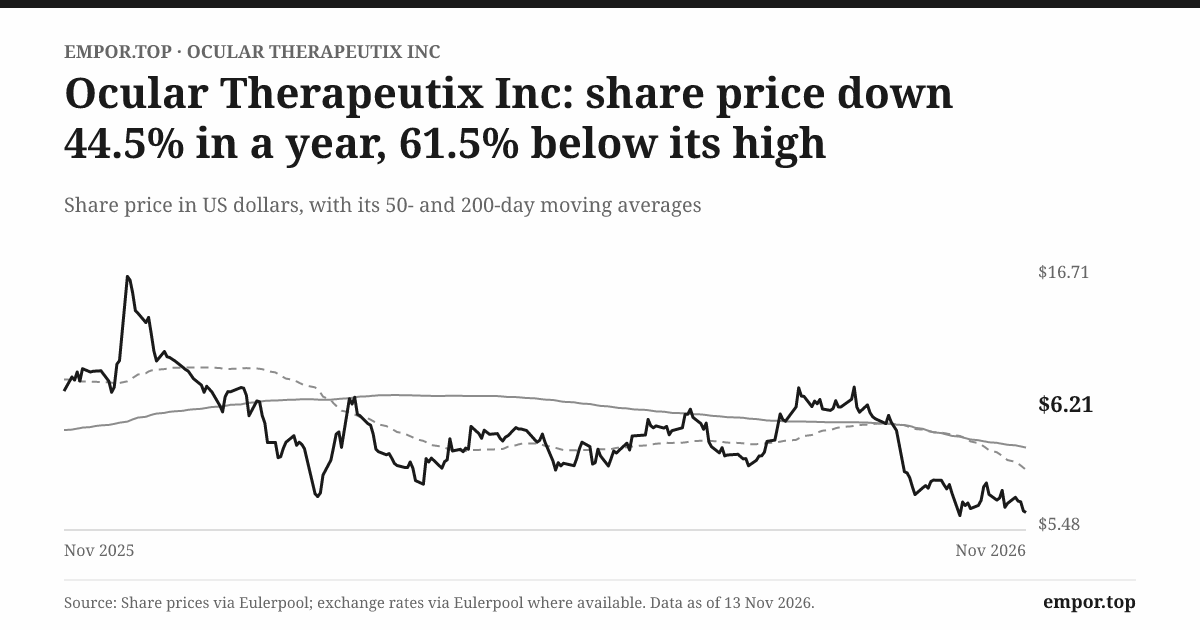
Then came the other numbers, the ones that explain why the stock did not behave like a stock on the eve of a filing. The company's only commercial product, a dissolving eye insert called DEXTENZA, had brought in about $12.9 million in the quarter.3 The net loss for the same three months was $94.8 million.3 Put those two figures side by side and the shape of the business is plain: for every dollar the existing product earned, the company lost more than seven. On November 13, the shares closed at $6.21, giving Ocular a market value of about $1.6 billion, and the price sat more than 60% below its high of the past year.4
That is the mismatch at the heart of this story. Investors are being asked to value a company that sells roughly $50 million of product a year at something close to thirty times those sales, and the gap is not explained by the product that exists. It is explained by the product that does not yet, at least not in a pharmacy, a clinic, or a reimbursement schedule.
AXPAXLI is an investigational implant that its developer hopes will let patients with wet AMD go much longer between treatments than today's injections allow. If it is approved with a good label and adopted by retina specialists, the current valuation may look modest in hindsight. If it stumbles at the FDA, or wins approval but struggles to displace entrenched incumbents, the company will have spent a very large sum building toward a market it cannot reach.
It helps to be clear about what a New Drug Application is and is not. It is a request, not a verdict. The company sends the FDA its trial data, its manufacturing information and its proposed label; the agency first decides whether the package is complete enough to review, and then spends many months deciding whether the drug's benefits outweigh its risks and what the label may say. A positive trial earns a company the right to ask. It does not guarantee the answer, and it says nothing about whether doctors will use the product once it is allowed.
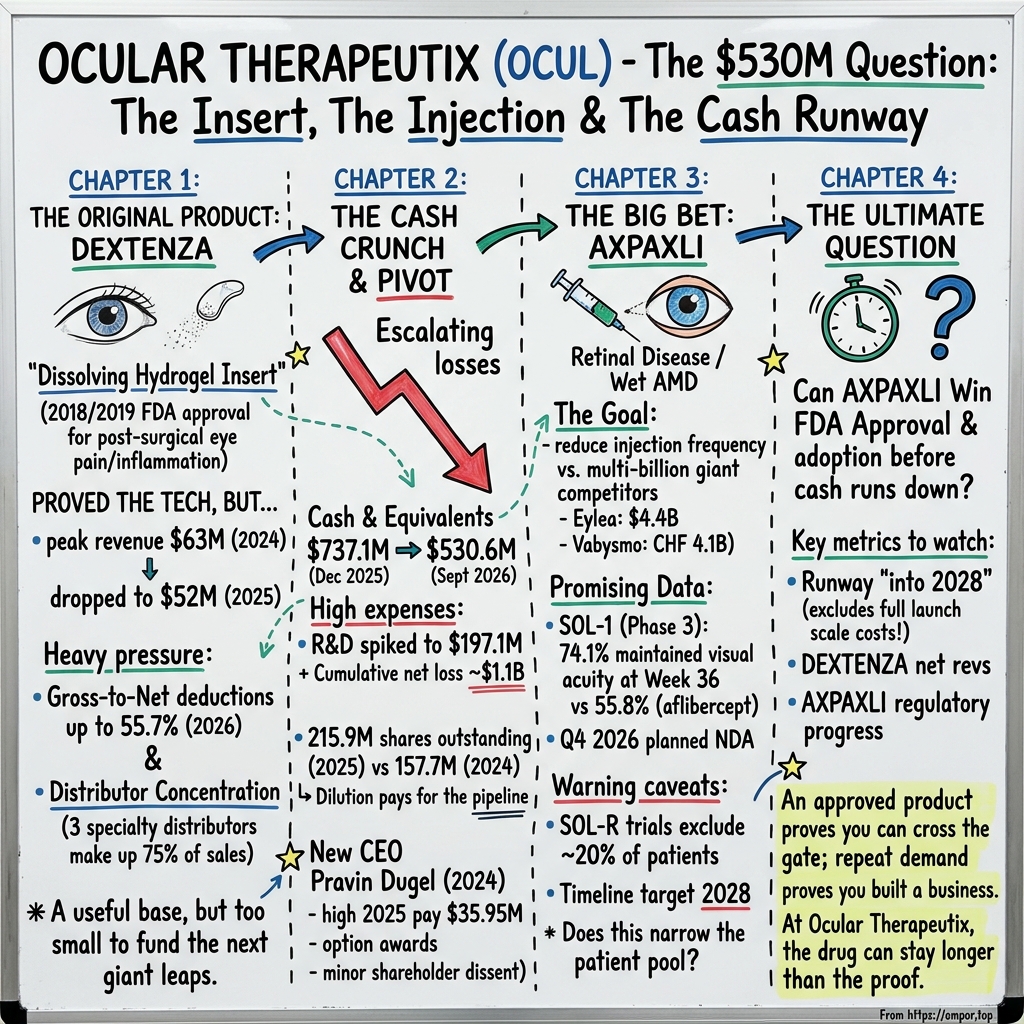
So this episode is organised around four questions, and they are worth stating plainly at the start. Can AXPAXLI win approval and then adoption, two very different achievements? Can DEXTENZA remain a dependable base while its net price erodes? Will $530 million cover both the remaining trials and a launch, or will shareholders be asked to pay again? And does the evidence, weighed honestly, justify the price the market sets today?
One boundary matters before the story begins. Ocular Therapeutix is an independent Delaware company listed on Nasdaq; it has no parent, and no single shareholder controls it.5 There is no larger pharmaceutical group to absorb a bad quarter or to lend it a sales force. Its value rests on its own products, its own pipeline, and its own ability to raise money. That independence is part of the appeal, because the upside is undiluted by a parent's priorities. It is also part of the risk, because every launch dollar has to come from DEXTENZA, from the bank balance, or from new shareholders.
The company's history explains why it ended up here. Ocular did not begin as a retina company. It began as a company that wanted to solve a smaller, more mundane problem: getting drugs to stay in the eye long enough to work. The first time it succeeded, it learned how hard it is to turn a clever delivery system into a business. That lesson is the right place to start.
 Subscribe on LinkedIn
II. A Drug Delivery Company Gets Its First Product Across the Finish Line
Anyone who has had cataract surgery, or cared for a parent who has, knows the ritual that follows. The operation itself is quick. The weeks afterward are a schedule of eye drops: a steroid to calm inflammation, often several times a day, tapering over weeks, alongside other drops for infection. For an elderly patient with arthritis, poor eyesight in the other eye, or a shaky memory, squeezing the right bottle into the right eye at the right time is not trivial. Drops get missed. Drops land on the cheek. The surgeon's careful work depends, in the days that follow, on a patient's ability to aim a bottle.
Ocular Therapeutix was built on the idea that the eye could be dosed differently. The company was incorporated in Delaware in 2006 and grew up in the Boston area around a hydrogel technology: a soft, water-swollen polymer, related to the material in some surgical sealants, that can hold a drug and release it slowly as the gel itself breaks down.6 Think of it as a sugar cube that dissolves on a schedule, except that the "sugar" is a medical-grade polymer and the schedule is measured in weeks.
The technology came from a licensor, Incept, to whom Ocular still pays royalties on product sales.5 The company's first approved product was not a drug at all but ReSure, a hydrogel sealant used to close incisions after cataract surgery, and by the time it filed to go public in June 2014 it was pitching investors on a pipeline of sustained-release drug products built on the same chemistry.6 The shares began trading on Nasdaq under the ticker OCUL in July 2014.5
The flagship of that pipeline became DEXTENZA. The product is a tiny rod of hydrogel loaded with dexamethasone, a standard steroid. At the end of surgery, the physician places it in the canaliculus, the small drainage channel at the inner corner of the eyelid that normally carries tears away into the nose. From there, the insert releases the steroid onto the eye's surface for up to about a month and then softens and clears without needing removal.7 The pitch to a surgeon is simple: one placement, by a professional, instead of a month of drops managed at home.
The choice of location is cleverer than it first sounds. Eye drops are an inefficient way to dose the eye: most of each drop spills over the lid or drains straight down the tear duct within minutes, which is why patients must repeat them so often. By parking the drug reservoir inside that same drainage channel, Ocular turned the eye's escape route into a slow-release depot. The hydrogel swells slightly once in place, which helps it stay put, and it softens as the weeks pass. The idea is not to make a stronger drug. It is to make an ordinary drug behave better.
Getting that rod to market took longer than anyone planned, and the delay is instructive. The science held up; the factory did not, at first. The FDA's first rejection, a complete response letter in July 2016, cited deficiencies in manufacturing processes and controls found during an inspection of Ocular's plant, and the company said no efficacy or safety problems had been raised.8 A resubmission followed.
In July 2017 the agency rejected the application again over manufacturing and analytical testing, issuing the second letter a day after Ocular had filed its response to the inspection findings.8 For a small company, two manufacturing rejections in a row are not a footnote. They cost time and cash, and they taught a lesson that will matter again later in this story: making a sustained-release product reliably, at scale, is a capability in its own right.
The third attempt worked. DEXTENZA was approved in late 2018 for pain after eye surgery, and in 2019 the label was extended to inflammation after eye surgery, which is the indication that maps most closely onto the post-cataract routine.7 Later approval for itching associated with allergic conjunctivitis widened the label further.7 Ocular had done the thing that most drug-delivery start-ups never do: it had taken a platform idea through clinical trials, through a stubborn FDA review, and onto the market.
The revenue line shows what happened next. Product sales were trivial in 2018 and 2019, around $4 million in the second year, because the product had to win a reimbursement code, convince surgery centers to stock it, and persuade surgeons to change a habit. Then the curve bent. Revenue rose from about $4 million in 2019 to a peak of about $63 million in 2024.57 That is a real commercial ramp. A medicine that did not exist on hospital shelves six years earlier was being used often enough to produce more than $60 million of net sales a year.
But the ramp had a shape that a careful investor should notice. Growth fell from triple digits in 2020 and 2021 to under 10% in 2024. And then, in 2025, revenue fell by about 19%, to roughly $52 million.5 On the three years from 2022 to 2025, the compound growth rate is effectively zero. The product did not collapse, but the story of a steadily compounding commercial franchise did.
It helps to separate two claims that are often blurred together. The first is that DEXTENZA proved Ocular could develop, manufacture, win approval for, and sell a hydrogel drug product. That claim is true, and it was hard-won. The second is that DEXTENZA proved the hydrogel platform would become a large and growing business. That claim the record does not support. Six years after launch, the product's sales remain smaller than many single-product specialty companies reach in their second or third year, and they are concentrated in one molecule, one use, and one channel. Every other candidate the company has pointed to over the years has had to earn its place on its own clinical and commercial merits; the DEXTENZA approval did not do that work for them.
Nor did DEXTENZA ever fund the company. Ocular has lost money every year of its public life, and over the twelve years through 2025 its cumulative net loss was about $1.1 billion.5 The first product was supposed to be the bridge to the next generation. Instead, the bridge needed its own scaffolding of equity raises the whole way across.
Which leaves a question that the 2025 decline makes urgent. If the technology worked, and surgeons used the product, why did growth stall before DEXTENZA could carry its share of the bill for the future? The answer is not in the laboratory. It is in the unglamorous plumbing of how an eye-surgery product is bought, paid for, and discounted.
III. The $63 Million Product Meets a Harder Market
Picture the end of a routine cataract operation in an ambulatory surgery center. The new lens is in, the incision is sealed, and the surgeon has a choice that takes seconds. One option is to place a DEXTENZA insert before the patient leaves the room. The other is to do what generations of eye surgeons have done: hand the patient a prescription for steroid drops and a printed schedule. The second option costs the surgery center nothing, requires no inventory, and fits every surgeon's habits. The first requires the center to have bought the insert, to be confident it will be reimbursed, and to believe the convenience is worth the extra step.
The economics of that choice are less obvious than the clinical ones. A surgery center is generally paid a set amount for performing a cataract operation, and anything it consumes during the procedure comes out of that payment unless the drug is paid for separately. A product like DEXTENZA therefore lives or dies on two questions at once: does the surgeon think it helps the patient, and does the facility believe it will be made whole for buying it?
When the second answer wobbles, even a surgeon who likes the product may find the purchasing department reluctant. That is why a company selling a physician-placed drug spends so much energy on billing codes and reimbursement support, and why its sales can move for reasons that have nothing to do with how well the drug works.
That moment, repeated many thousands of times a year, is where DEXTENZA's revenue is decided. And the money takes a winding path to get there.
How the money really moves
Ocular sells DEXTENZA mainly to specialty distributors, which then supply ambulatory surgery centers, hospital outpatient departments and physician offices; it also sells directly to some of those sites.5 The company does not book the sticker price. It records revenue after subtracting the discounts it offers, the chargebacks distributors claim when they sell at contracted prices, rebates, distribution fees, and expected returns.5 That subtraction has a name in the industry, gross-to-net, and for DEXTENZA it has become the most important number in the business.
The buyer and the user are different people, and that matters. Surgeons and facilities decide whether a patient receives the insert. Distributors, meanwhile, hold the invoices. In 2025, three unnamed specialty distributors accounted for 75% of Ocular's revenue, with the largest alone at 42% and the second at 24%.5 Those same three accounted for 82% of the money owed to Ocular at year-end.5 Concentration of that kind is common in specialty pharmaceuticals, where a handful of wholesalers handle most of the country's volume, and it has eased slightly from 85% in 2023.5
But it means that a contract dispute, a change in a distributor's inventory policy, or a payment delay at one firm could move Ocular's quarter. The company does not name the three distributors, and it does not disclose their contract lengths, any minimum purchase commitments, or how much DEXTENZA they resell each period.5 Investors can see the shipments into the channel; they cannot see how quickly product moves out of it.
What the discounts reveal
Here is the clue that explains much of the stall. In 2024, Ocular's provisions for discounts, rebates and other deductions equalled 38.5% of gross DEXTENZA sales. In 2025 that rose to 51.6%, and in the first nine months of 2026 it reached 55.7%.52 Management attributed the increase mainly to an off-invoice discount strategy, in effect lowering the price that buyers actually pay without changing the list price.5
Translate that into dollars a listener can hold. In 2024, for every $100 of DEXTENZA billed at list price, Ocular kept about $61 after deductions. By the first nine months of 2026, it kept about $44. Now run the arithmetic backwards. If net revenue fell from about $63 million to about $52 million while the share kept fell from roughly 61% to roughly 48%, then gross sales at list price were roughly flat to slightly higher between those two years. The decline in reported revenue, in other words, came almost entirely from what Ocular gave back, not from fewer inserts going out the door. This is an inference from the company's own percentages rather than a unit figure it publishes, but the direction is unambiguous.
That reframes the 2025 decline. It does not look like a product that surgeons abandoned. It looks like a product whose maker decided it had to pay more to keep its place, and which then had to watch its net price absorb the cost. The nine-month comparison through September 2026 tells the same story at a gentler slope: product revenue of about $37.1 million, against $38.6 million a year earlier, while the deduction rate kept rising.2 Volume may be holding; realisation is not.
Why would a company with a differentiated product cut its effective price? The likely answer lies in what DEXTENZA competes against. A course of generic steroid drops is cheap, familiar, and requires nothing from the surgery center. The insert's advantage is convenience and adherence, real benefits for patients and arguably for outcomes, but benefits that must be paid for by someone in a system where facilities are reimbursed on fixed schedules. When the advantage is convenience rather than a clinical result a payer must cover, the manufacturer's pricing power is thin. Ocular's own discounting is the market's verdict on how much that convenience is worth at the margin. The record does not show pricing power; it shows the opposite.
Slow money and careful accountants
A second clue sits on the balance sheet. At the end of 2025, net receivables were about $30.7 million against annual net revenue of about $52 million, which works out to roughly 219 days of sales outstanding.5 That is a long time for a pharmaceutical product, and the measure has drifted up from about 165 days in 2022.5 It is tempting to read it as customers paying late. The evidence does not quite allow that conclusion.
Receivables fell slightly during 2025 and contributed cash rather than absorbing it, and when gross-to-net deductions are large, receivables are often booked at gross amounts that are later reduced by chargebacks and rebates, which inflates the ratio against net revenue.5 Ocular does not publish an aging table, customer-level overdue balances, or a quantified allowance for bad debts.5 The honest reading is that 219 days is a flag to watch alongside the distributor concentration, not proof of a collection problem.
The auditors were watching too. PricewaterhouseCoopers issued a clean opinion on the 2025 financial statements and on internal controls, but it identified revenue recognition as the critical audit matter, focusing on the estimates behind the variable-consideration reserves and on confirming receivables.5 That is not a qualification or a warning; critical audit matters are routine disclosures of the hardest judgments in an audit. It does confirm where the judgment lives in this business: in the size of the discounts, and in how much of the gross invoice will ultimately turn into cash.
There is one more claim on DEXTENZA's economics worth noting in passing. The company's secured lender, Barings, receives a royalty-style fee linked to DEXTENZA sales as part of its loan terms, and Incept collects its licence royalty, about $1.7 million in 2025.5 Neither is large, but both take a slice before shareholders do.
Put the clues together and the verdict on DEXTENZA comes into focus. It is a real, approved product with repeat purchases from surgery centers that have chosen to use it, and it generates tens of millions of dollars a year that partly offset the company's spending. But the claim that it enjoys a durable advantage, the sort that lets a company hold price while volumes grow, is rejected by its own recent history.
Net realisation has fallen year after year, three distributors hold most of the channel, and generic drops remain the default alternative. The number that will tell investors whether this changes is quarterly net DEXTENZA revenue read alongside the gross-to-net percentage; if deductions stabilise while net revenue grows, the product's base is firming, and if deductions keep climbing, the base is being bought rather than earned.
At about $50 million a year, DEXTENZA can help pay the bills. It cannot justify a $1.6 billion valuation, and management no longer asks it to. The company's much larger claim now rests on a different product, aimed at a different part of the eye, in a market where the incumbents sell billions of dollars a year.
IV. Pravin Dugel Bets the Company on AXPAXLI
The man who now runs Ocular spent most of his career with a needle in his hand. Pravin Dugel trained at Columbia, UCLA's medical school, the USC Eye Institute and the Bascom Palmer Eye Institute, and for more than a quarter of a century, from 1994 to 2021, he was a managing partner at Retinal Consultants of Arizona, one of the larger retina practices in the United States.9 In that job, wet AMD was not an abstraction. It was the patient in the chair every four, six or eight weeks, getting another injection into the eye to keep a leaking blood vessel from destroying central vision.
In April 2020 he moved into industry, joining IVERIC bio, a company developing treatments for retinal disease, as chief strategy and business officer; he became its president in May 2021 and held that role until October 2023.9 Ocular brought him in as executive chairman in February 2024 and made him president and chief executive in April 2024.9 The arrival of a retina surgeon with a recent record of taking a retina drug through approval and a sale signalled what the board wanted. Ocular would no longer be primarily a front-of-the-eye company with a steroid insert. It would bet on the back of the eye, where the money is.
The patient problem and the proposed answer
Wet AMD is a disease of ageing in which abnormal blood vessels grow beneath the retina and leak fluid and blood, scarring the macula, the small patch of retina responsible for sharp central vision. Untreated, it can take away the ability to read or recognise faces within months. The modern treatment, introduced in the mid-2000s, is a class of drugs that block vascular endothelial growth factor, or VEGF, the signal that tells those vessels to grow and leak. They work remarkably well. Their weakness is that they wear off, so patients return for injections, often for years.
That treatment burden is the opening Ocular is targeting, and the incumbents are formidable. Regeneron's Eylea and its higher-dose successor, Eylea HD, generated about $4.4 billion of combined U.S. sales in 2025.10 Roche's Vabysmo, which blocks two pathways at once and was designed partly to extend the interval between injections, generated about CHF 4.1 billion of sales in 2025.11 Each of those franchises sells, in roughly a month, about what Ocular's entire business sells in a year. And both have already competed on the same axis Ocular wants to compete on: Eylea HD and Vabysmo were marketed in large part as ways to give injections less often.
AXPAXLI takes a different route to the same destination. Instead of an antibody, it uses axitinib, a small-molecule drug that blocks the VEGF receptor from inside the cell, and it embeds that drug in a bioresorbable hydrogel implant injected into the eye's vitreous, where it releases axitinib over many months and then dissolves.5 The family resemblance to DEXTENZA is obvious: the same company, the same core polymer, the same idea that the gel, not the patient, keeps the schedule. The difference is that this time the product competes against drugs that are already highly effective, sold by two of the best-resourced companies in medicine.
It is worth being precise about what "fewer injections" means as a business claim. A longer dosing interval is a genuine patient benefit, and many retina specialists say treatment burden is the main reason real-world outcomes lag trial results. But convenience is a hypothesis about adoption, not a fact about it. It has to survive the label the FDA grants, the reimbursement a clinic receives, and the economics of a retina practice that, today, is paid every time a patient comes in for an injection.
The clinic's side of that equation deserves a closer look, because it is where many promising long-acting products have struggled. In the United States, retina specialists typically buy injectable drugs, administer them in the office and are then reimbursed by Medicare or private insurers for both the drug and the visit. A practice's revenue, staffing and scheduling are built around a steady flow of injection appointments.
A product that halves those visits is wonderful for a ninety-year-old patient who depends on a relative for every trip to the clinic. For the practice, it means fewer billable visits per patient, unless the freed capacity is filled with new patients or the new product is reimbursed generously enough to compensate. None of this makes adoption impossible; physicians did embrace Eylea HD and Vabysmo partly because they extended intervals. It does mean that "fewer injections" is not automatically a selling point to the person who decides which product to use.
What SOL-1 showed
SOL-1 was designed to answer the efficacy question as sharply as possible. Patients newly diagnosed with wet AMD received loading injections of aflibercept, Eylea's active ingredient, and were then randomised to a single AXPAXLI implant or a single 2 mg aflibercept injection, with the question being how many kept their vision without needing rescue treatment over the following months.512 The trial was built as a superiority test, a higher bar than merely showing the new product is not worse.
The result, announced in February 2026, met the primary endpoint. At Week 36, 74.1% of AXPAXLI patients maintained their visual acuity, against 55.8% of those who received aflibercept.12 At Week 52, 68.8% of AXPAXLI patients remained free of rescue injections, against 47.7% in the aflibercept arm.12 In plain terms: a year after a single implant, roughly two in three treated patients had not needed another treatment, against fewer than half of those who had received a single standard injection.
That is meaningful positive evidence, and it should be given its weight. It is also bounded in ways that matter. The comparator was one dose of aflibercept 2 mg, not the regularly repeated dosing patients actually receive in practice, so SOL-1 shows durability relative to a single injection rather than equivalence to a full treatment regimen. Safety across repeated implants, in a larger population and over several years, is still being accumulated. And the trial does not tell investors what the FDA will allow the label to say about dosing frequency, which is the claim on which the commercial case depends.
The package, the second trial, and the fine print
The plan management laid out on the November call was to file in the fourth quarter of 2026 under the 505(b)(2) pathway, a route that allows a sponsor to rely partly on existing knowledge of an already approved molecule, using SOL-1's efficacy data through Week 52, safety data from SOL-1 and an interim analysis of the second Phase 3 trial, SOL-R, plus confirmatory evidence.1
Dugel said the safety database would include more than 300 patients with at least a year of follow-up, all of whom would have received repeat dosing, and that SOL-R's efficacy readout was not required for U.S. approval, though it matters more for some regulators outside the United States.1 The company said the September pre-NDA meeting reaffirmed alignment with the FDA on that package.2 That was management's characterisation of a private meeting; the agency itself has not said anything publicly, and acceptance of the filing will be the first independent check.
SOL-R is the trial that tests AXPAXLI in the shape of real-world maintenance: redosed implants compared with aflibercept given on a regular schedule. Two design features deserve to sit right beside the excitement about SOL-1.
The first is who gets in. SOL-R excludes patients who show early persistent retinal fluid or significant fluctuations in fluid during a run-in period before randomisation. Nadia Waheed, the chief medical officer, said on the call that preliminary screening data suggested about 20% of otherwise eligible patients had been excluded for those reasons, and she tied the choice to a post hoc finding from SOL-1 that roughly 28% of AXPAXLI-treated patients had early persistent fluid or variability and did worse visually.1
The reasoning is coherent: identify the patients the implant serves well and study it in them. The consequence is equally clear. A positive SOL-R would describe a more selected group than the broad wet-AMD population, and if a similar screen ends up in the label or in physicians' practice, the addressable market shrinks by a comparable share.
The second is when the trial is judged. SOL-R's primary endpoint moved from Week 56 to Week 40.2 Waheed explained that the change lets every patient complete the primary efficacy visit before the planned interim safety analysis is unmasked, protecting the trial from operational bias; she noted that Week 40 remains beyond the FDA's 36-week minimum in draft guidance and that the statistical penalty was minimal. Key secondary endpoints at Weeks 56 and 96 are preserved, and topline data are expected in the first quarter of 2028.12
Analysts pressed on the change. Asked by TD Cowen whether the FDA had requested it, Dugel declined to detail the agency interactions and said the discussion began after a Type C meeting in May.1 Asked by Bank of America whether the FDA had been consulted on labelling, he said the company was not yet in labelling discussions, while saying he expected "the first and only superiority label" and dosing "every 6 to 12 months."1
That exchange is a fair test of credibility, and it cuts both ways. The explanation for the endpoint change is technical and plausible, and nothing in it suggests the trial is in trouble. But an earlier primary endpoint, a narrower enrolled population, and a CEO describing a label the FDA has not yet discussed add up to a story that is running a little ahead of its proof. The company also lengthened the dosing interval in its SOL-X extension work from 24 to 48 weeks, citing SOL-1's durability, a choice that signals confidence but that will itself need data.1
Proportion about the rest of the pipeline
Ocular also points to diabetic retinal disease as the next market for AXPAXLI, and it is running HELIOS-3, a Phase 3 trial, in that area.2 Diabetic retinopathy is a large population that today is often watched rather than treated, so a long-acting option could matter. But it is a Phase 3 programme, not revenue, and history counsels caution: DEXTENZA's approval did not convert the rest of the hydrogel pipeline into products. The nearer test is wet AMD, and it should not be crowded out by the further one.
The verdict on AXPAXLI, then, is that SOL-1 is strong evidence for efficacy and durability against a single standard injection, and the filing plan is concrete. What remains unproven is everything that turns a trial into a business: the FDA's decision, the safety profile at scale, the label's dosing language, how the selected-patient design of SOL-R generalises, and whether retina specialists change their routine. The event that will first confirm or weaken the case is the FDA's acceptance of the filing and the review that follows. Until then, the company has to keep paying for all of it, and the bill has been rising quickly.
V. The Pipeline's Price Is Paid in Cash and Shares
At the end of 2025, Ocular's balance sheet looked like a fortress. Cash and cash equivalents stood at $737.1 million, almost all of it parked in money-market funds.5 It had never held anything close to that sum. Nine months later, the figure was $530.6 million.2 About $206 million had gone in three quarters, roughly $69 million a quarter, while the company was still a year or more from any possible AXPAXLI revenue. A fortress is reassuring. A fortress with a drawbridge that lowers itself every quarter is a different thing.
This section follows that money: where it went, where it came from, and what the runway estimate does and does not include.
What the money buys
The spending curve tracks the strategic turn. Research and development rose from about $62 million in 2023 to $197 million in 2025.5 In 2023, R&D was roughly equal to revenue. By 2025 it was almost four times revenue. The single largest driver of the 2025 increase was about $62 million more in direct spending on the wet-AMD AXPAXLI programme.5 Capital spending jumped as well, from about $1.3 million in 2024 to $12.0 million in 2025, as the company scaled up manufacturing.5 Given those earlier manufacturing delays with DEXTENZA, investing in production capacity before an AXPAXLI filing is not optional; it is the lesson of 2016 and 2017 being applied.
The company employed 325 full-time staff at the end of 2025, 154 in research and development and 98 in sales and marketing.5 That is the profile of a company that has built a clinical engine and kept a commercial team for DEXTENZA, but has not yet built the larger field force and medical-affairs organisation that a retina launch against Regeneron and Roche would require.
What none of this money buys yet is earnings. Operating losses widened from about $82 million in 2023 to $270 million in 2025, and the quarterly losses through 2026 have run higher still.52 The cash is purchasing trial enrolment, manufacturing capacity, regulatory work and pre-launch preparation. Those are investments in an option, and their return depends entirely on whether the option pays out.
Loss versus cash, at the right scale
A reader scanning the long history might notice something that looks encouraging. Over the twelve years through 2025, Ocular's cumulative net loss was about $1.1 billion, while the cumulative cash it burned in operations was about $848 million.5 Is the business less cash-hungry than its losses imply?
Only modestly, and for reasons that offer no comfort. The 2025 bridge shows the mechanism. A net loss of $265.9 million turned into an operating cash outflow of $204.9 million because about $53 million of the loss was non-cash, mostly $43.2 million of stock-based compensation, with smaller amounts of depreciation, non-cash interest and a derivative loss, and because working capital released about $8 million.5 Stock compensation does not drain the bank account, but it is not free: it is paid in shares, and shares are the other currency this company spends. The gap between loss and cash is not hidden profitability. It is the part of the bill that shareholders pay through dilution rather than through the cash balance.
How the bank account was filled
If DEXTENZA did not fund the pipeline, the capital markets did. The recent record reads as a sequence of substantial raises. In December 2023, a public offering raised about $108 million net. In February 2024, a private placement of shares and pre-funded warrants raised about $316 million net, timed close to Dugel's arrival. In 2025, at-the-market sales raised about $94 million by June, and then, in October 2025, a public offering raised about $446 million net, with existing large holders including FMR-, Avoro- and Venrock-affiliated funds participating.59
Those raises are why the company enters its filing year with a substantial cushion, and the willingness of specialist investors to keep writing cheques is itself a signal that informed money believes in the programme. The cost is visible in the share count. Common shares outstanding rose from about 158 million at the end of 2024 to about 216 million at the end of 2025, an increase of more than a third in a single year, with pre-funded warrants still being exercised into early 2026.5 Interest income on the cash pile, about $18 million in 2025, softened the losses a little but cannot change the arithmetic.5 The capital plan has been equity-funded from the start, and nothing in the operating results suggests that will change before AXPAXLI sells.
There is no acquisition story to weigh here. Ocular's capital has gone into its own trials, its own plant and its own launch preparation rather than into buying assets, so the question is not whether management overpaid for a deal but whether the internal programme earns back what it has cost.
Debt is not the near danger
The company does carry debt: an $82.5 million secured term loan from Barings, fully drawn, due in August 2029, floating at SOFR plus 6.75% with a 1.5% floor.5 The loan carries a first-priority lien over substantially all assets, including intellectual property, and a covenant requiring at least $20 million of liquidity.5 Those are tough terms, the kind a lender sets for a company that is losing money. But against more than half a billion dollars of cash, the principal is manageable, and the company reported no covenant breach.5 The lien matters more as a constraint than as a threat: any future partner or acquirer would have to deal with a lender holding a claim over AXPAXLI's patents. The nearer funding risk is not refinancing. It is the burn rate.
Testing "into 2028"
Management's guidance is that the cash on hand will fund planned operations into 2028, a statement repeated on the November call with one crucial qualifier: the estimate excludes the full anticipated expenses of commercialising AXPAXLI.12
A rough sanity check shows why the qualifier matters. At the nine-month burn rate of about $69 million a quarter, $530 million lasts about seven and a half quarters, which lands in the middle of 2028, consistent with management's language. But that burn rate does not include a retina launch.
If the filing goes in this quarter and the FDA follows a standard review clock, a decision would likely come sometime in the second half of 2027, and a company that intends to launch would need to hire field teams, build inventory and fund medical education before then. SOL-R's topline data are due in the first quarter of 2028, around the same point the runway runs thin.1 The likely sequence, then, is that Ocular will need new money, or a partner, before it knows what SOL-R shows and before AXPAXLI has generated a dollar of sales.
The call offered some insight into launch preparation. David Robinson, the global chief commercial officer, said pre-approval discussions with payers had reached all of the company's top-priority accounts, covering roughly 84% of commercial lives.1 What the call did not offer was a quantified launch budget. That is the question a sceptical investor should keep asking: how much will the build-out cost, when will it be committed, and which assumptions in the runway have changed since the prior guidance.
Each of the ways to close that gap carries its own cost. Another equity raise is the most familiar route and the most dilutive, and its price depends on where the shares trade when the money is needed, which today is well below where they stood a year ago. A royalty or structured-debt deal would avoid selling shares but would hand a slice of AXPAXLI's future sales to a financier and add to the claims already held by Barings.
A commercial partnership with a larger ophthalmology company would bring a sales force and a balance sheet, but it would also give away a large share of the economics that justify the current valuation. None of these is a failure; they are the normal tools of a company in Ocular's position. The point is that the price of each will be set by how convincing the evidence looks at the moment the company has to choose, which ties the financing directly to the FDA timeline.
The verdict is that Ocular has substantial liquidity relative to its debt but is not a self-funding business, and its runway language describes the development plan rather than the commercial one. As before, the next chapter will depend on issuing shares. The base case, absent a partnership, is that it will again, which puts a great deal of weight on the people deciding when and how to raise it.
VI. A New CEO, a Large Award, and a Diluted Share Count
The 2025 summary compensation table is a single line of numbers, but it tells a story about what Ocular's board believes it bought when it hired Pravin Dugel. His reported compensation for the year was about $36 million, nearly double the $19 million reported for 2024.95 Of the 2025 total, about $34 million, roughly 95%, came from the grant-date value of stock and option awards; his salary was about $0.8 million and his bonus about $0.9 million.9 In the same year, the company's net loss widened from $193.5 million to $265.9 million.5
On its face, that juxtaposition looks damning. Taken carefully, it is more ambiguous, and the ambiguity is the point.
A team built for a filing
Dugel has assembled a leadership group that looks like it was recruited for exactly one task: getting a retina product through the FDA. The chief medical officer, Nadia Waheed, is a retina specialist and imaging expert; the chief scientific and chief development officers, Jeffrey Heier and Peter Kaiser, are well-known retina clinicians.9 That depth of clinical credibility matters when the company's main argument rests on trial design and the interpretation of imaging data, and it showed on the November call, where Waheed handled the hardest questions on the endpoint change and patient selection.1
The finance seat has been less settled. Donald Notman, the long-time CFO who had also become chief operating officer, took a temporary medical leave in January 2026, and the company appointed Jason Robins as chief financial officer in June 2026.139 Robins had joined the company's finance team in early 2025 after a stint at Fusion Pharmaceuticals.9 A CFO transition in the year a company is preparing a filing and, almost certainly, its next financing is not a red flag on its own, but it means the person who will design that financing is new to the top job.
What the team has not yet done together is launch a product into a competitive market. Ocular's own commercial record under any management is DEXTENZA, whose net sales have fallen as discounts rose. The new leadership's record of commercial execution is therefore short, and the evidence that would lengthen it lies ahead.
Pay, dilution, and the vote
Almost all of Dugel's 2025 pay came in equity, which means its eventual value depends on the share price. In principle that is alignment: if AXPAXLI succeeds, he gets rich alongside shareholders; if it fails, the options may be worthless. The share price has fallen sharply since those grants were made, which illustrates the mechanism working in both directions. The counterargument is about scale and timing. The grants arrived in a year when existing holders had already absorbed a large increase in share count, and equity awards are themselves another layer of dilution.
Shareholders noticed. At the June 2026 annual meeting, the say-on-pay proposal passed, but about 40.1 million shares voted against it and 116.1 million for, so roughly a quarter of the votes cast on the question opposed the pay package.14 Votes against of that magnitude are not a rebellion, but they are well above the low single digits that most well-regarded boards receive, and they are the sort of signal compensation committees are expected to answer. At the same meeting, shareholders approved an additional 10 million shares for the company's incentive plan.14 So the message was mixed: investors were willing to fund more equity awards, but a sizeable minority was uncomfortable with the size of the ones already granted.
Ownership adds context. As of March 31, 2026, all executive officers and directors as a group beneficially owned about 3.1% of the company.9 The largest outside holders were specialist and institutional investors: FMR at about 14.5%, Avoro Life Sciences at about 5.8%, Summer Road at about 5.5% and Deep Track at about 5.1%, with BlackRock reporting about 7.0% as of June 30.915
No holder controls the company, and the presence of specialist healthcare funds that have bought into successive offerings gives the board a demanding audience. Because the share count changed so much in 2024 and 2025, those percentages are snapshots against a moving denominator; insiders' stake is meaningful in dollars but small as a fraction of the company. Directors and officers are restricted from pledging or hedging their shares.9
One related-party arrangement deserves a sentence of proportion. In 2025, Ocular paid about $761,000 in clinical-services fees to Boston Image Reading Center, where Waheed is a director, about 1.5% of revenue.5 Reading centres that grade retinal images are a normal part of retina trials, and the sum is small next to a $197 million R&D budget. It merits disclosure and board oversight, particularly since the company does not describe the pricing as arm's-length in its related-party note, but it is not where the company's economic exposure lies.5
How credibility gets earned from here
The fair verdict is that Dugel has done what he was hired to do so far: he concentrated the company on its most valuable asset, recruited clinical leaders with standing in the retina community, delivered a positive pivotal trial and brought the company to the edge of a filing. Those are real accomplishments, and they are the reason specialist investors keep backing the company. Against that, the pay is large relative to delivered commercial results, the share count has risen steeply, and a quarter of voting shareholders signalled discomfort.
A sceptical shareholder could reasonably press the board on three points. The first is whether future awards will be tied more tightly to milestones that the company does not control by itself, such as FDA approval, label terms and net sales, rather than to the passage of time or to share-price moves driven by trial headlines.
The second is how the board weighs the cost of equity grants against a share count that has already risen steeply, since each award is paid by the same holders who funded the trials. The third is how the company will explain itself if the 2026 vote is repeated: boards that receive a quarter of votes against typically engage with shareholders and describe what they changed, and the next proxy will show whether Ocular's did.
The way to resolve the tension is not to argue about it but to watch. If the filing goes in on time, the FDA accepts it, SOL-R proceeds without further design changes, DEXTENZA's net revenue stabilises and the next financing is struck on good terms, the leadership will have earned its awards. If timelines slip, the story keeps changing shape, or dilution accelerates before AXPAXLI sales, the 2026 vote will look like an early warning. Either way, Ocular's experience so far holds lessons that reach beyond one company.
VII. Business & Investing Lessons
There is a particular moment that sums up Ocular's first chapter: a surgeon, at the end of a cataract operation, slipping a dissolving insert into a tear duct while the patient is still on the table. It is a small, elegant solution to a real problem, and it took a decade, two manufacturing rejections and a great deal of shareholder money to make that moment possible. The lessons of this company begin there.
The first lesson is about the gap between approval and a business. Founders in medical technology often treat the regulatory gate as the finish line, and investors often reward them for it. Ocular's record suggests the opposite emphasis. An approved product proves you can cross the gate; repeat demand at a stable price proves you built a business.
The second lesson concerns what kind of advantage a delivery technology actually creates. In DEXTENZA's case, convenience has not preserved price. AXPAXLI faces the same test at much higher stakes: its longer dosing interval is a patient benefit only if the trial result survives the label, reimbursement, and the economics of the retina clinic. Investors should treat every claim about fewer injections as a claim that still has to clear all three.
The third lesson is written in the share register. The raises extended the runway, and specialist investors who know the field kept buying, but each one diluted existing holders. Cash buys time, but every new share asks existing owners to pay for another chapter.
The fourth lesson comes from SOL-R's patient selection. Selecting the patients most likely to respond is a legitimate way to run a trial, and it may well produce a cleaner answer. But every patient excluded from the study is a patient the eventual label may not cover, and every screening step written into the protocol is a step a busy clinic may have to repeat before prescribing. The scientific choice and the commercial consequence are the same decision seen from two sides. A trial that chooses its patients also chooses its market.
The fifth lesson is a warning against a seductive word. The public evidence supports a narrower claim: Ocular has deep experience making and gaining approval for hydrogel products, and that experience is worth something, especially in manufacturing, where it was hard won. But there is little evidence yet of pricing power, of low switching costs, or of a repeatable engine that turns pipeline candidates into revenue. A platform is a promise until it has produced a second commercial success.
Taken together, these lessons say that technical differentiation and regulatory success matter, and that neither substitutes for adoption, net pricing and cash generation. Ocular has proven the first two once. The open question, now priced into the shares, is whether it can prove all of them at once, in a market where the competition is far larger. That requires weighing the bull and bear cases directly.
VIII. Analysis & Bear vs. Bull Case
On November 13, 2026, Ocular's shares closed at $6.21, about 62% below their 52-week high.4 A casual observer might assume something had gone badly wrong. In fact, in the months since that high, the company had reported a positive pivotal trial, held a pre-NDA meeting it described as positive and announced a filing for this quarter.121 The fall is not a story of failure. It is the market re-pricing the distance between a trial result and a business, and deciding that distance is longer, costlier or riskier than it had hoped.
What the price assumes
At that price, the company was valued at about $1.6 billion, or about $1.0 billion of enterprise value after netting its cash and debt.4 Against roughly $50 million of trailing revenue, that is about 31 times sales, or about 21 times on an enterprise-value basis. Those multiples have no meaning as a valuation of DEXTENZA. A product with falling net prices and a single-digit market share of post-operative steroid use would not command thirty times sales in any market. The price is a wager on AXPAXLI.
The multiple's own history makes the point. Ocular traded at about 4 times sales in 2022 and about 6 times in 2023, before AXPAXLI became the centre of the story. The multiple then rose to about 22 times in 2024 and about 52 times in 2025 as the trial approached.16 Today's 31 times is well below that peak but still far above where the company traded when investors valued it mainly as a DEXTENZA business. The fall from the high does not make the shares cheap against current sales. It means the market is assigning a lower, though still substantial, probability-weighted value to the retina programme.
A peer comparison is of limited help. EyePoint, another listed ophthalmic drug-delivery company developing a long-acting wet-AMD treatment, was reported at about 12.5 times sales, but its trailing revenue was only about $2.8 million after a collapse of more than 90%, so the multiple is nearly meaningless.17 Both companies are valued on their pipelines. The two even met in court: EyePoint sued Ocular in March 2026 over defamation and related claims, and the case was settled and dismissed in October 2026 with no payment between the parties.2 The episode is closed, but it is a reminder that the race for a long-acting wet-AMD treatment is crowded, and that the rivals know each other well.
The bull case, stated narrowly
The bull case rests on one strong fact and several plausible consequences. The strong fact is SOL-1's superiority result. If the FDA accepts the filing, the safety database holds up and the label allows dosing every six to twelve months, AXPAXLI could offer something no approved wet-AMD drug offers today: a meaningful reduction in visits for a large share of patients.
Wet AMD is a multibillion-dollar category, so even a small share would dwarf DEXTENZA. The company has the cash to reach the filing and the review, a leadership team with credibility among retina specialists, and early payer engagement. On this view, today's market value is a fraction of what a successful launch could support.
The bear case, stated just as specifically
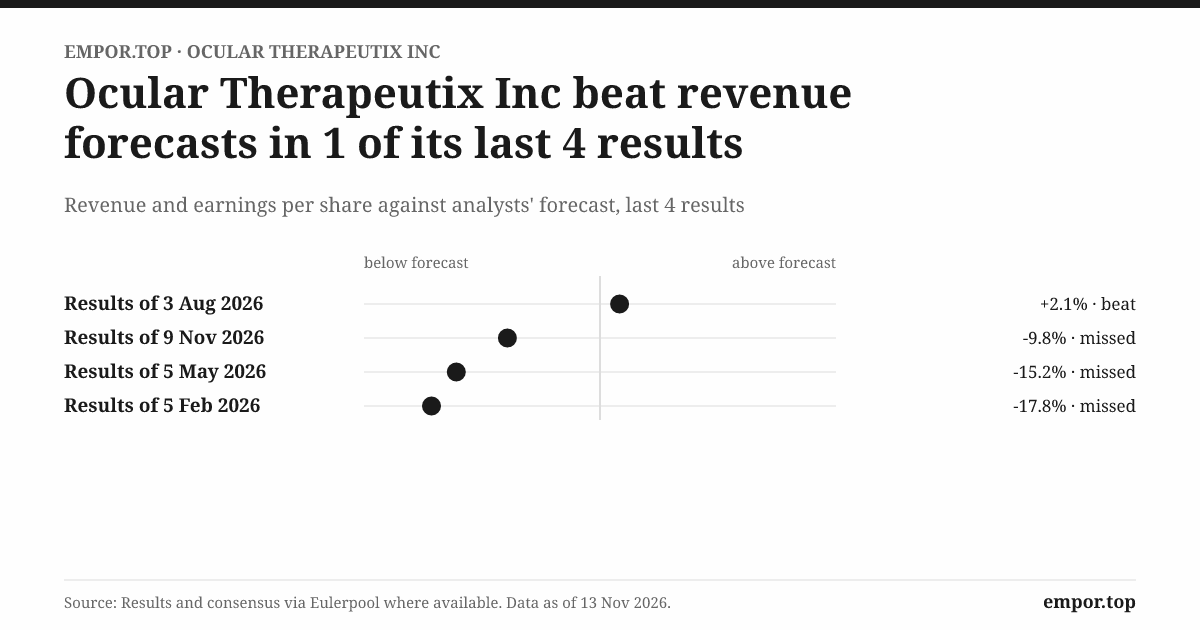
The bear case starts with the same trial. SOL-1 compared AXPAXLI with a single dose of aflibercept, not with the regularly repeated dosing physicians use, so its headline advantage overstates the practical gap. SOL-R, the trial that tests the real-world comparison, excludes about one in five otherwise eligible patients and had its primary endpoint moved earlier. Its efficacy results arrive in 2028, after the likely FDA decision and around the time the cash runway runs thin. The incumbents are enormous, have already built their marketing around longer intervals, and will defend their franchises. DEXTENZA, the company's only proof of commercial execution, has seen its net price fall and its revenue shrink. And the company will very likely need more capital before it knows whether AXPAXLI sells.
The forces at work
Michael Porter's five forces help show where the difficulties lie. Rivalry is the fiercest force: in wet AMD, Regeneron and Roche compete with branded products that are effective, familiar and backed by deep sales and medical-affairs organisations, and biosimilar versions of older anti-VEGF drugs are adding price competition. The threat of substitutes is real at both ends of Ocular's business: for DEXTENZA, cheap steroid drops; for AXPAXLI, the incumbents' longer-acting injections and other sustained-delivery candidates.
Buyer power is substantial, because physicians choose treatments, payers set coverage and reimbursement, and, in DEXTENZA's channel today, three distributors handle three-quarters of sales. Supplier power is moderate: Ocular relies on a small number of third-party manufacturers it does not name, as well as its own scaled-up plant, and the Incept licence takes a royalty.5 The threat of new entrants into wet AMD is low in the sense that a pivotal trial costs hundreds of millions of dollars, which is exactly the barrier Ocular has spent its shareholders' money to climb.
Hamilton Helmer's seven powers ask a narrower question: what durable advantage could Ocular hold? Counter-positioning is the most interesting candidate. A product that reduces visits could be awkward for incumbents whose businesses and physician economics are built around frequent injections, and they cannot easily copy a hydrogel implant without abandoning their own franchises. But counter-positioning only works if the new model is clearly better for the decision-makers, and retina practices are paid for injection visits, so fewer visits are not obviously in their interest.
Cornered resource is the second candidate, in the form of patents and manufacturing know-how around the hydrogel, but that resource is encumbered by the Barings lien and does not prevent rivals from pursuing long-acting delivery by other means. Scale economies, network effects, switching costs and brand favour the incumbents, not Ocular. Process power, in the sense of manufacturing expertise, is real but was learned through failure and is still being scaled.
The honest summary is that a delivery format may differentiate AXPAXLI, but it does not by itself corner the market. DEXTENZA demonstrated that differentiation without pricing power yields a modest business. AXPAXLI's differentiation is more clinically significant, which is why the stakes are larger, but the same test applies.
Scale, without false precision
It is tempting to translate the incumbents' sales into a forecast: if Eylea and Vabysmo sell billions, surely AXPAXLI could win a slice. That logic is incomplete. Those franchises are far larger than Ocular's current business.1011 The figures describe the size of the prize and the scale of the opponents. They do not describe what share a new entrant with a narrower studied population, a newly built commercial team and an unproven label will capture, or how quickly.
An activist with a short position would focus less on the science than on the sequencing. Why, such an investor might ask, should shareholders fund a full commercial build before the FDA has accepted the filing, or before SOL-R confirms the real-world comparison? Why not partner AXPAXLI now, while the SOL-1 data are fresh, and convert some of the risk into cash? And why should DEXTENZA keep absorbing deeper discounts if the product cannot fund itself at a stable price?
Management's implied answers are that keeping AXPAXLI's economics whole maximises value, that early payer and field preparation shorten the launch curve, and that DEXTENZA sustains relationships with eye surgeons. Those are reasonable positions, but they are bets on execution, and the activist's questions are the ones the next financing will force the company to answer in public.
Three numbers that will settle it
Three measures will do most of the work in confirming or rejecting the case. The first is DEXTENZA's quarterly net revenue read alongside its gross-to-net percentage: the latest readings show nine-month product revenue of about $37.1 million, slightly down on a year earlier, with deductions rising to 55.7% of gross sales.2 The direction is unfavourable. The second is cash burn and remaining runway once launch costs are included: cash fell by about $206 million in the first nine months of 2026, and the company says its runway estimate into 2028 excludes full commercialisation.2 The direction is, by design, downward. The third is AXPAXLI's regulatory progress and, if approved, paid uptake: the company plans to file this quarter, and paid uptake has, naturally, not yet begun.
The case would be falsified, or at least badly weakened, by any of several events: a delayed filing or an FDA demand for more data; SOL-R safety or efficacy results that undermine the selected-patient thesis; a continued decline in DEXTENZA; or launch spending that accelerates dilution well before AXPAXLI sales arrive. The bull case has a real clinical catalyst and a substantial cash cushion. The bear case has a small, pressured commercial base, formidable competitors, a high burn rate and no evidence yet of uptake. The valuation depends far more on AXPAXLI's future economics than on anything Ocular sells today, which is why the next eighteen months matter so much.
IX. Epilogue
Tonight, in mid-November 2026, Ocular Therapeutix is a company in the waiting room. The company says it plans to file before year-end.1 The planned interim SOL-R safety analysis is part of the package.1 The first efficacy readout remains expected in the first quarter of 2028.1 Cash continues to fall by tens of millions each quarter.2
The next chapters are already scheduled, which makes them easier to follow than most. The first is the submission itself and the FDA's decision on whether to accept it for review. Acceptance would be the first independent sign that the package management described, built on SOL-1's efficacy, the pooled safety database and confirmatory evidence, is complete enough to review. A refusal to file, or a request for more data, would push the timeline back and push the financing question forward.
The second chapter is the review. The FDA will look closely at safety, at repeat dosing and at what the label should say about how often patients can be treated. If the agency agrees with Dugel's hope for a superiority claim and a six-to-twelve-month dosing range, AXPAXLI would enter the market with the strongest possible pitch. If the label is narrower, perhaps tied to the patient selection used in SOL-R or to more frequent monitoring, the product would still be approved but the commercial story would shrink to fit.
The third chapter runs in parallel and is less dramatic but just as important. The quarterly DEXTENZA and cash figures will show whether the existing base is holding and how much runway remains. Somewhere along this road, the company will have to decide how to finance the launch, likely before SOL-R reads out, and the terms of that decision will say a great deal about how the market judges the probability of success.
The final chapter, if the others go well, is the one that matters most and the one no trial can predict: whether retina specialists, their patients and the payers who cover them actually choose a hydrogel implant over the injections they know. SOL-1 proved that AXPAXLI can last. The market will decide whether lasting is enough.
That is the decisive question Ocular leaves with anyone watching it. Can one less frequent treatment become enough of a commercial difference to overcome the scale of the incumbents?
X. Outro
Go back to that operating room at the end of a cataract procedure. The surgeon slips a sliver of gel into the corner of the eye, the patient goes home, and over the next few weeks the insert quietly does its work and then disappears. Nobody has to remember the drops. It is a small, clever thing, and it is real.
Ocular Therapeutix has spent twenty years trying to make that small, clever thing into something large: from a tear duct to the back of the eye, from post-operative inflammation to a disease that steals sight, from a $52 million product to a market in which the incumbents measure sales in billions. The technology has proved it can stay in the eye. The rest remains unproved. At Ocular Therapeutix, the drug can stay longer than the proof.
References
-
Q3 2026 Earnings Call Transcript — Ocular Therapeutix, 2026-11-09 ↩↩↩↩↩↩↩↩↩↩↩↩↩↩↩↩↩
-
Quarterly Report on Form 10-Q — Ocular Therapeutix, 2026-09-30 ↩↩↩↩↩↩↩↩↩↩↩↩↩↩
-
Q3 2026 Financial Results and Business Highlights — Ocular Therapeutix, 2026-11-09 ↩↩
-
Annual Report on Form 10-K — Ocular Therapeutix, 2025-12-31 ↩↩↩↩↩↩↩↩↩↩↩↩↩↩↩↩↩↩↩↩↩↩↩↩↩↩↩↩↩↩↩↩↩↩↩↩↩↩↩↩↩
-
Form S-1 Registration Statement — Ocular Therapeutix, 2014-06-20 ↩↩
-
Annual Report on Form 10-K — Ocular Therapeutix, 2021-12-31 ↩↩↩↩
-
FDA again rejects Ocular drug over manufacturing failings — Fierce Biotech, 2017-07 ↩↩
-
Definitive Proxy Statement — Ocular Therapeutix, 2026-04-30 ↩↩↩↩↩↩↩↩↩↩↩↩
-
Annual Report on Form 10-K — Regeneron Pharmaceuticals, 2025-12-31 ↩↩
-
Form 8-K: CFO appointment and annual meeting results — Ocular Therapeutix, 2026-06-12 ↩
-
Annual Meeting Results, Form 8-K — Ocular Therapeutix, 2026-06-12 ↩↩
 LinkedIn
 WhatsApp
 Reddit
 Hacker News
 Email
 Kindle
 RSS Feed
 Spotify
 Apple Podcasts
 Amazon Music
 Audible
 YouTube