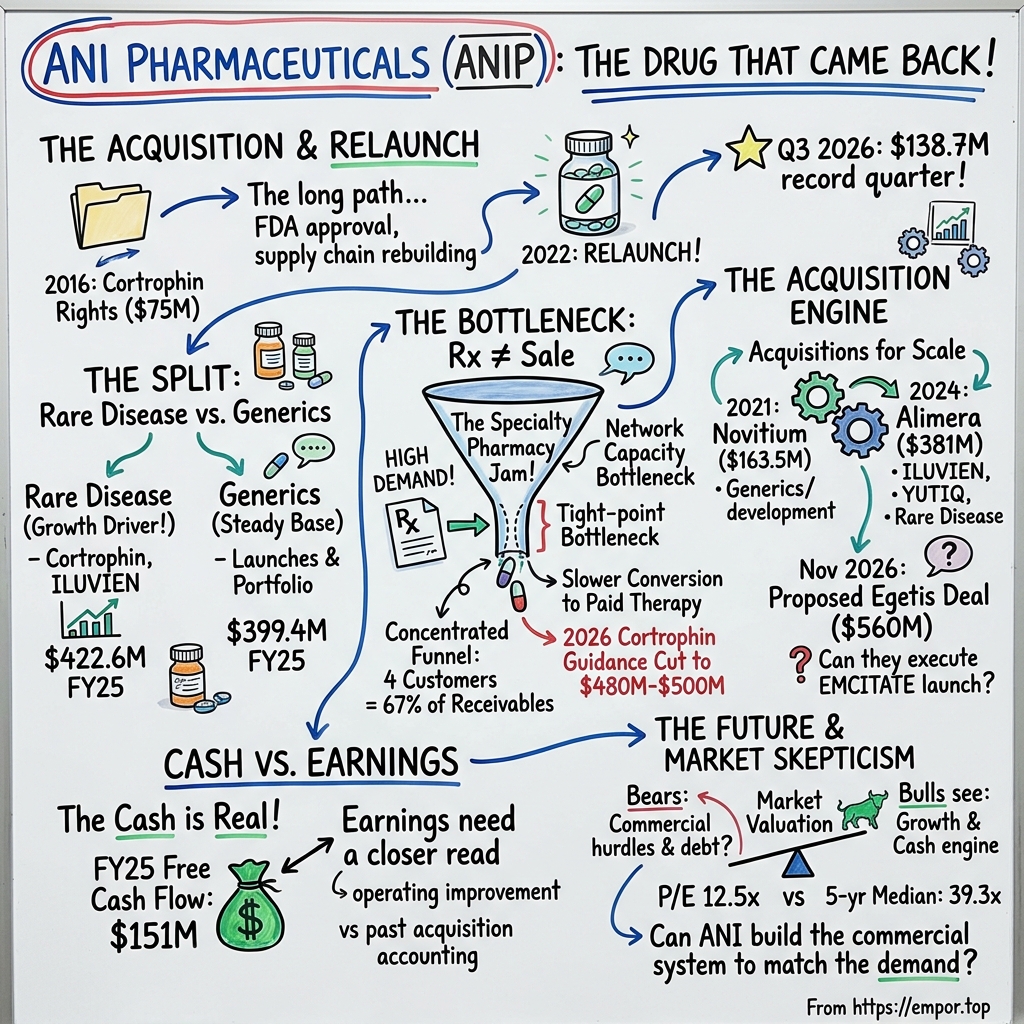
ANI Pharmaceuticals: The Drug That Came Back
I. Demand Was There. The Bottleneck Was the Pharmacy.
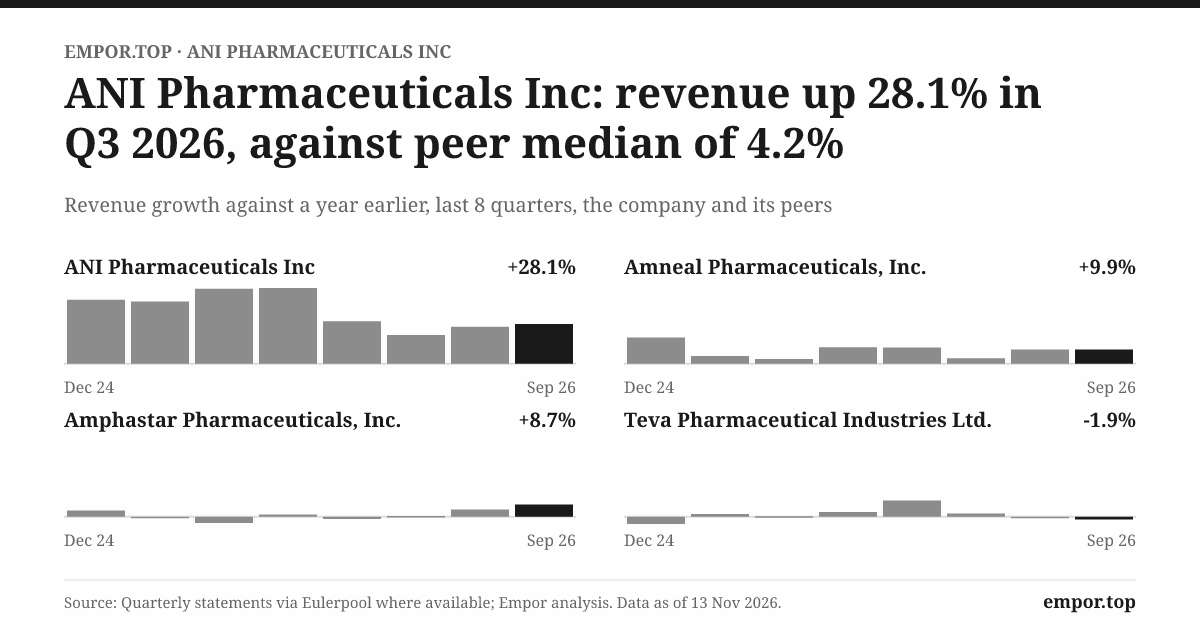
On the morning of November 5, 2026, ANI Pharmaceuticals published the best quarter in its history. Revenue had reached $290.8 million, up almost 28% on a year earlier.[^1] The star of the release was a product most investors had never heard of a decade ago: Purified Cortrophin Gel, an injectable hormone therapy that brought in $138.7 million in three months, 36% more than in the same quarter of 2025.[^1] For a company that, five years earlier, had sold about $208 million of medicines in an entire year, a single product earning two-thirds of that in one quarter is a remarkable thing.1
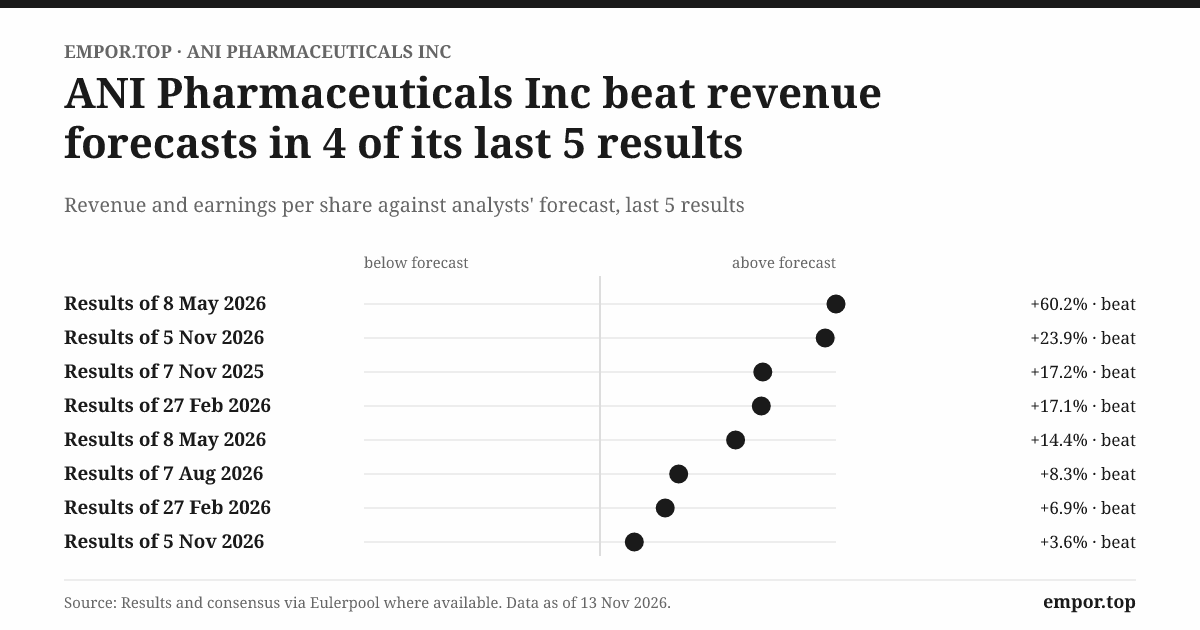
And yet the same release carried a sentence that took the shine off the record. ANI lowered its full-year forecast for Cortrophin to between $480 million and $500 million.[^1] It was the second cut in three months. In May, management had reaffirmed a range of $540 million to $575 million; in August, it trimmed that to $520 million to $540 million; now it was lower again.23 Worse, the quarter itself had fallen short of the $143 million to $153 million that management had pointed to on its summer call.4
The explanation was unusual. The problem was not that doctors had stopped prescribing the drug, or that a rival had undercut it on price, or that a factory had failed an inspection. The problem was that too many patients wanted it at once. ANI had spent the spring pushing Cortrophin into a new use, the treatment of acute gout flares, and the response from doctors had been strong.
Chief executive Nikhil Lalwani told analysts that new gout cases had doubled from the second quarter to the third, and that the number of doctors writing gout prescriptions had risen by about two-thirds.5 Over the five months since the gout launch, new Cortrophin cases ran about 85% higher than in the five months before it.5
Those cases, however, had to travel through a narrow pipe. Cortrophin is not a pill a patient collects at the corner drugstore. It is dispensed through specialty pharmacies, which verify insurance, chase prior authorizations, coordinate with the prescriber's office and only then ship a vial to the patient. Management said the flood of new gout cases "put pressure on our specialty pharmacy network capacity," and that the jam spilled over to slow processing for patients in the neurology, nephrology, rheumatology and eye-care practices that had been Cortrophin's established base.5
Many of the new prescribers were primary-care and podiatry offices that had never prescribed this class of drug before, and they were still learning the paperwork. That ramp, Lalwani said, "has taken a bit longer than we had anticipated."5
So here is the paradox that frames this story. ANI has built a growth engine that, by the company's own count, is gaining ground in a market for this hormone class that management expects to reach about $1.3 billion in 2026.5 It has evidence that doctors want to use its product in more patients. And it has just told investors that it cannot turn that interest into paid prescriptions as quickly as it promised, twice in a row.
Is this a temporary capacity problem, the kind of growing pain that disappears once a few more pharmacies are signed up and a few hundred office managers learn the forms? Or is it a signal that commercializing a specialty drug is harder, slower and more dependent on outside partners than ANI's growth story has implied? An analyst on the November call asked whether the quarter would have hit its target without the conversion problems. Lalwani's answer was one word: "Absolutely."6 That is a claim, not a proof, and it is the first thing this story has to test.
There are two other questions running underneath it. The first is whether ANI's acquisitions, which have transformed it from a small generics maker in rural Minnesota into a company guiding to more than $1 billion of revenue, have built useful capabilities at sensible prices.[^1] On the same day it reported the record quarter, ANI announced an offer to buy a Swedish rare-disease company, Egetis Therapeutics, for about $560 million.[^8]
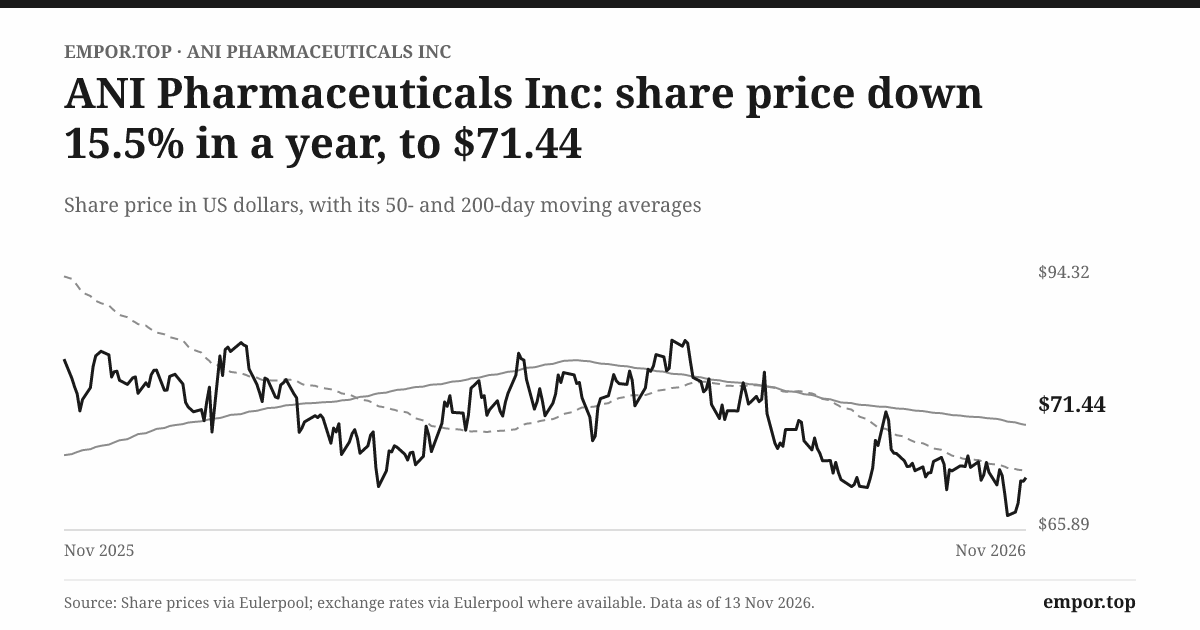
The second question is about price. On November 13, 2026, ANI's shares traded at about $71, giving the company a market value of roughly $1.3 billion and a price of about 12.5 times trailing earnings, against a median of about 39 times over the previous five years. Either the market sees something the growth numbers hide, or it is being unusually stingy.
To answer any of those questions, it helps to know how a generics company came to own a drug like Cortrophin in the first place, and why it took six years to sell a single vial.
 Subscribe on LinkedIn
II. The Company That Bought Back Its Old Drug
In January 2016, ANI was a small and slightly odd pharmaceutical company headquartered in Baudette, Minnesota, a town on the Canadian border.7 Its business was a collection of niche generic drugs and older branded products, many of them made in its own plant, chosen because they were too small or too awkward to attract heavy competition.
On January 5 of that year, ANI closed a deal that looked, at the time, like a long shot. It paid Merck $75 million in cash, plus a percentage of future net sales, for two old New Drug Applications: one for Purified Cortrophin Gel and one for a related zinc formulation of the same hormone.7
What ANI had bought was a set of rights, not a business. The drug was a purified form of adrenocorticotropic hormone, or ACTH, the signal the pituitary gland sends to tell the adrenal glands to produce the body's own anti-inflammatory steroids. Products of this kind had been used for decades to treat flares of autoimmune and inflammatory conditions, including rheumatoid arthritis, lupus, multiple sclerosis relapses, certain kidney diseases and some inflammatory eye conditions.1
Merck's Cortrophin had not been sold for years. Meanwhile, the one ACTH product still on the American market, Acthar Gel, had become a very large and very expensive franchise for a single seller. ANI's bet was simple to state and hard to execute: if it could bring an approved competitor back to market, it would be entering a large, high-priced category held by a single seller.
The hard part was everything between owning an approval and selling a medicine. An old drug application is a little like the deed to a house that has been empty for twenty years. The paperwork says the house is yours, but the plumbing has rotted, the wiring no longer meets code and the inspector will want to see everything before anyone moves in.
ANI had to find a source for the active ingredient, which for ACTH means a reliable supply of the biological raw material from which the hormone is extracted and purified. It had to rebuild a manufacturing process that met modern standards, prove to the Food and Drug Administration that the product it made was consistent with the original, and do this with outside partners, because ANI did not make the active ingredient or fill the gel itself.1
That work consumed the second half of the decade. The FDA approved ANI's supplemental application for Cortrophin Gel in late 2021, and ANI prepared to launch in early 2022.1 Nearly six years had passed between the purchase and the first commercial sale, years in which ANI's own profits shrank and then turned into losses.
In 2020 and 2021, ANI lost money on an operating basis, partly because it was paying for Cortrophin's rebirth and other investments before they produced revenue.1 Patience of that kind is easy to praise in hindsight. In 2019 it looked a lot like a company spending money on a product that might never arrive.
The relaunch also required something ANI had never really had: a rare-disease commercial organization. Selling a generic tablet means winning contracts with wholesalers and pharmacy chains, a business of price and reliability. Selling Cortrophin meant hiring sales representatives to call on specialists, building a patient-support service to help families navigate insurance, negotiating access with payers and contracting with specialty pharmacies to dispense the drug.
That is a different kind of company, with different people and a different cost base. The choice to build it is the real inflection in ANI's history. The founding of the company, its years as a contract manufacturer and its earlier mergers matter far less to an investor today than the decision to move from a portfolio of acquired generics toward products that ANI could actively sell.
It worked better than almost anyone outside the company expected. Cortrophin sales reached $348 million in 2025, and in the third quarter of 2026 alone the product generated $138.7 million.2[^1] Measured crudely against the $75 million purchase price, ANI now earns that sum from Cortrophin in less than three months. The real cost was higher, of course: years of development spending, the royalty owed to Merck, the cost of the commercial team and the patient-support machinery. But even after adjusting for those, the Cortrophin purchase looks like one of the better small acquisitions in American specialty pharma in the past decade.
That verdict deserves one immediate qualification. A product can have regulatory approval and strong demand while still depending on a fragile route to the patient. Cortrophin's revenue rests on a chain of outside parties: the supplier of the active ingredient, the contract manufacturer, the payers who decide whether to cover it, the specialty pharmacies that dispense it and the wholesalers that pay ANI.
Every link worked well enough to take the product from nothing to $348 million in four years. The autumn of 2026 showed what happens when one link, the pharmacy network, falls behind. Before following that thread, though, it is worth seeing how much of ANI now hangs on this one product, and what else the company has bolted around it.
III. One Drug, Two Commercial Systems
Look at ANI's results for the third quarter of 2026 and the company appears to be two businesses sharing a ticker. On one side sits Rare Disease and Brands, led by Cortrophin and by ILUVIEN, an eye implant ANI acquired in 2024. Together, that segment produced $182.3 million of revenue in the quarter.[^1] On the other side sits Generics and Other, a broad portfolio of off-patent medicines that produced $108.4 million.[^1] The first side is where the growth, the headlines and most of the valuation argument live. The second is older, steadier and, in revenue terms, still enormous.
The full-year picture for 2025 shows how evenly balanced the company was until very recently. Of $883.4 million of revenue that year, Rare Disease products contributed $422.6 million, Brands $61.3 million and Generics and Other $399.4 million.8 In other words, generics were still about 45 cents of every revenue dollar. By the third quarter of 2026, Cortrophin alone was close to half of all company revenue. That is the most important structural fact about ANI today: a business that once diversified its risk across hundreds of small products now has a single product that drives almost half its sales and most of its growth.
Where the growth actually came from
It is tempting to read ANI's revenue line as one smooth organic climb. Revenue grew from about $208 million in 2020 to $883 million in 2025, a compound rate of about a third a year, and the pace accelerated to about 41% a year over the three years to 2025.18 But much of that came from buying businesses, not just growing them. The acquisition of Novitium Pharma in late 2021 greatly expanded ANI's generics engine, and the purchase of Alimera Sciences in September 2024 added ILUVIEN and a second eye product, YUTIQ.[^11][^12]
When ANI explained its 43.8% revenue growth in 2025, it pointed to Cortrophin volume gains, a full year of the Alimera products and new generic launches.8 ANI does not publish a clean organic growth bridge that strips out the acquired products, so the honest statement is that Cortrophin's growth is organic and large, while a meaningful slice of the rest of the Rare Disease increase in 2025 reflected the first full year of owning Alimera.
ILUVIEN is a small implant injected into the back of the eye that slowly releases a steroid for up to three years, used for diabetic macular edema; YUTIQ uses similar technology for a chronic inflammatory eye disease.8 They are real products with real prescribers, and in the third quarter ILUVIEN revenue grew 34% to $22.3 million.5
ANI raised its full-year ILUVIEN forecast to between $80 million and $85 million.5 But they are a fraction of Cortrophin's scale, which is why management's argument for the Alimera deal rested partly on overlap: retina specialists are also potential Cortrophin prescribers for certain inflammatory eye conditions, and ANI said Cortrophin volumes in its combined ophthalmology and retina team were doubling year over year.5
The generics machine
The generics business runs on a different logic entirely. A generic drug is a copy of a medicine whose patents have expired, and its economics resemble a game of musical chairs. When a company launches a generic early, with few competitors, it can earn healthy margins. As more manufacturers file and win approval, prices fall, sometimes sharply, and the product becomes a commodity.
The way to win is not to own any single product forever but to keep launching new ones, to favor products that are hard to make or have small markets that discourage crowds, and to run the factories efficiently. ANI said it had launched sixteen generic products by the third quarter of 2026, and its generics revenue grew about 11% to $104.5 million in that quarter.5
That is a respectable engine, but it is not a moat. No single generic product stays profitable forever, because substitution is the whole point of the category: pharmacies and wholesalers will switch suppliers for a lower price, and payers encourage them to. What ANI's generics business offers instead is breadth, cash flow and manufacturing capability, including the development team and plants that came with Novitium.
Management has guided that fourth-quarter generics revenue will look similar to the third.6 The question an investor should ask is not whether generics will grow quickly, but whether they will keep throwing off cash while the rare-disease side absorbs the company's attention and capital.
Which segment actually makes the most money? ANI does not report standalone segment operating profit in a way that settles the question. It reports revenue by segment and product, and a consolidated gross margin. Rare-disease products, which carry high prices and do not face direct generic substitution, almost certainly earn higher gross margins than commodity generics, and management's adjusted gross margin of 61.8% in the third quarter, up from a year earlier, is consistent with the mix shifting toward Cortrophin.4
But the commercial infrastructure behind a rare-disease product, from specialist sales teams to patient hubs, is expensive, and those costs sit in operating expenses rather than cost of goods. So revenue leadership is clear. Profit leadership is plausible but unproven from the company's own disclosures.
There is also a quieter third stream hidden inside the Brands line, and it says something about how ANI makes money from intellectual property it does not sell itself. ANI receives royalties on WAKIX, a sleep-disorder drug marketed by Harmony Biosciences, along with occasional development milestones. In the third quarter, that relationship contributed $9.5 million of royalties and $2.0 million of milestone revenue.[^1]6
Royalty income like this carries almost no cost of goods or sales force, so it punches above its weight in profit even though it is small in revenue. It is also outside ANI's control: the growth of the royalty depends on Harmony's commercial execution, and milestones arrive when a partner's program hits a step, not on a schedule ANI sets. It is a pleasant cushion under the quarter, not a pillar of the thesis.
Cortrophin did not enter an empty market. ANI names Acthar Gel, now marketed by Keenova Therapeutics, as its principal competitor.8 Acthar's maker, Mallinckrodt, reported $677.5 million of Acthar sales in 2025, nearly twice Cortrophin's $348 million that year.92 So ANI is the challenger in a two-player branded market, and the incumbent has the larger sales force, the longer relationships with specialists and decades of habit on its side.
ANI says Cortrophin has been gaining market share, and its own forecasts imply Cortrophin growing far faster than the ACTH category as a whole.5 If management's expectation of a roughly $1.3 billion category in 2026 is right, Cortrophin's revised guidance would put it at a bit under 40% of the market.5
That is real traction. It is not, however, proof of a durable moat. Market-share gains in the early years of a challenger product are what one would expect when a newcomer offers a lower-cost alternative to an expensive incumbent and invests heavily in getting noticed. The test of durability comes later: whether Cortrophin holds share and price when Acthar invests in its own commercial programs, when payers squeeze both products, and when new treatments for the underlying diseases change how often doctors reach for an ACTH therapy at all.
On the November call, management said it saw no significant change in access across the category.5 That is reassuring for now and says nothing about 2028.
There is one more vulnerability hiding behind the growth: supply. ANI relies on third parties for key parts of its manufacturing, including single-source arrangements for products such as Cortrophin and ILUVIEN.8 The company generally qualifies only one source of active ingredient per product, and one domestic supplier alone accounted for 26% of its raw-material purchases in the first nine months of 2026.10
That is common in specialty pharma, where qualifying a second supplier can take years and cost millions. But it means a quality problem at a single partner could interrupt sales of the product that now carries the company. Demand risk, it turns out, is not the only risk in the pipe. The next question is how much of that pipe ANI actually controls.
IV. A Prescription Is Not Yet a Sale
Picture a podiatrist's office in a mid-sized American town in the summer of 2026. A patient limped in with a gout flare, the kind of joint pain that made a bedsheet feel like a brick. The usual treatments were not suitable for this patient, and a sales representative from ANI had recently explained that Cortrophin was another option. The doctor wrote the prescription. In the language of a pharmaceutical company's dashboard, that was a "new case." It was also the very beginning of a long journey, and ANI would not get paid until the end of it.
Walk the chain step by step. First, the prescription goes to a specialty pharmacy, which has to confirm the patient's insurance and, almost always for a high-priced injectable, obtain prior authorization from the payer. That requires paperwork from the doctor's office: diagnosis codes, history, sometimes evidence that other treatments failed. An office that has never prescribed an ACTH therapy before has no muscle memory for this, so forms come back incomplete and the clock runs.
ANI's patient-support team may step in to help the family understand coverage and copay assistance. Once the payer approves, the pharmacy ships the drug, often with nursing or injection training. ANI recognizes revenue when its product moves to its customers, and then waits to be paid by those customers, which are mostly large wholesalers and distributors.8 Every link has its own queue.
What ANI discovered in 2026 is that demand can rise faster than the queue can move. The gout expansion, which management said targeted an addressable population of roughly 285,000 patients, brought a wave of new prescribers who were, in management's words, "naïve to ACTH."35 Those offices needed more hand-holding.
The specialty pharmacies, already serving the established neurology, kidney and eye-care prescribers, suddenly had more cases than staff to process them. The result was the gap between the headline that new cases rose about 85% and the reality that full-year sales guidance fell.5 In plain terms, ANI proved it could create demand faster than it could convert it.
This was not the first stumble in the year. In May, ANI said its first quarter had been held back by insurance re-verifications, the annual ritual each January when patients' coverage has to be confirmed again, which it said "took slightly longer to clear" because of higher patient volume and weather-related office closures.2 In August, it lowered the Cortrophin range by about $35 million at the midpoint with only a terse explanation that it was "modestly adjusting" guidance based on the first half.3
In November it cut again and, this time, laid out the pharmacy bottleneck in detail.5 Taken one at a time, each explanation is plausible. Taken together, they form a pattern: three quarters in a row in which the route from prescription to revenue proved slower than management's models assumed. An independent write-up of the third quarter called the conversion shortfall "a recurring pattern rather than a one-off," and the record supports that reading.4
What did management offer as remedies? On the November call it described strengthening support at existing specialty pharmacies, adding pharmacies to serve regions with especially high demand, expanding the patient-support team that works with offices new to ACTH, and adding dedicated resources for the insurance re-verification season in early 2027.5 It said it was evaluating further pharmacy expansion for 2027 and beyond, and that it had seen "modest improvements" in the time from prescription to first fill in late September and October, without giving a number.5
It also said its revised guidance did not assume the full benefit of these fixes.6 Those are concrete steps, and conservatism in a third guidance range is sensible. But on the question of foreseeability, the answer was softer: management said it knew demand would rise, but that it rose "significantly in excess of what we had originally anticipated."6 An investor can reasonably ask why a company launching into a new physician audience of that size did not build pharmacy capacity before the launch rather than after it.
Analysts also raised softer third-party prescription data during the call, and management chose to point back to its own measures of new cases and prescribers rather than address the outside numbers directly.6 That is not necessarily evasive, since external prescription trackers can miss specialty-pharmacy dispensing. But it means the clean test sits in ANI's own future results: does time to first fill improve, and does that improvement show up as paid Cortrophin revenue in the first half of 2027?
There is a second chain to watch, and it is about money rather than patients. ANI sells most of its products through a handful of very large wholesale distributors. In the first nine months of 2026, four customers accounted for roughly 59% of revenue, and at the end of September those same four accounted for 67% of net receivables, the money owed to ANI.10
ANI itself says that the payment terms it negotiates with these customers materially affect its liquidity and working capital.10 When three or four buyers sit between you and nearly all of your revenue, they hold real bargaining power: over terms, over fees and over how quickly cash comes back.
The longer history here is encouraging, though it does not settle the current question. ANI's debtor days, the number of days of revenue sitting in receivables, peaked at 217 in 2021, when the company was absorbing Novitium and launching Cortrophin, and fell to 116 by 2025.18 That is a big improvement, and it means ANI collects its bills much faster than it did four years ago.
But an annual average cannot tell an investor how quickly the largest balances are being paid today, and ANI does not publish an ageing table showing how much of its $304.5 million of receivables is current versus overdue.10 Nothing in its filings suggests these balances are in trouble, and the company has not reported a major customer failure. The point is narrower: concentration makes collections a lever that a few counterparties can pull.
Revenue is also an estimate as much as a number. Every sale through wholesalers carries deductions for chargebacks, rebates to payers, administrative fees, returns and prompt-payment discounts, and ANI has to estimate many of them in advance. The company says a 10% change in its 2025 estimate of administrative fees alone would have moved revenue by $8.7 million.8 For a product like Cortrophin, where access depends on payer contracts, those estimates are a quiet source of judgment in every quarter's results.
So the forces around ANI cut both ways. Concentrated buyers have leverage. Generic substitution limits pricing on half the business. On the other side, FDA approval, specialized manufacturing and focused specialist sales teams make Cortrophin hard for a newcomer to copy quickly. But the single-source supply model and the reliance on outside pharmacies can interrupt sales just as surely as a competitor can. Demand is proven; dependable conversion is not yet. What happens to that demand once it does convert is the next question, because the cash it generates has to fund everything else ANI wants to do.
V. The Cash Is Real; the Earnings Need a Closer Read
For most of the past decade, ANI's income statement told a gloomier story than its bank account. Between 2014 and 2025, the company reported cumulative net profit of only about $33 million. Over the same twelve years, it generated about $571 million of cash from operations.81 That is a ratio of more than seventeen dollars of operating cash for every dollar of reported profit.
Read quickly, it sounds like a company whose true earning power has been hidden by accounting. Read carefully, it is a company whose accounts have been shaped by acquisitions, losses and growth, and the gap needs to be explained rather than celebrated.
Start with why the gap exists at all. When ANI buys a product or a company, most of the price is recorded as intangible assets, such as product rights and acquired technology, and those assets are then amortized, written down a little each year as an expense. Amortization reduces reported profit but costs no cash, because the cash went out the door on the day of the acquisition. The same is true of stock-based compensation, which is a real cost to shareholders through dilution but not a cash payment.
Changes in the fair value of earnouts and other contingent payments also move profits without moving cash. And the years 2020 to 2022, when ANI reported losses, dragged the cumulative profit figure down.1 ANI's filings do not divide the twelve-year gap neatly among these causes, and no one should pretend to know the exact share each contributes. But the direction is clear: much of the gap reflects acquisitions paid for in cash up front and expensed slowly afterward. That means the cash flow is real, but so was the cash spent buying the assets that produce it.
The recent improvement is more impressive than the long-run average. In 2025, ANI generated $185 million of operating cash flow and about $151 million of free cash flow after capital spending, and it ended the year with about $286 million of cash.8 In the first nine months of 2026, operating cash flow reached $198.8 million, including a record $83.8 million in the third quarter alone.106 For a company with a market value of about $1.3 billion, that is a lot of cash.
Part of the improvement came from fixing working capital. Think of the cash conversion cycle as the number of days between paying for raw materials and collecting cash from customers. In 2021, ANI's cycle stretched to 430 days, well over a year, because the company held a lot of inventory and waited a long time to be paid.
By 2025, it had fallen to 184 days, helped by inventory days dropping from roughly 300 to about 120 and debtor days falling sharply.18 Some of that is better management. Some of it is mix: Cortrophin's high price relative to its physical volume makes a dollar of Cortrophin revenue need less inventory than a dollar of generics. Either way, it released a lot of cash.
There is a second reason to read earnings carefully, and it runs in the opposite direction. ANI's management prefers adjusted measures. For 2026 it guides to adjusted earnings per share of $9.37 to $9.71 and adjusted EBITDA of $290 million to $300 million.[^1] Its reported, GAAP diluted earnings over the twelve months to September 2026 were about $5.28 per share.[^1]10
The gap between those two numbers is mostly amortization of acquired intangibles, stock compensation and acquisition-related items. Management's preferred measure is not wrong, but it treats acquired intangibles as if they cost nothing to replace, and a company that keeps buying products to stay ahead of generic erosion does have to keep paying for them.
The balance sheet captures the trade-off. At the end of September 2026, ANI held $420.8 million of unrestricted cash against $616.9 million of principal debt, including $316.3 million of 2.25% convertible notes due 2029 that it issued in 2024 to fund the Alimera deal.[^1]8 Management put net leverage at about 0.7 times trailing adjusted EBITDA at the end of the third quarter.5 That is comfortable.
ANI is in compliance with the covenants on its 2024 credit facility, which is secured by substantially all of its domestic assets.10 A credit history adds some color: when ANI borrowed to buy Novitium in 2021, it carried speculative-grade ratings, B2 from Moody's and B+ from S&P.11 S&P later withdrew its rating, and ANI has no current public agency rationale to point to.12 It is a leveraged company that has been deleveraging, not a fortress.
What has ANI done with its cash? Historically, very little has gone back to shareholders. Across the twelve years from 2014, it paid only about $3 million in dividends in total, roughly 1% of its free cash flow.8 In May 2026, the board authorized a $100 million share repurchase program, and by early November ANI had bought back about 275,000 shares for roughly $20 million.6
At an average price in the low seventies, those purchases were made at almost exactly where the shares traded in mid-November. The repurchases are modest relative to the cash pile. The real destination of ANI's cash has always been acquisitions, and that history is where the capital-allocation question has to be judged.
Before turning to those deals, it is worth noting what ANI spends on itself, because a company that lives by launching products has to keep feeding the pipeline. In the first nine months of 2026, ANI spent $38.3 million on research and development, about 4.8% of revenue, slightly less than in the same period of 2025, and $22.6 million on capital projects, nearly double the prior year's $12.6 million.10 Headcount rose from 898 at the start of 2025 to 970 at the start of 2026, an increase of about 8% in a year when revenue grew by more than 40%.138
Those figures say two things. Revenue has been outrunning the organization, which is good for margins and, as the pharmacy bottleneck showed, risky for execution. And R&D spending of under 5% of revenue is lean by pharmaceutical standards, which fits a business that buys more of its innovation than it invents. That makes the quality of the buying all the more important.
VI. Two Acquisitions, Two Tests of the Growth Thesis
On November 19, 2021, ANI closed the purchase of Novitium Pharma, a generics developer and manufacturer based in New Jersey.[^11] It was the first big move under Nikhil Lalwani, who had become chief executive the previous year, and it was a statement about what kind of company ANI wanted to be.
Three years later, on September 16, 2024, ANI closed its purchase of Alimera Sciences, a Georgia-based eye-care company with two commercial products and an international business.[^12] Between them, the two deals did more to change the size and shape of ANI than anything except Cortrophin itself. They are also the best evidence available for judging whether ANI's management buys well.
Novitium: buying a factory of ideas
Novitium's pitch was capability. ANI had long been good at manufacturing niche products, but its pipeline of new generic filings was thin. Novitium, founded by Muthusamy Shanmugam, brought a development team with a track record of filing applications for hard-to-make generics, plus manufacturing capacity.[^11]8 The announced consideration was $163.5 million plus up to $46.5 million in earnouts tied to future performance.[^11] To finance it, ANI raised debt and took a $25 million preferred equity investment, the PIPE, whose shares converted to common stock in 2025.8
Did it work? The revenue evidence is encouraging. The acquired Novitium operations reported about $149.9 million of revenue in 2023, which for a business bought for up to $210 million including the maximum earnout is a substantial return in revenue terms.8 ANI's generic launch cadence has stayed high, and Shanmugam remains on ANI's board and runs research and development and Novitium operations.13
But revenue is not return on capital. ANI does not report Novitium's standalone profit, and the generics business it bought into faces the same price erosion as every other generics business. The verdict on Novitium is that it expanded ANI's pipeline and scale at a reasonable headline price; whether it earned a strong return on capital after integration costs, earnouts and the cost of capital is not something ANI's disclosures allow anyone to prove.
Alimera: a bigger check, a narrower thesis
Alimera was a different kind of bet, larger and more strategic. In June 2024, ANI agreed to pay an upfront value of about $381 million for the company and to repay $72.5 million of Alimera's debt.14 What it bought was ILUVIEN and YUTIQ, a commercial team that called on retina specialists, and an international ophthalmology business in Europe. The strategic logic, as ANI presented it, had two parts: the eye products would diversify the Rare Disease segment away from Cortrophin, and retina doctors might become Cortrophin prescribers for inflammatory eye conditions.14
ANI forecast that Alimera would contribute $35 million to $38 million of adjusted EBITDA in 2025, including about $10 million of identified cost savings.14 Measured against the upfront consideration, that implies paying about 10 to 11 times the first full year's forecast contribution, before counting the debt repayment.
That multiple is a useful benchmark rather than a verdict. ANI does not disclose a set of directly comparable transactions that would show it paid either a premium or a bargain. What can be checked is delivery. The 2025 Rare Disease growth included a full year of ILUVIEN and YUTIQ, and ILUVIEN revenue grew 34% in the third quarter of 2026, with full-year guidance raised.85
Those are good signs. The cost side matters too: ANI recorded $32.9 million of amortization on ILUVIEN and YUTIQ in 2025, an annual reminder of how much was paid for them.8 And the deal was financed with the convertible notes that now make up about half of ANI's debt.
ANI's capital-allocation record also includes some smaller missteps. In 2024, ANI recorded $4.0 million of impairment on in-process research and development and $3.6 million of impairment on definite-lived intangible assets, and in 2025 a further $0.8 million.8 These are real write-downs, evidence that not every product or program ANI bought performed as planned. But at that scale they are not proof that either major acquisition failed; they look more like the normal attrition of a portfolio of small bets.
One accounting item deserves a closer look because it flatters 2025. ANI recorded a favorable adjustment of about $31 million to the fair value of contingent consideration, essentially reducing the amount it expected to pay in future earnouts or similar obligations.8 That adjustment boosted reported operating income for the year. But it is not product economics. A reduction in expected earnout payments usually means something underperformed the targets the earnout was designed around, so it is good news for the income statement and ambiguous news for the business. ANI's 2025 operating profit of about $81 million would have been closer to $50 million without it.8
Put the two deals together and a pattern emerges. Novitium bought development capability at a modest price, and the revenue followed. Alimera bought commercial products at a fuller price, financed with debt, and is so far delivering roughly what was promised. Neither has been a disaster; neither has yet proven that ANI earns well above its cost of capital on acquisitions. That matters, because in November 2026 ANI asked shareholders to trust it with a third large deal. And the person asking deserves a closer look.
VII. The Same CEO, a Bigger Bet
When ANI's board went looking for a new chief executive in 2020, it chose an outsider who had spent his career straddling strategy and generics. Nikhil Lalwani, then 43, had spent nearly seven years as an associate partner at McKinsey & Company advising pharmaceutical clients, before joining Cipla, the Indian drug maker, in 2012.15 At Cipla he held a sequence of jobs that read like a training program for ANI: head of US strategy, M&A and integration; chief executive of InvaGen, the US generics manufacturer Cipla bought; head of Cipla's global respiratory business; and finally chief executive of Cipla USA.15
He holds an electrical engineering degree from Georgia Tech and an MBA from Wharton.15 He took over on September 8, 2020, succeeding Patrick Walsh, who had served as interim CEO and stayed on as chairman.15
Lalwani's style, visible across six years of earnings calls, is that of an integrator and a strategist rather than a scientist: crisp segment frameworks, multi-year targets, a habit of describing the company as a set of growth engines. He arrived with a mandate to turn ANI from a collection of niche products into a platform, and the record of his tenure is substantial.
Revenue grew from about $208 million in 2020 to $883 million in 2025.18 Cortrophin went from approval to the company's largest product. Novitium and Alimera were bought and integrated. Reported net income swung from a $22 million loss in 2020 to a $78 million profit in 2025.18 Few chief executives of small-cap pharma companies can point to that kind of transformation over five years.
The 2026 guidance record, though, is a more mixed exhibit. In May, ANI raised its total revenue guidance to $1.08 billion to $1.14 billion while reaffirming the Cortrophin range.2 In August, it kept the total but cut Cortrophin.3 In November, it narrowed the total to $1.085 billion to $1.125 billion and cut Cortrophin again.[^1] That pattern says two things at once. The broader portfolio, especially generics, ILUVIEN and royalties, has been strong enough to offset the Cortrophin shortfall and keep the company-wide forecast intact, which is a real argument for the two-engine structure.
But the product investors care most about has disappointed twice in a row, and the explanations improved in detail only as the problem grew. A disciplined forecaster would have built more room into the first range. A candid one, which Lalwani has largely been, explains the problem once it is clear. The truth here is somewhere in between: management has not hidden from the misses, but it was slow to see them coming.
How are the executives paid? The 2025 compensation reported for Lalwani was about $10.3 million, up from $8.1 million in 2023, and included $1.57 million of annual incentive pay and $7.85 million of stock awards.13 The proxy shows that named executives received annual bonus payouts of 160% to 200% of target after 2025's results, and the incentive plan is tied in part to adjusted EBITDA and to shareholder returns.13 Equity-heavy pay aligns executives with shareholders over time.
But the choice of adjusted EBITDA as a key target means management is paid on a measure that excludes amortization of the very acquisitions it chooses to make, which can tilt the scales toward deals. Shareholders who care about GAAP earnings and cash conversion should keep that in mind. Directors and executive officers as a group beneficially owned about 8.1% of the company, according to the 2026 proxy, a figure that covers the whole group rather than the chief executive alone.13
Governance raises one more item worth naming. In the first nine months of 2026, ANI paid about $28.8 million to related parties, roughly 3.6% of revenue, spread across four counterparties: Esjay, Nuray, SThree and Scitus.10 ANI names the counterparties and the amounts, and its broader related-party disclosures describe continuing arrangements with Novitium's founders, including employment agreements and prior earnout payments.8 What it does not provide is a full breakdown of what each payment buys or a benchmark showing the pricing is at market rates.
That does not mean anything is wrong. It means that a significant stream of spending, larger than ANI's quarterly capital expenditure, rests on the board's oversight rather than on disclosure that outside shareholders can check. ANI's filings also disclose that chairman Patrick Walsh had a relationship with an affiliate of the 2021 PIPE investor.8
The tone of the November call offers its own evidence about this management team. Lalwani's one-word answer about the third quarter was not an isolated flash of conviction. He also framed patient conversion as "a question of when, not if."6 Confidence of that kind can be a strength in a commercial leader, because it keeps sales teams and partners pushing.
It can also be a weakness when it sets expectations that the delivery system cannot meet, and 2026 contains two examples of exactly that. The more useful signal will be whether the 2027 guidance, due early next year, is built with visibly more room for the conversion risk that management now understands.
Shareholders sent a mild signal. At the May 2026 annual meeting, the say-on-pay resolution passed but drew 1,058,460 votes against, and director Renee Tannenbaum received 829,566 votes against, the most of any nominee.[^20] With about 22.75 million common shares outstanding in March 2026, that dissent was meaningful but not a revolt.13 Shareholders also approved adding 962,000 shares to the equity incentive plan.13
So does the record support confidence in management? On building revenue, yes. On integrating acquisitions, so far, mostly yes. On forecasting the product the company now depends on, less so. And the next test is the largest yet in proportion to ANI's commercial bandwidth: a launch-stage rare-disease drug, owned by a Swedish company, that ANI wants to sell through its American machine.
VIII. Egetis: A Rare-Disease Platform or Another Promise to Underwrite?
On September 28, 2026, the FDA approved a drug called EMCITATE, and on October 27 it became commercially available in the United States.5 Its owner, Egetis Therapeutics, is a small Stockholm-listed company that had spent years developing it for one of the rarest conditions in medicine. Nine days after the launch, on November 5, ANI announced an offer to buy Egetis for SEK 11.25 a share, valuing the company at about $560 million.[^8]
The timing told its own story. ANI was not buying a research program. It was buying a product at the very moment it left the starting line, and betting that its American rare-disease machine could carry it further and faster than Egetis could alone.
The disease is MCT8 deficiency, a genetic disorder that mostly affects boys. MCT8 is a transporter, a kind of doorway on the surface of cells that lets thyroid hormone in. When it does not work, thyroid hormone cannot reach the developing brain properly, while too much of it accumulates in the rest of the body.
Patients suffer severe developmental disability and, at the same time, the effects of an overactive thyroid outside the brain: a racing metabolism, weight loss, heart strain. EMCITATE, a thyroid hormone analogue called tiratricol, is the first approved treatment for that peripheral thyrotoxicosis associated with MCT8 deficiency.[^8] It does not cure the condition, but it treats the part of it that can be measured and managed.
The patient numbers are tiny and the price is not. On the November call, ANI said about 60 American patients were already receiving the drug through an expanded access program, more than 100 had been diagnosed in the United States, and nearly 300 were being treated around the world.5 The drug's US list price works out to roughly $950,000 a year per patient.5
An independent analysis noted that European pricing for the same drug is about $200,000, and flagged the risk that American policy pressure toward most-favored-nation pricing could one day narrow that gap.4 So the business case is a classic ultra-rare-disease equation: a few hundred patients, each worth a great deal, found one at a time.
ANI's own estimate is that EMCITATE can reach more than $300 million in annual peak sales in its approved indication.5 Set that next to the price. After counting the expected proceeds from selling a priority review voucher that Egetis received with its approval, about $95 million, ANI put the deal's enterprise value at about $434 million.5[^8] That is roughly one and a half times management's peak-sales estimate, which would be an attractive price if the estimate proves right.
But peak sales are a forecast, not revenue. They depend on how many undiagnosed patients can be found, how quickly payers approve a drug costing nearly a million dollars a year, and whether families and doctors keep patients on therapy. Management declined to say how long it would take to reach peak.6
The fit, at least, is coherent. ANI argues that its US rare-disease infrastructure, built for Cortrophin, can support EMCITATE without starting from scratch.[^8] That is a real argument: a small Swedish company launching its first American product would have to build all of that alone. Approval, regulatory exclusivity and patents that ANI says run to 2045 protect the opportunity from direct copies for a long time.[^8]
But those protections establish that the market will be ANI's to develop, not how large it will be or how fast it will grow. ANI's own history makes the point: Cortrophin took six years from purchase to launch and four more to approach its potential, and it still hit a conversion bottleneck in its fifth commercial year.
The financing turns the bet into a balance-sheet decision. ANI plans to fund the all-cash offer with existing cash and up to $300 million of new debt, backed by a committed bridge facility from J.P. Morgan arranged under a credit agreement signed on November 4.516 Management expects net leverage of about 2.7 times trailing adjusted EBITDA at closing, up from about 0.7 times at the end of September, and it expects the deal to dilute adjusted earnings per share in the first year because of the cost of launching in the United States.5 Deleveraging, the company says, will follow.6
It helps to set this deal beside the last one. Alimera cost about $381 million up front, plus the repayment of $72.5 million of debt, for products that already generated meaningful revenue and a forecast contribution of $35 million to $38 million of adjusted EBITDA in their first full year under ANI.14 Egetis costs a similar amount on a net basis, for a product that had been on sale for about a week and that ANI expects to subtract from adjusted earnings in its first year.5
In other words, ANI is paying an Alimera-sized price for a far earlier stage of commercial proof. That is not irrational, since the protected runway is much longer and the potential margins on an ultra-rare drug are high, but it means more of the value rests on what ANI does after closing and less on what it is buying on the day.
Before any of that, the deal has to close. ANI's offer requires acceptance by holders of at least 90% of Egetis shares, plus regulatory approvals, and the stated timeline runs to late 2026 or early 2027.[^8]5 An independent report said about 42% of shares had already committed to accept.4 That is a good start but well short of the threshold, and Swedish tender offers can stall if a few large holders hold out for a higher price.
Now stress-test the capital allocation. ANI is asking its rare-disease organization to do three things at once in 2027: absorb the gout expansion and fix the pharmacy bottleneck that has already cost it two guidance cuts; keep ILUVIEN growing after the Alimera integration; and launch an ultra-rare drug that requires finding patients nearly one at a time. Each is plausible on its own. Together, they compete for the same scarce resources: management attention, patient-support staff, payer negotiators and pharmacy capacity.
The bull case says this is exactly what a platform is for, spreading a fixed commercial infrastructure across more products. The bear case says that a company still struggling to convert demand for its main product should not be taking on another launch and tripling its leverage at the same time. The deal is strategically sensible. Whether it creates value depends almost entirely on execution that has not happened yet, and that is part of why the market is pricing ANI the way it is.
IX. What the Market Is Discounting
On November 13, 2026, ANI's shares closed at $71.44, about 17% below their 52-week high of $86.03. On an enterprise-value basis, the stock traded at about 4.3 times EBITDA and offered a free-cash-flow yield of about 12%. Those are the kind of numbers usually reserved for businesses in decline, not a company whose most important product just grew 36%.
The comparison to the old multiple deserves some suspicion before anyone treats it as an opportunity. Five years ago, ANI was a smaller, loss-making company whose earnings were depressed by Cortrophin development costs and Novitium integration. A high price-to-earnings ratio on tiny or negative earnings says more about the denominator than the market's enthusiasm. The business mix has also changed completely: acquisitions have added amortization, debt and new products, so the historical median describes a different company.
And some of the recent improvement in reported profit came from non-recurring items, such as the $31 million favorable fair-value adjustment in 2025. The third quarter of 2026 is cleaner: GAAP operating profit of $52.4 million, more than double the $22.8 million of a year earlier.[^1] If ANI can repeat quarters like that, the current multiple looks low. The question the market is asking is whether it can.
There is a further twist in how the multiple is measured. The 12.5 times figure uses GAAP earnings of about $5.28 per share over the last twelve months.10 Management's own adjusted earnings guidance for 2026 is $9.37 to $9.71 per share.[^1] On that adjusted figure, the shares trade at roughly 7.5 times earnings, a number that looks almost absurdly low for a company growing revenue at nearly 30%. The difference between the two views is the core of the valuation debate.
A buyer who trusts the adjusted figure believes amortization of acquired products is a bookkeeping artifact. A buyer who prefers GAAP believes those products wear out and must be replaced with new acquisitions, which costs real cash. The truth for ANI probably sits between the two, because Cortrophin, the biggest earner, was bought cheaply and amortizes little, while ILUVIEN and YUTIQ carry heavy amortization and will face the slow erosion that every drug eventually meets.
What the skeptics see
Start with what a skeptical investor sees. Cortrophin's concentration, payer access, single-source supply and pharmacy bottleneck leave earnings exposed, and its guidance has been cut twice in three months. The earlier acquisitions have added leverage and amortization, and Egetis would push net leverage to nearly three times.
Customer concentration and related-party spending add to the collection and governance risks already described. Legal overhangs exist too: ANI and Novitium are defendants in ranitidine litigation in federal multidistrict and California state proceedings, which ANI disputes, and an outcome in one federal matter was pending after oral arguments in October 2025.8 Executive incentives also rely partly on adjusted EBITDA, a measure that excludes the cost of acquired intangibles. On that view, the low multiple is a fair price for concentrated, execution-dependent earnings.
What the believers see
Now the other side. ANI's two engines and substantial cash generation offer some resilience. Its commercial infrastructure has taken Cortrophin close to 40% of a billion-dollar category.5
The core bull case remains that the pharmacy bottleneck is fixable with more capacity and better office support. If time to first fill improves in 2027, the gout expansion becomes a tailwind instead of a headwind. And if EMCITATE reaches even part of its forecast, ANI will have a third growth driver protected for two decades.
To weigh these, it helps to look at the industry forces once, carefully. Buyer and supplier power are high, substitution is persistent, and barriers to entry are meaningful but not absolute. Rivalry is visible both in the head-to-head contest with Acthar and in the constant price competition of generics.
Through Hamilton Helmer's lens of durable advantage, the honest answer is modest. ANI does not have network effects, and it lacks scale economies against much larger generics makers. Switching costs for Cortrophin are low in principle, since a doctor can prescribe Acthar instead, though the paperwork and patient-support relationships create some stickiness. Its closest thing to a "cornered resource" is the regulatory approval for Cortrophin and, if the deal closes, EMCITATE's exclusivity; but approvals protect against copies, not against competition.
The best candidate for real power is process: the ability to take neglected or launch-stage products and run them through a specialist commercial system. That is exactly the capability the 2026 pharmacy bottleneck called into question. So the moat claim has to be narrowed. Cortrophin shows product-level traction; ANI does not yet show a durable, company-wide moat. The tests are patient conversion, price realization, retention and market share as Acthar responds.
Three measures will tell investors more than any others. The first is Cortrophin revenue against the revised $480 million to $500 million range, and with it time to first fill, which management says has started improving but has not quantified.[^1]5 The second is the balance of growth and gross margin between Rare Disease and Generics, which shows whether ANI's two-engine structure holds as the mix shifts. In the third quarter, rare-disease growth ran at about 36% and generics at about 11%, with adjusted gross margin near 62%.54 The third is cash: operating cash flow and receivable collections against net debt, especially after any Egetis closing. Year-to-date operating cash flow is about $199 million against net leverage of about 0.7 times today.105
Finally, the question a skeptical activist would put to the board. If ANI generates strong cash and offers a 12% free-cash-flow yield, why spend $560 million on a launch-stage product rather than buy back far more of its own stock, a business it understands well? Management's implicit answer is that buybacks shrink the share count but do not build a platform, and that EMCITATE's long exclusivity gives ANI growth beyond Cortrophin's eventual maturity.
That is a defensible answer, but it is a choice to underwrite another forecast rather than to buy a known stream of cash at a discount. Shareholders are entitled to ask for evidence that the first platform is fixed before the second product arrives. The lessons of ANI's story so far suggest why.
X. Business & Investing Lessons
Go back to Baudette in January 2016, when a small company paid $75 million for a drug no one was selling. Ten years later, that same drug had earned almost twice that in the third quarter of 2026, and the company that bought it was wrestling with how to deliver it fast enough. Between those two moments sit Novitium, Alimera and now Egetis, and a set of lessons that belong specifically to ANI.
The first lesson is that a product right is an option; the supply chain and patient pathway decide whether it pays. ANI spent years turning Cortrophin’s dormant approval into a sellable product, building the manufacturing and commercial systems around it.
Plenty of companies own dormant approvals. What made Cortrophin valuable was not the paper but the plumbing ANI built around it, and the same is true of EMCITATE, which arrives with approval and patents but no patients yet on ANI’s books. For founders and investors, the wider point is that in specialty pharma the acquisition price is the down payment, not the cost.
The second lesson is that revenue can scale faster than the system that has to deliver it. ANI’s 2026 gout expansion exposed a gap between new prescriptions and paid sales.
The lesson generalizes to any business that sells through intermediaries: demand you cannot convert is not revenue, and success in marketing can expose weakness in operations. Adding pharmacies and support staff after the backlog formed was an expensive way to learn it.
The third lesson is that a deal’s strategic logic is only the first half of the return; price, financing and follow-through finish the story. ANI’s Novitium and Alimera deals show why: capability and products matter, but debt and acquisition costs shape returns.
Egetis has the most compelling logic of the three deals and the least proven economics. The lesson is to judge acquirers on the second half: did the products earn more than the capital cost to buy them, including the cost of the borrowed money?
The fourth lesson is about oversight. A company that grows through acquisitions inherits people and relationships along with products. ANI’s related-party payments remain a disclosure gap.10 For a company asking investors to trust its judgment on a $560 million deal, the cheapest way to earn that trust is to show the details where it already has discretion. Disclosure is a form of capital allocation, too: it lowers the discount investors demand to trust you.
XI. Epilogue
Tonight, in mid-November 2026, ANI stands at a hinge. Its official forecast calls for Cortrophin revenue of $480 million to $500 million this year and total revenue of $1.085 billion to $1.125 billion.[^1] To hit the midpoint of the Cortrophin range, the fourth quarter needs to deliver roughly $160 million, a step up of about 15% from the third quarter, in the same weeks when the newly expanded pharmacy network is still bedding in. That is the first test, and it arrives in February, when ANI reports its full-year results.
The second test comes right behind it. Every January, Cortrophin patients go through insurance re-verification, the process that slowed the first quarter of 2026. ANI says it has added dedicated resources for that season in 2027.5 If the first quarter of 2027 shows a smaller seasonal dip and continued improvement in time to first fill, the story of 2026 becomes a story of growing pains handled well. If it shows the same pattern again, investors will have to accept that conversion, not demand, is the binding constraint on Cortrophin, and value it accordingly.
The third test is Egetis. Over the coming weeks, holders of Egetis shares will decide whether to tender. If ANI reaches its 90% threshold and receives regulatory approvals, it will close the deal, draw on its new financing and take on EMCITATE's launch; investors should then watch the actual financing terms, the size of the first-year dilution and how many of the roughly 100 diagnosed American patients move onto paid therapy. If the offer stalls, ANI may face a choice between raising its price and walking away, and both choices will say something about discipline.
Underneath those headline events run the slower measures. Investors will want several quarters of GAAP operating profit and free cash flow free of fair-value adjustments, to see what ANI earns from products rather than accounting. They will want to see whether collections from the big four distributors keep pace as revenue grows. And some questions will stay open unless ANI chooses to answer them: it does not publish a receivables ageing schedule, it does not disclose pricing benchmarks for its related-party payments, and no one yet knows the sales trajectory of a drug that went on sale in late October.
There is also a policy shadow over both rare-disease products. Drugs priced in the hundreds of thousands of dollars a year attract the attention of payers and politicians, and EMCITATE's American list price is several times what Europe pays for the same medicine.4 Any move in American pricing policy toward international reference prices would hit precisely this kind of product. Cortrophin faces a milder version of the same question, since its growth depends on payers continuing to cover an expensive injectable for conditions where cheaper treatments exist. Neither risk is acute tonight, but both sit in the background of every forecast ANI makes.
The central tension remains exactly where it began: conversion is still unproven, even as ANI asks its system to carry one more product.
XII. Outro
A record quarter, then another forecast cut. That was the scene on November 5, 2026.[^1] It is a strange problem to have, and a revealing one.
ANI began this story by buying a dormant drug back from Merck. It ends it betting that the commercial machine built around Cortrophin can carry more, including Egetis. The next prescription matters only when it reaches a patient and returns as collected cash.
References
-
ANI Pharmaceuticals 2021 Form 10-K — SEC, 2022-02-25 ↩↩↩↩↩↩↩↩↩↩↩↩
-
ANI Pharmaceuticals First Quarter 2026 Results, Exhibit 99.1 — SEC, 2026-05-08 ↩↩↩↩↩
-
ANI Pharmaceuticals Second Quarter 2026 Results, Exhibit 99.1 — SEC, 2026-08-07 ↩↩↩↩
-
ANI Pharmaceuticals Beats on Diversified Strength, but a Second Cortrophin Guidance Cut Overshadows the Egetis Deal — Earnings Whispers via Finviz, 2026-11 ↩↩↩↩↩↩↩
-
ANI Pharmaceuticals Q3 2026 Earnings Call Transcript — Benzinga via Webull, 2026-11-05 ↩↩↩↩↩↩↩↩↩↩↩↩↩↩↩↩↩↩↩↩↩↩↩↩↩↩↩↩↩↩↩↩↩
-
ANI Pharmaceuticals (ANIP) Q3 2026 Earnings Call Transcript — The Motley Fool, 2026-11-05 ↩↩↩↩↩↩↩↩↩↩↩
-
ANI Pharmaceuticals Closes Transaction to Acquire Two NDAs from Merck, Exhibit 99.1 — SEC, 2016-01-05 ↩↩
-
ANI Pharmaceuticals 2025 Form 10-K — SEC, 2026-02-27 ↩↩↩↩↩↩↩↩↩↩↩↩↩↩↩↩↩↩↩↩↩↩↩↩↩↩↩↩
-
ANI Pharmaceuticals Form 10-Q for the quarter ended September 30, 2026 — SEC, 2026-11-05 ↩↩↩↩↩↩↩↩↩↩↩↩
-
ANI Pharmaceuticals Q1 2021 Earnings Call Transcript — The Motley Fool, 2021-05-07 ↩
-
S&P Global Ratings withdrew Local Currency LT credit rating for ANI Pharmaceuticals — Cbonds, 2025-05-23 ↩
-
ANI Pharmaceuticals 2026 Definitive Proxy Statement — ANI Pharmaceuticals, 2026-04-09 ↩↩↩↩↩↩↩
-
Alimera Acquisition Investor Presentation — SEC, 2024-06-24 ↩↩↩↩
-
ANI Pharmaceuticals Form 8-K, Appointment of Nikhil Lalwani as President and CEO — SEC, 2020-08-03 ↩↩↩↩
 LinkedIn
 WhatsApp
 Reddit
 Hacker News
 Email
 Kindle
 RSS Feed
 Spotify
 Apple Podcasts
 Amazon Music
 Audible
 YouTube