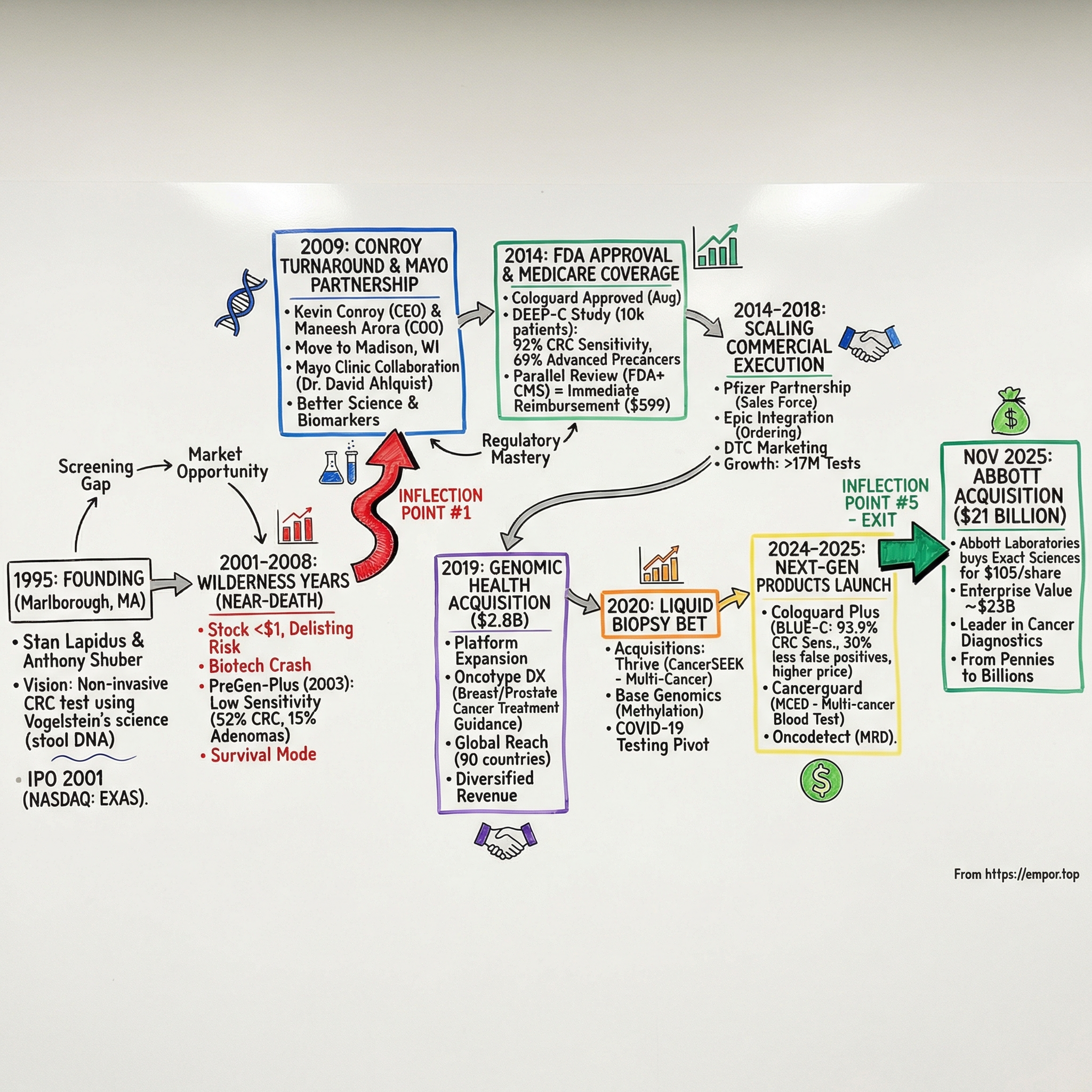
Exact Sciences: From Near-Death to $21 Billion Cancer Diagnostics Leader
I. Introduction & Episode Roadmap
Picture a company trading for pennies, its stock teetering on the edge of NASDAQ delisting, while industry observers speculated whether it would simply vanish into the biotech graveyard. That was Exact Sciences in the mid-2000s—a company founded on a revolutionary premise that had yet to deliver on its promise.
Fast forward to November 20, 2025, when Abbott Laboratories announced a definitive agreement to acquire Exact Sciences for $105 per common share, representing a total equity value of approximately $21 billion. This acquisition marks one of the largest deals in the diagnostics industry and represents a staggering return for shareholders who believed in the vision of detecting cancer earlier, more conveniently, and more accessibly.
Exact Sciences Corp. is an American molecular diagnostics company based in Madison, Wisconsin specializing in the detection of early stage cancers. The company provides products for the detection and prevention of colorectal cancer, including Cologuard, the first stool DNA test for colorectal cancer, along with additional screening and precision oncological tests for other types of cancer.
What transformed this struggling enterprise into a $21 billion acquisition target? The answer lies in a remarkable convergence of scientific innovation, strategic partnerships, regulatory mastery, and commercial execution that offers profound lessons for any investor watching the healthcare innovation space.
Exact Sciences is projected to generate more than $3 billion in revenue this year, with a high teens organic sales growth rate. The company's journey from near-bankruptcy to industry leadership illuminates the power of persistence, the importance of finding the right partners at the right moment, and the transformative potential of solving genuine healthcare problems.
This deep dive will trace the arc from founding in 1995 through five critical inflection points—each of which could have ended the company but instead propelled it forward—culminating in Abbott's blockbuster bid. Along the way, we'll examine the strategic decisions, scientific breakthroughs, and commercial strategies that built this cancer diagnostics powerhouse.
 Subscribe on LinkedIn
II. The Problem Worth Solving: Colorectal Cancer & the Screening Gap
To understand why Exact Sciences matters, one must first grasp the scale of the problem it set out to solve.
Colorectal cancer is the second leading cause of cancer death in the U.S. when men and women are combined, but it doesn't have to be. Few preventive interventions are as reliably effective in reducing avoidable death as screening for colorectal cancer. The paradox at the heart of colon cancer is that it's one of the most preventable cancers—if caught early—yet millions of Americans simply never get screened.
In 2025, there will be an estimated 154,270 new cases of colorectal cancer diagnosed in the US and 52,900 people will die from the disease. These numbers represent not just statistics but families torn apart by a cancer that, in most cases, could have been prevented or detected at a curable stage.
The fundamental challenge lies in the nature of the screening options that existed in the 1990s. Colorectal cancer (CRC) is a leading cause of cancer-related deaths in the United States. The main screening solution in the 1990s, colonoscopy, yields population health concerns due to cost, convenience, and invasive nature.
Consider what a colonoscopy requires: A full day off work. Drinking gallons of unpleasant bowel prep solution. Fasting. The procedure itself requires sedation, meaning you need someone to drive you home. And there's the psychological barrier—many people simply cannot bring themselves to undergo such an invasive procedure unless symptoms demand it.
The result? The overall colorectal cancer (CRC) screening rate in the US is 59%, well short of the National Colorectal Cancer Roundtable national goal of 80%. Even more alarming, screening rates are lowest for individuals aged 45-49 (20%), Asian Americans (50%), people with lower than high school education, and the uninsured (21%).
Among 50 to 75 year olds, the estimated colorectal cancer screening rate increased from 47.7% in 2005 to 69.9% in 2021, with the largest increase between 2005 and 2010 (47.7%-60.7%). Rates subsequently plateaued until 2015 but increased from 63.5% in 2015 to 69.9% in 2018. Much of this improvement came from the introduction of convenient alternatives to colonoscopy—alternatives that companies like Exact Sciences helped pioneer.
The scientific foundation for a stool-based approach came from groundbreaking work at Johns Hopkins University. Earlier research by Johns Hopkins University's Bert Vogelstein, M.D., shows that certain genes undergo alterations as normal colon cells transform into cancerous ones.
Bert Vogelstein, M.D., was the first scientist to elucidate the molecular basis of a common human cancer. In particular, he and his colleagues have demonstrated that colorectal tumors result from the gradual accumulation of genetic alterations in specific oncogenes and tumor suppressor genes. His group's discovery and analysis of these genes and their functions represent a landmark in the application of molecular biology to the study of human disease.
Vogelstein pioneered the idea that somatic mutations represent uniquely specific biomarkers for cancer, creating the field now called "liquid biopsies". Working with post-doctoral fellow David Sidransky in the early 1990s, he showed that such somatic mutations were detectable in the stool of colorectal cancer patients and the urine of bladder cancer patients.
This insight—that cancer leaves molecular fingerprints in bodily fluids and waste products—opened a new frontier in cancer detection. If you could find those fingerprints reliably, you could potentially screen millions more people who would never undergo a colonoscopy. The question was whether anyone could turn this scientific discovery into a practical, accurate test.
For investors, the screening gap represents both the problem and the opportunity. With roughly 60 million Americans not up-to-date on colorectal cancer screening, the addressable market is massive. Any company that could develop a convenient, accurate alternative would be addressing a genuine unmet need with enormous commercial potential.
III. Founding & Early Years: The Original Vision (1995-2001)
Exact Sciences was founded in 1995 in Marlborough, Massachusetts, by Stanley Lapidus and Anthony Shuber as a company focused on the development of a non-invasive test for colorectal cancer. The founders recognized that Vogelstein's scientific discoveries could potentially transform cancer screening—if someone could figure out how to make the science work at scale.
Engineer Stan Lapidus founds a company in Marlborough, Massachusetts, to address this unmet need. Lapidus wasn't a physician or research scientist but an engineer with a vision for applying molecular biology to solve a real-world healthcare problem. Exact Sciences is founded, aiming to develop a new, convenient colorectal cancer screening option. Researchers striving to find the right science take an innovative approach: screening patients' stools for abnormal DNA.
The initial funding for Exact Sciences came from a $6.7 million venture capital round. This modest seed capital allowed the company to begin the arduous process of developing a prototype stool-based DNA test. The company secured initial venture capital funding starting in the late 1990s, raising approximately $47.6 million across several rounds to support research and development.
The late 1990s were heady times for biotech. The Human Genome Project was racing toward completion, and investors were captivated by the promise of genomic medicine. Exact Sciences rode this wave to a public offering at a critical moment.
In February 2001, Exact Sciences went public with an initial public offering (IPO) on the NASDAQ exchange under the ticker symbol EXAS, raising $56 million to further advance its diagnostic platform. The IPO gave the company the capital it needed to push its technology forward—though the road ahead would prove far more treacherous than anyone anticipated.
The company's foundational patent outlined a method for collecting stool samples and analyzing them for DNA markers associated with colorectal cancer. The concept was elegant: cancer cells continuously shed from the colon lining into stool. By capturing and analyzing these cells, you could theoretically detect cancer without the invasiveness of colonoscopy.
But elegant concepts and working products are two very different things. Exact Sciences would spend the next several years learning that lesson the hard way.
IV. The Wilderness Years: Near-Death Experience (2001-2008)
The years following the IPO were brutal. The 2001 tech and biotech crash hammered the company's stock, and more fundamentally, the science wasn't working well enough to create a viable commercial product.
These funds enabled the development of the first prototype stool-based DNA test, PreGen-Plus, which analyzed 86 genetic markers and was introduced commercially in 2003 through a partnership with LabCorp. Initial clinical trials in the early 2000s provided proof-of-concept for the technology, with a 2005 multicenter study involving 4,404 average-risk adults showing the test's sensitivity for detecting CRC at 52% and advanced adenomas at 15%.
A 52% sensitivity for detecting colorectal cancer sounds promising until you realize what it means in practice: the test would miss nearly half of all cancers. Advanced adenomas—the precancerous polyps that are the real target of screening—were detected at only 15%. For a screening test intended to replace colonoscopy, these numbers were simply inadequate.
In the early years, there was much speculation that the company would be acquired by a competitor or exit the market; during this time the company's share price fell to less than one dollar. Trading below $1 per share placed the company at risk of NASDAQ delisting—a death sentence for public company credibility and capital access.
The fundamental problem was scientific: the first-generation test wasn't specific or sensitive enough. PreGen-Plus analyzed 86 genetic markers, but the technology to identify the right markers and detect them reliably simply wasn't mature enough. The biotech funding drought that followed the 2001 crash made it nearly impossible to raise capital for a company with disappointing clinical results.
Survival mode became the order of the day. The company slashed expenses, reduced headcount, and focused on staying alive long enough for the science to catch up with the vision. Many similarly situated companies simply folded during this period.
What kept Exact Sciences alive was a stubborn belief that the underlying science was sound—the company just hadn't found the right approach yet. The founders had identified a real problem and a scientifically valid path to solving it. What they needed was a new team, new science, and new partnerships.
V. Inflection Point #1: The Kevin Conroy Turnaround & Mayo Clinic Partnership (2009)
The year 2009 marked the beginning of Exact Sciences' transformation from a struggling biotech company to an industry leader. Two events changed everything: the arrival of a new CEO and a critical partnership with Mayo Clinic.
Kevin Conroy became CEO of Exact Sciences in 2009 and chairman in 2014, transforming the organization into one of the world's premier cancer diagnostics companies, with more than 6,500 employees.
Conroy's path to Exact Sciences began with a fateful phone call. Conroy thought Exact Sciences had potential in the same genetic-based medical diagnostics area. He joined as CEO in 2009 and immediately brought on partner Maneesh Arora as chief operating officer.
In April 2009, Kevin T. Conroy and Maneesh K. Arora joined us as our President & Chief Executive Officer and Senior Vice President & Chief Financial Officer, respectively. In February 2012, Mr. Arora was promoted to Chief Operating Officer in addition to his title of Chief Financial Officer.
Who was this turnaround artist? Before joining Exact Sciences, Mr. Conroy served as CEO of Third Wave Technologies, a molecular diagnostics company that developed a breakthrough cervical cancer screening test before being acquired by Hologic in 2008. He also held leadership positions as an Intellectual Property lawyer at GE and in private practice.
Conroy's background combined legal expertise in intellectual property with operational experience building diagnostics companies. At Third Wave Technologies, he had navigated the complex regulatory and reimbursement landscape to bring a cervical cancer screening test to market. Conroy and Arora had worked on getting a human papillomavirus (HPV) test to market with Third Wave Technologies and were wondering if they could use the same enzyme developed by Jim Dahlberg and others at UW-Madison to create a colon cancer test.
A native of Flint, Michigan, he holds a Bachelor of Science degree in electrical engineering from Michigan State University and earned his law degree from the University of Michigan Law School. His father, Senator Joe Conroy, had served 22 years in the Michigan state legislature—politics was literally a family business.
The Mayo Clinic partnership proved equally transformative. The announcement came in June 2009, linking Exact Sciences with one of the most respected medical institutions in the world. Since 2009, Exact Sciences has maintained a collaboration with Mayo Clinic for its current and future products.
The key figure at Mayo was Dr. David Ahlquist, a gastroenterologist who had spent two decades researching noninvasive colon cancer detection. A 1977 graduate of the Mayo Clinic Alix School of Medicine, Dr. Ahlquist spent 36 years on staff as a gastroenterologist. He spent 20 of those years inside Mayo Clinic Laboratories, researching what would eventually become Cologuard.
After meeting with Mayo Clinic's David Ahlquist, M.D., Kevin Conroy comes aboard to lead Exact Sciences. With Ahlquist's and Vogelstein's findings at the forefront, Conroy charts a new future for the company's founding idea of using stool to screen for CRC and plans for further innovations in cancer testing.
Ahlquist's approach represented a fundamental improvement over Exact Sciences' earlier technology. But it became apparent to him that blood is an imperfect marker for colon cancer and especially for pre-malignant polyps; many cancers and the vast majority of polyps do not bleed. "At that point, we tried to re-imagine an approach that would be biologically more rational and meet the criteria of an ideal training test."
Exact Sciences moves the corporate headquarters to Madison, Wisconsin. The new location draws upon the city's life-sciences culture and talent. The relocation was strategic: Madison offered proximity to the Mayo Clinic in Rochester, Minnesota, access to the University of Wisconsin's research ecosystem, and lower operating costs than the company's original Massachusetts home.
After raising additional capital, the stock price rose above $1 and out of danger of being delisted by Nasdaq. Then, after securing a $1 million loan from the Wisconsin Department of Commerce, they moved the Exact Sciences headquarters to Madison, where both Conroy and Arora were already settled.
In August 2009, Graham P. Lidgard joined us as our Senior Vice President & Chief Science Officer. Biotech veteran Graham Lidgard, Ph.D., becomes Exact Sciences' chief science officer. He collaborates with Ahlquist and others at Mayo Clinic on an approach to test stool for abnormal DNA, as well as the presence of blood cells that indicate that CRC may be present.
The Mayo Clinic collaboration gave Exact Sciences three crucial assets: scientific credibility through association with a globally respected institution, access to Ahlquist's superior biomarker research, and a platform for conducting the large clinical trials necessary for FDA approval. Mayo Clinic Ventures licensed the technology to Exact Sciences, creating the foundation for what would become Cologuard.
In 2009, Exact Sciences also completed a licensing agreement with Hologic for its molecular detection platform. This agreement provided additional technology capabilities that would prove important in developing the next generation of tests.
For investors, the 2009 turnaround illustrates a critical lesson: companies can be fundamentally transformed by the right leadership at the right moment. Conroy brought not just operational expertise but the specific experience of navigating FDA approval and Medicare reimbursement for diagnostic tests—exactly the challenges Exact Sciences faced.
VI. Inflection Point #2: FDA Approval & Medicare Coverage (2014)
The FDA approval of Cologuard in August 2014 stands as one of the most significant regulatory achievements in diagnostics history—not just for what the product accomplished, but for how the approval was obtained.
MADISON, Wis., Aug. 12, 2014 — Exact Sciences Corp. announced today that the U.S. Food and Drug Administration (FDA) has approved Cologuard, the company's noninvasive, stool DNA colorectal cancer screening test. Cologuard is the first noninvasive screening test for colorectal cancer that analyzes both stool DNA and blood biomarkers and has been proven to find 92 percent of cancers and 69 percent of the most advanced precancerous polyps in average risk patients. Cologuard, which is available through healthcare providers, offers people 50 and older at average risk for colorectal cancer an easy-to-use screening test they can do in the privacy of their own home.
The clinical data underlying this approval came from one of the largest colorectal cancer screening studies ever conducted. Results from the company's DeeP-C Study, prospective, 90-site, 10,000-patient pivotal study—one of the most extensive colorectal cancer screening studies ever conducted in the U.S.—were published in April 2014 in the New England Journal of Medicine.
Compare these results to the first-generation PreGen-Plus test, which detected only 52% of cancers and 15% of advanced adenomas. Cologuard's 92% cancer sensitivity and 69% advanced precancer detection represented a quantum leap in performance—the difference between a laboratory curiosity and a clinically useful screening tool.
But the real regulatory innovation lay in how Exact Sciences approached the approval process. Upon approval, Exact Sciences also received a proposed coverage memorandum from the Centers for Medicare and Medicaid Services (CMS). Cologuard is the first product to take part in the joint FDA and CMS parallel review pilot program in which both agencies simultaneously review medical devices to help reduce the time between FDA approval and Medicare coverage. A final National Coverage Determination is expected to be posted in October/November of this year after a public comment period.
Cologuard became the first medical device or diagnostic to receive simultaneous FDA approval and national Medicare coverage. This parallel review process was transformative for the company's commercial prospects. Typically, even after FDA approval, medical device and diagnostic companies face months or years of additional negotiation to secure Medicare reimbursement. Exact Sciences compressed this timeline to essentially zero.
We got FDA approval with a unanimous vote, which is rare. And Medicare, for the first time ever, did a parallel review with the FDA, so we were able to get not only FDA approval but Medicare approval on the same day.
The Medicare coverage determination was crucial because Medicare beneficiaries represent a significant portion of the colorectal cancer screening market—older Americans face the highest risk of developing colorectal cancer and are the primary target population for screening. Without Medicare coverage, commercial success would have been dramatically limited.
Cologuard is available to patients through their healthcare providers in the U.S. for $599. The initial pricing reflected the cost of running a sophisticated multi-marker DNA analysis and the value proposition of early cancer detection.
Dr. David Ahlquist, the Mayo Clinic gastroenterologist whose research formed the foundation of Cologuard, described the significance: "The robustly conducted research as part of this FDA approval process has proven that this noninvasive test is highly sensitive in detecting both early stage colorectal cancer and the most advanced precancerous polyps most likely to develop into cancer. The test is designed for high accuracy, ease of patient use, and wide accessibility."
For investors, the FDA/CMS parallel review created what Hamilton Helmer would call "process power"—a competitive advantage rooted in accumulated know-how about navigating complex regulatory systems. Competitors would need to master the same regulatory pathway, and Exact Sciences had done it first and best.
VII. Scaling the Business: Commercial Execution (2014-2018)
FDA approval was just the starting gun. Building a successful commercial franchise required mastering distribution, physician education, patient awareness, and insurance coverage—simultaneously.
In August 2018, Exact Sciences and Pfizer announced an agreement through 2021 to co-promote Cologuard. The Pfizer partnership gave Exact Sciences access to one of the largest pharmaceutical sales forces in the world. Pfizer's representatives were already calling on primary care physicians—exactly the physicians who would order colorectal cancer screening tests.
According to the company, Cologuard's revenue grew 94% year-over-year in the second quarter of 2019, driven in no small part by its marketing tie-up with Pfizer inked last August. This growth rate demonstrated the power of combining a superior product with broad distribution.
In November 2018, Exact Sciences announced a partnership with Epic Systems for order entries. Integration with Epic—the dominant electronic health records platform in U.S. healthcare—streamlined the ordering process for physicians. Instead of calling or faxing orders, physicians could order Cologuard tests directly through their existing workflows.
The company also pursued direct-to-consumer marketing, including memorable television advertisements and celebrity endorsements. This strategy was unusual for a diagnostic test but reflected the unique nature of Cologuard: unlike most medical tests, patients could complete Cologuard at home without a doctor's visit, making consumer awareness critically important.
The commercial infrastructure buildout required significant investment. In August 2017, the company made its first major acquisition when it purchased Sampleminded, a healthcare information technology company based in Salt Lake City, Utah, for $3.2 million. This was followed by the January 2018 announcement that Exact Sciences had completed a $690 million convertible bond offering.
The convertible bond offering demonstrated investor confidence in the company's growth trajectory and provided capital for continued expansion. By raising nearly $700 million in debt financing, Exact Sciences could invest aggressively in commercial infrastructure while avoiding the dilution that would come from an equity offering.
Per the company, the currently available version of Cologuard has been used over 17 million times. This penetration reflects both the commercial success of the franchise and the genuine healthcare impact of making colorectal cancer screening more accessible.
VIII. Inflection Point #3: The Genomic Health Acquisition (2019)
Until 2019, Exact Sciences was essentially a one-product company. Cologuard was successful, but the company's entire fortune was tied to colorectal cancer screening. The acquisition of Genomic Health transformed Exact Sciences from a specialized screening company into a comprehensive cancer diagnostics platform.
Cancer diagnostic test manufacturer Exact Sciences bought Genomic Health in a $2.8 billion deal. The sale is not likely to affect the companies' current products–Cologuard and Oncotype DX assays–but may promote development of new tests to detect other cancers.
The companies have entered into a definitive agreement under which Exact Sciences will combine with Genomic Health for $72.00 per share in a cash and stock transaction valued at $2.8 billion.
Genomic Health's flagship product, Oncotype DX, addressed a completely different point in the cancer care continuum. While Cologuard screens for colorectal cancer before diagnosis, Oncotype DX helps guide treatment decisions after a cancer diagnosis. The company also provides the Oncotype DX® test, which has spared more than one million breast cancer patients from chemotherapy while helping to predict the risk of their cancer returning.
The strategic logic was compelling: Driven by Exact Sciences' Cologuard at-home fecal DNA test for colorectal cancer and Genomic Health's Oncotype DX assays for breast and prostate cancer, the companies' leaders hope to see a gross profit of $1.2 billion next year, with a commercial presence in more than 90 countries. Those three areas alone represent about 40% of all new cases of solid tumors, according to the companies, which estimate a combined market opportunity of about $20 billion—of which they say they've penetrated less than 10%, with more room to expand in international markets.
Provides global infrastructure to accelerate the ability to provide new innovative cancer diagnostics to patients: The combined company will have a commercial presence in more than 90 countries and expanded reach across primary care, oncology, OB/GYN, gastroenterology, and urology to support growth of existing and future cancer tests.
Conroy articulated the vision: "Uniting the best minds and molecular diagnostics capabilities will advance the fight against cancer. Combining industry pioneers Exact Sciences and Genomic Health is a pivotal step toward building the leading cancer diagnostics company in the world. Exact Sciences is continuing to grow sales and expand adoption of Cologuard at a rapid pace, and Genomic Health's Oncotype DX is the global standard of care to inform treatment decisions for women with breast cancer."
The acquisition also diversified revenue geographically. Another upside, Weinstein says, is that the deal could help Exact Sciences expand internationally when its new products are available. Cologuard is sold only in the United States, whereas Oncotype DX assays are available in 90 countries.
For investors, the Genomic Health acquisition demonstrated management's ability to think strategically about platform building rather than single-product optimization. The deal transformed Exact Sciences from a company with concentrated risk into a diversified cancer diagnostics leader.
IX. Inflection Point #4: The Liquid Biopsy Bet (2020)
While Cologuard proved that stool-based testing could work for colorectal cancer, the frontier of cancer diagnostics was increasingly focused on blood-based testing—so-called "liquid biopsies" that could potentially detect multiple cancers from a single blood draw.
Exact Sciences Corp. and Thrive Earlier Detection Corp., a healthcare company dedicated to incorporating earlier cancer detection into routine medical care, today announced they have entered into a definitive agreement under which Exact Sciences will acquire Thrive for cash and stock consideration of up to $2.15 billion. The transaction was unanimously approved by both companies' Boards of Directors and is anticipated to close during the first quarter of 2021, subject to regulatory approval and the satisfaction of other conditions. Combining Thrive's pioneering early-stage screening test, CancerSEEK, with Exact Sciences' best-in-class scientific platform, clinical organization, and commercial infrastructure will establish Exact Sciences as a leading competitor in blood-based, multi-cancer screening.
Thrive's CancerSEEK technology traced directly back to Bert Vogelstein's lab at Johns Hopkins—the same lab whose foundational research had inspired Exact Sciences' founding. The heart of the researchers' work is the liquid biopsy, a test done on a blood sample to look for signals derived from cancer cells circulating in the blood. In 2011, they invented SafeSeqS, a next-generation gene sequencing technology that simultaneously and individually analyzed millions of DNA molecules to identify mutations in the bloodstream more accurately than other methods.
Thrive, with an early version of CancerSEEK, has conducted a first-of-its-kind 10,000-patient, prospective, interventional study in a real-world clinical setting. In this landmark study, using its mutation and protein biomarker approach, CancerSEEK achieved promising results detecting 10 different types of cancer, including seven with no recommended screening guidelines, with very few false positives.
Simultaneously, Exact Sciences acquired Base Genomics to strengthen its DNA methylation capabilities. Exact Sciences also Acquires Base Genomics to Extend its DNA Methylation Capabilities Exact Sciences also announced today that it has acquired Base Genomics, an epigenetics company working to set a new standard in DNA methylation analysis, one of the most promising approaches to detecting cancer in its earliest stages. Base Genomics has a talented team and innovative technology enabling highly accurate DNA methylation analysis. It also allows for the analysis of DNA methylation and mutations in a single sample. Base Genomics' differentiated technology is highly complementary to Exact Sciences' existing methylation expertise and multi-marker approach.
Conroy framed the opportunity: "The acquisition of Thrive is a giant leap toward ensuring blood-based, multi-cancer screening becomes a reality and eventually, the standard of care. We couldn't be more excited that Exact Sciences will be at the forefront of this incredible opportunity to serve patients."
The COVID-19 pandemic, paradoxically, accelerated some aspects of the company's development. Exact Sciences responded to the 2020 COVID-19 pandemic by temporarily refocusing a portion of its diagnostic capacity to testing for the disease. The company received FDA regulatory approval to provide home testing kits in April 2020, becoming one of the first companies in the U.S. to do so.
In early 2021, Exact Sciences announced its acquisition of Ashion Analytics and plans to collaborate in research with TGen, the City Of Hope's Genomics Institute. This news came shortly after the company's decision to purchase an exclusive-use license of TGen's proprietary liquid biopsy-based test technology, Tardis.
The liquid biopsy acquisitions positioned Exact Sciences for the emerging multi-cancer early detection (MCED) market—tests that could potentially detect dozens of different cancer types from a single blood draw. This represents perhaps the most transformative opportunity in cancer diagnostics since the development of modern screening programs.
X. Inflection Point #5: Next-Generation Products (2024-2025)
The years 2024-2025 represented a product launch bonanza for Exact Sciences, with three major new tests reaching market and demonstrating the company's expanded capabilities.
Ten years after first collecting an FDA approval, it's time for version number two. Exact Sciences has received an agency green light for Cologuard Plus, the next generation of its mainstay, at-home screening test for colorectal cancer. Compared to the original Cologuard, the addition of newly identified genetic biomarkers to the multi-target stool DNA test has reduced its rate of false positives by 30%, while maintaining similar sensitivity rates both in spotting tumors and advanced precancerous polyps.
Exact Sciences partnered with Mayo Clinic to develop the Cologuard Plus test. Compared to the earlier version, Cologuard Plus includes novel biomarkers, some designed to increase the test's specificity while maintaining or improving sensitivity. The new test reduces false positives by 30%, and will prevent unnecessary colonoscopies in the future, according to the company.
The clinical data supporting Cologuard Plus came from the BLUE-C study: The FDA approval is based on findings from the Blue-C study published in the New England Journal of Medicine. In the Blue-C clinical trial, which included more than 20,000 average-risk individuals, the next-generation multitarget stool DNA test demonstrated sensitivities of 93.9% for CRC, 43.4% for advanced precancerous lesions, and 92.7% for curable-stage CRC (stages I, II, III).
The new Medicare rate will be $592, marking a 16% increase from the current $509 rate for its existing Cologuard test. This pricing increase reflects the improved clinical performance of Cologuard Plus and represents significant margin expansion potential as the company transitions its customer base to the new test.
Perhaps most significant was the launch of Cancerguard, the company's first multi-cancer early detection test. Exact Sciences Corp., a leader in cancer diagnostics, today announced the launch of the Cancerguard™ test, a new multi-cancer early detection (MCED) blood test that is now available as a laboratory-developed test (LDT) in the United States. Cancerguard is the first MCED test commercially available that analyzes multiple biomarker classes to help detect a wide range of cancers, including those that often go undiagnosed until later stages when treatment options are limited.
The Cancerguard test delivered 68 percent sensitivity across six of the deadliest cancers and 64 percent overall sensitivity across a broader range of cancers, excluding breast and prostate, in test-development studies.
The Cancerguard test is recommended for individuals aged 50-84 with no known cancer diagnosis in the past three years and can be considered annually. It is priced at $689 and may be eligible for flexible spending and health savings account use, with payment plans available.
Exact Sciences has launched its long-awaited blood test designed to detect the early stages of multiple tumors, with a plan to sell it to consumers through a telehealth program in a bid to increase cancer screening rates. The Cancerguard test can help spot the signs of more than 50 different types of malignancies, according to the company—excluding breast and prostate cancers but including aggressive diseases and those responsible for more than 80% of annual new diagnoses in the U.S., such as cancers of the pancreas, ovaries, liver, lungs, esophagus and stomach. At the same time, Exact Sciences estimates that about 70% of yearly cases and deaths are linked to hidden tumors that currently have no recommended screening regimen.
The company also launched Oncodetect, a molecular residual disease (MRD) test that helps detect cancer recurrence earlier than traditional imaging. Results from a well-designed study of monitored colon cancer patients found those with a positive Oncodetect test were 50 times more likely to recur than those with a negative result. The study further showed Oncodetect identifies residual disease up to 10 months earlier than imaging, the current standard of care.
XI. The Abbott Acquisition: The $21 Billion Exit (2025)
On November 20, 2025, Abbott and Exact Sciences today announced a definitive agreement for Abbott to acquire Exact Sciences, which will enable it to enter and lead in fast-growing cancer diagnostics segments, serving millions more people.
Under the terms of the agreement, Abbott will acquire all outstanding shares of Exact Sciences for $105 per common share in cash, at a total equity value of approximately $21 billion and an estimated enterprise value of $23 billion. Abbott's financing contemplates absorption of Exact Sciences' estimated $1.8 billion of net debt.
Abbott is paying $105 a share in cash for Wisconsin-based Exact, roughly a 50% premium on its closing price Tuesday, before Bloomberg reported that the deal was likely.
The strategic rationale was clear for both parties. The purchase would give Abbott access to cancer screening tests including Cologuard and blood tests for multi-cancer early detection.
Acquisition adds a new growth vertical to Abbott's already high single-digit growth profile, gaining leadership in the fast-growing $60 billion U.S. cancer screening and precision oncology diagnostics segments.
For Abbott, whose medical device businesses focus heavily on diabetes and cardiovascular disease, the acquisition represented a new foray into cancer care. Once the transaction is completed, Exact Sciences will become a subsidiary of Abbott, and Abbott's total diagnostics sales will exceed $12 billion annually.
Conroy reflected on the journey: "Together with Abbott, we can reach more patients, advance earlier detection, and deliver answers that change lives. Abbott's culture of innovation and global commercial reach will help accelerate our mission of eradicating cancer and expanding access to our tests worldwide, while delivering immediate and substantial value to our shareholders. I want to thank the 7,000 Exact Sciences' team members for their extraordinary work and dedication — our journey has just begun."
The closing is expected in the second quarter of 2026 and is subject to Exact Sciences' shareholder approval, as well as receipt of applicable regulatory approvals and other customary closing conditions. The transaction was unanimously approved by both companies' boards of directors.
Exact Sciences will become a subsidiary of Abbott, maintaining its presence in Madison, Wisconsin, with its CEO in an advisory role.
XII. Playbook: Business & Investing Lessons
The Exact Sciences story offers several profound lessons for investors in healthcare innovation.
Lesson 1: The Right CEO at the Right Time
Kevin Conroy's arrival in 2009 transformed the company's trajectory. His combination of IP law background, biotech operations experience, and vision for navigating regulatory and reimbursement challenges proved exactly what Exact Sciences needed. Over the past decade, he transformed Exact Sciences from a small biotechnology firm into one of the world's premier cancer diagnostics companies. Mr. Conroy led Exact Sciences through the development, clinical trial, regulatory approval, and commercialization of its noninvasive colorectal cancer screening test, Cologuard®.
Lesson 2: Strategic Academic Partnerships
The Mayo Clinic relationship provided scientific credibility, clinical expertise, and ongoing R&D collaboration that would have been impossible to replicate internally. "We had an opportunity to help build Exact Sciences with excellent people around this idea, focusing completely on this single product and doing it right. It's a great collaboration of two cultures that led to a very efficient, multi-centered evaluation study. We got FDA approval with a unanimous vote, which is rare."
Lesson 3: Regulatory as Competitive Advantage
The parallel FDA/CMS review created a moat that competitors struggled to replicate. By pioneering a new regulatory pathway, Exact Sciences compressed the time from approval to reimbursement and established a template that required sophisticated understanding to navigate.
Lesson 4: Platform Thinking
Transitioning from a single product to a comprehensive cancer diagnostics platform through acquisitions—Genomic Health, Thrive, Base Genomics—created strategic optionality and reduced single-product risk.
Lesson 5: Patience in Biotech
Nearly 20 years elapsed from founding to blockbuster product. The company came close to failure multiple times. Exact Sciences chairman and CEO Kevin Conroy grew up in Flint, Michigan, with a tight group of friends. After he joined the company 15 years ago, four of those friends were diagnosed with colon cancer. Personal motivation sustained persistence through difficult years.
Lesson 6: The Importance of Reimbursement
FDA approval was necessary but not sufficient. Medicare coverage was equally crucial to commercial success. The company's sophisticated understanding of reimbursement dynamics differentiated it from competitors with good science but weak commercial strategies.
XIII. Porter's Five Forces & Hamilton's 7 Powers Analysis
Porter's Five Forces
1. Threat of New Entrants: MODERATE-HIGH
The colorectal cancer screening market has attracted significant new competition. The US Food and Drug Administration has approved a blood test to be used for colorectal cancer screening among average-risk adults 45 and older. The maker of the test, Palo Alto, California-based biotechnology company Guardant Health, announced Monday that this is the first blood test to be approved by the FDA as a primary screening option for colorectal cancer, and it's the first approved blood screening test for colorectal cancer that meets requirements for Medicare reimbursement.
This year, Guardant Health won FDA approval for a blood test as a primary screening option for colorectal cancer and Geneoscopy received the green light to sell its Labcorp-partnered test.
High barriers exist—FDA approval, clinical trial costs exceeding $100 million, and complex reimbursement negotiations—but well-funded competitors are emerging, particularly in liquid biopsy.
2. Bargaining Power of Suppliers: LOW
Exact Sciences uses standard lab equipment and reagents with in-house manufacturing capability, limiting supplier leverage.
3. Bargaining Power of Buyers: MODERATE
Medicare/CMS sets prices with limited negotiating power for individual providers. However, multiple screening options give physicians and patients choices, creating some competitive pressure on pricing.
The Centers for Medicare and Medicaid Services extinguished hopes that Cologuard Plus could receive a premium price at the first time of asking in September. In the preliminary payment determinations for its Clinical Laboratory Fee Schedule (CLFS), the CMS recommended crosswalking the price of the current test to Cologuard Plus.
4. Threat of Substitutes: HIGH
Multiple substitutes exist: colonoscopy remains the gold standard, FIT tests are cheaper (though less accurate), and blood-based liquid biopsies are emerging. Results from the study, published by Chung et al in March 2024 in The New England Journal of Medicine, showed that Shield demonstrated 83% sensitivity for the detection of colorectal cancer, with 90% specificity for advanced neoplasia. This performance is within range of current guideline-recommended noninvasive screening methods, in which overall colorectal cancer sensitivity ranges from 74% to 92%.
5. Competitive Rivalry: INCREASING
The colorectal cancer screening market is becoming more competitive as new entrants gain FDA approval and seek market share.
Hamilton Helmer's 7 Powers
Scale Economies: Exact Sciences has built significant processing capacity, with ability to handle millions of tests annually. This scale creates cost advantages difficult for smaller competitors to match.
Network Economies: Limited direct network effects, though integration with Epic and other healthcare IT systems creates switching costs.
Counter-Positioning: Cologuard's at-home convenience represents counter-positioning versus colonoscopy—incumbent gastroenterologists have incentives to promote colonoscopy, but patients increasingly prefer non-invasive alternatives.
Switching Costs: Once physicians integrate Cologuard into their workflows and electronic health records, switching to alternative tests requires retraining and process changes.
Branding: Cologuard has achieved significant brand recognition through direct-to-consumer advertising, creating pull demand from patients.
Cornered Resource: The Mayo Clinic partnership and accumulated clinical data represent cornered resources difficult for competitors to replicate.
Process Power: Exact Sciences' expertise in navigating FDA approval, Medicare coverage, and commercial scaling represents accumulated know-how that provides competitive advantage.
XIV. Key Performance Indicators for Investors
For long-term fundamental investors tracking Exact Sciences (or its successor as an Abbott subsidiary), three KPIs deserve particular attention:
1. Screening Test Volume Growth
The number of Cologuard tests completed directly measures market penetration and commercial execution. Screened more than 1 million people with Cologuard for the first time during a quarter represented a milestone achievement. Tracking quarterly test volumes reveals underlying demand trends independent of pricing changes.
2. Revenue Mix Between Screening and Precision Oncology
Total 2024 revenue of $2.76 billion, an increase of 10%, or 11% on a core revenue basis, with Screening revenue of $2.10 billion and Precision Oncology revenue of $655 million.
The balance between these segments reveals platform diversification progress. Growing precision oncology revenue demonstrates success in expanding beyond colorectal cancer screening.
3. Adjusted EBITDA Margin
Net loss was $38 million, adjusted EBITDA was $99 million, and adjusted EBITDA margin increased 500 basis points to 14%.
Margin expansion demonstrates the transition from growth-at-all-costs to sustainable profitability. As Exact Sciences transitions to Cologuard Plus (with lower cost of goods sold), margin improvement should accelerate.
XV. Competitive Landscape and Risks
Key Competitors
Guardant Health: The primary competitive threat in blood-based colorectal cancer screening. Guardant Health, Inc., a leading precision oncology company, today announced that its Shield™ blood test, recently approved by the U.S. Food and Drug Administration (FDA), is now covered by Medicare and is commercially available in the U.S. as the first FDA-approved blood test for primary colorectal cancer (CRC) screening.
Shield's approval fundamentally changes the competitive landscape by offering a blood-based alternative to stool-based testing. However, Shield's sensitivity for precancerous adenomas is lower than Cologuard's, creating clinical positioning differences.
GRAIL (Illumina): Pursuing multi-cancer early detection with the Galleri test, though focused more on supplemental screening rather than primary screening.
Freenome: Developing blood-based colorectal cancer screening, though clinical data have been mixed.
Material Risks
Regulatory Risk: Changes to FDA requirements or CMS reimbursement policies could impact pricing and market access.
Competitive Risk: Blood-based tests may prove more appealing to patients than stool-based tests, potentially eroding Cologuard's market position.
Execution Risk: Launching three new products (Cologuard Plus, Oncodetect, Cancerguard) simultaneously strains organizational capacity.
Integration Risk: Abbott acquisition creates uncertainty about strategic direction, employee retention, and cultural fit.
XVI. Conclusion: A Thirty-Year Arc from Science to Industry
The Exact Sciences story spans three decades—from Bert Vogelstein's foundational discovery that cancer leaves molecular fingerprints in stool, through the founding of a company to commercialize that insight, near-death in the mid-2000s, resurrection through the Mayo Clinic partnership and Kevin Conroy's leadership, FDA breakthrough, commercial scaling, platform expansion through acquisitions, and ultimately a $21 billion exit to Abbott.
What makes this story instructive for investors is not just the magnitude of the returns but the pattern of value creation: solving a genuine healthcare problem (the colonoscopy screening gap), building defensible competitive advantages (Mayo Clinic partnership, regulatory expertise, commercial infrastructure), and executing platform expansion at the right moments (Genomic Health, Thrive, Base Genomics).
The Abbott acquisition validates the thesis that cancer diagnostics represents a massive growth market. Cancer screening and precision oncology diagnostics are a $60 billion segment in the U.S. alone, according to Abbott. With cancer remaining the second leading cause of death in the United States, the demand for earlier, more convenient detection will only grow.
For investors in healthcare innovation, Exact Sciences demonstrates that patience, persistence, and strategic clarity can transform struggling enterprises into industry leaders. The company traded for less than $1 per share in the mid-2000s; it was acquired for $105 per share in 2025. That hundredfold return didn't happen overnight—it required navigating scientific setbacks, regulatory complexity, and competitive threats over nearly two decades.
The future of cancer diagnostics lies in multi-cancer early detection, liquid biopsies, and integration of screening with treatment guidance. With Cancerguard launched and the Abbott acquisition closing, Exact Sciences' technology will have the resources and global reach to pursue that vision at scale.
Kevin Conroy's observation captures the essence of building companies in this space: "You have a business challenge, a science challenge, a clinical trial challenge, and a regulatory challenge. It's like solving a complex puzzle, and there's simply no guarantee of success." Exact Sciences solved that puzzle. The $21 billion valuation is the result.
 LinkedIn
 WhatsApp
 Reddit
 Hacker News
 Email
Email Kindle
 RSS Feed
 Spotify
 Apple Podcasts
 Amazon Music
 Audible
 YouTube