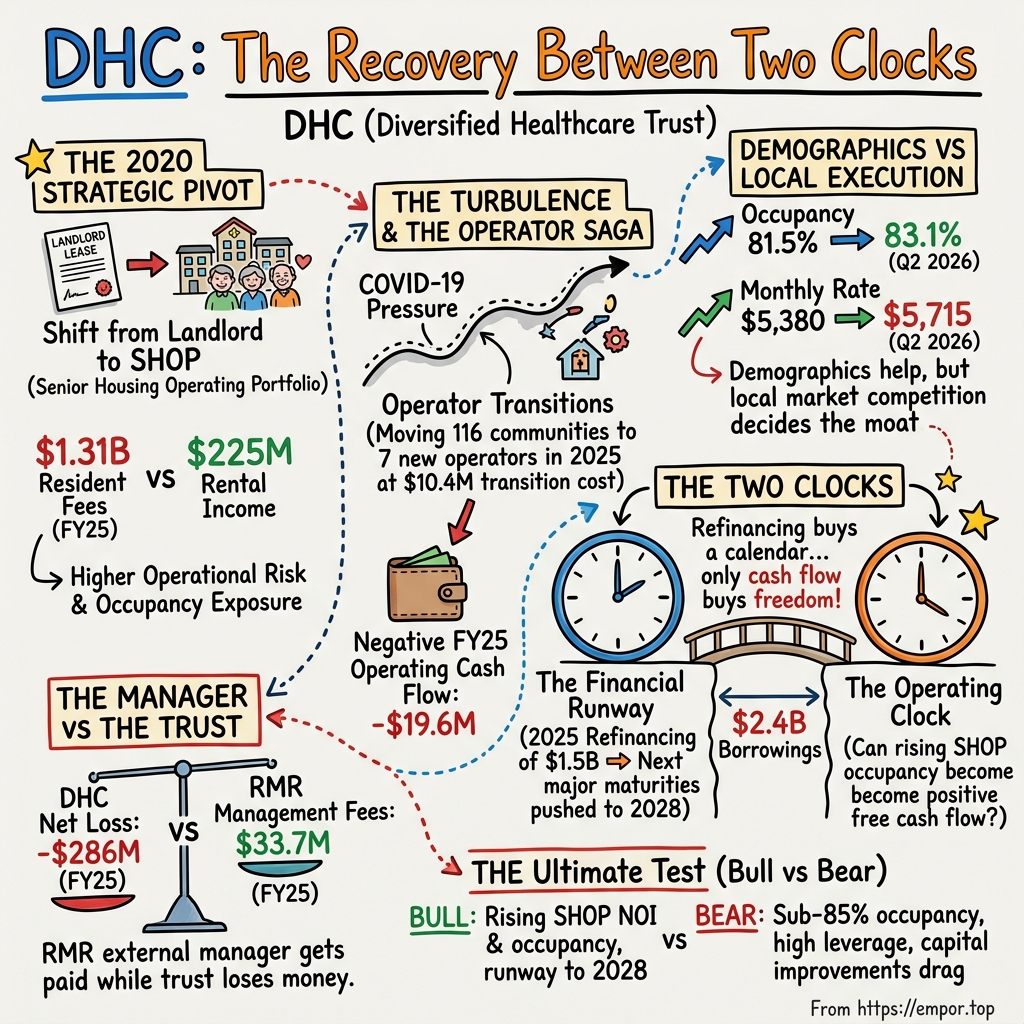
Diversified Healthcare Trust: The Recovery Between Two Clocks
I. The REIT With Two Clocks
In December 2025, Diversified Healthcare Trust did something it had spent more than a year working toward. It paid off its zero-coupon secured notes due in 2026, the debt that had hung over the company like a countdown timer.1 With that repayment, the next major maturity on DHC's calendar moved out to 2028.1 For a real estate trust whose share price had fallen by as much as 84% at its worst point in the previous five years, that was not a footnote.2 It was oxygen.
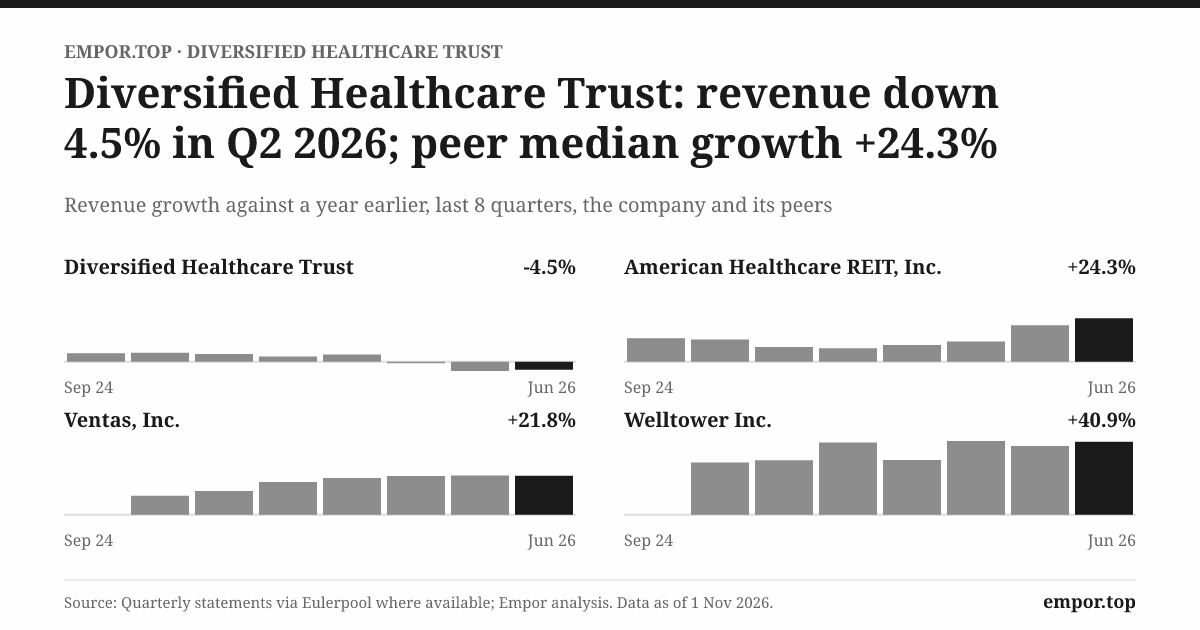
Then, on August 4, 2026, the company reported its second quarter, and the oxygen came with a puzzle attached. Consolidated revenue was about $365 million, roughly 4.5% lower than a year earlier.3 Yet in the same breath, management described a business that was getting better: senior housing occupancy up, monthly resident rates up, and same-property senior housing operating income up by more than a third on the prior year.4 Revenue falling while the core operation improves sounds like a contradiction. It is actually the whole story in miniature, because DHC has been selling buildings to pay down debt while trying to wring more income out of the ones it keeps.
That is why this company runs on two clocks. The first clock sits inside its senior living communities, where a resident and her family decide month by month whether to stay, and where a resident's agreement can usually be ended on about 30 days' notice.1 That clock measures whether the business is healing. The second clock sits on the balance sheet. At the end of 2025, DHC owned a property portfolio of roughly $6.3 billion and carried about $2.4 billion of borrowings, against only $122 million of cash and short-term investments.1 That clock measures how much time the healing has.
The uncomfortable number sits between the two. In 2025, DHC's operating activities consumed about $19.6 million of cash rather than producing it.1 A real estate trust is supposed to be a machine that turns buildings into dependable cash. For several years, DHC has been a machine that turns buildings into cash only after selling some of them.
Before going further, it is worth drawing a careful boundary around what DHC is. It is a Maryland real estate investment trust listed on Nasdaq that owns senior living communities, medical office buildings, life science properties and other healthcare real estate across the United States.1 It has no employees of its own.1 Everything from strategy to accounting is performed by The RMR Group, an external manager that also runs several other publicly traded trusts.1 RMR's broader business and its other clients are a separate story. What matters here is what DHC pays RMR, what RMR's people do for DHC, and whether that arrangement serves DHC's shareholders.
Four questions will carry this story. The first is whether the growth in DHC's senior housing operating portfolio, which the company calls SHOP, will last beyond a single good quarter. The second is whether asset sales and refinancing are rebuilding sustainable earnings or simply rearranging the calendar. The third is whether RMR's incentives line up with the interests of the people who own DHC's shares. The fourth is whether the share price, which had rebounded sharply from its lows by the autumn of 2026, has run ahead of the business underneath it.
None of those questions can be answered by a single valuation ratio. A REIT can look cheap on book value because its book value is overstated, or expensive because its earnings are depressed by depreciation that never touches cash. The verdict here rests on three things instead: whether the operations are improving, whether that improvement survives to become cash after property spending and interest, and whether the people allocating capital have earned the right to keep doing it. The refinancing bought DHC time to answer those questions. It did not answer them. To understand why the answers depend so heavily on what happens inside senior living communities, the story has to go back to the moment DHC stopped being a simple landlord.
 Subscribe on LinkedIn
II. From Rent Checks to Resident Fees
For most of its life, the company now called Diversified Healthcare Trust had a simple business. It was called Senior Housing Properties Trust, and it owned buildings that other companies operated. Its largest tenant was Five Star Senior Living, a senior living operator that shared a manager and a long history with the trust.5 Five Star ran the communities, hired the nurses and cooks, signed up the residents and paid Senior Housing Properties Trust a fixed rent. If a community filled up, Five Star kept the upside. If it emptied, Five Star still owed the rent. The landlord's job was to collect the check.
That arrangement worked until the tenant could no longer afford it. Five Star's economics deteriorated through the late 2010s as labor costs rose and new senior housing supply arrived in many markets, and a tenant that cannot pay its rent is not really a tenant. It is a liability with a lease attached. In 2019, the two companies agreed to restructure their relationship.5 Instead of leasing the communities, Five Star would manage them on the trust's behalf, earning a management fee, while the trust would take the communities' revenues and bear their operating costs directly. As part of the deal, the trust and its shareholders received a large equity stake in Five Star.5
The new arrangements took effect at the start of 2020, and the trust marked the moment by renaming itself Diversified Healthcare Trust.6 The new name was a statement of intent. The company had owned medical office and life science buildings for years, but under the old name it was easy to see it as a senior living landlord with a single dependent tenant. The new name pointed toward a broader healthcare property owner. It also concealed a deeper change. The trust was no longer only collecting rent from senior housing. It was now, in economic substance, running senior housing through hired operators.
The difference between those two models is the most important idea in this story, so it deserves a plain-English explanation. Think of a hotel owner. One kind of owner leases the whole building to a hotel company for a fixed annual payment. Whether the rooms are full on a Tuesday in February is the hotel company's problem. Another kind of owner hires a hotel brand to manage the property for a fee and keeps everything left over after paying staff, food, utilities and the manager. That owner enjoys every dollar of improvement and feels every empty room. DHC's leased properties work like the first model: tenants pay rent. Its SHOP communities work like the second: residents pay monthly fees for housing, meals and care, and DHC keeps what remains after the operator's costs and fees.1
By 2025, the second model had become the larger engine. Resident fees and services reached about $1.31 billion that year, up from roughly $1.15 billion in 2023.1 Rental income moved the other way, falling to about $225 million from roughly $258 million.1 Put simply, every dollar of DHC's recent revenue growth came from the operationally intensive part of the business, while the steadier rent base shrank as properties were sold and leases rolled.
That mix carries a consequence that is easy to miss. In a leased building, the contract defines the income for years. In a SHOP community, the income is renegotiated every month by hundreds of individual decisions. A resident's agreement can typically be terminated on reasonable notice, often around 30 days.1 So the drivers that matter are not lease expiry schedules but occupancy, monthly rates, staffing and service quality. A community that loses a well-liked executive director or runs short of nurses can see move-outs within a quarter. A community that improves its dining program or its memory care can lift rates almost as quickly.
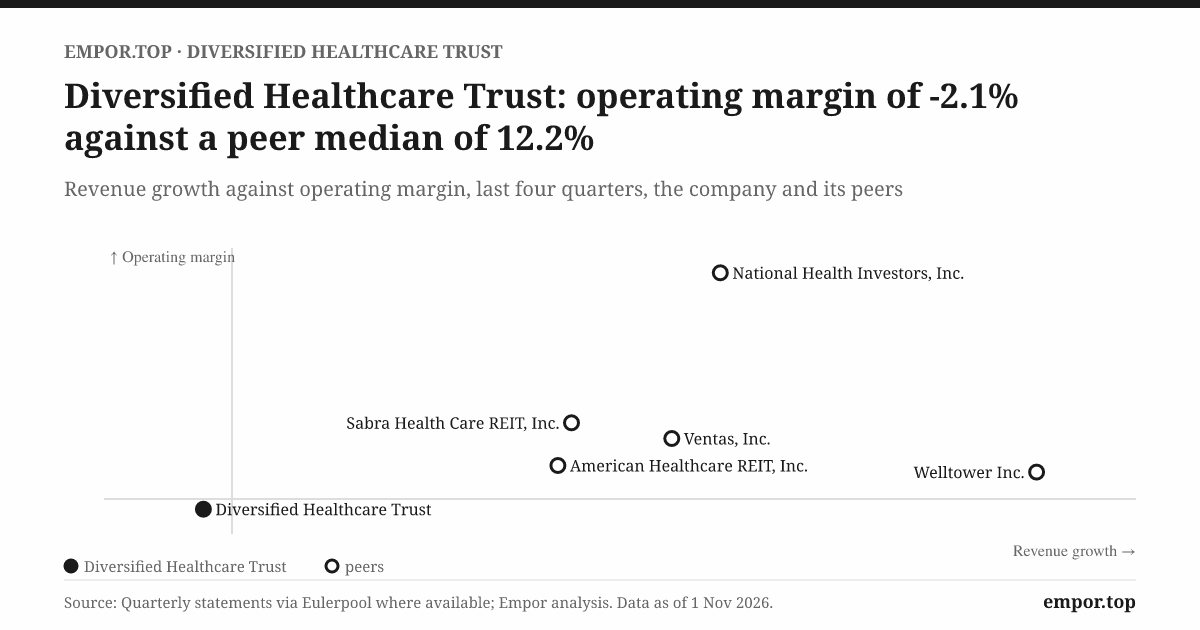
That is why revenue growth alone cannot settle whether the pivot created value. Resident fees are a gross number. They include the cost of every caregiver, every meal and every insurance premium, and they include the fee paid to the operator. A landlord's $1 of rent is mostly profit. An operator-owner's $1 of resident fees might leave a fraction of that after costs. DHC traded a smaller, cleaner income stream for a larger, messier one, and the measure of the trade is not how big the revenue line became but how much of it survives as operating income and then as cash.
The pivot therefore created the question that the rest of DHC's history has tried to answer: could a real estate trust capture the growth of senior housing without absorbing too much of an operator's risk? The answer depends on something beyond any trust's control, which is the local market in which each building competes.
III. The Demographic Tailwind Meets the Local Market
Every senior housing investor deck tells the same opening story. The baby boomers are ageing. The number of Americans over 80 is rising fast. Families are smaller and more scattered, so fewer adult children can care for parents at home. Demand, the story goes, is a mathematical certainty. It is a good story and largely true. It is also the reason senior housing owners have repeatedly lost money: when everyone believes demand is certain, everyone builds, and the people who need care arrive one building at a time, in one town at a time, choosing among whatever options are closest to their families.
That is the first thing to understand about DHC's market. Demographics shape national demand, but residents do not buy national demand. They buy a room within driving distance of a daughter's house. Whether a community fills up depends on how many competing buildings opened nearby in the last five years, whether the operator can hire and keep caregivers at wages the market will bear, and whether a family can afford a monthly bill that often rivals a mortgage. Senior housing is also fragmented. DHC's roughly $6.3 billion portfolio is a meaningful pool of buildings, but it is small next to diversified healthcare REITs such as Welltower and Ventas, and in a market made up of thousands of owners and operators no one company commands a national share that sets prices.1 The relevant competition for any DHC community is the handful of buildings around it.
Against that backdrop, DHC's second quarter of 2026 showed a business healing. Occupancy across its comparable SHOP communities averaged 83.1%, up from 81.5% a year earlier.3 The average monthly rate rose to about $5,715 from roughly $5,380.3 Rates rising more than 6% while occupancy also climbs is the combination owners want, because it suggests the communities are filling without discounting. SHOP generated about $53.5 million of net operating income in the quarter, roughly 63% of DHC's total segment operating income.7 In other words, nearly two-thirds of the profit engine now runs through buildings where residents can leave on a month's notice.
The rest of the portfolio behaves differently. DHC's medical office and life science buildings are leased to health systems, physician groups and research tenants under multi-year contracts. Across its consolidated medical office and life science properties, the weighted average remaining lease term was about 4.7 years at June 2026.3 DHC also holds interests in two unconsolidated joint ventures that own about 2.2 million square feet of medical office and life science space; those buildings were 99% leased with an average remaining term of about 13.6 years.3 That is income with a contract behind it. Compare it with a SHOP resident, whose relationship can end in weeks. The medical office side is the anchor; the senior housing side is the sail.
Even the anchor drags at times, and the second quarter showed how. DHC signed about 477,000 square feet of new and renewal medical office and life science leases in the quarter, at rents about 6.7% above the expiring leases and with an average term of about 7.1 years.4 That is a healthy result in a sector where many office landlords are still cutting rents. But same-property operating income from the segment was flat year over year, and three known tenant departures represented about 4.6% of the segment's expiring annualized revenue, two of them leaving on July 1.4 Management said it would market one of the affected buildings, about 150,000 square feet, for sale and try to re-lease the other two.4 A lease gives you visibility; it does not give you permanence. When a medical tenant leaves, the landlord pays for new improvements and commissions, and the space may sit empty for a year or more while it searches for a replacement.
That is why the segments should not be blended into a single average. The medical office and life science portfolio is a steadier, slower business whose main risk is the cost and timing of re-leasing. The SHOP portfolio is a faster, more volatile business whose main risk is that residents and caregivers walk out the door. Investors who value DHC as if it were mostly the first are underestimating its volatility; those who value it as if it were only the second are ignoring a ballast that kept income flowing through the worst of the pandemic.
So does DHC have a defensible way to win, or is it simply riding the same local tides as every other owner? The case for an edge would rest on evidence that DHC's communities retain residents longer, raise rates faster without losing occupancy, or run at lower cost than nearby competitors. The rate gains are encouraging. But occupancy still sits below 85%, which means roughly one unit in six is earning nothing, and consolidated revenue fell in the same quarter that occupancy rose.3 DHC does not publish resident retention or length-of-stay figures across the portfolio, nor market-by-market comparisons of its occupancy and rates against local competitors. Without that evidence, the honest conclusion is that the quarter supports a recovery, not a moat. The improvement is real; its source could be operator execution, a better national market, or both.
Management's own account, delivered on the Q2 call, supports that cautious reading more than a triumphant one. When RBC Capital Markets analyst Michael Carroll asked why the SHOP top line was tracking below expectations, chief executive Chris Bilotto attributed it mostly to "transition noise": new operators had inherited existing teams and were only now putting their sales programs in place, so occupancy growth would be "somewhat muted" and the ramp delayed.4 Chief financial officer Matt Brown had already explained that the company had cut its full-year occupancy growth assumption by 100 basis points to about 200 basis points and trimmed its revenue growth assumption, while raising its rate assumption slightly and cutting its operating expense growth assumption sharply.4 That is a revealing shape for guidance. The 2026 improvement is being driven more by costs and pricing than by filling rooms.
Cost-driven recovery is not worthless. Cutting waste is real value. But it is finite in a way that occupancy is not. A community can only renegotiate its food contract once; it can fill an empty room every month for years. That distinction gives the rest of this story its scorecard. Three measures matter most. The first is comparable SHOP occupancy, because it shows whether residents are choosing DHC's buildings. The second is SHOP net operating income on a same-property basis, stripped of one-time items, because it shows whether occupancy and rates translate into profit after labor and other operating costs. The third is cash flow after property improvements and leasing costs, because it shows whether any of this reaches shareholders and creditors. Those three numbers also carry the scars of the decision DHC made in 2019, when it handed operation of its buildings to an operator that would not survive the decade.
IV. The 2019 Restructuring Left a Long Tail
When the restructured Five Star arrangement took effect in January 2020, DHC had solved one problem: it no longer depended on a struggling tenant's ability to pay fixed rent. But it had created another. It now depended on that same company's ability to run its buildings well, and it bore the full cost when that did not happen. The move from triple-net leases, where the tenant pays rent plus property taxes, insurance and maintenance, to management agreements changed both how DHC's income statement looked and what DHC was exposed to. Overnight, labor, food, utilities and insurance for dozens of communities became DHC's costs, and the operator earned a fee of 5% of the managed communities' gross revenues regardless of whether those communities made money.1
A fee based on revenue rather than profit has a predictable weakness. It rewards an operator for keeping revenue up, but it does not directly reward controlling costs or maximizing what the owner keeps. DHC appears to have reached a similar conclusion fairly quickly. In 2021, it began moving 107 communities away from Five Star to other third-party managers, keeping a smaller portfolio with its longtime operator.5 It was the first admission that the 2019 fix needed a fix of its own.
Five Star, which later renamed itself AlerisLife, continued to manage a large portion of DHC's senior living portfolio after that first transfer. Then the operator itself reached the end of its road. AlerisLife sold its assets and wound down, and in 2025 DHC transferred the remaining 116 communities it managed to seven third-party managers.1 By year-end, every one of those communities had a new operator, and the move cost DHC about $10.4 million in transition costs.1 Two operator transitions in four years, covering more than 200 communities between them, is a lot of disruption for a business whose results depend on the continuity of on-site teams and resident relationships.
Woven into this story is a small capital-allocation episode that tells you how intertwined DHC and its operator had become. In 2024, DHC acquired a 34% stake in AlerisLife for $15.5 million.1 On its face, buying into an operator that would wind down the following year looks like a misjudgment. The cash trail is more nuanced. DHC recognized about $17 million and $3.4 million of AlerisLife distributions in 2025, roughly $20 million in total, already more than the original outlay.1 In its December 2025 investor presentation, the company estimated it would collect a further $25 million to $40 million of proceeds from AlerisLife's asset sales.8 If those estimates are realized, the stake will have returned several times its cost. The equity investment was not the expensive part of the AlerisLife relationship; the operational disruption was. Realized proceeds against the company's own estimate are the figure that will close that ledger, and DHC had not reported a final reconciliation in its mid-2026 filings.
The transitions themselves deserve a fair reading. A change of operator is not, by itself, proof of failure. In senior housing, owners routinely replace managers who underperform, and spreading a portfolio across several operators reduces the risk that one company's troubles sink the whole portfolio. DHC now works with seven managers for the 2025 cohort rather than relying on a single partner, which is a genuine reduction in concentration risk.1 What the repeated transitions do prove is that partner selection and the structure of management contracts are consequential, ongoing execution risks rather than one-time decisions.
Management appears to have learned at least part of that lesson. On the Q2 2026 call, Bilotto said the company was renegotiating its legacy operator contracts, covering more than 80 communities, to move toward lower base fees combined with tiered incentive fees, so operators earn more when the communities perform better.4 He expected close to $2 million of immediate annual savings, with the new agreements starting in January 2027.4 That is a sensible move toward aligning operators with the owner. It is also a reminder that the original Five Star structure, a flat percentage of revenue, did not do that.
How did the new operators actually do? The second-quarter numbers were strong, and that is the part management emphasized. The analyst questions pressed in a different direction. B. Riley analyst John Massocca asked about roughly $1.5 million of expense benefits that management had said would not recur, and Brown answered that it was "really just the timing of expense recognition," with over-accruals in the first quarter reversed in the second.4 Asked whether the new operators were deliberately avoiding expensive occupancy or simply behind schedule, Bilotto said it was a matter of timing.4 Those answers do not undermine the recovery, but they narrow it. Part of the second quarter's margin improvement was accounting timing, and the occupancy ramp that management expected from new operators was arriving later than planned.
That leads to the larger turning point. An operator handoff is only valuable if the financial recovery survives after the transition costs are paid and the one-time benefits fade. To judge whether DHC can deliver that, it helps to remember what happened the last time its operating bet was tested under real pressure.
V. COVID Exposed the Cost of the Operating Bet
DHC's new operating model went live in January 2020. Within weeks, a respiratory virus that was most lethal to the elderly began spreading through the United States, and senior living communities became the front line. Families stopped touring buildings. Move-ins froze. Communities restricted visitors, bought protective equipment in a panicked market and paid premium wages to keep staff from quitting. The timing could hardly have been worse. DHC had just taken on the full operating cost of dozens of communities at the precise moment those costs exploded and occupancy collapsed.
The headline numbers from that period are misleading if read naively, and the misreading is worth correcting directly. DHC's reported revenue jumped about 57% in 2020.5 A casual reader might take that as a demand boom. It was nothing of the sort. When the leases became management agreements, DHC stopped reporting only the rent Five Star paid and began reporting the communities' entire resident revenue, gross, along with their full operating expenses. The revenue line swelled because the accounting perimeter changed, not because more residents moved in. It is the equivalent of a landlord who used to report a tenant restaurant's rent suddenly reporting the restaurant's entire food sales. The revenue grows; the business is not necessarily any better.
What followed tells the real story. Revenue fell about 15% in 2021 and another 7% in 2022 as occupancy sagged and DHC sold properties.51 More tellingly, operating cash flow turned negative: about $63 million of cash went out the door in 2021 and roughly $40 million in 2022.51 For a REIT, negative operating cash flow is a striking result. Before 2020, DHC's operations had routinely generated several hundred million dollars of cash a year.5 The machine had gone into reverse.
Understanding why requires a brief detour into how REIT accounting works. GAAP net income for a property company is often a poor guide to its health, because buildings are depreciated over decades even though well-maintained real estate often holds or gains value. Depreciation and impairment charges reduce reported profit without any current cash leaving the company. That is why REITs emphasize measures such as funds from operations, which add back depreciation. But the correction cuts both ways. Operating cash flow ignores the money a REIT must spend on property improvements, the new roofs, renovated kitchens and refreshed common areas that keep a senior living community competitive, and it ignores the leasing commissions and tenant improvements that keep medical office buildings full. A REIT can look healthy on funds from operations and still be consuming cash once it pays to maintain its buildings. In DHC's case during 2021 and 2022, even the operating cash flow was negative before those capital needs.
The pandemic years also falsify a comfortable assumption that many investors hold about healthcare real estate: that it is automatically defensive. A medical office building leased to a hospital system for ten years is defensive. Its income barely flinched in 2020. A senior living community where residents pay month to month and the owner pays the staff is not. It behaves more like a hotel with a nursing department attached. When occupancy drops and wages spike at the same time, the owner's income can collapse far faster than the building's value. DHC's history from 2020 to 2022 is not a story of healthcare real estate failing; it is a story of the operating model doing exactly what operating models do in a downturn, magnifying the pain.
It would be too easy to blame everything on the virus. COVID was a genuine shock, and it hit the entire senior housing industry. But DHC's trouble did not end when the pandemic emergency did. The company reported net losses of roughly $290 million in 2023, about $370 million in 2024 and about $285 million in 2025, with impairments, interest and depreciation weighing on results long after move-ins had resumed.1 The pandemic is a key break in the time series, the moment when the costs of the operating bet became visible. It is not a complete explanation for what came after.
The more lasting consequence was financial. A company whose operations burn cash cannot fund its own property spending, its dividend or its debt service from internal resources. DHC cut its dividend to a token level, paying out about $9 million a year from 2021 onward compared with roughly $370 million a year in the late 2010s.51 It sold buildings. And it turned increasingly to the capital markets, which meant that the refinancing calendar, the second clock, moved from the background to the center of the story.
VI. Refinancing Bought Time, Not a Turnaround
By 2024, the question hanging over DHC was not whether its senior housing would recover eventually. It was whether the company would still be standing, on its own terms, when that recovery arrived. DHC had a stack of zero-coupon secured notes due in 2026, debt that paid no periodic interest but required a large lump-sum repayment at maturity. A zero-coupon note is like a balloon payment on a mortgage: it is cheap to carry until the day the whole balance comes due. And with operating cash flow negative, DHC could not save its way to that day.
During 2025, the company went to work on the problem from several directions at once. It raised about $1.5 billion from a range of sources, including new secured notes, mortgage financing and property sales, and in December it repaid the 2026 notes in full.19 Since the start of 2025, DHC had completed more than $600 million of asset sales, a program Bilotto described in August 2026 as "substantially complete."4 By the end of 2025, borrowings had fallen to about $2.4 billion from roughly $2.9 billion a year earlier.1 The next significant maturity is now February 2028.4
The rating agencies noticed. In September 2025, S&P raised DHC's rating, citing reduced refinancing risk after the secured notes offering, while still projecting that its adjusted debt would be roughly ten times EBITDA at the end of 2025 and in the high-eight to low-nine times range during 2026.10 Moody's upgraded DHC's corporate family rating to B3 with a positive outlook in April 2026, and in October 2026 S&P affirmed its B– rating and revised its outlook to positive.311 These are meaningful signals. Agencies do not move outlooks to positive for companies they believe are heading toward distress. But a positive outlook is not an upgrade, and B3 and B– remain deep in speculative-grade territory, the part of the credit spectrum where lenders expect a meaningful chance of default over a cycle.
This is where an important measurement problem enters. DHC's investor materials set a leverage target of 6.5 to 7.5 times.9 On its own preferred yardstick, net debt divided by the second quarter's adjusted EBITDAre annualized, management said leverage reached 7.1 times at June 2026, down from 8.7 times a year earlier.4 Read at face value, that means DHC has already reached its target. S&P's adjusted measure tells a different story, with projected leverage for 2026 still well above that range.10 The two figures differ because they measure different things: management annualizes a single strong quarter, while the agency adjusts debt and uses a fuller earnings period. Neither is wrong, but the gap matters. If the second quarter's earnings power proves durable, management's number is the right one. If part of that quarter was timing benefits and seasonal strength, the agency's more conservative view is closer to the truth. Interest coverage, measured as adjusted EBITDAre to interest expense, improved to about 2.2 times from 1.4 times, which is real progress but still thin for a company with this much debt.4
The shape of the debt matters too. At June 2026, DHC's principal obligations included about $1.6 billion of senior unsecured notes, $375 million of senior secured notes, around $327 million of fixed-rate mortgages and a $140 million floating-rate mortgage.3 Most of the stack is fixed-rate, which protects DHC from short-term interest rate moves. But the floating-rate piece moves with rates, and every fixed-rate note eventually has to be refinanced at whatever the market charges a B-rated borrower at that time. One clarification avoids a common error: DHC also has contractual operating lease payments of about $980.5 million on properties it leases, but those are lessee obligations recorded separately and should not be added to its funded debt as if they were borrowings.1
DHC's liquidity position looks adequate for now. At June 2026, it had about $117 million of cash and an undrawn $150 million secured revolving credit facility, for roughly $267 million of total liquidity.4 Brown pointed to more than $4 billion of unencumbered assets, properties with no mortgage attached, as a source of flexibility before the 2028 maturity.4 That cushion is the most important thing the refinancing created: options.
Asset sales, however, are a double-edged mechanism, and the tension shows up directly in the reported numbers. Every building sold brings cash to repay debt, but it also removes rent or operating income from the base. That is a large part of why DHC's revenue fell in the first half of 2026 even as its remaining communities improved.3 The company has effectively shrunk its way to a healthier balance sheet. That works only if what remains earns enough to support the debt that remains, and only if the buildings sold were genuinely the weaker ones.
The prepared remarks and the analyst questions on recent calls reveal the difference between the two clocks. Management's narrative emphasized falling leverage, the completed capital recycling program and "growing free cash flow."4 What management did not offer on the Q2 call was a specific free cash flow figure or a dated deleveraging target beyond the leverage range already in its presentation.4 Brown said leverage would "continue to decrease," and Bilotto even raised the possibility that the board might revisit the dividend.4 The refinancing materially reduced near-term maturity pressure. It did not grow the business, and it did not repay the debt. What it bought was a window, until February 2028, for the operating improvement to become cash. Whether that happens depends on seven operators DHC had only recently hired.
VII. Seven Operators, One Recovery Test
The person responsible for proving the recovery is Christopher Bilotto, DHC's president and chief executive officer, working alongside chief financial officer and treasurer Matthew Brown.12 Bilotto is a longtime RMR executive, and his style on calls is that of an operator rather than a promoter: he talks about dining contracts, skilled nursing wing conversions and fee structures more readily than about the demographic wave.124 Like every DHC executive, he is employed and paid by RMR, not by DHC.12 That detail will matter later. For now, what matters is the test he has set himself.
On the August 2026 call, the operating numbers gave Bilotto a strong hand. SHOP same-property net operating income rose about 37% year over year to roughly $52 million, and about 17% from the first quarter.4 Occupancy climbed 70 basis points sequentially on top of the year-over-year gains already described, and the average monthly rate rose about 1% from the prior quarter.4 Brown said SHOP net operating income was tracking toward the high end of the company's full-year guidance of $185 million to $195 million, which management had raised by $10 million at the midpoint in June.4 The company also reaffirmed normalized funds from operations guidance of 56 to 62 cents per share for 2026.4
Underneath those headline gains sit specific, concrete actions rather than demographic hope. Vice President Anthony Paula described new food and beverage contracts expected to save $14 million to $16 million a year, with about $8 million of savings landing in 2026.4 Bilotto described a plan to convert closed skilled nursing wings at 16 communities into independent living, assisted living and memory care, starting with roughly $20 million across six communities to add about 150 units, which he said would earn unlevered returns in the mid-teens.4 First deliveries are expected in the second half of 2027.4 Those are the moves of a management team trying to make each building more productive, and they deserve credit as such.
Then came the caveat that the outline of any honest recovery story must keep attached. Management acknowledged that about $1.5 million of the second quarter's expense performance would not repeat, and when Massocca pressed on it, Brown explained it as timing, first-quarter over-accruals reversed in the second.4 In a quarter with roughly $52 million of same-property SHOP income, $1.5 million is a modest amount. But it matters for how the quarter is extrapolated. A sequential jump of 17% partly reflects a weak first quarter flattered by those over-accruals in the comparison. The right way to read the first half of 2026 is to blend the two quarters, which produces a solid improvement rather than a dramatic one.
The guidance history adds a similar texture. When DHC raised its 2026 outlook in June, it did so while cutting its occupancy growth assumption and its revenue growth assumption.4 The raise came from lower expenses. When Massocca asked why the company had not lifted its rate assumption given first-half rate growth of about 6%, Bilotto said the company was comfortable with its trajectory but mindful of "a lot of moving pieces."4 That is cautious, defensible guidance practice. It is also an acknowledgement that the revenue side of the recovery, the part driven by residents choosing DHC's buildings, is moving more slowly than the cost side.
The risks to that recovery connect directly to the operating model rather than to abstract macroeconomics. Local demand can soften if competing communities open nearby. Staffing shortages and wage pressure can erode margins quickly, because labor is the largest cost in senior living. Resident turnover is constant, as residents move to higher levels of care or pass away, so communities must keep filling rooms simply to stand still. Operator execution matters enormously: a new manager must hire a sales team, rebuild referral relationships with hospitals and physicians, and win families' trust, which is exactly the process Bilotto described as still underway.4 And the occupancy ramp itself may be slower than planned, as the June guidance change already suggests.
There is also a second-order risk inside the cost savings. Dining contracts, maintenance programs and contract labor reductions are worth doing, and Brown said he expected further savings in 2027 from both new and legacy operators.4 But cost cuts eventually run into service quality. Families notice when the food gets worse or when the same caregiver no longer appears each morning. A recovery built on cost discipline must eventually hand over to a recovery built on occupancy, or the margin gains will hit a ceiling.
The credibility test for this management team is therefore straightforward. A genuine recovery should persist across several quarters, not just one; it should show up in same-property SHOP income after stripping out timing benefits; and it should reach cash after the recurring capital spending, guided at $100 million to $115 million for 2026, and the leasing costs required to keep the medical office buildings full.4 If the next few quarters show that pattern, the transition will have been worth its cost. If not, the strong second quarter will look like a peak in a noisy series. And while shareholders wait for the answer, one party to the arrangement is already being paid handsomely.
VIII. The Manager Gets Paid While the Trust Reports a Loss
In 2025, DHC reported a net loss of about $286 million.1 In the same year, it recorded a $17.9 million incentive management fee payable to The RMR Group, its external manager.1 On the surface, those two facts sit uncomfortably together. A manager earning a performance bonus in a year when the business lost more than a quarter of a billion dollars sounds like a governance scandal. The truth is more technical, and the technical truth is where the real question lives.
Start with the structure. RMR is not DHC's parent company and does not own a controlling stake in it. It is a hired manager, under contract, that provides DHC's entire executive team and corporate staff because DHC has no employees of its own.1 RMR's founding family, through managing trustee Adam Portnoy, also leads RMR itself, which means that the person on DHC's board most identified with the manager is also the controlling figure on the other side of the contract.12 That structure is common across the RMR-managed trusts and has long drawn scrutiny from governance advocates.
DHC pays RMR in several ways. In 2025, it recognized about $15.8 million of business management fees, $17.9 million of incentive management fees, $4.8 million of property management fees and $1.1 million of construction supervision fees.1 The base business management fee is calculated on the lower of DHC's historical property cost and its market capitalization, which means that when the share price falls, the base fee falls with it.1 That is a genuine alignment feature. RMR earned less from DHC during its worst years because the market valued DHC so cheaply.
The incentive fee is calculated differently. It is based on DHC's total shareholder return, share price change plus dividends, measured against a benchmark REIT index, specifically the MSCI U.S. REIT/Health Care REIT Index.1 It has nothing to do with GAAP profit. So the 2025 fee does not show that the formula broke. It shows that DHC's shares outperformed the benchmark over the relevant measurement period, which is plausible given how far the stock had fallen and how sharply it recovered once refinancing risk receded. The fee is working as designed. The question is whether the design is right.
The size of the change is what demands attention. Business management fees totaled about $16.5 million in 2024.1 In 2025, business and incentive fees combined reached about $33.7 million, roughly double, and equal to about 2.2% of revenue.1 In the second quarter of 2026 alone, DHC's general and administrative expenses included about $10 million of incentive management fees.4 With DHC's shares up about 82% for the year to that point against roughly 23% for the healthcare REIT index, according to management, the formula is likely to keep generating fees for as long as the rebound outpaces the benchmark.4
Here is the skeptical investor's challenge in its sharpest form. A total-shareholder-return incentive rewards recoveries from deep lows, and the depth of those lows was, at least in part, the product of decisions made under the same manager: the original Five Star structure, the operator transitions, the leverage. A manager can lead a company into a deep trough, collect a reduced base fee through it, and then collect an incentive fee on the bounce. The benchmark-relative design limits some of that, because DHC must beat other healthcare REITs, not just rise. But the measurement period matters enormously, and a reader of the proxy cannot easily reconcile, over a full cycle, how much DHC's shareholders have earned against how much RMR has been paid. What mechanism makes RMR share the downside? The lower base fee during bad times is one. Beyond that, the answer is not obvious.
Executive pay adds another layer of opacity. DHC does not pay its named executive officers any cash compensation directly; RMR pays them for work across DHC and its other clients, and RMR does not track or allocate executive time by client.121 DHC does grant share awards to its officers, but the proxy does not allow a DHC-only, multi-year comparison of executive pay against DHC's results.12 Shareholders can see what DHC pays RMR. They cannot see what share of Bilotto's working week DHC is actually buying. The management agreements also include termination provisions that would require DHC to pay a substantial fee to end the relationship, which makes replacing the manager an expensive option rather than an easy one.112
Shareholders expressed their views at the June 10, 2026 annual meeting. About 9% of votes cast opposed the say-on-pay resolution, a level of dissent that is noticeable but not alarming.13 Trustee elections told a sharper story. Adam Portnoy received about 41.2 million withhold votes and independent trustee Lisa Harris Jones about 25.4 million, materially more than other trustees.13 Withhold votes on the managing trustee who also controls the manager are a familiar pattern at RMR-managed companies. They are a signal worth examining, not proof of misconduct.
One more distinction belongs here. Deloitte gave DHC an unqualified audit opinion on its 2025 financial statements and its internal controls, and identified no material weakness.1 That is a clean result. But the auditor also flagged the valuation of real estate impairments as a critical audit matter, an area involving significant management judgment about future market rents, holding periods and capitalization rates.1 A clean opinion confirms that the books follow the rules. It does not certify that management's judgments about what the buildings are worth are right, and that question leads directly to the last of the four.
IX. What the Property Is Worth and What the Share Is Pricing
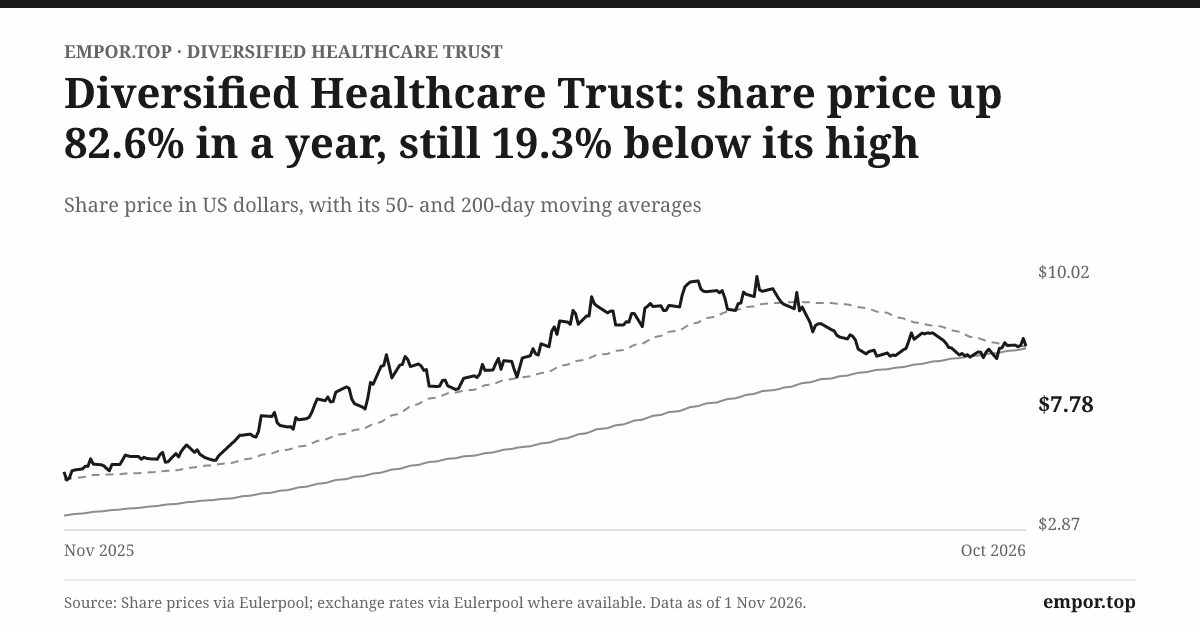
At their low point in the twelve months before November 2026, DHC's shares traded at about $4.21.2 By November 1, 2026, they had climbed to about $7.78, giving the company a market value of roughly $1.9 billion.2 That is an 85% rebound from the low, even after a pullback of nearly a fifth from the year's high of about $9.64.2 Something changed in how investors viewed DHC. The question is whether what changed was the business or simply the fear.
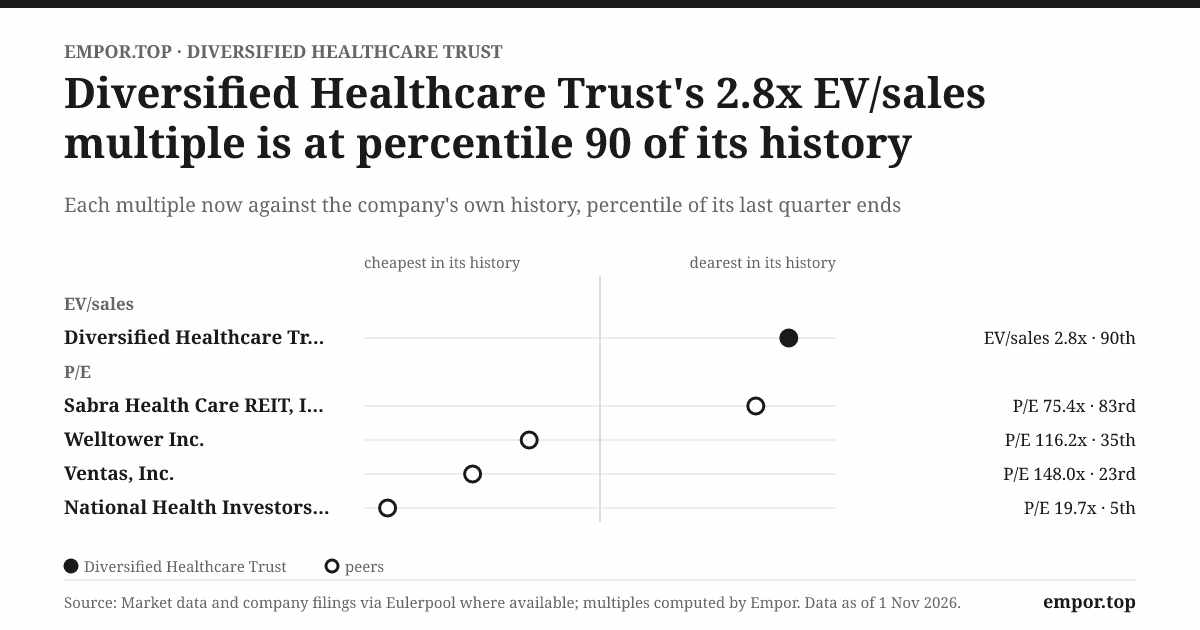
The most common shorthand for valuing a REIT against its assets is price to book value. At about 1.2 times book, DHC's shares sat far above their own five-year average of roughly 0.29 times.214 On the surface, the market now values DHC's equity at about four times the multiple of book value it applied, on average, over the previous five years. But two things moved at once. The share price rose, and book equity fell, from about $2.7 billion in 2021 to roughly $1.7 billion at the end of 2025, as losses and impairments ate into it.51 A higher multiple of a shrinking number is not the same as a higher valuation of the same thing.
Book value for a real estate company is also a peculiar measure. It is not an appraisal. It records what DHC paid for its properties, less accumulated depreciation and any impairment charges, and it marks properties down when management judges their value has fallen but never marks them up. In 2025, DHC recorded about $166 million of impairment charges, the same judgment area that Deloitte flagged.1 So book value can be too high, if impairments lag reality, or too low, if well-located buildings have been depreciated far below what a buyer would pay. Without a current, independently supported estimate of the portfolio's net asset value per share, there is no honest way to call 1.2 times book cheap or expensive. DHC does not publish such an estimate.
The other ratios in circulation need similar care. The enterprise value of about $4.2 billion is roughly 20 times trailing EBITDA on the conventional calculation, but that EBITDA figure is distorted by the timing of property sales, impairments and the operator transition.2 The trailing price-to-earnings ratio of 0.6 times that sometimes appears in data feeds is a relic of a single profitable twelve-month period ending in September 2022 and says nothing about DHC today.2 A more useful anchor is management's own normalized funds from operations guidance. At the midpoint of 56 to 62 cents per share, the share price is about 13 times 2026 normalized FFO.42 That is a multiple that assumes the recovery continues, though not one that assumes a dramatic transformation.
What the price does appear to embed is a sharp drop in perceived risk. A year earlier, the market was pricing a meaningful chance that DHC would struggle to refinance. With the 2026 notes repaid, the next maturity in 2028 and both rating agencies on positive outlooks, that tail risk has shrunk. Some of the rebound is simply the removal of a distress discount, and that part is earned. Whether the rest is earned depends on whether the second quarter's operating gains are the start of a trend.
Who is on the other side of that bet is instructive. DHC has no controlling shareholder; its largest disclosed holders are investment managers. BlackRock reported owning about 8.9% of the shares at the end of June 2026.15 Flat Footed, an investment firm that already appeared among DHC's largest holders in filings from 2023 and 2024, and related reporting persons reported up to about 9.7% in an August filing.1216 Those filings are dated differently and partly overlap, so they cannot simply be added together. But they sketch a shareholder base in which concentrated, value-oriented holders have stayed through the recovery rather than trading out on the rebound. A concentrated holder sitting near a tenth of the company is also a constituency that will notice how much of the recovery flows to the manager through the incentive fee.
Capital spending is the final piece of the valuation question, because what DHC must reinvest determines how much of its operating income actually belongs to shareholders. Real estate improvements fell from about $235 million in 2023 to roughly $147 million in 2025, a decline from about 17% to under 10% of revenue.1 That decline helped DHC's cash position, but it is not obviously sustainable. Senior living communities that need to win residents from newer competitors require renovation, and the skilled nursing wing conversions represent growth spending on top of maintenance. The medical office side has its own needs: in the first half of 2026, DHC committed about $14.5 million to leasing costs and concessions, and two medical office tenants vacated about 213,000 square feet representing about $6.9 million of annualized rent as of July.34 Keeping buildings full costs money even when the rent is contractual.
So has the market's rebound moved ahead of the business? On the evidence, the rebound has priced in the reduction of refinancing risk and a meaningful share of the operating recovery, but it has not been validated by cash generation. The share price is now asking investors to trust that the next several quarters will look like the second quarter of 2026, with the one-off benefits removed. To decide whether that trust is warranted, the bull and bear cases must be laid against each other in full.
X. Analysis & Bear vs. Bull Case
Picture two documents side by side on a desk. On the left is DHC's June 2026 investor presentation, with its leverage target of 6.5 to 7.5 times and its picture of a company that has refinanced, recycled capital and handed its senior living communities to a fresh roster of operators.9 On the right is the second-quarter operating data: comparable SHOP occupancy at 83.1%, SHOP net operating income of about $53.5 million, a quarter flattered by a modest timing benefit, and consolidated revenue still shrinking.374 Behind both sits the 2025 cash flow statement, showing operating cash flow of negative $19.6 million.1 And clipped to the top is the most recent credit action: S&P's B– rating with a positive outlook.11 Every argument about DHC is an argument about how to weigh those four pieces of paper.
The bull case begins with the evidence that the operating business is healing. Occupancy and monthly rates are rising together, which suggests that DHC's communities are filling without heavy discounting. Same-property SHOP income grew by more than a third year over year in the second quarter.4 The new operators are in place, the legacy contracts are being restructured to pay operators more when the owner does better, and the dining, maintenance and labor savings are specific and measurable rather than aspirational.4 The medical office and life science buildings provide a steadier counterweight: comparable occupancy there was about 95.8% in the second quarter, and new and renewal leases signed in the quarter carried rents about 6.7% higher than the expiring ones.4 The refinancing pushed the next major maturity out to 2028, both rating agencies have positive outlooks, and on management's own measure leverage has entered its target range.4311 In the bull's telling, DHC is a business at the bottom of an operating cycle with a balance sheet that has finally stopped being the main event.
The bear case begins with the longer record. SHOP occupancy remains below 85%, and residents can leave on a month's notice.31 Consolidated revenue fell in each of the first two quarters of 2026.3 Operating cash flow was negative in 2025, and the company has generated negative free cash flow after capital spending in every year since 2019.1 DHC has reported a net loss in every year since 2022.1 Leverage on the credit agencies' measure remains well above management's target.10 And the fee structure pays the manager handsomely on the share price rebound without any comparable mechanism to share the long years of losses. In the bear's telling, DHC has shrunk its way to survival, and the operating gains are partly cost cuts that cannot be repeated.
The industry structure explains why both stories can be true at once. Consider the forces that shape profits in DHC's markets. Buyers are fragmented across individual residents, medical office tenants and research tenants. The 2025 tenant table showed no medical office or life science tenant above 10% of annualized rental income, with the largest, the University of Kansas Health System, at about 2.1%.1 That fragmentation protects DHC from any single customer's bargaining power. But in medical office space that is not especially differentiated, a tenant can credibly threaten to move across the street, which gives tenants local bargaining power at renewal. Senior living residents face high switching costs in a practical sense, because moving an elderly parent is disruptive and emotionally draining. Yet their contracts allow exit on short notice, and every new resident chooses among local alternatives, so the switching cost protects retention more than it protects pricing.
Supplier power is concentrated in labor. Caregivers, nurses and cooks are the largest cost in senior living, and in tight labor markets they have real leverage. Operators are suppliers too, and DHC's experience with Five Star shows how much an operator's competence and contract terms can shape the owner's returns. The threat of new entrants is cyclical: when senior housing returns look attractive, developers build, and new, modern communities compete directly with older ones. The threat of substitutes is real and slowly growing, as home care and technology-assisted ageing at home allow some seniors to delay or avoid moving into a community. Rivalry is local and intense. Put together, these forces describe an industry in which profits rise when supply is scarce and fall when it is abundant, and in which no owner of DHC's scale sets prices.
Hamilton Helmer's framework of seven durable sources of competitive advantage sharpens the moat question. Scale economies are limited: DHC is far smaller than Welltower or Ventas, and senior housing economics are mostly local, so national scale offers modest purchasing advantages at best. Network effects do not apply. Switching costs exist for residents and some medical tenants but, as described, do not translate into evident pricing power. DHC has no brand that residents choose; residents choose operators and locations, and DHC's operators carry their own brands. Counter-positioning does not describe its strategy. A cornered resource would require something like irreplaceable locations or exclusive relationships, and DHC discloses no evidence of either across the portfolio. Process power, the most plausible candidate, would show up as consistently better occupancy, rates or margins than local competitors over many years. DHC does not publish the comparisons that would demonstrate it, and its own record of repeated operator transitions argues against an embedded operating advantage. The conclusion is plain: DHC has no demonstrated durable moat. It is a collection of reasonably well-leased medical buildings and senior living communities whose performance depends on location, operator execution and the industry cycle.
The capital-allocation record deserves the same scrutiny. The 2019 restructuring was meant to solve the Five Star problem; within two years, DHC was moving 107 communities to other operators, and within six, the operator itself had wound down and the remaining 116 communities had moved again at a cost of about $10.4 million.51 The 2024 AlerisLife stake looks, on the company's own figures, like it will return more than its $15.5 million cost through distributions and asset-sale proceeds, which is a better outcome than the operator's wind-down might suggest.18 But a profitable small investment does not offset the disruption costs of two operator handoffs. That record narrows rather than rejects the claim that DHC's capital allocation has improved. The 2025 refinancing and asset sales were well executed under pressure. The underlying operating model has required repeated repair, and the latest repair has not yet produced positive cash after property spending.
Management credibility gets a similar calibrated verdict. Across recent calls, the narrative has been consistent: complete the operator transitions, recycle capital, reduce leverage, improve SHOP margins. The transitions were completed in late 2025 as promised, and the asset sale program reached the scale management described.4 The guidance raise in June came with an honest cut to occupancy and revenue assumptions, and when analysts asked about the expense benefit and the occupancy pace, the answers were specific rather than evasive.4 Those are marks in management's favor. Against them sit the absence of a specific free cash flow target, the reliance on a single annualized quarter for the headline leverage figure, and a fee structure that rewards the share price recovery without a transparent reconciliation of DHC-specific costs. The record leaves management's credibility intact but unproven on the measure that matters most, which is cash.
That brings the story back to the three numbers that will decide it. Comparable SHOP occupancy stood at 83.1% in the second quarter of 2026, rising.3 Same-property SHOP net operating income, after stripping out one-time items such as the second quarter's timing benefit, was growing strongly year over year.4 Cash flow after property improvements and leasing costs was negative in 2025 and has not yet been shown to turn positive on a sustained basis.1 If the first two keep rising and the third turns positive, the bull case is being confirmed. If occupancy stalls, or if income growth fades once the cost savings are fully absorbed, the bear case is.
The investor answer can be stated plainly. DHC has a credible route to improvement, with real early evidence in occupancy, rates, operating income and refinancing access. The evidence for a durable competitive advantage is thin. What remains is a leveraged operating recovery, one whose success depends less on the demographics everyone talks about and more on whether a handful of operators can fill rooms faster than the debt clock ticks.
XI. Business & Investing Lessons
Go back to 2019, to the moment when Senior Housing Properties Trust decided to take its buildings back from a tenant that could no longer pay. On paper, the trust was gaining control. In practice, it was gaining a payroll. The first lesson of DHC is that a landlord can inherit the operator's cost base without inheriting the operator's pricing power. When the leases became management agreements, every caregiver's wage and every food invoice became DHC's problem, but DHC did not gain any special ability to charge residents more than the community down the road. The upside of operating senior housing is real when a market tightens. The downside arrives first, and it arrives in the form of fixed costs that do not shrink when residents leave. Founders and investors looking at any business that converts fixed contracts into variable exposure should ask what the new owner can control, not just what it now captures.
The second lesson comes from December 2025, when DHC repaid its 2026 notes and moved its next maturity to 2028. It was a genuine achievement, and the share price rewarded it. But the year's operating cash flow was still negative. Refinancing buys a calendar; only cash flow buys freedom. A company that refinances successfully has earned the right to keep trying, not the conclusion that it has succeeded. Investors who treat a maturity extension as a turnaround are confusing a longer runway with a working engine.
The third lesson comes from the $17.9 million incentive fee DHC paid RMR in a year of heavy losses. The formula was clear, benchmarked and followed exactly as written. A benchmark can explain an incentive fee, but it cannot settle whether shareholders are aligned. Alignment is about who bears the cost of mistakes as well as who shares in the recovery, and an external manager whose base fee falls in bad years but whose incentive fee rises on the bounce shares the upside far more fully than the downside. The lesson for investors in any externally managed vehicle is to look past the formula to the full-cycle reconciliation of what the manager earned and what the owners kept.
The fourth lesson lives in the gap between DHC's monthly rate growth and its occupancy. Rates rose more than 6% in a year, yet roughly one unit in six still stood empty.3 A demographic tailwind fills no room by itself. Somebody has to answer the phone, give the tour, earn the daughter's trust and keep the caregiver from quitting. National demographics determine how big the pool of potential residents becomes; local execution determines whether any of them choose your building.
Beneath all four lies the central lesson of DHC's story. In a leveraged REIT, operating recovery, capital allocation and governance cannot be evaluated separately. The occupancy gains matter because the debt is large. The debt matters because the operating model is volatile. The governance matters because the people deciding how to balance the two are paid on a formula that rewards the share price more directly than the cash. Pull any one thread, and the other two move with it.
XII. Epilogue
On November 1, 2026, DHC stands in a different place from where it stood eighteen months earlier. The 2026 debt is gone. The operator transition is complete and now sits in the comparison base, which means the next round of results will show whether the new operators can improve on themselves rather than merely on their predecessors. The share price has nearly doubled from its low. And the February 2028 maturity sits on the horizon, close enough to see, far enough to plan for.4
The next reporting cycle will begin to settle the central questions, and each outcome has a clear meaning. If comparable SHOP occupancy keeps climbing toward and past 85% while monthly rates continue to rise, that would be evidence that residents are choosing DHC's communities, not just paying more to stay. If same-property SHOP income keeps growing after the $1.5 million timing benefit drops out of the comparison and after the dining savings are fully absorbed, that would be evidence that the operating improvement is durable rather than a one-time cost reset.4 If cash flow after recurring capital spending and leasing costs turns positive, that would be the first time in years that DHC's buildings, rather than its asset sales and its bondholders, fund the company. And if leverage falls on the agencies' measure, not just management's annualized quarter, toward the 6.5 to 7.5 times range, that would be the strongest signal that the two clocks are finally running in DHC's favor.910
The opposite outcomes would mean something too. Flat occupancy would suggest that the new operators have reached the limits of what better management alone can achieve in DHC's local markets. Negative cash after property needs would suggest that the business still cannot fund itself. And further asset sales that shrink income without closing the gap to the leverage target would suggest that DHC is selling its way into a smaller company rather than recovering into a stronger one. The skilled nursing wing conversions, with first deliveries expected in the second half of 2027, will be an early test of whether DHC can invest its way to growth rather than only cut its way to margin.4
When the next quarter arrives, investors would do well to reread the second-quarter call: the prepared confidence that SHOP income was tracking toward the high end of guidance, and the more careful answers when analysts asked about timing benefits, seasonality and the pace of occupancy.4 The gap between those two registers is where the truth about this recovery will show up. DHC has moved from crisis refinancing toward operating repair. Its shareholders still need that repair to reach cash flow, and the calendar is moving.
XIII. Outro
Somewhere in one of DHC's communities tonight, a resident is settling into a room that cost about $5,700 this month, and her family is deciding, quietly, whether next month will look the same. Multiply that decision across thousands of rooms and it becomes the first clock: the one that measures whether DHC's business is healing. In a filing cabinet far from any resident's room sits the second clock, a bond due in February 2028, indifferent to how good the dining has become.
DHC is a property trust whose most important recovery depends on the people living in its buildings, and on whether their fees can become cash before the debt comes due. Everything else, the refinancing, the operator changes, the fee formula, the rebound in the share price, is commentary on that race. At DHC, the recovery is real only when a fuller building pays down the debt.
References
-
2025 Annual Report on Form 10-K — Diversified Healthcare Trust, SEC, 2026-02-24 ↩↩↩↩↩↩↩↩↩↩↩↩↩↩↩↩↩↩↩↩↩↩↩↩↩↩↩↩↩↩↩↩↩↩↩↩↩↩↩↩↩↩↩↩↩↩↩↩↩
-
Q2 2026 Form 10-Q — Diversified Healthcare Trust, SEC, 2026-08-03 ↩↩↩↩↩↩↩↩↩↩↩↩↩↩↩↩
-
Q2 2026 Earnings Call Transcript — Diversified Healthcare Trust, Stock Analysis, 2026-08-04 ↩↩↩↩↩↩↩↩↩↩↩↩↩↩↩↩↩↩↩↩↩↩↩↩↩↩↩↩↩↩↩↩↩↩↩↩↩↩↩↩↩↩↩↩↩↩↩↩↩
-
2021 Annual Report on Form 10-K — Diversified Healthcare Trust ↩↩↩↩↩↩↩↩↩↩↩
-
Senior Housing Properties Trust Announces Name Change to Diversified Healthcare Trust — DHC, 2019-12-30 ↩
-
Q2 2026 Supplemental Financial Information — Diversified Healthcare Trust, SEC, 2026-08-03 ↩↩
-
DHC Investor Presentation — Diversified Healthcare Trust, 2025-12 ↩↩
-
DHC Investor Presentation — Diversified Healthcare Trust, 2026-06 ↩↩↩↩
-
S&P Upgrades Diversified Healthcare Trust on Refinancing — Investing.com, 2025-09-16 ↩↩↩↩
-
S&P Rating Action on Diversified Healthcare Trust — Cbonds, 2026-10-16 ↩↩↩
-
2026 Proxy Statement — Diversified Healthcare Trust, SEC, 2026-03-19 ↩↩↩↩↩↩↩↩
-
2026 Annual Meeting Voting Results, Form 8-K — Diversified Healthcare Trust, SEC, 2026-06-12 ↩↩
-
DHC Price/Book Ratio History — TGMCharts, accessed 2026-11-01 ↩
-
Schedule 13G/A — Flat Footed LLC, StreetInsider, 2026-08-14 ↩
 LinkedIn
 WhatsApp
 Reddit
 Hacker News
 Email
 Kindle
 RSS Feed
 Spotify
 Apple Podcasts
 Amazon Music
 Audible
 YouTube