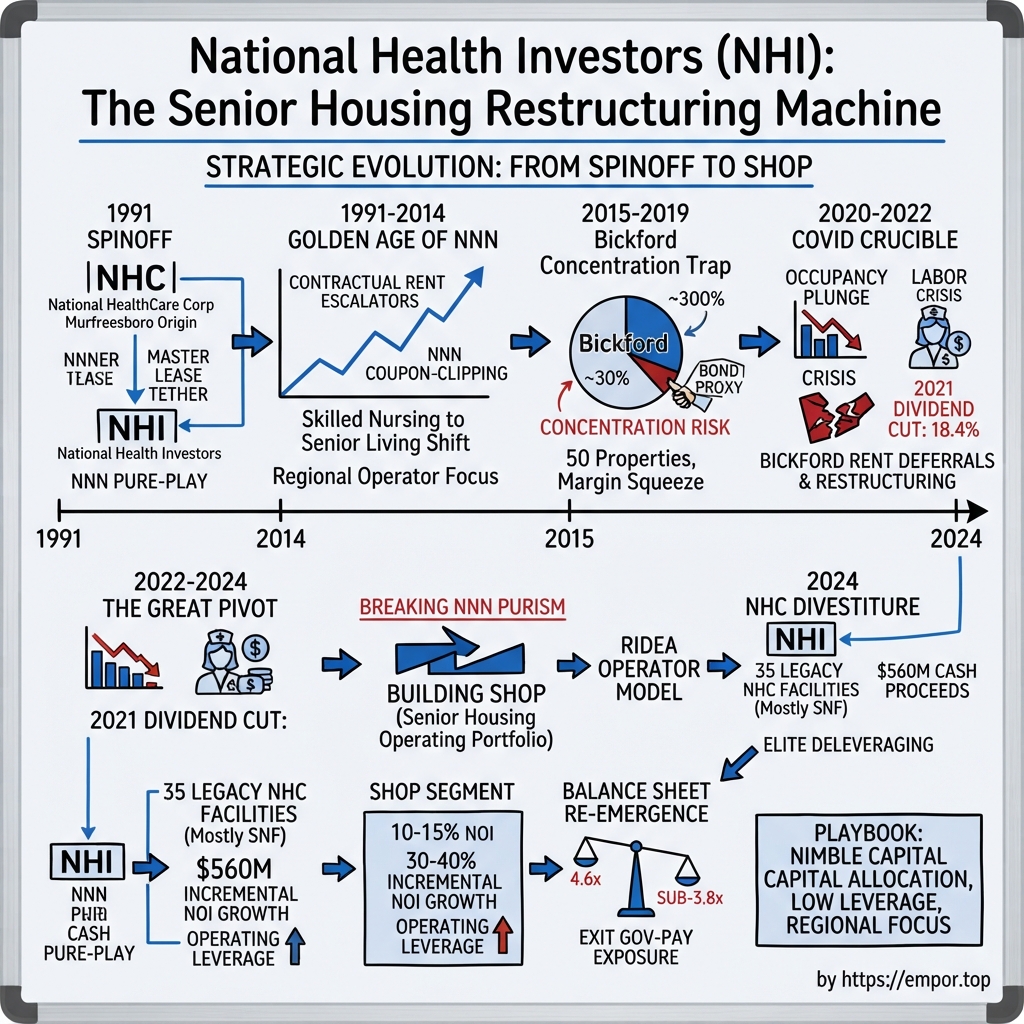
National Health Investors, Inc. (NYSE: NHI): The Senior Housing Restructuring Machine
I. Introduction & Episode Roadmap
On July 1, 2026, a wire transfer for $560 million moved between two companies headquartered eleven minutes apart by car in Murfreesboro, Tennessee. On one side sat National HealthCare Corporation, an operator of skilled nursing facilities that began business in 1971.1 On the other sat National Health Investors, the real estate investment trust that NHC itself created in 1991 to hold its properties. The document extinguished that morning was a Master Agreement to Lease dated October 17, 1991 — a contract older than many of the analysts covering the stock and, for three and a half decades, the foundational agreement in NHI's filings.2
Management framed the transaction as a watershed moment; on the August 2026 earnings call, Chief Executive Eric Mendelsohn called the sale "one of the most significant corporate actions in NHI's history."3 Market reception, however, has been markedly more reserved. In early September 2026, NHI shares trade around $70.88, near the lower end of their 52-week range of $67.94 to $91.38, giving the company a market capitalization of roughly $3.4 billion. Divesting the legacy master lease has so far coincided with a depressed stock price and lower earnings guidance than the company posted before the transaction.
That disconnect — between a clean strategic narrative and a share price moving sideways to lower — makes NHI worth careful analysis. The company navigated a severe industry downturn during the pandemic, cut a dividend once promoted as untouchable, stepped away from a three-decade reliance on pure triple-net leasing, fended off an activist investor by roughly one percent of outstanding shares, and ultimately monetized its founding relationship at a valuation analysts generally viewed as solid. Yet while each tactical move appeared defensible in isolation, the cumulative outcome is a $3.4 billion REIT that functions partly as a nascent senior housing operator. Management has yet to guide a seasoned operating portfolio through a full economic cycle, and its primary same-store operating metric has fallen short of internal guidance three times in succession.
The core paradox of healthcare REITs. The traditional pitch for triple-net healthcare real estate was straightforward. A landlord acquires a property, leases it to an operator under a long-term contract, and collects rent escalating at two to three percent annually. The tenant covers taxes, insurance, maintenance, and utilities. In theory, the landlord assumes no payroll exposure, no food-cost inflation, and no direct reimbursement risk from government payors. Combined with favorable demographic aging across developed economies, Wall Street marketed the structure for decades as delivering equity upside with bond-like predictability.
The operational reality has proved less forgiving. A triple-net lease depends entirely on operator-level unit economics. When facility earnings before rent drop below the contractual obligation, standard legal remedies offer limited protection. Evicting an operator leaves a landlord with a licensed building caring for elderly residents who cannot simply be displaced during litigation. As a result, default covenants routinely turn into rent concessions. What was underwritten like a fixed-income stream resembles a leveraged position in an operator's labor costs — without the commensurate upside during strong periods, as contractual escalators typically cap rent growth at two to three percent.
That structural asymmetry serves as the central thread in NHI's recent history, shaping its strategic choices since 2020.
What NHI actually is in 2026. Underneath the corporate narrative, the company operates three distinct segments on a single balance sheet. The core remains a triple-net landlord: at year-end 2025, it held 176 leased properties across 32 states with 31 tenant relationships, representing roughly $2.7 billion in gross real estate investment across 110 senior housing communities, 65 skilled nursing facilities, and one hospital. The second segment is an operating platform comprising 26 properties across 13 states with 3,009 units, structured through consolidated joint ventures with third-party management firms and totaling $634.3 million in gross investment at the end of 2025. The third and smallest business is financing: $218.7 million in mortgage and other notes receivable, before credit loss reserves.7
These lines generate divergent revenue profiles. Of NHI's $375.6 million in total revenue for 2025, rental income accounted for $271.6 million, resident fees and services from the operating portfolio contributed $80.1 million, and interest and other income generated $24.0 million.7 Five years earlier, the operating line did not exist. That shift encapsulates the strategic pivot: whether exchanging contractual rent for resident service fees builds a more resilient business or simply introduces operating volatility to an income-oriented REIT.
Where NHI sits in its industry. Relative scale shapes competition in healthcare real estate, and NHI remains a smaller player. Industry leaders Welltower and Ventas maintain national footprints, proprietary operating platforms, and lower capital costs that allow them to use operating partnership units effectively in acquisitions. Mid-tier REITs such as CareTrust, Sabra, and LTC Properties compete directly with NHI for regional operating partners.
Scale disparities directly influence investment economics. A REIT's principal input is its cost of capital, since value creation depends on the spread between financing costs and property yields. Larger, higher-rated competitors can bid more aggressively on prime assets while maintaining attractive spreads. NHI seeks to counter this dynamic by targeting transactions in the $30 million range — deals meaningful to a $3.4 billion company but generally too small for multi-billion-dollar rivals. Whether niche deal-sourcing can overcome a persistent capital-cost gap remains a pivotal question for the investment thesis.
The roadmap. The story begins in Murfreesboro, where a retired surgeon's concept for elder care established an operating business and, twenty years later, a dedicated real estate landlord. The account charts the prolonged period of steady lease collections, followed by mid-market portfolio expansion in the late 2010s that concentrated roughly a third of cash flow among a small group of tenants. It examines the 2020–2022 disruption, during which rent collections dropped into the mid-eighty percent range against contractual amounts and forced a dividend reduction.
The narrative then traces NHI's transition into property operations. It analyzes the July 2026 NHC transaction, evaluating the valuation, tax structure, governance backdrop, and future lease income surrendered in the sale. Finally, the analysis stress-tests the long-term thesis against industry fundamentals, evaluating whether NHI's balance-sheet profile, operational scale, and cost of capital position it to capitalize on demographic demand.
 Subscribe on LinkedIn
II. Spinoff DNA: Dr. Carl Adams and the Murfreesboro Blueprint (1971–1991)
In the early 1970s, Middle Tennessee was an unlikely cradle for a healthcare empire. Murfreesboro was a county-seat town of roughly 26,000 residents, thirty-five miles southeast of Nashville, recognized primarily for a Civil War battlefield and a state teachers' college. It was also home to a retired surgeon pursuing an unconventional model for elder care.
Dr. Carl Adams stepped away from active medical practice in 1971 to focus on nursing homes, which at the time formed a fragmented, undercapitalized, and often substandard corner of American healthcare. His core insight was architectural as much as clinical. Rather than treating a nursing home as a terminal destination, he envisioned a continuum-of-care campus: a physical site where residents could transition between independent living, assisted living, skilled nursing, and rehabilitation as their care requirements evolved, without leaving the community or their social network behind.4 The concept anticipated what the healthcare sector later formalized as continuing care retirement communities, marking a distinct departure from the standalone nursing-home model of the era.
The operating company that emerged from that model became National HealthCare Corporation. By 2024, NHC operated 80 skilled nursing facilities with more than 10,000 licensed beds, alongside assisted living, independent living, behavioral health hospitals, homecare, and hospice agencies, employing nearly 15,000 people across nine states.1 Yet operating healthcare facilities and owning the underlying real estate require fundamentally different capital structures. Facility operations are working-capital-intensive, heavily regulated, and thin-margin, whereas property ownership is an asset-heavy, long-duration business prioritizing predictable cash flow. Housing both inside a single corporation frequently obscured the financial performance of each, prompting public markets to discount the combined business.
The 1991 separation. In 1991, NHC executed a structural maneuver that multiple healthcare operators would replicate over the following decade: separating operating activities from property ownership, commonly referred to in the sector as separating the "beds" from the "bricks." The company transferred a portfolio of facilities into a newly formed Maryland corporation, National Health Investors, and distributed the shares to NHC stockholders.5 W. Andrew Adams founded NHI that year and served as its chairman continuously from inception, while holding the president's title until February 2009 and the chief executive role until March 2011 — an executive tenure with few parallels among publicly traded REITs.6
The contractual anchor between the two entities was the Master Agreement to Lease executed on October 17, 1991. Under the arrangement, NHC ran the facilities, while NHI collected contractual rent and, in accordance with REIT tax rules, distributed the vast majority of its taxable income to shareholders. The transaction provided NHC with capital for operational expansion while removing real estate debt from its balance sheet. In turn, NHI secured an established portfolio of cash-flowing assets backed by an operator whose executive leadership directly overlapped with its own.
The timing aligned with the emergence of the modern REIT era. By distributing at least 90 percent of taxable income to avoid corporate-level taxation, a REIT acts as a conduit for long-duration, contractually escalating rental streams. Conversely, operating companies face corporate income taxes and trade on earnings multiples that penalize capital-intensive property holdings. Bifurcating the business allowed public markets to value each component independently: income-focused investors could buy the yield of the property portfolio, while equity investors could price the operating business on operational earnings. In the early 1990s, this bifurcated model represented an innovative financial structure rather than standard industry practice.
The percentage-rent wrinkle. A critical feature of the 1991 lease remained economically active until the portfolio's sale in 2026. The NHC agreement did not rely solely on a fixed escalator; it incorporated percentage rent tied directly to the revenues NHC generated in the facilities, governed by true-up mechanics evaluating current- and prior-year revenues.8 This mechanism granted NHI direct participation in tenant top-line growth decades before hybrid revenue-sharing structures gained broader traction among healthcare REITs. However, it also introduced quarterly cash-flow variability. In the first quarter of 2026 alone, a stronger-than-expected prior-year percentage-rent true-up combined with higher current-quarter percentage rent produced $1.3 million more cash rent than management had guided just weeks earlier.17 Decades after its drafting, the founding agreement continued to inject volatility into quarterly financial results.
Why Murfreesboro mattered. Geography played an understated role in NHI's operational strategy. Middle Tennessee hosts one of the densest healthcare-management ecosystems in the United States. Since the late 1960s, the greater Nashville area has generated a high concentration of hospital networks, skilled nursing operators, and senior housing providers, flanked by specialized healthcare lenders and legal advisors.
For a specialized landlord seeking off-market transactions, proximity to this regional network provided an informal deal-sourcing pipeline. It also explained how NHI maintained an exceptionally lean corporate structure: diligence and underwriting frequently relied on long-standing regional relationships rather than sprawling internal teams. While this lean approach minimized overhead during periods of passive triple-net leasing, it posed structural challenges later when the company took on direct oversight of operating properties.
Cultural imprint, and the problem it created. The founding structure established two defining characteristics that continue to shape NHI's investment profile.
The first was a culture of cost discipline, relationship-driven underwriting, and balance-sheet conservatism. As late as February 2026, the company employed only about 35 people to manage a leased portfolio representing $2.7 billion in gross real estate investment.78 This lean staffing kept general and administrative expenses low as a percentage of total revenue compared to larger institutional peers.
The second outcome was governance entanglement. A public REIT whose founder and longtime chairman, principal tenant, and key board members shared decades of interlocking personal and financial ties presented an inherent conflict of interest. During periods of reliable rent payments and steady equity returns, institutional shareholders tolerated the overlapping oversight. But when operating headwinds emerged and share-price performance faltered, the close relationship that underpinned NHI's origin became a central target of shareholder criticism and activist scrutiny.
That governance pressure emerged only after an extended era of stability, however, as the company enjoyed nearly two decades of predictable triple-net lease execution.
III. The Golden Age of NNN Coupon-Clipping (1991–2014)
In its simplest form, the triple-net REIT model barely resembles an active operating business. An investor purchases a property with cash and debt, signs a 15-year lease with a two-to-three percent annual escalator, and collects predictable rental checks while periodically refinancing underlying debt at favorable rates. For much of the period from 1991 through 2014, that straightforward formula defined NHI.
How a triple-net lease actually works. While the triple-net structure shifts property taxes, insurance, and maintenance to the tenant, the core financial underwriting centers on investment yield and credit coverage. In a standard sale-leaseback, rent is set as an initial yield on the landlord's capital outlay: acquiring a building for $20 million at an 8 percent initial capitalization rate generates $1.6 million in first-year rent, increasing annually under contractual escalators. The transaction allows an operator to monetize illiquid real estate for growth capital, while providing the landlord with an income stream insulated from day-to-day property expenses.
The linchpin of this structure is not the headline rent, but the tenant's coverage ratio: property-level earnings before interest, taxes, depreciation, amortization, and rent (EBITDAR or EBITDARM) divided by contractual rent. A coverage ratio of 1.5x provides an operator with sufficient cushion to absorb a difficult operating year. At 1.2x, a single severe winter or localized wage spike can wipe out the operator's margin of safety. Below 1.0x, the tenant must fund rent payments out of its own corporate reserves or borrowed capital — a cash drain that an operator will sustain only as long as it views the distress as temporary.
For NHI's first two decades, coverage across the legacy NHC portfolio was rarely in doubt. NHC operated conservatively, understood the facilities it had designed and built, and reliably met its rent obligations.
The migration out of government pay. The strategic narrative of NHI's middle decades was a deliberate rotation away from government reimbursement risk. Skilled nursing facilities rely primarily on Medicare and Medicaid, leaving facility revenues subject to legislative budget cycles and administrative rate-setting. The sector felt the full weight of that vulnerability following the Balanced Budget Act of 1997, when abrupt modifications to federal payment formulas triggered a wave of nursing home bankruptcies.
Private-pay senior housing — encompassing assisted living, memory care, and independent living — offered an alternative profile. Because residents and their families fund care through private savings, pensions, and home equity, operators face no statutory rate-setting authority. Pricing power instead reflects local demographics, area wealth, and competing supply. The trade-off is operational: private-pay demand is discretionary at the margin and sensitive to housing downturns, with narrower operating margins that demand intensive labor management.
NHI leaned steadily into that transition. By the end of 2019, its leased footprint had expanded to 238 facilities across 34 states with 32 operating tenants, tilting toward 157 senior housing communities compared to 76 skilled nursing facilities, supplemented by $340.1 million in mortgage and other notes receivable spread across 11 borrowers.9 Six years later, at the end of 2025, subsequent asset sales and portfolio restructuring had pruned that leased footprint to 176 properties in 32 states across 31 tenants, of which 110 were senior housing and 65 skilled nursing.7
The quiet third business: lending. Alongside property leasing, NHI developed a financing book of mortgage and other notes receivable, providing construction financing, mezzanine debt, and transitional loans to operators not yet ready for a permanent sale-leaseback. In 2019, that book stood at $340.1 million across 11 borrowers.9 The lending strategy served a dual purpose: it generated an attractive interest spread and established a proprietary acquisition pipeline, as a construction loan effectively functioned as a call option to acquire the real estate once stabilized. Management frequently highlighted this pipeline as a primary deal engine; in 2025, NHI converted outstanding loans into fee-simple ownership and redeployed more than $93.3 million of loan payoffs into owned real estate.19
While effective for sourcing properties, the lending strategy carries a mechanical drag that investors must monitor: every successful conversion into owned real estate contracts the interest-income line. In the second quarter of 2026, interest income from mortgages and other notes fell 16.1 percent year over year purely because the principal balance had come down.3 That dynamic creates a headwind embedded in the business model — a self-liquidating earnings stream that requires ongoing replacement through new originations, contractual rent, or resident fees simply to keep total revenue flat.
The middle-market niche. NHI also made a defining choice regarding where it would compete. While industry leaders Welltower and Ventas built multi-billion-dollar national platforms partnering with the country's largest institutional operators, NHI focused on mid-market regional owner-operators managing between 10 and 40 buildings. These regional groups frequently required growth capital, liquidity, or construction takeout financing, yet were too small to attract attention from mega-cap REITs.
The value proposition was clear: NHI offered agile execution, flexible deal structuring, and a relationship-driven partnership rather than an institutional process. The underlying risk, however, took a decade to fully emerge. Regional operators are, by definition, undiversified. They operate with modest corporate balance sheets, constrained access to capital markets, and narrow geographic footprints that prevent them from cross-subsidizing struggling facilities with cash flows from stronger markets. While a master lease with cross-default provisions across 40 buildings appears protective on paper, partnering with an undercapitalized tenant ultimately converts a diversified property portfolio into a concentrated credit exposure to a single private entity.
One bet that did work. Not all specialized bets from this era faltered. NHI also established exposure to entrance-fee continuing care retirement communities — the campus model pioneered by Dr. Adams, where residents pay a substantial upfront entry fee alongside monthly charges in exchange for lifetime care guarantees. Entrance-fee CCRCs are operationally complex and capital-intensive, leading most publicly traded REITs to avoid them. Yet the segment proved resilient. Asked about the portfolio in February 2026, Chief Investment Officer Kevin Pascoe described it as "a very good portfolio" with an operating partner that "did wonders through COVID and continues to perform very well," while adding that NHI is "mindful of our concentrations there" and will approach further additions opportunistically rather than as a focus.16
That measured stance illustrated management's selective discipline when assessing capital-intensive formats, even as concentration risks were quietly mounting across its core regional senior housing portfolio. Over the latter half of the 2010s, NHI would confront the full operational consequences of that mid-market exposure.
IV. The Middle-Market Bet & The Bickford Concentration Trap (2015–2019)
On August 11, 2015, NHI announced that its president and chief executive, Justin Hutchens, was resigning immediately to become executive vice president and chief investment officer for senior housing and care at HCP. Hutchens had led the company for seven years. In his place, Chairman Andy Adams appointed an interim successor who had arrived at NHI barely seven months earlier: Eric Mendelsohn, then executive vice president of corporate finance, who had spent nine years in corporate development at Emeritus Senior Living before arriving in Murfreesboro in January 2015.10 By October, the board made his appointment permanent.
It was an unexpected promotion. Mendelsohn inherited an enterprise whose identity rested on an unbroken record of annual dividend growth, taking the helm just as healthcare real estate capitalization rates were compressing and REITs across the sector faced mounting pressure to maintain acquisition volumes. His practical mandate was to keep the expansion engine running.
Mendelsohn's background helps explain NHI's subsequent trajectory. Rather than rising through real estate brokerage or REIT accounting, he had spent nine years in corporate development at Emeritus Senior Living, an operator.10 Having worked on the operational side of the table, he understood firsthand the internal mechanics of an underperforming senior housing community — from sales quotas and staffing trade-offs to lease negotiations with property landlords. That was an unconventional résumé for a net-lease REIT executive, whose standard responsibilities in 2015 centered on credit underwriting and capital-markets execution.
In retrospect, that operational exposure proved valuable when market conditions later prompted NHI to convert roughly a quarter of its portfolio into an operating business. While outside observers cannot determine whether his background inspired that eventual strategy or merely facilitated its execution once distress forced a transition, it ensured the shift was directed by an executive with direct senior-housing experience, distinguishing NHI from pure-play financial REITs navigating the same operational pivot.
Feeding the machine. The most consequential partnership of this era was with Bickford Senior Living, a Midwestern operator of assisted living and memory care facilities. NHI established itself as Bickford's primary capital provider, acquiring stabilized and newly constructed communities and leasing them back under master-lease agreements. For years, the arrangement served both parties: Bickford secured expansion capital without diluting equity, while NHI achieved initial property yields comfortably above its borrowing costs in an increasingly competitive acquisition market.
By 2019, that exposure had expanded significantly. Bickford generated roughly 17 percent of NHI's total revenue that year and stood among four operators that each contributed at least 10 percent of the REIT's top line — a cohort that collectively accounted for approximately 58 percent of total revenue.9 In practical terms, nearly three-fifths of a $3 billion REIT's revenue stream depended on just four counterparties, only one of which (NHC) was a publicly traded company backed by an investment-grade-quality balance sheet.
Testing the moat claim before COVID arrives. The standard underwriting defense of this structure was that master leases reinforced by cross-default covenants and corporate guarantees insulate landlords from operator credit risk. Evaluating that claim against historical performance, however, reveals structural vulnerabilities that emerged well before the pandemic disrupted the industry.
Warning signs were visible across the portfolio in the late 2010s. Assisted living construction surged across the Midwest between 2016 and 2018. New competing inventory acted as an operational tax on incumbent properties, depressing occupancy while fixed facility costs remained unchanged. Operating margins narrowed, and tenant rent-coverage ratios steadily eroded.
Under those conditions, the cross-default mechanism revealed its practical limitations. Contractually, a cross-default clause grants a landlord the right to terminate an entire master lease if a tenant defaults on a single property. Yet executing that right against an operator managing dozens of buildings rarely yields a clean recovery. Instead, eviction triggers regulatory relicensing battles, immediate staffing turnover, substantial transition expenses, and the stigma of marketing distressed healthcare real estate. Because the costs of lease termination are prohibitively high for both parties, default covenants function less as an absolute safeguard and more as a framework for forced renegotiation. When tenant distress escalated, NHI did not terminate its master leases; it deferred rent, restructured obligations, and renegotiated contractual terms.
Why the machine kept running. The underlying incentive to concentrate tenant exposure was embedded directly in the company's business model. NHI's shareholder base consisted largely of income-focused investors who valued the stock for its dividend yield and consistent distribution increases. Sustaining dividend growth required steady expansion in funds from operations. For a REIT lacking an internal development arm or organic rental growth beyond modest two-to-three percent contractual escalators, expanding cash flow necessitated continuous property acquisitions.
With property yields compressing and larger institutional REITs outbidding mid-market competitors for premier assets, NHI found its most attractive investment spreads among regional operators with limited alternative financing options. Expanding commitments with existing partners offered an efficient path forward: incremental transactions required no new counterparty diligence, no unfamiliar lease negotiations, and no onboarding of new operating teams.
Concentration, therefore, was not an oversight in credit analysis. It was the structural consequence of delivering consistent dividend growth in an asset class constrained by fixed rental escalators. The mechanism that encouraged that concentration remains relevant to NHI's current investment thesis, as management has once again targeted elevated acquisition volumes and an expanding Senior Housing Operating Portfolio (SHOP) footprint in a competitive capital environment.
What management should have seen. Management was not blind to tenant concentration; the company's Annual Report on Form 10-K explicitly cited tenant concentration as a key risk factor year after year.8 The central issue was that NHI continued adding to concentrated tenant exposures even while disclosing the associated hazards, because the alternative — moderating acquisition volume, slowing dividend growth, and risking a lower valuation multiple — ran counter to prevailing market incentives.
By the close of 2019, NHI possessed an expanded balance sheet, an extended record of dividend increases, and a heavily concentrated tenant roster. Months later, the onset of the pandemic exposed the structural fragility of that portfolio.
V. The COVID Crucible & The Broken Dividend Illusion (2020–2022)
In early 2020, congregate senior housing represented nearly the worst conceivable environment for an airborne pathogen: communal dining, shared ventilation, a resident population with a median age above eighty and multiple comorbidities, and a caregiving workforce that moved between facilities.
The operational breakdown struck through three channels simultaneously. Facility admissions froze because families could not tour communities or visit loved ones. Resident move-outs and mortality accelerated. Concurrently, operating expenses escalated sharply as staff fell ill and facilities turned to temporary agency staffing at multiples of standard wage rates. In an operating business where labor accounts for roughly two-thirds of the cost structure while revenues remain bound by pre-existing leases, that dynamic does not merely compress margins—it eliminates them.
The mechanics of an occupancy shock in senior housing differ fundamentally from conventional commercial real estate. A senior living community operates with largely fixed overhead: the property requires around-the-clock staffing whether it houses sixty residents or ninety, food-service infrastructure remains operational, and state licensing mandates do not scale down during downturns. Consequently, the marginal resident carries substantial operating leverage—and the loss of that resident exerts an equally severe downward pull on cash flow. A ten-percentage-point decline in occupancy does not simply reduce property-level operating profit by ten percent; across many communities, it erases it entirely.
Compounding that operational drag is the extended sales cycle. Unlike multifamily housing, where vacancies can often be addressed through immediate rental concessions or advertising, senior housing transitions are typically prompted by an acute health event and guided by adult children vetting multiple properties over several months. The pandemic did not merely depress spot occupancy; it dismantled the customer acquisition pipeline required to replenish it. Restoring that admissions funnel has required years of operational rehabilitation—a headwind management still cites as a central operational challenge in 2026.
What it looked like inside NHI. By the spring of 2021, contractual lease collections were deteriorating. In May 2021, NHI collected 87.1 percent of contractual cash rent due, bringing its second-quarter collection rate through May to 86.2 percent.11 Property-level arrangements illustrated the depth of tenant distress: Holiday Retirement, then one of NHI's largest tenants, received a $600,000 monthly rent deferral from May through July 2021, accompanied by an agreement to release $600,000 per month from its existing security deposit to cover rent. In effect, NHI funded its own rental income using tenant collateral while accruing the balance as an interest-bearing receivable at 8 percent, repayable over eighteen months beginning in January 2022.11 Bickford Senior Living similarly deferred an increasing share of its contractual obligations.
The dividend breaks. On June 3, 2021, NHI declared a second-quarter dividend of $0.90 per share, down from $1.1025—an 18.4 percent reduction that preserved approximately $28 million in cash during 2021 alone. Mendelsohn characterized the reduction as a step to preserve "a prudent and conservative capital structure" while providing balance-sheet flexibility to restructure tenant relationships.11
This action marked the formal unraveling of the bond-proxy thesis. For three decades, NHI had marketed an uninterrupted record of dividend increases to income-oriented investors. That distribution history reflected an extended period of industry expansion rather than structural insulation from operator credit risk. When sector-wide distress took hold, contractual rent claims on insolvent operators proved unenforceable without severe economic concessions, forcing the landlord to absorb the shortfall. The dividend reduction reflected the economic reality that triple-net healthcare leases ultimately remain subordinate to operator-level solvency.
The prolonged distribution recovery underscores that structural shift. NHI maintained the quarterly dividend at $0.90 per share for roughly four years, increasing it to $0.92 in the third quarter of 2025 and to $0.94 in the third quarter of 2026.123 Five years after the reduction, the quarterly distribution remains approximately 15 percent below its pre-pandemic peak. For investors evaluating NHI's historical dividend franchise, the arithmetic is straightforward: at an incremental pace of two cents annually, restoring the pre-2021 payout will extend well toward the end of the decade.
The Bickford reckoning. Accounting adjustments followed in 2022. Effective April 1, 2022, NHI restructured its master leases with Bickford, reducing contractual annual rent to approximately $28 million through April 2024, after which rent would reset to fair market value subject to a floor of not less than 8.0 percent of NHI's initial gross investment. In exchange, lease terms were extended, pushing a twelve-property master lease from 2023 to 2028, with other maturities extended to 2033 and 2035.13
Concurrently, NHI transitioned Bickford to cash-basis revenue recognition, writing off $18.1 million in straight-line rent receivables and $7.1 million in unamortized lease incentives after financial disclosures from Bickford "raised substantial doubt as to its ability to continue as a going concern."14 Cumulative pandemic-related deferrals totaled approximately $26.0 million at the time of restructuring, structured for monthly repayment from October 2022 through December 2024, with up to $6.0 million eligible for forgiveness upon meeting operational performance targets.14
That adjustment highlights a crucial dynamic in net-lease accounting. Straight-line rental income is a non-cash accrual that averages contractual rent escalators across the duration of a lease, allowing landlords to recognize earnings well ahead of cash receipts. When an operator's credit profile deteriorates to the point of doubtful collectability, those accumulated accounting balances must be reversed in a single reporting period. NHI's $18.1 million write-off demonstrated that years of previously reported GAAP rental income had exceeded underlying cash realizations. For net-lease investors, an expanding straight-line receivable balance serves as an early indicator of credit vulnerability before an overt lease restructuring occurs.
Triage by disposal. Management paired lease restructurings with balance-sheet contraction. NHI later reported to shareholders that it had acted "early and decisively at the onset of the pandemic" by executing more than $400 million in asset dispositions, including the sale of seven properties tied to the 2022 Bickford lease amendment for $43.7 million in net proceeds.22 Divesting healthcare properties during an industry crisis typically limits realization values, and NHI did not publicly disclose the aggregate net proceeds of that disposition campaign relative to historical book value. The strategic result was clear: the company restored balance-sheet stability through asset sales rather than portfolio growth, retaining the communities management deemed viable for long-term recovery.
The Welltower fight. The period of distress culminated in litigation. In mid-2021, Welltower acquired assets from Holiday Retirement, including tenant leasehold interests across NHI-owned properties. NHI alleged that the acquiring entities fraudulently induced its consent to the lease assignment, subsequently ceased paying contractual rent, and withheld a pledged security agreement to extract lease modifications or force an asset sale. NHI filed suit in the Delaware Court of Chancery on December 20, 2021.13
The dispute was resolved through a memorandum of understanding on March 4, 2022. Under the settlement, NHI applied the remaining $8.8 million lease deposit toward delinquent rent, while Welltower placed approximately $6.9 million into escrow, released upon operational transition of the communities and mutual dismissal of legal claims.13 While NHI recovered capital, the master-lease arrangement dissolved. The company took back possession of fifteen senior living communities, leaving management with the task of repositioning those assets.
That operational transition established the foundation for NHI's modern corporate structure.
VI. The Great Pivot: Breaking NNN Dogmatism & Building SHOP (2022–2026)
When a triple-net landlord takes back possession of a distressed facility, it faces two unappealing options: sell into a market that recognizes the distress at a steep discount, or retain the real estate, establish a taxable subsidiary, engage a third-party manager, and absorb property-level operating economics directly onto its income statement.
The second path relies on the REIT Investment Diversification and Empowerment Act of 2007, or RIDEA. The statutory acronym obscures a fundamental transformation in business risk. Under a pure triple-net lease, a REIT's top line consists solely of contractual rent. Under a RIDEA structure, the REIT owns the real estate, leases it to a wholly owned taxable REIT subsidiary, and retains an independent management firm to oversee day-to-day operations in exchange for a fee. The landlord's income statement then reflects resident fees as revenue, while labor, food, utilities, insurance, and marketing appear as direct property operating expenses. The REIT retains the net residual cash flow. In healthcare REIT terminology, this collection of operating properties constitutes the Senior Housing Operating Portfolio, or SHOP.
The economic trade-off is clear: the landlord surrenders a contractual rent floor in exchange for unconstrained operating upside. During a broad occupancy recovery, the structure captures expanding facility margins. During periods of elevated inflation or regional oversupply, however, the arrangement exposes the balance sheet to sharp volatility, as wage increases or escalating utility bills flow dollar-for-dollar to the bottom line without a lease cushion to absorb them.
NHI backed into it. Rather than originating from a premeditated strategic blueprint, NHI entered property operations out of operational necessity. Effective April 1, 2022, following the Welltower settlement, the company transferred the fifteen recovered Holiday communities into two consolidated joint ventures—six managed by Merrill Gardens and nine by Discovery Senior Living—paying management fees to third-party operators.1315 That tactical repositioning marked the formal creation of NHI's SHOP segment: an expedient resolution to a contested lease default rather than an elective shift in corporate philosophy.
Management has acknowledged as much in public disclosures. On the fourth-quarter 2025 earnings call, Mendelsohn characterized the legacy Holiday portfolio as "more of a science experiment that we backed into when Holiday sold to Atria and Welltower."16 On the first-quarter 2026 call, he was even more direct: "The Holiday buildings were a science experiment," contrasting those legacy assets with the newer properties NHI began acquiring, which he noted are "not 40 years old, not in need of constant CapEx and not in very tertiary markets."17 For an executive team that spent decades defending passive net leasing while arguing that peers assuming operational risk went uncompensated for the volatility, the transition represented an unheralded strategic reversal—a pragmatic pivot whose intellectual rationale management never fully articulated in advance.
Then they leaned in, hard. Whatever its improvised beginnings, the operating platform quickly became NHI's primary growth vehicle. The company expanded the SHOP footprint from 15 properties to 26 over the course of 2025, reaching 42 communities by the middle of 2026.73 Invested capital in the segment reached approximately $854.8 million by the second quarter of 2026—a 137 percent increase year over year that brought operations to roughly 24 percent of the company's total portfolio.18 Net operating income from the segment rose in tandem, generating $11.0 million in the second quarter of 2026, up 188.5 percent from the prior-year period.18
Management signaled ambitions for a far more expansive transformation. On the August 2026 earnings call, Mendelsohn observed that SHOP exposure had climbed from roughly 5 or 6 percent of the business a year earlier to nearly 25 percent, reiterating an objective to lift operating assets to "40% or 50%" of the portfolio over an estimated three-year horizon. He also proposed expanding annual investment activity from a historical $200 million to $400 million pace up to a range of $500 million to $700 million.3 When Cantor Fitzgerald analyst Rich Anderson asked whether that three-year target was constructed to be beaten, Mendelsohn acknowledged the conservative posture: "part of my internal wiring is to underpromise and overdeliver."3
What the buying actually looks like. Broad descriptions of platform expansion obscure the practical mechanics of individual transactions, where three acquisitions illustrate the strategy. In late 2025, NHI deployed $52.1 million for a community in Jamison, Pennsylvania, structuring the transaction as a five-year triple-net lease to Priority Life Care at an 8.0 percent initial yield, supplemented by a revenue-participation feature projected to add 25 to 50 basis points. The contract included provisions permitting NHI to convert the asset into SHOP, an option management indicated it expected to exercise.19 In February 2026, the company completed a nine-property acquisition across Kentucky, South Carolina, and Tennessee for $105.5 million—its largest SHOP transaction to that date—assigning operational oversight to Allegro Living Management, an affiliate of Spring Arbor, which expanded NHI's total capital commitment with that operating group to $227 million.19
On May 1, 2026, NHI closed a seven-property Colorado portfolio for $106.9 million, encompassing 532 units with average occupancy in the upper 80 percent range and monthly revenue per occupied room around $5,300. The transaction was underwritten at an expected first-year NOI yield of roughly 8.3 percent, or 7.8 percent after routine capital expenditures, with day-to-day operations assigned to Generations, an existing tenant partner in the state.17
These transactions outline a consistent template. NHI acquires stabilized or near-stabilized private-pay communities in secondary markets at yields above prevailing institutional clearing prices, assigning management to regional operators with whom the REIT maintains established relationships. The Jamison structure represents a notable variation: a lease intentionally drafted to convert into an operating partnership, securing a contractual rent floor during operational onboarding while preserving upside participation under RIDEA. The mechanism provides an incremental method to acquire operating optionality without absorbing immediate operational downside—a structural tool NHI did not possess five years earlier.
The number that frames everything. In February 2026, then-Chief Financial Officer John Spaid disclosed a metric that encapsulates the financial trade-off: the in-place yield on NHI's SHOP invested capital stood at 5.4 percent.19 Management characterized the figure as an indicator of earnings potential, pointing to "substantial NOI growth upside for the company." While an unseasoned portfolio earning 5.4 percent offers headroom for operational improvement, the initial spread also highlights the core risk. NHI has reallocated capital out of triple-net leases that historically yielded north of 7 percent into an operating segment delivering 5.4 percent, making shareholder value creation entirely dependent on expanding occupancy, improving rental rates, and widening operating margins.
Segment disclosures demonstrate the earnings imbalance. In the first quarter of 2026, the leased real estate portfolio generated $75.3 million in net operating income, compared to just $8.9 million from the SHOP segment.24 Operating real estate accounted for roughly a quarter of invested capital but barely a tenth of total property NOI. Until operational execution narrows that yield disparity, every dollar redirected from contractual leases into operating joint ventures dilutes immediate cash earnings in exchange for projected future gains.
Testing the RIDEA thesis against NHI's own record. The core bullish argument contends that SHOP provides direct participation in an occupancy recovery driven by demographic aging. Yet the clearest empirical challenge to that thesis appears in NHI's own historical results.
The only operating properties the company has managed long enough to report on a same-store basis are the fifteen legacy Holiday communities. Their financial performance has been weak and consistently difficult for leadership to forecast. Same-store SHOP NOI fell 0.9 percent in the fourth quarter of 2025, even as overall segment NOI expanded 125 percent through acquisitions.19 Entering 2026, management issued same-store NOI growth guidance of 7.0 to 8.0 percent.19 By the May 2026 call, executives reduced that forecast to a range of 1.0 to 3.0 percent, with Mendelsohn acknowledging that legacy performance "continues to be below our expectations."17 During the first six months of 2026, same-store cash flow contracted: second-quarter same-store NOI dropped 6.3 percent year over year, from $3.821 million to $3.582 million, requiring roughly 8.0 to 9.0 percent growth across the second half of the year simply to reach the bottom of the downgraded target.318
On the August 2026 call, Chief Investment Officer Kevin Pascoe addressed the operational headwinds directly, pointing to resident move-outs that the local sales pipeline had failed to replenish, units taken offline for renovation that reduced occupancy by "at least a percentage point," and "an increased number of deaths for a few months."3 Leadership signaled that underperforming facilities would be divested, disclosing that it had "discussed a solution with our Board on a subset of same-store properties," while Mendelsohn summarized the portfolio-management approach: "prune your losers and develop those buildings that can be developed into winners."3
These recurring revisions do not invalidate the RIDEA model, but they highlight its operational demands. While the evidence challenges any assumption that NHI can automatically produce steady same-store growth across legacy senior housing, it does not disprove the thesis that newer, higher-acuity communities acquired in the upper 80 percent occupancy range can achieve high-single to low-double-digit growth. Those newly acquired communities have tracked initial underwriting, but they have been held for months rather than economic cycles, and none enter the reported same-store pool until late 2026 and 2027.1917
The critical performance indicator will be same-store SHOP NOI growth once the 2024 through 2026 acquisition vintages qualify for inclusion, evaluated alongside the specific composition of that asset pool. Until those metrics emerge, investors are effectively underwriting an operating platform based on pro forma projections rather than multi-year operational proof.
Meanwhile, the corporate overhead required to support an operating platform has already expanded. NHI's corporate roster grew to approximately 35 employees by early 2026, representing a 46 percent increase over its 2022 baseline.19 Cash general and administrative expenses climbed roughly 40 percent year over year in the fourth quarter of 2025 and 31 percent in the first quarter of 2026, pushing total G&A up 44 percent to $8.8 million in the second quarter of 2026.19173 While a portion of that increase reflects transitional onboarding costs, the overarching shift is structural. Assuming direct operating risk requires building out internal asset-management infrastructure—and NHI must absorb those corporate costs across a $3.4 billion enterprise rather than the multi-billion-dollar balance sheets of larger rivals.
VII. The $560 Million Masterstroke: The NHC Divestiture (April–July 2026)
The transaction that closed on July 1, 2026, did not materialize in a vacuum; it emerged from an approaching contractual deadline and an activist proxy challenge.
The deadline. The 1991 master lease with NHC was scheduled to mature on December 31, 2026.19 That expiration date reframed the negotiation. Rather than opportunistically monetizing a legacy asset from a position of detached strength, NHI was approaching the conclusion of an agreement covering 35 properties that generated $39.7 million in annual cash rent. Its counterparty had operated those facilities for three and a half decades and understood every operational challenge and deferred-maintenance liability within them.20 Negotiating leverage was therefore far from one-sided. On the February 2026 earnings call, Mendelsohn and Pascoe declined to discuss the status of discussions, with Mendelsohn noting, "we are in the thick of it right now, so I would describe our posture as we are in a quiet period regarding NHC."16
The proxy fight. The second catalyst arrived when an activist investor placed the NHC relationship at the center of a public campaign. In February 2025, Land & Buildings, led by Jonathan Litt, nominated two board candidates, James Hoffmann and A. Adam Troso, arguing that NHI's board suffered from excessive tenure and governance conflicts. The activist targeted three directors it characterized as conflicted regarding the impending NHC lease negotiations, prominently citing Robert Adams, who served as NHC's chairman, had spent five decades with the operating company, and held roughly $47 million in NHC equity. Holding approximately 587,000 shares, Land & Buildings argued that NHI traded at a persistent discount due to market skepticism over governance, contending that renewing the NHC master lease at open-market rates presented substantial upside over in-place rent.21
NHI prevailed, but by an exceptionally slim margin. All four company nominees secured election, with Land & Buildings falling short by approximately one percent of outstanding shares after proxy advisory firm ISS recommended against NHI's slate.22 The defense carried direct costs: the company absorbed $1.57 million in proxy contest expenses during the first six months of 2025 alone.15 Leadership also accelerated governance reforms, citing the appointment of five independent directors over five years, the retirement of two long-tenured board members, the selection of a new nominating and governance committee chair, and a formal commitment to declassify the board.22 Those adjustments followed an earlier milestone: in November 2024, W. Andrew Adams had announced his retirement as chairman effective December 31, 2024, concluding a 33-year tenure.6
Fifteen months after the proxy challenge, the related-party arrangement was completely dismantled. Assessing that outcome requires balancing two realities: management executed a complex, favorably priced transaction, yet it did so only under prolonged external scrutiny that leadership had resisted for decades. Acknowledging the favorable financial result does not obscure the external pressure that prompted it.
Anatomy of the deal. On April 21, 2026, NHI announced an agreement to sell 32 skilled nursing facilities and three independent living communities to NHC for $560 million in cash, scheduled to close July 1 pending Hart-Scott-Rodino regulatory clearance. Management estimated transaction expenses between $6 million and $8 million. Blueprint Healthcare Real Estate Advisors served as transaction advisor, while an independent special committee engaged Houlihan Lokey as financial advisor and Venable as legal counsel—an elaborate governance protocol reflecting the related-party history between buyer and seller.20
On pricing, the economics favored the seller. Measuring $39.7 million in 2025 cash lease revenue against the $560 million purchase price yielded an implied exit capitalization rate of approximately 7.1 percent. That represented an aggressive valuation for skilled nursing real estate, a sector that historically traded at wider capitalization rates. Furthermore, because NHI had held the properties for decades, their depreciated book value had declined below $15 million, generating an expected accounting gain of approximately $541.6 million.1718
NHC's willingness to pay an institutional valuation reflected its own operational imperatives. Having managed the communities since 1991, the operator faced the December lease expiration across 35 facilities critical to its network. Rather than subjecting its core business to market-rate rent renegotiations or potential displacement, NHC elected to acquire the real estate, funding the purchase through a $475 million senior unsecured term loan alongside a $55 million revolving credit draw administered by Bank of America.2 For the operator, swapping rental obligations for property ownership at an implied 7.1 percent capital cost offered strategic certainty. The transaction resolved long-term risks for both counterparties, reflecting an equitable commercial settlement rather than a one-sided concession.
Testing the activist's version too. Rigorous analysis requires examining the activist thesis with equal detachment. Land & Buildings did not ground its 2025 campaign solely on governance; it made a specific financial projection, arguing that renewing the NHC master lease at market rates offered "75% or more upside to current rent" and forecasting approximately 50 percent share-price appreciation over the ensuing twelve months.21 Neither outcome materialized. NHI did not reset the properties to higher contractual rent, choosing instead an outright divestiture, while the stock traded lower fifteen months later than when the activist launched its campaign.
That trajectory does not imply the activist erred regarding underlying asset value; securing a 7.1 percent exit yield on properties carried at under $15 million in net book value substantiated that the real estate held significant unreflected equity. However, it demonstrated that the activist's specific mark-to-market leasing thesis failed to drive the projected equity re-rating. In practice, public markets proved far more skeptical of the ultimate capital redeployment than either management's original pro formas or the activist's sum-of-the-parts models had anticipated.
What NHI gave up. The divestiture eliminated NHI's most reliable revenue stream. Within NHI's portfolio, skilled nursing rent coverage reached 2.66x EBITDARM for the twelve months ended March 31, 2026, compared to 1.62x across senior housing.3 The NHC master lease had satisfied all contractual obligations throughout the pandemic downturn, maintaining full payments while regional senior housing tenants required widespread deferrals and lease restructurings.
Reinvestment conditions, moreover, presented narrower spreads than the exit yield. NHI's investments through the second quarter of 2026 totaled $237.2 million at an average yield of 7.7 percent, but subsequent pipeline yields signaled compression: signed letters of intent totaled $127.3 million at an estimated initial gross yield of 6.8 percent, or 6.5 percent net of recurring maintenance capital expenditures.3 Pascoe described acquisition pricing candidly, noting that the pricing spread between institutional portfolios and single-asset acquisitions had compressed from at least 100 basis points down to 25 to 50 basis points, while initial yields that historically began with a seven were trending "closer to 6%, 6.5% on higher quality stuff, if not a little bit lower."3
The financial equation reveals a demanding reinvestment hurdle: NHI exited cash flows yielding 7.1 percent to acquire assets delivering roughly 6.5 percent net of capital expenditures. That capital rotation generates economic accretion only if operational growth across newly acquired properties substantially exceeds the predictable two-to-three percent annual escalators of the surrendered lease—an operational hurdle that NHI's historical same-store results have yet to demonstrate.
The tax clock. The substantial accounting gain introduced immediate tax complications. Under REIT tax regulations, NHI faced three choices: distribute the capital gain as a taxable special dividend, incur entity-level corporate taxes, or shelter the proceeds through Section 1031 like-kind exchanges. Management committed to tax deferral: approximately $221 million in proceeds funded previously acquired replacement assets through reverse 1031 exchanges, leaving roughly $334 million earmarked for future acquisitions under strict statutory deadlines.3 On the second-quarter 2026 earnings call, equity analysts repeatedly questioned whether the company could deploy those remaining funds before the exchange periods expired. Mendelsohn acknowledged the corporate priority: "we're going to do everything we can to avoid that special dividend." When asked to define execution success, he was equally explicit: "I would consider it success if we don't pay a special dividend because we're able to reinvest all of the 1031 proceeds."3
That statutory timetable creates a motivated-buyer dynamic, introducing significant capital-allocation risk. A REIT operating with strict deadlines, $334 million in idle cash, and an explicit public commitment to avoid distributing a taxable special dividend faces structural pressure to deploy capital quickly in an acquisition environment its own leadership characterizes as fiercely competitive. While Pascoe countered that acquisitions would remain selective—asserting that "it's not an asset aggregation strategy for us"—the impending deadlines will test whether underwriting discipline can withstand the pressure to avoid a taxable distribution.3
The balance sheet. The immediate result was substantial balance-sheet deleveraging. Prior to the transaction's close, NHI reported a net-debt-to-adjusted-EBITDA ratio of 4.1x as of June 30, 2026, resting within a revised target range of 3.5x to 4.5x that management had tightened from its prior 4.0x-to-5.0x parameter in February 2026.1819 Pro forma for the sale proceeds, management guided net leverage down to approximately 2.3x.20 Total available liquidity at the end of the second quarter stood at approximately $792.4 million.18
That conservative posture reflects structural constraints rather than unencumbered financial strength. Management had tightened its leverage parameters specifically due to "the importance we place on our investment grade rating" and shifts in its "debt service coverage ratio in this higher-for-longer interest rate environment."19 Despite achieving low spot leverage, credit rating agencies have maintained NHI at their lowest investment-grade tiers: Moody's affirmed its Baa3 rating on September 21, 2025; Fitch affirmed BBB-minus on April 16, 2025; and S&P affirmed BBB-minus on October 6, 2025, each with a stable outlook.7 Sub-3x leverage has not translated into a superior cost of capital; modest overall scale and historical tenant concentration continue to constrain the company's credit rating.
VIII. Current Management, Incentives, and Capital Allocation (2024–Present)
Three of the four executives tasked with executing NHI's operating strategy assumed their current positions within the past twelve months.
Eric Mendelsohn has served as president and chief executive since 2015, providing leadership continuity. His public persona is unusually candid and self-aware for a healthcare REIT executive: he openly describes acquired legacy portfolios as a "science experiment," joked that an incremental dividend increase was "not a reference to nostalgia," and acknowledges that his natural inclination is to underpromise. That transparency offers helpful clarity for investors. Yet personal candor does not resolve structural performance questions: Mendelsohn presided over the tenant concentration buildup of the late 2010s, the 2021 dividend reduction, and recurring SHOP guidance downgrades, while public disclosures have never fully articulated why leadership reversed its long-standing opposition to direct operating risk.
Kevin Pascoe, the chief investment officer, serves as the acquisition engine and the most technically detailed executive on investor calls. His commentary on property underwriting consistently highlights property vintage, acuity mix, local demographics, operator back-office depth, and pro forma assumptions. When asked in August 2026 whether additional triple-net properties would convert into operating joint ventures, Pascoe pinpointed the operational gate: whether a prospective operating partner has established the internal controls, Sarbanes-Oxley compliance infrastructure, and back-office depth necessary to support a management contract.3 The detail reflects practical underwriting diligence rather than generic corporate optimism.
Todd Siefert assumed the chief financial officer role on July 1, 2026, succeeding John Spaid, who joined in 2016 as NHI's thirteenth employee and retired the same day. That executive transition generated $1.1 million in second-quarter 2026 expenses, including approximately $0.5 million in cash.317 Siefert's initial public remarks adhered to conventional corporate framing—noting available balance-sheet capacity and stating that equity would be deployed if warranted by accretive growth opportunities—leaving his capital-allocation record still to be established.3
Chris Maingot became NHI's first chief operating officer on July 27, 2026, with a base salary of $415,000. Maingot brought deep operational background, having served as chief executive of Longview Senior Housing, a Blackstone portfolio company, after spending more than a decade at Brookdale Senior Living as senior vice president of corporate development, following early career experience at Horizon Bay.23 Mendelsohn characterized the appointment as serving two strategic functions: allowing Pascoe to focus fully on property acquisitions while infusing the operating platform with "a little bit of private equity mentality to our operating platform."3
Appointing a dedicated chief operating officer in the fourth year of an operational expansion represented a pragmatic step, implicitly acknowledging that direct property oversight had outgrown the company's lean management structure. The board made a parallel addition in February 2026 by appointing Lily Donahue, who served as chief executive of Holiday Retirement from 2016 to 2022—adding direct operational experience to a board that had historically been short of one.19
How the growth is being funded. NHI's acquisition volume over the past two years has relied primarily on equity rather than retained cash flow. Former CFO Spaid noted that weighted average diluted shares expanded 5.4 percent in the fourth quarter of 2025 and 5.8 percent in the first quarter of 2026 "as a result of the company's greater use of equity in lieu of debt to fund new investments over the last year."1917 The company executed this through at-the-market equity programs and forward sale agreements, under which NHI contracts to sell shares at a set future price, holds proceeds in escrow, and draws them down as acquisitions close. At year-end 2025, NHI held approximately $44.5 million in escrowed forward proceeds tied to 600,000 shares at an average price of $69.23; by March 2026, forward balances totaled roughly $44.2 million against 643,000 shares at $68.81.1917 Management replenished its at-the-market capacity to $500 million during the first quarter of 2026.17
Equity-financed growth is standard practice for conservative REITs seeking to maintain low leverage through acquisition cycles, explaining how NHI kept debt metrics subdued while expanding its portfolio. However, it tightens the hurdle for per-share accretion. Acquiring properties at a 6.5 percent net yield enhances funds from operations per share only if the blended cost of equity and debt used to fund the transaction clears that hurdle. With NHI shares trading near 52-week lows and supporting a dividend yield above 5 percent, the investment spread narrows considerably. Siefert's observation on the August 2026 call—that NHI would access the equity market "if the equity is there and we've got accretive deals that we can obviously show to investors"—is a conditional statement, and that condition is currently not comfortably met.3
The debt profile presents fewer immediate constraints. NHI retired a $125 million term loan maturing in June 2026 during the second quarter, carries a $100 million private placement note due in January 2027 that leadership expects to repay before the end of 2026, and faces no further maturities until its revolving facility matures in 2028.3 For a REIT preparing to deploy several hundred million dollars of reinvestment capital, an unencumbered maturity schedule provides meaningful operational runway.
Incentives and corporate accountability. Governance practices and executive incentives drew intense scrutiny during the 2025 proxy contest, prompting subsequent governance reforms—independent director appointments, a formal commitment to declassify the board, and the retirement of the company's longtime founder and chairman. In evaluating management execution, the broader historical pattern is instructive: NHI has routinely established beatable corporate targets and surpassed them at the enterprise level—posting 2025 normalized FFO of $4.91 per share, a 10.6 percent increase that exceeded initial guidance by roughly 6 percent—while missing repeatedly on the one operating metric it fully controls.19
What analysts are actually pressing on. Recent quarterly conference calls have centered on four recurring themes, revealing varying degrees of management clarity:
Redeployment drag. When asked directly about revisions to 2026 earnings expectations, Spaid conceded that "the net effect of the NHC transaction was to pull down our guidance."17 Financial disclosures confirmed the headwind: management lowered initial 2026 normalized FFO guidance from a range of $4.94 to $4.99 per share down to $4.74 to $4.79, which at the midpoint is a 2.9% decline from 2025.1917 This represented a quantified, transparent admission that near-term earnings would contract.
Special dividend risk. Leadership addressed questions on tax compliance directly, including Spaid's disclosure that any special distribution required to satisfy REIT taxable income rules "may include a portion of stock."17
Same-store SHOP performance. Explanations for operating volatility have been less consistent. Management's commentary has sequentially attributed same-store weakness to seasonality, property-specific disruptions, delayed capital improvement projects, elevated resident mortality, and an unannounced portfolio restructuring discussed with the board. While each factor represents a plausible operational headwind, the shifting explanations have required management to project second-half earnings acceleration twice in succession.
Scale disadvantage. When Deutsche Bank analyst Omotayo Okusanya questioned why NHI targeted high-single to low-double-digit SHOP NOI growth while larger peers posted gains in the low-to-mid teens, Pascoe provided a transparent rationale: NHI acquires stabilized, light-value-add properties in the upper 80 to low 90 percent occupancy range, sacrificing rapid occupancy upside in exchange for higher going-in yields and a more stable base.3 While representing a coherent investment strategy, the response also acknowledges that NHI's mid-market positioning limits its ability to capture the broader sector's sharpest cyclical recovery.
IX. Strategic Playbook & Investing Lessons
Strip away the company-specific details, and NHI's thirty-five-year history offers five investing lessons that generalize well beyond a single mid-cap healthcare REIT.
Lesson 1: In healthcare, the triple-net lease is a payment structure, not a risk transfer. In industrial or retail real estate, a landlord can evict a defaulting tenant and re-lease the physical box. In senior housing, the collateral is a licensed healthcare community occupied by frail residents whose daily care cannot be interrupted, rendering the landlord's ultimate legal remedy practically unusable. The operational consequence is that a healthcare REIT's actual credit exposure is not to its lease contracts, but to the operator's facility-level cash margin. Investors should evaluate rent coverage ratios the way commercial lenders review debt-service coverage — as the primary security — while viewing stated lease durations merely as secondary commentary.
There is a broader corollary that applies across commercial real estate. Any lease is effectively a put option written by the tenant to the landlord, and that option is only as solvent as the balance sheet behind it. When the tenant is a diversified, investment-grade corporation, the option is largely money-good. When the tenant is a private regional operator with thin corporate reserves and regulatory constraints that make its real estate illiquid, that option becomes virtually worthless precisely when an owner needs it most. Historically, public markets have often priced those two counterparty profiles at comparable capitalization rates. That mispricing remains both a recurring opportunity and a persistent trap in net-lease investing.
Lesson 2: Concentration compounds non-linearly, and disclosure is not mitigation. When Bickford Senior Living grew to generate 17 percent of total revenue and four operators collectively accounted for 58 percent, NHI ceased to function as a diversified real estate owner and became a leveraged credit play on a handful of private operating entities. The vulnerability was documented in regulatory filings all along. What the corporate record demonstrates is that disclosing a risk factor in an annual report does not restrain the capital-allocation behavior that creates it, because the incentive to sustain acquisition volume is immediate while the structural cost of concentration is deferred. Preventing that outcome requires an enforced internal cap on single-tenant exposure, which NHI did not maintain.
The non-linear compounding of concentration is the dynamic investors most frequently overlook. At 5 percent of revenue, an underperforming tenant represents an earnings headwind a landlord can absorb. At 17 percent, it becomes a capital-structure crisis: it compels rent concessions that permanently lower the earnings baseline, forces non-cash accounting write-offs that erode reported equity, consumes executive bandwidth for years, and — because equity analysts adjust their models accordingly — compresses the valuation multiple applied to the remaining 83 percent of the enterprise. The cost curve of concentration steepens dramatically somewhere between those two thresholds, and the exact inflection point cannot be determined in advance. That operational reality forms the core justification for strict portfolio concentration limits.
Lesson 3: Balance-sheet capacity is only an advantage if you can use it well. Sub-4x net leverage and roughly $792 million in available liquidity represent tangible financial assets, and NHI's capacity to execute quickly provides a genuine edge when negotiating with mid-market operators seeking to bypass complex institutional processes. However, credit rating agencies continue to place NHI at the lowest rung of investment grade, while property capitalization rates across its target sector have compressed toward 6.5 percent. Low-cost debt is a valuable asset; it provides far less competitive differentiation when competing buyers enjoy similar capital access. The true proof of balance-sheet discipline is not a spot leverage ratio, but the investment spread maintained between asset sales and subsequent acquisitions over an extended cycle.
A second-order dimension of this principle applies directly to NHI's position in 2026. Balance-sheet capacity delivers maximum value when capital is scarce — when rival bidders are sidelined because debt markets are constrained or equity valuations are depressed. That environment existed during 2023 and 2024. It is measurably less true in late 2026, as NHI's own acquisition disclosures indicate that renewed competition has compressed transaction yields and eliminated the pricing discounts historically available on regional portfolios. Dry powder deployed into a seller's market buys physical assets; dry powder deployed into a buyer's market secures durable investment returns. NHI built significant balance-sheet capacity, but arrived to deploy the bulk of it just as that window of wide buyer advantage was narrowing.
Lesson 4: Legacy relationships are optionality with an expiry date. The 1991 NHC master lease was simultaneously NHI's most dependable cash flow, its most prominent governance liability, and — as its contractual end approached — an asset ripe for monetization. NHI ultimately converted that legacy arrangement into $560 million in cash and a cleaner corporate structure. Yet the timing was not chosen entirely at management's discretion: it was dictated by a lease maturity deadline and accelerated by an activist proxy contest. The broader takeaway for investors is that long-term related-party contracts carry an implicit expiration clock, because maturity forces embedded economic value — or unresolved operational disputes — into public view.
There is an important governance corollary to this transaction. Related-party ties are typically analyzed as risks of direct value leakage — the suspicion that an affiliated tenant receives sweetheart terms at shareholders' expense. NHI's history suggests a subtler penalty. The operating relationship did not siphon value away; NHC ultimately paid a full institutional valuation for the properties. Instead, the arrangement weighed on NHI's equity valuation multiple for decades because public markets could not independently verify that lease terms reflected arm's-length negotiations. Governance opacity imposes a valuation discount even when underlying operations are sound, and public shareholders absorb that discount until external pressure forces a structural resolution.
Lesson 5: A business model change is a capability change, and capabilities take longer than balance sheets. Transitioning from a net-lease landlord into an active operating owner is frequently described as a portfolio-rebalancing decision — an adjustment of segment allocations on an investor presentation. In practice, it represents a fundamental change in required competencies. Collecting contractual rent demands credit underwriting, legal documentation, and capital-markets execution. Operating senior living communities requires managing local customer acquisition funnels, digital marketing campaigns, wage inflation, agency labor utilization, clinical compliance, and the ability to replace an underperforming third-party manager without destabilizing resident care. Those disciplines require an entirely different operational infrastructure. NHI spent four years expanding its operating footprint before appointing its first dedicated chief operating officer in mid-2026. A balance sheet can be restructured in a single transaction; operational capabilities require years to build and refine. The interval between deploying capital and achieving operational consistency is precisely where fundamental investment risk resides.
The unifying thread through NHI's modern history is that its most consequential corporate actions were largely reactive — responses to an unprecedented pandemic, a tenant legal battle, an activist campaign, and an expiring founding lease. Management handled each challenge with tactical competence. Whether leadership can operate proactively and execute at scale in an increasingly competitive acquisition market remains the central question examined in the frameworks ahead.
X. Strategic Frameworks: Porter's Five Forces & Hamilton Helmer's 7 Powers
Porter's Five Forces in senior healthcare real estate.
Bargaining power of tenants and operators: high. Because evicting a healthcare operator carries severe operational, regulatory, and reputational costs, a distressed tenant commands significant leverage during any lease restructuring. NHI's operational history illustrates this dynamic: the company reset rent downward for Bickford in 2022, wrote off $25.2 million in accumulated straight-line receivables and lease incentives, and negotiated repayment terms rather than enforcing contractual eviction remedies.14 The 2026 adjustment—raising Bickford's base rent from $35.0 million to $38.4 million, establishing pro forma coverage of 1.55x, and introducing a revenue-linked contingent rent feature—demonstrated that terms can reset favorably when facility cash flows rebound, but that recovery reflects underlying operational performance rather than contractual leverage.173
Bargaining power of suppliers — capital and labor: high. Capital costs are dictated by credit rating agencies and public equity markets, where NHI's credit rating sits at the lowest tier of investment grade. Labor expenses are set in competitive local markets; Mendelsohn noted that NHI avoids specific geographies such as Indiana because shallow labor pools force communities to rely heavily on expensive third-party agency staffing.19 Under the RIDEA structure, that labor exposure flows directly onto NHI's income statement rather than stopping at an operator's balance sheet.
Threat of new entrants: low. Supply constraints represent the sector's most durable macroeconomic tailwind. Industry data from NIC MAP cited by management showed fewer than 25,000 senior housing units under construction in the fourth quarter of 2025—roughly 2.2 percent of existing inventory and the lowest level since 2012—while construction starts fell below 1 percent of inventory, marking the lowest rate since tracking began in 2008.19 Elevated material costs, high construction borrowing rates, and certificate-of-need regulations in select states reinforce this barrier, creating a tangible supply constraint across established markets.
Threat of substitutes: moderate. Home healthcare services, remote monitoring technology, and age-restricted active-adult communities can postpone admission into assisted living by several years. While these alternatives do not eliminate the necessity of higher-acuity care for frail seniors, they siphon demand from the more discretionary independent living category—the exact segment where NHI's underperforming legacy same-store communities are concentrated.
Competitive rivalry: high. Welltower, Ventas, CareTrust, and institutional private equity all compete for established regional operating partners. Pascoe's disclosure that acquisition pricing spreads have compressed—with going-in yields declining from historical levels near 7 percent down toward 6.0 to 6.5 percent—indicates that competitive bidding has intensified just as NHI must deploy roughly $334 million in like-kind exchange capital.3
Hamilton Helmer's 7 Powers.
Scale economies: weak. NHI operates with approximately 35 corporate employees and a $3.4 billion market capitalization, competing against institutional peers that command substantially larger asset bases, proprietary data platforms, and structurally lower capital costs. Management's counterargument—that mid-sized acquisitions between $20 million and $60 million move the needle for NHI while remaining immaterial to a $40 billion competitor—reflects a genuine transaction sourcing advantage. However, that represents an advantage in deal access rather than cost position, which Helmer's framework distinguishes as a critical difference.
Network effects: none. A healthcare real estate portfolio generates no shared network value; each facility functions as an independent, localized asset whose utility to residents does not increase as the landlord adds properties elsewhere.
Counter-positioning: moderate. Large-cap healthcare REITs cannot efficiently underwrite and manage fragmented portfolios of regional operators; NHI can. Pascoe outlined an explicit strategy of establishing an initial platform with a small-to-midsize regional operator and subsequently bolting on single-asset additions.3 Whether this fulfills Helmer's definition of counter-positioning—where an incumbent refuses to mimic a challenger because doing so would cannibalize its core business—remains doubtful. Mega-cap REITs do not avoid regional portfolios to protect existing margins; they bypass them because small transactions cannot move their capital needle. That dynamic establishes an accessible niche, not an economic moat.
Switching costs: present but double-edged. Long-term master leases obligate tenants, but they also constrain the landlord when an operator stumbles. Under the RIDEA structure, that dynamic inverts: management agreements are intentionally designed with contractual termination flexibility—Pascoe confirmed NHI retains the contractual right to replace underperforming third-party managers—yet the REIT absorbs ongoing operating deficits until that transition is executed.19
Branding: weak. Healthcare decisions are guided by clinical reputation, local facility management, and word of mouth; no prospective resident or family chooses a senior living community based on which REIT holds the underlying deed.
Cornered resource: none. Real estate capital remains fungible. NHI's closest equivalent is its network of regional operator relationships, but those partnerships are non-exclusive and subject to competitive solicitation by better-capitalized peers.
Process power: modest and unproven in its new form. Thirty-five years of triple-net leasing established deep institutional capability in underwriting tenant credit and facility rent coverage. However, managing direct operating properties requires an entirely different operational toolkit: local customer acquisition funnels, digital lead generation, revenue per occupied room optimization, and agency labor mitigation. NHI is only four years into developing those operational competencies, appointed its first chief operating officer in mid-2026, and relies on a single reported same-store operating pool that has repeatedly trailed internal financial forecasts.
How that stacks against the peer set. Comparing NHI to the broader peer set highlights this structural divide. Applied to Welltower, the framework reveals clear competitive advantages: significant scale economies, proprietary data systems that drive site and operator selection, and deep institutional relationships with premier national operators. Applied to mid-tier peers such as CareTrust or LTC Properties, the profile aligns closely with NHI: a relationship-driven capital-allocation business lacking durable structural defenses.
The fundamental takeaway is that NHI operates in an industry tier where investment returns depend almost entirely on individual underwriting execution rather than enduring positional barriers. Capable management teams can generate substantial shareholder value within that tier. However, it means equity investors are underwriting executive judgment rather than a self-reinforcing business model—and that judgment must be validated deal by deal, year after year.
Moat summary. NHI does not possess a durable economic moat. It commands an established regional operating niche, a deleveraged balance sheet, and a proven willingness to restructure troubled assets. While these attributes provide tactical flexibility, they represent capabilities that must be actively demonstrated in each acquisition cycle rather than structural advantages that compound automatically over time.
XI. Bear vs. Bull Case, Core KPIs, & What to Watch
Three KPIs that actually matter.
1. Same-store SHOP NOI growth, with disclosure of what is in the pool. This single metric will either validate or undermine the company's operating pivot. At present, the pool consists of fifteen legacy independent-living communities that have repeatedly trailed internal forecasts. Beginning in late 2026 and extending through 2027, the 2024 through 2026 acquisition vintages will enter the same-store calculation. If that blended pool delivers the high-single to low-double-digit growth management underwrites, the operating strategy is validated and an equity multiple expansion could follow. If the newer assets converge toward the legacy pool's sluggish performance, the redeployment case unravels, indicating that NHI surrendered a 2.66x-covered lease to assume operational risk it has yet to manage effectively.
2. The reinvestment spread: yield on capital deployed versus yield on capital sold, and the resulting FAD per share. NHI exited the legacy NHC master lease at an implied capitalization rate of roughly 7.1 percent and has signed letters of intent at approximately 6.5 percent net of recurring maintenance capital expenditures. Funds available for distribution per share provides the clearest performance benchmark because it accounts for the ongoing capital investments that operated senior housing demands. Guided 2026 total FAD of $240.6 million to $243.7 million, compared to $232.1 million in 2025, represents roughly 4 percent headline growth, but against a share count that expanded about 6 percent in 2025, the per-share picture is essentially flat.1819
3. Triple-net EBITDARM coverage, particularly senior housing. At 1.62x for the twelve months ended March 31, 2026, up from 1.52x, this metric tracks the financial health of the roughly two-thirds of the business that continues to pay contractual rent.3 It serves as the primary early-warning indicator for operator distress—the exact signal that went unheeded prior to the pandemic-era restructurings. Investors should monitor the trajectory of this coverage rather than its absolute level.
A note on the dividend, since it is why many investors own this. The quarterly payout of $0.94 per share annualizes to $3.76, set against 2026 normalized FFO guidance of $4.74 to $4.79 and FAD guidance implying roughly $5.00 per share on the current diluted share count.318 That translates into a payout ratio in the high-seventies percentage range on normalized FFO and approximately 75 percent on FAD—a distribution that remains comfortably covered and aligns with standard investment-grade REIT parameters.
However, it does not represent a high-growth dividend thesis. Annual increases of two cents per share on a $0.94 quarterly base generate approximately 2 percent annual dividend growth, leaving the distribution noticeably below its pre-2021 high. An investor purchasing NHI for income today is acquiring a well-covered mid-5 percent dividend yield with low-single-digit expansion, rather than a rapidly compounding distribution. Distinguishing between payout safety and payout growth is critical to evaluating the stock.
The bull case. The macro supply dynamic represents the strongest element of the bullish thesis, underpinned by verified industry data rather than corporate promotion: construction sits at 2.2 percent of inventory with starts below 1 percent, marking a multi-year supply constraint arriving just as the oldest members of the baby boomer generation reach eighty years of age.19 In that supply-constrained environment, a healthcare landlord holding need-driven senior housing in secondary suburban markets with sub-4x leverage, $792 million in available liquidity, and no major debt maturities until 2028 possesses tangible capital-allocation optionality.18
If management deploys the like-kind exchange proceeds at yields near its recent 7.7 percent average, transitions select high-coverage triple-net communities into operating joint ventures where lease value remains constrained—as Pascoe observed when noting that Bickford's 1.55x pro forma coverage reflects "value that's locked up in that lease"—and achieves projected growth across newer SHOP acquisition vintages, normalized FFO per share could reaccelerate from its 2026 baseline toward the 5 to 6 percent core growth rate leadership targets, with operating real estate heading toward 40 percent or more of the portfolio.319 Under those conditions, a REIT compounding per-share FAD at a mid-single-digit pace alongside a covered, gradually rising mid-5 percent dividend yield could generate attractive total returns even without significant multiple expansion.
The bear case. The bearish thesis begins with the observation that the bull case depends on operational execution NHI has yet to substantiate. Management is redeploying capital into a market where its own chief investment officer notes yields have compressed by a full percentage point, operating under strict Section 1031 tax deadlines that penalize patience, while the chief executive has committed publicly to avoiding a taxable special dividend. Motivated buyers facing statutory deadlines in competitive markets routinely overpay. If NHI deploys $334 million at net yields of 6.5 percent into assets that subsequently mirror the weak performance of the legacy Holiday properties rather than underwriting models, the company will have traded a 2.66x-covered 7.1 percent cash flow for a lower-yielding, higher-volatility revenue stream—turning 2026's guided 2.9 percent decline in normalized FFO per share into an extended plateau rather than a cyclical trough.17
Second, the RIDEA structure eliminates the downside protection of a fixed lease. NHI now absorbs wage pressure, liability insurance, utility expenses, and resident marketing costs directly on its income statement. If caregiver wage growth reaccelerates beyond the roughly 4 percent expense growth that Pascoe projects against 5 percent resident rate increases, SHOP NOI would compress quickly, without a contractual lease buffer to absorb the decline.19
Third, capital-cost disparities persist. Rated at the lowest investment-grade tier across three agencies and carrying a $3.4 billion equity market capitalization, NHI cannot match the lower debt financing costs or operating partnership unit currency of larger rivals such as Welltower in competitive bidding situations. While Siefert indicated NHI would tap equity markets for accretive transactions, issuing stock near 52-week lows to fund acquisitions yielding 6.5 percent is dilutive rather than accretive.3
Fourth, governance and capital allocation face lingering scrutiny. Skeptical investors point out that the board that oversaw the late-2010s tenant concentration, the 2021 dividend reduction, and recurring SHOP guidance downgrades survived a proxy contest by roughly one percent of outstanding shares, after proxy advisory firm ISS recommended against the company's slate.22 Furthermore, management has requested that investors evaluate its operating platform on a newly acquired, unseasoned cohort while declining to provide details on the board-level "solution" proposed for the underperforming same-store properties. Meanwhile, corporate G&A expenses have expanded by 30 to 45 percent annually during an earnings contraction. These factors lead skeptics to ask whether a company steeped in passive net leasing should build an internal operating platform at all, rather than selling assets into strong market demand and returning capital to shareholders.
Myth versus reality. Three prevailing assumptions surrounding NHI warrant comparison against the empirical record:
Myth: the NHC sale was pure value creation. Reality: The transaction was a well-priced exit executed against a looming contractual lease maturity, and it lowered near-term earnings. Management's revised guidance quantified that contraction, and Spaid confirmed that causation directly. While long-term value creation is plausible, it remains conditional on the performance of redeployed capital. The transaction's ultimate success must be evaluated in 2027 based on portfolio results rather than the initial announcement.
Myth: sub-4x leverage gives NHI a cost-of-capital advantage. Reality: Three credit rating agencies evaluated that deleveraged balance sheet and retained NHI at the bottom rung of investment grade, as rating methodologies balance low spot leverage against modest enterprise scale, tenant concentration, and senior housing operating volatility. Management tightened its leverage targets defensively to safeguard the rating amid higher borrowing costs rather than to build an aggressive acquisition war chest. Low leverage affords execution speed and balance-sheet safety, but it has not translated into cheaper capital than larger competitors enjoy.
Myth: the demographic wave makes senior housing NOI growth close to automatic. Reality: Macro demographic trends govern the aggregate demand for beds, but they do not dictate operating profit margins. NHI's operated portfolio has struggled to expand occupancy over the past two years despite favorable industry demographics, as resident move-outs, property renovations, and local competition affect operational performance far faster than the broader aging curve unfolds. While supply constraints are real and measurable, converting those macroeconomic conditions into per-share earnings growth requires disciplined labor management and effective local sales execution—the most variable components of the business.
What would change the assessment. Three near-term developments will clarify the investment thesis:
First, the public disclosure of the planned solution for the legacy same-store properties—specifically its transaction structure, asset pricing, and whether it proves earnings-accretive, as Mendelsohn has committed. Second, the full redeployment of the remaining $334 million in like-kind exchange capital without triggering a special dividend, executed at yields and asset quality that withstand scrutiny. Third, the first two quarterly reports in which the 2024 through 2026 SHOP acquisition cohorts are included in the same-store operating pool. Because all three milestones should occur within the next four quarters, investors will receive unusually prompt empirical feedback on management's execution.
NHI has spent five years dismantling its legacy structure. That transition is now largely complete: the founding master lease has been extinguished, the founding chairman has retired, the longtime chief financial officer has stepped down, and direct operations comprise roughly a quarter of the property portfolio. What remains to be demonstrated is that the operating enterprise taking its place can deliver superior risk-adjusted returns to the passive net-lease model it replaced. That is not a dismissal of the transformation; it is an objective statement of where the operating evidence currently stands.
References
-
National HealthCare Corporation Form 10-K for the year ended December 31, 2024 — U.S. SEC EDGAR, 2025-02 ↩↩
-
National HealthCare Corporation Form 8-K: Completion of Acquisition of 35 NHI Facilities — U.S. SEC EDGAR, 2026-07-01 ↩↩
-
Earnings call transcript: NHI tops Q2 2026 EPS forecasts, revenue misses — Investing.com, 2026-08-11 ↩↩↩↩↩↩↩↩↩↩↩↩↩↩↩↩↩↩↩↩↩↩↩↩↩↩↩↩↩↩
-
NHI Announces Retirement of W. Andrew Adams from the Board of Directors — National Health Investors, 2024-11-05 ↩↩
-
National Health Investors, Inc. 2025 Annual Report — U.S. SEC EDGAR, 2026-04 ↩↩↩↩↩↩
-
National Health Investors, Inc. Form 10-K for the year ended December 31, 2025 — U.S. SEC EDGAR, 2026-02 ↩↩↩
-
National Health Investors, Inc. Form 10-K for the year ended December 31, 2019 — U.S. SEC EDGAR, 2020-02 ↩↩↩
-
National Health Investors Press Release: CEO Transition — U.S. SEC EDGAR, 2015-08-11 ↩↩
-
National Health Investors Form 8-K: Business Update and Second Quarter 2021 Dividend Declaration — U.S. SEC EDGAR, 2021-06-03 ↩↩↩
-
National Health Investors (NHI) Dividend History — StockAnalysis.com ↩
-
National Health Investors, Inc. Form 10-Q for the quarter ended March 31, 2022 — U.S. SEC EDGAR, 2022-05 ↩↩↩↩
-
National Health Investors, Inc. Form 10-Q for the quarter ended September 30, 2022 — U.S. SEC EDGAR, 2022-11 ↩↩↩
-
National Health Investors, Inc. Form 10-Q for the quarter ended June 30, 2025 — U.S. SEC EDGAR, 2025-08 ↩↩
-
Earnings call transcript: National Health Investors Q4 2025 earnings beat — Investing.com, 2026-02-27 ↩↩↩
-
Earnings call transcript: National Health Investors Q1 2026 beats expectations — Investing.com, 2026-05-05 ↩↩↩↩↩↩↩↩↩↩↩↩↩↩↩↩
-
NHI Announces Second Quarter 2026 Results — National Health Investors, 2026-08-10 ↩↩↩↩↩↩↩↩↩
-
National Health Investors Form 8-K: Fourth Quarter and Full Year 2025 Earnings Release — U.S. SEC EDGAR, 2026-02-26 ↩↩↩↩↩↩↩↩↩↩↩↩↩↩↩↩↩↩↩↩↩↩↩↩
-
NHI Announces Sale of NHC Portfolio for $560 Million — National Health Investors, 2026-04-21 ↩↩↩
-
Land & Buildings Form DFAN14A: Letter to NHI Stockholders — U.S. SEC EDGAR, 2025-02-19 ↩↩
-
National Health Investors, Inc. Form DEFA14A: Highlights Steps Taken to Deliver Stockholder Value — U.S. SEC EDGAR, 2025-05-13 ↩↩↩↩
-
NHI Appoints Chris Maingot as Chief Operating Officer — National Health Investors, 2026-07-27 ↩
-
National Health Investors, Inc. Form 8-K: First Quarter 2026 Earnings Release — U.S. SEC EDGAR, 2026-05-04 ↩
 LinkedIn
 WhatsApp
 Reddit
 Hacker News
 Email
Email Kindle
 RSS Feed
 Spotify
 Apple Podcasts
 Amazon Music
 Audible
 YouTube