Donnelley Financial Solutions: The Filing Deadline Became a Software Business
I. The Company That Makes the Deadline
Somewhere in an office tower, a little after midnight, a quarterly report sits open on a dozen screens. The controller has signed off on the numbers. The lawyers are still arguing over one sentence in the risk factors. The auditors want a footnote reworded. Every figure in the document has to be tagged in a machine-readable language that the Securities and Exchange Commission's computers can read, and the whole package has to reach EDGAR, the regulator's filing system, before a deadline that does not move for anybody.
If the filing goes in late, the company has a disclosure problem. If it goes in wrong, the company has a bigger one. Across town, on the same night, an investment banker is loading confidential documents into a virtual data room so that a buyer's lawyers can comb through a target company before a merger is announced. A mutual fund family is assembling hundreds of shareholder reports, each one regulated down to the font of its fee table.
Donnelley Financial Solutions, which trades on the New York Stock Exchange as DFIN, is the business behind all of those deadlines. It helps public companies, investment banks, law firms, mutual funds and other investment managers prepare, file, manage, print and distribute the regulated financial communications that capital markets run on.1 Most people never see its work. They see the 10-K, the prospectus or the proxy statement, not the software and the service team that got it filed on time.
The scale is modest by software standards and large by printing standards. In 2025 DFIN recorded $767 million of revenue.1 Software, sold mostly as subscriptions, made up about 47% of it.1 A further $181 million was what the company calls event-driven: work that only happens when a deal happens, such as an initial public offering, a merger, a debt raise or a contested proxy.1
That split is the whole story in miniature. One part of DFIN looks like a software company with customers who log in every quarter because the regulator says they must. The other part looks like what it historically was, a financial printer whose busiest nights depend on Wall Street's appetite for deals.
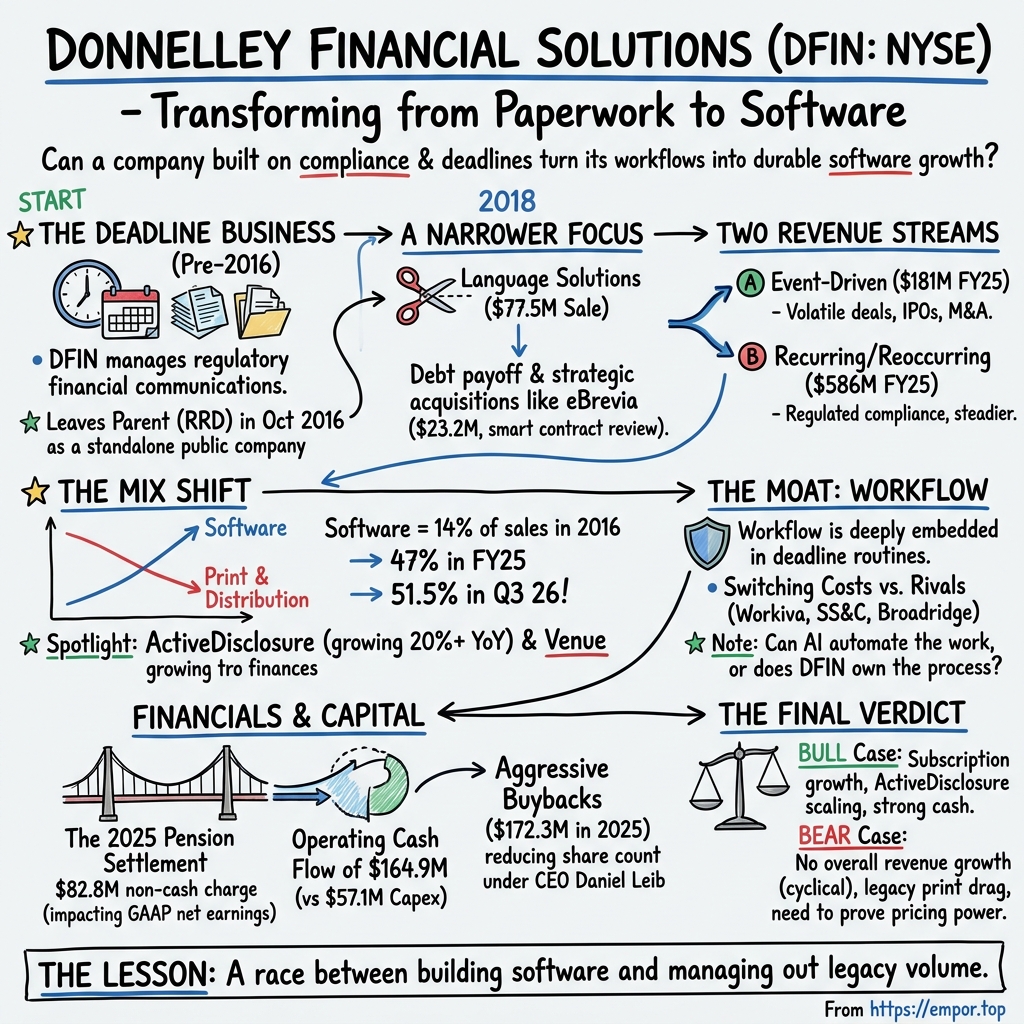
The popular version of DFIN, the one told on earnings calls and in investor presentations, is a transformation story: a printer has become a compliance software company. The record supports a large part of that. Software has climbed from a small slice of the business to roughly half of it.2
But the same record carries a stubborn fact that the transformation story tends to skip. Measured over the decade, DFIN's revenue has gone down, not up, shrinking at about 3% a year from roughly $1 billion in 2015 to $767 million in 2025.21 The mix shift is real. Consolidated growth is not yet.
That gap frames three questions, and this story returns to them repeatedly. The first is whether the subscription base is now large enough to carry the company through a weak deal market, when the event-driven revenue dries up and the printing presses go quiet. The second is whether DFIN can defend its place in the customer's workflow as filing teams adopt new tools, including artificial intelligence that can draft, review and tag documents. The third is whether management's heavy share repurchases are creating value for owners while the business underneath is still changing shape.
One boundary matters before the story starts. DFIN has existed as an independent public company only since 2016, when it separated from R. R. Donnelley & Sons Company, the Chicago printing giant that had housed the financial printing business for decades.3 Figures for 2014 and 2015 describe the business inside its former parent, not a standalone company with its own balance sheet, its own debt and its own board. This is the story of the standalone company, and it begins on the day it walked out of the parent's house carrying a large bill.
 Subscribe on LinkedIn
II. October 2016: The Business Leaves Its Parent
On October 3, 2016, the shares of a new company called Donnelley Financial Solutions began regular-way trading on the New York Stock Exchange.3 Two days earlier, R. R. Donnelley had completed a split that broke one of America's oldest printing empires into three pieces: the remaining RRD, which kept the commercial printing and logistics businesses; LSC Communications, which took the magazines, catalogs and books; and DFIN, which took the financial communications business.3 RRD distributed about 80.75% of DFIN's common stock to its own shareholders and kept the rest for itself.3
The logic of the split was straightforward. Inside a sprawling printing company, a financial business with software products and specialist compliance teams was easy to overlook and hard to value. Investors who wanted a regulated-disclosure business had to buy magazine printing and logistics to get it. Separation would let each piece be priced on its own merits and let each management team allocate capital to its own opportunities.
Separations are rarely free, though, and DFIN's came with a debt load attached. To fund the split, DFIN arranged a $350 million senior secured term loan and a $300 million revolving credit facility, and it issued $300 million of 8.25% senior notes due 2024.3 Those notes went to RRD, which used them in a debt exchange to retire some of its own bonds, while the term loan borrowings funded about $340 million of cash paid to the parent under the separation agreement.3
By the end of 2016, the newly independent company carried close to $600 million of borrowings against barely more than $100 million of shareholders' equity, a debt-to-equity ratio above five.3 An 8.25% coupon was an expensive way to start life. In plain terms, the parent had taken cash out of the child on the way out the door, and the child would spend years paying it back.
That repayment became one of the quiet constants of the decade. Every strategic choice DFIN made afterward, what to sell, what to build, when to buy back stock, was made against the backdrop of a balance sheet that started out stretched. By the end of 2025, total debt was about $171 million, and by September 2026 it was about $127 million, a fraction of the separation-era load.14
Debt fell from more than five times shareholders' equity to less than half of it.31 That deleveraging is one of the clearest promises-versus-outcomes tests available for this management team, and on it the record is unambiguous: the company that was handed a large bill at birth paid most of it down. It did so, however, partly by shrinking, which is the other half of the story.
The man running the child knew exactly how that bill had been written, because he had helped write it. Daniel Leib, DFIN's first and only chief executive, had joined RRD in 2004 and spent his career there in finance: he worked in mergers and acquisitions, served as treasurer and head of investor relations, and from May 2011 until the separation was RRD's executive vice president and chief financial officer.5
He was a finance executive, not a product founder or a salesman, and that background shows up throughout the decade that followed. DFIN under Leib has been run with a CFO's instincts: reduce debt, take out cost, sell what does not fit, buy back stock when the cash allows, and move the revenue mix toward the business lines that investors pay higher multiples for.
What exactly had DFIN inherited? The roots of the business explain its strengths today. Financial printing was never ordinary printing. A prospectus for an IPO had to be typeset overnight, proofread by lawyers in a printer's conference room, corrected, reprinted and delivered to the SEC and to investors on a timetable set by the deal. The printers that won that work did so through reliability, confidentiality and the accumulated knowledge of what the regulator required.
When filing went electronic and EDGAR became the system of record, that expertise migrated from typesetting into software and tagging. DFIN's installed base of corporate clients, law firm relationships and fund-company workflows is the residue of that history. So is its service culture, the people who stay up with the client on filing night.
At separation, software was a small part of the package. DFIN's own history puts software at about 14% of revenue in 2016.2 By 2025 it was 47%.2 That is a remarkable change in mix over less than a decade, and it is the evidence the transformation story rests on.
It is also where the falsification has to sit, right next to the claim. DFIN's standalone revenue was $797 million in 2023 and $767 million in 2025.1 Over the full ten-year span, revenue fell at about 3.1% a year.21 In other words, the software share rose partly because software grew, and partly because everything else shrank.
A company whose software share triples while its total revenue falls has changed its identity. It has not yet proved it can grow. The decade of independence has given DFIN a clearer identity and room to reshape its portfolio, but it has not produced sustained consolidated revenue growth, and any account of the company that skips that fact is telling half the story.
The first real test of Leib's willingness to reshape the portfolio arrived less than two years after the bell rang on the NYSE, and it involved selling something.
III. The 2018 Sale: A Narrower Company, by Choice
In July 2018, DFIN announced that it had agreed to sell Donnelley Language Solutions, its translation business, to SDL, the British language-technology company, for $77.5 million in cash.6 It was a modest deal in dollar terms. As a signal, it mattered more than its size.
Language Solutions translated and localized documents for corporate and legal clients, including the regulated filings that multinational companies and cross-border deals require. It was a respectable business. It was also a services business with a different set of competitors, a different technology stack and a different growth path from the compliance software DFIN wanted to become.
DFIN said the sale would let it focus on technology-enabled compliance and communications, and that it would use the proceeds to pay down debt.6 Given the separation debt DFIN had inherited, that second sentence was not a throwaway: every dollar repaid saved interest that could be redirected toward software.
The economics DFIN disclosed are worth translating. The business carried about $80 million of annual revenue and about $8 million of annual adjusted EBITDA, a measure of operating cash earnings before interest, taxes, depreciation and amortization, and that EBITDA figure included roughly $3 million of stranded costs, overhead that would stay with DFIN after the sale.6
So SDL paid about 9.7 times the stated $8 million of EBITDA. If the $3 million of stranded cost is added back, as a buyer integrating the unit into its own overhead might reasonably do, the multiple falls to roughly 7 times.6 Those are rough transaction ratios, not a full valuation. They suggest a sale at an ordinary price for a modest-margin services business, neither a fire sale nor a windfall.
There is a cost in that arithmetic that DFIN's announcement could not dodge. Selling $80 million of revenue made the company about 8% smaller on the top line overnight, and the stranded costs meant it lost some profit it could not immediately cut. The focus had to pay for itself later, through faster growth in the business that remained or through interest saved.
On the third-quarter 2018 call, management presented the sale as part of a broader agenda of cost reduction, debt reduction and investment in the software platforms.7 That is a coherent strategy. It is also a strategy that can only be judged by what happened next.
The acquisition side of the same year tells the other half of the portfolio story. Back in October 2016, within weeks of the separation, DFIN had made a strategic investment in eBrevia, a young company that used machine learning to extract and analyze terms from contracts, and had deepened a partnership that brought eBrevia's tools into Venue, DFIN's virtual data room.8
A data room is a secure online vault where a company selling itself lets bidders' lawyers read thousands of contracts. Contract-review software that can find every change-of-control clause in a stack of leases in minutes rather than days is an obvious fit. In December 2018, DFIN acquired eBrevia outright for about $23.2 million.9
It is tempting to treat that sequence, a non-core services unit out and a machine-learning software company in, as proof of acquisition discipline. The disclosed record is too thin for that verdict. DFIN did not publish eBrevia's revenue, its growth or the multiple it paid, and it has not since broken out what eBrevia contributes to Venue's results.9
There is no established set of comparable deals against which to call either transaction a bargain or an overpayment. Calling the language sale shrewd or the eBrevia deal visionary would be a characterization without the evidence to support it.
What the record does support is narrower and still useful. Leib's team showed in 2018 that it was willing to shrink the company to sharpen it, and willing to use the proceeds to repair the balance sheet rather than chase scale. The eBrevia purchase was small, consistent with the software direction, and an early bet on the kind of AI-assisted document review that the whole industry is now arguing about.
Whether such bets turn into reported economics is a question that keeps returning. The 2018 moves were a portfolio correction, not a proof of capital-allocation genius, and the proof, if it comes, has to show up in how the company that remained earns its money.
IV. Two Kinds of Revenue Meet at the Same Deadline
Picture two customers calling DFIN in the same week. The first is the reporting team at a mid-sized industrial company. Its quarterly report is due in forty days, as it was last quarter and will be next quarter, because SEC rules set the calendar. The team drafts the document in DFIN's software, tags the financial statements in XBRL, the structured data language the SEC requires, and files.
Nothing about the economy changed that work. The second customer is a law firm representing a technology company that has decided, after months of watching the market, to go public. It needs a registration statement drafted, revised dozens of times, typeset, filed and later printed and distributed. If markets had wobbled that month, the IPO would have been postponed and the call would never have come.
Both customers end up on the same deadline-driven treadmill, and both pay DFIN. But they are fundamentally different kinds of revenue, and understanding DFIN means keeping them apart.
DFIN organizes its business into four operating segments that follow its two customer worlds. Capital Markets Software Solutions sells subscription and platform software to public companies and deal teams. Capital Markets Compliance and Communications Management provides the technology-enabled services and the print and distribution behind corporate filings and transactions. Investment Companies Software Solutions sells software to mutual funds, exchange-traded funds and other asset managers. Investment Companies Compliance and Communications Management provides the services and print side for that same fund world.1
Within software there are two distinct engines. On the capital-markets side, ActiveDisclosure is the platform corporate reporting teams use to draft, collaborate on, tag and file their SEC reports, and Venue is the virtual data room used in mergers, financings and other confidential transactions.1 On the investment-company side, Arc Suite handles the regulatory documents and shareholder reporting that fund companies produce in enormous volume.1 ActiveDisclosure and Arc Suite live mostly on the regulatory calendar. Venue lives mostly on the deal calendar.
The fund side deserves a moment of its own, because it is the part of DFIN that outsiders tend to forget. A large mutual fund complex may run hundreds of funds, and each one produces a prospectus, a statement of additional information, periodic shareholder reports and a stream of regulatory filings, all of which must be kept consistent across share classes and updated whenever fees, holdings or rules change. That is enormous, repetitive, detail-heavy work, and errors carry regulatory consequences.
Historically, much of it ended in printed booklets mailed to shareholders, which is why the investment-company business carried a large print and distribution component. As regulators allowed more electronic delivery and investors stopped expecting paper, the print portion shrank, while the need to compose, manage and file the underlying content did not. Arc Suite is DFIN's attempt to own that underlying content workflow as software, so that the fund company's regulatory obligations flow through DFIN's platform whether the final output is a printed booklet, a web page or a filing.
The business is also overwhelmingly American. About 11% of 2025 sales came from outside the United States, mainly Europe, Canada and Asia, and DFIN says local-currency revenues and costs largely offset one another, so currency swings have only a modest effect on results.1 The story of DFIN is, for practical purposes, the story of the US disclosure regime and the US capital markets.
In 2025, revenue was split three ways by type. Software solutions brought in about $358 million, tech-enabled services about $298 million and print and distribution about $110 million.1 DFIN also offers a second lens: $586 million of revenue it classified as recurring or reoccurring, and $181 million as event-driven.1
That second lens is where a careful listener should slow down. "Recurring/reoccurring" sounds like subscriptions, and part of it is. Software is generally sold on a subscription basis, and ActiveDisclosure fees bundle access to the platform with XBRL tagging packages.1 But DFIN's own classification also counts traditional compliance services as recurring or reoccurring, the human-assisted typesetting, filing and print work tied to regular reports, even though those services generally do not sit under long-term contracts.1
They recur because the regulator's calendar recurs and because customers tend to come back, not because a contract obliges them to. A customer who decides next quarter to do the work in a rival's software, or in-house, can simply stop calling. So the $586 million is a statement about habit and regulation, not about contracted backlog. Treating the whole figure as if it were locked-in annual recurring revenue would overstate how much of DFIN's future is already sold.
The contracts that do exist add nuance rather than certainty. DFIN says some software contracts run multiple years and that both multi-year and shorter agreements renew, and that some service packages vary with how much a customer uses them.1 What the company does not publish is a standard contract length, the share of software revenue under multi-year terms, minimum commitments or a company-wide rate card.12
It also does not publish annual recurring revenue, net revenue retention or churn, the standard scorecards of subscription software. An investor trying to gauge the durability of the subscription base has to infer it from the direction of reported revenue.
This is why a strong quarter at DFIN can hide as much as it reveals. Revenue can rise because the IPO window opened and transaction volumes improved, because software won new customers, because existing customers moved work from services onto the platform, or because of all three. Those causes have very different implications.
Transaction recovery is borrowed from the market and can be handed back in the next downturn. Software customer wins compound. Migration from services to software is the most interesting case, because it can raise margins and durability while leaving total revenue little changed, or even lower. An income statement that blends them makes the job of the analyst harder.
The deeper point is that DFIN sells deadline assurance through three channels at once: software, people and paper. The customer often buys a blend. That blend is the company's commercial strength, since few rivals can offer all three at DFIN's scale. It is also what makes the revenue quality hard to read from the outside. The question is whether the software channel is now big and fast enough to change the arithmetic of the whole company.
V. The Software Mix Crosses the Halfway Mark
In the third quarter of 2026, a symbolic line was crossed. Software solutions made up 51.5% of DFIN's quarterly sales, the majority of the business in that period.10 The company that had left RRD a decade earlier with software at about one dollar in seven now earned more than half of its quarterly revenue from it.210 For a business that began life as a financial printer, that is the headline moment of the transformation, and it deserves to be taken seriously before it is tested.
The two-year movement underneath it is clean. From 2023 to 2025, software revenue rose from about $293 million to about $358 million, a gain of roughly $66 million.1 Over the same two years, print and distribution fell from about $168 million to about $110 million, a loss of about $57 million.1 Tech-enabled services slid too, from about $337 million to about $298 million.1
Put those three movements side by side and the shape of the company becomes visible. Software gains were large enough to roughly offset the collapse in print. They were not large enough to offset print and the decline in services together, which is why total revenue still slipped from $797 million to $767 million.1
There is a good reason why some of the services decline should not alarm anyone. When a customer that used to send its filing to DFIN's typesetters for formatting instead drafts and tags it in ActiveDisclosure, the services line falls and the software line rises. DFIN effectively cannibalizes itself, deliberately, and the company has argued that the trade is worth making because software revenue is stickier and higher-margin.
The evidence for that argument is visible in operating profit: on reported GAAP figures, operating income rose from about $110 million in 2023 to about $141 million in 2025, even as revenue fell.1 A company earning more operating profit on less revenue is a company whose mix is improving. That is the strongest single piece of evidence for the transformation thesis.
ActiveDisclosure has become the engine everyone watches. On the second-quarter 2026 call, management said ActiveDisclosure revenue grew about 29% from a year earlier, its fourth consecutive quarter of growth above 20%.11 More useful than the growth rate was the explanation. Management attributed the growth to three things: more clients, higher average revenue per client, and the migration of some activity that used to sit in traditional services onto the platform.11
Each of those drivers says something different. New clients suggest DFIN is winning share from rivals or from in-house processes. Higher value per client suggests customers are buying more modules, or paying more, or both. Migration says some of the growth is DFIN moving its own existing customers from one revenue line to another. That third driver is good for margins and retention but is not new demand, and DFIN does not disclose how much of the 29% came from each source.
The products around ActiveDisclosure are evolving too. DFIN launched Active Intelligence in 2025, a set of AI-assisted capabilities aimed at helping reporting teams draft and review disclosure.112 In 2026, management described adding AI features to Venue, the data room, building on the contract-analysis lineage that eBrevia had brought in.13
These are sensible product moves for a company whose customers are under pressure to do more with smaller teams. They should be treated as product development, not as a business line. DFIN has not disclosed AI revenue, paying-customer counts or adoption at scale.1 A feature launch is a promise of future relevance, not a source of current earnings, and the history of enterprise software is crowded with AI announcements that never moved the revenue line.
Now the transformation story has to face its sternest test, the longer record. In 2021, DFIN reported revenue of about $993 million.2 That year was extraordinary: special-purpose acquisition companies were listing by the hundreds, IPO volumes hit records, and every capital-markets service provider had a banner year. By 2022 revenue had fallen to about $833 million, a drop of about 16% in a single year, and by 2025 it was $767 million.21
The 2021 peak was unusual, and it is unfair to measure any company against its best-ever boom. But the episode demonstrates how easily the market cycle can overwhelm mix progress. Between 2021 and 2025, software kept growing, and the company still lost more than a fifth of its revenue, because transactional work and print fell faster than software rose.
The latest quarters look better. Revenue grew about 10% in the fourth quarter of 2025, about 2% and 3% in the first two quarters of 2026, and a little under 6% in the third quarter.14 Four consecutive quarters of growth after a long run of declines is a real change in direction.
But capital markets also improved during that period, so the growth is partly software and partly a friendlier deal environment. One quarter above the long-run base rate does not establish a new growth regime, and two years of software gains plus one product's strong run do not yet prove that software can drive sustained company-wide growth through a weak transaction cycle.
The verdict on the transformation is therefore clear and limited. The mix shift is real, the profit improvement is real and ActiveDisclosure's momentum is real. What has not been demonstrated is that the software engine is broad and durable enough to keep the whole company growing when deals dry up again, and DFIN does not publish the subscription metrics needed to settle the question.
The three numbers to watch together are software growth, ActiveDisclosure's client and value growth, and the pace of print decline. When software outruns print by a wide margin through a soft market, the story graduates from mix shift to growth. That raises the question of what keeps those software customers from leaving.
VI. The Moat Lives in the Workflow—and Its Proof Is Incomplete
Consider what a corporate filing team actually does in the final week before a 10-K goes out. The numbers come from the company's accounting system. The narrative comes from finance, legal, investor relations and the business units. Outside counsel marks up the risk factors. The auditors need to see every change. The XBRL tags have to match the financial statements exactly, and the regulator's validation rules have to pass.
Then someone presses the button that files the document on EDGAR, where it becomes permanent and public. The team is not buying a word processor. It is buying the ability to move information across its own systems, outside advisers and a regulator without losing control of the document, and to do it on a date it cannot change.
That is where DFIN's advantage lives, if it has one. The company's pitch is that it combines software built for this workflow, deep regulatory know-how and a service team that can step in on filing night. Customers who have built their close-and-report process around a platform, trained their staff on it, and stored years of prior filings in it face real friction in switching. Migrating a reporting process in the middle of a fiscal year is the kind of risk most controllers will not take for a modest discount.
The competitive field, however, is crowded, and it differs by product. In disclosure management, Workiva is the most prominent rival, a cloud platform that has grown by selling connected reporting tools to finance teams and that DFIN itself names as the comparison for ActiveDisclosure.2 In virtual data rooms, SS&C's Intralinks is the long-established competitor DFIN names for Venue, and the data-room market also includes a range of specialist providers.2
In compliance and communications for funds and corporate investors, Broadridge is a major presence with overlapping services.2 In capital-markets workflow and financial printing, Toppan Merrill is the historic rival from the old printing world. Each of these competitors attacks a different part of DFIN's bundle, which is why DFIN's moat cannot be argued as a single wall. It is a series of fences, each with its own weak point.
Scale comparisons need care. DFIN's $767 million of 2025 revenue is small next to the total revenue of Broadridge or SS&C, but those companies span far broader businesses, from proxy processing to fund administration, and their total size says little about who leads in DFIN's specific product markets.1 DFIN does not publish market share in disclosure management, data rooms or fund reporting, so any claim that it leads or trails in a given niche lacks a disclosed basis.
The bargaining power of customers is mixed. No single customer accounted for more than 10% of DFIN's sales in 2023, 2024 or 2025, so no buyer can dictate terms to the whole company.1 A fragmented customer base of thousands of issuers, funds and law firms limits the leverage of any one of them.
But DFIN does not disclose its top-five or top-ten customer share, so the concentration picture below the 10% line is not visible.1 And fragmentation is not the same as captivity: an individual customer can multi-source, putting its data room out to bid on each deal, or using DFIN for print while drafting in another vendor's software.
Regulation is DFIN's friend and its master. Repeat filing obligations guarantee recurring work, and every new rule that adds tagging, disclosure or fund-report requirements creates demand for the specialists who understand it. But regulation can also reduce work, as the long shift from printed to electronic delivery of shareholder materials has shown in the shrinking print line. The same rulebook that creates the deadline can remove the paper.
The test of any switching-cost claim is what happens when customers actually have the choice, and here the company's disclosures stop short. DFIN does not publish a retention or churn series, net revenue retention, win-loss rates in competitive bids or price realization on renewals.12 The evidence that would turn a plausible moat into a proven one, customers staying at high rates while paying more each year, sits inside the company.
From the outside, ActiveDisclosure's growth is the best indirect proof, though it is suggestive, not conclusive. Growth in a period of improving markets is not the same as retention through a slump.
Artificial intelligence sharpens all of this. Many of the steps DFIN gets paid for, formatting, tagging, consistency checks, first-draft disclosure language, document review in a data room, are exactly the kind of structured, rules-heavy tasks that large language models are good at. If a customer can use a general AI tool, or a rival's AI-native platform, to tag its financial statements and review its contracts, some of DFIN's paid workflow steps could become cheaper or disappear.
DFIN's answer is to put AI inside ActiveDisclosure and Venue, so that automation happens on its platform rather than off it. That is the right strategic response. But the record does not yet show that DFIN's AI makes customers more loyal or more profitable; it only shows that DFIN is not ignoring the threat.
The verdict on the moat is a calibrated one. DFIN has a plausible workflow advantage built on regulatory expertise, integrated tools and service support, and the evidence supports a useful position in a market where reliability matters more than price. The evidence does not support a cornered market, because the company does not disclose retention, win-loss or pricing data, and because strong rivals compete for each part of the bundle.
The proof point still needed is simple to state: sustained software growth and customer expansion through a weaker capital-markets period, accompanied by retention and pricing evidence. Until then, the moat is intact but unproven. Meanwhile, the cash the business throws off tells its own story, and in 2025 that story diverged sharply from the earnings.
VII. The Pension Charge Turns a Good Cash Year into a Bad Earnings Year
On paper, 2025 looked like a terrible year for DFIN. Net earnings fell to about $32 million, down from about $92 million in 2024.1 Diluted earnings per share fell from about $3.06 to $1.15.1 In the third quarter, the company reported a pretax loss.1 A casual reader of the earnings headline might have concluded that the business was deteriorating. A reader of the cash-flow statement would have concluded something closer to the opposite.
The difference was a single item. In 2025, DFIN settled its defined-benefit pension obligations and recorded an $82.8 million non-cash pension settlement charge.1 A pension settlement is when a company hands its obligation to pay retirees over to an insurer, usually by buying annuities, or pays participants lump sums, so the liability leaves the balance sheet for good.
Under accounting rules, the losses that had been accumulating quietly in shareholders' equity over the years, the gap between what the pension promised and what its investments earned, had to be pushed through the income statement all at once. The charge is a recognition of past costs, not a new cash outflow. The actual cash DFIN put in to fully fund the plan before the settlement was $11.3 million.1
Strip the charge out and 2025 looks like an ordinary year with better margins. The comparison year was not perfectly clean either: 2024's operating results included a $9.8 million gain from selling land, a one-time benefit that flattered that year's profit, while 2025 carried a small investment and other loss of about $2.3 million.1 Small items like these matter when the headline earnings comparison is being used to judge whether the business is improving. Add the $82.8 million back to pretax earnings of about $43 million and the underlying pretax figure is roughly $126 million, in line with 2024.1
That is the most important single adjustment in understanding DFIN's recent earnings. It is also a legacy story: a defined-benefit pension is the kind of liability an old printing company carries, not a software start-up, and settling it removed a long-tail obligation that had followed DFIN out of RRD. A related legacy remains. DFIN and RRD are still jointly and severally liable for certain multi-employer pension obligations, so DFIN could be asked to pay if RRD or other participating employers fail to.1 That exposure is contingent rather than active, but it is a reminder that the 2016 separation did not cut every tie.
The cash record is steadier. Operating cash flow stayed between about $124 million and $171 million from 2023 to 2025.1 In 2025 cash from operations was about five times net earnings, a gap explained mostly by the pension charge, along with depreciation and amortization of software and share-based compensation, which reduce earnings without consuming cash.1
Working capital pulled the other way: accrued liabilities consumed about $22.6 million of additional cash, mainly because higher incentive-compensation and commission payments went out the door while current-year accruals were lower.1 That is the kind of timing swing that can make one year's cash flow look better or worse than the business underneath.
Operating cash flow, however, is not money the company can freely hand back. DFIN's capital spending was about $60 million a year from 2023 to 2025, mostly for software development, and it expects $55 million to $60 million in 2026.14 That spending works out at roughly 7% to 8% of revenue every year, for a company that employed about 1,750 people at the end of 2025.1
It is the cost of keeping ActiveDisclosure, Venue and Arc Suite competitive, and in a software company it functions much like research and development, which DFIN does not separately disclose.1 Subtract it from operating cash flow and free cash flow in 2025 was about $108 million, the money available to repay debt and buy back stock.1 That is solid for a company of DFIN's size, and it is the cash flow on which every capital-allocation decision in the next part of the story rests.
There is one more quality check, the kind that rarely makes headlines but matters to anyone who has watched services businesses stumble. At the end of September 2026, DFIN had about $157 million of net receivables after an allowance of about $21.5 million, alongside about $23 million of unbilled receivables and about $21 million of contract assets.4 Unbilled receivables and contract assets represent work DFIN has done and recognized as revenue but has not yet invoiced, which is common when a big transaction is in progress or a fund-reporting cycle is half finished.
Deloitte, DFIN's auditor, flagged the valuation of those unbilled receivables and contract assets as a critical audit matter, citing the volume of transactions, manual processes and management estimates involved.1 A critical audit matter is not a finding of error. It is the auditor telling shareholders where the judgment calls are hardest. DFIN does not publish an ageing schedule for its receivables, so the best evidence of quality is whether those unbilled amounts are subsequently billed and collected in the quarters that follow.1 Debtor days of about 68 in 2025, well below their post-separation peak, suggest collections are not deteriorating.1
The overall conclusion is that the pension charge explains most of the gap between 2025 earnings and cash, but not all of the earnings volatility. DFIN converts profit into cash well. It also has to keep spending heavily on software, and its working capital swings with incentive payments and transaction timing. Those facts set the boundaries for the most controversial thing management did with the cash.
VIII. Leib's Transformation Meets the Buyback Record
Through 2025, while revenue slipped and a pension charge cratered reported earnings, DFIN was buying its own stock at a pace rarely seen in a company of its size. Over the year it repurchased about 3.6 million shares, roughly 12% of the shares it started the year with, for about $172 million, at an average price of about $48 a share.1
Repurchases rose from $23 million in 2023 to $172 million in 2025, more than sevenfold.1 A $150 million authorization renewed in May 2025 had about $54 million left at year-end.1 In the first nine months of 2026, DFIN bought back another 1.5 million shares for about $70 million, at an average of about $46.4
The buyback year is the clearest window into how Leib and his team think about capital. A decade after the separation, the same executive was running a company that had paid down most of its debt and was now treating its own shares as the most attractive investment available.
The board around him had a non-executive independent chairman, Richard Crandall, and every director other than the CEO was independent.14 The executive team included CFO David Gardella, Craig Clay as president of the capital-markets business and Eric Johnson as president of the investment-companies business, the leaders who own the two halves of the operating plan.14
Their incentives explain some of the choices. DFIN's 2024 and 2025 performance share awards paid out on two operating measures, recurring/reoccurring revenue and free-cash-flow conversion, with a modifier tied to total shareholder return relative to peers.14 That design rewards exactly the transformation management describes, growing the stickier revenue base and turning profit into cash, and it ties some pay to how the stock performs against others. It is worth noticing what it rewards less directly: total revenue growth and the price paid for repurchased shares.
Leib's reported compensation was about $8.5 million in 2025, up from about $6.8 million in 2023, a figure that includes the grant-date value of equity awards rather than cash alone.14 Pay rose over a period in which reported net earnings fell, though much of that fall was the pension charge. Shareholders were not troubled: about 98.8% of votes cast supported the say-on-pay proposal at the 2025 annual meeting.14 That is context, not proof of performance. Say-on-pay votes routinely pass with high support.
Ownership alignment is moderate rather than strong. Directors and named executive officers together held about 5.2% of the shares in the 2026 proxy.14 The largest holders were institutional: BlackRock with about 14.9%, Vanguard with about 6.8% and Mawer Investment Management, a Canadian investment manager, with about 5.2%.14 No controlling shareholder exists, and the company prohibits pledging and hedging of its stock by insiders.14 Insiders own enough to care, but not enough that their personal wealth necessarily moves with every capital-allocation decision.
So were the buybacks a good idea? The honest answer is that it depends on two things that cannot be judged in the moment: the price paid and the future earnings per share. On the first, the timing has so far looked favorable. DFIN bought at an average of about $48 in 2025 and about $46 in 2026, and by early November 2026 the shares traded near $67.1415 On a mark-to-market basis, the shares repurchased are worth more than DFIN paid.
On the second, the evidence is still accumulating. Reducing the share count by more than a tenth in a single year mechanically raises each remaining share's claim on future profits, but only if those profits hold up. Buybacks at a company with shrinking revenue are a bet on stabilization, and the bet is paying off only if the software mix keeps lifting per-share earnings.
An activist-style skeptic would push on the cost of that bet. In 2025 DFIN spent about $172 million on repurchases while generating about $108 million of free cash flow and while spending $57 million on capital investment.1 The difference was funded partly with borrowing: total debt rose from about $144 million at the end of 2024 to about $171 million at the end of 2025, and the company ended the year with about $24.5 million of cash, most of it held outside the United States.1
That is not reckless leverage for a business with DFIN's cash generation, and DFIN has since paid debt down to about $127 million by September 2026.4 But it does mean 2025's buyback was not simply surplus cash being returned. It was a decision to lean the balance sheet toward the stock at a time when the transformation was still incomplete.
On the third-quarter 2026 call, management restated its capital priorities as organic investment, share repurchases and reduction of net debt.13 On the fourth-quarter 2025 call, it had discussed the accelerated pace of buybacks that year.16 The useful test now is behavioral: whether the repurchase pace, debt reduction and software investment in coming quarters match the stated priority order, and whether management slows buybacks if the shares look expensive or the deal market weakens.
Weighing it all, Leib's long tenure and a consistent software-and-cost-control direction support continuity and a measure of credibility. The software mix rose, debt fell from its separation peak, and margins improved. Consolidated revenue still declined over the long run, and the buyback record must ultimately be judged against future per-share earnings. Disclosed ownership and compensation do not, on their own, establish strong personal alignment. Which leaves the question that every buyback implicitly answers: what is the stock actually worth relative to its earnings?
IX. The Price Depends on Which Earnings Number You Trust
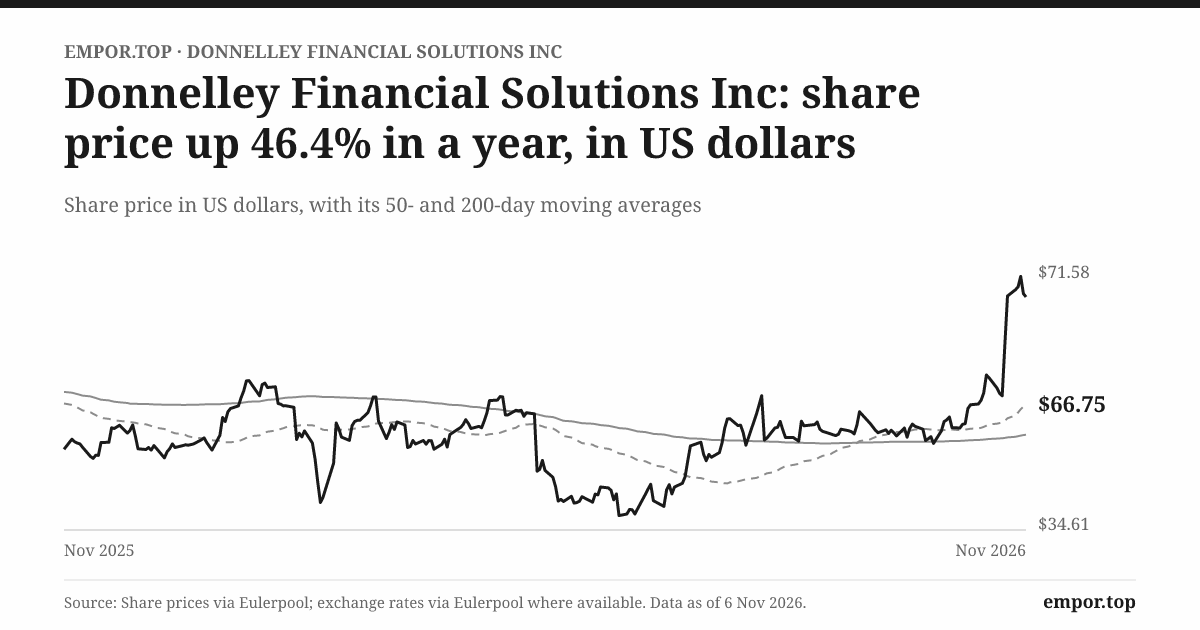
On November 6, 2026, DFIN shares closed at about $66.75, a few percent below their 52-week high of about $69.60 and far above a 52-week low near $36.60.15 In barely a year the stock had nearly doubled from its trough. A company that had been priced as a shrinking printer was being priced as something more.
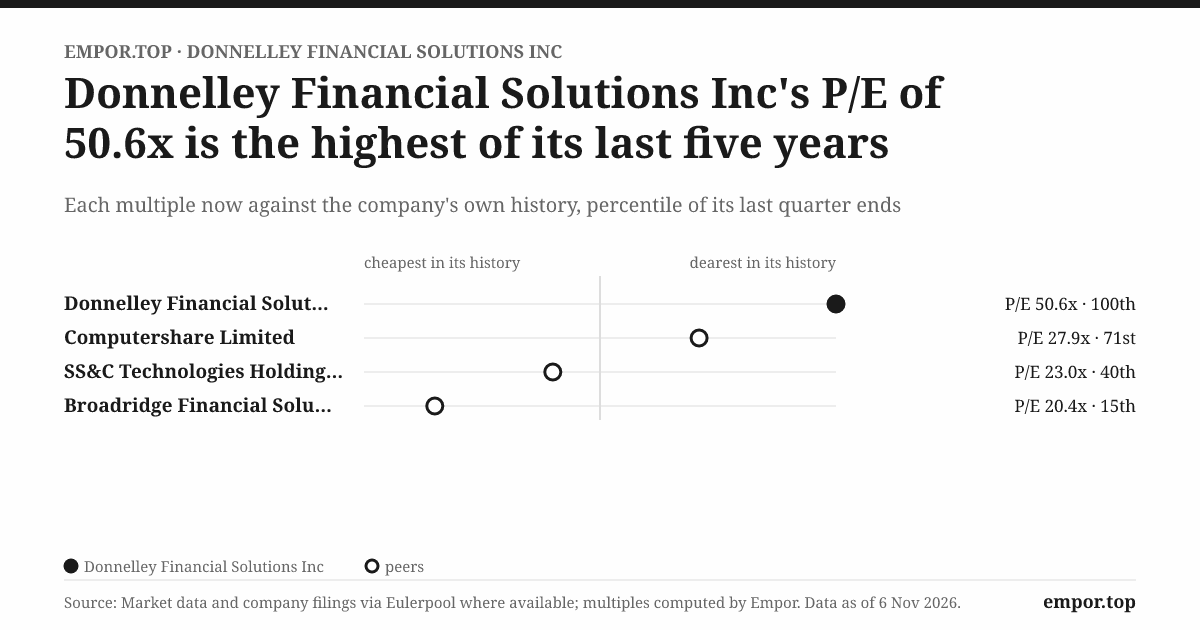
Here the story runs into a puzzle that sits in the numbers themselves. Some market-data screens show DFIN trading at a price-to-earnings multiple of about 50 times, against a five-year median of about 16 times, which would imply the market is paying a growth-stock premium.15 Another widely used provider showed about 38 times in late October.17
Yet DFIN's own reported diluted earnings per share for the four quarters through September 2026 add up to about $3.79: roughly $0.22 in the fourth quarter of 2025, $1.30 and $1.42 in the first two quarters of 2026, and $0.85 in the third.14 Divide $66.75 by $3.79 and the multiple is about 17.6 times. Divide the market value by trailing net profit of about $96 million and the answer is in the same neighborhood, around 18 or 19 times.4
Those numbers cannot all be right for the same period. A 50-times multiple implies an earnings yield of about 2%, meaning a shareholder's claim on annual profits is two cents for every dollar invested. A 17.6-times multiple implies an earnings yield of about 5.7%. The difference most likely comes from which earnings base is used.
The headline multiples appear to lean on periods still depressed by the 2025 pension charge, or on differing share counts and definitions, while the trailing twelve months that ended in September 2026 no longer include the third quarter of 2025, when the charge was booked. For an investor, the period-consistent calculation matters more than the headline: on earnings that exclude the one-off, DFIN trades at a high-teens multiple, a little above where it has typically traded over the past five years, not at a growth-stock premium.
Other valuation lenses point in the same direction. The stock trades at a little over two times sales and at an enterprise value, which adds debt and subtracts cash, of a bit under nine times EBITDA.15 Free cash flow of about $108 million in 2025 against a market value of a bit under $2 billion implies a free-cash-flow yield in the mid-to-high single digits.115
Each of those should be cross-checked against filed revenue, earnings, debt and cash before being used as confirmation of cheapness or expensiveness, because provider definitions of EBITDA and enterprise value vary.
Peers give a directional frame, not a precise one. In the late-October snapshot, DFIN traded at about 38 times earnings and 1.7 times sales on that provider's definitions, versus Broadridge at about 18 times and 2.7 times, SS&C at about 22 times and 2.9 times, and Workiva at about 100 times and 4.9 times.17
The ordering tells a story: the market values DFIN well below the fast-growing pure software player it competes with in disclosure management, and on sales multiples below the larger, steadier financial-technology companies, even if the noisy earnings figures place it above them on P/E. These businesses are not direct substitutes, their scale differs enormously, and their growth profiles are different, so the comparison says more about how the market categorizes DFIN, part software, part services, part print, than about what DFIN is worth.
The skeptical investor's test is simple to state. Suppose software growth slows from its recent pace, print continues its structural decline, transaction volumes soften, and buybacks stop lifting per-share earnings because the price is too high to make them accretive. On those assumptions, what earnings base supports a share price in the high sixties? On the period-consistent numbers, the answer is that the market is not demanding heroics.
A high-teens multiple on roughly $3.80 of trailing EPS assumes the transformation holds, not that it accelerates. That is a more modest bet than the headline multiple suggests. It is also a bet that can disappoint, because the trailing figure includes a strong deal environment, and the period after a strong deal environment has historically been where DFIN's revenue fell.
So the valuation question loops back to the operating question. If the software engine keeps growing through the next soft patch, the current price looks like it leaves room for the transition to work. If it does not, the earnings base underneath the price was partly cyclical all along. Weighing those two outcomes is the purpose of the bull and bear case.
X. Analysis & Bear vs. Bull Case
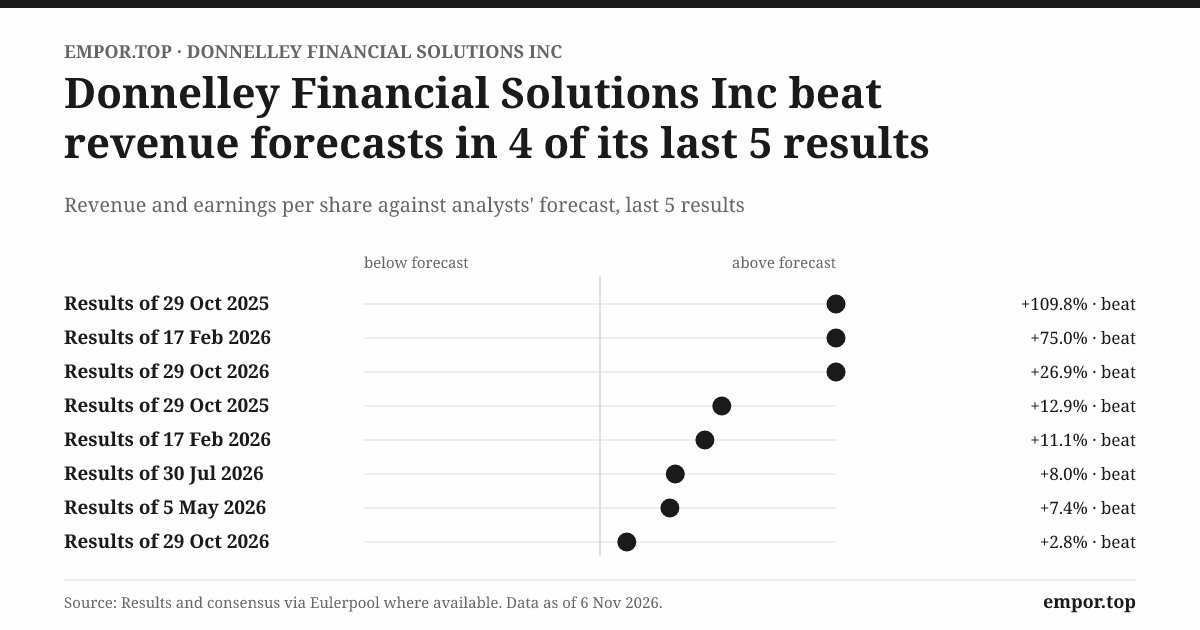
On October 29, 2026, DFIN reported third-quarter results that read like a company finding its footing. Net sales grew a little over 5% from a year earlier, software made up 51.5% of sales, and management guided to fourth-quarter net sales of $175 million to $180 million with an adjusted EBITDA margin of 26% to 27%.1013
The guidance implied growth of about 3% at the midpoint and a margin roughly flat with the prior year.13 At quarter-end, debt stood at about $127 million and non-GAAP net debt, debt minus cash, at about $99.8 million.10 That is the platform from which the bull and bear cases launch.
The bull case begins with the nature of the work. Disclosure is deadline-sensitive and regulated, and the cost of getting it wrong, a late filing, a restatement, a leaked deal, is wildly out of proportion to the cost of the software and services that prevent it. Customers in that position buy reliability first and price second.
ActiveDisclosure has been growing at more than 20% a year for four straight quarters, software has reached roughly half of sales, operating income rose even as revenue fell, and the balance sheet has moved from a separation-era debt load above five times equity to a manageable position with a revolving facility that does not mature until 2030.1114 The bull case says the mechanism is credible: customers migrate from services to subscriptions, margins rise, cash conversion improves, and buybacks compound the per-share effect.
The bear case is not that DFIN has no software business. It is more subtle and harder to dismiss. Recurring/reoccurring revenue is not all contracted software, so the base is less locked-in than its label suggests. Company revenue has declined over the long run, including a lost fifth of revenue after the 2021 peak.
Transaction demand remains volatile, print is in structural decline, and the company publishes no retention or pricing data to prove the moat. In the bear version, DFIN's returns are capped: software growth roughly offsets print and services decline, transactions cycle up and down, and the company's earnings bounce around a flat line while buybacks shrink the share count.
Porter's five forces help order the evidence. The threat of new entrants is moderate. Building a filing platform that meets regulatory rules is not trivial, but well-funded software companies have done it, as Workiva demonstrated, and AI lowers the cost of building document tools. Buyer power is limited at the individual level, because no customer exceeds 10% of sales, but buyers collectively can multi-source and can put data rooms and print out to bid deal by deal.1
Supplier power is low; DFIN's main inputs are people, cloud capacity and paper, and it does not disclose any concentrated supplier dependence.1 The threat of substitutes is the force rising fastest, because AI and in-house automation can perform some of the formatting, tagging and review steps DFIN charges for. Rivalry is intense and product-specific, with Workiva in disclosure software, Intralinks in data rooms, Broadridge in compliance communications and Toppan Merrill across capital-markets services.2 The industry structure is reasonable for an incumbent but not a fortress.
Hamilton Helmer's 7 Powers framework sharpens what kind of advantage DFIN might hold. Switching costs are the most plausible power: filings, historical documents, tagging taxonomies and team habits are embedded in the platform, and moving them mid-year is risky. But a switching-cost power is proven by retention, and DFIN does not disclose retention. Process power, the accumulated know-how of running thousands of filings and transactions under deadline, is real and visible in DFIN's service reputation, but process power in services tends to be replicable by a determined competitor over time.
Scale economies matter in print and service capacity, yet print is shrinking, which erodes the scale advantage in exactly the area where it was strongest. Counter-positioning, network effects, branding and cornered resources are weak or absent: DFIN's brand is respected but rarely the deciding factor, and it does not control any resource rivals cannot access. The honest summary is that DFIN has one plausible power, switching costs, supported by process expertise, and neither has yet been demonstrated through published customer behavior.
The current risk radar is short and specific. Capital-markets activity can delay or cancel deals, which hits event-driven revenue and Venue usage first. Print is in structural decline and will keep shrinking. AI may automate paid workflow steps faster than DFIN can monetize its own AI features. And receivable estimates matter because unbilled work and contract assets require judgment, as the auditor's critical audit matter emphasizes.1 Credit risk looks contained on current filings: the most recent public agency rationale available, an S&P Global Ratings component table from October 2020, showed a B+ rating with adequate liquidity but weak competitive position and aggressive cash flow and leverage, and that assessment predates most of the debt reduction and is stale.18
Current filings, which show covenant compliance and ample revolver availability, are the better guide.1 At the end of 2025, DFIN had about $238 million of unused capacity on its $300 million revolving facility, which matures in March 2030, and by September 2026 its borrowings consisted of about $106 million on a term loan and about $21 million drawn on the revolver.14 That is a balance sheet that can absorb a weak year without forcing management's hand.
Two smaller legal and accounting items belong on the radar without dominating it. DFIN carries roughly $55 million of non-cancelable commitments, mostly for outsourced services, which is a reminder that part of its cost base is contracted rather than flexible if volumes fall.1
And it faces the ordinary litigation of a business that handles customer money and confidential documents, including potential preference claims if bankrupt customers' pre-petition payments are clawed back; management says it does not expect those matters to have a material effect, and it concluded that its disclosure controls were effective as of September 30, 2026.14 The auditor's opinion carries no qualification and no material weakness is identified.1 For a company whose product is disclosure quality, a clean control environment is not a footnote; it is part of the brand.
Three indicators best capture whether the bull or bear case is winning. The first is software revenue growth and its share of sales, which reached 51.5% in the third quarter of 2026 and has been rising.10 The second is ActiveDisclosure's client count and average client value, which drove about 29% growth in the second quarter of 2026.11
The third is the conversion of operating cash flow into free cash flow after software investment, which was about $108 million in 2025 on about $165 million of operating cash.1 When all three move in the right direction through a soft transaction market, the bull case strengthens. When software growth slows while print keeps falling, the bear case takes over.
Management's commentary across the 2026 calls is worth reading as a sequence rather than a snapshot. The second-quarter call gave the most detailed explanation of ActiveDisclosure's growth, splitting it into new clients, higher value and migration.11 The third-quarter call paired solid growth with cautious fourth-quarter guidance and reiterated capital priorities that put organic investment first.13 Earlier, the fourth-quarter 2025 call had to explain an accelerated buyback during a year of declining revenue.16
The narrative has been consistent: software first, cost control, cash returns. The test of credibility is whether that order holds when the market turns, and whether management continues to separate transaction timing from subscription performance as clearly as it did in the second quarter. The record so far supports a credible mechanism without yet proving its durability. What the story teaches beyond DFIN itself is the next thread to pull.
XI. Lessons from the Filing Room
Go back to July 2018, when a company not yet two years old sold an $80 million translation business that most outsiders had never heard of.6 The sale did not make headlines, and it did not transform DFIN's growth rate. What it did was turn a portfolio into a direction. The cash went to debt, the attention went to software, and the business that remained had one story to tell instead of two.
The lesson for founders and investors is that a divestiture is only as good as the plan that receives its proceeds. Plenty of companies sell non-core units and then drift. DFIN's sale mattered because the proceeds and the freed management time had somewhere to go. A portfolio gets sharper when the exit has a destination.
The second lesson lives in a figure that looks like triumph and is really a warning. Software went from about 14% of DFIN's revenue at separation to about 47% in 2025 and crossed half in a single quarter of 2026.210 Over the same decade, total revenue fell by more than a fifth.21 Both facts are true, and the second one is the one a growth investor has to sit with.
Mix percentages are seductive because they always move in the direction of the story management is telling, even when the company is shrinking. The healthy question is not what share of revenue the new business has, but whether the new business is adding more dollars than the old one loses. A bigger share is not yet a bigger company.
The third lesson comes from the year DFIN bought back roughly an eighth of itself while its reported earnings collapsed under a pension charge.1 The decision looked bold, and with the stock far above the purchase price, it has so far looked shrewd. But it was really two bets placed at once: a bet that the business would stabilize and grow per-share earnings, and a bet that $48 a share was a good price for that future.
Getting either one wrong would have undone the other. Buybacks are often discussed as if they were a single act of shareholder friendliness. They are capital allocation decisions with a price attached, and the price is half the decision. A repurchase is a bet on the business and the price at once.
There is a fourth lesson, specific to companies whose old business still pays the bills. DFIN's print and services lines have been shrinking for years, yet they still fund much of the software investment and provide the service reliability customers buy on filing night. Kill them too fast and the company loses cash and customer trust; protect them too long and the transition stalls.
DFIN's approach has been to let customers migrate onto software at their own pace while cutting cost in the legacy lines, accepting slower revenue in exchange for better margins. Its path shows that in a transformation, the legacy business is not the enemy. It is the bridge, and the bridge is burning at a known rate. The art is crossing it before it collapses.
XII. Epilogue
Tonight, DFIN stands at a more interesting point than at any time since it left RRD. The stock trades near its high. Software is roughly half the company. Debt is the lowest it has been since the separation. Revenue has grown for four consecutive quarters after years of decline.410 And yet none of the questions that framed this story is fully settled.
The next moment that will matter arrives early in 2027, when DFIN reports its fourth quarter and full year. Management guided to $175 million to $180 million of sales and a 26% to 27% adjusted EBITDA margin.13 Landing at the top of that range with software leading would suggest that the third quarter's momentum was not a one-off.
Landing at the bottom, with transactions and print explaining the shortfall, would be a reminder that the deal cycle still has a vote. In either case, the useful work is separating transaction timing from subscription performance, the same discipline management applied on the second-quarter call.
Beyond the quarter, the next year will test whether ActiveDisclosure can sustain growth above 20% as it laps its own strong comparisons, and whether its growth comes increasingly from new clients rather than migration of DFIN's own service customers. It will test whether software growth holds up if the IPO and merger window narrows, which is the scenario the transformation has never yet faced at its current scale.
It will test whether capital spending of $55 million to $60 million a year continues to produce competitive products, and whether the receivable estimates the auditor flagged are billed and collected on schedule.41 And it will test the buybacks, not by the size of the authorization, but by whether per-share earnings rise as the share count falls.
The single most useful thing DFIN could do for its own case would be to publish the software customer metrics that would test its moat argument.
The open question remains whether DFIN can make deadline-critical compliance feel like a software product without losing the service reliability that customers actually pay for. If it succeeds, the old printer will have become a compliance software company in substance as well as in mix. If it fails, it will remain what it has been for much of the past decade: a good business that keeps getting smaller in the parts it cannot convert.
XIII. Outro
Return to the filing room after midnight. The quarterly report is nearly done. The controller is drafting in software, the tags are validating automatically, an AI tool has flagged an inconsistency in a footnote, and a DFIN service specialist is on the line in case something breaks. Somewhere in a warehouse, a much smaller print run than a decade ago is waiting for a fund's annual report.
That scene captures DFIN's central tension: how much deadline-critical work it can own as software while paper recedes, and whether customers keep trusting it on the nights that matter most. The deadline belongs to the customer. DFIN has to keep earning its place in it.
References
-
2025 Form 10-K — Donnelley Financial Solutions, SEC, 2026-02-17 ↩↩↩↩↩↩↩↩↩↩↩↩↩↩↩↩↩↩↩↩↩↩↩↩↩↩↩↩↩↩↩↩↩↩↩↩↩↩↩↩↩↩↩↩↩↩↩↩↩↩↩↩↩↩↩↩↩↩↩↩↩↩↩↩↩↩↩↩↩↩↩
-
Q4 2025 Investor Presentation — Donnelley Financial Solutions ↩↩↩↩↩↩↩↩↩↩↩↩↩↩↩↩
-
2016 Form 10-K — Donnelley Financial Solutions, SEC, 2017 ↩↩↩↩↩↩↩↩
-
Third-Quarter 2026 Form 10-Q — Donnelley Financial Solutions, SEC, 2026-10-29 ↩↩↩↩↩↩↩↩↩↩↩↩↩↩
-
Donnelley Financial Solutions Announces Sale of Language Solutions Business for $77.5 Million in Cash — DFIN, 2018-07-16 ↩↩↩↩↩
-
Q3 2018 Earnings Call Transcript — The Motley Fool, 2018-11-07 ↩
-
DFIN Deepens eBrevia Partnership Through Strategic Investment — DFIN, 2016-10-27 ↩
-
Q4 2018 Results and eBrevia Acquisition Disclosure — SEC, 2019-02-27 ↩↩
-
Third-Quarter 2026 Results — Donnelley Financial Solutions, SEC, 2026-10-29 ↩↩↩↩↩↩↩
-
Q2 2026 Earnings Call Transcript — Stock Analysis, 2026-07-30 ↩↩↩↩↩
-
2025 Annual Report Shareholder Letter — Donnelley Financial Solutions, SEC, 2026-04-01 ↩
-
Q3 2026 Earnings Call Transcript — Stock Analysis, 2026-10-29 ↩↩↩↩↩↩
-
2026 Proxy Statement — Donnelley Financial Solutions, SEC, 2026-04-01 ↩↩↩↩↩↩↩↩
-
Investor Relations Overview — Donnelley Financial Solutions ↩↩↩↩↩
-
Q4 2025 Earnings Call Transcript — Donnelley Financial Solutions, 2026-02-17 ↩↩
-
North America Corporate Rating Component Scores — S&P Global Ratings, 2020-10-31 ↩
 LinkedIn
 WhatsApp
 Reddit
 Hacker News
 Email
 Kindle
 RSS Feed
 Spotify
 Apple Podcasts
 Amazon Music
 Audible
 YouTube