Crane NXT: Can an Old Cash Business Buy Its Way Into the Future?
I. The Spin-Off That Made the Numbers Lie
On April 3, 2023, one of America's oldest industrial names split in two.1 Crane Holdings, the corporate descendant of a company whose lineage runs back to 1855, finished a tax-free separation that sent its Aerospace & Electronics and Process Flow Technologies businesses into a new company called Crane Company.1 What stayed behind, inside the original legal entity, was a smaller and stranger business: machines that check whether a banknote or coin is real, and the paper, threads and security features that make banknotes hard to fake in the first place. The old company had traded as CR. The day after the separation, its stock began trading as CXT.1 The name on the door became Crane NXT.
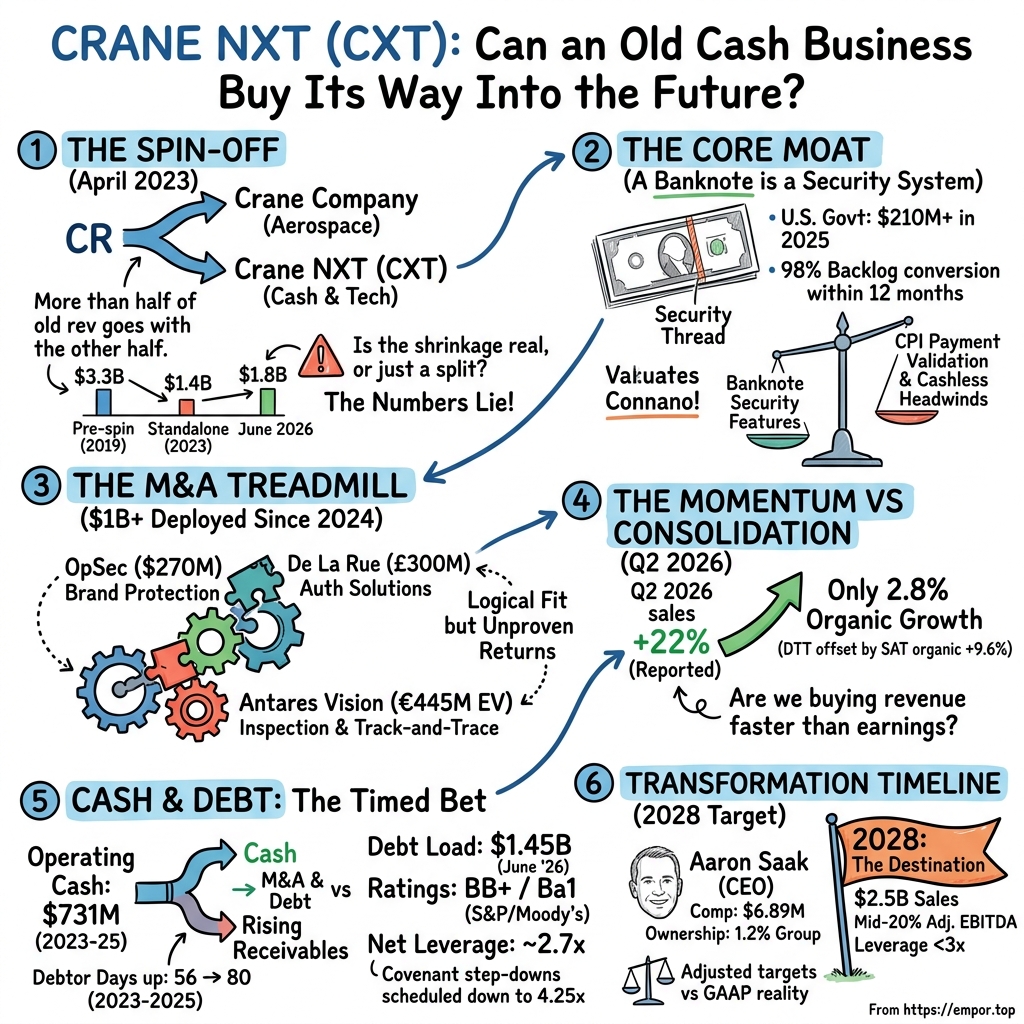
That small change of ticker created one of the more misleading charts in the industrial sector. Pull up Crane NXT's ten-year revenue history and it looks like a company in long decline. In 2019 the business reported revenue of about $3.3 billion.3 By 2023 it reported about $1.4 billion.4 Over ten years the line falls at almost 5% a year, and over five years at almost 11% a year. Anyone skimming a screen would think they had found a melting ice cube.
They would be looking at the wrong company. The pre-2023 figures belong to the old diversified conglomerate, with its valves, pumps, aerospace sensors and payment machines all under one roof. The spin did not shrink Crane NXT; it defined Crane NXT. More than half the revenue walked out the door on April 3, and it walked into a different stock. The decade-long decline is mostly the arithmetic of a corporate divorce, not a decade of customers leaving.
So the honest baseline starts in 2023. On that footing, the picture flips. Revenue rose from about $1.39 billion in 2023 to about $1.66 billion in 2025, and reached about $1.8 billion over the twelve months to June 2026.12 That is a company growing at better than 7% a year, which sounds like a healthy industrial technology business.
Here the second layer of the puzzle appears. When management strips out the effect of businesses it bought, what it calls core sales, the growth almost disappears. Core sales rose 1.1% in 2024 and 0.7% in 2025.1 In other words, nearly all of the reported growth since the spin was purchased. The OpSec acquisition contributed about $86 million of sales in 2024, and OpSec plus De La Rue Authentication added about $133 million in 2025.1 The organic business, the one that existed on spin day, grew at roughly the pace of a mature utility.
Meanwhile, profits went the other way. Net income slid from about $188 million in 2023 to about $145 million in 2025, a decline of more than a fifth, weighed down by deal expenses, restructuring, higher interest and early losses at acquired units.1 Revenue up, profit down: that is the signature of a company in the middle of a transformation, and it is also the signature of a company that has paid for growth it has not yet turned into earnings.
That gives this story its stakes, and they can be put as three questions. Can the acquisitions turn into organic growth and higher earnings, rather than just a bigger revenue line? Can authentication and inspection grow fast enough to offset the slow erosion of physical cash handling? And can Crane NXT pay down the debt it took on to buy its future without starving the businesses that are supposed to deliver it?
To answer any of them, it helps to forget the charts for a while and look at the products. Who actually pays Crane NXT, what are they buying, and why do they keep buying it?
 Subscribe on LinkedIn
II. A Banknote Is a Security System
Pick up an American $100 bill and tilt it. A blue ribbon woven into the paper shimmers, its little bells and numbers shifting as the angle changes. Hold it to the light and a thin embedded thread appears. Those features are not decoration. They are a security system printed on cotton and linen, designed so that a shopkeeper's eye and a bank's sorting machine can both decide in a fraction of a second whether the note is real. Every one of those notes passes through the procurement process of the Bureau of Engraving and Printing, the arm of the U.S. Treasury that prints the nation's currency. And for a long time, one of the companies supplying the substrate and security features has been Crane.
That relationship sits at the heart of Crane NXT's economics. In 2025 the company sold about $211 million to the U.S. Government, or roughly 13% of total sales.1 The figure has been remarkably steady: about $213 million in 2023, $209 million in 2024 and $211 million in 2025.1 No other customer accounted for as much as a tenth of sales.1 At year-end 2025 the company also carried a backlog of about $493 million, and it expected 98% of it to convert into revenue within twelve months.1 That is a business with visibility most industrial companies would envy, and it is also a business with one very large, very sophisticated buyer.
To understand what that buyer is paying for, it helps to understand the two halves of today's Crane NXT. The first is now called Detection and Traceability Technologies, or DTT. Its historic core is Crane Payment Innovations, which makes the devices inside vending machines, casino slot machines, self-checkout kiosks and retail cash recyclers that accept a bill or coin, decide whether it is genuine, and either store it or hand it back as change.1 Since 2026 DTT also includes Antares Vision, an Italian maker of inspection cameras and track-and-trace systems for pharmaceutical and food production lines.2 The second segment is Security and Authentication Technologies, or SAT. It holds Crane Currency, which produces banknote paper and security features for central banks, plus the authentication and brand-protection businesses acquired from OpSec and De La Rue.1
The two segments earn money in different ways, and the difference matters. DTT sells mostly by the device. An equipment maker or operator buys a validator or a recycler, and increasingly pays for the software, diagnostics and service agreements wrapped around it.1 SAT sells by the unit of security: so much security paper by area, so many million threads, so many tax stamps, or a subscription for monitoring counterfeit listings online.1 Think of DTT as the lock on the door and SAT as the specially cut key. One is bought when the door is built; the other is reordered every time someone needs new keys.
Most of the company's revenue is booked when a product ships. In 2025 about $1.43 billion was recognized at a point in time.1 But about $225 million, largely customized government banknote work, was recognized over time, using what accountants call the cost-to-cost method.1 In plain terms, if Crane has spent 40% of the costs it expects to incur on a contract, it books 40% of the contract's revenue and profit. The method is standard and sensible, but it depends on getting one estimate right: what the whole contract will cost when it is finished. If costs run over, profit already recognized has to be clawed back. That is why Deloitte, Crane NXT's auditor, singled out the estimation of margins at completion on U.S. Government contracts as its one critical audit matter for 2025.1 It is not a red flag; it is a spotlight on where judgment lives in the numbers.
Now to the moat question. The bull version runs like this: banknote security is a small club with long qualification cycles, government buyers do not switch suppliers casually, and Crane's decades of supplying the world's most-used currency prove the capability. Much of that is true. Security features must be tested, approved and integrated into a note's design years before it circulates, and a central bank that has built its counterfeit defenses around a particular thread does not swap it on a whim.
But the record narrows that claim. The customer is the U.S. Treasury, which has every incentive and every tool to keep its suppliers honest. It can re-bid, it can qualify alternatives, and it negotiates as one of the most powerful procurement offices on earth. The competitive field includes serious specialists: Giesecke+Devrient, De La Rue, Oberthur Fiduciaire and many state-owned printing works around the world.1 Crane NXT's filings establish its position and its dependence on this customer, but they do not disclose win rates on bids, retention statistics or price realization on government contracts. Flat U.S. Government sales across three years look like durability. They do not look like pricing power.
The other half of the business faces a different threat. In payment automation, CPI competes against other validator and recycler makers, and its real enemy is a phone held up to a contactless reader. The company itself names cashless behavior and softer vending demand as headwinds.1 Legacy CPI product sales fell from about $759 million in 2023 to about $709 million in 2025.1 That is a slow decline, not a collapse, and service revenue helps cushion it. But it confirms that the installed base of cash machines is something to be harvested and defended, not a growth engine.
So the moat is real but bounded. It is a moat of qualification, specialized materials and long relationships, sitting next to a customer with enormous bargaining power and an end market, physical cash, that is shrinking in many places. The breaking points are easy to name: banknote demand can fall as cash use falls; a government can split or re-bid supply; equipment customers can shift their workflows away from cash altogether.
Crane NXT's management has read the same map. Its answer has been to take what it knows about proving that something is genuine and apply it to things that are not money. That answer has been written in a series of checks, and they have not been small.
III. Three Deals, One New Company
In May 2024, Crane NXT closed its first major acquisition as an independent company: OpSec Security, a business that makes holograms, labels and online monitoring services that help brands fight counterfeits.15 The headline price was about $270 million.5 A year later, on May 1, 2025, it closed the purchase of De La Rue's Authentication Solutions business, the part of the historic British banknote printer that makes tax stamps, government identity products and authentication features, for a headline price of about £300 million.1 Then came the biggest and boldest move: an offer for Antares Vision, the Milan-listed inspection and traceability company, at €5 a share, which closed with the company's delisting on March 31, 2026.62
Add it up and Crane NXT deployed more than $1.07 billion across the three transactions.12 For a company whose entire market value is about $3.2 billion today, that is a third of itself, spent in under two years. And because the company has not repurchased stock or issued new equity to speak of, the money came largely from operating cash flow and from borrowing. By June 2026, borrowings stood at about $1.45 billion, roughly double their level at the end of 2023.2
The strategic logic is easier to see if one looks at it from the customer's side of the table. Imagine the head of supply chain at a pharmaceutical company. She has three problems. She needs to know that every package leaving the line is correctly filled and labelled. She needs to be able to trace each pack through distributors and pharmacies, because regulators in many countries require serialization. And she needs to catch fakes of her products when they turn up on the shelf or online. Antares sells the first two: cameras and software that inspect products at line speed, and systems that give each package a unique identity.6 OpSec and De La Rue sell the third: physical features that are hard to copy, and digital services that hunt for counterfeits.1 Crane NXT's pitch is that one supplier can now prove a product is genuine, inspect it, trace it and protect the brand around it.
It is a coherent story. Whether it is a coherent business depends on whether customers actually buy the bundle, and on what Crane paid for the pieces.
Start with the price. When Crane announced the Antares deal, the target had reported about €200 million of revenue in 2024 with an adjusted EBITDA margin of roughly 15%.6 The offer implied an enterprise value of about €445 million.6 Divide one by the other and Crane paid about 2.2 times sales, or roughly 14.8 times adjusted EBITDA. For context, Crane NXT itself trades at about 13 times EBITDA today. Buying a lower-margin business at a higher multiple than your own is only accretive if you can grow it or improve its margins, which is precisely what management promises and precisely what has yet to be shown. Comparable transaction multiples for inspection and traceability assets are not disclosed by the company, so whether Crane overpaid remains genuinely open.
The cash burden was real in every case. Net of cash acquired, Crane spent about $268 million on OpSec and about $391 million on De La Rue.1 Completing the Antares takeover, after an initial stake of about 32% held at year-end 2025, required roughly €362 million more in cash.12 Antares came with an unusual feature too: Antares managers received shares in the Italian acquisition vehicle, now carried as a redeemable non-controlling interest, and the related stock compensation produced a charge of about $12 million in 2025.1
Then compare promise with results. Management described OpSec as accretive to earnings per share in its first full year.10 On the company's adjusted measures that may well be true. But adjusted EPS excludes amortization of acquired intangibles and integration costs, and shareholders pay for those. On a GAAP basis, the acquired units have been a drag so far. De La Rue Authentication posted an operating loss of about $8 million in its first eight months under Crane.1 Antares lost about $5 million in its first full quarter of consolidation.2 Restructuring charges reached about $17 million in 2025, mostly in SAT, as the company rationalized facilities.1 None of that proves the deals were mistakes; integration costs are front-loaded by nature. It does mean the proof of value still lies ahead, not behind.
There is also a distinction worth drawing between capability and commercialization. Antares gives Crane access to life sciences and food producers, markets with regulatory tailwinds and long equipment lives. That access is strategic. But a camera installed on a packaging line is not the same as a recurring, growing revenue stream, and Antares' own record as a listed company, with modest margins on its revenue base, suggests the conversion from technology to profit has not been easy.6 Adoption, recurring software revenue and post-integration margins are the only things that will confirm the opportunity.
Does Crane have a track record here? Some. Legacy Crane bought MEI, the payment-validation maker, in 2013 and integrated it into its payment business, which became the backbone of today's CPI.14 In 2015, the company showed the routine disciplines of a serial acquirer: restructuring, small divestitures and a declared operating system.14 That is evidence the organization knows how to integrate. It is weaker evidence than it looks, because MEI was a same-industry deal run by a much larger conglomerate, while today's acquisitions are cross-border, cross-industry and funded by a balance sheet half the size.
So the test coming out of these deals is simple to state and hard to pass. Strip out the acquired revenue. Does what remains grow? And does segment profit rise faster than sales? The first quarters of the enlarged company offered the first real clues.
IV. The Quarter When Sales Grew 22%
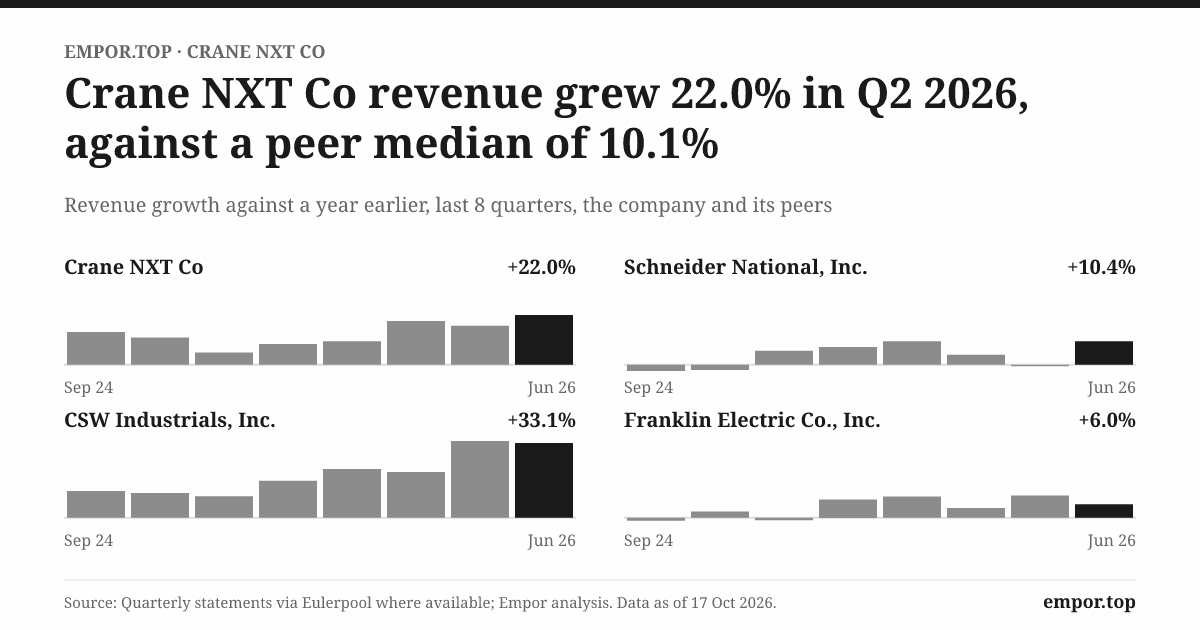
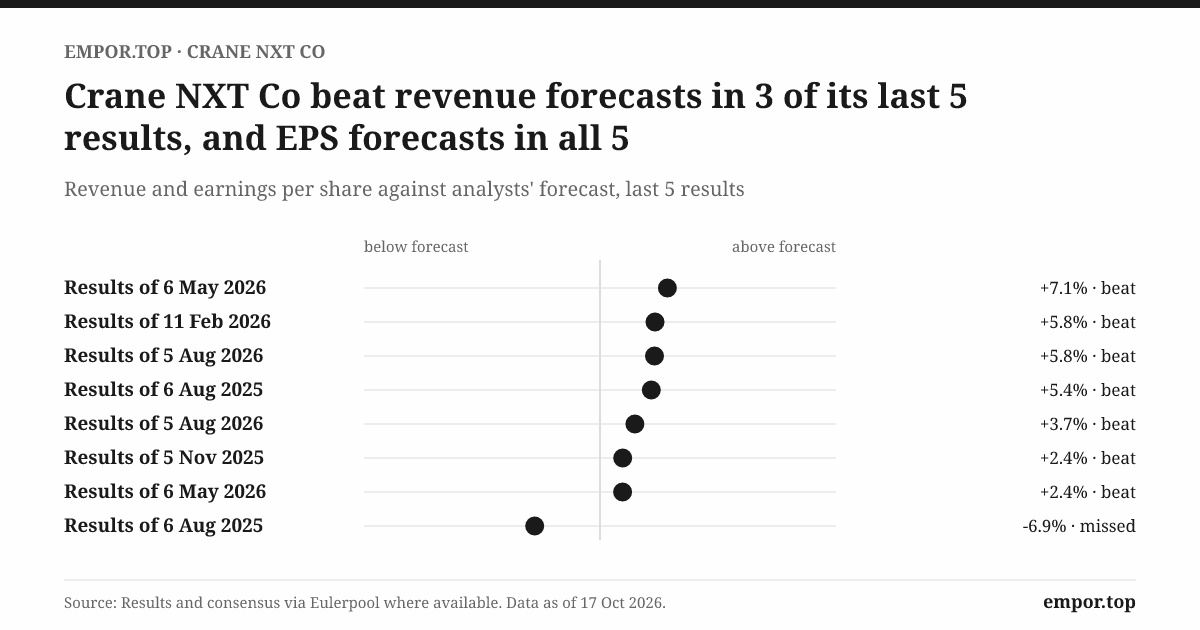
When Crane NXT reported its second quarter of 2026 in early August, the headline number looked spectacular. Sales rose 22% from a year earlier, to about $493 million.28 Operating profit jumped by more than 40%. Management raised its adjusted earnings guidance for the year.8 For a business that had grown under 1% organically the year before, it looked like an inflection.
Read one line further, though, and the 22% splits into two very different stories. Organic growth, the part that excludes acquisitions and currency, was 2.8%.8 The rest came from consolidating Antares for its first full quarter and from the De La Rue business annualizing.8 It is a bit like a family whose household income jumps because a new adult moved in. The household is bigger; whether anyone got a raise is a separate question.
The bridge from the first quarter matters here. In Q1 2026, organic growth had been about 6%, a sharp pickup from 2025.9 In Q2 it slowed to 2.8%.8 One strong quarter followed by a respectable one is better than what came before, but it is not yet a trend, and the deceleration means the company has not cleared the bar that would make its mid-single-digit ambition look routine.
The brightest number sat inside SAT, where organic growth reached 9.6% in Q2.8 That is a strong result, and it deserves to be read carefully rather than celebrated wholesale. SAT contains at least three distinct engines: U.S. currency demand, which depends on the Treasury's printing orders; international currency, which depends on central banks' redesign and reprinting cycles; and Crane Authentication, the OpSec and De La Rue businesses selling to brands and governments. A quarter that is strong because of the timing of currency orders is a different thing from a quarter that is strong because brand-protection subscriptions are compounding. Management's commentary attributed the strength across several of these lines, and the honest reading is that currency remains a lumpy, order-driven business layered on a smaller, steadier authentication base.8
DTT is the counterweight. CPI's hardware lives on the same structural fault line. On the Q4 2025 call, management guided to roughly flat CPI sales for 2026, with a low-single-digit decline in vending, and discussed tariff-related pricing as a factor in the mix.10 That is guidance for stability, not growth, and it frames the whole transformation. The cash-machine business is expected to hold its ground, while the growth is supposed to come from somewhere else. On the subsequent calls, analysts pressed on Antares' early losses, its seasonality and how much it contributed to the quarter.98 Management described the first months of integration as on plan, with margin improvement to come.8 On the record so far, that remains a plan.
Then there is the gap between the two kinds of earnings. GAAP diluted EPS over the twelve months to June 2026 was about $2.42.2 Adjusted EPS, the measure management guides to, is materially higher, because it excludes amortization of acquired intangibles, transaction costs, restructuring and other special items.8 Some of that gap is genuinely non-cash; amortizing a customer list does not consume money this year. But it reflects money already spent to buy those customer lists, and the restructuring and deal fees are real cash. Investors should hold both numbers side by side. The adjusted figure tells you what management believes the business earns in steady state; the GAAP figure tells you what shareholders have actually received so far.
All of this rolls up into the ambition management laid out at its Investor Day in February 2026: a business of roughly $2.5 billion of sales by 2028, with adjusted EBITDA margins in the mid-20s.7 That is a target built substantially on acquired revenue, with Antares bringing several hundred million dollars of sales on day one. Hitting the sales number therefore says less than it seems about the strategy's success. Hitting the margin number, with Antares and De La Rue both starting at lower profitability than the core, would say a great deal.
The second quarter leaves the transition unresolved, then: better momentum than 2024 and 2025, especially in authentication, but not yet proof that the enlarged company can grow by itself. The more pressing question is what happened to the cash, and the balance sheet, that paid for the deals.
V. The Cash Is Real; So Is the Working-Capital Bill
Picture a government authentication contract moving through a Crane plant. Raw materials arrive, specialized inks and substrates are prepared, production runs begin. Under cost-to-cost accounting, Crane books revenue and profit as each stage of work is completed.1 But the customer pays on its own schedule, according to milestones written into the contract. Between the day the profit appears in the income statement and the day the cash lands in the bank there can be a long walk. Multiply that walk across tax-stamp contracts in emerging markets, security-print deals in Europe and a newly consolidated Italian equipment maker, and it becomes visible in the balance sheet.
Begin, though, with the part of the story that is genuinely impressive. Over the eleven years from 2015 to 2025, across both the old conglomerate and the new standalone company, about $2.1 billion of net profit produced about $3.3 billion of operating cash, and free cash flow totaled about $2.8 billion.13 Crane has been, for a long time, a business whose cash runs ahead of its reported profit. In 2025 alone, free cash flow was about $198 million against net income of about $145 million.1
The standalone period tells a more nuanced version. Between 2023 and 2025, net income of about $518 million generated about $732 million of operating cash, a conversion of roughly 140%.1 Much of that gap is depreciation and amortization, which rose from about $78 million in 2023 to about $107 million in 2025 as acquired customer relationships and technology were written down over time.1 That helps the cash line, but it is a mechanical effect of having bought companies. It is not evidence that the underlying business got better at turning sales into money. In fact, free cash flow fell from about $245 million in 2023 to about $198 million in 2025, even as revenue rose.14
Where did the cash go? Over the eleven-year record, dividends absorbed about $607 million, roughly a fifth of free cash flow. Since the spin, dividends have run at a modest $23 million to $39 million a year.1 There were no share buybacks at all from 2023 through June 2026.12 Almost every other dollar of free cash, and a large amount of borrowed money, went into acquisitions and their financing costs. That is a deliberate choice, and an internally consistent one for a company trying to reinvent itself, but it means the cash story and the deal story are the same story.
Now the working-capital bill. Debtor days, the average number of days it takes to collect a sale, sat at about 56 in 2022 and 2023. They jumped to 75 in 2024 and 80 in 2025.1 Net receivables rose from about $266 million at the end of 2024 to about $352 million at the end of 2025, and about $407 million by June 2026.12 Working capital absorbed about $68 million of cash across 2024 and 2025, and about $56 million in the first half of 2026 alone, as receivables and inventory both grew.12
That sounds alarming, so it is worth answering the obvious question directly: are customers failing to pay? The evidence says not. The allowance for credit losses stayed at roughly 2.5% to 2.7% of gross receivables, rising from about $8 million to about $11 million in dollars but not in proportion.12 The lengthening is tied to the type of business acquired. International security-print and tax-stamp contracts from OpSec and De La Rue collect more slowly than vending equipment sales, and government-style contracts accumulate unbilled contract assets, which rose from about $38 million to about $56 million during 2025.1 On the other side of the ledger, customer advances, which are cash collected before revenue, rose to about $159 million by June 2026 after Antares was consolidated.2 That partially offsets the receivables build. The mix shift explains the slower collection; it does not make the slower collection free.
The audit backdrop is clean. Deloitte gave unqualified opinions on both the financial statements and internal controls for 2025, with no material weakness, though it excluded De La Rue from the controls review as a newly acquired business.1 Its critical audit matter, again, was the judgment in over-time revenue on U.S. Government contracts.1 That is the right place to look: if contract margin estimates prove too optimistic, it would show up as reversals of profit already booked, and as receivables or contract assets that turn into cash more slowly than expected.
So the cash claim is real but conditional. Crane NXT generates healthy free cash, and much of the receivables build reflects the contracts it chose to buy. But the business it is becoming needs more working capital than the business it was, which means less cash is available for the job that matters most right now: paying down debt.
VI. The Debt Makes the Strategy a Timed Bet
On March 31, 2026, the Antares takeover closed and the Milan listing ended.2 Three months later, at the end of June, Crane NXT's borrowings stood at about $1.45 billion, of which about $194 million was due within a year.2 Two and a half years earlier, at the end of 2023, borrowings had been about $695 million.1 The company had doubled its debt to buy its future.
The structure is worth understanding, because it shapes what can go wrong. At the end of 2025 the company had a sterling-denominated Term Loan A of £300 million maturing in 2030, a euro Term Loan B facility of €430 million maturing in 2032 that was drawn further in early 2026 to fund Antares, an $800 million revolving credit line maturing in 2030, and two long-dated bonds: $200 million of 6.55% notes due 2036 and $350 million of 4.20% notes due 2048.1 Lease liabilities of about $70 million sit separately from that debt.1 Net debt, which subtracts cash of roughly $231 million at June 2026, is the figure that matters for leverage.2 The long-dated bonds are a gift from an earlier era of cheap money; the term loans are floating-rate and newer, which is where the rising cost lives.
That cost has been rising steadily. Interest expense climbed from about $48 million in 2023 to about $60 million in 2025, and on a trailing basis after the Antares financing, it exceeded $75 million.12 For perspective, that is more than a quarter of the company's trailing operating profit of about $272 million. Every dollar of interest is a dollar of operating profit that does not reach shareholders, and it is a dollar that cannot go toward paying down principal.
On the Q2 call, management described net leverage of about 2.7 times on its bank-defined basis.8 That number uses pro forma EBITDA that includes a full year of Antares and adds back certain charges, so it is more generous than a simple division of net debt by reported EBITDA would be. Reported EBITDA for 2025 was about $348 million; against net debt of more than $1.2 billion in June, the plain-arithmetic ratio sits well above three times.12 Both measures are legitimate. The bank-defined one is what governs the covenants; the plain one is closer to what a skeptical bondholder sees.
The rating agencies have taken a measured view. S&P rates Crane NXT BB+ with a stable outlook, one notch below investment grade, crediting its market positions in payment validation and currency security and its record of deleveraging, while warning that debt-funded acquisitions push leverage toward its downgrade threshold.13 Moody's rates the company Ba1, also stable, and in August 2026 lowered its rating on the secured credit facilities to Ba1 to reflect the larger share of secured debt in the structure after Antares.13 Moody's names strong cash flow and niche barriers to entry as strengths and modest scale and integration risk as constraints. Neither agency is sounding an alarm. Both are describing a company with little margin for a stumble.
The covenants frame that margin. Under the amended credit agreement, the maximum net leverage ratio was reset to 5.50 times in the quarter Antares closed, then steps down over subsequent quarters to 4.25 times; interest coverage must stay above 3.00 times.12 Against a bank-defined 2.7 times, the headroom today is wide, and the revolver offers ample liquidity. These are constraints to watch, not forecasts of distress. They matter because they set the pace: if earnings disappoint while the ceiling comes down, the room for another deal, or for a bad year, narrows quickly.
A skeptical investor, the kind who writes activist letters, would ask an uncomfortable question here. Why did Crane NXT buy Antares, its largest deal, before it had shown that OpSec and De La Rue were earning their cost of capital? Management's answer is strategic: the opportunity to own a scarce inspection and traceability platform does not wait.7 The rigorous answer can only come in numbers: synergy delivery, cash returns on the acquired assets, and net debt falling quarter after quarter. A bigger portfolio slide is not an answer.
The chain reaction is easy to sketch. Weak organic growth, or slow collections on acquired contracts, would reduce the cash available for debt paydown. Higher floating-rate costs would take a larger share of operating profit. Less paydown would keep the interest bill high. That loop runs in reverse too, which is the bull case: modest organic growth, improving working capital and falling debt would release cash faster each year.
One settling test is worth carrying forward: net debt below about $1 billion, and leverage below 3.5 times on the plain measure, by the end of 2027, without issuing new equity. Whether that happens depends heavily on the person who chose this path.
VII. What Crane's Capital Allocation Says About Its CEO
In late February 2026, Crane NXT's leadership stood in front of investors with a deck of slides and an ambition: roughly $2.5 billion of sales by 2028, mid-20s adjusted EBITDA margins and net leverage below three times.7 Antares had not yet closed; it would do so a month later. The person carrying that message, and the person who will be judged by it, is President and CEO Aaron Saak, who has led the company since the spin.11
His record is still being written, so it is best judged by what he has done with capital and how he has been paid. Saak's total compensation rose from about $6.3 million in 2023, including a sign-on bonus, to about $6.9 million in 2025.11 The 2025 package combined a base salary of $875,000, roughly $3.9 million of stock awards, about $1.2 million of options and about $0.9 million of annual cash incentive.11 Over the same span, GAAP net income fell about 23%, from about $188 million to about $145 million.1 Pay rose about 9% while profit fell by almost a quarter.
That gap has an explanation, and it is worth understanding rather than simply condemning. The incentive plans measure adjusted results, which exclude acquisition and restructuring costs.11 That design rewards the executive for running the operations well without penalizing them for the one-time costs of strategic deals. The trouble is that it also removes the cost of the strategy from the scorecard of the person choosing the strategy. A CEO paid on adjusted earnings faces less friction in pursuing deals than shareholders, who pay for every transaction fee and every amortized dollar. That does not mean Saak's deals were bad. It means the incentive system does not, by itself, protect shareholders from bad ones.
Ownership is modest. Executives and directors as a group held 684,213 shares, about 1.2% of the class, in March 2026.11 There have been no buybacks since the spin, and the dividend has grown gently while the deal pipeline consumed the rest of the capital.1 Management is a steward, not an owner.
What can be credited is consistency. Since the spin, the strategy has pointed in one direction: away from dependence on physical cash and toward authentication and traceability. There has been no hidden pivot and no sudden change of story between calls. The guidance Saak's team gave on the Q4 2025 call, flat CPI with modestly declining vending, was cautious, and the Q1 and Q2 results that followed were consistent with it, with Q2 bringing a guidance raise.1098 The risk is not inconsistency. It is that the pace of deals may have outrun the earnings and integration capacity of a company this size.
Governance is in decent shape on paper. Eight of nine directors are independent, and the chair, John Stroup, is separate from the CEO.11 At the May 21, 2026 annual meeting, say-on-pay passed with 97.2% support, and every director was re-elected, though David Petratis drew the most votes against.12 Those results should be read with one fact in mind. The Crane Fund, a trust for former employees in need, owns about 13.5% of the stock, and its shares are voted at the direction of the board of Crane Company, the former sister.11 That makes an outside corporate board the director of the second-largest voting block. There is no sign of conflict so far, but it is an unusual overhang, and it dampens the signal sent by lopsided votes.
The other ties to Crane Company are narrow. After the separation, the relationship is limited to separation and transition agreements and tax indemnities, with a receivable of about $1.9 million at year-end 2025.1 There are no brand royalties, operating fees or shared facilities.1 This is a clean break, not a hidden dependency.
The footnotes are similarly unremarkable, and that counts in management's favor. The company disclosed no pending lawsuit or environmental claim with a reasonably possible material loss, and the legacy asbestos liabilities of the old Crane stayed with the pre-spin structure and Crane Company.1 Standby letters of credit rose to about $98 million, reflecting performance bonds on acquired contracts, and restricted cash and contingent acquisition liabilities are small.1
Currency deserves a sentence because it is now half the story. About half of 2025 sales were outside the U.S., with the euro, pound, Swedish krona and yen the main exposures.1 The company uses forward contracts and has designated its euro term loan as a hedge of European operations, so a weaker euro reduces both the debt and the value of the assets it funds.1 Translation effects will nonetheless move reported growth from quarter to quarter.
So the credibility test is clear. Take the deal assumptions and the Investor Day targets and compare them every quarter with organic growth, cash returns, restructuring charges and leverage. Saak has delivered consistency. What he has not yet delivered is proof that the capital he deployed is earning its keep, and that is what the market is now pricing.
VIII. Analysis & Bear vs. Bull Case
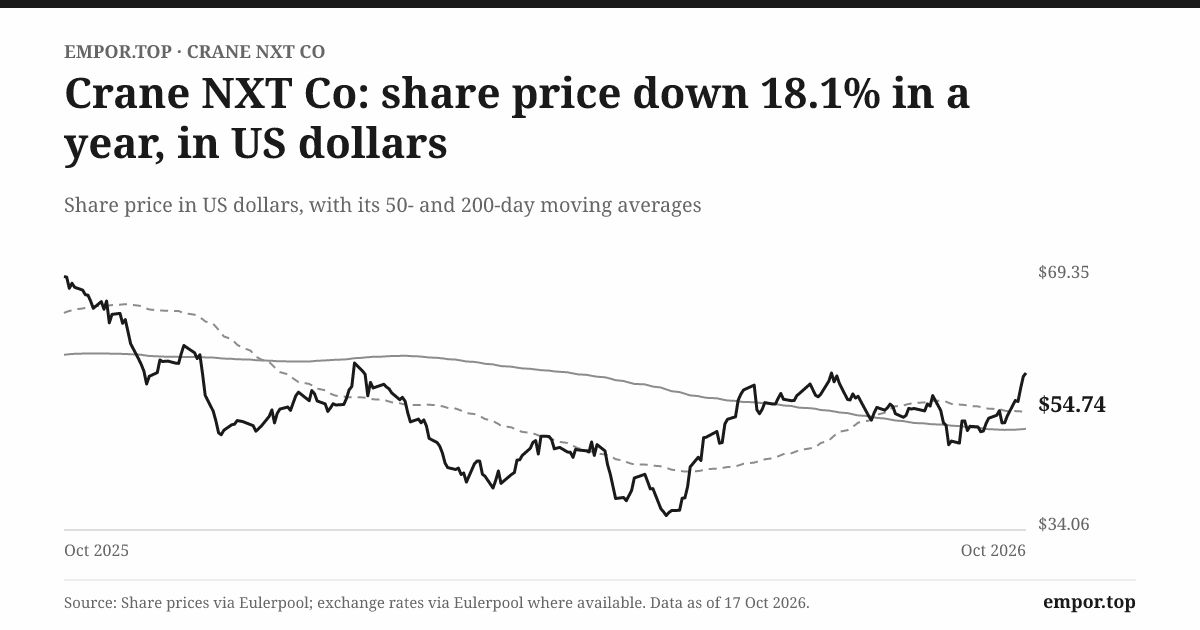
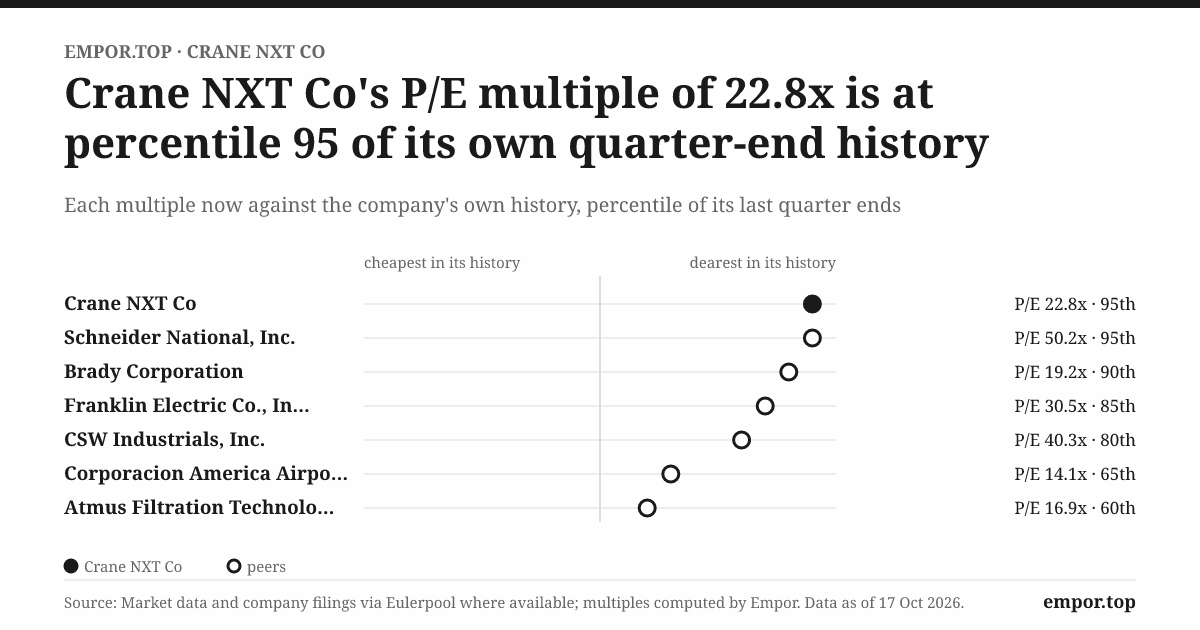
At $54.74 on October 17, 2026, Crane NXT trades about 19% below its 52-week high of roughly $67.15 On the surface that looks like a discount. Look at earnings and it is not. The stock trades at about 22.8 times trailing GAAP earnings, against a five-year median of about 18 times. Investors are paying more for each dollar of today's reported profit than they did, on average, over the past five years, even though that profit is lower than it was in 2023. That is the core tension of the valuation: the price assumes a recovery in earnings that has not yet arrived.
Begin with the industry forces, argued once and in full. Buyer power is high. The single largest customer is the U.S. Treasury, which buys about an eighth of everything Crane sells and can re-bid or qualify alternatives.1 Commercial buyers in payment automation are equipment makers and operators who have other validator suppliers to choose from, and brand owners buying protection have many vendors. Supplier power is meaningful in a specific way: the company relies on single- or sole-source suppliers for cotton and flax fibers, specialized security chemistry and certain semiconductors.1 That makes supply resilience and the ability to pass through costs part of the investment case. The threat of substitutes is the largest force of all for the legacy business, because digital payments substitute directly for the cash that CPI's machines count. Rivalry is concentrated among a few qualified players in currency security, and broader in brand protection and inspection. Barriers to entry are real in currency security, where qualification takes years, and lower in software-led brand protection.
Hamilton Helmer's 7 Powers framework sharpens the question of what, if anything, is durable. Switching costs are the most plausible power: a central bank that has designed its notes around a feature, or a pharmaceutical line that has validated an inspection system with regulators, does not change suppliers lightly. But the company does not disclose retention or bid-win rates, so the strength of that power is inferred, not measured. Cornered resource is a tempting label for the Treasury relationship, but it does not fit: a single customer with procurement leverage is not a resource the company controls. Process power may exist in manufacturing security features at scale, though it is hard to evidence from outside. Scale economies are modest, as both rating agencies note.13 Network effects, brand power in the consumer sense and counter-positioning are absent. The honest conclusion: Crane NXT's advantage is a narrow, qualification-based switching-cost power in currency security and installed equipment, real enough to support steady cash flow, not established across the enlarged portfolio.
The bull case runs like this. The legacy business is a cash machine, producing about $198 million of free cash in 2025, and the 6.3% free-cash-flow yield on today's market value is generous for a company with long-lived customer relationships.1 SAT's organic growth of nearly 10% in Q2 shows authentication demand is real.8 If Antares and De La Rue move from early losses to the margins of the core, and if amortization shrinks as a share of earnings, then GAAP profit will rise toward adjusted profit, and today's P/E will look less demanding. Deleveraging would then shift value from lenders to shareholders year after year.
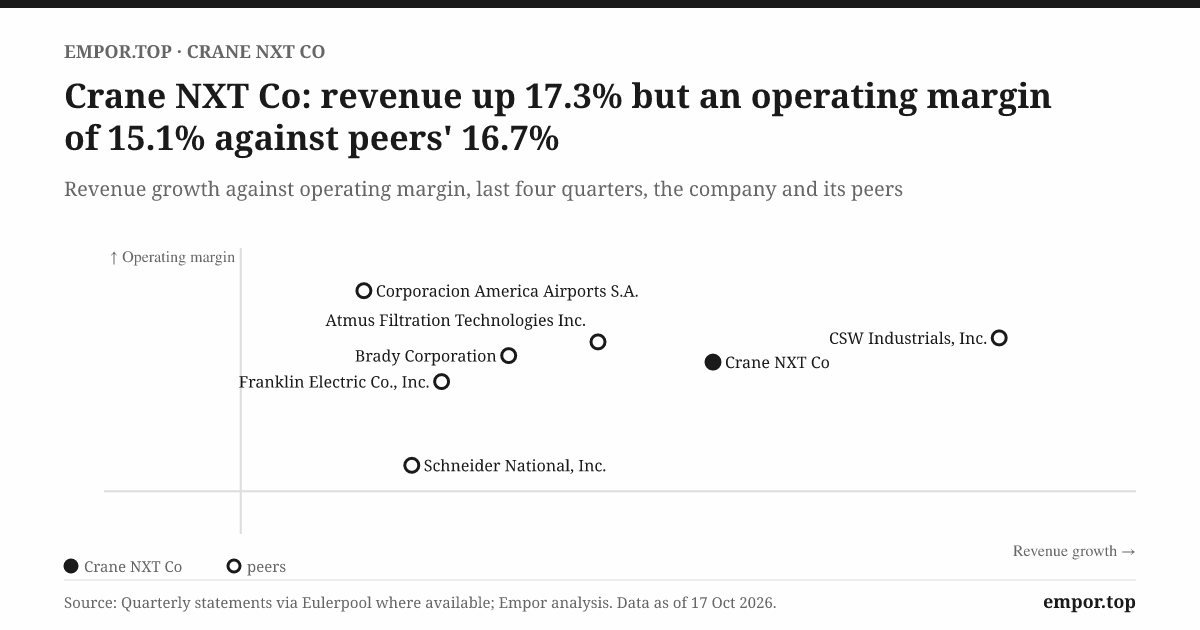
The bear case runs on the same scoreboard. Organic growth since the spin has been near zero outside two recent quarters. Two of the three acquisitions have lost money on a GAAP basis in their first reporting periods.12 Return on invested capital has fallen from about 16% in 2023 to under 9% on a trailing basis, meaning the capital added has, so far, earned less than the capital that was already there. Debtor days are up two dozen days in three years. Interest expense takes a growing slice of operating profit. If cash keeps declining as a payment method and integration drags, the roll-up could prove worth less than the parts it paid for.
Peer comparison helps only a little. Crane NXT's P/E sits near Zebra Technologies and below Veralto and its former sister Crane Company, which trade in the mid-20s.15 But those peers have different business mixes, and Crane NXT's earnings are depressed by acquisition accounting in a way theirs are not. The cleaner comparison is with itself: a premium to its own history, at a time of lower returns, implies that the market is already underwriting part of the integration's success.
That narrows the decision to two indicators that matter more than any others. The first is organic sales growth by segment, which last read 2.8% for the company and 9.6% for SAT in Q2 2026, up from under 1% for the whole company in 2025.81 The second is net leverage falling while margins and working capital improve, last described by management at 2.7 times on a bank basis, with debtor days still elevated at 80 at year-end 2025.81 If both move in the right direction for several quarters, the bull case is being written. If the first stalls while the second stays high, the bear case is.
IX. Lessons from a Company Buying Its Next Chapter
Go back to April 3, 2023, the day the ticker changed. The separation turned a sprawling conglomerate into a focused company, and then three deals in two years redrew what focused meant. More than $1.07 billion was deployed; organic core growth in the following year was 0.7%; the most recent quarter showed 2.8%.128 Inside that arc sit lessons that belong to this company and no other.
The first comes from the spin itself. A cleaner story starts with a cleaner denominator. The separation made Crane NXT's real business far easier to see, but it also left behind a decade of predecessor numbers that make a growing company look like a dying one. For investors in any spin-off, the first job is to decide where history actually begins, because the wrong starting line will produce the wrong verdict every time.
The second comes from the banknote. A security feature is valuable only while the buyer keeps specifying it. The ribbon in a $100 bill is extraordinarily hard to copy, and that is the technology's moat. But the economics of that moat are set by the Treasury's procurement office, not the engineering lab. Qualification earns you a seat at the table; buyer power decides what the seat is worth.
The third comes from the deals. A platform is a promise until the acquired revenue grows without another acquisition. Bundling inspection, traceability and authentication is a sensible answer to a real customer problem. It becomes a business only when the pieces grow organically and earn margins above what was paid for them. Every serial acquirer should be judged on the second year after a deal, not the announcement day.
The fourth comes from the cash. Cash conversion can finance a transformation, but receivables can slow the escape route. Crane NXT's history of turning profit into cash is long and genuine. Yet the contracts it bought collect more slowly, and every extra day of collection is cash that does not go to the lenders. Free cash flow and debtor days belong in the same sentence.
The fifth comes from the boardroom. Adjusted targets are a map; GAAP cash and debt are the terrain. Management is paid on adjusted earnings, the Investor Day targets are adjusted, and the guidance is adjusted. Shareholders live on the terrain: reported profit, cash in the bank, debt outstanding. The distance between the two is the most honest measure of how the transformation is going.
X. Epilogue
Tonight, in mid-October 2026, Crane NXT is about to report the first full quarter in which every piece of its new shape sits inside the numbers from start to finish. The 2028 targets set at the Investor Day are ticking: about $2.5 billion of sales, mid-20s adjusted EBITDA margins and net leverage below three times.7 Three results days, for the third quarter, the fourth quarter and then the full-year 2026 annual report, will start to answer whether those numbers were a plan or a hope.
The first thing to watch is DTT. If the cash-machine business, excluding Antares, can deliver positive organic product growth, or if service can offset hardware and vending pressure as management guided, then the legacy base becomes a stable floor rather than a slow leak.10 If DTT's growth exists only because Antares is consolidated, the floor is sloping.
The second is SAT. Backlog, the share of sales going to the U.S. Government and the conversion of those orders into cash will reveal whether the strong currency demand of 2026 is a cycle of reprinting or a durable level. Currency orders are lumpy by nature; a weak quarter there would not break the thesis, but a weak year would weaken it.
The third is the acquired units. Antares began its life under Crane with operating losses.2 The question for the next four quarters is whether it moves toward sustained margins and whether integration costs taper as promised. De La Rue's first full year under Crane will be visible in the 2026 annual report, giving the first clean look at how one of these deals performs after integration.
The fourth is working capital. Eighty debtor days is a warning light to monitor, not evidence of default. If collections improve as acquired contracts mature, the light goes out. If receivables keep rising faster than sales, it starts to flash.
The fifth is the debt. Every quarter, net debt and bank-defined leverage will be compared against the covenant step-down from 5.50 times toward 4.25 times and against management's sub-three-times target.17 A steady decline would show the deleveraging promise is real. A plateau would mean the timed bet is running late.
All of which leads back to the question that started this story. Has Crane NXT bought itself a new growth engine, or has it bought time against the decline of cash? The next four quarters will not settle it entirely. They will show which way the needle is pointing.
XI. Outro
The company that became Crane NXT traces its roots to 1855, and for much of its modern life it has made its money proving that a piece of paper is real.1 Its thread sits inside the world's most-used banknote. Its machines decide, millions of times a day, whether a bill fed into a vending machine is genuine. At the other end of the new portfolio, a camera on an Italian-designed inspection line checks a pharmaceutical package and gives it an identity it will carry to the pharmacy shelf.
That is the leap Crane NXT is attempting: to take the technologies that authenticate physical money and make them matter in an economy that increasingly does without it. A company built on trust marks is now asking investors to trust an acquisition-led transformation. Like the thread in the note, the strategy is difficult to copy and valuable only if customers keep choosing it. The difference is that this time, the company has to earn the return before the debt comes due.
References
-
Crane NXT Form 10-K for FY2025 — SEC, 2026-02-26 ↩↩↩↩↩↩↩↩↩↩↩↩↩↩↩↩↩↩↩↩↩↩↩↩↩↩↩↩↩↩↩↩↩↩↩↩↩↩↩↩↩↩↩↩↩↩↩↩↩↩↩↩↩↩↩↩↩↩↩↩↩↩↩↩↩↩↩↩
-
Crane NXT Form 10-Q for Q2 2026 — SEC, 2026-08-05 ↩↩↩↩↩↩↩↩↩↩↩↩↩↩↩↩↩↩↩↩↩↩↩
-
Crane Holdings Form 10-K for FY2022 — Crane Company investor site, 2023 ↩↩
-
Crane NXT 2026 Investor Day presentation — Crane NXT, 2026-02-25 ↩↩↩↩↩
-
Crane NXT Q2 2026 earnings call transcript — The Motley Fool, 2026-08-12 ↩↩↩↩↩↩↩↩↩↩↩↩↩↩↩↩
-
Crane NXT Q1 2026 earnings call transcript — Stock Analysis, 2026 ↩↩↩
-
Crane NXT Q4 2025 earnings call transcript — Seeking Alpha, 2026-02-12 ↩↩↩↩
-
Crane NXT 2026 Annual Meeting voting results, Form 8-K — SEC, 2026-05-28 ↩
-
Crane NXT BB+ issuer rating affirmed, outlook stable — S&P Global Ratings, 2025 ↩↩↩
 LinkedIn
 WhatsApp
 Reddit
 Hacker News
 Email
 Kindle
 RSS Feed
 Spotify
 Apple Podcasts
 Amazon Music
 Audible
 YouTube