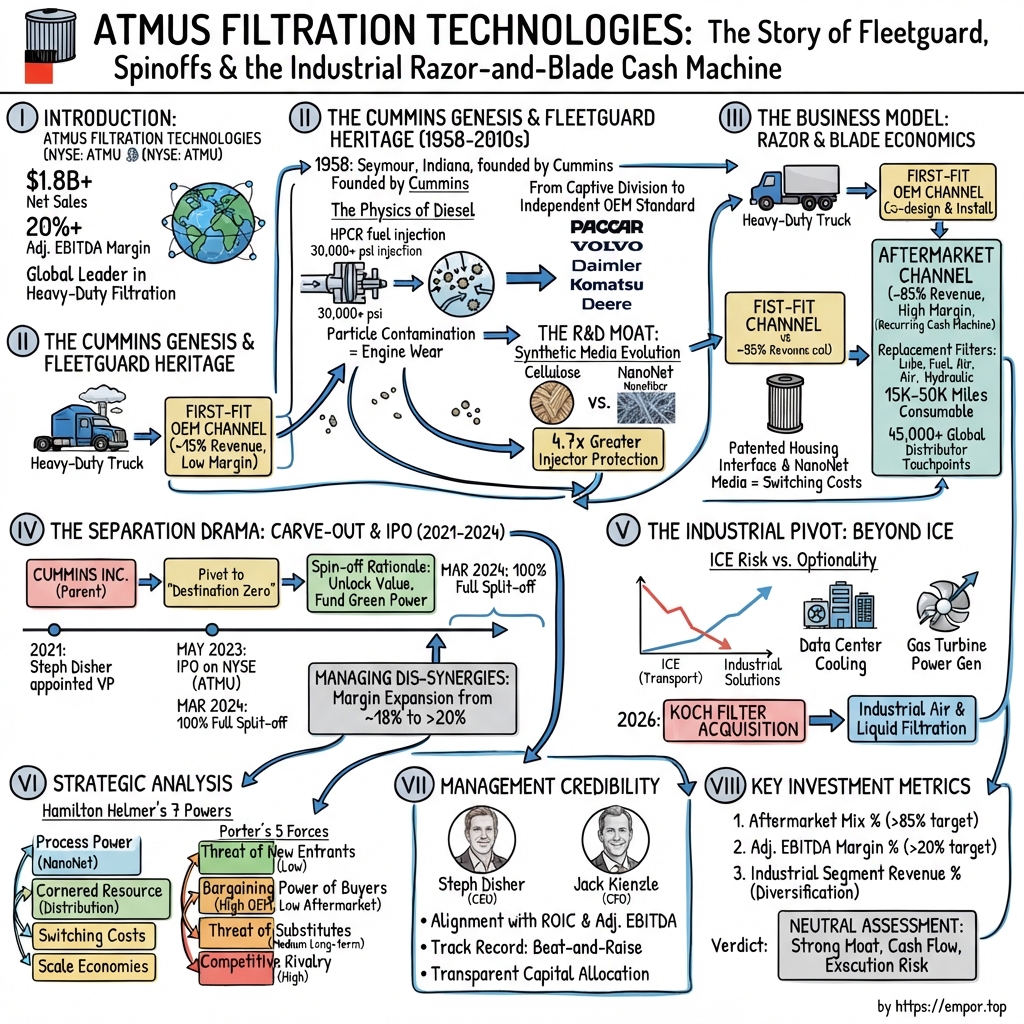
Atmus Filtration Technologies: The Story of Fleetguard, Spinoffs, and the Industrial Razor-and-Blade Cash Machine
I. Introduction & Episode Roadmap (~12 min)
There is a particular kind of business that investors fall in love with and then struggle to value. It sells something cheap, unglamorous, and utterly non-negotiable. Nobody wakes up excited to buy it. Everybody has to.
A diesel fuel filter costs somewhere between the price of a decent dinner and a tank of fuel. It is a canister of pleated media, a gasket, and a threaded base. It weighs a couple of pounds. And if a fleet manager skips it — or buys the wrong one — the modern high-pressure fuel injectors sitting downstream, which are machined to tolerances finer than a human hair and pressurized to levels that would core a steel plate, will erode, foul, and eventually fail. The repair bill runs into the thousands. The truck sits still, which is worse, because a Class 8 tractor parked at a service bay earns nothing while its financing payment keeps arriving.
That asymmetry — trivial cost, catastrophic consequence — is the entire business model of Atmus Filtration Technologies Inc. (ATMU, NYSE), a company that most investors had never heard of before 2023 and that many still describe, imprecisely, as "the Cummins filter spinoff."
The numbers are more serious than the profile suggests. In fiscal 2025, Atmus generated $1.76 billion in net sales, $207.4 million in net income, and $353.5 million in adjusted EBITDA — a 20.0% adjusted margin on a business that manufactures physical goods in ten plants across six continents.1 By the second quarter of 2026, after its first acquisition, the company posted record quarterly sales of $528 million and raised full-year guidance toward the $2 billion mark.2 In late August 2026, the shares traded near $48, against a 52-week range of roughly $43 to $67, for a market capitalization just under $4 billion.3
The hook
Here is the question this story turns on: How did a filter line started inside Cummins Engine Company in 1958 in Seymour, Indiana — built to solve an engine-wear problem Cummins created for itself — become an independent public company that sells to Cummins' fiercest rivals, earns margins most diversified industrials envy, executed a two-step separation from its parent with unusual precision, and is now spending $450 million to buy its way into air filters for data centers and hospitals?
And the harder question underneath it: is the resulting business genuinely advantaged, or is it a well-run cash machine bolted to a powertrain technology with a finite, if distant, expiry date?
Empor's posture here is neutral. Atmus management tells a coherent story, and the operating record since 2023 has largely matched it. That does not make the story true in the way a proof is true. Several of the load-bearing claims — technology leadership, aftermarket share gains, disciplined M&A — rest on evidence that ranges from strong to thin, and this piece will grade them individually rather than in aggregate.
What the episode covers
The arc runs in five movements.
The first is the origin: a captive component division built to fix Cummins' engine-wear problem, which spent six decades converting an internal engineering requirement into a branded consumable sold under the Fleetguard name to virtually every major engine and equipment maker on earth.1
The second is the economics. Atmus estimates roughly 14% of 2025 net sales came from first-fit — filters installed as original components on new vehicles and equipment — and roughly 86% from the aftermarket, where those filters are replaced again and again over an asset's life.1 That ratio is the whole game, and understanding why the 14% creates the 86% is the difference between seeing a commodity manufacturer and seeing an annuity.
The third is the separation itself: a 2023 IPO in which the company sold no shares and received no proceeds, followed nine months later by a tax-free split-off that erased Cummins from the register entirely.45 Steph Disher, an Australian executive who had run Cummins' South Pacific business before taking over filtration, had to build a standalone company — IT systems, distribution centers, payroll, a legal function — while the parent watched from the boardroom with 80.5% of the votes.
The fourth is the pivot. Substantially all of Atmus' revenue is tied to internal combustion engine filtration, a concentration the company itself flags as a risk.1 The answer has been to buy into industrial air filtration, starting with Koch Filter Corporation in January 2026 — HVAC, healthcare, power generation, and the end market every industrial company now mentions on every call: data centers.6
The fifth is the stress test. Customer concentration is real: Cummins alone was 18.8% of 2025 net sales.1 Freight demand has been soft for three years. Emissions regulation, the historical friend of every filtration company, has become genuinely unpredictable in the United States. And the bull case leans on share gains that management quantifies but no external source verifies.
Start where the filters started: with an engine company that had a dirt problem.
 Subscribe on LinkedIn
II. The Cummins Genesis & The Fleetguard Heritage (1958–2010s) (~25 min)
Seymour, Indiana sits about forty miles down the road from Columbus, where Clessie Cummins founded his engine company in 1919. In 1958, Cummins opened a small operation there called Seymour Filtration Co. — a single filter production line whose only customer was the parent's own diesel engines.7
It is worth pausing on how modest that origin was. This was not a strategic entry into a growth market; it was a maintenance department with a P&L. Cummins built engines that ingested air, fuel, and oil, and all three arrived carrying abrasive contamination that shortened engine life in ways customers noticed and complained about. Buying filters from third parties meant accepting external specifications for a component that directly determined whether a Cummins engine built a reputation for durability. So Cummins manufactured its own.
In 1963 the operation was renamed Fleetguard, and the brand — rather than the corporate entity — became the centerpiece.7 For the next six decades, through a 2006 renaming to Cummins Filtration and a 2022 rebranding to Atmus, the product a mechanic pulled off a shelf in Nairobi or Nashville said Fleetguard on the box.7 Sixty-eight years after its founding, it still does. Brand continuity of that length is rare in industrial manufacturing, making it one of the few genuinely uncontested assets in this story.
Why diesel engines are so fussy about dirt
To understand what Fleetguard was actually selling, it helps to abandon the mental image of a coffee filter.
A modern heavy-duty diesel engine relies on a common-rail fuel system that pressurizes fuel to extreme levels before spraying it through injector nozzles with orifices measured in microns. Engineers push pressure high to maximize emissions compliance and efficiency: finer atomization burns fuel more completely, generating more power with less soot. Yet the same physics that enables fine atomization makes the hardware exquisitely vulnerable. A particle invisible to the naked eye can score an injector's precision surfaces. Once the spray pattern degrades, combustion degrades with it — increasing soot, spoiling fuel economy, and eventually triggering repairs that cost multiples of a decade's worth of replacement filters.
Lube oil filtration solves a different problem with identical stakes: trapping metal-on-metal wear particles circulating through engine bearings. Air filtration handles a third: a heavy-duty engine ingests thousands of cubic feet of air per minute, which in a mining pit or harvest field is closer to dust suspension than clean atmosphere. Atmus' current product lineup spans fuel, lube, air, crankcase ventilation, and hydraulic filters alongside coolants and chemicals — a range the company argues enables one-stop shopping for distributors who would otherwise manage four separate vendors.1
The engineering distinction separating a premium filter from a cheap alternative is not merely catching smaller particles. Any filter media can be made finer, but tighter media restricts flow and starves the engine. The real engineering challenge is holding onto captured debris. A filter installed on a commercial truck endures continuous vibration, thermal cycling from cold starts to full loads, and sudden fuel surges. Standard paper-based cellulose media tends to release captured contaminants back into the fluid stream under those operational stresses, while swelling upon contact with water.
Fleetguard's media development programs targeted those specific vulnerabilities. Over several decades, the company commercialized a lineage of proprietary media families — including StrataPore, NanoNet, NanoForce, NanoNet Plus, and NanoNet N3 — and manufactures a substantial portion of that media internally rather than outsourcing it.1 In January 2025, the company launched NanoNet N3, combining microfibers and nanofibers into a fully polymeric web with a gradient mesh structure designed to increase contaminant-holding capacity so filters can be sized down or operated longer.8 Greg Hoverson, the company's chief technology officer, noted that the media can be fine-tuned for specific customer applications.8 In December 2025, the World Filtration Institute named NanoNet N3 its Product of the Year for filter media.9
An analytical perspective requires evaluating two aspects of this technology story simultaneously. First, vertical integration into proprietary media represents a distinct operational capability; most competing filter suppliers convert third-party media into finished assemblies, which caps their value capture and product differentiation. Second, an industry award and internal performance metrics do not replace independent, third-party benchmark testing, and Atmus does not publish head-to-head comparative data against peers like MANN+HUMMEL or Donaldson. The technical advantage remains plausible and is supported by OEM adoption, though it remains unverified by public third-party benchmarks.
From captive supplier to industry standard
The central strategic evolution was not just the underlying media technology, but the multi-decade expansion into selling to competing equipment manufacturers.
The business initially operated as a captive supplier, meeting Cummins' internal requirements and capturing the recurring aftermarket generated by every Cummins engine put into service. The subsequent phase required winning original equipment positions on engines and machinery produced by Cummins' direct commercial rivals. Today, Atmus' original equipment customer list includes major global heavy-duty manufacturers: Daimler, Deere, Doosan, Foton, Komatsu, PACCAR/DAF, the Traton Group, Stellantis, and Volvo, alongside Cummins. Atmus has maintained supply relationships with each of these manufacturers for at least ten years. Together, this group generated roughly 70% of net sales in 2025, maintaining a concentration level above 67% over each of the last five fiscal years.1
Supplying critical components to original equipment manufacturers whose complete vehicles compete with your parent company's engines required careful operational boundaries under Cummins ownership. Whether corporate independence enables broader market access remains a key testable element of the Atmus investment case. During the company's first earnings call following full separation, Chief Executive Officer Steph Disher stated that Atmus was actively pursuing prospective clients previously out of reach under Cummins, reporting a new fuel filtration contract win with a global equipment manufacturer across its European and North American operations.10 While this represents a tangible commercial milestone, Atmus did not publicly name the manufacturer, reflecting standard commercial confidentiality while limiting external verification.
The Cummins era also established Atmus' international joint venture footprint. Atmus entered the Indian market through a joint venture in 1987 and China in 1994. The company maintains these positions through a 50% economic interest in Shanghai Fleetguard Filter Co. Ltd., a 49.491% interest in Fleetguard Filter Private Ltd. in India, and an equity stake in Filtrum Fibretechnologies.1 These holdings generate material cash flow: equity, royalty, and interest income from investees reached $33.8 million in 2025 against $207.4 million in total net income, though management explicitly notes in filings that Atmus does not exercise unilateral control over these entities.1
By the 2010s, the core operational structure was established: an in-house media manufacturing base, an established aftermarket brand name, first-fit positions across leading global equipment manufacturers, and exposure to major international heavy-duty markets. However, the business lacked a standalone financial structure, an independent balance sheet, and a dedicated executive team focused exclusively on its corporate allocation. That structural transition occurred later, driven by the underlying economics built inside Cummins over the preceding decades.
III. The Business Model & Segment Economics: The Razor and the Blade (~30 min)
Walk into a truck dealership's parts counter in Laredo or Lyon and look at what is actually moving. Not engines. Not transmissions. Filters — stacked in cartons, sold by the case, reordered on a rhythm set by odometers and hour meters rather than by economic cycles.
That counter is where Atmus makes its money, and the mechanics of how it gets there are central to understanding the business.
The seed and the crop
Roughly 14% of 2025 net sales came from first-fit: filters sold to OEMs and installed as original components on new trucks, tractors, excavators, and gensets.1 First-fit is competitively tough revenue: OEM purchasing organizations are sophisticated and focused on unit cost, treating the filter as a line item in a heavily cost-engineered bill of materials.
Atmus pursues first-fit because it unlocks the remaining 86% of sales.1
Winning a first-fit position means co-developing a filtration system alongside an OEM's engineering team — specifying housing dimensions, mounting hardware, interface geometry, flow dynamics, and service intervals. That design becomes embedded in engine service manuals, dealer catalog databases, and vehicle warranty terms. Each vehicle built on that platform expands an installed base that will require replacement filters for a decade or more.
Management describes the mechanism directly: winning first-fit positions "drives Atmus' installed base, yielding strong recurring revenue streams in the aftermarket."1 This razor-and-blade commercial structure relies on three distinct operational drivers:
First, physical fit. A filter designed for a specific housing features precise dimensions, thread pitch, sealing geometry, and internal bypass specifications. A generic substitute risks improper seating or bypass failure, a flaw costly to uncover during active vehicle operations.
Second, warranty requirements and specifications. OEM maintenance guidelines dictate filter performance parameters, giving fleet managers a compelling reason to stick with specified components to safeguard engine warranty coverage. On the company's first post-separation earnings call, Chief Executive Officer Steph Disher linked this dynamic to tightening regulations, noting that as OEMs lengthen warranty windows, "I would expect our aftermarket capture to extend."10 That prediction offers a concrete metric for investors to track across newer vehicle platforms.
Third, customer habit and brand confidence. For a fleet maintenance manager whose performance hinges on vehicle uptime, the price differential between a premium filter and a low-cost alternative is trivial compared to the expense of engine downtime. Atmus backs the Fleetguard product line with a structural warranty designed to reinforce customer trust.111
These three drivers carry different durability profiles. Physical fit advantages diminish over time as aftermarket competitors reverse-engineer filter geometry. Warranty protection exerts its strongest pull during initial vehicle ownership, tapering off as older assets transition to second or third owners who prioritize price. Brand loyalty persists longest, yet remains highly sensitive to parts availability; if a specified component is out of stock, customer allegiance can vanish in a single transaction. Consequently, logistics and distribution function as core elements of the competitive moat.
What the mix does to the P&L
This high-margin consumable mix differentiates Atmus' financial profile from traditional vehicle component manufacturers. Standard suppliers depend heavily on OEM assembly line volumes, leaving them vulnerable to vehicle production downturns. Atmus faces direct build-rate exposure on only 14% of its top line; the remaining 86% tracks total equipment operating hours across the active fleet.
Financial results from 2023 through 2025 illustrate this operational buffer during a prolonged freight slowdown. Net sales expanded from $1.63 billion ($1,628.1 million) in 2023 to $1.67 billion ($1,669.6 million) in 2024, reaching $1.76 billion ($1,764.3 million) in 2025.1 Profitability showed similar resilience: adjusted EBITDA margins expanded from 18.6% in 2023 to 19.7% in 2024, reaching 20.0% in 2025. This margin expansion occurred even as "aftermarket demand remained soft throughout 2025" and first-fit "experienced reduced demand in 2025 reflecting depressed market conditions."1
Expanding adjusted EBITDA margin by approximately 140 basis points across two soft market years highlights the business model's defensive strength, though the underlying components warrant detailed examination. Favorable pricing contributed $50.0 million to 2025 revenue and an equivalent amount to gross margin, partly driven by tariff cost pass-throughs.1 Margin metrics also benefited from the burn-down of one-time corporate separation expenses. Structural operational gains provided additional support: combined manufacturing and related costs decreased by $7.7 million in 2025, offsetting a $36.2 million increase in freight and duty expenses.1 Consequently, roughly half of the margin expansion stemmed from pricing and non-recurring separation expense reductions, while the remaining half reflected structural cost discipline.
For peer comparison, Donaldson Company — the primary listed pure-play filter peer — reported fiscal 2025 net sales of $3.69 billion with an adjusted operating margin of 15.7%.12 By comparison, Atmus posted 2025 operating income of $299.0 million on $1.76 billion ($1,764.3 million) in net sales, representing an operating margin of 16.9%.1 Although smaller and less diversified than Donaldson, Atmus maintains comparable operational profitability within the commercial vehicle aftermarket.
Distribution: the part that nearly broke, and then didn't
A pivotal factor in Atmus' post-spinoff trajectory has been the overhaul of its global distribution operations.
Prior to the separation, filtration products moved through warehouse facilities shared with Cummins' primary engine supply chain. While seemingly cost-efficient, that structure created operational friction. Cummins prioritized first-fit assembly schedules, whereas aftermarket filter customers required rapid local part availability. Disher addressed this historical mismatch during the first-quarter 2024 earnings call: "previously, our distribution centers were intermingled with Cummins' supply chain management [...] that meant we weren't focusing on our customers in the right way in terms of their availability needs in product. And we've just been able to capture gains because that's actually our customers prefer to have our products. It was just we weren't putting it where they needed it to be."10
This operational realigning reframes the corporate independence thesis. Recent market share gains were driven less by sudden technology breakthroughs than by uncoupling a division previously constrained by parent-company logistics.
The distribution footprint was rebuilt around dedicated facilities, including a primary North American center near Dallas, a regional hub in Singapore, and expanded European facilities. By mid-2024, over 80% of shipping volume moved through dedicated Atmus warehouses.10 The company fully finalized its independent distribution network during 2025.9 As of December 2025, Atmus operated 11 distribution centers, 10 manufacturing facilities, and five technical centers globally, supported by a sales force across 25 countries and joint venture operations adding ten additional manufacturing plants.1 By the second quarter of 2026, management reported delivery fulfillment and on-shelf availability metrics at historical highs.13
Commercial distribution spans multiple channels: OEM dealer networks, independent distributors, and retail truck stops.1 Notably, dealer networks representing four of the largest North American on-highway OEMs carry extensive lines of Fleetguard products.1 While this multi-channel approach ensures broad market reach across dealer service bays and independent repair shops, it requires ongoing management of channel pricing overlap.
From an investment perspective, the initial logistics turnaround represents a discrete operational step-change that has now been substantially realized. Management targets 1 to 2 percentage points of annual market share expansion going forward and has met that benchmark.1413 However, as Disher acknowledged, 2025 share gains are "now in our base business."9 With low-hanging logistics improvements harvested, future share gains will depend on incremental commercial execution against established market competitors.
Which leads to how this business gained the freedom to fix its own warehouse network in the first place.
IV. The Separation Drama: Carve-Out, IPO, and 100% Independence (2021–2024) (~25 min)
On April 21, 2022, Cummins disclosed that its filtration business had confidentially submitted a draft registration statement to the SEC for a proposed initial public offering.15 The unit being detached had generated $1.4 billion in revenue in 2021, up 17% year over year, having operated within Cummins since 1958.15
The corporate logic was clear. Cummins had committed to a decarbonization strategy branded Destination Zero, and in 2023 consolidated its zero-emissions technologies — including batteries, fuel cells, electrolyzers, and e-axles — into a dedicated business unit named Accelera.16 Building that portfolio required significant capital and executive focus. A mature, cash-generative filtration business tied to internal combustion engines represented an awkward fit inside a parent company signaling a strategic pivot away from fossil fuel powertrains.
From an investor perspective, the dynamic was straightforward: filtration operated as a high-return business embedded within a lower-multiple industrial conglomerate, competing internally for capital against long-dated green technology investments. Separating the unit allowed Cummins to monetize the asset and fund clean-tech development, while permitting the filtration business to trade on its standalone operational economics.
The executive who had to build a company
Steph Disher was appointed Vice President of Cummins Filtration in 2021, bringing an operational background tailored to the carve-out task.17
Educated at the University of Western Sydney and the University of Melbourne, Disher spent thirteen years at BP before joining Cummins in 2013.17 Her core operational leadership role was Managing Director for Cummins South Pacific in Melbourne — a distribution and service operation where business performance depended on component availability, dealer networks, and minimizing fleet downtime in remote mining sectors.17
Disher was tasked with constructing corporate infrastructure from scratch while maintaining active operations. Corporate headquarters were established in Nashville, Tennessee, establishing physical separation from Cummins' base in Indiana, while the team built independent IT, legal, human resources, treasury, distribution, and public reporting systems.117 Jack Kienzler, who joined Cummins in 2014 and served as Executive Director of Investor Relations after leading Corporate Development, assumed the CFO role.1 Renee Swan joined as Chief People Officer in August 2023, and Laura Heltebran joined as Chief Legal Officer in May 2025.1
The standalone corporate identity — Atmus, derived from "atmosphere" — was introduced in November 2022.7 The Fleetguard brand was retained on all product packaging.
Step one: an IPO where the company sold nothing
The offering priced on May 25, 2023, at $19.50 per share, with trading commencing on the NYSE the following day and the transaction closing on May 30.4
The transaction structure highlighted the carve-out's financial engineering. Atmus itself issued no new shares and received no cash proceeds; all shares offered were existing stock sold directly by Cummins.4 Goldman Sachs and J.P. Morgan served as lead underwriters, with Baird, BofA Securities, Wells Fargo, and HSBC acting as joint bookrunners.4 Following the full exercise of the underwriters' over-allotment option, 16.24 million shares were sold, leaving Cummins with an 80.5% controlling stake.1
In parallel, Atmus established a $1.0 billion credit facility prior to separation, comprising a $600 million term loan and a $400 million revolving line of credit. Upon closing, Atmus drew $650 million from the facility and transferred the full amount to Cummins as partial consideration for the transferred business assets.1
As a result, the newly independent entity entered the public market carrying $650 million in debt incurred to fund a dividend to its former parent. While standard practice in corporate separations, this leverage profile constrained early capital deployment, delaying cash dividends through 2023 and share repurchases until mid-2024. The debt load carried an ongoing cost, reflected in $40.6 million of annual interest expense in 2024.1
Step two: the split-off, and a 12x oversubscription
The final separation was executed through a secondary exchange offer.
On February 14, 2024, Cummins launched an exchange offer allowing its shareholders to tender Cummins stock for Atmus stock at a structural discount.1 Executing the separation as a split-off rather than a pro-rata spin-off provided two primary advantages for the parent: it qualified as a tax-free transaction and directly retired Cummins shares, providing an immediate boost to the parent's earnings per share.
Market demand for the exchange proved robust. The offer was roughly twelve times oversubscribed. Upon expiration on March 13, 2024, Cummins accepted 5.57 million parent shares in exchange for 67.05 million Atmus shares, applying pro-rata allocation to tendered positions.105 By March 18, 2024, Cummins had fully divested its equity ownership in Atmus.5
While the twelve-times oversubscription reflected strong investor demand, it primarily demonstrated the financial attractiveness of the exchange ratio discount. Crucially, the transaction achieved full corporate independence within ten months of the initial public offering, eliminating the equity overhang associated with a lingering parent stake.
Governance changes took effect concurrently. All Cummins-designated directors resigned from the board, and independent directors Diego Donoso and Stuart Taylor were appointed, establishing a majority independent board.10
Absorbing the cost of standing alone
The operational separation required an extended transition period.
Atmus continued purchasing administrative and corporate support from Cummins under a transition services agreement (TSA), which fully terminated in September 2025.1 Standalone setup expenses totaled approximately $29 million in 2023, followed by $10 million to $20 million in 2024, and $15.5 million in 2025 — split between $11.2 million in cost of goods sold and $4.3 million in SG&A — along with $9.5 million in cumulative separation capital expenditures.110 With the TSA expired, management confirmed that non-recurring separation costs have concluded.1
The separation also introduced working capital adjustments. Under Cummins ownership, payroll processing had operated on 60-day reimbursement terms. Operating independent payroll systems required immediate cash settlement, generating a one-time working capital outflow estimated at $30 million in 2024.10
Despite these standalone corporate overhead costs, operating profitability improved. Typical corporate carve-outs experience 100 to 200 basis points of margin compression as redundant corporate overhead is absorbed. Atmus expanded its adjusted EBITDA margin by approximately 300 basis points in 2023, reaching 20.0% by fiscal 2025 while fully absorbing independent IT, logistics, compliance, and governance costs.110
This margin expansion indicates that operational efficiency gains and improved commercial execution offset standalone corporate costs. However, establishing corporate independence only resolves structural governance; it does not eliminate long-term volume exposure to internal combustion engine markets.
V. The Industrial Pivot: Expanding Beyond the Internal Combustion Engine (~25 min)
In its annual report, Atmus writes a sentence that every bull on the stock has to metabolize: "Substantially all of our net sales are related to internal combustion engine filtration products."1
The company then spells out the risk with a candor that is unusual in a risk factor filing. Battery-electric vehicles "may not utilize as much filtration content." Regulation may accelerate the shift. And — the sharpest observation — Cummins itself, Atmus' largest customer, has established 2030 environmental goals to reduce lifetime emissions from newly sold products, which "may result in Cummins preferring products that reduce its direct and/or indirect GHG emissions."1
That is a public company writing down, in an official filing, that its largest customer has an institutional incentive to shrink the addressable market on which it relies.
Sizing the risk honestly
The bear framing centers on the "terminal value trap": a business with excellent current economics and a shrinking addressable market eventually re-rates downward regardless of near-term execution, because terminal value represents the majority of discounted cash flow models.
The bull framing centers on duration. Heavy long-haul trucking, mining, agriculture, and remote power generation represent applications where battery electrification remains most difficult due to limits in energy density, refueling speed, and charging infrastructure. Furthermore, filtration demand does not vanish the moment a fleet begins electrifying; existing equipment remains in active service, and heavy-duty commercial assets maintain long operating lifespans.
Both perspectives carry valid arguments, which is why the valuation debate persists. Stated with greater precision, the risk is not an immediate cliff but a gradual slope, and that slope is shallow enough to give management time — provided the company uses that time effectively.
A near-term regulatory shift adds further complexity. On the February 2026 earnings call, Chief Executive Officer Steph Disher addressed the finalized rollback of the 2009 EPA endangerment finding for greenhouse gases, noting that the decision "eliminates the legal foundation for all federal vehicle greenhouse gas standards" while explicitly noting it "does not repeal criteria pollutant standards such as NOx."9 Assessing the longer-term implications, Disher observed that the change has "implications for the trajectory of electrification," adding that Atmus' business "potentially has tailwinds associated with the changes in regulation here."9
That assessment reflects management acknowledging that looser federal greenhouse gas regulations provide a medium-term boost to diesel filter demand. It offers a candid commercial view, while illustrating that regulatory conditions cut both ways and remain less predictable than in past cycles.
Buying a second engine
Atmus has pursued an inorganic strategy to address terminal value risk, though executing the initial transaction took nearly three years.
The fourth strategic pillar — expanding into industrial filtration — was outlined prior to full independence. On the first-quarter 2024 earnings call, Disher described a targeted M&A approach, pointing to a "programmatic approach to acquisitions around that sort of $100 million, $150 million acquisition price," executed at a rate of "1 to 2 of those a year."10 Over the subsequent seven quarters, management reported maintaining a "strong pipeline" while completing zero transactions, informing investors that the team had evaluated multiple targets and "decided not to proceed."10
That pattern changed on November 24, 2025, when Atmus agreed to acquire Koch Filter Corporation for $450 million in cash — three to four-and-a-half times the purchase price range outlined eighteen months earlier.18
The transaction scale warrants careful analytical review rather than immediate praise. A executive team that commits to a disciplined, smaller-scale programmatic acquisition model and subsequently executes a single transaction several times larger has adjusted its strategy or outlined an initial aspiration rather than an operational plan. The supportive interpretation — consistent with available evidence — is that Atmus determined sub-scale bolt-on acquisitions would fail to establish a meaningful market platform, making a larger investment in an established anchor business more effective than assembling fragmented assets. Framing the deal on the transaction call, Disher noted that the acquisition "was really a market step for us."14 However, investors must monitor whether management maintains discipline on subsequent transactions.
The acquired asset, Koch Filter Corporation, was founded in 1966 and is headquartered in Louisville, Kentucky. The business manufactures air filtration products for commercial and industrial HVAC, data centers, and power generation across multiple U.S. production facilities.18 Koch Filter generated $156 million in revenue for its fiscal year ended September 30, 2025, and was acquired from Air Distribution Technologies, a portfolio company of Truelink Capital.18 Mark Mattingly, a 30-year industry veteran, remained as president.6 Rakesh Gangwani, Atmus' Senior Vice President of Strategy, assumed leadership of the newly formed Industrial Solutions segment.9
Was the price right?
The transaction carried a headline valuation multiple of 13.9 times Koch Filter's adjusted EBITDA for that fiscal year. Accounting for tax benefits and identified cost savings, Atmus estimated the net transaction multiple at 10.9 times adjusted EBITDA, representing a net valuation of approximately $395 million.18 The acquisition closed on January 7, 2026, funded through cash on hand and an amended five-year credit facility providing a $1.0 billion term loan and a $500 million revolving credit line, both maturing in January 2031, with the term loan fully drawn at closing.16
Paying nearly 14 times trailing EBITDA for a domestic air filter manufacturer represents a full valuation. The rationale for the price tag rests on three key premises, only one of which is currently backed by operational data.
First, performance and integration are moving forward. In its initial quarter under Atmus ownership, the Industrial Solutions segment generated $38 million in revenue with a 21.9% adjusted EBITDA margin — expanding group-level profit margins — while delivering approximately 6% year-over-year revenue growth.14 By August 2026, management reported exiting more than 95% of transition service agreements with the seller, targeting full integration completion by the third quarter of 2026.13
Second, cost synergies remain modest. Identifiable cost savings announced at closing totaled approximately $4 million, primarily concentrated in procurement.14 Relative to a $450 million purchase price, that low figure indicates the deal is structured as a top-line growth investment rather than a cost-rationalization play.
Third, the long-term strategic benefits remain to be demonstrated. The theoretical benefit centers on media vertical integration: Atmus engineers and manufactures proprietary filter media in-house, whereas Koch Filter historically purchased media from external suppliers. Integrating media production could capture gross margin and support new product development. Chief Financial Officer Jack Kienzler noted this technical potential while highlighting broader strategic goals, stating that "the greater opportunity is how we innovate together to create products to support the end markets and the customers into the future."9 Joint innovation workshops have commenced, though commercial outputs are not yet visible in reported results.
Market commentary has also focused heavily on data center exposure, where narrative enthusiasm currently outpaces financial scale. Koch Filter generates approximately 8% of its sales from data center applications, a segment growing at what Disher described as a high-teens annual rate.9 Relative to full-year 2026 segment revenue guidance of $155 million to $165 million, data center sales represent roughly $13 million — accounting for well under 1% of total consolidated revenue.29
In summary, data center filtration represents a fast-growing, highly demanding niche with established customer accounts, but it remains financially immaterial to Atmus' consolidated results today. Valuation models relying heavily on data center growth are premature. The primary driver remains whether commercial and industrial HVAC operations — which comprise the majority of the segment and track broader GDP growth — can be developed into a scaled platform through further bolt-on acquisitions. Management has designated industrial air as its primary expansion target, with industrial water and liquid filtration under opportunistic evaluation.13
Capital allocation after the cheque
Financing the Koch Filter acquisition altered Atmus' leverage metrics. Leverage rose to approximately 2.1 times net debt to adjusted EBITDA following the deal, compared to 1.5 times at the end of the first quarter of 2024.910 By June 30, 2026, cash generation reduced net leverage back to roughly 1.9 times adjusted EBITDA.13
Direct capital returns to shareholders have been conservative. Atmus paid no common dividend in 2023, $8.3 million in 2024, and $17.3 million in 2025, raising its quarterly dividend rate from $0.05 to $0.055 per share during 2025.1 The board of directors authorized a $150 million share repurchase program on July 17, 2024, of which $80.7 million was completed by year-end 2025, leaving $69.3 million in remaining authorization.1 Combined capital returned through dividends and buybacks totaled $78 million in 2025.9
In August 2026, management outlined a shift in capital deployment priorities. Disher informed investors that beyond guided 2026 share repurchases of $20 million to $40 million, "we intend to allocate surplus cash towards paying down gross debt," explicitly aiming to position the business "for investing in future growth opportunities."13
That shift signals that Atmus is rebuilding balance sheet capacity for future transactions. For a company pursuing a platform-building strategy in industrial filtration, allocating capital toward debt reduction rather than higher share repurchases reflects a clear strategic choice. The long-term return on that capital will depend on whether future acquisitions are executed at more attractive valuations than its initial anchor purchase.
VI. Strategic Analysis: Helmer's 7 Powers & Porter's 5 Forces (~25 min)
Strip away the narrative and ask the war-game question: if a well-capitalized competitor decided tomorrow to take Atmus' aftermarket business, how would it go about it, and where would it fail?
That is a more useful exercise than a framework recital, so let us run the frameworks with that question in mind.
Where the power actually is
Process power — the ability to do something rivals cannot easily copy, embedded in the organization rather than in a patent — is the most defensible claim Atmus makes. The company manufactures a large portion of its own filtration media and has commercialized successive generations of it, culminating in NanoNet N3.18 Its technical organization comprises roughly 350 engineers, scientists, and specialists across five technical centers, about a quarter holding advanced degrees, supported by a portfolio of approximately 1,200 active or pending patents and applications worldwide.1
The caveat is that Atmus explicitly states it does not believe any single patent or patent group is solely responsible for protecting its products.1 That is standard, honest disclosure, and it means the protection is diffuse know-how rather than a legal wall. Diffuse know-how is harder to copy quickly and easier to erode slowly.
Switching costs are real but bounded, and the boundaries matter. The strong form applies to first-fit and in-warranty service: designed-in geometry, OEM specification, dealer parts catalogs, warranty exposure. The weak form applies to an eight-year-old truck owned by a small operator buying on price at a truck stop. Atmus' 86% aftermarket mix spans both populations, and the company does not disclose the split. This is a genuine gap in the disclosure, and it is the single number that would most sharpen an outside investor's view of moat durability.
Cornered resource is the framework element the Atmus story is usually credited with and where the evidence is weakest. The company's OEM relationships are long — at least ten years with each of its major customers — and its Cummins supply agreements provide for continued first-fit supply and its "full line of aftermarket filtration needs."1 But those agreements "do not commit a specific volume of filters," and other OEM agreements contain bilateral termination rights on material breach, change of control, or insolvency.1 These are strong commercial relationships, not cornered resources. Calling them the latter overstates the case.
Scale economies work in Atmus' favor in media manufacturing and R&D — $40.7 million of annual research, development, and engineering spend spread across a very large unit volume — but work against it at the corporate level, where a $1.8 billion company carries public-company costs that a $3.7 billion competitor amortizes better.112 Scale in this industry is regional and product-line specific rather than absolute.
Branding deserves a mention the outline does not force. Fleetguard has been the brand on the box since 1963, and in an aftermarket where the buyer is choosing between an unknown risk and a known one, brand functions as a genuine price premium mechanism.17
The five forces, honestly scored
Threat of new entrants: low. Not because filters are hard to make — they are not — but because the three things that matter are hard to assemble simultaneously: in-house media capability with a decade of process learning, designed-in positions across the OEM base, and physical distribution reach in the places heavy equipment actually operates. A new entrant can achieve any one of these. Achieving all three is a decade-long capital program with no revenue in the interim.
Bargaining power of buyers: split, and asymmetric. OEM buyers in first-fit hold real power and use it — this is the low-margin 14%. Aftermarket buyers hold less, because their decision is dominated by uptime rather than unit cost. But the aggregate picture is less comfortable than that framing suggests: Cummins was 18.8% of 2025 net sales, the next four customers together were approximately 40%, and PACCAR and the Traton Group each exceeded 10%.1 Roughly 70% of revenue runs through ten named OEM relationships.1 Even where end-user preference favors Fleetguard, the channel frequently runs through the OEM's own dealer network — which means the OEM has leverage over the aftermarket too.
Bargaining power of suppliers: moderate. Principal inputs are steel, filter media, and petrochemical products including plastics, rubber, and adhesives, representing approximately 60% of cost of sales in 2025.1 Atmus expects these to be available from numerous sources.1 The 2026 experience shows the limit of that comfort: management attributed elevated commodity costs, particularly petroleum-based components, to the ongoing Middle East conflict and flagged a lag between cost increases and price recovery, since base pricing is generally set at the start and middle of the year.1413 Pass-through works; it just does not work instantly.
Threat of substitutes: the long-dated question. Discussed above; the mechanism is powertrain change, not a better filter.
Competitive rivalry: high, and structurally stable. Atmus names MANN+HUMMEL, Donaldson, Parker, and MAHLE as key global participants, with the rest of the market highly fragmented across specialized and regional players.1 Most large players serve both channels; smaller regional ones focus on the aftermarket, where entry is easiest and price competition fiercest.1 Competition is on product quality and performance, price, geographic and application coverage, availability, customer service, and brand.1
The comparison set extends to other separations. PHINIA, spun off from BorgWarner on July 3, 2023 — six weeks after the Atmus IPO — is the closest structural analogue: an engine-systems business with a large aftermarket component, operating under the Delphi, Delco Remy, and Hartridge brands and serving both commercial and light-vehicle markets.1920 Both companies made the same wager: that a mature internal combustion franchise is worth more standing alone, priced on its cash flows, than buried inside a parent narrating a transition away from it.
The verdict on the moat
The war-game answer is that a competitor could take share from Atmus in the low-margin, price-sensitive tail of the aftermarket — older equipment, price-driven buyers, regions with weak distribution — and would find it very hard to take the high-value core: newer platforms, in-warranty equipment, fleets that measure uptime, and applications where filtration performance is specified.
That is a real moat. It is narrower than the framework language suggests, it is strongest exactly where the installed base is youngest, and it therefore depends on Atmus continuing to win first-fit positions on new platforms. First-fit is 14% of revenue and the least profitable 14%. It is also the part that determines whether the other 86% still exists in 2035.
VII. Management Credibility & Transcripts Deep Dive (~20 min)
The most useful feature of analyzing a company with thirteen quarterly earnings calls in its public record is the ability to evaluate all of them in full.
Atmus has communicated its corporate strategy almost entirely through those quarterly calls rather than through a set-piece capital markets day, making the consistency of its message a key analytical data point. The company's four-pillar strategy — growing first-fit market share, accelerating profitable aftermarket growth, transforming supply chain operations, and expanding into industrial filtration — appeared in essentially its current form on the first post-separation earnings call in May 2024 and has been presented in the exact same order and language through the 2025 annual report and the August 2026 earnings call.11013
Narrative consistency is a lower bar than operational execution, but it represents a baseline that many corporate carve-outs fail to maintain. Frequently shifting strategy documents often signal underlying operational friction.
Where the numbers backed the words, and where they did not
Evaluating the company's financial guidance record reveals a consistent pattern of execution.
Entering 2024, Atmus projected full-year net sales of $1.61 billion to $1.675 billion and an adjusted EBITDA margin between 18.25% and 19.25%.10 The business delivered $1.67 billion ($1,669.6 million) in net sales and an adjusted EBITDA margin of 19.7% — placing revenue near the upper end of guidance and margin above the top of the target range.1 Entering 2026, management initially guided to full-year revenue of $1.945 billion to $2.015 billion and an adjusted EBITDA margin of 19.5% to 20.5%. By August 2026, the company raised its net sales outlook to between $1.975 billion and $2.030 billion while narrowing the adjusted EBITDA margin range to 19.75% to 20.25%, lifting adjusted earnings per share guidance from $2.75–$3.00 up to $2.85–$3.00.29
That margin narrowing warrants careful scrutiny because it illustrates operational trade-offs. The upper bound of the EBITDA margin target fell by 25 basis points even as top-line revenue and adjusted EPS guidance moved higher. Pressed on this adjustment by JPMorgan analyst Tami Zakaria, Chief Financial Officer Jack Kienzler provided five specific operational drivers rather than a general summary: first-half adjusted EBITDA margins ran strong at 20.3%; the second half faced tougher year-over-year comparisons on pricing and foreign exchange; Middle East conflict-driven inflation in chemical and plastic raw materials would persist longer than assumed; joint venture equity income from India was expected lower; and stronger relative volume growth in first-fit compared to aftermarket generated a temporary mix headwind.13
That detailed breakdown offered quantified drivers, including an explicit acknowledgment of an incorrect internal macro assumption. Kienzler stated: "originally, we had kind of built in an assumption I think like many people did that we'd see some resolution of that conflict in the second quarter. And obviously, that's not been the case."13 Management acknowledging its own missed assumption without re-framing it as an unavoidable industry-wide surprise reflects sound disclosure discipline, despite the minor qualification that others shared the view.
The first-quarter 2026 earnings call provided a further test of reporting transparency when Power Solutions volume turned slightly negative and first-fit sales dropped 8%.14 Chief Executive Officer Steph Disher did not obscure the slowdown. Management itemized a $4 million revenue impact — approximately one percentage point of growth — stemming from shipping disruptions into the Middle East during March, highlighted inventory stocking shifts in Latin America and Southeast Asia, sized total Middle East exposure at $38 million of 2025 revenue (roughly 2% of total sales), and disclosed a discrete $3 million charge at the Indian joint venture resulting from labor law statutory benefit remeasurements.14 Granularity of that level, provided voluntarily during a softer quarter, reinforces reporting credibility.
Where analysts have pushed hardest
Wall Street analysts have focused questioning on three recurring operational topics, where management's responses exhibit varying degrees of external verifiability.
On share gains, analysts repeatedly seek quantitative proof. Management consistently cites an annual aftermarket market share gain target of 1 to 2 percentage points and reports that operating results have tracked inside that range.1413 While internally consistent, the figure remains externally unverifiable because public third-party market share data for heavy-duty commercial vehicle filtration by geography and sales channel does not exist. Furthermore, the underlying U.S. aftermarket proxy used by management is a freight tonnage index, which measures freight transport activity rather than filter consumption.10 Consequently, investors must take management's reported market share expansion on trust — a key consideration given that share gain represents a central premise of the investment case.
On tariffs, Kienzler has maintained a steady strategy across calls: pursue duty exemptions, optimize the supply chain footprint, pass remaining costs to customers, and target price-cost neutrality at the EBITDA level.1413 In August 2026, he reported that Atmus had received only an immaterial amount of tariff refunds to date, confirmed that the company had filed applications for all eligible refunds, and noted that accounting treatment regarding how refunds will be allocated between past expenses and customer credits remains undetermined.13 The framing has remained consistent and pragmatic regarding unresolved items.
On the 2027 emissions transition, management's commentary has adapted to changing regulatory timelines. In February 2026, management operated under the assumption that the EPA's 0.035 g/bhp-hr NOx standard would take effect for model year 2027 engines, estimating incremental vehicle costs at $10,000 to $15,000 per truck and factoring pre-buy demand into 2026 financial guidance.9 By August 2026, following proposed EPA rules allowing engine manufacturers to sell existing engine configurations into 2027 by paying nonconformance penalties, Disher noted that the regulatory update was "expected to ease some pre-buy pressure," while adding that customer feedback pointed toward second-half volume strength driven by cyclical market recovery rather than regulatory pull-forward.13
Attributing volume strength to cyclical recovery after regulatory pre-buy expectations receded warrants healthy skepticism. However, this commercial claim offers an empirically testable element: Disher explained that Atmus detects first-fit demand shifts four to six weeks ahead of published OEM vehicle build data due to its position in the component manufacturing supply chain, noting that the volume uptick materialized in second-quarter results.13 Second-quarter Power Solutions volume confirmed that trend, turning positive with 2% growth.13
Alignment and the credibility ledger
From a governance perspective, Kienzler holds a Bachelor of Science in finance and accounting and an MBA from Indiana University, while Disher serves on the board of directors of IDEX Corporation alongside her executive role at Atmus.117 The company does not detail a simplified public formula for executive incentive compensation in the primary disclosures reviewed here, and available public filings provide limited granular detail on specific bonus thresholds.
The overall credibility record balances positively, balanced by two notable open items. On the positive ledger: financial guidance has been consistently met or exceeded, operating margin targets have expanded, the corporate carve-out was finalized faster than typical industrial transactions, earnings soft spots have been itemized with specific financial impacts, and core strategic priorities have remained stable. On the open ledger: inorganic capital allocation departed from the $100 million to $150 million acquisition size range promised in 2024 by executing a $450 million transaction for Koch Filter, while the core thesis claim of steady aftermarket share gains remains self-reported and unverified by independent benchmarks.
Neither open item undermines the operational record, yet both represent critical metrics for ongoing shareholder monitoring as Atmus expands its standalone industrial footprint.
VIII. Activist / Skeptical-Investor Stress Test & Current Risk Radar (~20 min)
Imagine an activist letter landing on the Atmus board's desk. What would it actually say?
It would not attack the operations, which are demonstrably well run. It would attack the story around them—and it would open with terminal value.
The bear case, stated at full strength
Atmus is a melting ice cube with excellent quarterly hygiene. Substantially all revenue comes from internal combustion engine filtration.1 The company's own filing concedes that battery-electric vehicles may not use as much filtration content and that its largest customer has decarbonization goals that may bias it toward lower-emission products.1 Every year of strong execution buys time; none of it changes the ultimate destination. Meanwhile, the company paid nearly 14x trailing EBITDA to buy a domestic air filter manufacturer, levering the balance sheet to roughly 2.1x, and telling shareholders it will now direct surplus cash toward debt paydown to fund more of the same.918 That is a management team spending shareholder capital to escape its core end market—the classic pattern that precedes value destruction.
And the moat is thinner than described. Cummins accounts for 18.8% of sales under supply agreements that commit no specific volume.1 The top five customers represent roughly 59% of total sales.1 Market share gains are self-reported. The distribution overhaul that drove recent outperformance was a one-time fix to an operational bottleneck created by its former parent, not a repeatable competitive advantage. Furthermore, roughly $33.8 million of 2025 net income came from joint ventures in China and India that the company does not control.1
That is a serious case. Here is what actually answers it, and what does not.
The counter-evidence, graded
On duration, the evidence is decent. Long-haul trucking, mining, agriculture, and standby power generation represent the hardest applications to electrify, and Atmus' off-highway exposure—42% of 2025 net sales—is weighted directly toward those markets.1 The regulatory backdrop has also shifted from the assumptions built into bear cases as recently as 2023, highlighted by the rollback of the greenhouse gas endangerment finding and proposed 2027 NOx rules that permit nonconformance penalties between $1,000 and nearly $7,000 per engine rather than mandating a hard cutoff.921 Deregulation is not a long-term business strategy, but it materially extends the operational runway.
On aging fleets, the evidence is weaker than commonly claimed. The argument that older vehicles require more frequent filter replacements is intuitive, but Atmus does not quantify this effect. Moreover, aftermarket demand remained soft from 2023 through 2025 despite an aging North American fleet, demonstrating that overall freight activity—not fleet age—dominated demand.1 Treat this leg of the bull case as unproven.
On alternative fuels, the logic is sound, but revenue is not yet visible. Hydrogen internal combustion, renewable diesel, and biodiesel plausibly require equal or more stringent filtration, and Atmus positions NanoNet N3 as designed for "a wide variety of fuels."9 The company also reports investing in filtration and separation technologies for electric vehicles, hydrogen production, and industrial applications.1 However, it discloses no material revenue from these emerging areas, and its own risk filings explicitly warn there is no assurance new products "will generate the same revenue or margin as internal combustion engine filtration products."1 This represents optionality, not current earnings.
On diversification, the strategy is sound, but the current scale remains small. Industrial Solutions guidance of $155 million to $165 million in 2026 represents roughly 8% of total company revenue approaching $2 billion.2 The segment's second-quarter adjusted EBITDA margin of 18.9% trailed the Power Solutions segment's 20.8%, which management attributed to temporary inefficiencies while transitioning off seller service agreements.213 Industrial diversification remains a multi-year effort that has completed only its initial phase.
On customer concentration, the honest answer is that it is a permanent structural feature, not a temporary issue to be solved. A commercial filtration supplier that is not engineered into major OEM platforms cannot build a high-margin aftermarket franchise. Customer concentration and the competitive moat are two sides of the same coin. Management's task is maintaining genuine supplier neutrality while staying closely aligned technically with Cummins—and contract wins with non-Cummins OEMs since separation demonstrate that execution is possible.10
The current risk radar
Freight cyclicality remains the dominant near-term variable. Through August 2026, management described aftermarket conditions as flat, noting steady sentiment in the U.S. and Mexico alongside subdued demand across Europe, the Middle East, and Asia Pacific outside China.13 Roughly half of Power Solutions aftermarket revenue is generated in the U.S.13 A broad freight recovery represents the largest potential upside not reflected in current guidance, while prolonged stagnation remains the primary downside risk.
The 2027 engine build cliff remains an active variable. If regulatory pre-buy demand shifts volume into 2026, a portion of 2027 first-fit demand will already be satisfied. The EPA's proposed nonconformance penalty structure, open for public comment through August 29, 2026, could moderate both the initial pull-forward and the subsequent volume decline.21 In either scenario, build-rate volatility directly impacts only the 14% first-fit portion of sales, illustrating the defensive design of the aftermarket-focused model.
Input costs and geopolitical exposure have proven real rather than theoretical. Shipping disruptions from Middle East conflict reduced first-quarter deliveries by roughly $4 million, inflated petroleum-based raw material costs with a pricing recovery lag, and lowered contributions from the Indian joint venture.1413 While direct Middle East sales represent approximately 2% of total revenue, secondary cost inflation and joint venture impacts have exceeded the direct top-line disruption.14
M&A execution risk represents the primary controllable operational challenge. Integration of Koch Filter has proceeded rapidly, but the transaction thesis depends on growth and technical synergies that remain unproven against $4 million in identified cost savings and a target of high-single-digit return on invested capital by 2028.146 Shareholders should benchmark transaction success against that 2028 return target.
Second-layer diligence items remain notably quiet. PricewaterhouseCoopers' 2025 audit cited a single critical audit matter regarding revenue recognition—driven by auditor labor rather than accounting estimation uncertainty—and reported no material weaknesses.1 Goodwill stood at $84.7 million prior to the Koch acquisition, with no recorded impairments.1 The company discloses no pending legal matters expected to have a material adverse effect.1 One minor operational item includes an $8 million fourth-quarter 2025 equipment impairment excluded from adjusted earnings, which management noted will not affect ongoing operations.9 Approximately 53% of global employees are covered by collective bargaining agreements, with the primary Cookeville, Tennessee contract running through February 2028.1 Substantially all corporate assets remain pledged as collateral under existing credit facilities, representing a standard operational constraint.1
None of these findings present immediate concern. The absence of accounting or legal friction for a company three years past a complex corporate carve-out stands as a clean baseline.
IX. Epilogue: Playbook & Key Investing Metrics (~15 min)
Three lessons travel beyond this company.
Corporate carve-outs can release value that was structurally trapped, not merely mispriced. The Atmus distribution story is the cleanest illustration an investor is likely to find. For decades, filtration's warehouses were optimized for an engine business, leaving filtration's customers underserved as a result. No amount of investor pressure on Cummins would have fixed that, because the problem was organizational rather than financial. It required a separate company with an independent balance sheet and an executive team focused exclusively on filtration. The broader takeaway is clear: when searching for hidden value inside a conglomerate, look for the division whose operational needs conflict with the parent's, not just the unit with the highest margins.
The first-fit design lock is one of the more durable annuity structures in industrials — and it must be continuously repurchased. Winning the original specification on a vehicle platform creates a decade-plus consumable stream at attractive margins. Yet the annuity does not renew automatically; it renews when the next platform is won, at narrow first-fit margins, against relentless OEM purchasing pressure. Companies that harvest aftermarket cash flows while under-investing in first-fit look formidable for five years, only to discover their installed base is aging out. The primary indicator is not this year's aftermarket margin, but whether the business continues winning new platform specifications.
Funding a transition from a mature core is a race between two clocks. Atmus is directing cash generated by internal combustion filtration to establish a position in industrial air filtration. The strategic logic is sound; the open question is whether the acquired business can be scaled into a material platform before the core market plateaus. Year one delivered 8% of revenue at a full valuation. The clock is running.
The three metrics that matter
Dozens of data points shape this story, but three metrics ultimately determine the investment outcome.
First, aftermarket mix and aftermarket organic volume growth in Power Solutions. This reflects the health of the core annuity and must be evaluated as two separate components. The mix — approximately 86% of net sales in 2025 — defines the structure of the business model.1 Organic volume growth reveals whether the installed base is actively consuming more filters, isolated from the pricing adjustments and foreign exchange shifts that have inflated recent top-line figures. When Atmus reports 7% growth in Power Solutions revenue split between 3% price, 2% volume, and 2% currency tailwinds, that 2% volume figure is the metric reflecting true franchise expansion.13 Investors should watch whether reported share gains remain inside the target band of 1 to 2 percentage points once the initial distribution gains are fully lapped.
Second, adjusted EBITDA margin, and its underlying composition. The margin trajectory — expanding from 18.6% in 2023 to 19.7% in 2024 and 20.0% in 2025, with 2026 guidance set at 19.75% to 20.25% — offers strong evidence that corporate separation created operational value rather than simply reallocating costs.12 However, margin composition matters as much as the headline level. Profitability supported by tariff cost pass-throughs and the burn-down of non-recurring separation expenses is fundamentally different from margin expansion driven by structural supply chain productivity. With separation expenses now fully concluded and tariff adjustments stabilizing, fiscal 2026 and 2027 will provide the first clean baseline of underlying standalone operating leverage.19
Third, Industrial Solutions revenue as a share of total sales, and its operating margin. This serves as the scoreboard for corporate diversification. For 2026, the segment is projected to generate roughly 8% of total revenue with an adjusted EBITDA margin near 20%.213 For the expansion strategy to succeed over time, two conditions must hold: the segment's revenue contribution must increase substantially through organic growth and disciplined bolt-on acquisitions, while operating margins remain resilient. A segment that expands to 20% of sales while suffering margin compression would indicate that management bought top-line revenue rather than a high-return platform — a critical distinction given the segment's central role in the long-term investment case.
Bull versus bear, without a verdict
The bull case views Atmus as a structurally advantaged niche operator with proprietary media technology, an established brand, an installed base generating recurring revenue largely detached from new vehicle sales cycles, an executive team with a consistent execution record, and a viable expansion path in industrial filtration — trading at a valuation that reflects heavy skepticism over a terminal value risk that may be decades away.
The bear case views Atmus as a well-managed business constrained by high customer concentration, self-reported market share gains, and single-technology exposure, whose recent margin expansion drew significantly from non-recurring drivers, and which paid a full multiple to enter an industrial market where it remains sub-scale relative to established peers.
Both perspectives rely on the same fundamental evidence. The division between them rests on two analytical judgments: the duration of diesel dominance in heavy-duty commercial applications, and the discipline with which management executes subsequent industrial acquisitions relative to its initial transaction.
Frameworks alone cannot settle those questions. The answers will emerge as aftermarket volume trends, margin composition, and segment mix unfold, one quarterly report at a time, for investors tracking the scorecard.
References
-
Atmus Filtration Technologies Inc. Annual Report on Form 10-K for the fiscal year ended December 31, 2025 — SEC EDGAR, 2026-02-13 ↩↩↩↩↩↩↩↩↩↩↩↩↩↩↩↩↩↩↩↩↩↩↩↩↩↩↩↩↩↩↩↩↩↩↩↩↩↩↩↩↩↩↩↩↩↩↩↩↩↩↩↩↩↩↩↩↩↩↩↩↩↩↩↩↩↩↩↩↩↩↩↩
-
Atmus Filtration Technologies Reports Second Quarter 2026 Results — Atmus Filtration Technologies, 2026-08-07 ↩↩↩↩↩↩↩
-
Atmus Filtration Technologies Inc. Market Data and Quote — The Wall Street Journal ↩
-
Atmus Filtration Technologies Announces Pricing of Initial Public Offering — Atmus Filtration Technologies, 2023-05-25 ↩↩↩↩
-
Cummins Announces Final Results of Exchange Offer and Finalizes Separation of Atmus Filtration Technologies Inc. — Cummins Inc., 2024-03-18 ↩↩↩
-
Atmus Filtration Technologies Completes Acquisition of Koch Filter Corporation — Atmus Filtration Technologies, 2026-01-07 ↩↩↩↩
-
Cummins files for IPO for filtration business spinoff — Inside INdiana Business, 2023-02 ↩↩↩↩↩
-
Atmus Launches Advanced NanoNet N3 Filter Media Technology — Atmus Filtration Technologies, 2025-01-16 ↩↩↩
-
Atmus (ATMU) Q4 2025 Earnings Call Transcript — The Motley Fool, 2026-02-13 ↩↩↩↩↩↩↩↩↩↩↩↩↩↩↩↩↩↩
-
Atmus Filtration Technologies (ATMU) Q1 2024 Earnings Call Transcript — The Motley Fool, 2024-05-03 ↩↩↩↩↩↩↩↩↩↩↩↩↩↩↩↩
-
Fleetguard Filtration Products and Technology — Fleetguard ↩
-
Donaldson Reports Record Fourth Quarter; Full-Year 2025 Sales and Earnings — Donaldson Company, Inc., 2025-08-27 ↩↩
-
Atmus Filtration (ATMU) Q2 2026 Earnings Call Transcript — The Motley Fool, 2026-08-14 ↩↩↩↩↩↩↩↩↩↩↩↩↩↩↩↩↩↩↩↩↩↩
-
Atmus (ATMU) Q1 2026 Earnings Call Transcript — The Motley Fool, 2026-05-01 ↩↩↩↩↩↩↩↩↩↩↩↩
-
Cummins' Filtration Business Submits Confidential Registration Statement for Proposed Initial Public Offering — Cummins Inc., 2022-04-21 ↩↩
-
Cummins launches Accelera by Cummins to advance the transition to a zero-emissions future — Cummins Inc., 2023 ↩
-
Steph Disher, Chief Executive Officer — Atmus Filtration Technologies ↩↩↩↩↩
-
Atmus Filtration Technologies to Acquire Koch Filter Corporation — Atmus Filtration Technologies, 2025-11-24 ↩↩↩↩↩
-
BorgWarner Announces Completion of PHINIA Spin-Off — BorgWarner Inc., 2023-07-03 ↩
-
Proposed Rule: Amendments and Nonconformance Penalties for Model Year 2027 and Later Heavy-Duty Highway Engines — U.S. Environmental Protection Agency, 2026-07 ↩↩
 LinkedIn
 WhatsApp
 Reddit
 Hacker News
 Email
Email Kindle
 RSS Feed
 Spotify
 Apple Podcasts
 Amazon Music
 Audible
 YouTube