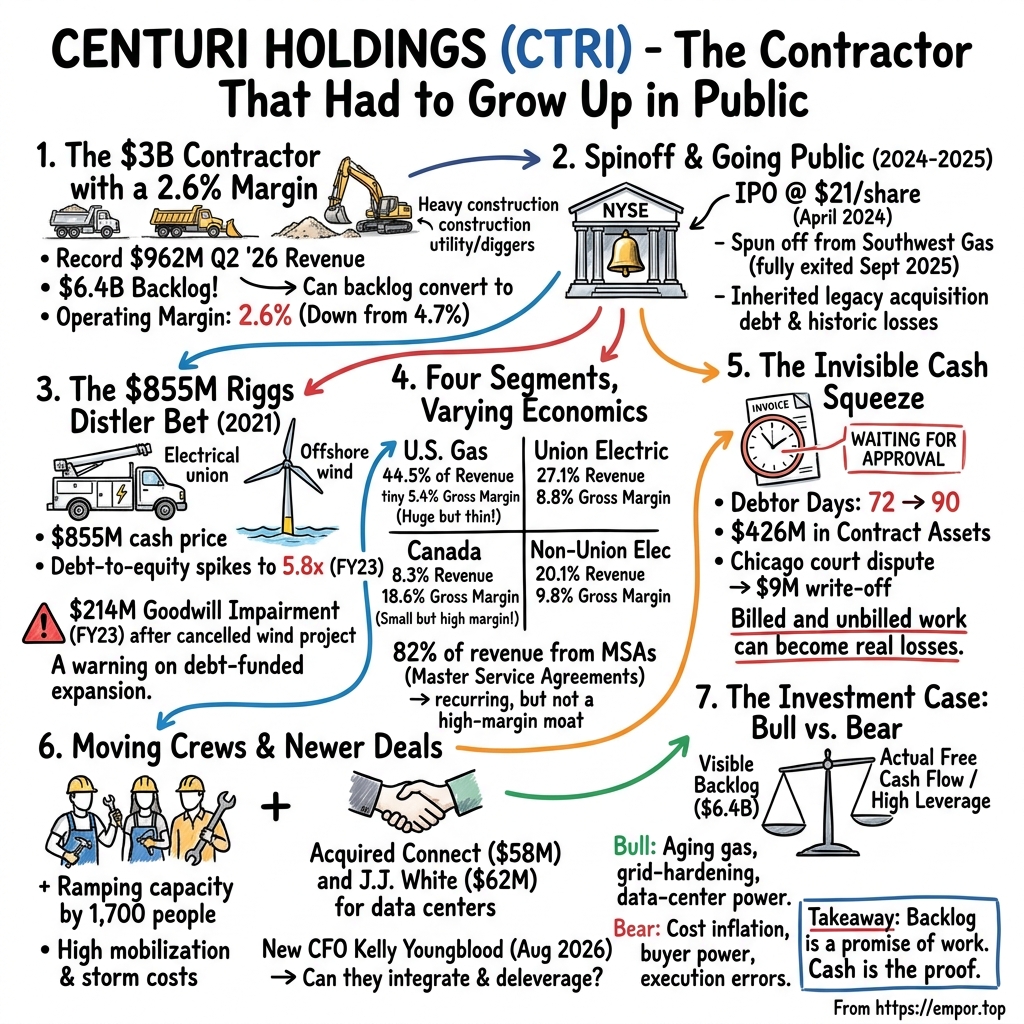
Centuri Holdings: The Contractor That Had to Grow Up in Public
I. The $3 Billion Contractor With a 2.6% Margin
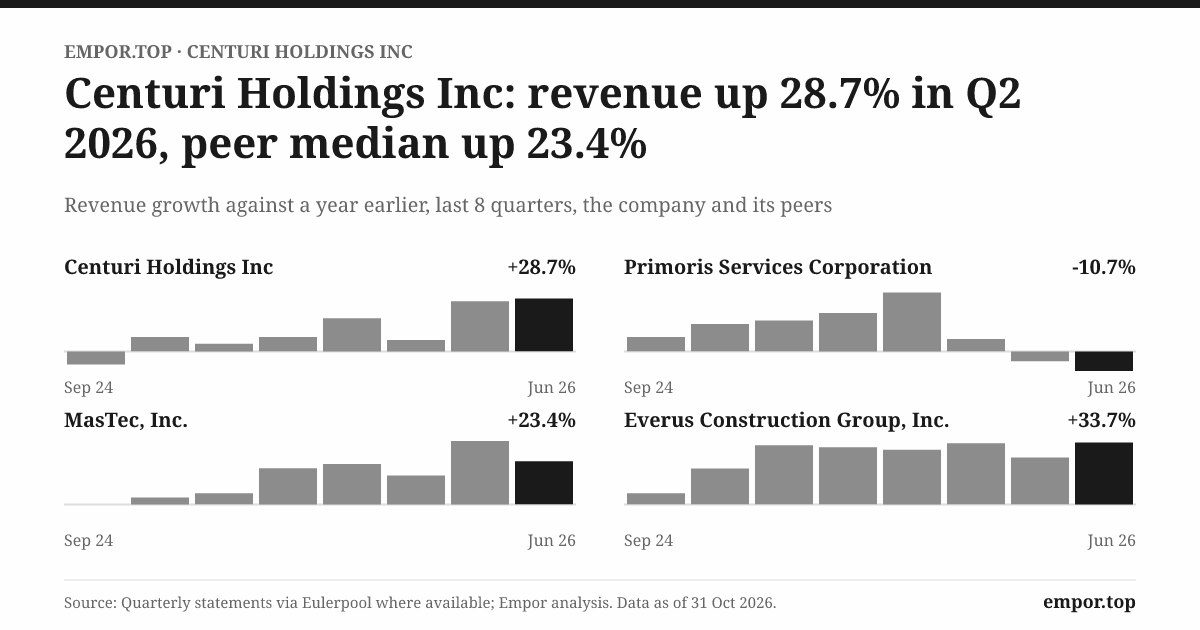
On the morning of August 4, 2026, Centuri Holdings told the market it had just had the biggest quarter in its history. Revenue for the three months to the end of June came in at about $962 million, up roughly a third on the same quarter a year earlier.1 Backlog, the contracted work still waiting to be done, stood at about $6.4 billion, 21% higher than a year before.1 Behind that sat what management called a $16 billion pipeline of opportunities it was chasing.1 Debt, measured against the company's own adjusted earnings yardstick, had fallen to 2.6 times, from 3.7 times a year earlier.1 And then came the line every contractor's investors wait for: Centuri raised its full-year guidance.1
On the earnings call that followed, chief executive Chris Brown described a company that had added about 1,700 people to its workforce in six months, roughly an 18% increase, and that was mobilizing crews into new natural-gas work across the United States.2 The demand story was not subtle. Utilities wanted their old gas pipes replaced and their electric grids hardened, data centers wanted power connections, and Centuri was being asked to show up in more places with more trucks and more people.
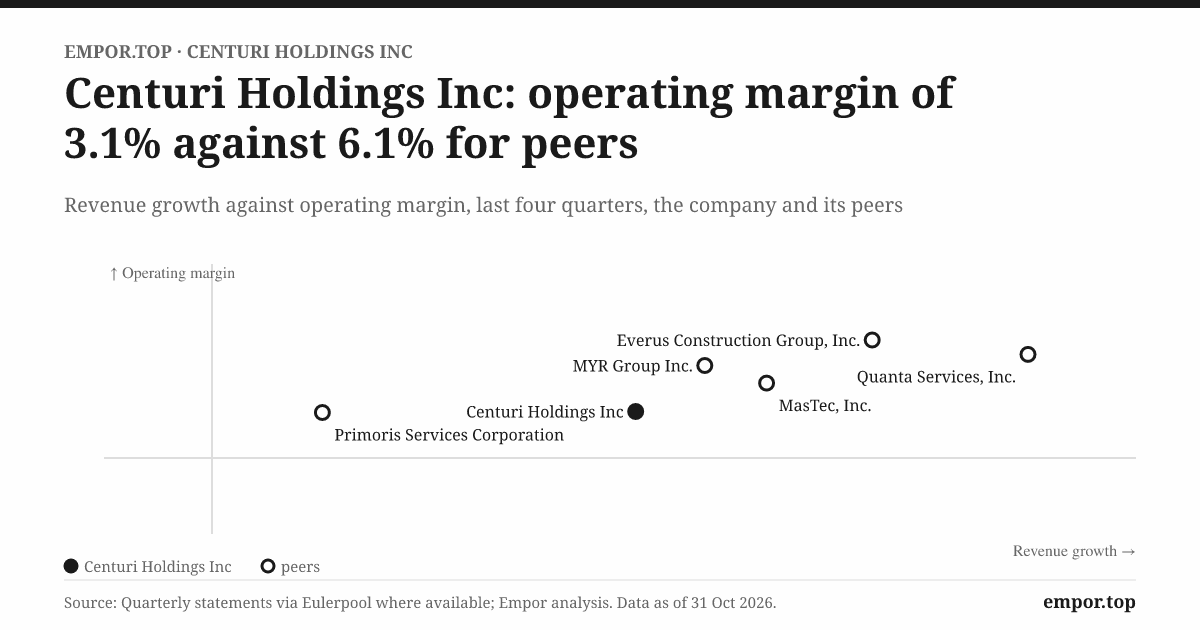
Now look at the same quarter from the other end of the income statement. Of every dollar Centuri billed in that record quarter, about two and a half cents survived as operating profit, compared with nearly five cents a year earlier.3 Net income attributable to shareholders was $6.1 million, below the $8.1 million it earned in the smaller quarter a year before.1 Revenue went up by roughly a third. Profit went down. That is the puzzle at the heart of this story, and it is the puzzle that decides whether Centuri is a growth business or merely a busy one.
Asked plainly, the question is this: what is a dollar of Centuri revenue actually worth after it has paid for the welder, the excavator, the diesel, the week of rain that kept the crew home, and the months it takes for a utility to approve the invoice? For most companies, revenue is the headline and profit is the footnote. For a utility contractor, revenue is closer to a measure of effort. The economics live in what is left after the labor, equipment, weather and collection delays have taken their share.
Before going further, it is worth being precise about which company this is. Centuri Holdings is the New York Stock Exchange-listed contractor that was spun out of Southwest Gas Holdings in 2024.4 It is not Southwest Gas Corporation, the regulated utility that delivers gas to homes in Arizona, Nevada and California. That utility remains a Centuri customer, but its rate base, its regulated returns and its customers belong to a different company with a different set of economics.4 When this story talks about Centuri's revenue, debt or workforce, it means the contractor alone.
The starting point is a company of real scale and thin returns. In fiscal 2025, Centuri generated about $3.0 billion of revenue, up about 13% on the year before.4 Its operating margin was about 3.2%.4 Net income was $22.7 million, a sliver of a cent on each dollar of sales.4 And after paying for the equipment needed to do the work, the business consumed cash rather than producing it: operating cash flow of about $78 million did not cover roughly $86 million of capital spending, leaving free cash flow of about negative $8 million.4
Those four numbers put four questions on the table, and they run through everything that follows. The first is whether growth can convert into better margins, or whether Centuri is simply buying revenue with labor. The second is whether the receivables and contract assets piling up on its balance sheet turn into cash on schedule. The third is whether the company can keep growing while it pays down the debt it inherited. The fourth is about people: whether a leadership team that has turned over quickly, in a company that separated from its parent at speed, can deliver what it promises.
None of these questions is exotic. They are the questions every investor in a construction contractor eventually learns to ask. What makes Centuri unusual is that it has had to answer them in public for barely two and a half years, after spending most of its life inside a utility holding company where nobody outside the boardroom needed to ask. To understand why the margin matters so much now, the story has to go back to the moment the contractor stepped out on its own.
 Subscribe on LinkedIn
II. A Utility Contractor Becomes a Standalone Company
In April 2024, a company most investors had never heard of rang its way onto the New York Stock Exchange under the ticker CTRI. Centuri sold about 14.3 million shares at $21 each, and at the same time Carl Icahn's investment entities bought roughly 2.6 million more shares at the same price in a private placement alongside the offering.4 The two deals together brought Centuri about $328 million of net proceeds, and almost all of it was earmarked for a single purpose: paying down debt.4 Southwest Gas Holdings, the parent that had owned the business, kept about 81% of the shares.4
That last fact explains a great deal about the company's first year as a listed entity. An IPO usually marks the moment a company raises money to grow. Centuri's IPO was closer to a parent loosening its grip on a subsidiary it no longer wanted to hold, while using new equity to repair a balance sheet that had become uncomfortably heavy. The listing changed who owned Centuri and how it could raise capital. It did not create a new business overnight.
That business had a long history before it had a ticker. Centuri's operating companies had worked for gas and electric utilities across the United States and Canada for years as part of the Southwest Gas family, building relationships with utility customers, a regional footprint and a workforce of skilled field crews.5 Those relationships are the reason Centuri exists in its current form. They are also why its historical financial statements, which describe the operating business while it sat inside a utility holding company, are an imperfect guide to how it will behave on its own. Southwest Gas allocated certain corporate costs to the contractor before separation, and the prospectus warned that those allocations might not equal what a standalone company would pay.5 The amounts were small, about $1 million to $1.6 million a year, so the distortion is modest, but the principle matters: the old record was written by a different owner with a different cost of capital.5
The public-company transition that followed was fast, even by spin-off standards. In 2025, Southwest Gas sold down its holding through secondary offerings and private placements, including sales to Icahn entities, and by August its stake was about 31%.4 On September 5, 2025, it sold the last of its shares.4 In roughly seventeen months, Centuri went from a controlled subsidiary to a company with no controlling shareholder at all.
The commercial relationship survived the divorce. Centuri still does construction work for Southwest Gas Corporation, and in fiscal 2025 that work brought in about $98 million, or 3% of revenue, down from about $116 million in 2023.4 The gross profit on it was about $6.6 million.4 So the former parent is still a customer, but a modest one, and it pays at margins that look much like the rest of the business. There is no royalty or management fee flowing back to Southwest Gas.4 For investors, the separation is clean in the way that counts: the utility's regulated economics and the proceeds of its share sales stayed with Southwest Gas, and none of them sits inside Centuri.
The leadership churn around the separation was less tidy. Chief executive William Daily retired in January 2024, months before the listing.6 His successor, William Fehrman, resigned in July 2024, barely three months after the IPO.6 Matthew Caudill ran the company on an interim basis until December 2024, when Christian Brown became chief executive.6 Three changes at the top in a single year is a lot for any company. For one simultaneously learning to report quarterly results, set guidance and court a new shareholder base, it meant the public record of "management delivering against promises" really begins with Brown.
The longer financial record is where the growth story meets its first hard test. Over the five years from fiscal 2020 to fiscal 2025, Centuri's revenue grew about 8% a year, from roughly $1.9 billion to about $3.0 billion.45 That sounds like a compounding contractor. But net profit moved the other way, shrinking at about 19% a year over the same period, from about $63 million in 2020 to $22.7 million in 2025.45 In between, the company lost money in three consecutive years, 2022, 2023 and 2024.54 Over the last three of those years, revenue growth slowed to about 1.5% a year, because 2024 revenue actually fell about 9% before rebounding.4
Put the two lines side by side and the conclusion is uncomfortable but clear. Centuri spent half a decade getting bigger without getting more profitable. Its 2025 return to a modest profit was real, but it was a return to a level well below where the business stood at the start of the decade. Whatever investors bought at $21 a share, it was not a proven compounding machine. It was a contractor with a large customer base, a heavy debt load, and a recent history of losses that needed explaining.
Most of that explanation leads to one decision, made three years before the IPO, that changed what kind of company Centuri was. It was the largest acquisition in the company's history, and it was paid for almost entirely with borrowed money.
III. The $855 Million Bet on Riggs Distler
In the summer of 2021, Centuri was best known as a gas pipeline contractor. Its crews dug trenches, replaced aging cast-iron and bare-steel mains, and connected homes to distribution networks. Electric work was a smaller part of the mix. Then, in June of that year, Southwest Gas Holdings announced that Centuri would buy Riggs Distler, a unionized electric and gas contractor with deep relationships among utilities in the Northeast and Mid-Atlantic.[^7] The deal closed in August 2021, and the price was $855 million in cash.[^8]
The strategic logic was easy to follow. Electric utilities were entering a long cycle of spending on grid hardening, storm resilience and renewable connections, and much of that work in the dense Northeast corridor was done by union crews under long-standing agreements. A contractor trying to build that position from scratch would need years to train workers, win qualifications and earn the trust of utility procurement departments. Riggs Distler came with all three. It gave Centuri a ready-made electric platform, a new regional footprint and access to a customer base it could cross-sell into.[^7]
The financing told a different story. Centuri did not have $855 million lying around, so it borrowed. In fiscal 2021, the company's investing cash outflow jumped to about $917 million, and its financing inflow to about $884 million, almost a mirror image of the purchase.5 Total borrowings rose to about $1.4 billion by the end of that year.5 For a contractor earning operating margins in the mid-single digits, that is a heavy load. Interest expense became one of the largest claims on the company's profit, and as earnings sagged in the following two years, debt grew relative to the equity cushion beneath it. By the end of 2023, Centuri's debt was about 5.8 times its shareholders' equity.5
Then came the write-down. In fiscal 2023, Centuri recorded a goodwill impairment of about $214 million.4 Goodwill is the part of an acquisition price that exceeds the value of the identifiable assets a buyer gets, essentially the premium paid for future earnings. Writing it down is an admission that those future earnings look smaller than they did on the day of purchase. In this case, the company tied the impairment to two specific causes: the cancellation of an offshore wind project and lower expected earnings at Riggs Distler.4 The fourth quarter of 2023 carried an operating loss of almost $200 million, and the full year a net loss of about $186 million.5
It is tempting to read that number as a simple verdict: Centuri overpaid. The record supports a narrower conclusion. A $214 million impairment on an $855 million purchase means that roughly a quarter of the price, in accounting terms, was judged not to be supported by the cash flows the business was expected to generate. That is meaningful evidence against the original growth-and-margin promise, especially because the cause was partly a bet on a new market, offshore wind, that did not materialize. But neither the company nor its former parent disclosed a deal-date earnings multiple, so there is no clean way to compare the price against comparable utility-contractor transactions and declare a specific overpayment. What can be said is that the acquisition was priced for a future that came in smaller than expected, and that the debt used to pay for it kept compounding regardless.
The more important question for a long-term investor is what Riggs Distler became after the write-down. Here the evidence is more encouraging. In fiscal 2025, the Union Electric segment, which is built around Riggs Distler, generated about 27% of Centuri's revenue and about 29% of its gross profit.4 On roughly $808 million of revenue, it earned about $71 million of gross profit, a margin near 8.8%, well above the company's largest segment.4 Union electric work is now a durable part of the business, and in mid-2026 Centuri chose to bolt its newest acquisition onto Riggs Distler rather than build a separate platform.7
So the honest verdict comes in two parts. Strategically, the acquisition did what it was supposed to do: it broadened Centuri beyond gas and gave it a real place in union electric services, a market that is hard to enter. Financially, it stretched the balance sheet ahead of the returns, and the impairment shows that part of the original promise did not survive contact with reality. It is one large acquisition and one material write-down, not proof that the electric platform failed. But it is the defining capital-allocation event in the company's history, and it sets the bar for every deal that came after.
The IPO proceeds, the Southwest Gas sell-down and the 2025 equity raise all chipped away at the debt this purchase created. By the end of 2025, borrowings were down to about $938 million, and the debt-to-equity ratio was about 1.1.4 And yet Centuri has since resumed buying companies. The lesson carried forward from Riggs Distler is therefore not "never acquire". It is a sharper test: do the newer deals add profitable capacity without recreating the debt burden? Answering that requires understanding what Centuri actually sells, and where in its business the profit really comes from.
IV. Four Kinds of Work, Four Different Economics
Picture a gas utility in the Midwest that needs to replace forty miles of aging distribution pipe over the next several years. It does not run a public tender for each street. Instead, it signs a master services agreement, or MSA, with a contractor like Centuri. The MSA sets the rules: prices for units of work, safety standards, insurance, payment terms. Then, week by week, the utility issues work authorizations that say which street, which block, how many feet of pipe and by when. A Centuri crew arrives with skilled labor, trucks, trenchers and fusion equipment, does the job, and gets paid as the work is completed and the utility approves it.
That is the heart of the revenue model. MSAs generally run three to seven years, and at the IPO, the weighted-average remaining term was about three years.5 Pricing can be per unit of work, time and materials, or a fixed price for a defined project.5 In fiscal 2023, the last year for which the company published the split, about 82% of revenue came from MSAs, with the rest from bid contracts, often one-off projects, some of them for the same MSA customers.5 The company has not published a more recent split.
It is worth being careful about what an MSA is and is not. It is a framework that makes Centuri a qualified, preferred vendor for a stream of work. It is not a guarantee of volume. The utility decides how many work authorizations to issue, when and where, and it can shift work between approved contractors. Think of it less like a subscription and more like a standing table reservation at a busy restaurant: it assures you a seat when you want one, but it does not oblige you to eat there every night, and it does not fix what you will order.
The demand behind those work orders is real and long-dated. Much of the American gas distribution network was built decades ago and is subject to safety and integrity rules that require replacement of older pipe. Electric utilities are spending to harden grids against storms and wildfires, to connect renewable generation and, increasingly, to supply power-hungry data centers.4 These are the drivers management cites, and they are the reason backlog has grown.41 But demand for the industry's services is not the same as pricing power for any one contractor, and that distinction runs through the rest of this story.
Centuri reports its work in four segments, and they behave very differently. In fiscal 2025, U.S. Gas contributed about 44.5% of revenue, Union Electric about 27%, Non-Union Electric about 20%, and Canadian Operations about 8%.4 If revenue were the whole story, U.S. Gas would be the company's crown jewel.
Gross profit tells another story. U.S. Gas earned about $71 million of gross profit on roughly $1.33 billion of revenue, a gross margin of about 5.4%.4 Union Electric earned the same $71 million on about $808 million of revenue, a margin of about 8.8%.4 Non-Union Electric earned about $59 million on about $599 million, nearly 10%.4 And the small Canadian business earned about $46 million on just $247 million of revenue, a margin of about 18.6%.4 Put differently, for every $100 of work a U.S. Gas crew completes, the company keeps about $5 after paying for the labor, equipment and materials on the job. For every $100 in Canada, it keeps almost $19.
That comparison reshapes how to think about the company. U.S. Gas is the largest revenue pool, but it produced under 30% of gross profit.4 U.S. Gas and Union Electric are tied as the largest absolute profit contributors. Canada is the smallest segment by revenue but, at roughly a fifth of gross profit, one of the most valuable per dollar of work. The single most important lever on Centuri's overall profitability is therefore the margin on its biggest, thinnest business. If U.S. Gas could earn even a couple of percentage points more, the whole company's economics would change. If it slips, growth there can make the whole company look busier and less profitable at the same time.
Why are the margins so different? The filings explain the mechanics more than the cause. Gas distribution work is highly seasonal, much of it outdoors in northern climates where frozen ground and storms stop work, so crews and equipment sit idle for part of the year while costs keep running.4 Management has said that one of its strategic goals is to push more gas work into warmer geographies and indoor tasks, precisely to smooth that seasonality.8 Canada's higher margins reflect a different market and mix, though the company does not break down why in detail.
Centuri describes its industry as fragmented, with many regional and local contractors competing alongside larger listed firms. It names Dycom, MYR Group, MasTec and Primoris among its public peers.4 With about $3 billion of revenue, Centuri is a scaled player, large enough to serve major utilities across North America. But the company does not publish market-share figures, and no defensible estimate of its share is available from its filings. Scale here means capacity and geographic breadth, not dominance.
Does this business have a moat? The honest answer is that the filings support only part of one. Multi-year MSAs, safety records and utility qualifications create real friction for new entrants, because a utility will not hand gas-line work to a crew it has never vetted. Long customer relationships matter. But the company does not disclose customer retention rates, bid-win rates, price increases achieved on renewal, or anything that would prove customers cannot easily move work to another qualified contractor. Without those numbers, the most defensible claim is that Centuri has privileged access to repeat work, not that it has pricing power.
The customer base sharpens that point. No single customer accounted for more than 10% of revenue in fiscal 2025, yet the top ten together accounted for 48%, and the top twenty for 65%.4 In the first half of 2026, one Non-Union Electric customer, which Centuri does not name, generated about $187 million of revenue, or 11% of the total.3 At the end of June 2026, that same customer accounted for about $151 million, or 20%, of Centuri's receivables and contract assets.3 Large, sophisticated utility buyers who multi-source their work and who represent a big share of what a contractor is owed hold a strong hand at the bargaining table.
Which brings the story to the question the segment numbers leave hanging. If the work is contracted, the demand is strong and the customers are utilities with investment-grade balance sheets, why did Centuri's margin fall exactly as its revenue surged?
V. The Crews Arrive Before the Margin Does
Building a pipeline crew is not like adding a server to a data center. Each new crew needs a foreman who knows the utility's safety rules, operators qualified on fusion and welding equipment, laborers, trucks, an excavator, a trailer, and enough work in one area to keep them busy. Before that crew earns a dollar of margin, Centuri has to recruit, train, equip and move it. In the first half of 2026, the company did this on a scale it had not attempted before.
On the second-quarter call, Brown said Centuri had added about 1,700 people since the start of the year, roughly an 18% increase in its workforce, with about 1,200 of them in gas operations, a 25% increase in that part of the business.2 At the end of fiscal 2025, Centuri had reported about 9,700 full-time-equivalent employees.4 Adding a fifth to that base in six months is a dramatic bet that the work will be there to absorb it. The backlog suggests it will: U.S. Gas revenue in the second quarter rose about 45% year on year, to roughly $490 million.1
Here, though, is where the margin went. U.S. Gas earned a gross margin of about 4.2% in the second quarter, or about 5.9% after stripping out the Chicago write-down that is the subject of the next chapter.1 Across the whole company, base gross margin, management's measure that excludes storm work and one-off items, fell to about 7.9% from about 8.9% a year earlier.1 Management attributed the drop to two specific costs. Higher fuel prices, which Brown tied to the conflict in the Middle East, cost about $6 million in the quarter, with fuel per gallon up nearly half on the year.12 Mobilizing and ramping up the new gas crews cost about $3 million more.1 Together, the company said, those two items took roughly 95 basis points, nearly a full percentage point, off base gross margin.1
That decomposition matters because it accounts for most, though not all, of the decline. At the Morgan Stanley Laguna conference in September, Brown named a third headwind: a change in how Centuri finances its fleet, which he put at about $9 million in the second quarter.9 Severe weather also affected work timing earlier in the year.3 So the margin squeeze has identifiable causes. The question is whether those causes are temporary.
Some of them plausibly are. Fuel prices move both ways, and mobilization costs are by nature one-off: once a crew is trained and working, it should earn the same margin as any other. Brown told the Laguna audience that productivity among new hires had "normalized" by early in the third quarter, and that U.S. Gas was "trending very nicely above" the 7.5% gross margin the company had committed to for the second half.9 He also said the company's underlying incremental margin on new work was about 11.6% in the first half, against a target of 12% to 15%.9 If those claims hold, the second quarter would look like the cost of building capacity rather than a sign that new work is unprofitable.
But the longer record counsels caution. U.S. Gas earned a 5.4% gross margin in fiscal 2025, slightly down from 5.5% the year before, after weather-related stoppages and delays early in the year were only partly offset by later workforce improvements.4 That is, the segment was not on a clear upward path before the hiring surge began. The 7.5% second-half target would be a meaningful step above anything U.S. Gas has delivered in the recent past. Management's explanation of the squeeze is coherent, and on the second-quarter call it was more quantified than most: it put numbers on fuel, mobilization and the expected second-half margin.2 Yet when Baird analyst Justin Hauke pressed on whether the acquired and newly added revenue implied essentially zero incremental margin, Brown answered qualitatively rather than walking through the bridge.2 The squeeze is explained; the payoff is still a forecast.
The way Centuri reinvests adds a subtler wrinkle. This is not a business with a research budget. Its reinvestment is physical: vehicles, heavy equipment, tools and the people who use them. Capital expenditure was about $99 million in fiscal 2024, or 3.8% of revenue, and about $86 million in 2025, or 2.9%.4 At first glance, a falling capex ratio during a period of growth looks like efficiency. The fourth-quarter call revealed something more interesting. Centuri's total fleet investment in 2025 was about $135 million, but only about $42 million of it was net capex. The rest came from about $55 million of operating leases and $38 million of sale-leasebacks.8 For 2026, management planned $150 million to $180 million of fleet investment, split roughly evenly between buying and leasing.8
That shift has real consequences for how the numbers look. Leasing a truck instead of buying it lowers capex and flatters free cash flow in the near term, but it adds a recurring lease payment that shows up in operating costs, and part of it shows up as a lease liability on the balance sheet. At the end of June 2026, Centuri carried about $198 million of operating lease liabilities on top of its borrowings.3 Brown argued at Laguna that the 50-50 mix improved the company's ability to generate cash, and on the second-quarter call management put the leasing drag at roughly 55 basis points of margin.92 Neither claim is unreasonable. But it means that a lower capex bill is not purely a sign of efficiency; it is partly a choice to pay for equipment through the income statement rather than up front. When management lowered its 2026 net capex guidance from $75–90 million in February to $60–75 million in August, part of the change reflected that same financing choice.81
Put the backlog next to these figures and the distinction between the work opportunity and the profit opportunity becomes sharp. A $6.4 billion backlog says utilities have committed to give Centuri a lot of work. A $16 billion pipeline says there is much more Centuri hopes to win. Neither says what margin the work will earn, or how quickly the customer will pay. Brown said on the second-quarter call that more than $3.6 billion of 2027 revenue was already covered, about 20% more than at the same point a year earlier.2 That is a strong demand signal. It is not a profit signal.
Management's own guidance trajectory gives a partial read on how well it understands this gap. In February 2026, the company guided to base gross profit of $255 million to $285 million and adjusted EBITDA of $280 million to $310 million.8 By August, base revenue guidance had jumped by about $350 million at both ends, to $3.5–3.7 billion, while base gross profit guidance rose by a smaller amount, to $270–290 million, and the adjusted EBITDA range moved only at the bottom, to $285–310 million.1 Revenue expectations climbed far faster than profit expectations. That is consistent with management's story of costly ramp-up, and also with the bear case that growth is coming at lower incremental returns.
So the near-term proof point is specific: gross margin by segment once the new crews are fully deployed, especially in U.S. Gas, and whether the second half of 2026 actually delivers the roughly 9% base gross margin and 7.5% U.S. Gas margin management promised.29 Margin, though, is only half of the conversion problem. The other half is whether completed work turns into cash, and Centuri received a costly reminder of that risk in the same quarter.
VI. The Receivable That Became a $9 Million Loss
The work in Chicago had been finished years earlier. Before 2020, a Centuri business performed contract work for the City of Chicago, and when the time came to be paid, the City withheld payment. Centuri filed an administrative claim. The City denied it.4 For years, the money sat on Centuri's balance sheet as receivables and contract assets, amounts the company believed it was owed and expected eventually to collect.
On April 20, 2026, the Circuit Court of Cook County, Illinois, issued an opinion and order that went against Centuri.1 In the second quarter, the company wrote down all of its remaining receivables and contract assets related to the pre-2020 Chicago work, which reduced U.S. Gas revenue by about $9 million.1 After the write-down, no Chicago amounts remained on its books.1 Management excluded the charge from its "base" figures and said it would not affect 2026 cash-flow expectations, which makes sense because the cash had never arrived in the first place.1
In a $3 billion company, $9 million is not a crisis. Its importance is what it demonstrates. Work that has been performed and recorded as revenue can, years later, turn out never to be paid for. The Chicago dispute is a closed case now. But it is a concrete example of a risk that sits across Centuri's entire balance sheet, and it raises a question that is genuinely open: how much of what Centuri says it is owed today will actually be collected, and when?
To answer that, it helps to understand contract assets. In plain terms, a contract asset is work Centuri has done but cannot yet bill. Some contracts let the company invoice only when a milestone is reached; others require the customer to approve a change in scope before the extra work can be billed. In the meantime, the company records revenue for the work and carries the unbilled amount as an asset. It is a promise of a future invoice, which is itself a promise of future cash.
In fiscal 2025, those promises piled up. Contract assets rose by about $164 million in a single year, to about $426 million, compared with about $262 million at the end of 2024.4 About $48 million of that total related to recovery claims and unapproved change orders, amounts the customer has not yet agreed to pay.4 Gross trade receivables, money already invoiced, were about $315 million.4 On the cash-flow statement, the growth in receivables and contract assets consumed about $174 million of cash in 2025, only partly offset by about $61 million of help from paying suppliers more slowly and about $20 million from customer prepayments.4
A useful way to see the trend is to ask how many days of sales are waiting to be collected. By that measure, Centuri's receivables represented about 72 days of revenue at the end of 2024 and about 90 days at the end of 2025.4 Almost three extra weeks of revenue were tied up in the balance sheet. Some of that reflects real growth, since a business that expands quickly in the second half of the year will naturally carry more receivables at year end. But the direction was the wrong one for a company whose investment case depends on cash conversion.
Next to that build-up, the reserve Centuri held against bad debts looks strikingly small. The allowance for credit losses on trade receivables was about $2.7 million at the end of 2024. At the end of 2025, it was $37,000.4 That is not a typo: on more than $300 million of receivables, the company reserved less than the price of a pickup truck. Centuri describes its method, which considers customer credit quality and historical experience, and most of its customers are large utilities that rarely default.4 But the company does not publish an aging table showing how long its receivables and contract assets have been outstanding. Without one, outside investors cannot test whether the near-zero allowance is a reflection of high-quality customers or of optimistic judgment. The Chicago write-off happened through revenue rather than through the allowance, which shows that collection risk in this business often lives in disputed contract terms rather than in customer insolvency.
The concentration makes the question pointed. At the end of June 2026, the single Non-Union Electric customer that generated 11% of first-half revenue accounted for about $151 million, or 20%, of Centuri's receivables and contract assets, up from about $132 million, or 19%, at the end of 2025.3 Centuri does not name the customer. A large regulated utility is unlikely to fail to pay. But one fifth of everything the company is owed now rests with one counterparty, and that counterparty's billing approvals and payment timing have an outsized effect on Centuri's cash flow in any given quarter.
There is a financing wrinkle that makes the picture harder to read. In September 2024, Centuri set up a $125 million receivables securitization. Under it, the company sells receivables to a facility and removes them from its balance sheet in exchange for immediate cash.4 At the end of 2025, the full $125 million was in use, and the company paid about $7 million in fees on the facility during the year.4 This is a legitimate and common liquidity tool. But it means that the receivables on Centuri's balance sheet are lower than they would otherwise be, and that cash flows from working capital are not directly comparable to the years before the facility existed. Days-receivable of 90 would look worse still if those sold receivables were added back.
The cash results show why all of this matters. In the first half of 2026, Centuri's operating cash flow was negative $15 million, while it spent about $48 million on capex.1 Cash on hand fell to about $40 million by the end of June.1 Some of that is seasonal; contractors typically consume cash in the first half and collect in the second. At Laguna, new chief financial officer Kelly Youngblood laid out the conversion story in management's own terms: cash generation of about $36 million in 2025, roughly 14% of adjusted EBITDA; guidance of more than $75 million in 2026, about 25%; and a target of 40% to 50% conversion from 2027 to 2029.9 Those targets are admirably specific. They also imply that, by management's own measure, Centuri has been converting a small fraction of its earnings into cash, and that the improvement is still ahead.
The forward proof point is simple to state and hard to fake: what happens to the June 2026 balances. If the concentrated customer's receivables are collected, contract assets fall back as milestones are reached, and days-receivable retreat from 90, the Chicago case will look like an old, isolated dispute. If those balances keep growing faster than revenue, the case that Centuri's growth is turning into cash will weaken. Watching that conversion is now the job of an executive who arrived just eight days after the quarterly report, in a leadership shake-up that capped two years of change at the top.
VII. From the Southwest Parent to Icahn and a New CFO
On August 12, 2026, Centuri announced that Kelly Youngblood had become its executive vice president and chief financial officer, replacing Gregory Izenstark.10 On the same day, Danielle Hunter became chief legal and administrative officer, replacing Jason Wilcock.10 The filing gave no reason for either departure; it said only that both men would receive the severance due to them under their existing agreements for a termination without cause.10 Eight days after Izenstark had presented record results and raised guidance on the earnings call, he was gone.
Youngblood brought a résumé built in the hard school of energy-services cycles. A certified public accountant who studied accounting at Cameron University, he spent years at Halliburton in finance and accounting roles, including leading investor relations, then served as chief financial officer of Diamond Offshore Drilling, of BJ Services, and, from 2020 to 2025, of MRC Global, the pipe and valve distributor, until its acquisition by DNOW.10 That is a career spent inside capital-intensive, cyclical businesses where working capital and leverage decide who survives a downturn, which is exactly the discipline Centuri's case now depends on. Hunter came from Berry Corporation, where she had been president until its sale in late 2025, and earlier from C&J Energy Services and Vinson & Elkins.10 Youngblood's employment agreement placed him in the company's Houston office, with a base salary of $680,000, a target bonus of 85% of salary, and sign-on restricted stock worth about $2 million.10
The person he reports to has been in the job for less than two years. Christian Brown became chief executive in December 2024, after the run of departures that followed the IPO.6 On calls, Brown presents as an operator with a plan and a vocabulary to match. At Laguna, he framed his strategy as "Vision One Centuri," with three strands: protecting and deepening the core, expanding the portfolio, and integrating the business.9 He set out ambitious multi-year goals: at least 10% organic growth a year over five years, and base gross margin moving toward 10%.9 He talks about fleet efficiency, about seasonality as a problem to be engineered away over three years, and about a staffing model he described as a strong predictive tool for matching crews to work by skill, craft and union status.89 Whether that operating style produces results is the open question; the style itself is concrete rather than vague, which is a point in its favor.
Brown's pay reflects both his short tenure and the turnaround he has overseen. His reported total compensation was about $4.27 million in fiscal 2025, much of it stock awards and annual incentives, compared with about $2.08 million in his partial 2024, which included a $500,000 sign-on bonus.6 Over the same period, Centuri returned to profit.64 Pay rose as results improved, which is how incentive plans are supposed to work. The fairer test, though, is whether the measures that trigger those incentives reward the things that matter most for shareholders: operating margin, cash flow and leverage, rather than revenue or adjusted figures alone. The 2025 profit was real, but free cash flow was negative, and management's own conversion figure for 2025 was only about 14% of adjusted EBITDA.9
Ownership is where Centuri's post-separation structure looks most different from its past. With Southwest Gas gone, there is no controlling shareholder. As of March 2026, the largest holder was Icahn Enterprises, with about 14.2%, followed by Vanguard at about 7.9% and FMR at about 5.0%.6 Directors and executive officers together owned about 335,000 shares, less than 1% of the company.6 No director or executive had pledged shares.6
The Icahn position deserves a moment of attention. Icahn entities invested alongside the IPO, bought shares from Southwest Gas during its sell-down, and bought new shares directly from Centuri in November 2025.4 Carl Icahn is famous for agitating when he believes management is not maximizing value, but a 14% holder in a company with no other controlling shareholder can also be a stabilizing presence. Its presence at the top of the register means the board answers to an investor with both the resources and the history to push hard if results disappoint. Executives, meanwhile, own very little stock outright, so their alignment with shareholders runs mainly through equity awards rather than personal capital at risk.
The 2026 annual meeting offered a modest signal of investor sentiment. Shareholders approved executive pay overwhelmingly, with about 81.7 million votes for and fewer than 1 million against.11 But director Anne Mariucci received about 16.9 million withheld votes against about 65.8 million for, a protest of roughly a fifth of votes cast.11 That is not a revolt, and the company did not explain it. It is a reminder that some shareholders are watching the board closely. Seven of the nine directors were described as independent, with Brown and Karen Haller, then a Southwest Gas executive, the exceptions.6
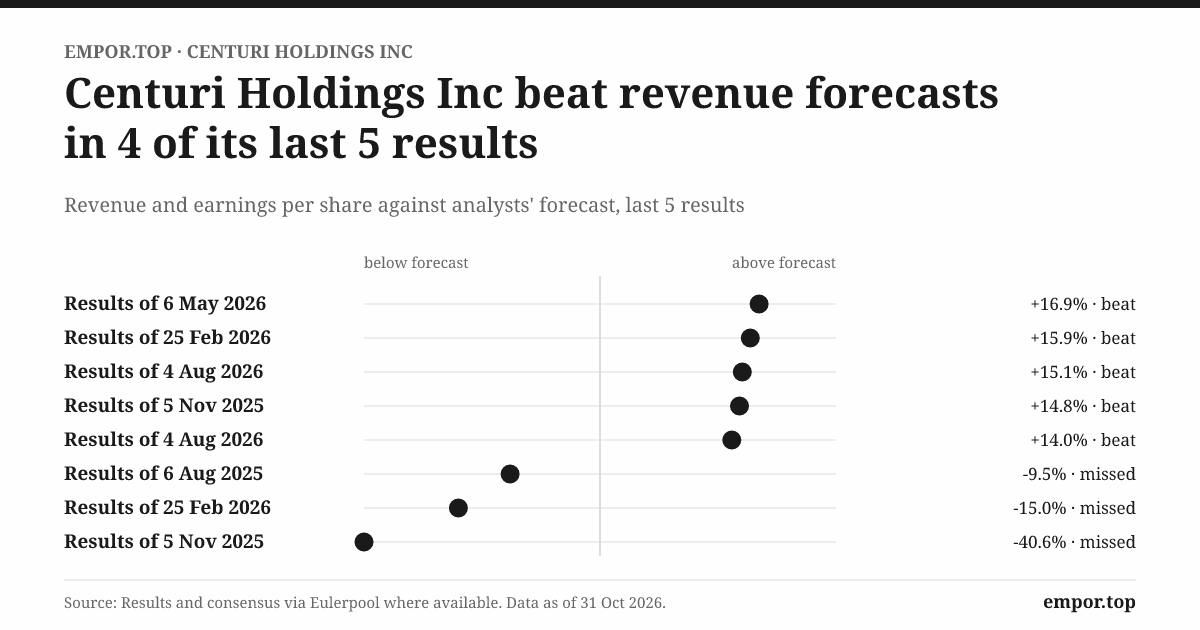
The credibility record itself is short, and mixed in an informative way. On the positive side, Brown's team returned the company to profit in 2025, reduced leverage from 3.6 times to 2.5 times over that year, and raised 2026 guidance in August rather than cutting it.81 The explanation for the second-quarter margin squeeze was consistent across the results release, the call and the Laguna conference: fuel, mobilization and fleet changes, each with a number attached.129 On the other side, management admitted in February that data-center wins in early 2026 had been slower than expected, and the hard financial targets that matter most, cash conversion and margin expansion, remain promises about the future.8 Youngblood has inherited guidance he did not set. His first full year will show whether the new finance team keeps those commitments or resets them.
The judgment, then, has to stay at the right scale. Centuri has an experienced chief executive with a clear operational agenda and a new CFO whose background suits the job. Its public-company history is short, insider ownership is low, and its leadership has changed substantially since the IPO. Its return to modest profit has yet to produce free cash flow. Credibility here will be earned in the coming reporting periods: whether the 2026 guidance is met, whether the explanations for margin pressure remain consistent, and whether the cash targets start to arrive. Meanwhile, the same team has gone back to doing something that once cost the company dearly. It has started buying businesses again.
VIII. Connect and J.J. White: Buying More Work Again
In November 2025, Centuri bought Connect Atlantic Utility Services, an electric-services business in Atlantic Canada, for about $58 million in cash.48 The company paid for it in an unusual way for a contractor that had spent years deleveraging: it issued new shares. In a concurrent offering that month, Centuri sold about $75 million of stock to Icahn-affiliated investors, and management later said about $58 million of the equity proceeds went to fund Connect, with the rest helping to repay borrowings.48 In other words, the first acquisition of the post-separation era was paid for with shareholder capital rather than debt, which is exactly the opposite of how the Riggs Distler deal was financed.
Eight months later, Centuri went shopping again, this time in Philadelphia. On July 20, 2026, it closed the purchase of J.J. White, a union industrial and electrical contractor founded in 1920.79 J.J. White brought nearly 1,000 employees, more than 950 of them union field workers, and a mix of mechanical, electrical, HVAC, power generation, industrial maintenance and data-center work.7 Centuri folded it into Riggs Distler, its existing union electric platform, extending that business across the Northeast and Midwest.7 The cash price was about $62 million, paid from existing balance-sheet liquidity.12
The two deals have different purposes. Connect is small, geographic and Canadian. It fits into Canadian Operations, which already earns the company's highest margins, and adds electric capability in a region where Centuri had less presence. In the first half of 2026, Connect contributed about $45.5 million of revenue, but the company described its contribution to earnings as not material.3 Brown nevertheless called it "one of the best deals we have done" at Laguna and said integration had gone very well.9 One audit detail is worth noting: Connect was excluded from the assessment of internal controls in the 2025 annual report, a standard exemption for recently acquired businesses that meant its controls were not included in Centuri's 2025 assessment.4
J.J. White is more strategic. It brings exactly the kind of work Centuri wants more of: union electric jobs in dense industrial markets, and exposure to the data-center construction boom. At the time of the deal, it carried about $315 million of contracted backlog and, by Centuri's estimate, an opportunity pipeline of about $2.8 billion.7 Management said it expected J.J. White to contribute more than $20 million of annual gross profit, at margins consistent with the rest of Centuri.7 Brown said on the call that the company did not expect cost synergies from the deal; the bet is on revenue and capability, not on cutting overhead.2
The deal math is tempting, so it is worth doing carefully. A $62 million price against more than $20 million of expected annual gross profit means Centuri paid less than about 3.1 times that gross profit. On the surface, that looks inexpensive. But gross profit is not the cash a business throws off. From that $20 million, J.J. White still has to cover its share of corporate overhead, the equipment it needs to replace, the working capital tied up in its receivables and contract assets, and any integration costs. The company has not disclosed J.J. White's EBITDA or cash flow, so there is no way to translate the gross-profit figure into a true earnings multiple. The honest summary is that the price appears reasonable relative to the gross profit management expects, and that management's expectation is the only basis for the comparison.
Set against the Riggs Distler purchase, both deals look like a company that learned something. Each is under a tenth of Riggs Distler's price. One was funded with equity, the other with existing liquidity. Neither carries an exotic bet comparable to the offshore wind project that helped trigger the 2023 impairment. On the Laguna stage, Brown said future acquisitions would be "similar in size, similar in quality," complementing the electric business, and Youngblood placed bolt-on M&A third in the order of priorities, behind funding organic growth and reducing leverage.9 That is the language of discipline. It is also language that cannot yet be tested against outcomes, because neither deal has been owned long enough to show what it earns.
History narrows the claim rather than refuting it. The Riggs Distler record shows that acquisitions in this industry can expand capability and still disappoint on returns. It does not show that smaller, cheaper deals will fail. What it does is raise the bar of proof: an acquisition creates value only if the gross profit management projects turns into incremental free cash flow after all the costs a gross-profit number leaves out. When analysts on the second-quarter call pressed on how much of the raised guidance came from acquired revenue and at what margin, management's answers were more general than precise.2
A skeptical investor would put the challenge bluntly. Centuri is now growing on four fronts at once: organic hiring, new gas mobilizations, a Canadian acquisition and a Philadelphia acquisition. Its backlog and announced pipelines are expanding fast. Its free cash flow was negative last year. Are acquisition announcements and backlog growing faster than returns? The answer will come from a few lines in the next several reports: revenue and gross profit from the acquired businesses, integration costs, net leverage and free cash flow. If those numbers move together in the right direction, the post-Riggs acquisition strategy will have proved itself. If acquired revenue keeps rising while cash conversion lags, investors will have seen this pattern before. That tension, between a business that can clearly win work and one that has not yet proved it can earn an attractive return on it, is the heart of the investment case.
IX. The Case for a Contractor With a Thin Moat
Put two documents on a table. On the left is a multi-year master services agreement with a large utility; on the right is the $6.4 billion backlog figure from the second quarter. Together, they make a powerful argument about visibility. Centuri has more certainty than most businesses about what work it will be doing next year. The question an investor has to answer is how much of that visibility becomes profitable, collected work, and whether anything protects Centuri's share of it.
Start with the bull case, because it is a real one. Demand for Centuri's services is supported by forces that do not depend on the economic cycle: regulators require utilities to replace aging gas pipe, electric utilities must harden grids against storms and wildfires, and the build-out of data centers is creating new demand for power connections.4 Centuri's established utility relationships support that position.4 Its backlog has grown sharply, its 2027 revenue is substantially covered already, and its data-center work has grown from a small base to about $400 million of booked work by September, with Brown saying it would probably stay below 10% of total revenue.29 If new crews reach full productivity and the U.S. Gas margin moves toward management's targets, the company's gross profit could grow faster than revenue, and the acquisitions could add complementary electric and industrial work. In that scenario, a business earning about 3% operating margins could see that figure climb meaningfully, and the leverage inherited from the Riggs Distler era would keep falling.
The bear case is equally concrete. Revenue can grow without margin growth, as the second quarter of 2026 showed. Cash conversion and contract disputes remain risks, as 2025 and the Chicago case showed. Low free cash flow and remaining leverage can limit how much the company invests in equipment and acquisitions. None of these risks requires a recession. They are built into the way the work is done.
The structure of the industry explains why. Run it through Michael Porter's five forces and the picture is one of a business that sits in a demanding position. Buyer power is high: utilities are large, sophisticated purchasers that multi-source their work, and Centuri's top ten customers accounted for nearly half its 2025 revenue.4 The threat of new entrants is moderated by the need for safety records, qualifications and union relationships, but the market remains fragmented, with many regional and local contractors that can bid for work.4 Rivalry is real, with large public peers such as MasTec, Primoris, MYR Group and Dycom competing for adjacent work.4 The threat of substitutes is low, because pipes and power lines have to be built and maintained by someone. Supplier power shows up mainly in the cost of skilled labor, fuel and equipment; the recent hiring surge illustrates how tight that labor market can be.2 The industry's demand is strong, but its profits are contested from several directions.
Hamilton Helmer's seven powers framework is even more revealing. Scale economies exist in a limited form: Centuri's size lets it serve large utilities across multiple regions and spread overhead, but the work is local and labor-driven, so scale does not translate into dramatically lower unit costs. Switching costs are modest; a utility can move work authorizations between approved contractors without much friction, and Centuri does not publish retention or renewal rates that would prove otherwise. There is no network effect, no brand that commands a price premium with procurement departments, and no proprietary technology. Counter-positioning does not apply. The strongest candidate is a cornered resource of a sort: qualified, unionized crews and long-standing customer qualifications in regions such as the Northeast, which are hard to replicate quickly. Process power, the possibility that Centuri's operating methods let it execute more efficiently than rivals, is what management is trying to build with its fleet and staffing initiatives, but the margins have not yet shown it.
The evidence therefore supports a credible demand position, not a proven moat. Centuri's advantages are real but conditional: long relationships, qualified crews and a broad footprint give it access to work, and the record shows customers keep giving it more. What the record does not show is that it can raise prices, lower costs relative to peers, or prevent customers from moving work elsewhere. The company does not disclose retention, bid-win rates or price realization, and the 2025 U.S. Gas margin, which slipped despite strong demand, is the closest thing to a test of pricing power the filings provide. It suggests that strong demand has not yet translated into better terms.
Credit analysts reached a similar conclusion from a different angle. In June 2025, S&P affirmed Centuri's B+ issuer rating with a stable outlook, citing grid-resiliency spending, MSA visibility and investment-grade utility customers as strengths, but also pointing to leverage of around 4 times and sensitivity to free cash flow.12 Moody's, at around the same time, likewise credited the long-term MSAs and utility customer base while flagging modest scale, customer concentration, inconsistent free cash flow and a limited standalone track record.[^15] In March 2026, S&P assigned a BB- rating with a positive outlook to Centuri's $616 million term loan, with adjusted leverage expected near 4 times in 2026 and improving to the high 3s in 2027, according to a report.13 That later action, as reported, points to improving credit, but the core message from both agencies has been consistent: good customers, thin cash.
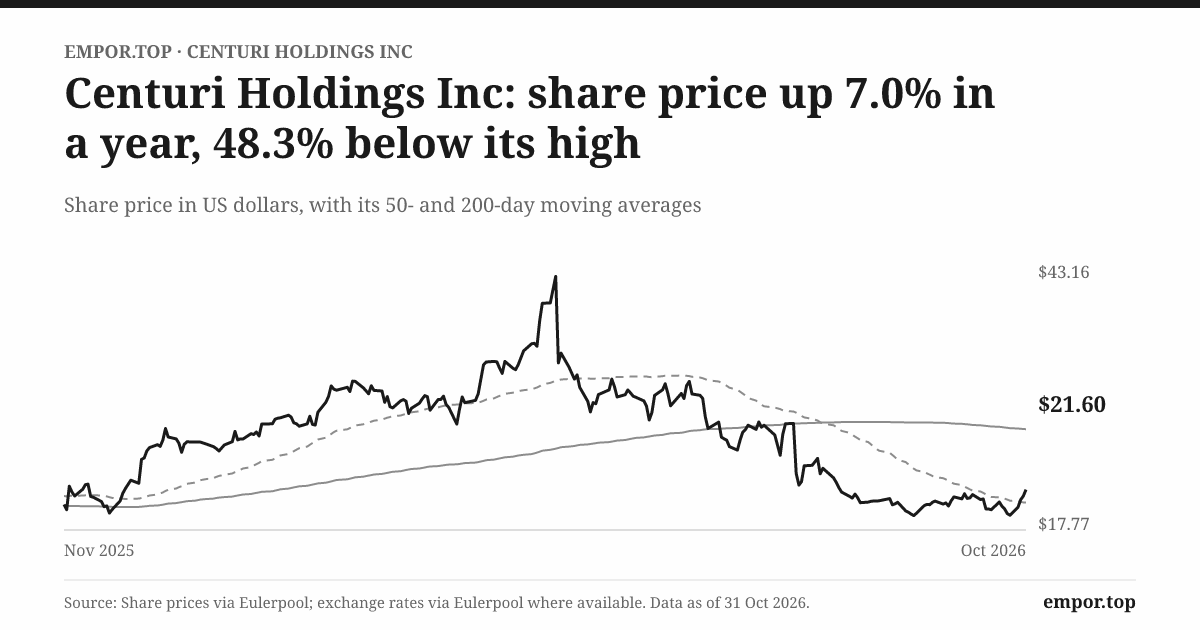
The stock market has delivered a harsher verdict on the timing. As of October 31, 2026, Centuri's shares stood at about $21.60, barely above the $21 IPO price two and a half years earlier and nearly half below their 52-week high of about $41.80.14 The company's market value was about $2.0 billion and its enterprise value, including debt, about $2.8 billion. That enterprise value was about 11 times trailing EBITDA and less than one times annual revenue, while the price-to-earnings ratio was almost 89 times, on trailing earnings of only $0.31 a share.143 The high P/E is less a sign of exuberance than of how thin the earnings are: when net margin is under 1%, even a modest share price looks expensive against profit. With only about two and a half years of trading history, there is no five-year record of how the market has valued Centuri through a full cycle.
What the price appears to assume is a middle path. At about 11 times EBITDA, the market is not paying for a business it expects to stagnate, but neither is it paying for one it believes will reliably convert growth into cash. A sharp move in either direction would likely require evidence on the same few measures. The first is whether U.S. Gas margins recover as management promised.41 The second is cash conversion through receivables and contract assets.4 The third is net leverage alongside free cash flow.14 Those three numbers will decide whether Centuri's thin moat is thin enough to matter.
X. Business & Investing Lessons
Go back to two moments in this story. In August 2021, Centuri paid $855 million in borrowed money for Riggs Distler, and two years later wrote off $214 million of what it had paid. In April 2026, a court in Cook County ruled against Centuri in a dispute over work completed years earlier, and the company erased $9 million of revenue from its books. One was a bet on the future. The other was a bill from the past. Together they explain why Centuri's investment case cannot be settled by the size of its backlog.
The first lesson is this: a contract is a promise of work; cash is proof the work paid. Centuri's MSAs, backlog and pipeline are evidence of demand, but the Chicago dispute and the 2025 rise in contract assets show the gap between booked revenue and cash. For founders, a signed agreement is the beginning of a negotiation over timing and scope, not the end. For investors, the line to watch is where revenue turns into cash, not where it is booked.
The second lesson: scale can open a new market and still leave you with the wrong price. Riggs Distler gave Centuri a real position in union electric services, but the later impairment and debt burden showed the strategic logic and financial outcome could diverge. Capability bought at the wrong price, with the wrong financing, can be the right business and the wrong investment at once.
The third lesson: when labor and equipment arrive before the margin, execution is the investment thesis. The 2026 hiring and mobilization surge showed that demand appears sufficient to absorb the crews, but the work still has to be executed well, again and again, at the price agreed. In a contractor, there is no product that sells itself once built.
And there is a fourth lesson, specific to companies that leave a corporate parent: a spin-off inherits its history and must then earn its future. Centuri walked out of Southwest Gas with relationships, crews and acquisition debt, then lost two chief executives in a year before finding a third. Its leaders did not choose the starting point, but investors judge them from it. That is why every quarter since the IPO has carried more weight than usual, and why the next ones will too.
XI. Epilogue
Tonight, Kelly Youngblood, working from the company's Houston office, is the chief financial officer of a company that is bigger, busier and more indebted to its own promises than at any point in its history. Backlog stood at about $6.4 billion at the end of June.1 The workforce had grown by about 1,700 people in six months.2 Two acquisitions were still being absorbed. And the covenant in Centuri's revolving credit facility, which had allowed leverage of up to 4.5 times through September 2026, has now tightened to a maximum of 4.0 times.3 At 2.6 times in June, the company had room to spare, but the margin for error is narrower than it was.1
The next moments that will decide this story are already on the calendar. The first is the remainder of fiscal 2026. Management committed to a base gross margin of about 9% in the second half, a U.S. Gas margin of around 7.5%, and year-end leverage of about 2 times.29 Youngblood told the Laguna audience the company was trying to get to "around 2x or so" by year end.9 If those numbers arrive, the second-quarter squeeze will look like the cost of building capacity, and the four questions that opened this story will have their first positive answers. If U.S. Gas margins stall again, the case that Centuri can turn growth into profit will weaken, whatever the backlog says.
The second moment is the cash. Management has guided to more than $75 million of cash generation in 2026, and to 40% to 50% conversion of adjusted EBITDA into cash from 2027 to 2029.9 The proof will come in the receivables and contract assets that ballooned in 2025, and especially in the balances owed by the single customer that accounted for a fifth of them in June. If days-receivable fall back from 90 and the concentrated balance shrinks, the Chicago write-down will look like an old dispute. If they rise further, the balance sheet will be telling a different story from the income statement.
The third is the acquisitions. Connect and J.J. White are small enough that neither can sink the company, but large enough to test whether management has learned the Riggs Distler lesson. Investors will want to see J.J. White deliver the more than $20 million of annual gross profit management described, and Connect move from immaterial earnings to a visible contribution, without another impairment and without pushing leverage back up.
None of these outcomes is certain, and each points to the same underlying question. Centuri's near-term strategy is understandable: grow with its utility customers, build crews ahead of the work, buy complementary businesses carefully, and reduce leverage along the way. Whether that strategy earns a return above the company's cost of capital remains to be demonstrated, and the next several reports will begin to show which way it is going.
XII. Outro
Somewhere tonight, a Centuri crew is packing up at the end of a shift. A trench has been filled, a new length of plastic gas main is in the ground, a meter has been reconnected. The work is visible, and it is real. But the story of that job is not finished when the crew drives away. Somewhere in a utility's accounts-payable department, an invoice is waiting for approval. Somewhere in Centuri's ledgers, the job is still waiting to become cash. Whether that job made money depends on what happens after the trucks leave.
That is the gap at the center of Centuri: between a full backlog and a full cash register. The contractor that had to grow up in public has proved it can win work. It has not yet proved it can keep enough of what that work earns. Centuri can build the grid one job at a time; the investment case is whether those jobs build returns too.
References
-
Centuri Reports Second Quarter 2026 Results and Raises Full Year 2026 Guidance — SEC, 2026-08-04 ↩↩↩↩↩↩↩↩↩↩↩↩↩↩↩↩↩↩↩↩↩↩↩↩↩↩↩↩
-
Centuri Holdings Q2 2026 Earnings Call Transcript — Stock Analysis, 2026-08-04 ↩↩↩↩↩↩↩↩↩↩↩↩↩↩↩↩
-
Centuri Holdings, Inc. Form 10-Q for the quarter ended June 28, 2026 — SEC, 2026-08-04 ↩↩↩↩↩↩↩↩↩
-
Centuri Holdings, Inc. 2025 Form 10-K — SEC, 2026-02-26 ↩↩↩↩↩↩↩↩↩↩↩↩↩↩↩↩↩↩↩↩↩↩↩↩↩↩↩↩↩↩↩↩↩↩↩↩↩↩↩↩↩↩↩↩↩↩↩↩↩↩↩↩↩↩↩↩↩↩↩↩
-
Centuri Holdings, Inc. Amendment No. 1 to Form S-1 — SEC, 2024-04-08 ↩↩↩↩↩↩↩↩↩↩↩↩↩
-
Centuri Holdings, Inc. 2026 Proxy Statement — SEC, 2026-04-06 ↩↩↩↩↩↩↩↩↩↩
-
Centuri Expands Industrial and Union Electric Capabilities with Acquisition of J.J. White — Centuri Holdings, 2026-07-20 ↩↩↩↩↩↩
-
Centuri (CTRI) Q4 2025 Earnings Call Transcript — The Motley Fool, 2026-02-25 ↩↩↩↩↩↩↩↩↩↩
-
Centuri Holdings at Morgan Stanley's 14th Annual Laguna Conference, Transcript — Stock Analysis, 2026-09-17 ↩↩↩↩↩↩↩↩↩↩↩↩↩↩↩↩↩↩
-
Centuri Announces Executive Leadership Changes, Form 8-K — SEC, 2026-08-12 ↩↩↩↩↩↩
-
Centuri Holdings 2026 Annual Meeting Voting Results, Form 8-K — SEC, 2026-05-22 ↩↩
-
S&P Global revises Centuri Holdings outlook to stable — Investing.com, 2025-06-23 ↩
-
S&P rating action summary for Centuri Holdings — Cbonds, 2026-03-27 ↩
 LinkedIn
 WhatsApp
 Reddit
 Hacker News
 Email
 Kindle
 RSS Feed
 Spotify
 Apple Podcasts
 Amazon Music
 Audible
 YouTube