CRA International, Inc.: The Experts Who Get Called When the Stakes Are Highest
The record quarter, and the questions behind it
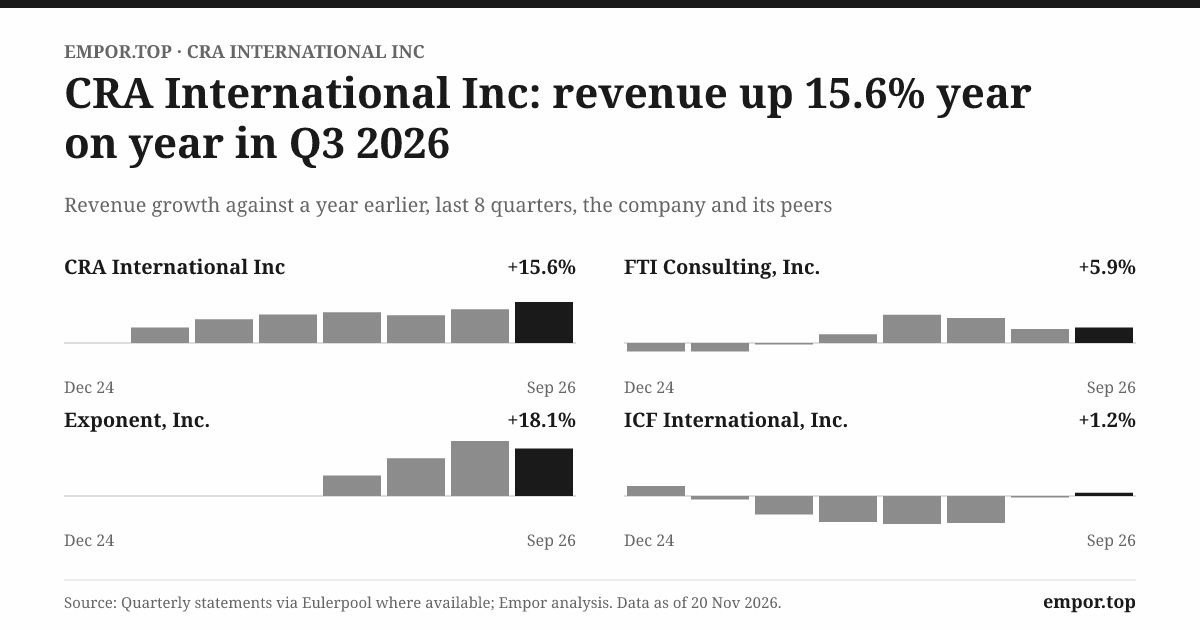
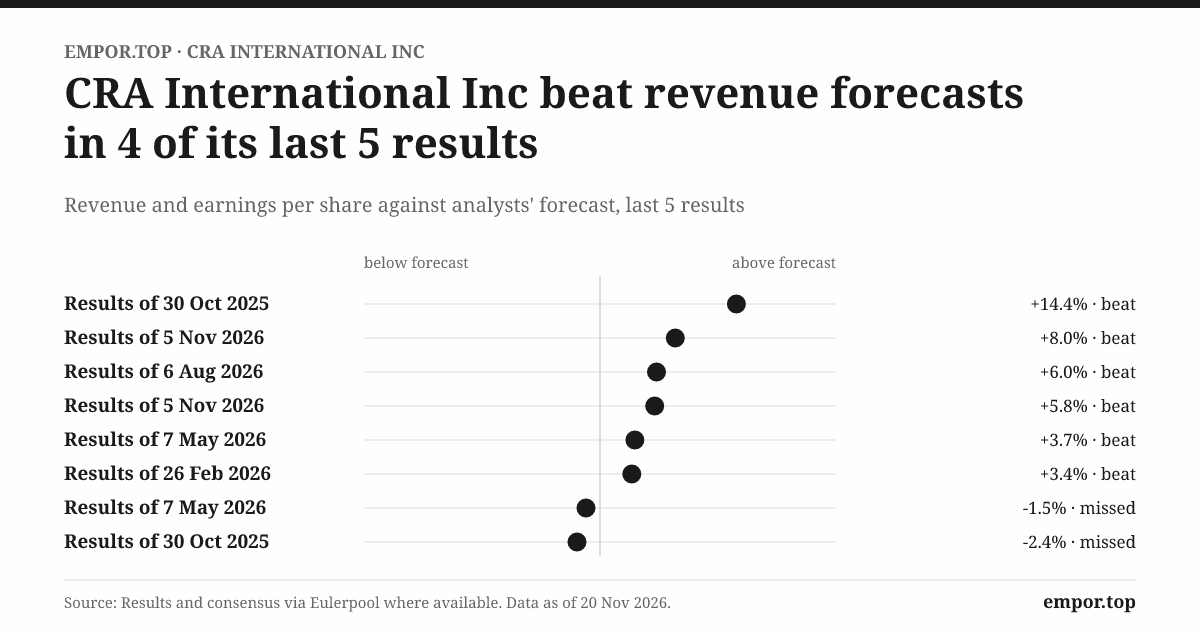
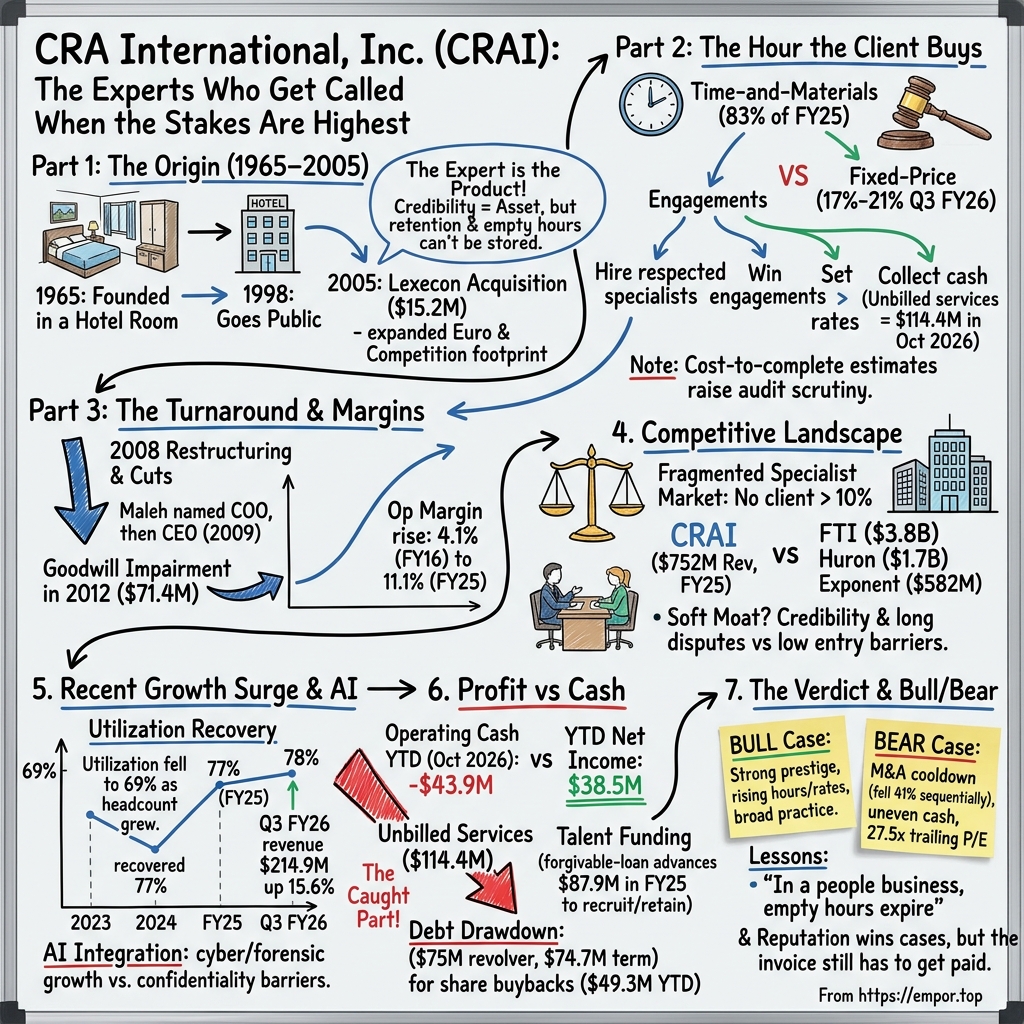
On November 5, 2026, CRA International released the kind of quarter that partners in a consulting firm like to frame. Revenue for the third quarter of fiscal 2026 came to $214.9 million, up 15.6% from a year earlier, the best third quarter the company had ever reported.[^1] Operating profit rose almost 39%, more than twice as fast as revenue.[^1] Its Antitrust & Competition Economics practice, whose economists help companies and their lawyers argue about mergers, monopolies and cartels, set a quarterly record, and management raised its revenue outlook for the full year.[^1]1
That second number explains the first. When revenue grows by about a sixth and operating profit by more than a third, the extra revenue is landing on a cost base that has not grown as fast. In a firm whose main cost is the salaries of its own people, that usually means one thing: the people are busier. CRA's consultants billed 78% of their available time in the quarter, up from 77% a year earlier, while headcount rose about 6%.2 More hours from roughly the same team are the most profitable kind of growth a professional-services firm can have.
The record looks less spectacular one line further down. Net profit for the quarter rose about 21%, not 39%, to roughly $13.9 million.[^1] Two things absorbed the difference. The company's effective tax rate climbed to about 35% from about 29% a year earlier, and interest costs rose as CRA borrowed more against its credit lines.[^1]2 Neither changes the operating story, but both matter to a shareholder. A record in operating profit is a statement about how well the consultants were deployed. The profit that belongs to shareholders is also shaped by the tax bill and by how the company chose to finance itself, and in 2026 both moved against them.
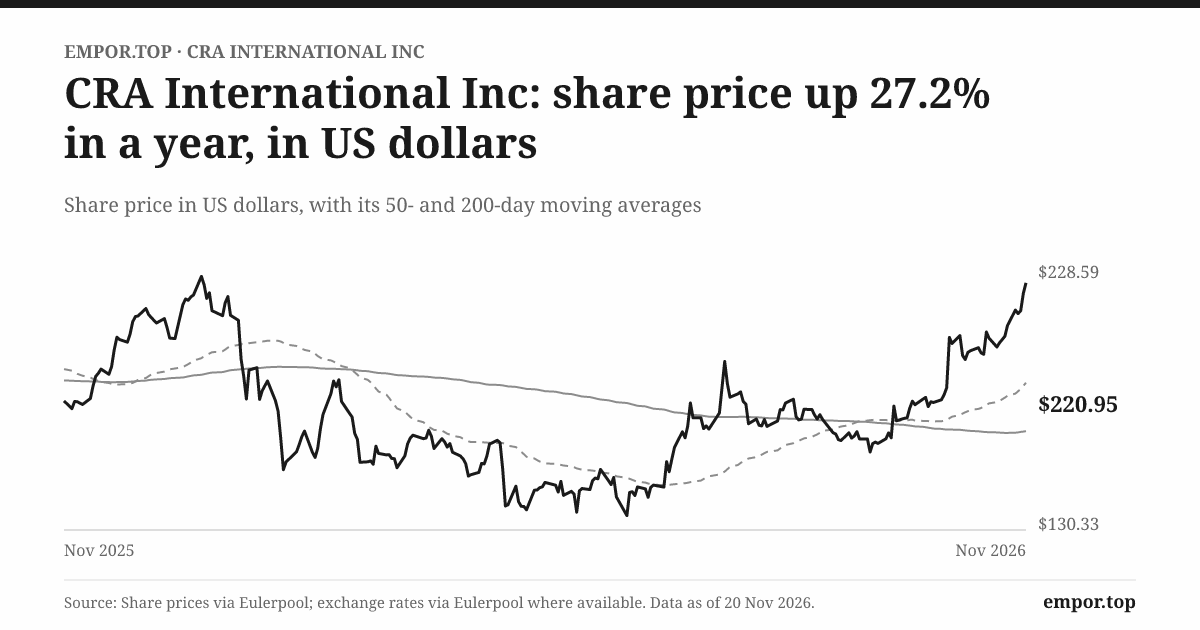
The market had already noticed. On November 20, 2026, the shares closed at $220.95, about 1% below their 52-week high and roughly 60% above the low of about $136 they had touched within the previous year.3 At that price, the company was worth about $1.4 billion on the stock market and about $1.6 billion once its borrowings were added.3 Investors were paying about 27.5 times the last year's earnings for a firm that sells advice by the hour.3
Now split the screen. On the left sit the record revenue and the soaring operating profit. On the right sits the cash-flow statement for the same nine months. CRA reported $38.5 million of net income for the first three quarters of fiscal 2026, yet its operations consumed $43.9 million of cash.2 That is a gap of more than $80 million between what the income statement recorded and what reached the bank. Nothing in it suggests the profit is fictitious. The money went into work that had been done but not yet billed, and into loans the company advances to the experts it wants to hire and keep.2 But a gap of that size, in a business with almost no physical assets, is the reason the record quarter is a beginning and not an answer.
This story is built around four questions that sit between those two halves of the screen. The first is what makes CRA the expert clients choose, when a law firm facing a billion-dollar antitrust case could call any of a dozen economics firms or a professor down the road. The second is whether CRA can keep growing after a weak stretch in 2023, when its consultants were underused and its profit fell. The third is whether the money spent recruiting talent and the time taken to collect fees are absorbing too much of the profit the company reports. The fourth is whether a share price near its high assumes more than the evidence proves.
It helps to know what kind of company this is before testing it. CRA International, which still markets itself as Charles River Associates, is a single listed consulting firm, a Massachusetts corporation headquartered in Boston and traded on NASDAQ.4 It describes two broad kinds of work. Legal and regulatory consulting covers economic analysis for litigation, competition reviews, regulatory proceedings and forensic investigations. Management consulting covers advice to companies on strategy, operations and transactions.4 Both sit inside one reportable accounting segment, so the company does not publish a separate profit figure for each side.4 Investors see revenue growth by practice, but they cannot see which practice earns the best margin.
So the verdict on the record quarter is easy to state and hard to finish. The acceleration is real: more hours, fuller schedules, and broad growth across the practices. But one strong quarter cannot settle whether growth is durable, whether the cash will catch up with the profit, or whether a valuation this close to the high leaves room for a stumble. To answer any of that, it is worth starting where CRA's product was invented: with an economist whose analysis had to survive a hostile cross-examination.
 Subscribe on LinkedIn
The expert becomes the product
By the company's own telling, CRA began in 1965 as a small analytical firm working out of a hotel room.5 It was not a software company waiting for a market, and it was not a factory with a product to stamp out. Its founders had something harder to scale: the ability to bring rigorous economic analysis to questions that lawyers, regulators and executives needed answered. The firm's identity formed around that work, and six decades later it is still the core of what CRA sells.5
The company went public in April 1998, more than three decades after its founding.4 A listing gave the partners a currency and a way to reward the people who did the work, but it did not change the essential nature of the firm. A consulting company does not go public to build a plant. It goes public so that its experts can own a piece of the reputation they create and so that it can buy other teams of experts with shares as well as cash.
That second purpose became visible in 2005. On June 16 of that year, CRA's British subsidiary completed its purchase of the former Lexecon Ltd, a London firm specializing in competition economics in Europe.6 The deal brought about 30 consultants and academic experts into CRA.6 The price was about £8.4 million, or roughly $15.2 million, made up of about £6.3 million in cash and £2.1 million in loan notes that were to be exchanged for restricted CRA shares, with further payments possible if the team hit performance targets.7 The London firm had generated about $13.5 million of revenue in the previous twelve months, so CRA paid only a little more than one year's sales.7
There is a historical wrinkle hiding in the name. The British firm was not affiliated with Lexecon Inc., the American economics consultancy that was by then a wholly owned subsidiary of FTI Consulting.6 The two shared a brand history, not an owner. That detail would be trivia, except that FTI became one of CRA's largest competitors. In this industry, the same names, the same academic networks and sometimes the same people move among rival firms. The fight is less over factories or patents than over who can claim the most credible experts.
The structure of the payment tells the real story. Part of the purchase price came as shares that the incoming team could not sell immediately, and part depended on future performance.7 CRA was not really buying a London lease or a list of contracts. It was buying 30 people and their relationships, and it designed the deal so those people had reasons to stay and keep producing. That is the logic of nearly every acquisition this firm has made since: buy expertise and relationships that extend its reach, then try to keep the expertise from walking out.
Lexecon also extended CRA's map. European competition enforcement has been one of the busiest areas of antitrust work for years, and a London team gave CRA a seat in it. Today, about 20% of CRA's revenue comes from outside the United States, and its British operations alone account for about 13%.4 The 2005 deal was small, but it pointed in the direction the company would keep going.
That international reach brings a currency exposure that CRA manages in an unusual way. It does not use foreign-exchange hedging contracts. Instead, it settles balances between its own subsidiaries frequently and relies on what it calls self-hedging: its British teams are paid in pounds and largely bill in pounds, so costs and revenues move together.4 The approach has worked well enough. Transaction losses were about $1.2 million in fiscal 2025, and the company estimated that a 10% swing in exchange rates at year-end would have moved pre-tax income by about $5.5 million.4 For a firm earning around $76 million before tax, that is a noticeable but not dangerous sensitivity, the financial footprint of a London team that began with 30 people.
To see why such a team is worth buying, consider what a client actually receives. When two companies plan a merger, competition regulators may ask whether it will raise prices. When a company is sued for damages, the court may need to know how much harm a cartel caused. In each case, a lawyer needs an economist who can build a model, defend its assumptions and explain it plainly to a judge, a jury or a regulator. The other side will hire its own expert, whose job is partly to tear down the first one.
That is why credibility is part of the product. The client is not buying a standard report that could be checked against a specification. It is buying analysis that must survive a challenge from people paid to find its weaknesses. An expert who has testified many times, whose work has been tested and who has not been discredited, carries something like a professional engineer's stamp on a bridge drawing. The stamp is valuable because someone's reputation stands behind it. Lose that reputation, and the analysis loses much of its value, however good the spreadsheet.
CRA does not rely only on its employees for that authority. It also works with academic and industry experts who are not on the payroll, paying them a commission on the work they bring or support; those commissions were about 1% of revenue in the fourth quarter of fiscal 2025.[^9] That arrangement lets CRA put a famous professor in front of a tribunal without hiring that professor full-time. It also shows how thin the line is between a firm's reputation and the reputations it borrows.
Here lies the basic bargain of the business. CRA's people are its productive capacity. Their reputations can support higher billing rates and bring repeat work from law firms that trust them. But a consultant's unsold Tuesday afternoon cannot be put in a warehouse and sold next month. When work is plentiful, the firm earns well on a mostly fixed payroll. When work dries up, the payroll does not shrink by itself. The company's best asset goes home every evening, and its cost goes on accruing whether the hours are sold or not.
That bargain is what every later chapter of the CRA story tests. Before following the people, it is worth following the money through a single engagement: from the moment a client signs to the moment, sometimes many months later, when the cash arrives.
The hour the client buys
Picture a typical engagement. A company receives notice that a competition authority wants to look closely at its planned acquisition. Its outside law firm needs economists who can analyze market shares, pricing data and customer behavior quickly, often under deadlines set by the regulator. The lawyers call CRA. A team forms around a senior expert, a few experienced consultants and a group of analysts who will clean data and run models. From that moment, the meter is running.
The engine that turns this call into money has five moving parts, and each can fail. CRA must first hire respected specialists, because the client is choosing the expert as much as the firm. It must win the engagement against other firms. It must keep the team busy, because an idle consultant is still paid. It must set billing rates that reflect the expertise involved. Finally, it must collect the fee. A firm can do the first four brilliantly and still struggle if the fifth slows down.
Most of CRA's work is sold on time-and-materials terms. The client agrees on hourly rates and pays for the hours worked, plus expenses. That model generated 83% of fiscal 2025 revenue.4 The rest came from fixed-price engagements, in which CRA agrees to deliver defined services for a set fee.4 Fixed-price work was 17% of revenue in fiscal 2025 and rose to 21% in the third quarter of fiscal 2026, up from 17% a year earlier.42
That shift matters more than its size suggests. On an hourly engagement, the client bears most of the risk that the work takes longer than expected. On a fixed-price engagement, CRA bears it. Think of a builder who agrees to remodel a kitchen for a fixed sum. If the walls hide rot, the builder's margin disappears. For accounting purposes, CRA recognizes revenue on partly completed fixed-price work by estimating how much cost remains to finish it.4 If those estimates are too optimistic, revenue and profit are recognized too early, and the correction comes later.
CRA's auditor considered that estimate significant enough to name it a critical audit matter in its report on the fiscal 2025 accounts.4 That is not a warning that anything was wrong. The auditor gave an unqualified opinion on the financial statements and on internal controls.4 A critical audit matter is the auditor's way of telling investors where judgment is heaviest. In CRA's case, the place where judgment is heaviest is precisely the kind of work that has grown as a share of revenue in the latest quarter.
The time-and-materials model has its own limits. Revenue depends on the number of consultants, the hours they bill, the rates they charge and the share of their available time they spend on client work. That last measure, utilization, is the single number that best summarizes how efficiently a consulting firm is using its people. If a consultant could bill 2,000 hours a year and bills 1,560, utilization is 78%. Each percentage point is worth real money, because the salary is paid either way.
A rough worked example shows how much. CRA ended the third quarter of fiscal 2026 with 1,028 consultants and about $824 million of revenue over the previous twelve months, or roughly $800,000 of revenue per consultant, including pass-through costs.2[^1] At 78% utilization, one extra percentage point means about 1.3% more billed hours from the same people. Applied to CRA's revenue base, that is on the order of $10 million a year, and because the consultants are already on the payroll, most of it falls toward operating profit. The arithmetic runs in reverse too. Lose a few points of utilization, as CRA did in 2023, and tens of millions of dollars of revenue vanish while almost none of the cost does. That asymmetry, more than any brand or methodology, is why the third quarter's operating profit grew more than twice as fast as its revenue.
There is also some pass-through revenue that flatters the top line without adding much profit. CRA's reimbursable third-party costs were $72.5 million in fiscal 2025, or about 9.6% of revenue, and the company says it recovers substantially all of them from clients.4 Those are costs such as outside data or subcontracted services that clients reimburse. They make the firm look larger, but they are not where CRA's expertise earns its return.
One irony of selling expertise for disputes is that the seller is itself rarely the subject of a dispute worth worrying about. CRA lists no material legal proceedings in its latest annual report, describing only ordinary-course actions that management believes are adequately covered by defenses or insurance, and its latest quarterly filing repeats that assessment.42 For a firm whose experts sit in contested rooms every week, that quiet record is itself a small piece of evidence about professional conduct. It is not a guarantee: a discredited expert or a conflict-of-interest claim would show up first as lost work, not as a lawsuit.
Then comes the lag between work and cash. CRA can recognize revenue as its consultants perform work, even before it sends an invoice. That recognized but uninvoiced amount is called unbilled services. Once CRA does invoice the client, the amount moves into accounts receivable, where it waits until the client pays. At October 3, 2026, CRA had $114.4 million of net unbilled services and $175.2 million of net accounts receivable.2 Nine months earlier, at January 3, 2026, unbilled services had been $65.6 million.2 Work completed but not yet invoiced had nearly doubled in nine months.
There are ordinary reasons a balance like that can rise. Engagements can reach billing milestones at quarter-end, clients can ask for invoices on a particular schedule, and large matters can be billed in stages. A sharp increase is not proof of a problem. But it is a promise that has not yet become cash, and the company sometimes asks clients for retainers but does not require collateral.4
What investors cannot see is just as important. CRA does not publish client-level contract lengths, minimum commitments, the share of revenue from repeat customers or a table showing how long receivables have been outstanding.4 It also keeps client identities confidential unless the work is already public.4 Some of that secrecy is the nature of the business; clients involved in sensitive litigation or regulatory investigations do not want to be named. Yet the omission has a cost. Investors must judge revenue durability and collection quality from aggregate figures, not from the behavior of identifiable customers.
The conclusion is plain. CRA is primarily a people-and-hours business. Billable hours, rates and utilization drive revenue, while fixed-price projects add estimation risk and the gap between doing the work and collecting the money can absorb cash for months. The model works well when demand is steady. The harder test arrives when demand turns before the payroll can. CRA faced that test in 2008, and the man who managed the response still runs the company.
The downturn that put Maleh in the operating seat
On October 30, 2008, as the financial crisis tore through the economy, CRA announced a set of organizational changes that were really a confession about utilization. The company said its consultants were working below target and the economic outlook was uncertain.8 It planned to reduce its workforce by about 75 consultants, exit selected practices and close some offices.8 In the same announcement, it named Paul Maleh as chief operating officer.8
The cuts were a direct adjustment to the business's central constraint. A manufacturer facing a slump can slow production and build less inventory. A consulting firm with too many consultants and too little work has fewer options. It can try to win more work, accept lower rates, wait for demand to recover, or reduce the number of people on the payroll. CRA chose to cut and narrow its focus. It is the operating equivalent of a hospital closing a ward when the beds are empty for too long: painful, visible and often unavoidable.
Maleh was not an outsider brought in to wield an axe. He had joined CRA in 1989, almost two decades before the restructuring, and had worked his way up inside the firm.9 He became chief executive in 2009 and added the role of chairman in 2020.9 Some data services date his tenure as chief executive to 2006, but the company's own proxy statement records the 2009 appointment, and the distinction matters: the 2008 retrenchment was the setting for his rise, not a crisis he had already led for years.9
That career path shapes how to read him. He is an operator who rose inside a professional firm, not a founder with a grand product vision or a deal-maker parachuted in from private equity. The record of his tenure is therefore best judged by operating outcomes: whether utilization recovers, whether margins rise, whether acquisitions earn their price and whether the firm avoids repeating the mistakes that made 2008 necessary.
The early years after he took charge were not smooth. In fiscal 2012, CRA recorded a $71.4 million goodwill impairment and reported a net loss of $53.0 million.[^12] In fiscal 2013, it returned to net income of $11.4 million.[^12] The impairment needs careful handling. Goodwill is the premium a company pays above the book value of what it acquires, and accounting rules require it to be tested for impairment. CRA's charge reflected a large gap between the company's book value and its market value under that test, not a disclosed write-down of one named acquisition.[^12] It was also non-cash. No money left the firm when the charge was taken.
But non-cash is not the same as harmless. The charge was an admission that the market no longer valued CRA's acquired businesses at the price recorded on the balance sheet. It accompanied a difficult year, and it is the strongest disconfirming evidence in CRA's record against any claim that its acquisitions automatically create value. Investors who read the Lexecon story as proof that buying teams always works should keep the 2012 charge next to it.
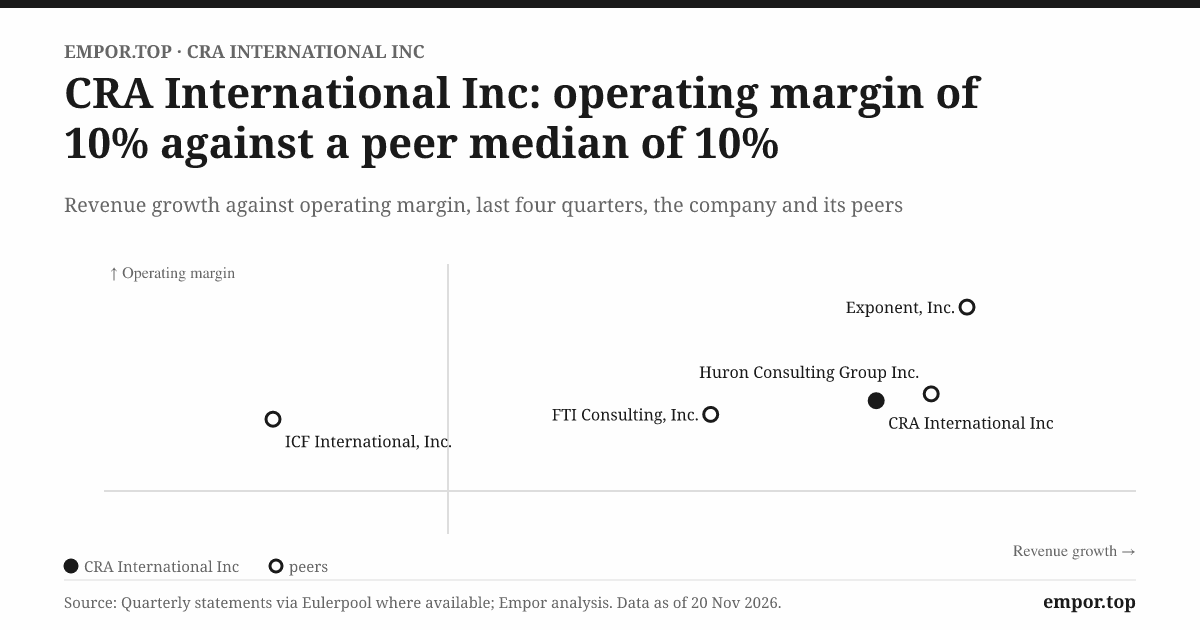
The later record is stronger. CRA's operating margin, operating profit as a share of revenue, was only about 4% in fiscal 2015 and fiscal 2017.10 By fiscal 2025 it had risen to 11.1%.4 For a firm whose main cost is its people, that is a meaningful change. It suggests better pricing, fuller schedules, more control over overhead, or some combination of the three. It does not prove that every capital decision succeeded, and it does not tell investors which practices drove the improvement, because the company does not publish profit by practice. Still, a firm that went from a goodwill write-down to margins nearly three times their mid-2010s level has clearly rebuilt its economics.
The most relevant recent test came in 2023. CRA had expanded its consultant headcount, but demand did not keep pace. In the first three quarters of fiscal 2023, utilization fell to 69%.11 That is the 2008 problem in a milder form: more people, not enough billable work. Net income fell in fiscal 2023, from about $43 million to about $38 million.114 This time, the company did not announce mass layoffs or practice closures. It absorbed the slower period and let demand catch up with the larger team.
Compare the explanations across those moments. In 2008, management named below-target utilization directly and acted on it by cutting staff.8 In 2023, the filings again tied the weaker result to lower utilization as headcount grew, which was honest about the mechanism but showed that the company had hired ahead of demand.11 By 2026, the story had reversed: management credited stronger utilization, more billable hours and broad practice growth, while headcount was up about 6% year over year.2[^1] The language is consistent, which is a point in management's favor. The mechanism they describe is the right one. The unresolved question is whether the firm has become better at matching capacity to demand, or whether it simply waited long enough for demand to return.
The governance picture is mostly quiet. Maleh received $4.16 million in total compensation in fiscal 2025, including $2.10 million in stock awards and $1.125 million in incentive pay.9 His pay was $3.58 million in fiscal 2023, when net income was $38.5 million, and it rose as net income climbed to $54.8 million in fiscal 2025.9 He owned about 2.3% of the company as of the 2026 proxy, a stake worth roughly $30 million at the November 2026 share price.93 Shareholders approved the company's executive pay in July 2026 with about 97.5% of votes cast in favor, excluding abstentions.12
There were personnel changes worth noting. Chief Financial Officer Daniel Mahoney resigned in April 2025; Chad Holmes served as interim CFO until Eric Nierenberg was appointed in August 2025.9 At the July 2026 annual meeting, lead independent director William Concannon retired and the board shrank from eight members to seven.912 None of this signals a governance crisis. It does mean that the finance chief interpreting the current cash shortfall has been in the job for little more than a year.
Maleh's tenure therefore contains two lessons that sit uneasily together. The early record cautions against treating growth plans or acquisition goodwill as proof of durable value. The later record shows a leaner firm able to rebuild profitability and to absorb a utilization slump without a 2008-style cut. Which lesson matters more depends on a question that goes beyond any one CEO: how much of CRA's success belongs to the firm, and how much belongs to experts who could, in principle, work somewhere else?
How much moat can a firm of experts own?
Imagine the partner at a major law firm whose client has just been sued in a large antitrust case. The partner needs an economist who can survive a deposition, explain market definition to a judge and withstand cross-examination by opposing counsel who have read every paper the expert has ever published. The partner has options. CRA is one. So are specialist economics firms, large consulting companies, accounting firms and independent academics who can be hired directly.4
That choice is the core of the moat question. CRA's reputation is real, but is it a durable economic advantage, or simply one of several credible names a client can choose from each time a new case arrives? CRA's own description of its market offers the first clue. The company says it competes with a wide range of firms and that there are few barriers to entry into the consulting business.4 A company that tells investors its industry has low entry barriers is not claiming to own a fortress.
Scale is the second clue. CRA reported about $751 million of revenue in fiscal 2025.4 FTI Consulting reported about $3.8 billion in its latest fiscal year, Huron about $1.7 billion, ICF about $1.9 billion and Exponent about $582 million.13 On those figures, FTI is about five times CRA's size and Huron more than twice as large. But the comparison needs care. FTI's business spans restructuring, forensic accounting, communications and technology services as well as economics. Huron has large healthcare and education consulting businesses. ICF does substantial work for government clients. Exponent, the closest specialist reference by size, is best known for engineering and scientific failure analysis. These firms compete with CRA in some engagements, not in every engagement.
So revenue totals measure scale, not market share in CRA's niches. There is no published market-share figure showing that CRA dominates antitrust economics, damages analysis or forensic work. A fair reading is that CRA is a mid-sized specialist with a strong position in certain practices, operating among larger and more diversified firms.
Michael Porter's five forces help turn that picture into economics. Start with buyers. No CRA client represented more than 10% of revenue in fiscal 2023, 2024 or 2025.4 That limits the damage from losing any single customer and keeps any one client from dictating terms across the whole firm. But a broad client base is not the same as weak buyer power. Each client, often advised by a sophisticated law firm, can choose among several qualified experts for each new matter. CRA does not disclose top-five or top-ten client concentration, so investors cannot see whether a small group of relationships matters more than the 10% threshold suggests.4
The second force is where CRA's model is most unusual: supplier power. In most companies, suppliers sell raw materials or components. In CRA's case, the most important supplier is the expert. Senior economists, forensic specialists and consultants with deep client relationships can command high pay because they are the asset clients want. Some can take clients with them if they leave. CRA's forgivable loans, discussed in the next part of this story, are partly the price of keeping that supplier power in check. The firm does not own its best people. It rents their loyalty, sometimes years in advance.
What investors cannot measure is how often that rental agreement fails. CRA does not publish consultant attrition, the departures of senior experts or the revenue that leaves with them. Its headcount figures are net numbers: they show that the firm had 1,028 consultants at the end of the third quarter, up from 968 a year earlier, but not how many joined and how many left to reach that total.2 In a business where a single star economist can anchor a practice, the gross flows matter more than the net. A firm that hires 200 people and loses 140 looks identical in the headcount table to one that hires 70 and loses 10, yet the two are running very different businesses.
The threat of new entrants follows directly. A well-known expert with a few colleagues and a network of law firms can set up a boutique without building a factory or obtaining a license. CRA itself acknowledges low entry barriers.4 What a new entrant lacks is breadth: the ability to staff large cases, process massive datasets and offer many specialties under one roof. That is a real advantage for large matters, but it is not a barrier that prevents competition for the most prized experts.
Substitutes come from three directions. Clients can use internal teams for some analysis. Law firms can hire independent academics directly. And artificial intelligence may make some data-heavy tasks faster, reducing the hours needed for parts of a project. On the third-quarter call, management described AI as both a source of new forensic and cyber work and a tool clients may be reluctant to use because of data-confidentiality concerns.1 That is a sensible reading of the present. It is not evidence that AI is a protected advantage for CRA or a meaningful new revenue stream.
Rivalry among existing firms is intense but fragmented. FTI, Huron, ICF and Exponent are not all direct substitutes, but large accounting firms, global strategy consultancies and specialist economics firms add more competition in particular practices.4 The consequence is a market in which reputation matters, but no one appears to have cornered it.
There is a genuine counterweight. Confidential work and expert credibility can favor teams with long, clean track records. A lawyer may be reluctant to risk a large case on an untested expert, especially when testimony will be scrutinized in court or by regulators. Litigation and regulatory work can also last many months. On the third-quarter call, management said antitrust work was still benefiting from matters launched six to eighteen months earlier.1 Once an expert has built the model, gathered the data and become familiar with the case, replacing that expert midstream would be costly. The switching cost is high inside a matter.
The weakness is that the switching cost may be much lower between matters. A client that used CRA last year can choose a different firm for its next case. CRA does not publish client retention, repeat-revenue share, win rates or market share, so investors cannot prove that clients keep coming back at a high rate.4 That absence does not mean the advantage is fake. It means the advantage remains unproven in the way investors usually require.
The practice data provide proof of breadth rather than proof of a moat. In the third quarter of fiscal 2026, seven practices grew, together accounting for about 95% of revenue.[^1] The legal and regulatory grouping grew 15.7%, and management consulting grew 9.8%.[^1] Broad growth is valuable because it reduces dependence on one specialty. But broad growth during a strong demand cycle does not by itself show that clients would stay loyal if pricing or service quality weakened.
The verdict is narrower than the brand suggests. CRA has a credible specialist reputation, a broad client base and real advantages in staffing complex matters. Public evidence does not establish a cornered market, high switching costs across engagements or a demonstrated customer-retention advantage. It operates in a fragmented market with larger competitors and low stated entry barriers. The moat is best described as a collection of individual and team reputations that the firm must keep renewing. The evidence that would strengthen the claim would be sustained rate increases, stable or rising utilization through a slower market and fewer high-profile expert departures. The next question is whether recent growth reflects that renewal or simply a favorable cycle.
The new growth is coming back through the door
The weak stretch came in 2023, when utilization fell as headcount grew.11 That was the clearest signal that capacity had run ahead of demand.
That stumble remains the most relevant recent test of management, because it involved the same leadership, the same business model and the same constraint that defined 2008. A large drop in utilization can erase much of a consulting firm's operating leverage. When revenue rises slowly but salaries keep coming, margins compress. As the earlier slowdown showed, lower utilization can weigh on net income.114
The recovery came through the same channel. In fiscal 2025, billable hours rose 6.0%, utilization increased from 75% to 77% and revenue grew 9.3%.4 That is a clean story: more hours from a better-used team. It is also a disciplined one. Consultant headcount grew by only 13 people across the whole of fiscal 2025, so nearly all of the year's growth came from getting more out of the people already there rather than from hiring.4 After the overhiring of 2023, that restraint was the right response, and it is the clearest evidence in the recent record that management learned from the slump rather than simply outlasting it. By the third quarter of fiscal 2026, utilization stood at 78% as CRA added consultants again.2
The growth has been substantial. Revenue rose from about $623 million in fiscal 2023 to about $751 million in fiscal 2025 and roughly $824 million over the latest twelve months.4[^1] Put simply, revenue is about a third higher than it was less than three years earlier, an annual pace of roughly 10%. One accounting caveat belongs beside that figure: CRA's fiscal 2025 ended on January 3, 2026, giving that year an extra week compared with a normal 52-week year.4 The extra week does not change the direction of the story, but it is a reminder that a single annual growth rate can be flattered by the calendar.
The quarterly path shows the acceleration building rather than arriving all at once. Year-over-year revenue growth was about 6% in the first quarter of fiscal 2025 and climbed, quarter by quarter with one pause, to 15.6% in the third quarter of fiscal 2026.[^1] Operating margin did not follow a straight line: it dipped to about 9% in the first quarter of fiscal 2026 before recovering to about 11% in the second and third quarters.[^1] That pattern is consistent with a firm that kept adding people through early 2026 and then saw demand fill their schedules. It is also a reminder that margin gains in this business can reverse within a single quarter when hiring briefly outruns the work.
The most important feature of the recent acceleration is that it appears organic. It rests on better utilization, more billable hours and practice growth, rather than on a large acquisition that added revenue overnight. That matters for quality. Acquired growth can mask weak demand in the existing business. Growth that comes from fuller schedules and more hours suggests clients are actually buying more of what CRA already sells.
The two business groupings have played different roles. Legal and regulatory consulting remains the larger engine in recent quarters. Management consulting was the faster-growing grouping in the second quarter of fiscal 2026, then grew 9.8% in the third quarter, while legal and regulatory work grew 15.7%.14[^1] Because CRA reports one accounting segment, investors cannot see whether the faster-growing work also carries higher margins. The growth is broad, but the profit mix remains opaque.
Artificial intelligence sits awkwardly in this picture, which is the right place for it to sit. Management described AI as a source of new forensic and cyber work.1 A company dealing with a cyber breach, a dispute over algorithmic pricing or questions about data use may need specialist investigators and economists. At the same time, management cited client concerns about confidentiality when using AI tools.1 A law firm handling sensitive evidence may not want that evidence passing through a third-party model. AI could also reduce the time needed for some research and data-processing tasks, which matters in a business that charges by the hour. CRA has not shown that AI-related demand is a material revenue pool or that AI gives it a proprietary advantage.
The more immediate risk is the deal market. On the third-quarter call, analysts pressed Maleh on a 41% sequential fall in global mergers and acquisitions activity.1 He said CRA was watching whether it was a short-term dip, while noting that antitrust work was still benefiting from matters launched six to eighteen months earlier.1 That answer was candid about the timing. Merger-related antitrust work tends to arrive after deals are announced, as regulators review them and lawyers prepare arguments. A drop in new deals may not hurt this quarter's revenue, but it can weaken the pipeline that supports revenue a year later.
The other risk is internal. Headcount growth is good when demand rises to meet it. It becomes expensive when hiring outpaces the work. The firm's 2023 experience showed exactly how that can happen. The current numbers look healthier, because utilization is high and rising. Yet the same 6% headcount growth that supports the current acceleration would become a burden if M&A-linked work slowed and the hours did not follow.
The conclusion is encouraging, with a clear boundary. The latest acceleration rests on stronger utilization, more billable hours and broad practice growth rather than acquisitions. That is better-quality growth than a bolt-on spree would provide. But it remains exposed to hiring ahead of demand and to shifts in M&A activity. Growth on the income statement is only half the case, though. The other half is whether the money for all that work is actually arriving.
The profit is there; the cash is elsewhere
At October 3, 2026, CRA's books told two stories at once. Operations had used $43.9 million of cash in the first three quarters of the fiscal year.2 The difference was not a mystery. Unbilled services absorbed $49.3 million of cash, and forgivable loans to employees and experts absorbed another $46.7 million, partly offset by changes in compensation and other payables.2
There was also an awkward coincidence. In the same nine months, CRA spent $49.3 million buying back its own shares, the same amount as the cash tied up in growing unbilled services.2 The two figures are unrelated in accounting terms, but they make the capital-allocation question vivid. Money that had not yet come in from clients was matched dollar for dollar by money going out to repurchase stock.
The long-run record is better than the recent one. Over the nine years for which comparable figures are available from fiscal 2016 through the latest period, CRA generated about $271 million of operating cash flow against about $281 million of net profit, or about 97% conversion.410 That is respectable for a firm with significant receivables and talent investments. Over a long enough period, CRA's profit has mostly turned into cash.
But long-run averages can hide a recent reversal, and this one is real. In fiscal 2025, CRA generated $22.4 million of operating cash flow against $54.8 million of net income.4 Then fiscal 2026's first three quarters went negative. The company explained the fiscal 2025 shortfall as the result of forgivable-loan advances and the timing of performance-bonus payments.4 Those explanations are plausible. They are also reasons to watch the next year closely, because they describe cash leaving before the full benefit appears in earnings.
Forgivable loans are central to understanding the gap. CRA advances money to employees and non-employee experts, often to recruit or retain them. If the person stays for the agreed period, the loan is forgiven over time. Think of it as a signing bonus with a leash. The cash goes out up front, but the expense is recognized gradually as the loan is forgiven. That makes the cash-flow statement look worse in years of heavy recruiting or retention spending, even if the income statement recognizes the cost slowly.
In fiscal 2025, CRA advanced $87.9 million in forgivable loans, nearly double the $45.5 million advanced in fiscal 2024.4 Amortization, the amount recognized as expense, was $39.4 million.4 When advances run far above amortization, the balance grows, and future earnings will carry more of that cost. The loans can be productive. They help a firm compete for scarce experts and keep them from moving to rivals. But they also show that CRA's ability to retain talent is not free, and it is not fully visible in a single year's earnings.
Management offers an adjusted operating cash-flow figure that adds back forgivable-loan advances. For fiscal 2025, that adjusted figure was $108.4 million.[^9]4 It is useful for understanding the investment cycle: the business generates cash before it chooses to spend heavily on talent. It is not GAAP cash flow, and it does not represent money already collected from clients. The loans are not optional in the same way a factory expansion might be. In a talent business, keeping the best people is part of operating the business.
Receivables point in the same direction. Debtor days, a measure of how many days of revenue are tied up in receivables, rose from about 103 in fiscal 2016 to 129 in fiscal 2025.104 By October 3, 2026, net receivables and unbilled services together were about $290 million, roughly four months of revenue at the latest twelve-month pace.2 Unbilled services had risen sharply since January.2 That means a growing share of reported revenue was still waiting to be invoiced, collected or both.
Credit losses have been manageable but not trivial. CRA had allowances of $6.7 million for accounts receivable and $1.5 million for unbilled services at the end of fiscal 2025.4 Its bad-debt expense was only about $0.75 million that year, but it wrote off $6.2 million of receivable reserves and $8.3 million of unbilled-service reserves.4 Write-offs against reserves are not new losses in that year's income statement, because the reserves had already been recorded. But together they show that not every hour recognized as revenue becomes cash. CRA describes credit reviews, reserves based on historical charge-offs and occasional retainers, yet it does not publish a receivables ageing table.4
Capital allocation adds tension. From fiscal 2021 through fiscal 2025, CRA returned $239 million to shareholders and invested $229 million in talent.4 It expanded its share-repurchase authorization by $55 million in February 2026.4 In fiscal 2026's first three quarters, it repurchased $49.3 million of shares and paid $11.0 million in dividends.2 Issued shares fell from about 6.55 million at fiscal 2025 year-end to about 6.26 million at October 3, 2026, a reduction of more than 4% in nine months.2
That reduction is good for remaining shareholders if the shares are bought below their intrinsic value. It is less clearly good when operating cash flow is negative and the company is borrowing. In the same period, net financing cash flow was positive, meaning CRA raised more from borrowing than it paid out in buybacks and dividends.2 At quarter-end, it had $75 million drawn on its revolving credit facility and $74.7 million on its term loan.2 It also had $171.9 million of available revolver capacity, and it said it was in compliance with its covenants, which cap net leverage at 3.0 times and require interest coverage of at least 2.5 times.2 The facilities are unsecured and mature on July 31, 2031.2
The debt is not alarming on its own. But leases add another layer: CRA had $17.2 million of current and $61.6 million of non-current lease liabilities at October 3, 2026, largely for offices.2 Cash on hand was only $20.4 million.2 CRA classifies its revolver borrowing as current because it intends to repay it within twelve months, despite the facility's later maturity.2 That intention depends on collecting the unbilled balance and moderating the pace of new talent advances.
It is worth noticing how thin the cash cushion has become over time. CRA held more than $50 million of cash at the end of fiscal 2016 and had no bank borrowings at all.10 By the end of fiscal 2025, cash had fallen to about $18 million and borrowings had risen to about $127 million.4 Some of that shift reflects a sensible decision not to hold idle cash in a business with reliable credit lines; the company says its cash sits with two financial institutions it considers creditworthy, and it holds no meaningful investment portfolio.4 But it also means that the buyback and the dividend now depend on the revolver in any period when collections lag. The balance sheet has moved from a fortress to a working account.
The bolt-on record adds context but not a clear verdict. In 2017, CRA acquired C1 Consulting, adding 86 colleagues focused on life-sciences consulting.[^18] In 2022, it added 45 colleagues from Welch Consulting and 17 from bioStrategies.15 These deals show the same pattern seen with Lexecon: buy experienced teams and expand capabilities. But purchase terms were not consistently disclosed, so there is no reliable basis to claim CRA overpaid or underpaid compared with acquisition prices elsewhere in the industry. The 2012 goodwill impairment remains a general caution about acquisition value creation, but it is not evidence that these specific later deals were impaired.
The verdict is clear enough. Long-run profit-to-cash conversion is reasonable, but the latest period is a real warning. The cash shortfall is tied to unbilled work, working capital and talent funding, not to the absence of reported profit. Whether it clears depends on collections and the pace of new advances. That brings the story to the price investors were paying on November 20, 2026, and what has to go right for that price to be earned.
Analysis & Bear vs. Bull Case
The stock closed at $220.95 on November 20, 2026, near its 52-week high.3 At that price, investors were paying about 27.5 times trailing earnings and 26.3 times trailing enterprise value to EBITDA.3 The free-cash-flow yield was only 0.7%, meaning a $100 investment in the shares bought claim to about 70 cents of last year's free cash flow.3 That is a demanding valuation for a business whose operating cash flow was negative in the most recent nine months.
A different snapshot looks less extreme. In a Houlihan Lokey peer comparison using September 21, 2026 market data and consensus estimates, CRA traded at 13.1 times expected 2026 EBITDA.13 FTI was at 11.1 times, Huron 11.6 times, Exponent 19.4 times and ICF 9.7 times.13 On that forward-looking basis, CRA traded at a premium to FTI, Huron and ICF but well below Exponent. The gap between that forward multiple and the trailing multiple shows how much the earnings basis matters. Forward estimates assume the growth and margins continue; trailing measures use the last reported results. The comparison frames a premium, but it does not prove mispricing.
What does the price appear to assume? It assumes CRA can keep growing faster than it did in its weak 2023 stretch, maintain utilization near current levels and turn more of its reported profit into cash. A low free-cash-flow yield leaves little room for disappointment. If cash conversion recovers and growth stays strong, the valuation can be supported by rising earnings and cash. If utilization falls, M&A-linked work fades or talent costs rise, the premium can shrink quickly.
The bull case is straightforward. CRA can keep consultants busy, grow rates and hours and deepen its higher-growth practices without losing the quality that attracts legal and corporate clients. Its recent growth is organic and broad. Seven practices grew in the third quarter, legal and regulatory work grew strongly and management consulting also expanded.[^1] Operating margins have improved substantially over the past decade, suggesting the firm has become more efficient and better at pricing its expertise.
The bear case is equally concrete. The present utilization recovery may fade. Clients may delay work if markets weaken. Merger-related matters may roll off after the sequential drop in global M&A activity.1 AI may reduce the hours needed for some projects while raising client concerns about confidentiality.1 Meanwhile, the cash profile remains uneven, receivables and unbilled services are high and forgivable-loan advances are rising. The company does not publish retention, pricing, win-rate or market-share data that would prove its reputation is hard to substitute.4
Hamilton Helmer's seven powers framework helps test the bull case more strictly. Scale economies are limited, because CRA is smaller than FTI and Huron and consulting costs rise with the number of people. Network economies are weak; one client using CRA does not make the service more valuable to another client in the way a marketplace might. Counter-positioning is not obvious, because CRA's model resembles that of other expert-consulting firms. Switching costs are high within a matter, but not proven across matters.
Brand is CRA's most plausible power. A respected name can help win engagements and support rates. But in this business, the brand is partly the firm and partly the individual expert. A cornered resource would exist only if CRA controlled experts or data that competitors could not access. It does not own its experts, and forgivable loans show the cost of keeping them. Process power, the ability to execute better through embedded know-how, may exist in CRA's data analysis and case management, but the company does not publish evidence that would let investors measure it directly.
The historical record offers one more test of the brand claim, and it cuts both ways. If CRA's reputation were a strong, firm-level power, the 2008 and 2023 utilization slumps should have been shallow, because loyal clients would keep sending work regardless of the cycle. Instead, both episodes showed that demand for CRA's hours can fall faster than its capacity can adjust.811 Yet in neither case did the franchise break. Revenue kept rising over the decade, margins nearly tripled and the most recent recovery came without acquisitions.4 That history does not reject the brand claim. It narrows it: CRA's reputation appears strong enough to bring clients back over a cycle, but not strong enough to protect utilization within one. The KPI that would confirm a stronger version is utilization holding near its current level through the softer merger market that management is now watching.
The resulting verdict is that CRA wins from here if its broad specialist practices, high recent utilization and margin track record continue to reinforce one another. It may not win if clients treat its experts as one credible option among many, if talent costs rise faster than rates, or if the current growth proves more cyclical than structural. The moat is plausible but narrower than the brand alone implies.
Three measures will tell investors which version is unfolding. The first is utilization alongside billable-hour growth. Utilization was 78% in the third quarter of fiscal 2026, up from 77% a year earlier.2 If it stays high while headcount grows, demand is keeping pace with capacity. The second is operating cash flow against net income, with unbilled services as a key part of the story. That ratio is currently negative for the year to date, and unbilled services are much higher than at the start of the year.2 The third is practice-level growth through a softer M&A period. Seven practices grew in the latest quarter.[^1] Whether that breadth holds after the lagged benefit of earlier deals fades will reveal how much of the current acceleration is cyclical.
The ownership base is institutional rather than controlled. FMR held about 9.0%, BlackRock about 7.8% and Copeland Capital about 5.6% as of April 2026.9 No controlling shareholder appears in the proxy, and Maleh's 2.3% stake gives him meaningful alignment without control.9 That structure leaves capital allocation decisions to management and the board, subject to the discipline of public investors.
An activist would focus on buybacks. CRA's repurchases reduce the share count and can create value if the stock is undervalued. But should buybacks continue at current prices while cash conversion is negative and talent advances are rising? A skeptical investor would ask whether the company is borrowing to support earnings-per-share growth before the cash from its recent revenue arrives. Management could answer that the unbilled balance is temporary, that forgivable loans are investments in future revenue and that the company has ample credit capacity. That answer will be tested by the next full-year cash-flow statement.
The valuation comparison should stay disciplined. The peer snapshot is forward-looking and uses a different earnings basis from CRA's trailing multiples. It provides context, not an apples-to-apples verdict. On the evidence available, CRA's price is supported by better growth and broad practice momentum, but it assumes that the company will convert those strengths into durable cash. That is the thread the lessons of this story must follow.
Playbook: Business & Investing Lessons
Move from the courtroom to the spreadsheet. On one side is the expert whose analysis must withstand cross-examination. On the other is the operating report that tracks utilization, headcount, unbilled services and collections. Both matter, but in different ways. The expert wins the work. The spreadsheet tells investors whether the work creates value.
The first lesson begins with the 2008 cuts. CRA's consultants were underused, the economy was weakening and the company had to reduce headcount and close offices.8 That moment captures the central economics of a professional firm: "In a people business, an empty hour is inventory that expires." A manufacturer can store unsold products. A consulting firm cannot store an unbilled hour. That is why utilization at 78% is more than a statistic.2 It is the measure of how much of the firm's perishable inventory is being sold.
The second lesson comes from the fixed-price estimate and the receivables balance. CRA's auditor highlighted the judgment involved in estimating the cost to complete fixed-price engagements, and fixed-price work rose to 21% of revenue in the latest quarter.42 At the same time, unbilled services rose to $114.4 million.2 The line that belongs to this company is: "The expert's reputation wins the case; the invoice still has to get paid." Reputation can create revenue, but collections determine whether that revenue becomes value for shareholders.
The third lesson is about talent funding. CRA's forgivable loans help it attract and retain scarce experts, but the cash leaves before the full cost appears in earnings.4 That makes them a strategic investment and a financial obligation at the same time. For founders building expert firms, the lesson is that retention tools should be treated as part of the business model, not as an accounting footnote. For investors, the lesson is to watch the cash, not only the amortized expense.
The fourth lesson comes from the buybacks. CRA repurchased $49.3 million of shares in the first three quarters of fiscal 2026 while operating cash flow was negative and the company drew on its credit facilities.2 The quote is: "A buyback is only disciplined if the cash and price make it so." A repurchase is not automatically shareholder-friendly. It depends on the price paid and on whether the business can fund it from collected cash rather than from borrowing while receivables build.
There is a quieter fifth lesson in the 2005 London deal and the 2012 write-down that followed CRA's acquisitive decade. Lexecon was bought for a little more than one year's revenue, with part of the price paid in restricted shares and part held back for performance.7 The structure treated the team, not the contracts, as the thing being bought, and it tied the sellers' payoff to their staying. Seven years later, the goodwill test showed that the premium CRA had recorded for its acquired businesses no longer matched what the market would pay for the whole firm.[^12] The line for founders who build by buying teams: "When you acquire experts, you are paying for people who can leave, so pay them to stay, not just to sign." The goodwill on a consulting firm's balance sheet is a bet on future loyalty, and it should be priced like one.
Taken together, CRA's story is a lesson in managing scarce expert time. Reputation wins the assignment, but utilization and collections decide whether the assignment creates value. That is not a generic consulting lesson. It is the specific balance CRA has to strike between paying for credibility, selling hours and converting those hours into cash.
Epilogue
Tonight, CRA sits in an odd position for a company that just reported a record. Its consultants have rarely been busier. Its antitrust economists have never billed more in a quarter. Its shares trade within a couple of dollars of their high. And yet the company is carrying roughly $115 million of work it has done but not invoiced, a revolver drawn to $75 million and a cash-flow statement that has run backwards for nine months.2 Everything about the business looks like it is winning, except the bank balance.
The calendar is about to resolve some of that. Last year, CRA reported its full-year results on February 26; the fiscal 2026 report should arrive early in 2027, with the fourth quarter's cash flows attached.[^9] On the second-quarter call, management guided to fiscal 2026 revenue of $805 million to $820 million and a non-GAAP EBITDA margin of 12.0% to 13.0%.16 With the third-quarter results, it raised the revenue outlook.[^1] The revenue number is now the least interesting part of that report. The company has already booked about $627 million in three quarters; the open question is what the fourth quarter does to the cash.2
Picture the good version of that February. Unbilled services fall back toward where they began the year as invoices go out and clients pay. Operating cash flow for the fourth quarter is strongly positive, pulling the full-year figure toward net income. Utilization holds in the high seventies even with a larger team. In that world, the record quarter becomes the start of a new phase, the buybacks look like a well-timed bet on the company's own recovery, and the debate about the valuation shifts from whether the cash exists to how fast it grows.
Now picture the uncomfortable version. Unbilled services stay high or climb again. Forgivable-loan advances repeat the near-doubling seen in fiscal 2025. Utilization slips a point or two as the merger slowdown reaches the antitrust pipeline that management said was still being fed by matters begun up to eighteen months earlier.1 In that world, the company would have borrowed to buy back stock near its high while its profit sat in client ledgers, and the 2023 lesson about hiring ahead of demand would be back on the table.
The live call will matter as much as the numbers. Prepared remarks will almost certainly celebrate the record year. The analyst questions will be where the story is told honestly: whether the global decline in deal activity has begun to reach new antitrust engagements, whether clients are using AI to shrink the hours they buy or refusing it to protect their data, and whether the finance team, still relatively new, can explain the unbilled balance in specific terms rather than in reassurances.19 Concrete answers would be evidence. Vague ones would be evidence too.
Until then, the valuation is a bet placed before the cash has been counted. The story turns on whether high utilization converts into collected cash, and whether demand holds after the lagged benefit of earlier merger activity fades. CRA has spent six decades persuading the world's most skeptical audiences, opposing counsel, regulators and judges, that its numbers hold up. Its next audience is its own shareholders, and the exhibit they are waiting for is a cash-flow statement.
Outro
A product on a shelf can wait in a warehouse until someone buys it, and it does not care who made it. CRA's product cannot wait and cannot be separated from its makers. Its value lies in judgment under scrutiny, which is why the phone rings in Boston when the stakes are highest.
But picture the two documents that sit on either side of that testimony. One is the expert report, the thing the client remembers. The other is a utilization sheet and an unpaid invoice, the things the shareholder has to remember. CRA's edge lives in the first document, and it is personal and powerful. The value of the company lives in the second, where trust has to be turned, hour by hour, into billed work and collected cash.
References
-
Q3 FY2026 Earnings Call Transcript — EarningsAPI, 2026-11-05 ↩↩↩↩↩↩↩↩↩↩↩
-
2026 Form 10-Q — CRA International, Inc., 2026-11-05 ↩↩↩↩↩↩↩↩↩↩↩↩↩↩↩↩↩↩↩↩↩↩↩↩↩↩↩↩↩↩↩↩↩↩
-
2025 Form 10-K — CRA International, Inc., 2026-02-26 ↩↩↩↩↩↩↩↩↩↩↩↩↩↩↩↩↩↩↩↩↩↩↩↩↩↩↩↩↩↩↩↩↩↩↩↩↩↩↩↩↩↩↩↩↩↩↩↩↩↩↩
-
CRA International Completes Acquisition of the Former Lexecon Ltd — CRA International, Inc., 2005-06-16 ↩↩↩
-
2008 Organizational Changes and Workforce Reduction — CRA International, Inc., 2008-10-30 ↩↩↩↩↩↩
-
2026 Definitive Proxy Statement — CRA International, Inc., 2026-04-24 ↩↩↩↩↩↩↩↩↩↩↩
-
2026 Annual Meeting Voting Results, Form 8-K — CRA International, Inc., 2026-07-20 ↩↩
-
Specialty Consulting Market Update — Houlihan Lokey, 2026-09-21 ↩↩↩
-
Q2 FY2026 Earnings Call Transcript — The Motley Fool, 2026-08-13 ↩
 LinkedIn
 WhatsApp
 Reddit
 Hacker News
 Email
 Kindle
 RSS Feed
 Spotify
 Apple Podcasts
 Amazon Music
 Audible
 YouTube