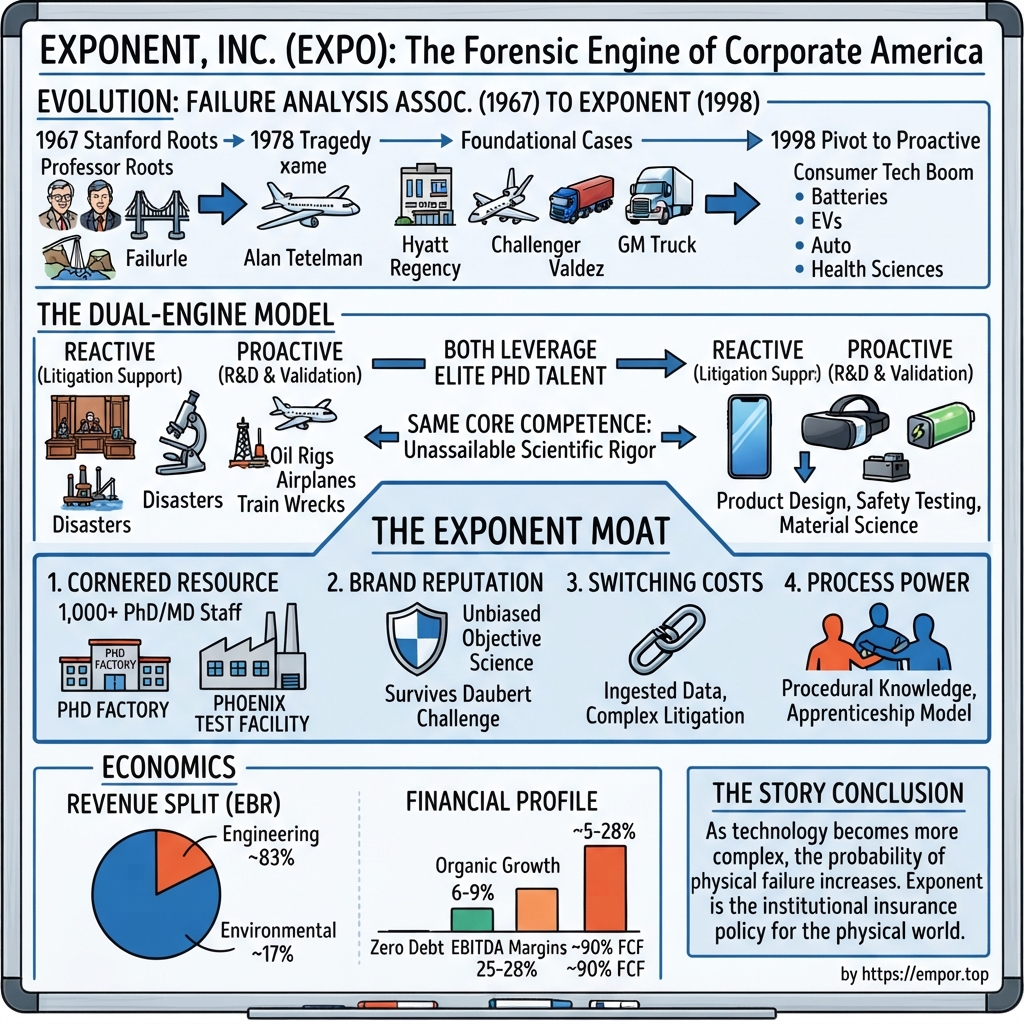
Exponent, Inc. (NASDAQ: EXPO): The Forensic Engine of Corporate America
I. Introduction & Episode Roadmap
There is a particular kind of phone call placed in the first hours after a corporate catastrophe. A battery has caught fire inside a passenger cabin. A structure has collapsed. A regulator has opened an inquiry. A plaintiffs' firm has filed suit in a hostile venue.
Somewhere in that first frantic day, a general counsel or chief engineer dials a firm in Menlo Park, California, whose primary purpose is to answer one question with enough rigor to withstand hostile cross-examination: what actually happened?
That company is Exponent, Inc.
Exponent operates essentially as a private research university that bills by the hour. At the end of fiscal 2025, it employed 1,212 people, of whom 949 were engineering and scientific staff, 922 held advanced degrees, and 731 held doctorates.1 Roughly 60% of the entire company — including administrative personnel, accountants, and IT staff — holds a PhD or equivalent credential. That workforce is organized into seventeen technical practices spanning biomechanics, metallurgy, thermal sciences, human factors, polymer chemistry, epidemiology, and chemical regulation.1
The company's balance sheet is equally distinctive. Exponent carries no long-term debt. It closed fiscal 2025 with $221.9 million in cash and short-term investments and just $8.6 million in goodwill on an $808.6 million balance sheet — the goodwill figure representing the residual value of three small acquisitions completed roughly twenty-five years ago, with essentially none since.2 During fiscal 2025, the firm generated $131.7 million in operating cash flow against $9.4 million in capital expenditures, and returned $159.3 million to shareholders through dividends and share repurchases — distributing more than its free cash flow by tapping into cash reserves.2
The central question
Here is the central puzzle in Exponent's business model.
The firm was founded in April 1967 as Failure Analysis Associates by three Stanford professors — Alan Tetelman, Bernard Ross, and John Shyne — along with two Stanford Research Institute engineers, Marsh Pound and Sathyanaraya Hanagud.3 Its original business required disaster to thrive: bridges had to collapse, boilers had to explode, and aircraft had to fail in flight. When the company listed on NASDAQ in 1990, it traded under the ticker FAIL.3
Yet a business model dependent on external catastrophe is inherently difficult to manage: demand is erratic, revenue is hard to forecast, and staffing is challenging to balance. The defining development in Exponent's history is not how it achieved technical forensic mastery — that capability was foundational. The critical question is how a firm established to conduct engineering autopsies transformed itself into an ongoing risk-mitigation and design-validation partner for global technology, automotive, chemical, and life sciences corporations, and whether that shift established a durable moat or merely exchanged episodic litigation risk for corporate spending cycles.
The historical record indicates that the transition created a defensible franchise, but one with narrower margins of safety and greater cyclical sensitivity than bullish narratives often suggest — a vulnerability demonstrated by recent financial performance.
What we will test
The analysis follows a nine-part roadmap. First, the firm's Stanford origins and the early loss of a founder that shaped its corporate culture. Second, the high-stakes courtroom cases of the 1990s that built Exponent's technical reputation while cementing its controversial status in product-liability litigation. Third, the strategic push into proactive design analysis and the consumer-electronics product cycle. Fourth, the core unit economics of its specialized consulting model: headcount, billable utilization, and realization rates. Fifth, capital allocation discipline and the company's strict organic-growth doctrine tested against its capital returns. Sixth, the 2023–2025 slowdown, which tested common assumptions regarding the counter-cyclical resilience of its revenue base. Seventh, executive succession and corporate governance. Eighth, competitive positioning assessed through classical strategy frameworks. Ninth, the valuation debate distilled into the primary operating metrics that determine future performance.
Throughout this review, competitive claims are evaluated against historical performance. Each argument regarding economic moats is weighed against the strongest disconfirming evidence in Exponent's public filings to determine whether the historical record validates, narrows, or refutes the thesis.
The story begins in a Palo Alto office in 1967, with five engineers and scientists who recognized that the postwar industrial economy was building complex systems faster than it could fully understand their failure modes.
 Subscribe on LinkedIn
II. Origins & The Stanford "CSI" Roots: Failure Analysis Associates (1967–1989)
The intellectual seed of Exponent is a discipline called fracture mechanics — the study of how cracks propagate through solid materials.
For most of industrial history, engineering relied on a safety factor: make a component three times stronger than required and hope for the best. Fracture mechanics replaced hope with mathematics. It established that structural failure is not an unpredictable act of God, but a deterministic outcome governed by flaw size, stress intensity, and material toughness. Given a crack of known length in a known alloy under a known load, an engineer can calculate whether it will grow. Crucially, that equation also runs in reverse: by examining a fractured surface, investigators can reconstruct the exact loading history that caused it.
Alan Tetelman was one of the world's leading authorities on the discipline. Just thirty-one years old when the partnership formed in Palo Alto, he helped guide the group in pioneering what the firm now describes as "a new field: investigating how and why failures and accidents occur."3
Why 1967, and why California
The timing reflected the convergence of two powerful forces.
The first was technological. Postwar industries — jet aviation, nuclear power, petrochemical refining, and high-strength metallurgy — operated materials far closer to their physical limits than prewar manufacturing ever dared. The margin for error had shrunk.
The second was legal. American tort law was undergoing a structural revolution, shifting from traditional negligence standards toward strict product liability. Under the earlier standard, a manufacturer's defense was largely procedural: we followed accepted industry practice. Under strict liability, the question turned physical: did this product contain a defect, and did that defect cause this harm? Answering that required empirical scientific proof.
Failure Analysis Associates emerged to deliver that evidence. Its earliest engagements came from electric utilities and the nuclear power sector, prompting geographic expansion along key industrial corridors in the American West and Gulf Coast, with a Los Angeles office in 1975 and Houston in 1977.3
September 25, 1978
Then came the disaster that permanently defined the firm's culture.
On the morning of September 25, 1978, Pacific Southwest Airlines Flight 182, a Boeing 727 on approach to San Diego, collided with a Cessna over the city's North Park neighborhood. All 137 passengers and crew across both aircraft died, alongside seven people on the ground, making it at the time the deadliest aviation accident in United States history.
Alan Tetelman was on that flight. He was forty-two years old, travelling to San Diego to investigate an unrelated military aircraft crash. He died en route to perform the exact work his firm had been created to conduct.
Bernard Ross took over the presidency.3 Establishing direct causation between a founder's death and corporate behavior nearly five decades later is impossible. Yet the alignment was unmistakable, reinforcing an institutional posture that has persisted ever since: the physical world does not negotiate. A finite element model either matches the fracture surface or it does not. A thermal runaway event either initiates at the observed cell voltage or it does not. Opposing counsel can dispute an interpretation, but they cannot argue with the physical specimen.
The 1980s: from autopsy to laboratory
During the 1980s, the firm evolved from a boutique consultancy into an enduring industrial asset.
Throughout the decade, it expanded across civil and structural engineering, electrical engineering, biomechanics, statistics, human factors, and visual communication.3 Visual presentation proved pivotal in the courtroom: explaining technical failure modes to a jury required clear visual evidence, prompting Exponent to build computer animation and scientific visualization capabilities early.
The decisive operational leap occurred in 1985, when the firm invested in a 147-acre Test and Engineering Center in Phoenix, Arizona.3 Today, that site features roughly 27,000 square feet of indoor testing space, an oval track, a skid pad, a crash rail, all-terrain test areas, robotic vehicle-control rigs for automated driving evaluation, motion-capture biomechanics laboratories, and a 450-kilovolt computed tomography scanner used to inspect battery cells without cutting them open.4
From an analytical standpoint, this capital commitment converted a variable-cost professional services firm into one supported by scarce, proprietary infrastructure. A competing litigation boutique can hire a gifted metallurgist, but it cannot easily permit and construct a 147-acre outdoor crash facility in a major metropolitan area, nor can it amortize an industrial CT scanner across an individual matter.
At the same time, the strategic moat provided by these assets requires realistic sizing. Exponent's capital expenditures totaled $9.4 million in fiscal 2025, with management guiding to $12 million to $14 million for 2026 — roughly 2% of annual revenue.25 The core business remains fundamentally asset-light. The Phoenix facility serves as an effective operational differentiator and a barrier against casual competitors, but it is not a capital sinkhole or a multi-billion-dollar fabrication barrier.
A note on attribution
Exponent's commercial profile, alongside much of the secondary literature surrounding it, frequently links the firm to nearly every prominent American disaster of that era. Some assignments are rigorously documented; others are not. The 1981 Hyatt Regency walkway collapse in Kansas City, for instance, remains a foundational case study in structural failure — 114 people were killed after an unreviewed design change doubled the load on a hanger-rod assembly — but the definitive technical investigation of record was conducted by the National Bureau of Standards, the predecessor of NIST.6 Primary sources do not substantiate Failure Analysis Associates' specific role in that inquiry, making any direct attribution unwarranted.
That analytical restraint is particularly vital for a business whose entire commercial value rests on refusing to assert what it cannot independently substantiate. A rigorous assessment of the company must adhere to that same standard.
What the public record confirms is that by the close of the 1980s, the firm had established a defensible technical franchise, a physical testing complex unmatched by direct peers, and an underlying business model hobbled by one severe flaw: highly unpredictable revenue. Stabilizing that volatility became the defining project of the next three decades, starting with the decision to go public.
III. Disasters, Courtrooms, and the "Hired Gun" Crucible (1990–2005)
When Failure Analysis Associates listed on NASDAQ in 1990 under the ticker FAIL, the symbol offered an unvarnished summary of the public investment case.3 Public shareholders were acquiring an interest in the cash flows of catastrophe. When an industrial refinery burned or an airframe suffered structural failure, billings surged. When accidents abated, revenue vanished.
The structural problem with selling autopsies
The underlying economics of pure forensic engineering presented an inherent operational challenge.
A major piece of product-liability or structural litigation generates intense, lucrative billings: dozens of specialized experts, thousands of billable hours, physical crash testing, and extensive deposition preparation. Then the case settles. When litigation concludes, revenue does not taper off gradually; it halts overnight. Meanwhile, the firm's cost structure consists primarily of salaried doctoral-level researchers who cannot be hired and dismissed in cadence with a court docket without eroding the specialized human capital that constitutes the firm's core asset.
This dynamic represents operating leverage working in reverse. It remains a foundational vulnerability in Exponent's business model more than three decades later, directly contributing to the firm's operating slowdown between 2023 and 2025.
The case that built the brand
The assignment that transformed Failure Analysis Associates from a respected engineering boutique into a corporate household name arrived in November 1992.
On November 17 of that year, Dateline NBC broadcast an investigative segment titled "Waiting to Explode," alleging that General Motors' C/K-series pickup trucks, designed with external "sidesaddle" fuel tanks, routinely caught fire during side-impact collisions. The program featured a staged crash demonstration in which a test pickup erupted into flames.
General Motors contested the findings and retained Failure Analysis Associates to examine the television footage and the vehicle wreckage. The forensic finding proved decisive: smoke began venting from the fuel tank area six frames before the test vehicles actually made contact. Something had ignited prior to impact; the demonstration had been staged with remote incendiary devices and an improperly fitted gas cap.7
On February 9, 1993, NBC settled General Motors' defamation lawsuit, issued an on-air apology through co-anchor Stone Phillips conceding that an inappropriate demonstration had been broadcast, and agreed to reimburse the costs of General Motors' investigation.8
For a network news division, the retraction was an extraordinary institutional embarrassment. For Failure Analysis Associates, it became the most potent commercial marketing event in its history. The demonstration delivered an unambiguous message to corporate defendants facing existential product-liability claims: when an accusation hinges on physical dynamics, rigorous physical science can dismantle the narrative.
The counter-narrative
That rising prominence also accelerated an enduring critique that has followed Exponent for decades and remains central to evaluating its commercial franchise.
The claim, advanced repeatedly by plaintiffs' attorneys, regulators, and academic researchers, is that Exponent operates not as an impartial arbiter but as a credentialed instrument of corporate defense — a producer of what critics term "doubt science," in which research consistently emphasizes scientific uncertainty, confounding variables, and the necessity of further study, in a manner that reliably aligns with client interests.
A 2016 investigative report by Myron Levin and Paul Feldman documented the specifics behind the allegation. David Michaels, then the head of the Occupational Safety and Health Administration (OSHA), stated plainly: "I have yet to see an Exponent study that does not support the conclusion needed by the corporation paying the bill." A mesothelioma plaintiffs' attorney described the firm's peer-reviewed papers as "litigation reports dressed up as science." Most notably, Jeffrey Croteau, the director of Exponent's vehicle practice, testified that he had participated in approximately 500 automotive lawsuits without once concluding that any component of any vehicle was defective.9
The same investigation detailed the financial relationships behind the work. Ford Motor Company paid Exponent more than $106 million between 1999 and 2011. Toyota Motor paid more than $33 million between 2010 and the third quarter of 2013, primarily in connection with unintended-acceleration litigation. Automakers, led by Ford, paid more than $33 million between 2001 and 2014 for technical defense against asbestos brake claims.9 The firm's engagements spanned defense research on tobacco and secondhand smoke in the 1990s, automotive rollover and roof-crush standards, agricultural pesticides such as glyphosate and chlorpyrifos, endocrine disruptors, and environmental damage assessments following the Exxon Valdez and Deepwater Horizon oil spills.9
Exponent has consistently rejected this characterization, maintaining that it operates with "integrity, objectivity, independence, and professionalism," performs work for government agencies, municipalities, and plaintiffs alongside defense counsel, and relies on long-term scientific credibility rather than any client's immediate commercial objective. Its executive chairman at the time dismissed the criticism as an unfounded attack, asserting that the firm routinely delivered findings its clients preferred not to hear, while declining to cite specific examples.9
Weighing it
Does this persistent "hired gun" critique undermine the investment thesis? A rigorous evaluation requires distinguishing the reputational and ethical dispute from the commercial reality.
From an evidentiary standpoint, the Croteau statistic is difficult to explain away. A baseline of zero defect findings across approximately 500 legal matters diverges substantially from an unbiased statistical distribution, even when accounting for the selection bias of which cases corporate defendants elect to contest in court.
From an economic standpoint, however, the critique has circulated publicly for decades without impeding the firm's growth. Exponent's revenues before reimbursements expanded from approximately $315 million in fiscal 2016 to $536.8 million in fiscal 2025.105 The buyers of these services are corporate legal departments and defense law firms seeking expert witnesses capable of withstanding hostile cross-examination and rigorous Daubert admissibility challenges in federal court. A reputation for unyielding defense advocacy does not diminish that commercial value; in practice, it frequently reinforces it.
The balanced conclusion is that advocacy criticism does not represent an active threat to top-line demand. Instead, it introduces two distinct structural considerations: recruitment friction and tail risk. In public health and environmental disciplines, persistent reputational scrutiny can complicate the recruitment of top academic researchers. More critically, it creates an asymmetric vulnerability: while political and regulatory criticism has proved commercially benign, an indisputable methodological failure in a high-profile assignment could inflict severe franchise damage by discrediting the scientific rigor of the underlying product. The 2015 "Deflategate" controversy, in which Exponent's ideal-gas-law analysis for the National Football League's Wells Report faced public technical challenges from outside physicists, offered a clear demonstration of that specific exposure.[^11]
The rebrand
The firm's corporate architecture evolved alongside its broadening technical scope. The business reorganized as The Failure Group, Inc. in 1989, acquired Environmental Health Strategies in 1996 and PTI Environmental Services in 1997, and in 1998, under chief executive Michael Gaulke, formally changed its name to Exponent.31
The immediate corporate rationale was straightforward: Gaulke recognized that the word "Failure" created counterproductive branding for a practice expanding into environmental science and human health. Yet the deeper motivation was strategic. A consulting firm cannot effectively market preventative engineering, quality assurance, and proactive design validation under a brand that signals it arrives only after disaster strikes. The rebrand marked the initial phase of a multi-decade transition from episodic forensic autopsies to recurring corporate risk management — retiring the ticker FAIL in the process.
IV. The Pivot to "Proactive": Consumer Tech & The Lithium-Ion Supercycle (2006–2021)
The economic arithmetic that shaped the next two decades stemmed from a fundamental shift in client engagements.
A forensic assignment on a consumer product that has already failed in the field is a finite, episodic piece of work. It has a discrete beginning, an endpoint, and often concludes with a legal settlement. Assisting in the design and validation of that same product before it reaches the market operates under fundamentally different economics: it recurs with every successive product cycle, expands alongside the client's corporate research-and-development budget, and embeds Exponent within an ongoing product launch calendar rather than an unpredictable court docket.
Exponent's management does not disclose an explicit proactive-versus-reactive revenue split as an official accounting line item, meaning the exact proportion cannot be verified with precision. However, executive leadership characterizes the two streams qualitatively on quarterly earnings calls and provides directional growth trends for each, providing sufficient clarity to evaluate the underlying business model.
Why lithium-ion changed everything
The technological catalyst that scaled this proactive practice was the rechargeable lithium-ion battery.
A lithium-ion cell packs dense energy into a compact package, with its positive and negative electrodes separated by a porous polymer membrane only twenty micrometers thick—roughly one-quarter the width of a human hair. If that separator tears, degrades, or is pinched during assembly, the electrodes make direct contact. Current surges across the internal short circuit, generating intense localized heat. Above a critical temperature threshold, the chemical reaction becomes self-sustaining, producing more heat than the cell can dissipate. Engineers term this thermal runaway; consumers recognize it as a smoking smartphone or an in-flight battery fire.
The commercial significance for an engineering consultancy lies in how these failures manifest. Thermal runaway is a materials physics problem governed by manufacturing tolerances and analyzed through probability statistics. A defect rate of one in a hundred thousand units is virtually undetectable in small prototype runs, yet it guarantees dozens of hazardous failures when scaled across a production run of fifty million devices. Diagnosing and preventing that risk requires materials science, thermal modeling, electrical engineering, and quality-control statistics working in concert—an interdisciplinary combination that mirrors Exponent's core organizational structure.
The Galaxy Note 7
The definitive case study for this market arrived in 2016.
Following the high-profile launch of the Galaxy Note 7, Samsung Electronics faced reports of devices overheating and catching fire, including incidents aboard commercial aircraft. The company initiated a global recall, issued replacement units with batteries from an alternate supplier, and was ultimately forced to recall the replacement devices when they too caught fire—resulting in one of the most financially damaging product recalls in consumer technology history.
The subsequent investigation Samsung initiated was unprecedented in scope: roughly 700 engineers evaluated 200,000 devices and 30,000 separate battery cells, while three independent testing organizations—UL, Exponent, and TÜV Rheinland—conducted parallel forensic examinations.11 At a Seoul press briefing on January 23, 2017, Samsung disclosed the technical findings: two distinct physical defects across two different battery suppliers. In the primary supplier's cells, a design defect in the curved upper corner squeezed the electrodes too closely together, causing internal contact. In the secondary supplier's cells, microscopic burrs generated during ultrasonic welding punctured the separator, bridging the positive tab and the negative electrode.1112
That technical conclusion captured the essential value proposition of proactive consulting. Two separate physical failure mechanisms, originating from two independent component manufacturers, had yielded an identical catastrophic symptom—a flaw that could only be identified by deconstructing tens of thousands of battery cells using industrial computed tomography and electron microscopy, combined with statistical correlation.
For Exponent, the lasting commercial payoff was not simply the forensic fee earned from investigating the recall. Rather, global consumer hardware manufacturers recognized that a fatal defect in a flagship product line had escaped standard pre-launch quality checks. That realization sparked an industry-wide reassessment of product testing, driving durable, recurring demand for independent pre-market validation across annual hardware release cycles.
The other pillars
Two parallel initiatives complemented the expansion into consumer electronics.
The first involved automotive electronics. In December 2009, Toyota retained Exponent to determine whether electronic throttle control systems could trigger unintended acceleration. Exponent purchased six production Toyota and Lexus vehicles equipped with the electronic throttle system and reported in February 2010 that its engineers had been unable to induce unintended acceleration in any of the test vehicles.13 The engagement illustrated the firm's operational strengths and vulnerabilities alike: it highlighted an ability to design and execute a complex, defensible testing program under intense regulatory scrutiny, while simultaneously serving as a prominent example for critics who argue the firm's findings reliably align with defense-client objectives.
The second pillar centered on environmental and health sciences, developed in part through targeted acquisitions. In 2002, Exponent acquired Novigen Sciences to establish its Chemical Regulation and Food Safety practice and opened its first international office in China that same year.3 Unlike engineering, this segment aligns with long-term regulatory frameworks rather than annual commercial product cycles: evaluating pesticide and chemical registrations, assessing food safety protocols, modeling toxicological exposure risks, and advising on multi-district litigation involving per- and polyfluoroalkyl substances (PFAS), commonly termed "forever chemicals."
The business characteristics of the Environmental and Health segment differ markedly from the engineering practices. While its work is generally less exposed to corporate discretionary spending cycles, tied instead to multi-year statutory reviews and court dockets, it remains smaller and has recently lagged in operational performance. In the fourth quarter of fiscal 2025, Environmental and Health generated 15% of revenues before reimbursements and declined 5% year over year, while Engineering and Other Scientific grew 7%.5 While emerging liabilities around PFAS represent a potential multi-year catalyst, that tailwind had not translated into segment growth by early 2026, making any investment thesis contingent on near-term environmental expansion unsupported by reported results.
What the pivot actually accomplished
Through this strategic transition, Exponent built a business substantially more diversified than the pure litigation consultancy that went public under the ticker FAIL. By fiscal 2025, client revenue was distributed across consumer products at 21%, energy and utilities at 20%, transportation at 16%, and chemicals at 11%—a balanced industrial portfolio rather than an erratic court docket.1
Yet that transformation also introduced an unhedged operational exposure: direct sensitivity to the discretionary research and development budgets of major consumer technology corporations. While that exposure fueled robust top-line growth through the consumer hardware boom, it also exposed the business to sudden corporate belt-tightening during the spending contractions of 2023 and 2024. Analyzing how that vulnerability manifested requires examining the underlying unit economics that govern Exponent's consulting model.
V. The Economics of the PhD Factory: Business Model & Segment Anatomy
Exponent's operating model is straightforward to analyze and difficult to obscure because top-line growth is governed by three core variables.
Revenue before reimbursements—the primary metric management guides toward and the one that reflects underlying performance, given that client-reimbursed expenses like travel and third-party laboratory fees pass through at zero margin—is the mathematical product of billable technical headcount, billable utilization, and realized hourly billing rates.
Headcount multiplied by utilization multiplied by realized rate: that formula drives the entire economic engine.
Where the numbers actually sit
In fiscal 2025, that formula generated modest top-line expansion. Average technical full-time-equivalent employees reached 973, up roughly 1% year over year. Billable utilization slipped slightly to 72.5% from 72.9%, while total billable hours declined 2% to approximately 1,468,000. Offsetting that volume contraction, realized billing rates rose about 5%.14
Multiplying those factors yielded revenues before reimbursements of $536.8 million, an increase of 3.5%, alongside EBITDA of $148.1 million, representing an EBITDA margin of 27.6% of net revenue.5
The first quarter of fiscal 2026 demonstrated the compounding effect when all three drivers accelerate simultaneously. Technical headcount reached 1,013, up 5% year over year; utilization rose to 76% from 75%; billable hours expanded 6% to roughly 399,000; and realized rates increased 4%. As a result, net revenue rose 10% to $151.8 million, while the EBITDA margin expanded to 28.4% from 27.3%.15 The second quarter maintained that momentum, reporting technical headcount of 1,012 (up 6%), utilization of 74% compared to 72% in the prior-year period, and billable hours climbing 8% to roughly 390,000.16
The mechanism behind that margin expansion across both quarters was direct: while headcount grew 5% to 6%, billable hours grew 6% to 8%, expanding operating margins by roughly a full percentage point. That positive spread between headcount growth and billable hour growth is utilization—and utilization is the primary lever governing Exponent's profitability.
The leverage, quantified
The underlying mechanism reflects a basic mathematical reality of professional services. A senior engineer's compensation does not fluctuate with short-term client demand; it represents an essentially fixed operational cost. If an engineer bills 74% of available hours rather than 68%, the firm captures approximately 9% more revenue against a virtually unchanged expense base, allowing almost the entire incremental dollar to flow directly into operating profit.
In reverse, that same dynamic generates severe operating deleverage. In fiscal 2023, billable utilization dropped to 69%.17 In fiscal 2024, it rebounded to 73%.17 With essentially the same personnel and billing rates, that four-percentage-point recovery in utilization lifted the EBITDA margin back from the mid-twenties to 28.4%.
This dynamic makes billable utilization the single most revealing operating metric in Exponent's disclosures, establishing the target band management consistently characterizes as the "mid-70s" as the benchmark against which quarterly execution must be evaluated.17
The anti-pyramid
The second structural distinction lies in the architecture of Exponent's organizational chart, which inverts the conventional professional-services model.
A traditional management consultancy or accounting firm operates as a leverage pyramid: a small tier of partners originates business, an expansive base of junior analysts executes the billable hours, and corporate profit is generated from the spread between junior salaries and client billing rates. In that structure, scaling revenue requires widening the base.
Exponent cannot adopt that model for reasons rooted in courtroom admissibility and regulatory standing. A federal jury will not defer to technical testimony delivered by an entry-level analyst, nor will a regulatory body accept a toxicological assessment signed by an investigator lacking recognized standing in the discipline. The technical conclusions must be formulated and defended under cross-examination by credentialed authorities. This necessity explains why 731 employees hold doctorates within a total workforce of 1,212.1
That structural requirement is reflected directly in the firm's billing schedule. In fiscal 2025, Exponent's disclosed hourly billing rates ranged from $225 to $1,375 per hour.1 The upper boundary represents what a testifying principal commands in high-stakes litigation, while the lower end covers junior staff scientists. Because there is no broad pyramid of entry-level associates to dilute the blended rate, realization remains high.
Yet that same structure imposes an operational constraint frequently overlooked in bullish narratives. Without the ability to scale through junior leverage, the business cannot grow organically any faster than it can recruit, integrate, and develop specialized doctoral talent. For 2026, management guided to 4% to 5% growth in technical headcount—amounting to roughly 40 to 50 net new hires.14 That projection represents the firm's fundamental organic capacity ceiling. Any revenue expansion beyond that pace must be generated through higher utilization or rate increases. Furthermore, utilization faces a natural ceiling below 80% once allowances are made for vacations, professional training, business origination, and non-billable administrative responsibilities.
Segment anatomy
Financially, Exponent reports through two segments spanning seventeen distinct technical practices.1
Engineering and Other Scientific serves as the primary economic engine, encompassing thirteen practices: biomechanics, biomedical engineering, civil and structural engineering, construction consulting, data sciences, electrical engineering, human factors, materials science, mechanical engineering, metallurgy, polymers and chemistry, thermal sciences, and vehicle engineering.1 In the second quarter of fiscal 2026, this segment generated 85% of revenues before reimbursements.16
Environmental and Health accounts for the remaining 15% across four practices: chemical regulation and food safety, ecological and biological sciences, environmental and earth sciences, and health sciences.116
This composition clarifies an important operational reality. Exponent is not a balanced, two-engine business; it is fundamentally an engineering consultancy with a specialized regulatory-sciences arm attached. Moreover, the division long viewed as counter-cyclical ballast has recently lagged the broader firm. When leadership emphasizes revenue diversification, that diversification exists primarily within the engineering segment—distributed across consumer hardware, electric utilities, transportation, and industrial clients—rather than across reporting segments.
That distinction proves critical when a major client industry curtails capital commitments, an exposure that surfaced directly in the recent operating cycle. Before examining that demand shock, however, the economic engine raises a fundamental question: how does the firm deploy the substantial cash flows its high-margin model generates?
VI. Capital Allocation & The "Anti-M&A" Doctrine
Every few years a private equity firm examines the forensic engineering and expert services sector and identifies the same opportunity: a fragmented landscape of subscale technical boutiques, apparent operational synergies, and multiple arbitrage. The standard playbook calls for acquiring regional firms at eight to ten times EBITDA, executing roll-ups, cross-selling specialized practices, and seeking an exit at fourteen times.
Adjacent professional-services firms—including FTI Consulting, the entities that consolidated into Guidehouse, CRA International, and the engineering divisions of multidisciplinary conglomerates—expanded substantially through acquisitions. The recurring vulnerabilities of that strategy are well established across the industry: goodwill write-downs following practice underperformance, cultural friction between original and acquired partners, and the departure of key client-facing principals once contractual earnouts vest.
Exponent has largely avoided that consolidation wave. Yet the common assertion that the firm has avoided mergers and acquisitions entirely oversimplifies its actual corporate history.
What the record actually shows
The company completed three strategic transactions while establishing its environmental and health capabilities: acquiring Environmental Health Strategies in 1996, PTI Environmental Services in 1997, and Novigen Sciences in 2002.3 Those additions created an enduring practice area that remains an integral reporting segment.
Since that initial expansion, deal activity has remained dormant. Goodwill on the balance sheet stood at $8.6 million at the end of fiscal 2025—unchanged from the prior two years—and cash flow statements show zero acquisition spending across each fiscal year from 2020 through 2025.2
The accurate characterization is therefore more nuanced than total abstinence: Exponent acquired selectively around the turn of the millennium to build specialized capabilities it could not readily seed organically, and has deployed essentially no acquisition capital in more than two decades. That posture remains rare across professional services, even if it falls short of an absolute ban.
That operational restraint is reinforced by a structural reality unique to high-stakes expert testimony. If Exponent acquires a boutique whose experts authored questionable reports or offered fragile testimony years earlier, opposing counsel can present that record before a federal judge to impeach the credibility of the entire firm. In standard commercial industries, a troubled legacy contract represents a financial write-off. In expert litigation consulting, it represents a permanent attack surface on the primary commercial asset.
Where the money goes instead
With external corporate takeovers off the table, capital allocation flows almost entirely into shareholder distributions—a program that has shifted over recent years from steady returns into aggressive capital deployment.
Between fiscal 2021 and fiscal 2025, that program unfolded with notable annual variability. In fiscal 2021, the firm distributed $43.2 million in dividends and spent $7.0 million on share repurchases. In fiscal 2022, repurchases jumped to $155.9 million alongside $49.2 million in dividends. As broader demand subsequently softened, capital returns contracted: buybacks dropped to $24.2 million in fiscal 2023 and fell to $5.7 million in fiscal 2024, even as annual dividends climbed to $54.0 million and $58.2 million, respectively. In fiscal 2025, share repurchases rebounded sharply to $97.1 million alongside $61.5 million in dividends.2
That cadence complicates the thesis of a disciplined, counter-cyclical capital allocator. Exponent repurchased stock aggressively in 2022 when its market valuation was elevated, yet turned nearly dormant in 2024—the year the business experienced its sharpest cyclical slowdown and when its shares traded at their lowest levels. In fiscal 2025, the company resumed large-scale repurchases, retiring shares at an average price of $72.22.14 By comparison, the stock closed at $68.35 on September 4, 2026.18
In the first half of fiscal 2026, the repurchase program accelerated significantly. Exponent completed $79 million in repurchases during the first quarter at an average price of $68.09, and deployed $146.1 million across the six-month period alongside $31.3 million in dividends.1516 Over the trailing twelve months through the second quarter, the company repurchased roughly $211 million in equity, reducing its diluted share count by approximately 5% to around 49 million shares.16 To support that activity, the board expanded the buyback authorization by $50 million in each of the first two quarters of 2026, lifting the cumulative program to $836.7 million, while cash reserves dropped from $221.9 million at year-end to $66.6 million by early July.165
The honest scorecard
Exponent's underlying balance-sheet quality is not in dispute. The firm carries no funded long-term debt; the $82.8 million listed as total debt reflects operating lease obligations for regional offices and testing laboratories rather than commercial borrowings.2 Capital expenditure demands remain minimal, and the board has steadily increased the dividend, raising it from $0.30 to $0.31 per quarter alongside the fiscal 2025 financial results.5
Yet the designation of a disciplined capital allocator must be demonstrated across cycles rather than assumed, and Exponent's execution on share repurchases shows an unexceptional record. Committing $155.9 million to buybacks near market highs in 2022 while pulling back to just $5.7 million in 2024 reflects pro-cyclical execution rather than value-conscious timing. While the heavy repurchases in early 2026 were completed below the 2025 average purchase price, they were funded by drawing down more than two-thirds of the firm's cash balance in six months—substantially narrowing an operational liquidity cushion the company had maintained for decades.
The defensible conclusion is narrower than typical market commentary suggests: Exponent has demonstrated exceptional discipline by refusing to dilute shareholder returns through speculative acquisitions—a rare and valuable virtue in human-capital businesses. However, it has shown little evidence of opportunistic timing in its share repurchases. Those are distinct corporate competencies, and only the first is validated by the historical record.
This dynamic leads directly into the multi-year operating period that tested every underlying assumption regarding the stability of Exponent's client demand.
VII. The 2022–2024 Tech Hangover & The Historical Falsification Stress Test
For long-term observers of Exponent, the multi-year downturn that began in 2022 provided the clearest empirical test of the company's business model in a decade. Prolonged contractions test whether core competitive advantages hold under pressure.
What happened
Following the pandemic hardware surge, major consumer technology platforms sharply reduced discretionary research and development spending. Consumer hardware programs paused, product roadmaps lengthened, and corporate capital redirected toward artificial intelligence infrastructure. Exponent's proactive consumer-electronics practice—the primary growth engine of the preceding fifteen years—abruptly stalled.
The consequences surfaced immediately in the firm's critical operating lever: billable utilization. In fiscal 2023, utilization fell to 69%, well below management's target band in the mid-70s.17 Exponent found itself carrying an expensive roster of salaried, fixed-cost doctoral staff against sharply reduced client demand.
Once executive leadership recognized that the spending freeze was not a brief air pocket, the firm adjusted its cost structure. Over the course of eighteen months, management steadily reduced technical headcount. Average technical full-time-equivalent employees for fiscal 2024 declined 8% from 2023 to 967, with fourth-quarter headcount falling 6% year over year to 947.17 Chief Financial Officer Rich Schlenker framed the contraction plainly on an earnings call, noting that headcount had declined year over year as the firm aligned its resources with client demand.17
That contraction restored operational profitability. For fiscal 2024, billable utilization recovered to 73%, fourth-quarter utilization improved to 68% from 65%, and the full-year EBITDA margin reached 28.4%.1719 Yet capacity reduction also created an operational hurdle entering 2025: the company began the year with a 5% to 6% headcount deficit, guided first-quarter revenue down in the low single digits, projected full-year revenue growth in the low single digits, and guided the EBITDA margin to between 26.25% and 27.0%—well below the prior year's performance.17
Testing the claims
Evaluating the investment thesis requires testing its core claims against the historical record.
Claim one: Exponent is a counter-cyclical, all-weather business.
This claim sustained the most direct empirical damage. Exponent's reactive forensic and litigation practices demonstrate genuine counter-cyclical resilience—corporate legal disputes do not subside during macroeconomic downturns, and in the third quarter of fiscal 2025, reactive billings grew approximately 18% while proactive work remained roughly flat.20 However, the proactive practice—which generated the firm's valuation premium and established its deep exposure to consumer electronics—is inherently pro-cyclical with corporate research-and-development budgets. When those budgets were curtailed, demand contracted rapidly.
Verdict: Rejected in its generalized form and narrowed to a specific reality. Exponent operates two distinct commercial engines with opposing cyclical characteristics. During the 2023–2024 downturn, those engines failed to counterbalance one another because the pro-cyclical proactive practice had become larger and contracted more rapidly than the litigation practice grew. The key indicator going forward is the growth spread between reactive and proactive billings, which management describes qualitatively on quarterly calls. If a future pullback in consumer electronics yields flat rather than negative net revenue, an operational offset will have been proven. Until then, the record indicates that proactive exposures dominate broader downturns.
Claim two: Exponent has uncapped pricing power.
Realized rate increases tracked within a tight band: roughly 5% in fiscal 2025, about 6% in the third quarter of 2025 when the mix favored senior staff, and approximately 4% in the first half of 2026, alongside full-year management guidance of 3.5% to 4%.14201516 Schlenker explained that realized rate increases would normalize toward 3% to 3.5% as hiring accelerated and junior staff entered the workforce.20
Verdict: Narrowed rather than refuted. Exponent possesses consistent, above-inflation pricing power in the mid-single digits. However, it does not command uncapped pricing elasticity, a constraint management acknowledges directly. Realized rate growth also reflects a structural workforce mix: hiring additional junior researchers dilutes blended billing rates, meaning pricing realization and headcount expansion are interdependent variables rather than separate growth levers.
Claim three: Management protects elite talent through downturns rather than reducing staff.
This claim requires explicit correction, as market commentary frequently overstates the firm's willingness to absorb idle capacity. Exponent did not navigate the downturn with its technical roster intact; it reduced average technical headcount by 8% year over year in fiscal 2024.17
Verdict: Rejected as formulated. The historical record supports a narrower and still disciplined practice: capacity reductions were executed gradually through attrition and restrained hiring over eighteen months rather than abrupt mass layoffs, and leadership resumed recruiting as soon as demand stabilized, generating sequential headcount gains by late 2024 and 4% to 5% year-over-year expansion by 2026.1714 Chief Executive Officer Catherine Corrigan outlined this approach on the fourth-quarter 2024 earnings call, emphasizing that while recruitment could be accelerated, the company prioritized maintaining sustainable growth aligned with demand rather than aggressive overexpansion.17
This represents a prudent operating discipline, but it directly contradicts the notion of an unbending commitment to maintain headcount regardless of demand. Investors must view Exponent as an enterprise that actively manages capacity downward during slumps, accepting the hiring lag required when demand rebounds.
Claim four: Organic talent scaling is effectively unlimited.
The 2024 contraction demonstrated clear boundaries on personnel growth. Technical headcount is constrained on the downside by demand visibility—the partnership will not carry unbillable doctorates indefinitely—and bounded on the upside by recruiting capacity and a strict refusal to lower hiring standards. Truist analyst Tobey Sommer pressed this structural ceiling on the second-quarter 2026 earnings call, citing a projected 15% decline in U.S. doctoral admissions.16
Corrigan offered a concrete defense of the firm's talent pipeline, explaining that Exponent recruits from premier research universities by offering direct industrial impact as an alternative to traditional academia, and adding that roughly 95% of its hires require no visa sponsorship.16 That domestic staffing ratio provides meaningful insulation against shifting immigration policies, reflecting a deliberate operational strategy rather than standard corporate rhetoric.
Verdict: Rejected. Headcount availability represents a structural constraint and functions as the primary governor on Exponent's long-term organic growth rate.
The recovery
The subsequent recovery unfolded swiftly. Fiscal 2025 delivered 3.5% net revenue growth alongside a 27.6% EBITDA margin—tracking the low end of a normal operating year and exceeding the guidance the company issued entering the period.5 Performance accelerated further into fiscal 2026, delivering net revenue growth of 10% in the first quarter and 12% in the second alongside expanding operating margins.1516
Following the second-quarter results, management raised full-year guidance to 9% to 10% net revenue growth and an EBITDA margin of 27.8% to 28.1%, up from high-single-digit growth and 27.6% to 28.1% previously.165
An important qualification accompanies that reported acceleration. A single large user-research study contributed approximately 4% of revenues in the second quarter against an anticipated 2%, and Chief Financial Officer Eric Anderson informed analysts that the remaining phase would run at roughly 2% for the balance of the year.16 A portion of the second-quarter top-line surge reflected project revenue being pulled forward, placing underlying run-rate growth somewhat below headline numbers. Management's prompt disclosure of that contract dynamic provided welcome transparency, while reminding investors that project timing can temporarily distort quarterly trends.
VIII. Current Management, Incentives & Governance
Catherine Ford Corrigan serves as chief executive of Exponent, and her professional trajectory reflects the internal culture the firm promotes.
She trained as a biomechanical engineer and joined the company in the 1990s, specializing in injury biomechanics—evaluating how biological structures deform and fail under dynamic impact forces. She became president in 2016 and chief executive in 2018, succeeding Paul Johnston, who had joined the firm in 1981, led the health and environmental practices, became chief operating officer in 2003 and president in 2007, and assumed the chief executive role at the board meeting following the annual shareholder meeting on May 28, 2009.21
That promotion pattern defines the firm's governance philosophy. Exponent has been led by technical practitioners who advanced through its consulting practices for three consecutive chief executive tenures—with Michael Gaulke, who transferred executive leadership to Johnston after what the company described as "sixteen plus years" at the firm and who oversaw the 1998 rebrand, serving as the partial exception as a former chief financial officer.21 In an enterprise where the underlying product is credentialed scientific authority, employing a chief executive who has personally provided expert testimony under deposition functions as both a recruiting asset and a cultural reinforcement mechanism.
The 2026 reshuffle
On April 6, 2026, Exponent announced its most significant executive realignment in nearly a decade.22
Effective May 1, John Pye became president. Pye joined Exponent in 1999, was promoted to principal engineer in 2006, and directed the Phoenix Test and Engineering Center before leading the Technology Development practice, serving as corporate vice president, group vice president for transportation, and vice president of global offices and innovation.22 Corrigan described him as "a visionary leader with deep technical credibility and a keen ability to see around corners."22
Concurrently, Eric Anderson assumed the role of chief financial officer. Anderson joined Exponent in 2003 as controller, became a vice president in 2013, and was appointed vice president of finance and accounting in 2024.22
He succeeded Rich Schlenker, who had served as chief financial officer for more than two decades—overseeing financial reporting through the aftermath of the dot-com contraction, the 2008 financial crisis, the expansion into consumer hardware validation, the pandemic, and the 2023–2024 demand slump. Schlenker remained with the firm as an executive vice president focused on corporate governance and investor relations, standing for election to the board of directors at the June 4, 2026 annual meeting.2215
How to read this transition
Two distinct interpretations emerge from this executive realignment.
The constructive reading, supported by the organizational structure, views the transition as orderly succession planning within an internal partnership model: two executives with more than two decades of institutional tenure were promoted simultaneously, while the longtime chief financial officer transitioned to the board to preserve strategic continuity. The firm executed the C-suite succession through the same internal development pathway that governs its consulting roster.
A more skeptical reading notes that concentrating institutional memory in a board seat provides less day-to-day oversight than operational tenure, and that executing a financial transition during an operating rebound leaves Anderson's forecasting discipline yet to face a major cyclical contraction. His initial disclosures show directness: he raised full-year guidance following the second quarter while explicitly quantifying the revenue pulled forward by a single large user-research project, and pushed back when JPMorgan analyst Tomo Sano suggested third-quarter utilization guidance of 74% to 75% appeared conservative in light of artificial intelligence demand—explaining that fourth-quarter utilization declines predictably due to year-end holidays and vacations, requiring full-year utilization to remain between 72.5% and 73%.16 That response adhered to structural operational baselines rather than narrative enthusiasm.
Incentives — and a governance flag
The executive compensation framework presents a more mixed structure, diverging in key respects from standard corporate incentive design.
For fiscal 2025, the chief executive's quantitative performance award was determined by two equally weighted metrics: a 3.0% target for growth in revenues before reimbursements, against which actual growth of 3.52% yielded a payout factor of 1.05; and an adjusted EBITDAS margin target of 31.71%, which the firm exceeded by 31 basis points for a factor of 1.15. The composite factor of 1.10 generated a $450,000 award. A separate qualitative incentive with a target of $816,667 was evaluated 25% on revenue growth, 25% on profitability measures, and 50% on executive leadership objectives.23
Long-term equity incentives are awarded primarily in restricted stock units subject to four-year cliff vesting, and approximately 40% of annual executive bonuses are delivered in equity rather than cash.23
The notable characteristic is what the framework omits: the plan incorporates no relative total shareholder return metric and no performance-contingent equity tied to multi-year operational benchmarks. Long-term compensation consists entirely of time-vesting equity. Four-year cliff vesting operates as a potent retention mechanism—imposing a stricter holding requirement than the annual ratable vesting standard prevalent across public corporations—an important feature for a firm whose core intellectual assets can readily depart. However, time-vesting grants vest identically whether the equity compounds or stagnates, while annual bonus formulas evaluate top-line growth and operating margins over a single-year period—the exact timeframe vulnerable to hiring excessively during cyclical upturns or pruning capacity during cyclical downturns.
From a governance standpoint, that structure offers weaker direct alignment with multi-year shareholder value creation. Shareholders, however, have registered minimal opposition: approximately 95.7% of votes cast supported the fiscal 2024 executive compensation program.23
The broader governance profile remains conventional: five of the six board members are independent, all board committees consist entirely of independent directors, board members stand for election annually to one-year terms, KPMG serves as the ratified independent auditor, and directors must satisfy equity ownership guidelines requiring holdings equal to three times their annual cash retainer.23 The company maintains no dual-class common stock, claims no controlled-company exemptions, and discloses no complex related-party transactions—a structural simplicity that minimizes external governance risk.
IX. Strategic Playbook: 7 Powers, Porter's 5 Forces & Business Lessons
Stripping away the corporate narrative raises a fundamental competitive question: if a rival had access to substantial capital and sought to challenge Exponent's position, how would it attempt to do so?
The Helmer audit
Cornered resource. This represents Exponent's most prominent competitive claim, resting on two assets. The first is its concentration of credentialed human capital: 731 doctorates across seventeen technical practices within a single firm, deployable as an integrated interdisciplinary unit.1 The second is physical testing infrastructure: the 147-acre Phoenix Test and Engineering Center, equipped with an oval track, a skid pad, a crash rail, robotic vehicle-control rigs, and a 450-kilovolt computed tomography scanner.4
Yet a rigorous strategic calibration reveals this as a cornered combination rather than an unreplicable single resource. Any individual component can be acquired on the commercial market. A well-funded competitor can recruit an experienced metallurgist, lease a proving ground, or purchase an industrial CT scanner. What remains difficult to duplicate is housing those capabilities under one roof, fielding fifty doctorates across eight distinct disciplines on short notice, and generating an evidentiary report robust enough to survive a Daubert admissibility challenge in federal court. That represents an organizational coordination asset—formidable in practice, yet ultimately replicable over a decade with patient capital.
Brand and reputation. In corporate disputes carrying nine- or ten-figure exposures, selecting an expert witness is an exercise in board-level governance. A board of directors that retains a lower-cost consultancy and suffers an adverse verdict due to methodological vulnerabilities creates a fiduciary liability that extends far beyond the legal loss. This dynamic creates genuine pricing resilience, explaining why decades of criticism regarding defense advocacy have not dented commercial demand. Yet this asset carries an inherent asymmetry: Exponent's brand has proved durable against political and public-relations criticism, but remains acutely vulnerable to a high-profile methodological failure.
Switching costs. These are substantial, but strictly bounded by the life of an individual assignment. Once Exponent has ingested proprietary engineering schematics, constructed finite-element simulation models, and prepared expert witness declarations, substituting another consultancy mid-matter is virtually impossible. Once the dispute settles or the product cycle concludes, however, that operational lock completely dissipates. The switching cost attaches to the individual engagement rather than the overarching corporate relationship—a far weaker economic moat than the multi-year software contracts that recurring-revenue investors typically prize.
Process power. The internal apprenticeship model—requiring years to master forensic chain-of-custody protocols, non-destructive disassembly techniques, and cross-examination resilience under hostile deposition—is substantive and slow to reproduce. Yet this same operational discipline imposes the capacity ceiling that restricts top-line expansion, because the multi-year apprenticeship cannot be compressed.
Scale economies, network economies, and counter-positioning. These classical advantages are largely absent. Exponent operates a linear professional-services model in which incremental revenue demands a proportional addition of billable personnel. There is no structural network effect whereby adding a client enhances value for existing clients. Nor does the company enjoy a counter-positioned business model that rivals cannot duplicate; competitors are simply unable to duplicate it quickly.
Porter's five forces
New entrants: Low threat at the high-end tier; moderate at the specialized perimeter. Single-discipline forensic boutiques form frequently to contest regional or niche matters, but lack the multidisciplinary breadth required to bid on complex, multi-jurisdiction corporate crises.
Buyer power: Highly asymmetric across practices, representing the critical operational dynamic of the business. In active product-liability litigation or an emergency recall, buyer price sensitivity is virtually non-existent, as the client's commercial exposure vastly exceeds the consulting fee. In proactive research-and-development consulting, however, buyer power is substantial: purchasing decisions run through corporate procurement departments, exposing Exponent to direct budget freezes. The utilization trough of 2023 offered a direct empirical demonstration of what happens when that buyer leverage is exercised across the proactive book.
Substitutes: Negligible in courtroom disputes, yet moderate and rising across design validation. A federal judge, regulatory body, or jury demands a human expert witness testifying under oath, for which software offers no viable substitute. In early-stage engineering, however, advanced simulation software functions as a partial substitute for physical testing, while generative artificial intelligence increasingly automates preliminary literature reviews and first-pass document discovery.
Supplier power: Substantial. The essential suppliers are elite doctoral-level engineers and scientists. Professional compensation represents the firm's largest operating expense, set within an external academic and private-sector labor market that Exponent cannot unilaterally control.
Rivalry: Moderate. Direct competitors compete primarily on technical credibility and specialized expertise rather than hourly rate discounting, which allows realized billing rates to expand in the mid-single digits annually rather than eroding under competitive bidding.
The AI question, properly framed
The conventional bear argument posits that artificial intelligence will compress billable hours, while the prevailing bull argument counters that software cannot take the witness stand. Both frameworks oversimplify the operational reality.
Public disclosures demonstrate that artificial intelligence currently functions as an expanding source of commercial demand. On the fourth-quarter 2025 earnings call, former Chief Financial Officer Rich Schlenker stated that "mid-teens as a percentage of our business is related to AI, probably either directly or one step removed."14 The underlying mechanism is not that Exponent sells artificial intelligence tools, but that clients are embedding machine-learning models into physical hardware. When physical systems incorporate artificial intelligence, they introduce novel failure mechanisms and spark complex liability disputes.
Chief Executive Officer Catherine Corrigan illustrated that shift during the second-quarter 2026 call: whereas automotive product litigation historically centered on whether a mechanical airbag deployed as intended, it now routinely interrogates "the performance of driver distraction and driver monitoring systems" — requiring investigators to evaluate the behavior of a trained model under varied operational conditions, demanding significantly broader testing scenarios across multiple scientific disciplines.16 On the first-quarter 2026 call, leadership noted a similar expansion across intellectual property disputes, where products incorporating artificial intelligence require extensive research matrices.15
A parallel demand catalyst is emerging in industrial infrastructure. President John Pye noted that supply-chain diversification and accelerated infrastructure schedules have expanded technical due diligence, as capital expenditures for data centers flow into high-capacity cooling systems, power inverters, and battery storage installations.16 Novel on-site power generation and storage technologies generate uncatalogued thermal and electrical failure modes—creating an advisory opportunity structurally identical to the lithium-ion adoption wave of fifteen years earlier.
Regarding potential workflow substitution, Corrigan asserted on the fourth-quarter 2025 call that internal artificial intelligence adoption drives efficiency across routine tasks while "unlocking the ability to differentiate ourselves even further because of the complexity."14
That perspective warrants analytical skepticism. In an hourly billing model, automated efficiency across routine tasks represents direct revenue compression unless it is fully counterbalanced by higher realized rates or expanded project scopes. While management projects that complex assignments will provide that offset, the firm's annual report offers a more candid assessment. Exponent's 10-K risk disclosures acknowledge that artificial intelligence could alter client expectations regarding "the speed, cost, and manner of service delivery," that competitors could integrate automated tools more rapidly, and that emerging technologies might render certain traditional consulting services obsolete.1
An analytical assessment should remain neutral. Artificial intelligence currently provides a measurable boost to Exponent's top line, as confirmed by reported billings. Whether it remains net-accretive over a five-year horizon will depend on the balance between growing case complexity and automated task substitution—an equilibrium that cannot yet be forecasted with certainty. The primary indicator that will resolve the debate is the long-term relationship between billable hours and net revenue: if net revenue expansion consistently outpaces billable hour growth by more than the realized billing rate increase, the mix is successfully migrating toward higher-value advisory work. If billable hours stagnate while technical headcount expands, operational leverage will deteriorate.
Three durable lessons
First, in a specialized credential business, the organizational structure is the product. Exponent's deliberate refusal to operate an expansive leverage pyramid bounds organic growth to the mid-to-high single digits—a structural ceiling that represents the necessary cost of preserving premium pricing power.
Second, counter-cyclical resilience must be proven empirically across cycles rather than assumed. The firm's business model appeared insulated from macroeconomic stress until its two commercial divisions revealed an operational mismatch: the pro-cyclical proactive practice had outgrown the reactive litigation practice that once anchored the brand.
Third, capital allocation discipline in human-capital firms is primarily defensive. Exponent's enduring refusal to engage in dilutive corporate acquisitions represents a rare and valuable safeguard against goodwill destruction, but it reflects operational prudence rather than tested opportunistic market timing.
X. Bear vs. Bull Case, Risk Radar & The 3 Critical KPIs
At $68.35 per share on September 4, 2026, Exponent carried a market capitalization of approximately $3.3 billion, against a 52-week trading range of $51.91 to $81.95.18 The equity has exhibited a level of volatility absent from the underlying business, signaling that the core market debate centers on the durability of the firm's growth rate rather than the quality of its underlying earnings.
The bear case
Consumer hardware research and development represents a structurally smaller pool. If technology spending permanently migrates away from consumer devices toward data center infrastructure and software, the proactive consulting practice that powered Exponent's historical growth premium shrinks structurally rather than cyclically. The 2023–2024 downturn illustrated how swiftly that headwind transmits through the operating model: billable utilization dropped to 69%, forcing an 8% reduction in technical headcount.17 The counterargument—that these same enterprise clients are commissioning data center and artificial intelligence hardware validation—is supported by early 2026 results, but rests on just two quarters of reported execution.
The growth ceiling is mathematical rather than strategic. With technical headcount growth constrained to 4% to 5% annually and realized billing rate increases running between 3.5% and 4%, the firm's organic revenue formula tops out at roughly 8% to 9% before utilization adjustments.1416 Because Exponent refuses to execute dilutive acquisitions, it cannot purchase inorganic growth. Any expansion above that baseline algorithm requires higher billable utilization; yet with utilization already rebounding to 74% to 76% against a mid-70s target, the cyclical recovery has largely played out, leaving subsequent margin expansion reliant on pricing realization and project mix.
Project concentration introduces quarterly lumpiness. A single large user-research study contributed approximately 4% of total revenues in the second quarter of fiscal 2026.16 For a firm that highlights broad diversification across client accounts, that degree of single-engagement concentration introduces revenue lumpiness and sets up a challenging year-over-year comparison once the contract concludes.
Aggressive share repurchases have depleted operational liquidity. Cash and short-term investments dropped from $221.9 million to $66.6 million over a six-month span as the company deployed $146.1 million to repurchase its own shares.516 Management projected that second-half free cash flow exceeding $100 million would replenish cash reserves.16 If cash conversion falters, however, the pristine balance-sheet flexibility that has historically anchored the enterprise will be meaningfully curtailed.
Automated task substitution threatens entry-level billable hours. While artificial intelligence drives case complexity at the high end, automated tooling poses a direct risk to routine billable tasks—a vulnerability acknowledged explicitly within Exponent's own regulatory risk disclosures.1
The bull case
Compounding technological complexity expands the addressable market. Structural shifts across the physical economy—including vehicle electrification, grid-scale battery storage, autonomous sensing, advanced semiconductor packaging, AI-enabled wearables, and localized power generation—multiply potential failure mechanisms while requiring interdisciplinary scientific teams to diagnose them. As Catherine Corrigan framed the dynamic on the first-quarter 2026 earnings call: "the question is no longer simply whether a system functions, but whether it can be trusted to perform reliably in high-stakes real-world conditions."15
The dual commercial engine provides demonstrable downside ballast. During the third quarter of fiscal 2025, reactive litigation and forensic billings expanded approximately 18% year over year while proactive consulting remained flat.20 While reactive demand does not offer a complete operational hedge against a sharp decline in corporate research budgets, that counter-cyclical surge provided the stabilization that allowed net revenue to grow rather than contract during an otherwise subdued operating year.
Insulated domestic recruiting shields the talent pipeline. Approximately 95% of Exponent's technical hires require no visa sponsorship, and the firm recruits directly from elite research universities where its commercial reputation is deeply entrenched.16 In a macro environment marked by immigration restrictions and declining domestic doctoral admissions, that established pipeline reinforces a sustainable hiring advantage.
Emerging environmental regulations offer multi-year optionality. Engagements involving per- and polyfluoroalkyl substances (PFAS) span both chemical manufacturers and downstream industrial users; Corrigan noted that this exposure generates both litigation defense and product reformulation mandates.15 Simultaneously, the regulatory transition toward computational simulation and away from traditional animal testing directly aligns with the capabilities of Exponent's data sciences and toxicology practices.15
The financial architecture remains exceptionally clean. The enterprise operates with zero funded debt, minimal capital expenditure requirements, consistent 27% to 28% EBITDA margins, and cash conversion strong enough to finance substantial shareholder distributions over time.2
The activist stress test
What vulnerabilities would an activist investor target at Exponent?
An activist campaign could gain little traction attacking the balance sheet: there are no unencumbered physical assets to lever, and burdening a human-capital consultancy with funded debt would introduce existential operational fragility. Nor does the corporate portfolio contain non-core divisions suitable for divestiture. Operational disclosure is equally robust: Exponent provides detailed quarterly figures for technical headcount, billable utilization, billable hours, and realized billing rates, offering transparency rare among publicly traded professional services peers.
Instead, three distinct operational areas present legitimate targets for critique. The first is executive compensation design: the framework pairs single-year financial targets with four-year time-vesting equity, omitting multi-year performance-contingent equity or relative shareholder return benchmarks. The second is capital return execution: deploying $155.9 million into share repurchases during the 2022 peak while pulling back to $5.7 million during the 2024 trough reflects pro-cyclical capital allocation rather than disciplined market timing. The third attack surface is the organic growth ceiling itself. A critic could contend that an enterprise generating $122 million in annual free cash flow while carrying just $8.6 million in goodwill is under-allocating capital, and that selective programmatic tuck-ins across regulatory and health sciences could accelerate expansion beyond the organic limit.2 Management's defense—that acquired testimony creates permanent impeachment exposure in federal court—is rooted in high-stakes legal reality, yet it remains an operational doctrine that has gone untested against external acquisition targets for more than two decades.
The three KPIs
Evaluating Exponent's execution across market cycles ultimately distills down to three operating metrics disclosed each quarter.
1. Billable utilization rate. This metric functions simultaneously as the firm's operational margin throttle and its most sensitive demand indicator. The historical baseline target sits in the mid-70s; utilization tracked at 76% in the first quarter of fiscal 2026 and 74% in the second, with full-year guidance pegged between 72.5% and 73%.1516 Sustained utilization readings below 70% signal a contraction in proactive corporate consulting that inevitably produces operating deleverage—the exact warning delivered by the 69% figure reported in fiscal 2023.17
2. Average technical full-time-equivalent headcount. Technical headcount serves as the firm's organic capacity ceiling. Headcount expansion sets the upper boundary for sustainable revenue growth, while net hiring trends provide the most reliable indicator of management's forward demand expectations, as the partnership refuses to maintain unbillable doctoral staff indefinitely. The 8% headcount contraction executed in fiscal 2024 served as the most candid forward guidance the company delivered during that operating slump.17
3. Growth in revenues before reimbursements. Net revenue is the primary top-line metric management guides toward, stripping out pass-through client reimbursements that carry zero margin. That distinction proved critical in the second quarter of fiscal 2026: total revenues expanded 21% year over year while net revenue rose 12%, driven by a sharp surge in reimbursed third-party testing expenditures.16 Evaluating top-line performance through headline revenue rather than net revenue obscures underlying consulting demand.
These three metrics must be evaluated in concert. Expanding technical headcount paired with stable utilization signals healthy, organic capacity growth. Rising utilization against flat headcount reflects an operational squeeze that typically reverses as fatigue sets in or hiring catches up. A simultaneous contraction across both metrics signals the operating deleverage that defined the 2023 downturn.
XI. Epilogue: What Does Exponent Look Like in an AI-Driven World?
A popular narrative surrounding Exponent's future suggests a straightforward thesis: artificial intelligence can draft briefs, but it cannot swear an oath under cross-examination. It cannot operate an electron microscope over a fractured composite, cannot crash a vehicle into a barrier at the Phoenix test facility, and cannot stand before a federal jury. In this view, the physical world remains the ultimate proving ground, and Exponent sits squarely at its center.
That narrative contains substantial truth, but it presents too tidy a conclusion.
What is demonstrably true is the underlying engineering paradox: increasing technological sophistication does not eliminate unexpected physical failure. Instead, it relocates and multiplies the failure modes. A traditional mechanical throttle linkage failed in predictable patterns that an experienced engineer could catalogue in an afternoon. By contrast, a driver-monitoring system running a trained machine-learning model across a sensor-fusion stack fails in complex, emergent ways that require extensive scenario testing to isolate—explaining why Exponent's automotive disputes have expanded in scope rather than contracted.16 Every additional layer of digital intelligence embedded within a physical product introduces new avenues for structural or operational failure.
Where the narrative overreaches is the assumption that rising technical complexity automatically translates into compounding financial returns. It does not, for an elementary reason: Exponent operates on billable hours, and the volume of hours it can sell is strictly bounded by how many doctoral-level specialists it can recruit, integrate, and retain. Complexity elevates the realized value of an individual billable hour; it does not expand the total number of hours available to sell. Management's forward guidance—projecting 4% to 5% technical headcount expansion alongside 3.5% to 4% billing rate increases—provides the mathematical confirmation of that organic capacity ceiling.1416
The resulting picture of the business is clear. Exponent is a high-quality, debt-free enterprise supported by distinct structural advantages: a concentration of multidisciplinary doctorates that smaller forensic boutiques cannot replicate, physical testing infrastructure that competitors cannot readily finance, an institutional reputation that has endured decades of advocacy criticism, and a domestic recruiting pipeline largely insulated from immigration friction. The firm translates those advantages into mid-to-high single-digit organic revenue growth, operating margins consistently in the upper twenties, and significant capital distributions to shareholders.
Yet the historical record refutes the idea of an all-weather compounder. The business model experienced a multi-year contraction in which its primary growth engine stalled, billable utilization dropped to 69%, technical headcount was pruned by 8%, and the subsequent operational recovery required two full years to materialize. That contraction provides crucial empirical evidence: it establishes the precise boundaries of the firm's downside risk during corporate spending downturns, rather than leaving those risks to speculation.
The thesis that withstands analytical testing is narrower and more grounded than the conventional bullish case: Exponent is the premier operator in a slow-growing, capacity-constrained, and genuinely defensible professional-services niche. Its underlying earnings power is durable, its top-line expansion is capped by recruitment velocity, and its cyclical vulnerability is concentrated in proactive research and development consulting—a business line management has shown a willingness to resize when demand falters.
Whether the shares represent an attractive investment depends on valuation, and on whether the operating acceleration recorded in early 2026—delivering 10% and 12% net revenue growth in the first two quarters and lifting full-year net revenue guidance to between 9% and 10%—signals a durable demand expansion driven by artificial intelligence hardware and electrical infrastructure, or simply a cyclical rebound from a depressed baseline that will ultimately mean-revert toward the firm's historical algorithm.1516
The three operating metrics identified in this review—billable utilization, technical headcount, and net revenue—will deliver the answer long before market sentiment catches up.
References
-
Exponent, Inc. Form 10-K for the Fiscal Year Ended January 2, 2026 — SEC EDGAR, 2026-02-27 ↩↩↩↩↩↩↩↩↩↩↩↩
-
Exponent Reports Fourth Quarter and Fiscal Year 2025 Financial Results — Exponent, Inc., 2026-02-05 ↩↩↩↩↩↩↩↩↩
-
Investigation of the Kansas City Hyatt Regency Walkways Collapse — National Bureau of Standards / NIST, 1982-05-01 ↩
-
NBC Admits It Rigged Crash of GM Pickup — The New York Times, 1993-02-11 ↩
-
NBC Apologizes to GM, Viewers for Rigged Pickup Test Explosion — Roanoke Times, 1993-02-10 ↩
-
Science: Companies in Legal Scrapes Turn to Menlo Park Firm — Capitol Weekly (Myron Levin and Paul Feldman), 2016-12-14 ↩↩↩↩
-
Exponent, Inc. Company Profile and Financial Data — Reuters ↩
-
Samsung Electronics Announces Cause of Galaxy Note7 Incidents in Press Conference — Samsung Newsroom, 2017-01-23 ↩↩
-
Samsung Finds Two Separate Battery Defects in Galaxy Note 7 Smartphones — The Wall Street Journal, 2017-01-22 ↩
-
Toyota's Star Witness Under Fire: Exponent and the Unintended Acceleration Investigation — Los Angeles Times, 2010-02-18 ↩
-
Exponent (EXPO) Q4 2025 Earnings Call Transcript — The Motley Fool, 2026-02-06 ↩↩↩↩↩↩↩↩↩
-
Exponent (EXPO) Q1 2026 Earnings Call Transcript — The Motley Fool, 2026-04-30 ↩↩↩↩↩↩↩↩↩↩↩
-
Exponent (EXPO) Q2 2026 Earnings Call Transcript — The Globe and Mail, 2026-08-07 ↩↩↩↩↩↩↩↩↩↩↩↩↩↩↩↩↩↩↩↩↩↩↩↩↩
-
Exponent, Inc. Q4 2024 Earnings Call Transcript — MarketBeat, 2025-02-06 ↩↩↩↩↩↩↩↩↩↩↩↩↩↩
-
Exponent, Inc. (EXPO.O) Share Price and Company Data — Reuters, accessed 2026-09-05 ↩↩
-
Exponent Reports Fourth Quarter and Fiscal Year 2024 Financial Results — Exponent, Inc., 2025-01-30 ↩
-
Exponent (EXPO) Q3 2025 Earnings Call Transcript — The Motley Fool, 2025-10-30 ↩↩↩↩
-
Exponent, Inc. Press Release Announcing Executive Transition Plan — SEC EDGAR, 2009-02-19 ↩↩
-
Exponent Elevates John Pye to President and Eric Anderson to CFO; Rich Schlenker to Remain as Executive VP — Exponent, Inc., 2026-04-06 ↩↩↩↩↩
-
Exponent, Inc. Definitive Proxy Statement (DEF 14A) — SEC EDGAR, 2026-04-16 ↩↩↩↩
 LinkedIn
 WhatsApp
 Reddit
 Hacker News
 Email
Email Kindle
 RSS Feed
 Spotify
 Apple Podcasts
 Amazon Music
 Audible
 YouTube