Huron Consulting Group: The Turnaround Doctors of Healthcare and Higher Ed
I. The Restructuring Doctors and the Higher Ed Squeeze
At the end of July 2009, Huron Consulting Group was supposed to be one of the winners of the financial crisis. Wall Street was coming apart, bankruptcies were piling up, and a firm whose founders had built their careers in forensic accounting and corporate restructuring should have been the busiest shop in Chicago. Instead, Huron announced that it would restate three years of its own financial results, that its chief executive and its chief financial officer were leaving, and that the earnings investors had been paying for were smaller than reported.1 The stock lost roughly two-thirds of its value in a single session.1 The accountants who had been hired to explain other companies' books had to explain their own.
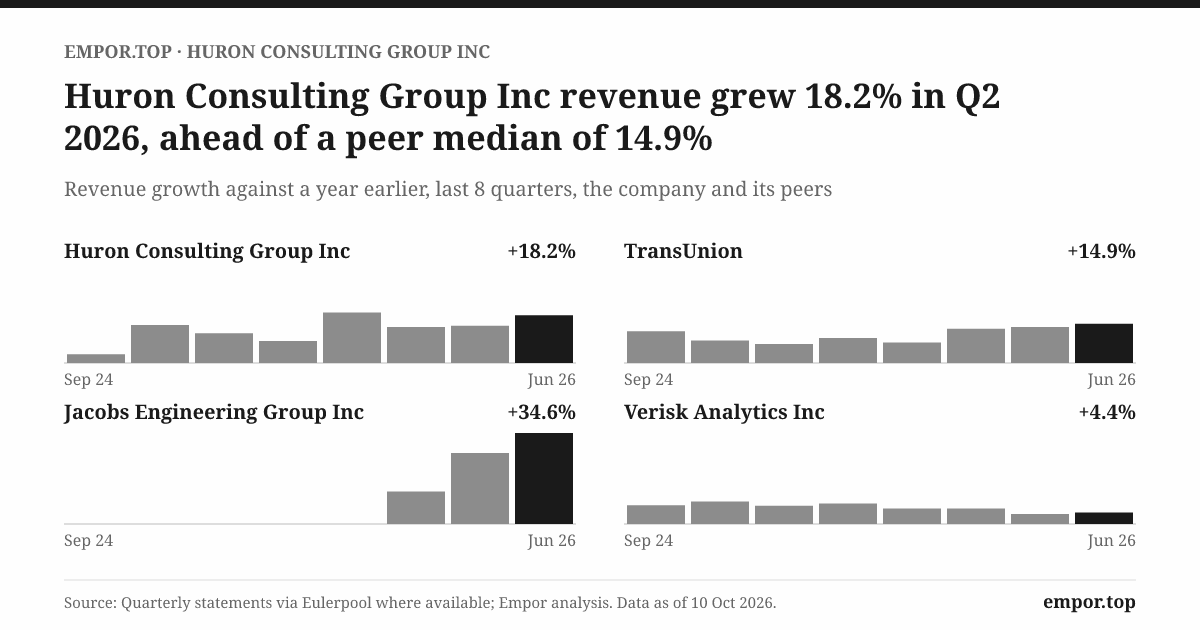
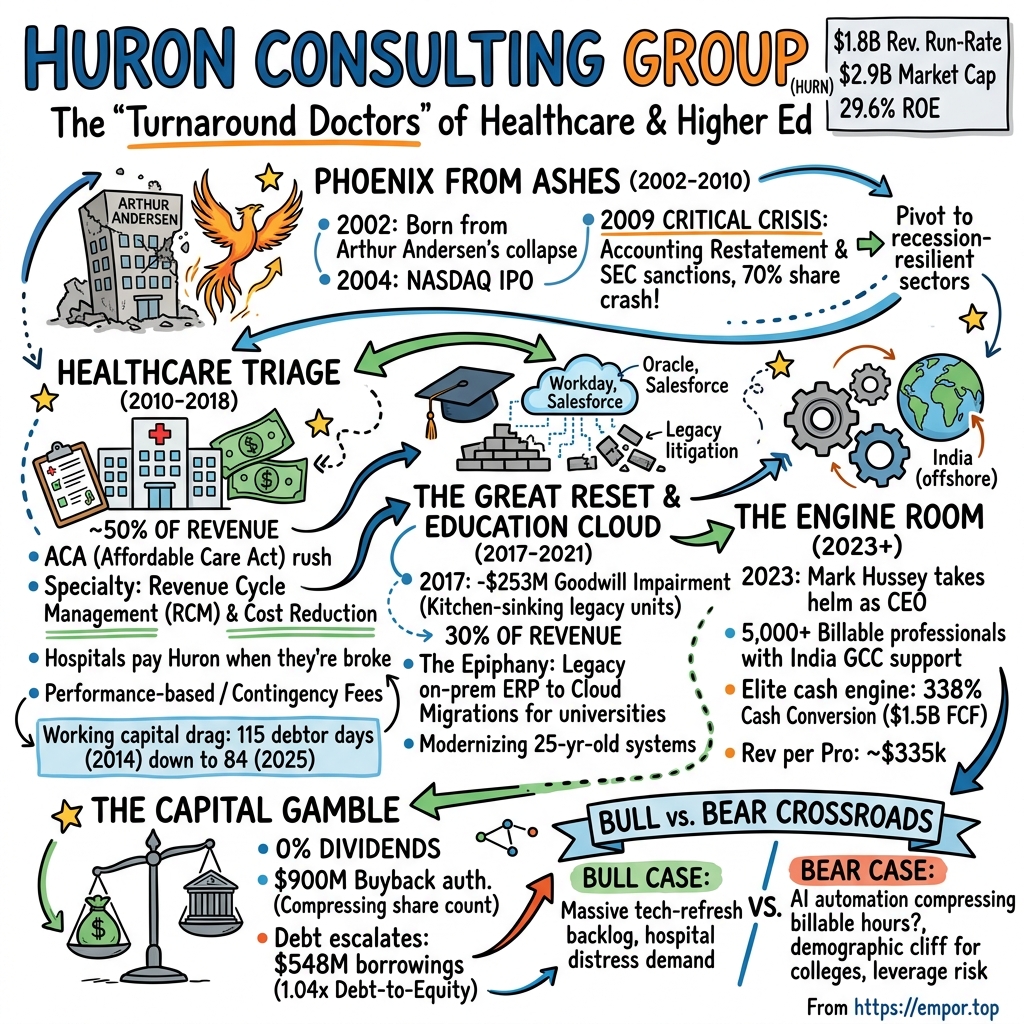
Seventeen years later, that same company is something very different. Over the twelve months to June 2026, Huron booked about $1.8 billion of revenue, and in the second quarter of 2026 revenue rose about 18% from a year earlier.2 Roughly half of that business now comes from hospitals and health systems, and roughly three-tenths from colleges and research universities.34 The litigation boutique has turned into something closer to an outsourced operations department for two of the most financially stressed kinds of institution in America.
The work is easy to picture. A regional hospital network is losing money on nurse overtime and on insurance claims that are denied or never collected. A research university is running grant accounting, payroll and student billing on a mainframe-era system that predates the iPhone, while enrollment forecasts point at a shrinking pool of eighteen-year-olds. Both call Huron. One gets a team that rebuilds the hospital's revenue cycle, the chain of steps between a patient visit and cash in the bank. The other gets a team that moves the university onto Workday or Oracle in the cloud. Neither job is a slide deck; both are surgery on the plumbing.
That transformation raises three questions that run through this whole story. The first is whether a firm so concentrated in hospitals and universities can keep growing at double-digit rates when those very clients face demographic cliffs, federal research-funding volatility and thin or negative operating margins. The second is whether Huron's surging earnings per share come from a better business or from a thinner share count bought with borrowed money, because borrowings reached about $548 million at the end of 2025 and now exceed shareholders' equity.4 The third is the artificial-intelligence paradox: software that writes code and documents workflows could shrink the hours Huron bills, or it could set off a wave of complex system replacements that only firms like Huron can install.
The money trail offers the first clue. Over the twelve years from 2014 through 2025, Huron reported about $456 million of cumulative net profit, yet generated about $1.5 billion of cash from operations, more than three dollars of cash for every dollar of accounting profit.43 That gap, explained later in this story, is the single most important fact about how the company works, because it tells an investor that the income statement has consistently understated the business.
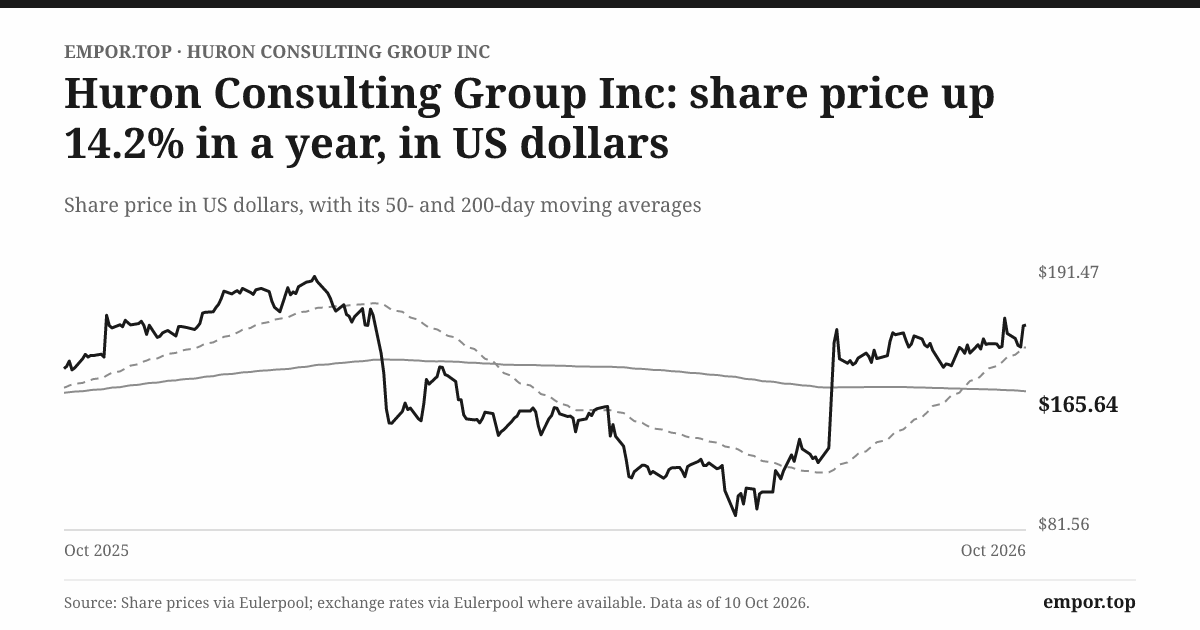
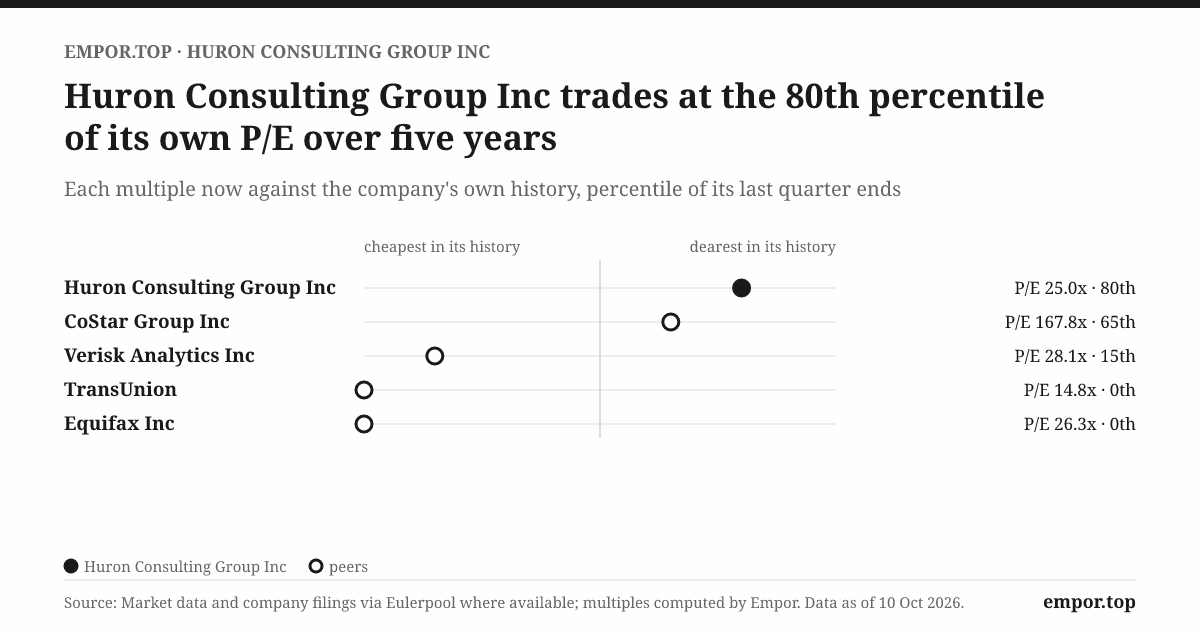
The market has noticed. At $165.64 a share on October 10, 2026, Huron is valued at about $2.9 billion, or roughly 25 times trailing earnings against a five-year median near 22 times, and about 15.7 times EBITDA once its debt is counted.5 Return on equity of almost 30% looks spectacular, though part of that shine comes from a balance sheet in which debt has been used to retire stock.2
So the verdict up front, hedged once: Huron executed one of the more remarkable migrations in professional services, from forensic triage to mission-critical operational work, but today's price assumes the migration keeps paying off. If university deficits and hospital reimbursement pressure squeeze consulting budgets, a stock priced above its own history has little cushion. To see why the company is built the way it is, the story has to go back to the wreckage of the accounting firm that gave birth to it.
 Subscribe on LinkedIn
II. Phoenix from Andersen's Ashes: The Founding and the Forensic Restatement (2002–2010)
In the spring of 2002, Arthur Andersen was dying. The Enron audit had produced a federal indictment, clients were fleeing, and the 89-year-old firm's partners were deciding where to take their practices before the lights went out. In Chicago, Andersen's home city, Gary Holdren and a group of partners from its financial and economic consulting business chose a different path from most: rather than fold themselves into a rival, they would start over. With backing from private equity, they launched Huron Consulting Group in May 2002.6
The timing was grimly perfect. The same scandals that killed Andersen produced the Sarbanes-Oxley Act, a wave of shareholder suits, and a parade of companies needing forensic investigations, restatement work and expert witnesses. Huron's founding team knew how to reconstruct a ledger, testify about damages and walk a distressed company through a restructuring, and the market for those skills had never been hotter. The firm's own prospectus described a business built around financial and economic consulting for companies involved in disputes, investigations, regulatory matters and bankruptcy, alongside operational consulting for hospitals and universities.6 That second line, small at the start, is the seed of everything that came later.
Huron listed on NASDAQ in October 2004, barely two and a half years after its founding.6 For a firm that sold people's time, the IPO gave it something consulting partnerships usually lack: a currency. Stock could be used to buy other firms, and Huron used it.
Between the listing and the financial crisis, Huron bought a string of boutique consulting firms, many structured with earn-outs, where the sellers' final price depended on how the business performed after the deal. Earn-outs are common in professional services because the assets walk out the door every evening; tying payment to future results keeps the sellers engaged. They also create a temptation. If selling partners take their earn-out money and quietly pass part of it to the employees who generate the revenue, then the acquirer is, in substance, paying those employees' compensation, and that cost belongs on the income statement.
That is what went wrong. In July 2009, Huron disclosed that certain selling shareholders of acquired businesses had redistributed portions of their acquisition payments to employees, and that the company had failed to record those payments as compensation expense.1 The fix required restating results for 2006, 2007, 2008 and the first quarter of 2009, which cut previously reported earnings.1 Holdren resigned as chief executive, chairman and director, and the chief financial officer and chief accounting officer also left.1 Shares collapsed on August 3, 2009, wiping out most of the company's market value in one trading day.1
The legal tail ran for years. In July 2012, the Securities and Exchange Commission charged Huron and former executives over the accounting, and the company settled by paying a civil penalty.7 The settlement closed the matter, but the stain was permanent in one useful sense: anyone evaluating Huron's accounting today should remember that its most serious historic failure was not a bad engagement or a lost client but the misclassification of payments tied to acquisitions. That history is why the earn-out mechanics in any future deal deserve scrutiny.
Into the vacuum stepped James H. Roth, one of the founders, who had run the firm's health and education consulting business.1 Roth was not a showman. He came from the operational side of the house rather than the courtroom, and his practice was the one whose clients, hospitals and universities, bought consulting as a matter of necessity rather than litigation luck. His elevation was more than a personnel decision. It was a quiet signal about which part of Huron would become the company.
The lesson Huron took from 2009 shaped the next decade. Litigation and investigation work is lucrative but lumpy; it rises with scandals and falls when the courts quiet down. Roll-ups bought with stock and earn-outs create accounting risk and culture risk at the same time. Hospitals and universities, by contrast, never stop needing to collect bills, manage compliance and replace systems. Over the following years Huron leaned into those clients, and it eventually sold off the disputes and investigations practices that had defined its birth.8
The claim that the restatement "purged" bad habits deserves a test rather than applause. Huron did not stop buying companies after 2009; it kept acquiring, and as the next part of this story shows, a number of those deals ended in large write-downs. What changed was the accounting discipline, which has since passed clean audits, not necessarily the instinct to buy growth.4 With the survival question settled, the firm turned to the industry that would become its engine: American hospitals, which were about to be shaken by a new law.
III. The Hospital Operating Room: Mastering Healthcare Financial Triage (2010–2018)
In March 2010, the Affordable Care Act became law, and hospital chief financial officers across the country began doing arithmetic that frightened them. Millions of newly insured patients would arrive, but payment models were shifting toward value and outcomes, Medicare reimbursement growth was being squeezed, and every clinical note a doctor failed to document properly was money a hospital would never collect. A mid-sized nonprofit system with a 1% or 2% operating margin had almost no room for error. These were exactly the clients Huron's health practice had been serving, and suddenly they had a far bigger set of problems.
Today that practice is the heart of the company. In 2024, Huron's Healthcare segment produced about $756 million of revenue before reimbursable expenses, roughly 51% of the firm, at a segment operating margin of about 28%.3 Segment margins exclude corporate overhead, so they flatter every unit, but the ranking matters: Healthcare is both the largest and the most profitable of Huron's three businesses.
The work falls into a few families. Revenue cycle management is the most important: the end-to-end process by which a hospital registers a patient, codes the visit, bills the insurer, chases denials and collects. A hospital might lose several percentage points of potential revenue in that chain, through miscoded procedures, missed prior authorizations or claims that simply age out. Huron's teams map the chain, fix the leaks and increasingly run parts of it on a managed-services basis. Around that core sit cost reduction in non-labor spending, physician alignment, clinical documentation improvement and broader performance transformation.
The obvious puzzle is why a hospital that is losing money would hire an expensive consultant. The answer is in the contract. Huron uses a blend of time-and-materials billing, fixed fees and performance-based arrangements in which part of its fee depends on verified results, such as cost savings or cash collected.4 To a hospital board, a fee that is paid out of money the consultant helped recover feels less like discretionary spending and more like a share of found money. That is the core of the counter-cyclical argument: when hospital margins compress, demand for revenue-cycle and cost work can rise rather than fall.
The same structure has a cost on Huron's side, and it shows up in working capital. When fees depend on milestones and verified outcomes, Huron does the work first and gets paid later. In 2014, receivables stood at about 115 days of revenue, meaning Huron was effectively lending its clients almost four months of work.3 Over the following decade that figure fell to about 84 days by 2025, which suggests better invoicing and collection discipline, though it remains long by the standards of most service businesses.4
Concentration risk is low in one sense and high in another. No single client accounted for more than 10% of revenue or receivables in 2023, 2024 or 2025.43 A single health system going bankrupt would sting, not maim. But the clients look alike. They are academic medical centers and regional nonprofit systems that rise and fall with the same reimbursement policy, the same labor market and the same Medicaid rolls. Huron is diversified across names and concentrated across economics.
The disconfirming evidence for the "distress is good for us" thesis sits in the balance sheet. Contract assets, the work Huron has performed but cannot yet bill because a milestone or outcome has not been verified, jumped from about $60 million at the end of 2024 to about $92 million at the end of 2025, an increase of roughly half.4 Some of that is growth and timing. But it is also a reminder of who holds the leverage in a performance contract: the client decides when a milestone is met. Huron's auditor flagged the estimates behind fixed-fee and performance-based revenue as a critical audit matter, which is the profession's way of saying that these numbers rely on judgment.4
Weighed together, the healthcare franchise passes its test in a narrower form. The evidence supports the claim that Huron's hospital work is non-discretionary and resilient across cycles, because demand held up through the reimbursement pressure of the 2010s and the post-pandemic labor squeeze. It does not support the claim that distress is costless; the more of Huron's pay depends on outcomes, the more cash it waits for. Contract assets and receivable days are the gauges to watch. Yet in the middle of the 2010s, the healthcare engine was not enough to keep the rest of the firm from stalling, and the bill for years of acquisitions was about to come due.
IV. The Great Reset: Goodwill Write-Offs and the Education Cloud Pivot (2017–2021)
By 2017, Huron's revenue had stopped growing. It rose less than 1% that year after only about 4% the year before.83 Inside the company, the uncomfortable conversation was not about hospitals but about the businesses Huron had bought to diversify away from them. When an acquired business no longer seems able to earn what was paid for it, accounting rules require the buyer to write down goodwill, the premium paid above the value of tangible assets. In 2017 Huron's board took that medicine in one large dose.
The result was a reported operating loss of about $207 million and a diluted loss of $7.91 a share, driven by roughly $253 million of non-cash goodwill impairment charges.8 In plain terms, Huron admitted that a meaningful slice of the money it had spent on acquisitions had not produced the value it expected. The charge did not drain a dollar of cash that year, because the money had already gone out the door when the deals were done. That is precisely the point: impairment is the accounting record of an old capital-allocation mistake.
This matters for any later praise of Huron's discipline. The 2009 restatement dealt with how acquisitions were accounted for; the 2017 impairment showed that the acquisitions themselves often disappointed. A company that buys boutiques with its stock or cash, and then writes them down, has not proven it is a good buyer of businesses. What it showed in 2017 was realism, which is not the same thing as skill.
The pivot that followed came from a less glamorous place: the server rooms of American universities. Many research universities ran their finances, human resources and student records on on-premise enterprise resource planning systems, often decades old and heavily customized. These systems struggled with the things modern universities need, from tracking every dollar of a federal research grant to handling online enrollment and complex student billing. When vendors like Workday and Oracle began pushing cloud versions aimed at higher education, universities faced a choice between patching ancient code and undertaking a multi-year migration that would touch every department.
Huron already had deep relationships with research administrators through its compliance and grant-management work. It used those relationships to become an implementation partner for the cloud platforms, adding Salesforce for student engagement and advancement. The bet was simple: the people who already understood how a university's research office and finance office actually worked would be best placed to move those processes onto new software. By 2024, the Education segment generated about $474 million of revenue, about 32% of the firm, at a segment margin of about 23%.3
The reset is visible in the cash flows. In the year of the giant 2017 loss, Huron still generated about $99 million of operating cash.3 That is the paradox this company keeps presenting: GAAP results that look like a crisis and a bank account that does not.
Then came the second test. In 2020, the pandemic cancelled elective surgeries, the most profitable procedures in many hospitals, and emptied college campuses. Huron's revenue fell about 4%, and further goodwill charges pushed it to an operating loss of about $29 million.3 Yet operating cash flow that year was about $136 million, higher than in the boom years before.3 Part of that came from collecting receivables as new work slowed; receivable days dropped to about 63, the lowest of the decade.3 A professional services firm in a downturn tends to throw off cash as its working capital unwinds, which is a cushion, but also a one-time one.
The rebound proved more durable than many expected. Hospitals came out of COVID facing a labor-cost shock and an urgent need to modernize; universities had discovered that paper processes and old systems failed when everyone went remote. Revenue climbed about 25% in 2022 and about 20% in 2023.39 The pivot to digital work looked, in hindsight, like the right move at the right moment. Whether it was foresight or a lucky alignment of Huron's existing client list with a technology cycle is impossible to separate cleanly, and an honest reading credits both. What is clear is that the firm that emerged had a very particular financial anatomy, and it is worth opening it up.
V. The Engine Room: Revenue Architecture, Utilization, and Cash Conversion
Picture a Huron partner's spreadsheet at the start of a quarter. Across the rows are engagements, each with a staffing plan: a few senior consultants in Chicago or Boston, a larger team of configuration specialists, and a growing block of professionals in India who build integrations, test data and run managed processes around the clock. Across the columns are hours, rates and milestones. Profit lives in the gap between what each hour is billed at and what that person costs, multiplied by how many of their hours are actually billed. Everything else is overhead.
Huron's contracts come in four broad flavors. Time-and-materials is the classic consulting model: the client pays for hours worked at agreed rates. Fixed-fee arrangements set a price for a defined deliverable, so Huron carries the risk of overruns. Performance-based contracts tie some or all of the fee to measured results. Managed services and software subscriptions provide recurring, multi-year revenue for running a process or a platform.4 The company does not disclose how its revenue splits among these types, which is a real gap for an investor trying to judge how exposed it is to fewer billable hours.4
The physical footprint is almost nothing. Net property and equipment was about $44 million at the end of 2025, less than 3% of total assets, mostly office fit-outs and computers.4 Capital spending ran around $10 million in 2025.4 Asking about factories or construction in progress at Huron is like asking a law firm about its inventory.
The real assets are people. Huron ended 2023 with about 4,470 revenue-generating professionals and grew that to nearly 5,000 by 2025, with total headcount above 7,200 once its India-based global capability centers and support staff are counted.43 The offshore element is the quiet margin lever. Work that once required a consultant in an expensive American city can increasingly be done by a team in India at a fraction of the cost, while the client relationship remains onshore.
The productivity number that matters most is revenue per revenue-generating professional, which captures pricing, utilization and mix in a single figure. It rose from roughly $305,000 in 2023 to about $335,000 in 2025.4 A 10% gain over two years is significant in an industry where rate increases are hard-won. It suggests Huron has been able to raise prices or shift toward higher-value work, though some of the improvement could come from mix effects, such as more software and managed-services revenue relative to hours.
Now return to the riddle from the opening: how does $456 million of cumulative profit become $1.5 billion of operating cash over twelve years? The answer has three parts. The first is depreciation and amortization, especially the amortization of intangible assets acquired with businesses, which reduces profit without consuming cash. The second is stock-based compensation, which runs in the tens of millions of dollars a year: employees are paid partly in shares, which is a real cost to shareholders but not a cash outflow. The third is the impairments of 2017 and 2020, which wiped hundreds of millions off reported earnings long after the cash had already been spent.48
That third piece is why the 338% conversion ratio needs a caveat. Cash did not appear by magic; much of it had been spent earlier on the acquisitions that were later written down. Measured over a long enough horizon, the gap between profit and cash partly reflects that the acquisition outlays sit in the investing section of the cash-flow statement, not in operating cash flow. And stock compensation, while non-cash, is paid for later through buybacks. A fair reading is that Huron's ongoing cash generation is genuinely strong, with operating cash flow running close to EBITDA in 2024 and 2025, but that the twelve-year multiple overstates it.43
Free cash flow over the period totaled about $1.3 billion, and in 2025 alone it was about $183 million.4 Against that, the corporate housekeeping is clean. Huron has no parent company, no controlling shareholder, no royalty payments to affiliates and no material related-party transactions in its recent annual reports.43 PricewaterhouseCoopers has given unqualified opinions on its financial statements and internal controls.4 For a company that once restated, that clean record is the minimum requirement, and it is met.
So the engine is efficient, light and cash-generative. The natural next question is the one shareholders ask of any cash machine: where did all that cash go? Huron's answer is unusual, and it involves a bank.
VI. Capital Allocation & The Leverage Gamble: Where Did the $1.3 Billion Go?
On July 30, 2025, Huron closed its Fourth Amended and Restated Credit Agreement with a bank syndicate led by Bank of America. The new facility provided $1.1 billion of capacity, made up of a $700 million revolving line and a $400 million term loan, both maturing in July 2030.10 For a company with about $25 million of cash on hand, it was a declaration of intent. Huron would run lean on cash, lean on its bankers and use the borrowing capacity to return money to shareholders the only way it ever has: by buying back stock.
Huron has never paid a dividend in its public life.4 Every dollar of free cash flow that was not spent on acquisitions has gone into repurchases or debt reduction. In 2024, it bought back about 1.2 million shares for about $122 million; in 2025, about 1.2 million shares for about $166 million.43 The board raised the repurchase authorization to $700 million in early 2025 and then to $900 million in the first quarter of 2026.42
The effect on per-share numbers is powerful. Diluted shares fell from about 20.5 million in 2022 to about 17.9 million in 2025, a reduction of roughly an eighth.4 Earnings per share rose from $3.75 in 2022 to $6.74 over the twelve months to June 2026.32 Some of that came from higher profit; operating profit roughly doubled over the same span. But the shrinking denominator amplified the gain, and in 2024 the 94% jump in EPS ran far ahead of the improvement in the underlying business.3
The other side of the ledger is debt. Borrowings rose from about $346 million at the end of 2022 to about $548 million at the end of 2025, while shareholders' equity edged down to about $529 million, pushing debt above equity for the first time in the period.4 Equity is shrinking because buybacks are retiring it faster than profits add to it. That is how a company produces a return on equity near 30%: not only by earning more, but by having less equity on the books.
Is that dangerous? The covenants give a measured answer. With net debt around $524 million and 2025 EBITDA of about $202 million, leverage sits around 2.6 times, comfortably inside the facility's maximum of 3.75 times.4 The term loan amortizes at about $20 million a year, a small fraction of free cash flow.4 Huron has stayed in compliance with every covenant through the second quarter of 2026.2 On those numbers the balance sheet is stretched, not strained.
The bigger issue is what kind of cushion is left. Huron has no public credit rating from S&P, Moody's or Fitch; its debt is entirely bank debt and largely floating-rate.4 That spares it from rating-agency downgrades, but it means the cost and availability of its capital depend on a syndicate's view of a consulting firm whose assets are people. If utilization fell sharply in a recession, EBITDA would drop faster than revenue, and leverage could approach covenant limits in a way that forces buybacks to stop at precisely the moment the stock is cheap. The interest bill already matters: other expense, mostly interest, rose to about $64 million in 2025 from about $15 million the year before, a jump large enough that profit before tax fell even as operating profit rose.43
That 2025 figure also contained a reminder of what happens when Huron strays from its core. The company held a convertible note in Shorelight Holdings, an education-services business, with a cost basis of about $41 million, and in 2025 recorded an allowance for credit losses of about $11 million against it.4 By the standards of a $1.8 billion company it is small, but it adds to the pattern: the 2009 restatement involved acquired businesses, the 2017 and 2020 impairments involved acquired businesses, and the most recent write-down involved a non-core investment. Huron's organic engine has been far more reliable than its deal-making.
An activist looking at this record would push on two points. The first is whether a company with a history of acquisition write-downs should be trusted with a $1.1 billion credit line. The second is whether buying back stock at 25 times earnings is a better use of borrowed money than paying down debt. Management's implicit answer is that the free cash flow is reliable enough to support both. The evidence of the past three years supports that answer, but it has been tested only in an expanding market. The people making these choices changed at the start of 2023, and their record is the next thread.
VII. The Hussey Era: Strategy, Incentives, and Governance (2023–2026)
On January 1, 2023, C. Mark Hussey became Huron's chief executive, succeeding James Roth after more than a decade in the role.11 The announcement, made in September 2022, framed the move as a planned succession, and in practice it was: Hussey had joined Huron in 2011 and served as chief financial officer and then chief operating officer, giving him years inside the machine before he ran it.11 Roth moved off the front line rather than leaving in a crisis, a contrast to the abrupt exits of 2009.
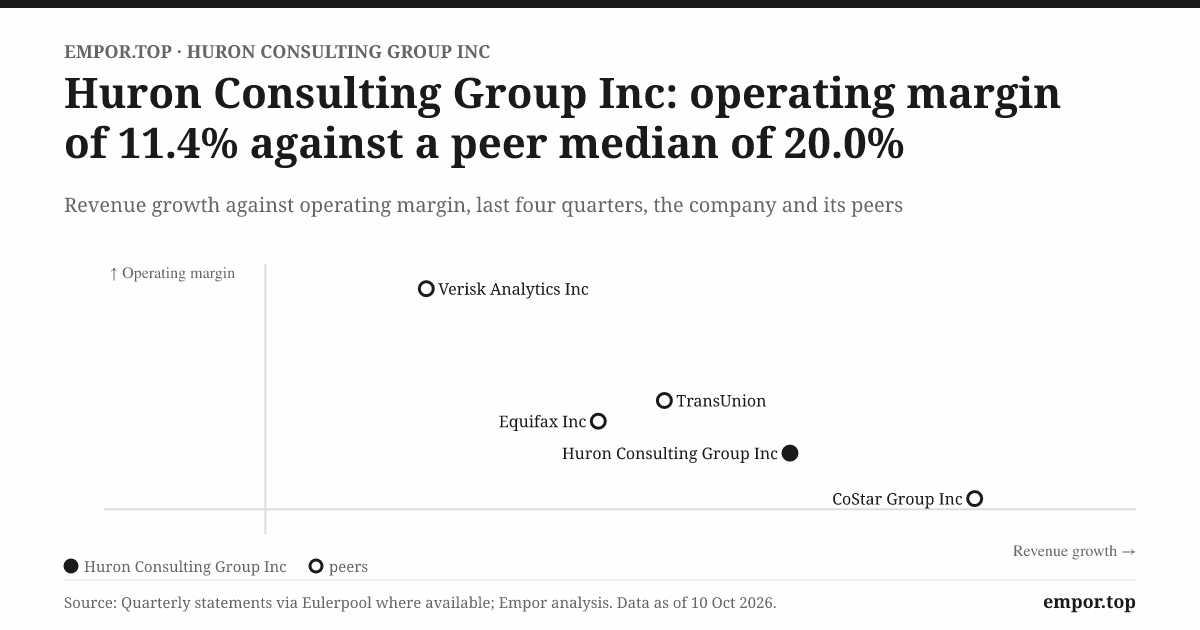
Hussey's background is financial and operational rather than a rainmaker's. That shows in the priorities of his tenure: margin expansion, offshore delivery scaling, disciplined overhead and the aggressive buybacks. Operating margin rose from about 9% in 2023 to almost 12% in 2025.43 Revenue growth reaccelerated in late 2025 and into 2026, reaching about 18% in the second quarter.2 On the scorecard that public investors care about, the first three years of the Hussey era have been strong.
Pay is designed to reinforce that. Executive compensation is heavily weighted toward adjusted EBITDA and earnings-per-share targets.12 Hussey's reported total compensation was about $7.2 million, most of it in performance and restricted stock.12 That structure has a predictable side effect. When pay depends on EPS, buybacks help hit the target, regardless of whether they create value at the price paid. An investor need not assume bad faith to note that the incentive and the capital-allocation choice point in the same direction.
Shareholders have not objected. At the May 2025 annual meeting, more than 96% of votes cast supported the say-on-pay resolution, and directors were elected with minimal dissent.13 Huron has a single class of shares, and institutional investors hold the vast majority of the stock, led by Vanguard funds at roughly 10% and BlackRock at roughly 9%.112 Directors and executive officers own about 2.5% combined.12 There has been no activist campaign. This is a widely held, index-heavy shareholder base, which tends to approve management when results are good and to scrutinize only when they turn.
Management's credibility is best judged by what it promised and what it delivered. On earnings calls through 2024 and 2025, the company repeatedly emphasized margin expansion and growth in its digital and managed-services work, and the reported numbers bore that out. But two numbers from the quarterly record show where the story is less smooth. In the first quarter of each year, operating margin falls sharply, to about 5.6% in early 2024, 8.3% in early 2025 and 9.2% in early 2026, as annual payroll taxes and bonuses reset.23 And in 2025, net profit fell even as revenue rose 14%, because higher interest and the Shorelight charge ate into the gains.3 Neither is a broken promise, but both show that adjusted metrics, which strip such items out, can paint a brighter picture than the GAAP results.
The verdict on the Hussey era is solid execution with a rising level of financial risk. Hussey inherited a business emerging from its post-pandemic rebound and has improved its margins and growth. He has also chosen to lever the balance sheet to an extent his predecessors did not. That choice is reasonable in a growth phase and uncomfortable in a slowdown, and it can only be fully judged after one. The other way to judge a management team is to ask whether the business it runs has a moat worth defending, and that requires a look at the competitive field.
VIII. Moat & Industry Structure: Hamilton Helmer's 7 Powers & Porter's 5 Forces
Imagine a procurement committee at a large public research university, a dozen people around a table with three binders in front of them. One is from Deloitte, with a global brand and an army of Workday-certified consultants. One is from Accenture, with the biggest technology practice on earth. One is from Huron. The committee must choose a partner for a multi-year migration of its finance, HR and research administration systems, a project that will touch every department and cost tens of millions of dollars. Why would it choose the smallest of the three?
The most persuasive answer is specialization. Huron's teams spend their careers inside universities and hospitals; they know how indirect-cost recovery works on a federal grant, how a faculty appointment flows through HR, and why a health system's revenue cycle differs from a manufacturer's billing. For a university, a consultant that does not need to be taught the language of sponsored research is worth paying for. The question is whether that know-how amounts to a durable economic advantage or simply a reputation.
Hamilton Helmer's 7 Powers framework provides a test. Switching costs are Huron's strongest power. Once an ERP migration or a revenue-cycle overhaul is underway, replacing the implementation partner mid-project risks delays, data errors and billing disruption, which no university provost or hospital CFO wants to explain to a board. Managed-services contracts, which run a client's process for years, deepen that lock-in. But switching costs bind clients to a project, not to Huron forever; when the next project goes out to bid, the competition starts again.
Process power and cornered resources are present but moderate. Decades of benchmarking hospital operations and university administration give Huron a library of comparisons that a newcomer cannot easily replicate. Yet its best consultants can walk out the door, and the firm's main assets are people, not patents. Scale economies and network effects are essentially absent. Accenture and Deloitte are many times larger, and in professional services one more client does not make the service more valuable to the others. Counter-positioning is a niche advantage at best: Huron can take on mid-market hospital and university projects that larger firms may find less attractive, but nothing stops those firms from competing when they choose.
Porter's five forces round out the picture. Buyer power is high. Hospitals and universities run formal procurement, nonprofit boards scrutinize consulting spend, and performance-based contracts give clients a say over when Huron gets paid. The swelling contract assets of 2025 are a direct read of that leverage.4 The threat of substitutes is moderate and rising: internal IT departments can handle more work themselves as software becomes easier to configure, and AI tools for medical coding, documentation and workflow automation could replace some of the tasks that consultants now perform. Rivalry is intense, with FTI Consulting and Alvarez & Marsal in restructuring, Deloitte, Accenture and Guidehouse in healthcare and public-sector technology, and a host of specialist boutiques. Supplier power, which in consulting means the talent itself, is significant whenever the labor market tightens. New entrants face moderate barriers: credibility with hospital and university buyers takes years to build.
The financial evidence is consistent with that diagnosis. Huron's return on capital employed of about 15% is good but not extraordinary for an asset-light business, and its operating margin of about 12% sits in the normal range for consulting.54 A business with a dominant moat would earn more. The 30% return on equity mostly reflects leverage rather than unusual pricing power.
The verdict is that Huron has a real but narrow moat. Switching costs and specialized knowledge in two sectors give it an edge in winning and keeping complex work. It does not have the scale to set prices or the network effects to lock in demand. If the larger integrators decided to compete harder on price in higher education and healthcare, Huron would feel it. Revenue per professional is the gauge to watch, because it would show any loss of pricing power before the income statement does. That brings the story to the bull and bear debate, where AI sits right at the center.
IX. Bull vs. Bear Case & The AI Crossroads
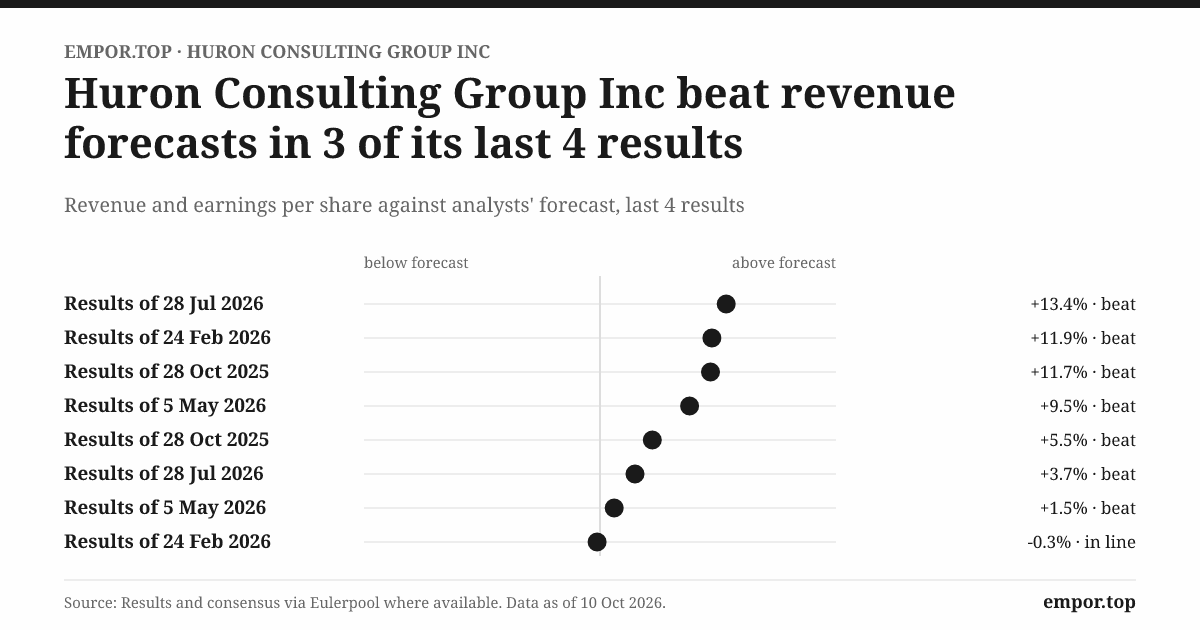
When Huron reported its second-quarter 2026 results at the end of July, the headline was hard to argue with. Revenue was about $475 million, up roughly 18% from a year earlier, the fastest growth in almost three years.2 Operating profit rose about 10% and net profit about 63%, the latter boosted by the absence of the prior year's Shorelight charge.2 Analysts asked about the obvious tension: if generative AI makes coding and documentation dramatically faster, why should clients keep paying for consulting hours at today's rates?
The bull case begins with backlog. Thousands of hospitals and universities still run on aging systems, and the migration to Workday, Oracle and Salesforce in the cloud is a multi-year cycle, not a one-off. Each migration is complex, high-risk and specific to the institution, which is exactly where Huron's specialized teams are strongest. Add to that the counter-cyclical appeal of its healthcare work, where squeezed margins drive demand for revenue-cycle and cost improvement. Finally, there is shareholder yield: free cash flow of about $180 million a year, against a market value of about $2.9 billion, gives a free cash flow yield above 5%, and Huron has been retiring a meaningful slice of its shares each year.45
The bear case mirrors each point. Higher education faces a demographic cliff, as the number of American high school graduates begins a long decline from its peak around 2025, and federal research funding has become more volatile. Universities under pressure can delay ERP projects, and many have already frozen hiring. Hospitals face Medicaid enrollment losses and reimbursement pressure that can force cuts in discretionary spending, and some consulting falls into that category no matter how it is priced. On the balance sheet, about $548 million of mostly floating-rate debt and a debt-to-equity ratio above one leave less room to absorb a slowdown than Huron had a decade ago.4 And then there is AI.
The AI argument cuts both ways, and the honest answer is that the evidence is not yet in. If AI tools can automate a large share of configuration, testing and documentation, the hours required for each implementation fall, and time-and-materials revenue shrinks unless pricing shifts toward fixed fees or outcomes. On the other hand, AI may accelerate the replacement of old systems, because institutions cannot use modern AI tools on data trapped in decades-old mainframes. The single best real-time test is revenue per professional. It rose to about $335,000 in 2025.4 If it keeps rising, Huron is capturing the productivity gains; if it starts falling while headcount grows, the paradox is resolving against it.
Valuation shows how the market has weighed this. At about 25 times earnings and about 15.7 times EBITDA, Huron trades above its own five-year median and well above FTI Consulting, which trades at roughly 14 times earnings and about 12 times EBITDA.5 CRA International, a smaller economic-consulting peer, sits in between. The premium reflects faster growth, since FTI has been growing in single digits, and higher returns on equity. But Huron's returns are inflated by leverage, while FTI carries a much lighter debt load. The market is paying for growth and assuming it continues.
Weighing it all, the bull case holds the upper hand in the medium term, because the backlog of hospital and university system replacements is real and Huron's recent growth is visible in revenue, not just bookings. The bear case wins on margin of safety: at a premium multiple with elevated leverage, any delivery hiccup, budget freeze or evidence of AI-driven pricing pressure would hit both earnings and the multiple at once.
Three measures will decide which story prevails. The first is revenue per revenue-generating professional, last at about $335,000 and rising; staying above roughly $330,000 would confirm that pricing power is intact.4 The second is the pair of contract assets and receivable days, last at about $92 million and 84 days, the former up sharply and the latter improving; further growth in unbilled work would signal that clients are stretching Huron.4 The third is net debt to EBITDA, last at about 2.6 times and rising; a move toward 3 times would mean buybacks are outrunning the business.4 Those numbers tell an investor where Huron is headed; the company's journey so far offers lessons that apply well beyond it.
X. Playbook: Business & Investing Lessons
After the summer of 2009, Huron's leaders faced a choice about what kind of firm they wanted to be. They could rebuild the litigation and investigations machine that had made the founders' names, betting on the next scandal. Or they could double down on the unglamorous work of fixing the finances and systems of hospitals and universities. They chose the second path, and nearly everything good in this story flows from that decision. So does a fair share of the risk.
The first lesson is that the plumbing beats the penthouse. Strategy consulting, the work of advising boards on big-picture direction, is the first thing cut in a downturn. Rebuilding a hospital's billing engine or replacing a university's core financial system is survival work that cannot easily be postponed. Huron's revenue fell only about 4% in the pandemic year, when hospitals stopped elective surgery and campuses closed, and it then grew faster than ever.3 Be the firm a client cannot stop paying, not the one it can stop hiring.
The second lesson is that when GAAP shouts, listen to the bank account. In 2017 Huron reported a loss of almost $8 a share, and in 2020 another loss, yet in both years the company generated around $100 million or more of operating cash.83 Investors who sold on the headlines misread the business. But the lesson has a second half: the cash was strong partly because the losses were the delayed recognition of money already spent on acquisitions. An impairment is a confession about yesterday's cash, not a gift to today's.
The third lesson is to beware the earn-out. Huron's near-death came not from a failed engagement but from how payments to the sellers of acquired businesses were accounted for, and the later write-downs came from the same source.18 Buying people-businesses is uniquely risky, because the assets can walk away and the incentives built to keep them can distort both behavior and accounting. Huron's organic growth, powered by hiring and offshore delivery, has been far more reliable than its acquisitions. In consulting, you can buy a client list, but you can only rent a partner.
The fourth lesson is that leverage is a turbocharger with no brakes. Borrowing to buy back shares has multiplied Huron's earnings per share in a growing market, and the covenants are comfortable today.4 But a consulting firm's costs are mostly salaries, and when demand softens, utilization falls before headcount can be cut, so EBITDA can drop faster than revenue. Leverage that looks prudent at 2.6 times can look different after a single bad year. Debt-funded buybacks reward good times and amplify bad ones.
Together these lessons sketch a company that has learned to choose its markets well, to convert work into cash reliably and to communicate cleanly, while still showing an appetite for financial risk that its own history argues for handling carefully. The question now is what happens next.
XI. Epilogue
Tonight, Huron sits near the top of its post-pandemic run. Revenue over the past year was about $1.8 billion and still accelerating.2 The stock trades about 11% below its 52-week high of roughly $186, after a year in which it moved between about $87 and that peak, a range that shows how quickly the market can change its mind about this business.5 It has about $700 million of revolving credit capacity, a $900 million repurchase authorization and a client base that has never needed its help more.102
The next few moments will decide which version of the story holds. The first is fall enrollment and budget season in higher education for 2026 and 2027. If falling enrollment and federal funding pressure push more universities into deficit, the question becomes whether they pause cloud migrations or accelerate them to save money. A slowdown in Education segment growth would be the first sign of the former.
The second is hospital finances. If health system margins recover, Huron's work should tilt from emergency cost-cutting toward digital expansion, a more sustainable kind of demand. If they deteriorate, the counter-cyclical thesis will be tested in real time, and contract assets will show whether clients are paying on schedule.
The third is capital deployment. How much of the $900 million authorization Huron uses, and whether borrowings rise beyond $600 million, will show whether management is prioritizing per-share growth over balance-sheet flexibility.2 With the stock trading at a premium to history, every dollar of buyback buys less than it did.
The fourth is the expansion of the India delivery centers. Offshore capacity is Huron's main defense against wage inflation and the most likely way it will capture AI-driven productivity gains for itself rather than handing them to clients.
The tension that remains is the one this story opened with. Huron's 18% growth is either the start of a lasting expansion into digital and managed services for two essential industries, or the peak of a post-COVID spending cycle financed by clients who are running out of money. The next four quarters will show which, and the stock's price assumes it is the former.
XII. Outro
Late at night on a research university campus, an administrator crosses an empty quad, opens a laptop and logs into a cloud portal. A federal grant is reconciled, financial aid is released, payroll runs for thousands of employees. Nobody on campus thinks about who built the system, and that is the point. Somewhere behind the screen are Huron consultants who mapped every process, migrated every record and still keep parts of it running.
From the ashes of Arthur Andersen and its own restatement scandal, Huron found its fortune not in advising the titans of industry but in fixing the broken machinery of institutions society cannot afford to let fail. Whether that fortune endures depends on whether those institutions can keep paying for the repairs.
References
-
Huron Consulting Shares Tumble on Restatement and Resignations — The Wall Street Journal, 2009-08-01 ↩↩↩↩↩↩↩↩↩
-
Huron Consulting Group Inc. Form 10-Q for Quarterly Period Ended June 30, 2026 — SEC EDGAR, 2026-07-28 ↩↩↩↩↩↩↩↩↩↩↩↩
-
Huron Consulting Group Inc. Form 10-K for Fiscal Year Ended December 31, 2024 — SEC EDGAR, 2025-02-25 ↩↩↩↩↩↩↩↩↩↩↩↩↩↩↩↩↩↩↩↩↩↩↩↩
-
Huron Consulting Group Inc. Form 10-K for Fiscal Year Ended December 31, 2025 — SEC EDGAR, 2026-02-24 ↩↩↩↩↩↩↩↩↩↩↩↩↩↩↩↩↩↩↩↩↩↩↩↩↩↩↩↩↩↩↩↩↩↩↩↩↩↩↩↩
-
Huron Consulting Group Inc. Reuters Company Profile and Fundamentals — Reuters ↩↩↩↩↩
-
Huron Consulting Group Inc. Form S-1 Registration Statement (IPO Prospectus) — SEC EDGAR, 2004-05-18 ↩↩↩
-
SEC Charges Huron Consulting Group and Former Executives With Accounting Fraud — U.S. Securities and Exchange Commission, 2012-07-19 ↩
-
Huron Consulting Group Inc. Form 10-K for Fiscal Year Ended December 31, 2017 — SEC EDGAR, 2018-02-27 ↩↩↩↩↩↩
-
Huron Consulting Group Inc. Form 10-K for Fiscal Year Ended December 31, 2023 — SEC EDGAR, 2024-02-27 ↩
-
Huron Consulting Group Inc. Form 8-K Current Report (Fourth Amended Credit Agreement) — SEC EDGAR, 2025-07-30 ↩↩
-
Huron Consulting Names Mark Hussey as Chief Executive Officer — Business Wire, 2022-09-15 ↩↩
-
Huron Consulting Group Inc. DEF 14A Definitive Proxy Statement — SEC EDGAR, 2025-03-28 ↩↩↩↩
-
Huron Consulting Group Inc. Form 8-K Current Report (Annual Meeting Voting Results) — SEC EDGAR, 2025-05-13 ↩
 LinkedIn
 WhatsApp
 Reddit
 Hacker News
 Email
Email Kindle
 RSS Feed
 Spotify
 Apple Podcasts
 Amazon Music
 Audible
 YouTube