Coty Inc.: Can the Beauty Giant Keep the Brands?
I. The Gucci Exit Opens the Story
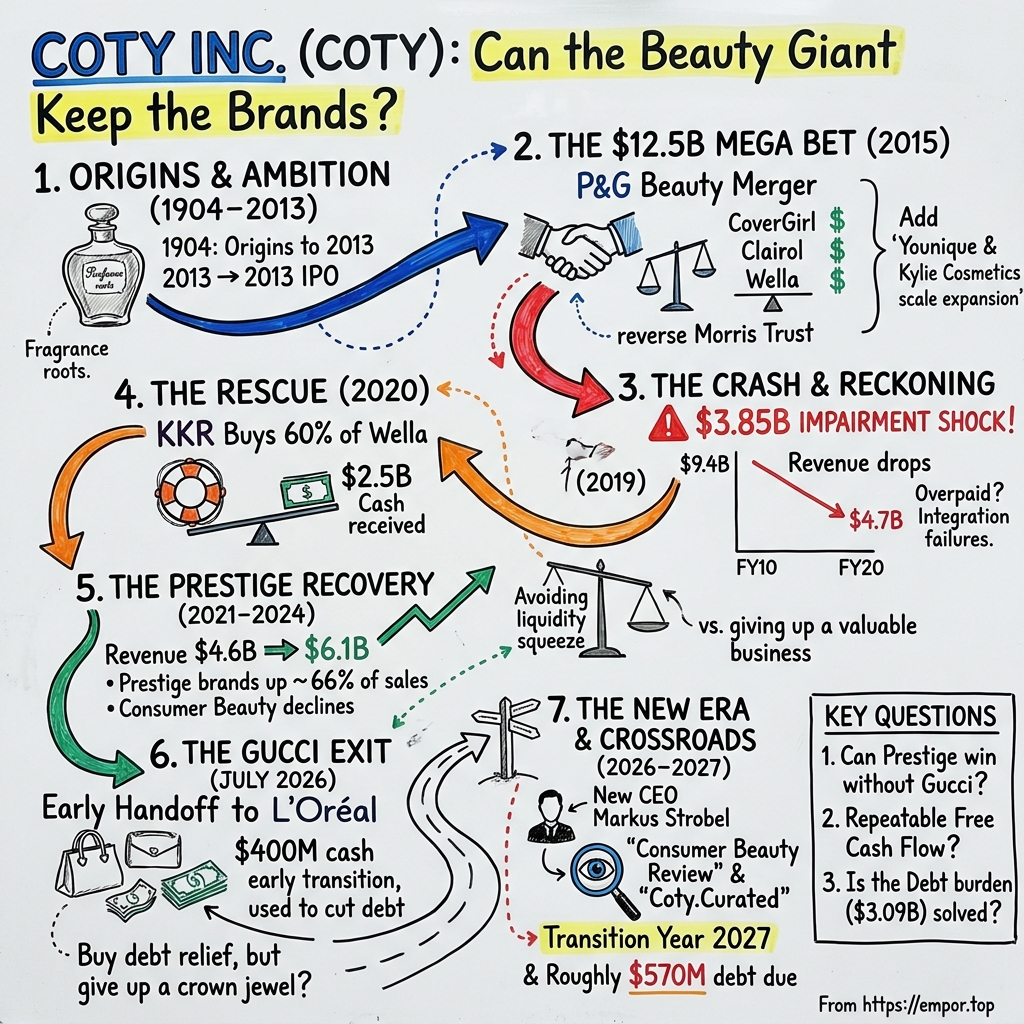
In the first week of July 2026, Coty did something that, on the surface, looks like a contradiction. It agreed to give back one of the most recognisable names in its cabinet, the Gucci beauty license, years before the contract required it to, and it arranged to be paid for doing so. Kering, Gucci's parent, would hand Coty about $400 million for an early transition, and Coty would keep making and selling Gucci fragrances and cosmetics until the end of June 2027 before the name walked out the door.1
The buyer waiting on the other side of that door made the irony complete. Nine months earlier, Kering had sold its beauty operation to L'Oréal, the largest beauty company in the world, in a deal worth about €4 billion that included the right to develop Gucci beauty under a 50-year license once Coty's tenure ended.2 So Coty was being paid to step aside early for a rival roughly eight times its size. Reuters framed it plainly: Coty was returning the license early in a $400 million deal.3
There are two ways to read that payment. The generous reading is that Coty extracted cash for a license it would have lost anyway, and that a company carrying about $3.1 billion of debt has better uses for $400 million today than for a few more years of a brand whose future already belonged to someone else.4 The harsher reading is that a company built on the promise of owning and renting famous beauty names had just watched one of its biggest names leave, and that the cheque is a measure of what it was giving up.
By the time Coty reported its first quarter of fiscal 2027 on November 4, 2026, the money had started to arrive. About $250 million of the Gucci proceeds had come in, and management said that cash generation plus those proceeds had cut net debt by more than $300 million since the end of June.5 On the call the next day, the questions from analysts kept circling back to the same two things: what Gucci's departure would do to revenue and profit after June 2027, and what Coty intended to do with its mass-market cosmetics business.6
That is the right place to start, because the Gucci handoff compresses the whole Coty story into a single transaction. It is a story about brands Coty owns and brands it rents. It is a story about debt, and about how often Coty has sold something valuable to manage that debt. And it is a story about whether the company that remains after all the selling is strong enough to grow on its own.
Five questions run underneath everything that follows. The first is whether Coty bought more scale than it could ever integrate, beginning with the $12.5 billion merger with Procter & Gamble's beauty brands in 2015. The second is whether its brands are durable, or whether famous names on a perfume bottle are weaker protection than they look. The third is whether Coty's cash generation is repeatable, or whether it has leaned on asset sales and squeezing working capital. The fourth is whether the current leadership, installed at the start of 2026, has the credibility to make the portfolio smaller and stronger. The fifth is what it means that one shareholder, JAB, controls the vote.
A boundary is worth drawing at the outset. The economics in this story are those of Coty Inc., the NYSE-listed Delaware company and its subsidiaries. JAB Beauty B.V. is its controlling shareholder, holding about 54% of the voting power on an if-converted basis, but JAB's other holdings and its own finances are not Coty's.7 When this story says Coty earned, owed or spent something, it means the listed company and nothing above it.
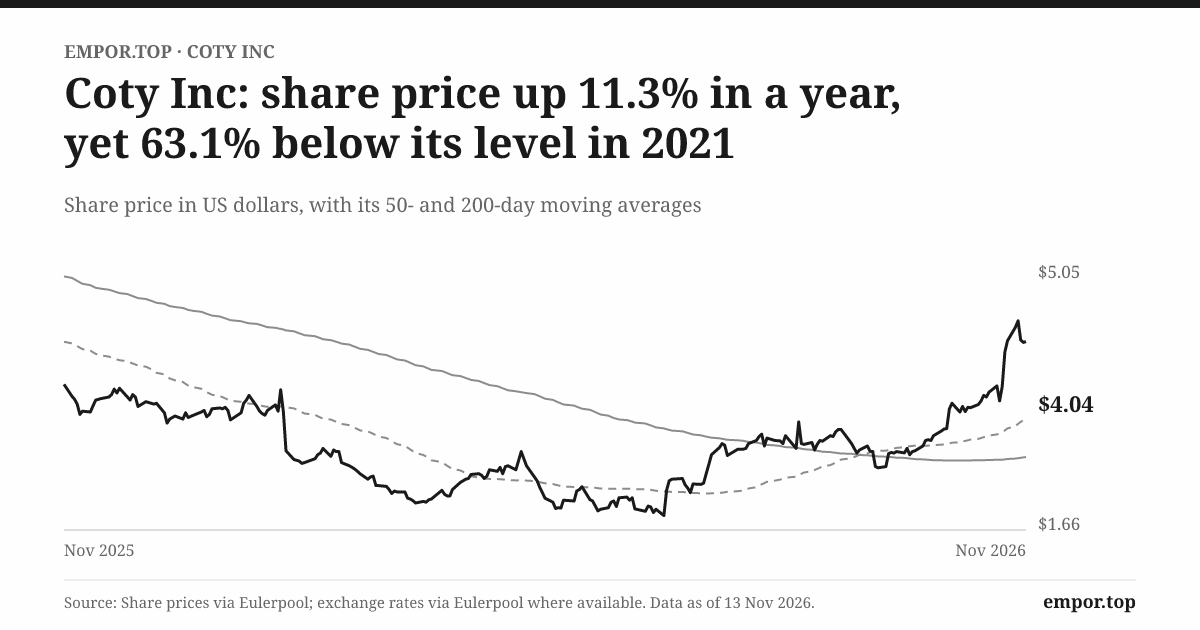
The stock market has already taken a view on how that test might go, and the view has swung wildly. Over the past year Coty's shares have traded as low as about $1.84 and as high as about $4.30, and in mid-November 2026 they sat near the top of that range, at about $4.04. That is a market that, after a long period of disappointment, has begun to price in some chance of recovery. It is also a stock that has fallen by about 86% at its worst point over five years, which is a useful reminder of how quickly that optimism has evaporated before.
The Gucci cheque buys cash and time. What it cannot buy is the answer to the question hanging over the next eight months: whether the brands that stay can replace what leaves. To understand why that question carries so much weight, the story has to go back to a perfumer in Paris, and to the moment his company decided it wanted to be something much larger.
 Subscribe on LinkedIn
II. The Fragrance House That Wanted to Become a Global Beauty Group
Coty's origin story is a perfumer's story. François Coty founded the business in Paris in 1904, at a moment when fragrance was shifting from a luxury made for a few households to something that could be bottled, branded and sold widely.4 The company's identity was built around scent for most of the century that followed, and fragrance is still the part of Coty that pays the bills.
For long stretches the company was more a holding than a protagonist. It passed through several owners, and by the modern era it sat inside the orbit of JAB, the investment vehicle of the Reimann family, which used Coty as one of its platforms in consumer goods. The investor story becomes consequential only when that fragrance house decided to become a global beauty challenger, one that could stand next to L'Oréal and Estée Lauder rather than in their shadow.
The first step was the public listing. Coty went public on the New York Stock Exchange in 2013, giving JAB and the company a currency for deals and a public market valuation against which to measure ambition.4 In fiscal 2015, the last full year before the big transformation, Coty sold about $4.4 billion of products and earned an operating margin of about 9%.4 That was a respectable fragrance-led business. It was also, by the standards of the companies Coty wanted to rival, small.
Then the shape of the company changed almost overnight. Revenue more than doubled, from about $4.3 billion in fiscal 2016 to $9.4 billion in fiscal 2018.4 No beauty company grows organically by more than double in two years. Coty grew that way because it bought a business almost as large as itself.
Just as quickly, the line went back down. By fiscal 2020, revenue had fallen to about $4.7 billion, below where it had started before the deal.4 That is the shape a listener should keep in mind for the rest of this story: a steep climb built by acquisition, a cliff built by write-downs and divestments, and then a slower recovery.
It also explains why the usual growth statistics mislead. Over the ten years to fiscal 2026, Coty's revenue grew about 2.9% a year, which sounds like a steady compounder. In reality the starting point sits before the merger and the ending point sits after the sale of a large chunk of what was bought, so that average describes a round trip rather than a trajectory.
The vehicle for the leap was a structure with an unglamorous name: the Reverse Morris Trust. The idea is simpler than it sounds. A large company that wants to shed a division without paying corporate tax on the gain spins that division off to its own shareholders, and the spun-off business immediately merges with a smaller company. To keep the deal tax-free, the original parent's shareholders must end up owning a majority of the combined company. Procter & Gamble wanted out of a collection of beauty brands it no longer saw as core; Coty wanted scale; the structure let P&G's shareholders, rather than P&G itself, become majority owners of the new Coty, with 52% of the combined company.8
The entity boundary matters here too. The deal moved brands, factories and employees into listed Coty. It did not make P&G's broader economics part of Coty's results, and it did not merge any of JAB's other businesses into the company. What Coty acquired was a portfolio, and the risk that came with running it.
The ambition was clear. The less obvious question was what all that breadth would actually buy. Scale in beauty is supposed to deliver lower costs in buying glass and media, more power with retailers, and more money to spend launching products. But it only delivers those things if the acquirer can run what it bought. Coty was about to find out how much capability it had, and how much it had simply assembled.
III. The $12.5 Billion Bet on P&G's Beauty Brands
On July 9, 2015, Coty announced that it would merge with 43 of Procter & Gamble's beauty brands in a transaction that valued them at about $12.5 billion.8 The list read like the inventory of an American drugstore and a European salon at the same time. There was CoverGirl and Max Factor in colour cosmetics, Clairol and Wella in hair colour and professional hair care, and a fine fragrance business with designer licenses.8 For a company whose identity had been built on scent, this was a leap into categories it had never run at that size.
Coty's announcement promised a new global leader in beauty. It also promised economics: the deal materials projected that the acquired businesses could add roughly 600 basis points to Coty's standalone operating margin over four years.8 In plain English, management was saying that for every $100 of sales, the combined company would eventually keep about $6 more as operating profit than Coty alone could manage, because of shared costs, buying power and cross-selling.
Was the price defensible? The popular version of the Coty story says the company overpaid for a tired portfolio. The record is more interesting than that. The P&G businesses had generated about $5.9 billion of sales and about $1.15 billion of EBITDA in fiscal 2014.8 That puts the headline price at a little over 2 times sales and close to 11 times trailing EBITDA.
Coty's financial advisers, in the merger proxy statement, built valuation ranges for the business. They selected multiples of roughly 12 to 14.5 times projected adjusted EBITDA and 2.25 to 2.75 times sales, based on comparable deals and trading companies.9 On those yardsticks, the announced price sat within or below the range the bankers considered reasonable at signing. By the standards of the time, $12.5 billion was not an obviously reckless price for the earnings P&G's beauty brands were producing.
The catch lies in the word "projected". The fairness analyses depended on forecasts of what the brands would earn and on a set of transactions the advisers chose as benchmarks.9 A buyer paying 11 times EBITDA for a business whose EBITDA is about to fall is not paying 11 times anything. So the entry multiple alone does not prove overpayment, and it does not prove a bargain. It tells you that the deal was priced for a business that would hold its earnings and then improve them.
The financing had its own consequences. Because of the Reverse Morris Trust structure, the price was paid largely in Coty shares issued to P&G's shareholders, and the combined company also took on substantial debt. When the deal closed on October 1, 2016, Coty's operating base more than doubled while its ownership was spread across a new and much larger shareholder register.10 Total assets on Coty's balance sheet jumped from about $7 billion to more than $22 billion, and borrowings rose from about $4.2 billion to about $7 billion within a year.10 That is the shape of a company that had made one large bet with both equity and debt.
The integration was enormous. Coty had to separate dozens of brands, supply chains and IT systems from P&G and stitch them into its own operations, while keeping retailers supplied and launches on schedule. Integrations like this rarely fail in one dramatic moment. They fail in a thousand small ones: a missed shipment, a confused sales force, a brand manager who leaves, a promotion that runs late.
And Coty did not stop buying. In 2017 it took a majority stake in Younique, a direct-selling cosmetics business that sold through social networks of independent presenters. It had also acquired ghd, the British maker of premium hair-styling tools.10 Later it bought a majority stake in Kylie Cosmetics, betting on an influencer-founded brand.4 Each deal had its own logic. Together they reveal an instinct: Coty believed that portfolio breadth, assembled through acquisitions, was itself a source of value.
The company's own record soon tested that belief. Younique's revenue and profitability declined more than management had expected, and Coty recorded impairment charges against it.10 The same year, the company took a far larger charge against the mass-market Consumer Beauty business it had inherited from P&G. Breadth had brought more brands, more categories and more channels. It had not, on its own, brought more value.
There is a quieter clue in the identity of the seller. Procter & Gamble was, and remains, one of the most sophisticated brand operators in the world, with more consumer data, more media buying power and more marketing talent than almost any company alive. It chose to sell these brands.
Sellers usually know more about their assets than buyers do, and when the most famous brand manager on the planet decides that a portfolio is no longer core, a buyer has to believe it can do something with those brands that P&G could not. Coty's answer was focus: these brands would be central at Coty, rather than peripheral at P&G. That is a reasonable argument. It is also an argument that only execution can prove.
So did Coty overpay? The fairest verdict is narrower than the popular one. The price fit the comparables at signing. What failed were the assumptions underneath the price: that CoverGirl and its peers would hold share in drugstores, that integration costs would be recovered, and that margin would expand by six points. The next chapter is about what happened when those assumptions met the market.
IV. When Scale Turned into an Impairment Charge
When Coty filed its annual report for fiscal 2019, it contained a number that rewrote the meaning of the P&G merger. The company recorded asset impairments of about $3.85 billion for the year, of which roughly $3.69 billion related to Consumer Beauty goodwill and intangible assets.10 Net loss for the year came to about $3.8 billion, or nearly $5 per share.10
An impairment is the accounting version of an admission. When a company buys a business, it records the brands and the "goodwill", meaning the premium paid above identifiable assets, on its balance sheet. Each year it must test whether the future cash those assets are expected to produce still justifies that carrying value. If the forecast falls far enough, the asset is written down, and the write-down runs through the income statement as a loss. No cash leaves the building on the day of the charge. The cash left years earlier, when the price was paid.
Coty's filing was specific about why the forecasts fell. Consumer Beauty revenue and market-share trends had come in below expectations, categories such as mass colour cosmetics had declined, Younique had underperformed, and management had lowered its near-term growth and margin assumptions while extending the time it expected recovery to take.10 That is not the language of bad luck in one quarter. It is the language of a business that was weaker than the buyer had planned for.
Separating scale from growth makes the point sharper. Revenue had peaked at about $9.4 billion in fiscal 2018, only because the acquired businesses were consolidated for a full year.4 Even by fiscal 2019, before any pandemic, revenue was already slipping, to about $8.6 billion, and operating margin was under 5%.10 The combined company was bigger than Coty had ever been, and it was earning a thinner margin than Coty had earned on its own in fiscal 2015. The 600 basis points of margin improvement promised in 2015 had, four years later, gone in the opposite direction.
The write-downs also exposed a problem with the cash that had already gone out of the door. Between fiscal 2017 and fiscal 2019, while the integration was struggling and borrowings stood around $7 billion to $7.7 billion, Coty kept paying dividends of roughly $350 million to $375 million a year.10 Over the same three years, its free cash flow was considerably smaller than those payouts. A skeptical investor would call that a capital allocation choice made as though the merger's promised economics had already arrived.
The impairment reset the carrying value of the assets to something closer to reality. It did not repay a dollar of debt, rebuild CoverGirl's shelf space or persuade a single shopper to choose Max Factor over a rival. That is the trap that impairments often hide. The balance sheet looks cleaner afterwards, but the obligations taken on to buy the assets remain at full value. Coty entered fiscal 2020 with a smaller asset base, the same debt and a weaker business.
The sensitivity has not gone away. In the fiscal 2026 annual report, Coty's auditor named the valuation of goodwill in both the Consumer Beauty and Prestige segments, and the valuation of the CoverGirl and Sally Hansen trademarks, as critical audit matters, meaning the areas that required the most challenging judgement.4 Those values depend on forecasts of revenue growth, margins and the discount rate used to translate future cash into today's money. Coty recorded another $362.8 million of impairments in fiscal 2026, including $237.1 million of goodwill and $125.7 million of trademarks.4 The write-downs of 2019 were the largest, but they were not the last.
The lesson that this period teaches is specific. Famous names and the scale of a deal are not enough when category position weakens and execution falters. CoverGirl was one of the best-known cosmetics brands in America when Coty bought it. Being well known did not protect it from losing share in drugstores to newer, faster brands. The record rejects a simple thesis that a bigger portfolio means better economics. It narrows the case to something harder to prove: a portfolio is only as valuable as the company's ability to keep each brand growing.
And by the spring of 2020, Coty no longer had the luxury of time to prove anything. A pandemic was about to close the shops where it sold.
V. KKR Buys the Hair Business—and Coty Buys Time
In the spring of 2020, the beauty counters of the world were shuttered. Department stores closed, travel retail at airports collapsed and the salons that bought Wella's hair colour and professional products sat empty. For a company carrying more than $9 billion of borrowings, that combination was close to an emergency.4 Fixed costs kept running while sales disappeared, and debt service did not pause.
In May 2020, Coty announced a strategic partnership with KKR. The private equity firm would make a convertible preferred investment in Coty and acquire 60% of the professional beauty and retail hair business, including Wella, Clairol, OPI and ghd, which would be carved out as a standalone company. Coty would keep the remaining 40%. The transaction valued the business at an enterprise value of $4.3 billion, or 12.3 times its 2019 EBITDA.11 When the deal was finalised, Coty expected net cash proceeds of roughly $2.5 billion.12
The comparison with the P&G merger is instructive. Coty had bought the P&G portfolio at a price its advisers had benchmarked at 12 to 14.5 times projected EBITDA. Now it was selling a large part of that portfolio at 12.3 times trailing EBITDA. The businesses were not identical and the timing was very different, but the multiple shows something important: the hair business, at least, had held its value. The problem in the P&G deal was never that every acquired asset was worthless. It was that the most troubled parts, like mass cosmetics, had been priced as if they would hold their earnings, and they had not.
Management's plan for the proceeds was straightforward. Debt paydown came first, then liquidity, then investment in the brands Coty kept.12 On the fourth-quarter fiscal 2020 call, the company framed the transaction as the cornerstone of a leaner, more focused Coty, built around prestige fragrance and skin care, with a cost-reduction programme alongside it.12 Fiscal 2020 had been brutal: revenue fell about 45% to $4.7 billion, operating cash flow turned negative and the company reported an operating loss of more than $1.2 billion.4
Was this a value-creating choice or a balance-sheet rescue? It was both, and the order matters. Without the sale, Coty faced the real possibility of a liquidity squeeze in the worst consumer environment in decades. With it, Coty's borrowings fell from about $9.2 billion at June 2020 to about $5.8 billion a year later.4 The cost was that Coty gave up control of one of its steadiest businesses. Professional hair care sells to salons, where colourists build habits around a brand's shades and formulas. That is closer to genuine switching costs than almost anything else in the Coty portfolio.
There is a counterpoint, and it flatters Coty. The company kept a minority stake and a share of the upside, and that stake turned out to be worth more than the 2020 valuation implied. In late 2021, Coty sold additional slices of Wella to KKR in two transactions, and the company's own filing said both reflected roughly 50% appreciation in Wella's equity value since the December 2020 closing.13
Coty used those stakes to redeem KKR's preferred shares in Coty, saving about $65 million a year in preferred dividends across the three KKR transactions, and its stake fell to about 25.9%.13 In fiscal 2026, Coty sold the remainder, receiving $750 million in cash, but booking a $201.9 million loss on the sale against the stake's carrying value.4
Comparing what management promised in 2020 with what followed is a fair test. The promise was a simpler, less leveraged company that would grow profitably in prestige. Leverage did come down meaningfully: by June 2026, reported debt stood at about $3.09 billion.4 Operating margin recovered from deeply negative to nearly 10% in fiscal 2023.4 Then it slipped again, to about 4% in fiscal 2025 and below zero in fiscal 2026.4 The pandemic explains the trough of 2020. It does not explain why, six years later, the company is still reporting operating losses on a smaller revenue base.
The Wella sale, then, bought time. It removed a solvency risk and preserved some upside, but it also made Coty more dependent on the businesses that remained: prestige fragrance, which had always been the company's heart, and mass cosmetics, which had always been its problem. The next chapter is about how far fragrance could carry the load.
VI. Prestige Carries the Recovery—Until Growth Slows
The recovery that followed the pandemic had a smell to it. As shops reopened, consumers who had spent two years at home turned to fragrance as an affordable luxury, and Coty's prestige business was positioned to catch the wave. Under Sue Nabi, who took over as chief executive in 2020, the company leaned hard into fragrance launches. Coty itself later credited her with blockbusters such as Burberry Goddess.14
Revenue followed. From about $4.6 billion in fiscal 2021, sales rose to about $6.1 billion in fiscal 2024, a gain of roughly a third in three years.4 Operating margin rebuilt itself from below zero to nearly 9% in fiscal 2024.4 For a while, it looked like the narrower Coty was a better company: less leveraged, more profitable, and centred on the part of beauty it understood best.
Attributing that growth carefully matters, because several forces were at work at once. Some of it was market recovery, as shoppers returned to stores. Some of it was price, as the whole industry pushed through increases during the inflation of 2022 and 2023. Some reflected currency, and some came from portfolio changes like the consolidation of Kylie Cosmetics. A rising tide in fragrance lifted most prestige players during those years, so the fact that Coty grew does not, by itself, prove it gained ground on competitors.
Then the growth stopped. Revenue eased to about $5.9 billion in fiscal 2025 and about $5.8 billion in fiscal 2026, a decline of about 1.5% in the latest year.4 Operating profit swung from a profit of about $547 million in fiscal 2024 to a loss of about $82 million in fiscal 2026, the loss driven by impairments, restructuring and weaker trading.4 The three-year compound growth rate, at about 1.5% a year, is now below the company's ten-year base rate of about 2.9%.4
Today, Prestige is clearly the larger part of the business. It accounted for about 66% of fiscal 2026 revenue.4 Consumer Beauty, the mass business built around CoverGirl, Max Factor, Rimmel and Sally Hansen, generated about $2.0 billion and declined about 3%.4 That segment still contributes roughly a third of revenue, which makes it economically material even if it no longer defines the story.
Consumer Beauty's problem is easy to describe and hard to fix. Mass colour cosmetics in drugstores and supermarkets is the part of beauty most exposed to newer brands that launch on social media, sell at low prices and move fast. A teenager deciding between a familiar CoverGirl mascara and a viral brand she saw in a short video has almost no reason to stay loyal, and the retailer stocking both has every reason to give shelf space to whichever is selling. Big legacy names in that aisle can survive, but they have to fight for every point of share, usually with promotional spending that thins margins.
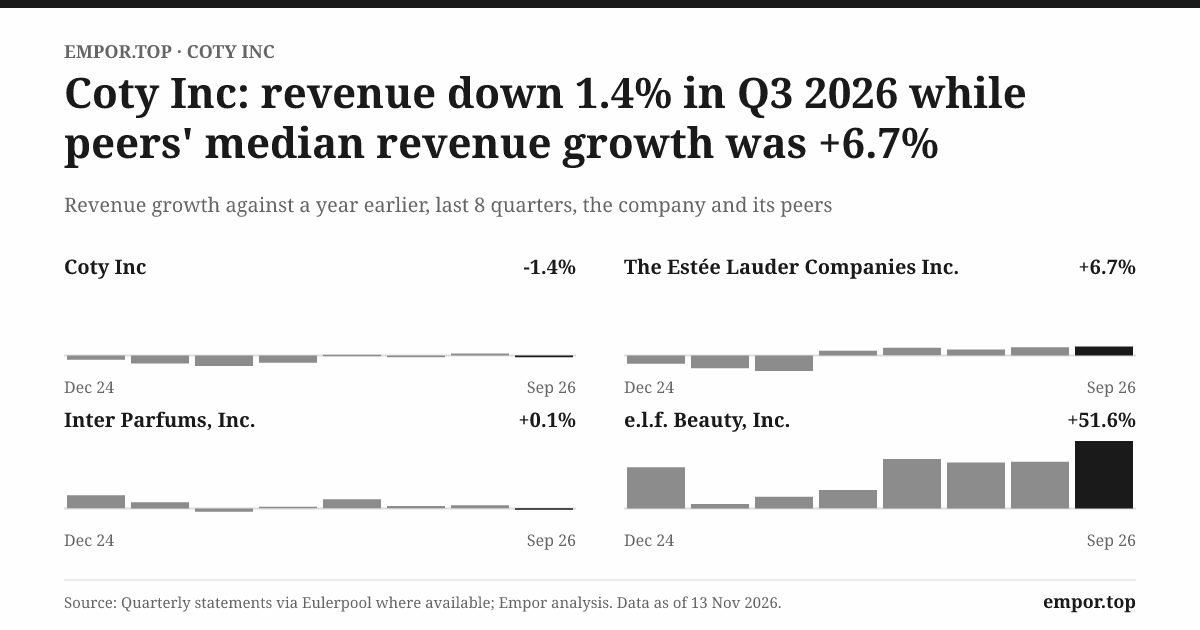
The first quarter of fiscal 2027 showed the split clearly. Prestige accounted for about 68% of quarterly sales.5 Total revenue declined about 1% on a reported basis and about 2% like-for-like, meaning after stripping out currency and portfolio changes.5 Beneath that number was an unusual combination: units sold rose about 3%, while price and mix together fell about 5%.15 In other words, Coty sold more bottles and compacts, but it sold them at lower average prices, either because of discounting, less favourable trade terms with retailers or a shift toward cheaper products.15
That mix is worth pausing on. In a healthy brand business, growth tends to come from both volume and price, because consumers will pay more for something they want. When volume rises while price and mix fall by more, the company may be buying unit growth with promotions. It is not proof of weakness by itself, but it is the opposite of the pricing power that a premium brand portfolio is supposed to deliver.
The bright spot was the core. Coty's six largest Prestige brands grew about 5% like-for-like in the quarter, with five of the six growing.5 Those six brands, by the company's own account, account for about 73% of Prestige sales.5 If that is the start of a trend, it is the strongest argument that Coty's strategy is working. If it is a quarter, it is a quarter. The record of the past three years, in which a sharp recovery gave way to stagnation, counsels caution about reading a single quarter as a turn.
So the growth claim is intact but unproven. Prestige fragrance remains Coty's value engine, but the engine has slowed, Consumer Beauty continues to shrink, and the company is about to lose one of its largest prestige names. The figures to watch are like-for-like growth, price and mix, and sell-out, meaning what consumers actually buy at retail as opposed to what retailers order, in the quarters after Gucci leaves. And that raises the deeper question that sits under every prestige brand in the portfolio: how much of it does Coty actually control?
VII. What a Beauty Moat Costs to Keep
Walk into any department store's fragrance hall and the bottles on the shelf tell a story about ownership that most shoppers never notice. Many of Coty's best-known scents carry names that Coty does not own. It rents them. At the end of June 2026, the company held 22 brand licenses.4 About 48% of fiscal 2026 revenue came from brands Coty owns outright or holds under effectively perpetual arrangements, and about 37% came from exclusive licenses with between six and 24 years left to run.4
A license is a contract in which a fashion house lends its name to a beauty company. The beauty company designs, manufactures, markets and distributes the products, and pays the brand owner a royalty, generally a percentage of sales and sometimes with a guaranteed minimum.4 Coty's licenses average about 24 years in length.4 That is long enough to build a business, but not so long that the brand owner loses leverage. When renewal approaches, the owner holds the card.
The economics of the model explain why the cost of keeping a moat is so high. Coty sells products to retailers and distributors, and its revenue depends on how many units it ships, at what net price after discounts, and in what mix.4 Retailers order based on how fast products sell through to consumers, so a launch that fails at retail can leave inventory sitting in the channel and depress the next season's orders. Holiday demand makes the December quarter especially important.4 To keep the system moving, Coty spent about $1.61 billion on advertising and promotion in fiscal 2026, roughly 28% of revenue.4 Research and development cost about $121 million, about 2.1% of revenue.4
Those two numbers describe the business. Coty is not primarily a technology company that wins on formulation. It is a marketing company that wins on desire. For every $100 of sales, it spends about $28 persuading people to want the bottle and about $2 on the science inside it. That spending is the price of admission in prestige beauty, and it is also the reason the industry rewards scale: a company that can spread media costs over more brands and more countries has a structural advantage.
Coty is not, however, the largest player in the room. L'Oréal reported sales of about €44.1 billion in 2025.16 Estée Lauder reported about $14.3 billion in its fiscal year to June 2025.17 Puig, the Spanish fragrance and fashion group that is perhaps Coty's closest peer in prestige fragrance, reported about €5.0 billion in 2025.18 Fiscal years, currencies and portfolios differ, but the order of magnitude is clear: Coty's roughly $5.8 billion makes it a mid-sized player in a game where the leader is about seven times larger.
Now apply the forces that shape the industry. Brand owners have considerable bargaining power, because a fashion house with a famous name can shop its license to multiple beauty companies when the contract ends. Retailers have some power too. No single Coty customer exceeded 10% of sales in the past three fiscal years, which limits single-customer risk, but retailers negotiate trade terms and promotional support, and in the first quarter of fiscal 2027 less favourable customer trade terms weighed on revenue.415
Consumers have enormous choice and low switching costs, because a person who loves one fragrance today can try another tomorrow at almost no cost. Scale helps Coty's marketing and distribution, but it does not guarantee pricing power, as the negative price and mix in the latest quarter shows.
The Gucci outcome is the clearest test of license durability: Kering had already signed a 50-year arrangement with L'Oréal for after Coty's departure.2 On the other side of the ledger, Coty extended its Marc Jacobs license by 40 years in 2026, evidence that brand owners still choose Coty when the relationship works.19 Both facts are true at once. A long license can be renewed, and a long license can be taken away. Neither proves the other is the rule.
The balance sheet adds a further clue. Coty's inventory has crept up relative to its cost of sales over the past decade, from about 116 days of supply in fiscal 2015 to about 142 days in fiscal 2026, partly because Coty says it chose to carry more safety stock.4 Its receivables look leaner, with debtor days falling from a peak of about 70 to about 33, but that improvement is flattered by factoring, which removes invoices from the balance sheet.
A company with genuine pricing power and fast-moving brands would tend to show the opposite: lean inventory, because products sell through quickly, and strong collections without needing to sell invoices. Coty's working-capital profile does not prove weakness, but it does not show the signature of a brand portfolio that retailers are clamouring for.
So how strong is the moat? The honest verdict is that brand strength and global execution are plausible advantages, but Coty's disclosures do not demonstrate portfolio-wide switching costs, customer retention or pricing power. The company does not publish retention data or sell-out figures across its brands. Its license portfolio is valuable access, not ownership of every brand's future. The tests that would settle the question are visible: core-brand sell-out, price and mix, and the outcome of license renewals.
One more point belongs here, because it is fashionable to claim otherwise. Coty describes artificial intelligence and advanced analytics as operational initiatives, used in marketing, demand forecasting and commerce execution.4 The company does not report AI as a material revenue stream. It may help Coty spend its marketing dollars more efficiently. It does not change what sells the bottle, which is still the brand.
The question, then, is what Coty's new leadership chooses to do with that portfolio, and how much of it to keep.
VIII. Strobel's First Portfolio Choice Is How Much Coty to Keep
On December 22, 2025, Coty announced that Markus Strobel would become executive chairman and interim chief executive from January 1, 2026.14 He succeeded Sue Nabi, who stepped down after five years as chief executive, and Peter Harf, the long-time JAB figure who retired from the board after more than three decades.14 The announcement came days after Coty said it had sold its remaining stake in Wella, and in a year when the shares had fallen by more than half.14
Strobel came from the company that had sold Coty much of its portfolio. He spent 33 years at Procter & Gamble, most recently as president of its global skin and personal care business.14 That background is a double-edged sword. On one side, he knows how a disciplined consumer company allocates marketing money, prunes brands and runs supply chains. On the other, his experience is in a company where scale was built over decades, not acquired in a single deal, and where the balance sheet was never the constraint.
His first priorities followed a familiar playbook. Coty set out to focus on its core brands and core markets, reduce portfolio complexity, simplify the organisation and redirect savings into consumer engagement.19 It launched Coty.Curated as part of that reorganisation of the portfolio and opened a strategic review of Consumer Beauty, with a decision due by the end of calendar 2026.195 Coverage of the company's options had begun even before Strobel arrived: in September 2025, Axios reported that Coty was weighing options for CoverGirl and other cosmetics brands.20
It helps to remember what Strobel inherited. Nabi's tenure had real accomplishments, including blockbuster fragrance launches.14 But it ended with revenue falling, operating profit collapsing into losses and a share price down by half in a year. Strobel took over a company that had already been through one turnaround and was now asking investors to believe in a second.
The stakes of that review are hard to overstate. Consumer Beauty sold about $2 billion of products in fiscal 2026.4 Selling some or all of it could cut leverage and simplify the company dramatically. It could also leave Coty with a much smaller revenue base, fewer shared costs to spread across its factories and distribution, and greater dependence on a prestige portfolio that is about to lose Gucci. Keeping it requires a believable plan to stop the decline. There is no free option.
The November 5, 2026 call showed the difference between prepared remarks and the questions analysts actually asked. In the prepared remarks, management emphasised that the first quarter was ahead of its own guidance, that core Prestige brands had returned to growth and that net debt had fallen.5 In the Q&A, analysts pressed on three things: what the Consumer Beauty decision would look like, how much revenue and profit Gucci represented, and what a recovery would look like after the license transition.6 Management described fiscal 2027 as a transition year and warned that the recovery would be uneven.6 That is candid. It is also a reminder that the company itself is not promising a straight line.
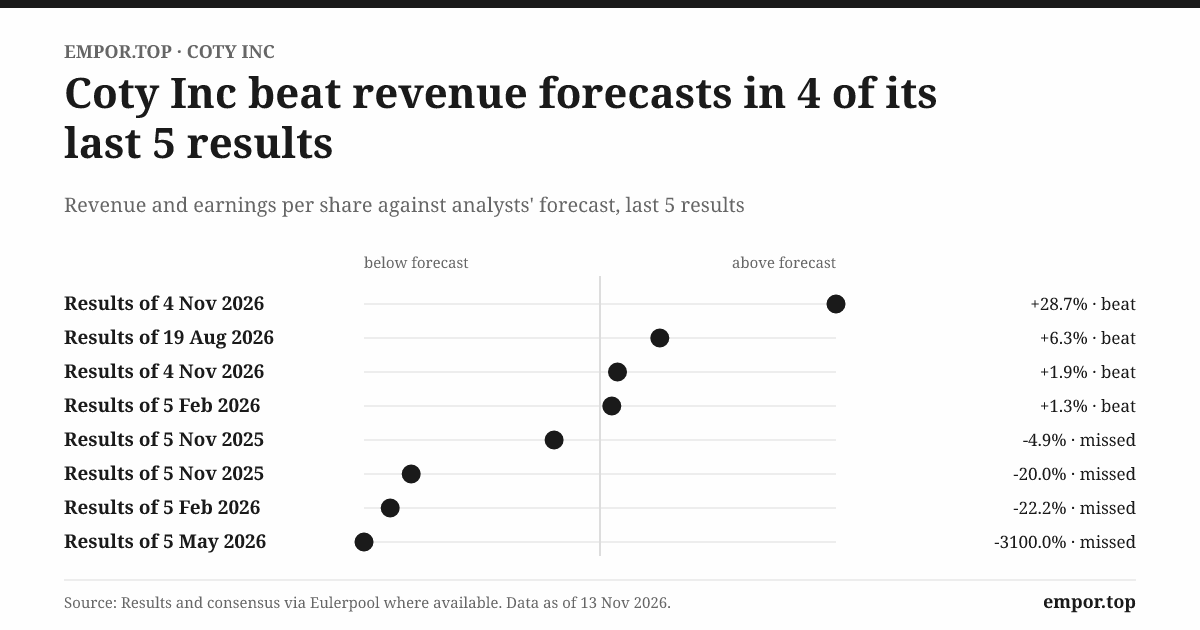
Beating a quarterly outlook is a useful signal, but a narrow one: it says management forecast three months correctly, not that the business has turned. Coty's fiscal 2026 annual incentive plan paid nothing to eligible executives, because the company missed its adjusted EBITDA threshold.7 That is a sign that the pay system works as designed; it is also a record of a year in which the company missed the target it set for itself.
Strobel's incentives are designed around the share price. On appointment, he received 1.35 million restricted stock units and six million stock options.7 Half of those options vest only if the share price reaches $5.56, and all of them vest at $9.00, subject to continued service and other conditions.7 His reported compensation for fiscal 2026 was about $11.1 million, mostly from that equity award, against about $3.6 million for Nabi.7 The current directors, nominees and executive officers together owned less than 1% of the company, according to the latest proxy.7
That structure aligns part of Strobel's upside with a recovery in the share price, which closed at about $4.04 on November 13, 2026. The first vesting threshold is roughly 40% above that level, and the second more than double. Those are demanding hurdles, which is a point in the plan's favour. But share-price targets can also be met through market moves that have little to do with the business, and they say nothing directly about free cash flow, debt or brand health. Coty's leadership also changed at the finance level in September 2026, when the company appointed Soraya Benchikh as chief financial officer.7
The fair conclusion is a measured one. The strategy has a measurable early signal in the core brands, and Strobel's incentives point in the right direction. But his operating record at Coty is too short to establish credibility, and the company has announced strategic resets before. The outcome of the Consumer Beauty review and several quarters of price, mix and sell-out data will matter more than one quarter's beat. And every one of those decisions will be shaped by the same constraint that has shaped Coty for a decade: the debt.
IX. Cash Arrives, but the Debt Still Sets the Terms
Coty's fiscal 2026 cash-flow statement contains what looks like a riddle. The company reported an operating loss of about $82 million and a net loss of roughly $600 million.4 Yet its operating cash flow rose to about $538 million from about $493 million the year before.4 How does a company lose money on paper and generate more cash?
The answer runs back through every chapter of this story. Over the twelve fiscal years from 2015 to 2026, Coty generated about $6.1 billion of operating cash flow while recording about $5.3 billion of cumulative net losses.4 Free cash flow, meaning operating cash minus capital spending, totalled about $3.0 billion. The gap between losses and cash is mostly accounting: large non-cash charges for impairments and amortisation, the slow expensing of the cost of acquired brands, reduce reported profit without consuming cash. In fiscal 2026 alone, impairments were $362.8 million and depreciation and amortisation $421.1 million.4
That is the reassuring half of the riddle. The less reassuring half is about where the cash went and how it was produced. Of the roughly $3.0 billion of free cash flow over twelve years, about $1.6 billion, more than half, was paid out as dividends, much of it in the years when the integration was faltering. Meanwhile, cash and short-term investments fell from about $1.2 billion at the end of fiscal 2014 to about $176 million at the end of fiscal 2026.4 The company paid out money it would later need.
The quality of recent cash flow deserves a closer look too. Coty says fiscal 2026 operating cash benefited from working-capital movements: lower discretionary compensation payments, the timing of receivables and higher accounts payable and accruals, partly offset by higher safety stock.4 Coty also factored about $164 million of receivables at year-end, with some invoices carrying recourse of up to 10% if customers do not pay.4 And it pays its suppliers slowly. Days payable have roughly doubled over the past decade, from about 155 to more than 300, meaning Coty's suppliers effectively finance a large part of its working capital.4
None of these practices is improper, and all of them are common. But each one can only be done once. A company that stretches its payables from 155 days to 318 days gets a one-time cash boost; it cannot stretch them again by the same amount. When those benefits roll off, the cash flow that remains is the real measure of the business.
Asset sales sit on top of that. Fiscal 2026's investing cash flow was positive because of the $750 million Coty received for its remaining Wella stake.4 Financing outflows of about $1.16 billion included substantial debt repayments.4 Reported debt fell to about $3.09 billion at June 2026, down from about $4.0 billion a year earlier, and the Wella proceeds paid for much of that reduction.4 Cash at year-end was about $176 million, rising to about $228 million at the end of September.15 The first quarter of fiscal 2027 produced about $85 million of free cash flow.15
The refinancing calendar is where the debt sets the terms. About $570 million of euro notes come due in May 2027.4 After that, $500 million falls due in 2029, $750 million in 2030 and $900 million in 2031, and the revolving credit facility, with about $350 million drawn at June 2026, matures in July 2028.4 In April 2026, Coty repaid €250 million of notes using revolver borrowings.4 That is a normal treasury manoeuvre. It also shows how thin the cushion is.
Put those maturities next to the cash and the arithmetic becomes vivid. At the end of September 2026, Coty held about $228 million of cash. The first quarter produced about $85 million of free cash flow, and the remaining Gucci proceeds, roughly $150 million of the agreed $400 million, are still to come.5
Even if every one of those dollars were kept, they would not by themselves cover the May 2027 notes. Coty can draw on its revolver or refinance in the bond market, and it has done both before. But the price of that money depends on how lenders view the business, which is why every quarter of operating performance between now and May matters more than it would at a company with a cash pile.
The credit agencies have been watching. In February 2026, Fitch affirmed Coty's BB+ issuer rating but revised the outlook to negative, citing weak operating trends, leverage and exposure to consumer and retail demand.21 In July 2026, a rating downgrade reinstated covenants, guarantees and collateral on Coty's senior secured notes.4 Coty said the change should not materially affect its liquidity but could increase future borrowing costs.4 Those protections had been released when credit quality improved; their return is a sign that lenders want more security than they did a year earlier.
There is one more contingent risk worth naming. Coty faces talc-related personal-injury litigation, among other disputes, and management says that its current legal matters are not expected to be material except for the talc claims.4 The company does not provide a single quantified maximum exposure for those claims. Investors should treat talc as an open question, not a disaster and not a dismissal.
The verdict on cash is that it is real, but not yet a clean proxy for repeatable earnings. Impairments, amortisation, working-capital timing and asset sales all shape the record. The numbers to watch are operating cash flow, free cash flow excluding asset-sale proceeds and net debt after the 2027 maturity. If Coty can reduce debt from recurring cash rather than one-off proceeds, the story changes. Until it does, the debt sets the terms, and the shareholder who controls the vote has a central role in deciding what happens next.
X. JAB Has the Votes; Coty Has to Earn the Trust
When Coty's 2026 proxy statement landed on September 24, it spelled out the governance reality of the company in two numbers. JAB Beauty B.V. held about 51.3% of Coty's Class A shares as of September 10, 2026, and about 54% of the voting power on an if-converted basis, including Series B preferred stock.7 BlackRock, the next-largest holder, owned about 6.4%.7 One shareholder controls the outcome of almost any vote.
JAB's commitment has not been costless. In 2023, it bought 150 million Coty shares in a tender offer at $11.65 a share.7 The same year, Coty sold 33 million new shares to the public at $10.80 in a global offering, raising about $348 million after fees.4 Today the shares trade at about $4. Both JAB and the investors who bought in 2023 have lost most of their money on those purchases. That is an alignment of a painful kind: the controlling shareholder has every reason to want the share price to recover.
But alignment on outcomes is not the same as independent oversight. A controlled company can make decisions quickly, without fearing a hostile bid or a proxy fight, which can be a strength during a turnaround. It can also make decisions in which the controlling holder's interests and those of minority shareholders diverge, in timing, risk appetite or the price of an asset sale. That is why the quality of the board and the transparency of related-party dealings matter more, not less, at a company like Coty.
The disclosed related-party items are small. Coty has assigned a lease performance guarantee to a JAB affiliate with a maximum potential exposure of about $2.6 million, and it assesses the risk of default as remote.4 More notable is a secondment arrangement: Gordon von Bretten, the former president of Consumer Beauty, served under a JAB-affiliate secondment, and Coty paid the affiliate a fixed fee.7 The proxy does not disclose the amount. Neither item suggests a quantified financial burden on Coty. The undisclosed fee is a disclosure question that a careful shareholder could reasonably ask to see answered in the next proxy.
Peter Harf's retirement at the end of 2025 marked the end of an era. He had been the face of JAB's involvement in Coty for more than three decades, through the P&G merger, the impairments and the Wella sale.14 His departure did not change who controls the votes, but it did change who sits in the chair, and it handed that seat to an executive who combines the roles of chairman and chief executive. Combining those roles concentrates authority at exactly the moment when a skeptical shareholder would want the most independent challenge.
The board has changed sharply. Of the nine nominees in the 2026 proxy, seven had joined in the preceding year, and three directors had current ties to JAB as partners or directors.7 A refreshed board can bring new perspectives and fresh accountability to a strategic review. It also brings directors with a short record of oversight at a company that is making some of its most consequential choices in a decade.
Shareholders have sent mixed signals. The say-on-pay proposal in 2025 received about 76% support, and the three-year average was about 82%.7 With JAB holding a majority of the votes, a figure like 76% implies that a large share of independent shareholders voted against. At the November 2026 annual meeting, about 82.7% of votes entitled to be cast were present.22
Strobel's compensation, viewed in this light, is a forward-looking bet. The options vest only if the share price clears $5.56 and $9.00, levels last seen before much of the past few years' decline. That means the award creates value only if the business recovers enough to lift the stock. But Coty's record of setting targets, missing them and then resetting strategy is long enough that shareholders should judge the new plan on delivery, not design.
The evidence warrants scrutiny, not an assumption of misconduct. JAB's control gives it influence over Coty's direction; independent directors and transparent disclosure are the counterweight. Whether that counterweight is strong enough will be tested by the decisions due in the coming months, beginning with what happens to Consumer Beauty. Which leaves the question every investor has to answer: is the market pricing Coty correctly?
XI. Analysis & Bear vs. Bull Case
On November 13, 2026, Coty's shares closed at about $4.04, within about 6% of their 52-week high of $4.30 and more than double their 52-week low of about $1.84. The market value was about $3.0 billion and the enterprise value, which adds debt and subtracts cash, about $5.7 billion. On those numbers, Coty trades at about 0.5 times sales and 1.0 times enterprise value to sales. By comparison, Estée Lauder recently traded at about 3 times enterprise value to sales and about 18 times EBITDA.23
At first glance, that gap looks like a bargain. A company with $5.8 billion of sales, a famous brand portfolio and global distribution, valued at about one times sales, can look absurdly cheap next to peers at three times. But the other multiples tell a different story. Coty's enterprise value is about 55 times trailing EBITDA, because that EBITDA, depressed by impairments and other charges, has fallen to almost nothing. The trailing price-to-earnings ratio is not meaningful when the company is losing money. The free-cash-flow yield of about 11.5% is the most flattering number, but it rests on cash flow that has been helped by working capital.
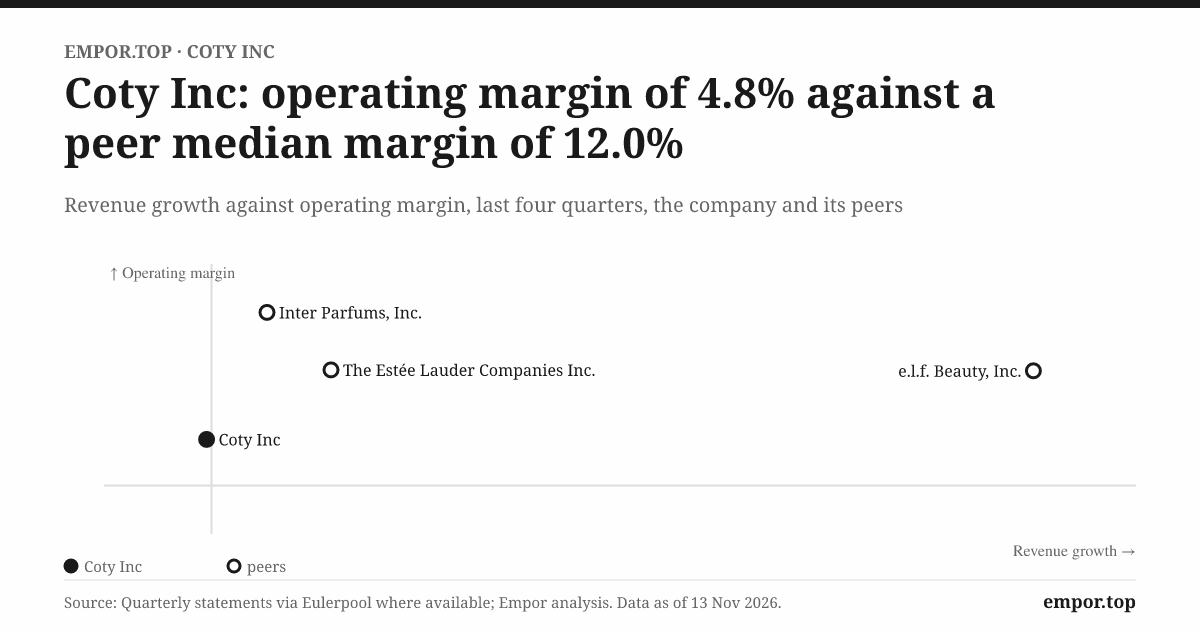
What the market seems to be saying is that Coty's sales are worth much less than a peer's sales, because they generate much less profit and carry much more debt. Coty's operating margin was about -1.4% in fiscal 2026, while larger peers typically earn double-digit margins. That gap is the real question. If Coty can earn something closer to the margins it reached in fiscal 2023 and 2024, the stock is cheap. If it cannot, the low sales multiple is a fair reflection of a weak business with a heavy balance sheet.
The bull case is that Coty's core Prestige business can recover, supported by long-term licenses, global distribution and new leadership with deep consumer-goods experience. The Gucci cheque and the Wella proceeds have reduced debt, and if the Consumer Beauty review produces a sale at a reasonable price, leverage could fall further.
The bear case is that the declines and weak pricing power persist, while Coty hands Gucci to its largest competitor. The company's history of impairments, from the $3.85 billion of 2019 to the $363 million of 2026, challenges the idea that brand breadth alone creates value.
The way to settle the argument is to ask whether Coty can sustain positive price and mix and sell-out after Gucci exits, while funding brand investment and covering its debt maturities. All three have to happen at once. If price and mix stay negative, revenue growth will depend on volume and promotions, which compresses margins. If brand investment is cut to protect cash, the brands weaken. If cash is thin when the 2027 notes come due, refinancing costs rise.
Michael Porter's five forces sharpen the picture. Rivalry in prestige beauty is intense, and social media has lowered the cost of building a beauty brand. Retailers negotiate trade terms, while brand owners can take their names elsewhere, as Gucci showed. Consumers can switch fragrances easily.
Hamilton Helmer's seven powers framework points in the same direction. Coty has some scale economies in marketing and distribution, but it is not the scale leader. Consumer switching costs are low, network effects do not apply, and counter-positioning is not obvious. The strongest candidate is branding, the power that lets a company charge more for an identical product because of what the name means.
But many of the brands are licensed, so the branding power belongs partly to the licensor. A cornered resource would be something only Coty can access, and licensed brand access is not that: renewal terms remain in the hands of the brand owners. Process power, the kind of operating excellence that is hard to copy, would show up in consistently superior margins, which Coty's record does not show.
An activist looking at Coty would not need long to find the pressure points. The first would be portfolio complexity: 22 licenses, two segments, dozens of brands and a mass business that has been shrinking for years, all run by a company of about 11,300 employees with a fraction of its rivals' marketing budgets.4
The second would be capital allocation, from the dividends paid during the integration to the forward repurchase contracts tied to intended buybacks, which generated a $133 million loss in fiscal 2026 alone.4 The third would be accountability: a company that has missed its own incentive thresholds, reset strategy under successive leaders and still reports operating losses. The activist would not get far, of course, because JAB holds the votes. That is precisely why the board's independence matters.
The verdict is that there is a recovery case, but the low sales multiple is not proof of undervaluation. The case depends on profitable growth in core Prestige, a coherent decision on Consumer Beauty and cash-led debt reduction. Three numbers decide it. The first is like-for-like sales growth with price and mix: in the first quarter, growth was -2% and price and mix were -5%.
The second is core-brand sell-out, the clearest sign of whether consumers are choosing Coty's brands. The third is free cash flow and net debt after the Gucci proceeds and the 2027 maturity. Right now, the first is negative, the second is improving in the core but unproven, and the third is improving but still dependent on asset sales.
XII. Business & Investing Lessons
Stand back from the details and Coty's decade reads like a four-act play. In 2015, it announced the P&G merger. In 2019, it wrote down much of the value it had acquired. In 2020, it sold control of its hair business to KKR to stay solvent. And in 2026, it accepted payment to give up Gucci early. Each act was a decision made under different pressures, but together they teach lessons that are distinctively Coty's.
The first lesson is that a brand name is not a moat until customers keep choosing it at a price that pays for the advertising. CoverGirl showed that fame bought attention.
It did not buy loyalty, and in mass cosmetics, where shoppers can try a new brand for a few dollars, attention without loyalty is an expensive habit. For investors, the lesson is to look past brand recognition to the evidence that matters: market share, price realisation and repeat purchases. When a brand's prices are falling, recognition alone is not doing the work.
The second lesson is that a deal can fit the comparables and still disappoint if the operating plan misses. Coty's bankers found the P&G deal's price reasonable against comparables; the forecasts missed on what the brands would earn.
For founders and acquirers, the lesson is that a fair price is a necessary condition, not a sufficient one. The real question in any acquisition is not "what is this worth?" but "can we run it better than the seller did?" P&G's decision to sell should have sharpened that question.
The third lesson is that selling an asset can buy time, but only the remaining business can prove the turnaround. The Wella and Gucci sales reduced debt, but every sale left Coty smaller and more dependent on what remained. Asset sales are a bridge, not a destination. Investors should treat cash from asset sales as a one-time gift and judge the turnaround on recurring cash flow.
The fourth lesson is that a license can last decades, but the owner still holds the renewal card. Gucci's departure and Marc Jacobs's renewal showed both sides of the bargain. The lesson for anyone investing in a licensing business is that the moat belongs partly to someone else, and its durability depends on how the licensee performs and on what the licensor wants.
The fifth lesson is that a dividend paid from borrowed time has to be repaid with interest. Coty's dividend record during the integration and its shrinking cash balance showed how those payments reduced the cushion when later troubles arrived. Those payments did not cause the impairments, but they reduced the cushion the company had when the pandemic and the downgrade arrived. For a leveraged acquirer, every dollar paid out before the promised synergies have arrived is a dollar borrowed from the future.
Underneath all five lessons sits one that ties them together: the value of beauty brands depends on what the buyer can integrate, renew and finance after the announcement. Coty has been a company of announcements. Its future depends on whether it can become a company of execution.
XIII. Epilogue
Tonight, as the calendar year approaches its end, Coty stands at a fork. The Consumer Beauty review is due by the end of 2026.5 Gucci remains in the portfolio through June 2027, earning money for a company that knows it is leaving.1 And roughly $570 million of notes mature in May 2027.4 Each of those three dates is a test, and each will answer a different part of the story's central questions.
The first test is the portfolio decision. If Coty sells some or all of Consumer Beauty, it will become a smaller, more prestige-focused company with less debt. The question will then be whether it reinvests the proceeds credibly, or whether the sale is another bridge to buy time. If it keeps the business, the question will be whether management has a specific plan to stop the decline, with milestones the market can track. Either way, the decision will reveal what kind of company Strobel and the board want Coty to be.
The second test is what happens to Prestige after Gucci leaves. The six core brands grew in the first quarter, but they will have to carry more of the load once Gucci's revenue disappears. Like-for-like growth and price and mix in Prestige will show whether the core can grow without the departing name, and whether it can grow without discounting.
The third test is cash. Free cash flow, net debt and the terms on which Coty refinances or repays its 2027 maturity will show whether the company can reduce debt from recurring cash rather than one-off proceeds. A refinancing on reasonable terms, without another downgrade, would signal that lenders believe in the recovery. A costly one would signal the opposite.
These tests are linked, which is what makes the coming months unusually consequential. A strong Consumer Beauty sale would ease the refinancing; a weak one would leave Coty choosing between a small, more profitable company with less cash and a larger one still carrying a declining business. A Prestige quarter with positive price and mix would make lenders more comfortable, while another quarter of falling prices would strengthen the case of those who argue Coty is buying volume rather than earning it. The company does not get to pass one test at a time.
There is a fourth, quieter test. Coty has announced many strategies over the past decade. If the company announces another strategic shift without measurable follow-through, that would be evidence against management's recovery case. Credibility, in the end, is built by doing what you said you would do, and then doing it again.
The tension that remains is the one this story began with. Coty is a company that has been paid to give up a name, and it must now prove that the names it keeps are enough.
XIV. Outro
Picture the moment in June 2027 when the last Gucci bottle made by Coty leaves a factory. It will be a small event, unnoticed by most shoppers. But it will close a costly chapter.
Coty's familiar tension remains: owning some beauty brands, renting famous names and finding enough time and balance-sheet room to make both pay. After years of buying and selling, it is now being paid to let go of Gucci. The $400 million cheque is real. The question it cannot answer is whether the brands that stay can make Coty matter without the one that left.
References
-
Coty Announces Agreement with Kering for Early Transition of Gucci Beauty License — Coty Inc., 2026-07-07 ↩↩
-
Kering Sells Beauty Branch to L’Oréal, Refocusing on Fashion — Le Monde, 2025-10-20 ↩↩
-
Coty to Return Gucci Beauty License to Kering Early in $400 Million Deal — Reuters via Investing.com, 2026-07-07 ↩
-
Annual Report on Form 10-K for fiscal 2026 — Coty Inc., 2026-08-20 ↩↩↩↩↩↩↩↩↩↩↩↩↩↩↩↩↩↩↩↩↩↩↩↩↩↩↩↩↩↩↩↩↩↩↩↩↩↩↩↩↩↩↩↩↩↩↩↩↩↩↩↩↩↩↩↩↩↩
-
Coty Announces First Quarter Fiscal Year 2027 Results — Coty Inc., 2026-11-04 ↩↩↩↩↩↩↩↩↩
-
Q1 FY2027 Earnings Q&A Transcript — Coty Inc., 2026-11-05 ↩↩↩
-
Definitive Proxy Statement — Coty Inc., 2026-09-24 ↩↩↩↩↩↩↩↩↩↩↩↩↩
-
Coty to Merge with P&G Beauty Business — Coty Inc., 2015-07-09 ↩↩↩↩↩
-
Merger Information Statement for the P&G Beauty Business Transaction — Coty Inc., 2016 ↩↩
-
Annual Report on Form 10-K for fiscal 2019 — Coty Inc., 2019-08-28 ↩↩↩↩↩↩↩↩↩
-
Coty Announces Strategic Partnership with KKR (Form 8-K exhibit) — Coty Inc., 2020-05 ↩
-
Q4 FY2020 Earnings Call Transcript — Coty Inc., 2020-08-27 ↩↩↩
-
Coty Agrees to Sell Additional Partial Stake in Wella to KKR (Form 8-K exhibit) — Coty Inc., 2021-11-08 ↩↩
-
Coty Taps Procter & Gamble Veteran as Executive Chair, Interim CEO as Sue Nabi Exits — Retail Dive, 2025-12-22 ↩↩↩↩↩↩↩
-
Quarterly Report on Form 10-Q for the quarter ended September 30, 2026 — Coty Inc., 2026-11-05 ↩↩↩↩↩
-
Annual Report on Form 10-K for fiscal 2025 — The Estée Lauder Companies, 2025 ↩
-
Coty Announces Fourth Quarter Fiscal Year 2026 Results — Coty Inc., 2026-08-19 ↩↩↩
-
Coty Weighs Options for CoverGirl and Other Cosmetic Brands — Axios, 2025-09-30 ↩
-
Fitch Revises Coty Inc. Outlook to Negative, Affirms IDRs at BB+ — Fitch Ratings, 2026-02-13 ↩
-
Annual Meeting Voting Results (Form 8-K) — Coty Inc., 2026-11-05 ↩
 LinkedIn
 WhatsApp
 Reddit
 Hacker News
 Email
 Kindle
 RSS Feed
 Spotify
 Apple Podcasts
 Amazon Music
 Audible
 YouTube