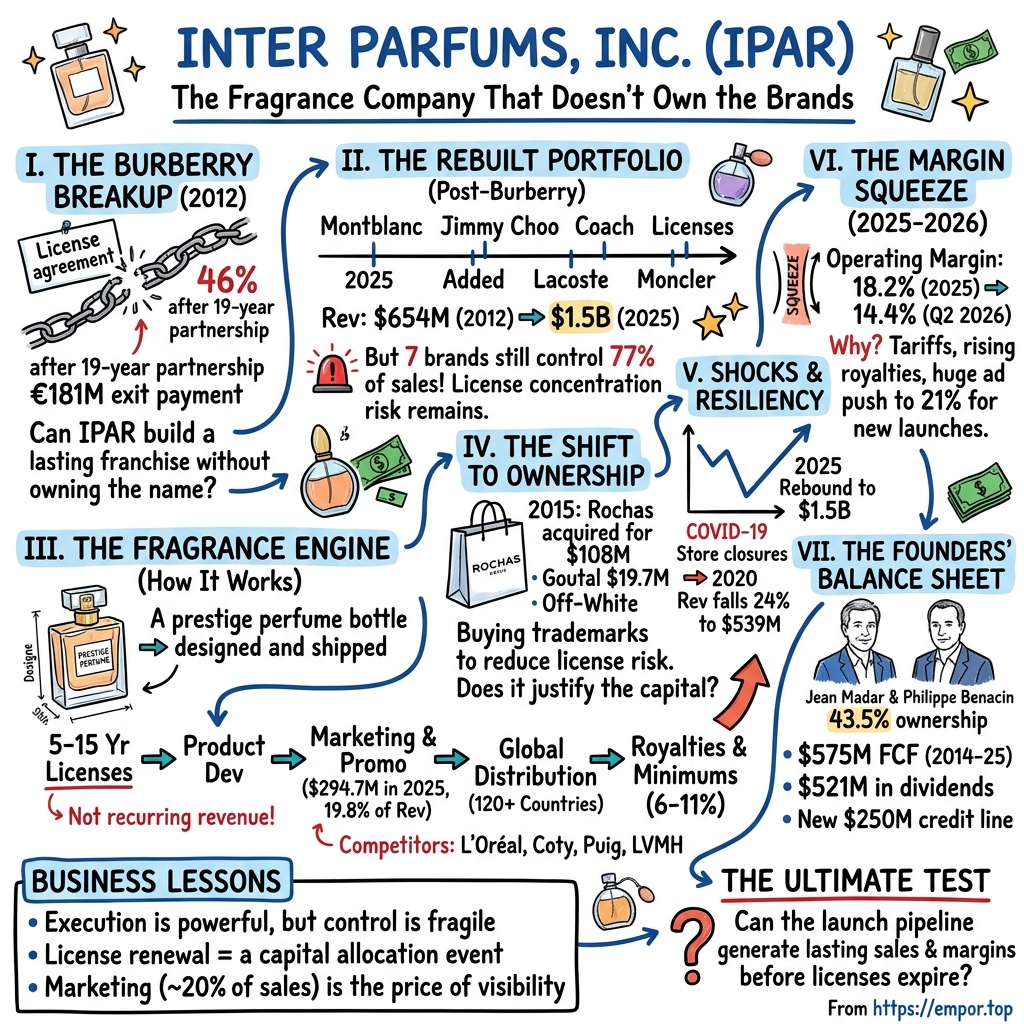
Inter Parfums, Inc.: The Fragrance Company That Doesn’t Own the Fragrance Brands
I. Burberry walked away with the fragrance business
On July 16, 2012, Jean Madar and Philippe Benacin were still in talks with Burberry about how their fragrance partnership should work in the years ahead. Then Burberry stopped talking and used a clause in the contract. It exercised its option to buy out the license, effective at the end of the year, and ten days later the discussions about a new operating model were formally over.1 The two Frenchmen had run the Burberry fragrance business since 1993.1 Over those nineteen years they had taken a trench-coat maker's name and turned it into a perfume franchise. In 2011, for the first time, it sold more than $300 million of product in a year.1 Now the owner of the name wanted it back.
What makes the scene so useful is that it is a victory and a defeat at the same moment. On December 21, 2012, Burberry paid Inter Parfums an exit payment of €181 million, about $239 million at the year-end exchange rate.1 The company booked a pre-tax gain of roughly $199 million. After tax, and after the share that belonged to outside investors in its French subsidiary, about $93 million of that gain reached Inter Parfums' own shareholders.1 Few licensees ever get a cheque like that. It put a price on what the founders had built, and the price was large.
The other side of the ledger was just as plain. Burberry products had made up 46% of Inter Parfums' net sales in 2012, and the share had been even higher in the two years before.1 The company's total sales that year were about $654 million.1 Nearly half of the business could now be taken away by a single decision in London, and it was. A short transition agreement let Inter Parfums keep selling Burberry products, under a cap, until the end of March 2013. Leftover inventory could be sold off until the end of June.1 Then the bottles carrying the most valuable name in the portfolio belonged to someone else.
The founders' public response was a mix of realism and bravado. "Future sales within our European operations will be significantly affected as a result of the buy-out of the Burberry license," the company wrote in its annual report, before adding: "However, we are confident in our future."1 They said the windfall would let them "strengthen investments supporting all portfolio brands and to accelerate their development."1 For 2013 they set a preliminary sales target of just over $400 million, excluding Burberry.1 That number was the cost of the exit, stated in the company's own words. A business that had just reported $654 million was telling investors to expect something closer to $400 million.
This is the question that runs through the whole Inter Parfums story. The company is very good at making other people's names smell like money. It finds a fashion house, a jeweller or a pen maker with a recognisable brand and little fragrance know-how. It designs the juice and the bottle and pays for the advertising. Then it pushes the product through department stores, perfumeries and duty-free counters in dozens of countries. When it works, the brand owner collects a royalty for doing very little, and Inter Parfums collects the rest. But the brand never belongs to Inter Parfums. Neither does the shopper's loyalty, which attaches to Burberry, Jimmy Choo or Coach, not to the company that made the scent. A license ends when its term runs out, or earlier if the owner can buy its way out.
So the stakes are simple to state and hard to settle. Can the company keep replacing the licenses it loses with licenses that grow? Can it turn a launch, which is an expensive event, into a fragrance family that sells for a decade? And can the two founders, who still run the business more than four decades after they started it, keep investing for the next cycle when sales are growing slowly? In 2025 sales rose about 2.5%. In the first nine months of 2026 they rose 1%.23
It also matters exactly what is being analysed. Inter Parfums, Inc. is a Delaware company listed on Nasdaq. Its biggest asset is a 72% stake in Interparfums SA, a separately listed company in Paris. The other 28% of that French company belongs to outside shareholders.2 IPAR's consolidated statements count all of the French company's sales. They then subtract the minority's share of the profit before arriving at what belongs to IPAR's own stockholders. In this story, "the company" means the consolidated U.S. issuer unless the French subsidiary is named. Every euro the Paris business earns is shared with someone else before it reaches the Nasdaq shareholder.
Burberry showed that the company could build a franchise worth hundreds of millions of dollars. It also showed that the right to keep that franchise sat with someone else. The rest of this story asks whether Inter Parfums has since built something sturdier than a series of excellent tenancies.
 Subscribe on LinkedIn
II. The portfolio after Burberry
The two founders who faced the post-Burberry reset had been partners since business school. Jean Madar and Philippe Benacin both graduated from ESSEC, one of France's elite business schools, in 1983.45 Their company's history dates the creation of the Paris business to 1982.6 In 1985 Madar flew to New York with a business plan and a few thousand dollars, and set up Jean Philippe Fragrances there.7 Its business was "alternative designer fragrances": scents built to evoke famous perfumes at a fraction of the price. The company was not glamorous, but it taught the partners how bottles, components, fillers and retailers fit together. Its American shares went public in early 1988, one of the first IPOs after the October 1987 crash.76 The same year the French side signed its first license in selective perfumery, for the Régine's brand.6 Five years later came Burberry.6
The division of labour between the two has barely changed since. Madar has been chairman of the U.S. company since its inception and chief executive since 1997.4 Benacin became vice chairman in 1991 and later president of the U.S. company, and he runs Interparfums SA in Paris.5 One sits in New York and one in Paris, and each runs the half of the business closest to him. In an industry full of conglomerates run by professional managers, this is a firm run by the two people who started it, with their own fortunes at stake.
When Burberry left, they were not starting from nothing. Through the 2000s they had built a set of smaller names behind the big one. S.T. Dupont arrived in 1997, Paul Smith in 1998, Lanvin as a license in 2004 and Van Cleef & Arpels in the mid-2000s.61 In July 2007 the company bought the worldwide rights to the Lanvin brand names for fragrance outright. It was an early, quiet sign that owning a name might matter.1 Then, in the years just before Burberry left, came the deals that would carry the next decade. Jimmy Choo was signed in 2009, with sales starting at the beginning of 2010.1 Montblanc was signed in January 2010 and started that July.1 Boucheron followed later that year, and Balmain, Anna Sui, Repetto and Karl Lagerfeld were added in 2011 and 2012.16
The money from Burberry paid for a second, more aggressive wave. Coach was signed in 2015.6 Rochas was bought from Procter & Gamble the same year, a deal with its own chapter later in this story. Kate Spade arrived in 2019, Moncler in 2020 and Lacoste in 2022.6 The list is long, and that is part of the strategy. If one brand can take away half your business, the obvious answer is to make sure no single brand is that large again.
The discontinuity in the numbers was brutal. Burberry went from 46% of sales in 2012 to nothing by 2014, once the transition period and the inventory sell-off had run out.1 Consolidated revenue fell from about $654 million in 2012 to about $468 million in 2015.12 Even with the founders spending the exit money on new brands, the company needed three years to find the bottom. After that the recovery was real and steady. Sales passed $700 million by 2019. After the pandemic detour, revenue reached about $1.1 billion in 2022 and about $1.5 billion in 2025.2 Over the decade to 2025, revenue compounded at a little over 12% a year.2
That result answers the first half of the question. Inter Parfums did replace the Burberry sales, and then more than doubled them. Spreading the risk was the harder part, and it is less clearly answered. In 2025 seven brands supplied 77% of sales. The share has been creeping upward, from 73% in 2023.2 Jimmy Choo, Coach and Montblanc alone each account for about a sixth of the business. Together they come close to half of it.2 The company swapped one giant for a handful of large names, and the handful is becoming more concentrated, not less. That is better than before Burberry left, but it is still concentrated.
The rights to those large names are mostly safe for now. Montblanc runs to the end of 2030, and Jimmy Choo and Coach to 2031. Guess, which supplies about an eighth of sales, was renewed in December 2025 all the way to 2048.28 Lacoste runs to 2038.2 These are long leases, and renewals so far have mostly gone the company's way. But a lease is still a lease. In the early 2030s the three largest licenses will come up within about a year of each other. Those negotiations will matter more to the company's value than any launch in between.
Dunhill showed how a smaller loss feels when nobody writes a cheque. The license was not renewed, and the company finished phasing out the brand in August 2024.9 There was no buyout cheque this time. A brand that had sold well in the Middle East and Africa simply left the portfolio. The company said the exit weighed on its 2025 results, particularly in those regions.2 Excluding Dunhill, the U.S.-based business's full-year sales were still down about 3%.9 A non-renewal of this kind does not hit as hard as Burberry did. It leaves a gap that the next launch has to fill before the company can show any growth.
So the reset leaves a distinction that runs through the rest of this story. Replacing a license is not the same as replacing a hit. Signing Moncler, Lacoste or, most recently, Longchamp gives the company the right to try. It does not give it a franchise. Whether a new name becomes one depends on what happens after the contract is signed, in the long, costly process of turning a designer's name into something people buy again and again.
III. What it takes to turn a designer’s name into a bottle
A new fragrance begins life as a legal document. The brand owner grants Inter Parfums an exclusive right to make and sell perfume under its name. These rights typically run for five to fifteen years at the start and can be renewed if the licensee meets its obligations.2 The licensor gets a royalty on every sale, usually between 6% and 11% of net sales to third parties.2 Most contracts also require minimum royalties, minimum sales levels and a minimum spend on advertising.2 The deal is a promise from the licensee as much as a grant from the brand. It says, in effect, that the licensee will make this name visible on fragrance counters around the world, at its own cost, or lose the right to use it.
What follows is a year of work before anything reaches a shop. The company says it generally studies the market for a proposed fragrance family "for almost a full year" before introducing it. It looks at scent, bottle, packaging and the product's "appeal to the buyer."2 The perfume itself is created by the large fragrance houses and outside perfumers. The bottle and box are drawn by specialist design agencies and then made by component suppliers.2 Inter Parfums owns no factories. "We act as a general contractor," the company says, and that is the right picture.2 Components arrive at third-party fillers, who blend, fill and pack the finished product before it moves to the company's distribution centres.2 Think of a film studio that owns no cameras. It picks the script, hires the director, signs the stars and pays for the marketing. The value lies in the choices, the relationships and the distribution, not in the equipment.
The product cycle has a rhythm the industry has its own words for. Every few years a brand gets a new fragrance family, which the company calls a "blockbuster." In between come seasonal and limited editions, the "flankers" and line extensions that keep the name on the counter and give retailers something new to sell.2 Shoppers find a hero scent, and if it works they come back for the refill, the gift set or the variation. That repeat buying is what makes fragrance such an attractive category. It is not what an investor would call recurring revenue, though. Inter Parfums sells to retailers and distributors, not to consumers on subscription. Every year's sales depend on retailers reordering, and they reorder only when the product sells through and when their own inventory plans allow. Nothing in the company's accounts is contractually recurring.2
Then comes the bill for making a fragrance visible. In 2025 Inter Parfums spent $294.7 million on advertising and promotion, almost exactly a fifth of its revenue.2 That is the cost of competing in this category. It pays for television and social-media campaigns, celebrity faces, testers and gift-with-purchase offers, and the counter staff who spray strangers in the aisle. On the February 2026 call, the finance chief Michel Atwood broke the spend down. The European business, which carries most of the luxury names, spent about 22% of its sales on advertising. The U.S. business spent about 16%.9 Royalties to brand owners took roughly another 8% of sales in 2025, in line with the company's five-year run rate.9 Put the two together and more than a quarter of every sales dollar goes, before any other cost, to keeping someone else's name in front of shoppers and paying that someone for the privilege.
These costs are sticky, which is the harder part. Minimum royalties and minimum advertising commitments do not shrink automatically when a fragrance slows. The company estimates its future license and advertising commitments at about $2.98 billion, based on planned sales.2 It is easy to read the high gross margin and assume a fat, flexible business. The truth is that the costs which really decide profitability are largely committed in advance to people outside the company.
The company's reach is real. Its products are sold in more than 120 countries.2 About half of the French subsidiary's sales are made in U.S. dollars, so the business behaves as a global exporter as well as a European luxury house.2 In its home market the French subsidiary estimates it has about 4% of the selective fragrance market, meaning perfume sold through prestige channels. In some other countries the figure is 2% to 5%.10 Those numbers are respectable for a company of its size. They also make clear that Inter Parfums is a mid-sized supplier in a crowded aisle, not the leader of it.
Look at who else is in that aisle. L'Oréal reported group sales of about €44 billion in 2025, and called fragrances "a powerful growth engine."11 That is roughly thirty times Inter Parfums' revenue. Coty, Shiseido, Puig, LVMH and Estée Lauder all compete for the same counter space, the same perfumers and, crucially, the same brand licenses.2 Inter Parfums itself says many competitors "are larger than we are and have greater financial resources."2 When a fashion house puts its fragrance license up for grabs, Inter Parfums is bidding against companies that can outspend it on advertising many times over. Newer entrants are crowding in as well. Industry estimates counted around six thousand new perfumes launched in 2025.12 Each one is another reason a shopper might walk past a Montblanc tester.
What, then, does Inter Parfums offer a brand owner that L'Oréal does not? The plausible answer is attention. For a company with dozens of names, a $100 million fragrance brand is a rounding error. For Inter Parfums, a brand like that sits at the centre of the portfolio, and the two founders are involved in it personally. Jimmy Choo had no fragrance business before 2010. It has since become the company's largest brand.12 Coach went from a new signing in 2015 to one of the three biggest names. The company also has a record of renewing its largest licenses early and for long periods. That is the best evidence that brand owners are, on the whole, satisfied with the work.
The evidence has limits, and they matter. The company does not publish how many of its licenses have been renewed against how many have expired. It does not show sell-through at the consumer level, brand by brand, so nobody outside can tell how much of a year's sales reflected genuine shopper demand and how much reflected retailers stocking up. It publishes no figure that shows it can raise prices without losing volume. On the retail side the risk is moderate. Macy's, its largest customer, took about 10% of 2025 sales, down from 12% the year before.2 The bigger exposure is upstream, to the licensors, who decide at each renewal whether the relationship continues and on what terms.
So the verdict on the operating machine is narrow. Inter Parfums plainly has a working platform for product development, marketing and global distribution. It has also kept its biggest partners for long periods. But nothing it discloses shows that partners cannot leave, that shoppers prefer its products because of how it runs them, or that the marketing bill could ever fall much below a fifth of sales. The full moat question, asked with formal frameworks, comes later in this story. For now the useful point is that a license operator is always a renter. That raises a natural question: what happens when such a company decides to buy a building?
IV. The first major bet on owning the name
On March 19, 2015, Interparfums SA signed an agreement with Procter & Gamble to buy Rochas.13 The deal closed at the end of May, and Madar called it the opening of "a new page in the company's history." For the first time, he said, the group would combine "both fragrances and fashion."13 Rochas was a storied Paris couture house with a long fragrance heritage. P&G, which was cutting back its beauty portfolio, no longer wanted it. Inter Parfums wanted something it had never had at scale: a name that no one could take back.
The price was $108 million, not counting inventory. The company paid for it with a €100 million five-year loan, carrying standard covenants.13 The purchase covered the trademarks for perfume and cosmetics and for fashion.6 Rochas fragrances had reported sales of about $46 million before the deal.14 The company was therefore paying about 2.3 times a year's sales for a brand it would own outright. Like Lanvin before it, Rochas also opened a second line of business. A fashion trademark can be licensed out to clothing makers, so Inter Parfums could collect royalties for once instead of paying them.
Was that a good price? The honest answer is that nobody outside the company can say with confidence. The filings never disclosed what Rochas earned at the time of purchase, either as profit or as EBITDA. Without that, there is no way to calculate the multiple a buyer would normally care about. There is also no clean set of comparable trademark sales from the same period to measure it against. Fragrance brand deals are rare and usually private, and their terms are seldom public. As a rough sense-check, the market today values IPAR itself at about 2.4 times its annual sales.15 That is a whole company, with a portfolio, a distribution network and decades of cash flow behind it. Rochas, which cost about the same multiple of sales, was a single brand that needed rebuilding. The comparison does not prove the price was too high. It does show that the purchase was a serious use of capital, and that the case for it depended on what Inter Parfums could do with the brand once it owned it.
Ownership changes those economics. As Burberry showed, a license ends and the value created goes back to the licensor. With ownership, there is no royalty to pay and no deadline. Advertising can build an asset the company keeps. The catch is that the company pays for that ownership up front, in cash. If the brand never grows, it carries the purchase price as a sunk cost, with no licensor to hand it back to.
A decade later, the evidence on Rochas is mixed. The brand has not become one of the seven names that dominate the portfolio.2 A franchise that a Jimmy Choo or a Coach would recognise as a peer has not emerged. That does not make the purchase a failure. A permanently owned brand that earns steady royalty-free profit can still earn its cost back slowly. But the original vision has not yet been demonstrated in the numbers the company publishes. Inter Parfums does not break out Rochas's profit contribution, so investors cannot calculate the return on the $108 million.
The strategy has accelerated anyway. In 2024 the group bought the Off-White brand for fragrance and beauty. It did not disclose the purchase price.6 In March 2025 Interparfums SA bought all the intellectual property of Maison Goutal from Amorepacific Europe.16 Goutal is a Paris perfume house founded in 1981 by Annick Goutal. It is known for L'Eau d'Hadrien and Petite Chérie, and its scents were sold through its own boutiques.16 The company said annual fragrance sales had reached €10 million to €12 million at their peak.16 The purchase price was about $19.7 million, less than twice the brand's best historical sales.2 Benacin described the deal as part of a strategy of "broadening our product offering to include high-end fragrances." Camille Goutal, the founder's daughter, would stay involved in choosing fragrances.16 In 2025 the group also launched Solférino, a brand of its own named after its Paris headquarters street.6
The phrasing of the Goutal announcement is worth noticing. The company said sales "have reached" that range "in the past." That is a historical figure, not current sales. Under the deal, the previous owner kept running the brand under license for a fixed period, with Inter Parfums due to take over development from 2026.16 The comparison with Rochas is therefore unflattering to neither deal and conclusive for neither. Rochas cost more and came with a known sales base. Goutal cost less but comes with a sales record that has to be rebuilt. Off-White comes with no disclosed price at all.
It is also important to keep these bets in proportion. The company planned the Goutal and Off-White launches, together with the first Longchamp fragrances under a license signed in July 2025, for 2027.817 Nautica and David Beckham, both signed as twenty-year licenses in January 2026, start later. Beckham begins in April 2028 and Nautica takes over globally from January 2030.8 All of these are options. None of them is yet producing growth. Management talks about the higher-end owned brands as a step into "the higher luxury space."17 Today, however, they are small next to the licensed names that pay the bills.
What would settle whether owning brands is worth it? Not more acquisition announcements. The test is whether, within several years of launch, Rochas, Goutal, Off-White and Lanvin together produce sales and margins comparable to a midsized license, without royalties and without an end date. If they do, the company will have turned some of its rent into equity. If they stay small, the strategy will have cost more money to buy the same thing licenses already provide: names that may or may not sell. Before that test could be run, though, the company had to survive a test of a different kind.
V. The year the stores closed—and the rebound began
In March 2020 the counters went dark. Across Europe and North America, government orders closed most of the shops that sold prestige fragrance. Air travel slowed to a crawl, taking down the duty-free business in airports, and supply chains seized up.18 Fragrance is an impulse and gift category, and it depends on shoppers being able to smell the product. It was badly exposed. On May 11, 2020, Inter Parfums withdrew its sales and earnings guidance for the year, saying it could not issue new numbers "until we gain greater visibility."18
The shock showed up immediately. First-quarter sales fell to about $145 million, from $178 million a year earlier.18 Management estimated that about $34 million of sales had been lost against its own expectations in those three months alone. About $28 million of that came from Europe and $6 million from the U.S.18 Net income attributable to shareholders roughly halved in the quarter.18 For the full year, revenue fell 24% to about $539 million.2 For a business that had just spent five years climbing back from Burberry, this was a second cliff in less than a decade.
The rebound was faster than anyone had a right to expect. In 2021 revenue jumped 63% to about $879 million. In 2022 it rose another 24% to about $1.1 billion, and by 2025 it reached about $1.5 billion.2 Profit grew even faster than sales, because the business was spreading fixed costs over a much larger base. Operating margin rose from about 13% in 2020 to about 19% in 2023.2 Part of the story was the industry. Fragrance became one of the strongest categories in beauty after the pandemic. Consumers who had been stuck at home treated a perfume as an affordable luxury, and younger buyers came to the category through social media. Part of the story was execution. The company's big brands, Jimmy Choo, Coach, Montblanc and Guess, launched new families and flankers into that demand. New licenses such as Lacoste added sales on top. Lacoste reached about $108 million in 2025, up 28%.9
Here, though, the numbers need care. Over the five years from 2020 to 2025, revenue compounded at about 22.5% a year.2 That figure appears in a lot of investor material, and it is misleading on its own, because it starts at the bottom of the pandemic hole. Measured over ten years, from 2015 to 2025, the rate is about 12.3%. Over three years, from 2022 to 2025, it is about 11.1%.2 Those two figures describe the underlying business better. The five-year number describes a recovery from an unusually low base. A twelve per cent grower is still an impressive business in a category where the largest players are happy with mid-single digits. But it is a different company from one compounding at twenty per cent and more.
The rebound also brought back a habit the business had always had. Inventory swelled. By 2023, the company's inventory equalled more than 280 days of cost of goods sold, compared with about 230 days in the late 2010s.2 Product for future launches, safety stock against shaky supply chains and slower-moving lines all piled up. Cash flow from operations in 2022 and 2023 ran well below profit. Free cash flow was negative in 2021 and 2022, partly because of property purchases, before turning strongly positive again in 2024 and 2025.2 The recovery was paid for with working capital. That is not a problem in itself. It is a reminder that rising sales do not automatically mean rising cash.
What does the pandemic episode prove? It shows that fragrance demand recovered sharply once shoppers could return. It shows that the company could restart growth without losing its major licenses. It shows that operating margins could rise as sales scaled. Those are meaningful results. What it cannot prove is that the post-2021 growth rate was the company's normal pace. Some of it was catch-up, some was a category boom and some was product launches. And the boom has faded. By August 2026, Madar was describing a market that had "normalized after several years of exceptional growth."19 That sentence leads to the next, harder question. When the tailwind stops, what does growth cost?
VI. The launches are coming; the margin bill is already here
In February 2026 Jean Madar presented a deliberately cautious year. The company guided to 2026 sales of about $1.48 billion, roughly flat on 2025, and diluted earnings of $4.85 a share, down from $5.25.92 "We have maintained quite a conservative posture with respect to our guidance," he said, "but we will revisit it as the year evolves."9 He framed 2026 as a year of preparation, getting ready "for what we expect will be a more favorable operating environment in 2027 and beyond."9 Management was in effect asking investors to accept a pause, with a better year promised behind it.
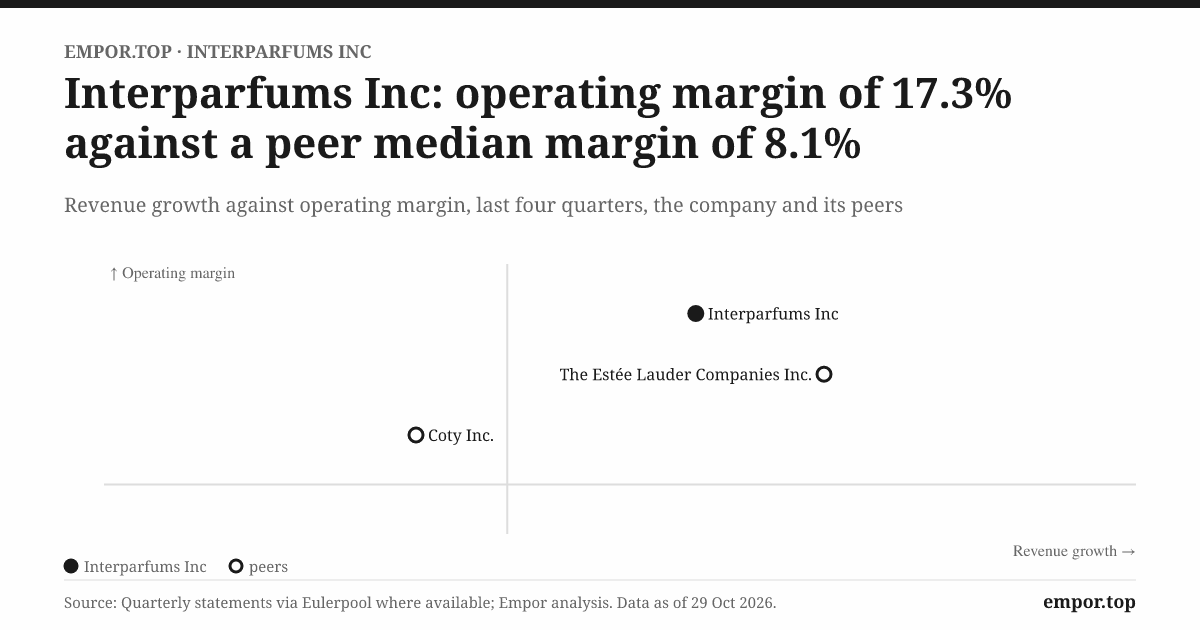
To judge that request, the first thing to understand is where the margin went. In 2023 operating profit was about 19.1% of sales. In 2025 it was about 18.2%.2 The drop looks small, but at $1.5 billion of revenue, a point of margin is worth about $15 million of operating profit a year. Three costs explain most of the move. The first was tariffs. The U.S. began imposing new import duties in February 2025, and the company paid about $12.8 million in extra tariff costs that year, almost a full point of sales.92 The second was advertising, which grew faster than sales and reached 19.8% of revenue.2 The third was royalties, which were rising as brand mix shifted.
The tariff story then took a surprising turn. The Supreme Court ruled that the tariffs imposed under emergency powers had not been validly authorised, and a new 15% global tariff replaced them.2 The duties already paid became eligible for refunds. The company estimated it had paid about $17.6 million of these tariffs. It received $8.7 million of refunds by the end of June 2026 and another $8.0 million in July.8 Under the accounting the company chose, a refund is booked as a gain only when the cash arrives.8 Most of the benefit therefore lands in the second half of 2026. On the May call, management left the potential refund out of its earnings guidance and said any windfall would "likely" be reinvested in brands.17 By August the refund was inside the guidance. The company said it now expected gross margin to rise about 150 basis points for the year, with about 110 of them coming from refunds.19 That is a meaningful shift. In May, the refund was upside the company might spend. By August, it had become part of the base case that kept the full-year earnings target intact.
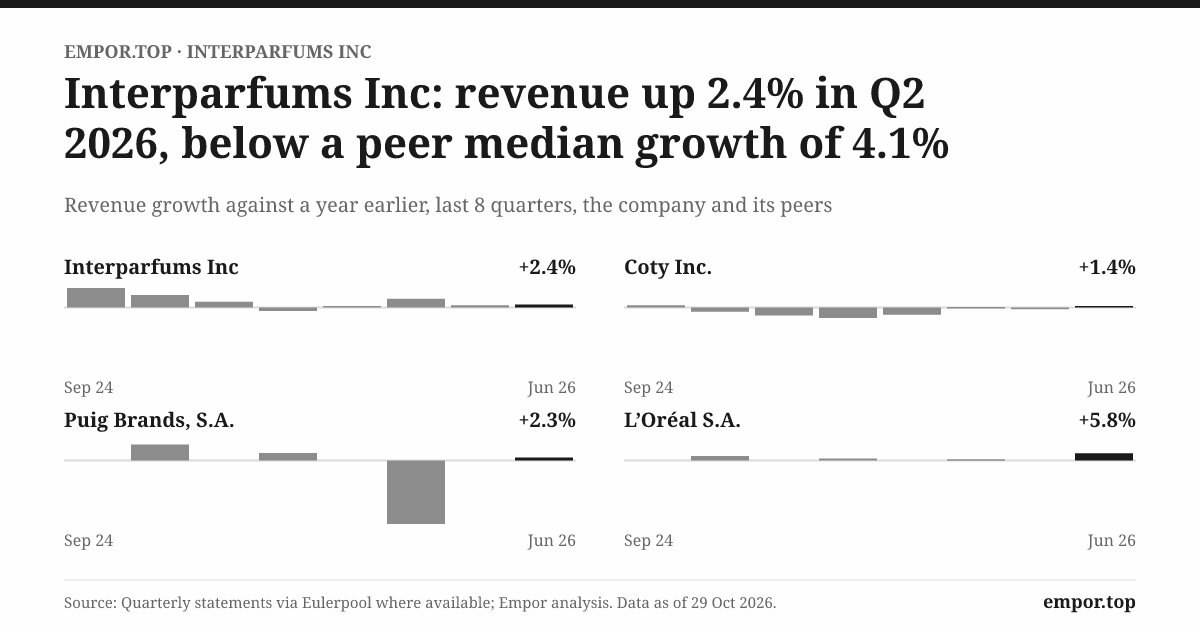
Strip the refund out and the underlying picture looks less comfortable. In the second quarter of 2026, sales rose about 2% to $341 million, but operating income fell about 17%, to $49 million from $59 million.8 Operating margin fell from 17.7% to 14.4%.8 Royalties rose to about 9.1% of quarterly sales.8 The full-year 2025 rate had been about 8%. The company blamed "unfavorable brand mix."19 Earlier in the year it had pointed to the Guess license extension, which raised royalty costs ahead of sales.17 A long renewal, in other words, has a price: Guess is secured to 2048, but on terms that cost more today.
Then there is advertising, which management is choosing to raise. In August Atwood said that full-year advertising would "approach our long-term target of approximately 21% of net sales."19 For the first half the figure had been 18.8%, so the second half will carry much heavier spending as the company prepares for 2027.19 The logic is sound if the launches work. In fragrance, a blockbuster without a big campaign rarely becomes a blockbuster. But it means investors are paying for 2027 out of 2026 profits, before they have any evidence of what 2027 will bring.
The sales line is where the story should start to turn, and so far it has not. In the third quarter of 2026, sales were flat at about $430 million. For the first nine months they were up about 1%, at about $1.12 billion.3 Beneath that flat total, the two halves of the business moved in opposite directions. The European business, which holds the luxury licenses, grew about 4% in the quarter to $306 million. The U.S. business fell about 7% to $127 million.3 Madar said about $10 million of U.S. gift-set shipments had slipped into the fourth quarter because of supply-chain delays. Without that slip, he said, U.S. sales would have been flat for the quarter and up about 6% for nine months.3 That is a plausible explanation, and it can be checked: the shipments should show up in fourth-quarter sales. Until they do, the claim is management's account and not yet a fact.
The brand picture inside the quarter was as uneven as the regions. Coach rose about 23% and Montblanc about 12%. Ferragamo fell about 22%.3 The company said the war in the Middle East cost about a point of growth in the quarter and two points over nine months.3 The region was once Dunhill's stronghold and is now the largest market for the Roberto Cavalli brand, and in the first half sales to the Middle East and Africa fell about 24%.19 Lacoste, after a huge 2025, fell about 9% over nine months.3 That is a reminder that a franchise's second year is often harder than its first.
The live calls add texture to the official account. Prepared remarks have stayed consistent across February, May and August. Management promised conservative guidance, a light year for big launches in 2026, and "a return to stronger growth in 2027."17 By August, that phrase had softened slightly to "a return to improved growth in 2027, driven by enhanced innovation."19 Madar's boldest claim came in May. Next year, he said, "all our biggest brands will have a new franchise, a new pillar."17 In August he singled out Longchamp, saying it had "the potential to become our next $100 million brand."19 Analysts from Jefferies, Goldman Sachs, Canaccord and others pressed repeatedly on margins, guidance and the cost of launches. When asked whether the strong first-quarter gross margin was structural, Atwood answered candidly: "It was really a perfect storm," and it would normalise.17 On what would make the company raise or cut its guidance, the answers were more general and offered no specific thresholds.9 That pattern is common in the industry. It does mean the 2027 claim is still a promise without a published yardstick attached.
On September 22, 2026, the company added one more name to that future. It signed an exclusive worldwide fragrance license with Puma running to the end of 2037, with a first "signature lifestyle fragrance" planned for 2027.20 The financial terms were not disclosed. Like Nautica and Beckham, it adds a franchise to the pipeline, not to the income statement.
Put the pieces together and the verdict on the margin squeeze is a split decision. Tariffs were a real, external hit. The refunds partly reverse it, which is why management could hold its guidance through mid-year. But royalties are rising as a share of sales, advertising is heading toward 21%, and the brand mix is less favourable. None of those costs disappears when the tariff case is resolved. A full return to the 19% operating margins of 2023 therefore remains unproven. It requires the 2027 launches to sell well enough to absorb the spending ahead of them. The next question is what the people paying for that bet own, and what they are doing with the cash.
VII. The founders’ balance sheet
Jean Madar and Philippe Benacin still stand at the centre of Inter Parfums, running its U.S. and French businesses, respectively.45 More than four decades after they started, the two together own about 43.5% of IPAR's shares. Madar holds about 22.1% and Benacin about 21.4%.21 At the current share price of about $114, that stake is worth well over $1.5 billion.15 There are few public companies of this size where two founders own so much and still run day-to-day operations.
The alignment that creates is obvious. Every decision that destroys value costs the founders far more than it costs any outside shareholder. The founders have not received IPAR option grants in recent years, so their wealth rises and falls with the shares they already own.21 Their cash pay is modest by the standards of companies this size. In 2025 Madar's reported compensation was about $2.1 million and Benacin's about $1.45 million.21 Most of Madar's figure is a $2 million annual fee for "coordinating and supervising" services. It is paid not to him directly but to Jean Madar Holding SAS, his personal holding company, and the company treats it as his base salary for proxy purposes.21 The fee was raised from $1.23 million under an earlier arrangement, and the compensation and audit committees approved the change.21 The filings do not describe it as independently benchmarked against market rates.
Is that a governance problem? In proportion, not a large one. The fee amounts to about a tenth of a per cent of sales. It is a structure investors should know about, not a drain on the business. The more consequential issue is control. A voting bloc of more than 40% means the founders effectively decide board elections and any strategic transaction. Outside shareholders' only real lever is the share price. In a company run well, that is a feature. In one run badly, it would be a trap.
The cash record helps explain why shareholders have been patient. Over the twelve years from 2014 to 2025, the company reported about $975 million of net profit attributable to shareholders. Cash generated by operations in the same period came to about $1.1 billion, or roughly 115% of that profit.2 Part of the gap is structural. Consolidated cash flow includes the cash belonging to the 28% minority owners of the French subsidiary, while attributable profit does not. So the comparison flatters the parent somewhat. Even so, profits here generally turn into cash, which is not true of every consumer company carrying piles of inventory.
The more telling figure is where the free cash went. Over the same twelve years, after capital spending, the company generated about $575 million of free cash flow. It paid out about $521 million of that, about 91%, in dividends.2 Cash and short-term investments ended 2025 at about $295 million, roughly where they started the period.2 In practice, nearly all of the cash the business threw off over more than a decade went straight back to shareholders, half of them the founders and their families. Acquisitions like Rochas and the Paris headquarters were paid for largely with borrowing and cash already on hand. The dividend has climbed to $3.20 a share a year, and it took about 61% of earnings in 2025, the highest share in a dozen years.29
That record makes the latest capital decision more interesting. In July 2026 the board authorised the company to arrange a credit line of up to $250 million to buy back shares of IPAR, of Interparfums SA, or of both.8 It had already approved, in February, a smaller programme to repurchase up to 260,000 IPAR shares.8 At current prices, that smaller authorisation is worth roughly $30 million. The proposed credit line is about eight times larger. Atwood described the plan as one to be approached "in a measured and disciplined way."19 Its terms had not been settled by the time of the June quarterly report.8
Debt is not alarming at the moment. Borrowings were about $185 million at the end of 2025, against $295 million of cash and short-term investments.2 By the end of June 2026, long-term debt including the current portion had fallen to about $143 million.8 Short-term investments, however, dropped sharply in the first half, from $137 million to about $42 million, and cash on hand stood at about $211 million.819 No covenant breach or refinancing pressure has been disclosed.2 Drawing heavily on a new $250 million line would change that picture, though. The company would be borrowing to return capital in the same year it is raising advertising to about a fifth of sales and preparing the biggest launch calendar in years.
The buyback plan also contains an option worth noticing. Repurchasing shares of the French subsidiary rather than the parent would raise IPAR's 72% stake. That would shrink the share of European profits leaking to minority investors. It could be an efficient use of capital, depending on the relative prices of the two stocks. It would also tighten the founders' grip on the Paris business. The board has not said which way it will lean.
Shareholders have been sending mixed signals about their trust in the board. At the September 2026 annual meeting, the say-on-pay resolution passed with about 99% of votes cast in favour. A year earlier support had fallen to about 84%.2223 But nearly three million votes were withheld from the independent director François Heilbronn, about an eighth of those cast. About 1.8 million were withheld from Atwood, who sits on the board as well as serving as finance chief.22 A more serious signal came from the auditor. At the end of 2025, the auditor concluded that the company's internal control over financial reporting was not effective. A material weakness remained in how the company designed and carried out its risk assessment, even though other weaknesses found a year earlier had been fixed.2 The opinion on the financial statements themselves was clean.2 In May 2026 the company changed auditors, from Forvis Mazars to Grant Thornton, and disclosed no disagreements with the outgoing firm.2 None of this suggests the numbers are wrong. It does suggest that the controls behind them lagged the company's growth, and that a new auditor will be the one to decide whether the gap has closed.
Working capital ties the cash and the operations together. On the August call, management pointed to inventory down 12% from a year earlier and days on hand down by 34.19 Cash generated by operations in the first half was about $46 million, against close to nothing a year earlier.19 But first-half operating cash still amounted to only about half of net income. Inventory on the balance sheet at the end of June was higher than at the end of 2025, at about $376 million.8 The year-end figures will show whether the efficiency gains hold through a heavy launch build.
So the founders' balance sheet has two faces. Ownership aligns them with outside investors, and the long dividend record is well covered by the cash the business produces. Yet the company has typically returned almost all of its free cash and grown through borrowing. It now proposes to borrow more to buy back stock while its growth spending rises. Whether that is clever capital allocation or a bet that the share price is cheap depends on what the business is actually worth. That, in turn, depends on whether it has an advantage it can defend.
VIII. Porter’s Five Forces and Hamilton Helmer’s Seven Powers
Go back to London in July 2012. Burberry decided it could run its own fragrance business, or hand it to someone else, and capture the profit Inter Parfums had been earning. Nothing Inter Parfums had built could stop it. Not its relationships with retailers, its perfumers, its supply chain or its nineteen years of history. Burberry's ability to pay the exit fee and walk away is the most important fact for any analysis of this company's competitive position. It tells you where the power sits.
Michael Porter's five forces are a way of asking who captures the profit in an industry. Start with the suppliers who matter most. For Inter Parfums, those are not the bottle makers or the fragrance houses but the brand owners. Their bargaining power is very strong at the moment of renewal. They can demand higher royalties, bigger advertising commitments or simply leave. Guess's long renewal came with heavier royalty costs, and Dunhill's license was not renewed.179 The physical suppliers, meanwhile, are numerous enough that no single one has much leverage. The company works with many perfumers, component makers and fillers.2
Buyers are the second force. Retail power is real but moderate. Macy's remains the largest customer.2 Department stores and perfumery chains can squeeze margins through promotions, returns and slower reordering. Atwood described "a little bit more discounting than usual" late in 2025 and retailers "maintaining a cautious stance on inventory."9 But because the business is spread across many channels and more than 120 countries, no single retailer can decide its fate.
Rivalry, the third force, is intense. The largest beauty groups compete for the same counter space and, more importantly, the same licenses. They can outspend Inter Parfums on advertising many times over. Puig, LVMH and Estée Lauder own powerful fragrance brands outright. Coty and L'Oréal, like Inter Parfums, live partly on licenses. Every big fashion license that comes up for renewal is a contest between these companies.
The fourth force, substitutes, is high. A shopper who likes a fresh citrus scent can choose among dozens of brands at every price, and a gift buyer can switch from perfume to anything else. The field is crowded, with thousands of launches in 2025 alone.12 Social media can make an inexpensive scent go viral overnight, and the company itself started out selling alternatives to famous perfumes. Nothing about a fragrance stops a competitor from making something similar.
The fifth force, new entrants, is weaker than it looks. Making a fragrance is not hard. Making a fragrance business with global reach, the know-how to launch a blockbuster and the trust of Jimmy Choo is. The company describes its business as "not capital intensive" and relies on outside manufacturers.2 That keeps the barrier low for outsiders with money and a brand. Big groups can enter any segment they like, and small niche houses can build a following online. Inter Parfums does not disclose any scale advantage over its larger rivals. Its share of perhaps 4% in its home market shows it is not dominant.10
Hamilton Helmer's seven powers ask a narrower question: what lets a company earn higher returns than its rivals for a long time? Run through them one by one and the result is sobering. Scale economies favour the larger groups, not Inter Parfums. Network effects do not exist in fragrance; a perfume does not become more useful because more people own it. Switching costs, which keep customers locked in, are weak at the moment that matters. When a license expires, the brand owner can move to another licensee at the cost of a transition period. Counter-positioning would require a business model incumbents cannot copy without hurting themselves. Licensing is not that; L'Oréal and Coty do it too. Brand power is real in this industry, but it belongs mainly to the licensors. Shoppers buy Coach, not Inter Parfums. A cornered resource, such as a unique asset or a uniquely talented team locked into the company, is not evident in the filings. The founders are central, but they are not a resource a rival is barred from replicating.
That leaves the seventh power, process. This is the accumulated know-how that lets a company do something better and more cheaply than others, built up in ways that are hard to copy. Process power is the most plausible explanation for Inter Parfums' record. It took Jimmy Choo and Coach from nothing to more than a hundred million dollars each in fragrance. It keeps renewing its largest licenses for long terms. And it has earned returns on invested capital of about 25% to 30% a year through most of the past decade.2 Those are the outcomes that strong process power would produce. But process power is supposed to be visible in specific operating evidence. That would mean a higher share of launches that succeed, better sell-through, longer-lived franchises and better renewal terms than competitors manage. Inter Parfums publishes none of these figures. Outsiders can see the results, but not the mechanism that would prove them.
The honest conclusion is therefore narrower than the bulls would like. The evidence supports an experienced operating platform with an excellent record of execution. It does not prove a structural moat. The best defence Inter Parfums has is repeating that execution across many brands, so that losing any one does not sink the business. That defence is real but it has to be earned again at every launch and every renewal. The test will be whether the 2027 launches keep their sales and margins once the heavy launch advertising stops. That is precisely what the market is now trying to price.
IX. Analysis & Bear vs. Bull Case
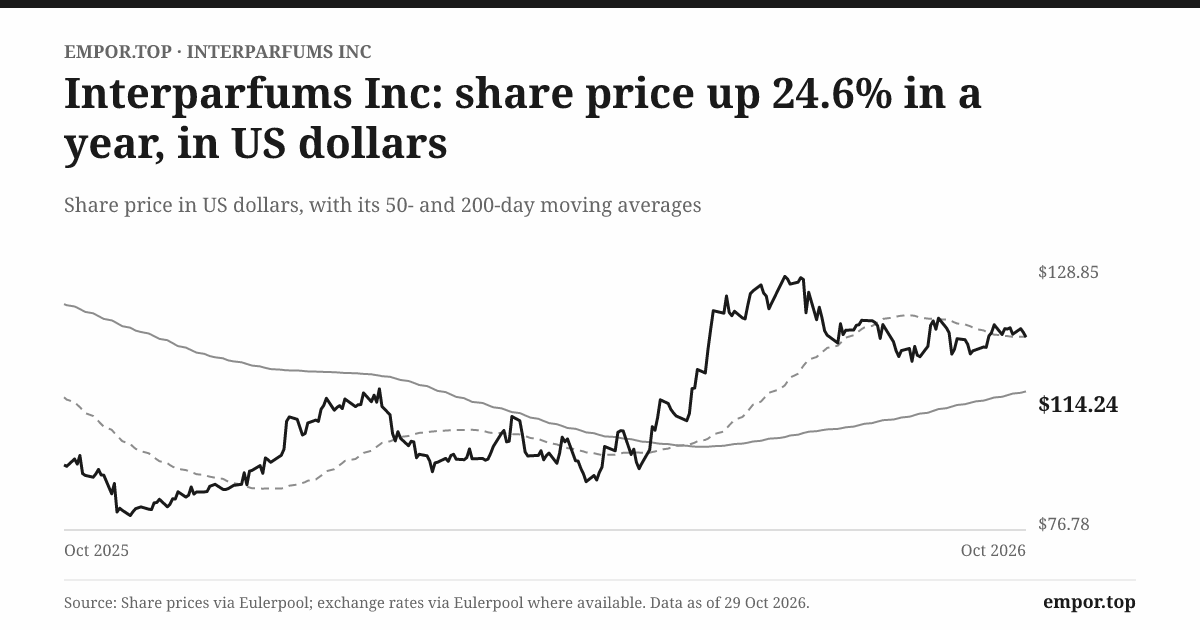
On October 29, 2026, IPAR shares closed at about $114, roughly 9% below their high of the past year. The company is valued at about $3.7 billion.15 Nine days earlier it had reported flat third-quarter sales. Its results for the full quarter, including profit and margins, will follow on November 4, with a call the next morning.3 The stock sits in an uneasy middle. It has not collapsed the way it did at points in the past five years, when it fell by nearly half from peak to trough. Nor does it trade as though the 2027 recovery were certain.15
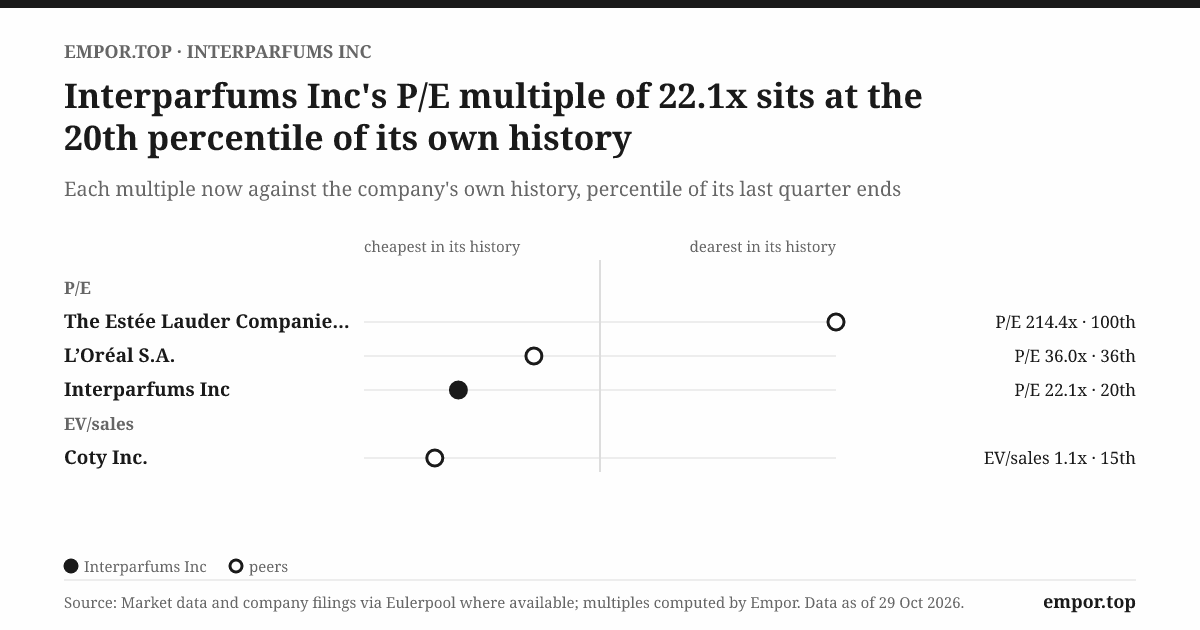
The valuation itself tells part of the story. At about 22 times trailing earnings, IPAR trades below its own five-year median of about 26 times.15 Against sales, the multiple is about 2.4. Against EBITDA, after adjusting for net cash, it is about 12.15 Its free-cash-flow yield is about 6.7% and its dividend yield about 2.8%.15 For comparison, Puig, the Spanish fragrance group that owns most of its brands, traded at about 18 times earnings on the same day.24 The two companies differ in size, currency and accounting periods, so the comparison is only rough. But it shows the market is not giving IPAR an extreme premium, nor a discount for being a licensee. The price appears to assume that earnings will roughly grow again from here. It does not assume a return to the twenty-plus per cent growth of the post-pandemic years. What it is betting on is that the dip in 2025 and 2026 is a pause rather than a new normal.
The bull case starts from the long record. Revenue has compounded at about 12% a year over ten years, and the company did it after losing nearly half its business to Burberry.2 Profits have generally turned into cash. Returns on invested capital have stayed above 20%, high for a company that relies on outside brands.2 The biggest licenses are secured for years, several of them into the 2030s and beyond.2 The launch calendar for 2027 is the fullest in years. It includes new families for the largest brands, first launches for Longchamp, Off-White and Goutal, and a new Puma fragrance.1720 Nautica and David Beckham then join later in the decade.8 And the founders have every reason to get it right, because their own wealth depends on it. In this reading, 2026 is the quiet year before a harvest. A price below the five-year average is an entry point for patient investors.
The bear case starts from the most recent numbers. Sales grew only about 2.5% in 2025 and about 1% in the first nine months of 2026.23 The company's own guidance for 2026 implies roughly flat sales and lower earnings per share.9 Margins are falling. Royalties are rising as a share of sales, and advertising is heading toward 21%, so profits are being squeezed even before the launches arrive.198 The portfolio is more concentrated than it was, not less, with seven brands supplying more than three quarters of sales.2 The licensors, not the company, decide the most important outcomes, as Burberry and Dunhill showed. Tariffs, the Middle East war and Ferragamo's slide are reminders that external shocks can wipe out a quarter's progress. In this reading, the 2027 recovery is a hope management has repeated for three quarters without a measurable target. And a plan to borrow up to $250 million for buybacks looks like a way to support the share price rather than build the business.
Management deserves credit where the record supports it. The company set a conservative guide in February and held it through the August call, despite tariffs, war and margin pressure.919 It explained its misses rather than hiding them. It quantified the gift-set delay and named the brands that fell, not just those that rose.3 Its large license renewals, with Guess to 2048 and Coach to 2031, show that the biggest brand owners keep choosing to stay.8 Those are signs of a disciplined team. But the test of that discipline comes now. The third-quarter sales report kept to the qualitative language of "a measured but positive outlook" and did not restate the numerical guidance.3 The November call will show whether the full-year targets still hold. It will also show whether the $10 million of delayed shipments can make up the gap.
Three numbers should settle the debate more than any others. The first is organic sales growth by segment, meaning growth that excludes currency movements and acquisitions, reported separately for Europe and the U.S. Today it is running at low single digits overall, with the European business ahead and the U.S. business volatile.3 If 2027 is the recovery year management promises, this number has to move into high single digits or better. The second is operating margin after the tariff refunds. In 2025 it was about 18.2%, and in the second quarter of 2026 it fell to about 14.4%.8 If margins recover only because refunds flatter one year, the recovery is not real. The third is cash flow from operations after the working-capital investment that launches require. In 2025 it was about $215 million.2 In the first half of 2026 it ran at about half of net income.19 A launch boom that consumes cash to build inventory is not the same as one that funds itself.
That leaves the question an activist investor would press. The company returns almost all its free cash as dividends and has now authorised borrowing for buybacks. Would shareholders be better served by keeping more of that capacity for the work that actually creates value: launching new families, building owned brands like Goutal and Off-White, and bidding for the next big license? Or, given the founders' stake, is the buyback mainly a way to increase control cheaply while the shares trade below their usual multiple? A skeptical investor would also ask the company to publish the evidence its claims rest on. That means royalty rates by brand, launch performance and the profitability of owned brands. Without it, the market is valuing a strategy it can only partly see.
The verdict on valuation is therefore conditional. At this price the market already accepts that IPAR is a capable license operator that turns profit into cash and pays it out. It does not yet have proof that the launch pipeline can restore the old growth rate. The share price will follow that proof. What the story has shown so far is worth turning into lessons.
X. Business & Investing Lessons
The first lesson begins with the cheque Burberry wrote in December 2012. Inter Parfums had taken a brand it did not own and built a fragrance business selling more than $300 million a year. The owner then paid about €181 million to take it back.1 That transaction proves two things at once: the operating capability had real value, and the rights were fragile. Founders who build on someone else's intellectual property should learn to price both. The lesson that belongs to Inter Parfums is this: you can build a great franchise without owning it, but you will eventually be paid to leave it.
The second lesson comes from Dunhill and the license calendar. Burberry's buyout cut sales by almost half. Dunhill's non-renewal carved a smaller but visible gap into 2025 results.19 In the early 2030s the licenses for Montblanc, Jimmy Choo and Coach expire within about a year of each other.2 An investor reading this company's accounts should treat each renewal date as a capital-allocation event at least as important as an acquisition. That is when the business is effectively repurchased, on new terms, from the brand owner. For a licensee, the renewal is the real acquisition, and it happens every decade whether you like it or not.
The third lesson is about the bill that never goes away. Advertising has run at close to a fifth of sales for years, and management wants it at about 21%.219 That is not a discretionary marketing budget that can be cut in a lean year. In prestige fragrance, the campaign is part of what the shopper buys. A perfume without visibility becomes a discount-bin product within a few seasons, and the license contracts usually require minimum spending anyway. Investors tempted to model margin expansion through lower marketing spend should remember that in this business, the advertising is part of the product, not a cost of selling it.
The fourth lesson comes from Rochas and Goutal. Rochas cost $108 million in 2015 at about 2.3 times sales, and a decade later it has not joined the brands that drive the portfolio.13142 Goutal cost about $19.7 million on the strength of sales it "reached in the past."216 Buying a brand outright fixes the problem Burberry exposed. But it creates a new one: the full cost is paid in advance, with no licensor to absorb the risk if the brand never grows. A purchase price is only the opening question; the answer arrives years later, in sales that are never guaranteed.
The fifth lesson is about cash. Over twelve years Inter Parfums generated about $575 million of free cash flow and paid out about $521 million as dividends, and it now proposes to borrow for buybacks.28 That record has rewarded patient shareholders. It also means the company has relied on borrowing for big strategic moves and kept only modest reserves for the next opportunity. When the next Burberry-sized license becomes available, the company will need firepower. A business whose central skill is winning and rebuilding licenses should think carefully before spending its balance sheet on its own shares. Cash returned is not the same as optionality kept.
XI. Epilogue
Tonight, Inter Parfums stands between two announcements. On October 20 it reported that third-quarter sales were flat at about $430 million and that nine-month sales were up about 1%.3 It also said about $10 million of U.S. gift-set shipments had slipped into the fourth quarter.3 What it did not report were the quarter's profits, margins and cash flow. Those arrive on November 4, and the founders and Atwood will face analysts the next morning.3
That call will settle the first near-term question. It will show whether the margin recovery promised for the second half has begun. The tariff refunds should lift reported gross margin in the third quarter. The heavier advertising spending planned for the second half should pull operating margin the other way.198 If operating margin returns toward the high teens, management's account of 2026 as a pause will gain credibility. If it stays close to the second quarter's 14%, investors will start to ask whether the cost base has shifted for good.
The fourth quarter will answer the second question: does the U.S. business recover once the delayed gift sets ship? The holiday season is when gift sets sell, so shipments that missed September and October must reach shelves in time for December. If they do, the U.S. business ends the year roughly where management said it would. If they slip again, or if retailers trim orders, the gap will be harder to explain away. Throughout, the number to watch is organic growth alongside margin. Shipments alone say nothing about whether new launches are earning their royalty and marketing costs.
Then comes 2027, the year management has promised to be different. Madar has said every one of the largest brands will receive a new pillar.17 Longchamp, Off-White and Goutal are due to launch, and so is the first Puma fragrance.1920 If they succeed, sales growth should return toward the long-term pace, and margins should rise as launch spending turns into repeat sales. If they disappoint, the company will be heading into the early-2030s license renewals with a weaker hand and a heavier balance sheet. Further out, David Beckham arrives in 2028 and Nautica in 2030.8 These are options, valuable only if they become franchises. Their commercial weight is still to be demonstrated.
The final tension is the one this story began with. Every one of these catalysts depends on the company's ability to make other people's names sell. None of them changes the fact that most of the names are not its own.
XII. Outro
Walk past a fragrance counter and pick up a bottle of Jimmy Choo or Coach or Montblanc. The name on the glass belongs to a shoemaker, a handbag company or a maker of pens. The scent inside, the bottle, the campaign and the fact that it is on that shelf in that city belong to Inter Parfums, a company most shoppers have never heard of.
Burberry's exit showed the value of Inter Parfums' skill—and its limits. What it has not yet shown is that the skill can outlast the names. Can it build a franchise, licensed or owned, that lasts longer than its right to the brand? The company has been trying to answer that question since the day Burberry walked away.
References
-
2012 Form 10-K — Inter Parfums, Inc., SEC, 2013-03 ↩↩↩↩↩↩↩↩↩↩↩↩↩↩↩↩↩↩↩↩↩
-
2025 Form 10-K — Inter Parfums, Inc., SEC, 2026-03-10 ↩↩↩↩↩↩↩↩↩↩↩↩↩↩↩↩↩↩↩↩↩↩↩↩↩↩↩↩↩↩↩↩↩↩↩↩↩↩↩↩↩↩↩↩↩↩↩↩↩↩↩↩↩↩↩↩↩↩↩↩↩↩↩↩↩
-
2026 Q3 Net Sales Release — Inter Parfums, Inc., SEC, 2026-10-20 ↩↩↩↩↩↩↩↩↩↩↩↩↩↩↩
-
Board of Directors: Philippe Benacin — Inter Parfums, Inc. ↩↩↩
-
2026 Q2 Form 10-Q — Inter Parfums, Inc., SEC, 2026-08-04 ↩↩↩↩↩↩↩↩↩↩↩↩↩↩↩↩↩↩↩↩↩
-
Q4 2025 Earnings Call Transcript — The Motley Fool, 2026-02-25 ↩↩↩↩↩↩↩↩↩↩↩↩↩↩↩↩
-
Six Thousand New Perfumes in 2025: Why Manufacturers Are Flooding the Market — Le Monde, 2025-12-27 ↩↩
-
Rochas Acquisition Closing Announcement — Inter Parfums, Inc., SEC, 2015-06-01 ↩↩↩↩
-
Goutal Brand Acquisition Announcement — Interparfums SA, 2025-03-18 ↩↩↩↩↩↩
-
Q1 2026 Earnings Call Transcript — The Motley Fool, 2026-05-06 ↩↩↩↩↩↩↩↩↩↩
-
Q1 2020 Form 10-Q — Inter Parfums, Inc., SEC, 2020-05-11 ↩↩↩↩↩
-
Q2 2026 Earnings Call Transcript — The Motley Fool, 2026-08-11 ↩↩↩↩↩↩↩↩↩↩↩↩↩↩↩↩↩↩
-
Puma License Agreement Press Release, Form 8-K Exhibit 99.1 — Inter Parfums, Inc., SEC, 2026-09-22 ↩↩↩
-
2026 Proxy Statement — Inter Parfums, Inc., SEC, 2026-07-31 ↩↩↩↩↩
-
2026 Annual Meeting Results, Form 8-K — Inter Parfums, Inc., SEC, 2026-09-16 ↩↩
-
2025 Proxy Statement — Inter Parfums, Inc., SEC, 2025-07-28 ↩
 LinkedIn
 WhatsApp
 Reddit
 Hacker News
 Email
 Kindle
 RSS Feed
 Spotify
 Apple Podcasts
 Amazon Music
 Audible
 YouTube