Cracker Barrel Old Country Store: The Barrel, the Biscuit Bet, and the Traffic Problem
I. The Logo That Became an Earnings Question
For more than half a century, the sign at the bottom of the off-ramp said the same thing. An old man in overalls leaned against a wooden barrel beside the words "Cracker Barrel Old Country Store." Guests called him Uncle Herschel, and the company called him the Old Timer. In August 2025 the company took him off the logo and replaced the whole image with a cleaner, wordmark-only design that looked as though it had been drawn for a shopping app rather than a highway sign.1
The reaction was immediate and huge. On the day after the unveiling the stock lost more than a tenth of its value, as investors watched a rebrand turn into a national argument in real time.2 Within about a week the company gave in. It said it had heard its guests, that the Old Timer would return to the sign, and that it "could have done a better job" explaining its plans.1 A company that had spent months planning a modernization had reversed its most visible piece in days.
This story could easily become a culture-war story, and plenty of coverage told it that way. For anyone who owns the stock, or is thinking about buying it, it is better read as a business event. A symbol that most Americans could draw from memory had just become a live test of whether management understood the people who walk through its doors. The company failed the test in public, and the bill arrived in the income statement over the following year.
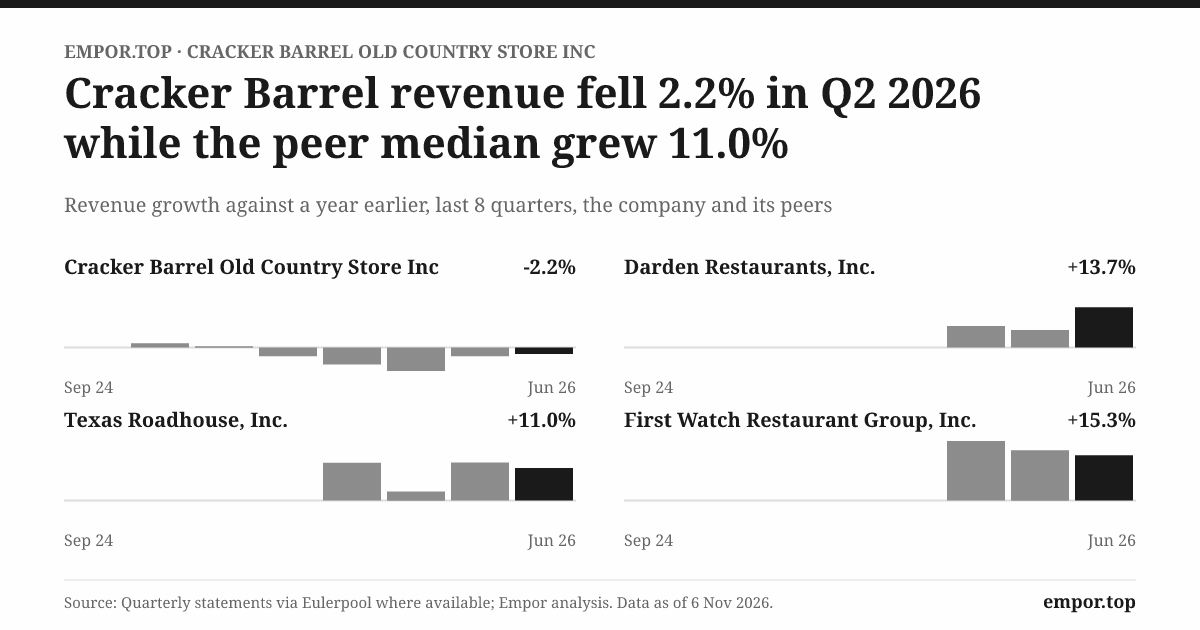
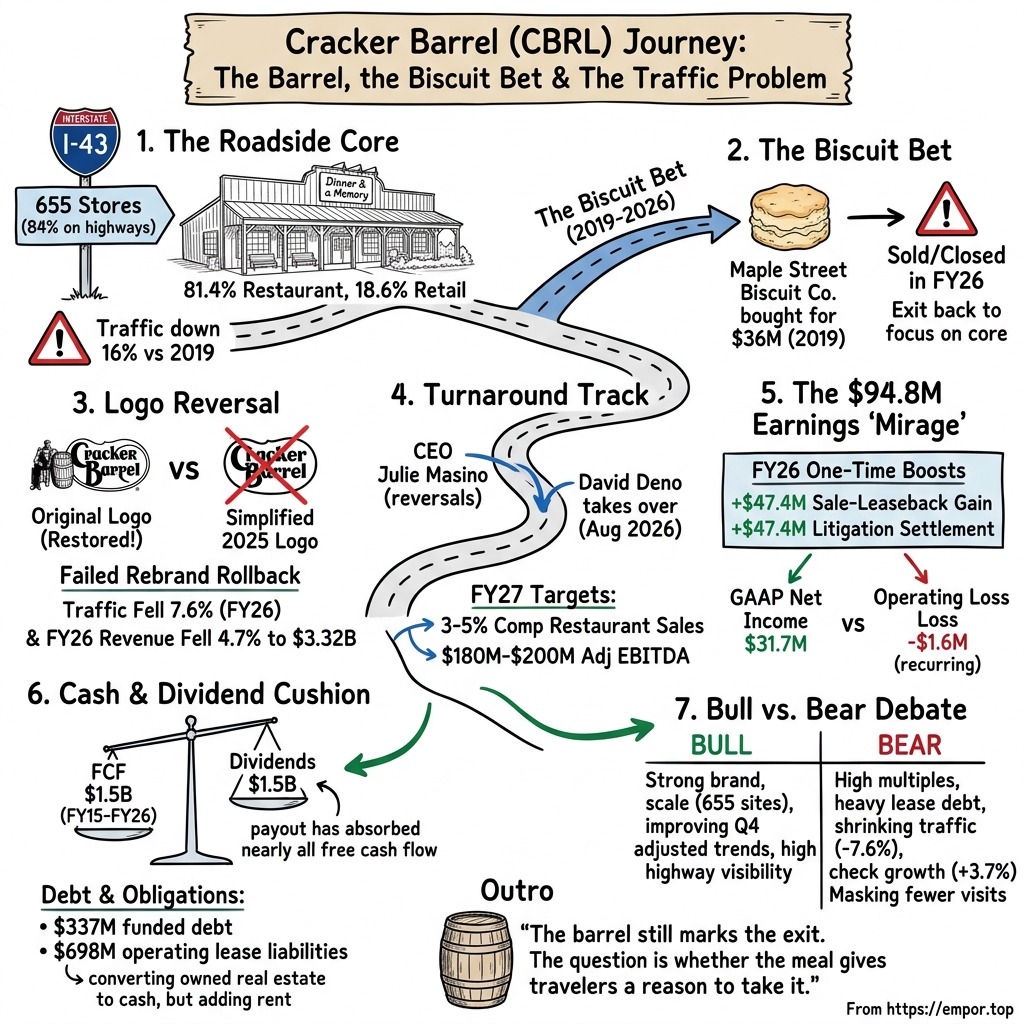
That bill is the subject of this story. In the fiscal year that ended in July 2026, restaurant traffic fell 7.6%, while the average check rose 3.7%.3 Revenue fell 4.7%, to about $3.32 billion.3 The two traffic and check figures nearly explain each other. Fewer visits, partly offset by bigger bills, work out almost exactly to the 4.2% decline in comparable restaurant sales.3 A restaurant chain can raise prices for a while to make up for lost guests. It cannot do it forever, because every increase gives a hesitant guest one more reason to stay on the highway.
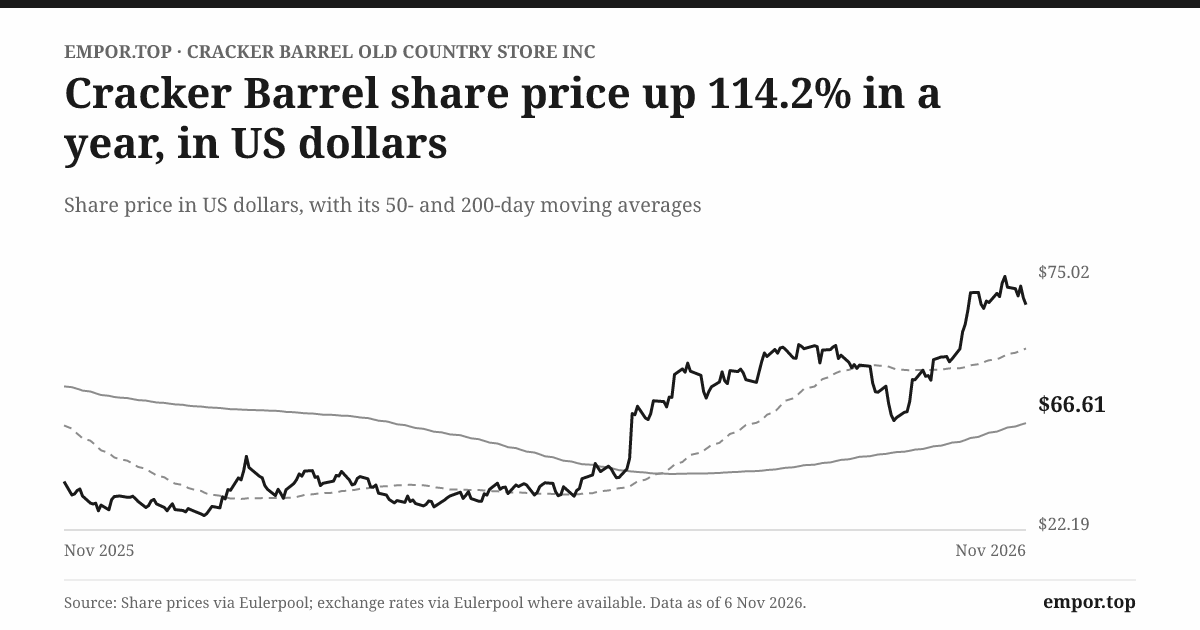
The stakes are bigger than one logo. Cracker Barrel runs 655 restaurant-and-retail stores in 43 states, most of them a short drive off an interstate.3 It changed chief executives in August 2026, when David Deno took over from Julie Masino a year after the logo episode.4 Its profits are thin enough that a single legal settlement can decide whether the year looks good or bad. And yet, as of early November 2026, the stock traded near its 52-week high of about $72, up from a low of about $25.5 The market had already decided that something was getting better.
So this story asks three questions. First, can Cracker Barrel bring guests back without leaning on ever-higher checks? Second, is the brand a durable advantage, or a promise the operating business has to keep earning? Third, can the company pay for its recovery and its dividend while carrying a long tail of rent? Running underneath all three is a distinction that matters for anyone reading the next set of results. A better quarter is evidence of improvement. It is not yet proof of a turnaround.
To see why the logo mattered so much, start with what the company sells, and with the traveler who pulls off the highway to buy it.
 Subscribe on LinkedIn
II. The Roadside Stop That Sold You Dinner and a Memory
Picture the stop the way the company designed it. A family has been driving for three hours on Interstate 40. The kids are restless, the gas light is on, and a sign appears over the trees with the familiar barrel. They take the exit and park beside a long front porch lined with rocking chairs. Inside, before they reach a table, they have to walk through a country store full of candy in glass jars, cast-iron skillets, seasonal decorations and toys that look as if they belong to another decade. After pancakes or chicken and dumplings, they walk back through the store again on the way to the register. Somebody usually leaves holding a bag.
That layout is the business model in physical form. Dan Evins, a Shell Oil jobber in Lebanon, Tennessee, opened the first Cracker Barrel in 1969 close to the new Interstate 40.6 His insight was simple and well timed. The Eisenhower highway system was creating millions of long car trips, and travelers needed somewhere to stop that felt familiar and safe. Evins offered them gasoline, a Southern meal and a shop in one place, wrapped in the look of a rural general store. The gas pumps eventually disappeared. Everything else is still recognizable. About 84% of today's stores sit near an interstate highway, so the company still lives, in large part, where Evins put it.3
The money changes hands in the most ordinary way possible. A guest eats, pays at the register by card or cash, and leaves.3 There are no subscriptions, no contracts and no minimum commitments. The closest things to prepaid revenue are gift cards and a rewards program. At the end of fiscal 2026, guests held about $80 million of unredeemed gift-card value, and the company recognized about $10 million of breakage, the accountant's word for money on cards that will probably never be spent.3 Those balances are useful working capital. They do not change the basic truth that every dollar of revenue has to be won again on every visit.
The restaurant is the engine. In fiscal 2026 it produced 81.4% of revenue, and the country store produced 18.6%.3 The average restaurant check was $15.58.3 A rough calculation shows the scale this implies: restaurant revenue of about $2.7 billion, divided by a check of that size, comes to something like 170 million guest checks a year. On that base, a 7.6% traffic decline means losing roughly 13 million visits in a single year. That is the traffic problem expressed in people rather than percentages.
Inside a typical store, the economics look like a seesaw. The standard format covers about 8,900 square feet, with roughly 1,900 of those given to retail.3 On one side sit the variable costs: food, which the company buys through a principal food distributor, and labor, which in a full-service restaurant open from breakfast to dinner is the biggest controllable cost. On the other side sit the costs that barely move whether the dining room is full or half empty: rent or depreciation on the building and land, utilities, maintenance, and the managers who have to be there regardless. The retail shop adds its own wrinkle, because it requires inventory, much of it sourced abroad, that has to be bought months before a holiday season that may disappoint.3
The people are the other half of the system. Cracker Barrel employed about 74,500 people at the end of fiscal 2026, many of them part-time servers, cooks and retail associates.3 That is more than a hundred people per store, which says something about what the company is selling. A fast-food restaurant can run on a few dozen workers and a drive-through window. A full-service dining room that seats families for breakfast, lunch and dinner, with a shop attached, needs hosts, servers, cooks, dishwashers, retail staff and managers on the floor for well over twelve hours a day. Hospitality is labor, and labor is the cost that rises every year whether or not guests do.
The supply chain carries its own quirks. The principal food distributor supplies restaurant inventory on what the company calls net-zero-day terms, which means Cracker Barrel pays for food essentially when it arrives, while other local restaurant inventory is generally bought on trade credit of 30 days or less.3 Because guests pay immediately by card or cash, the business collects its money about as fast as it spends it on food. The retail side works differently: merchandise has to be ordered, shipped, warehoused and allocated to stores well ahead of each season. In fiscal 2026 the company held noticeably less inventory relative to its cost of sales than in prior years, a sign of tighter buying as retail sales fell 5.2%.3 Leaner shelves free up cash. They also risk making the shop less of a reason to linger.
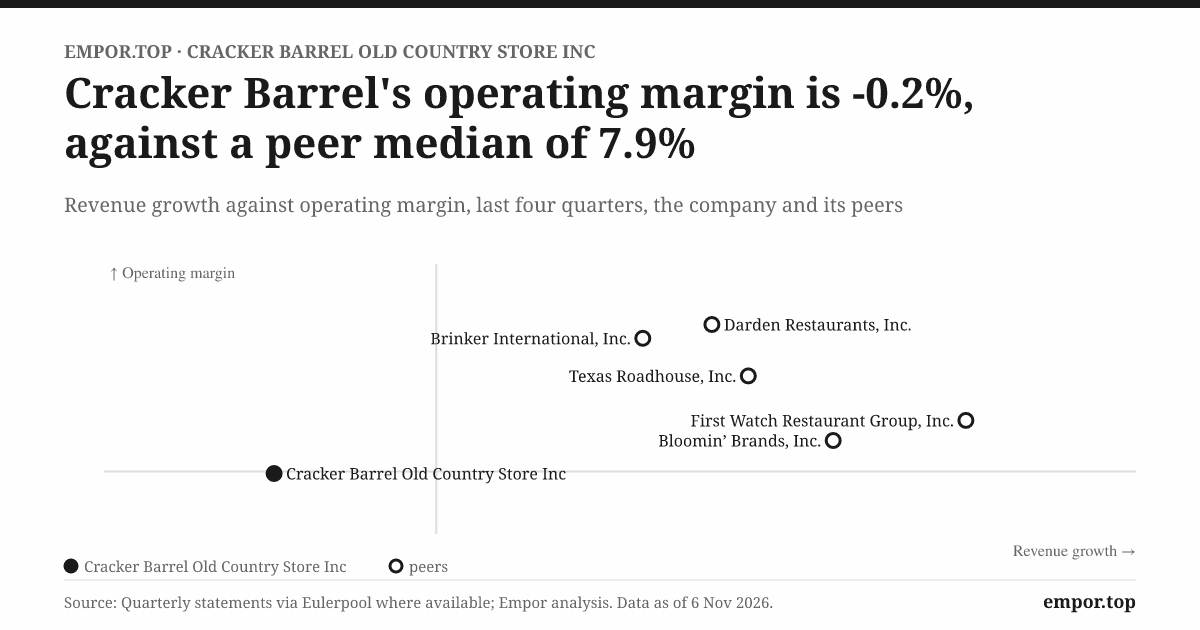
That structure explains why traffic matters more than almost anything else. When guests come back, each extra plate of biscuits spreads the fixed costs more thinly and profits rise quickly. When guests disappear, the same fixed costs stay put and margins collapse. Cracker Barrel's operating margin was around 9% to 11% in the years before the pandemic. In fiscal 2026 it was essentially zero.37 The seesaw has tipped.
Scale helps put the chain in perspective. Cracker Barrel's 655 stores compare with the 2,202 restaurants Darden ran across its portfolio in May 2026, and the 714 company-owned restaurants Texas Roadhouse operated at the end of 2025.89 These are not like-for-like comparisons. Darden owns Olive Garden, LongHorn Steakhouse and a range of other concepts, and Texas Roadhouse is a steakhouse with franchised locations alongside its own. But the numbers show that Cracker Barrel is a large single-brand system, not a niche operator.
The competitive set is broader than any list of peers. At breakfast, the family on I-40 could choose Denny's or IHOP. At dinner, it could choose Texas Roadhouse, an Olive Garden or a LongHorn. And at any time of day it could choose a drive-through, a fast-casual chain or a gas station with a food counter, all of which are cheaper and quicker. Cracker Barrel does not compete only with other sit-down restaurants. It competes with every other way a traveler can get fed and back on the road.
So is the format hard to copy? Partly. The combination of a full-service Southern menu, an attached shop, a highway location and a deliberately nostalgic atmosphere is unusual. No national competitor has tried to rebuild it at scale, and there are good reasons why: the stores are large, the retail operation needs its own buying and distribution system, and the brand's look took decades to accumulate. That is real differentiation. But being different is not the same as being protected. Guests face no switching costs. Buyers are millions of individuals, none of whom matter on their own. And the company does not publish market share, customer retention or repeat-visit data that would show its guests are more loyal than anyone else's.
The strongest evidence about the moat is what has happened to visits. In 2024, management said restaurant traffic was about 16% below 2019 levels.[^10] That decline came before the logo episode, before the remodel tests and before the new CEO. Then it fell further in fiscal 2026.3 A durable brand advantage would normally show up as guests who keep coming even when the experience wobbles. Cracker Barrel's record shows the opposite: a long-lived footprint and a beloved symbol that have not translated into dependable guest growth for most of a decade. The brand gets travelers to notice the exit. It does not, on its own, persuade them to take it.
Long before the logo, management had already concluded that the core needed help. Its first big answer was not to fix the old store. It was to buy a new one.
III. The Biscuit Chain Bought for Growth and Sold for Focus
In October 2019, Cracker Barrel announced that it had bought Maple Street Biscuit Company for $36 million in cash.[^11] Maple Street was a fast-casual chain from Jacksonville, Florida, built around big biscuit sandwiches, strong coffee and a counter-service format that could fit into a strip mall. At the time of the deal it had 33 locations: 28 owned by the company and five run by franchisees.[^11]
The logic was easy to follow. Cracker Barrel's own stores were large, expensive and tied to highways, which limited where the company could grow. A smaller breakfast-and-lunch concept could follow customers into suburbs and city neighborhoods, reach younger guests who would never sit through a full-service breakfast, and give the company a second growth engine at a time when new Cracker Barrel openings were slowing. The company described the acquisition as a platform for expansion and said it was attracted by Maple Street's store-level economics, citing target store-level EBITDA margins above 17%.[^11]
That number deserves a careful reading. It was a target, presented in an acquisition announcement. It was not an audited record of what Maple Street had actually earned, and nothing published later showed whether the chain reached it at scale.
Cracker Barrel had been trying to build this kind of concept itself. In 2016 it had launched Holler & Dash, its own fast-casual biscuit restaurant. When it bought Maple Street, it decided to convert the Holler & Dash units to the acquired brand.[^11] In other words, the acquisition was partly an admission that the in-house experiment had not worked well enough to keep on its own. The company then grew Maple Street over the next several years until it operated 51 locations.3
Then, in July 2026, it gave up. Cracker Barrel sold 35 Maple Street locations and closed the remaining 16 during fiscal 2026.3 The company recorded impairments, closing costs and a reported loss on the sale.3[^12] The second growth engine was dismantled almost seven years after it was bought, with less fanfare than it had arrived with.
Was the $36 million price too high? It is tempting to say so, but the public record does not support a clean answer. A fair judgment would require Maple Street's realized earnings, the purchase-price allocation and comparable deal multiples for small fast-casual chains, and the company has not published a full accounting of the investment's return. Without those, labeling the price an overpayment would be guessing.
What can be judged is the outcome. The original thesis was that Maple Street would become a vehicle for growth beyond the highway. It did not. Instead of becoming a meaningful second business, the chain stayed small relative to the core and ended as a source of write-downs and closing costs. The company spent management attention, capital and years of opportunity cost on a concept it ultimately decided it did not want to own. That does not mean the idea was foolish in 2019. It means the bet did not pay, and the company had to absorb the cost of exiting.
There is a quieter lesson in the sequence. Cracker Barrel tried to grow outside its core twice, first by building Holler & Dash and then by buying Maple Street. Both paths ended in retreat. When a company's adjacent bets keep failing, there are two possible explanations. One is that the company is not good at running small concepts, which is common, since large, slow-moving restaurant systems often struggle to support nimble fast-casual operations. The other is that management was looking for growth elsewhere because the core business had stopped producing it. The Maple Street story supports both.
The exit narrows Cracker Barrel back to one concept. Management can present that as discipline: a lesson learned, resources concentrated where they matter. A skeptical investor can present it differently: the company has run out of ways to avoid fixing the main business. Either way, the focus has shifted to the 655 stores with the barrel on the sign. And when the company turned to repair those stores, it reached for the most visible tool it had.
IV. The Turnaround Plan Met the Guest at the Door
When Julie Masino became chief executive in November 2023, she inherited a company that looked healthy from the outside and worried from the inside. She came from Taco Bell, where she had run the international business, and before that had worked at consumer brands outside restaurants.4 She was the kind of executive boards hire when they think a brand needs fresh eyes. Within months she gave her diagnosis in public, and it was blunt.
On the February 2024 results call, Masino said Cracker Barrel had lost relevance with guests. She also cited the traffic shortfall and said the company's research had found weaknesses in food, value, convenience and the atmosphere of the stores.[^10] It was an unusually frank admission for a new chief executive. It also framed what came next. If the problem was relevance, the solution would have to touch everything: the menu, the price points, the labor model, the stores and the way the brand looked to people who had never been inside.
In May 2024 she laid out the plan. The company described a multi-year strategic transformation that would refresh the menu, invest in labor and advertising, test remodeled stores and lift guest experience.[^13] To pay for it, the board cut the quarterly dividend from $1.30 a share to $0.25, freeing more than $70 million a year of cash for the turnaround.[^13] Management also warned that the work would weigh on earnings before it helped. It said fiscal 2025 adjusted EBITDA would be roughly flat to slightly lower, and that improvement would begin in the back half of fiscal 2026 and accelerate in fiscal 2027.[^13] That forecast matters, because it became the benchmark against which the next two years could be judged.
The plan was not foolish. Traffic really had fallen, and a business that relies on spreading fixed costs over visitors cannot simply wait for guests to return. Remodel tests made sense, since many stores were tired. Menu changes made sense, since the research said food and value were weak spots. And in principle, a brand refresh can attract new guests without driving away old ones. Plenty of restaurant companies have updated their look and been rewarded for it.
The trouble was in the choice of what to change. A Cracker Barrel store is, in some sense, a museum of a version of rural America. Its walls are covered with old tools and signs, its shop sells nostalgia, and its logo was a picture of a man leaning on a barrel. When the company unveiled the simplified logo and showed remodeled interiors with lighter colors and fewer antiques in August 2025, many longtime guests saw not a refresh but an erasure of the thing they came for.1 The criticism came largely, though not only, from conservative commentators who read the change as a retreat from Southern identity. The company had planned a modernization. Its guests experienced it as a broken promise.
The rollback came quickly. The Old Timer returned to the sign within about a week, and the company later paused the remodel program as well.1[^14] Then came the evidence that the damage had reached the dining room. On the fiscal 2025 fourth-quarter call in September 2025, CFO Craig Pommells said traffic had been down about 1% in the first half of August, before the logo announcement, and about 8% in the weeks after it.10 The company's outlook for fiscal 2026 reflected the hit.[^14] By December 2025, with its first-quarter results, it lowered its revenue forecast again as traffic stayed weak.[^16]11
Across those quarters, the story shifted. In 2024, management spoke the language of a long transformation with a clear arc: invest now, recover later. By late 2025 the language had become about listening to guests, returning to core cues and stabilizing traffic. The forecasts moved down step by step. To management's credit, it did not deny what had happened, and it explained the traffic data rather than hiding it. To its discredit, the plan's most visible element had been designed without understanding how strongly guests were attached to it.
It would be too simple to blame the logo for every lost guest. Restaurant demand was soft across much of the industry, consumers were watching their spending, and Cracker Barrel's traffic problem was years old. In its fiscal 2026 annual report, the company named both forces, pointing to negative publicity around its brand initiatives alongside softer consumer demand.3 The honest conclusion is that the brand episode made a weak trend markedly worse at exactly the moment the company was spending to reverse it. For the full year, comparable restaurant sales fell 4.2%.3 Revenue and net income both fell.3
The governance consequence arrived at the November 2025 annual meeting. Shareholders kept Masino on the board, though more than four million shares voted against her.12 Director Gilbert Dávila, who had become a focus of criticism over the brand changes, received about 9.6 million votes against and was not re-elected.12 The say-on-pay proposal passed with 79.5% support, a figure that would count as a warning at most large companies.12 The vote took place against the background of years of pressure from Sardar Biglari's Biglari Capital, which had run repeated proxy contests at the company and had prompted the board to extend a shareholder rights plan in 2024.13
What did the vote mean? It showed dissent, not a mandate. Shareholders were willing to punish a director tied to the rebrand but not to throw out the CEO. Some interpreted that as patience with a needed refresh that had been executed badly. Others interpreted it as a warning shot.
There are two competing ways to read the whole episode. In the first, Cracker Barrel needed modernization, and Masino's team simply made bad choices about which pieces to modernize. On this view, food quality, service speed and value were the right priorities all along, and the logo was an unforced error on top of a sound plan. In the second reading, the nostalgia is the product. Guests do not come to Cracker Barrel despite its old-fashioned identity; they come because of it. On this view, any attempt to make the brand look contemporary is a mistake, and the company's real task is to deliver the old promise better.
The evidence leans toward a combination. The traffic decline that began well before 2025 says the old formula alone was not enough. The reaction to the logo says the old identity is not something the company can safely discard. The next test is narrower and harder: can traffic improve through better food and service while the old identity stays exactly where it is? That test now belongs to someone else.
V. A New CEO Inherits a Recovery, Not a Blank Slate
On August 10, 2026, David Deno walked into the Lebanon, Tennessee headquarters as Cracker Barrel's new chief executive.4 He arrived with the résumé of a restaurant operator who had spent years in the hardest seat in casual dining. He had led Bloomin' Brands, the owner of Outback Steakhouse, and before that had held senior executive roles at Best Buy and Yum Brands.4 Bloomin' Brands is a useful training ground for this job. It runs large, mature full-service chains in a mature market, and it spent much of Deno's tenure fighting the same traffic pressures Cracker Barrel now faces.
His appointment followed Masino's departure from both the CEO role and the board, which took effect the same day.413 The board's change came a year after the logo episode, and it came at an awkward moment. By late fiscal 2026, some operating trends were beginning to improve.[^12] The board was not replacing a CEO in freefall. It was replacing one whose most visible initiative had failed, whose forecasts had been cut repeatedly, and whose credibility with guests and shareholders had been damaged. That is a reasonable reason to change leaders, even when the latest quarter looks better.
The team Deno inherited includes CFO Craig Pommells, who had been the company's financial voice through the transformation and the reversal.13 Continuity at the finance chair has value: Pommells knows the cost structure, the lenders and the history of every forecast. It also means the new chief executive's numbers will be delivered by someone who delivered the old ones.
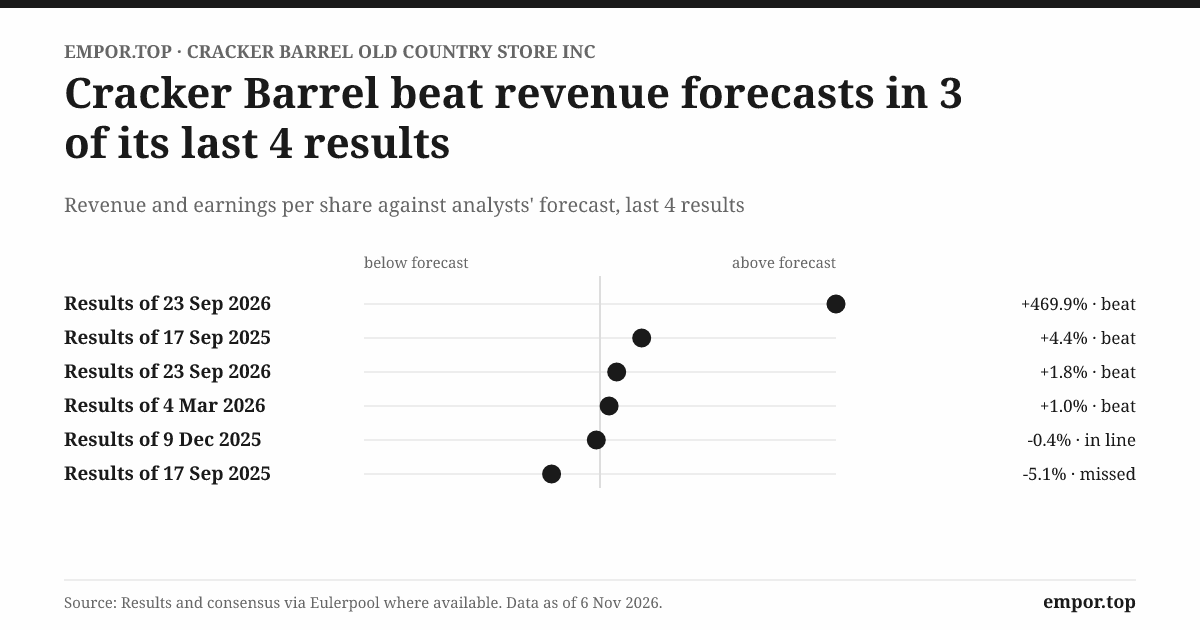
The best way to judge the new regime is to look at what the old one promised. In May 2024, management said fiscal 2025 adjusted EBITDA would be roughly flat to slightly lower, and that profit growth would start in the second half of fiscal 2026 before accelerating in fiscal 2027.[^13] What actually happened was a traffic shock after the logo, followed by sharp guidance cuts.[^16]11 Fiscal 2025 adjusted EBITDA came in at $224.3 million.[^12] Fiscal 2026 adjusted EBITDA landed at $147.7 million, down about a third.[^12] The promised improvement in fiscal 2026 did not arrive for the year as a whole, though the fourth quarter did grow.
Deno's first outlook is ambitious by comparison. For fiscal 2027, the company guided to comparable restaurant sales growth of 3% to 5% and adjusted EBITDA of $180 million to $200 million.[^12] At the midpoint, that is roughly 29% higher than fiscal 2026. Management also planned no new store openings and capital spending of $110 million to $125 million.[^12]
On the fourth-quarter call in September 2026, Deno laid out his priorities in operator's terms: the food, the guest experience, the people who work in the stores, and cost discipline.14 He pointed to improvement in underlying trends. Analysts pressed on two points: what specifically he would change, and whether the recent gains would hold once the comparison with the worst post-logo months faded.14 It was an early call for a new chief executive, and his answers were necessarily more about direction than results. The test of credibility will come when fiscal 2027's reported numbers can be laid next to that guidance and that conversation.
Deno's pay is designed to reward that test. His salary is $1.0 million, his target annual bonus is at least 125% of salary, and his long-term incentive target is at least 360% of salary.13 Most of his potential pay, in other words, depends on results and share-price performance rather than simply showing up. Ownership at the company is spread out. The largest holders listed in the proxy are BlackRock with about 14.8%, D.E. Shaw with about 7.3% and Vanguard with about 5.1%, and no one controls the company.13 A newly arrived chief executive's stake will be built mostly through those incentive awards rather than from a founder's block of shares.
His predecessor's pay shows how incentive systems can drift away from shareholders' experience. Masino's reported total compensation for fiscal 2026 was about $6.9 million, in a year when the company's GAAP net income was $31.7 million.133 Pay alone does not prove misalignment. A large part of it came as stock and option awards, whose value depends on future share prices, and her annual bonus was tied to an adjusted-EBITDA plan.13 Executive bonuses under that plan paid out at about 80% of target for the year.13 That payout tells its own story: the bonus plan measured performance against targets reset after the traffic shock, while shareholders experienced a 34% fall in adjusted EBITDA. Investors who cast votes against the say-on-pay proposal the previous year had noticed the same gap.12
The board around him has also been reshaped by the last two years. Eight of its nine directors are independent, and the audit, compensation and nominating committees are made up entirely of independent members.13 The proxy reports no related-party transactions requiring disclosure in fiscal 2026, no controlling shareholder and no affiliate arrangements of the kind that complicate governance at many family-controlled companies.13 That is a clean structure. Its weakness has not been conflicts of interest but judgment: the same independent board approved the brand initiatives, set the bonus targets and extended the rights plan that has kept activist pressure at arm's length.13 Independence protects shareholders from self-dealing. It does not, on its own, protect them from a board that misreads its customers.
For a recovery story, it is useful to keep the scorecard short. Three measures matter most. The first is comparable restaurant traffic, which tells whether guests are coming back. The second is average check, which tells whether sales growth comes from more visits or bigger bills. The third is GAAP operating profit once major one-off gains are stripped out, which tells whether the business itself is earning money. In fiscal 2026, traffic fell, the average check rose and operating profit was roughly zero.3 Those are the starting lines for Deno's tenure.
The third measure is where the year's headlines were most misleading, because fiscal 2026 looked better on paper than it was in the dining rooms.
VI. The $47 Million Gain That Made a Thin Year Look Better
In July 2026, in the last weeks of its fiscal year, Cracker Barrel closed a deal that had nothing to do with biscuits. It sold 26 of its stores to a real-estate investor and immediately leased them back.3 Guests saw no change; the same rocking chairs sat on the same porches. On the company's books, though, something significant happened. Because the buildings and land had been carried at historical cost, selling them at market value produced an accounting gain of $47.4 million.3
By an odd coincidence, the company also reported a second, unrelated gain of exactly the same size. Cracker Barrel had been part of the long-running class action brought by merchants against the card networks over interchange fees, the charges retailers pay every time a guest swipes a card. Its share of the settlement produced $47.4 million of net litigation-settlement income.3 A separate supplier-litigation recovery added another $12.6 million, which the company recorded as a reduction of store operating expenses.3
Put those facts next to the headline numbers, and the year changes shape. Revenue was about $3.32 billion.3 GAAP net income was $31.7 million.3 Operating profit for the year was roughly breakeven, a loss of about $1.6 million.3 Pre-tax income was about $20 million.3 The litigation settlement alone was larger than the year's pre-tax income. Without it, the company would have reported a pre-tax loss, before even considering the real-estate gain.
Those gains were not the only unusual items. The Maple Street exit brought a reported loss on the sale, along with impairments and closing costs.3 Tariff refunds, after courts and policy changes reversed some import duties, helped the fourth quarter's adjusted EBITDA by about $9.1 million.[^12] Each of these items pushed earnings up or down in ways unrelated to whether guests ordered more meals. Adding them together, the year's bottom line was shaped as much by lawyers, real-estate buyers and trade policy as by restaurant operations.
Adjusted EBITDA is supposed to cut through this noise, and it partly does. The company strips out items it considers unusual, such as the litigation settlement and the gain on the sale-leaseback, to give a picture of underlying operations.[^12] On that measure, fiscal 2026 was clearly weak: adjusted EBITDA fell from $224.3 million to $147.7 million, a drop of about a third.[^12] The fourth quarter was better. Adjusted EBITDA grew 11.4% year over year, to $62.1 million.[^12] But around $9 million of that quarter's figure came from tariff refunds that will not recur on the same scale.[^12] Without them, the quarter's growth would have been modest.
There is also a quieter detail in the accounting. Where a gain lands in the income statement changes how a year looks. The $12.6 million supplier recovery reduced store operating expenses, which means it flattered the operating margin for fiscal 2026, while the $47.4 million interchange settlement was recorded below operating profit.3 An investor comparing margins across years needs to know that one recovery sits inside the operating line and the other does not. The company discloses both, which is to its credit. The responsibility for reading them correctly falls on the reader.
Taxes add one more layer of distortion. For three straight years the company has reported a negative effective tax rate, meaning it booked a tax benefit even though it reported a pre-tax profit.3 That happens when tax credits, chiefly the federal credit employers receive on tips reported by restaurant workers, are large relative to a small pre-tax income. In fiscal 2026 the effect turned about $20 million of pre-tax income into about $31 million of net income.3 The credits are real and recurring, and they are a genuine advantage of running a full-service restaurant with tipped staff. But they also mean that net income overstates how well the operations performed, and they will matter less as a share of profits if pre-tax earnings recover. An investor reading the bottom line in isolation would see a company that made money in fiscal 2026. One reading the operating line would see a company that, from its restaurants and stores alone, roughly broke even.
The broader numbers show how far the earnings base has slipped. In fiscal 2016, Cracker Barrel earned about $189 million of net income on about $2.9 billion of revenue.7 Ten years later it earned less than a fifth of that on a larger revenue base, and that smaller figure was propped up by gains.3 The ten-year record shows revenue up about 1.3% a year and net profit down about 16.5% a year.37 Over the last three years, revenue shrank by about 1.2% a year.3 This is not a business whose profits have dipped with the cycle. It is one whose earning power has steadily eroded as costs have risen faster than guest counts.
The market has noticed the fourth quarter, the cleaner trend and the new chief executive. It is entitled to. But the honest reading of fiscal 2026 is that the year's improvement in reported profit came more from transactions and settlements than from the restaurants. A single good adjusted quarter does not demonstrate a restored earning base.
The test is simple to state. Fiscal 2027 will include no interchange settlement on the same scale and no repeat of the July real-estate sale, unless the company does more of them. Its GAAP operating profit, and the bridge from that figure to adjusted EBITDA, will show whether the restaurants themselves are recovering. If the adjusted figure reaches the guided range while GAAP operating profit stays near zero, the gap will deserve hard questions. If both move up together, the recovery will start to look real.
That July sale-leaseback was not just an accounting event. It was a financing decision, and it reveals the most important tension in Cracker Barrel's capital structure.
VII. The Dividend Has Outlasted the Cash Cushion
When Cracker Barrel sold those 26 stores, it received about $77 million in net cash.3 In return it signed 20-year leases on the same buildings, with initial annual rent of about $5.7 million.3 That is a revealing exchange. Dividing the rent by the proceeds gives a cost of roughly 7% a year for the money, before any increases in rent over time. For comparison, the company's convertible notes carry a coupon of 1.75%.3 A sale-leaseback is not a loan, and the comparison is not exact. Still, it makes the trade-off clear. The company turned owned real estate into cash at a price that commits it to two decades of fixed payments.
Why would management make that choice? Because the balance sheet had been tightening for years, and the decision followed a sequence of refinancing moves. In fiscal 2025 the company issued $345 million of convertible notes due in 2030, at a coupon of 1.75%, and used about $146 million of the proceeds to buy back $150 million of older notes due in 2026.3 It repaid the remaining $150 million of those older notes at maturity in June 2026.3 The sale-leaseback proceeds arrived the following month and helped reduce borrowings.3 By July 31, 2026, the company's only funded debt was the convertible notes, carried at about $337 million, with nothing drawn on its $550 million revolving credit line and $541.3 million of that line available.3 It was in compliance with its covenants.3
That picture is healthier than the headline debt figures suggest. Many data services show Cracker Barrel with roughly $1.0 billion of borrowings and a debt-to-equity ratio above 2, because they count lease liabilities as debt.3 The company's actual borrowings are about a third of that. The rest is rent.
A few smaller commitments sit around the edges of that picture. The company had about $8.7 million of standby letters of credit outstanding, mostly backing insurance claims and some lease obligations, and it remains contingently liable on certain leases it has assigned to others, a risk it considers remote.3 The more interesting judgment lies in insurance. Cracker Barrel self-insures a substantial part of its workers' compensation and general-liability exposure, which means it estimates and books the cost of injuries and accidents that have happened but have not yet been fully claimed. Its auditor, Deloitte, issued a clean opinion on the fiscal 2026 statements and singled out those insurance reserves as the critical audit matter, because they depend on actuarial assumptions about claims nobody has yet filed.3 For a company with tens of thousands of employees working around hot grills and wet floors, that reserve is not trivial, and small changes in its assumptions can move reported store costs from one year to the next. No material weakness in internal controls was reported.3
But rent is not a detail. At the end of fiscal 2026, operating lease liabilities stood at about $699 million on the balance sheet.3 The undiscounted value of all future lease payments, the actual cash the company has promised to pay landlords, was about $1.08 billion, spread over a weighted-average remaining term of about 15 years.3 Lenders and rating agencies routinely treat that kind of long-dated rent as debt-like, because it has to be paid in good years and bad. The sale-leaseback reduced funded debt pressure in the short term while adding to that fixed rent stack. It was not a free improvement in the balance sheet. It was a swap of one kind of obligation for another.
The deeper story is about where the cash has gone. Over the twelve fiscal years from 2015 through 2026, Cracker Barrel generated about $3.1 billion of operating cash flow, nearly twice its cumulative net income.37 That gap is not suspicious. It reflects a business with large depreciation charges and noncash lease expense: in fiscal 2026 alone, depreciation and amortization were about $123 million and noncash lease expense about $58 million.3 After capital spending, the company produced about $1.5 billion of free cash flow over the period.37
It paid out almost all of it. Dividends over the same twelve years also totaled about $1.5 billion, or roughly 95% of cumulative free cash flow.37 Cash and short-term investments ended fiscal 2026 at about $37 million, about $83 million lower than at the end of fiscal 2014.3 For years, Cracker Barrel was run as a cash machine for its shareholders. It paid a large regular dividend and, in some years, special dividends on top. That worked when the business earned operating margins near 10%. It became harder to sustain when margins fell, and by fiscal 2024 the company paid out nearly three times its net income in dividends.3
The payout ratio swings make the point. Measured against net income, the dividend ranged from about 12% in fiscal 2021, when pandemic-era payments had been suspended and profits rebounded, to about 290% in fiscal 2024, before the cut.3 In fiscal 2026 the payout was about 75% of net income.3 These numbers answer a different question from cash coverage. The earnings payout tells an investor whether profits support the dividend. The cash figures tell whether the business can afford it. At Cracker Barrel those two answers have often disagreed, because earnings have been depressed while cash flow, flattered by depreciation, has stayed higher.
The May 2024 cut to $0.25 a quarter was the moment management admitted the old model could no longer run on autopilot.[^13] The dividend now costs a little over $20 million a year.3 In fiscal 2026, free cash flow was about $91 million, comfortably more than that.3 But that free cash flow includes the cash from the litigation settlements, roughly $60 million before tax.3 Take them out, and the underlying figure is closer to $30 million, still enough to cover the reduced dividend but with very little room to spare.
The forward arithmetic is equally tight. Fiscal 2027 guidance calls for capital spending of $110 million to $125 million, covering store maintenance, technology and strategic investments, with no new stores planned.[^12] If the company reaches the midpoint of its adjusted EBITDA guidance, about $190 million, then after capex, interest and the dividend there would be only a few tens of millions of dollars left before taxes and working-capital swings.[^12] That cushion can disappear quickly in a restaurant business, where the main risk works through a familiar mechanism. When traffic falls, sales fall immediately, but rent, depreciation and much of the labor bill do not. Fixed lease payments continue no matter how many guests walk in.
Capital spending itself has already been squeezed. The company spent about $115 million on capital projects in fiscal 2026, down from about $159 million the year before, or roughly 3.5% of revenue against 4.6%.3 Management attributed the decline to lower spending on existing stores and strategic projects and fewer openings.3 For a chain whose stores are large, old and built around the feel of their interiors, that is a meaningful number. Restaurants age in public. Worn booths, tired restrooms and dated kitchen equipment are noticed by guests long before they show up in an impairment test. Cutting capex helps free cash flow this year, but it can quietly borrow from traffic in future years, which is the one thing Cracker Barrel cannot afford to borrow from.
The company has other levers. It authorized up to $100 million of share repurchases through September 2027, though it did not buy back stock in fiscal 2025 or fiscal 2026.3 It still owns many of its stores, which means further sale-leasebacks remain possible. But each one would add to the rent stack, and each would make the company more like a tenant and less like a landlord. That shift is not necessarily bad. It is a choice to trade future flexibility for cash today.
So the dividend is covered, for now, by the cash the business produces. It is not covered generously, and the long record shows a company that chose to distribute almost everything it earned rather than build a reserve. The number to watch is free cash flow after maintenance and technology spending, measured against the dividend and against total debt including leases. If that gap widens in fiscal 2027, the recovery will be paying for itself. If it narrows, the next hard choice will come back to the board.
All of which raises the question the market has been answering every trading day: what is this business worth, if it works?
VIII. Analysis & Bear vs. Bull Case
On November 6, 2026, Cracker Barrel's shares closed at about $66.61, roughly 8% below a 52-week high and more than two and a half times the low of about $25 reached during the year.5 The company's market value was about $1.5 billion, and its enterprise value, including debt and lease liabilities and net of cash, was about $2.5 billion.53 For a company whose most recent year was rescued by legal settlements, that rebound says something. Investors have started to price a recovery before the reported numbers show one.
The valuation multiples make the bet visible. On trailing earnings that include the one-off gains, the stock traded at about 48 times earnings.5 On trailing EBITDA, its enterprise value was about 20.5 times.5 Its own five-year median EV/EBITDA, on a somewhat different calculation, was about 12.9 times, and Darden traded at about 12.7 times on the same date.515 By those measures, Cracker Barrel looked expensive against both its own history and a larger, more profitable peer. On sales, by contrast, the stock looked ordinary: its price-to-sales ratio of about 0.4 was close to its five-year median.5
Those numbers need careful handling, because depressed earnings make multiples misleading. When profits are near zero, even a modest recovery causes the ratio to collapse. A rough calculation shows how much the current price depends on the new guidance. If fiscal 2027 adjusted EBITDA reaches the midpoint of the $180 million to $200 million range, the enterprise value would be about 13 times that figure, close to its own historical median.[^12] The comparison is imperfect, because adjusted EBITDA is defined differently from the trailing figure and the enterprise value includes lease liabilities. Still, the direction is clear. The market price assumes, more or less, that the company delivers the plan its new CEO laid out. It does not leave much room for disappointment.
So why might Cracker Barrel win from here? The bull case starts with things that cannot easily be copied. The company owns or controls 655 large stores, most of them in highly visible spots off interstates, built over five decades.3 A new competitor trying to rebuild that footprint would need years and billions of dollars, and would struggle to find comparable sites. The combined restaurant-and-retail format remains unusual, and the logo episode, for all its damage, proved how strongly people feel about the brand. Hardly anyone protests when a forgettable chain changes its sign.
Then there is operating leverage, the restaurant industry's version of a coiled spring. Because so many of the company's costs are fixed, a return of guests would flow quickly to profit. Each extra visit to an existing store carries little additional rent, little additional management cost and no new construction. If traffic simply stabilized and then grew a few percent a year, the margin could recover meaningfully from a base near zero. The fourth quarter's adjusted EBITDA growth, the guidance for 3% to 5% comparable restaurant sales and the company's ample liquidity all support the view that the worst is behind it.[^12]3
Why might it not? The bear case starts with the same facts read differently. Traffic was already about 16% below 2019 in 2024, and it fell further in fiscal 2026.[^10]3 Revenue shrank over the last three years.3 Operating profit was negative for the year, and reported earnings depended on settlements and a real-estate sale.3 The company's profits are a fraction of what they were a decade ago.73 And the current multiple already prices a substantial recovery.
It helps to set Cracker Barrel against the peers investors are implicitly comparing it with. Darden, with more than three times as many restaurants, a portfolio of brands to shift capital between and a long record of steady unit growth, trades at roughly the multiple Cracker Barrel would trade at if its guidance were met in full.158 In other words, the market is offering Cracker Barrel something close to a Darden-style valuation on the assumption that it recovers to a level of profitability it has not shown for several years. Texas Roadhouse, the other comparison, has spent the same period opening restaurants and growing traffic, which is precisely the thing Cracker Barrel has been unable to do.9 Those are not perfect comparisons. They do show that the industry's best operators have been able to win guests in the same economy, with the same wage pressure and the same consumers. Cracker Barrel's traffic problem is therefore not simply an industry problem. It is, in large part, its own.
A structured look at the industry's forces helps clarify which reading is more likely. Start with buyers. Cracker Barrel's guests are millions of individuals, so no single one has bargaining power, but collectively they have enormous power through the simplest tool there is: choosing to eat somewhere else. There are no switching costs. A guest who drives past one Cracker Barrel loses nothing.
Then rivals. The competition for any given meal occasion is fierce. Denny's and IHOP compete for breakfast, Darden's chains and Texas Roadhouse compete for sit-down dinners, and fast-food and fast-casual chains compete for travelers in a hurry. Substitutes are everywhere, including groceries and gas-station food. The threat of a direct new entrant copying the full format is low, but the threat of substitution is high.
Then suppliers. Labor is the largest cost, and in a tight market for restaurant workers, wages have risen faster than menu prices for much of the decade. Food costs swing with commodity cycles. The retail shop relies heavily on foreign-sourced goods, which exposes the company to tariffs and shipping disruption.3 And Cracker Barrel depends on a single distribution facility for retail merchandise and on a small number of significant vendors.3 If that facility were disrupted, the stores' shelves would empty quickly. Supplier power here is less about any one vendor's pricing and more about continuity risk concentrated in a few places.
Hamilton Helmer's framework of seven durable powers offers another test. Scale economies? Cracker Barrel is large, but full-service restaurants do not benefit from scale the way software or manufacturing does, because each new store must be staffed and supplied on its own. Network effects? None. Switching costs? None. Counter-positioning? Not really, since competitors could copy the format if they thought it was worth it. Process power? Possibly, in the retail buying and merchandising operation, but the company does not publish the kind of evidence that would prove it. Cornered resource? The highway sites come closest, but newer roadside options have eroded that advantage. That leaves branding, the one power where Cracker Barrel has a credible claim.
Branding in Helmer's sense means customers will pay more for an identical product because of what the brand means to them. The evidence for that is mixed at best. In fiscal 2026 the average check rose 3.7% while traffic fell 7.6%.3 That is not pricing power in the way the framework intends. A business with true pricing power raises prices without losing many customers. Cracker Barrel raised prices and lost a lot of them, and the comparable sales decline was the result. The brand clearly generates attention and emotion. What it has not demonstrated, over most of a decade, is the ability to convert that attention into rising guest counts at higher prices.
The verdict on the moat is therefore narrower than the bull case wants. Cracker Barrel's position is differentiated: no one else offers quite this experience at this scale. But it is not proven to be durable. Traffic history rejects the strong claim that the brand protects the business on its own. It leaves intact a smaller claim: the brand gives the company a large, loyal base of potential guests who will come back if the meal and service are worth it. The figure that would confirm or falsify that smaller claim is comparable traffic in fiscal 2027.
An activist looking at the company would focus on a few points. The dividend absorbed almost all free cash flow for a decade while the core business weakened. The Maple Street bet consumed years and capital before being written off. The board approved a brand change that misread its own customers, then saw bonuses pay out at 80% of target in a year when adjusted EBITDA fell by a third.13 Real estate has been sold to fund the balance sheet, turning owned stores into long-term leases. Each of these is defensible on its own terms. Together they describe a company that has been managing decline rather than reversing it, and that is the case the new CEO must disprove.
The risks are real and work through specific mechanisms. Weaker consumer spending hits traffic first, and traffic hits margins hardest because of the fixed-cost structure. Wage and food inflation squeeze margins unless prices rise, and price increases put more pressure on traffic. Tariffs raise the cost of the imported goods that fill the retail shop.3 A disruption at the single distribution facility could empty shelves.3 Negative publicity, as the logo episode showed, can cost millions of visits.3 A security breach involving card data would damage trust and invite litigation.3 And the long leases mean that if any of these risks materialize, the company cannot easily shrink its cost base.
So is the stock pricing a recovery that the evidence has not yet proven? Largely, yes. The rebound in the share price reflects better late-year trends, a new chief executive and guidance that implies meaningful profit growth. The operating evidence so far is one improving quarter, partly flattered by tariff refunds, after a year of falling traffic and a GAAP operating loss. That does not mean the recovery will fail. It means that fiscal 2027's traffic and check mix, its GAAP operating profit, its free cash flow after capex and the gap between adjusted and reported earnings will decide whether the valuation is earned. Until then, the market is paying in advance.
IX. Playbook: Business & Investing Lessons
The barrel came back to the sign within days. The guests did not come back nearly as fast. That gap, between how quickly a company can reverse a decision and how slowly it can rebuild trust, is the most useful thing Cracker Barrel teaches anyone who owns, runs or invests in a beloved brand.
The first lesson is that a brand is a promise kept at the point of sale, not a logo on the sign. Cracker Barrel's management treated the logo as an asset to be refreshed, like an outdated website. Its guests treated it as a promise about what they would find inside: the same food, the same porch, the same sense of a slower America. When the company changed the sign, guests assumed the promise had changed too. Restoring the Old Timer fixed the sign, but traffic kept falling, because the deeper promise depends on every plate of pancakes and every server's greeting. For founders, the lesson is to know which parts of the brand guests experience as identity and which they experience as decoration. For investors, it is to measure brand strength by visits, not by recognition. Recognition is free. Visits cost the guest money and time.
The second lesson is that a growth plan needs an exit price as well as an entry thesis. Maple Street arrived in 2019 as a growth platform with a promising store-level margin target, and it left in 2026 through a sale and a set of closures that brought losses, impairments and costs.[^11]3 Nobody outside the company can say whether $36 million was the wrong price, because the realized returns were never fully published. What can be said is that the company had no visible test for when to stop. An acquisition that can only be judged at its exit should have its exit criteria written down at its entry. Investors evaluating a restaurant company's diversification should ask the same question: what would have to happen for management to admit this did not work, and how long would that take?
The third lesson is that a dividend is a claim on future choices. For a decade, Cracker Barrel paid out about 95 cents of every dollar of free cash flow as dividends.37 That was a reasonable choice in a business with high margins and few attractive reinvestment opportunities. But it left the company with a thin cash cushion just as it needed money to fix its stores. When the moment came, the board had to cut the dividend, sell real estate and lean on convertible debt. Every dollar paid out in the good years was a dollar that could not be spent on remodels or menu work in the bad ones. A generous dividend is not free money for shareholders. It is a decision about what the company will be unable to do later.
The fourth lesson is that a turnaround is a sequence of receipts, not a slogan. In 2024, management promised that profits would bottom in fiscal 2025, improve in the back half of fiscal 2026 and accelerate in fiscal 2027.[^13] Fiscal 2026 adjusted EBITDA fell by a third instead.[^12] Now a new chief executive promises 3% to 5% comparable sales growth and adjusted EBITDA up nearly 30%.[^12] Maybe he will deliver. The way to know is not to listen harder to the plan. It is to check the receipts: traffic, GAAP operating profit and free cash flow, quarter after quarter, against what was promised. Turnarounds that work tend to show their progress in boring, consistent numbers before they show it in the share price. At Cracker Barrel the share price has moved first.
Put the four lessons together and they say the same thing from different angles. Memory can bring a traveler to the exit. Only the meal brings them back.
X. Epilogue
Tonight, Cracker Barrel stands at the start of the first full fiscal year under its new chief executive. It has 655 stores and no plans to open new ones.3[^12] It has sold its biscuit chain and returned its Old Timer to the sign. It carries about $337 million of convertible debt, a decade and a half of rent commitments and a dividend that costs a little over $20 million a year.3 It has promised investors comparable restaurant sales growth of 3% to 5%, adjusted EBITDA of $180 million to $200 million, and capital spending of $110 million to $125 million.[^12] And its share price already reflects a good deal of optimism that those promises will be kept.
The next moments that will decide the story are close at hand. The first fiscal 2027 quarterly report, due in December, will be the first chance to see Deno's plan in reported numbers. It will also be the first quarter compared against a period after the logo episode, which means easier comparisons and higher stakes. A strong traffic number in that report will mean less if the comparison base was the worst stretch of the reversal.
Three measures will tell the real story. The first is traffic relative to check. If comparable sales improve mainly because more guests come in, the recovery gains credibility, because it would show that the brand still has pulling power when the experience improves. If check growth carries the sales while traffic stays weak, the brand repair remains unfinished, and the company is still relying on loyal guests paying more rather than lost guests returning.
The second is GAAP operating profit, with one-off gains stripped out. Fiscal 2026 showed how easily settlements and real-estate sales can disguise a weak year. If fiscal 2027's reported operating profit rises toward the adjusted figures, the earning base is recovering. If the gap between the two stays wide, investors will be right to ask what the adjustments are hiding.
The third is free cash flow after maintenance and technology spending. The company has promised to invest in the stores and in systems while keeping the dividend. If cash flow covers both comfortably without further sale-leasebacks, the balance sheet is healing. If the company needs to sell more stores and lease them back to fund its plans, it will be trading future flexibility for present comfort again.
There is also the matter of margins and the guest experience. Restaurant companies under pressure often improve margins by cutting labor hours or shrinking portions, and the cuts show up in results before they show up in guest frustration. If Deno's margin gains come from staffing the stores more thinly, the traffic problem will return. If they come from better purchasing, fewer wasted hours and higher volumes, they will last.
One more event is close. The company's annual meeting is scheduled for November 19, 2026, eleven days from now.13 Last year's vote removed a director and sent a message on pay.12 This year's results are not yet known. They will show whether shareholders are willing to give the new team time, or whether the pressure that has shadowed the board for years has eased.
The story remains open because the new chief executive's plan has not yet produced a single full quarter of results under his name. The market has bought the ticket. The meal has not been served.
XI. Outro
Go back to the traveler on Interstate 40, pulling off at the sign with the barrel. Everything about Cracker Barrel's future depends on what happens in the next forty minutes.
The logo could be restored in a week. Guest trust is rebuilt one visit at a time.
The barrel still marks the exit. The question is whether the meal gives travelers a reason to take it.
References
-
Cracker Barrel scraps new logo design, keeps 'Old Timer' after listening to customers — Fox Business, 2025-08-26 ↩↩↩↩
-
What's in a brand? Cracker Barrel stock tanks after booting Uncle Herschel from logo — TribLive, 2025-08 ↩
-
Cracker Barrel Old Country Store, Inc. — Form 10-K, FY2026 — SEC, 2026-09-25 ↩↩↩↩↩↩↩↩↩↩↩↩↩↩↩↩↩↩↩↩↩↩↩↩↩↩↩↩↩↩↩↩↩↩↩↩↩↩↩↩↩↩↩↩↩↩↩↩↩↩↩↩↩↩↩↩↩↩↩↩↩↩↩↩↩↩↩↩↩↩↩↩↩↩↩↩↩↩↩↩↩↩↩↩↩
-
Cracker Barrel CEO Steps Down a Year After Logo Debacle — AP, 2026-07-27 ↩↩↩↩↩
-
Cracker Barrel Old Country Store Valuation History — TGMCharts ↩↩↩↩↩↩↩
-
Cracker Barrel founder Dan Evins dead at 76 — NBC News, 2012-01 ↩
-
Cracker Barrel Old Country Store, Inc. — Form 10-K, FY2016 — SEC, 2016-09-26 ↩↩↩↩↩↩↩↩
-
Cracker Barrel shares drop as logo change blowback dents restaurant traffic — BNN Bloomberg, 2025-09-18 ↩
-
Cracker Barrel Lowers Revenue Forecast as Traffic Falls After Logo Blowup — AP, 2025-12-09 ↩↩
-
Cracker Barrel Annual Meeting Results, Form 8-K — SEC, 2025-11-24 ↩↩↩↩↩
-
Cracker Barrel Old Country Store, Inc. — Definitive Proxy Statement — SEC, 2026-10-06 ↩↩↩↩↩↩↩↩↩↩↩↩↩
-
Cracker Barrel Q4 2026 Earnings Call Transcript — The Motley Fool, 2026-09-23 ↩↩
 LinkedIn
 WhatsApp
 Reddit
 Hacker News
 Email
 Kindle
 RSS Feed
 Spotify
 Apple Podcasts
 Amazon Music
 Audible
 YouTube