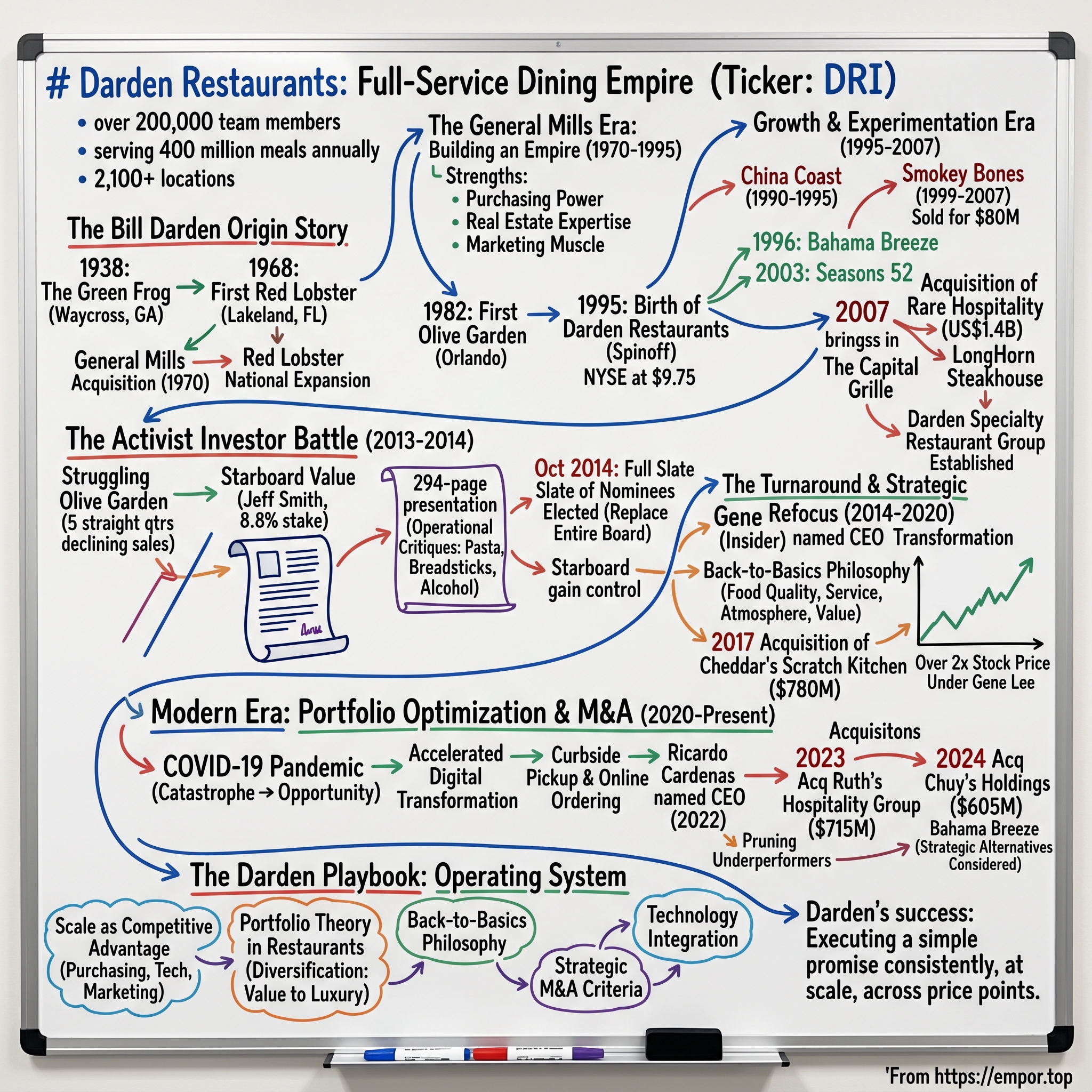
Darden Restaurants: The Full-Service Dining Empire
I. Introduction & Episode Overview
On any given Tuesday evening in suburban America, somewhere between forty and fifty thousand people sit down inside an Olive Garden. Baskets of breadsticks land on tables, servers grate cheese over pasta, and a kitchen manager monitors a display detailing staffing requirements in fifteen-minute increments for the upcoming shift.
Multiplied across more than 2,100 restaurants operating under ten distinct brands, that scale makes Darden Restaurants, Inc. the largest full-service restaurant company on Earth. In fiscal 2025, ended May 25, 2025, Darden Restaurants, Inc. reported total sales of approximately $12.1 billion and net earnings of roughly $1.05 billion, operating a portfolio that stretched from $12 unlimited soup-salad-and-breadsticks lunches to $200 dry-aged ribeye dinners in midtown Manhattan.1
That range defines the business model. While most restaurant companies replicate a single concept, Darden operates as a shared procurement, logistics, real-estate, and data analytics platform that scales across distinct dining brands. Olive Garden and The Capital Grille share almost nothing on the menu, but they share beef procurement, insurance programs, technology systems, legal departments, and distribution centers.
This structure frames a central question: how did a business viewed by the market in 2014 as severely mismanaged become the highest-margin operator in American casual dining a decade later? Darden began as a corporate spin-off shed by cereal manufacturer General Mills. During its first decade as an independent public company, it eroded capital on internally created concepts. It later faced a major activist campaign in 2014, when Starboard Value published a 294-slide presentation detailing operational deficiencies—including kitchen practices—leading shareholders to replace the entire board of directors.
The central issue is whether Darden's current performance reflects a durable structural advantage or a combination of disciplined operating execution, scale advantages, and an acquisition strategy that supplements organic growth.
The analysis traces this trajectory across key phases: the company's origins under founder Bill Darden and General Mills; the 1995 spin-off and subsequent failed concepts like China Coast and Smokey Bones; the 2007 acquisition of RARE Hospitality; the 2014 Starboard proxy battle; the operational rebuild under Gene Lee; and the current era under CEO Rick Cardenas, marked by acquisitions such as Ruth's Chris and Chuy's alongside a shift into third-party delivery. The section concludes with an evaluation of segment economics, competitive advantages, and the key risks that could challenge the investment thesis.
The critical takeaway is that Darden's primary strength is specific: acquiring established dining concepts and improving their margins through corporate scale. Historically, the company has struggled to build new concepts from scratch, and separating acquisition integration from internal innovation remains essential for evaluating its strategy.
 Subscribe on LinkedIn
II. The Bill Darden Origin Story & Red Lobster Foundation
In 1938, nineteen-year-old William Darden opened a 25-seat lunch counter named The Green Frog in Waycross, Georgia. Beyond its youthful slogan, "Service with a Hop," Darden made a distinct operational decision for the era: in the segregated Deep South of the late 1930s, he served Black customers in the main dining room. In that context, integrating his seating was not a promotional tactic, but a tangible commercial risk taken on principle.
Over the next three decades, Darden honed his trade through hands-on operations, running Howard Johnson's franchises and several independent restaurants across Florida and Georgia. He focused intensely on fundamental unit metrics—table turnover, kitchen pass-through times, and server engagement. Rather than positioning himself as a broad industry visionary, he operated as a pragmatic practitioner grounded in the mechanics of high-volume meal execution.
His primary commercial insight emerged from an observation about American geography: in the late 1960s, fresh seafood remained largely a coastal privilege. For diners in landlocked states like Ohio, Tennessee, or Oklahoma, a shrimp dinner was an occasional vacation luxury. Darden recognized this not as a lack of regional demand, but as a distribution deficit. He saw that advances in commercial freezing and refrigerated trucking had made affordable inland seafood viable, though no restaurant operator had yet built the chain infrastructure to capitalize on it.
In 1968, Darden opened the first Red Lobster Inn in Lakeland, Florida—a landlocked citrus town selected specifically to test whether inland demand would support the model. The concept succeeded immediately. Guest volume and unit sales ran well above typical casual dining metrics of the era, generating rapid profitability and confirming a broad, unserved market for accessible seafood.
This initial success highlighted the primary structural constraint facing the business. Transitioning a concept from a single location to a multi-hundred-unit footprint required vast capital for site acquisition, cold-chain logistics, inventory financing, and a balance sheet capable of absorbing commodity price swings. Darden possessed a proven restaurant unit, but lacked the institutional capital to scale it nationally.
In 1970, with three locations operating, Darden sold Red Lobster to packaged-foods corporation General Mills, remaining as executive manager. Often treated as a historical footnote, this transaction stood as the most consequential capital-allocation decision in the company's history: Darden traded equity control for the balance sheet required to build a national chain.
The falsification pass: was the supply chain ever really a moat?
Corporate histories often suggest that Red Lobster possessed an unassailable seafood procurement advantage from its inception. Historical evidence does not support that narrative—a distinction that bears directly on similar scale claims made about Darden’s business model today.
Throughout the 1970s, Red Lobster’s unit economics experienced significant instability. Wild-caught shrimp was a volatile commodity subject to weather-driven supply shocks, and fixed menu pricing forced the growing chain to absorb raw material price spikes directly into its cost of goods sold. Early scaling generated notable margin fluctuations and spoilage losses because purchasing was uncentralized and distribution reliance was fragmented. The procurement advantage materialized only after General Mills spent the late 1970s building dedicated distribution infrastructure and deploying its corporate balance sheet to hedge commodity cycles.
Scale in seafood procurement was not an inherent feature of the original concept, but an asset purchased over a decade with parent-company capital. This historical reality provides the proper framework for analyzing Darden's subsequent scale claims. In the restaurant industry, procurement advantages are artifacts of continuous capital investment and logistics infrastructure, rather than passive attributes of size—meaning they can be built, but will decay if investment lags.
This outcome raised a fundamental strategic question for General Mills: if corporate capital could industrialize one dining concept, could it systematically manufacture new ones on demand?
III. The General Mills Era & The Birth of Olive Garden
In the 1970s, Minneapolis-based consumer packaged goods giant General Mills brought rigorous market research to the restaurant industry. It ran focus groups, tested product concepts extensively, and evaluated dining through the lens of category management, shelf space, and market share. Applying that corporate consumer research to full-service dining was novel for the era, when most restaurant chains still expanded on operator intuition.
The company moved its restaurant division headquarters to Orlando, Florida, physically and culturally separating it from the core cereal business. This structural division allowed Orlando to serve as an operational testing ground. Site selection shifted from local real-estate intuition to data-driven modeling based on traffic counts, household income demographics, competitive density, and daypart mix. Purchasing was centralized, and kitchen equipment was standardized rather than sourced ad hoc.
By the late 1970s, the division had built a repeatable system for site evaluation and unit-level cost forecasting.
Manufacturing Olive Garden
In 1982, General Mills opened the first Olive Garden in Orlando. The concept was not derived from an authentic regional family recipe, but developed as a consumer product: research first, concept second. The development team evaluated what American consumers sought in Italian dining, identifying key preferences around abundance, familiarity, warmth, and an accessible price point for families.
The operational strategy directly reflected those findings. Unlimited breadsticks and salad were delivered using some of the lowest-cost inputs on the menu to establish strong perceived value. A standardized hospitality script—"When you're here, you're family"—provided an emotional register that set the brand apart from low-price competitors.
The concept expanded rapidly, reaching 145 locations by 1989 and becoming the fastest-growing Italian casual dining chain in the United States. Per-restaurant sales volumes rose to rival those of Red Lobster. By the early 1990s, General Mills owned the two largest brands in American casual dining across distinct categories, operating on a single shared back-end infrastructure.
Management then drew a broader, flawed conclusion from that success.
The China Coast falsification episode
Olive Garden's rapid expansion led management to assume its formula was cuisine-agnostic: identify an underserved category, apply market research, and scale a national footprint.
In 1990, General Mills launched China Coast to nationalize casual Chinese dining—a category that mirrored the Italian market of a decade earlier: broadly popular, highly fragmented, and lacking a national full-service chain.
The venture failed. Executing Chinese cuisine at scale introduced kitchen complexities that conflicted with Darden's operational strengths. Wok cooking requires skilled, à-la-minute execution that resisted the central preparation and assembly-line standardization behind Olive Garden's economics. Raw ingredient counts expanded, kitchen throughput slowed, and store-level operating losses persisted as locations matured. In 1995, with 51 locations open, General Mills shut down the chain and wrote off the investment ahead of spinning off the restaurant division.
The failure highlighted a fundamental boundary of the operating model. The issue was not consumer demand for Chinese food, but the mismatch with Darden's production model. Darden's competitive advantage depended on menu items that could be centrally prepped and standardized in high-volume kitchens. Olive Garden demonstrated that the system worked for food suited to assembly-line prep, rather than proving a universal formula for launching any dining concept from scratch.
That operational limit would be tested once more before being fully integrated into corporate strategy—and it would be tested on the public market's dime, as General Mills decided by 1995 to exit the restaurant business entirely.
IV. The 1995 Spinoff & Early Portfolio Stumbles
Corporate spinoffs generally stem from either strategic conviction or operational fatigue. The General Mills board's decision to separate its restaurant division in May 1995 was largely driven by the latter. Packaged food and full-service dining had diverged into fundamentally different businesses with contrasting capital requirements, labor exposures, and economic cycles. Maintaining 1,250 dining rooms required continuous capital expenditure to prevent facilities from becoming dated—capital that directly competed with brand investments in cereal and consumer packaged goods.
Darden Restaurants, Inc. began trading on the New York Stock Exchange in May 1995, distributed to General Mills shareholders on a one-for-one basis and opening around $9.75 per share. The new entity inherited 1,250 locations across 49 states and Canada—primarily Red Lobster and Olive Garden—along with a name honoring founder Bill Darden, who had died a year before the standalone company was formed.
Independence brought immediate operational challenges. Casual dining had overbuilt during the early 1990s, leaving the market Olive Garden had defined crowded with competing chains. As same-restaurant sales softened in 1997, management closed 48 underperforming locations and recorded a restructuring charge of roughly $91 million—a clear admission that scale alone could not insulate store volumes.
Faced with maturing core brands, Darden chose not to acquire established operators, but to return to internal concept development. Bahama Breeze launched in 1996 as a Caribbean-themed concept featuring high construction costs and high-volume, entertainment-oriented dining. Seasons 52 followed in 2003 as a seasonally rotating, calorie-conscious upscale concept that proved well-aligned with emerging consumer trends, yet operationally complex to execute. Neither brand ever achieved national scale.
Smokey Bones: the second identical mistake
In 1999, Darden launched Smokey Bones Barbeque & Grill, entering a category that once again appeared structurally promising: widely popular, regionally fragmented, and lacking a national full-service competitor. Management expanded the chain aggressively, eventually building 128 units.
However, Smokey Bones encountered the same fundamental operational mismatch that derailed China Coast. Authentic barbecue requires long-cycle smoking, forcing kitchen managers to commit meat to smoker pits hours before knowing shift demand—the exact opposite of Darden’s high-turnover, assembly-line preparation model. Food waste ran high, labor efficiency deteriorated, and the concept struggled to compete against both casual sports bars and established regional barbecue operators. When guest traffic slowed, unit economics quickly eroded.
In 2007, Darden closed 54 Smokey Bones locations and sold the remaining 73 units, incurring cumulative impairment and exit costs exceeding $100 million.
Across nearly two decades, Darden's internal R&D produced two major greenfield write-offs alongside niche concepts that failed to become major growth drivers, consuming substantial shareholder capital. The outcome illustrated a fundamental distinction in Darden's business model: the company possessed a proven capability for operating and scaling established dining concepts through supply-chain and corporate infrastructure, but lacked a track record of inventing successful concepts from scratch.
In 2007, Darden finally pivoted from internal concept creation to strategic acquisition.
V. The Rare Acquisition & The Gathering Storm
Atlanta-based RARE Hospitality International was not widely known to consumers, but its portfolio included two prominent concepts: LongHorn Steakhouse, a 287-unit Western-themed chain with a strong regional presence in the Southeast, and The Capital Grille, a 28-unit fine-dining steakhouse generating unusually high average unit volumes for the segment.[^2]
In August 2007, Darden acquired RARE Hospitality for approximately $1.4 billion in cash, valuing the business at roughly 11.5 times EBITDA (earnings before interest, taxes, depreciation, and amortization). Within eighteen months, the timing appeared precarious. The debt-funded transaction closed roughly a year before the 2008 financial crisis, exposing Darden to sharp contractions in discretionary consumer spending. Steakhouses represent one of the most cyclically vulnerable segments in casual dining, while expense-account fine dining is even more sensitive to corporate budget cuts. As economic conditions deteriorated in 2008 and 2009, critics viewed the purchase price as overly aggressive.
Over the longer term, however, the transaction reshaped Darden's portfolio economics. LongHorn developed into a major growth driver, while The Capital Grille anchored a fine-dining division characterized by higher operating margins and greater pricing power than Darden's traditional casual-dining concepts. The deal also established the Specialty Restaurant Group—the organizational unit that would later absorb subsequent acquisitions, including Yard House, Eddie V's, Ruth's Chris, and Chuy's.
The strategic rationale for the acquisition rested on operational alignment: RARE Hospitality's concepts fit Darden's centralized production model. Unlike the kitchen prep demands that derailed China Coast, steak relies on a single high-value protein where centralized procurement yields substantial supply-chain leverage, combined with standardized kitchen execution. LongHorn's unit economics improved significantly once integrated into Darden's multi-billion-dollar purchasing system.
Then management stopped paying attention to the core
Between 2008 and 2013, Darden experienced operational missteps that tested whether corporate scale alone could protect core brand health.
Olive Garden—Darden's flagship brand and highest-volume chain—slid into sustained negative same-restaurant sales. Management responded with heavy promotional discounting, introducing two-for-$25 bundled meals and an escalating cadence of limited-time offers. While these promotions provided temporary traffic surges, they eroded price integrity and accustomed diners to wait for discounts. Concurrently, menu expansions increased kitchen complexity and degraded execution quality.
Despite weakening performance at its core brand, management continued pursuing external acquisitions. In 2012, Darden acquired Yard House, a 39-unit upscale-casual chain built around an extensive draft beer program, purchasing it from TSG Consumer Partners for $585 million. The deal valued the chain at approximately 12.8 times EBITDA—a premium multiple that added financial leverage during a period of operational softening at Olive Garden.
This strategy exposed a vulnerability in corporate capital allocation: attempting to use portfolio expansion to compensate for declining traffic in core operations. By taking on debt to acquire a small chain at a high valuation while its primary brand lost guests, Darden drew increasing criticism from investors, setting the stage for a major proxy fight.
VI. The 2014 Starboard Value Proxy Battle
Starboard Value, an activist hedge fund led by former investment banker Jeffrey Smith, built its reputation less on hostile takeovers than on public forensic accounting. Its strategy relied on conducting exhaustive operational research that outpaced target management teams.
Barington Capital initiated the pressure campaign in June 2013, advocating for a separation of Darden's restaurant brands. Starboard arrived shortly after with a larger equity stake and a broader set of demands: spin off the company's real estate, divest Red Lobster, overhaul Olive Garden operations, and—critically—allow shareholders to vote on any major transaction.
Darden's management rejected that approach.
The Red Lobster sale, and why the structure mattered more than the price
In May 2014, despite activist demands for a vote, Darden agreed to sell Red Lobster to private equity firm Golden Gate Capital for $2.1 billion in cash.2 Management executed the transaction without submitting it to shareholders, ignoring a request from Starboard to call a special meeting.
While the sale price was defensible, the deal structure proved problematic—offering a clear case study in how financial engineering can undermine an operating business.
Golden Gate funded roughly $1.5 billion of the $2.1 billion purchase price by immediately selling the land and buildings beneath the restaurants in a sale-leaseback transaction. In practice, Red Lobster lost the real-estate assets that provided balance-sheet flexibility, replacing them with long-term, escalating, non-cancellable lease obligations across hundreds of locations.
For a restaurant operator, owned real estate functions as a financial shock absorber. A chain that owns its property can withstand temporary operational downturns; one paying market rent across its entire footprint loses that cushion.
Starboard warned that the financial burden would cripple the chain, a projection dismissed by management at the time. A decade later, that warning proved accurate. In May 2024, Red Lobster filed for Chapter 11 bankruptcy protection, driven down by a combination of unprofitable promotions and the heavy lease burdens created by the 2014 transaction.3
The outcome provided a decade-long validation of Starboard's thesis, transforming the sale into a landmark corporate governance case study.
The 294 slides
In September 2014, Starboard released a 294-page presentation.4 While activist investor decks typically focus on capital allocation and balance-sheet engineering, Starboard targeted fundamental kitchen operations.
Using photographs and detailed operational data, the deck showed that Olive Garden had stopped salting its pasta water—reportedly to preserve pot warranties—at the expense of food quality. It calculated that failing to enforce breadstick portion limits wasted between $4 million and $5 million annually while degrading quality by letting product sit until cold. The analysis also detailed how takeout packaging complexity, table-side cheese grating, underutilized kitchen equipment, and an overly broad menu created kitchen bottlenecks and drove up supply-chain costs.
Although initial media coverage focused on the micro-details, the presentation carried a broader operational critique. Starboard argued that compromising core food quality to save money on cookware reflected a systemic loss of operational discipline across the organization. The granular examples served as evidence of broader managerial drift throughout the income statement.
October 10, 2014
On October 10, 2014, Darden shareholders voted to replace all twelve members of the board of directors with Starboard's slate. It marked the first time shareholders had removed the entire board of a Fortune 500 company in a proxy contest while holding less than 10% of the equity.5
The campaign succeeded because Starboard grounded its case in observable operational execution rather than abstract financial modeling. Institutional investors could evaluate cold breadsticks and unseasoned pasta firsthand. That tangible evidence, paired with frustration over the board bypassing shareholders on the $2.1 billion Red Lobster sale, unified investor support behind the slate.
Following the vote, the new board appointed Gene Lee—a veteran operator who had joined Darden through the RARE Hospitality acquisition—as interim CEO, later naming him permanent chief executive. The operational turn that followed focused not on radical strategic reinvention, but on restoring execution fundamentals across the chain's dining rooms.
VII. The Post-Starboard Turnaround & Operational Re-Engineering
As chief executive, Gene Lee focused heavily on unit-level execution over corporate messaging. Having managed restaurant operations throughout his career, Lee routinely reframed inquiries about broad corporate strategy around store-level fundamentals: consistent kitchen execution, accurate shift staffing, and disciplined pricing without promotional discounting.
Back to basics, concretely
The turnaround began with menu simplification. Olive Garden reduced its menu items by roughly 20 percent, re-standardizing kitchen prep lines around core dishes. While unspectacular, menu reduction serves as an effective operational lever: eliminating lower-volume or complex items reduces stock-keeping units (SKUs) in walk-in coolers, minimizes preparation errors, curtails food waste, and accelerates kitchen throughput. While menu streamlining does not appear as an explicit line item on an income statement, its cumulative impact surfaces directly in expanding operating margins.
Second, management overhauled supply-chain procurement. Darden bypassed broadline food distributors to build direct sourcing relationships with growers, ranchers, and processors. By managing demand forecasting, quality assurance, and logistics internally, Darden captured distributor markups directly. Executing direct procurement requires both substantial purchasing volume and internal management capacity, creating an advantage that smaller casual-dining operators cannot easily replicate.
Third, Darden adopted a deliberate pricing strategy: committing to keep menu price increases below the Consumer Price Index (CPI) for food away from home. If industry-wide restaurant prices rose 5 percent, Darden capped its own price increases below that threshold.
Most casual-dining operators take the opposite approach, relying on frequent price increases to deliver immediate comparable-sales growth and short-term margin expansion, even at the risk of eroding guest traffic over time. Darden calculated that pricing below industry inflation would progressively widen its relative value proposition, driving market share gains while relying on its supply-chain cost advantage to preserve operating margins.
This pricing model represents a core assumption of Darden's modern investment thesis. The strategy succeeds only if Darden maintains a structural cost advantage; if input costs rise at industry-standard rates while menu prices lag, restaurant margins inevitably compress. Darden's ability to maintain restaurant-level margins above peer averages while under-pricing inflation provides empirical evidence of its purchasing efficiency. However, this scale advantage remains vulnerable over the long term should industry competitors achieve similar purchasing power through consolidation.
Four Corners: monetizing the dirt
In 2015, Darden spun off 418 owned restaurant properties into Four Corners Property Trust (FCPT), a real estate investment trust distributed to shareholders in a tax-free transaction. The move monetized real-estate value into a separately traded security while Darden retained operational control of the dining rooms through long-term leases.
This transaction highlighted an apparent tension with Starboard's prior criticism of the Red Lobster divestiture. While Starboard had opposed selling Red Lobster’s real estate to an outside private equity firm, it executed a similar real-estate spin-off at Darden. The financial structure differed in key respects: FCPT accrued value directly to Darden’s existing shareholders with manageable rent-coverage ratios, rather than extracting capital to fund a private equity buyer's acquisition debt. Nevertheless, the underlying financial risk remained similar. By converting owned properties into long-term lease commitments, Darden increased its fixed operating obligations, creating a permanent structural vulnerability if guest traffic declines significantly.
Cheddar's: the integration that didn't go smoothly
In March 2017, Darden acquired Cheddar's Scratch Kitchen for $780 million from private equity firms L Catterton and Oak Investment Partners. The transaction added 165 restaurant units generating average annual sales of roughly $2.4 million per store, centered on a value proposition of made-from-scratch meals at accessible prices.
Integration proved difficult. Cheddar's reliance on store-level scratch kitchen preparation conflicted with Darden's centralized production and standardized operating model. Applying Darden's standard operational playbook threatened to compromise Cheddar's core brand identity, while preserving store-level preparation limited the supply-chain synergies needed to justify the purchase price. Consequently, Cheddar's experienced margin compression throughout 2018 and 2019, and its comparable-store sales lagged the broader Darden portfolio.
The Cheddar's integration demonstrated clear boundaries to Darden's acquisition model. Corporate scale and centralized procurement deliver predictable margin expansion primarily when applied to concepts with production models compatible with standardized preparation. When an acquired concept relies on labor-intensive, in-store preparation, operational synergies are harder to extract.
By early 2020, Darden's operational turnaround had stabilized performance across its primary brands, shifting investor focus to the remaining expansion runway. That trajectory was abruptly interrupted in March 2020 when the COVID-19 pandemic forced the temporary closure of dining rooms nationwide.
VIII. Pandemic Stress Test & The Digital / Off-Premise Evolution
In mid-March 2020, Darden's business model—dependent on high-volume, on-premise dining—faced immediate disruption as dining rooms closed nationwide. Full-service dining stood out as one of the most vulnerable sectors in the economy, lacking both the freight operations of airlines and the drive-thru facilities of quick-service restaurant chains.
Darden's response was guided by a strategy that had previously appeared conservative: developing proprietary digital ordering, mobile app infrastructure, and curbside fulfillment systems rather than outsourcing off-premise sales to third-party marketplaces.
When pandemic restrictions took effect, that internal infrastructure enabled a rapid pivot. Olive Garden's off-premise sales, which averaged roughly 15 percent of total revenue before the pandemic, climbed above 40 percent during peak restrictions. As dining rooms reopened, off-premise sales stabilized at approximately 25 percent of total volume, marking a lasting shift in customer ordering patterns and establishing curbside pickup as a core revenue stream.
The anti-aggregator position
From 2020 through 2023, while casual-dining competitors such as Brinker International and Bloomin' Brands listed on DoorDash and Uber Eats, Darden refused to join third-party marketplaces. Chief Executive Gene Lee and his successor, Rick Cardenas, argued consistently on earnings calls that aggregator commission rates of 20 to 30 percent eliminated the unit-level operating margin—typically around 20 percent—on incremental orders, while surrendering customer relationships and transaction data to external platforms.[^11]
From a unit-economics perspective, a 25 percent commission structure resulted in unprofitable incremental transactions unless those orders converted customers into higher-margin dine-in guests.
However, the policy created strategic exposure. Aggregator platforms increasingly served as a primary discovery channel for restaurant consumers. Refusing to list on third-party apps excluded Darden brands from those digital storefronts, relying entirely on Olive Garden's brand equity and value pricing to drive direct digital traffic.
Succession
In May 2022, Gene Lee transitioned to executive chairman, and Chief Operating Officer Ricardo "Rick" Cardenas succeeded him as chief executive officer in a long-planned leadership handoff. In contrast to the board turnover of 2014, the transition demonstrated organizational stability.
Cardenas assumed control of a company with restored operating margins and a strengthened balance sheet, alongside a firm public stance against third-party delivery that would eventually require strategic reassessment.
IX. The Modern Darden Empire: Rick Cardenas Era & Portfolio Optimization
In 1984, Ricardo "Rick" Cardenas began his career at Darden as an hourly busboy at an Olive Garden in Tampa, Florida. Thirty-eight years later, in May 2022, he became chief executive officer.
Cardenas's progression—from restaurant worker to industrial engineer, followed by roles in finance, strategy, chief financial officer, and chief operating officer—directly shapes his managerial approach. His engineering background informs a process-driven view of restaurant operations, treating labor deployment, prep schedules, and kitchen workflow as throughput optimization problems rather than abstract hospitality functions.
His executive compensation structure is tied to relative total shareholder return, restaurant-level EBITDA growth, and return on invested capital. Notably, the framework excludes rewards for top-line revenue growth or store count expansion for their own sake. This incentive design directly addresses the corporate governance vulnerabilities that emerged prior to 2014, prioritizing capital efficiency and return on invested capital over volume growth.
Ruth's Chris: the template acquisition
In May 2023, Darden agreed to acquire Ruth's Hospitality Group—parent of Ruth's Chris Steak House—for $21.50 per share in cash, representing an equity value of approximately $715 million and a valuation of roughly 10 times EBITDA.[^7]
The transaction represented one of the clearest operational fits in Darden's acquisition history. As a standalone public company operating 150 locations, Ruth's Chris bore full corporate administrative costs—including board expenses, public reporting, legal compliance, and independent technology systems—across a relatively small revenue base. Integrating the chain into Darden's corporate infrastructure eliminated those redundant overhead expenses while immediately routing its beef purchasing through Darden's high-volume supply chain.
Management initially projected $20 million in run-rate synergies, later achieving approximately $35 million. That 75 percent outperformance demonstrated both Darden's execution capability and a conservative baseline forecasting approach, capturing immediate margin expansion with low operational risk.
Chuy's: filling the Tex-Mex hole
In July 2024, Darden agreed to acquire Chuy's Holdings, an Austin-based Tex-Mex chain operating just over 100 locations, for $37.50 per share in cash—an enterprise value of approximately $605 million.[^8] The transaction closed in October 2024.6
The acquisition filled a strategic gap in Darden's portfolio, establishing a presence in the large Mexican and Tex-Mex casual dining category. However, Chuy's operates a store-level scratch-kitchen format, raising operational considerations similar to those encountered during the Cheddar's Scratch Kitchen integration. Management guided the deal to be roughly neutral to net earnings in fiscal 2025, projecting 12 to 15 cents per share of earnings accretion by fiscal 2027.
The transaction tests whether Darden can extract supply-chain and corporate scale from an acquired brand without compromising an in-store scratch prep model. The ultimate evaluation rests on the trajectory of restaurant-level operating margins and same-restaurant sales as the integration proceeds.
The delivery reversal
In September 2024, Darden announced an exclusive multi-year delivery partnership with Uber Technologies.[^10]
The partnership's structure preserved key elements of Darden's digital framework. Rather than listing menu items on third-party marketplace apps, customer orders continue to flow directly through Olive Garden's website and proprietary app. Uber Direct functions as a white-label delivery provider, handling logistics while Darden retains guest data, menu pricing integrity, and the direct customer relationship.
While management presented the agreement as consistent with its long-standing off-premise principles, the timing coincided with softening casual dining traffic across 2024. The move represented a tactical adaptation: maintaining core structural conditions—avoiding marketplace commissions and data surrender—while leveraging third-party logistics to support sales volume. The critical metric for investors is whether white-label delivery generates genuinely incremental order volume or displaces higher-margin dine-in visits.
Bahama Breeze: the pruning
Across 2024 and 2025, management initiated a strategic review of Bahama Breeze—the 28-location Caribbean concept launched in 1996—evaluating potential asset sales or location conversions to Olive Garden and LongHorn Steakhouse.
Bahama Breeze operated below national scale for nearly three decades. Reallocating its real estate and capital toward brands with proven unit economics reflects portfolio discipline, while concluding the operational history of one of Darden's earliest internally developed concepts.
X. The Core Engine: Segment Economics, Unit Level Dynamics & Competitor Benchmarking
Stripping away individual brand names, Darden's fiscal 2025 revenue base of roughly $12.1 billion resolves into four economically distinct segments.
Olive Garden — the cash generator. Generating roughly $5.2 billion—about 43% of total company sales—across more than 900 locations, Olive Garden produces average unit volumes near $5.7 million and restaurant-level operating margins in the low 20% range. Its economic engine rests on a favorable food-cost structure: core commodities like pasta, flour, tomatoes, and lettuce are non-perishable-adjacent items purchased in high volume through direct supply contracts. The signature unlimited soup, salad, and breadsticks offer delivers a high perception of value using some of the lowest-cost inputs in the kitchen—an operational framework originally engineered during General Mills' market-research era.
LongHorn Steakhouse — the growth engine. LongHorn generates around $3.0 billion across more than 570 units, with average unit volumes near $5.3 million and margins just behind Olive Garden's. LongHorn has stood as the portfolio's most consistent same-restaurant sales performer for much of the past decade. Notably, it converts a higher proportion of revenue into restaurant-level profit than category volume leader Texas Roadhouse, despite operating at lower average unit volumes. This margin gap provides empirical evidence of Darden's procurement advantage: while Texas Roadhouse achieves higher table turns and unit sales, Darden's lower purchasing costs allow LongHorn to retain a larger profit margin per dollar of sales.
Fine Dining — the pricing-power pocket. Accounting for approximately $1.2 billion—roughly 10% of total sales—the Fine Dining segment comprises The Capital Grille, Ruth's Chris, and Eddie V's, with unit volumes ranging from $6.5 million to over $10 million. Profitability is driven by a high-margin beverage mix approaching one-third of sales, supported by premium wine programs and expense-account dining. However, the segment remains cyclically sensitive, experiencing sharp contractions when corporate travel and entertainment budgets tighten, as demonstrated in 2008 and 2020.
Other Business — mixed. Generating about $2.7 billion across Yard House, Cheddar's, Seasons 52, Chuy's, and Bahama Breeze, this segment features unit volumes ranging from $2.8 million to $8.5 million. Representing the portfolio's most diverse collection of concepts, it serves as an ongoing test of Darden's ability to integrate acquired brands with varying kitchen prep models.
Against the peer set
When benchmarked against casual-dining peers, Darden's distinct cost structure comes into focus. Texas Roadhouse leads the category in sales volume, generating average unit volumes of around $7.4 million through rapid table turnover. However, its restaurant-level margins run in the mid-teens—several hundred basis points below Olive Garden and LongHorn. Meanwhile, Brinker International's Chili's (with unit volumes near $3.6 million) and Bloomin' Brands' Outback Steakhouse (near $3.9 million) both operate at margins in the low-to-mid teens while relying more heavily on menu price increases.
Off-premise performance reflects a similar separation: Olive Garden generates nearly a quarter of its sales from takeout and delivery, and LongHorn stands at around 14%, compared to a peer group average clustered between 12% and 15%.
These comparisons highlight a central characteristic of Darden's operational model: the company does not lead the industry in sales volume per location, but it leads in operating margin. Furthermore, Darden achieves those margins while consistently pricing menu items below prevailing food-away-from-home inflation rates. Maintaining higher profitability while under-pricing competitors demonstrates an underlying cost advantage built on purchasing scale and standardized execution.
The key analytical question centers on durability. That cost advantage depends on procurement scale and kitchen standardization—capabilities that consolidated competitors could theoretically match over time, and which offer limited defense if broader consumer dining preferences shift away from traditional casual dining formats.
XI. Playbook: The Darden Operating System & Hamilton Helmer's 7 Powers
Darden management frames the company's operating system around four core pillars. Testing each pillar against economic realities reveals where Darden's competitive advantages truly reside.
Scale advantages. Darden generates annual food and beverage purchasing exceeding $4 billion, commanding a substantial share of North American casual-dining beef and shrimp volume. Direct contracting with growers and ranchers bypasses broadline distributors like US Foods, Sysco, and Performance Food Group, capturing distributor margins that independent operators pay away. Simultaneously, national advertising expenditures exceeding $400 million are amortized across more than 2,100 units, lowering the per-restaurant cost of building brand awareness to a fraction of what a 200-unit chain bears for equivalent reach.
Operational execution. A proprietary kitchen management system enables labor forecasting down to 15-minute intervals. The system predicts guest traffic during each quarter-hour of a shift and schedules kitchen and service staff to match that specific demand curve rather than relying on fixed shifts. Because labor accounts for roughly one-third of a restaurant's operating cost, optimizing shift schedules yields several percentage points of margin improvement.
Data and analytics. Guest frequency tracking, digital order optimization, and machine-learning site selection build upon the data-driven location modeling General Mills introduced decades earlier.
Team member retention. General manager retention runs around 90%, supported by incentive compensation tied directly to store-level operating performance. While often framed as routine corporate human-resources policy, retention at this level delivers significant economic value. Restaurant management turnover remains a persistent industry challenge; a new general manager typically requires months to reach full operational efficiency, during which food costs, labor scheduling, and service consistency tend to deteriorate. High retention compounds efficiency across every unit-level metric.
Running the 7 Powers
Scale Economies — the cornerstone, and the only power here that is unambiguously strong. Darden's procurement position provides a tangible structural advantage, reflected in LongHorn's higher operating margins relative to Texas Roadhouse despite lower average unit volumes. An estimated 200 to 300 basis point cost-of-goods-sold advantage over independent operators allows Darden to price below inflation while protecting profitability. The key test for this power is whether competitors can erode that edge, with the critical metric being whether Olive Garden and LongHorn maintain restaurant-level margins through volatile commodity cycles.
Process Power — strong, but bounded. Decades of refined kitchen ergonomics, standardized prep routines, and direct supply-chain logistics represent institutional knowledge that cannot be quickly replicated. According to Hamilton Helmer's strategic framework, process power is the slowest to accrue and hardest to copy. However, the operational difficulties during the Cheddar's integration demonstrated that this process advantage is model-specific: it delivers efficiency when applied to menu items suited to centralized preparation, but offers limited leverage for concepts dependent on store-level scratch prep.
Brand — moderate, and narrower than traditional pricing power. Olive Garden maintains strong top-of-mind awareness for Italian dining in suburban markets, supported by high-profile promotional offerings. Under Helmer's framework, however, brand power is defined as the ability to command premium pricing for a comparable product. Darden's strategy deliberately converts brand equity into higher guest traffic by pricing below category inflation rather than extracting premium prices—meaning brand awareness drives volume rather than standalone pricing power.
Counter-Positioning — an industry exposure rather than a company power. Fast-casual operators like Chipotle and CAVA operate on a fundamentally different cost structure, characterized by self-service models, higher table throughput, smaller footprints, and lower real-estate development costs. A full-service operator cannot adopt that model without dismantling its core dining experience. Darden is on the receiving end of this counter-positioning, relying on the distinction between convenient fast-casual dining and full-service dining occasions like family celebrations. While this defense is supported by Darden's market-share gains within full-service dining, it does not protect against a broader structural contraction in full-service category demand.
The remaining strategic powers—network economies, switching costs, and cornered resources—are largely absent. Restaurant guests face zero switching costs, evaluating every dining decision independently.
Ultimately, Darden operates with two genuine strategic powers—scale economies and process power—within a full-service dining category facing long-term structural pressure. This framework presents a more bounded competitive profile than a generic wide moat, defining how much of the company's past performance can be reliably projected forward.
XII. Management Assessment, Incentives & Governance Stress Test
Evaluating management credibility requires comparing strategic commitments against actual operational outcomes.
On that metric, Chief Executive Officer Rick Cardenas and Chief Financial Officer Raj Vennam have demonstrated strong execution during their tenure. Operational integration targets, such as the cost synergies from the Ruth's Chris acquisition, were achieved and ultimately exceeded. Financial guidance ranges have consistently reflected achievable targets. When comparable-store sales disappointed—particularly during softer periods in 2024—management attributed the shortfalls to specific operational factors rather than macroeconomic generalities, pairing explanations with concrete corrective measures.[^12]
This consistency is supported by executive communications across SEC filings and earnings calls, which repeatedly focus on the same core strategy: under-pricing inflation, protecting guest value perception, and prioritizing guest traffic volume over average check size.
Where analysts push, and how management answers
Wall Street analysts frequently challenge leadership on the composition of comparable-store sales growth, specifically distinguishing between guest traffic and menu price increases. Relying on price increases to drive growth can mask underlying volume declines. Management maintains that it deliberately accepts lower price realization to protect guest traffic, a stance consistent with its stated operating strategy and corroborated by peer pricing data.
A second recurring challenge centered on third-party delivery. For years, leadership resisted marketplace delivery platforms, arguing that high commission fees and lost customer data damaged unit economics. However, management adapted this policy in September 2024 by establishing an exclusive partnership with Uber Direct for white-label delivery. While the agreement preserved direct ordering channels and menu pricing control, it demonstrated that management's anti-aggregator stance was subject to tactical adjustment when casual dining traffic softened.
The activist stress test
From a critical investment perspective, four primary balance-sheet and portfolio vulnerabilities remain:
Portfolio complexity. Operating ten distinct dining concepts creates organizational complexity. Smaller brands like Seasons 52 and Yard House have never matched the strategic or financial scale of Olive Garden and LongHorn Steakhouse, while Bahama Breeze ultimately required a strategic review after decades of stagnant growth. Although management argues that shared corporate services justify a multi-brand portfolio, each concept adds marketing, real estate, and managerial overhead that centralized platforms cannot fully eliminate.
Acquisition dependence. A steady cadence of acquisitions—such as Ruth's Chris in 2023 and Chuy's in 2024—expands top-line revenue, which can flatter consolidated growth while masking flat organic performance in legacy brands. Evaluating underlying operational health requires isolating same-restaurant sales by segment rather than relying on top-line expansion.
Lease obligations. Following the Four Corners Property Trust spin-off, Darden's balance sheet carries substantial long-term lease liabilities. While rent coverage ratios remain comfortable at current sales volumes, non-cancellable lease payments represent fixed commitments during severe economic downturns—a structural risk demonstrated by Red Lobster's post-spin-off bankruptcy.
Capital returns versus deployment. Management targets returning the majority of free cash flow to shareholders through dividends and share repurchases, allocating the remainder to strategic acquisitions. However, historical returns on invested capital across acquired concepts remain mixed: while RARE Hospitality and Ruth's Chris generated clear cost synergies, Yard House commanded a high valuation at 12.8 times EBITDA for modest strategic benefit, Cheddar's required a difficult operational integration, and the long-term returns on Chuy's remain to be established.
In sum, Darden's leadership team has demonstrated strong operational discipline and credibility in executing its core strategy, even as portfolio complexity and long-term lease obligations remain key points of analytical scrutiny.
XIII. Risk Radar & Historical Falsification Audit
What actually threatens the business
Beef. LongHorn Steakhouse, The Capital Grille, Ruth's Chris, and a significant portion of Olive Garden's menu sit downstream of cattle prices. With the U.S. cattle herd in a multi-year contraction, beef prices have reached sustained record highs. Because cattle cycles are biological, rebuilding a herd takes years—animals retained for breeding cannot be sent to processing plants. While Darden's purchasing scale mitigates commodity inflation relative to smaller peers, it does not exempt the company from cost pressures. Furthermore, maintaining menu price increases below general inflation becomes hardest precisely when core input costs surge, testing the strategy's credibility when it is most expensive to execute.
Labor. State-level minimum wage increases and tight labor markets have structurally raised the operating costs of full-service dining rooms, which require significantly higher staffing per dollar of revenue than counter-service formats. This pressure is asymmetric, burdening full-service operators more heavily than fast-casual competitors—an operational counter-positioning challenge expressed directly on the labor expense line.
The value-conscious consumer. Softening spending among middle-income households directly impacts Darden's value-oriented brands, including Olive Garden, Cheddar's Scratch Kitchen, and Chuy's. While value pricing offers an effective counter-measure, it also highlights where the portfolio's macro vulnerability sits.
Delivery cannibalization. White-label delivery through Uber Direct must generate genuinely incremental dining occasions rather than converting high-margin dine-in guests into lower-margin delivery customers. A delivery order typically lacks high-margin beverage add-ons and impulse dessert purchases while adding fulfillment friction. The key metric of success is whether total guest counts increase, rather than delivery order volume alone.
Integration. Integrating Chuy's requires extracting corporate efficiency without eroding the store-level brand identity that drove the acquisition. The prolonged integration challenges encountered at Cheddar's Scratch Kitchen demonstrate how difficult that balance can be to maintain.
The consolidated falsification audit
Evaluating four core strategic claims against Darden's historical record yields a clear picture of the company's operational boundaries.
Claim: Darden can create concepts. Rejected. China Coast was shut down in 1995 after expanding to 51 locations. Smokey Bones was exited in 2007 after growing to 128 units, incurring more than $100 million in cumulative charges. Early internal concepts like Bahama Breeze and Seasons 52 never achieved national scale, with Bahama Breeze entering a strategic review nearly three decades after its launch. Across four greenfield initiatives, Darden produced zero national winners. The empirical record refutes this claim, and management has appropriately abandoned internal concept creation in favor of acquiring established brands.
Claim: Darden allocates capital well. Bounded. Acquiring RARE Hospitality at 11.5 times EBITDA—criticized on the eve of the 2008 financial crisis—ultimately added LongHorn Steakhouse and The Capital Grille, the portfolio's two strongest performers. Similarly, the 2023 purchase of Ruth's Chris delivered cost synergies well above initial guidance. Conversely, the 2014 sale of Red Lobster, executed over shareholder objections and structured via a sale-leaseback that stripped real-estate flexibility, contributed directly to the brand's bankruptcy a decade later. The surviving claim is narrower: the management team in place since 2015 has demonstrated disciplined capital allocation, but that track record is shorter than the company's full corporate history implies.
Claim: Scale protects the business. Rejected in its absolute form. Between 2012 and 2014, Darden possessed purchasing scale comparable to today's, yet Olive Garden experienced sustained traffic declines due to compromised food quality and kitchen execution. Scale alone proved insufficient to protect guest volume. The valid formulation is conditional: scale creates a structural cost advantage, but that advantage translates into market outperformance only when unit-level operational execution is maintained. Consequently, Darden's competitive advantage relies on continuous managerial discipline rather than an unassailable structural moat.
Claim: Management's strategic judgment on technology. Bounded. Leadership's longstanding refusal to list on third-party delivery marketplaces was defended for nearly a decade as an unyielding operational principle, before being modified in September 2024 under commercial pressure. Although the underlying financial reasoning—that marketplace commissions exceed restaurant-level operating margins—remained sound, the rigidity of the stance exceeded what market conditions ultimately permitted. This pivot serves as a reminder to evaluate management's strategic commitments alongside their tactical flexibility.
In summary, Darden's core capabilities are genuine, specific, and conditional. The company excels at acquiring established dining concepts and improving their profitability through direct supply-chain procurement and standardized operational discipline. However, it does not successfully invent new concepts from scratch, its scale advantages decay without rigorous store-level execution, and its strategic frameworks remain subject to market realities.
XIV. Analysis & Investment Case: The Bull vs. Bear Thesis
Porter's Five Forces, applied honestly
Rivalry: intense. Casual dining remains a mature, over-supplied category in which sales growth primarily requires capturing guest market share from competitors. Brinker International, Bloomin' Brands, Texas Roadhouse, Applebee's, and thousands of independent operators compete for the same dining occasions. Darden's core edge is competing on cost rather than relying solely on menu price increases, though category rivalry remains constant.
Buyer power: very high, and permanent. Diners face zero switching costs and have access to transparent pricing and reviews. This structural reality explains why restaurant brands rarely compound long-term capital in the manner of consumer packaged goods companies.
Supplier power: low, providing Darden's strongest relative position. As one of the largest food-service buyers of beef, shrimp, produce, and dairy in North America, Darden holds substantial leverage in vendor negotiations. Contracting directly with producers extends that advantage by bypassing distributor markups.
Threat of substitutes: high and rising. Fast-casual concepts, delivery platforms, prepared grocery options, and at-home meal solutions all offer alternatives to full-service dining. This competitive pressure represents a primary structural challenge over the coming decade.
Threat of new entrants: low at national scale, high at the unit level. While barriers to opening a single restaurant are minimal, building a 900-unit chain backed by a national supply chain and several hundred million dollars in annual advertising creates a formidable barrier to nationwide entry.
This competitive framework reveals a business occupying a strong operational position within a structurally challenging industry.
The bull case
Cost position converts to market share. Darden's purchasing scale allows the company to price menu items below general food inflation without eroding operating margins, steadily widening its value gap against competitors. In an environment where restaurant inflation has outpaced grocery costs and independent operators face margin pressure, the lowest-cost operator captures market share by default. This advantage is reflected in Darden's margin premium over listed peers.
A functioning consolidation engine. Acquiring regional dining chains at valuation multiples of roughly 9 to 11 times EBITDA, eliminating redundant corporate overhead, and routing procurement through existing contracts provides a repeatable expansion model. The integration of Ruth's Chris Steak House illustrates the strategic playbook.
Off-premise sales as structural growth. Approximately 25 percent of Olive Garden's sales flow through off-premise channels, supported by proprietary digital infrastructure that avoids third-party marketplace commission fees. The Uber Direct delivery partnership expands distribution without surrendering unit economics.
Management alignment. Executive compensation remains tied to return on invested capital and relative total shareholder return rather than top-line revenue or store count expansion, reinforcing capital discipline.
The bear case
Structural contraction of casual dining. Shifting consumer preferences—toward fast-casual formats, immediate delivery, and shorter meal duration—pose a long-term risk to traditional sit-down dining. If the overall category shrinks, operational efficiency merely slows the rate of revenue decline rather than preventing it.
Commodity inflation in key proteins. Sustained record cattle prices directly compress margins across Darden's steakhouse concepts and Olive Garden's beef-based menu items. Because Darden commits to pricing below inflation, rapid input-cost surges limit its ability to offset raw-material inflation through menu price increases.
Revenue growth versus guest volume. If comparable-store sales growth depends primarily on average check increases rather than expanding guest traffic, the business risks monetizing existing brand equity instead of generating new demand—repeating the operational missteps that preceded the 2014 proxy battle.
Acquisition dependence masking legacy performance. Consolidated top-line growth driven by recent acquisitions like Ruth's Chris and Chuy's can obscure flat or negative organic traffic trends at core legacy brands like Olive Garden.
Fixed lease liabilities. A property footprint dominated by long-term, non-cancellable leases creates fixed overhead that amplifies earnings contractions during prolonged traffic downturns.
Weighing the thesis
The bull case rests on a measurable, empirical mechanism: Darden maintains a genuine cost advantage, an observable margin lead over industry peers, and the capability to under-price competitors while maintaining profitability.
The bear case centers on an unresolved structural question: whether the full-service casual dining category itself faces long-term demand contraction, where lower operating costs provide less protection than in a stable or expanding market.
These factors operate on different timelines. Purchasing and operational advantages dictate quarterly performance, while category demand shifts evolve over a decade. Evaluating Darden's outlook depends on which timeframe takes precedence—though company history offers a clear precedent. In 2012, Darden held comparable supply-chain scale yet still lost guest traffic when store-level execution deteriorated. Structural scale provides an operational foundation, but sustained performance requires continuous execution at the store level.
XV. Epilogue & Future Vision
The most effective framework for analyzing Darden Restaurants is as a shared procurement, logistics, real-estate, and data analytics platform rather than a conventional restaurant operator. The company functions as a corporate utility that rents scale across a portfolio of dining concepts, each of which would operate with lower profitability on a standalone basis. This structure explains key historical dynamics: why acquiring Ruth's Chris yielded immediate corporate overhead synergies upon leaving the public market, why China Coast failed under central preparation constraints, and why disciplined acquisition integration, rather than internal concept creation, remains the primary growth driver.
Three primary conclusions emerge from Darden's operational history.
First, operational detail is strategy. Starboard Value's 294-slide presentation in 2014 initially drew media attention for cataloging micro-details such as breadstick waste, yet its underlying thesis proved accurate: an operator willing to compromise food preparation to preserve kitchen equipment warranties will make similar compromises across unobserved operations. Execution discipline ultimately manifests at the store level.
Second, internal concept creation and brand acquisition represent distinct operational capabilities. Darden spent seventeen years and substantial capital demonstrating that it could not reliably launch greenfield concepts from scratch, while spending the subsequent eighteen years proving it can acquire and scale established chains. Investor losses occurred when market participants assumed an operator skilled at scaling Olive Garden could replicate that success by building new concepts internally.
Third, retaining control of customer relationships carries long-term strategic value. Darden's initial resistance to listing on third-party marketplace apps preserved its direct digital customer channels. By eventually partnering with Uber Direct in 2024 for white-label delivery, Darden maintained control over guest data and menu pricing integrity, avoiding the high commission fees and customer disintermediation experienced by industry peers.
What to actually track
Evaluating Darden's ongoing execution requires monitoring three core metrics:
Same-restaurant guest traffic, separated from check size. Comparable-store sales growth can obscure underlying volume declines if top-line gains rely entirely on menu price increases. For a value-positioned operator, price-led growth risks eroding guest frequency, as demonstrated during the brand softening between 2012 and 2014.
Restaurant-level margins at Olive Garden and LongHorn Steakhouse. Store-level profitability reveals whether Darden's purchasing scale can absorb elevated protein costs while maintaining menu price increases below general inflation. If margins remain stable while menu pricing trails competitors, the supply-chain cost advantage remains intact. If margins compress, the value pricing strategy is being funded by shareholder returns rather than operational efficiency.
Returns on invested capital from Ruth's Chris and Chuy's. Acquisitions represent the company's main growth engine, making return on invested capital the decisive test of long-term value creation. Integrating Chuy's specifically tests whether management can extract procurement scale from a store-level scratch kitchen without repeating the operational friction and margin compression encountered during the Cheddar's Scratch Kitchen integration.
Beyond these three indicators, consolidated revenue gains, unit count expansion, and concept rollouts remain secondary to unit-level traffic, margin preservation, and disciplined capital allocation.
References
-
Darden Restaurants Form 10-K for Fiscal Year Ended May 25, 2025 — SEC EDGAR, 2025-07-18 ↩
-
Darden to Sell Red Lobster to Golden Gate Capital for $2.1 Billion — Wall Street Journal, 2014-05-16 ↩
-
Red Lobster Files for Bankruptcy After Endless Shrimp Losses and Debt Burden — Bloomberg, 2024-05-20 ↩
-
Starboard Value 294-Slide Presentation on Darden Restaurants (DFAN14A) — SEC EDGAR, 2014-09-12 ↩
-
Starboard Wins Darden Proxy Fight, Replaces Entire Board — Reuters, 2014-10-10 ↩
-
Darden Closes $605M Acquisition of Chuy's Tex-Mex Chain — Restaurant Dive, 2024-10-11 ↩
 LinkedIn
 WhatsApp
 Reddit
 Hacker News
 Email
Email Kindle
 RSS Feed
 Spotify
 Apple Podcasts
 Amazon Music
 Audible
 YouTube