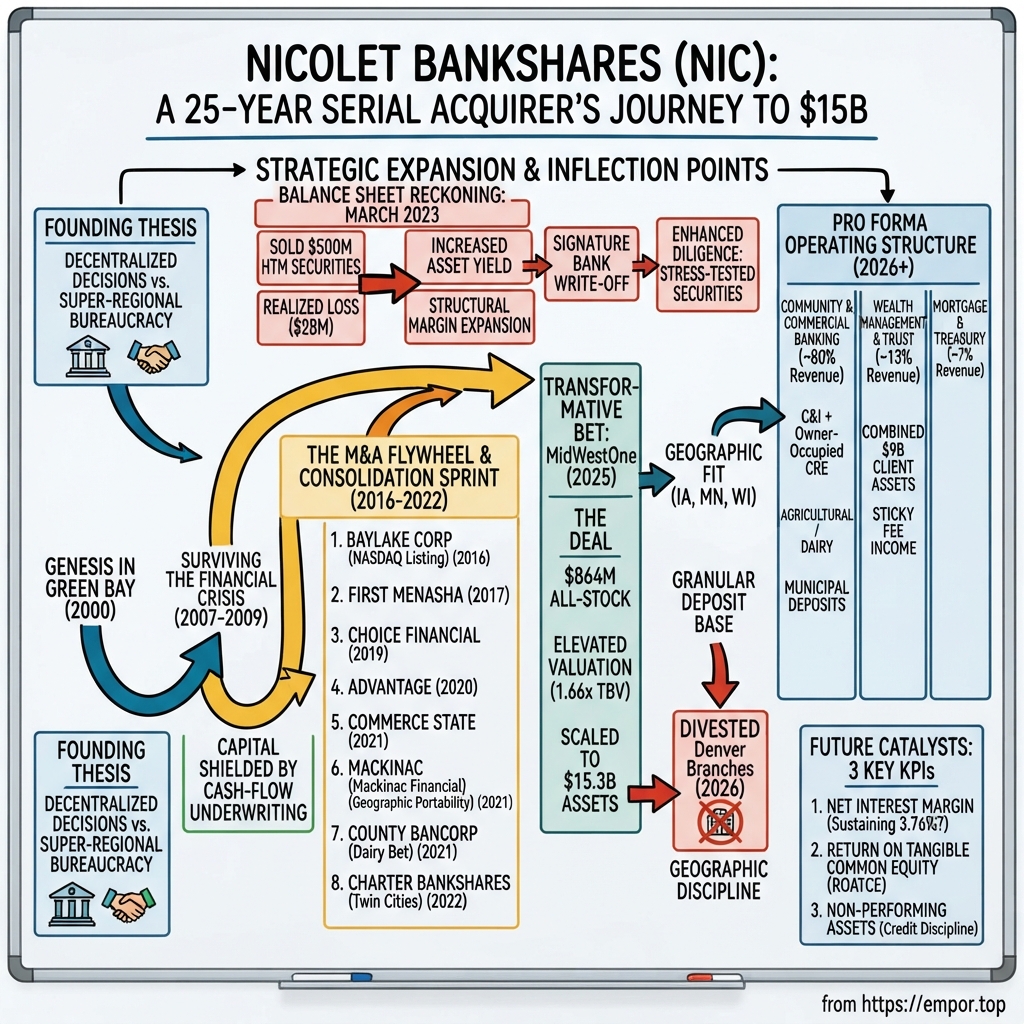
Nicolet Bankshares: The Upper Midwest's Serial Acquirer & Community Banking Juggernaut
I. Introduction & The $15 Billion Consolidation Machine
In the autumn of 2000, out-of-state holding companies were rapidly redrawing the commercial banking map of Wisconsin. Regional institutions such as Firstar were expanding through steady acquisitions, while lenders like Bank One and U.S. Bancorp absorbed long-standing community institutions whose names had anchored local downtowns for generations. Credit decisions that once took place three blocks from a machine shop in Green Bay were increasingly routed to central committees in Minneapolis or Chicago, where credit officers evaluated files transmitted by fax.
Two Green Bay bankers saw a market opportunity in the disruption. Robert "Bob" Atwell and Michael "Mike" Daniels founded Nicolet National Bank in November 2000 with roughly $12 million in seed capital and a straightforward thesis: mid-sized business owners in northeast Wisconsin disliked being treated as commoditized accounts by distant institutions and would reward a local lender—with deposits, customer loyalty, and pricing power—that could deliver definitive credit answers in days rather than months.116
A quarter-century later, the financial results of that regional expansion strategy are on display. Nicolet Bankshares (NYSE: NIC) has completed ten bank acquisitions, evolving from a single-office startup into an institution with roughly $15.3 billion in assets operating across Wisconsin, Iowa, Minnesota, and Michigan's Upper Peninsula.56 In 2025, the bank generated record net income of $151 million, delivering a return on average tangible common equity exceeding 18%—a profitability metric that placed it in the top tier of publicly traded regional banks of comparable scale.7
In October 2025, Nicolet executed its largest transaction to date: an all-stock acquisition of Iowa City-based MidWestOne Financial Group valued at roughly $864 million—a $6 billion asset institution equal to roughly two-thirds of everything Nicolet had acquired across the prior decade combined.6 The deal elevated the company from a local consolidator to a mid-tier regional franchise, roughly doubling its wealth management division to approximately $9 billion in client assets. Underscoring its focus on geographic density over simple asset accumulation, management immediately arranged to divest MidWestOne's out-of-market Denver branches rather than treat them as a distant growth platform.[^11]
The central question for investors is whether that expansion engine can sustain its performance. Evaluating the road ahead requires addressing five core questions. First, why did nationwide banking consolidation leave commercial borrowers underserved, and how did Nicolet's founders monetize that gap? Second, how does an institution acquire nine community banks within a decade without diluting tangible book value? Third, what unfolded inside Nicolet's treasury department during the first week of March 2023, just days before the collapse of Silicon Valley Bank? Fourth, did paying 1.66 times tangible book value for MidWestOne reflect disciplined capital allocation, or did it signal an inflection toward looser pricing? Finally, what constitutes a durable competitive moat in community banking—and whether relationship lending represents a structural advantage or merely a marketing narrative.
A balanced assessment requires weighing both sides of the ledger. Nicolet has established an operating track record that ranks in the industry's top decile. At the same time, the bank has absorbed an acquired bond that was written down to zero, paid a higher valuation multiple for MidWestOne than in its historical transactions, and is now integrating a balance sheet proportionally larger than anything it has previously attempted. All three realities belong in the same conversation.
 Subscribe on LinkedIn
II. Genesis in Green Bay: The Commercial Banking Vacuum
Understanding why Nicolet emerged in northeast Wisconsin requires examining the regulatory shift Congress enacted in 1994.
The Riegle-Neal Interstate Banking and Branching Efficiency Act dismantled the remaining statutory barriers to banking across state lines. For most of the twentieth century, American commercial banking had been geographically partitioned by law; a bank chartered in Wisconsin operated strictly within state borders. Riegle-Neal removed those restrictions, triggering one of the largest consolidation waves in American corporate history. Over the following two decades, the total number of U.S. commercial banks dropped by thousands. Across Wisconsin, institutions that had underwritten local paper mills, dairy processors, tool-and-die shops, and trucking fleets for generations were absorbed, rebranded, and reorganized.
The critical commercial consequence lay in where lending decisions were made. When a super-regional institution acquires a community bank, eliminating local credit committees generates the primary cost synergies. Underwriting authority migrates to a centralized regional hub, reducing the institution's appetite for credits that fail to fit standardized templates: a family-owned fabricator managing uneven working capital, a dairy producer with seasonal cash flow, or a logistics company whose primary collateral consists of rolling stock and a book of commercial contracts. Borrowers generating between $1 million and $20 million in annual revenue were typically too small to warrant dedicated corporate banking teams, yet too complex to score cleanly in automated credit models. As a result, they were frequently managed as commoditized accounts.
Atwell had observed this friction firsthand. As an executive at Citizens Bank and Associated Bank, he had seen larger institutional committees deliberate over commercial credits that an experienced local lender could evaluate in an afternoon. Daniels, focused on banking operations and transaction execution, reached the same conclusion. Their thesis did not assume large institutions were deficient at banking. Rather, super-regionals had made an economically rational decision to step back from borrowers requiring labor-intensive local judgment. That middle-market segment remained profitable, active, and underserved.
Nicolet launched in Green Bay with a deliberately lean operating structure: a minimal branch footprint, senior commercial relationship managers instead of junior lending officers, and decentralized credit authority. While community banks routinely brand themselves as relationship lenders, the operational distinction rests on decision rights: who holds credit approval authority, and how quickly they can deliver a binding commitment.
The crisis that tested the design. The 2007–2009 financial crisis presented the first major stress test for de novo institutions. Many banks chartered in the early 2000s failed because startups often expanded by underwriting riskier credits turned away by established incumbents—frequently speculative construction and out-of-market commercial real estate. Nicolet kept its underwriting tied to the operating cash flows of established businesses in northeast Wisconsin. When real estate collateral values declined across the Midwest, loans underwritten to recurring corporate cash flow continued to perform more reliably than those dependent purely on underlying property valuations.
The analytical distinction is not prescience. Rather, an institution that underwrites a borrower's income statement instead of an appraiser's valuation exhibits a different loss distribution during an asset-price shock. That conservative credit orientation represented a structural operating choice that shielded tangible capital.
The pivot to acquisitions. Surviving the downturn with capital intact created strategic optionality when peers faced capital impairment. In 2013, Nicolet completed its first two transactions—acquiring the troubled Bank of Wausau and Mid-Wisconsin Bank. Through those distressed deals, management developed the playbook that would define its expansion over the next decade. The strategy extended beyond acquiring low-cost deposits; it required evaluating another bank's loan portfolio, applying disciplined fair-value marks, eliminating redundant back-office overhead, and retaining key commercial relationships through system conversions.
That integration discipline became a repeatable operating framework. For an institution with a systematic acquisition process, the primary operational constraint becomes the value and stability of its acquisition currency.
III. The Consolidation Sprint: Building the M&A Flywheel (2016–2022)
Currency arrived in 2016, from Door County.
The Baylake merger and the listing mechanism. Nicolet, then holding roughly $1.2 billion in assets, combined with Baylake Corp, an institution with approximately $1.0 billion in assets rooted in the Door County peninsula, in an all-stock transaction that lifted combined assets past $2.2 billion.16 The strategic rationale followed familiar community banking lines: contiguous markets, similar customer profiles, and clear administrative cost overlaps. The lasting structural consequence was financial. The merger provided Nicolet with a public equity listing on NASDAQ.
The public listing represented a critical operational mechanism rather than merely a corporate milestone. A privately held community bank seeking to acquire a peer is largely confined to paying cash, which depletes the regulatory capital that governs its lending capacity. A publicly listed institution, by contrast, can fund acquisitions with its own equity. When an acquirer's shares trade at a premium to tangible book value and target banks are purchased at lower valuation multiples, issuing shares directly accretes tangible book value per share. The listing did not alter Nicolet's underlying banking operations; it provided a capital currency that allowed the institution to expand through serial acquisitions without repeatedly turning to shareholders for additional cash.
The sprint. Over the subsequent five years, management executed a sequence of targeted transactions across contiguous Midwestern markets:
First Menasha Bancshares (2017) and Choice Financial Holdings (2019) deepened Nicolet's footprint in the Fox River Valley—the industrial corridor extending from Green Bay south through Appleton and Oshkosh, characterized by the commercial manufacturing and paper-converting businesses central to Nicolet's core lending book.
Advantage Community Bancshares (2020) and Commerce State Bank (2020–2021, for approximately $129.6 million) expanded the bank into central Wisconsin and the suburban Milwaukee commercial market. Milwaukee represented a larger, more crowded banking environment where Nicolet competed directly against entrenched super-regional institutions rather than stepping into an underserved void.
Mackinac Financial Corporation (2021, roughly $1.5 billion in assets) represented the first real test of geographic portability.14 Mackinac's mBank franchise spanned Michigan's Upper Peninsula and northern Lower Michigan—markets featuring distinct demographic profiles, differing deposit behaviors, and none of Nicolet's historical brand equity in Brown County. If the operating model was genuinely repeatable beyond the founders' personal networks in Green Bay, it had to demonstrate execution in unfamiliar territory. The closing of that transaction in September 2021 indicated that the integration playbook could travel.
The dairy bet. The most specialized transaction of this period closed in December 2021 with the purchase of County Bancorp, the Manitowoc-based parent of Investors Community Bank with approximately $1.5 billion in assets, for roughly $219 million.13
The primary asset acquired was not a retail branch network, but an agricultural underwriting specialization. Investors Community Bank operated one of the most concentrated agricultural loan portfolios in the Upper Midwest, focused heavily on Wisconsin's dairy sector—including dairy producers, milk processors, and feed and equipment suppliers. The portfolio was supported by USDA and Farm Service Agency loan guarantees and administered by a veteran agricultural lending division.
Agricultural dairy lending involves distinct underwriting dynamics. A dairy producer's operating margin functions as a spread: milk prices dictate top-line revenue, feed costs govern the primary expense, and both fluctuate independently and sharply. Sound underwriting requires understanding milk hedging programs, herd feed-conversion ratios, federal guarantee structures, and secondary liquidation values for agricultural acreage. That expertise reflects specialized institutional judgment that cannot be quickly replicated through standard retail credit scoring.
The acquisition also introduced visible credit stress. Nicolet absorbed the portfolio after an extended downcycle during which milk prices had dropped below production costs for many Midwestern operators. Consequently, Investors Community Bank held elevated non-performing assets of roughly $58 million in early 2021. Rather than purchasing a franchise insulated from commodity cycles, Nicolet acquired specialized expertise alongside an underperforming loan book it believed it could successfully work out. The transaction represented a calculated workout trade backed by federal guarantees, carrying distinct credit risks alongside the specialty assets.
Into the Twin Cities. In August 2022, Nicolet completed the acquisition of Charter Bankshares, an institution with roughly $1.1 billion in assets operating in Eau Claire, Wisconsin, and the Minneapolis–St. Paul metro area.15 While western Wisconsin represented familiar territory, the Twin Cities introduced a competitive metropolitan banking environment dominated by national and super-regional lenders. Charter provided a regional beachhead rather than an immediate competitive advantage.
The Big Board. On May 12, 2022, Nicolet transferred its common stock listing from NASDAQ to the New York Stock Exchange under the ticker NIC.12 While an exchange listing does not alter an institution's underlying earnings power, it broadens institutional index eligibility, expands trading liquidity, and enhances the perceived credibility of the equity currency when offered to target boards in stock-for-stock transactions.
Evaluating the acquisition template. Throughout this expansion phase, Nicolet adhered to a consistent financial structure. Purchase prices generally ranged from 1.30 to 1.55 times tangible book value, structured primarily with stock so selling shareholders retained equity risk in the combined bank. Transactions included conservative fair-value credit marks at closing, targeted non-interest expense reductions between 25% and 35% within twelve months, and an earnback period on tangible book value dilution of less than three and a half years.
The earnback period served as the primary capital discipline metric. When an acquirer pays a premium over tangible book value, the excess purchase price creates goodwill, diluting tangible book value per share at closing. The acquiring bank must subsequently recover that capital dilution through the combined institution's incremental earnings. A three-year earnback horizon enables an acquirer to restore tangible capital before a typical credit cycle turns. Conversely, extended earnback periods stretching past six or seven years assume sustained macroeconomic stability—a structure through which numerous regional banks have historically eroded economic capital despite reporting immediate accounting earnings accretion.
The 2016–2022 expansion demonstrated that Nicolet had developed a disciplined integration capability across small-bank acquisitions in the Upper Midwest while paying prices that preserved a margin of safety. What that track record had not yet demonstrated was how the integration framework would perform on a materially larger transaction. Before that question emerged, however, the bank's balance sheet faced an industry-wide liquidity shock.
IV. The Balance Sheet Reckoning: March 2023 & The Post-Crisis Surge
Managing asset-liability duration becomes acutely challenging when the Federal Reserve tightens monetary policy faster than bank balance sheets can reprice.
Between early 2022 and early 2023, the federal funds rate surged from near zero to more than 5%—the sharpest tightening campaign in four decades. Across the banking sector, institutions had absorbed an unprecedented influx of deposits during the pandemic. Facing limited loan demand, many banks directed those funds into long-duration government and agency bonds at prevailing low yields. As interest rates climbed, bond valuations dropped sharply. A bank holding a ten-year Treasury purchased at a 1.5% yield while newly issued notes yielded 4% held an asset whose market value sat well below par.
Standard banking accounting conventions offered an avenue to defer that recognition through the held-to-maturity (HTM) designation. Under GAAP, if an institution formally documents its intent to hold a debt security to maturity, it is not required to mark that asset to market on its balance sheet. The paper loss is disclosed in financial statement footnotes rather than reflected in reported regulatory equity.
Yet the accounting treatment does not eliminate the underlying economic constraint. Securities classified as held-to-maturity are functionally illiquid; reclassifying or selling a material portion can compromise the accounting designation for the entire portfolio. Consequently, an institution cannot readily liquidate those positions to redeploy proceeds into higher-yielding commercial credits. Balance sheet turnover stalls precisely when opportunity costs peak.
The first week of March 2023. On March 7, 2023, Nicolet's management—led by Daniels alongside Chief Financial Officer H. Phillip Moore, Jr.—acted to address that drag directly. The bank sold $500 million in par value of U.S. Treasury securities from its held-to-maturity portfolio, recognizing an immediate after-tax loss of approximately $28 million.910
Three days later, Silicon Valley Bank collapsed into FDIC receivership. Within days, regional bank valuations across the sector plummeted under intense scrutiny over underwater securities portfolios funded by potentially flight-prone deposits.
The transaction did not imply that management anticipated the specific failure of Silicon Valley Bank; public disclosures provide no basis for that inference. Instead, the move reflected an operational trade-off. In its subsequent earnings call, management framed the rationale in economic terms: the held-to-maturity designation functioned as accounting relief rather than economic protection, and maintaining it restricted portfolio velocity.10 By absorbing the realized loss upfront, Nicolet freed liquidity to reinvest in floating-rate loans and short-duration assets yielding above 5%, permanently elevating its earning-asset run rate.
The strategic choice was explicit: accept an immediate, quantified charge against reported capital to establish a structurally higher margin profile. While many peer institutions deferred action to protect quarterly reported earnings, Nicolet prioritized economic velocity over headline accounting stability—a distinction borne out by its subsequent net interest margin trajectory.
The diligence gap: the bond that went to zero. That decisive repositioning was accompanied, however, by a tangible credit misstep.
During the same quarter, Nicolet recognized a complete write-off on a subordinated debt note issued by Signature Bank—an asset acquired through a prior bank purchase rather than underwritten directly. When Signature Bank failed on March 12, 2023, its subordinated debt was wiped out. Combined with the securities restructuring charge, the write-off contributed to a GAAP net loss of approximately $9 million for the quarter.10
The incident provides a concrete test of Nicolet's acquisition diligence. While the bank had established a reliable record of applying conservative credit marks to acquired commercial loan portfolios, the Signature note demonstrated that pre-merger diligence had focused primarily on core credit books while scrutinizing target investment portfolios and counterparty risks far less rigorously.
Management responded not with rhetorical defense, but with an operational adjustment: subsequent M&A reviews introduced stricter discount stress-testing across acquired securities portfolios alongside customary loan evaluations. The episode narrowed the thesis on Nicolet's M&A capability. The institution had demonstrated seasoned competence in pricing acquired commercial loans, but it had also exhibited an institutional blind spot in evaluating non-loan assets. The practical metric for whether that diligence enhancement took hold is the adequacy of the marks applied to MidWestOne's balance sheet, and whether any subsequent revisions surface in 2026 filings.
The earnings aftermath. Over the ensuing two years, the repositioning translated directly into financial performance.
Net interest margin expanded from 3.18% in 2023 to 3.47% in 2024, before reaching 3.76% for the full year 2025.78 That 58-basis-point expansion across a multi-billion-dollar balance sheet generated substantial pre-tax net interest income with negligible incremental overhead.
Earnings expanded in lockstep: net income rose from approximately $62 million and diluted EPS of $4.08 in 2023—a baseline depressed by both the securities loss and the Signature write-down—to $124 million and $8.05 in 2024, reaching a record $151 million and $9.78 per share in 2025.78 Return on average tangible common equity climbed to 18.53% in 2025.7
Two analytical caveats frame that performance. First, a meaningful portion of the margin expansion was cyclical. As an asset-sensitive institution, Nicolet benefited broadly from rising interest rates, meaning the repositioning amplified an existing industry tailwind rather than generating yield in isolation. The structural durability of that margin faces its primary test during easing cycles, when floating-rate assets reprice downward while funding costs lag. Second, return on average tangible common equity is inherently flattered by acquisition accounting, as goodwill generated across serial transactions is excluded from the tangible equity denominator. While standard practice, that convention means reported ROATCE modestly overstates comparative capital efficiency relative to institutions that scaled through organic branch expansion.
Nevertheless, supported by record profitability and a share price trading at a solid premium to tangible book value, Nicolet commanded the essential ingredients for large-scale consolidation. The test lay in how aggressively it would deploy them.
V. The Transformative Bet: MidWestOne & Scaling to $15 Billion
On October 23, 2025, Nicolet announced the deal that changed its category.
MidWestOne Financial Group, headquartered in Iowa City, agreed to merge into Nicolet in an all-stock transaction valued at approximately $864 million — $41.37 per MidWestOne share, at a fixed exchange ratio of 0.3175 Nicolet shares for each MidWestOne share.6[^17]
The fixed exchange ratio deserves a note, because it is a genuine risk allocation, not a technicality. In a fixed-ratio deal, the headline price moves with the acquirer's stock between announcement and close. The seller is not being handed a guaranteed dollar value; they are accepting ownership in the combined company and the market risk that comes with it. It is the structure an acquirer uses when it does not want to write a check that grows if its own stock falls — and the structure a seller accepts when they believe in the combined entity. Both readings are available, and both were arguably true here.
What $864 million bought. MidWestOne brought approximately $6.0 billion in assets, $5.1 billion in deposits, and $4.3 billion in loans, spread across eastern and central Iowa, the Twin Cities metro, and western Wisconsin.6 The pro forma company became a roughly $15.3 billion asset institution with about $13.1 billion in deposits and $11.3 billion in loans.6
The geographic fit is the strongest part of the case. Iowa is contiguous to Nicolet's existing footprint and economically legible to it — the same agricultural and small-manufacturing economy Nicolet has banked for a quarter century, with the specialized underwriting capability already resident from the County Bancorp acquisition. The Twin Cities overlap deepened a beachhead Nicolet had established but not scaled. Western Wisconsin was simply home turf.
The deposit franchise is the second pillar. MidWestOne's funding base was granular and concentrated in Iowa college towns and stable agricultural communities — the kind of deposits that historically carry low beta, meaning their cost rises slowly when market rates rise. In a world where the scarce resource in banking is cheap, sticky funding rather than loan demand, that is the asset actually being purchased. The loans are the visible half of a bank; the deposits are the half that determines whether you make money on them.
The price question. Nicolet paid approximately 166% of tangible book value — 1.66x — and roughly 11.5x estimated 2026 earnings.6 Against median Midwest bank M&A comparables in the 2024–2025 window, generally in the 1.30x to 1.45x range, and against Nicolet's own historical band of 1.30x to 1.55x, this was a premium. There is no way to characterize it otherwise, and it should not be waved away with strategic language.
Management's justification rested on two pillars: the quality and rate-insensitivity of the deposit base, and a targeted non-interest expense reduction of roughly 35% of MidWestOne's cost structure — above the 25–35% range typical of prior deals, reflecting the larger absolute overhead pool available in a $6 billion institution. Management projected double-digit EPS accretion with tangible book value dilution earned back in approximately 3.2 years.6
Those projections are assumptions, not results, and the distinction matters more here than in any prior Nicolet deal. A 35% expense reduction on an institution of MidWestOne's size is not achieved by consolidating a few back-office functions; it requires meaningful branch rationalization and headcount reduction in communities where the departing employees are also customers and referral sources. A 3.2-year earnback assumes those saves land roughly on schedule and that the acquired credit book performs to the marks taken at close. If either slips, the earnback extends into territory where the next credit cycle arrives before the dilution is recovered.
The skeptical framing is worth stating plainly: paying a record multiple for the largest target you have ever bought, at a point when your own earnings and stock are at all-time highs, is the textbook setup for acquirer regret. It is also, mechanically, when acquisition currency is cheapest — and Nicolet used stock, not cash or debt, which means the balance sheet was not levered to fund it. The structure mitigates the risk; it does not eliminate the price.
The tell: selling Denver. MidWestOne carried legacy branches in Denver, Colorado — an artifact of a prior expansion, a thousand miles from any Nicolet customer, in a market where the company had no density, no underwriting familiarity, and no plausible path to relevance.
Nicolet arranged to sell them. The Denver branches went to Sunwest Bank, with the transaction completed in July 2026.[^11]
This is the most informative single decision in the entire MidWestOne episode, and it is informative precisely because of how ordinary the alternative would have been. The standard behavior for a bank that has just crossed $15 billion in assets is to describe its accidental Colorado footprint as a "growth market" and staff it up. Empire-building in banking almost never looks like a bad acquisition; it looks like a defensible acquisition followed by a refusal to prune. Nicolet pruned within months.
That is evidence of geographic discipline. It is one data point, from one situation where the logic was unusually clear-cut, and it should be weighted accordingly rather than elevated into a philosophy. The harder test is what happens with a marginal market that is neither obviously core nor obviously absurd.
Closing and conversion. The merger closed on February 13, 2026.5 Core systems and brand conversion were scheduled for August 2026 — the six-month gap being standard practice, since converting a $6 billion bank's core processing platform is the operational event where acquisitions actually succeed or fail. Customers do not leave because of a merger announcement; they leave when their account numbers change, their online banking breaks for a weekend, and their relationship manager cannot answer the phone. Four legacy MidWestOne directors joined an expanded twelve-member Nicolet board.5
As of this writing in September 2026, the conversion has occurred but the full-year results that would validate or falsify the cost-save and credit assumptions have not yet been reported. That is the honest state of the evidence: the strategic logic is coherent, the price was above precedent, and the execution proof is still pending.
VI. Under the Hood: Segments, Economics, & The Hidden Wealth Engine
Stripping away the acquisition narrative reveals an operating structure divided into three distinct components:
[Pro Forma Nicolet Bankshares Revenue / Profit Drivers]
├── Community & Commercial Banking (~78-82% of Net Revenue)
│   ├── Commercial & Industrial (C&I) / Owner-Occupied CRE (Core Growth Engine)
│   ├── Agricultural & Dairy Lending (Specialized Niche: Manitowoc / Central WI / Iowa)
│   └── Core Retail & Municipal Deposits (Low-Cost Funding Base)
├── Wealth Management & Trust Services (~12-15% of Net Revenue, High ROTCE)
│   ├── Pre-merger Nicolet Wealth: $4.29B discretionary AUM + $1.6B non-discretionary
│   ├── MidWestOne Trust & Wealth: ~$3.4B AUM/AUA added
│   └── Combined Platform: ~$9B in Client Assets Generating Sticky Fee Income
└── Secondary Market Mortgage & Treasury Fees (~5-8% of Net Revenue, Cyclical)
The core engine. Roughly four-fifths of net revenue originates in the spread business—lending funds at rates higher than the underlying cost of capital. Within that base, the primary expansion driver is commercial and industrial lending alongside owner-occupied commercial real estate. Owner-occupied properties differ fundamentally from the speculative commercial real estate that periodically impairs bank balance sheets: because the borrower occupies the facility, debt service is supported by operating cash flows rather than third-party tenant rent rolls. During property market downturns, the two loan categories display distinct credit loss profiles.
A key structural feature governs that loan book: Nicolet's commercial credits predominantly float against benchmark rates such as SOFR or the prime rate, or reprice within a three- to five-year window. In practice, the asset side of the balance sheet adjusts to interest rate shifts relatively rapidly. That sensitivity made the March 2023 balance sheet restructuring advantageous: redeploying low-yielding bond proceeds into floating-rate credits allowed the bank to capture higher prevailing interest rates rather than remaining burdened by legacy fixed yields.
Yet that structure also creates symmetrical downside. When the Federal Reserve eases monetary policy, floating-rate loans reprice downward immediately, whereas deposit costs decline only as quickly as competitive pressures allow. Asset sensitivity represents a deliberate balance sheet positioning choice rather than a permanent competitive advantage, carrying revenue headwinds during rate-cutting cycles just as it generated margin expansion during monetary tightening.
The efficiency story. Nicolet has consistently maintained an efficiency ratio below 52%—measuring non-interest expenses as a proportion of total revenue—compared to regional peer medians that generally range from the upper 50s to low 60s. An operating advantage of roughly ten percentage points creates a meaningful performance differential that compounds across quarters.
That efficiency profile stems from three operational factors with varying degrees of permanence. First, a branch-light commercial distribution network keeps facility overhead low: commercial lending is driven by senior relationship managers visiting corporate clients on-site rather than staffing traditional retail branch lobbies. Second, lean executive overhead and disciplined headcount control operating costs, though preserving that restraint requires ongoing managerial discipline. Third, acquisition cost synergies deliver discrete reductions in the combined expense base as redundant back-office systems are eliminated. Synergies represent an operational flow rather than a permanent stock: each transaction produces a one-time cost reduction, meaning an active consolidator's efficiency ratio benefits from transaction momentum and can plateau if deal activity slows.
The wealth franchise. The most underappreciated component of the business model sits in the middle of the corporate structure.
Prior to the merger, Nicolet Wealth Management oversaw approximately $4.29 billion in discretionary assets under management alongside roughly $1.6 billion in non-discretionary assets.3 MidWestOne's trust and wealth management operations contributed an additional $3.4 billion, lifting the combined platform to roughly $9 billion in client assets.6
The strategic significance of that fee base centers on capital efficiency and equity valuation. Net interest income requires regulatory capital reserves, carries direct credit risk, and remains vulnerable to yield-curve shifts. Trust and wealth management fee income, by contrast, consumes minimal regulatory capital, bears no credit exposure, and generates recurring revenue. Consequently, banks deriving 90% or more of revenue strictly from spread lending frequently trade at valuation discounts relative to institutions with substantial fee-generating operations.
Nicolet's wealth management division generates more than $30 million in annual non-interest fee revenue on that capital-light foundation. The MidWestOne merger created a clear cross-selling target: MidWestOne's footprint includes Iowa commercial owners and agricultural operators with concentrated illiquid assets, succession planning requirements, and trust needs who were previously serviced by a smaller institutional platform.
Converting that opportunity, however, remains an operational challenge rather than an established result. Cross-selling initiatives in regional banking frequently encounter internal friction, as commercial lenders are often reluctant to introduce third parties to their primary client relationships. The practical benchmark for execution will be whether wealth management fee revenue expands faster than the baseline contribution inherited from MidWestOne over subsequent reporting periods. If fee growth merely reflects the acquired asset total, the cross-selling thesis remains unproven.
The cyclical tail. The remaining revenue stream—secondary market mortgage banking and treasury management services—represents the smallest and most volatile component. Mortgage banking gain-on-sale fees swing sharply with residential refinancing volumes and have remained structurally subdued across the industry since the 2022 interest rate increases. Rather than driving the core valuation, mortgage origination functions as peripheral fee income around the commercial lending franchise.
The operating franchise resolves into a high-efficiency commercial spread lender with a specialized agricultural underwriting division and an expanding wealth management fee business. Evaluating its long-term trajectory requires examining the executive leadership directing that capital, and the compensation incentives governing their decisions.
VII. Management, Governance, & Incentives: The Daniels Era
Executive transitions derail promising companies as frequently as recessions do, and commercial banking is especially vulnerable: an institution built on decentralized relationship lending and localized judgment carries inherent succession risk.
Nicolet managed that transition over three years rather than executing an abrupt handoff. Co-founder Bob Atwell stepped down as chief executive in April 2021, remained executive chairman, and in 2024 transitioned to a non-executive director seat.4 Mike Daniels—co-founder, longtime president, and the operational architect behind the bank's ten acquisitions—assumed the chairman, president, and chief executive roles.
While the extended handoff provided operational stability, it produced a notable governance structure: Daniels holds the chairman and CEO roles simultaneously, while the founder's shift to non-executive status removed an internal counterweight. Combined chair and CEO structures are common across American regional banking, yet they concentrate executive authority at an institution pursuing an aggressive acquisition strategy—the domain where independent board oversight is most critical. Investors evaluating the governance model must scrutinize the proxy statement's board independence provisions and lead director authorities rather than relying on the co-founder's continued presence on the board roster.4
The bench. Executive Vice President and Chief Financial Officer H. Phillip Moore, Jr. serves as the balance-sheet architect, having managed the March 2023 securities repositioning and structured the consideration for MidWestOne.4 In an institution whose most consequential recent financial decisions have centered on liability management and portfolio duration rather than baseline loan expansion, that seat carries substantial strategic weight.
Brad Hutjens, Executive Vice President and Chief Credit Officer, occupies what is arguably the most critical operational post at a serial consolidator. Every transaction introduces an acquired loan book underwritten to external credit standards, leaving the chief credit officer to determine fair-value marks and oversee portfolio integration. Hutjens directed credit administration through the pandemic disruptions and the 2022–2024 dairy pricing downturn—the commodity stress that had driven elevated non-performing assets at Investors Community Bank prior to Nicolet's acquisition.
Eric Witczak, Executive Vice President and Chief Operating Officer, oversees frontline commercial, agricultural, and retail banking operations.4
Skin in the game. Daniels holds over 140,000 common shares directly and indirectly, alongside substantial unvested performance-linked equity.4 In September 2025—one month prior to the MidWestOne announcement—the board secured his tenure through December 31, 2030, granting 30,000 restricted shares and 60,000 performance-based restricted stock units tied to multi-year return on average tangible common equity targets and tangible book value per share compounding.11
The corporate sequencing is revealing: a board rarely extends a chief executive's contract through 2030 and awards substantial multi-year performance equity without preparing for an integration that will require years to validate. The retention package and the acquisition represent two angles of the same capital allocation decision.
Do the incentives point the right way? The governance framework derives its primary analytical strength from how executive performance is evaluated. Nicolet's executive incentive compensation weights return on average assets, return on average tangible common equity, and credit quality benchmarks—not asset growth.
That distinction represents a critical governance factor in bank investing. A significant share of the shareholder value destroyed in regional banking over recent decades originated with management teams compensated, directly or indirectly, on balance-sheet size. When incentives reward asset growth, executives face a structural incentive to overpay for acquisitions to expand the institution. Conversely, when compensation is tied to return on tangible equity and credit discipline, leadership is penalized for transactions that dilute returns.
The MidWestOne transaction serves as the live test of whether that alignment holds under pressure. At 1.66 times tangible book value, Nicolet paid above its historical acquisition multiples. Under an executive compensation plan linked to ROATCE and tangible book value compounding, leadership directly absorbs the financial consequences: if cost reductions fall short of targets or credit marks require upward revision, the return metrics that determine executive equity vesting decline. The incentive framework does not prevent overpaying; it ensures that overpaying directly penalizes the decision-makers.
That alignment leads directly to the core strategic question: not whether management's incentives are structured for capital discipline, but whether the institution's underlying competitive advantage is durable.
VIII. Strategic Moats & The Historical Falsification Layer
A durable competitive moat in community banking often sounds contradictory. Deposits are legally standardized, loans are largely commoditized, thousands of competing institutions crowd the field, and national money-center banks enjoy substantially lower wholesale funding costs alongside multi-billion-dollar technology budgets.
Evaluating what protects Nicolet's profitability requires looking past corporate marketing to identify three distinct operational mechanisms—and testing each against historical execution.
Switching costs, correctly specified. The stickiest component of a commercial bank's balance sheet is not a retail checking or savings account, which a depositor can move in minutes online. Rather, it is an operating commercial treasury relationship. When a mid-sized manufacturer generating $30 million in revenue integrates automated clearing house payroll files, routes receivables through a bank lockbox, and operates under an asset-based revolving line of credit with custom borrowing-base covenants, migrating to a competing institution becomes a multi-month operational transition. The process requires coordination across executive leadership, external payroll providers, and corporate vendors instructed to update payment instructions.
That friction is administrative and operational rather than emotional. Consequently, it endures even when a rival institution offers marginally higher deposit yields. Yet that advantage protects an established portfolio far more effectively than it wins new accounts. It also leaves an institution vulnerable if service breaks down—such as during an executive departure, a credit covenant dispute, or a disruptive core systems conversion. That operational exposure explains why the August 2026 integration of MidWestOne's core IT platform represented a critical milestone for deposit retention.
Process power in agriculture. Specialized dairy and agricultural underwriting represents the closest operational asset Nicolet possesses to an entry barrier that cannot be quickly replicated. Evaluating farm operating cash flow against fluctuating milk futures, feed input spreads, and Farm Service Agency guarantee structures requires underwriting judgment developed over decades. A regional or national institution cannot readily establish an agricultural lending division in eastern Wisconsin simply by deploying capital; the requisite underwriting experience and borrower relationships take years to cultivate.
However, specialized underwriting functions as an economic moat only if it reliably delivers superior through-the-cycle risk-adjusted returns—an assumption challenged by prior credit cycles.
Counter-positioning. Against large regional competitors such as Associated Banc-Corp, BMO, and U.S. Bank, Nicolet's primary operational advantage centers on decision velocity. Commercial loan requests under roughly $10 million are typically resolved by local market executives within 48 to 72 hours, bypassing centralized multi-tiered credit committees. In corporate strategy terms, this represents counter-positioning: large incumbents could theoretically delegate credit authority to match that turnaround time, but doing so would compromise the centralized risk controls that generate their scale efficiencies.
That speed advantage, however, applies primarily when competing against larger institutions. When facing well-capitalized community banks across the Upper Midwest offering comparable local access, Nicolet's competitive position depends on balance-sheet capacity, treasury technology, and relationship execution rather than a structural organizational edge.
Evaluating whether these mechanisms constitute durable competitive advantages requires testing three central investment claims against historical disconfirming evidence.
Thesis Claim 1: "Nicolet is a disciplined serial acquirer whose M&A integration playbook represents a durable competitive edge."
The disconfirming evidence: In the first quarter of 2023, Nicolet recognized a total loss on an acquired Signature Bank subordinated debt note, which contributed to a $9 million quarterly GAAP net loss.10 More recently, the bank paid 1.66 times tangible book value for MidWestOne—a valuation multiple that exceeded both prevailing Midwestern bank M&A transaction medians and Nicolet's historical acquisition pricing band.6
The analytical test: These two events reflect distinct risks. The Signature write-off was modest in size, occurred once, and prompted an immediate operational review that introduced tighter discount stress-testing across acquired securities portfolios. The incident demonstrated that prior diligence had scrutinized acquired loan portfolios far more rigorously than non-loan balance-sheet assets, but it did not invalidate the core credit integration model.
By contrast, paying a record valuation multiple for MidWestOne—an institution representing approximately 40% of the pro forma entity—is far more consequential. While transaction multiples remain within management's direct control, Nicolet executed its largest acquisition at a premium valuation while its own equity traded at historical highs.
The calibrated conclusion: The historical evidence supports Nicolet's acquisition execution, but primarily across community banks with assets below $1.5 billion in contiguous Upper Midwest markets purchased at 1.30 to 1.55 times tangible book value. MidWestOne sits outside those parameters in both asset scale and transaction pricing. Falsification tests over the near term will center on whether the targeted 35% non-interest expense reduction reaches its full run-rate by the fourth quarter of 2026, and whether credit marks on MidWestOne's acquired loans hold without material negative revisions through 2027.
Thesis Claim 2: "Granular relationship deposits provide a permanent low-cost funding moat."
The disconfirming evidence: Balance-sheet repricing during the 2022–2024 Federal Reserve tightening cycle tested that premise directly. Nicolet's interest-bearing deposit costs climbed from approximately 0.40% to more than 2.60%, requiring the bank to compete actively for municipal deposits and offer certificate-of-deposit specials to retain liquidity.3 Furthermore, uninsured deposits stood at approximately $2.3 billion in mid-2025—roughly 31% of total deposits—representing a meaningful volume of balances exceeding statutory FDIC coverage limits.
The analytical test: Nicolet experienced no liquidity runs during the March 2023 regional banking turmoil. Its uninsured deposit ratio remains consistent with commercial peer averages and reflects an operating customer base composed of commercial businesses running payroll accounts. Nevertheless, pricing disclosures revealed that when market interest rates rose, the bank was forced to raise deposit yields to prevent customer outflows. The deposit base demonstrated relationship stickiness, but it did not remain insulated from rising funding costs.
The calibrated conclusion: Nicolet's deposit franchise functions as a customer retention moat rather than a structural pricing shield. Customer stickiness protects against liquidity flight during market stress, but it does not prevent net interest margin compression when commercial depositors demand yields aligned with short-term interest rates. In an extended higher-rate environment, preserving customer balances exerts steady upward pressure on deposit betas.
Thesis Claim 3: "Agricultural lending delivers high-margin balance-sheet diversification without elevated credit losses."
The disconfirming evidence: The historical performance of the acquired County Bancorp portfolio provides a direct test. Prior to its acquisition by Nicolet, Investors Community Bank reported non-performing assets of roughly $58 million in early 2021, driven by prolonged milk price declines that pushed farm revenues below cash production costs across the Upper Midwest.
The analytical test: Several credit mitigants softened the impact: USDA and Farm Service Agency guarantees absorbed a portion of credit exposure, conservative loan-to-value limits on agricultural acreage provided stable collateral support, and the problem assets were resolved over time. Even so, the portfolio was exposed directly to commodity market cycles.
The calibrated conclusion: Agricultural lending does not eliminate credit losses; rather, it provides asset diversification accompanied by cyclical credit stress that has historically been mitigated by federal guarantees and underlying real estate collateral. Agricultural exposure represents an underwriting niche that must be managed through commodity downturns, rather than an insulated credit moat. The forward metric remains the agricultural portfolio's non-performing asset ratio during the next extended dairy downcycle, particularly if driven by reductions in export demand that affect larger, leveraged farm operators.
The scale paradox. Integrating an institution with $6 billion in assets into a $9 billion organization represents a fundamentally different operational task than absorbing a $500 million single-market community bank.
In smaller historical transactions, Nicolet's corporate systems and operational standards served as the dominant framework, allowing acquired offices to assimilate quickly. MidWestOne, however, contributed roughly two-fifths of the combined enterprise. Its institutional culture, operational conventions, and regional commercial relationships cannot be reorganized overnight. Operating across Wisconsin, Iowa, Minnesota, and Michigan with an expanded twelve-member board inevitably stretches executive management beyond the localized oversight that defined the bank's founding era.
The original thesis established in Green Bay in 2000—that decentralized credit authority and executive accessibility serve as a decisive weapon against distant banking bureaucracies—faces greater operational complexity as the company itself attains regional scale. At more than $15 billion in total assets, Nicolet must navigate elevated regulatory scrutiny, compliance mandates, and organizational layers. Whether an institution founded to counter regional bank bureaucracy can preserve that localized responsiveness as its own balance sheet expands represents the central question for the coming years.
IX. Bull vs. Bear Case & The 3 Critical KPIs
The bull case
Operating leverage from the conversion. With MidWestOne's core IT systems consolidated following the August 2026 cutover, targeted cost reductions transition from underwriting projections to an operating run-rate. In a spread-lending business, realized cost savings drop almost entirely to pre-tax net income. If expense cuts reach management's 35% target, earnings per share would advance past the 2025 record while return on average tangible common equity could sustain in the high teens—a profitability tier that, maintained across a complete credit cycle, compounds tangible book value per share at a pace few regional peers match.
The wealth multiplier. The combined $9 billion client asset platform provides direct access to an expanded customer base of Iowa and Minnesota commercial owners and agricultural families managing succession planning and trust requirements. Expanding wealth management fee revenue without consuming regulatory capital represents the most accretive growth available to a commercial bank, supporting both return on tangible capital and the valuation multiple assigned to the equity.
Franchise positioning. Nicolet occupies an advantageous middle tier: sufficiently capitalized to hold a $50 million commercial credit line and provide sophisticated treasury management services, yet localized enough that middle-market borrowers maintain direct access to senior decision-makers. Super-regional competitors often struggle to deliver localized responsiveness, while smaller community banks lack the legal lending limits to fund larger middle-market credits.
The bear case
Integration indigestion. Although the core systems cutover occurred in August 2026, the subsequent operating window represents the period of highest customer vulnerability. Disruptive conversions historically trigger two negative outcomes: productive commercial relationship managers depart, taking customer portfolios with them, and dissatisfied depositors migrate balances elsewhere. In addition, cultural friction between a fast-moving Green Bay commercial acquirer and an Iowa City institution with a century-old independent identity represents a persistent integration friction.
Midwest economic synchronization. Nicolet's balance-sheet diversification remains geographic within a single economic corridor rather than dispersed across multiple regions. A commercial real estate refinancing wall coinciding with a cyclical downturn in dairy and agricultural commodity prices would stress the loan portfolio from two fronts simultaneously—a macro shock the institution has never managed at a $15 billion asset scale.
The margin squeeze. The structural downside of a floating-rate loan portfolio. If the Federal Reserve reduces benchmark interest rates, variable-rate commercial loans reprice downward immediately, while funding costs may remain sticky if local competitors resist lowering deposit rates. Under that dynamic, net interest margin compresses rapidly. Because Nicolet's post-2023 margin expansion was substantially amplified by rising rates, monetary easing runs the same asset-liability mechanism in reverse.
Through Porter's lens. Rivalry is structurally elevated—commercial banking offers standardized financial products across thousands of competing institutions, and credit pricing discipline regularly erodes near cyclical peaks. Supplier power translates directly into depositor pricing power; the 2022–2024 monetary tightening demonstrated that commercial depositors demand market yields when rates climb. Buyer power—exercised by commercial borrowers—is moderated by the operational switching costs embedded in operating treasury and cash-management accounts. Threat of substitutes represents a persistent competitive headwind: private credit funds and non-bank commercial lenders have captured meaningful market share in middle-market sponsor and commercial financing, operating without regulatory capital requirements or FDIC assessment costs. Barriers to entry are high from a regulatory chartering perspective, but low operationally, as established regional competitors can open commercial loan production offices across Wisconsin, Iowa, and Minnesota with minimal capital investment.
Through Helmer's. The strategic powers demonstrably present are switching costs (confined to established commercial operating accounts), process power (demonstrated in agricultural and dairy underwriting, though specialized in scope), and counter-positioning (effective against bureaucratic super-regionals, but providing minimal advantage against nimble community peers). The powers visibly absent are scale economies—at $15 billion in assets, Nicolet remains a fraction of the size of super-regional incumbents and cannot compete purely on technology development budgets or wholesale funding costs—alongside network economies, which are virtually nonexistent in commercial lending, and cornered resources, as specialized agricultural lending teams represent portable talent rather than proprietary institutional assets. The structural moat is real but bounded. Superior financial returns depend heavily on operating execution and disciplined capital allocation—variables that rely on managerial discretion rather than permanent structural barriers.
The three KPIs that matter
Net interest margin, alongside cost of total deposits. The core operational test is whether the 3.76% margin achieved in 2025 endures through balance-sheet integration and potential Federal Reserve easing cycles, or whether it reverts toward regional peer averages. Net interest margin and deposit costs must be evaluated jointly; margin alone cannot isolate whether performance stems from asset yields or disciplined liability pricing.
Return on average tangible common equity. The single cleanest quantitative gauge of capital allocation efficiency for a serial acquirer, as it measures returns against tangible equity after accounting for acquisition consideration and balance-sheet expansion. A sustained compression in ROATCE following the MidWestOne transaction would indicate that the 1.66 times tangible book valuation multiple paid at closing diluted underlying corporate earning power.
Non-performing assets to total assets, together with the net charge-off ratio. The primary indicator of underwriting discipline across the acquired agricultural, dairy, and commercial real estate portfolios. Credit distress represents the swiftest failure mode in regional banking, and at an active acquirer, credit deterioration typically emerges as upward revisions to acquired-loan marks before appearing as charge-offs in newly originated credits.
X. Epilogue & Playbook Lessons
The strategic takeaways from Nicolet's trajectory extend beyond commercial banking.
Consolidation always strands someone. Every wave of industry consolidation produces an underserved customer segment—borrowers and depositors deemed too small to justify an acquirer's centralized cost structure or too idiosyncratic for automated scoring models. Super-regional institutions do not step back from these accounts out of operational failure; they do so because servicing them requires an expense structure that centralized scale deliberately removes. That structural gap creates commercial opportunity across consolidating industries. Capturing it, however, requires embracing the labor-intensive judgment that larger incumbents reject—a dynamic where specialized, localized operators can establish an enduring foothold.
Take the loss while you can choose when. The March 2023 decision to realize an after-tax loss of approximately $28 million on underwater Treasury securities required accepting an immediate quarterly GAAP deficit.9 The alternative—relying on a held-to-maturity accounting designation to defer mark-to-market losses—would have preserved short-term optical stability at the expense of balance-sheet velocity. Economic losses do not disappear because accounting rules allow an institution to defer recognizing them on the income statement. Management teams that conflate reported accounting optics with liquidity optionality often discover the distinction when balance-sheet flexibility matters most.
Knowing what to divest is half of acquisition discipline. Divesting MidWestOne's legacy Denver branches carried negligible strategic disruption and could easily have been deferred.[^11] Acquirers frequently delay shedding non-core assets, as pruning requires an early acknowledgement that an acquired territory does not fit the long-term franchise. Capital discipline in serial consolidation is rarely proven during transaction announcements, when strategic optimism runs high; it is validated by what management is willing to divest within the first twelve months.
The institutional trade-off. Conventional wisdom long held that community banking was an obsolete twentieth-century model, displaced by technology budgets, wholesale funding scale, and centralized credit committees. Over a quarter-century, Nicolet demonstrated that localized banking can operate as an effective commercial distribution platform—provided it is paired with operating discipline rigorous enough to overcome wholesale cost disadvantages, alongside an executive compensation structure that rewards tangible equity returns rather than balance-sheet expansion.
The financial performance through 2025 demonstrated the viability of that framework across small-bank acquisitions. The operating results through 2026 and 2027—validating expense reductions following the August 2026 systems conversion, confirming the adequacy of acquired credit marks, and managing asset-sensitive margins through monetary easing—will determine whether that capital discipline endures at a $15 billion asset scale, or whether the operational responsiveness that fueled Nicolet's growth was fundamentally a product of its smaller size.
References
-
Nicolet Bankshares Investor Relations Portal — Nicolet Bankshares, Inc. ↩
-
SEC EDGAR Company Information & Filings: Nicolet Bankshares, Inc. (CIK 0001174850) — U.S. Securities and Exchange Commission ↩
-
Nicolet Bankshares, Inc. Form 10-K Annual Report for the Fiscal Year Ended December 31, 2024 — U.S. Securities and Exchange Commission, 2025-02-28 ↩↩
-
Nicolet Bankshares, Inc. Form DEF 14A Notice of 2025 Annual Meeting and Definitive Proxy Statement — U.S. Securities and Exchange Commission, 2025-03-28 ↩↩↩↩↩
-
Nicolet Bankshares, Inc. Completes Merger with MidWestOne Financial Group, Inc. — Business Wire, 2026-02-17 ↩↩↩
-
Nicolet Bankshares, Inc. and MidWestOne Financial Group, Inc. Agree to Merge — Business Wire, 2025-10-23 ↩↩↩↩↩↩↩↩↩
-
Nicolet Bankshares, Inc. Reports Full Year and Fourth Quarter 2025 Financial Results — Business Wire, 2026-01-20 ↩↩↩↩
-
Nicolet Bankshares, Inc. Reports Full Year and Fourth Quarter 2024 Financial Results — Business Wire, 2025-01-21 ↩↩
-
Nicolet Bankshares, Inc. Form 8-K: Balance Sheet Repositioning and Sale of HTM Securities — U.S. Securities and Exchange Commission, 2023-03-08 ↩↩
-
Nicolet Bankshares, Inc. Reports First Quarter 2023 Financial Results and Balance Sheet Restructuring — Business Wire, 2023-04-18 ↩↩↩↩
-
Nicolet Bankshares, Inc. Announces Extension of CEO Mike Daniels Leadership Agreement Through 2030 — Business Wire, 2025-09-16 ↩
-
Nicolet Bankshares, Inc. Form 8-K: Transfer of Common Stock Listing to New York Stock Exchange — U.S. Securities and Exchange Commission, 2022-05-12 ↩
-
Nicolet Bankshares Completes Acquisition of County Bancorp, Inc. — Business Wire, 2021-12-06 ↩
-
Nicolet Bankshares Completes Acquisition of Mackinac Financial Corporation — Business Wire, 2021-09-03 ↩
-
Nicolet Bankshares Completes Acquisition of Charter Bankshares, Inc. — Business Wire, 2022-08-26 ↩
-
FDIC BankFind Suite: Nicolet National Bank (FDIC Certificate #57069) Profile and Financial Reports — Federal Deposit Insurance Corporation ↩↩
 LinkedIn
 WhatsApp
 Reddit
 Hacker News
 Email
Email Kindle
 RSS Feed
 Spotify
 Apple Podcasts
 Amazon Music
 Audible
 YouTube