Azenta: The $3 Billion Exit and the Sample Business That Followed
I. One freezer, two very different businesses
Somewhere in a pharmaceutical company's research campus, a technician slides a rack of small tubes into a machine that looks less like a freezer than a bank vault. Inside, at temperatures far colder than any kitchen appliance can reach, a robotic arm takes the rack, files it in the dark, and records exactly where it went. The tubes might hold blood drawn from a clinical-trial patient, a cell line that took years to engineer, or DNA from a population study that can never be collected again.
Nobody will think about those tubes for months, perhaps years. Then one day a scientist will need one specific sample, out of millions, and it will either come back intact and identified in minutes, or it will not. The whole value of the system lies in that one moment of retrieval, which is why the people who buy it think less about the hardware than about the promise that the sample will still be there.
That promise is what Azenta sells. The company makes automated cold stores, sample tubes and the software that tracks them; it runs repositories where customers park their samples for years; and through its GENEWIZ business it sequences and synthesizes DNA for researchers around the world.1 It employs roughly 3,000 people, sells in about 95 countries and is headquartered in Burlington, Massachusetts.1 On paper it looks like a tidy specialist in what the industry calls sample management.
The paper hides a stranger origin. Azenta was founded in 1978 as Brooks Automation, a supplier of robots and automation to the semiconductor industry, and it only became a pure life-sciences company in February 2022, when it sold the last of its chip business to the private-equity firm Thomas H. Lee Partners for $2.9 billion in cash.1
The company that trades on Nasdaq under the ticker AZTA is, in effect, the life-sciences division that was left standing after the founding business walked out the door, leaving the remaining company with a war chest much larger than its own earnings could have built.
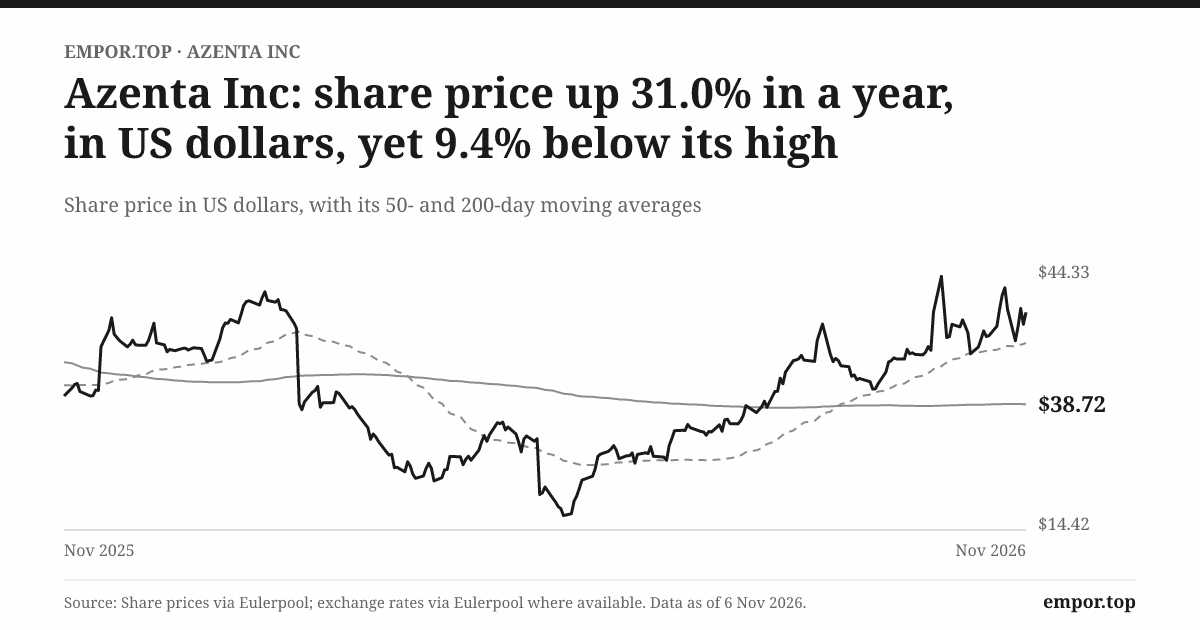
The sale funded an experiment, and the experiment still has not delivered its answer. Tonight, on November 7, 2026, Azenta is worth about $1.8 billion on the stock market, and its shares sit at about $38.72, more than double their 52-week low of about $16. The company still had $528.5 million in cash, restricted cash and marketable securities at the end of June 2026, and no funded debt.2
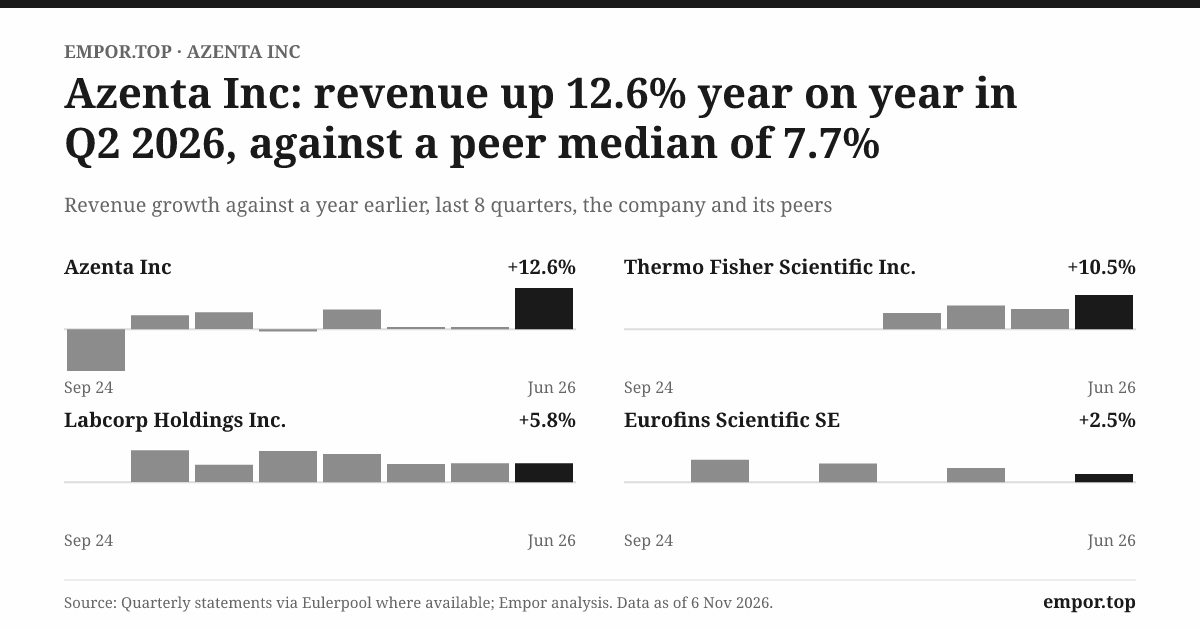
In the June quarter, revenue rose 12.6% from a year earlier to about $161 million, the best growth in years.3 Yet the full-year guidance that management gave in August implied organic growth, stripping out currency and acquisitions, of roughly flat to 1% for fiscal 2026, which ended in September.4 The good quarter was a single strong reading inside a flat year.
The calendar makes the moment unusually sharp. The June quarter is the latest one reported. Fiscal 2026 results, and the company's first look at fiscal 2027, are due within days, and management has said it will present its 2027 outlook in November.4 They will arrive under an interim chief executive, after the previous CEO resigned in August, and after a year in which management cut its forecasts, pushed back its long-range margin target and sold, at a deep loss, the largest acquisition it made with the semiconductor money.56
So the story of Azenta is really four questions wearing one lab coat. The first is whether growth can become durable, whether the company can grow faster than the roughly 1% a year its revenue managed over the past decade, a figure distorted by disposals and acquisitions but sobering all the same.1 The second is whether sample management, the business of keeping biological material safe and findable, can support a real competitive edge, or whether customers can simply buy another freezer.
The third is whether management can restore confidence in its execution and in its reporting, after auditors flagged material weaknesses in internal controls.1 The fourth, and perhaps the one shareholders care about most, is whether Azenta can earn a respectable return on the capital it has left. Over the twelve months to June, return on invested capital was about minus 1%, and earnings per share were a loss of about $2.72.2
The central tension is almost poetic. Azenta's customers pay it for continuity and precision: a sample stored at the right temperature, in the right slot, under a clean chain of custody, for as long as twenty years. Azenta's own record over the past four years has been anything but continuous.
Growth has lurched between double-digit gains and double-digit declines, operating margins have been negative more often than positive, and the chief executive's office has changed hands twice since 2024.15 The company that promises nothing will be lost has struggled to show investors that its own value will not leak away.
To understand how Azenta got here, the story has to go back to the semiconductor company that decided, more than a decade before the sale, that it wanted to keep samples cold.
 Subscribe on LinkedIn
II. Brooks built a life-sciences business one acquisition at a time
For most of its life, Brooks Automation lived inside the rhythm of the chip industry. It built the robots that move silicon wafers between machines in a fabrication plant, and the vacuum and cryogenic equipment that keeps those plants running.1 It was a good, cyclical, capital-equipment business: when chipmakers built fabs, Brooks boomed, and when they stopped, Brooks waited. Anyone who has watched a semiconductor cycle knows that this can be a hard way to compound value.
The bridge to biology was more natural than it looks. A wafer-handling robot and a sample-handling robot solve related problems: pick up something fragile and valuable, move it precisely in a controlled environment, and never lose track of it. Brooks already knew how to build machines that work reliably at very low temperatures. Biobanks, pharmaceutical libraries and clinical-trial repositories needed exactly that, from ‑20°C down to ‑190°C, with the added twist that each item was a unique biological asset rather than one wafer among thousands.7
So, starting around 2011, Brooks began buying its way in. The company's own timeline shows the sequence. Nexus Biosystems and RTS came first, in 2011 and 2012, bringing automated sample stores. Matrical and the first of two BioCision deals followed in 2013 and 2014. FluidX, a maker of sample tubes and consumables, and BioStorage Technologies, which ran outsourced repositories, arrived in 2015 and 2016. In 2017 and 2018 came the second BioCision deal, FreezerPro software, 4titude's lab plastics and GENEWIZ.
RURO's sample-tracking software and Trans-Hit Biomarkers followed in 2019 and 2020.8 Each deal added a piece: a store, a tube, a label, a database, a building full of freezers. By the time the pieces were assembled, Brooks could offer a customer the whole lifecycle of a sample, from the moment it was collected and labeled to its long-term custody and eventual retrieval.7
It was a deliberate strategy, but also a portfolio strategy. Roll-ups in specialist laboratory markets can create genuine integrated workflows, or they can create a catalogue of products that happen to share a logo. Which one Brooks was building is a question the financial record still struggles to answer.
The GENEWIZ bet
The deal that changed the shape of the business was GENEWIZ. In September 2018, Brooks agreed to pay $450 million in cash for the New Jersey genomics services company, its largest life-sciences purchase to that point.7 GENEWIZ had been founded in 1999 and had grown into a global provider of DNA sequencing and gene synthesis, with more than 4,000 customers and laboratories in the United States, China, Japan, Germany and the United Kingdom.79
Its co-founder and chief executive, Amy Liao, stayed on to run it, describing a team of more than 1,000 people with two decades of scientific experience behind them.7 Brooks financed much of the price with a new $350 million term loan and closed the deal on November 15, 2018.10
The timing tells its own story. About a month before agreeing to buy GENEWIZ, Brooks had sold a piece of its semiconductor business for $675 million, and then-CEO Steve Schwartz said the proceeds would accelerate the growth of life sciences.7 In other words, the habit of converting chip cash into biology was established years before the big sale.
Management forecast that GENEWIZ would bring in more than $140 million of revenue over the following twelve months.7 That put the price at about 3.2 times forecast sales. For a services business with lab-based gross margins, that is not an outlandish number, but neither Brooks nor its later filings published a set of comparable deals that would show whether it was cheap or rich against what other buyers paid for genomics labs at the time.
The useful conclusion is narrower: Brooks paid a full price for a real business with real customers, and the returns would depend on whether it could grow those customers and make the labs more efficient.
GENEWIZ also changed what kind of company Brooks was. Sample storage is about keeping things safe. Sequencing and gene synthesis are about doing something with them: reading the genetic code in a sample, or writing new DNA to a customer's design. Schwartz pitched it as adding value to "samples under our care."7 The idea was that a customer who stored samples with Brooks could also send them to Brooks to be analyzed, and that a researcher who ordered gene synthesis might also need the storage. That cross-selling logic would become the core of Azenta's later pitch.
What the pieces add up to
Seven years later, the pieces have scale. At its December 2025 Investor Day, management estimated that Sample Management Solutions addressed a market of roughly $3 billion, and that Azenta held about 11% of it; Multiomics, the renamed GENEWIZ business, addressed another roughly $3 billion, where management put its share at about 9%.11 Those are the company's own estimates, built with help from McKinsey, and there is no independent series of market shares to check them against.11 Still, they describe a mid-sized specialist: big enough to matter to customers, far from dominant.
The longer financial record must be read carefully. Over the past ten years, reported revenue grew by less than 1% a year, from about $552 million in fiscal 2015 to about $593 million in fiscal 2025.1 That number is almost meaningless as a growth rate for today's business, because the 2015 figure was mostly semiconductor revenue that no longer belongs to the company, while the 2025 figure is all life sciences, including businesses that did not exist inside Brooks a decade earlier.
The life-sciences business itself grew through both acquisitions and organic expansion. What can be said is that the acquired pieces were technically coherent. They fit together in a lab. What cannot yet be said is that they earned their cost of capital as a combined portfolio: the company's return on invested capital has hovered around zero or below for most of the past five years.1
That gap between technical fit and financial proof is the thread that runs through everything that follows. And in 2021, Brooks made a decision that would turn that gap from a question of modest acquisitions into a question of billions.
III. The semiconductor sale turned a division into a capital-allocation test
By 2021, Brooks had an identity problem. It had two businesses that shared almost nothing except a headquarters and a stock ticker. The semiconductor arm sold to chipmakers and rode their spending cycles. The life-sciences arm sold to pharmaceutical companies, biotechs and academic labs, and was valued by investors on very different terms. The obvious move was to separate them, and Brooks announced it would do just that, preparing to split the company in two.
Then a better offer arrived. On September 20, 2021, Brooks said it would instead sell the semiconductor automation business outright to Thomas H. Lee Partners for $3 billion in cash, scrapping the separation plan.12 The life-sciences unit would become a standalone public company.12 Investors liked the move; the shares rose more than 3% in premarket trading.12 A spin-off would have handed shareholders two stocks. A sale handed them one stock and a mountain of cash.
The choice made sense on its face. Private equity was willing to pay a strong price for a semiconductor equipment supplier in the middle of a chip boom, and taking cash removed the risk of trying to run two different businesses as public companies through the next downturn. The cash price also gives a rough benchmark for what Brooks sold. Those were the economics of a semiconductor equipment business at a cyclical high, and they belonged to the company that was leaving. None of the $3 billion was generated by the life-sciences business that stayed behind.
The transformation came in two steps. On December 1, 2021, Brooks Automation renamed itself Azenta, and its stock began trading under AZTA instead of BRKS.13 On February 1, 2022, the sale closed.1 The renamed company also had one of the strongest balance sheets in its corner of the industry. At the end of fiscal 2022, cash and investments stood at about $1.6 billion, with equity of about $3.4 billion.1
That money changed the nature of the management problem. A company with modest cash has to earn its growth. A company with billions in the bank has to decide how to spend it, and every decision becomes a test. Return it to shareholders, and the company shrinks to its earning power. Buy businesses, and the returns depend on price and integration. Invest internally, and the returns depend on whether the market wants what the labs and factories produce. The windfall did not establish a durable return profile. It created a capital-allocation exam that would run for years.
Where the money went
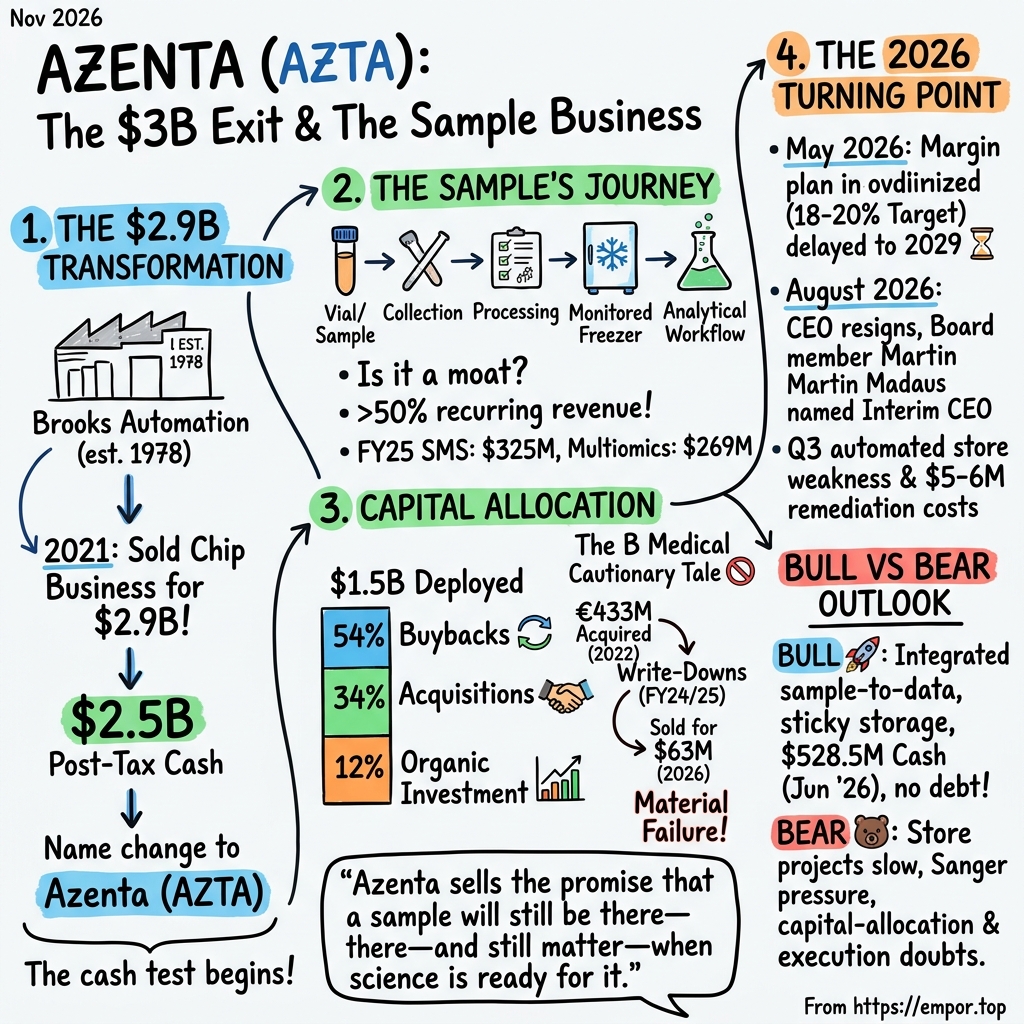
By March 2024, management could give a scorecard. At its Investor Day that month, the company said it had deployed about $1.5 billion since becoming Azenta. About 54% had gone back to shareholders, including $1 billion of share repurchases; about 34% had gone to acquisitions, chiefly B Medical Systems, along with Barkey and Ziath; and about 12% had gone to organic investment, research and development running at about 5% of revenue and capital spending for growth.8 Management then planned another $500 million of buybacks in fiscal 2024.8
It followed through. By September 2024, Azenta had completed $1.5 billion of repurchases, retiring about 30 million shares.1 In December 2025 the board authorized a further $250 million through 2028, and in the June 2026 quarter the company bought about 2.3 million shares for $50 million, leaving about $200 million on the authorization.4 The shareholder who held on through those years ended up owning a larger slice of a smaller company.
Whether that was a good trade depends on the price paid and what the remaining business earned. The record here is unflattering. The share price has fallen as much as 87% from its five-year high at its worst point, and the stock traded as low as about $16 in the past year. The average buyback price is unclear, but the scale of the decline means that a large share of the repurchase money retired shares at prices well above where the stock later traded.
Buybacks are only as good as the value of what is bought, and a business with a near-zero return on capital is hard to buy cheaply even at a falling price.
The other slices tell a similar story in different ways. The 12% that went into organic investment was the smallest piece, even though organic growth was supposed to be the company's long-term engine. Research spending actually fell from about 5.8% of revenue in fiscal 2023 to about 5.1% in fiscal 2025, before recovering to about 6% in the first nine months of fiscal 2026 to support new products.12 And the 34% that went to acquisitions was dominated by a single deal, B Medical, whose fate would become the defining verdict on the post-sale strategy.
There is a skeptic's reading of this sequence that deserves a hearing. Azenta was handed the proceeds of its founding business and chose to spend the largest single slice on repurchasing its own stock, at a time when its operating margins were negative. A buyback signals that management believes the shares are cheap. It can also signal that management lacks better uses for the money. Those signals are not mutually exclusive, and the company's later operating struggles make the second reading harder to dismiss.
The more generous reading is that Azenta returned what it could not sensibly invest, kept a strong balance sheet and avoided the temptation to overpay for a large transformative deal. The trouble is that it did make one large deal. To see whether the sale money built something durable, the place to look is the business itself, and the clearest way to see that business is to follow a sample through it.
IV. A sample's journey is Azenta's best argument for recurring revenue
Picture a blood sample drawn at a clinical-trial site. A nurse labels the tube with a barcode, perhaps on one of Azenta's FluidX or 4titude consumables. The tube is shipped cold and logged into a laboratory information system that tracks where it is, how long it has been out of the freezer, and who touched it last. It might be split into smaller portions, or aliquots, so that one sample can serve several tests.
Most of those portions then go into storage, either into an automated store on the customer's own site or into an Azenta repository, where the customer pays to keep them. Years later, a researcher asks for one portion, and it comes back out, perhaps to be sequenced at a GENEWIZ lab.111
That journey is Azenta's best argument for its business model, because at almost every step there is something to sell, and some of it repeats. Azenta reports two segments that map onto the journey. Sample Management Solutions covers the hardware and custody: automated stores, cryogenic systems, consumables and instruments, and repository services. Multiomics covers the analysis: next-generation sequencing, the older Sanger sequencing method, gene synthesis and related genomic services.1
The scale of each became clear in fiscal 2025. Sample Management Solutions brought in about $325 million and Multiomics about $269 million.11 Looked at by type rather than segment, products, meaning the machines, tubes and instruments, brought in about $173 million, while services brought in about $421 million.1 So about seven of every ten dollars Azenta earns come from doing something for a customer rather than shipping them a box. By the June 2026 quarter the two segments were almost equal in size, with Sample Management Solutions at about $88 million and Multiomics at about $73 million.3
Two kinds of money
Inside those totals sit two very different kinds of revenue, and the difference explains most of Azenta's recent volatility. The first kind is project money. An automated store is a large, highly customized capital purchase. Management described these systems as uniquely configured for each customer, with final acceptance depending on customer-specific testing.4 They take a long time to sell, depend on a customer's capital budget, and land in lumps. When research budgets tighten, store orders are among the first things to slip. Cryogenic systems and lab instruments behave in a similar way.
The second kind is annuity-like money. Once a sample is in a repository, the customer pays to keep it there, often for a long time. Management told investors that biorepository samples typically have an expected storage term of 7 to 25 years, and that about 80% of biorepository revenue is recurring.11 Consumables, the tubes and plates that every lab burns through, also repeat.
Management said the number of samples in Azenta's storage had grown at more than 15% a year from fiscal 2015 to fiscal 2025, and that its repositories served all twenty of the top twenty pharmaceutical companies.11 An installed base of more than 180 stores and more than 10,000 instruments generates service and consumables revenue around the hardware.11
Management leans hard on this second category. On the August 2026 call, chief executive John Marotta said that "more than half of our revenue is reoccurring in nature," and that the repository and consumables businesses, which it calls Sample Repository Solutions and Consumables and Instruments, were growing strongly.4 In answer to an analyst, he put the recurring share of those two businesses at about 70% to 80%.4 In Multiomics, management said more than 70% of revenue came from returning customers.11 And the December 2025 plan targeted recurring revenue at 70% of the total by the end of fiscal 2028.11
The claim is plausible. It is also unaudited in any meaningful sense. Azenta's annual report says sales are generally made through purchase orders or binding arrangements that can be short- or long-term, and that long-term project contracts may bill on milestones.1 What the company does not disclose is the evidence that would turn "recurring" from a description into a measurement: the average contract length, minimum commitments, how much revenue each customer generates over time, or how many repository customers renew.
A "returning customer" in a sequencing business might simply be a lab that ordered again because GENEWIZ was convenient last month, which is a long way from a contracted annuity. The company's own definition of recurring revenue is not spelled out in its filings, and the best question an investor can ask on the next call is exactly that: what counts, and what renewal or retention data supports it.
A repository in England
The clearest sign of where management wants the business to go came in March 2026, when Azenta bought UK Biocentre, a sample storage and high-throughput processing provider founded in 2014 that had supported large-scale biomedical and population studies.14 Azenta paid about £20.5 million, net of cash and including up to £1.8 million of contingent consideration, for a business that generated about £15.3 million of revenue in the twelve months to September 2025.14
That is about 1.3 times sales, a modest price. Management said the deal would make UK Biocentre a European operating hub alongside its existing repository in Griesheim, Germany, and that it would deploy its BioArc Ultra system, able to hold 16 million samples, to expand automated capacity.14
UK Biocentre is a small, concrete expansion of repository capacity, not a new core business. It contributed about $4 million of revenue in the June quarter, and management expected it to trim fiscal 2026 adjusted EBITDA margin by roughly 30 to 35 basis points before turning accretive.144 Its significance lies in what it signals: management chose to spend money on more of the annuity and less of the lumpy hardware.
The direction is sensible. A business that earns rent on samples for a decade can smooth the swings in store orders and sequencing volumes. But recurring revenue only softens a cycle if it is large enough, and if the customers keep paying. Without retention data, the investor has a mechanism and a management assertion, not a measured annuity. Whether that mechanism is protected by anything that would stop a customer walking away is the question at the heart of Azenta's competitive position.
V. The moat has to survive a customer's choice of another freezer
Imagine a lab director at a mid-sized biotech facing a familiar problem. The freezer farm, rows of upright ‑80°C freezers humming in a room that keeps getting more crowded, is running out of space. Technicians spend hours digging for samples with frosted gloves. An audit has found labeling gaps. She has three choices. She can buy a high-throughput automated store, a large robotic system that keeps samples in the cold and retrieves them on demand.
She can outsource the whole problem to a repository operator and ship the samples off-site. Or she can buy more conventional freezers and hire another technician. Every option is a real option, and each one has a different winner.
That decision, repeated thousands of times across pharma, biotech, hospitals and universities, is where Azenta's competitive advantage either lives or does not. The company believes it has a unique portfolio, but its own annual report names competitors in every arena.1 In automated storage, the main rivals are Hamilton Company and Liconic. In storage, consumables and services, they include Thermo Fisher Scientific and Labcorp. In Multiomics, the list is long: 华大基因 BGI Genomics, Eurofins Scientific, 金斯瑞 GenScript, Integrated DNA Technologies, 诺禾致源 Novogene and Twist Bioscience.1
Those names reveal the shape of the fight. Thermo Fisher and Labcorp are vastly larger diversified laboratory groups that can bundle storage with dozens of other products and services. BGI and Novogene are scaled sequencing providers with deep cost advantages in China and beyond. Twist and IDT are focused players in gene synthesis and DNA products. Hamilton and Liconic are specialist automation engineers.
Azenta is not competing against one rival but against a different specialist in each workflow, and often against a giant that can treat the category as a sideline. Management's 11% share figure in Sample Management Solutions is its own estimate, and there is no consistent peer share series to show whether that share is rising or falling.11
What would make switching hard
The case for a moat rests on three mechanisms, and each deserves a test.
The first is switching cost. A sample stored in a repository for fifteen years is not easy to move. Transferring it means shipping it cold, revalidating its chain of custody, re-entering its records in another system and accepting the risk that something goes wrong. For a clinical-trial sample, that risk can carry regulatory weight. Azenta's software, including its FreezerPro and Limfinity information systems, adds another layer: once a lab's inventory lives in one database, migrating it is painful.151
This is the strongest mechanism, and it fits the claim that repository revenue is largely recurring. But it protects the samples already in storage. It does not guarantee that the next study's samples come to Azenta, and it does not stop a customer from multi-sourcing, using Azenta for some programs and Thermo Fisher or a rival repository for others.
The second is buyer power. Here the evidence is modest but useful. No single customer accounted for more than 10% of Azenta's revenue or receivables in fiscal 2023, 2024 or 2025.1 That means no one buyer can dictate terms to the company. It does not mean customers are powerless. Pharmaceutical procurement departments run competitive bids, and Azenta does not disclose its top-five or top-ten customer shares, its win rates, or any customers lost.1 Low concentration limits one kind of risk without proving pricing power.
The third is technical advantage. Management argues that its automated stores offer high throughput and that only Azenta can offer the full chain, from storing a sample to reading and writing its genes, backed by software and off-site repositories.11 It describes itself as "the only player with full capabilities" across that journey.11 That may be true as a product catalogue.
A capability, though, is not a moat until customers keep paying for it. The evidence that would show this, such as repeat purchase rates for integrated customers, price increases that stick, utilization of repository space or wins against named rivals, is not in Azenta's disclosures.
The core product stumbled
The sharpest test of the technical claim came from Azenta's own factory. During fiscal 2026, quality problems surfaced in a set of automated stores already sold to customers. On the August call, Marotta said remediation had been completed on the three remaining affected systems, which were in final testing before customer sign-off, and that the company would consider the issue closed only when those stores were accepted and operating as intended.4
Chief financial officer Lawrence Lin put the cost at about $1 million in the June quarter and $5 million to $6 million for the year.4 At the same time, automated store revenue remained below the prior year, and management said it was evaluating options to cut costs in stores and cryogenic systems because project timing was so uncertain.4
That episode does not prove the franchise is weak. It does show that execution in a core product line faltered at precisely the moment when customers were already cautious about capital spending. A store that needs remediation after installation is the opposite of the sales pitch, which is reliability. Management's response, a shift toward modular stores built from more standardized parts, is aimed squarely at reducing engineering complexity and the quality risk that came with it.4 Whether it works will show up in store orders and margins over the next year, not in the product brochure.
The fair verdict is that Azenta's moat claim is intact but narrowed. The sample-integrity and switching-cost argument is credible for samples already in its repositories and for labs whose inventories run on its software. It is unproven for new projects, where customers have real alternatives, including simply keeping samples in conventional freezers. The public evidence on retention, pricing power and lost bids is too thin to call the advantage proven.
And the clearest piece of recent evidence, the store quality problem, cut against it. The question of whether management could turn capabilities into returns was tested most brutally not by a freezer, but by an acquisition.
VI. B Medical turned the acquisition thesis into a write-down and an exit
In October 2022, with the semiconductor cash newly in hand, Azenta closed the largest new bet of its independent life: B Medical Systems, a company based in Hosingen, Luxembourg, that made refrigerators and transport boxes for vaccines and blood.16 On the day the deal was announced in August, B Medical looked like a strategic gem.
It was one of the leading vaccine cold-chain providers, serving fast-growing emerging markets with refrigeration from room temperature down to ‑86°C, monitored transport systems and blood-management equipment. It had an installed base of more than 500,000 units across roughly 150 countries and a highly automated factory in Luxembourg.16
The deal terms were rich. Azenta agreed to pay about €410 million in cash at closing, plus up to €50 million more if B Medical hit performance milestones.16 B Medical had generated about €109 million of revenue in the twelve months to June 2022.16 So the upfront price alone was close to four times sales, before any milestones. Steve Schwartz, still Azenta's chief executive, said the company saw "a breadth of opportunities" to drive more value by plugging B Medical into the Azenta platform.16
B Medical's long-time chief executive, Luc Provost, who had been with the company for more than twenty years, and its deputy chief executive Jesal Doshi were to stay and run the business.16 Management promised that the deal would add to non-GAAP earnings in fiscal 2023 and to GAAP earnings in fiscal 2024.16
The logic was cold chain. Azenta kept biological samples cold; B Medical kept vaccines cold. Both shared a vocabulary of temperature control, monitoring and traceability. But the customers were different. Azenta sold mostly to pharmaceutical companies, biotechs and research institutions. B Medical sold vaccine refrigerators largely to governments, health ministries and non-governmental organizations in international markets.2 Those buyers procure through tenders, depend on donor funding and can shift spending sharply when public-health priorities change. A business built on a global vaccine campaign faced a structural problem once that campaign wound down.
From accretion to impairment
The promised accretion never became the story. In fiscal 2024, Azenta took a goodwill impairment on B Medical that drove a $140.5 million loss from discontinued operations that year.1 In the first quarter of fiscal 2025, it announced it would sell the business, and the unit was classified as held for sale and reported as discontinued.1 In fiscal 2025, Azenta recorded a further $93.1 million estimated loss on the assets held for sale, based on what bidders were willing to pay.1
The final price arrived in December 2025, when Azenta agreed to sell B Medical to a company called Thelema, and the deal closed on July 1, 2026, for $63 million.2 Measured against the roughly €410 million paid upfront, at the near-parity exchange rate of the time, the sale price was about a sixth of what Azenta had paid. That is not a full investment-return calculation. It ignores whatever cash B Medical generated or consumed while Azenta owned it, the liabilities that went with it, and currency moves.
Azenta also never published a set of peer transactions that would show whether four times sales was a normal multiple for cold-chain equipment makers in 2022. But the scale of the impairment and the size of the discount leave little room for a generous reading. B Medical was a material capital-allocation failure, the single largest acquisition of the post-sale era, and it destroyed a large share of the money put into it.
The buyer was an insider
The way the exit was financed added a governance complication that shareholders should weigh. Thelema was majority-owned by Luc Provost, an Azenta vice president and still B Medical's chief executive.2 In other words, the business was sold to the man who ran it. Azenta did not receive all the cash at closing.
Of the $63 million, $28 million was paid in cash, and the remaining $35 million came as a secured loan from an Azenta subsidiary to the buyer, at 6% interest, secured by a pledge over B Medical's shares.215 The arrangements were reviewed and approved by Azenta's audit committee.2
Selling a struggling business to its management is not unusual; insiders often know its value best and may be the most motivated buyers. Lending them a large part of the price is less common, because it leaves the seller exposed to the buyer's ability to pay. In this case the exposure was retired quickly. Thelema repaid the loan in full, with accrued interest, on September 3, 2026, before it was due, and the share pledge was released.1715
Interim chief executive Martin Madaus called the repayment the completion of the divestiture, saying it supported the company's "disciplined approach to capital allocation."15 That last phrase deserves a raised eyebrow. Getting paid on a vendor loan is good housekeeping. It does not redeem the acquisition.
There is one comparison that makes the lesson sharper. UK Biocentre, bought in 2026 for about 1.3 times trailing sales, is everything B Medical was not: small, priced modestly, and strategically close to Azenta's repository business, with similar customers and the same service model.14 If it shows up as faster organic repository growth and better margins over the next two years, it will suggest that Azenta has learned to buy closer to home. If it does not, it will suggest the company's problem is integration, not just price.
B Medical's story ended with a $63 million cheque and a series of lessons about promising accretion. The question for 2026 was whether the remaining business could deliver its own promises, and in May, management had to admit it could not, at least not on schedule.
VII. The margin plan moved back a year just as the CEO left
On December 10, 2025, Azenta's management walked investors through a confident long-range plan. Revenue would grow from about $594 million in fiscal 2025 to $700 million to $750 million by fiscal 2028, a growth rate of 6% to 8% a year.11 Recurring revenue would reach 70% of the total.11 Most strikingly, adjusted EBITDA margin, a measure of operating profit before interest, taxes, depreciation, amortization and various one-off items, would climb from about 11% in fiscal 2025 to 18% to 20% as a run-rate by the end of fiscal 2028.11
Management summed it up on a slide headline: double adjusted EBITDA by 2028.11
The bridge to get there had three girders, each worth roughly 2 to 3 percentage points of margin. The first was volume and mix, meaning more revenue from higher-margin repository and consumables work spread across a largely fixed cost base. The second was productivity, making labs and factories more efficient. The third was savings in procurement and general and administrative costs. Together they were supposed to add 700 to 900 basis points of margin.11 Each driver was concrete and measurable, which is to management's credit. It also meant each could be checked.
May: the reset
The check came quickly. On May 5, 2026, less than five months after the Investor Day, Azenta reported a weak March quarter and cut its outlook. Revenue of about $145 million was up 1% as reported but down 3% organically.6 Adjusted EBITDA margin fell to 5.4%.6 Management slashed its fiscal 2026 forecast: organic growth, previously expected at 3% to 5%, was now seen at down about 2% to up 1%, and adjusted EBITDA margin, previously expected to expand by about 300 basis points, was now seen as flat to down about 125 basis points.6
The company also took a $149 million goodwill impairment in the period, which pushed the quarter to a large reported loss.2
And it moved the long-range plan back a year, from 2028 to 2029.6 Marotta was unusually direct about the cause. The results, he said, "fell short of our expectations, reflecting both execution gaps and a more cautious demand environment, particularly in North America."6 He insisted that delaying the targets "does not change our confidence in our strategy."6
That candor counts for something. Many management teams blame the market alone. Marotta named execution, and in August he repeated that "many of the performance challenges we faced were within our control."4 But the speed of the reset matters too. A plan unveiled in December and delayed in May is a plan whose assumptions did not survive a single winter. The delay is a real change in the timetable, not a detail.
The June quarter offered relief. Revenue of about $161 million beat the company's outlook, organic growth hit 9%, and adjusted EBITDA margin recovered to about 11.4%, up sharply from the March quarter though slightly below the prior year.4 Both segments grew organically, Sample Management Solutions by 9% and Multiomics by 8%.4
The segment margins told the more interesting story. In Sample Management Solutions, gross margin fell to 45.9%, down 7.5 percentage points from a year earlier, as automated stores and cryogenic systems suffered from low volumes, unabsorbed fixed costs and quality remediation.4 This is the cruel arithmetic of a factory: when fewer stores ship, the same buildings and engineers are spread across less revenue, so each dollar of sales carries more cost.
Repositories, by contrast, improved, helped by higher utilization and denser storage.4 In Multiomics, gross margin rose about 5.5 percentage points to 46.5%, as volumes in next-generation sequencing and gene synthesis rose.4 Sanger sequencing, the older, slower method that newer technologies are steadily replacing, remained under pressure.4
Analysts pushed on how durable the improvement was. When Needham's David Saxon asked what drove the North American Multiomics pickup, Marotta pointed partly to catch-up on projects delayed earlier in the year, including some government-funded work, and to a clinical customer project worth about $3 million that landed in the June quarter instead of September.4 Lin added that "one quarter doesn't really evidence a broad-based sustained market recovery yet."4 Asked to bridge the margin outlook, Lin argued that the fiscal 2026 adjusted EBITDA guidance of $59 million to $62 million included about $5 million of quality costs, about $5 million of strategic investments and other one-off items, implying a "resting heart rate" in the mid-$70 millions.4
That framing is management's own, and it is worth testing: even the mid-$70 millions would put adjusted EBITDA margin somewhere around 12%, still far below the 18% to 20% target.
The CEO walks out
Seventeen days after that call, the story changed again. On August 22, 2026, John Marotta resigned as president, chief executive and director, effective immediately, and the board shrank from nine members to eight.5 The filing said his departure was not the result of any disagreement over the company's operations, policies or practices.5 No other explanation was given.
Marotta had arrived in September 2024 with a résumé built in life-sciences tools and medical devices. He had run PHC Holdings (PHCホールディングス), the former Panasonic Healthcare, as chief executive from December 2020 to May 2022, leading its preparation for public listing; before that he had held senior roles at Danaher's dental platform and its spinout Envista; and he had spent the eighteen months before Azenta as an executive in residence at the healthcare investor Patient Square Capital.18
His fiscal 2025 pay totaled about $10.4 million, mostly in stock awards, in a year when the company lost about $56 million.181 He lasted less than two years.
His replacement, on an interim basis, is a board member with a very different profile. Martin Madaus, 66, joined the board in January 2024. He is a veterinarian by training, with a doctorate from Munich, who rose through Roche Diagnostics in North America, then served as chairman and chief executive of Millipore, where he led its $7.2 billion sale to Merck KGaA, and later led the $4.2 billion leveraged buyout of Ortho Clinical Diagnostics.5
He is a senior operating executive at Carlyle and chairs the board of Repligen.5 His career has been built on strategy, mergers and transformations, including the sale of companies. Whether that is relevant to Azenta's future is a question shareholders will naturally ask, though the company has given no indication of strategic intent beyond its stated plan.
The board set his pay in September: a $600,000 salary, a cash bonus equal to his salary, and restricted stock units worth $1.2 million vesting monthly over a year.19 It also awarded one-time retention grants totaling $2.5 million to four executives, including $1 million to CFO Lawrence Lin, who had joined in November 2024 after his predecessor Herman Cueto left.1918
Retention awards are a common response to leadership turmoil. They also pay people to stay rather than to deliver, and the company has not yet tied them to the margin and growth outcomes that would show the plan is working.
The shareholder base gives the board's decisions an audience. In the December 2025 proxy, BlackRock held about 13.5%, Vanguard about 12.3% and Politan Capital about 10.0%; Politan's founder, Quentin Koffey, sits on the board under a cooperation agreement.18 This is ordinary U.S. institutional ownership, with no controlling shareholder. But an activist with a board seat and a tenth of the company is not a passive audience. At the January 2026 annual meeting, say-on-pay passed easily, but directors Tina Nova and Dipal Doshi drew the most withheld votes, at about 7.1 million and 6.9 million.20
The plan's drivers are measurable, which is the good news. The reset and the abrupt transition leave execution credibility unresolved, which is the bad news. Before deciding which weighs more, an investor has to look at the cash, because Azenta's cash-flow statement tells a story that can easily be misread.
VIII. Cash from a sale is not cash from the business
Open Azenta's cash-flow statement for fiscal 2025 and a puzzle jumps out. The company lost about $56 million that year on a consolidated basis, yet it generated about $72 million of cash from operations.1 A business that loses money and still produces cash can look like a hidden gem: perhaps the accounting losses are mostly paper, and the real economics are better than the income statement shows. Sometimes that is true. At Azenta, the gap is mostly explained by things that will not repeat.
The longer record frames the puzzle. Over the twelve years from fiscal 2014 to fiscal 2025, Azenta and its predecessor Brooks reported cumulative net losses of about $332 million while generating about $241 million of operating cash flow. After capital spending, cumulative free cash flow was negative, at about minus $117 million.1 That span is a clue rather than a verdict on today's company.
It includes the semiconductor years, the acquisitions, the fiscal 2022 loss of about $428 million and the discontinued-operation charges on B Medical.1 In fiscal 2022 alone, operating cash flow was negative by about $466 million, while the sale proceeds themselves flowed through investing cash flow, so the sale year distorts every cumulative measure.1 Cash from selling a business is not cash from running one.
Fiscal 2025 shows the mechanism in miniature. Operating cash flow was lifted by about $61 million of depreciation and amortization, the $93 million loss on B Medical's assets held for sale, which reduced profit but not cash, and about $21 million of stock-based compensation, which is a real cost to shareholders paid in shares rather than dollars.1 Working the other way, a $46 million long-term tax receivable, created by a worthless-stock tax deduction on a foreign subsidiary, absorbed cash on paper.1
That same deduction generated a $45.6 million tax benefit, turning a pretax loss of about $7 million into an after-tax profit. Net interest income on the cash pile contributed about $19 million to pretax income.1 In other words, interest on the sale money and a one-off tax benefit did more for the year's bottom line than the operating business did.
The pattern continued into fiscal 2026. In the first nine months, the $149 million goodwill impairment and a further held-for-sale loss were large non-cash charges, and operating cash flow came to about $36 million.2 In the June quarter, free cash flow including B Medical was about minus $5 million, as working capital absorbed cash and deferred revenue fell.4 Management expected full-year free cash flow to improve by 10% to 15% from fiscal 2025, a forecast already cut in May from about 30%.46
There is a second clue in how quickly customers pay. Debtor days, the number of days of revenue sitting in unpaid receivables, rose from about 61 in fiscal 2014 to about 116 in fiscal 2025.1 Part of that may reflect project-based stores and milestone billing, where revenue can be recognized before the customer pays. At June 2026, net receivables were about $144 million and contract assets about $29 million, against a small $4 million allowance for bad debts.2
Azenta does not publish an ageing schedule, so the rise in debtor days is a yellow flag rather than a red one: there is no sign of large write-offs, but the cash conversion cycle is long for a company that likes to describe itself as recurring.
A fortress with a leaky roof
The balance sheet, by contrast, remains strong. At June 30, 2026, its cash and marketable securities were held mostly in money-market funds, highly rated corporate debt and U.S. government-backed securities.2 Its lease obligations, about $60 million at September 2025, are a cost of doing business, not funded debt.1 That cushion is why Azenta could absorb B Medical's losses, the store remediation and a goodwill write-down without any threat to solvency.
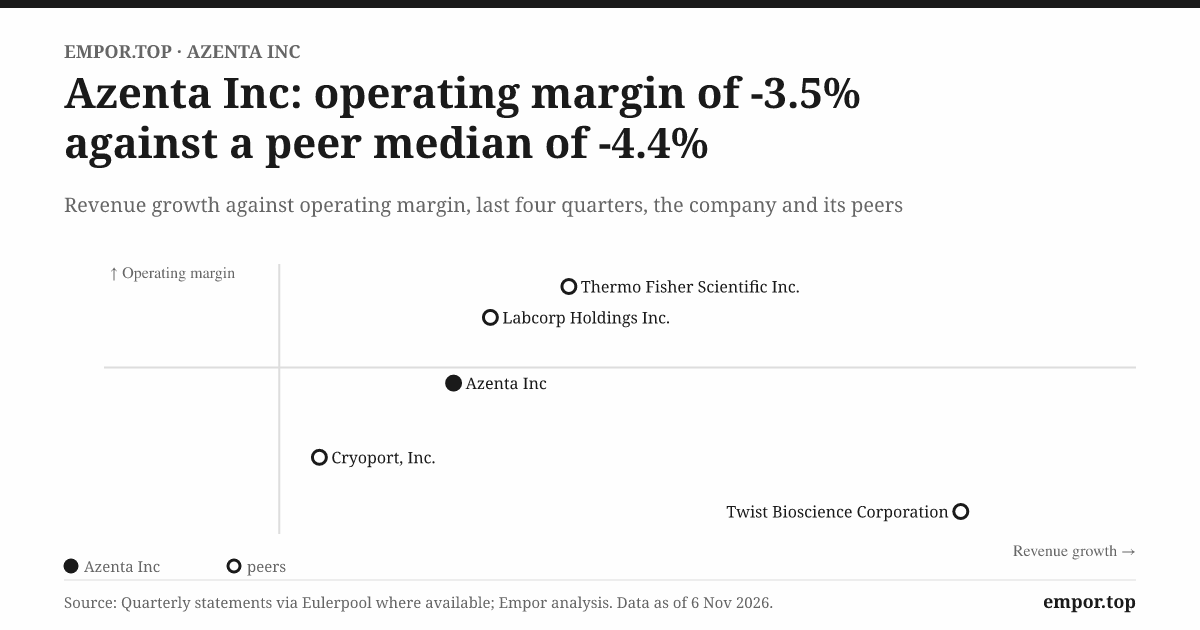
But a fortress does not by itself make a good business. Operating profitability remains weak: over the twelve months to June, the company lost money at the operating line, and return on equity was about minus 8%.2 Interest income on the cash pile is a meaningful contributor to earnings, which flatters reported profit while the operating business struggles. And the cash is shrinking as it is spent: down from about $1.6 billion at the end of fiscal 2022 to about $341 million of cash and short-term investments at the end of fiscal 2025, with longer-dated securities on top.1
The capital-allocation question is therefore sharper than it looks. Azenta restarted buybacks in the June quarter, spending $50 million, while its fiscal 2026 operating profit remained weak.4 At the same time, shareholders approved an additional 2.75 million shares for the company's equity incentive plan in January 2026.20 Repurchases shrink the share count; stock awards expand it. A shareholder should ask how much of the buyback simply offsets dilution from employee stock, and whether the money would earn more inside the business, in new products or service capacity, than it does retiring shares.
The auditors added a further complication. In its fiscal 2025 report, Azenta's auditor gave a clean opinion on the financial statements but found material weaknesses in internal control over financial reporting, covering the review of the cash-flow statement, account reconciliations and the classification of expenses.1 By June 2026, management said the expense-classification weakness had been fixed, but the cash-flow and reconciliation weaknesses remained.2
For a company whose investment case depends on cash generation, a weakness in the controls around the cash-flow statement is not a footnote. It does not mean the numbers are wrong; management and the auditor concluded the statements were fairly presented. It means the systems that produce the numbers have not yet been shown to work reliably.
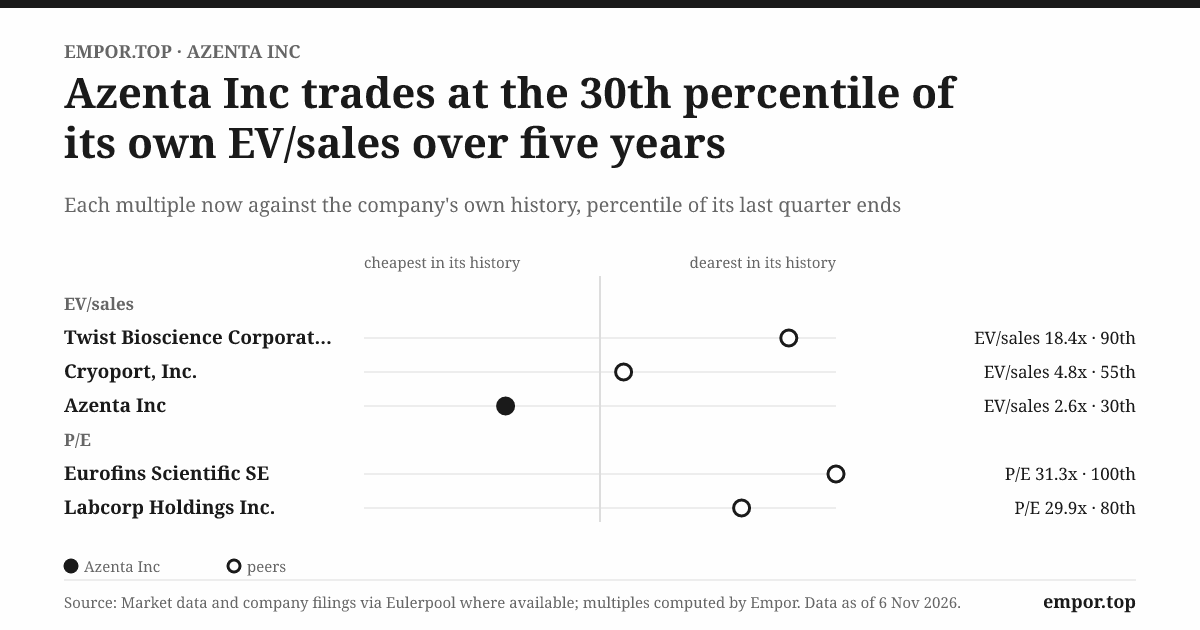
The market's price reflects this mix of a strong balance sheet and weak earnings. On November 6, Azenta traded at about 2.9 times sales and 2.6 times enterprise value to sales, with a free-cash-flow yield of about 0.6% and a price of about 1.2 times book value. The often-quoted price-to-earnings ratio of about 38 dates from December 2021, when the company still had the semiconductor business, and has no meaning today when trailing earnings are negative. A market-data history puts Azenta's ten-year median price-to-sales multiple at about 3.7 times, though that history crosses the divestiture.21
Broad life-sciences-tools peers span a wide range, from about 3.3 times sales for Merck KGaA to about 9.2 times for Bio-Techne.22 Those are context, not peers. The current multiple sits below Azenta's own history and well below the best-run tools companies, which is roughly what one would expect from a business that is liquid but not yet reliably profitable. The price appears to assume that some recovery happens, without paying for the 2029 plan in full.
That leaves the core judgment: what would make this a stronger business, and what would prove the recovery is failing?
IX. Analysis & Bear vs. Bull Case
Put two facts side by side on a desk. The first is management's statement that more than half of Azenta's revenue is recurring, with a goal of reaching 70% by the end of the long-range plan.411 The second is that the long-range plan's margin target already slipped by a year, five months after it was set.6 A long-term investor's job is to decide which fact describes the company's future better. The bull case rests on the first; the bear case on the second.
The bull case has a real mechanism. Samples are long-lived. Once a pharmaceutical company commits a study's samples to an Azenta repository, they may stay there for seven to twenty-five years, generating storage fees each year.11 Consumables repeat every time a lab runs an experiment. Software that tracks a lab's inventory is sticky. And because Azenta can also sequence or synthesize DNA, it can offer a customer more of the sample's journey than most specialists.
If repositories and consumables keep growing faster than the hardware, the mix shift should raise margins, because storage fees on a partly filled facility are high-margin once the building is paid for. The June quarter offered a glimpse: repository economics improved as utilization and storage density rose, and Multiomics margins jumped on higher volumes.4
There are other supporting facts. The balance sheet gives management room to invest without borrowing. The installed base of stores and instruments generates service revenue. Customer concentration is low. The new investments in gene synthesis, announced in October, aim at a growing demand for DNA designed with the help of artificial intelligence.9 And Madaus, whatever his tenure, brings experience running a much larger tools company.5
For the bull case to be proven, three things would need to show up in the numbers: repository renewal or retention rates that the company is willing to publish, organic growth in both segments sustained over several quarters rather than one, and margins that rise as volumes return.
The case against is grounded in evidence from the company's own recent past, not just a slow research-spending market. Store orders have weakened, and the quality problems in installed stores showed that the core hardware business can stumble.4 Sanger sequencing, a legacy profit pool, is in structural decline as newer methods replace it.4 Fixed costs magnify weak volumes, as the 7.5-point drop in Sample Management Solutions gross margin showed.4
The disclosures do not establish retention or pricing power. The largest acquisition of the post-sale era was sold at a fraction of its cost, to an insider, partly on vendor credit.2 Two material weaknesses in internal controls remain open.2 And the CEO who set the 2028 targets left before the first year of the plan was finished.5
The bear case also has a demand mechanism. When research budgets tighten, especially in North America, where government funding visibility had only modestly improved and research spending remained below the prior year, labs delay capital purchases and cut discretionary sequencing.4 Azenta cannot control that, but its cost base magnifies it.
A framework helps keep the moat argument honest. Start with Michael Porter's five forces. Rivalry is intense but fragmented: Azenta faces a different specialist in each workflow, from Hamilton and Liconic in automation to BGI, Novogene and Twist in genomics, and diversified giants like Thermo Fisher and Labcorp that can bundle storage with much else.1 Buyer power is mixed. No customer accounts for more than 10% of revenue, which limits the power of any single buyer, but pharmaceutical procurement teams run bids and can multi-source, and Azenta does not publish data on bids won or lost.1
Supplier power is hard to judge because the company does not quantify supplier concentration, though it flags supply-chain disruption as a risk.1 The threat of substitutes is real: a lab can keep samples in conventional freezers, and newer sequencing technology is already substituting for Sanger. The threat of new entrants is moderate in repositories, where facilities, regulatory track record and customer trust take years to build, and higher in genomics services, where scaled Chinese providers and focused synthesis companies compete on price and speed.
Hamilton Helmer's seven powers ask a stricter question: which durable advantage lets a company earn returns above its cost of capital? Switching costs are Azenta's strongest candidate, rooted in long-term stored samples and embedded software. Scale economies are possible in repositories, where fixed facility costs fall per sample as utilization rises, but Azenta has not shown that its scale beats Thermo Fisher's or Labcorp's. Counter-positioning, network effects and a cornered resource do not obviously apply. Brand matters, especially for GENEWIZ among academic labs, but brand in lab services rarely protects pricing for long.
Process power, the ability to run complex operations better than anyone, is precisely what the store quality problem called into question. The honest conclusion is that Azenta has one plausible power, switching costs in custody, and that its returns have not yet shown it. A company with a strong power usually earns strong returns; Azenta's return on invested capital has been near zero or negative for five years.1
An activist reading this record would ask uncomfortable questions. Why prioritize buybacks while margins and controls remain weak? Azenta spent $1.5 billion on repurchases while research spending slipped as a share of revenue, and then restarted buybacks during a year of guidance cuts.14 What evidence shows that repurchases have outperformed investment in products and service capacity? The company has not published one. Why did the board allow B Medical to be sold to the unit's own chief executive with a vendor loan, and what alternatives were considered?
The audit committee approved it, but the company has not disclosed whether any competing bids existed.2 And why should shareholders trust a 2029 target when the 2028 version lasted five months? None of these questions has a disqualifying answer. All of them deserve one.
Three measures will tell investors more than any others. The first is organic revenue growth by segment. In the June quarter, Sample Management Solutions grew 9% organically and Multiomics 8%, but the full year was guided to roughly flat to 1%, with Sample Management Solutions at low single digits and Multiomics down about 1% to flat.4 The direction over the next several quarters will reveal whether June was a turning point or a timing quirk.
The second is the recurring-revenue share, tracked alongside any repository renewal or retention data. Management says it is above half and targets 70%.411 The share means little without evidence that customers renew; any disclosure of renewal rates would be the most important new fact the company could publish.
The third is adjusted EBITDA margin, read alongside segment gross margins and fixed-cost absorption. It stood at about 11% for fiscal 2025, fell to 5.4% in the March quarter and recovered to about 11.4% in June.1164 The path from there to 18% to 20% by 2029 is the plan's whole promise.
The risk radar is short but specific. Weak research spending reduces sequencing and equipment demand. Product quality problems delay store deployments and cost money to fix. Sanger's replacement by newer sequencing erodes a legacy profit pool. And the remaining control weaknesses can undermine confidence in reported progress just when the company most needs investors to believe its numbers. A smaller overhang also lingers from the GENEWIZ years: Azenta had paid about $5.9 million in tariffs in fiscal 2022 and about $2.5 million plus interest in July 2024 related to GENEWIZ imports, and was awaiting final customs audit results.1
A separate dispute tied to a former semiconductor sale, in which Edwards had sought more than $13 million was dismissed in full in July 2026.2
The verdict is balanced but clear. The bull case has a plausible mechanism. It has not yet been demonstrated in consistently higher returns. The bear case is not just about a cyclical slowdown; it rests on execution, impairment and control evidence from Azenta's own record. The stories of how the company got here offer lessons that reach beyond this one freezer maker.
X. Playbook: Business & Investing Lessons
Go back to September 2021, to the morning Brooks Automation announced it would sell its founding business for $3 billion and become a pure life-sciences company.12 The shares rose. The future looked funded. Five years later, the lessons of what happened next are more interesting than the deal itself.
The first lesson is that a windfall is a strategy only after it earns a return. The sale money gave Azenta options most mid-sized tools companies never have. It returned much of the cash to shareholders and spent smaller shares on acquisitions and internal investment.8 None of those choices was unreasonable on the day it was made. Together, they produced a company with a strong balance sheet, a smaller share count and returns on capital near zero.
The money bought time. It did not, by itself, buy an advantage. For founders and boards that suddenly find themselves holding a pile of cash from a divestiture, the lesson is that the cash is not the achievement. The achievement is whatever the cash becomes.
The second lesson is that a capability is not a moat until customers keep paying for it. Azenta can store a sample at ‑190°C, find it among millions, track it in software and then sequence it. That is a genuinely impressive capability, and management calls the company the only player with the full set.11 But the evidence that turns capability into power, renewal rates, retention, prices that hold, bids won against Thermo Fisher or Hamilton, is not in the company's disclosures.
And the clearest recent test of the capability, the automated stores that needed remediation after delivery, cut against it.4 Investors who hear "end-to-end platform" from any company should ask the same question: show me the customers who stayed and paid more.
The third lesson is that recurring revenue can soften a cycle; it cannot fix utilization by itself. The June quarter showed that tension: repository economics improved while store quality and utilization weighed on the segment.4 The repository revenue was real, but it was not big enough to carry the factory.
A business that mixes rent-like revenue with lumpy capital equipment will always be judged on the weaker half when budgets tighten, unless the annuity grows large enough to dominate. The mix shift Azenta promises is the right destination. It is not yet the company's present.
The fourth lesson is the sharpest, and it belongs to B Medical: the exit price is part of the acquisition thesis. Management had promised that the vaccine cold-chain business would add to earnings within two years.16 By July 2026 it had been sold to its own chief executive for $63 million, with part of the price lent to the buyer.216
Every acquisition presentation includes synergies and accretion. Few include a realistic view of what the business would fetch if it failed. Investors who ask "what is this worth if the thesis is wrong?" before a deal closes will rarely be surprised afterward.
Underneath all four sits a quieter lesson about time. Strategic fit and financial discipline can only be judged after integration. GENEWIZ and B Medical show why: the headlines on announcement day rarely know which is which.
XI. Epilogue
Tonight Azenta sits on the eve of its fiscal 2026 results, with an interim chief executive, a cash pile that is smaller than it was but still large, and a margin plan that already moved once. The guidance it gave in August called for revenue of $613 million to $618 million and adjusted EBITDA of $59 million to $62 million for the year that ended in September.4 Hitting that range would mean the company finished a difficult year roughly where it said it would in August, after missing where it said it would in December.
The results call will carry more weight than the numbers alone. Investors will listen for segment organic growth in the September quarter, which management expected to decline by low single digits against a record quarter a year earlier in Multiomics.4 They will listen for the automated-store remediation and modular-store shift: whether customer acceptance is complete, whether new orders are building backlog, and whether modularization is reducing complexity.4
They will listen for Sanger, and whether next-generation sequencing and gene synthesis are growing fast enough to replace it. And they will listen, above all, for fiscal 2027 guidance and a fresh explanation of the path to 18% to 20% margins by 2029.6
The second test is leadership. The board has to find a permanent chief executive, and the choice will say a great deal. An operator with a record of fixing factories and service networks would signal that the board believes in the plan. A leader with a record in portfolio reshaping would signal something else.
Either way, investors will want management to explain past misses with specific operating actions and dated milestones, not with references to the market environment. The interim pay and retention arrangements suggest the board wants continuity while it decides.19
The third test is the reporting machinery. The remaining control weaknesses were still open in June.2 The fiscal 2026 annual report will show whether management and the auditor can declare them fixed and tested. A clean bill of health would remove a quiet discount from every number the company reports. Another year with open weaknesses would make each new target harder to believe.
The fourth thread is the newest bet. On October 30, 2026, Azenta announced an exclusive licensing agreement with Elegen for a cell-free DNA manufacturing technology and the acquisition of SynPlexity, a maker of pooled gene libraries that can produce thousands of gene variants in one batch.9 Trey Martin, now president of Multiomics, said the deals would position GENEWIZ for "the next era of biologics discovery," including designs generated by artificial intelligence.9
The pitch is exciting. It is also, for now, an option. The company has promised more detail on its year-end call.9 Until it reports customer adoption, revenue and returns from these technologies, they belong in the same category as the integrated-platform pitch: a capability awaiting proof.
Each outcome points somewhere different. Steady organic growth, rising margins, closed control weaknesses and a credible permanent CEO would suggest the business is regaining the execution discipline its customers pay for. Another guidance cut, another delay to the plan or another stumble in the stores would suggest the recovery timetable is still stretching. The tension that remains is the one the story began with: a company that sells certainty, still trying to show it can deliver its own.
XII. Outro
Somewhere tonight, a robotic arm is moving in the cold, filing a rack of tubes into the dark. Nobody is watching. The samples inside might be needed next month, or in fifteen years, by a scientist who has not yet asked the question they will answer. Their value depends on three things: that they stay intact, that they can be found, and that someone eventually does something useful with them.
Azenta has spent more than a decade, and the proceeds of its founding business, assembling the pieces of that journey: the stores, the tubes, the software, the repositories, the sequencing labs. What makes it unlike a generic life-sciences roll-up is that the pieces really do belong together in a lab. What it has not yet shown is that they belong together in a profit-and-loss statement. The investment case turns on whether custody, traceability and analysis can be made to work as one business that earns its keep.
Azenta sells the promise that a sample will still be there, and still matter, when science is ready for it.
References
-
Annual Report on Form 10-K for fiscal 2025 — Azenta, Inc., 2025-12-04 ↩↩↩↩↩↩↩↩↩↩↩↩↩↩↩↩↩↩↩↩↩↩↩↩↩↩↩↩↩↩↩↩↩↩↩↩↩↩↩↩↩↩↩
-
Quarterly Report on Form 10-Q for the quarter ended June 30, 2026 — Azenta, Inc., 2026-08-06 ↩↩↩↩↩↩↩↩↩↩↩↩↩↩↩↩↩↩↩↩
-
Azenta Reports Third Quarter Results for Fiscal 2026 — Azenta, Inc., 2026-08-04 ↩↩
-
Azenta (AZTA) Q3 2026 Earnings Call Transcript — The Motley Fool, 2026-08-11 ↩↩↩↩↩↩↩↩↩↩↩↩↩↩↩↩↩↩↩↩↩↩↩↩↩↩↩↩↩↩↩↩↩↩↩↩↩↩↩
-
Form 8-K: Leadership Transition — Azenta, Inc., 2026-08-24 ↩↩↩↩↩↩↩↩
-
Azenta Reports Second Quarter Results for Fiscal 2026, Updates Guidance and Extends Long-Range Plan to 2029 — Azenta, Inc., 2026-05-05 ↩↩↩↩↩↩↩↩↩↩↩
-
Brooks Automation Moves Further into Life Sciences with $450 Million Deal for Genewiz Group — BioSpace, 2018-09-26 ↩↩↩↩↩↩↩↩
-
Investor Day 2024 Presentation — Azenta, Inc., 2024-03-14 ↩↩↩↩
-
Azenta Announces Strategic Investments to Advance the Next Generation of GENEWIZ Gene Synthesis Capabilities — PR Newswire via Finviz, 2026-10-30 ↩↩↩↩↩
-
Form 8-K: Incremental Term Loan and GENEWIZ Acquisition Financing — Brooks Automation, Inc., 2018-11-15 ↩
-
Investor Day 2025 Presentation — Azenta, Inc., 2025-12-10 ↩↩↩↩↩↩↩↩↩↩↩↩↩↩↩↩↩↩↩↩↩↩
-
Brooks Automation to sell automation unit for $3 bln, scraps separation plans — Reuters via Yahoo Finance, 2021-09-20 ↩↩↩↩
-
Form 8-K: Name and Ticker Change — Azenta, Inc., 2021-12-01 ↩
-
Azenta Completes Strategic Acquisition of UK Biocentre Limited — Azenta, Inc., 2026-03-04 ↩↩↩↩↩
-
Azenta Receives Full Repayment of $35 Million Vendor Loan Related to Sale of B Medical Systems — Azenta, Inc., 2026-09-04 ↩↩↩↩
-
Azenta Announces Agreement to Acquire B Medical Systems — Azenta, Inc., 2022-08-08 ↩↩↩↩↩↩↩↩↩
-
Form 8-K: Vendor Loan Repayment — Azenta, Inc., 2026-09-03 ↩
-
Form 8-K: Interim CEO Compensation and Executive Retention Awards — Azenta, Inc., 2026-09-11 ↩↩↩
-
Form 8-K: Annual Meeting Voting Results — Azenta, Inc., 2026-01-29 ↩↩
-
Azenta Price/Sales History — Superworth, accessed 2026-11-07 ↩
-
Life Sciences Tools Public Comps — Multiples.vc, accessed 2026-11-07 ↩
 LinkedIn
 WhatsApp
 Reddit
 Hacker News
 Email
 Kindle
 RSS Feed
 Spotify
 Apple Podcasts
 Amazon Music
 Audible
 YouTube