Accelerant Holdings: The Insurance Exchange With an Exit Clock
I. A $20.25 Offer for a Company Near Its High
On the morning of August 13, 2026, Accelerant Holdings was supposed to do the ordinary thing a young public company does every ninety days. It had second-quarter numbers to report, a conference line booked, and analysts ready with questions about premium growth, loss ratios and the share price, which had spent most of the year trying to recover from a brutal winter. Instead, the company announced that it had agreed to be bought. Thoma Bravo, the software-focused private equity firm, would pay $20.25 a share in cash, and the call was off.12 When the third quarter came around in November, the pattern repeated: results arrived as a press release, with no call and no guidance, because of the pending transaction.3
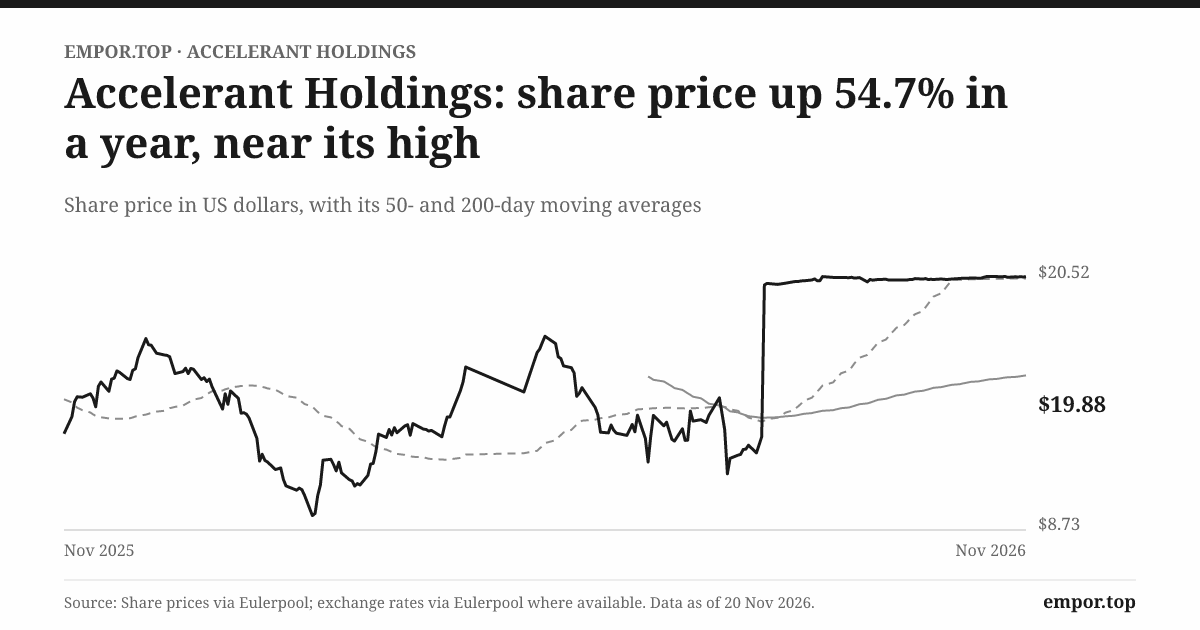
The price was a jolt. Accelerant's shares had closed at $13.61 on August 12, so the offer was a premium of about 49% to the last undisturbed price, and about 54% to the average price of the previous six months.2 By November 20, the stock had drifted up to $19.88, a hair below its 52-week high and only 37 cents short of the cash on the table. A stock that trades that close to a deal price has stopped being a bet on the business and become a bet on the deal closing. The market value of roughly $4.4 billion now reflects that bet more than any view of the future, and the transaction itself was described as worth more than $4 billion in enterprise value.4
Those two "values" are worth a moment, because they foreshadow the whole story. Standard data services put Accelerant's enterprise value at only about $1.9 billion, because they subtract the cash on its balance sheet from its market value, and Accelerant had about $2.1 billion of cash and equivalents at the end of September.5 For a software company that subtraction would be reasonable. For an insurance group it is misleading: much of that cash is there to pay reinsurance disbursements and claims, not to be handed to an owner.6 The gap between the two numbers is a first clue that the usual shortcuts do not work here. Accelerant is part marketplace, part insurer, part collection of insurance agencies, and every simple metric bends when it touches the company.
There was another number that made the offer feel less like a triumph than the premium suggested. Accelerant had gone public only thirteen months earlier, in July 2025, at $21.00 a share, and the stock had briefly run above $30 that August.4 Then, in February 2026, it fell to around $9 in a sell-off across insurance distribution stocks, set off by fears that AI-powered rate-comparison tools could squeeze intermediaries.4 Thoma Bravo's offer rescued holders who bought at the bottom. For anyone who bought at the IPO and held, it was a cash exit slightly below the price they paid. A trade publication summed up the arc in its headline: from a 55-times growth story to a 12-times buyout target.4
So the central question is not only whether $20.25 is a fair price. It is whether the deal cuts short a public-market story just as the economics were becoming legible. Accelerant had built something large. The volume of insurance premium flowing through its exchange reached about $4.9 billion over the twelve months to September 2026, and the number of specialist underwriting firms using it rose to 340.3 Yet its reported revenue and earnings moved unevenly from quarter to quarter, sometimes for reasons that had little to do with the operating business. Can Accelerant keep turning specialty premium growth into durable fee revenue? And what does a private equity firm's willingness to pay for that engine say about its value?
One clarification before going further. This is the story of Accelerant Holdings, the Cayman Islands company listed on the New York Stock Exchange under the ticker ARX. It has no substantial standalone operations of its own; it is the holding company above the insurance and reinsurance carriers, the agency businesses and the technology that make up the Accelerant Risk Exchange.6 It is not Altamont Capital Partners, the private equity firm that controlled it, and it is not Thoma Bravo, the firm that wants to buy it. Both of those firms matter enormously to the plot, but their economics are not Accelerant's.
The story runs along three threads. The first is how the Risk Exchange works, and why a specialist insurance underwriter would hand part of its economics to a platform. The second is whether that growth is defensible, which means testing the moat claims against the evidence the company has published. The third is what public shareholders give up, and what they receive, in the take-private. To follow any of them, it helps to start with the small, specialised firms at the bottom of the insurance food chain, and the problem they could not solve on their own.
 Subscribe on LinkedIn
II. The MGA With a Capacity Problem
Picture a team of six underwriters in a modest office who know more about one narrow kind of risk than almost anyone else. Perhaps it is crop insurance for a particular region, or liability cover for craft breweries, or property insurance for coastal holiday rentals. They know the loss patterns, the warning signs, the brokers who bring good business and the ones who bring trouble. What they do not have is a balance sheet. They cannot issue an insurance policy, because policies must be issued by a licensed insurer with regulatory capital behind it. They cannot pay a large claim out of their own pocket. They are, in the jargon of the industry, a managing general agent: an MGA, a firm that underwrites and administers business on behalf of insurers that carry the risk.
The MGA model has a simple appeal. A broad carrier cannot afford to employ a world-class specialist for every niche, so it lends its licence and capital to specialists who can. The MGA gets underwriting authority and a commission; the carrier gets access to expertise it could never build in-house. But the arrangement has a fragile centre. The MGA needs an insurer willing to put its name on the policy, often called "paper", and it needs capital providers, usually reinsurers, willing to back the risk. If that capacity is withdrawn after a bad year, or because a carrier changes strategy, the MGA's business can disappear almost overnight. Gallagher Re, the reinsurance broker, has charted how the MGA market matured as premiums rose and how much of the sector's capacity now depends on reinsurance capital, which is another way of saying the specialist is only as secure as the capital standing behind it.78
That is the gap Accelerant set out to fill. The partnership at its root, Accelerant Holdings LP, was formed in 2018, and the business that became the Risk Exchange started small: at the end of 2019, it had 12 Members writing 60 products across seven countries, supported by two risk capital partners.9 Three co-founders shaped it: chief executive Jeff Radke, Christopher Lee-Smith, who runs distribution, and Frank O'Neill, the chief underwriting officer.9 Their design was a market rather than a carrier. Instead of one insurer lending its paper to one MGA, Accelerant would build a platform where many MGAs and many capital providers met, with Accelerant in the middle doing the work of selecting, pricing, monitoring and reporting.
The cast of characters needs a little untangling, because it explains everything that follows. The MGAs are called Members. They bring the specialist business. On the other side are risk capital partners: reinsurers, insurers and other investors who want exposure to specialty insurance risk without hiring hundreds of niche underwriters. Some of those partners are "Risk Exchange Insurers", which issue policies on their own paper through the platform. Accelerant also owns licensed carriers that can issue policies and then pass most of the risk on to reinsurers. In the middle sits Accelerant, which says it sources, manages and monitors portfolios, and charges for doing so.6 The company organises all of this into three reportable segments. Exchange Services, which it calls its core offering, earns fees for running the market. MGA Operations, a fee business too, holds MGAs that Accelerant owns or controls. Underwriting captures ceding commissions from reinsurers and the profit or loss on risk Accelerant keeps.9
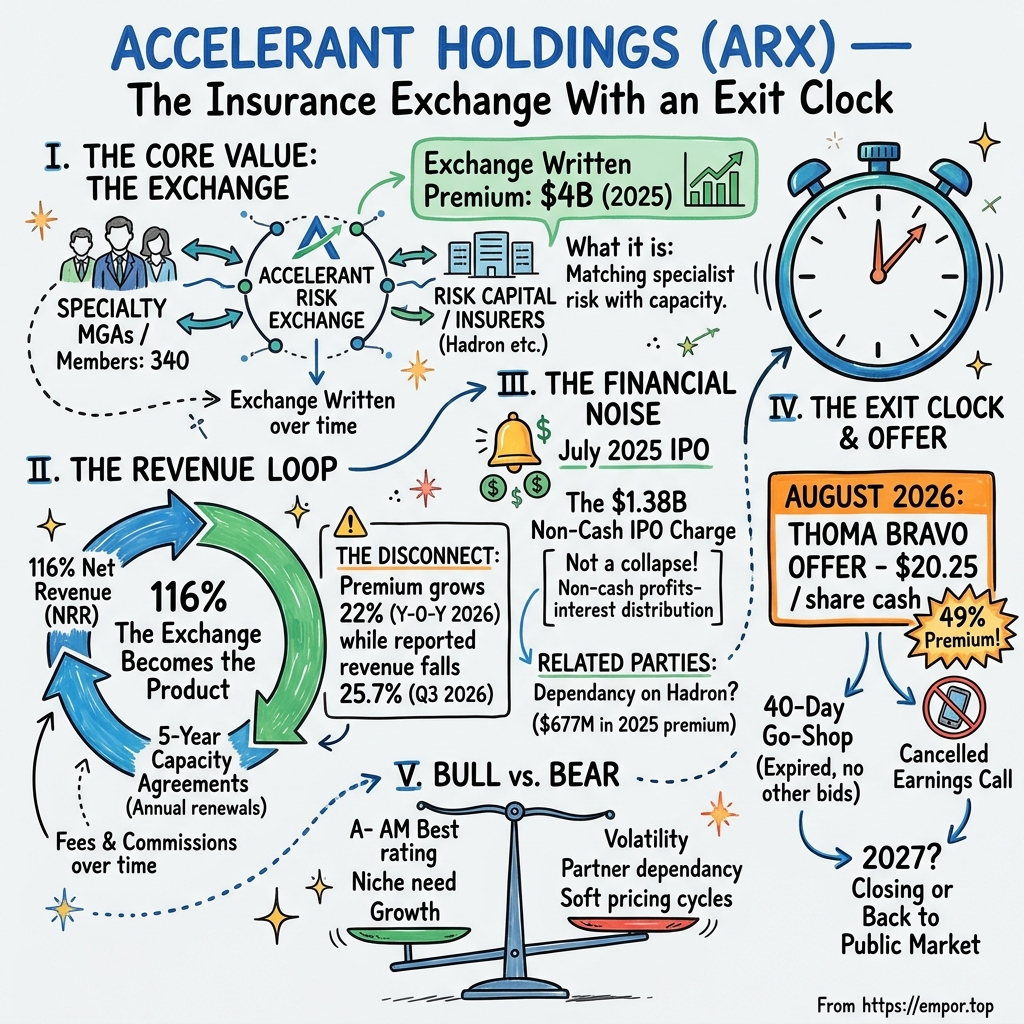
The growth of this market has been fast by any standard. Accelerant's measure of the business flowing through the platform is Exchange Written Premium: the total premium written by Members across all the paper on the exchange. It rose from about $1.8 billion in 2023 to $2.7 billion in 2024 and $4.0 billion in 2025, more than doubling in two years.6 The number of risk capital partners grew from two in 2019 to 96 in 2024.9 The Member count reached 340 by the third quarter of 2026, up from 265 a year earlier.3 And Accelerant has told investors that it is choosy: since inception, it says, it declined about 90% of prospective new Members.9
Here the story needs its first discipline. Exchange Written Premium is not Accelerant's revenue, and confusing the two is the most common mistake anyone can make about this company. Premium is the traffic on the road. When a coastal property MGA writes a $10,000 policy through the exchange, most of that $10,000 eventually belongs to the carriers and reinsurers who bear the risk and pay the claims. Accelerant earns a slice. On business that risk capital partners write directly on their own paper, the company described its charge as a fixed-percentage, volume-based fee for sourcing, managing and monitoring the business, net of performance-based commissions it pays back to Members.9 On business written on Accelerant's own carriers, it reinsured more than 91% of the premium in 2024, earning ceding commissions from the reinsurers in return, and kept a small portion of the risk for itself.9 In 2025, the company's total revenue was about $913 million, against $4.0 billion of exchange premium.6 That is roughly 23 cents of revenue for every dollar of premium, and only a fraction of that 23 cents is the pure platform fee.
That distinction shapes how the scale should be judged. A $4 billion exchange sounds like a large insurer, and in premium terms it is a substantial player in the specialty market. But Accelerant's own economics are closer to those of an operator that charges a toll on the traffic, plus an insurance book that it mostly passes on. What matters for shareholders is how big the toll is, how reliably it is paid, and how much of the risk it keeps when the traffic includes a bad year.
Accelerant is also not alone on the road. The specialty market is fragmented. Other platforms aggregate MGAs and connect them to capacity. Wholesale brokers such as Ryan Specialty run their own delegated-authority businesses and are the nearest public comparison investors reach for, though their mix of brokerage and underwriting management is different.4 Fronting carriers lend their paper to MGAs for a fee. Large specialty carriers can simply write the business themselves. Gallagher Re's market work places Accelerant among the growing program carriers serving MGAs, but there is no listed company with the same blend of exchange fees, owned agencies and retained underwriting, which makes neat peer comparisons hard.78
That leaves the test that will run through every later chapter. A successful MGA that has built a strong record could, in principle, take its book elsewhere: to a fronting carrier, a larger reinsurer, or its own capital. If Accelerant is merely one route to capacity, it will be paid like a commodity route. If the exchange is a network that a Member cannot easily replace, because the data, reporting, claims support and access to dozens of capital providers make it more valuable together than apart, then the toll can grow. Which of those is true depends on what happens when the policy comes up for renewal.
III. The Exchange Becomes the Product
Every insurance policy carries a built-in cliffhanger. Twelve months after it is written, it expires, and someone must decide whether to write it again. For the MGA, the renewal is a chance to keep a customer and perhaps raise the price. For the capital provider, it is a chance to reassess whether the business is profitable enough to keep backing. For Accelerant, it is the moment the marketplace proves its worth: if the Member brings the risk back through the exchange, and a capital provider is still willing to carry it, Accelerant earns again from the next policy year without having to find a new customer.
That is the economic loop the company has been building. It attracts a specialist MGA, finds capacity to back its products, monitors the book with its data tools, and then participates in revenue as the policies renew and the Member's premium grows. Accelerant describes its fees as recurring when the underlying policies renew.10 If the model works, each Member is less a single sale than an annuity: the first year's premium is the floor, and the following years add new products, new territories and rate increases on top.
The best evidence that this loop is turning is a metric Accelerant calls net revenue retention. It compares the revenue from a cohort of existing Members with what the same Members generated a year earlier. A reading above 100% means the existing base, on its own, is producing more than it did. In the third quarter of 2026, net revenue retention was 116%, up from 111% in the second quarter.31 On the face of it, that means existing relationships were generating about a sixth more revenue than a year before, before counting a single new Member.
The Member count tells a similar story of momentum. Accelerant had 314 Members in the second quarter of 2026 and 340 by the third, an addition of 26 specialist firms in three months.13 A year earlier, the count had been 265.3 At the time of its IPO prospectus, Accelerant reported 232 Members as of March 2025, divided into Independent Members, Mission Members and Owned Members, the last being MGAs the company controls.9 The base has grown by about half in eighteen months.
But retention is a measure that deserves a closer look before it carries the weight of a moat. The same third-quarter release that reported 116% also showed that a year earlier, in the third quarter of 2025, net revenue retention had been 135%.3 The sequential improvement from 111% to 116% is real, but it sits within a decline from a much higher level. That is not necessarily a bad sign; a growing base of older Members is bound to expand more slowly than a young one, and specialty insurance rates have been cooling in some lines. Still, it means the expansion engine was running slower in late 2026 than when the company went public. Retention also measures revenue, not margin or cash. A Member whose premium grows 16% can still be a worse customer if its losses rise faster.
There is a second change inside the exchange that matters as much as the Member count. In the third quarter of 2026, 49% of exchange premium was written directly on third-party paper, meaning by outside Risk Exchange Insurers rather than Accelerant's own carriers. A year earlier, that share had been just 32%.3 In the second quarter, it was 47%.1 The shift sounds technical, but it moves more of the exchange toward fee income and away from risk retained by Accelerant. A rising third-party share suggests that outside insurers are increasingly willing to use the platform to write business directly, which is the kind of behaviour a marketplace needs. It also makes Accelerant more dependent on those insurers' appetite, which becomes important when one of them is owned by Accelerant's controlling shareholder.
The contractual skeleton beneath the relationships is sturdier than a single-year insurance policy but not as firm as it first sounds. Capacity agreements generally run for five years, but they renew annually, and Accelerant can terminate them early for performance reasons.10 That five-year term gives continuity, a framework both sides expect to keep using. The annual renewal points mean that pricing, capacity amounts and risk appetite are revisited every year. A capital provider that sees a disappointing loss ratio can shrink its line; a Member with a strong record can negotiate better commission terms or test the market. What Accelerant does not publish is the exact pricing on individual policies, any minimum premium commitments, or what share of its revenue is contractually recurring rather than simply expected to recur.10 Investors are asked to infer persistence from retention, not to read it from a contract schedule.
Then there is the technology. Accelerant presents itself as a data-driven platform; its investor website lives at an ".ai" domain, and it markets AI-enabled tools to Members and partners.11 Its annual report describes research and development teams building software, product, data and machine-learning capabilities that underpin the exchange.6 The claim is that because Accelerant sees data across hundreds of portfolios, it can spot deteriorating books earlier, price capacity more accurately and give capital providers a level of transparency they could not get by backing an MGA directly. That is a plausible mechanism. It is also, so far, a claim rather than a measured result. The company does not quantify how its AI tools change pricing, costs or Member outcomes.10 There is no disclosed comparison of loss ratios on monitored portfolios against similar books elsewhere, beyond management's general statement that its approach helps drive lower-than-average loss ratios relative to the broader industry, which comes without an industry benchmark.9
Put the evidence together and the moat case can be made once, carefully. Retention above 100% and a fast-growing Member base suggest that relationships on the exchange are valuable to both sides. A rising share of premium written directly on outside paper suggests the capital side is engaging, not just the Member side. Against that, the company does not disclose its customer concentration, its fee pricing, renewal economics or how often Members leave and where they go. Retention has been measured for only a few years and is now lower than it was a year ago. A network effect requires that each added Member makes the exchange more valuable to capital providers, and each added provider makes it more valuable to Members. The pieces are visible; the proof that they reinforce each other is not yet in the record.
The next proof points are clear enough. Retention needs to hold above 100% across several years and through a softer insurance pricing cycle, when rate increases no longer flatter growth. Revenue from the fee businesses needs to grow at least as fast as premium, which would show that Accelerant is not giving away share of the toll to win traffic. And the gap between premium and revenue needs to be explained in a way that investors can follow. That last test is where the reported numbers start to misbehave.
IV. When Premiums Rose Faster Than Revenue
The third-quarter release in November 2026 should have been a victory lap. Exchange Written Premium rose 27% from a year earlier, to about $1.33 billion for the quarter.3 Over nine months, premium was up 22%.3 Members were up by about 28%.3 And yet, on the standardized revenue series compiled by market-data services, Accelerant's revenue for the quarter fell by about a quarter. For anyone scanning a screen of growth stocks, it looked like a company whose volume was racing ahead while its sales went backward.
The puzzle has a solution, but it takes a few steps. Start with the long arc. On those same data-provider figures, revenue rose from about $100 million in 2021 to about $880 million in 2025, compounding at roughly 60% a year over the last three years, with growth easing from about 82% in 2024 to about 47% in 2025.6 That is fast growth by any standard, though it is slowing as the base gets larger. The company's own income statement groups the lines differently.6 In Accelerant's presentation, 2025 revenue came from four main sources: about $357 million of ceding commission, about $162 million of direct commission, about $298 million of net earned premiums on risk it kept, and about $49 million of net investment income, plus investment gains.6
Each of those lines behaves differently, which is why headline revenue can move in ways that seem disconnected from premium. Ceding commission is what reinsurers pay Accelerant's carriers for business passed on to them. Direct commission includes fees earned when outside carriers write business directly through the platform and commissions earned by the agencies it owns. Net earned premiums are recognised gradually over the life of a policy, not when it is written, so they lag. Investment income and gains depend on interest rates and the value of the bond portfolio at the end of the quarter. Shift the mix of premium between Accelerant's own carriers and outside paper, or have a quarter in which bond prices jump or slump, and reported revenue moves without any change in how much business Members are writing.
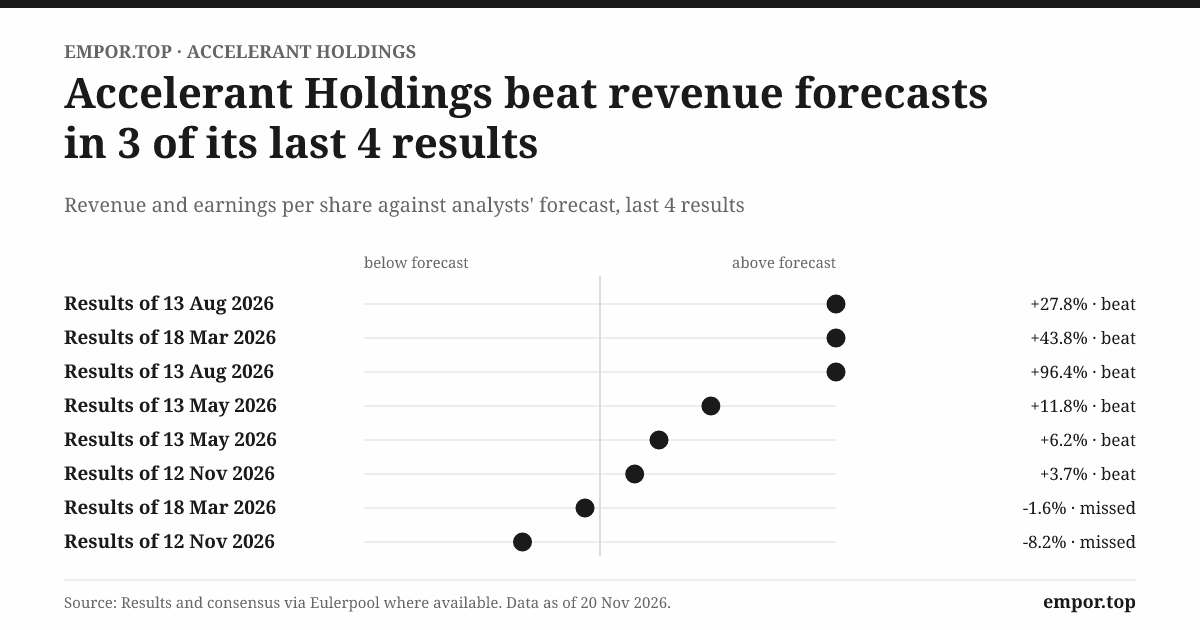
Now look at the third quarter through the company's own statement rather than a standardized feed. Accelerant reported total revenue of about $279 million in the third quarter of 2026, up about 4% from $267 million a year earlier.3 Strip out investment gains and losses, and operating revenue rose from about $228 million to about $280 million, an increase of about 23%.3 The data-provider series and the company's statement simply do not measure the same thing, and where they disagree, the filing is the better guide. Read properly, the quarter did not show revenue collapsing. It showed operating revenue growing a little more slowly than premium, with a large swing in investment results masking part of that growth.
The details reveal two forces at work. The first is the growing role of outside insurers writing directly through the exchange. Ceding commission fell from about $92 million to about $70 million, while direct commission more than doubled, from about $43 million to about $91 million.3 That pattern fits the move toward outside insurers writing business directly: as less premium flows through Accelerant's own carriers to reinsurers, ceding commission shrinks, and fee income from direct writing rises. The company did not explain the change line by line in its release, but the direction is consistent with the rising third-party share.3 The second force is investment marks. In the third quarter of 2025, Accelerant booked about $36 million of unrealized investment gains. A year later, that line was essentially zero, and realized gains swung to small losses.3 On a total-revenue basis, a year-earlier gain of that size makes any comparison look worse.
There is a more uncomfortable detail beneath the reconciliation, and it concerns the part of the business that keeps risk. Accelerant's segment results showed the fee businesses doing well. Exchange Services' operating revenue grew from about $85 million to about $113 million, and its adjusted EBITDA rose from about $59 million to about $74 million.3 MGA Operations' adjusted EBITDA nearly tripled, from about $15 million to $41 million.3 The chief financial officer pointed out that the fee-based businesses together delivered about $85 million of adjusted EBITDA, up 75%.3 But the Underwriting segment swung from about $17 million of adjusted EBITDA to a loss of about $13 million, and the gross loss ratio rose from about 50% to about 57%.3 Accelerant had also increased the share of exchange premium it retains, from 7% to 11%.3 Keeping more risk when losses are running higher is exactly the combination that can turn a fee story into an insurance story, and not in a good way.
Put simply, the third quarter showed the toll road working and the insurance book wobbling. Fee revenue and fee profit grew faster than premium, which is the most encouraging evidence yet that Accelerant can convert traffic into tolls. At the same time, the part of the business that most resembles a traditional insurer had a poor quarter, and its result pulled consolidated adjusted EBITDA margin down from about 29% to about 25%.3 Neither the bullish reading ("premium up 27%") nor the bearish one ("revenue down a quarter") captures what happened. The honest reading is that the business has two engines with different risks, and the reported totals blend them.
The quarter before showed the same machinery running in the other direction. In the second quarter of 2026, the standardized series recorded revenue of roughly $357 million and net profit of almost $79 million, by far the best quarter in Accelerant's public life, and pre-tax profit ran well ahead of operating profit, a sign that items below the operating line, investment results among them, had lifted the total.10 Three months later the same company, with more Members and more premium, reported a loss.3 Nothing in the Member base changed that dramatically between June and September. What changed was the timing of earned premium, the mix of paper, the movement of investment marks and the run of losses on retained business. An investor who annualised either quarter would have drawn the wrong conclusion, and the stock's annualised volatility of close to 70% over the preceding year reflected a market trying to price a business whose quarterly totals kept changing shape.
That blend is why a more useful operating bridge would help investors judge the company. Ideally, Accelerant would show premium from renewing Members separately from new Members, fee revenue by source, the underwriting result on retained risk, and investment and currency effects as distinct lines. It publishes some of these pieces: segment revenue and adjusted EBITDA, retention, Member counts, the third-party share and a retained-premium share.3 It does not publish the renewal and new-Member split of premium, nor fee rates. Without them, investors can see the toll rising but not whether it is rising because of more cars or a higher price per car.
The reconciliation also sets up the next puzzle. If quarterly revenue can be distorted by investment marks and mix shifts, earnings can be distorted much more. And in the year Accelerant went public, its earnings were distorted by an amount larger than its entire annual revenue.
V. The IPO Loss That Wasn't an Operating Collapse
When a company lists on the stock market, the paperwork usually changes more than the business. For Accelerant, the paperwork created a loss of about $1.4 billion. The SEC declared the registration effective on July 23, 2025, and the shares began trading the next day at an IPO price of $21.00, above the $18 to $20 range the company had marketed.1294 Accelerant sold about 20.3 million new Class A shares and selling shareholders sold about 8.7 million more.9 Behind that headline, a much larger set of transactions was taking place.
Three things happened around the listing. Preference shares converted into common shares. About 1.83 million shares were issued to buy the remaining 25% of an agricultural insurance business, a deal that belongs to the capital-allocation chapter. And, most importantly for the income statement, Accelerant Holdings LP, the partnership that sat above the company, distributed about 65 million shares it held to officers and employees to settle profits-interest awards.6 Profits interests are a common way for private equity-backed companies to reward management: instead of stock options, employees receive a share of the future gain in value above a threshold. At the IPO, those interests were converted into actual shares.
Accounting rules required Accelerant to recognise the value of those shares as an expense, about $1.38 billion, at the moment they were delivered.6 That one charge turned what would have been a profitable year into a reported net loss of about $1.4 billion for 2025.6 In the third quarter of 2025 alone, the profits-interest distribution expense was about $1.38 billion, against a reported net loss of about $1.37 billion for that quarter.3 The company did not pay that $1.38 billion in cash. The shares came from the partnership, not from new money raised or spent, and the expense was matched by an equal capital contribution in shareholders' equity.6 In plain terms, the owners above the company handed part of their stake to employees, and the accounting recorded that gift as if the company had paid for it.
That is why the 2025 loss is not a useful verdict on the platform's health. It is not cash burn, not an operating failure and not an underwriting disaster. It also did not wipe out the balance sheet: shareholders' equity rose from about $409 million at the end of 2024 to about $698 million at the end of 2025, helped by IPO proceeds.6 The charge was a one-time transfer of value from the old owners to the people who built the business, made visible by the listing. Anyone looking at a screen that shows a return on equity of minus 194% for 2025 is looking at an accounting artefact.
But the explanation is not a permission slip to ignore GAAP earnings altogether. Strip out the IPO charge and Accelerant's reported profits remain volatile. In the third quarter of 2026, the company reported a net loss of about $9 million and a loss per share of six cents, even as adjusted net income was about $38 million and adjusted EBITDA about $71 million.3 The gap between those two pictures came mainly from about $32 million of share-based compensation and about $22 million of "other expenses" that management excludes from its adjusted measures.3 Share-based compensation is a real cost to shareholders, even if it is not paid in cash, because it dilutes their ownership. A business that habitually excludes stock compensation and recurring "other" expenses from its profit measure deserves scrutiny of whether those exclusions stay consistent over time.
Accelerant did change its definitions during its short public life. Since the first quarter of 2026, its non-GAAP measures exclude realized and unrealized investment gains and losses, and it recast the prior-year figures to match.3 That change is defensible, because investment marks are not part of the fee business. It also shows how much those marks mattered. In 2025, net investment income plus realized and unrealized gains totalled about $96 million, a meaningful contribution compared with the company's operating earnings before the listing.6 When bond prices rose, they flattered results; in the third quarter of 2026, they barely moved, and the comparison suffered.
Currency is a smaller but real factor. Accelerant has assets, liabilities, revenues and expenses in euros, pounds and Canadian dollars, and subsidiaries in Europe, the UK and Canada.6 Its policy is to match foreign-currency insurance liabilities with assets in the same currency where possible, and it says it continues to assess further hedging.6 Even so, net foreign-exchange losses were about $20 million in 2025, after a gain of about $5 million in 2024.6 For a business whose quarterly GAAP profit can sit within a few million dollars of zero, a currency swing of that size can decide whether a quarter shows a profit or a loss.
Cash flow tells a version of the same story, with its own caveats. Accelerant generated about $445 million of operating cash in 2025, after about $785 million in 2024.6 For an insurance group, operating cash includes premiums collected before claims are paid, reinsurance settlements and investment receipts, so it is not a clean measure of how much the fee business earns.6 At the parent-company level, the holding company itself had negative operating cash flow of about $115 million in 2025, reflecting corporate costs and changes in balances with subsidiaries and related parties.6 Cash on the consolidated balance sheet is abundant; cash that belongs unambiguously to shareholders is a smaller, harder-to-measure number.
The IPO, then, was a structural turning point that turned private partnership economics into public-company earnings. Public investors inherited a more visible but unusual earnings profile, in which the fee business's progress was routinely obscured by investment marks, currency, stock compensation and an enormous one-time charge. Separating those effects is not optional for anyone trying to value Accelerant. It is also not the only place where the structure of ownership shaped the numbers. The partnership that gave away the shares had a controlling shareholder of its own, and that shareholder's reach extended onto the exchange itself. That same volatility can distort earnings even more. And in the year Accelerant went public, its earnings were distorted by an amount larger than its entire annual revenue.
VI. Hadron and the Question of Who Depends on Whom
Buried in the related-party note of Accelerant's 2025 annual report is a name that rarely appears in the company's marketing: Hadron. Hadron is an insurer, majority-owned by Altamont Capital Partners, the private equity firm whose affiliates controlled Accelerant.6 It is also one of the Risk Exchange Insurers that issue policies on their own paper through Accelerant's platform. In 2025, Hadron accounted for about $677 million of Exchange Written Premium, up from about $216 million in 2024.6 In a single year, the volume written through one Altamont-controlled carrier more than tripled.
The scale of that number needs careful handling, because it is easy to misread. Hadron's $677 million is premium, not Accelerant's revenue or a payment from Hadron to Accelerant.6 Measured against the $4.0 billion of exchange premium in 2025, Hadron's business was about a sixth of the total. Accelerant earns its fees on that business in the same broad way it earns them on other third-party paper, but the company does not disclose how much of its fee revenue comes from Hadron, what fee rate applies, or how the Hadron contracts compare with those of independent insurers.6 The 13 Risk Exchange Insurers on the platform together wrote 19% of premium in the first quarter of 2025, which gives a sense of how quickly one of them grew to rival that whole group's earlier share.9
Why does this relationship deserve attention, when it is not a revenue customer in the usual sense? Because in a marketplace, the capacity side is half the network. If one capital provider supplies a growing share of the paper, and that provider is controlled by the same owner who controls the marketplace, two questions follow. The first is dependency: if Hadron reduced its participation, could Accelerant replace that capacity with independent insurers at similar terms? The second is governance: were the terms set at arm's length, or did the shared owner shape them? Accelerant's annual report records the affiliation but does not describe the Hadron relationship as an arm's-length customer contract.6 And because Hadron writes on its own paper, its growth is likely part of the rise in the third-party direct share of premium, which otherwise reads as evidence of outside insurers embracing the platform. The company does not say how much of that rise Hadron accounts for.
The counterweights are real, and they limit the size of the direct financial relationship that Accelerant has identified. Advisory fees and expenses paid to Altamont Capital Management, the affiliate, were about $0.8 million in 2025, after $0.2 million in 2024 and $2.8 million in 2023.6 Those are trivial sums next to roughly $900 million of revenue. Related-party receivables, amounts owed to Accelerant by related parties, fell from about $7.6 million at the end of 2024 to nil at the end of 2025.6 There is no royalty, brand fee or intercompany loan to the controlling shareholder in the related-party note.6 One more payment is worth adding to the record, though: the IPO prospectus earmarked $25 million of the offering proceeds for a one-time termination fee to an Altamont affiliate, a common way for a sponsor to end a management agreement at listing.9 The direct cash flows to the sponsor, in other words, were modest and mostly ended at the IPO.
What the public record does not answer is the more consequential question. Accelerant does not disclose Hadron's share of fee revenue, the contract terms on its capacity or how those terms compare with independent Risk Exchange Insurers. Nor does it say whether comparable independent capacity would be available if Hadron's appetite changed. It also does not say how Hadron's business has performed on the exchange in loss terms. For a company whose third-quarter underwriting segment swung to a loss as its gross loss ratio rose, knowing which capacity providers are writing which business, and how profitably, would matter a great deal.
Hadron is not the only place where capacity clusters. In 2022, Accelerant formed Flywheel Re, a reinsurance sidecar that it does not consolidate, and by March 2025 about 26% of the company's risk capital came from it.9 A sidecar is a vehicle that lets outside investors take a slice of an insurer's risk without buying the insurer, and it can be a cheap, flexible source of capacity. It is also, by construction, a concentrated one. The prospectus itself warned that losing one existing risk capital partner could leave the company more concentrated in the remaining counterparties as premium grew.9 Accelerant reinsured more than nine-tenths of the business written on its own carriers, so the real counterparty question is not only who writes policies but who stands behind them: at the time of the IPO, the company carried about $1.64 billion of reinsurance recoverables, money that reinsurers owed it on claims.9 A marketplace that advertises 96 capital partners can still depend heavily on a handful.9
Altamont's influence went well beyond Hadron. At the IPO, Altamont's affiliates held about 100 million Class B shares, each with ten votes, giving them about 79% of the combined voting power; other holders were capped at 9.9% of the vote.9 Accelerant listed as a "controlled company" under NYSE rules, which allows it to skip certain board-independence requirements.9 By the time of the merger proxy, Altamont's holders still controlled more than half of the voting power, enough on their own to approve the transaction, and they signed an agreement to vote for it.2 A trade publication put Altamont's control at roughly 82% of outstanding stock and noted that the founders and Altamont would keep equity alongside Thoma Bravo after closing.4 The definitive proxy will carry the final ownership table and rollover elections; the preliminary version left those percentage fields blank.2
So the Hadron question is not a scandal; it is a structural feature that investors should understand. Accelerant's controlling shareholder owned a significant capital provider on the exchange, that provider's volume grew very quickly, and the economic terms were not published. The direct payments that could be measured were small. The dependency that could not be measured was potentially large. When an owner sits on both sides of a marketplace, the marketplace's independence becomes part of the value proposition, and that independence is something the coming private owner will inherit. Before turning to what Thoma Bravo is buying, it is worth asking how Accelerant spent its own capital while it was public.
VII. From Building the Platform to Buying the Rest
In the run-up to the IPO, Accelerant completed its ownership of Agribusiness Risk Underwriters (ARU), the agricultural insurance business, with a share issue.6 It was not a headline deal. There was no press conference, no grand strategic narrative of transformation. But it was a real capital-allocation choice: Accelerant chose to pay in stock to own all of a specialty underwriting business rather than leave a minority with outside partners.
The ARU decision fits a broader pattern in how Accelerant has deployed capital. The company's MGA Operations segment holds agencies it owns or controls, and owning MGAs outright lets it capture both the agency commission and the exchange fee on the same business.9 In the third quarter of 2026, that segment's adjusted EBITDA nearly tripled from a year earlier, suggesting the owned agencies had become a meaningful profit engine.3 Acquisitions like ARU can add underwriting capability in niches that the exchange wants to serve. They also add the risks every insurance roll-up faces: paying too much for books whose losses emerge later, and blurring the line between neutral marketplace and competitor to independent Members.
On ARU itself, the record is thin. Accelerant does not publish a purchase price multiple, the earnings of the business acquired, or a comparison with similar deals. The value of 1.83 million shares depends on the price assigned to them at the time, and without the underlying earnings, there is no way to say whether ARU was bought cheaply or expensively.6 What can be said is narrower. The evidence points to platform investment and a targeted ownership completion, not to a documented spree of acquisitions.
The larger and steadier investment has gone into the platform. Accelerant does not report a separate R&D expense, but it capitalises software development, and those additions rose from about $36 million in 2023 to about $44 million in 2025.6 Measured against the revenue series, that fell from roughly a tenth of revenue to roughly a twentieth, because revenue grew far faster than the software budget.6 That ratio should not be read too literally. Capitalised software is only the part of technology spending that accounting rules allow to be recorded as an asset; salaries for engineers maintaining systems, data costs and many AI experiments are expensed and buried elsewhere. Depreciation and amortisation of about $35 million in 2025 included both capitalised technology and acquisition-related intangibles.6 The direction suggests that Accelerant gained operating leverage on its technology spend as volume grew. Whether that reflects efficiency or underinvestment cannot be settled from the outside.
It also helps to remember how short the record is. Accelerant's partnership was formed in 2018; it reorganised into its current holding structure in December 2021, and it listed in July 2025.9 There is no decade of public-company history to test management's capital allocation through a downturn, no record of large write-offs or marked-down acquisitions to examine, and no prior cycle in which the exchange's growth faltered. The IPO is the major inflection point, and the company had been listed for just over a year before it agreed to leave the market.
In that year, Accelerant did try one classic public-company capital move. In the second quarter of 2026, after the shares had fallen sharply from their IPO highs, it repurchased about 4.73 million Class A shares for about $66 million, leaving about $123 million of authorization.1 Over the first nine months of 2026, repurchases totalled about $84 million.3 Buying back shares at around $14 looks well-timed in hindsight against a $20.25 cash offer. It also reflects a board that believed the market was undervaluing the business, a belief it soon expressed in a much bigger way. By the time the buyback authorization had a chance to matter, the pending merger had overtaken it as the defining capital decision of Accelerant's public life.
VIII. $20.25, a Go-Shop, and a Call That Never Happened
The courtship began with an email. On March 2, 2026, Jeff Radke received an unsolicited message from Thoma Bravo.2 The timing was not accidental: the shares were still reeling from the winter sell-off.4 For a private equity firm that specialises in software and data businesses, a platform company priced like a distressed broker looked like an opportunity.
What followed was a five-month negotiation that the preliminary merger proxy lays out in detail. Accelerant and Thoma Bravo signed a confidentiality agreement on March 24.2 The board was told in June of an exploratory indication of interest, and the company lined up legal advisers and Morgan Stanley as its financial adviser.2 On July 17, Thoma Bravo put a number on the table: a non-binding proposal of $17.00 to $18.00 a share.2
Ten days later, on July 27, the board formed a special committee of independent directors, chaired by Karen Meriwether, with Paul Little, David Talach and Simon Wainwright as members.2 The board told Thoma Bravo that $17 to $18 was not enough and directed Morgan Stanley to test the market. Over the following two weeks, Morgan Stanley contacted 17 potential buyers; eight signed confidentiality agreements and nine declined.2 None of them produced an offer before signing.
The price then moved in a series of steps that tell their own story about leverage. On August 3, Thoma Bravo raised its proposal to $19.00.2 On August 10, it offered what it called a final proposal of $19.50 a share, plus a 4% annualized "ticking fee" if regulatory approvals dragged on, and set a deadline before the market opened on August 13.2 Accelerant pushed back, asking for at least $20.50 and a higher ticking rate. Thoma Bravo came back at $20.25 with a 6% ticking amount, describing it as its best and final offer.2 The special committee and the board approved the deal, and it was signed on August 13.2 From the first indication to the signed price, the committee extracted roughly $2.75 a share, or about 15% above the top of Thoma Bravo's opening range.
The ticking amount is a clever piece of engineering worth understanding. Taking over an insurance group requires approvals from insurance regulators in several jurisdictions, and those approvals can take many months. To compensate shareholders for waiting, the agreement adds about a third of a cent per share for each day after all other conditions are satisfied but specified insurance-regulatory approvals remain outstanding.2 On a $20.25 price, that works out to about 6% a year.2 It shifts some of the cost of regulatory delay from shareholders to the buyer, which is a genuine protection, though it only begins once everything else is in place.
The agreement also included a go-shop, a window in which Accelerant could actively solicit better offers. It ran for about 40 days, until just before midnight on September 22.2 On September 23, Accelerant announced that the go-shop had expired without any alternative acquisition proposal.13 A bidder that emerged during the go-shop would have triggered a smaller break fee than the standard $136.5 million Accelerant would owe if it walked away for another deal later.2 No one took advantage of the discount.
How should the price be judged? The offer was above the November 20 close but below the $21.00 IPO price; investors who bought during the winter panic would roughly double their money.24 A premium is always measured from somewhere, and from the IPO it is not a premium at all.
The trailing multiples that market screens produce are of little help. At $19.88, Accelerant traded at about 73 times trailing earnings, about 5.9 times book value and about 4.6 times sales. Those numbers are distorted by volatile GAAP profits, a book value shaped by the IPO's accounting, and a sales line that blends fees with insurance premium. A trailing earnings multiple of 73 times does not mean the market thought Accelerant was expensive; it means the last twelve months of earnings were unusually depressed by stock compensation, currency and underwriting noise.
Morgan Stanley's analysis in the proxy takes a different, more useful approach. It valued the fee business separately from underwriting, and its illustrative range for the fee-based business alone was $16.25 to $26.00 a share, with the underwriting operation valued on its own.2 It also put the transaction at about 13.7 times adjusted EBITDA for the twelve months to June 2026, falling to about 9.4 times on 2027 estimates.2 Those adjusted multiples are not comparable with the EV-to-EBITDA ratios on market screens, which use GAAP figures and subtract all of the insurance group's cash. A trade publication's own estimate, about 12 times trailing adjusted EBITDA, against roughly 12.6 times for Ryan Specialty, suggests Thoma Bravo paid a multiple in line with the nearest listed comparison rather than a growth premium.4 The width of Morgan Stanley's fee-business range is itself revealing. When the plausible value of the core engine spans from 20% below the offer to almost 30% above it, the deal price is less a precise measurement than a negotiated settlement of uncertainty.
The governance protections deserve a fair hearing. An independent special committee led the final negotiation, retained its own financial adviser, Houlihan Lokey, and obtained a fairness opinion dated August 13.2 Morgan Stanley gave the company's board a separate opinion.2 The board recommended the deal. The go-shop gave rival bidders a real, if short, chance to step forward. Because the transaction involves affiliates of the company, Accelerant also filed a Schedule 13E-3, the SEC disclosure required for going-private deals with insider participation.14
The other side of the ledger is about who controls the outcome. Altamont's holders signed a voting and support agreement, and they held enough shares on their own to approve the merger.2 The deal requires a special resolution passed by two-thirds of the votes cast, but with the controlling shareholder committed, the vote is effectively settled before it is held.2 The founders and Altamont are also expected to keep equity alongside Thoma Bravo after closing.4 That arrangement aligns them with the buyer's future success, but it also means the people who negotiated and supported the price will participate in whatever upside the private company captures. Public holders get cash; the insiders get cash and a seat in the next chapter.
Executive interests sharpen that point. The merger proxy describes accelerated vesting of equity awards, severance arrangements, prorated bonuses, a transaction bonus for one executive and continued roles for some managers.2 Performance share units are fixed at 250% of target for 2026 and 100% for 2027 and 2028, regardless of actual performance.2 The IPO prospectus had also disclosed that about 54.8 million Class A shares, more than half the class at the time, were pledged to secure loans to executives, including the three co-founders.9 None of this proves the price was unfair. It does mean that the people closest to the deal had personal financial reasons to want it completed, which is exactly why the special committee's role matters so much.
The leadership itself had already changed during the company's brief public life. The chief financial officer at the IPO, Jay Green, had been succeeded by Linda Huber by the second quarter of 2026.1 The scheduled earnings calls that might have let analysts probe the numbers, and the deal, simply stopped. That is the quiet cost of a take-private announced in the middle of a reporting cycle: the public conversation about the business ends at precisely the moment its economics were getting interesting.
Much remains undone. The preliminary proxy was filed on October 30, with blank fields for share counts, the record date and the meeting date.2 The shareholder vote has not been held. Regulatory approvals are pending, and the company expects closing in the first half of 2027.3 Until then, the price of $20.25 is a promise, not a payment. To judge whether it was the right promise, the business has to be weighed on its own merits.
IX. The Case for the Exchange—and the Case Against It
Imagine two decisions being made on the same morning. In one office, a specialty MGA's underwriting team reviews its renewals for the coming year. Its book on the exchange has grown; it wants to add a new product in a neighbouring state and needs more capacity to do it. In another office, a reinsurer's portfolio manager reviews the same MGA's loss data, delivered through Accelerant's reporting tools, and decides how much of next year's risk to support. Accelerant's value lives in the space between those two decisions. If both sides keep saying yes, and keep saying it through Accelerant, the company compounds. If either side starts saying no, or starts saying yes somewhere else, the toll road loses traffic.
The bull case begins with the evidence of demand. Members grew to 340 by the third quarter of 2026, net revenue retention was 116%, and 49% of exchange premium was written directly on outside insurers' paper, up sharply from a year earlier.3 The fee businesses' adjusted EBITDA grew 75% in the latest quarter, faster than premium.3 Those numbers suggest that Members want what the exchange offers, that capital providers increasingly trust it, and that the platform can turn more traffic into more toll.
The structural argument supports the evidence. Specialty MGAs need capacity, claims infrastructure and reporting; they cannot build all of it themselves, and the capital market for specialty risk prefers diversified, well-monitored portfolios to one-off bets on single agencies. A platform that can offer capital providers access to hundreds of curated MGAs, with consistent data, solves a real coordination problem. Accelerant's selectivity, declining about 90% of applicants, supports a reputation for quality that capital providers might pay for.9
Financial strength adds a third leg. A.M. Best rates the group A− (Excellent) with a stable outlook and assesses its balance-sheet strength as "Very Strong," citing the strongest level of risk-adjusted capital on its BCAR model.156 That is a rating of claims-paying ability, not of the shares, but it matters commercially: brokers and policyholders care whether the carrier behind a policy will pay. An insurer-grade rating gives Accelerant's own carriers credibility with buyers of specialty insurance.
The bear case starts with what the company does not show. It does not disclose its top-customer revenue concentration, fee pricing, contract minimums or a long history of retention by Member cohort. Retention, though healthy, fell from 135% to 116% over the year to the third quarter of 2026.3 Exchange premium grew, but the retained underwriting book swung to a loss as the gross loss ratio climbed to about 57%.3 And a single Altamont-controlled insurer, Hadron, wrote about a sixth of exchange premium in 2025, on terms that are not published.6
The bear case also has the insurance cycle on its side. Specialty insurance has enjoyed several years of rising rates, which inflate premium growth without any increase in the number of policies. When rates soften, premium growth slows, and capital providers, who have more alternatives, tend to demand better terms. A.M. Best's rating discussion lists the constraints that could hurt: adverse loss development, regulatory problems, the loss of senior managers, investment losses, liquidity strains and excess capacity in the market.6 Each is a mechanism through which a platform's growth can stall.
There is also a reminder in the company's own history that counterparty risk is not theoretical. In 2023, Accelerant discovered falsified letters of credit, which left about $23 million of reinsurance recoverables not effectively collateralized.9 A marketplace that relies on dozens of capital providers is only as strong as its ability to verify that their promises are real. The amount was manageable against $1.64 billion of reinsurance recoverables at the time of the IPO, but the episode shows that the monitoring the company sells has had gaps.9
Porter's five forces help organise these tensions. The bargaining power of suppliers, here the capital providers, is substantial: reinsurers and insurers can allocate capital to many specialty markets and can deal directly with MGAs, fronting carriers or other platforms. The power of buyers, the MGAs, rises with their success; a Member with a strong loss record has alternatives and can negotiate better commissions or leave. The threat of substitutes is real, because fronting carriers, wholesale brokers with delegated-authority businesses, and large carriers writing directly all offer different routes to the same end. Rivalry among MGA aggregators and program carriers is intense in a fragmented market. The threat of new entrants is moderated by regulation and capital: building licensed carriers, an A− rating and a network of dozens of capital providers takes years and hundreds of millions of dollars. On balance, the industry structure gives Accelerant some protection from new entry but leaves it exposed to both sides of its market.
Hamilton Helmer's 7 Powers framework sharpens the moat question. Of the seven, two are plausibly relevant: network economies, if each Member makes the exchange more valuable to capital providers and vice versa; and switching costs, if Members' data, reporting and capacity arrangements are hard to move. Retention above 100% is consistent with both. But a single KPI cannot establish either power. Network economies would show up as independent capital providers joining because of the Member base, and as falling cost of capacity as the network grows. Switching costs would show up as very low Member attrition and stable fee rates even when competitors offer cheaper capacity. Accelerant does not publish attrition, fee rates or cost of capacity. Scale economies may be emerging in the technology budget, which grew more slowly than revenue. Counter-positioning, cornered resources, brand and process power are not established by the record. The verdict is that the moat is plausible rather than proven: the evidence narrows the claim from "network-effect marketplace" to "fast-growing, selective platform with promising retention," and the proof that would upgrade it, multi-year retention through a soft market and independent capacity growth, has not yet arrived.
AI belongs in this discussion, but in proportion. The February 2026 sell-off was driven by fears that AI would disintermediate insurance distribution, and Accelerant's own pitch leans on data and machine learning as an underwriting edge.411 Both claims, the threat and the promise, are unproven for this company. AI may improve underwriting selection and lower operating costs for a platform that sees data across hundreds of portfolios. Accelerant does not quantify savings, pricing improvements or loss-ratio benefits from its tools.10 For now, the most defensible reading is that AI is an enabler of the exchange model, not the source of its advantage.
Three KPIs will tell investors which case is winning. The first is Exchange Written Premium growth, which reached about $4.9 billion over the twelve months to September 2026 and grew 27% in the latest quarter, slowing from faster rates in 2024 and 2025.36 The second is net revenue retention together with Member additions: 116% and 340 Members in the third quarter, retention up from the second quarter but down from 135% a year earlier.3 The third is the fee business's contribution separated from underwriting, investment and currency effects, which in the third quarter meant about $85 million of fee-business adjusted EBITDA against a loss in underwriting.3
The stress test follows from those KPIs. If premium keeps growing while fee revenue, retention or adjusted profitability weaken, or if capacity becomes more concentrated in a few related or unrelated providers, the scale story may not translate into durable shareholder value. If, on the other hand, retention holds above 100% through a softer rate cycle and fee revenue keeps outrunning premium, the platform case would be substantially stronger than the public market gave it credit for at its February low. Thoma Bravo has evidently bet on the second outcome. Public holders who accept the cash will not find out.
X. Playbook: Business & Investing Lessons
The first lesson begins at the toll booth. Accelerant's exchange premium translated into only a fraction as revenue, and a smaller fraction as pure platform fees.6 Founders building marketplaces in heavy, regulated industries face the same temptation to lead with gross volume, because it is the biggest number they have. Investors should always ask how much of that volume the company keeps, how reliably, and at what risk, because a marketplace is valued on its tolls, not its traffic.
The second lesson comes from the summer of the IPO. An IPO can change the earnings story without changing the claims. Accelerant's IPO-related share award created a $1.38 billion non-cash expense and a reported loss for the year that exceeded revenue.6 Nothing about the policies, the losses or the Members changed. For founders, private-equity-style incentive structures that are invisible in private ownership can become headline numbers in public ownership. For investors, the discipline is to separate non-cash transfers of value from underwriting and fees, and then to apply the same scepticism to the adjustments management makes in quieter quarters.
The third lesson is about both sides of the market. A marketplace is only as durable as both sides' reason to return. Accelerant reported retention above 100%, but did not publish capital-side concentration; one fast-growing capacity provider was owned by its controlling shareholder.36 Builders of two-sided platforms tend to measure the side they sell to most carefully. In a capital-intensive marketplace, the supply side, here the capital, may be the scarcer and more fickle one.
The fourth lesson belongs to the deal. A high-premium exit is still a decision about the future you surrender. Thoma Bravo's offer followed a sector-wide sell-off4 and survived a go-shop untouched.213 It was also below the IPO price. Public shareholders get certainty; insiders and the buyer get the option on whatever the platform becomes. A premium measured from the bottom of a sell-off answers one question, whether the price is higher than last week's, and leaves open the more important one, whether it reflects what the business could compound into.
There is a quieter fifth lesson for anyone investing in controlled companies. When a sponsor controls the vote, the board's protections, from special committees to go-shops, are the only negotiating leverage minority holders have. Accelerant's committee moved the price above the buyer's opening range.2 That is meaningful. It is also the ceiling of what process can do when the outcome of the vote is known in advance.
XI. Epilogue
Tonight, Accelerant is a public company on borrowed time. The remaining steps are a definitive proxy with the final deal disclosures2 and a shareholder meeting whose outcome is all but certain, because the controlling holders have committed their votes.2
The real uncertainty lies with regulators. Insurance-regulatory approvals in several jurisdictions remain outstanding, and Accelerant expects closing in the first half of 2027.3 The ticking amount compensates holders if those approvals delay closing.2 A clean, timely closing would make the November 20 price look like a modest discount for waiting. A delayed one would reward patient holders a little more. A failed one would reopen everything.
If the deal closes, the story becomes Thoma Bravo's. It will test whether the exchange can compound under private ownership. The founders and Altamont, staying in alongside the new owner, will be judged in private rather than in quarterly calls.4
If the deal fails, the public-market case returns immediately, with the same questions about growth, earnings quality, underwriting risk and capacity independence. Investors would also be pricing a company that had just watched a buyer walk away.
Either way, the operating test continues. Accelerant has built a sizable exchange in less than a decade. Whether it can keep compounding through a softer market is a question that the $20.25 price settles for public shareholders but does not settle for the business.
XII. Outro
Return to where this began: a share price a few cents below a cash offer, and a conference line that never opened. Somewhere behind those numbers, a specialist underwriter is renewing a policy for a vineyard, a warehouse or a fleet of delivery vans. A capital provider is deciding whether to stand behind it. And Accelerant, with its Members, is in the middle, taking its toll and keeping its share of the risk.3
The listed company's future now hangs on a shareholder vote and regulators' signatures, but the platform's future hangs on something older: whether that connection between specialist risk and willing capital keeps earning its place, renewal after renewal. Accelerant built a market between risk and capital; now the market is deciding what that connection is worth.
References
-
Accelerant Announces Second Quarter 2026 Results — Accelerant, 2026-08-13 ↩↩↩↩↩↩
-
Preliminary Merger Proxy Statement (PREM14A) — Accelerant Holdings, 2026-10-30 ↩↩↩↩↩↩↩↩↩↩↩↩↩↩↩↩↩↩↩↩↩↩↩↩↩↩↩↩↩↩↩↩↩
-
Accelerant Announces Third Quarter 2026 Results (Exhibit 99.1) — Accelerant Holdings, 2026-11-12 ↩↩↩↩↩↩↩↩↩↩↩↩↩↩↩↩↩↩↩↩↩↩↩↩↩↩↩↩↩↩↩↩↩↩↩↩↩↩↩↩↩
-
An Insurance Exchange's Wild Ride — Leader's Edge, 2026-09-22 ↩↩↩↩↩↩↩↩↩↩↩↩↩↩
-
2025 Form 10-K — Accelerant Holdings, 2026-03-12 ↩↩↩↩↩↩↩↩↩↩↩↩↩↩↩↩↩↩↩↩↩↩↩↩↩↩↩↩↩↩↩↩↩↩↩↩↩↩↩↩↩
-
A Mature MGA Market, Rising Premiums, Shifting Risks — Gallagher Re, 2025 ↩↩
-
Form S-1/A (Amendment No. 2) — Accelerant Holdings, 2025-07-18 ↩↩↩↩↩↩↩↩↩↩↩↩↩↩↩↩↩↩↩↩↩↩↩↩↩
-
Notice of Effectiveness — U.S. Securities and Exchange Commission, 2025-07-23 ↩
-
Accelerant Announces Expiration of Go-Shop Period — Accelerant, 2026-09-23 ↩↩
-
AMB Rating Disclosure Report: Accelerant Holdings — A.M. Best ↩
 LinkedIn
 WhatsApp
 Reddit
 Hacker News
 Email
 Kindle
 RSS Feed
 Spotify
 Apple Podcasts
 Amazon Music
 Audible
 YouTube