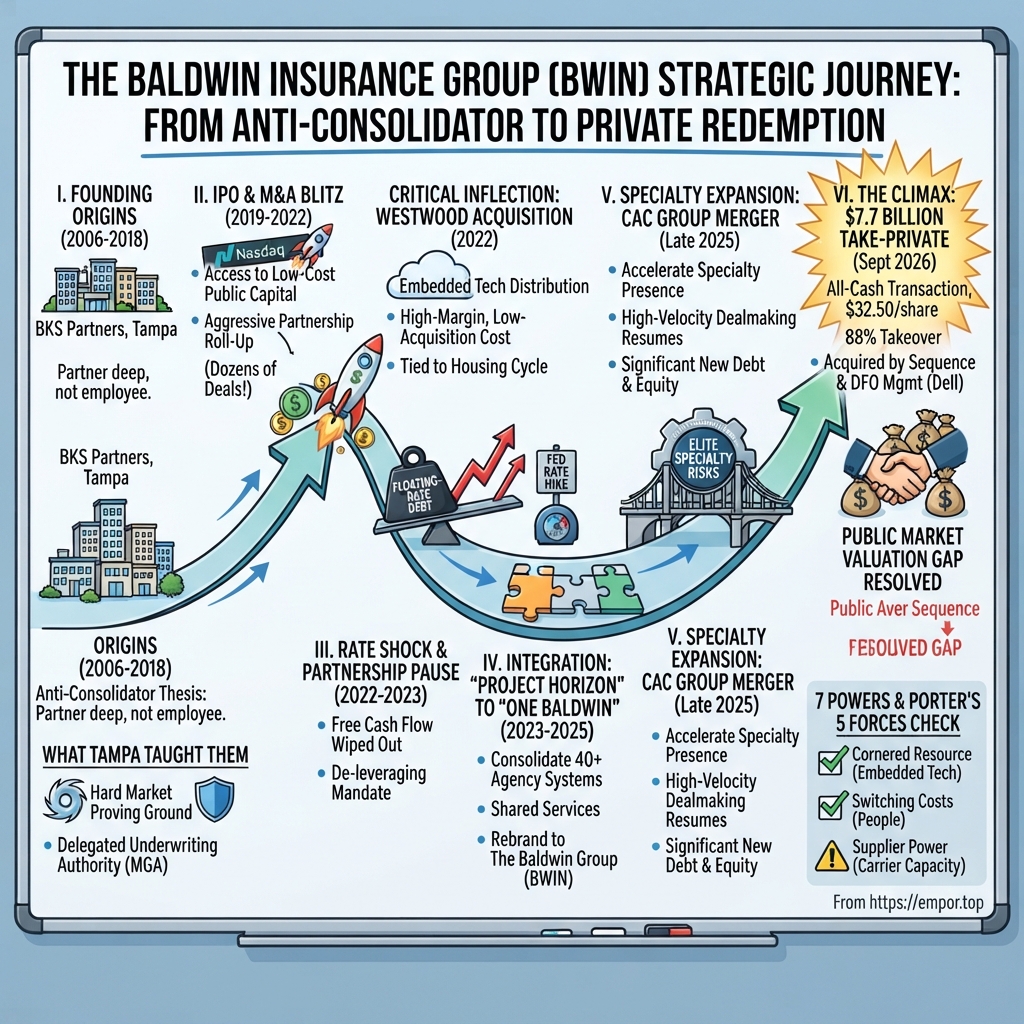
The Baldwin Insurance Group: The Roll-Up That Refused to Be a Private Equity Puppet
I. Introduction & The $7.7 Billion Private Equity Redemption
Before the opening bell on Monday, September 14, 2026, The Baldwin Insurance Group announced a definitive agreement to be acquired by Sequence Holdings and DFO Management—the private investment office of Michael Dell—in an all-cash transaction valuing the brokerage platform at approximately $7.7 billion, with public shareholders set to receive $32.50 per share.[^1]
What drew immediate attention across the financial sector was the size of the takeover premium: 88% above Baldwin's unaffected share price of $17.29 on June 17, 2026, the final trading session before news of a potential sale surfaced.[^1] A premium of that magnitude represented a decisive statement by two institutional buyers that public markets were valuing the firm at nearly half what private capital believed it was worth.
That valuation gap defines the central tension of the transaction. Baldwin was not a distressed business requiring operational rehabilitation. The Tampa-based insurance brokerage had expanded from roughly $138 million in revenue at its October 2019 initial public offering to $1.5 billion in fiscal 2025, delivered 17% organic revenue growth in 2024—a rate well above its large public brokerage peers—and recently absorbed a billion-dollar specialty intermediary.1[^3] Yet its equity spent most of 2026 trading in the high teens, discounted by public investors relative to the multiples commanded by private distribution platforms.
Why Insurance Distribution Is a Beautiful Business
Understanding both the strategic appetite of private acquirers and the persistent public market discount requires examining the economic fundamentals of insurance brokerage, alongside the valuation dynamics of debt-financed roll-ups.
Commercial brokers do not underwrite insurance risk. When a business purchases property and casualty coverage, the underwriting carrier—such as Travelers, Chubb, or Liberty Mutual—assumes the contractual liability on its balance sheet. If a catastrophic loss occurs, the carrier pays the claim. The broker acts as an intermediary, advising clients on policy structure, negotiating terms across carriers, and managing ongoing account service. For this role, the brokerage collects a commission, typically a low-double-digit percentage of the underlying premium. Free from direct underwriting liabilities, the broker functions essentially as a toll collector on recurring premium flows.
The operating dynamics generate attractive cash flow profiles. Brokers collect premiums from insured clients and remit them to carriers with an operational delay, producing negative working capital that enables customer funds to support ongoing liquidity. Client retention across commercial property-casualty and corporate employee benefits routinely exceeds 90%, since changing primary brokers requires significant administrative effort. The revenue model also carries an organic hedge against inflation: as asset replacement costs climb, required coverage limits and gross premiums rise, driving commission revenues higher with minimal incremental cost to serve.
These economics are reinforced by a fragmented industry structure that has supported two decades of aggressive consolidation. The United States has tens of thousands of independent insurance agencies, many of them subscale and operated by principals nearing retirement without internal succession plans. That dynamic has made retail and specialty brokerage one of the most active merger and acquisition segments in North American financial services.
The Drama
That consolidation wave formed the backdrop for Baldwin's ascent. Founded in Tampa in 2006 by Lowry Baldwin, Elizabeth Krystyn, and Laura Sherman on the premise that national brokerages were delivering commoditized service to middle-market businesses, the firm evolved into a fast-scaling public acquisition vehicle. Along the way, it faced severe balance sheet pressure from floating-rate debt as the Federal Reserve rapidly tightened monetary policy, restructured its disparate acquisitions into an integrated operating structure under the One Baldwin banner, absorbed a $1.026 billion specialty brokerage, and ultimately agreed to leave the public markets at an 88% premium.2
The following analysis traces that trajectory: the original partnership model designed to challenge traditional private equity roll-ups; the October 2019 IPO and the subsequent low-rate acquisition expansion; the 2022 interest rate shock that forced a structural reassessment; the Project Horizon integration; the CAC Group transaction; and the complex Up-C governance structure and tax receivable agreement supporting the enterprise. Throughout each chapter, management's stated strategic roadmap is measured against the company's disclosed operating performance, identifying where the thesis held and where financial leverage exposed the model to market volatility.
The story begins in Tampa, before the public roll-up strategy was put into motion.
 Subscribe on LinkedIn
II. Founding Origins: BKS Partners & The Anti-Consolidator Thesis (2006–2018)
When Lowry Baldwin co-founded Baldwin Krystyn Sherman Partners in Tampa in 2006, he had already built and sold a commercial brokerage. Known across the regional market as an effective relationship operator who could win middle-market accounts on trust, he chose not to retire. Instead, he partnered with industry executives Elizabeth Krystyn and Laura Sherman, launching the firm under the BKS Partners banner.
The Thesis: A Gap in the Middle
The founding premise addressed a distinct market inefficiency. At the top of the commercial insurance sector, global brokerages like Marsh, Aon, and Willis Towers Watson served Fortune 500 risk managers with deep technical resources. At the bottom, local independent agencies handled small business accounts. Between those tiers sat an expansive, profitable, and underserved segment: middle-market enterprises generating between $25 million and $500 million in revenue, alongside high-net-worth individuals with complex personal risk profiles. These clients were often relegated to standardized, transactional service by national brokers that treated them as small accounts, or to boutique agencies that offered attentive service but lacked specialized placement capabilities and carrier leverage.
BKS targeted that gap by pairing boutique service with institutional capabilities. A pivotal structural decision supported the strategy: the firm extended equity partnership deep into the producer ranks rather than treating producers simply as commission-earning employees. In an industry where client relationships frequently follow departing brokers, broadening equity ownership functioned as a structural retention mechanism designed to protect client books and align long-term incentives.
What Tampa Taught Them
Florida served as a rigorous proving ground that shaped the firm's underwriting instincts. As one of the most volatile property insurance markets in the United States, Florida exposes brokers to acute hurricane risk, cyclical capacity retractions tied to global reinsurance pricing, and litigation trends that have periodically driven major national carriers from the state. Operating in that environment reinforced an essential industry dynamic: carrier capacity is not a commodity, placement execution is the core deliverable, and securing coverage during hard market cycles provides more client value than competing on minor commission differentials.
That operating reality prompted the firm to pursue delegated underwriting authority rather than remaining strictly an intermediary. When insurance capacity is constrained, controlling a delegated underwriting program—holding the authority to bind coverage on behalf of carriers—carries substantially more economic leverage than competing as one of dozens of brokers accessing the same market. This managing general agent capability, which eventually evolved into the firm's highest-margin business segment, began not as a proprietary technology initiative, but as an operational necessity in a market where pure distribution left brokers vulnerable to carrier retrenchment.
Father and Son
In 2009, Lowry's son, Trevor Baldwin, joined the firm following early career stints in commercial banking and private equity. That corporate finance background would profoundly influence the brokerage's long-term expansion.
The complementary skill sets of the two Baldwins established the firm's operating momentum. Lowry served as the primary relationship builder and cultural anchor, skilled at earning the trust of independent agency owners. Trevor brought an analytical, systems-driven perspective focused on organizational architecture, continually evaluating how to scale boutique agency operations into an institutional platform. While Lowry's network attracted acquisition candidates and client accounts, Trevor's operational structure established the administrative framework required to expand well beyond a regional footprint.
Baldwin Risk Partners and the Roll-Up Supercycle
By 2011, the leadership team recognized that purely organic growth had operational limits. They formed Baldwin Risk Partners as a dedicated holding entity, creating the corporate chassis to support programmatic acquisitions.
That corporate formation coincided with an unprecedented consolidation wave across North American insurance brokerage. Private equity sponsors had recognized the sector's attractive fundamentals: recurring commissions, zero direct underwriting liability, high client retention, and an aging, fragmented base of independent agency owners. Private equity firms such as KKR, Hellman & Friedman, Stone Point Capital, and Genstar Capital acquired and funded major national platforms—including Hub International, USI Insurance Services, Acrisure, and AssuredPartners—that bought agencies at an industrial pace.
The BRP founders believed this prevailing private equity roll-up playbook suffered from structural flaws. Traditional sponsor-backed platforms typically retired acquired brands, reduced local back-office headcount to expand margins, levered the combined company to seven or eight times EBITDA, and used the acquired cash flows to service debt until orchestrating a secondary buyout four or five years later. For selling agency principals, this structure often resulted in earn-out targets tied to cost reductions beyond their direct control, while producing cultural friction that led key producers to depart for competitors.
The Partnership Model
BRP positioned its model as an explicit counterweight to traditional private equity buyouts. Rather than executing straight cash acquisitions, BRP structured transactions as partnerships: selling principals rolled a meaningful portion of their sale proceeds into equity in the BRP holding company. Acquired agencies retained their local branding and day-to-day operational autonomy while gaining centralized access to expanded carrier appointments, human resources, regulatory compliance, risk analytics, and enterprise technology that a standalone boutique could rarely justify.
The economic logic was designed around alignment: BRP reduced upfront cash outlays by offering equity participation in the broader enterprise. The selling principal's financial upside was tied to the compounded value of the entire holding company rather than solely to a local earn-out metric. In competitive bidding against private equity platforms offering all-cash consideration at comparable multiples, BRP could win sellers who prioritized operational autonomy and ongoing equity upside for their staff.
Through the 2010s, the platform generated low-to-mid-teens organic revenue growth across Florida and the broader Southeast—a robust clip for a middle-market brokerage. Simultaneously, it expanded its managing general agency capabilities, underwriting commercial and personal risks directly under carrier-delegated agreements.
Two structural tensions emerged during this era that would be tested as the enterprise expanded. First, the Partnership model drew its competitive appeal from contrasting itself directly with private equity roll-ups—a differentiation that would face scrutiny as Baldwin's own scale and acquisition pace began to mirror the incumbents. Second, the fundamental promise of local autonomy would eventually run up against the economic pressures of corporate integration and cost efficiency.
By 2019, BRP had demonstrated the viability of its regional platform, established Trevor Baldwin as chief executive officer, and constructed an aggressive acquisition pipeline. Accelerating that consolidation strategy, however, required access to lower-cost institutional capital. An initial public offering would soon supply it.
III. The IPO & The Zero-Interest-Rate M&A Blitz (2019–2022)
In October 2019, BRP Group priced its initial public offering on the Nasdaq at $14.00 per share, raising roughly $241 million in net proceeds and becoming the first pure-play U.S. insurance broker to list publicly in over a decade.2 Trevor Baldwin served as chief executive officer, while Lowry Baldwin became chairman.
The pitch to institutional investors rested on three pillars. The first was organic growth: BRP reported organic expansion at roughly twice the rate of established public peers such as Brown & Brown, Arthur J. Gallagher, and Marsh McLennan—a trajectory that, if sustained, promised to justify a valuation premium. The second was a hybrid operating profile: beyond acting as a conventional retail broker, BRP increasingly functioned as an underwriter through delegated authority in its higher-margin managing general agency operations. The third was market runway: tens of thousands of fragmented independent agencies, and now a publicly traded equity currency to finance their acquisition.
Free Money and a Buyer's Mandate
What followed illustrated how loose monetary policy can accelerate a corporate strategy. Between 2020 and 2022, benchmark short-term interest rates hovered near zero, debt capital was readily available, and public insurance distribution platforms traded at robust multiples of adjusted EBITDA. For a brokerage able to issue public shares and low-cost, floating-rate debt to purchase private agencies at ten to thirteen times adjusted EBITDA, the financial spread created an immediate multiple arbitrage.
BRP pursued the opportunity aggressively, completing dozens of partnership transactions in roughly three years. Key acquisitions included Armfield, Harrison & Thomas, Burnham Benefits, Insgroup, and Highland Risk Services. Total revenue expanded from roughly $138 million around the IPO to a run rate exceeding $1 billion by late 2022—a compounding pace that, at such velocity, was predominantly fueled by debt-financed acquisitions layered onto a solid organic base.
The transaction structure remained consistent across deals: approximately 60% to 70% paid in upfront cash, 15% to 20% in BRP equity, and 15% to 20% structured as contingent earn-outs tied to the acquired agency's future performance. For comparison, established public acquirers like Brown & Brown and Arthur J. Gallagher typically purchased smaller books of business at nine to twelve times EBITDA, while private equity sponsors bid premium platforms up to thirteen to sixteen times. Management contended that offering sellers an ongoing equity stake allowed BRP to secure high-quality agencies without matching the peak cash multiples offered by private equity.
That rationale offered genuine advantages in seller negotiations, but it also masked significant balance sheet risk. Deferring acquisition costs through equity and performance-contingent earn-outs did not lower the ultimate purchase price. Instead, it converted future obligations into two vulnerable mechanisms under market stress: dilution for existing public shareholders and expanding contingent cash liabilities that grew precisely when acquired businesses outperformed expectations.
Westwood: The Deal That Changed the Company
In March 2022, BRP agreed to acquire Westwood Insurance Agency for $385 million in upfront cash plus up to $15 million in deferred consideration, closing the transaction that May.3 It proved to be the most consequential acquisition in the firm's history, diverging sharply from the mechanics of traditional commercial brokerage.
The strategic difference lay in the distribution channel. When a homebuyer purchases a newly built property, obtaining homeowners insurance is a mandatory condition of the mortgage closing process. Most buyers do not compare policies across multiple carriers during this window; facing simultaneous moving deadlines, financing approvals, and closing documents, they tend to accept the most convenient option presented. Westwood had spent years integrating its policy placement technology directly into the sales and closing systems of major U.S. residential developers, establishing partnerships with fifteen of the nation's top twenty homebuilders. When a buyer reaches the insurance verification stage, Westwood's software automatically generates a bindable quote within the builder's transaction flow.
This workflow transformed customer acquisition economics. While a traditional brokerage commits significant producer compensation and months of sales outreach to win a commercial account, Westwood secured insureds at near-zero marginal acquisition cost at the precise moment a transaction was required. That structural advantage generated conversion rates far higher than standard direct marketing channels, providing BRP with a high-margin, automated retail distribution pipeline.
Yet the model introduced an external vulnerability that was easily overlooked during an active housing market: Westwood's revenue stream was directly linked to new residential construction and closing volumes. Those volumes depended entirely on prevailing mortgage rates and macroeconomic homebuilding activity—factors outside BRP's operational control.
Testing the Claim: Did Decentralized Acquisition Actually Work?
BRP presented its partnership strategy to public markets as a way to acquire aggressively while preserving local entrepreneurial incentive and unlocking holding-company economies of scale. The company's operating performance between 2021 and 2022, however, revealed the practical boundaries of that model.
By absorbing dozens of independent agencies while pledging operational independence to local leadership, BRP accumulated more than fifteen disparate agency management systems—including AMS360, Applied Epic, and Sagitta—alongside fractured information technology infrastructure and overlapping administrative overhead. The very promise of operational autonomy that attracted selling principals prevented the corporate cost rationalization and margin leverage that public investors had anticipated. For three years, management prioritized seller autonomy over platform consolidation.
Meanwhile, the earn-out mechanism created a compounding financial strain. Because BRP had minimized initial cash payments by weighting deals toward performance-based earn-outs, rapid growth at acquired agencies automatically increased the liabilities owed to former owners. Under GAAP accounting, changes in the estimated fair value of contingent consideration flow directly through the income statement. As a result, strong operational outperformance generated headline accounting charges and triggered substantial deferred cash outlays. The brokerage had engineered an acquisition structure where operating success came with an escalating financial tab.
Ultimately, the premise that BRP could scale rapidly through programmatic acquisitions without deep operational integration proved unsustainable. The partnership model functioned effectively as a tool for attracting agency owners in a crowded deal market, but it fell short as a scalable operating architecture. That structural limitation might have remained a manageable drag on operating margins had borrowing costs stayed low. Instead, the macroeconomic landscape was about to shift dramatically.
IV. The Rate Shock, The Leverage Wall, & The "Partnership Pause" (2022–2023)
In March 2022, the Federal Reserve raised its benchmark interest rate by a quarter point, initiating the most aggressive tightening cycle in four decades and lifting borrowing costs from near zero to more than 5.25% in roughly eighteen months. For most American corporations, rising rates posed an operational headwind. For a brokerage that had financed an aggressive, multi-year acquisition blitz largely with floating-rate debt, the tightening cycle repriced its underlying strategy.
The Arithmetic of a Floating-Rate Balance Sheet
The underlying mechanics were straightforward and dictated everything that followed. BRP had funded its dealmaking primarily through Term Loan B facilities and revolving credit lines—debt instruments whose interest charges floated with benchmark rates rather than locking in fixed coupons at issuance. For an enterprise carrying roughly $1.5 billion in floating debt, each one-percentage-point increase in benchmark rates added roughly $15 million to annual interest obligations. A five-percentage-point surge did not merely squeeze free cash flow; it wiped it out entirely. Annualized cash interest expense escalated from well under $25 million to comfortably over $100 million.
Layering contingent earn-out obligations on top created further balance sheet strain. Net debt to adjusted EBITDA climbed beyond 5.5 times. When impending earn-out payments were added to the calculation, effective leverage approached 6.5 times EBITDA. At that threshold, debt service and deferred purchase obligations consumed virtually all the operating cash flow the brokerage generated.
The deteriorating coverage metrics drew intense scrutiny from short sellers and skeptical analysts. Their core argument challenged the fundamental nature of the business: that BRP was not an operating company utilizing leverage, but a leveraged financial vehicle that owned operating assets—a creature of zero-interest-rate policy whose headline expansion was purchased rather than earned organically, and whose financial model could not survive normalized capital costs.
The Pause
The strategic shift arrived during the third-quarter 2022 earnings call in November 2022.4 Faced with sharp questioning from analysts regarding leverage covenants and cash generation, management announced an immediate pivot that became known internally and across Wall Street as the "Partnership Pause": an indefinite moratorium on large-scale acquisitions, redirecting all available capital toward organic growth, internal operational integration, and debt paydown.
The announcement marked a candid public concession: BRP's central premise—that it could compound indefinitely through debt-financed acquisitions—depended fundamentally on external credit conditions beyond its control. While executive leadership moved swiftly to pause deal activity rather than compounding leverage risk with further transactions, the decision was also unavoidable. A brokerage operating at more than five turns of leverage in a rapidly tightening credit cycle had exhausted its capacity to pursue large-scale acquisitions.
Testing the Claim: Superior Financial Flexibility
During its IPO and subsequent expansion, BRP had marketed its partnership structure—combining public shares, seller-aligned equity, and reduced upfront cash consideration—as a vehicle that provided greater financial flexibility than private equity-backed roll-ups, allowing it to compound through credit contractions. The performance record across 2022 and 2023 disproved that assertion.
Free cash flow turned sharply negative after accounting for earn-out settlements and capitalized software investments. GAAP net losses widened beyond $50 million annually, burdened by the amortization of acquired intangibles, stock-based compensation, contingent consideration remeasurements, and escalating debt service. To avoid covenant breaches, management had to amend credit agreements and purchase expensive interest rate caps—effectively buying portfolio protection after the rate shock had already hit. Share repurchases and opportunistic investments were entirely ruled out.
BRP did not out-compound its consolidated peers during the monetary tightening. Instead, the firm survived by abandoning its signature acquisition strategy and relying on organic revenue expansion to gradually de-lever a balance sheet constructed during the zero-rate era. While generating sufficient organic cash flow to resolve a leverage overhang without a dilutive emergency equity offering represented a notable operational strength, it was fundamentally distinct from genuine balance sheet flexibility.
The episode highlighted a core structural lesson regarding capital structure versus underlying business resilience. The economic fundamentals of insurance brokerage proved durable; client retention held and commission revenues continued to compound. What faltered was the financial architecture layered across those assets. Debt design dictates corporate strategy—and relying on floating-rate debt had been an unhedged bet on perpetual central bank accommodation.
With programmatic dealmaking brought to a halt, Baldwin faced a new mandate: proving that the platform it had assembled could function as an integrated, profitable enterprise.
V. The Anatomy of The Core Engine: Three Segments & Unit Economics
Beneath the capital structure challenges sat an operating enterprise that by fiscal 2025 generated approximately $1.50 billion in revenue and $341.5 million in adjusted EBITDA.[^3] The business operated through three distinct segments with sharply contrasting economic profiles—an internal divergence that consolidated financial reporting often obscured.
Insurance Advisory Solutions: The Anchor
The largest segment, contributing roughly 60% to 65% of revenue, represented the traditional advisory business across three core practices: middle-market commercial property and casualty brokerage, employee benefits consulting, and private risk management for high-net-worth individuals.
The unit economics reflected classic brokerage fundamentals: commissions typically ranged between 10% and 15% of gross written premiums, while client retention held consistently in the low nineties. That durability stemmed from structural switching costs rather than proprietary technology. Changing an incumbent commercial broker requires an insured enterprise to re-specify coverage across multiple operating lines, transfer years of historical claims data, remarket the account to carriers who often penalize frequently shopped risks, and secure chief financial officer or board approval. The marginal premium savings rarely justify the administrative disruption. This switching-cost inertia protects cash flows reliably—until an individual producer departs with their book of business, making producer retention and client retention functionally identical metrics.
The competitive environment was demanding. Brown & Brown served as the industry's operational benchmark: decentralized, culturally disciplined, and generating adjusted EBITDA margins in the mid-thirties percent range.5 Arthur J. Gallagher offered global scale backed by a programmatic acquisition apparatus operating across decades.6 Below them, sponsor-backed aggregators—including Acrisure, USI Insurance Services, Hub International, and AssuredPartners—competed for similar middle-market accounts. Baldwin attempted to differentiate through vertical specialization in construction, real estate, healthcare, and technology, combined with risk analytics and local relationship management. While effective for securing individual mandates, those capabilities represented operational execution rather than an insurmountable competitive moat.
The Commission Model, and What Could Break It
One structural feature of the brokerage model directly governed the cyclical durability of Baldwin's revenue base.
Broker compensation flows through three channels. Base commissions—calculated as a percentage of gross premium—are remitted by carriers from client payments. Fee-based arrangements, more prevalent among larger corporate accounts, provide direct client payments for advisory services. The third and most cyclically sensitive component consists of contingent or profit-sharing commissions: supplemental incentive payments awarded by underwriting carriers based on the aggregate volume and loss performance of the broker's book. Contingent commissions generate high incremental margins because they require negligible direct service costs, expanding naturally with scale.
The structural vulnerability in this model is that brokerage revenue remains pegged to an underlying premium price that the broker does not dictate. During a hardening market cycle, as underwriters implement broad premium rate increases, brokers experience revenue growth on identical client portfolios with minimal incremental effort. That industry-wide tailwind materially boosted organic growth rates across the brokerage sector between 2020 and 2024. In a softening market, the dynamic reverses. Recognizing this cyclical leverage is critical when evaluating Baldwin's operating history: the variance between 17% organic expansion and low single-digit growth reflected prevailing insurance pricing cycles just as much as internal sales execution.
Underwriting, Capacity & Technology Solutions: The Interesting One
The second segment, generating approximately 25% to 30% of total revenue, operated outside conventional retail brokerage norms.
As a managing general agent, or MGA, the segment occupied a hybrid position between broker and underwriter. Underwriting carriers such as Munich Re, Markel, or Lloyd's syndicates delegate binding authority: the MGA designs coverage forms, establishes pricing parameters within agreed carrier guidelines, and binds risk directly on the carrier's balance sheet. In exchange, the MGA earns underwriting fees and commissions while the risk-bearing carrier absorbs claim losses. The operational profile resembles a private-label manufacturer: the MGA controls product design, digital distribution, and client relationships, while third-party capital finances the underwriting liabilities.
This structure yields higher operating margins than traditional brokerage by capturing fees for both distribution and product administration. Yet it introduces a critical structural dependency: capacity risk. If underwriting losses escalate or reinsurers reprice capital following severe catastrophe years, carriers can curtail or withdraw delegated authority entirely, abruptly halting revenue generation within an affected program.
Two primary platforms anchored the segment. Millennial Specialty Insurance developed an automated underwriting engine for renters and habitational insurance, integrated directly into property management software platforms like Yardi and RealPage. Because residential leases require proof of insurance, the software presents coverage at the moment of lease execution. Renters rarely shop for policies across third-party channels, allowing the platform to achieve high conversion rates at low customer acquisition cost.
Westwood Insurance Agency applied a comparable model at the residential builder point of sale, converting at more than 70% on a quote-to-bind basis by embedding coverage placement directly within mortgage closing workflows. By comparison, traditional direct-to-consumer personal insurance marketing typically converts in the low single digits. That efficiency gap illustrated the financial thesis behind embedded distribution, enabling the segment's operating margins to run structurally above Baldwin's advisory business.
Mainstreet Insurance Solutions: The Quiet Base
The smallest division, contributing roughly 10% to 15% of revenue, handled community-based personal lines and small commercial accounts—distributing homeowners, personal auto, and small-business policies through regional offices. It generated the lowest margins of the three operating units and offered minimal strategic differentiation, serving primarily as a provider of recurring local cash flow and a regional referral conduit for commercial advisory accounts.
What the Structure Means
Taken together, these three segments explained the ongoing valuation debate between public equity markets and private buyers. A conventional middle-market brokerage of Baldwin's caliber typically commanded an average market multiple. An enterprise housing an automated, high-margin embedded distribution franchise could argue for a premium valuation. Yet those technology-enabled assets were also capital-intensive to develop, sensitive to housing construction and residential leasing cycles, and dependent on delegated carrier capacity. Faced with a consolidated income statement burdened by debt service, intangible amortization, and recurring GAAP net losses, public equity markets discounted the portfolio's hybrid nature.
Unlocking that latent value required management to address the operational challenge it had deferred throughout its acquisition expansion: integrating dozens of disparate agency platforms into a single operating architecture.
VI. Transformation & Rebranding: "Project Horizon" to "One Baldwin" (2023–2024)
In 2023, with acquisition activity halted and its balance sheet under intense market scrutiny, Baldwin turned inward. Leadership initiated Project Horizon, a multi-year enterprise restructuring program with a demanding operational mandate: consolidate more than forty disparate agency management systems into a unified technology and operating architecture, eliminate redundant administrative layers, and establish shared service centers for policy administration and claims processing.
Consolidation roll-ups frequently encounter their most acute challenges during operational integration. The acquisition phase relies primarily on transaction execution—identifying targets, negotiating valuation multiples, and deploying capital. Integration, by contrast, requires standardizing workflows across dozens of formerly independent agency founders, realigning producer compensation structures, and dismantling local brands that agency principals spent decades establishing.
Retiring the Names
The symbolic culmination of that integration arrived in May 2024, when BRP Group formally rebranded as The Baldwin Insurance Group, changed its Nasdaq ticker from BRP to BWIN, and retired dozens of legacy regional brands to go to market under a single national identity, The Baldwin Group.7
The rebranding marked an overt departure from the firm's founding partnership thesis. When courting agency owners during its rapid expansion, Baldwin had differentiated itself from traditional private equity roll-ups by promising that acquired firms would preserve their local brand equity and operational independence. Fourteen years after establishing that partnership model, operational necessity compelled the brokerage to adopt the consolidation playbook it had once criticized. While unifying behind a single national brand provided clear commercial advantages—facilitating cross-selling across specialty practices, strengthening bids for national commercial accounts, and streamlining recruitment—the transition underscored that maintaining a decentralized patchwork of independent brands became economically unfeasible once the business achieved institutional scale.
The Proof Point
Financial results for 2024 offered the first substantial validation of the unified platform. Full-year revenue reached $1.389 billion, up 14% year over year, driven by 17% organic revenue growth, while full-year adjusted EBITDA margin expanded 200 basis points to 22.5%.1
A 17% organic growth rate was an exceptional figure in commercial insurance brokerage. Even during hard insurance pricing environments when rising premium rates automatically lift commission revenues, mature public peers typically generate organic expansion in the mid-single digits, with high single digits representing strong execution. Baldwin roughly doubled that peer average. Crucially, because organic calculations exclude revenue gained from acquisitions, the performance supplied empirical evidence for the organic compounding narrative management had promoted since the IPO—delivered precisely when market confidence in the model was most strained.
The composition of that growth was just as significant as the headline figure. A meaningful portion was driven by embedded distribution channels, where revenue scales through software platform penetration rather than individual brokers winning client mandates one by one. While this programmatic distribution represented a scalable growth mechanism insulated from producer departures, it also tied the firm's fortunes more closely to cyclical fluctuations in residential construction and leasing activity.
Testing the Claim: Frictionless Integration
Management framed Project Horizon as an efficient consolidation that unlocked operational cost synergies without disrupting producer culture or impairing client retention. Disclosed operating results across 2024 and 2025, however, revealed notable friction beneath the headline metrics.
Harmonizing producer compensation structures across dozens of acquired agencies created friction in regional offices, and producer turnover in commercial property and casualty increased. Standardizing compensation plans that had been individually negotiated during the acquisition blitz inevitably reduced earnings potential for certain producers, and experienced commercial brokers with portable books of business had alternatives across competing platforms.
The cash cost of the restructuring was also substantial. Capitalized software development and one-time restructuring charges ran above $30 million annually. While these expenditures funded essential digital infrastructure, capitalizing software investments kept those costs off the operating expense line, flattering reported adjusted EBITDA relative to actual cash generation. Investors monitoring only adjusted EBITDA margin expansion received a more favorable impression of profitability than true cash flow dynamics supported.
The balanced conclusion is that Baldwin achieved genuine operational synergies and recorded impressive organic growth, but the transition was far from frictionless. The enterprise completed an intricate integration at meaningful capital expense and with measurable producer friction, translating those efforts into tangible operating momentum. The enduring test was whether margin expansion had been secured at the cost of the underlying growth engine—a question that would quickly be tested as market conditions evolved.
VII. The Mega-Merger: Swallowing CAC Group (Late 2025 – Early 2026)
By late 2025, Baldwin faced a strategic limitation masked by its top-line expansion. While the firm had built substantial scale in regional middle-market commercial accounts and programmatic personal lines, it remained largely absent from elite specialty risk—the segment that commands the highest fee and commission structures in commercial insurance distribution.
Specialty brokerage encompasses complex directors and officers liability, transactional liability for private equity mergers and acquisitions, structured cyber programs, and catastrophic property placements. These placements are technically demanding, require bespoke risk structuring, and are dominated by a concentrated cadre of high-producing brokers whose clients routinely follow them across platforms. Competing against established platforms like Ryan Specialty, Lockton, and the specialty divisions of the global brokerages typically cannot be achieved through incremental producer recruitment.
The Deal
On December 8, 2025, Baldwin announced a definitive agreement to merge with CAC Group, comprising CAC Specialty and CAC Agency, with the transaction closing in early 2026.[^10] The upfront purchase price was approximately $1.026 billion, consisting of $438 million in cash alongside 23.2 million Baldwin shares valued at roughly $589 million, supplemented by up to $250 million in multi-year performance earn-outs and a $70 million deferred payment on top.[^10]
The headline transaction multiple stood at approximately twelve to thirteen times pro forma adjusted EBITDA before synergies—a market-clearing valuation for an established specialty franchise rather than a discounted asset. Through a single transaction, Baldwin secured an immediate presence in a complex specialty market that would have taken years to assemble organically.
The transaction architecture closely mirrored the structure Baldwin had deployed during its earlier roll-up phase, but on a far larger scale. Funding more than half the upfront consideration with equity conserved immediate cash and aligned CAC's producing brokers, but it also diluted existing Class A shareholders. Furthermore, the $250 million contingent earn-out reintroduced the balance sheet dynamics that had strained the firm in 2022: creating a deferred cash liability that would expand if the acquired business outperformed expectations.
What the Market Saw
Rather than rewarding the strategic expansion into specialty lines, public equity investors focused on two operational risks.
First, leverage returned to the forefront. After spending three years gradually reducing net leverage toward four times EBITDA, the debt-financed cash component of the CAC transaction pushed net debt back above $3 billion. Having committed to capital discipline during the 2022 pause, management executed the largest acquisition in corporate history roughly three years later. While leadership maintained that the pause was always intended to be temporary until borrowing capacity recovered, skeptical analysts viewed the transaction as a resumption of the debt-financed roll-up strategy that had previously constrained the balance sheet.
Second, the merger introduced acute cyclical exposure. A substantial share of CAC's earnings stemmed from transactional liability, such as representations and warranties insurance underwritten for corporate mergers and acquisitions. While highly profitable during active dealmaking environments, transactional liability demand contracts sharply when private equity transaction volumes stall. In diversifying away from housing-related volume risks within its personal lines division, Baldwin had tied a portion of its future growth to the private equity cycle.
The Q4 2025 Call
The broader operational implications became clear during the fourth-quarter earnings release on February 26, 2026. Full-year 2025 revenue reached $1.500 billion, representing an 8% increase, alongside adjusted EBITDA of $341.5 million at a 22.7% margin.[^3] However, full-year organic revenue growth slowed to 7% and slid to 3% in the fourth quarter—a marked deceleration from the 17% organic expansion reported in 2024. The GAAP net loss for 2025 was $54.2 million.[^3]
On the call, analysts from Morgan Stanley, J.P. Morgan, and Wells Fargo pressed management on three points in sequence: the sharp deceleration in organic revenue growth, the persistence of GAAP net losses after seven years as a public company, and the decision to incur substantial new debt for CAC precisely as the commercial property and casualty pricing cycle was flattening.8
Management attributed the slowdown primarily to insurance pricing conditions. Following several years of sharp commercial premium rate increases, the hard pricing market had begun to plateau. In an industry where brokerage commissions are calculated as a percentage of gross premium, stabilizing rates naturally moderate commission growth across an identical portfolio of client accounts. While that explanation was consistent with decelerating organic trends across peer public brokerages, it also highlighted an underlying reality: a meaningful portion of Baldwin's 17% organic growth in 2024 had been powered by broad industry pricing tailwinds rather than market share expansion alone.
The deceleration to 3% quarterly organic growth challenged the narrative of Baldwin as an exceptional, through-the-cycle compounder. While a single quarter in a moderating pricing environment did not disprove the platform's commercial viability, it placed its organic expansion in perspective: Baldwin's structural growth advantage over legacy peers was more modest than peak performance suggested, with superior growth concentrated within its automated, embedded distribution channels rather than its traditional retail advisory practice.
That was the fundamental picture. The ownership structure sitting on top of it was its own complication.
VIII. Corporate Governance, The Up-C Web, & Management Under the Microscope
A close reading of Baldwin's proxy filings revealed an organization that functioned less like a conventional public corporation and more like a private partnership operating within public equity markets.9
The People
Trevor Baldwin's record as chief executive officer presented a complex operating case study. On operational execution, the evidence was substantial: he halted the acquisition strategy when leverage became threatening rather than defending it, delivered the enterprise integration program under Project Horizon, and generated the 17% organic expansion in 2024 that validated management's growth thesis. On capital allocation, however, the record was more vulnerable: leadership built a floating-rate balance sheet that the Federal Reserve's tightening cycle nearly overwhelmed, relied consistently on adjusted EBITDA while GAAP net losses persisted throughout the firm's public tenure, and returned to large-scale debt-financed acquisitions within three years of pledging capital discipline.
Lowry Baldwin, as chairman and co-founder, remained the cultural anchor—the executive whose regional standing and industry relationships gave the partnership pitch credibility when negotiating with independent agency owners.
The Up-C Structure
Baldwin operated through an umbrella partnership C-corporation, or Up-C structure, whose mechanics directly affected the distribution of corporate cash flow.
Public Class A investors held shares in The Baldwin Insurance Group, Inc.—the publicly traded holding corporation—carrying one vote per share and representing the public economic float. That holding company served as the sole managing member of an underlying operating LLC that held the brokerage's operating assets. Pre-IPO partners and company insiders, by contrast, did not hold conventional Class A shares. Instead, they held operating units in the LLC alongside super-voting Class B shares that conferred voting control without direct economic claims on the public entity.
The core financial friction centered on the Tax Receivable Agreement, or TRA. When pre-IPO owners exchanged their LLC units for Class A shares, the exchange increased the public company's tax basis in its acquired assets, generating substantial future cash tax deductions. Under the terms of the agreement, the public corporation was contractually obligated to pay 85% of those realized cash tax savings directly back to the pre-IPO owners.
This arrangement sat at the heart of the governance critique. A tax benefit generated within the public corporation was routed almost entirely to insiders. Up-C structures and tax receivable agreements are standard and legal across sponsor-backed public offerings, and proponents emphasize that the underlying tax basis step-up would not exist without the initial partnership exchange. Yet the practical consequence was that public Class A shareholders absorbed equity volatility and the financial strain of the 2022–2023 rate shock, while a defined stream of corporate cash savings was contractually committed to insiders.
The Myth and the Reality
The prevailing market narrative around Baldwin, echoed across industry commentary and sell-side research for years, framed the firm as a differentiated compounder whose partnership model provided a structural advantage in acquiring agencies that competitors could not match—an advantage expected to yield durable above-market growth and subsequent valuation multiple expansion.
The historical record supported a more nuanced reality. The partnership structure did give Baldwin a genuine advantage in winning selling agency principals, assembling a $1.5 billion revenue platform in less than two decades. But an operational edge in acquiring agencies did not equate to an operational edge in running an integrated national enterprise—and it did not guarantee per-share value creation. The model's primary advantage was concentrated at the closing table. The offsetting costs emerged later: restructuring charges, share dilution, expanding earn-out liabilities, and the ultimate retirement of the local-autonomy promise that had attracted sellers in the first place.
The second pillar of the market consensus—that valuation multiples would expand once organic growth was verified—faced a direct empirical test. Baldwin delivered 17% organic growth in 2024, outperforming all major public peers, yet public market valuation multiples failed to re-rate higher on a sustained basis. That disconnect was telling. It demonstrated that the public market discount was not driven by skepticism over top-line growth, but by persistent concerns over financial leverage, share dilution, recurring GAAP net losses, and governance complexity. Management spent years emphasizing organic growth to a market that had already accepted the revenue thesis while remaining wary of the corporate capital structure.
Incentives and Dilution
Executive compensation design reinforced those investor reservations. Executive incentives were weighted heavily toward adjusted EBITDA and organic growth rather than GAAP earnings per share or return on invested capital.9
The misalignment was structural rather than personal. When executive remuneration is tied primarily to adjusted EBITDA and top-line organic growth, funding acquisitions with newly issued equity naturally lifts both benchmark metrics, irrespective of whether the transaction enhances intrinsic value per share. The incentive framework lacked a direct mechanism to penalize share dilution. Consequently, Baldwin issued substantial equity across its public tenure: settling deferred earn-out obligations with stock, granting executive equity awards, and issuing 23.2 million shares to fund the CAC Group transaction. Public Class A shareholders consistently absorbed that gradual expansion in share count.
An activist investor evaluating the brokerage in early 2026 would have confronted a familiar catalog of structural governance concerns: a dual-class equity framework with super-voting insider stock, an ongoing related-party cash transfer via the Tax Receivable Agreement, executive incentive targets that excluded dilution and intangible amortization, unbroken GAAP net losses throughout the company's public history, net debt exceeding $3 billion, and a swift resumption of large-scale debt-financed acquisitions after public assurances of balance sheet discipline. While none of these elements alone was fatal to the enterprise, together they explained why public markets consistently discounted Baldwin's equity.
They also explained why private capital, unencumbered by quarterly public reporting conventions and GAAP optical drag, viewed the cash-generative distribution engine beneath that corporate superstructure as an attractive buyout target.
IX. The Climax: The $7.7 Billion Michael Dell Take-Private (September 2026)
Baldwin's share price in mid-June 2026 reflected the market's prevailing verdict. At $17.29, the stock traded barely above its October 2019 IPO price of $14.00, despite the brokerage expanding revenue more than tenfold, establishing automated embedded distribution channels, consolidating dozens of regional acquisitions into a unified platform, and adding an elite specialty brokerage.[^1]
On September 14, 2026, that verdict was overturned in cash.[^1]
The Terms
Sequence Holdings and DFO Management—the private investment office of Michael Dell—agreed to acquire the company for $32.50 per share in cash, representing an enterprise value of approximately $7.7 billion that included roughly $4.6 billion in equity value and $3.1 billion in net debt assumed or refinanced, at an 88% premium to the unaffected price.[^1]
Why Take It Private
The arbitrage the buyers identified was structural rather than operational, resting on three primary dynamics.
The first was the valuation spread. Public markets valued Baldwin at roughly ten to twelve times adjusted EBITDA, discounting the shares for high financial leverage, persistent GAAP net losses, and Up-C governance complexity. By contrast, private transactions in high-quality insurance distribution had for years cleared at fifteen to eighteen times.10 The underlying cash flows commanded a premium in private hands because private acquirers typically underwrite cash generation over a multi-year horizon, untroubled by non-cash charges such as intangible asset amortization running through reported earnings.
The second was the ownership model. As a family investment office, DFO represents permanent capital, unconstrained by fixed fund lifecycles, institutional distribution schedules, or a mandate to exit within five years. That extended horizon alters operational priorities: CAC Group's integration can be managed across three years with full tolerance for near-term margin drag, a softening commercial property and casualty pricing cycle can be absorbed without defending a decelerating organic growth metric on quarterly earnings calls, and balance sheet deleveraging can proceed steadily using operating cash flow.
The third centered on the gap between accounting conventions and economic reality. The primary attributes that alienated public equity investors—heavy amortization of acquired intangibles, fluctuating fair-value adjustments on contingent earn-outs, and upfront investments in producer recruitment—represented accounting charges rather than cash operating drains. A serial acquirer can generate substantial operational cash flow while remaining persistently unprofitable under GAAP. This divergence created a structural valuation discount that private capital moved to exploit.
Yet the alternative interpretation carries equal analytical weight. Private acquirers paying multiples above fifteen times EBITDA are also participants in a broader valuation cycle. The 88% takeover premium demonstrated what Sequence and DFO were willing to pay to secure the asset, but it did not independently prove public market skepticism wrong regarding Baldwin's elevated debt burden, ongoing share dilution, or moderating organic growth.
The Seven-Year Public Record, Summarized
The take-private transaction provided a definitive accounting of Baldwin's tenure as a public company.
A shareholder who bought at the $14.00 IPO price in October 2019 and held to the unaffected June 2026 price of $17.29 realized a cumulative return of roughly 23% over nearly seven years. That performance lagged broad equity market indices over the same period and fell well short of returns generated by established public peers like Brown & Brown or Arthur J. Gallagher. Investors who bought during the peak valuation environment of 2021 sat on substantial unrealized losses for years. For long-term public shareholders, an attractive return arrived not through steady compounding, but through the sudden intervention of a buyout offer.
This divergence highlighted the structural disconnect between top-line expansion and per-share equity value. Over seven years, Baldwin expanded revenue at an exceptional rate, but public equity holders captured only a fraction of that growth. Expanding the business required a continuous mix of equity issuance, floating-rate debt, and contingent earn-outs—and each of those financing mechanisms laid claim to enterprise value before cash flows could reach Class A shares.
Viewed through this lens, the takeover premium functioned less as an organic vindication of the public roll-up than as a reallocation of value. Public shareholders absorbed the volatility of floating-rate debt shocks, integration restructurings, and equity dilution during the platform's capital-intensive assembly. Private acquirers stepped in to harvest the cash flows of that finished distribution network once the public market had priced the platform at a discount.
The Lawsuits
Following the announcement, shareholder rights law firms filed lawsuits challenging the transaction. The complaints focused on the equity rollover: founders and executive insiders rolling their stakes into the acquiring entity retained participation in future upside, whereas public Class A shareholders who weathered the 2022–2023 downturn were cashed out at a fixed price. Plaintiffs pointed to Wall Street analyst price targets exceeding $36.00 per share to argue that the $32.50 offer undervalued the enterprise.
While shareholder litigation is customary in large public take-private transactions and is routinely settled through supplemental proxy disclosures, the governance critique reflected structural friction inherent in the Up-C framework. When controlling insiders with super-voting stock and claims under the Tax Receivable Agreement roll their interests into an unlisted vehicle, their financial incentives diverge from public Class A shareholders facing a mandatory cash exit. The transaction underscored the fundamental tension that defined Baldwin's public tenure: operating a private partnership model within the formal confines of public equity markets.
X. Strategic Analysis: 7 Powers & Porter's Five Forces
Setting aside the corporate transactions and governance disputes, an evaluation of Baldwin requires addressing a core structural question: What, if anything, protected the business from sustained competition?
Hamilton Helmer's 7 Powers
Cornered Resource — moderate and narrow. Westwood's embedded integration into the enterprise software systems of fifteen of the top twenty U.S. homebuilders represented the closest Baldwin came to a genuinely cornered asset. A competing brokerage cannot duplicate that distribution pipeline simply by recruiting talent; replicating it would require multi-year enterprise negotiations with residential developers who have little incentive to disrupt a functioning closing workflow. Millennial Specialty Insurance's integrations into property management software platforms share similar, though somewhat weaker, characteristics. The primary limitation is that these arrangements are contractual relationships rather than proprietary intellectual property, concentrated among a small number of enterprise partners capable of negotiating for a substantial share of the economics.
Switching Costs — high, but attached to individuals rather than the enterprise. Client retention exceeding 90% across the advisory business is genuine and structural, supported by the administrative friction of re-specifying coverage lines and transferring historical claims data across carriers. The critical qualification is that switching costs frequently attach to the individual commercial producer rather than to the brokerage. When a producer departs, a meaningful share of their client book often follows. The compensation harmonization executed during Project Horizon increased commercial producer turnover, illustrating how readily this structural advantage can convert into an operating vulnerability.
Network Economies — absent. Commercial insurance brokerage exhibits no meaningful direct network effects. An incremental client added to the roster does not enhance the service or pricing received by existing clients. Broader scale does yield expanded carrier access and market leverage, but that dynamic represents an economy of scale rather than a network effect. Roll-up narratives often blur the two concepts, yet the distinction is fundamental: brokerage scale does not generate an automatic, demand-side flywheel.
Scale Economies — moderate and real. At $1.5 billion in annual revenue, Baldwin commanded top-tier carrier commission schedules and qualification for contingent profit-sharing bonuses unavailable to independent boutique agencies. Expanded scale also allowed the firm to amortize enterprise technology, regulatory compliance, and shared administrative centers across a substantially larger revenue base. While this operational leverage provides the core economic justification for industry consolidation, it is not proprietary to Baldwin; the same scale advantages are accessible to every national competitor operating above $1 billion in revenue, several of which possess vastly larger balance sheets.
Counter-Positioning — historically strong, but largely surrendered. The original partnership model was an effective counter-positioning strategy: offering selling agency principals ongoing equity participation and operational autonomy that traditional private equity consolidators could not match without dismantling their own financial playbook. That differentiation supported rapid growth for more than a decade, but it concluded with the transition to The Baldwin Group and Project Horizon. Once legacy regional brands were retired and producer compensation was standardized, Baldwin began competing along the same operational axes as the established national platforms it had once sought to disrupt.
Process Power — developing and unproven. The programmatic underwriting algorithms and automated digital binding capabilities embedded within Millennial Specialty Insurance reflect specialized organizational workflows that cannot be replicated overnight. However, whether that infrastructure constitutes durable process power or merely a temporary operational lead in a financial technology sector with widely accessible tools remains unproven in the public record.
Branding — low to moderate. In commercial insurance brokerage, brand equity resides almost entirely with individual producing brokers. While consolidation under a unified national banner may establish broader institutional recognition over time, there is little operating evidence that middle-market corporate executives select a brokerage based on the corporate name on the door rather than the individual advisory relationship.
Porter's Five Forces
Buyer power — low to moderate. Middle-market corporate clients lack the institutional leverage of Fortune 500 risk managers who maintain dedicated in-house risk departments and run formal brokerage requests for proposals. Mid-sized business owners typically lack the technical expertise and administrative time to remarket commercial policies annually, keeping account retention high and direct fee pressure modest.
Supplier power — high, and the most critical operational risk in the model. Underwriting carriers control insurance capacity and retain the unilateral authority to adjust underwriting terms or withdraw entirely. When carriers pull back from volatile risk classes—such as Florida windstorm or California wildfire coverage—broker commission revenue does not simply experience gradual compression; lines of business can vanish entirely. In managing general agency operations where Baldwin writes under carrier-delegated authority, supplier leverage is acute: an MGA stripped of carrier capacity becomes a software interface with no insurance product to bind.
Threat of substitutes — low. Direct-to-consumer commercial property and casualty distribution has been anticipated across the financial technology sector for over a decade but has failed to materialize at scale. Middle-market commercial risks remain sufficiently complex and heterogeneous that algorithmic underwriting engines still require experienced human advisory judgment. The tangible substitution threat is confined to transactional retail lines—basic small-business and personal auto policies—where automated quoting is technically viable, which represents Baldwin's lowest-margin operating segment.
Threat of new entrants — low to moderate, but asymmetric across scale tiers. A small team of commercial brokers can establish a boutique agency immediately, but scaling to $100 million in revenue requires carrier appointments, regulatory compliance infrastructure, and balance sheet capital that require years to assemble. The more credible entrant threat is not a broad-based regional competitor, but an agile, well-funded financial technology venture targeting a single high-margin embedded channel, such as residential tenant insurance.
Competitive rivalry — intense and permanent. Arthur J. Gallagher, Brown & Brown, Marsh McLennan, Lockton, Ryan Specialty, and dozens of sponsor-backed consolidators pursue the identical universe of middle-market accounts and acquisition targets. In commercial insurance brokerage, competitive rivalry rarely takes the form of retail price discounting, since carrier commissions are standardized. Instead, it manifests as producer compensation inflation and escalated valuation multiples for target agencies—both of which transfer economic value away from public shareholders and toward producing brokers and selling principals.
The overall strategic assessment reveals an enterprise defined by two genuine operational advantages—programmatic embedded distribution and switching-cost inertia—operating within an industry structure that provides minimal structural shelter from well-capitalized competitors. Baldwin established a durable, cash-generative distribution business, but never an unassailable economic fortress.
XI. Bull vs. Bear Case: The Independent Stress Test
The Case the Buyers Are Making
The investment thesis Sequence Holdings and DFO Management are underwriting rests on four distinct pillars, each supported by the operational turnaround achieved during Baldwin's public tenure.
First, the enterprise infrastructure is built. The capital-intensive, culturally demanding task of consolidating more than forty disparate agencies onto a unified technology and operating architecture under Project Horizon has been completed. Rather than bolting future acquisitions onto a fragmented patchwork of legacy systems, any incremental agency additions can be integrated directly into an established corporate core.
Second, the specialty gap is closed. Merging with CAC Group provided Baldwin with immediate credibility across transactional liability, structured cyber programs, and complex directors and officers liability—the highest-margin, most technically demanding segments of commercial distribution, which middle-market brokerages rarely succeed in assembling organically.
Third, the embedded distribution channels are structurally differentiated. The automated point-of-sale integrations developed by Westwood with national homebuilders and Millennial Specialty Insurance with property-management software secure clients at conversion rates and acquisition costs that conventional retail brokers cannot match. These programmatic channels explain why Baldwin's organic expansion outpaced peers even as commercial property and casualty pricing began to moderate.
Fourth, a cash flow inflection is mathematically achievable. With the heavy capital expenditures of the enterprise restructuring winding down and large-scale dealmaking paused under private ownership, free cash flow conversion can rebound from the depressed levels of the integration years. In a debt-financed private buyout, that operating cash flow inflection represents the primary engine of equity compounding.
The Case Against
The bear case, however, presents equally compelling structural risks that private ownership does not erase.
The balance sheet remains the most acute vulnerability. Carrying roughly $3.1 billion in net debt into a leveraged private structure means that a substantial share of operating cash flow is contractually committed to debt service before any value reaches equity. The 2022 rate shock demonstrated how vulnerable this specific capital structure is to monetary tightening, and the reality that debt design dictates corporate strategy applies with even greater force under private ownership.
The commercial pricing cycle poses a second cyclical headwind. The hard insurance pricing market from 2020 through 2024 supplied a powerful industry-wide tailwind that lifted organic growth across every major brokerage. As that pricing cycle flattened, Baldwin's organic revenue growth decelerated to 3% in the fourth quarter of 2025, revealing how much of its headline expansion had been driven by premium inflation rather than organic market share gains.[^3] Soft pricing cycles in commercial property and casualty have historically persisted for years rather than quarters.
Producer retention represents the third, and least predictable, risk. CAC Group's specialty brokers oversee substantial client books and possess extensive mobility across the brokerage sector. Attempting to integrate these high-producing brokers into a standardized corporate compensation structure—the very process that generated friction in commercial property and casualty during Project Horizon—creates an acute risk of producer departures. In commercial insurance brokerage, the revenue-generating assets walk out the door every evening, and specialty talent has the most alternatives.
Carrier capacity creates a fourth structural dependency. Baldwin's managing general agency operations concentrate risk in catastrophe-exposed coastal and habitational property lines. If severe storm activity or mounting losses prompt reinsurers to reprice risk or withdraw underwriting capacity, revenue in the firm's highest-margin segment would contract abruptly, leaving the brokerage with no operational recourse.
The Honest Middle
Weighing the evidence reveals a business whose operational achievements are genuine, but whose structural moat was consistently overstated. The embedded distribution assets are genuinely differentiated, the specialty capabilities acquired through CAC are high-grade, and the 17% organic growth recorded in 2024 demonstrated undeniable sales velocity. What the historical record does not support is the thesis management promoted to public markets: that Baldwin had developed a superior operating architecture capable of out-compounding the brokerage industry through every macro environment. That narrative was tested twice—first by the 2022 interest rate shock and then by the 2025 pricing deceleration—and the model was forced to retrench on both occasions.
The reality supported by disclosed financial results is that Baldwin is a well-managed regional brokerage with two automated embedded distribution channels, a newly acquired specialty practice, a heavily leveraged balance sheet, and an executive leadership team with proven operational skill but a volatile record in capital structure design. Whether that combination yields attractive investment returns depends entirely on the entry multiple paid and the leverage deployed—a financial calculus that now rests exclusively with its private owners.
The Metrics That Matter
For analysts tracking the enterprise through its private chapter, as well as the public competitors that contend with it, three operational indicators will signal whether the buyout thesis is succeeding:
Organic revenue growth by segment, not consolidated. Consolidated top-line growth blends a cyclical retail advisory business with faster-growing embedded distribution channels. The critical test is whether the Underwriting, Capacity & Technology Solutions division maintains momentum if the retail advisory business stalls. If both segments decelerate in tandem, the differentiation thesis was largely a pricing-cycle artifact.
Producer retention, particularly in newly acquired specialty. In commercial brokerage, producer retention is the definitive leading indicator. Client retention metrics merely confirm, twelve to twenty-four months later, whether the underlying advisory relationships remained intact after key brokers departed.
Free cash flow conversion against adjusted EBITDA. This is the core metric of capital discipline. Tracking actual free cash flow conversion captures cash interest obligations, contingent earn-out settlements, and capitalized software expenditures—the three financial mechanisms that historically caused Baldwin's reported adjusted EBITDA to overstate the cash the business actually produced.
XII. Epilogue & Playbook Lessons
The Baldwin story ends where the roll-up genre frequently concludes—in private hands—but it arrives there offering a more instructive set of conclusions than standard consolidation narratives provide.
Roll-ups eventually pay the integration tax. There is no version of acquisitive compounding that avoids it. A consolidator either pays it deliberately, as Baldwin did through Project Horizon at substantial cash expense and operational friction, or pays it involuntarily when corporate complexity outstrips management's ability to control it. The partnership model's promise of permanent local autonomy was never a sustainable operating architecture; it was an exceptionally effective mechanism for acquiring independent agencies. Ultimately, the enterprise had to choose between honoring that promise and capturing operational margins.
Debt structure is strategy. This is the most transferable lesson from the Baldwin trajectory. The brokerage's underlying operating engine remained resilient through 2022 and 2023—clients renewed policies, premiums rose with inflation, and client retention held above 90%. What nearly fractured the enterprise was the floating-rate capital structure layered across it. An organization that finances long-duration operating assets with debt that reprices every quarter makes an implicit macroeconomic wager, regardless of intent—and that wager was resolved by Federal Reserve interest rate policy rather than operational execution.
The best distribution is not sold—it is embedded. Westwood and Millennial Specialty Insurance proved to be the most structurally resilient platforms Baldwin assembled, and neither relied on an individual commercial broker winning an account through cold outreach. Both succeeded by embedding coverage placement directly into enterprise workflows where customers were required to transact and had minimal incentive to shop. That structural principle extends well beyond insurance distribution, and an approximately 70% quote-to-bind conversion rate provides the clearest empirical validation of the model.
Some businesses are genuinely mispriced by public markets—and proving it is expensive. Substantial intangible asset amortization, fair-value remeasurements of contingent consideration, and multi-year investments in producer recruitment can make acquisitive platforms look chronically unprofitable under GAAP while generating robust operational cash flows. Baldwin spent seven years explaining that divergence to public investors using adjusted metrics—the precise reporting approach that tends to deepen skepticism among institutional equity managers. Ultimately, that valuation debate was resolved not by a more persuasive investor presentation, but by private buyers willing to commit capital at an 88% premium.
The closing chapter carried a distinct irony for the founders. In 2011, Baldwin Risk Partners was formed explicitly as a counterweight to private equity's conventional roll-up playbook—an alternative to financial sponsors that levered platforms, stripped local back offices, and orchestrated rapid secondary sales. Fifteen years, an initial public offering, dozens of acquisitions, an acute floating-rate debt shock, and a national rebranding later, the brokerage that built its brand resisting the private equity mold agreed to be acquired by private capital at the highest valuation in its history.
Whether that outcome represents capitulation or vindication depends on how the original partnership thesis is evaluated. The model was never a philosophical rejection of private capital; it was a rejection of short-term, transactional capital. And in Michael Dell's family office—permanent, patient, and unconstrained by quarterly GAAP reporting cycles—Baldwin arguably secured the ownership structure its operating model had demanded all along.
References
-
The Baldwin Insurance Group, Inc. Form 10-K for the Fiscal Year Ended December 31, 2024 — U.S. Securities and Exchange Commission, 2025-02-28 ↩↩
-
BRP Group, Inc. Form S-1 Registration Statement (IPO Prospectus) — U.S. Securities and Exchange Commission, 2019-09-27 ↩↩
-
BRP Group, Inc. Completes Acquisition of Westwood Insurance Agency — Business Wire, 2022-05-02 ↩
-
BRP Group, Inc. Q3 2022 Earnings Call Transcript — Seeking Alpha, 2022-11-09 ↩
-
Brown & Brown, Inc. Form 10-K Annual Report — U.S. Securities and Exchange Commission, 2025-02-18 ↩
-
Arthur J. Gallagher & Co. Form 10-K Annual Report — U.S. Securities and Exchange Commission, 2025-02-12 ↩
-
BRP Group, Inc. Rebrands as The Baldwin Group and Announces Ticker Change to BWIN — Business Wire, 2024-05-13 ↩
-
The Baldwin Insurance Group Q4 2025 Earnings Call Transcript and Analyst Q&A — Seeking Alpha, 2026-02-27 ↩
-
The Baldwin Insurance Group, Inc. Schedule 14A Definitive Proxy Statement — U.S. Securities and Exchange Commission, 2025-04-25 ↩↩
-
Insurance Brokerage M&A Supercycle and the Private Equity Valuation Gap — Reinsurance News, 2026-01-15 ↩
 LinkedIn
 WhatsApp
 Reddit
 Hacker News
 Email
Email Kindle
 RSS Feed
 Spotify
 Apple Podcasts
 Amazon Music
 Audible
 YouTube