ARMOUR Residential REIT: The Dividend Against the Mortgage Market
I. The Quarter the Dividend Outlasted the Book Value
On October 21, 2026, ARMOUR Residential REIT told its shareholders two things at once, and they did not sound like they came from the same company.[^1]
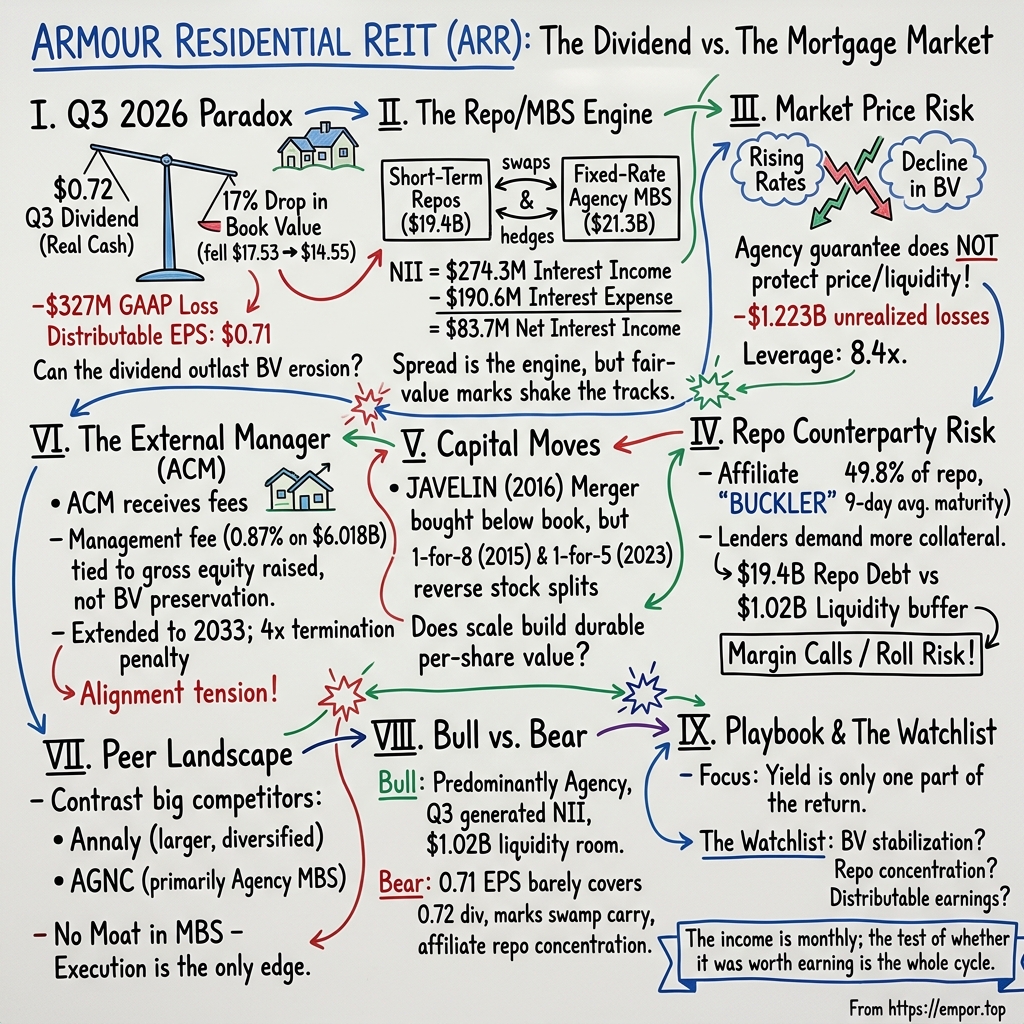
The first was familiar, almost soothing. ARMOUR had kept paying its common dividend at $0.24 a share every month, which added up to $0.72 for the quarter.[^1] For the many income investors who own the stock, that monthly deposit is the whole point. It arrives like a rent cheque, on schedule, whatever the headlines say.
The second thing was a shock. Over the same three months, the company lost about $327 million for its common shareholders under ordinary accounting rules.[^1] Book value per common share, which is the company's own estimate of what each share would be worth if its portfolio were marked to market and its debts paid off, fell from $17.53 at the end of June to $14.55 at the end of September.[^1] That was a drop of about 17% in a single quarter.
Put those two facts side by side and the puzzle writes itself. A shareholder who owned one share through the quarter received 72 cents in cash. The same shareholder watched the value underneath that share fall by almost three dollars. Add the dividend back and the total economic return, which is ARMOUR's preferred measure of how much a shareholder actually gained or lost, came to negative 12.9% for the quarter.[^1]
There was a third number in the release, and it is the one management wanted listeners to hold onto. Distributable earnings, a non-GAAP measure that strips out the mark-to-market swings and tries to capture what the portfolio earned from its interest spread, came to $102.3 million, or $0.71 a share.[^1] The dividend was 72 cents. So by the company's own preferred yardstick, the quarter's earnings fell one cent short of the payout.
One cent sounds trivial. It is not, because it frames the question this whole story will chase. If the dividend is roughly earned, then the book-value loss is a market event that the portfolio may eventually recover from. If the dividend is roughly earned only in good quarters, and book value keeps getting eroded in bad ones, then the payout is being funded, over time, out of the shareholders' own capital.
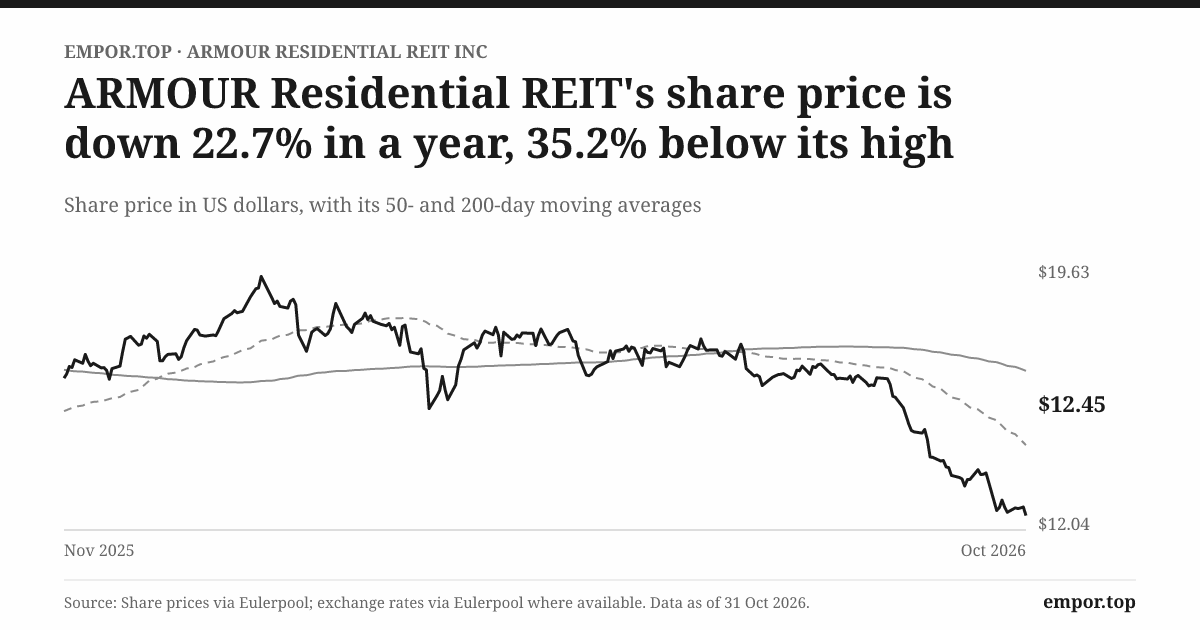
By the end of October the stock market had delivered its own verdict. The shares closed October 31 at $12.45, which was also their 52-week low and about 35% below their 52-week high of $19.22.[^2] At that price the $2.88 of annualized dividends works out to a yield of about 23%.[^2] A yield like that is either a gift or a warning, and the market does not hand out gifts very often.
Notice, too, that $12.45 was below even the freshly reduced September book value of $14.55. Buyers in late October were paying roughly 86 cents for each dollar of book value the company had just reported.[^1] One reading is that the market sees a bargain. Another is that it expects the next book-value statement to be lower still.
To understand which reading is closer to the truth, it helps to know what ARMOUR is. It is not a landlord. It does not own houses, collect rent from tenants or fix leaky roofs. The word "Residential" in its name refers to the mortgages behind the securities it owns, and nothing else.
ARMOUR is a mortgage real estate investment trust, a REIT that owns bonds rather than buildings. At the end of September it held an investment portfolio of about $21.3 billion, mostly mortgage-backed securities guaranteed by Fannie Mae, Freddie Mac or Ginnie Mae.[^1] It paid for that portfolio largely with about $19.4 billion of repurchase agreements, which are short-term loans secured by the securities themselves.1
The ordinary instincts of a stock investor break down almost immediately in a business like this. There is no product launch to anticipate, no market share to win from a rival, no price increase to push through. The company buys bonds that anyone can buy, borrows from lenders who lend to everyone, and earns what the market allows on the difference. Whatever separates a good mortgage REIT from a poor one has to be found in how it sizes, hedges and funds those positions.
Those two numbers are the scale of the bet. The company's common equity, the shareholders' slice, is a thin layer sitting on top of a very large stack of borrowed money. That structure is what makes a 23% yield possible. It is also what turned a bad few weeks in the mortgage market into a 17% hit to book value.
It is worth being precise about who this story follows. The listed company is ARMOUR Residential REIT, Inc., a Maryland corporation traded on the New York Stock Exchange.1 It has no employees of its own in the usual sense. It is run by an external manager, ARMOUR Capital Management LP, known as ACM, which employs the executives and is paid a fee for running the portfolio.1 ACM is a related party, not the listed issuer, and its economics are not the shareholders' economics.
That distinction will matter later, because the four questions this story has to answer are all, in one way or another, about the gap between the dividend and the shareholder. What does ARMOUR actually earn? Can its short-term funding survive another shock? Does the manager's fee structure serve the common shareholders? And is the discount to book value fair compensation for the risk, or a sign that book value itself is not as solid as it looks?
To answer any of them, the first job is to understand the machine that produces that monthly 24 cents.
 Subscribe on LinkedIn
II. The Mortgage REIT That Makes Its Money Between Two Rates
Picture a single family in Ohio taking out a 30-year fixed-rate mortgage to buy a house. Their bank does not keep the loan. It sells it, and the loan is pooled with thousands of similar mortgages into a security guaranteed by Fannie Mae or Freddie Mac. The family's monthly payments of principal and interest now flow, through that pool, to whoever owns the security.
ARMOUR is one of those owners. When it buys a slice of that pool, it pays with a little of its own capital and a lot of borrowed money. The borrowed money comes from a repo lender, usually a bank or broker-dealer, which takes the security as collateral and lends ARMOUR most of its value for a period that might be a few days or a few weeks.1 When the loan comes due, ARMOUR rolls it over, again and again, as long as the lender is willing.
That is the whole engine. The mortgage pays a fixed rate for years. The repo loan charges a floating rate that resets every few weeks. ARMOUR earns the difference, the spread, on every dollar it borrows. Its portfolio is mainly fixed-rate Agency mortgage-backed securities, and its economic unit is that spread, adjusted for hedges, prepayments and portfolio marks.1
There is no customer contract, no subscription, no seat licence and no minimum purchase commitment in this business.1 Volume is set by how much capital ARMOUR has, how many suitable securities it can buy, how much repo funding lenders will provide and how much hedging it can afford.1
The third quarter of 2026 showed the engine at work. Interest income on the portfolio was $274.3 million. Interest expense on the borrowings was $190.6 million. The difference, net interest income, was $83.7 million.1 That is the spread, after the cost of money, before anything else happens.
Something else did happen, though. In the same quarter, the company reported a net loss of $323.7 million, and about $327 million after preferred dividends were set aside.1[^1] The spread engine produced tens of millions of dollars, and the market value of the portfolio and its hedges took back several times that amount.
So what is the bridge between $84 million of net interest income and a loss of more than $300 million? It is the gap between earning interest and owning an asset whose price moves. ARMOUR marks its securities and derivatives to fair value, and those changes run through its income statement.1 When mortgage bond prices fall faster than its hedges gain, the loss shows up immediately, even if every homeowner in the pool keeps paying on time.
Distributable earnings sits between those two worlds. It starts from net interest income and adds back the income the company earns on its hedges, such as interest-rate swaps that pay ARMOUR a floating rate in exchange for a fixed one, while excluding the market-value changes.[^1] That is why distributable earnings of $102.3 million came in above net interest income of $83.7 million. It is also why distributable earnings is a management measure, not an audited one, and should be read as an estimate of the spread engine's output rather than a definition of profit.
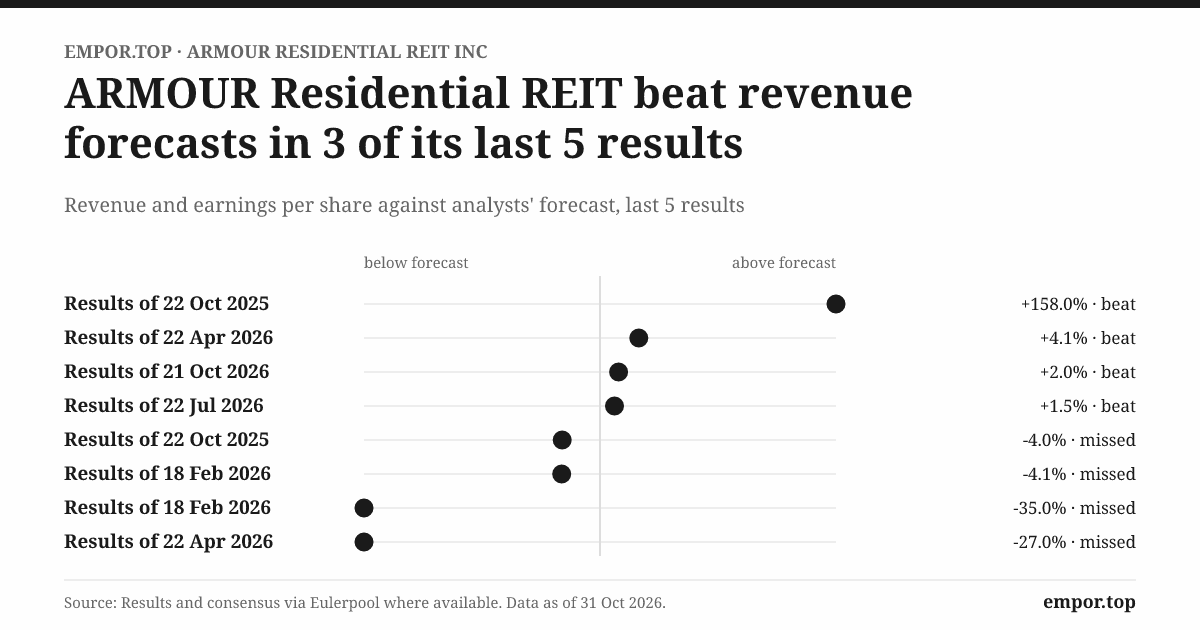
This structure makes ARMOUR look bizarre in an ordinary stock screen. In its standardized data, ARMOUR's "revenue" has swung from negative hundreds of millions of dollars in some quarters to positive hundreds of millions in others, because the data provider folds market-value gains and losses into the top line.1 One quarter of 2025 showed revenue up more than 2,400% from a year earlier.2 That is not a growth spurt. It is an accounting artefact of a bond portfolio rising and falling in price.
The same distortion runs through every ratio built on revenue or EBITDA. An EV/sales of more than 23 times, or an EV/EBITDA of nearly 39 times, sounds alarming for an ordinary company.[^2] For ARMOUR, enterprise value is mostly repo debt, and "sales" is a number that can go negative. Those ratios describe nothing a long-term investor can use.
The long-run earnings record makes the point more starkly. The company lost $229.9 million in 2022, $67.9 million in 2023 and $14.4 million in 2024, and then earned $322.7 million in 2025.2 There is no compounding trend there, just a portfolio being marked to a market that moved against it for three years and then in its favour for one.
Cash flow is equally slippery. In 2025, ARMOUR reported $322 million of net income but only about $124 million of operating cash flow.2 A conventional analyst would call that poor cash conversion. In fact, the cash-flow statement simply reversed a $514.8 million net gain on trading Agency securities, because a price gain on a bond you still own is not cash, and added back $314.5 million related to derivatives, while collateral and accrued-interest movements also shuffled the totals.2
The first nine months of 2026 ran the same arithmetic in reverse. The company reported a net loss of $263.8 million but $420.7 million of cash from operating activities, because the marks that created the loss were not cash outflows.1 Free cash flow, defined as operating cash less capital expenditure, therefore means very little here. ARMOUR has no factories to build. Its "investment" is buying more bonds, which shows up in a completely different part of the cash-flow statement.
The better tests are the ones management itself uses: book value per share, total economic return and distributable earnings against the dividend. Those three numbers will keep coming back in this story because they are the only ones that track what the shareholder actually owns.
Behind all of this sits leverage, and leverage is the part an investor has to feel rather than just read. A mortgage bond might yield a couple of percentage points more than ARMOUR's cost of funding. That alone would not support a double-digit dividend. Borrow eight dollars for every dollar of equity, however, and that modest spread is earned nine times over on the shareholders' capital.
A simple, stylized example makes the point. Suppose shareholders put up $11 and a repo lender adds $89, so ARMOUR owns $100 of mortgage bonds. If the bonds yield 5.5% and the repo costs 4.3%, the portfolio earns $5.50 a year and pays the lender about $3.80. After a hedge cost and the manager's fee, perhaps a dollar and a bit remains for shareholders on their $11. That is a return on equity in the low teens, built out of a spread of barely more than a percentage point. Every mortgage REIT dividend in the market is some variation on that sum.
The same example shows how fragile the result is. If the repo rate rises by half a point and the hedge does not make up for it, almost half a dollar of that shareholder income disappears. If prepayments speed up and the bonds were bought above par, the premium paid gets written off faster. The engine is real, but its output depends on several moving parts, none of which ARMOUR controls.
There is also a layer between the common shareholders and the portfolio that is easy to overlook. ARMOUR has preferred stock outstanding, including its Series C shares, and those preferred dividends are paid before anything reaches the common.1 That is why the quarter's net loss of about $323.7 million became a loss of about $327 million for common shareholders.1[^1] The preferred holders are a small, senior claim. They are also one more mouth the spread has to feed.
The same multiplier works on losses. If the portfolio falls 2% in value and the hedges recover only part of it, a company levered eight times can lose well over 10% of its equity. That is not a hypothetical; it is roughly what happened in the third quarter of 2026.
That is the defining bargain of a mortgage REIT. Leverage turns a thin spread into a fat dividend, and it turns a modest move in mortgage prices into a severe hit to book value. ARMOUR's bonds are backed by the US government. The obvious next question is how something so safe can produce losses so large.
III. A Government-Backed Bond Still Has a Market Price
In the last weeks of September 2026, the market for mortgage bonds moved against ARMOUR. Interest rates rose, and the extra yield that investors demanded to hold mortgage securities rather than Treasuries, known as the mortgage spread, widened sharply.[^1] Both forces push mortgage bond prices down. They arrived together, at the end of the quarter, after much of the quarter had looked calm.
By September 30, the portfolio was carrying $1.223 billion of gross unrealized losses on its securities.1 Book value fell sharply.[^1] And the company's implied leverage, the ratio of its borrowings and hedged exposure to its equity, had risen to about 8.4 times, partly because the equity denominator had just shrunk.[^1]
None of that involved a single homeowner defaulting. That is the first thing to understand about Agency mortgage securities, and the thing most often misunderstood. Fannie Mae, Freddie Mac and Ginnie Mae guarantee that bondholders will receive the principal and interest on the underlying mortgages even if a borrower stops paying.1 That guarantee largely removes borrower credit risk.
What it does not remove is price risk. A guaranteed bond paying 5% is worth less when new bonds pay 6%. A guaranteed bond is also worth less when investors as a group decide they need more compensation for holding mortgages instead of Treasuries. The guarantee says the cash flows will arrive. It says nothing about what someone will pay for those cash flows next Tuesday.
Mortgages add a twist that ordinary bonds do not have, and it is the heart of why mortgage REITs are so volatile. Every American homeowner with a fixed-rate mortgage holds an option: they can pay off the loan early, usually by refinancing, whenever it suits them.
When rates fall, homeowners refinance, and the bond's principal comes back early, just when the owner would least like it, because the money now has to be reinvested at lower yields. When rates rise, homeowners sit tight. Nobody refinances a 4% mortgage into a 7% one. The bond that looked like it would pay back in seven years now looks like it will pay back in twelve.
Bond people call that stretching "extension", and the technical name for the whole effect is negative convexity. A plain-English version is this: a mortgage bond gains less than a Treasury when rates fall and loses more when rates rise. The homeowner has the option, and the bondholder has sold it to them.
That option is why hedging a mortgage portfolio is so hard. ARMOUR uses interest-rate swaps, Treasury futures and other instruments to offset the effect of rate moves.1 But the amount of hedging the portfolio needs changes as rates move, because the mortgages' effective life, their duration, changes with them. A hedge book that was well matched in July can be too small by September.
Then there is the second mismatch, the one between the assets and the funding. The mortgages and the hedges respond to rates, spreads and market liquidity on their own schedules. The repo loans that pay for them reset every few days or weeks.1 ARMOUR is, in effect, borrowing short to lend long, and doing it with a security whose expected life keeps changing.
Place the 2026 book-value path beside the dividend and the year's story becomes visible. Book value per common share was $18.63 at the end of 2025.2 It slipped to $17.53 by June 2026.3 Then it fell to $14.55 by September.[^1] Through all three points, the common dividend held at $0.72 a quarter.[^1]
Over those nine months, a shareholder collected $2.16 in dividends and lost $4.08 in book value. Measured against the starting book, the nine-month economic return was roughly negative 10%. The dividend was paid in full. It was also more than consumed by the decline in what the shares represented.
The second quarter is worth a pause, because it complicates the bear story. Between April and June, ARMOUR reported $115 million of net income and its book value held up reasonably well, giving shareholders a positive economic return for that quarter.3 The machine can work. In calm markets, with spreads stable, the carry flows through and book value does not erode much.
The third quarter shows what happens when calm ends. The interesting detail in the company's disclosures is that ARMOUR's net duration, its overall sensitivity to rate moves after hedges, moved only modestly during the quarter.[^6] On paper, management was not making a large directional bet on rates.
That points the finger at spread risk, the one thing a rate hedge cannot fully neutralize. Swaps and Treasury futures move with Treasury yields. When mortgage bonds fall relative to Treasuries, the hedges do not follow them down, so the loss passes straight through. On the third-quarter call, management attributed the decline largely to the late-quarter rise in rates combined with wider mortgage spreads, which it framed as a market move rather than a failure of positioning.4
That explanation is plausible and consistent with the numbers. It is also the explanation every Agency mortgage REIT offers in a bad quarter, because it is usually true. The investor's question is not whether spreads widened. It is whether ARMOUR chose a level of leverage and a hedge structure that left the equity able to absorb an ordinary spread shock without losing a sixth of its value.
Eight times leverage is not unusual for an Agency REIT, but it is not small either. At that level, a fall of about two percentage points in the value of the net exposure, after hedges, translates into a loss of roughly 15% to 17% of equity. That is approximately what the third quarter delivered. The sizing chosen in calm conditions decided the damage in a storm.
The next reported book value will be the first real test of whether the third quarter was a temporary shock or the start of something worse. Mortgage spreads that widen can narrow again, and when they do, the unrealized losses partly reverse. Management argued on the call that wider spreads also mean higher yields on new purchases, improving the outlook for the spread engine.4 Both statements can be true. Neither guarantees that book value comes back before the next shock.
There is one more reason the third quarter mattered beyond the headline loss. A bond portfolio that falls in value does not just reduce book value. It also reduces the value of the collateral pledged to lenders. And that is where the second counterparty in this story enters, the one that never appears on a stock ticker.
IV. The Repo Market Is the Company's Other Counterparty
Imagine a Tuesday morning when mortgage spreads have widened again overnight. A repo lender's systems re-price the securities ARMOUR has pledged. They are worth less than yesterday, so the cushion of collateral protecting the loan has thinned. The lender sends a margin call: post more cash or more securities by the end of the day.
ARMOUR has three ways to answer. It can hand over cash from its liquidity reserve. It can pledge unencumbered securities it holds free and clear. Or it can sell assets, reduce the loan and shrink the portfolio, which means selling bonds into the same weak market that caused the margin call in the first place.2
That third option is the one every mortgage REIT tries to avoid, because it turns an unrealized mark into a realized loss and leaves the company smaller when prices eventually recover. The whole liquidity strategy of a firm like ARMOUR exists to make sure it never has to choose it under pressure.
The two sides of this business are not customers and suppliers in any ordinary sense. ARMOUR has no operating customers and no top-customer revenue share.1 Its counterparties are its lenders and the firms on the other side of its hedges. They decide whether it can stay in business on any given week.
At the end of September 2026, those lenders had extended about $19.4 billion of repurchase-agreement financing.1 Against that, ARMOUR's management reported about $1.02 billion of liquidity, made up of cash and unencumbered securities available to meet calls.4
It helps to understand how a repo loan is sized. A lender does not advance the full value of the bond. It lends perhaps 95 cents or so on each dollar of Agency collateral and keeps the gap, called the haircut, as protection. The haircut is the shareholders' money sitting inside every loan. When the bond's price falls, the haircut shrinks, and the lender asks ARMOUR to top it back up. Multiply that by thousands of positions and dozens of lenders and the result is a daily cash requirement that rises exactly when markets are worst.
Liquidity also has a less visible side. At the end of September, ARMOUR held about $99.7 million in cash, had posted about $34.2 million of cash collateral to counterparties and carried about $474.0 million of US Treasuries alongside its roughly $20.0 billion of Agency securities.1 It was also owed about $411.8 million for securities it had sold but not yet settled, and about $93.2 million of accrued interest.1 Those receivables are not customer invoices. They are claims on trading counterparties, and in a calm market they settle like clockwork. In a disorderly one, settlement and counterparty performance become risks in their own right.
The headline liquidity figure and the repo balance have to be read together. On its own, a billion dollars sounds like a lot of cash. Set against $19.4 billion of collateralized debt, it is roughly 5%. If the market value of the pledged securities fell another 5% and the hedges did not offset it, the cushion would be largely spoken for. That is not a forecast. It is the arithmetic of how much room the company has.
ARMOUR acknowledges exactly this exposure: it describes repo obligations as short-term secured financings, identifies collateral calls and rollover as material liquidity risks, and reports no corporate credit rating that might offer an independent view of its resilience.21 The company disclosed no covenant breach and reported no sign of funding stress.1 But the structure is what it is: long assets, short liabilities, and lenders who can change terms quickly.
That brings in the most unusual feature of ARMOUR's funding, and the one a skeptical investor should spend the most time on. Nearly half its repo borrowing came from a single lender, and that lender was not a stranger.
BUCKLER Securities LLC is a broker-dealer affiliated with ARMOUR's management, and ARMOUR itself owns a 10.8% interest in it.1 At the end of 2025, BUCKLER provided 47.0% of ARMOUR's repo borrowings. By September 30, 2026, its share had risen to 49.8%.1 Its repo agreements with ARMOUR carried a weighted average maturity of just nine days.1
BUCKLER also participated in ARMOUR's Treasury transactions, its at-the-market share sales and its share repurchases.1 It is woven through the capital structure, not sitting at the edge of it.
The bull case for this arrangement is real. An affiliated lender that understands the portfolio and has an interest in ARMOUR's survival may be more reliable in a crunch than a dealer bank that is cutting balance sheet across the industry. Having a captive source of repo can be a strategic asset when outside lenders retreat.
The bear case is equally real. Half the funding depending on one counterparty is concentration, whoever the counterparty is. A nine-day maturity means that funding is renewed roughly three times a month. And because BUCKLER is a related party, the terms on which it lends, and the fees it earns on share sales, are matters that the independent directors have to police rather than the market.
BUCKLER's own capacity to keep lending also depends on its access to funding, so the affiliate does not remove market risk. It relocates it to a place investors cannot see as clearly. ARMOUR does not publish a breakdown that would let shareholders compare BUCKLER's repo pricing with what other lenders charge on the same collateral.
The questions that matter on any call, and the ones a careful investor will keep asking, all orbit this point. How diversified is the rest of the lender base? How quickly could ARMOUR replace BUCKLER funding if it had to? What leverage would management target during a sustained spread-widening episode? On the third-quarter call, management's answer to the broader concern was that liquidity remained ample and that leverage would be managed as conditions evolved.4 That is a reasonable stance. It is also a general one.
The best evidence about how ARMOUR behaves under real funding stress comes from early 2020, when the pandemic briefly broke the mortgage market. In March of that year, Agency mortgage bonds, the safest part of the market, fell sharply as investors rushed for cash, and repo lenders demanded more collateral across the industry.
ARMOUR survived, but at a cost. Over 2020, its total assets shrank from about $13.3 billion to about $5.5 billion, and its borrowings fell from about $11.4 billion to about $4.5 billion.5 Shareholders' equity fell from about $1.4 billion to about $938 million.5 The company lost $224 million that year.5
That is what deleveraging looks like. The company met its obligations, and it did not fail. It also sold a large part of its portfolio into a falling market, and a large slice of shareholder capital did not come back. The 2020 portfolio was not identical to today's, and the funding mix was different. But the episode is the clearest proof in ARMOUR's own record that liquidity buffers delay forced selling rather than abolish it.
So the funding story narrows the safety argument. The government guarantee covers the mortgages. Nobody guarantees the repo. Liquidity of about a billion dollars and an affiliated lender provide a buffer, and a buffer is not immunity.
If funding and leverage are the risks that come with the business, the obvious question is whether ARMOUR's management has used its capital in ways that made the risk worth bearing. The most visible test of that came a decade ago, when ARMOUR bought one of its smaller cousins at a discount.
V. The JAVELIN Deal Bought Scale at a Discount to Book
In early 2016, the mortgage REIT industry was trading at a deep discount to book value. Many smaller REITs were too small to be efficient, too expensive to run and too cheap in the stock market to raise new equity. One of them was JAVELIN Mortgage Investment Corp., a REIT that was, like ARMOUR, managed by ARMOUR Capital Management.
On March 2, 2016, ARMOUR announced that it would acquire JAVELIN in a cash tender offer.6 The price valued JAVELIN at about $85.2 million.6 That was 87% of JAVELIN's calculated book value, about 20% above its market price before the announcement, and about a 10% premium to ARMOUR's estimate of what JAVELIN would be worth in liquidation.6 The acquisition completed in April 2016.7
Those three comparisons tell different stories, and the choice of which one to emphasize is the whole argument. To a JAVELIN shareholder, a 20% premium over the market price looked generous. To an ARMOUR shareholder, paying 87 cents per dollar of book looked like buying assets on sale.
The most honest benchmark was liquidation value. JAVELIN's realistic alternative was not to keep trading at its depressed price forever. It was to sell its portfolio, pay off its repo, cover the costs of winding down and return what was left. ARMOUR estimated that number and offered about 10% more.6 In other words, it paid JAVELIN shareholders a modest premium to avoid the friction of liquidation, and kept the rest of the book-value discount for itself.
There is also a related-party dimension that cannot be ignored. Both companies were managed by ACM, so the same management team sat on both sides of the economic relationship. Combining the two simplified ACM's operations. Whether it served each set of shareholders equally depended on the price, and the independent directors had to judge that.
What exactly did ARMOUR acquire? Not a new business line, a customer base or a distinct moat. JAVELIN owned another portfolio of mortgage securities, financed with repo. ARMOUR bought more of the thing it already owned, at less than its stated value.
That kind of deal can create real value per share, because if you can buy a dollar of assets for 87 cents and the assets are honestly marked, the 13 cents of discount accrues to the buyer. But it is a one-time gain. It does not change the earning power of the portfolio, the cost of funding or the volatility of book value.
The deal did not happen in isolation, and the longer per-share record is where a fair verdict has to come from. A year before JAVELIN, in 2015, ARMOUR completed a one-for-eight reverse stock split.8 In 2023, it completed a one-for-five reverse split.2 Combined, those two actions mean one share today is equivalent to forty shares from before 2015.
Reverse splits do not destroy value on their own. They change the number of shares, not the size of the pie. But companies rarely need them unless the share price has fallen a long way, and the long-run record of per-share losses in ARMOUR's filings is consistent with that. Over the decade from 2014 to 2024, the company reported net losses in most years, including large ones in 2018, 2019, 2020 and 2022.25
At the same time, ARMOUR has kept issuing shares. In the first nine months of 2026 alone, it sold about 36.9 million common shares through at-the-market offerings for $639.7 million after costs.1 That averages to roughly $17.30 a share, a touch below the June book value of $17.53. It also issued Series C preferred shares for about $13.0 million and bought back roughly 0.5 million common shares for $7.2 million.1
Issuance close to or below book value is a quiet tax on existing shareholders. If ARMOUR sells shares for $17.30 when each existing share represents $17.53 of book, the existing holders lose a few cents per share each time. Issuance above book is the opposite: new shareholders pay a premium that accrues to the old. Whether an equity raise helps or hurts depends entirely on that relationship.
In September 2026, as the share price fell, ARMOUR bought back 364,000 shares at an average of $14.16.1 That was below the September 30 book value of $14.55, so each repurchase was modestly accretive. It was also small: more than $600 million of issuance in the year to date against roughly $5 million of repurchases in that month.
So the JAVELIN deal, taken alone, looks like a sensible piece of capital allocation: a discount-to-book acquisition priced against a credible liquidation alternative. Taken alongside two reverse splits, a decade of erratic per-share results and repeated equity raising, it looks like one good trade in a long record that has not compounded book value per share.
The verdict narrows rather than rejects the claim that ARMOUR allocates capital well. It can execute opportunistic deals at sensible prices. The record does not show that scale, once acquired, translated into durable growth in book value per share. That is the KPI that would confirm the stronger claim, and it has not yet done so.
All of which raises a structural question. Every share ARMOUR sells increases the capital the manager is paid on. Every share it buys back does not reduce it. To understand why that matters, it is necessary to look at who runs ARMOUR and how they are paid.
VI. The Manager's Fee Is Tied to Capital Raised
ARMOUR has been run, for its entire public life, by a small group of people at ACM. Its co-chief executives are Scott Ulm and Jeffrey Zimmer, who have shared the top job for many years and steered the company through every cycle described here.[^12] Gordon Harper is chief financial officer.[^12] The portfolio is run by co-chief investment officers Sergey Losyev and Desmond Macauley.[^1]
Co-CEOs are rare in American public companies, and the arrangement says something about how ARMOUR sees itself. It is less a corporation with a single commanding leader and more a trading partnership, in which a few experienced specialists in mortgage securities, funding and hedging make decisions together. The style that comes through in ARMOUR's calls and letters is technical and steady, focused on spreads, hedges and liquidity rather than grand visions.
None of these executives is employed or paid directly by ARMOUR. They are employees of ACM, and ACM bears their salaries and the firm's overhead.1 ARMOUR pays ACM a management fee, and that fee is the economic relationship at the centre of this section.
The fee is calculated on gross equity raised. At September 30, 2026, ARMOUR had raised about $6.0 billion of gross equity over its life, and the effective fee rate on that base was 0.87%.1 That implies an annual fee in the region of $52 million. The contractual fee for 2025 was about $45.5 million.2
The phrase "gross equity raised" deserves careful attention. It is not the company's current equity, which has been shrunk by years of losses and is far smaller. It is not book value, total return or distributable earnings. It is, broadly, the cumulative amount of capital shareholders have handed over, which does not fall when that capital is lost.
That creates an incentive tension worth naming plainly, without assuming any misconduct. If ARMOUR raises another billion dollars of equity, ACM's fee base grows, whether or not the money is invested at a return that benefits existing shareholders. If ARMOUR's book value halves, the fee base does not shrink. The fee rises with issuance, not with performance.
ARMOUR's own 2025 annual report states that the management agreement was not negotiated at arm's length.2 That is a standard disclosure for externally managed REITs, but standard does not mean irrelevant. It is the company telling investors that the terms were set between related parties.
In April 2026, the agreement was extended to run until March 31, 2033.1 ARMOUR cannot voluntarily terminate it without cause before then.1 And if the agreement is terminated in connection with certain liquidation or business-combination events, ACM is entitled to a fee equal to four times the contractual fee for the preceding twelve months.1
Work through what that means. At a fee of about $50 million a year, a four-times termination payment would be roughly $200 million. Against common equity of a little over $2 billion at September book value, that is close to a tenth of shareholders' capital. A buyer considering an acquisition of ARMOUR, or a board considering liquidation at a discount, has to add that cost to the bill.
That matters precisely because the stock trades below book value. In theory, a REIT trading at 86% of book could be worth more liquidated than continued. In practice, the termination fee, the long contract and the lack of voluntary termination rights make that path expensive and slow. The discount to book is partly protected by the contract.
The case for ACM is not trivial. Running a $21 billion leveraged mortgage portfolio requires specialized trading, hedging and financing capability, and ARMOUR shareholders get access to that capability without paying the full cost of building it. ACM bears the payroll and the overhead.1 Internally managed peers have to fund those costs themselves.
The question is whether the outcomes justify the arrangement. And the right way to judge any manager, especially one whose fee is not indexed to performance, is by behaviour over time.
On the dividend, the recent record is mixed: distributable earnings fell one cent short of the payout in the third quarter, while the second quarter's earnings comfortably supported it.43 Over the longer span, the payout has not been immune to downturns: cash dividends paid fell from about $140 million in 2019 to about $85 million in 2020 as the portfolio shrank.5
On book-value preservation, the record is weaker. Agency REITs as a group have struggled in the same periods, which narrows the critique without removing it.
On capital issuance versus repurchases, the record leans toward issuance. ARMOUR's 2026 issuance and repurchases followed that pattern.1 It is consistent with a strategy of growing the portfolio. It is also the pattern that the fee structure rewards.
On explaining misses, management's third-quarter explanation was clear about the cause, rates and spreads, and was framed around the opportunity that wider spreads create for new investments.4 What a skeptical shareholder would want alongside it is a clearer account of why leverage was set where it was going into the quarter, and what the board's risk limits are.
Shareholders have limited direct leverage over any of this. ARMOUR's 2026 proxy shows directors and executive officers collectively owned less than 1% of the shares.[^12] The two largest shareholders were index managers: BlackRock with about 10.5% and Vanguard with about 7.2% as of March 2026.[^12] No controlling holder is identified.[^12] On later reported positions, institutions collectively held a little over half the shares, spread across more than three hundred holders, with mutual funds holding about a sixth.[^13] That is a register of diversified, mostly passive owners, which is precisely the kind of shareholder base least likely to challenge a management contract.
The board's independent directors are therefore the main check on the relationship, and their task is unusually concrete. They approved the extension to 2033.1 They oversee the BUCKLER relationship and the terms of affiliate repo and share-sale transactions.1 And they set the dividend each month. Every one of those decisions affects ACM's economics as well as the shareholders', which is why the substance of board oversight, rather than its existence, is the thing worth watching.
The proxy's pay-versus-performance tables add colour but should be handled carefully. They report "compensation actually paid" to the co-CEOs of about $74,000 each in 2025, down from about $706,000 each in 2023.[^12] Those are SEC-defined figures tied to the value of equity awards granted by ARMOUR, not the executives' cash salaries and not their total compensation from ACM, which ARMOUR does not disclose. They tell investors how much ARMOUR-granted equity moved with the stock, which is not much of a window into what ACM's partners earn.
At the 2026 annual meeting, the advisory vote on 2025 executive pay passed.[^14] With insiders owning so little and index funds dominating the register, that result says more about the shareholder base than about enthusiasm for the structure.
The verdict on alignment is therefore narrow and conditional. ACM's expertise is real, and the arrangement has advantages. But the fee base grows with capital raised rather than shareholder returns, the contract runs to 2033, and leaving it is expensive. That makes the board's oversight and the per-share results the only evidence of alignment that counts. On per-share results, the long record has not yet earned the benefit of the doubt.
That leads to a broader question. If the manager's skill is the main thing ARMOUR offers, how does that skill compare with what investors could get from ARMOUR's larger rivals in the same market?
VII. No Moat in the Mortgage, an Edge in Execution
Walk onto a mortgage-bond trading desk and ask what makes one Fannie Mae pool different from another, and a trader will happily spend an hour explaining coupon, loan size, geography and prepayment behaviour. Ask what makes ARMOUR's Fannie Mae bonds different from AGNC's or Annaly's, and the honest answer is: nothing about the bonds.
Agency mortgage-backed securities are among the most standardized financial assets in the world. They are traded in a deep market, quoted in similar terms by many dealers and available to anyone with capital and funding. There is no proprietary product, no switching cost and no customer network that ARMOUR owns.
That is the starting point for any competitive analysis. ARMOUR sits beside AGNC Investment Corp. and Annaly Capital Management as one of a handful of public companies that make their living from levered Agency mortgage exposure. They borrow from overlapping pools of lenders.
The differences are in scale and mix. ARMOUR's portfolio was about $21.3 billion at the end of September 2026.[^1] AGNC is far larger and remains the closest comparison in strategy: at the end of its own third quarter, about 94% of its portfolio was Agency MBS and TBA positions.[^15] Annaly describes itself as roughly thirteen times the median mortgage-REIT peer by market capitalization and operates across Agency MBS, mortgage servicing rights and residential credit.9
There is a structural difference too. AGNC and Annaly both run their own platforms with their own employees, so their shareholders pay operating costs directly rather than a fee to an outside manager calculated on equity raised.[^15]9 That does not automatically make them cheaper or better run. It does mean that the alignment questions raised by ARMOUR's management agreement are specific to ARMOUR, not a feature of the whole sector.
Those differences matter, but they should not be used to grade ARMOUR's performance. Annaly's servicing rights tend to gain value when rates rise, which partly offsets losses on its Agency bonds. That is a different business mix, not necessarily better management. Comparing ARMOUR with Annaly's book-value path without adjusting for that would be comparing two different machines.
Michael Porter's five forces, the classic test of an industry's structure, map onto this business unusually cleanly once the labels are translated. The "suppliers" are the funding counterparties and capital markets. Repo lenders set haircuts and rates, and equity investors decide whether ATM issuance is possible at a sensible price. Their bargaining power is high, especially in stress, as the 2020 deleveraging showed.
The "products" ARMOUR buys are produced by Fannie Mae, Freddie Mac and Ginnie Mae, whose guarantee and issuance policies define the market. ARMOUR is a price taker there. The "buyers", in the sense of those who choose whether to fund the company, are shareholders, and they can move between public mortgage REITs with a single trade. Substitutes are everywhere: an investor can buy an Agency MBS fund, a Treasury fund or a peer REIT. And entry, while capital-intensive, is not blocked by any patent or licence.
Hamilton Helmer's seven powers, which ask what lets a business earn persistent returns, make the picture starker. Scale economies exist in a weak form: a bigger REIT spreads fixed costs over more assets and may get better repo terms. But ARMOUR is the smaller player against AGNC and Annaly, so any scale advantage belongs to its rivals.
Network effects do not apply. Switching costs do not exist for shareholders or for the bonds. Brand matters only insofar as income investors recognize a name. ARMOUR has no cornered resource, unless one counts its affiliated lender, BUCKLER, which provides access to funding but also concentration risk. Counter-positioning and process power are the two remaining candidates.
Process power, the idea that a company's way of doing things is so embedded and hard to copy that it produces better outcomes, is the only one that could plausibly describe ARMOUR's case. If the company's team really is better at sourcing attractive bonds, sizing hedges and managing liquidity, that skill would show up as better total economic returns and less book-value erosion through full cycles.
That is the testable form of the "why win" case. ARMOUR wins if its execution in risk management, liquidity discipline and security selection produces a better risk-adjusted spread than peers over multiple rate and spread environments, and if that shows up per share.
The evidence to date does not establish that. The long per-share record includes reverse splits, losses in most years of the past decade and a sharp book-value decline in the latest quarter.2[^1] ARMOUR does not publish, and nothing on its record shows, a quantified cost advantage, a proprietary data edge or a durable lender advantage beyond BUCKLER.
The "why not" case is easier to articulate. Larger competitors may have deeper access to capital markets, more diverse funding and broader platforms that cushion Agency losses with other businesses. ARMOUR's concentration in affiliate repo, its leverage and its external management structure expose it to funding and market shocks that larger or internally managed peers may handle at lower cost.
There is one place where ARMOUR's structure could look like an edge. An external manager with a dedicated affiliate broker-dealer may move quickly, and BUCKLER may keep lending when others hesitate. But that is a claim about behaviour in a crisis that has not yet been fully tested at current scale. If it held in a sustained spread-widening episode, it would be meaningful evidence. If BUCKLER's share of funding kept rising because others were pulling back, it would be a warning.
So the moat claim must stay narrow. Risk-management capability may matter, and the Agency guarantee and the broad mortgage market are real features of the playing field. But they belong to every player in the field, not to ARMOUR. Whatever edge ARMOUR has must be earned quarter by quarter in book value and economic return, and the evidence so far leaves that edge unproven.
That leaves the final question every holder and every skeptic eventually reaches: at a 23% yield and a price below book, is ARMOUR paying investors enough for the risk?
VIII. Bull and Bear: Carry Versus Another Book-Value Shock
Hold the two most important third-quarter numbers up to the light. On one side, $102.3 million of distributable earnings, about $0.71 a share.[^1] On the other, a GAAP net loss to common shareholders of about $327 million.[^1] Both came from the same portfolio in the same three months. One describes the income the bonds threw off. The other describes what happened to their price.
The bull and bear cases for ARMOUR are, in the end, arguments about which of those two numbers will dominate over the next few years.
The bull case begins with the portfolio. It is predominantly Agency-backed, so the risk of homeowners defaulting is largely carried by the US government's mortgage agencies, not by ARMOUR.1 Even in a quarter when book value fell 17%, the spread engine produced positive net interest income and distributable earnings close to the dividend.1[^1] That is evidence the carry is real.
The bull case continues with timing. Wider mortgage spreads hurt book value immediately, but they also mean that every new bond ARMOUR buys, and every dollar reinvested from prepayments, earns a higher yield. If spreads stabilize or narrow from their September levels, part of the unrealized loss can reverse while the portfolio earns more. Management made this argument on the third-quarter call.4
And the bull case leans on liquidity. With about $1.02 billion of cash and unencumbered securities, ARMOUR has room to meet margin calls without selling assets into weakness in an ordinary storm.4 The shares, at 86% of September book, give a buyer a cushion if book value merely holds.[^1][^2]
The bear case reads the same evidence differently. Distributable earnings fell just below the common dividend in the third quarter. That is a thin margin of safety for a payout that requires roughly $2.88 a year per share. If funding costs stay elevated or hedge income declines, the gap could widen.
The bear case also points to the arithmetic of leverage. GAAP marks can swamp spread income in a single quarter, as the third quarter showed. At about 8.4 times leverage, the equity is exposed to every move in mortgage spreads.[^1] Repo funding is short, and half of it comes from one affiliated lender on a nine-day average maturity.1
And the bear case points to the record. History is the best stress test for both arguments, and ARMOUR's record contains two episodes that bear directly on them.
The first was the pandemic shock of 2020. ARMOUR survived, but its equity fell by about a third, the company lost $224 million and the portfolio shrank by more than half.5 Dividends paid fell to about $85 million that year from about $140 million in 2019.5 The carry was not enough to offset the damage, and shareholders did not get it back in the following year.
The second was 2022, when the Federal Reserve raised rates aggressively. ARMOUR lost about $229.9 million that year.2 Rising rates, extending mortgage durations and widening spreads all hit together. A high dividend kept flowing while book value per share fell, and within a year the company had completed the one-for-five reverse split.2
Those episodes do not prove that the next shock will be equally damaging. Each portfolio and funding mix was different. But they do reject the claim that a high distribution, on its own, protects shareholders. They narrow the bull case to a smaller and testable version: ARMOUR can earn its dividend through the cycle only if its book value does not keep resetting lower between the good quarters.
Valuation has to be read with the same care. The headline price-to-book ratio is a date-sensitive clue, not a fact about the company's worth. October's price of $12.45 against September's book value of $14.55 gives about 0.86 times.[^2][^1] But book value is a moving target. If mortgage spreads widened further in October, the current book could already be lower than the last reported figure, in which case the discount is smaller than it appears.
That is why the low price-to-book ratio is not proof of a stable liquidation value. The September book figure had itself just fallen by 17%. The market's discount may be pricing in expected further erosion, the cost of the external management contract and the risks of short-term, concentrated funding, rather than offering a free margin of safety.
Traditional valuation tools do not help much. A P/E of 2.7 times sounds absurdly cheap, but it reflects one strong year of marks rolling through trailing earnings while the last twelve months actually show a slight per-share loss.[^2] EV/sales and EV/EBITDA are close to meaningless for a leveraged bond portfolio whose enterprise value is mostly repo and whose "sales" can turn negative.
The useful comparisons are matched-date book value, total economic return, distributable earnings and price-to-book against close peers such as AGNC on the same date. A peer's price-to-book must be measured against that peer's book value on the same day, because Agency REIT books all move with the same spreads. A comparison of ARMOUR's October price with a peer's June book would mean nothing.
An activist reading this story would press on three points. First, the management agreement, with its fee tied to equity raised and a four-times termination payment, which may help explain why the stock can trade below book without any obvious path to closing the gap. Second, the affiliate funding concentration, which a board seeking independence might seek to reduce or at least to price transparently. Third, equity issuance near or below book value, which a shareholder-focused board might restrict to periods when the stock trades at a premium.
None of those challenges requires assuming misconduct. They follow from the structure. And they point back to the same three numbers that will decide the case.
The first is book value per common share and total economic return. The latest reading was $14.55, down 17% in the quarter, with an economic return of negative 12.9%.[^1] Direction: sharply down in the latest quarter, after a modestly positive second quarter.
The second is distributable earnings per share relative to the dividend. The latest reading was $0.71 against $0.72.[^1] Direction: just below coverage.
The third is funding resilience: liquidity after collateral needs, and BUCKLER's share of repo. The latest readings were about $1.02 billion of liquidity and a 49.8% affiliate share.41 Direction: affiliate concentration rising from 47.0% at the end of 2025.1
If book value stabilizes, distributable earnings stay at or above the dividend and funding diversifies, the bull case strengthens. If book value falls again, coverage slips and BUCKLER's share keeps rising, the discount looks less like a bargain and more like a warning. The record so far does not decide the matter. It does tell an investor exactly where to look.
IX. Playbook: What ARMOUR Teaches About Yield
Go back to that October morning. The release arrives, the monthly dividend has been paid without interruption, and book value has fallen by a sixth. For income investors, it is one of the most clarifying moments a stock can offer. It strips away the comfort of the payout and shows what the payout rests on.
The first lesson is the one that quarter taught in a single page: a dividend is a payment; it is not proof the business earned its keep. ARMOUR paid 72 cents a share in the third quarter. It earned 71 cents of distributable earnings and lost several dollars of book value.[^1] For a mortgage REIT, the cash arriving every month is the spread engine's output less the cost of the machine wearing down. Investors who count only the first half are measuring the rent and ignoring the roof.
The lesson travels well beyond ARMOUR. Any business that pays out nearly everything it earns, levered or not, can maintain a dividend for a long time while its capital erodes. The test is never the size of the cheque. It is whether the thing that writes the cheque is the same size, or bigger, a year later.
The second lesson comes from that imagined Tuesday morning margin call: when your assets are long and your funding is short, liquidity is part of the product. ARMOUR's bonds pay for years, and its repo resets in days.1 The billion-dollar liquidity buffer and the affiliated lender are not side details. They are what decide whether a bad month becomes a bad year, as it did in 2020.
For investors in any leveraged vehicle, the rule is the same. Read the funding terms before the asset yields. The company with the best assets and the worst funding can still be forced to sell those assets at the worst possible moment.
The third lesson belongs to the JAVELIN deal and the decade of share issuance that surrounded it: buying below book is only a bargain if value survives per share. ARMOUR bought JAVELIN at 87% of book and priced the deal sensibly against liquidation value.6 It also went through two reverse splits and kept selling shares near book value.821 A discount captured at entry can be given back many times over through issuance and erosion.
That is a lesson for anyone evaluating serial acquirers, spin-offs or closed-end funds. The number that matters is not the discount on the day of the deal. It is the value per share, years later, after every share sold and every mark taken.
The fourth lesson is about the manager: expertise earns trust through outcomes, especially when the fee is not indexed to them. ACM's fee rises with equity raised and does not fall when that equity is lost.1 The contract runs to 2033.1 Those terms do not prove the manager is acting against shareholders. They do mean that shareholders cannot rely on the fee structure to align interests, and must rely instead on book value and total return.
Any investor considering an externally managed vehicle, whether a REIT, a business development company or a fund, should ask the same question. If the manager did a poor job for five years, what would happen to its fee? If the answer is "very little", then the evidence of good judgment has to come from results, and the results have to be read with that in mind.
X. Epilogue
Tonight, at the end of October 2026, ARMOUR stands at an uncomfortable point. Its last reported book value is $14.55 a share, its stock trades well below that, and its monthly dividend of 24 cents has kept arriving.[^1][^2] The September spread widening is in the rear-view mirror, and mortgage markets continued to move through October. The next book-value statement will tell shareholders what the past month did to their capital.
That statement will be the first chance to answer whether the third quarter was a shock or a turning point. A recovery in book value would suggest that much of the September loss was the market overshooting, and that the portfolio's marks can partially reverse as spreads settle. A further decline would suggest that the equity is still being squeezed between leverage and an unfriendly market.
The second moment that matters is whether management's own guidance holds. On the third-quarter call, it said distributable earnings should remain around the dividend level.4 If distributable earnings return to 72 cents or more a quarter, the payout looks sustainable at its current rate. If they fall further below it, the history of earlier dividend resets will come back into view.
The third moment is the funding report. Investors will want to see whether BUCKLER's share of repo, already close to half, keeps rising, and whether liquidity stays near a billion dollars as spreads shift.14 A falling affiliate share and stable liquidity would ease the concentration worry. A rising affiliate share alongside falling liquidity would be the opposite.
The fourth is capital. ARMOUR has been an active issuer of equity through its ATM programme and a modest buyer of its own stock.1 With the shares well below book, any new issuance would dilute existing holders. Repurchases at a discount would be accretive. Which way management leans, and how it explains the choice, will say a good deal about whose interests are steering the capital decisions.
And the fifth, quieter but persistent, is alignment. Fee disclosures, annual-meeting votes and any changes to the management agreement will show whether the board treats the external structure as a fixed fact or as something to be continually justified.[^14]1
It is worth sketching what the good and bad versions of the next year would look like. In the good version, mortgage spreads drift back from their September extremes, the unrealized losses on the portfolio shrink, and the higher yields on newly purchased bonds lift distributable earnings comfortably above 72 cents. Book value recovers part of the lost ground, the shares close some of the gap to book, and any equity ARMOUR sells is sold at or above book, adding to value per share rather than subtracting from it. In that world, the third quarter becomes a painful but survivable episode, much like the second quarter's positive return was a reminder that the machine can work.
In the bad version, spreads stay wide or widen further, the Federal Reserve's path keeps short-term funding costs stubborn, and the hedges cost more to maintain than they earn. Distributable earnings drift below the dividend, book value keeps sliding, and the board eventually faces the choice it has faced before: cut the payout or fund it partly from capital. If BUCKLER's share of funding kept climbing through that period, it would suggest outside lenders were stepping back just when ARMOUR needed them most.
Most likely, the truth will land somewhere between those two, and that is exactly why the measures matter more than the narrative. A shareholder does not need to forecast mortgage spreads to judge ARMOUR. They need to watch whether, quarter after quarter, value per share and income per share move together or apart.
No single quarter can resolve a question that only a full rate and spread cycle can answer. But the next report can show whether book value stabilizes, whether funding remains available on reasonable terms and whether the dividend starts to outrun the earnings that support it. The central tension remains: a payout that has proven steady, sitting on a capital base that has proven anything but.
XI. Outro
Picture those two documents on a kitchen table: the monthly dividend notice beside a quarterly book-value statement.[^1]
That is ARMOUR's bargain in a single image. The company sells investors a stream of mortgage carry, and it delivers that stream with remarkable regularity. But the shareholders, not the manager and not the government that guarantees the mortgages, own the market risk, the funding risk and the manager relationship that sit behind it. With ARMOUR, the income is monthly; the test of whether it was worth earning is the whole cycle.
References
-
ARMOUR Residential REIT, Inc. Form 10-Q for the quarter ended September 30, 2026 — SEC, 2026-10-21 ↩↩↩↩↩↩↩↩↩↩↩↩↩↩↩↩↩↩↩↩↩↩↩↩↩↩↩↩↩↩↩↩↩↩↩↩↩↩↩↩↩↩↩↩↩↩↩↩↩↩↩↩
-
ARMOUR Residential REIT, Inc. 2025 Form 10-K — SEC, 2026-02-18 ↩↩↩↩↩↩↩↩↩↩↩↩↩↩↩
-
ARMOUR Q2 2026 Results and June 30 Financial Position — SEC, 2026-07-22 ↩↩↩
-
ARMOUR Residential REIT (ARR) Q3 2026 Earnings Call Transcript — Seeking Alpha, 2026-10-22 ↩↩↩↩↩↩↩↩↩↩↩
-
ARMOUR Residential REIT 2020 Annual Report — ARMOUR Residential REIT ↩↩↩↩↩↩↩
-
ARMOUR Residential REIT to Acquire JAVELIN Mortgage Investment Corp. — SEC, 2016-03-02 ↩↩↩↩↩
-
ARMOUR Completes Acquisition of JAVELIN Mortgage Investment Corp. — SEC, 2016-04-06 ↩
-
ARMOUR Residential REIT 2015 Annual Report — ARMOUR Residential REIT ↩↩
 LinkedIn
 WhatsApp
 Reddit
 Hacker News
 Email
 Kindle
 RSS Feed
 Spotify
 Apple Podcasts
 Amazon Music
 Audible
 YouTube