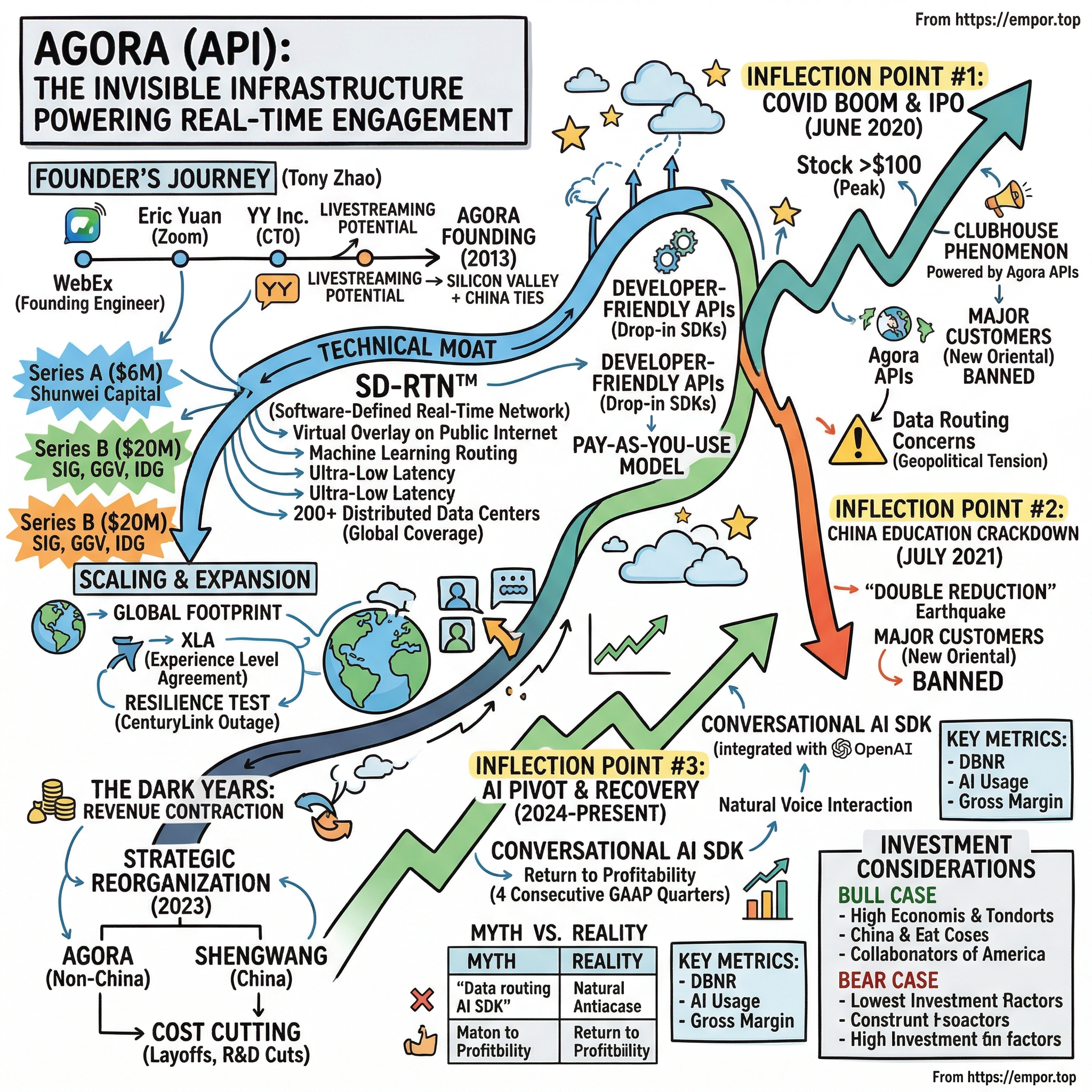
Agora: The Invisible Infrastructure Powering Real-Time Engagement
How a Chinese-American Company Became the Hidden Plumbing Behind the World's Most Viral Apps—and What Happens When Your Biggest Customer Base Gets Regulated Out of Existence
Picture this: It's February 2021, and Elon Musk has just appeared on Clubhouse, the buzzy audio social app that has Silicon Valley in a frenzy. The stock of a company most people have never heard of—Agora—rockets past $100 per share, five times its IPO price from just eight months earlier. Angel investors are tweeting that Clubhouse was "built in a week" using Agora's APIs. The invisible plumbing company behind the hottest app in tech is suddenly very visible indeed.
But here's the thing about being invisible infrastructure: when your customers succeed, you succeed. And when your customers face existential crises—regulatory crackdowns, pandemic-fueled bubbles that inevitably pop, geopolitical tensions between the world's two largest economies—you're along for the ride whether you like it or not.
Agora's platform today powers over 80 billion minutes of real-time interaction per month in over 200 countries and regions globally. The company has survived the Clubhouse crash, Beijing's devastating education crackdown, and years of revenue contraction. Now, with conversational AI emerging as the next frontier, Agora is pivoting aggressively—and finally returning to profitability.
This is the story of Agora: founder-market fit at its finest, the treacherous path of building infrastructure versus applications, the dangers of platform risk and customer concentration, and the regulatory whiplash that can reshape an entire industry overnight.
 Subscribe on LinkedIn
The Founder's Journey: From WebEx to YY to Agora
The Making of a Real-Time Communications Veteran
To understand Agora, you first need to understand Tony Zhao—or Zhao Bin, as he's known in Chinese. To appreciate Agora's rise, you have to understand its founder. Picture a tech veteran who's spent nearly two decades in the trenches of real-time communication (RTC), a field that, until recently, was mostly the domain of telecom giants and a handful of Silicon Valley pioneers.
After earning a bachelor's in radio and electronics from Peking University in 1992, he spent seven years at WebEx Communications in the US, developing backend audio and video calling architecture—skills that would later become the backbone of his own company. This wasn't just any role at WebEx. Tony was a founding engineer at WebEx (now Cisco WebEx) in 1997 and played an integral role in a small founding team that developed real-time audio sessions for the company.
The WebEx connection is significant for another reason: Tony Zhao worked alongside another ambitious Chinese engineer named Eric Yuan. He was a founding engineer at Webex and worked with Eric Yuan, who founded Zoom. While Yuan would later leave Cisco to build Zoom—taking the approach of creating a complete end-to-end video conferencing product—Zhao would take a fundamentally different path.
WebEx sold to Cisco for $3.2 billion in 2007. Yuan became the tech giant's vice president of engineering, earning compensation in the "very high six-figures." That acquisition represented a massive validation of the real-time communications space and gave Zhao invaluable lessons in what it took to build infrastructure that could scale globally.
The YY Crucible: Understanding Livestreaming Before the West Caught On
After WebEx, Zhao's path diverged from the typical Silicon Valley trajectory. He then returned to China, where he founded NeoTasks, LLC, before joining YY Inc. (now JOYY Inc.), a Nasdaq-listed video-based social network, as Chief Technology Officer and Director from 2008 to 2013.
YY was a crucible for Zhao in ways that would directly shape Agora's future. From December 2009 to March 2015, Mr. Zhao served as a director of YY, Inc. (recently renamed JOYY Inc.), a video-based social network listed on the Nasdaq Stock Market. At YY, Zhao witnessed something the Western investment community would only understand years later: the explosive potential of livestreaming as a medium.
While most Americans in 2010 were still struggling with Skype's clunky interface, Chinese users were already tipping performers on livestreaming platforms, creating an entirely new creator economy. Hans Tung: "As you know, we also had David Li from YY to be on this podcast before, I think yourself and your startup to YY helped to make YY what it is today, without all your technology YY probably won't be able to support millions of concurrent users live."
This experience gave Zhao a unique insight: the future wasn't about building better video conferencing tools for enterprises. It was about enabling developers everywhere to embed real-time engagement into any application. But Zhao's ambitions soon outgrew YY. He realized that the future of RTC was not in building another standalone app, but in providing a flexible, developer-friendly platform that could power any app, anywhere in the world.
The Pivotal Insight: Infrastructure Over Applications
Tony Zhao: "I do have a working experience on real time audio video itself for long enough time, and I personally was the guy who wrote the audio session, video session for WebEx. So I know a lot of headache in it. And by the time I see smartphone really growing into the whole population, I see there's an opportunity to combine this real time audio technology together with smartphone, because smartphone is such a complete and ready device for this technology."
This was the key insight. The smartphone has high quality building cameras—two, nowadays maybe three or four—and high quality microphone design as a communication device with programming capability. The convergence of powerful mobile devices with ubiquitous internet connectivity created an opportunity for someone to build the underlying infrastructure that every developer would need.
In late 2013, after nearly 20 years in the field, he left YY and moved to Silicon Valley to start Agora. The vision: create a global, open RTC ecosystem, packaging voice and video technology into SDKs that developers could drop into their apps with minimal fuss.
Instead of competing with the likes of Tencent or ByteDance on the front lines of consumer apps, Agora would be the invisible engine behind thousands of platforms, from live-streaming startups to education giants. As Zhao himself put it, "We're not building a product, we're building an ecosystem."
For long-term investors, Zhao's career trajectory represents an almost textbook case of founder-market fit. Twenty years of building real-time audio and video systems at scale, understanding both the enterprise (WebEx) and consumer (YY) sides of the market, and experiencing firsthand the pain points that developers face when trying to implement these features. Few founders arrive at their company's founding moment with such comprehensive domain expertise.
Founding & Early Years: Building the Network First (2013-2017)
The Unconventional Beginning: No Revenue, No Problem
Mr. Zhao founded Agora in November 2013. The company was incorporated and headquartered in Santa Clara, California—positioning itself firmly in Silicon Valley while maintaining strong ties to China.
The early days of Agora defied conventional startup wisdom. Most founders obsess about finding product-market fit as quickly as possible, then monetizing. Zhao took a different approach, one that revealed his deep understanding of developer-focused businesses.
In a GGV podcast episode, Zhao somewhat shyly admitted that in the early days of Agora, there was no revenue or business model. The company simply opened its SD-RTN via a layer of APIs for developers to use, with 10,000 free minutes every month. If a developer's usage exceeded that limit, then Agora would charge something. The goal was just to encourage developers to try its service.
This "give it away first" strategy might seem reckless, but it was deeply calculated. Because Agora is distributed via APIs—a very convenient distribution model of technology—it can generate revenue on a pay-as-you-use basis. If your crazy virtual dinner party idea takes off like a rocketship (Clubhouse), pay Agora more money to support the growth. If the idea is a dud, no big cost and no big deal.
In this model, the customer-vendor relationship is very aligned. Agora only succeeds if the developers succeed. This was developer evangelism as business strategy—betting that if you build something truly useful and remove barriers to adoption, the revenue will eventually follow.
The Technical Moat: Building the SD-RTN
While the business model was unconventional, the technical investment was anything but. With our APIs, developers can embed real-time engagement functionalities into their applications without the need to develop the technology or build the underlying infrastructure themselves. The real-time data transmission is handled by our Software-Defined Real-Time Network, or SD-RTN, which is a virtual network overlay on top of the public internet.
Agora's voice, video and live broadcasting software all run on a Software Defined Real Time Network (SD-RTN™), which is a real-time transmission network built by Agora and is the only network infrastructure specifically designed for real-time communications in the world.
This is a critical distinction that many casual observers miss. Agora isn't just providing APIs—it's building and maintaining a global physical infrastructure optimized for a specific purpose. Agora's Software-Defined Real-Time Network is the world's most widely used and intelligent real-time network, delivering reliable performance with much lower latency than content delivery networks (CDNs). SDRTN® uses machine learning to intelligently route traffic and find the fastest path for ultra-low latency, enabling real-time communication, synchronization, and conversational AI at scale.
Agora's SDRTN® provides the broadest range of coverage throughout the world. With coverage for 200+ countries and regions globally, you can connect people anywhere.
The difference between a CDN and Agora's SD-RTN is fundamental to understanding the company's value proposition. The proximity of content storage to users makes CDNs load faster and deliver quicker. However, CDNs fall short when it comes to real-time video and communication. The delay (latency) of 1 to 30 seconds in CDNs makes real-time communication and interaction impossible.
Agora's Software Defined-Real Time Network™ (SD-RTN) was built specifically for real-time engagement. It is set up with global points of presence like a CDN, but instead of caching content, it dynamically selects the most efficient routes for transmitting real-time streams of video and audio frames with the highest speed, or lowest amount of latency possible.
Agora SD-RTN is designed to solve these issues and deliver sub-second low latency utilizing over 200 distributed data centres across the world.
Early Funding: Smart Money from the Right Places
The investor roster in Agora's early rounds reveals how well-connected Zhao was in both Silicon Valley and China tech circles.
Agora finished its A round of financing with USD $6 million in February 2014 led by Shunwei Capital, which is a venture capital company from Xiaomi Group. The Xiaomi connection wasn't accidental—it would later prove strategic as Xiaomi became one of Agora's largest customers.
On September 17, 2015, Agora completed its Series B financing with USD $20 million. Famous investors joined this round of financing, including SIG, GGV, Chenxing Capital, IDG and YY—notably, the very company where Zhao had served as CTO.
The engineering-heavy culture Zhao instilled from day one would define the company. There are about 90% engineers in the total employees of Agora, Zhao has noted. Therefore, Agora invested heavily on research and development to try to provide better products for developers.
For investors evaluating infrastructure businesses, Agora's early trajectory illustrates a crucial pattern: the willingness to build hard things (a global real-time network) before pursuing easy monetization. This created a technical moat that would take years and significant capital for competitors to replicate—but it also meant years of cash burn before profitability became possible.
Scaling & Pre-IPO Growth: The Global Expansion (2017-2020)
Momentum Builds Across Geographies
By 2017, Agora's bet on developer adoption was paying off. The company had established a leading market share in the broadcast industry. Almost all of the head players in broadcast across North America, Europe, India, China, Middle East, and Southeast Asia were using Agora's RTC technology.
Agora provides a global real-time network infrastructure with data centers distributed across different regions, ensuring low latency and reliable connections for users worldwide. Twilio also has a global infrastructure but is relatively smaller in scale compared to Agora.
In November 2018, Agora completed its B+ round of financing with USD $30 million, led by Coatue Management, with SIG, Chenxing Capital, and Shunwei Capital participating. According to Zhao, Coatue made the investment decision within 2 weeks, which showed the strong confidence of Coatue in Agora.
Zhao emphasized that going overseas was one of the most important businesses of Agora. The company built strong strategic cooperation relationships with famous overseas enterprises such as The Meet Group, Hike Messenger, Musical.ly (later acquired by ByteDance and merged with TikTok), and V-cube.
The global footprint was substantial: more than 200 employees located in Silicon Valley, Shanghai, Beijing, Guangzhou, Tokyo, and Bangalore.
The XLA Innovation: Rethinking Service Commitments
One of Agora's most clever innovations was the Experience Level Agreement (XLA), announced in Q4 2020. It's a clever spin to Service Level Agreement or SLA, a concept that's already familiar with most developers.
A typical example of an SLA is when a cloud vendor, say AWS or Azure, guarantees uptime and availability up to a threshold, like 99.99% of the time per year. If that uptime was not delivered due to server outage or other problems, the cloud vendor would have to compensate its customers somehow.
In the world of delivering audio and video streaming, just keeping the service up and available may not be enough. The data could be technically delivered but the quality would be so bad the receiving end could barely hear or see it. Agora's XLA went beyond uptime guarantees to commit to actual experience quality—acknowledging that in real-time communications, a degraded experience is often worse than no connection at all.
Resilience in Action: The Network Outage Test
The true test of any infrastructure comes when things go wrong. CenturyLink and Level 3's North American network outage on August 30th, 2020 possibly affected up to 3.5% of global web traffic. Agora's SD-RTN™ is designed to ensure low impact from such outages.
Agora immediately detected the network abnormality in North America on Aug 30, and adopted automatic systematic responses such as automatic line switching and automatic disabling of impacted data centers to minimize potential impact to users of our customers, except for those who are only accessing the Internet through Level 3. The Agora SD-RTN™ has been designed to shield our services from network failures of this type. As part of our network design, a real-time dynamic allocation strategy is built into the Agora SDK.
Once a network failure is detected, the user's connection is allocated to available nodes and the user's normal network experience is restored within seconds.
This kind of resilience doesn't happen by accident. It requires years of engineering investment and architectural decisions made from the very beginning—exactly the kind of technical moat that compounds over time and creates switching costs for customers.
Inflection Point #1: The IPO & COVID Boom (June 2020)
Perfect Timing: Going Public Amid a Pandemic
Sometimes timing is everything. Agora announced the pricing of its initial public offering of 17,500,000 American depositary shares at a price to the public of $20.00 per ADS. The initial public offering (IPO) on June 26, 2020, marked a pivotal moment.
Agora, a Chinese provider of APIs for developers to embed voice, video, and messaging, raised $350 million by offering 17.5 million ADSs at $20, above the range of $16 to $18. The market was hungry for COVID beneficiaries, and real-time engagement infrastructure seemed perfectly positioned for a world suddenly working, learning, and socializing from home.
For the first half year after its IPO, everything seemed to be going swimmingly for Agora's technology that lets popular social, education, entertainment and gaming apps embed real-time video and voice-engagement features. Its stable of paying customers doubled in 2020, and revenues grew by triple digits. As that happened, the company's first profits emerged.
The Clubhouse Phenomenon: From Infrastructure to Investor Darling
Then came Clubhouse, and everything changed.
Clubhouse has been drumming up a lot of excitement in Silicon Valley. The invite-only, social audio app allows users to easily organize virtual talk shows in chat rooms. Since launching on iPhone in April 2020, the app has built a following among venture capitalists and tech company founders. The company recently raised US$100 million in funding led by Andreessen Horowitz, putting the start-up's valuation at US$1 billion.
The hype around Agora, which went public on the Nasdaq last June and has headquarters in both Shanghai and Silicon Valley, started when news got out that it was the platform powering Clubhouse's audio features.
Angel investor Justin Caldbeck claimed on Twitter last summer that Clubhouse was built in a week using Agora. Saga Partners investor Richard Chu repeated the claim in his newsletter when he said he was investing in the company.
When Clubhouse released its first version in March 2020, Agora was already an established, soon-to-be-public company (its IPO happened in June 2020). Without the flexibility, affordability, and maturity of Agora's APIs, Clubhouse may not have been created or would at least have taken a much longer time to build.
The stock went parabolic. On February 1, the price created a historical high of USD $79.12. The investment mania, especially after Elon Musk's Clubhouse announcement, started from the beginning of the new year. The company briefly became an investor darling in early 2021 when its stock shot above the $100 level, five times its $20 IPO price.
Real-time communication (RTC) supporter Agora reached an all-time high on the first day of February, the day Elon Musk made an appearance on Clubhouse to speak live. Investors' passion for the latter audio streaming app moved onto RTC concept stocks and the sudden heat introduced by Clubhouse pushed Agora's stock price up by around 50% in one day.
The Darker Side: Data Routing Concerns
But the Clubhouse moment wasn't entirely positive. Agora briefly made global headlines two years ago when media reported it was one of the main technology partners behind social media sensation Clubhouse's audio chatroom service. But the company quickly came under fire after people discovered that some of the Clubhouse-related data was being routed through Agora's China-based servers.
This was the first hint of the geopolitical complications that would increasingly define Agora's story. A Chinese-founded company with operations in both Silicon Valley and Shanghai was suddenly caught in the crossfire of growing US-China tensions. But the damage was done, and Agora shares slid from their Clubhouse-hype high of $106 in early February to the $60 range by the end of that month.
For investors, the Clubhouse episode offered both a validation of Agora's business model and a warning. The platform's usage-based pricing meant that viral success from customers translated directly to revenue—but it also meant customer concentration risk and reputational exposure to whatever those customers did.
Inflection Point #2: The China Education Crackdown (July 2021)
The "Double Reduction" Earthquake
If the Clubhouse data routing concerns were tremors, what came next was a full-blown earthquake.
The Chinese government has issued stringent new regulations for the private education industry. The rules include requiring tutoring and education services firms to convert to nonprofit status, banning core-curriculum tutoring—aimed at passing exams—during weekends and vacations, and forbidding foreign curricula or hiring foreigners outside of China to teach remotely.
In July 2021, the government launched a sweeping clampdown on its private tutoring sector, banning them from providing for-profit classes on school curriculum subjects. The objective was two-fold: easing the burden on families, including overworked students and parents struggling to pay tuition, and curbing what it deemed "disorderly expansion of capital" in what had become a $100 billion education industry.
Part of the reason for this change is the belief that private tutoring companies operating in China had become too focused on profit rather than social good, triggering the need for stronger regulation. As a result, after-school tutoring companies must now register as not-for-profit organisations, and private education companies are prohibited from going public and raising capital.
The scale of the devastation was staggering. The regulatory moves, hinted at for months, have hammered stock prices in the $120 billion sector. New Oriental, a firm that dominates English-language learning, plunged from a high of $19.68 on the New York Stock Exchange in February to a low of $2.18 last Friday.
The high-profile campaign, widely known as "Shuang Jian" in Mandarin, or "Double Reductions," drove legions of tutoring companies into the red or into bankruptcy in some cases, and wiped billions of dollars off the market value of listed tutoring firms, resulting in tens of thousands of layoffs.
Direct Hit on Agora's Business
Agora was caught in the blast radius. New Oriental, one of China's oldest and largest private extracurricular education providers, was believed to be a major customer previously featured in Agora's financial filings. Its IPO prospectus last June said an unnamed "educational institution application" was responsible for 14% of its revenues in the first quarter of 2020, making it the company's biggest client by a wide margin.
The nine-year-old company was growing rapidly around the time of its June 2020 IPO, though it has yet to earn a profit for any of its previously reported years. But its growth hit a major speedbump last year when one of its key customer groups – providers of K-12 tutoring services in China – was banned by Beijing from providing such services in 2021.
The customer concentration that had fueled Agora's growth became a liability virtually overnight. At the end of 2020, Agora said it had 2,095 active customers, defined as those generating more than $100 of revenue during the preceding 12 months. But the reality is that its top 10 customers and their subsidiaries accounted for 37.4% of its revenue last year, according to its 2020 annual report. That concentration of business in a small group of customers – a relatively common problem for many smaller companies – contrasts with Agora's stated strategy of getting rich by supplying the picks and shovels needed by thousands of app operators to mine internet gold.
For long-term investors, the education crackdown offers a sobering lesson in regulatory risk—particularly when operating across jurisdictions with vastly different regulatory philosophies. Agora's "invisible infrastructure" positioning, while operationally elegant, provided no insulation when the government decided to eliminate an entire industry virtually overnight.
The Dark Years & Restructuring (2022-2024)
The Long Revenue Contraction
The aftermath of the double shock—Clubhouse's collapse and the education crackdown—was prolonged and painful.
Total revenues were $36.4 million in the first quarter of 2023, a decrease of 5.6% from $38.6 million in the same period last year. Revenues of Agora were $15.1 million in the first quarter of 2023, an increase of 10.2% from $13.7 million in the same period last year, primarily due to the business expansion and usage growth. Revenues of Shengwang were $21.3 million in the first quarter of 2023, a decrease of 14.5% from $24.9 million in the same period last year.
The pattern was clear: the international Agora business was growing, but the China-based Shengwang business was contracting faster than the international growth could compensate.
Total revenues were $31.6 million in the third quarter of 2024, a decrease of 9.8% from $35.0 million in the same period last year. Revenues of Agora were $15.7 million in the third quarter of 2024, an increase of 2.6% from $15.3 million in the same period last year. Revenues of Shengwang were RMB112.9 million ($15.9 million) in the third quarter of 2024, a decrease of 20.0% from RMB141.2 million ($19.7 million) in the same period last year.
The Strategic Split: Separating China and Global Operations
The year 2023 is rapidly becoming the "Year of the Breakup" for Chinese tech companies, with Agora Inc. becoming the latest to join the trend. The provider of real-time engagement services announced it has split itself into two parts, one focused on China and the other on its non-China operations.
Tony Zhao announced: "Over the past few months, we have worked diligently to streamline our organizational structure and improve our operational efficiency. Going forward, we will operate two independent divisions under separate brands and led by separate leadership teams. The U.S. and international business will operate under the Agora brand, and the China business will operate under the Shengwang brand."
Following the recent reorganization, Agora, Inc. is now the holding company of two independent businesses, Agora and Shengwang. Headquartered in Santa Clara, California, Agora is a pioneer and global leader in Real-Time Engagement Platform-as-a-Service (PaaS). Headquartered in Shanghai, China, Shengwang is a pioneer and leading Real-Time Engagement PaaS provider in the China market. Agora and Shengwang will operate under their own unique brands and distinct legal entities, and each will be run by separate local management teams.
"We believe that this strategic reorganization will allow us to optimally focus our resources on the priorities of each business – driving growth for the Agora business and competing more effectively for the Shengwang business – while taking into consideration the unique economic and product needs of customers in each market," said Agora founder and Chairman Tony Zhao.
The kind of breakup Agora has just revealed would probably address data security issues by making sure data from its international division remained outside of China, ideally housed on servers in the same country where each Agora customer was based.
Cost Cutting: The Path to Profitability
With revenue declining, management turned to cost discipline. The company slashed its operating expenses dramatically through previously announced layoffs and restructuring.
Operating expenses fell 44.8% year-over-year, driven by R&D cuts. This was a painful but necessary pivot from the engineering-heavy culture Zhao had championed since founding. In Q3 2025, R&D Expenses were $13.8 million, decreased 52.8% year-over-year.
The company also returned capital to shareholders aggressively. The firm repurchased approximately $132.1M in shares (66% of $200M program).
For investors, the 2022-2024 period represents a case study in how infrastructure companies can weather severe demand shocks. The combination of cost rationalization, operational separation to address geopolitical concerns, and continued R&D investment in growth areas (like AI) positioned Agora for a potential recovery—even if the path was painful.
Inflection Point #3: The AI Pivot & Recovery (2024-Present)
Conversational AI: The New Growth Engine
The emergence of conversational AI as a major technology theme has given Agora a new strategic direction—and one that plays directly to its core strengths.
Agora, Inc. announced the launch of its revolutionary Conversational AI SDK, integrated with OpenAI's Realtime API to allow developers to seamlessly bring engaging, voice-driven AI experiences to any app. This integration lets developers build conversational AI for a vast range of use cases and provide users with a more natural way to interact with AI than ever before.
"Real-time conversational AI is the next step in helping consumers and organizations across the world realize the benefits of this seismic and revolutionary technology," said Tony Zhao, CEO and Co-Founder of Agora.
The SDK integrates with OpenAI's new Realtime API to enable natural voice interaction with AI, where speech is directly processed instead of being converted into text. This ultra-low latency approach allows for lifelike conversations and gives AI the ability to understand human emotion.
The strategic logic is compelling. SD-RTN™ has been powering real-time voice interaction for over 10 years, and currently powers over 60 billion minutes of real-time interaction every month. The network serves users in 200+ countries and regions, providing global scalability and reliability for your conversational AI experience.
Agora's decade of investment in ultra-low-latency real-time communications infrastructure turns out to be exactly what's needed to make AI voice agents feel natural. The new integration will allow developers to quickly build robust AI voice agents for use cases including 24/7 customer support, concierge services, health and wellness, education and language learning, gaming, voice interfaces and many more.
The Education Comeback—On AI's Terms
Perhaps most remarkably, education is making a comeback as a growth vertical—but in a fundamentally different form. Bin Zhao, CEO, stated that education, particularly language learning, and IoT, such as conversational toys, are key areas of focus. The company is working closely with developers to create compelling products that meet specific industry needs.
The company showcased accelerated adoption of its conversational AI products, with usage increasing by more than 150% quarter over quarter, launch of the Conversational AI Engine 2.0, and increasing customer adoption for applications such as call centers, education, and smart toys. In China, growth was driven by social apps, education apps, and rapid growth in the IoT sector.
Return to Profitability
The financial turnaround has been meaningful. Agora Inc reported its fourth consecutive quarter of GAAP profitability, with a net profit of $2.7 million and a net margin of 7.8%. Total revenue for Q3 2025 reached $35.4 million, marking a 12% year-over-year increase.
Total revenues for the third quarter reached $35.4 million, up 12% year over year, representing the third consecutive quarter of double-digit organic growth.
Agora delivered its fourth consecutive quarter of GAAP profitability with double-digit revenue growth, and management expects these trends to continue into the next quarter. The company showcased accelerated adoption of its conversational AI products.
Q4 2025 Guidance: Revenue expected to be $37 million to $38 million, representing year-over-year growth of 7.7% to 10.1%, with net income projected to increase sequentially. 2026 Profitability Outlook: Targeting full-year GAAP operating profit and a significant net income improvement over 2025.
Industry Recognition
The pivot is receiving external validation. On September 8, 2025, Agora, Inc. accepted the award for Best Communications API at the 2025 API Awards.
API World is the world's largest API conference and expo and serves as a platform for developers and technical leaders to connect, share knowledge, and explore advancements in API-related tech. The API Awards celebrate technical innovation and adoption in the API ecosystem, and the Best Communications API category honors seamless, natural, and scalable communication experiences.
"Agora has spent over a decade optimizing real-time communication between humans. With our Conversational AI Engine, we're extending that expertise to human-AI conversations," said Tony Zhao, CEO of Agora. "Winning Best Communications API validates our belief that every conversation with AI should be as natural and responsive as speaking to another human."
For investors, the AI pivot represents a potential second act for Agora—one that leverages its core technical infrastructure for an emerging category with massive potential. The key question is whether Agora can become a dominant infrastructure provider for conversational AI the way it was for human-to-human real-time engagement.
Business Model Deep Dive
How Agora Makes Money
Agora offers a pay-as-you-go pricing model, where users are charged based on their usage of various communication features, such as voice and video calls. On the other hand, Twilio follows a usage-based pricing model, where users pay for the number of minutes or messages they consume. Agora's pricing model may be more cost-effective for businesses with unpredictable communication needs.
All of Agora's services are priced on a "per 1,000 minutes" basis. The prices only vary depending on how heavy and complex the workload is on Agora's SDN, e.g. live video streaming is more expensive than live audio streaming.
The Dual-Brand Structure
Agora, Inc. is the holding company of two independent businesses, Agora and Shengwang. Headquartered in Santa Clara, California, Agora is a pioneer and global leader in Real-Time Engagement Platform-as-a-Service (PaaS), providing developers with simple, flexible, and powerful application programming interfaces, or APIs, to embed real-time conversational AI, video, voice, chat and interactive streaming into their applications. Headquartered in Shanghai, China, Shengwang is a pioneer and leading Real-Time Engagement PaaS provider in the China market.
The revenue split tells the story of the ongoing divergence:
In Q3 2025, Agora reported total revenue of $35.4M with segment revenue: Agora $18.2M (+15.9%) and Shengwang $17.2M (+8.4%).
Shengwang revenues reached RMB 122,400,000 in Q3, up 8.4% year over year and 6% sequentially, driven by continuous business expansion and adoption in key verticals such as social, entertainment, and IoT. Dollar-based network retention rate is 108% for Agora and 90% for Shengwang, marking the fourth consecutive quarter of improvement for both businesses.
Product Portfolio
Agora's cloud platform enables real-time engagement for concurrent end users which offers developers products, such as video calling, voice calling, interactive live streaming, broadcast streaming, chat, signaling, interactive whiteboard, conversational AI engine and conversational AI toolkit for IoT devices. The company also provides extensions, including analytics, recording, AI noise suppression, 3D spatial audio technology, real-time transcription, and extensions marketplace. It also offers application platforms comprising flexible classroom, a low-code application platform as a service for education providers; and app builder, a no-code application platform.
Ownership Structure
The largest single shareholder is CEO Bin Zhao, who holds a 24% stake. Upon completion of the IPO, the company was a "controlled company" as defined under the Nasdaq Stock Market corporate governance rules because the chief executive officer beneficially owns all of the Class B ordinary shares, representing more than 50% of total voting power.
This dual-class structure provides Zhao with significant control over the company's strategic direction—a common feature among founder-led tech companies but one that limits outside shareholder influence on major decisions.
Competitive Landscape & Strategic Analysis
The CPaaS Market Context
The communications API market has evolved dramatically in recent years, with Twilio leading the charge as a pioneer in cloud communications platforms. However, businesses seeking more specialized features, better pricing models, or alternative technological approaches have increasingly turned to Twilio competitors.
According to a report by Mordor Intelligence, the Communication Platform as a Service (CPaaS) market is expected to grow at a CAGR of 34.3% from 2022 to 2027, highlighting the expanding opportunity for Twilio alternatives to capture market share.
Key Competitors
Agora and Twilio are the two popular real-time communication SDK providers in the market whose names get popped up. But trust me, there are several video, voice, and chat SDK alternatives to Agora and Twilio for your web and mobile app that offer the same set of features for the best pricing.
Agora.io provides lightweight real-time video SDKs with exceptional performance across challenging network conditions, particularly in mobile applications. Vonage Video API (formerly TokBox) delivers enterprise-grade video experiences with proven scalability for large multi-party sessions.
As the market grows, there are a number of big players making waves, including Cisco, Infobip, and Sinch. Nevertheless, Twilio and Vonage still stand out as two of the biggest names associated with CPaaS.
Porter's Five Forces Analysis
Threat of New Entrants: MEDIUM
Agora provides a global real-time network infrastructure with data centers distributed across different regions, ensuring low latency and reliable connections for users worldwide. Twilio also has a global infrastructure but is relatively smaller in scale compared to Agora. Agora's extensive network coverage provides an advantage for businesses with a global presence or targeting international audiences.
Building a global real-time network requires substantial capital investment and years of optimization. This creates meaningful barriers to entry. However, cloud hyperscalers (AWS, Google Cloud, Microsoft Azure) have the resources to enter the market if they choose to prioritize it.
Bargaining Power of Suppliers: LOW-MEDIUM
Agora relies on data centers and cloud infrastructure providers. Agora SD-RTN is designed utilizing over 200 distributed data centres across the world. While multiple suppliers are available, switching costs exist due to the optimization work required for each data center relationship.
Bargaining Power of Buyers: MEDIUM-HIGH
Developers have many alternatives. The usage-based pricing model means customers can scale down easily without contractual penalties. However, once deeply integrated, switching costs increase due to the technical work required to migrate APIs.
Threat of Substitutes: MEDIUM
End-to-end solutions like Zoom and Microsoft Teams compete for enterprise use cases. Native platform features (Apple FaceTime APIs, etc.) and open-source WebRTC implementations provide alternatives for developers willing to build more themselves.
Industry Rivalry: HIGH
Competition is intense across multiple dimensions—features, pricing, geographic coverage, and developer experience. The market is growing fast enough to support multiple players, but differentiation becomes increasingly difficult as products mature.
Hamilton Helmer's 7 Powers Framework
Scale Economies: MODERATE STRENGTH Agora's global network benefits from scale—the more usage, the lower the per-minute cost of maintaining infrastructure. However, competitors can achieve similar economics at sufficient scale.
Network Effects: LIMITED Unlike social platforms, Agora's infrastructure doesn't exhibit strong network effects. Developers don't benefit from other developers using the same platform in most cases.
Counter-Positioning: HISTORICAL STRENGTH Agora's pure infrastructure focus (vs. building applications) represented counter-positioning against companies like Zoom that chose to build end-user products. This allowed Agora to serve as infrastructure for potential competitors.
Switching Costs: MODERATE Once integrated, Agora's APIs create meaningful technical switching costs. However, for smaller implementations, switching isn't prohibitive.
Branding: EMERGING The "Best Communications API" award and Clubhouse association created brand awareness. Among developers in certain segments, Agora has meaningful brand equity.
Cornered Resource: LIMITED While Tony Zhao's expertise is valuable, the core technology isn't truly proprietary in a way that couldn't eventually be replicated.
Process Power: MODERATE A decade of optimizing real-time communications creates institutional knowledge and operational excellence that takes time to replicate.
Myth vs. Reality
| Consensus Narrative | Reality Check |
|---|---|
| "Agora is just an API company" | Agora is fundamentally an infrastructure company that built a global real-time network (SD-RTN) requiring substantial capital investment and ongoing optimization |
| "The education crackdown destroyed the company" | Education losses were severe but manageable; the company adapted through cost-cutting, strategic restructuring, and pivoting to new growth areas like AI |
| "Clubhouse was Agora's biggest success" | Clubhouse demonstrated the model but also exposed customer concentration risk; it was both validation and warning |
| "China is the core business" | International Agora segment is now growing faster and becoming a larger share of revenue; the business is genuinely global |
| "The company is a perpetual money loser" | Agora achieved four consecutive quarters of GAAP profitability in 2025, demonstrating operating leverage as revenue stabilizes |
Key Metrics to Watch
For investors following Agora's ongoing performance, three metrics stand out as the most critical to track:
1. Dollar-Based Net Retention Rate (By Segment)
Dollar-based network retention rate is 108% for Agora and 90% for Shengwang, marking the fourth consecutive quarter of improvement for both businesses.
This metric reveals whether existing customers are expanding or contracting their usage over time. A rate above 100% indicates organic growth from the existing customer base—the hallmark of a healthy infrastructure business. The divergence between Agora (108%) and Shengwang (90%) tells the story of the two markets' different trajectories.
2. Conversational AI Usage Growth
The company showcased accelerated adoption of its conversational AI products, with usage increasing by more than 150% quarter over quarter.
As Agora pivots toward conversational AI as its growth engine, tracking adoption of these newer products becomes essential. This represents the "second act" that could determine whether Agora returns to meaningful growth or remains a slowly contracting infrastructure business.
3. Gross Margin Trend
Gross Margin: 66%, a slight decrease of 0.7% year-over-year.
Gross margin reveals the underlying unit economics of the infrastructure business. As the company shifts product mix (away from some lower-margin products) and gains scale, gross margin expansion would signal improving economics. Compression would suggest increasing competitive pressure or infrastructure cost challenges.
Investment Considerations
Bull Case
Technical Leadership in a Growing Market: The combination of a decade-old global real-time network and deep expertise positions Agora to capture the emerging conversational AI opportunity. The OpenAI partnership provides validation and distribution.
Operating Leverage Emerging: Four consecutive quarters of GAAP profitability with double-digit revenue growth suggests the painful restructuring period is bearing fruit. If revenue continues growing, profitability should expand.
Valuation Correction: Its latest close of $3.025 is still a fraction of its $20 IPO price. In terms of valuation, the company trades at a quite modest price-to-sales (P/S) ratio of 1.8. The stock has been de-rated significantly, potentially creating opportunity if the business stabilizes.
Aligned Founder Leadership: Tony Zhao's two decades of RTC experience, significant ownership stake, and continued involvement provide strategic continuity.
Balance Sheet Strength: Cash and Equivalents: $374.3 million at the end of Q3. The company has substantial liquidity to invest in growth opportunities and weather any further turbulence.
Bear Case
Regulatory Uncertainty Persists: Operating between the U.S. and China exposes Agora to regulatory risk from both jurisdictions. The VIE structure used for China operations adds legal complexity.
Competitive Intensity: The CPaaS market is becoming increasingly crowded, with hyperscalers having the resources to invest aggressively if they choose. Differentiation may become harder over time.
Customer Concentration Risk: Despite diversification efforts, significant customer concentration remains. Another viral app boom-and-bust cycle could create revenue volatility.
China Recovery Uncertain: While Shengwang showed some improvement in recent quarters, the Chinese market faces structural headwinds including slower economic growth and continued regulatory uncertainty.
Technology Risk: Conversational AI is evolving rapidly. Agora is betting on voice-based AI agents, but the technology landscape could shift in ways that favor different approaches or players.
Material Legal and Regulatory Considerations
VIE Structure: Like many U.S.-listed Chinese companies, Agora operates in China through a Variable Interest Entity structure. Investors do not hold direct equity in the operating entities in China but rather shares in a Cayman Islands holding company with contractual rights. This structure has faced increased scrutiny from both U.S. and Chinese regulators.
Controlled Company Status: As a controlled company under Nasdaq rules due to Zhao's supervoting shares, Agora is exempt from certain corporate governance requirements. This limits shareholder influence on board composition and other governance matters.
Data Privacy Regulations: As a company handling real-time communications data across jurisdictions, Agora faces compliance requirements under various data protection regimes including GDPR, CCPA, and China's data security laws. The separation into Agora and Shengwang partially addresses this by keeping data within respective jurisdictions.
Conclusion: The Infrastructure Builder's Long Game
Agora's story is fundamentally about the promise and peril of building infrastructure businesses. When Tony Zhao left YY in 2013, he made a bet that the future of real-time communications lay not in building the next viral app, but in providing the invisible plumbing that every developer would need.
That bet was validated spectacularly when Clubhouse was reportedly "built in a week" on Agora's infrastructure. It was tested severely when China's education crackdown eliminated a major customer category overnight. And it's being renewed now as conversational AI creates demand for exactly the kind of ultra-low-latency, globally distributed infrastructure Agora has spent a decade building.
"Agora has spent over a decade optimizing real-time communication between humans. With our Conversational AI Engine, we're extending that expertise to human-AI conversations," said Tony Zhao. "Winning Best Communications API validates our belief that every conversation with AI should be as natural and responsive as speaking to another human."
The infrastructure builder's advantage is patience. The network Agora constructed, the relationships with developers cultivated, and the institutional knowledge accumulated don't disappear when a customer vertical collapses or a hype cycle ends. They compound over time and become increasingly valuable when new use cases emerge—as conversational AI appears to be doing now.
Whether Agora can successfully navigate the continued geopolitical tensions, competitive pressures, and technology evolution to capture this opportunity remains to be seen. But for investors interested in real-time communications infrastructure and the conversational AI opportunity, Agora represents a unique asset—built by one of the few founders with the domain expertise to have attempted it, tested by adversity, and potentially positioned for a meaningful second act.
 LinkedIn
 WhatsApp
 Reddit
 Hacker News
 Email
Email Kindle
 RSS Feed
 Spotify
 Apple Podcasts
 Amazon Music
 Audible
 YouTube