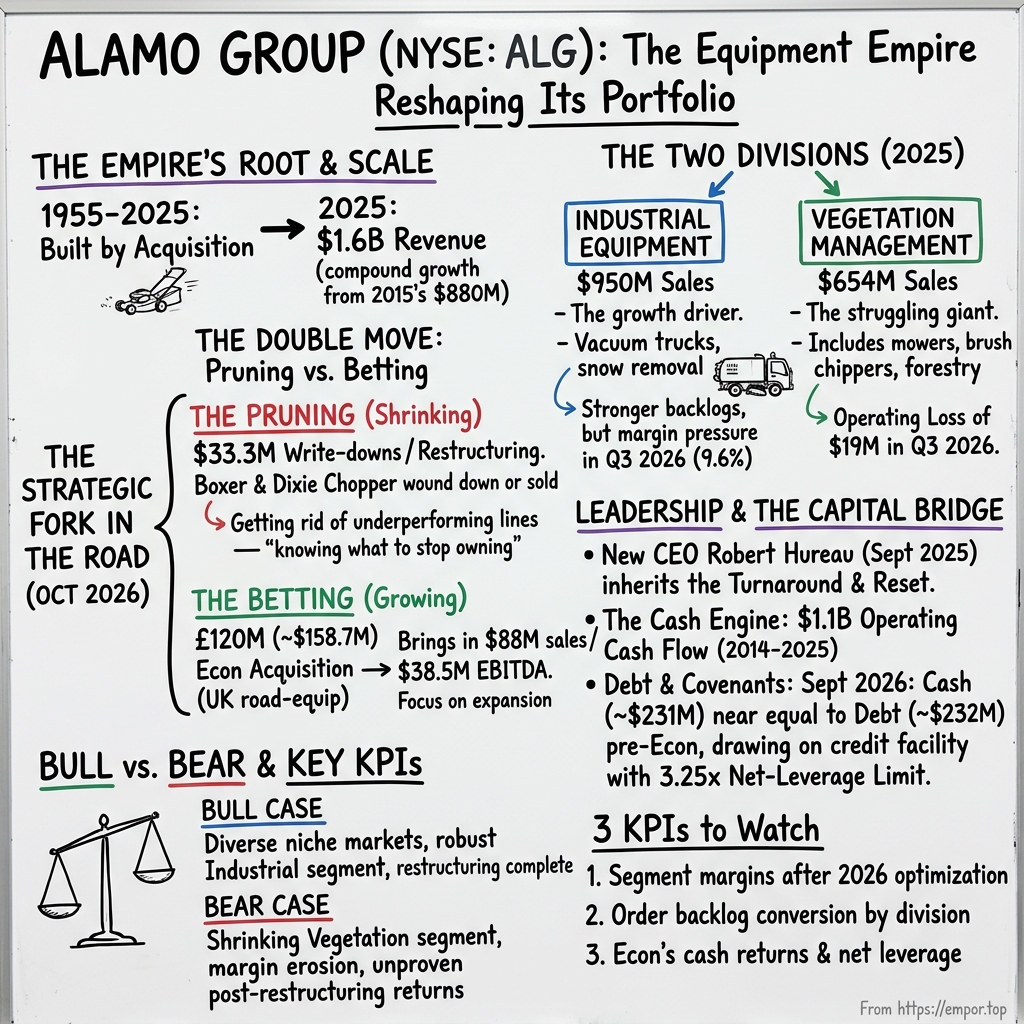
Alamo Group: The Equipment Empire That Started Shrinking Its Own Portfolio
I. The $33 Million Write-Down—and the £120 Million Bet
In the autumn of 2026, two very different pieces of paperwork defined the year for Alamo Group, the Texas-based equipment maker. One was a purchase. Alamo closed its acquisition of Econ, a British maker of road-maintenance and winter-service trucks, for £120 million, or about $158.7 million.1
The other was a set of exits. When the company reported its third quarter a few days into November, the results carried $33.3 million of net pre-tax charges tied to selling or winding down businesses that included Dixie Chopper, a zero-turn mower brand, and Boxer, a line of compact utility equipment.2
Most companies do one of these things at a time. They either clean house or they go shopping. Alamo did both inside a single season, and the juxtaposition is the best doorway into the company. Here is a manufacturer that spent decades getting bigger by buying specialist equipment makers, now paying a premium for one more while paying to be rid of others.
The numbers made the tension vivid. The charges nearly erased the quarter's reported profit: operating income fell to $3.4 million on about $403 million of sales, against $37.5 million a year earlier.2 Net profit came to roughly $2 million, or 17 cents a share.2 Yet strip out the portfolio charges, as management invited investors to do, and the picture looked almost serene. Adjusted operating income was $38.7 million, and adjusted EBITDA margin held at 13.0%, against 13.1% in the same quarter of 2025.2
So which quarter was real? The honest answer is both, and the gap between them is the subject of this story. A GAAP quarter close to zero says that Alamo had been carrying businesses that no longer earned their keep, and that letting go of them costs real money. An adjusted quarter near last year's level says that what remains is still a functioning, profitable equipment company. The investor's job is to work out which of those two descriptions will matter more in 2027 and beyond.
Econ adds a third layer. Alamo described the British company as having roughly $88 million of sales and $38.5 million of adjusted EBITDA in its latest fiscal year.1 On those figures, Alamo paid a little over four times EBITDA, which sounds cheap for any industrial business.
But that EBITDA margin, around 44 cents on every dollar of sales, is more than three times what Alamo itself earns on the same measure.12 A number that unusual is either a sign of a genuinely exceptional niche franchise or a figure that needs careful translation before anyone treats it as cash. Probably a little of both, and the next year of disclosure will tell.
Why would a company that is busy shrinking want Econ at all? The fit is easier to see once you know where Alamo already lives. It manufactures in the United Kingdom, France, the Netherlands, Canada, Brazil and Australia as well as the United States, and its British operations have long made roadside and verge-cutting equipment for councils and highway contractors.3
Econ's trucks spread grit and salt on icy roads and carry road-maintenance bodies, the kind of machine a British highway authority buys to keep traffic moving through winter.1 That is a municipal, public-works customer, the same kind of buyer that sustains Alamo's stronger division, not the farmer or homeowner whose spending has slumped.
So the October paperwork, read together, describes a deliberate tilt. Money is leaving consumer-facing and compact equipment and arriving in road maintenance. Whether that tilt was bought at a sensible price is a separate question, and one this story will return to.
Three questions run through everything that follows. The first is whether Alamo's Industrial Equipment division, the sweepers, vacuum trucks and snow equipment, can replace the weight that its Vegetation Management division has lost over the past three years. The second is whether the weak reported results are a temporary cost of pruning, or evidence that the underlying economics of parts of the portfolio have deteriorated. The third is whether Alamo's acquisition habit can keep earning its place without eating into the financial flexibility that has been its quiet strength.
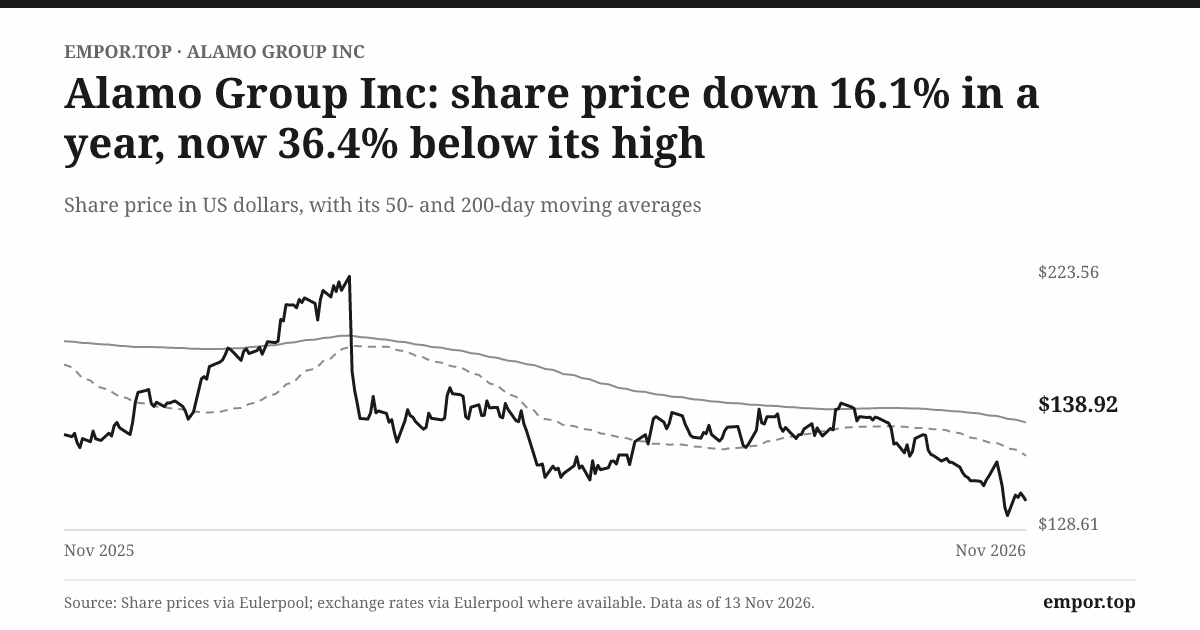
It helps to know what kind of company is asking these questions. Alamo Group is a listed American manufacturer of specialized equipment for maintaining the world's roadsides, streets, farms, forests and municipal infrastructure.3 It sold about $1.6 billion of equipment, parts and service in 2025, through two reporting divisions, and it employed roughly 3,800 people.3 Its shares trade on the New York Stock Exchange, where in mid-November 2026 the company was valued at about $1.7 billion, with the stock roughly 36% below its high of the previous twelve months.
That last fact deserves a moment. A share price that has fallen by more than a third tells you the market has already registered that something is wrong. What it has not yet decided is whether the reset is the beginning of a better company or the acknowledgement of a weaker one.
Alamo does not look like a turnaround story from a distance. It has no dominant customer, no single product, no exotic balance sheet. Its history is one of patient accumulation: a mower business that bought another business, and then another, until it had become a federation of specialist brands. To understand why it is now pruning that federation, the story has to begin with how the federation was built.
 Subscribe on LinkedIn
II. A Mower Maker Built by Acquisition
The roots go back to Texas in 1955, when the business that became Alamo began selling mowing equipment, the kind of heavy rotary cutter a farmer or a highway crew drags behind a tractor to keep grass and brush from swallowing a field or a ditch.4 It was an unglamorous product in an unglamorous market. Roadsides do not stop growing. Pastures need clearing every season. Somebody has to sell the machines that do it.
Alamo Group itself was incorporated in 1969 and listed its shares in 1993, after an S-1 registration dated February of that year.43 The listing mattered less as a fundraising event than as a statement of intent. A public currency, and access to public debt markets, gave a regional mower maker the means to buy other equipment makers. Over the following three decades, that is exactly what it did.
Rhino Products brought Alamo deeper into agricultural mowing and implements. Later purchases added municipal and road-maintenance lines, forestry equipment and a substantial European business built around British and French brands.3 The roster in today's annual report reads like a trade show directory: McConnel and Bomford in the United Kingdom, Rousseau and SMA in France, Bush Hog and Rhino in American farm country, Schwarze in street sweepers, Super Products in vacuum trucks, Gradall in excavators, Tenco and R.P.M.
Tech in snow-removal equipment.3 A quiet postscript to that early history appeared in 2025, when Alamo booked a gain on the sale of the former Rhino Ag facility, a small sign that even the oldest pieces of the portfolio were being re-examined.3
Why build a company this way? Because each of these markets is too small to support a giant on its own. The world does not need a $5 billion street-sweeper company. It needs a handful of competent sweeper makers, a few vacuum-truck makers, a few boom-mower makers, each serving a modest pool of municipalities, contractors and farmers.
A single specialist can be a fine business, but it is exposed to its own small market's cycle, its own customers' budgets, its own weather. Owning many of them spreads those risks across different customers, seasons and replacement cycles. A snowless winter that hurts the snow-plow business may be a good summer for mowers.
That is the logic. The more interesting question is whether the logic has delivered. On the surface, it has. Revenue grew from about $880 million in 2015 to $1.6 billion in 2025, a compound rate of about 6% a year, while net profit grew a bit faster, at about 9% a year.53 Shareholders' equity roughly tripled over the same decade.3
But that headline carries a footnote the size of a tractor. The growth includes acquisitions. Alamo does not publish a clean decade-long split between what it bought and what it grew, which means the 6% figure tells you the company got bigger, not how fast its underlying products gained ground. For a roll-up, that distinction is the whole game. A company that grows 6% a year by buying businesses with borrowed money is a very different animal from one that grows 6% a year by selling more of its own machines.
The recent scale step came in 2019, the busiest acquisition year in the modern record. Alamo bought Dutch Power, a Dutch maker of vegetation and road-maintenance equipment; Dixie Chopper, the zero-turn mower brand; and Morbark, a Michigan-based maker of forestry, tree-care and recycling equipment, which arrived with its own family of brands.6 Timberwolf, a British wood-chipper maker, followed in 2021, and later additions included Royal Truck & Equipment and Ring-O-Matic.3
It was not the first time Alamo had leaned on borrowed money. In 2014, the company spent about $200 million on investments, mostly acquisitions, and borrowings rose to about $190 million.5 What followed is the pattern worth noticing: over the next three years, Alamo used its cash flow to pay that debt down to about $60 million by 2017.53 Buy with debt, digest, deleverage, then buy again. That rhythm, more than any single deal, is the company's operating system.
Those deals reshaped the balance sheet. Borrowings jumped from about $85 million at the end of 2018 to about $444 million a year later, and total assets rose from roughly $720 million to $1.2 billion.6 For a company that had spent the mid-2010s paying down debt, this was a decisive lean back into leverage to buy scale.
Here is where history turns from an origin story into a test. If the acquisition engine has simply diversified Alamo, the brands it bought should, in aggregate, still be earning their place. If it has instead left the company carrying too many brands and some weaker product lines, the evidence would appear as precisely what happened in 2026: charges, exits, facility consolidation and a shrinking division. Both things can be true at once. The record suggests the engine built something valuable and also collected some passengers that did not pay their fare.
Before deciding which passengers to judge, it is worth looking at the machines themselves, and at who actually pays for them.
III. The Machines Behind the Two Divisions
It is before dawn in an American city. A street sweeper rolls down an empty avenue, rotating brooms pushing grit and leaves toward a vacuum intake, the water spray keeping the dust down. A few miles away, on a state highway, a contractor's truck crawls along the shoulder with a hydraulic boom arm extended over the ditch, its cutting head chewing through brush that would otherwise creep onto the asphalt. Neither machine is glamorous. Both are the sort of thing nobody notices until a city stops buying them.
Alamo makes both kinds of machine, and its two divisions map neatly onto those two scenes. The Industrial Equipment division sells vacuum trucks, street sweepers, snow-removal equipment, hydraulic excavators and related municipal and infrastructure machinery.3 The Vegetation Management division sells mowers of many sizes, boom and flail mowers, brush chippers, forestry and land-clearing equipment, and agricultural implements.3
For most of Alamo's modern history, Vegetation was the heart of the company. In 2023, it sold nearly $1 billion of equipment.3 Two years later it was down to about $654 million, while Industrial had grown to about $950 million.3 In other words, the bigger division is now the one built around street sweepers and vacuum trucks, not the one built around the mower that started it all.
The latest quarter showed what that shift means for profit. In the third quarter of 2026, Industrial generated about $233 million of sales and $22.4 million of operating income.2 Vegetation generated about $170 million of sales and recorded a $19.0 million operating loss, which included most of the portfolio charges.2 Put plainly, Industrial produced all of the company's reported operating profit, and Vegetation's losses consumed almost all of it.
That loss deserves a careful reading. Strip out the charges, and Vegetation's adjusted EBITDA margin actually rose to 12.5% from 9.7% a year earlier.2 So the division is not collapsing in its day-to-day operations. It is paying, all at once, for the decision to stop making some products.
That is a very different signal from a business bleeding money on every sale, and it is the first piece of evidence in the bull case. The bear case answers that adjusted margins are management's chosen lens, and that a division which has lost a third of its sales in two years has to prove the improvement through reported numbers, not reclassified ones.
How do these machines reach customers? Through two routes. Much of the equipment goes through independent dealers, the farm-equipment and municipal-equipment dealerships that stock machines, finance them and service them. The rest is sold directly to contractors, municipalities and other government buyers, often through bids.3
Then there is the aftermarket: replacement blades, brooms, hoses, hydraulic parts and service that keep machines working long after the sale.3 That aftermarket is real revenue, and in equipment businesses it is often the most profitable kind. But Alamo does not disclose what share of revenue comes from parts and service, so its stability cannot be measured from the outside.
The demand drivers are worth spelling out, because they explain why this business moves the way it does. Municipal and state budgets decide how many sweepers and snowplows get bought. Infrastructure and maintenance programs decide how many vacuum trucks and excavators get deployed. Contractors' workloads matter for both divisions.
Agriculture and forestry conditions, the price of crops and timber, the health of farm incomes, decide how many mowers and chippers farmers and tree-care companies buy. Weather matters in obvious ways: a heavy winter clears out snow-equipment inventory, a wet spring grows more grass. And all of it is mediated by dealers, who stock up before the season when they are confident and run down inventory when they are not.3
Each product family has its own clock. A city might keep a street sweeper for many years and replace it when maintenance costs climb; a snowplow fleet is refreshed when budgets and memories of a hard winter line up; a farmer replaces a rotary cutter when the old one wears out or a good harvest leaves money to spend.
Because these clocks rarely tick in unison, a portfolio spanning all of them should, in theory, be steadier than any single line. The last three years tested that theory hard, because several of the farm and consumer clocks slowed at once.
That last point, dealer inventory, is the hidden lever in Vegetation's decline. When dealers have too many machines on their lots, they stop ordering, even if end customers are still buying. Factory sales can fall far faster than real demand, and then recover just as abruptly.
A good part of the past two years' drop in Vegetation looks like this kind of destocking cycle combined with weaker farm and consumer-mower markets, but the company does not publish dealer inventory figures, so the split between a temporary destock and a permanent loss of demand cannot be measured precisely.
One reassuring structural fact: no single customer or customer group accounts for 10% of Alamo's revenue, and no supplier provides more than 10% of its principal raw materials or purchased components.3 That means Alamo is not hostage to a single municipality, distributor or steel mill. It does not, however, prove pricing power or loyalty. A company with thousands of small customers can still be a price-taker if each of those customers runs a competitive bid every time.
Then there is the backlog, the order book of machines customers have committed to but Alamo has not yet shipped. At the end of September 2026, backlog stood at about $521 million, down roughly 16% from $618 million a year earlier.2 Management said order intake strengthened during the quarter, particularly for vacuum trucks and sweepers.2 That is encouraging, but backlog is not revenue in waiting. Customer orders can be cancelled before shipment, and the falling total means the cushion that carried Alamo through 2025 is thinner going into 2027.3
Seasonality adds one more wrinkle. Vegetation sells heavily ahead of the mowing season, which means dealers take machines in the first and fourth quarters and pay for them later, so receivables swell at those points in the year.3 A quarter-to-quarter swing in receivables at Alamo is therefore often a calendar effect rather than a credit warning.
Alamo also runs a fleet of rental equipment, which is why cash flow statements show money flowing into rental machines, about $20 million in 2025.3 Renting machines can deepen a customer relationship, but it ties up capital that a pure manufacturer would not need.
So the economic weight of Alamo now sits in Industrial: the larger division, and the profitable one. Vegetation remains a substantial business, still bigger than many listed equipment companies on its own, but its recovery has become central to whether Alamo's earnings can grow again. And that raises the question every investor eventually asks of a portfolio like this: what, if anything, stops a competitor from taking the next order?
IV. Where the Moat Ends
Picture the procurement officer for a mid-sized American city. The council has approved budget for two new street sweepers. The officer writes a specification, posts a bid, and waits. Schwarze, Alamo's sweeper brand, may submit a bid. So may Elgin, owned by Federal Signal. So may other specialists. The officer compares price, delivery time, warranty, dealer support and the crews' experience with the last machines. Next time the city needs sweepers, the process starts again.
That scene captures both the strength and the limit of Alamo's competitive position. The strength is that Alamo is often in the room. Its brands are established, its dealers cover a lot of territory, and its product range lets a dealer or municipal customer buy many different machines from one family. The limit is that being in the room is not the same as owning the room. A sweeper is not a subscription. The customer can switch on the next purchase.
Scale offers some context. Alamo sold about $1.6 billion of equipment in 2025.3 Federal Signal, the closest listed comparator in sweepers, vacuum trucks and environmental equipment, sold roughly $2 billion.7 Deere is many times larger overall but sells mostly tractors, combines and construction equipment, so it overlaps with Alamo mainly at the margins of mowing and agricultural implements.
Oshkosh and Terex compete in selected vocational and specialty equipment, and Lindsay sits in adjacent infrastructure and irrigation markets. Alamo does not disclose segment market shares, so any claim that it leads a given niche is a claim, not a published fact.
The way to frame these economics is to walk through the forces that shape any industry, once, carefully. Buyers have real bargaining power, not because any one of them is large, but because municipalities and contractors buy through competitive bids and can compare machines side by side. Suppliers have limited power over Alamo, because no supplier provides more than 10% of key purchases, though steel and component inflation can still squeeze margins when price increases lag.3
New entrants face moderate barriers: building a credible sweeper or boom mower requires engineering, manufacturing, certifications and, above all, a dealer and service network that takes years to assemble. Substitutes are limited; there is no software that sweeps a street. And rivalry is real but fragmented, a world of specialist competitors rather than a single giant.
What might give Alamo a durable edge in that world? The plausible list is short and specific. Its brands carry reputations with specialist buyers. Its dealer relationships give it reach that a newcomer would struggle to match. Its product breadth lets it sell a municipality a sweeper, a mower and a snowplow through the same channel. And its installed base generates parts and service demand that competitors cannot easily capture.
That is a credible story. It is not yet a proven one. The evidence that would confirm it is concrete: price realization that keeps pace with input inflation, repeat parts demand, dealer coverage that grows rather than shrinks, a rising win rate in competitive bids, and stable segment margins through the cycle.
On the most direct of those tests, the recent evidence cuts the wrong way. In the third quarter of 2026, Industrial's operating margin fell to 9.6% from 12.2% a year earlier because material and freight inflation outran pricing, and the company said its pricing actions had lagged.2 A business with strong pricing power usually passes on inflation faster than that.
Where does that leave the comparison with Federal Signal, the rival that most resembles Alamo's Industrial business? The market values Federal Signal's earnings far more richly, a sign that investors see its sweeper, vacuum-truck and safety businesses as more consistent compounders.8 Whatever the precise reasons, the gap is a reminder that being a specialist in municipal equipment is not by itself a guarantee of premium economics. Execution, mix and pricing discipline decide who earns the premium.
The record over a longer span narrows the claim rather than rejecting it. Alamo's operating margin rose from about 7.5% in 2014 to a peak near 11.7% in 2023, which suggests that, in good markets, the portfolio can earn meaningfully better returns than it once did.53 It then slipped back to about 9.5% in 2025, which suggests that the improvement was partly cyclical.3 A moat that leaks two percentage points of margin in two years is not a fortress. It is a fence.
There is one more piece of evidence worth weighing. Alamo spent about $11 million on research and development in 2025, about 0.7% of sales.3 That is low for a company that describes product development as central to its competitiveness. It is not proof of underinvestment, because much of the engineering in specialty equipment happens inside manufacturing and product-line budgets and some peers report R&D similarly modestly, but it means Alamo's edge depends more on distribution, service and brand than on technology leadership. Investors should therefore watch customer evidence, wins and margins, more than innovation language.
The technology question deserves a sentence of its own, because every industrial story in 2026 is asked about it. Software does not sweep streets or cut brush, so Alamo faces little direct risk of being replaced by code or artificial intelligence. The more realistic technological pressure is gradual: municipal buyers asking for cleaner engines, better telematics and safer operator cabs, and competitors using automation to build machines more cheaply.
Alamo's 10-K describes continuing product development and competition on price, quality, availability and service, which is another way of saying that technology changes the terms of the contest rather than the contest itself.3 R&D spending also drifted down, from about $13 million in 2023 and 2024 to about $11 million in 2025, as the company cut costs.3 That trend is worth watching if the next generation of municipal equipment rewards engineering depth.
The verdict: Alamo's advantage is plausible in its niches and real enough to sustain a decent business, but public evidence does not establish strong switching costs, market-share leadership or a superior cost position. Treat the moat as credible but unproven. And if a moat is only partly proven, then the way management spends capital, especially on acquisitions, becomes the main determinant of returns. That leads directly to the biggest bet in the company's modern history.
V. The Morbark Bet—and the Products Alamo Later Left Behind
In the autumn of 2019, Alamo did the largest deal it had ever done. It bought Morbark, a Michigan-based maker of wood chippers, stump grinders, forestry machines and recycling equipment, for a debt-free price of about $352 million.69 Morbark came with a family of brands, including Rayco, Denis Cimaf and Boxer Equipment, a maker of compact utility loaders.6
The financing told you how much Alamo wanted it. The company expanded its credit facility from $250 million to $650 million and borrowed heavily to close the deal.6 For a business that had spent much of the previous five years shrinking its debt, this was a statement: Alamo intended to become a serious force in forestry and tree care, not just a mower and municipal equipment maker.
What did it pay for? Morbark had about $205 million of sales in 2018, according to its audited statements.10 At roughly $352 million, Alamo paid about 1.7 times sales. The available disclosures do not give a clean, deal-comparable EBITDA figure for Morbark, so it is not possible to say with confidence whether that was a rich or a reasonable multiple of earnings. What the filings do show is an inauspicious start. In the short period Alamo owned Morbark in 2019, the business contributed about $35 million of sales and a loss of roughly $1.5 million.6
One short stub period is not a verdict. Acquisition accounting, inventory step-ups and integration costs routinely depress early results. But it was not the sort of debut that proves a deal brilliant, either.
Now fast forward seven years. Among the businesses Alamo chose to sell or wind down in its 2026 portfolio optimization was Boxer, one of the product lines that had come with Morbark.2 Another was Dixie Chopper, the zero-turn mower brand also bought in 2019.2 Both exits contributed to the charges that nearly erased third-quarter operating income.2
This deserves to be read carefully, because the temptation is to overreach in both directions. Boxer's exit does not prove that the Morbark acquisition failed. Morbark's core chipper, grinder and forestry lines remain part of the Vegetation division, and Alamo does not publish standalone Morbark returns, so nobody outside the company can say whether the wider business earned its cost.
But the exits do narrow the claim of acquisition discipline. A company that buys well and integrates well should not need to pay to exit two of its 2019 purchases seven years later. The honest reading is that the 2019 shopping spree brought in some products that did not earn their keep, and that it took several years and a new chief executive to act on that.
The balance sheet, at least, absorbed Morbark faster than the income statement did. Borrowings peaked at about $444 million at the end of 2019 and fell to about $289 million a year later, helped by an unusually strong year of cash generation in 2020, when operating cash flow reached about $184 million.63
Within a few years debt was back to roughly where it had been before the deal, relative to equity. That repeated the old rhythm of borrow, digest and deleverage, and it shows that Alamo's financial discipline after a deal has been more consistent than its discipline in choosing what to buy.
Return on capital tells the broader story. Alamo's return on invested capital was about 14% in 2018, the year before the spree. It fell to about 7% in 2019 as the newly borrowed capital entered the base, and climbed back to around 14% by 2023 before slipping to about 11% in 2025.63
So the company eventually earned its way back to pre-deal returns, but it took four years, a favourable demand cycle and, in the end, some exits. That is neither a disaster nor a triumph. It is what a large acquisition looks like when it works only partly.
Set Econ against that history. Alamo paid about $158.7 million for a business with roughly $88 million of sales and $38.5 million of adjusted EBITDA, a little over four times that EBITDA before closing adjustments and integration costs.1 On the surface, that is a far lower entry price than Morbark's. But surfaces deceive in acquisitions.
A 44% EBITDA margin is extraordinary for a manufacturer, and it invites the questions that matter: what adjustments the seller made, how much of that EBITDA depends on depreciation-heavy activities that require continual capital, how much working capital the business ties up, and what integration will cost. Alamo has not yet reconciled the seller's adjusted figure to the cash earnings that its own shareholders will actually receive.
There is no matched transaction benchmark that settles whether either deal was cheap or expensive. The 2019 purchases came during a strong acquisition year, and further deals followed in 2021 and after.3 Management now speaks of disciplined capital allocation. The full record suggests discipline that is real but intermittent: willing to borrow heavily for scale, slow to prune when products disappointed, and now, under new leadership, both pruning and buying at once.
The decisive evidence for Econ will be its contribution to cash flow and returns over its first full year. The decisive evidence for the portfolio as a whole will be what happened to the division that most of these acquisitions were meant to strengthen. And that division has had a very difficult three years.
VI. The Vegetation Business Stops Growing
In 2023, Vegetation Management sold nearly $1 billion of equipment. That year was the high point of a post-pandemic boom in which farmers flush with high crop prices, homeowners with stimulus cash and contractors with infrastructure work all bought mowers, chippers and implements. Two years later, the division's sales had fallen by about a third, to roughly $654 million.3 Over the same two years, Industrial grew from about $711 million to about $950 million.3
The mix shift is striking enough that it deserves a moment. In 2023, Vegetation was almost 60% of Alamo's revenue. By 2025, Industrial had overtaken it. In two years, a mower company had become, by sales, a street-sweeper and vacuum-truck company.
That shift is either a sign of resilience or a sign of loss, depending on which way you look. Seen from the optimistic side, Alamo's diversification worked as designed: when farm and consumer mowing demand softened, municipal and infrastructure spending kept the company growing in the other division.
Seen from the pessimistic side, Industrial's growth did not fully replace what Vegetation lost. Consolidated revenue fell from about $1.69 billion in 2023 to about $1.60 billion in 2025, and operating profit dropped from about $198 million to about $152 million.3 The diversification cushioned the blow. It did not prevent it.
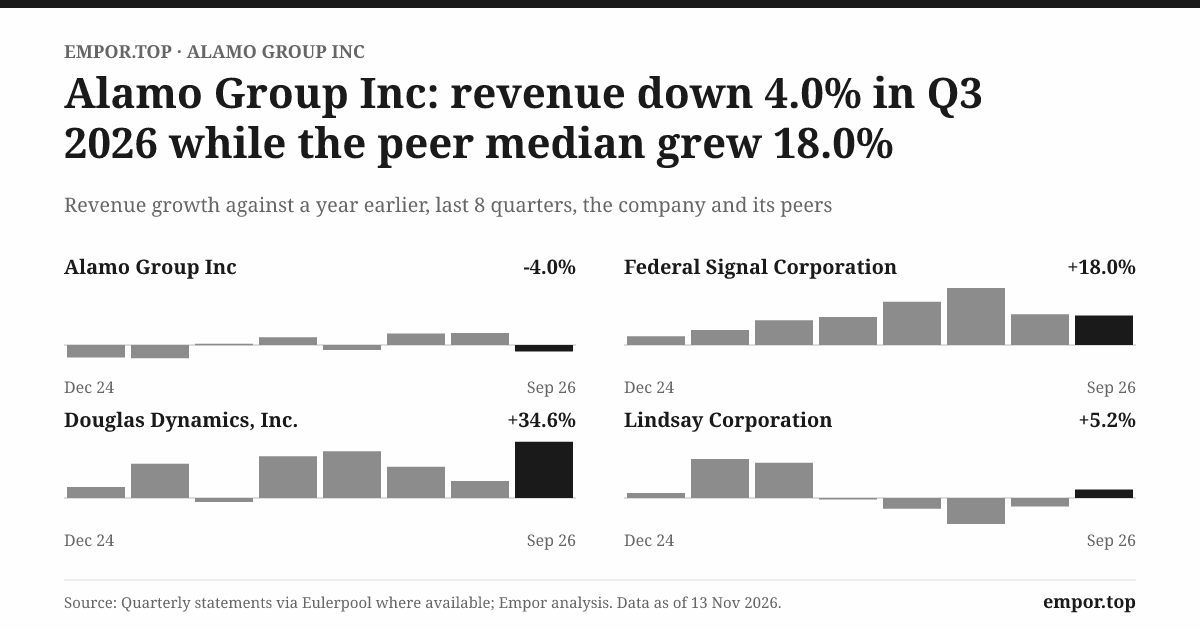
The early months of 2026 had briefly suggested the worst was over. Revenue rose about 7% from a year earlier in both the first and second quarters, before falling about 4% in the third.112 One good half-year followed by a down quarter is not a trend in either direction, but it is a reminder that recoveries in this business arrive unevenly, season by season.
Why did Vegetation fall so sharply? It helps to separate the forces Alamo cannot control from those it can. Demand-side forces include lower farm incomes, weaker consumer and contractor mower purchases, dealer destocking after the 2021–2023 boom, and weather. Those affect order timing and volumes, and they tend to reverse eventually.
Execution-side forces include the number of facilities, the mix of product lines, plant utilization and pricing. Those are management's to fix. The 2026 optimization is explicitly aimed at the second group: facility relocations and consolidation intended to improve utilization and reduce structural costs, alongside the product-line exits.12
Headcount offers one clue that the restructuring has been under way for some time. Alamo employed about 4,350 people at the end of 2023 and about 3,800 at the end of 2025, a reduction of roughly an eighth.3 Sales fell less than that, which is consistent with a company trimming capacity to match lower volumes.
Inventory gives a less comfortable clue. A business that is shrinking ought to hold less stock. Alamo's inventory, measured in days of cost of sales, rose from about 103 days at the end of 2024 to about 116 days at the end of 2025, and inventory absorbed about $28 million of cash in 2025 even as sales fell.3 Asset turnover, the amount of sales each dollar of assets produces, has drifted from about 1.4 before the 2019 deals to about 1.0 in 2025.3
Some of that decline reflects acquired goodwill and a growing cash pile, which inflate assets without producing sales. But the inventory figure is operational, and it points to a portfolio with too many products and too many plants for the volumes it now ships. That is exactly the problem that facility consolidation and product exits are meant to solve, and it is why the exits are more than an accounting event.
Now to the third quarter, which carried the story's most important single number. The $33.3 million in net pre-tax portfolio-optimization charges drove reported operating income down to $3.4 million.2 Adjusted operating income, which excludes those charges, was $38.7 million.2 The difference is almost entirely Vegetation. Even the tax line misbehaved: with pre-tax profit squeezed to about $4 million, the effective tax rate jumped to roughly 50%, leaving net profit of about $2 million.2 Small denominators make for strange ratios, which is one reason the reported quarter cannot be read on its own.
What makes that number awkward is not its size but its context. In the same quarter, Industrial, the division that is supposed to be carrying the company, also weakened. Its operating margin fell to 9.6% from 12.2% a year earlier, as material and freight inflation outpaced pricing.2 The company said pricing actions had lagged.2 So the recovery narrative needs to explain two problems at once: the shrinking division's restructuring, and the growing division's margin squeeze.
Management's live version of this story is worth listening to closely. Over the summer, the narrative sounded like recovery: second-quarter sales rose about 7% from a year earlier, and operating margin held at about 10%.1113
By the third-quarter call in November, the emphasis had shifted to portfolio optimization, with management pointing to strengthening order intake in vacuum trucks and sweepers and to pricing actions intended to recover inflation.14 The tests for the next calls are simple: whether the stronger orders in sweepers and vacuum trucks become shipments, and whether management gives measurable milestones for pricing recovery rather than directional reassurance.
Here the disconfirming evidence sits right beside the recovery case. Yes, adjusted Vegetation margins improved. Yes, orders strengthened in parts of Industrial. But backlog fell from about $618 million to about $521 million over the year.2 Industrial margins fell. And the company's total revenue in the third quarter was about 4% below a year earlier.2 A recovery is possible. It has not yet appeared in reported results.
The verdict for this chapter: the portfolio has already shifted toward Industrial, but it has not yet cleanly replaced Vegetation's lost earnings. A credible recovery needs several consecutive quarters of improved reported margins after the exits finish, not just better adjusted figures and stronger order commentary. And if a recovery is going to take time, then the next question is whether Alamo has the financial room to wait for it while also absorbing a new acquisition.
VII. Cash in the Bank, and a New Acquisition to Pay For
At the end of September 2026, Alamo held about $231 million of cash and owed about $232 million of debt.12 In plain terms, it could have written a cheque to repay almost every dollar it had borrowed. A month later, it drew on its revolving credit line to buy Econ.21
That snapshot captures one of Alamo's genuine strengths. Over the twelve years from 2014 to 2025, the company generated about $1.1 billion of cash from operations, about 122% of the roughly $900 million it reported as net profit.3 Free cash flow, after capital spending, was about $823 million over that period.3
Dividends took only about $80 million of it, roughly a tenth.3 The rest went to acquisitions, debt repayment and, increasingly in recent years, a growing pile of cash, which rose from about $64 million at the end of 2013 to about $310 million at the end of 2025.3
That is the profile of a company that turns its accounting earnings into real money over time. It is worth explaining why. Equipment makers carry large non-cash charges, depreciation of factories, amortization of acquired intangibles and stock compensation, which reduce reported profit without consuming cash. Add those back, and operating cash flow naturally exceeds net income in normal years.
But the path has been anything but smooth. Operating cash flow was about $12 million in 2018 and $14 million in 2022, years in which inventory and receivables swallowed nearly all of the company's earnings.3 It surged to about $184 million in 2020, $209 million in 2024 and $178 million in 2025, years when working capital released cash.3
In 2025, for instance, lower receivables released about $41 million and higher payables about $30 million, while inventory absorbed about $28 million.3 So the twelve-year ratio is a fair summary of long-run quality, but it is not a promise of smooth annual cash. Recent strength has partly come from running down working capital as sales slowed, a source that reverses when growth resumes.
The uses of that cash have been modest outside acquisitions. Capital expenditure was about $31 million in 2025, under 2% of sales.3 Dividends were about $14 million.3 Buybacks were token, about $3 million.3 The dividend is a gesture of commitment, not the main capital-allocation story. The main story is acquisitions, and the balance sheet exists primarily to fund them.
That is where the May 2026 bank renewal matters. Alamo signed a new credit agreement with a $202.5 million term loan and a $400 million revolver, maturing in May 2031.1516 The agreement caps consolidated net leverage at 3.25 times EBITDA, with a temporary step-up to 3.75 times after a qualifying material acquisition, and requires fixed-charge coverage of at least 1.25 times.15
Think of the leverage covenant as a speed limit on how much Alamo can borrow relative to its earnings, and the acquisition step-up as a short stretch of road where the limit is temporarily raised.
How close is Alamo to that limit after Econ? A rough calculation suggests plenty of room. Even if the entire Econ price had been added to net debt, the result would be in the neighbourhood of $160 million, well under one times the company's annual EBITDA, against a covenant ceiling of 3.25.12115 The bank definitions of debt and EBITDA differ from reported figures, so this is an approximation, but the gap is wide.
The composition of that debt matters too. At the end of September, almost all of it was term debt, about $199 million, with only about $33 million drawn on the revolver; operating leases of about $15 million sit separately and are not counted in borrowings.123
Alamo also carries an interest-rate swap with $140 million of notional value, which fixes the cost on part of the floating-rate term loan.12 The cash pile, meanwhile, earned its keep in a modest way: interest income reached about $5.6 million in 2025, about 4% of pre-tax profit, because the company held more cash.3
Econ also deepens a risk Alamo already lives with. Most of the company's products are sold in the markets where they are made, so currency moves mainly change the translated value of foreign profits rather than creating mismatches between costs and revenue. Alamo estimated that a uniform 10% stronger dollar would have cut gross profit by about $12.5 million at the end of 2025.3
It uses British pound forward contracts to offset part of that exposure and says it does not trade derivatives speculatively.3 A sterling-earning acquisition adds to the British slice of that sensitivity. It is a manageable risk, but one that will add noise to reported growth.
The quality of what customers owe is reassuring. Receivables ran about 67 days of sales in 2025, down from a peak of 83 in 2018, and the provision for doubtful accounts was only about $0.1 million that year.3 Alamo does not publish an ageing schedule, so the detail cannot be checked from outside, but nothing in the disclosed provisions suggests dealers or municipalities are struggling to pay.
So refinancing risk is secondary for now. No credit-rating agency publishes a rating rationale for Alamo, and the bank facility runs into 2031. The nearer risk is subtler: using acquisition capacity without earning the cost of capital. A company with a nearly unlevered balance sheet and a habit of buying businesses will always be tempted to deploy that capacity. The question is not whether it can afford Econ. It is whether Econ, and whatever comes next, will produce cash returns above what shareholders could earn elsewhere.
The return bridge on Econ is what investors should ask for: the purchase price, integration costs and any required capital spending, the working capital the business absorbs, and its cash contribution through the first full year. That is the scorecard that turns a 4 times EBITDA headline into an actual return. And responsibility for that scorecard now sits with a new chief executive.
VIII. A New CEO Inherits the Turnaround
In September 2025, Robert Hureau took over as Alamo's president and chief executive, succeeding Jeff Leonard.17 He arrived at an awkward moment. Operating income had already fallen from about $198 million in 2023 to about $165 million in 2024, and it would fall again, to about $152 million, in 2025.3 Vegetation was shrinking. The 2019 acquisitions included lines that were not earning their keep. The new chief executive inherited not a growth story but a repair job.
Alongside him is Agnieszka Kamps, the chief financial officer, who joined Alamo in 2024.17 Together they form the leadership team that will be judged on the recovery. The stories of their predecessors matter less now than the record this pair builds over the next two years.
What has Hureau said he wants? Portfolio quality and margins have been the stated priorities, and the actions of 2026 match those words: product-line exits, facility consolidation, and a new acquisition in a niche, British road maintenance, that sits closer to Industrial's municipal heartland than to Vegetation's farm market.21 That consistency between words and deeds is a point in management's favour. But consistency is not yet credibility. Credibility comes when the reported numbers follow.
His pay offers a lens on what the board is asking him to deliver. Hureau's reported 2025 compensation was about $4.5 million, including about $3.5 million in stock awards, a $200,000 sign-on bonus and about $451,000 of incentive pay.17 Because he joined during the year, that figure is not comparable to a full-year chief executive package. The heavy weighting toward stock awards ties a large part of his potential reward to the equity value that shareholders care about.
The incentive design is more revealing than the total. The 2025 plan paid out on adjusted pretax income and cash conversion, while the component tied to organic revenue growth paid nothing.17 That tells you two things. First, the board is rewarding profit and cash, the right measures for a company in repair. Second, the zero on organic growth is an honest acknowledgment that the underlying business did not grow.
The risk worth watching is that a plan built around adjusted pretax income can reward management for results that exclude precisely the charges investors are trying to evaluate. If adjustments keep recurring, the incentive and the shareholder experience can drift apart. Alamo also recorded about $2.3 million of chief executive transition costs in 2025.3
It also matters how the market has treated the transition. With the share price down by more than a third from its recent high, Hureau is being judged not by the enthusiasm that greets a new chief executive but by the skepticism that greets a restructuring. That can be an advantage. Expectations are low enough that measurable progress would be noticed quickly.
Ownership adds context without changing the picture dramatically. Henry Crown and Company, the Chicago-based Crown family investment firm, held about 14% of the shares in the 2026 proxy, making it the largest disclosed holder.17 BlackRock held about 13% and Vanguard about 6%.17 A year earlier, Crown's stake was essentially unchanged at about 14%, while BlackRock's had been somewhat larger.18 Crown is a long-term anchor, not a controlling parent. The board has nine members, an independent chair, Richard Parod, and independent committees.17
Alamo's treatment of its own shares has been unremarkable in a good way. It repurchased only small amounts, about $3 million in 2025, while option exercises and equity awards added shares; the share count rose only slightly, from about 12.02 million to 12.07 million, across 2025.3
The company has not raised equity through a rights issue or placement in that period, and no pledge of shares by a major holder is disclosed.317 For a company that has made dozens of acquisitions, that is a meaningful fact: the deals were funded by cash and debt, not by diluting existing owners.
The trust checks come back clean but bounded. The proxy disclosed one related-party arrangement: former executive Dan Malone received $13,300 a month for consulting from April 2025 to March 2026, a trivial sum relative to a $1.6 billion business, and reported no other related-party transactions in 2025.17 KPMG gave an unqualified opinion on the 2025 financial statements and internal controls.3 Shareholders gave about 98% support to the prior year's say-on-pay vote.17 The legal record is similarly quiet.
The 2025 annual report describes routine product-liability claims, generally covered by insurance above self-insured retentions, and identifies no material pending proceeding; the third-quarter filing reports no material change in risk factors.312 Machines that cut brush and clear snow can injure people, so product liability will always be a background cost, but nothing disclosed suggests it is a hidden overhang. None of that proves good stewardship. It does mean the governance questions here are about strategy and capital allocation, not about integrity.
The best way to judge Hureau is to listen to how he talks when analysts push. On the November call, the emphasis was on portfolio optimization, the order recovery in Industrial and pricing actions to catch up with inflation.14 What investors should track across the next several calls is whether his explanation of the Vegetation decline, the Industrial pricing lag and Econ's returns stays consistent, and whether vague assurances turn into specific milestones and dates.
Consider also what Hureau's arrival did and did not change in the company's character. The acquisition reflex survived the transition, as Econ shows. What changed was a new willingness to exit, and to take the charges in one visible quarter rather than letting weak lines linger. Whether that willingness reflects a new philosophy or simply a new leader clearing the decks of predecessors' decisions is something only a longer record can reveal.
The verdict: Hureau inherited real operating problems, named the right priorities and has acted on them quickly. But his record is barely a year long, and much of it consists of charges and announcements. The reported margins and cash returns of 2027 will decide whether he has earned the market's trust. Which raises the market's own question: how much of that trust has the stock price already extended?
IX. Analysis & Bear vs. Bull Case
Imagine two investors reading the same third-quarter release. One sees a quarter in which $33.3 million of charges almost erased GAAP operating profit. The other sees adjusted EBITDA margin holding at 13.0%, essentially unchanged from a year earlier.2 Both are reading the same document. They come away with very different stories, and the share price, around $139 in mid-November, reflects a market that has not yet chosen between them.
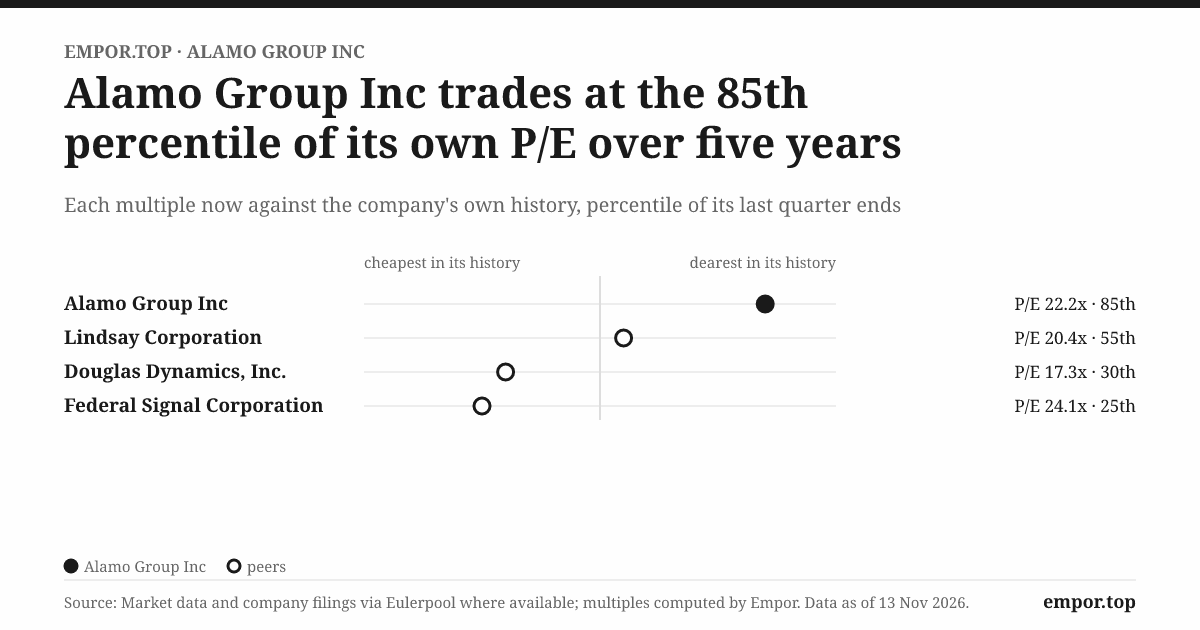
Start with how the market prices Alamo. On trailing reported earnings of about $6.43 a share, the stock traded at about 22 times earnings, above its own five-year median of about 19.5 times.12 On enterprise value to EBITDA, which looks through the depressed GAAP numbers somewhat, it traded at about 8.7 times. Federal Signal traded at about 14.7 times on the same measure, and Lindsay at about 11.6 times.819
A third lens complicates matters further. Measured against free cash flow rather than earnings, the stock yields about 8%, almost twice its earnings yield of about 4.5%.3 That gap exists because recent cash flow has been flattered by working capital released as sales fell, while earnings have been depressed by charges. Neither figure is a clean read of normal earning power. The truth probably sits between them, which is precisely why the next year of reported results matters so much.
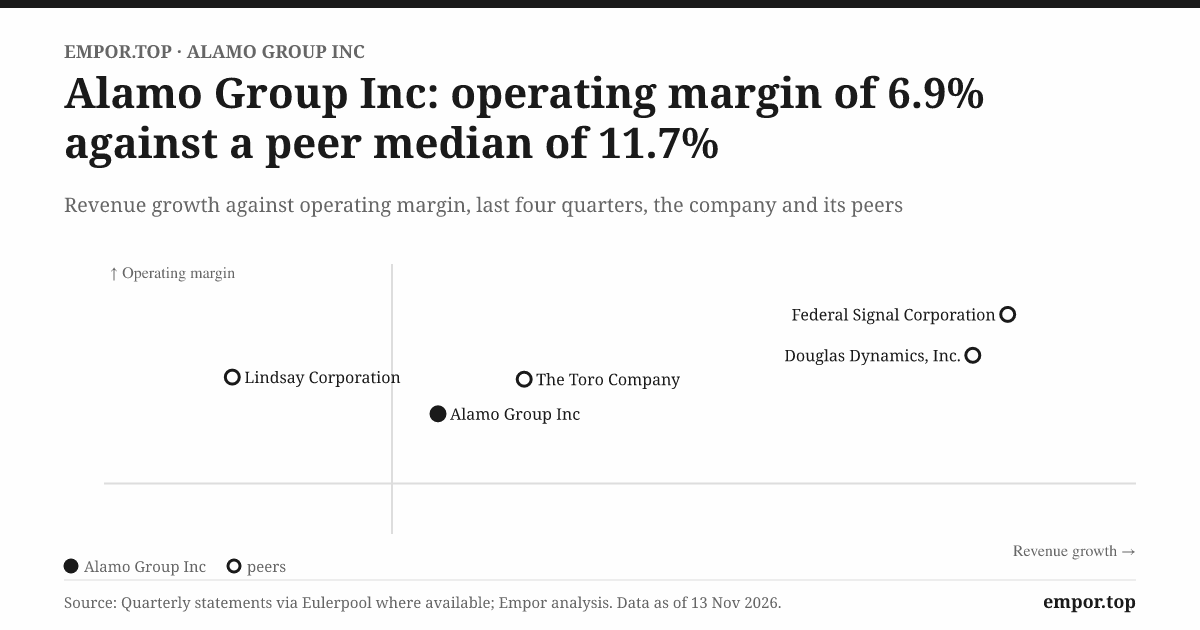
Those numbers point in different directions, and both are partly distorted. The price-to-earnings multiple looks high because trailing earnings include restructuring charges. The EV/EBITDA multiple looks low against peers, but Federal Signal has grown faster and earned higher margins, and Lindsay has a different mix entirely.
Peer multiples are context, not proof of what Alamo is worth. The fair reading is that the stock is not an obvious bargain against its own history, even though it looks cheaper than selected peers on cash-earnings measures. The price appears to assume that a substantial part of the earnings lost since 2023 will come back.
The bull case, in its strongest form, runs like this. Alamo makes essential maintenance equipment: roads must be swept, ditches mowed, snow cleared, trees trimmed. Its end markets are diverse, its customers fragmented, and no buyer accounts for a tenth of revenue.
It has generated positive cash over a long record, and its balance sheet was close to net debt-free before Econ. Industrial is now the larger division and has grown through the Vegetation slump. The Q3 GAAP collapse is mostly explained by one-off restructuring charges. Remove those, exit the weak lines, add a high-margin British business, and margins should step up.
The bear case, in its strongest form, runs like this. The decade of growth was partly bought, and recent organic performance is poor: revenue grew only about 2% a year over the past three years, and net profit less than 1% a year.3 Vegetation has lost about a third of its sales.
Industrial's margins fell sharply in the latest quarter as inflation outran pricing. Return on equity fell to about 6% over the past twelve months. And the company has not yet shown post-restructuring returns on anything, let alone Econ, whose seller-adjusted margin looks almost too good to be true for an equipment maker.
How does the competitive frame hold up under that tension? Running the forces once more as a stress test rather than a second moat argument: buyer power is the binding constraint, because public and contractor buyers bid each purchase; supplier power shows up through inflation, as the third quarter demonstrated; entry barriers are moderate; substitutes are weak; and rivalry among fragmented specialists is persistent.
Hamilton Helmer's seven powers, the sources of durable advantage he identifies, sharpen the picture. Scale economies are limited: Alamo is not much larger than Federal Signal and is fragmented across many small product lines, so it is not the low-cost producer in most niches. Network effects do not apply. Counter-positioning does not obviously apply. Switching costs exist only in a soft form, crews' familiarity with a machine and a dealer's parts inventory, but nothing contractually locks a customer in.
Branding is real in specialist circles, but there is little evidence that it commands a measurable price premium, given the recent pricing lag. Cornered resources are absent. Process power, the hardest-to-copy organizational capability, is the most interesting candidate: Alamo's real skill may be buying and running small specialist manufacturers. But the 2026 exits show that this process does not always produce winners. The honest summary is that Alamo has modest, overlapping advantages rather than one decisive power.
Three numbers will decide which story wins. The first is segment operating margins after the optimization charges end. Industrial's most recent reading was 9.6%, down from 12.2%; Vegetation's was negative on a reported basis even as its adjusted EBITDA margin improved.2 The second is order intake and backlog conversion by division. Backlog was about $521 million, down about 16% year on year, with orders improving in sweepers and vacuum trucks.2 The third is post-Econ cash returns and net leverage, which start from close to zero net debt before the acquisition.12
Before that test, a word on the risks that actually bear on this business, rather than the generic list every industrial company recites. The most material is input-cost inflation running ahead of price, because Alamo's latest quarter showed exactly that mechanism at work in its stronger division.
The second is public-budget risk: municipal and highway authorities fund most Industrial purchases, so a squeeze on local government finances would show up first in sweeper and vacuum-truck orders. The third is execution risk in the restructuring itself, because moving production between plants can disrupt deliveries and quality in the very quarters when management needs to show improvement. Currency and refinancing risks exist but are secondary on today's evidence.
Why those three and not the dozens of other figures Alamo reports? Because each one tests a different link in the bull case. Segment margins test whether the restructuring fixed the cost base and whether pricing power exists. Order conversion tests whether demand is genuinely recovering or merely being described as recovering. And cash returns on Econ test whether management's capital allocation, the engine that built the company, still creates value. If all three improve together, the bull case is being proved. If one stalls, investors will know exactly which part of the story has broken.
Now the skeptical owner's test. Imagine a patient shareholder, not an activist, sitting with the board in a year's time if the expected returns have not appeared. What would they ask? They would ask the company to publish acquired-business returns, so that every deal could be measured against its cost.
They would ask whether any other Vegetation product lines should follow Dixie Chopper and Boxer out of the door. They would ask the board to tie incentive pay more closely to reported rather than adjusted earnings once the restructuring is over. And they would ask management to pause further acquisitions until Econ's first full year shows whether its remarkable margins translate into cash.
None of these questions implies that the strategy is wrong. They imply that the burden of proof sits with management. And that burden carries lessons that reach well beyond one Texas equipment maker.
X. Playbook: Business & Investing Lessons
In 2019, Alamo brought a family of forestry brands into its portfolio in one transaction, along with a zero-turn mower maker in another. Seven years later it was paying to leave two of those product lines behind while it bought a British specialist in road maintenance. That arc contains the most useful lessons in the whole story.
The first lesson: a collection of niches becomes a strategy only when the owner knows what to stop owning. Alamo's model of assembling small specialist manufacturers is a sound idea, because none of those markets supports a giant and diversification across them smooths the bumps of any one.
But the model has a hidden cost: every acquisition brings products that will, eventually, stop deserving their place. The Dixie Chopper and Boxer exits are not an admission that the roll-up failed. They are the overdue half of the roll-up, the pruning that has to accompany the planting. A roll-up that only buys is a hoarder; one that also sells is a gardener.
The second lesson: cash is proof of endurance, not proof that every deal worked. Alamo's cumulative free cash flow of about $823 million over twelve years shows a company that has consistently turned accounting profit into real money.3 Yet in the same period, it bought businesses that it later had to exit at a cost. Both facts are true. A strong aggregate cash record can hide the underperformance of particular deployments, because the winners pay for the losers. Investors in any acquisitive company should ask for returns deal by deal, not just in aggregate.
The third lesson: the purchase multiple is only the opening bid. Econ cost about four times its seller-reported adjusted EBITDA, a number that sounds like a bargain.1 But the real price of an acquisition includes integration costs, required capital spending, the working capital the business ties up, and the risk that a seller's adjusted figures do not translate into the buyer's cash. Morbark looked like a strategic transformation in 2019; by 2026, part of it was being written off. The headline multiple is where the story of a deal begins, not where it ends.
The fourth lesson: adjusted earnings buy time; reported returns earn trust. In the third quarter of 2026, reported operating income was about $3 million and adjusted operating income almost $39 million.2 That gap is legitimate as long as the charges really are one-offs. If exclusions keep recurring quarter after quarter, they stop being adjustments and become part of the cost of running the business. The moment a company's adjusted and reported numbers converge, its story becomes believable again.
There is a final, quieter lesson in Alamo's inventory and plant count. A roll-up's costs hide in places a headline never reaches: in the extra factory that one acquired brand still needs, in the warehouse of parts for a product line that sells a few hundred units a year, in the engineer splitting time across too many models. Complexity is the tax a collector of niches pays, and it is levied every year whether or not the niche is growing. The best roll-ups audit that tax as rigorously as they audit a purchase price.
XI. Epilogue
Tonight, Alamo stands at the threshold of the first full reporting periods after its portfolio reset. Dixie Chopper and Boxer are being sold or wound down. Econ is newly consolidated. The charges have been taken. What comes next will show whether the reset produced a better company or simply a smaller one.
The first moment to watch is Vegetation's reported operating margin once the exit charges end. If the division returns to positive reported profits within a couple of quarters, the claim that its weakness was mostly about cleanup will look credible. If it stays near breakeven even after the charges stop, the problem will look structural: weaker demand, weaker pricing or a cost base that remains too large for the business that is left.
The second moment is Industrial's conversion of orders into shipments. Management pointed to stronger order intake in sweepers and vacuum trucks during the third quarter.2 Those orders should turn into higher sales over the next several quarters. The crucial detail is whether they do so at better margins. If pricing finally catches up with material and freight inflation, Industrial's margin should recover toward its prior level. If it does not, the moat will have proved thinner than the bulls hoped.
The third moment is the gap between adjusted and reported results. Alamo has taken large charges once. If, a year from now, it is still reporting significant exclusions every quarter, the temporary-reset explanation will lose its force. Cash from operations is the referee here: it cannot be adjusted.
The fourth moment is Econ's first full-year disclosure. Investors will want to see its revenue, its operating profit, its cash conversion and how much acquisition-related borrowing remains. Against a purchase price of about $158.7 million, Econ needs to contribute meaningful cash within a few years to justify the decision.1 Net leverage should remain comfortably below the 3.25 times covenant ceiling.15
There is also the calendar. The fourth-quarter results, due early in 2027, will be the first to include Econ and the first full quarter after the exit decisions; the 2026 annual report will show how much the optimization finally cost and what the new segment structure looks like. The next proxy will reveal how the board scored Hureau's first full year, and whether the incentive plan leans on adjusted or reported figures. Each of those documents is a chapter in the answer.
Put those together and the test is simple to state. Two consecutive quarters of improving reported margins, alongside clear cash returns from Econ, would support the recovery thesis. Persistent Vegetation losses, a lingering Industrial margin squeeze and repeated large adjustments would challenge it. The story now turns on execution, not on the announcement of a better portfolio.
XII. Outro
Go back to the October in which Alamo did two opposite things at once: selling or closing mower and compact-equipment lines it had bought only seven years earlier, while adding a British maker of road-maintenance trucks for $158.7 million.12 That pairing is the company in miniature. Alamo has always grown by buying specialists. What is new is that it has started deciding, out loud and at a cost, which specialists it no longer wants.
That is what makes Alamo unlike a typical industrial roll-up. Its defining act was never simply buying niche equipment companies; plenty of companies do that. Its defining act, now, is choosing which niches still deserve a place. The company has spent seventy years learning how to buy the right machines.
The next few years will show whether it has learned the harder skill of letting go of the wrong ones, and whether the shape that remains can earn more than the one it replaced. Investors do not need Alamo to stop changing. They need proof that each change pays.
Somewhere tonight, a street sweeper heads out before dawn, brooms turning, headlights on an empty avenue. It was built by a company still deciding which machines it wants to make next.
References
-
Q3 2026 Results — Alamo Group, 2026-11-02 ↩↩↩↩↩↩↩↩↩↩↩↩↩↩↩↩↩↩↩↩↩↩↩↩↩↩↩↩↩↩
-
2025 Form 10-K — Alamo Group Inc., 2026-03-02 ↩↩↩↩↩↩↩↩↩↩↩↩↩↩↩↩↩↩↩↩↩↩↩↩↩↩↩↩↩↩↩↩↩↩↩↩↩↩↩↩↩↩↩↩↩↩↩↩↩↩↩↩↩↩↩↩↩↩↩↩↩↩
-
Federal Signal valuation statistics — Stocknear, 2026-11-13 ↩↩
-
Morbark Acquisition Pro Forma Financial Statements — Alamo Group, 2020 ↩
-
2026 Form 10-Q, quarter ended September 30 — Alamo Group Inc., 2026-11-04 ↩↩↩↩↩↩↩↩
-
Fourth Amended and Restated Credit Agreement — Alamo Group Inc., 2026-05-27 ↩↩↩↩
-
2026 Proxy Statement — Alamo Group Inc., 2026-03-19 ↩↩↩↩↩↩↩↩↩↩
 LinkedIn
 WhatsApp
 Reddit
 Hacker News
 Email
 Kindle
 RSS Feed
 Spotify
 Apple Podcasts
 Amazon Music
 Audible
 YouTube