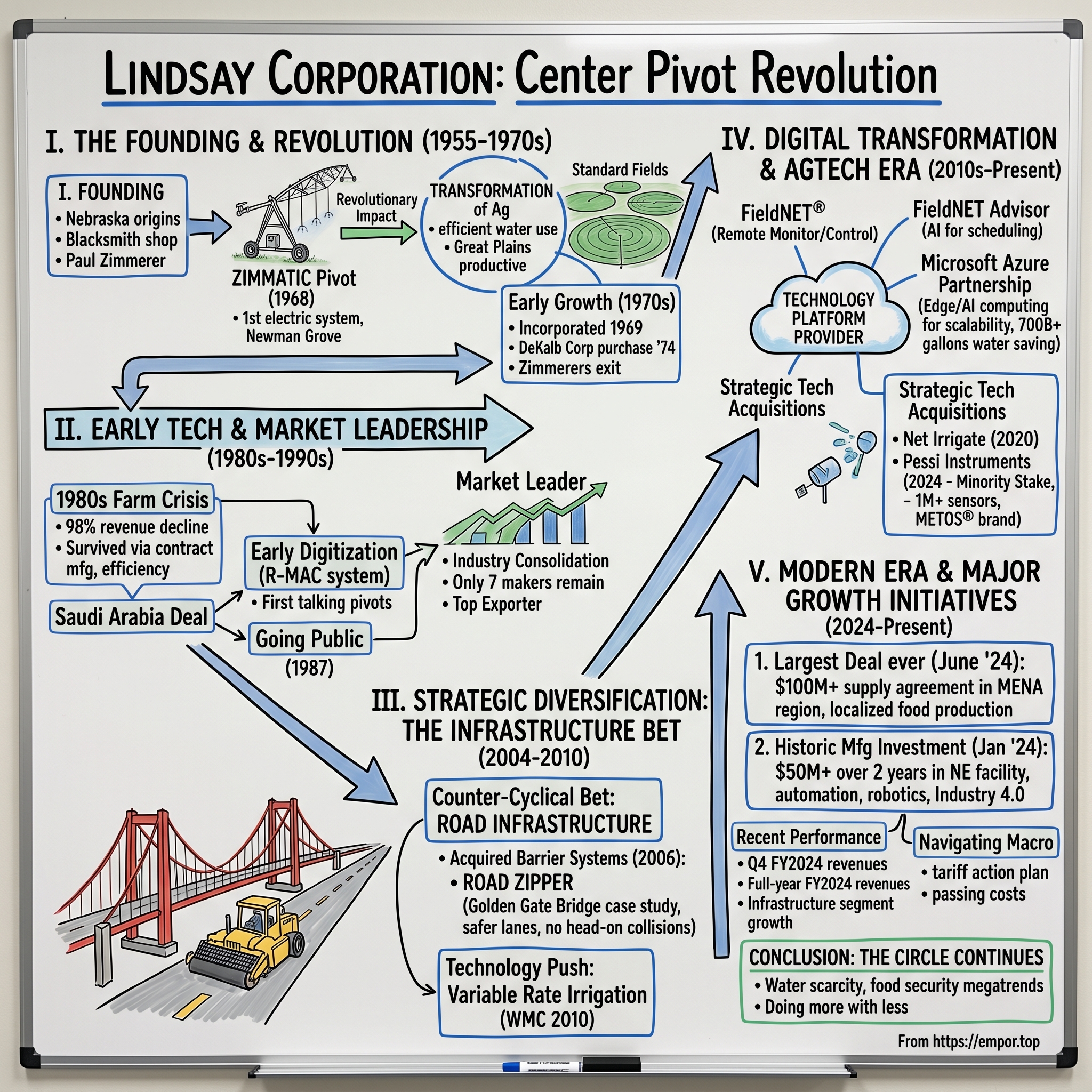
Lindsay Corporation: The Story of the Center Pivot Revolution
I. Introduction & Episode Roadmap
Picture the American Great Plains from 35,000 feet: an endless patchwork of circles—emerald green against brown earth—stretching from Nebraska to West Texas. These circles, visible from any commercial flight crossing the heartland, represent one of the most profound transformations in agricultural history. Each circle is irrigated by a center pivot system, and a remarkable number of them bear the Zimmatic brand name. They belong to Lindsay Corporation.
With a market capitalization hovering around $1.5 billion and trailing twelve-month revenue of approximately $678 million, Lindsay isn't the kind of company that typically captures Wall Street's imagination. The company reported Q4 FY2024 revenues of $155.0 million and full-year FY2024 revenues of $607.1 million. Yet this small-cap industrial concern from Omaha, Nebraska has accomplished something extraordinary: it helped turn America's semi-arid interior into the world's most productive agricultural region, and today its systems irrigate approximately 12 million acres across more than 90 countries.
The questions that make Lindsay fascinating go beyond simple financial metrics. How did a small farm equipment business in rural Nebraska become a global leader that fundamentally changed how America farms? How does a 70-year-old hardware company reinvent itself for the age of artificial intelligence and water scarcity? And what does Lindsay's evolution tell us about the intersection of agriculture, technology, and the megatrend of resource conservation?
Lindsay Corporation celebrated 50 years since the sale of the first Zimmatic center pivot irrigation system in 2018. Nebraska became the epicenter of the irrigation industry—more than 60,000 center pivots operate in the state today. The innovation of the center pivot changed not just how farmers water crops, but the very landscape of American agriculture itself.
This is a story with several intertwining threads: agricultural transformation, water scarcity as a defining challenge of our era, the strategic pivot from pure hardware to software and services, and an unlikely diversification into road infrastructure. It's also a story about family entrepreneurship, corporate evolution, and the endurance of American manufacturing in an age of globalization.
 Subscribe on LinkedIn
II. The Founding & The Center Pivot Revolution (1955–1970s)
The Origin Story
In the early 1950s, a farmer and mechanic named Paul Zimmerer worked out of his blacksmith shop in Lindsay, Nebraska—a village of fewer than 300 souls, about 30 miles northwest of Columbus. Paul Zimmerer opened a blacksmith shop in 1955 to focus on the concept of selling modified car engines to be used on irrigation wells. His idea became the foundation of one of Northeast Nebraska's largest companies—Lindsay Manufacturing—and made him a pioneer in irrigation system development.
Zimmerer wasn't dreaming of building a multinational corporation. He was solving practical problems for his neighbors—farmers who struggled with the backbreaking work of irrigation on Nebraska's rolling terrain. In 1955, founder Paul Zimmerer began a farm equipment business in Lindsay, Nebraska, USA, with the first successful irrigation towline for rough field terrain.
The problem Zimmerer set out to solve was fundamental: American agriculture's inefficiency with water. Traditional flood irrigation wasted enormous amounts of water and required punishing labor. Compared to traditional flood plain irrigation, where water moves by gravity across a field from its higher end, a center pivot system can use as little as half as much water. In an era before precision agriculture, farmers often over-irrigated some areas while leaving others parched—a costly and inefficient approach that couldn't scale.
Lindsay Manufacturing Co. was founded as a farm equipment repair business in the small Nebraska town of Lindsay in 1955 by Paul Zimmerer. Over the next few years he was joined by his sons, Bernard and Arthur. The family operation grew steadily, with Paul's mechanical ingenuity and his sons' energy driving constant innovation.
The Zimmatic Breakthrough
The turning point came in 1968. In 1968, Paul with his sons Art and Bernie, developed one of the first electric center pivots that made its first circle on a cornfield in Newman Grove, Nebraska, a short distance from his farm machinery business in Lindsay.
The initial sale revealed the family's mixture of confidence and uncertainty. "Art and Bernie weren't sure the equipment was going to work," recalled one company historian. "The initial contract that they signed with the first customer said we won't make you pay until that system makes one full revolution, and it sold for $15,000 back in 1968."
That first Zimmatic—named by combining "Zimmerer" and "automatic"—still runs today, more than five decades later. It stands as both a testament to the design's durability and a powerful marketing asset: physical proof that these systems are built to last.
What made the Zimmatic different from competing center pivot designs? The answer lay in Paul Zimmerer's mechanical creativity. Its unique 'Uni-Knuckle' joint enabled the system to irrigate rough terrain. The original water-driven pivots were capable of irrigating only relatively flat fields. The Zimmatic also used an external collector ring to transfer electrical power throughout the system.
Lindsay received patents for the uni-knuckle joint and proprietary external collector ring to give Zimmatic systems a competitive advantage. These features still contribute to the leading performance, strength and long-lasting durability of pivot and lateral-move systems today.
The technical innovations addressed a real constraint. Nebraska's terrain isn't the billiard-table-flat plain that many imagine. The Sandhills region, in particular, features rolling dunes and uneven ground that defeated earlier center pivot designs. Zimmerer's engineering allowed pivots to flex and adapt, opening vast new acreage to irrigation.
The Transformation of American Agriculture
The impact of the center pivot on American agriculture cannot be overstated. Before its widespread adoption, the Great Plains were known as the nation's most drought-vulnerable region—"the Great American Desert" in some early maps. Farmers gambled each season on rainfall that often didn't come.
The center pivot changed everything. This development was a major step in propelling the name of Lindsay and the Zimmatic center pivots as a leader and a major supplier of irrigation equipment with systems operating in over 80 countries worldwide. More than 25,000 miles of Zimmatic center pivots have been built at the original plant site founded by Paul Zimmerer.
The visual transformation was literal. Fly over Nebraska, Kansas, or Texas today, and the characteristic circular fields—each watered by a quarter-mile-long pipe rotating around a central pivot—dominate the landscape. These circles became an icon of modern farming, visible from space and recognizable to anyone who has peered out an airplane window crossing the heartland.
The business grew rapidly. In 1969, the company was incorporated and began to manufacture its first irrigation system, under the "Zimmatic" name. By 1971, Lindsay was having enough success to bring in professional business and manufacturing managers.
Then came a pivotal transition. The following year, the Zimmerer sons bought the company from their father, selling it to DeKalb Corp. in 1974. In 1978, the Zimmerers left active involvement with the company, Bernard moving to California and becoming a Lindsay dealer. Arthur Zimmerer was killed in an automobile accident the day after he left his post as a Lindsay executive.
The tragic loss of Arthur Zimmerer marked the end of the founding family's direct involvement, but the company they built was only beginning its journey. Under DeKalb's ownership, Lindsay continued to grow, building manufacturing capability and market presence throughout the late 1970s and early 1980s.
III. Early Technology Innovation & Market Leadership (1980s–1990s)
Surviving the Farm Crisis
The 1980s farm crisis nearly destroyed Lindsay. Gary Parker, who had started at Lindsay in 1971, was named CEO in 1984, when the steadily growing company reached a peak in employment of 1,100 workers and annual sales hit a high of almost $40 million. At this time the company's sales were largely to the domestic market, which was to lead to near-disastrous consequences when the farm economy hit the skids over the next several years.
The collapse was staggering. In 1985, Lindsay's annual sales plummeted to $1 million, sliding back up to $6 million the next year. This represented a more than 98% revenue decline in a single year—the kind of shock that kills most companies.
Lindsay survived through a combination of desperation, diversification, and relentless efficiency improvement. One approach was to do contract manufacturing for other businesses, making use of excess capacity at the company's 500,000 square foot plant. This included work for Deere & Company and Caterpillar, for whom Lindsay has produced components.
The company also drove dramatic manufacturing productivity gains. Manufacturing efficiency was continually being improved, with a reduction in the man-hours required to build a center pivot from 500 in the 1970s to less than 200 a decade later. This 60%+ improvement in labor productivity would prove essential to Lindsay's survival and eventual dominance.
The Saudi Arabia Windfall
The company's salvation came from an unexpected direction: the Saudi Arabian desert. Lindsay's biggest success in the 1980s came through the company's relationship with Saudi Arabia. The company had pursued international sales since the early 1970s, with some success in South America, South Africa, Spain, France, and Iran. In 1976 Lindsay first sent sales representatives to the Middle East, but it was not until 1983 that the first significant sales were made. In that year, the Saudi government, flush with the huge amounts of cash flowing in from its oil fields, decided to become agriculturally self-sufficient, and began to subsidize the production of wheat in the desert.
This strategic decision by the Saudi government created enormous demand for center pivot irrigation systems—demand that Lindsay was positioned to fill. The Middle East would become a recurring theme in Lindsay's history, culminating decades later in the company's largest contract ever.
Control Systems & Early Digitization
Even as Lindsay fought for survival, it continued to innovate. Lindsay released the revolutionary Zimmatic 9500P center pivot and launched the Remote Monitor and Alarm Control (R-MAC) system using computer technology that allows pivots to "talk" for the first time.
This early move toward digitization was prescient. In the 1980s, "smart" wasn't yet a buzzword, and the idea of farm equipment communicating remotely seemed almost futuristic. Yet Lindsay recognized that the pivot itself was just hardware—the real value would come from the data and control capabilities built on top of it.
Going Public and Building Management
In 1992, Gary Parker of Lindsay Manufacturing Co. was named to the National Agri-Marketing Association Agribusiness Leader of the Year honor roll. Parker's leadership through the farm crisis and subsequent recovery had established Lindsay as a survivor in an industry where most competitors had failed.
From 1974 to 1987, DeKalb owned the company. Then in 1987, Lindsay became a public company and is currently traded on the New York Stock Exchange. The transition from family ownership to corporate ownership to public company was complete, setting the stage for the next phase of growth.
Where there had once been as many as 75 American makers of center pivot irrigation equipment, by the 1990s only seven remained in business. Of those, Lindsay and Nebraska rival Valmont were the top two, Valmont the leader in domestic sales and Lindsay the top exporter.
This industry consolidation created a durable competitive structure. Today, only six center pivot manufacturing companies are left, and the four largest—Valmont, Lindsay, Reinke, and T-L—are in Nebraska. The state that gave birth to the center pivot industry remains its global headquarters.
IV. Strategic Diversification: The Infrastructure Bet (2004–2010)
Why Diversify?
By the early 2000s, Lindsay faced a strategic challenge familiar to any cyclical business: agriculture's boom-and-bust nature made earnings unpredictable and planning difficult. Even with global diversification, commodity price swings, weather patterns, and government policy could cause demand for irrigation equipment to fluctuate wildly.
Management began searching for a counter-cyclical complement to the irrigation business. The answer came from an unexpected source: road infrastructure.
Key Acquisitions That Shaped the Company
The diversification strategy unfolded through a series of carefully chosen acquisitions. In 2004, the company's African unit acquired Stettyn, a manufacturer of center pivots based in Bloemfontein, South Africa. This acquisition strengthened Lindsay's position in the growing African market while demonstrating the company's appetite for strategic M&A.
Then came the transformative deal: In June 2006, Lindsay acquired Barrier Systems Inc. which was founded in 1985 and developed the Quickchange Moveable Barrier (QMB) which helps control and manage traffic by adding lanes to a roadway during periods of heavy traffic and then removing the added lanes when the traffic influx is reversed.
The acquisition of Barrier Systems brought Lindsay the Road Zipper—a product that would become iconic in its own right. The technology addressed a fundamental problem in traffic management: how to dynamically reallocate lane capacity on roads, bridges, and tunnels without permanent construction.
On January 25, 2008, the outstanding shares of stock of Watertronics, Inc, based in Hartland, Wisconsin, were purchased by Lindsay. Watertronics is a leader in designing, manufacturing, and servicing water pumping stations and controls for the golf, landscape and municipal markets. On November 3, 2010, Lindsay acquired WMC Technology Limited. The Colyton, New Zealand based company created the first commercially available variable-rate irrigation system in 2008, which uses solenoid valves to vary the amount of water applied under a center-pivot irrigator.
The WMC acquisition was particularly significant technologically. Variable-rate irrigation—the ability to apply different amounts of water to different parts of a field based on soil conditions, topography, and crop needs—represented the cutting edge of precision agriculture. This capability would later become central to Lindsay's technology platform.
The Road Zipper System
The Road Zipper System deserves special attention because it illustrates Lindsay's ability to apply engineering excellence beyond agriculture.
In early 2015, the Road Zipper System was installed on San Francisco's iconic Golden Gate Bridge. Since then, one of the world's most photographed—and busiest—bridges has been moving traffic faster and more safely than ever before.
Since the Road Zipper movable barrier system was installed in 2015, there have been no head-on collisions on the Golden Gate Bridge. From 1970 until the system's installation, there were more than 100 such collisions. The elimination of head-on collisions on one of America's most famous bridges represents a remarkable safety achievement.
Lindsay partnered with the Golden Gate Bridge, Highway & Transportation District to engineer a streamlined and custom-made version of the Road Zipper System to fit the Golden Gate Bridge's narrow lanes. While previously the bridge carried three lanes of traffic in either direction, the new system allowed the bridge to retain six lanes but easily be reconfigured to feature up to four lanes in one direction and two in the other.
Since 1984, The Road Zipper System has reduced commuter congestion and improved roadway safety in U.S. cities including Boston, Dallas, Honolulu, New York, Philadelphia, San Diego, and Washington, D.C. It is used in countries around the world, including in Australia, Holland, Italy, New Zealand, Puerto Rico, and the United Kingdom.
The infrastructure segment provided exactly what Lindsay needed: counter-cyclical revenue streams tied to government infrastructure spending rather than agricultural commodity prices. When farm incomes fall, farmers defer equipment purchases—but highway construction and maintenance continues regardless of grain prices.
V. The Digital Transformation & AgTech Era (2010s–Present)
Building the Software Stack
The 2010s brought a fundamental shift in Lindsay's strategy. Management recognized that the future of agriculture lay not just in hardware but in the intelligence layer on top of it—the sensors, software, and data analytics that would transform irrigation from an art to a science.
Lindsay introduced its award-winning FieldNET® technology to give growers remote monitoring and control capabilities. This marked the company's transition from equipment manufacturer to technology platform provider.
The FieldNET platform evolved rapidly. By combining irrigation control with agronomic data, weather information, and satellite imagery, Lindsay created a comprehensive farm management solution. FieldNET Advisor emerged as the industry's first automated irrigation scheduling tool—using artificial intelligence to synthesize millions of data points and recommend precisely when, where, and how much to irrigate.
The Microsoft Azure Partnership
Lindsay announced in 2020 that it would utilize Microsoft Azure IoT Edge and Azure Machine Learning for edge-of-field computing, artificial intelligence and machine learning solutions. Collaboration will result in complete end-to-end monitoring and control capabilities, and predictive IoT features that will enhance irrigation management for growers around the world.
The partnership with Microsoft signaled Lindsay's ambition to become a genuine technology company. The companies had already collaborated to integrate FieldNET™, Lindsay's award-winning irrigation management platform, into Azure. The resulting solution effectively increased the scalability of FieldNET as a global, cloud-based platform that enables Lindsay to deliver global technology products that were expected to save over 700 billion gallons of water and more than one billion kilowatt hours of energy by 2022.
"Microsoft is committed to driving digital transformations for people, organizations and industries around the world," said Tony Shakib, Partner General Manager, Azure IoT at Microsoft. "Lindsay will apply our machine learning and edge-of-field computing capabilities to help growers and the rising global population benefit from these advancements."
Strategic Tech Acquisitions
Lindsay accelerated its technology buildout through targeted acquisitions. In July 2020, Lindsay acquired Net Irrigate, LLC, an agriculture Internet of Things technology company that provides remote monitoring solutions for irrigation customers. Net Irrigate joined Lindsay's FieldNET brand of remote irrigation monitoring and control solutions. The acquisition furthers the two companies' shared goals of delivering innovative real-world solutions to help growers increase water and energy efficiency.
Founded in 2006, Net Irrigate built customized remote monitoring devices and reporting software for large farms and government agencies associated with ground and surface water conservation. In 2010, the company released its flagship WireRat® brand, which led to the reduction of copper theft on center pivots in several areas of the United States and Canada. Net Irrigate deployed more than 10,000 monitoring devices across 2,000+ agricultural enterprises.
The acquisition of Net Irrigate was strategic for multiple reasons. It brought additional monitoring hardware into Lindsay's ecosystem, expanded the customer base, and—importantly—added expertise in the Industrial Internet of Things that extended beyond Lindsay's traditional pivot-centric focus.
The Pessl Instruments Investment
Perhaps the most significant technology move came in 2024. Lindsay announced it agreed to acquire a 49.9 percent minority interest in Austria-based Pessl Instruments GmbH, with an option to acquire the remainder of the company at a later date. Pessl is a leading global provider of advanced agricultural technology solutions under the METOS® brand and offers IoT hardware and software tools for informed decision-making.
Pessl boasts more than one million sensors connected to 100,000 in-field data collection devices globally, with 50,000 active customers using its FieldClimate online interface. These connected devices include weather stations, soil moisture probes, insect monitoring traps, crop monitoring cameras, soil and nutrient sampling, machine and asset trackers, providing key agronomic health indicators.
"With this investment, Lindsay will strengthen its position as the leading irrigation management and scheduling solution provider in the industry," said Randy Wood, Lindsay President and CEO. "No other company has the same ability to connect on-farm equipment, in-field sensors and remote sensing assets to provide producers with affordable and scalable solutions."
The acquisition was completed on January 6, 2025. The investment in Pessl, a global provider of advanced technology solutions, helps advance Lindsay's efforts to drive significant investment and innovation in AgTech and address the food, fuel, and fiber demands of the world's growing population. The strategic partnership between Lindsay and Pessl has evolved and progressed since it was announced in May 2023.
The Pessl investment dramatically expands Lindsay's sensor network and data capabilities. Combined with the FieldNET platform and Microsoft Azure partnership, Lindsay now possesses one of the most comprehensive precision agriculture technology stacks in the industry.
VI. The Modern Era & Major Growth Initiatives (2024–Present)
The Largest Deal in Company History
In June 2024, Lindsay announced a milestone that validated decades of international expansion efforts. Lindsay announced that it had entered into a multi-year supply agreement to provide Zimmatic™ irrigation systems and the Company's FieldNET™ remote management and scheduling technology in the MENA region. The project, valued at more than $100 million in revenue, is the largest in Lindsay's history and is part of a broader strategy to support localized food production in the region.
"Lindsay's proven ability to provide this integrated solution, at scale, positions the organization to drive meaningful impact on food security and expansion of agricultural production in the region," said Gustavo Oberto, President of Global Irrigation for Lindsay. Pivot shipments for this project began in the fiscal fourth quarter of 2024 and are expected to continue through 2025.
The MENA deal demonstrates several important strategic capabilities. First, it shows Lindsay's ability to execute large-scale, complex projects—the kind of opportunity that increasingly drives growth in global agriculture. Second, it validates the integrated hardware-plus-software approach: the contract includes both Zimmatic pivots and FieldNET technology. Third, it positions Lindsay in a region where water scarcity and food security are existential concerns, backed by substantial government investment.
In Q2 2025, international project volume in the Middle East and North Africa (MENA) region contributed to 11 percent revenue growth in irrigation. During the quarter, Lindsay continued delivery of its large irrigation project in the MENA region in addition to realizing increased sales in other parts of this developing region.
The backlog of unfilled orders as of February 28, 2025, was $127.0 million, up from $94.2 million the previous year. This backlog growth, driven substantially by the MENA project, provides revenue visibility and reduces earnings volatility.
Historic Investment in Manufacturing
In January 2024, Lindsay announced plans to invest more than $50 million over the next two years in its largest global manufacturing facility located in Lindsay, Nebraska. This investment is the largest in Lindsay's history.
Plans for the modernization of the facility include implementing Industry 4.0 technologies, including data connectivity, analytics, artificial intelligence and the additions of automation and robotics. The facility will house new equipment and the latest advancements in galvanizing, a core process for manufacturing pivot irrigation systems and road safety products.
Lindsay will also expand the facility footprint by 40,000 square feet to allow for increased capacity and capabilities in metal forming.
"Lindsay has grown to become a worldwide force in irrigation and infrastructure, all from smalltown Nebraska," said Governor Jim Pillen. "This historic investment will continue to drive innovation, improve efficiencies, and enhance products that will benefit agriculture and infrastructure projects across the globe."
"This investment will accelerate Lindsay's ability to bring its latest innovations, including the Smart Pivot, to market, and it aligns with our strategic growth plan and commitment to leveraging state-of-the-art technology across our global operations," said Lindsay President and CEO Randy Wood.
The company expected to begin capital spending in the second quarter of fiscal 2024 and complete the facility modernization by the end of 2025.
Recent Financial Performance
Lindsay's recent results demonstrate resilience in a challenging agricultural environment. Revenues for the second quarter of fiscal 2025 were $187.1 million, an increase of $35.5 million, or 23 percent, compared to revenues of $151.5 million in the prior year. Revenue growth in international irrigation and infrastructure was partially offset by lower revenue in North America irrigation. Operating income for the second quarter of fiscal 2025 was $32.1 million, an increase of $10.0 million, or 45 percent. Operating margin was 17.2 percent of sales, compared to 14.6 percent of sales in the prior year.
The company's earnings totaled $26.6 million, or $2.44 per share. This compares with $18.1 million, or $1.64 per share, last year. Analysts on average had expected the company to earn $1.89 per share.
Infrastructure segment revenues more than doubled to $38.9 million, driven by the completion of a large Road Zipper system project valued at over $20 million. Despite lower lease revenues and road safety product sales compared to the prior year, the segment's operating margin improved to 34.1% due to a more favorable revenue mix.
Navigating Macro Challenges
Regarding tariff uncertainty, Randy Wood stated: "In regard to the U.S.'s recently announced tariffs on imports from Canada, Mexico, China and other countries, we have implemented a comprehensive action plan that includes supplier negotiation, strategic inventory placement, and other supply chain initiatives to manage potential cost impacts to our business. We anticipate the impact of the proposed tariffs to result in a marginal increase to our cost of goods, which we would expect to pass through to the market through increased pricing."
The company's global manufacturing footprint provides strategic flexibility. With production facilities in multiple countries—including Brazil and South Africa—Lindsay can shift production to minimize tariff impacts and serve regional markets more efficiently.
VII. Business Model Deep Dive
Two-Segment Structure
Lindsay operates through two complementary business segments. The Infrastructure segment provides Road Zipper System comprised of T-shaped concrete and steel barriers, barrier transfer machine, and variable length barriers, which are used for highway reconstruction, paving and resurfacing, road widening, median and shoulder construction, and repairs to tunnels and bridges. This segment also offers redirective and non-redirective crash cushions, moveable barriers to enhance highway safety, end terminals, road marking, and road safety products.
The Irrigation segment generates the majority of revenue and includes center pivot and lateral move irrigation systems under the Zimmatic brand, FieldNET remote irrigation management technology, FieldNET Advisor scheduling tools, and various sensors and controls. The segment serves agricultural customers ranging from small family farms to massive agribusiness operations.
Geographic Mix and Global Reach
It's impossible to drive through Nebraska without seeing Zimmatic center pivots. The company started with humble beginnings and now is worldwide, with products sold in more than 90 countries.
The geographic diversification provides natural hedging against regional agricultural cycles. When drought hits the U.S. Plains, Brazilian farmers may be expanding acreage. When commodity prices fall in one currency, they may rise in another. Lindsay's global presence smooths out these regional fluctuations.
Recent results highlight the importance of international diversification. International irrigation revenues for the first quarter of fiscal 2025 of $69.4 million increased $18.6 million, or 37 percent, compared to the prior year. The increase resulted primarily from revenues related to the large project in the MENA region, along with higher sales in Europe and certain regions of Latin America.
The Shift from Hardware to Software+Services
The evolution from pure hardware manufacturer to technology-enabled solutions provider represents perhaps the most important strategic shift in Lindsay's recent history. Valmont and Lindsay blend hardware with telematics on center-pivot platforms. The industry demonstrates a strong commitment to innovation, with companies regularly launching advanced irrigation solutions incorporating smart technologies.
Consolidation appears mostly in strategic technology acquisitions rather than large-scale mergers. Satellite partnerships create data moats that are hard to replicate. Collectively, these dynamics indicate a contest where algorithm quality, platform openness, and service agility shape competitive advantage.
Suppliers now prioritize software and subscription revenues over one-time hardware sales. Service contracts that bundle monitoring, crop consulting, and carbon credit verification expand gross margins and lock in customers. Lindsay's FieldNET platform, combined with the Pessl sensor network, positions the company to capture an increasing share of recurring agricultural technology spending.
VIII. Playbook: Business & Investing Lessons
Lesson 1: The Power of Solving a Fundamental Problem
Water scarcity and food security represent megatrends that will only intensify over the coming decades. The global population is projected to reach 10 billion people within 30 years, and irrigated land—while covering only 20% of total agricultural land—supports 40% of global food output and 55% of output value. Lindsay's core competency addresses this challenge directly.
The company's products don't just make farming more convenient—they make farming possible in regions that would otherwise be unproductive. This creates customer loyalty that transcends price competition: when your pivot is literally the difference between a crop and a failure, brand reliability matters enormously.
Lesson 2: Smart Diversification for Cyclicality Protection
The infrastructure segment demonstrates disciplined diversification. Rather than branching into unrelated businesses, Lindsay found an adjacent market (road safety equipment) that shares manufacturing competencies (metalworking, galvanizing) while providing counter-cyclical revenue. The Road Zipper business benefits from government infrastructure spending, which typically increases during economic downturns as stimulus.
This approach contrasts with the unfocused diversification that destroyed value at many industrial conglomerates. Lindsay stayed close to its core competencies while addressing its fundamental strategic challenge: revenue volatility.
Lesson 3: Platform Thinking in Industrial Equipment
Lindsay's evolution from selling equipment to selling outcomes—water savings, yield optimization, operational efficiency—mirrors successful transformations across many industrial sectors. The key insight is that hardware becomes a platform for software and services that generate recurring revenue and higher margins.
The FieldNET platform exemplifies this transition. A farmer who manages irrigation through FieldNET develops historical data, customized schedules, and operational workflows tied to the platform. Switching to a competitor's system would mean losing this accumulated intelligence—a powerful source of customer stickiness.
Lesson 4: Global Expansion Through Partnerships
Lindsay's 350+ dealer network represents decades of relationship building that competitors cannot easily replicate. The Road Zipper System operates in countries around the world, including Australia, Holland, Italy, New Zealand, Puerto Rico, and the United Kingdom. This global presence creates opportunities to serve international projects like the MENA deal while providing local service and support.
Lesson 5: Technology Layering on Physical Assets
The transformation of a 70-year-old hardware business into an AgTech company provides a template for industrial reinvention. Key elements include: - Strategic acquisitions to accelerate technology capabilities (WMC, Net Irrigate, Pessl) - Partnerships with technology leaders (Microsoft Azure) - Platform development that creates network effects and switching costs - Integration of AI and machine learning into product offerings
IX. Competitive Analysis: Porter's 5 Forces & Hamilton's 7 Powers
Porter's Five Forces Analysis
Competitive Rivalry: MODERATE-HIGH
The Toro Company, Rain Bird Corporation, Lindsay Corporation, Valmont Industries, Inc., and Netafim (Orbia) together commanded 45.2% combined market share in 2024 in the smart irrigation market.
The sector remains moderately fragmented; the five largest firms held only 45.2% combined revenue in 2024, leaving material headroom for specialists and new entrants.
Valmont's irrigation business unit, Valley Irrigation, has one of the largest shares in the center pivot irrigation systems market. Lindsay Corporation is one of the major players in the global center pivot irrigation market.
The competitive dynamic differs significantly across segments. In center pivot irrigation, the market has consolidated to a handful of players—primarily Nebraska-based companies with decades of experience. In drip irrigation and landscape systems, competition is more fragmented with Netafim and Toro holding strong positions.
Threat of New Entrants: LOW-MODERATE
Several factors create barriers to entry in center pivot manufacturing: - High capital requirements for manufacturing facilities (Lindsay's plant expansion alone costs $50 million) - Distribution network barriers: building a 350+ dealer network takes decades - Technology moats through software platforms - Customer reluctance to trust expensive, long-lived capital assets to unproven manufacturers
The global center pivot irrigation systems market is consolidated with the top 5 companies accounting for over 50% of global sales. Valmont Industries, Inc, Lindsay Corporation, Rainfine, and T-L Irrigation Company are dominating the market.
Bargaining Power of Suppliers: MODERATE
Steel and components are largely commoditized, limiting individual supplier power. However, specialized components—electronics, sensors, control systems—may have more concentrated supply bases. Lindsay's response to tariff challenges demonstrates proactive supplier management: strategic inventory placement, supplier negotiation, and global sourcing flexibility.
Bargaining Power of Buyers: MODERATE
Individual farmers are price-sensitive but value reliability highly—a broken pivot during the growing season can devastate a crop. Large-scale agricultural projects (like the MENA deal) have significant negotiating power, but such projects also require proven capability that few suppliers can demonstrate.
Switching costs increase as farmers become dependent on FieldNET platform data and established irrigation schedules. The digital layer creates customer stickiness that pure hardware cannot achieve.
Threat of Substitutes: LOW
For large-scale commodity crop production, center pivots have few substitutes. Drip irrigation is effective for certain crop types (orchards, vegetables, vineyards) but impractical for the vast grain fields that represent Lindsay's core market. Flood irrigation remains common in some regions but cannot match center pivot efficiency.
Hamilton's 7 Powers Analysis
Scale Economies: ✓
Lindsay benefits from manufacturing efficiency accumulated over 70 years of production optimization. The $50 million manufacturing modernization investment amplifies these advantages through automation, robotics, and Industry 4.0 technologies. Fixed costs are amortized across global production volumes, while the global distribution network spreads sales and marketing expenses.
Network Effects: EMERGING ✓
The FieldNET platform benefits from data aggregation across millions of irrigated acres. Each additional customer provides data that improves recommendations for all customers. The integration of Pessl's extensive sensor network—over 1 million sensors across 100,000 devices—with Lindsay's FieldNET platform creates a formidable competitive moat in precision agriculture.
Counter-Positioning: ✓
Traditional irrigation equipment makers face the incumbent's dilemma in transitioning to software-integrated approaches. Companies optimized for hardware margins struggle to build software capabilities, while pure AgTech startups lack manufacturing expertise and distribution networks. Lindsay's integrated position is difficult to replicate from either direction.
Switching Costs: ✓
Physical switching costs are substantial: pivots are long-lived capital assets designed to operate for decades. The first Zimmatic is still running after 50+ years, demonstrating both product quality and the extended useful life of these investments.
Digital switching costs compound physical ones. Farmers' historical data, irrigation schedules, and crop optimization algorithms are tied to FieldNET. Switching platforms means losing this accumulated intelligence—a cost that grows with each season of data collection.
Branding: ✓
The Zimmatic brand carries significant recognition and trust in the center pivot space. The 70-year heritage and track record—including that original pivot still running in Nebraska—provides powerful marketing proof points. Customer testimonials and the visible durability of installed systems create word-of-mouth marketing that advertising cannot replicate.
Cornered Resource: PARTIAL
Lindsay possesses several difficult-to-replicate resources: - 50+ years of crop and irrigation research data - Patent portfolio on key technologies (uni-knuckle joint, external collector ring) - Established dealer relationships built over decades - Manufacturing expertise accumulated since 1955
While none of these resources is absolutely unique, the combination creates a bundle of capabilities that competitors struggle to match.
X. Key KPIs for Investors
For investors tracking Lindsay's ongoing performance, three metrics deserve particular attention:
1. International Irrigation Revenue Growth Rate
With North American markets relatively mature and cyclical, Lindsay's growth increasingly depends on international expansion. The MENA project demonstrates the potential: a single contract worth more than $100 million that will flow through revenue over multiple years. Investors should track international irrigation revenue as a percentage of total irrigation revenue, watching for continued diversification away from North American dependence.
2. FieldNET Connected Acres / Recurring Technology Revenue
As Lindsay transitions from hardware manufacturer to technology platform provider, the growth of recurring software and services revenue becomes critical. While specific FieldNET metrics aren't always disclosed, investors should track any reported connected acreage figures, subscription revenues, or technology segment disclosures. The Pessl acquisition—with its 50,000 active customers and 100,000 connected devices—should accelerate this metric meaningfully.
3. Backlog of Unfilled Orders
Order backlog provides visibility into future revenue and indicates the trajectory of demand. The backlog of unfilled orders as of February 28, 2025, was $127.0 million, up from $94.2 million the previous year. Rising backlog—particularly in the irrigation segment—signals strong demand and provides confidence in near-term revenue projections. Declining backlog, conversely, may indicate softening demand or project delivery completion.
XI. Risk Factors and Material Considerations
Agricultural Cyclicality
Lindsay's core business remains tied to farmer profitability, which depends on commodity prices, weather, and government policy. "While agricultural markets globally remain challenged due to lower grain prices and grower profitability, I am pleased with the demonstrated resilience and performance of our North America irrigation business," noted CEO Randy Wood. "Equipment sales volume in both the fourth quarter and full year grew versus the prior year periods."
Low commodity prices can defer equipment purchases for years, creating significant revenue volatility. The infrastructure segment provides partial offset but cannot fully eliminate agricultural cycle exposure.
Tariff and Trade Policy Uncertainty
CFO Brian Ketcham noted that the biggest tariff impact is on the Irrigation business, with tariffs affecting products sourced from Taiwan and Korea. They have implemented supplier negotiations and strategic inventory placements to manage costs, estimating a mid-single-digit increase in cost of goods.
Trade tensions can also affect demand: retaliatory tariffs on U.S. agricultural exports reduce farm income, which ultimately flows through to equipment demand.
Execution Risk on Large Projects
The MENA project—Lindsay's largest ever—creates concentration risk. Revenue from the project will be recognized over multiple years, delaying immediate financial benefits. There are potential risks in executing large-scale, complex projects in a challenging region.
Technology Integration Risk
The acquisitions of Net Irrigate and the minority stake in Pessl require successful integration to realize anticipated synergies. Technology platforms must interoperate effectively, and customer adoption of combined solutions cannot be guaranteed.
CFO Transition
Lindsay announced that Brian Ketcham intends to retire from his position as Senior Vice President and Chief Financial Officer effective December 31, 2025. Leadership transitions create uncertainty, though Lindsay has executed management succession effectively in the past.
XII. Conclusion: The Circle Continues
From a blacksmith shop in rural Nebraska to a global leader irrigating millions of acres across 90+ countries, Lindsay Corporation's journey embodies the best of American industrial enterprise: practical innovation solving real problems, disciplined adaptation to changing markets, and patient building of competitive advantages over decades.
The company faces genuine challenges. Agricultural markets are cyclical. Technology transitions are never certain. Competition is intensifying as digital capabilities become table stakes. Yet Lindsay enters this era from a position of strength: a 70-year manufacturing heritage, a global distribution network, leading technology platforms, and a proven management team.
CEO Randy Wood, who joined Lindsay in 2008, served in a variety of leadership roles of increasing responsibility before assuming the CEO position in 2021. He currently serves as Chief Operating Officer, a position in which he is responsible for the company's financial results and overall operations. He played a significant role in growing Lindsay's international irrigation business, building capabilities through innovation and technology and creating key relationships across the globe.
The fundamental thesis remains compelling: water scarcity will intensify, food production must increase, and precision agriculture represents the intersection of these megatrends. Lindsay's systems enable farmers to do more with less—producing more food with less water, less energy, and less labor. In a world of 10 billion people and shrinking aquifers, that capability will only become more valuable.
Those circles visible from 35,000 feet—the emerald green against Nebraska brown—tell a story of transformation that continues today. Paul Zimmerer's invention didn't just change how America farms; it changed what farming means in the 21st century. And the company he founded continues to shape that future, one pivot at a time.
 LinkedIn
 WhatsApp
 Reddit
 Hacker News
 Email
Email Kindle
 RSS Feed
 Spotify
 Apple Podcasts
 Amazon Music
 Audible
 YouTube