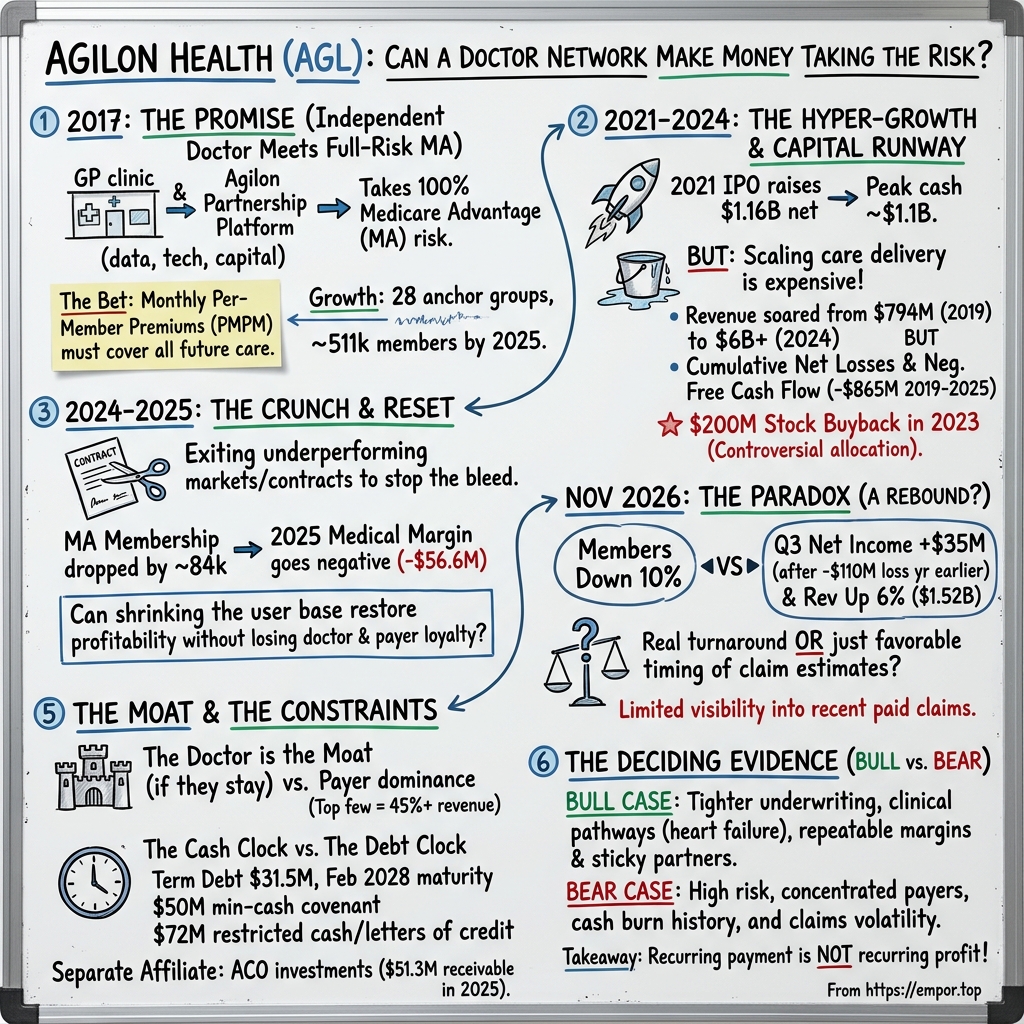
Agilon Health: Can a Doctor Network Make Money Taking the Risk?
I. The Quarter When Fewer Members Made More Money
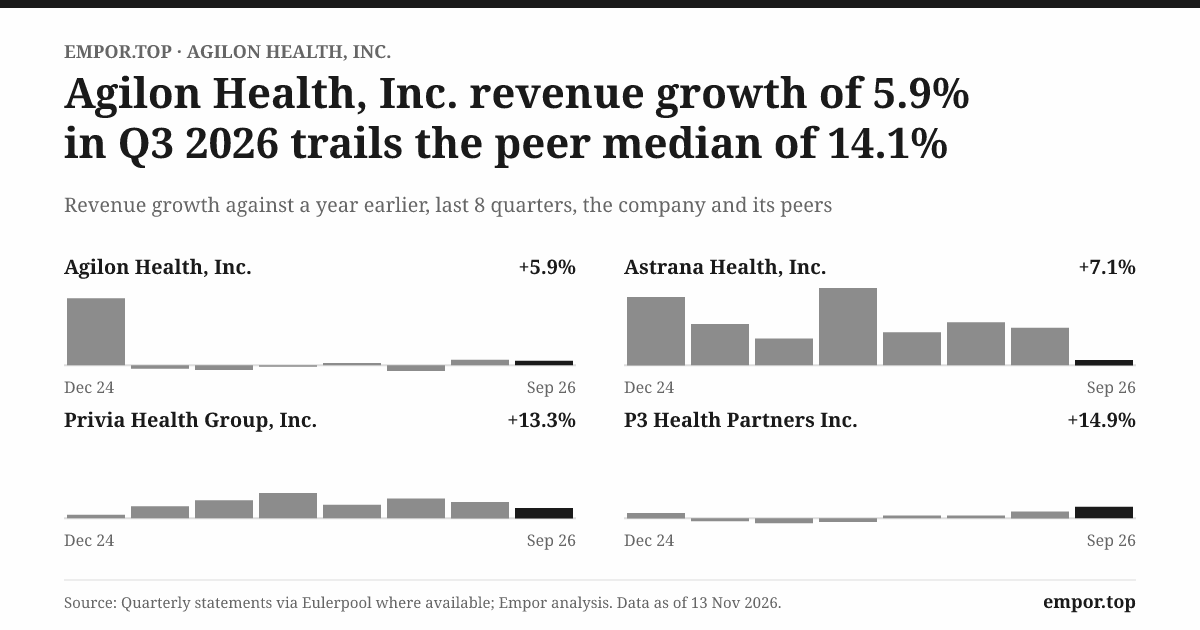
On November 4, 2026, Agilon Health published a set of quarterly numbers that looked, at first glance, like a typo. The company had fewer Medicare Advantage patients than it had a year earlier, about 454,000 against 503,000, a drop of roughly 10%.1 Yet revenue was up about 6%, to roughly $1.52 billion for the quarter. And the bottom line had swung from a loss of about $110 million in the third quarter of 2025 to a profit of about $35 million.1
Shrinking companies do not usually report results like that. A retailer that closes a tenth of its stores does not sell more. A software company that loses a tenth of its customers does not usually grow. But Agilon is neither. It is a company that gets paid a fixed monthly amount for each older patient its partner doctors look after, and then pays for whatever care those patients need. Its profit lives in the gap between the two, and in the third quarter of 2026 that gap opened wide.
The number that explains the swing is a ratio with an ungainly name: the medical services expense ratio, or MSER. It measures how many cents of every premium dollar go out the door to pay for hospital stays, specialist visits, drugs and everything else. A year earlier the ratio had been 104%, which meant Agilon paid out $1.04 for every dollar it took in before it spent a cent on its own staff, technology or rent.1
In the third quarter of 2026 the ratio was 88.5%.1 Fifteen and a half points is an enormous move in a business where a few points separate a good year from a terrible one. On roughly $1.5 billion of quarterly revenue, each point is worth about $15 million.
So the obvious question is whether this is a better business or a better quarter. The answer matters because Agilon has looked like this before: a company whose results could change direction faster than its explanations. And the company's own finance chief offered a reason for caution on the very call where he celebrated the numbers.
Jeff Schwaneke told analysts the improvement included about $14 million of favorable development on claims from prior periods, meaning bills for care delivered earlier came in lower than the company had reserved for.2 He also said the company had "limited paid claims visibility" for the quarter just ended, because many of the bills for care delivered in July, August and September had not yet arrived.2
That is the honest state of the evidence. The turnaround is real in the reported numbers. It is not yet proof that Agilon's unit economics are durable. Part of the improvement came from the past being cheaper than feared, and part depends on estimates about bills not yet received.
This story is organized around four questions. The first is whether the 2026 profit rebound can persist once the favorable claims development rolls off. The second is whether a smaller book of patients can produce better economics without weakening Agilon's bargaining position with insurers and doctors.
The third is whether its physician-partnership platform creates a durable edge, or merely a large one. The fourth is whether its cash and capital structure can absorb the next bad claims year, which, in this business, is a matter of when rather than if.
The stakes are large. In 2025 Agilon collected nearly $6 billion of revenue, a scale that would place it among the larger healthcare services companies in America.3 Yet it reported an operating loss of about $421 million that year and used about $106 million of cash in its operations.3 Revenue of that size with losses of that size is the signature of a business where the money flowing through is not the same as the money being made.
One boundary needs drawing before the story begins, because Agilon's own reporting makes it easy to blur. The company has two kinds of business. The first, and by far the larger, is its Medicare Advantage business, in which it takes financial risk on patients enrolled in private insurance plans that replace traditional Medicare. That business is consolidated: its members, revenue, costs and cash sit inside Agilon's financial statements.4
The second is a set of investments in accountable care organizations, or ACOs, run under programs of the Centers for Medicare & Medicaid Services for patients in traditional Medicare. Those entities are accounted for as affiliates, not as consolidated subsidiaries, and their roughly 112,000 beneficiaries, their revenue and their cash belong to separate entities.41 Folding them into the core business would flatter it. Ignoring them would miss a source of earnings and an obligation that matter, and they will get their own chapter.
The central tension is simple to state and hard to resolve. The same company can look like a recovering care platform in one quarter and a highly exposed risk-taker in the next, because the thing it sells, the promise to cover a patient's medical bills for a fixed price, does not reveal its true cost until months after the sale. To understand how Agilon arrived at that bargain, the story has to go back to a question that predates the company: what does an independent doctor need to take charge of a patient's whole year of care?
 Subscribe on LinkedIn
II. The Independent Doctor Becomes the Risk-Bearing Business
Picture a primary-care practice in a mid-sized American city in 2017. A few dozen doctors, a waiting room full of patients in their seventies and eighties, many with diabetes, heart failure, kidney disease or several of those at once. These doctors see their patients more often than anyone else in the healthcare system.
They know who is skipping medications, who lives alone, who is drifting toward a hospital admission. And under the payment system they grew up in, almost none of that knowledge earns them anything. They are paid per visit. The expensive events, the hospital stays, the emergency-room trips, the specialist procedures, happen elsewhere and are paid to someone else.
That is the problem Agilon was built to solve. Founded in 2016, the company set out to partner with existing community physician groups rather than buy them or replace them.3
The pitch to doctors was that they could stay independent, keep their names on the door, and still move from being paid per visit to being paid for the whole patient. The pitch to investors was that the doctors who know patients best were the people most likely to keep them healthy and out of the hospital, and that the savings from doing so were large enough to share.
The obstacle was that a typical physician group lacks almost everything required to take on that kind of responsibility. It has no capital to absorb a bad year. It has no data infrastructure to see claims from hospitals and specialists. It has no actuaries, no contracting team that can negotiate with UnitedHealthcare or Humana, no staff to run care-management programs.
So Agilon offered to supply all of it. It would form a local operating entity with the physician group, bring in technology, people, capital and payer relationships, and take on the financial risk.3 The doctors would practice medicine with a new set of tools and a new set of incentives.
By the end of 2025 the model had spread to 28 anchor physician groups across 30 geographies, covering roughly 511,000 Medicare Advantage members.3 That is a real network, built one local relationship at a time, and it explains why Agilon describes itself as a partner rather than a vendor.
The trade at the heart of the model is worth slowing down for, because everything else in this story flows from it. When an older American enrolls in a Medicare Advantage plan, the federal government pays the insurer a monthly premium for that person. The insurer, in turn, contracts with Agilon for the patients attributed to Agilon's partner doctors.
Agilon generally receives a monthly per-member payment set as a percentage of that government premium, and in return it generally takes full financial risk for the cost of those members' care.3 Substantially all of its revenue is this kind of payment, called capitation.3 The physician partners share in the economics.
A simple analogy helps. Imagine a caterer who agrees to feed a family for a year for a fixed monthly fee. If the family eats modestly, the caterer profits. If someone develops an appetite for lobster, the caterer pays.
Now imagine that the caterer cannot see the grocery bills for several months, and that the fee itself is adjusted later depending on how hungry the family was judged to be at the start of the year. That is roughly Agilon's business, with the difference that the "appetite" here is a patient's illness, and the stakes are hospital admissions rather than lobster.
The adjustment for how sick patients are is called risk adjustment, and it matters as much as the claims. The government pays more for a patient with documented heart failure and diabetes than for a healthy one, so accurate documentation of each patient's conditions directly changes revenue.
Quality ratings, the star system Medicare uses to grade plans, also flow through to the premium. So Agilon's revenue depends not just on how many patients it has, but on how sick they are documented to be and how well the plans they belong to are rated, while its costs depend on how much care those patients actually use.
This makes the revenue recurring in a specific and limited sense. The payments keep coming as long as members stay eligible and attributed to Agilon's partner doctors. But recurring revenue is not the same as a subscription.
The company does not disclose a single standard contract length, a minimum commitment, or an aggregate figure for how much of its revenue is contracted in advance, because its contracts vary by insurer and by geography.3 Anyone describing Agilon as a recurring-revenue platform in the software sense is borrowing a vocabulary its filings do not support.
There is an uncomfortable implication buried here. In most businesses, more revenue at the same margin means more profit. In a full-risk capitation business, revenue rises when premiums rise, and premiums tend to rise when patients are sicker or when the government raises benchmarks to reflect higher medical costs.
That means more revenue can simply mean more exposure: a bigger pot of money that must cover a bigger pile of bills. The partnership model can create a sticky local network, but it makes medical-cost execution the central wager of the whole enterprise. Agilon is not selling software to doctors. It is underwriting their patients.
Underwriting at scale requires capital, and in the spring of 2021 Agilon went to the public markets to get a great deal of it.
III. The IPO Filled the Tank—and Set a Runway
On April 15, 2021, Agilon's shares began trading on the New York Stock Exchange under the ticker AGL.5 It was a good moment to sell a healthcare growth story.
Investors were enthusiastic about value-based care, the idea that paying for outcomes rather than visits would reshape American medicine, and several companies in the space had either just listed or were lining up to do so. Agilon priced its offering at $23 a share and sold about 53.6 million shares, including the underwriters' full option to buy extra, raising roughly $1.23 billion before fees.5
That money went to the company. This is worth emphasizing because later share sales did not. Agilon's largest backer, the private equity firm Clayton, Dubilier & Rice, or CD&R, sold shares in subsequent secondary offerings, and in those deals the company received nothing; in 2023 it even bore about $1.7 million of expenses administering one such sale.3
The IPO was the moment Agilon filled its own tank. Financing cash flow that year was about $1.2 billion, and cash and short-term investments swelled from about $107 million at the end of 2020 to roughly $1.1 billion at the end of 2021.67
Cash on that scale is a runway. The question for any company with a long runway is whether it uses the distance to build a business that can eventually fly on its own, or simply to taxi further.
The answer, over the next four years, was mixed at best. The cash pile shrank steadily, to about $285 million by the end of 2025.3 Some of that decline reflected money moved into longer-term investments, but most of it reflected the simple arithmetic of a business that consumed cash.
Across the seven years from 2019 through 2025, Agilon accumulated about $1.8 billion of net losses, used about $756 million of cash in operations, and produced negative free cash flow of about $865 million.673 It never paid a dividend. Not once in those seven years did operations generate cash over a full year.
Against that record, one decision stands out. In 2023 Agilon spent $200 million repurchasing its own stock.3 Buybacks can be a sensible use of capital when a company produces more cash than it needs and believes its shares are cheap. Agilon did not produce more cash than it needed. Its operations had not generated cash in a single year since at least 2019. The repurchase used roughly a fifth of the money the IPO had raised, at a time when the core business was still losing money and was about to lose more. There were no repurchases in 2024 or 2025, which suggests the board recognized the cash was better kept.3
How did the buyback turn out for shareholders? Measured against the share price, badly. In March 2026 Agilon carried out a one-for-25 reverse stock split, combining every 25 old shares into one new share.4 The split changed how the shares were presented, not what the company was worth, and it raised no capital. But it makes the arithmetic easy: the $23 IPO price is equivalent to about $575 per post-split share.
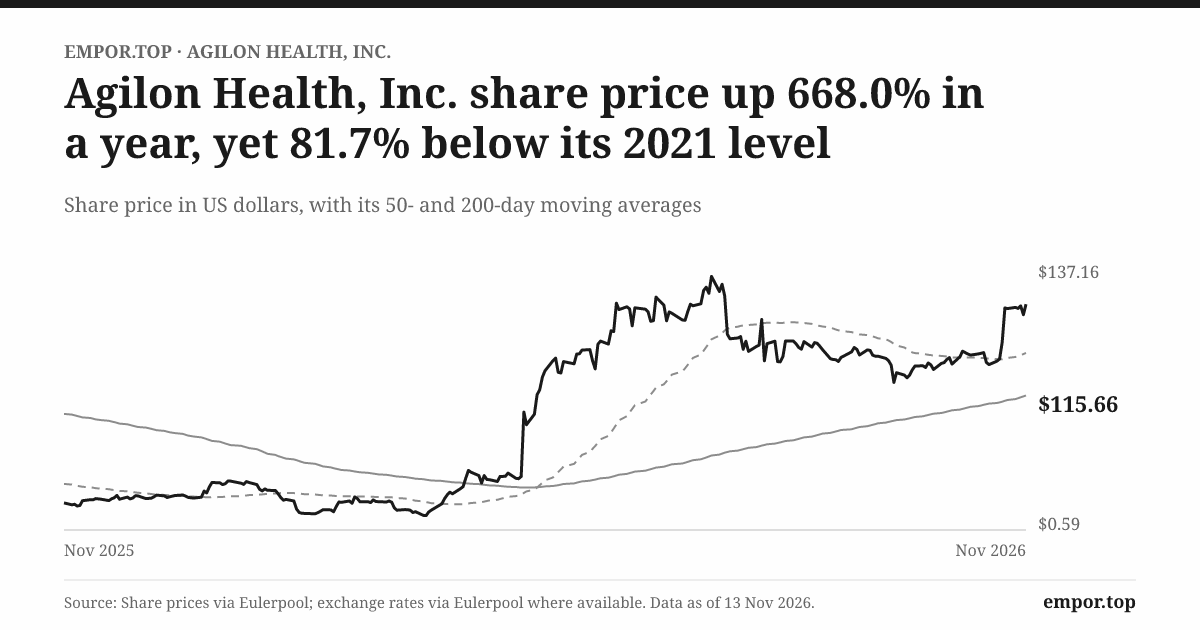
On November 13, 2026, the shares closed at about $116, roughly 80% below that split-adjusted IPO price, even after a spectacular rally from a 52-week low near $8. Any shares repurchased in 2023, at prices well above where the stock traded for much of 2025, were bought at levels the market has not revisited. More important than the mark-to-market loss is the opportunity cost: $200 million of cushion that was not there when the 2025 claims shock arrived.
It is also worth being precise about what kind of growth story this was. Agilon's expansion was chiefly organic in the sense that matters: it signed new physician partnerships and entered new geographies, adding what it called a "class" of partners each year.3 The filings do not describe a large acquisition-led roll-up. That cuts both ways. Agilon avoided paying premium prices for practices, but it also bore the start-up costs of every new market, and each new class arrived with patients whose costs were not yet understood.
The broader industry offers a warning about how expensive scaling care delivery can be. In 2023 CVS Health paid about $10.6 billion for Oak Street Health, a chain of primary-care clinics focused on older patients, and in 2025 it took a charge of about $5.7 billion related to that business.8
Oak Street owned clinics and employed doctors, which Agilon does not, so it is no direct valuation comparison. But it shows the category's base rate: even a buyer with CVS's resources found that paying for growth in risk-bearing primary care could destroy value at speed.
So by 2025 the IPO money had bought Agilon a national network and a revenue line approaching $6 billion. It had not bought a business that generated cash. The question that followed the cash was blunt: if the core still consumed money, how much room remained to learn the medicine? Answering it requires opening up the core and seeing how a Medicare premium becomes, or fails to become, a profit.
IV. The Premium Was Never the Profit
Walk into one of Agilon's partner practices and follow a single patient. She is 78, with congestive heart failure, type 2 diabetes and early kidney disease. Every month, a payment arrives for her care, a fixed sum set as a share of what the government pays her insurance plan. That payment does not change if she visits her doctor twice that month or not at all.
What it has to cover is everything that might happen next: the cardiologist, the medications, the night in March when fluid builds in her lungs and an ambulance takes her to the emergency room, the four days in the hospital, the rehabilitation stay afterwards. The premium is known in January. The bill is not known until well after December.
Agilon's economics can be followed in four steps, and the order matters. First, members are attributed to its partner doctors under contracts with insurers, and the government's benchmark premium for each member sets the starting point for revenue. Second, risk adjustment changes that payment: the more accurately and completely each patient's conditions are documented, the closer the payment comes to reflecting how sick the patient actually is.
Third, care delivery and utilization determine the claims—the money paid out to hospitals, specialists, pharmacies and everyone else. Fourth, what is left after claims, which Agilon calls medical margin, is split with physician partners and must cover Agilon's own operating costs before anything reaches shareholders.
Each step is a place where the model can break. Attribution can slip if patients change plans or doctors. Risk adjustment can be cut by the government, as it was when Medicare phased in a revised risk model, known as V28, that reduced the payment value of many diagnoses.9 Claims can surge if patients use more care than expected, which is precisely what happened across the Medicare Advantage industry from 2023 onward. And the partner split and corporate overhead can consume whatever margin survives.
Reading Agilon's income statement requires some translation. Substantially all of its revenue is capitation, so the top line is essentially the sum of those monthly payments.3 Below the operating line sits "other income," which in 2025 came to about $68 million and included roughly $50 million of service income from the ACO affiliates plus interest on the company's cash.3 That other income is real, but it is not the core business, and it flatters the gap between operating losses and pretax losses.
Now the long view. Revenue rose from about $794 million in 2019 to about $6.1 billion in 2024, almost eight times larger in five years.610 That is extraordinary growth for any healthcare business. But operating profit was negative in every fiscal year from 2019 through 2025.673
The growth was real; the economics did not come with it. Revenue scaled because Agilon kept adding partner groups, geographies and members, and because premiums rose. Losses scaled too, because each new market arrived with start-up costs, and because the medical cost of the patients rose faster than anyone had planned.
Then came 2025, the year the model's weak point was exposed. Revenue fell about 2%, to roughly $5.9 billion, as the company exited underperforming contracts and markets.3 Medical cost per member rose about 5%.3 And medical margin, which had been about $205 million positive in 2024, turned negative, at about $57 million below zero.103 In plain English, Agilon paid out more for its members' care than it received to cover that care, before paying a single employee. That was the year the operating loss reached $421 million.
It helps to translate that into a single patient. In 2025, on a membership base of roughly half a million, negative medical margin of $57 million means that on average, every member cost Agilon about $110 more in medical bills over the year than the premium paid. Add the company's overhead and the hole was much deeper. For a business that exists to manage medical cost, that is the most damning number in its history, because it says that across the whole book, the core promise was not met.
The 2026 rebound therefore needs its own test, separate from simply noting that the ratio improved. The MSER fell from 104% to 88.5% in a year.1 Some of that is genuine repricing: management says it re-contracted roughly 80% of its membership for 2026 and attributes about $127 million of value to that work.2 Some is better documentation: risk scores rose about 3% year over year even after the V28 changes, double what the company had originally assumed.911
And some is the past turning out cheaper than expected. On the second-quarter call, Schwaneke cut the company's estimate of its 2025 cost trend from 6.2% to 5.8% and booked about $22 million of favorable prior-year development.11 By the third quarter, the first half of 2026 had restated favorably to a cost trend in the low 6% range, while the third quarter itself was recorded at roughly 7%, the same figure the company assumes for the fourth.2
That sequence is the crux. When a company books a conservative estimate for claims it cannot yet see, and the bills later come in lower, the difference flows back into profit in a later quarter. That is prudent accounting, and it is also why a single quarter's profit can overstate the underlying run rate.
The first quarter of 2026 was booked at a cost trend of 7.4% precisely because, in Schwaneke's words, the company had "limited paid claims visibility" for the year.12 Those cautious early estimates are part of what is now coming back as good news.
Which operating measures matter? The most important are membership, the MSER, medical margin per member, the effect of risk adjustment, and operating cash flow. The rest of this story will keep returning to the first three as the core scorecard, with cash flow as the final arbiter.
So the key causal question is not whether 2026 looks better than 2025. It obviously does. The question is whether doctors and Agilon are changing the trajectory of care, sending fewer patients like the woman with heart failure back to the hospital, or whether this year's result is partly the timing of when claims arrived and how they were estimated. The first is a business. The second is a cycle. Management's answer has been to shrink the business on purpose, and that decision deserves to be examined in full.
V. The 2024 Reset Cut Growth to Save the Contract
In February 2025, Agilon's leadership stood in front of investors after a brutal year and offered a plan. Revenue for 2024 had grown about 40%, to roughly $6.1 billion, but the company had lost about $260 million and its medical margin in the fourth quarter had shrunk to just $1 million.10 Then-CEO Steven Sell acknowledged the obvious: "we are still managing through a challenging Medicare Advantage environment."10
The plan amounted to a reversal of the company's identity. For years Agilon had been a growth machine, adding new classes of physician partners every January and celebrating membership milestones. Now management announced that it would exit market partnerships and insurer contracts covering about 54,000 members, with only about 20,000 Medicare Advantage members arriving through its new 2025 class.10
It even set aside about $5 million to cover expected 2025 losses on "partnerships we intend to exit this year."10 The language shifted from growth to underwriting discipline: tighter contract terms, selective markets, cost control.
It helps to understand why a risk-taking company would choose to shrink. In a full-risk contract, a bad contract is worse than no contract. If a particular insurer's benchmark is too low for the patients involved, or if Agilon has no control over the insurer's data, pharmacy benefits or supplemental benefits, every additional member under that contract adds expected losses. Exiting such a contract reduces revenue but raises profit. Agilon's management was making exactly that bet.
The 2025 guidance laid out what the bet was supposed to produce: revenue of about $5.8 billion to $6.0 billion, medical margin of $275 million to $325 million, and adjusted EBITDA, the company's preferred measure of operating cash earnings, of negative $55 million to negative $95 million.10 The plan assumed help from the exits, from premium increases and from risk adjustment.
The outcome missed badly. Revenue landed inside the range, at about $5.9 billion, but medical margin came in at roughly negative $57 million, more than $330 million below the midpoint of guidance.3 The operating loss swelled to $421 million.3 In July 2025, Sell resigned.3
When a company guides to $300 million of medical margin and delivers a loss, the miss is not a rounding error. It is evidence that the people running the company did not understand, a few weeks into the year, what their book of business was going to cost.
Strip away the drama and the reset's logic still holds: Agilon had written contracts it could not profitably serve. The 2025 failure showed that walking away from the worst contracts was necessary but not sufficient; the remaining book also needed repricing, and that takes a full contracting cycle.
That cycle arrived for 2026. Management says it re-contracted around 80% of its membership, pushing for better economics and for removing risks it could not control, including exposure to Part D prescription-drug costs; management put that Part D risk at roughly 15% in 2026, down from about 30% in 2025.2 Membership fell sharply at the turn of the year. By the end of March 2026 the company had about 426,000 Medicare Advantage members, against 491,000 a year earlier.12
The membership-versus-revenue divergence is the most striking feature of 2026. Average Medicare Advantage membership in the third quarter was about 488,000, down 4% from a year earlier, while revenue rose 6%.1 That implies revenue per average member rose roughly 10%, to a little over $1,000 per member per month. Higher government benchmarks, better risk-adjustment scores and better contract terms all contributed.
The more important number is what was left after care. In the third quarter of 2025, Agilon lost roughly $110 on every average member in medical margin alone. In the third quarter of 2026, by a simple calculation from the company's reported revenue and medical expense, it kept roughly $350 per member before overhead.1 That is the clearest piece of evidence that the reset is working.
But one quarter is not a year, and execution must be separated from timing. Management points to clinical programs as proof that the improvement is structural. New CEO Tim O'Rourke told analysts in November that "heart failure has emerged as a strong proof point" for the company's clinical pathway framework, and he described virtual pharmacy services reaching about a quarter of partners and programs for dementia and lung health in about a third of markets.2
Those are plausible mechanisms. Heart failure is one of the most common reasons older patients end up back in the hospital, and a primary-care team that tracks weight, symptoms and medication closely can prevent some of those admissions. But the company has not published outcome data, such as readmission rates or hospital days per thousand members, that would let an outsider measure the effect.
Reading the calls in sequence tells its own story. In February 2025, management assumed the exits, premiums and risk adjustment would produce positive medical margin, and they did not.
On the first-quarter 2026 call in May, guidance pointed to a full-year adjusted EBITDA of about $25 million at the midpoint.12 In August, after the second quarter, the company raised that to $75 million to $95 million, citing stronger documentation of illness burden, risk scores up 3% and cost trends in the low 7% range for the rest of the year.9
In November it raised again, to $145 million to $155 million.1 When Schwaneke bridged the latest raise, the pieces were a $64 million beat in the third quarter, risk adjustment gains, about $14 million of favorable prior-year development, and a lower cost trend in the first half than previously booked.2 Three raises in a row are better than three cuts, but the raises also reveal how wide the range of outcomes was when the year began.
The contracting trade-off is now shifting to 2027. O'Rourke said the 2027 contracting cycle "will address approximately 50% of our book of business," and Schwaneke said the company anticipated "a favorable benefit in 2027, albeit more modest than we saw in 2026."2 That is a candid acknowledgment that the easiest gains have been harvested. The remaining work is on contracts that were not repriced last year, and on reducing risks outside Agilon's control, including how well the insurers themselves run their plans.
What would validate the reset? Not lower membership; anyone can shrink. Not one favorable quarter either. The proof would be sustained medical margin per member across a full year, and positive operating cash flow after claims have settled, in a year without a large tailwind from prior periods.
Until that arrives, the reset has addressed a real underwriting problem without yet showing that a smaller Agilon is a durably profitable one. And shrinking raises a different worry: whether a smaller network is still the network that doctors and insurers need.
VI. The Doctor Is the Moat—If the Doctor Stays
Imagine the managing partner of a 60-doctor primary-care group in the Midwest, sitting with three proposals on her desk. One is from Agilon, offering a local joint venture, capital, data infrastructure and a share of the economics under full-risk Medicare Advantage contracts. One is from a large insurer, offering its own care-management tools and a bonus for meeting quality targets, with no need to take on downside risk.
A third is from the regional hospital system, which would like to bring the group into its network, perhaps eventually to buy it. And somewhere in her inbox is a pitch from another value-based-care company offering a lighter-touch partnership with less financial exposure.
That is what competition looks like in Agilon's business. It is not a single national market with a share chart. It is a series of local contests, practice by practice and insurer by insurer, in which Agilon competes against physician-enablement companies such as Privia Health and Aledade, against insurer-owned platforms such as UnitedHealth's Optum, against health systems, and against local networks and management service organizations.3 The company's own filings acknowledge that some of those competitors have greater resources, and that insurers are expanding their own services.3
Agilon has long described its model as distinctive, a first-of-its-kind platform for community physicians. That claim deserves testing rather than repeating, and the best way to test it is to look at what a moat would have to produce: doctors who stay, insurers who pay well, and margins per patient better than rivals'.
Start with the doctors, who are Agilon's suppliers and partners at once. The case for a durable relationship is real. The partnerships are long-term arrangements, built around local entities with shared economics, and a group that has reorganized its workflows around Agilon's data, care teams and contracts would face real disruption in leaving. That network remained in place at year-end.3
Yet the same company exited partnerships during 2024 and 2025, and those exits help explain why average membership fell 2% in 2025.3 The company does not name the partners it left or publish a partner retention rate. Some of those departures were Agilon's own choice, but the outside observer cannot tell how many partners would have stayed on terms Agilon could afford.
Then the insurers, who are Agilon's customers and the source of nearly all its revenue. Here the evidence points toward their leverage, not Agilon's. In 2025, five unnamed insurers each accounted for at least 10% of revenue, and the top three together accounted for about 46%.3
By the third quarter of 2026, just two insurers accounted for about 45% of the quarter's revenue, at roughly 21% and 24%.4 Concentration rose as the book shrank. When two customers decide nearly half your revenue, the price you get is the price they will pay.
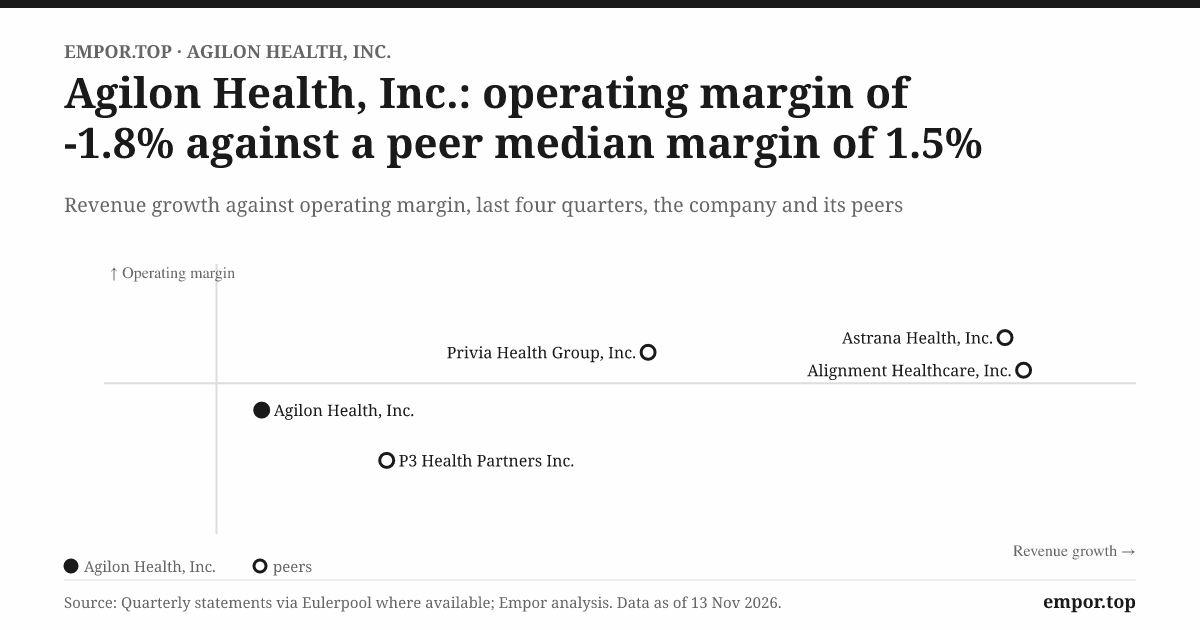
Peers offer a partial benchmark, but only with care. Privia Health, the closest publicly traded physician-enablement company, reported about 1.54 million attributed lives and about $2.12 billion of revenue in 2025.[^13] That is three times Agilon's membership on about a third of its revenue.
The comparison is not like for like: Privia's lives include fee-for-service, shared-savings and commercial arrangements where it does not bear full risk, and much of its revenue is not capitation. But the contrast clarifies the strategic choice. Privia built breadth with less downside; Agilon built depth by holding the full premium and the full risk. The full-risk model produces far more revenue per patient, and far more volatility.
Run the competitive forces through Agilon's actual economics. The bargaining power of buyers, the insurers, is high, as the concentration figures show. The bargaining power of suppliers, the physicians, is meaningful, because doctors can affiliate elsewhere when contracts end. Substitutes are plentiful: insurer-built care-management tools, health-system networks, lighter-risk enablement models. Barriers to entry are moderate, since new entrants need capital and actuarial skill but not unique assets.
Rivalry is intense in the most attractive markets. Against those forces, Agilon's possible advantage is local density: in a geography where it partners with the dominant independent primary-care group, an insurer may find it hard to build an equivalent network. That is a real but local advantage, and national scale alone does not prove switching costs.
There is one area where Agilon is producing evidence rather than claims. The company says about 75% of its members are expected to be in plans rated four stars or above for payment year 2028, against about 71% nationally.2 Because contracts are typically a percent of premium, and star ratings raise premiums, better quality scores flow directly into Agilon's revenue.
A doctor network that consistently lifts its plans' quality ratings above the national average would have something an insurer values. But four points above the national average is a modest edge, and star ratings are set by Medicare's rules, which have shifted repeatedly.
Data is another test. Agilon depends on insurers to send it claims data so it can see what its patients cost. Schwaneke said in November that the company's data coverage was "close to the mid-80% range," with a long-term aim of the low-to-mid 90s.2
That means that for roughly one in seven members, Agilon still lacks the full, timely picture of what is happening to them. A platform that cannot see the claims cannot manage them, and the companies that own the claims data are the same insurers that hold the pricing power.
The management question now follows from all of this. Selective contracting strengthens the book when it cuts losses without cutting relationships. It weakens the platform when it reduces local density, so that the insurers find Agilon less essential and the doctors find it less valuable. The membership decline through 2026 makes this a live question, not a theoretical one.
So the moat claim, tested against the record, narrows to a smaller and more plausible version. Long-term physician relationships and local operating infrastructure may be advantages in specific markets. The company has not demonstrated superior partner retention, pricing power or patient outcomes against peers, and its rising concentration in a few insurers points the other way.
The proof points to watch are concrete: whether Medicare Advantage membership stabilizes, whether new and existing physician partners sign and renew, whether medical margin per member holds, and whether concentration in the top two insurers falls. Until those move, the doctor is a moat only as long as the doctor stays, and the contract pays.
One part of Agilon's business, though, has been growing while the core shrank, and it is not in the consolidated numbers at all.
VII. The Affiliate That Makes Earnings—and Owes the Cash
There is a second Agilon that rarely appears in headlines. It does not manage Medicare Advantage members. Instead, it works with the same physician partners on patients enrolled in traditional Medicare, through accountable care organizations that participate in federal programs.
Under these programs, known as ACO REACH and the Medicare Shared Savings Program, or MSSP, groups of doctors agree to be measured against a spending benchmark for a population of patients. If the population's care costs less than the benchmark while meeting quality standards, the ACO shares in the savings; in the riskier versions, it also shares in losses.
Agilon holds these ACOs as equity-method investments, meaning it records its share of their results but does not consolidate them.4 At the end of September 2026, they held about $74 million of cash off Agilon's balance sheet.1 They are a separate bucket, and this story has kept them separate.
What does connect them to Agilon is a service relationship. Agilon provides operating and administrative services to the ACOs and earns fees for doing so. In 2025, that service income was about $50 million, up from about $15 million in 2024, more than tripling in a year.3 It sits in "other income," below the operating line, not hidden inside the capitation revenue.3
How much does it matter? Against nearly $6 billion of consolidated revenue, $50 million is less than 1%. Against a pretax loss of about $404 million, it is a meaningful cushion.3 And against the company's preferred earnings measure, it matters even more. For 2026, Agilon expects its ACO business to contribute about $40 million to $45 million of adjusted EBITDA, against a full-year guide of $145 million to $155 million.1
That means roughly a quarter to a third of the year's headline operating earnings is expected to come from a business whose patients, revenue and cash are not consolidated. An investor who values Agilon on adjusted EBITDA is, to a significant degree, valuing the ACOs.
Earnings, though, are not cash. At the end of 2025, Agilon was owed about $51 million by its ACO affiliates, a receivable roughly equal to the full year's service income.3 In other words, by year-end, the ACOs had not yet paid what amounted to a year's worth of fees. The delay may be timing: ACO settlements with the government run on a lag, and the affiliates may pay Agilon once their own shared-savings payments arrive. But it means the income is recognized well before the cash is collected.
The obligations run the other way as well. Agilon has posted surety bonds of about $95 million associated with its unconsolidated ACO investments, and the company states that its maximum exposure to loss from them cannot be quantified because of an ongoing obligation to support them.4 That is an unusual sentence to find in a filing, and it deserves a plain reading: if the ACOs incur losses against their benchmarks, Agilon may have to fund them, and the company itself cannot put a ceiling on how much.
Management sees the ACO business as a growth engine. On the November call, the company said it expected ACO membership to grow by roughly 40% to 50% in 2027, to about 160,000, helped by three multiyear expansions adding nearly 50,000 shared-savings members, and noted that the ACO business currently works with about half of its partners.2 That would make the ACO segment a larger share of the story precisely as the Medicare Advantage book shrinks.
What would make this income trustworthy is simple to describe. The next audited disclosures should show collections against the affiliate receivable, distributions from the ACOs back to Agilon, and the amount of any new support Agilon provides. If the receivable keeps growing faster than the service income, the earnings are running ahead of the cash. If distributions arrive and the support obligations stay contained, the ACO business becomes a genuine second engine.
And that leads to a broader balance-sheet question. If some of the cash on the books is restricted, some is pledged behind letters of credit, and some may one day be needed to support affiliates, how much of the apparent cushion is actually available to absorb the next claims shock? Before that question can be answered, it is worth asking who is now making these calls, because the people setting guidance in 2026 are not the people who set it in 2025.
VIII. A New CEO Inherits a Difficult Scorecard
On May 6, 2026, the day before the new chief executive started, Agilon's executive chair Ronald Williams opened the first-quarter earnings call with a welcome: "we are excited to welcome Tim O'Rourke as our new CEO beginning tomorrow, May 7, 2026."12 Williams, who had run Aetna before becoming Agilon's chairman, had been holding the company together through nearly a year without a permanent leader.13 The man he was handing it to had spent most of his career on the other side of the table.
Timothy O'Rourke, 54 when he was appointed, spent from 1996 to 2019 at Humana, one of the largest Medicare Advantage insurers in the country, rising through several roles including senior vice president of its Central Division and president of provider development.14 That last title is telling: his job was to build relationships between an insurer and the doctors it paid.
He then worked at Centene, ran Ascension Complete, a Medicare Advantage joint venture between Centene and the Ascension health system, from late 2020 to mid-2021, and spent four years as president of Help at Home, a home-care company.14 He is, in other words, a Medicare Advantage insider who has seen how insurers think about provider risk, which is exactly the relationship Agilon needs to renegotiate. Agilon announced the appointment on April 27, 2026; he joined as chief executive, president and a director.14
His arrival ended a messy interregnum. Steven Sell resigned in July 2025, and interim leaders ran the company through the rest of that year and into 2026.3 The 2025 annual report was signed by Benjamin Shaker and Jeff Schwaneke as interim principal executive officers.3
Schwaneke remains chief financial officer, and he has been the voice explaining the numbers on every call since.2 The leadership list circulating on financial data sites still mixes old and new roles, so the clean version is this: O'Rourke is chief executive, Schwaneke is chief financial officer, Williams chairs the board.
O'Rourke's terms say a great deal about what the board wants. He receives a base salary of $850,000, a target bonus of 100% of salary and a $500,000 signing bonus, along with 120,000 restricted stock units that vest over three years.14 The most interesting piece is a grant of 200,000 performance stock units that vest in three equal tranches if the share price, averaged over 30 consecutive trading days, reaches $50, $100 and $150 within three years.14
Those hurdles tie his reward to the market's verdict. They also mean that the payout depends on the share price rather than on medical margin or cash flow, which is a design choice worth noting in a stock with annual volatility of about 140%. The shares have since traded above the first two hurdles, which shows how quickly a volatile stock can reach a price target, and how little a price target alone says about the business beneath it.
The scorecard O'Rourke inherited invites a harder look at the previous regime's incentives. In 2025, the year the company reported a net loss of about $391 million, the 2026 proxy reports total compensation of about $5.61 million for Schwaneke and about $5.36 million for Shaker, including about $4.70 million each in stock and option awards.13 Sell's 2025 compensation was about $7.28 million, including about $4.50 million in equity, though he received no annual cash incentive after resigning.13
The compensation committee also used discretion in setting bonus outcomes and reset membership-growth targets after management deliberately limited growth.13 There is a defensible logic to the reset: paying executives to grow membership would have rewarded exactly the behavior the company was trying to stop. But resetting targets midstream in a year of large losses is the kind of decision shareholders are entitled to scrutinize, because it can turn a missed plan into a paid one.
Ownership frames the governance. As of March 31, 2026, CD&R's investment vehicle remained the largest owner at about 24.1%, down from control-level ownership at the time of the IPO, followed by Morgan Stanley at about 12.1%, North Peak at about 9.5% and BlackRock at about 5.7%.1315 Those holdings were measured on different dates, and the proxy is a list of large owners, not a full shareholder count. O'Rourke's appointment came after it was filed.
Shareholders expressed their views at the June 2026 annual meeting. The advisory vote on executive pay passed.16 But director Karen McLoughlin received about 2.33 million votes against and about 9.53 million for, meaning almost one in five votes cast opposed her.16 That is not a revolt, but it is a meaningful signal at a company whose largest shareholders hold so much of the vote.
The legal overhang adds to the pressure. Agilon faces securities class actions over its statements about guidance, medical margin, adjusted EBITDA, growth strategy and data management; some claims survived dismissal and moved into discovery, a second suit was filed on December 31, 2025, and derivative actions are also pending.3 The company says it cannot estimate the ultimate liability.3 The auditor gave a clean opinion for 2025, and controls were judged effective, after a material weakness had been reported for 2023.37
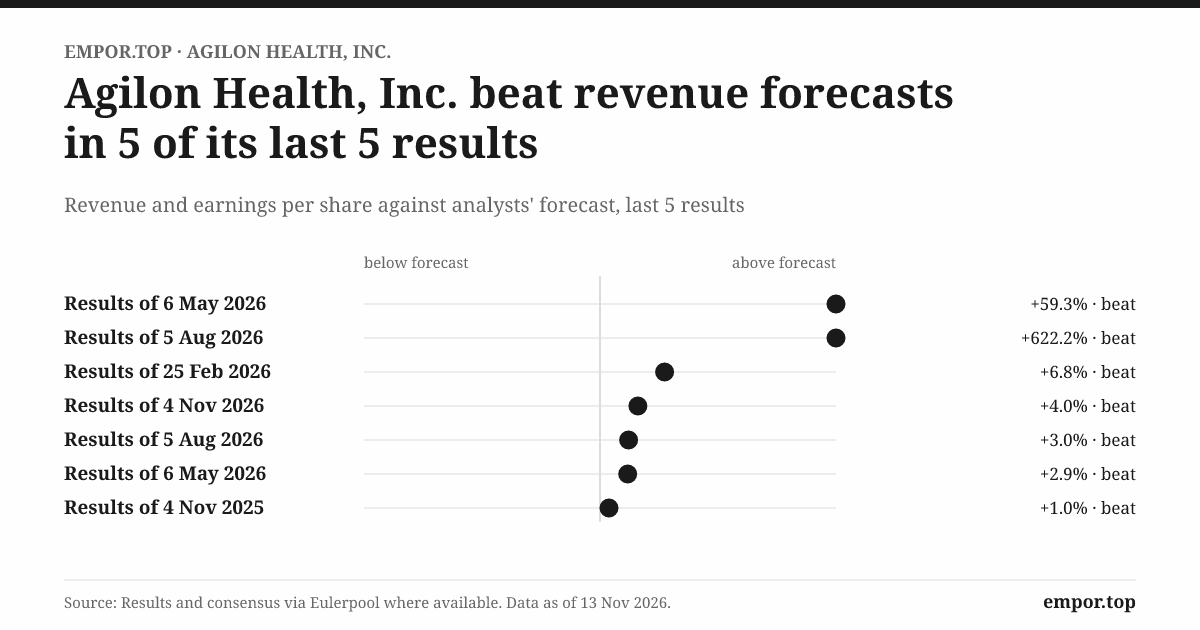
How should the current team's communication be judged? The 2026 record so far is better than 2025's: guidance has risen three times, and management has provided specific bridges between revisions.
Schwaneke has repeatedly flagged limited claims visibility.122 When an analyst asked why the 2027 contracting benefit would be smaller, he answered directly: most contracts had already been touched, and the remaining work was on the last fifth.2 Those are signs of a management team trying to rebuild credibility by being explicit.
But O'Rourke has run Agilon for six months, and that is not long enough to establish a forecasting record. The test is the one the 2025 plan failed: whether the year turns out roughly where management said it would at the start, not after three revisions.
Will the recovery be explained in operational terms, fewer admissions and better documentation, and will revised targets be met? Or will the recovery case keep moving with the claims cycle? The answer will be written partly in the income statement, but mostly in the cash account, which is where the next chapter goes.
IX. The Cash Clock Runs Faster Than the Debt Clock
At the end of September 2026, Agilon's balance sheet offered a headline that looked comfortable: about $312 million of cash and marketable securities, against just $32 million of debt.1 A quick glance would suggest a company with nearly ten times as much cash as borrowings, a fortress by any ordinary standard.
The fortress has fewer usable rooms than the headline suggests. Look inside the $312 million and it breaks into three parts: about $174 million of cash, about $65 million of marketable securities, mostly U.S. Treasury notes, and about $72 million of restricted cash.14
Restricted cash is money held aside, typically to meet regulatory or contractual requirements for risk-bearing entities, and it is not available to pay general bills. Strip it out and the freely available pool is closer to $240 million. The $74 million held by the unconsolidated ACOs, already off Agilon's balance sheet, is excluded.1
Then there is the bank facility. Agilon's secured term loan had about $31.5 million outstanding at the end of September 2026, at an effective interest rate of about 10.5%, which is expensive for so small a loan and signals how lenders view the credit.4 The loan matures in February 2028, after an extension.4
The facility also includes a revolving credit line, but about $69.7 million of letters of credit were drawn against it, leaving only about $20.3 million available.4 Letters of credit are guarantees, typically posted to insurers or regulators to show that Agilon can pay its share of medical costs, and they tie up borrowing capacity even though no cash changes hands. And the lenders require Agilon to hold at least $50 million of cash every single day.4
So the right way to read the balance sheet is not cash versus debt. It is free cash versus the claims volatility the company might have to absorb, minus the minimum it must always keep. On that reading, Agilon has roughly $190 million of true cushion above its covenant floor, before considering any future support for its ACO affiliates or surety bonds of about $32 million tied to payer contracts.4
Why does the cushion matter so much? Because cash conversion in this business is unusually unstable, and the swings come from timing, not just profit. In 2023 and 2024, claims payable rose sharply, adding about $442 million and $194 million of operating cash respectively as the company owed more to providers than it had yet paid.3 Those inflows made cash flow look better than the underlying economics.
In 2025, the company collected about $345 million from receivables, a large release of working capital, and still reported negative operating cash flow of about $106 million.3 A year in which the company pulled $345 million of cash out of its receivables and still burned cash is a warning about how much cash the underlying business was consuming.
The receivables have since rebuilt. Net receivables were about $674 million at the end of 2025 and had risen back to about $1.02 billion at the end of September 2026.4 Much of that is the estimated value of risk-adjustment payments still to come from insurers and the government, and final settlements can take 12 to 18 months.3
The company estimates these amounts, and it warns that the final figures can differ materially. It does not publish an ageing schedule or a history of write-offs. So a meaningful part of 2026's improved profit sits on the balance sheet as money owed rather than money banked.
There is good news in the 2026 cash flow, and it should be stated plainly. In the first nine months of 2026, Agilon generated about $16 million of operating cash flow, against an outflow of about $85 million a year earlier.1 Management now expects to end the year with at least $175 million of cash, up from a floor of $125 million it had pointed to in May.212 Small as it is, positive operating cash flow over nine months is a break from seven straight years of outflows.
The long view keeps that good news in proportion. After years of negative free cash flow, nine months of modestly positive operating cash flow is a turning point to watch, not yet a trend.
The risk mechanism is specific. If claims for 2026 settle worse than estimated, or if risk-adjustment receivables are collected for less than booked, profit falls and cash follows. If insurers slow their payments, receivables swell and cash shrinks even when profit holds.
Either would eat into the roughly $190 million of headroom above the covenant. And if operating cash flow does not improve, the refinancing question returns well before February 2028, because lenders will be asked to extend credit to a company whose debt is small but whose cash generation is unproven.
The watch condition is therefore precise: sustained positive operating cash flow after claims settlements, while maintaining headroom over the $50 million covenant and without a further rise in restricted cash or letters of credit. Debt is not the danger at Agilon. The cash clock is. With that clock in view, the bull and bear cases can finally be weighed against each other.
X. Analysis & Bear vs. Bull Case
Set two pictures of Agilon side by side. In the first, from 2025, a company with about $5.9 billion of revenue reported an operating loss of about $421 million and negative free cash flow of about $119 million.3
In the second, from the third quarter of 2026, the same company earned about $35 million of net income on an MSER of 88.5%, with Medicare Advantage membership 10% lower than a year before.1 Both pictures are accurate. The investment question is which one is the exception, and what must recur for the second picture to become the business.
The market has already voted with startling force. Over the 12 months to mid-November 2026, Agilon's shares rose from a low of about $8 to around $116, roughly a fourteenfold move, before settling about 11% below their 52-week high.
That rally valued the company at about $1.9 billion, or an enterprise value of about $1.7 billion after netting cash against debt. Yet at its worst point over the past five years the stock had fallen almost 99% from its peak, a reminder that the same shareholders have lived through both extremes.
The bull case deserves to be stated at full strength. Agilon has a revenue base of nearly $6 billion, made up of monthly payments that recur as long as members stay attributed. It has long-standing partnerships with established community physician groups in 30 geographies. It has just demonstrated, across three consecutive quarters of 2026, that a repriced book can produce positive medical margin and positive operating earnings.
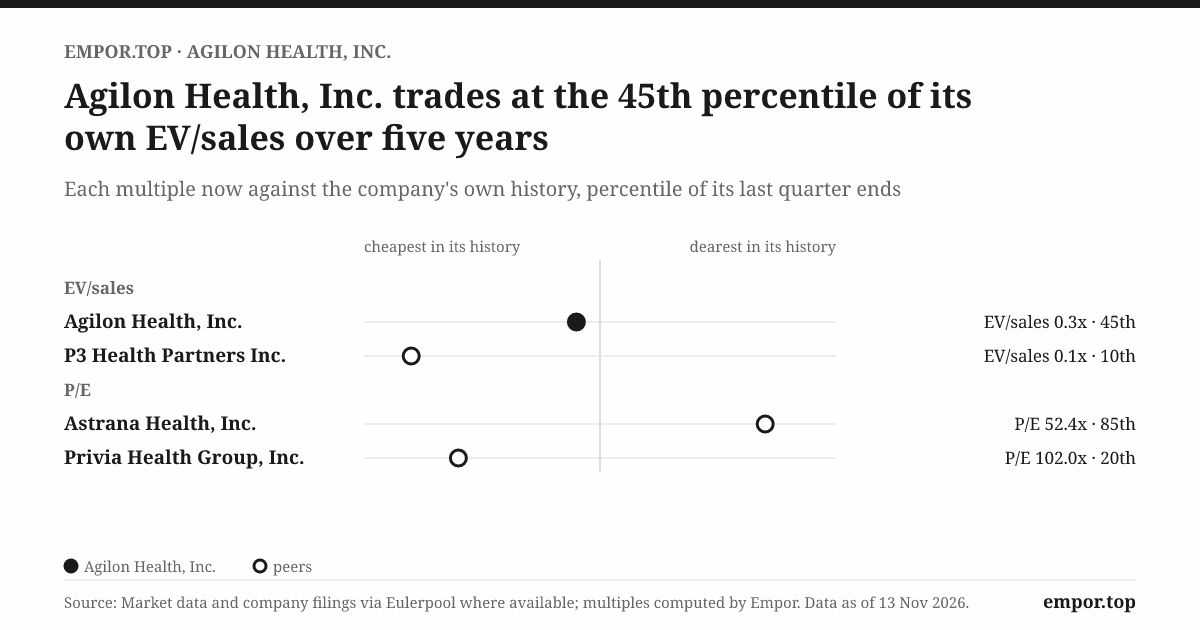
Management has removed much of the Part D drug risk, repriced about 80% of its membership, and raised guidance three times. Its clinical programs, especially in heart failure, offer a plausible mechanism for lowering costs. The ACO business is growing quickly and adds a second earnings stream. If care execution improves and the 2026 margin is mostly repeatable, a company earning even a few percent on $6 billion of revenue would be worth far more than 0.3 times sales.
What the bull case has not yet proved matters as much as what it has. It has not shown durable partner retention, because the company does not publish it. It has not shown superior patient outcomes, because the company does not publish outcome data that peers could be compared against.
It has not shown pricing power, because the insurers hold the leverage. And it has not shown positive cash flow across a full claims cycle, because every full fiscal year from 2019 through 2025 consumed cash, and 2026's improvement covers only nine months.
The bear case is equally coherent. Agilon bears full medical-cost risk on a concentrated book, with two insurers accounting for about 45% of quarterly revenue.4 Its revenue depends on risk-adjustment estimates that take 12 to 18 months to settle and can differ materially from final figures.3 Its 2026 profit includes favorable development from prior periods that, by definition, cannot be repeated indefinitely.
Its affiliates owe it money while it carries open-ended support obligations to them. Its historical cash flow is negative, its secured debt is expensive, and its covenant requires cash it cannot spend. In the bear scenario, the claims improvement fades in 2027, concentrated insurers push back in contracting, shrinking membership weakens local density, and the company finds itself back where it was in 2025, but with less cash.
Hamilton Helmer's framework of seven sources of durable power is a useful way to test which of these stories the evidence favors. Scale economies are limited, because each local market must be built and staffed separately and the 2025 loss came at peak scale.
Network economies are weak: a patient does not get more value because other patients use Agilon. Counter-positioning is the most interesting candidate. Insurers and hospital systems have structural reasons not to hand full risk to independent doctors, and Agilon's willingness to do so is something incumbents may be reluctant to copy.
But Privia and others have shown that a lighter-risk model can attract more doctors, which suggests the counter-position is not unassailable. Switching costs exist at the physician level but are not demonstrated by published retention data. Brand matters little to patients, who mostly never hear the name.
Cornered resources, such as exclusive relationships with a dominant local group, may exist in particular markets but are not disclosed. Process power, the accumulated know-how of managing risk, is what Agilon claims, and 2025 is the strongest evidence against it. The competitive forces examined earlier point the same way: buyer power is high, substitutes are many, and the moat is local and conditional.
The valuation needs careful reading. At 0.3 times sales, Agilon looks cheap by most healthcare services standards. But a sales multiple means little when nearly all of each dollar of sales is paid back out in medical costs; a business that keeps 1% of revenue and one that keeps 5% look identical on that measure. There is no meaningful price-to-earnings ratio, because trailing earnings remain negative, and comparisons with peer or historical multiples are hard to anchor.
On the company's own adjusted EBITDA guidance of about $150 million at the midpoint, the enterprise value is around 11 times, but that figure includes roughly $40 million to $45 million from the unconsolidated ACO business and excludes items that GAAP counts. Price-to-book is about 6.9 times, a reflection of how much equity the losses consumed.
The free cash flow yield is still negative, at about minus 1.6%. What the market appears to be pricing is that the 2026 economics are substantially repeatable. That is precisely the claim that has not yet been tested.
A skeptical investor would push on two points. First, what evidence would show that 2026's profit is repeatable once prior-period development is excluded? The answer is a full year in which the MSER holds near 2026's level without a meaningful benefit from earlier periods, and in which the company discloses that split clearly.
Second, why should shareholders accept a capital-allocation record that includes a $200 million buyback amid persistent cash burn? The honest answer is that they should treat it as a lesson about the prior regime and watch whether the current one, now holding a smaller cash cushion, keeps every spare dollar of liquidity against the next claims year.
Three measures will carry most of the signal. The first is the MSER and medical margin per member, now at 88.5% and roughly $350 per average member in the third quarter, sharply better than a year ago. The second is Medicare Advantage membership and concentration, now about 454,000 members and falling, with two insurers at about 45% of revenue and rising. The third is operating cash flow after claims settlements, now modestly positive for nine months after seven negative years.
The falsifiable claim at the center of the bull case is this: Agilon earns its valuation only if it can shrink selectively, keep the right physician partners and produce cash through ordinary claims periods, not just favorable ones. A year from now, the record will either support that claim or reject it.
XI. Business & Investing Lessons
Go back to the exam room and the 78-year-old patient with heart failure. Her monthly premium is known. Her next year of care is not. Everything Agilon has taught investors flows from that asymmetry, and the lessons are specific enough to belong to this company rather than to healthcare in general.
The first lesson is that a recurring payment is not recurring profit. Agilon's nearly eightfold revenue growth ended with a book of risk that lost money in 2025. Founders building risk-bearing models, and investors underwriting them, should value them like insurers, by the quality of underwriting, not like subscriptions, by the volume of billings.
The second lesson is that when claims are the product, timing can impersonate progress. The $345 million release from receivables in 2025 and favorable development on earlier claims in 2026 show how timing can make a single period look different from the underlying business. The discipline that follows is to test accounting profit and cash separately, and to ask, every time a company in this business reports a beat, how much of it came from the past.
The third lesson is that scale is only useful when the contract pays for the risk. Agilon learned that some of its scale was underwater, and walking away from members was part of fixing it.
But every exit carries a cost: fewer members in a market can mean less leverage with insurers and less value to doctors. A risk-bearing platform should earn the right to grow one contract at a time, not one membership milestone at a time.
The fourth lesson is that cash spent is a strategy whether management calls it one or not. Agilon's IPO funded years of cash burn, yet in 2023 the company still spent $200 million buying back its own shares.
By 2026, the company had a minimum-cash covenant requiring $50 million on hand each day and a term loan costing more than 10%. No one announced a strategy of trading balance-sheet resilience for share count. But that is what the decision amounted to, and the bill came due in the claims shock that followed.
The fifth lesson is that a platform moat must show up in partner behavior. Agilon's long-term physician relationships and local infrastructure are real assets, but the evidence of partner retention, better insurer terms and superior margins per member remains absent. Until a company publishes evidence of partners staying and economics improving, its moat is a description, not a fact.
XII. Epilogue
Tonight, in mid-November 2026, Agilon is a company in the middle of a test it has not yet finished. The third quarter is reported, guidance has been raised, and the stock has rallied as hard as almost any in American healthcare. The fourth quarter, which management says is usually the weakest of the year, is under way, and its claims will not be fully visible for months.2 The 2026 cohort of repriced contracts has had nine months to prove itself. The 2027 contracts are being negotiated now.
The next moments that will decide the story arrive in a clear sequence. The first is the full-year 2026 report. Management's latest adjusted EBITDA guidance is $145 million to $155 million.1
The question is whether that converts into GAAP operating income and operating cash flow, and how much of it depends on prior-period development, risk-adjustment true-ups and the ACO contribution. A result that lands in the range, with cash ending above management's expected floor, would be the first full year in Agilon's public life in which the company arguably paid for itself.
The second is the 2027 contracting cycle.2 Management expects a benefit smaller than 2026's. The more important question is whether these contracts reduce volatility, by removing risks Agilon cannot control, without further eroding member scale or relationships with the two insurers that now provide nearly half of revenue.
If membership stabilizes and margins hold, the reset will have produced a smaller, sturdier business. If membership keeps falling and concentration keeps rising, the company will have improved its economics by narrowing the base those economics rest on.
The third is the disclosure that would settle the per-member question: a full-year medical margin per average Medicare Advantage member, with prior-period development and risk-adjustment effects separated out. That number, more than any headline, would show whether care is truly being managed better.
The fourth is the ACO ledger. The next annual report should show whether affiliate income is turning into cash as ACO membership is projected to grow by about half.
And beneath all of it runs the debt clock. The term loan matures in February 2028.4 If 2026's improvement holds through 2027, refinancing should be straightforward, and the conversation may turn to growth again. If 2027 brings a claims year like 2025, the company will meet its lenders with less cash, a smaller membership and the same covenant.
The filings cannot yet answer the question that matters most: whether Agilon can make disciplined growth repeatable before its financing flexibility tightens. The turnaround is promising. It is not yet proven.
XIII. Outro
A doctor closes the exam-room door. Inside, she listens to a patient's lungs, adjusts a diuretic, books a follow-up for next week instead of next month. Outside, a monthly premium has already been paid, and it has to cover whatever comes next: the visit that prevents a hospital stay, or the hospital stay that was not prevented.
That is Agilon's bargain, and it is unlike almost any other in American business. It asks doctors to practice for the patient's whole health, and asks investors to underwrite the uncertainty between the premium and the bill. In the autumn of 2026, fewer members produced more money, and the bargain looked like it might finally work.
One quarter cannot settle a claims cycle. But it has given Agilon something it has rarely had since the IPO: a chance to prove that a network of independent doctors can manage the whole patient better, and that the company can survive the risk long enough to show it.
References
-
Agilon Health Reports Third Quarter 2026 Results — SEC, 2026-11-04 ↩↩↩↩↩↩↩↩↩↩↩↩↩↩↩↩↩
-
Agilon Health (AGL) Q3 2026 Earnings Call Transcript — The Motley Fool, 2026-11-05 ↩↩↩↩↩↩↩↩↩↩↩↩↩↩↩↩↩
-
Agilon Health 2025 Form 10-K — SEC, 2026-02-25 ↩↩↩↩↩↩↩↩↩↩↩↩↩↩↩↩↩↩↩↩↩↩↩↩↩↩↩↩↩↩↩↩↩↩↩↩↩↩↩↩↩↩
-
Agilon Health Q3 2026 Form 10-Q — SEC, 2026-11-04 ↩↩↩↩↩↩↩↩↩↩↩↩↩↩↩
-
Agilon Health Announces Closing of Initial Public Offering — SEC, 2021-04-19 ↩↩
-
CVS Health Tops Q3 Forecasts but Absorbs Hefty Charge for Struggling Clinic Business — AP, 2025-10-29 ↩
-
Agilon Health Reports Second Quarter 2026 Results — Agilon Health, 2026-08-05 ↩↩↩
-
Agilon Health Reports Fourth Quarter and Full Year 2024 Results — SEC, 2025-02-25 ↩↩↩↩↩↩↩
-
Agilon Health (AGL) Q2 2026 Earnings Call Transcript — The Motley Fool, 2026-08-12 ↩↩
-
Agilon Health (AGL) Q1 2026 Earnings Call Transcript — The Motley Fool, 2026-05-06 ↩↩↩↩↩↩
-
Agilon Health Form 8-K on CEO Appointment — Boardroom Alpha (SEC filing), 2026-04-27 ↩↩↩↩↩
-
Agilon Health Annual Meeting Voting Results — SEC, 2026-06-02 ↩↩
 LinkedIn
 WhatsApp
 Reddit
 Hacker News
 Email
 Kindle
 RSS Feed
 Spotify
 Apple Podcasts
 Amazon Music
 Audible
 YouTube