Privia Health: The Doctors Who Kept the Risk
I. The Doctor's Office That Went Public
Picture a family-medicine practice in suburban Virginia on an ordinary Tuesday morning. The waiting room has a few patients, a television nobody watches, and a front desk that seems to spend more time on the phone with insurers than with patients. The doctor who owns the place went to medical school to treat people. These days, though, a good part of the job is coding visits, chasing denied claims, negotiating with health plans that are far larger than the practice, and filling in quality measures for programs whose rules change every year. For two decades the standard way out has been to sell the practice to a hospital system and become an employee. Privia Health Group was built on a different offer: stay independent and let a platform carry the weight.
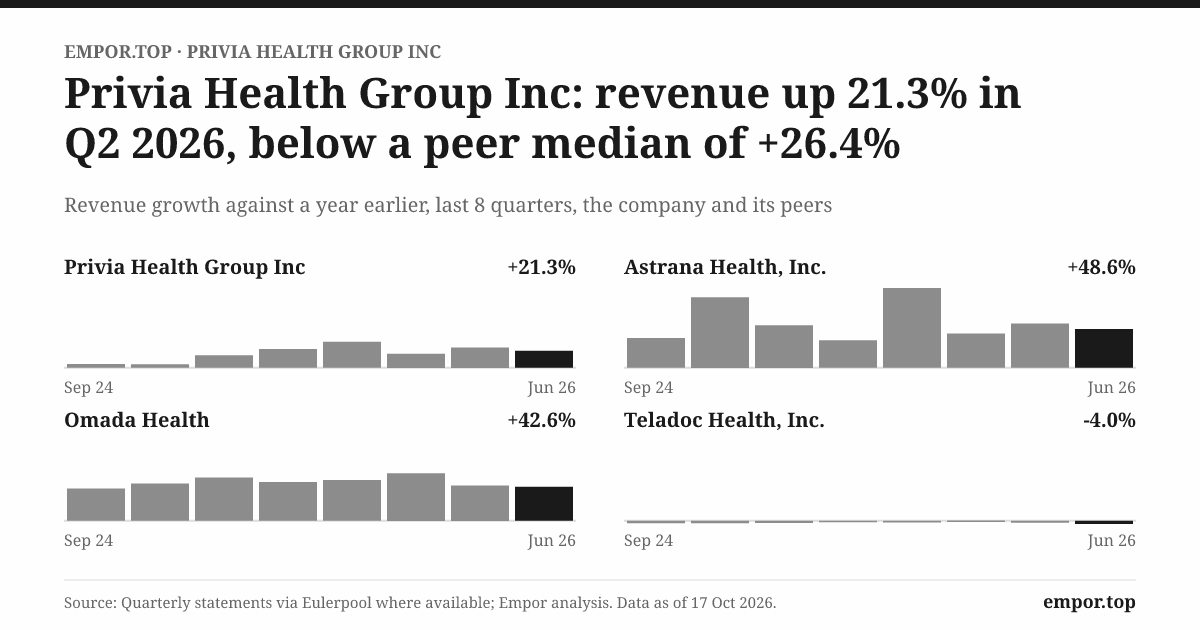
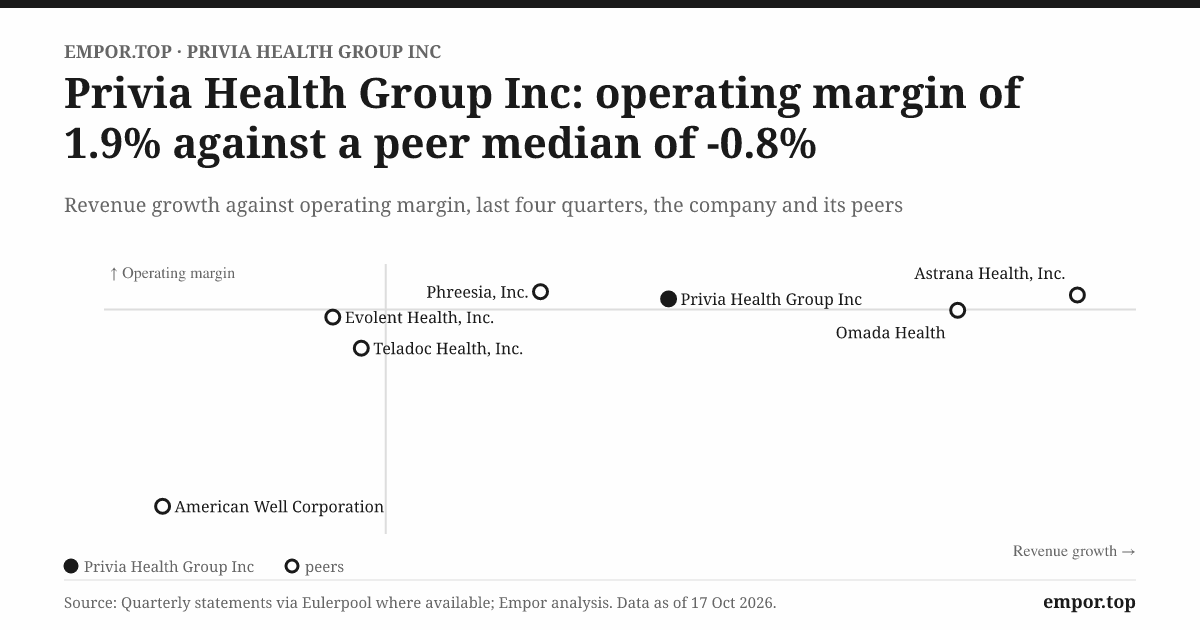
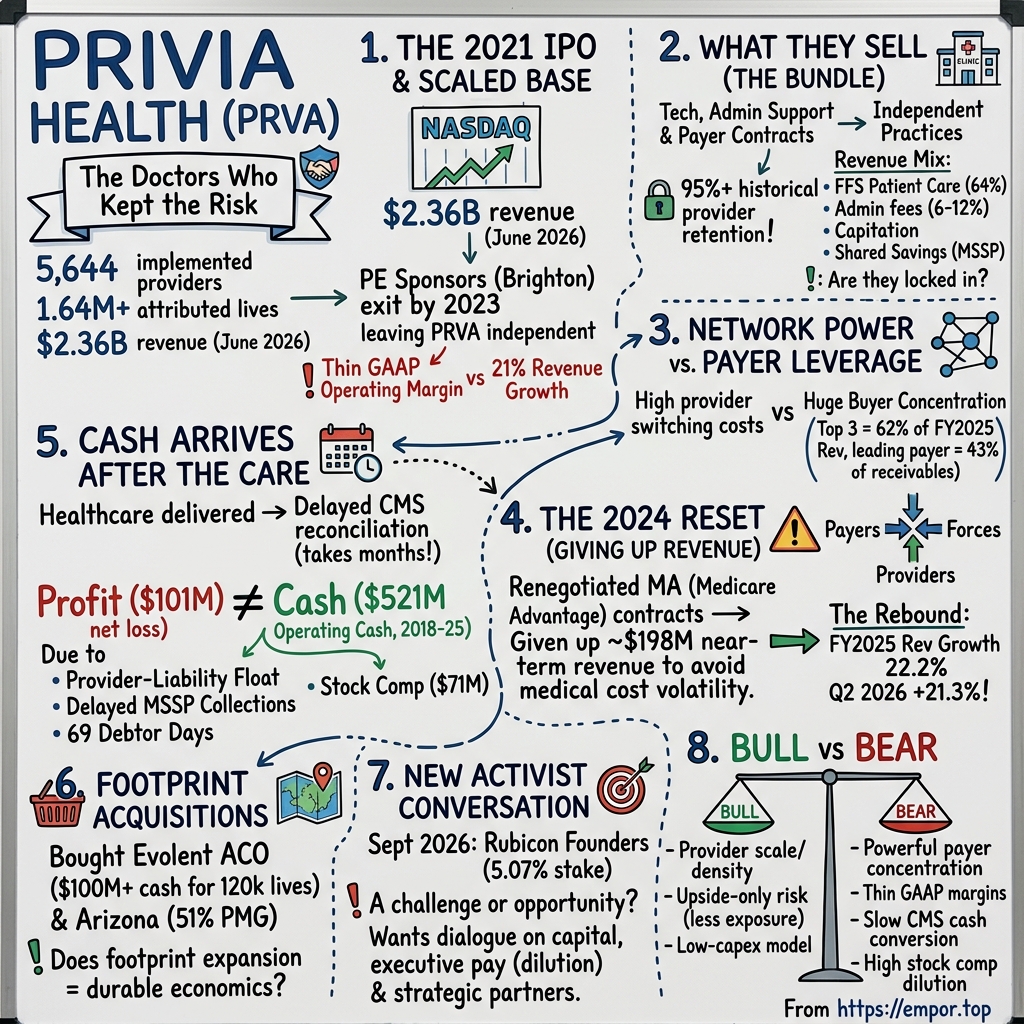
The company has now made that offer to thousands of doctors. By the middle of 2026, Privia counted 5,644 implemented providers and more than 1.64 million attributed lives, meaning patients whose care it is accountable for under value-based contracts.2[^5] Over the twelve months to June 2026 it booked about $2.36 billion of revenue.12 In the latest quarter revenue grew 21% from a year earlier, to roughly $633 million.2 Yet operating profit in that quarter was under $12 million, a margin of about 2%.2 That gap between fast growth and thin margins runs through this whole story. Privia moves a great deal of money and keeps very little of it. Whether it can keep more, without turning into an insurance company by accident, is the question underneath everything else.
The company's roots go back to 2007, when it began building physician networks in the Mid-Atlantic under its founding chief executive, Jeff Butler.3 The model was a medical group in which doctors kept their own offices while sharing technology, billing, payer contracts and the bargaining power that comes from size. Over time Privia came under the control of Brighton Health Group Holdings, a vehicle owned by Pamplona Capital Management and affiliates of Goldman Sachs.3 One distinction matters from the start. Brighton's returns and Pamplona's fund economics were the sponsors' story. Everything that follows concerns the listed company, Privia Health Group, Inc., and its consolidated medical groups and accountable care organizations.
The IPO, on April 29, 2021, showed who the listing was really for. Privia priced at $23 a share and issued 2.8 million new shares, about $64 million gross, plus a concurrent private placement of 4 million shares to Anthem, now Elevance Health, at the same price.3 Altogether the company raised about $141 million net.3 Brighton sold 19.5 million shares of its own in the same offering, close to seven times the new shares Privia issued, and then another 7 million at $26.50 in a November 2021 follow-on that brought the company nothing.31 In other words, the IPO was mainly a door for the sponsors to leave by. By 2023 Brighton, Pamplona and the Goldman affiliates had gone entirely.16 Privia became something unusual among healthcare roll-ups: a widely held public company with no controlling owner, whose strategy and capital allocation belonged to its own management and board.
The listing also left an odd accounting mark. In 2021 Privia recognized more than $215 million of stock compensation, largely from equity awards that vested when the company went public, and so posted a GAAP net loss of $188 million on revenue below $1 billion.1 That loss was a one-off. The habit of paying in stock was not. Stock compensation came to about $71 million in 2025, which is several times that year's GAAP net income.1 The IPO spike faded, but stock awards remain one of the biggest numbers in the business.
That leaves four questions for the hour ahead. Can doctors' loyalty become a durable competitive advantage, or does it last only as long as Privia keeps paying its way? Can Privia make more money from value-based care without taking on the insurer-style risk that has hurt so many of its peers? Is its large operating cash flow a real engine or mostly timing? And do the recent acquisitions, together with the activist investor who arrived in September 2026, confirm the strategy or challenge it? Answering any of them starts with understanding what a doctor actually gets when they sign.
 Subscribe on LinkedIn
II. What the Platform Actually Sells
Imagine an internist with a busy two-doctor practice deciding to join Privia. On go-live day the practice moves onto Privia's electronic health record and billing system. Its claims start going out under the medical group's contracts with commercial insurers rather than the rates a two-doctor shop could negotiate alone. A care-management team begins calling the practice's sickest patients between visits. Quality reports that used to eat up evenings are produced centrally. The internist keeps the sign on the door, keeps their staff, and keeps making the clinical calls. What they give up is a share of their collections, plus a degree of control over how the business side runs.
So the product is a bundle, not software. It combines technology, administrative work, contracting leverage and a seat in value-based programs that a small practice could never join alone. That shapes how Privia's numbers should be read. A software company's revenue is roughly what customers pay it. Privia's reported revenue is much larger than what it keeps, because in many markets the patient-care billings of the affiliated medical groups flow through its income statement before most of the money goes back out to doctors.
There are four streams of money. The largest is fee-for-service patient care: the ordinary bills for office visits and procedures that the owned medical groups send to insurers, which came to about $1.36 billion in 2025, or 64% of revenue.1 Commercial payers accounted for about 71% of that, Medicare and Medicaid for about 15%, and patients for the rest.1 The second stream is administrative fees from practices Privia does not own but manages under long-term agreements. These are usually set at 6% to 12% of the practice's collections and totaled about $137 million in 2025.1 The third is capitation: fixed monthly payments per member, or a percentage of premium, under Medicare Advantage contracts where Privia takes on some medical-cost risk. That brought in about $309 million.1 The fourth is value-based care: about $235 million of shared savings, mostly from Medicare's Shared Savings Program (MSSP), plus around $73 million of per-member care-management fees.1
Each stream is priced in a different unit, and the unit tells you a lot about the risk. Administrative fees scale with collections, so they rise with physician volume and with payer rates. Capitation and care-management fees scale with covered lives and are paid monthly. Shared savings are priced on something more abstract: the gap between what a population's care actually cost and the benchmark Medicare set for it, reconciled once a year after the books close. An analogy helps. Fee-for-service is a contractor paid by the hour. Capitation is a contractor paid a fixed price for the whole job, who absorbs any overrun. Shared savings is a bonus for finishing under budget, with no penalty, under the upside-only versions, for going over.
Contracts usually run for an initial three years and then renew automatically each year.1 The company says more than 90% of practice collections are predictable on a rolling twelve-month basis, because historically more than 95% of its providers have stayed.1 Growth has been real as well. Implemented providers climbed from about 4,300 at the end of 2023 to 5,380 at the end of 2025, and passed 5,600 by mid-2026.12 Attributed lives grew faster still, up about 23% in 2025 to 1.54 million at year-end.1
Here is where reported revenue can mislead. Owned medical groups record the full patient-care bill as revenue, but most of it is paid on to physicians as provider distributions, and capitation carries medical costs that also run through the business. Privia therefore manages itself on "care margin," what remains after those pass-throughs, and on "platform contribution," what remains after the cost of running the platform. Care margin grew about 14% in 2025 to roughly $462 million, against 22% growth in revenue.1 Revenue growing faster than the economic take is not automatically a warning. Acquisitions, the mix of capitated contracts and the timing of shared savings all move the two figures differently. It does mean the headline revenue figure overstates the business Privia is really building.
The competition is a varied crowd, and the comparisons are imperfect. agilon health partners with physician groups mainly to take on full risk for Medicare Advantage seniors, which makes it a much more concentrated bet on medical-cost management.10 Astrana Health reports a network of more than 20,000 providers and around 1.5 million lives under value-based arrangements, with a more vertically integrated model that includes its own risk-bearing entities.11 Aledade, which is private, runs one of the largest ACO networks for independent primary-care practices. Each company counts "providers" and "lives" in its own way, so no clean market-share figure exists, and anyone who quotes one is guessing.
What does this evidence show? It shows a proposition doctors join and mostly stay with, which is the first condition for a durable platform. It does not show pricing power. Nowhere in the record does Privia show it has raised its administrative fee percentages, and the filings do not say how often it loses a competitive bid for a practice. High retention can mean doctors love the platform. It can also mean that leaving is a hassle, or that nothing better has come along yet. Those are different moats with different lifespans. Telling them apart requires following Privia to the other side of the table, where it faces the payers.
III. The Network Has to Earn Its Doctors—and Its Payers
The scene is a contracting meeting, the kind that never makes the news but decides the economics of American primary care. On one side sits a regional Blue Cross plan or a national insurer that needs a local network dense enough to sell to employers and Medicare beneficiaries, and needs that network to keep members out of the emergency room. On the other side sits Privia, which brings hundreds of community practices in the same metro area under one contract, one data feed and one quality program. Privia's pitch is that a single counterparty with real care coordination is worth more to the plan than a few hundred separate practices. The payer's reply is that it has alternatives, and that it writes the checks.
It helps to begin with who holds the leverage. Privia's three largest payers produced 62% of its 2025 revenue: the largest 28%, the next 18%, the third 16%.1 The largest is CMS, the federal Medicare program, and the commercial relationships include Elevance/Anthem, CareFirst BlueCross BlueShield and UnitedHealthcare.1 The concentration is greater still on the balance sheet. At year-end 2025 the leading payer accounted for 43% of net receivables and the top three for 74%.1 That is the profile of a supplier with a handful of very large customers. When one of them is the federal government, which sets prices by regulation and not by negotiation, buyer power is close to the maximum.
Michael Porter's framework sets out the rest of the picture. Physicians, the other side of the market, also have options. They can stay independent, join Aledade or a similar ACO enabler, sign with a hospital, or take an offer from a private-equity-backed group. Rivalry is real but split up by locality, since what counts is density in a specific metro and not national scale. New entrants need capital and contracting credibility, which is a meaningful but not insurmountable barrier. The substitute is the old answer of hospital employment. Overall, that is an industry where a well-run intermediary can earn a living but not one that hands out monopoly rents.
Hamilton Helmer's seven powers help narrow down which advantage Privia could plausibly have. Switching costs are the strongest claim. A practice that has moved its records, billing and payer contracts onto Privia faces real disruption if it leaves, and retention above 95% is consistent with that.1 Network economies are the second candidate. More practices in a metro means more attributed lives to bring to a payer, more claims data to steer care, and more shared savings to divide, which in turn makes the platform more attractive to the next practice. Scale economies in the platform's fixed costs are plausible too, since revenue per employee rose from about $1.46 million in 2020 to $1.73 million in 2025.1 A cornered resource or a proprietary technology is harder to argue. Privia's tools help with workflows, but nothing in its disclosures shows a technology that a well-funded rival could not build or buy.
The record tests these claims in useful ways. On switching costs, the evidence is decent: retention has held across ownership regimes and through the 2024 contract reset, so doctors did not walk away when the company's growth stalled. On network value, the evidence is suggestive but incomplete, because Privia does not disclose shared savings per attributed life by market, which would show whether its denser markets in fact earn more. On pricing, the evidence is weakest. A business with real bargaining power over payers would show it through rising rates or better contract terms, and Privia's disclosures contain nothing of the kind. What they do show is a supplier that had to renegotiate unfavorable contracts in 2024.
Peer behavior adds perspective. agilon chose the opposite end of the spectrum, taking full risk on seniors so as to capture the entire margin between premiums and medical costs, and its own filings describe the medical-cost pressure that strategy produced once senior utilization rose.10 Astrana built a bigger network and owns more of the risk-bearing machinery.11 Privia's mix, with substantial fee-for-service revenue and mostly upside-only value-based contracts, means it captures less of the upside when medical trends go well and absorbs much less of the pain when they turn. That is a choice of business model, not a moat in itself. It does explain why Privia's network came through the utilization surge of 2023 to 2025 largely intact while some peers did not.
The verdict at this point is a moat in the narrow sense. The history does not reject the switching-cost claim. It narrows it to "doctors rarely leave," which is valuable, rather than "Privia can name its price," which the evidence does not support. The test is simple to state. Provider growth and retention have to hold while payer concentration, collection times and care margin stay manageable. If retention slips below its historical level, or a top-three payer renegotiates downward, the narrow moat gets narrower. The plainest evidence of what Privia's bargaining position looks like under pressure came in early 2024, when the company chose to give up revenue.
IV. The Year Privia Chose to Give Up Revenue
In the spring of 2024 the American Medicare Advantage industry had a problem nobody had priced in. Seniors were back in doctors' offices and operating rooms in numbers well above what the actuaries expected, catching up on hip replacements, outpatient procedures and specialist visits that had been put off. For any company paid a fixed monthly amount per member, every extra visit came straight out of margin. Insurers cut forecasts. Full-risk provider groups watched their medical-cost ratios climb. Privia had some of these contracts, and its management had a decision to make.
They chose to retreat. On the first-quarter 2024 call, management explained that the company had renegotiated certain at-risk Medicare Advantage contracts to reduce its exposure to medical costs, and that guidance now reflected about $198 million less top-line revenue as a result.5 The effect showed up in the annual results. Capitated revenue fell from about $339 million in 2023 to $213 million in 2024, a drop of more than a third, and total revenue growth slowed to 4.8% after years of double digits.14 Quarterly growth went from above 20% in late 2023 to about 2% by mid-2024.21
Look at it from the other side of that conference call. A newly appointed CEO, less than a year in the job, was telling a public market that values growth that the company would deliberately book less revenue. The logic was simple. Under those contracts Privia had been acting like a small insurer, holding medical-cost risk on a population it did not fully control, in a year when that risk was going the wrong way. By reshaping the contracts so that more of the volatility sat with the health plans, Privia gave up some potential upside and a large slice of reported revenue in exchange for not betting the income statement on senior utilization. Taking that stance mid-surge, and not after the losses arrived, is one of the more telling pieces of evidence in the company's record.
The reacceleration that followed was striking. Revenue grew 22.2% in 2025, a little above the company's five-year compound rate of about 21%, and was up 21.3% year over year in the second quarter of 2026.12 Capitated revenue itself recovered to about $309 million in 2025.1 On the second-quarter 2025 call, management described the business as growing across providers, attributed lives and value-based contracts without returning to the kind of exposure it had cut back, and analysts' questions centered on how much risk the company was willing to take on in future contract cycles.[^7] Management's message across both calls was consistent: value-based care is the growth engine, and downside risk would be taken selectively, on terms the company could manage.
Consistency is not proof, and the type of growth matters. More implemented providers bring more fee-for-service billings and administrative fees, which are relatively low-margin but low-risk. More attributed lives, especially those acquired through ACO purchases, bring shared-savings potential that pays off a year or more later and depends on performance. Capitation regrowth brings revenue and also brings back some medical-cost risk. At year-end 2025, Privia carried about $79 million of unpaid medical claims liabilities on its remaining at-risk business, a reminder that risk was reduced, not removed.1 Reported revenue growth on its own cannot reveal how much margin and how much risk ride on each new dollar.
The shared-savings model sounds safer, and in an important sense it is. Under MSSP's upside-only tracks, an ACO that spends less than Medicare's benchmark for its patients shares in the savings, and an ACO that spends more simply earns nothing. There is no repayment. The catch is that the payout depends on things Privia only partly controls: how CMS sets the benchmark, which patients are attributed to which doctors, quality scores, and spending trends across the entire population. CMS revised Shared Savings Program rules again in its 2026 physician fee schedule, adjusting how ACOs progress toward risk-bearing tracks and how benchmarks and quality are measured.9 A business can be free of downside medical risk and still be heavily exposed to regulatory design.
Medicare Advantage policy works in a similar way, even where Privia is not the insurer. CMS's V28 risk-adjustment model, phased in over recent years, lowers the risk scores attached to many patients' diagnoses and therefore the premiums insurers receive for them.1 When insurers get paid less, they press harder on the providers they share money with, and capitation contracts become less generous. Privia's 2024 reset shows it will walk away from bad terms. Whether enough good terms remain to drive growth as the policy screws tighten is a question the company cannot fully answer, because the answer is written in Baltimore, where CMS sits, not in Arlington.
The conclusion is that the 2024 reset was a material and deliberate course correction, and the growth cost was visible and accepted. It supports the view that this management team prices risk soberly. What it leaves open is how much attractive value-based growth is available to a company that refuses most of the downside, and how much of the recent growth will turn into cash. That last point is where the story moves next, because in Privia's business the money for good performance arrives long after the care is delivered.
V. Cash Arrives After the Care
In January, a Privia physician in Maryland sees a diabetic patient, adjusts their medications, and has the care team call twice in the following month to make sure the patient is taking them. The patient stays out of the hospital all year. Medicare pays the fee-for-service claim for the visit within weeks. The reward for the hospitalization that never happened, the shared savings, arrives much later. CMS has to close the performance year, wait for claims to run out, compute every ACO's spending against its benchmark, score quality, and only then send the money. For the 2024 performance year, that cash reached Privia in September 2025.1 The doctor did the work in the first month of one year. The check came in the ninth month of the year after.
That delay is the key to Privia's cash story, which on its surface looks almost too good. From 2018 through 2025, the company's cumulative GAAP net result was a loss of about $101 million, while cumulative cash from operations was about $521 million.14 Cash beat earnings by more than $600 million over eight years. Capital spending was close to nothing, so free cash flow over the same period was about $516 million.1 A company that loses money on paper and produces half a billion dollars in cash is either running an unusually good business or showing you timing. In Privia's case it is some of each.
Three mechanisms account for the gap, and separating them is what tells you how durable the cash is. The first is stock compensation, which reduces GAAP earnings but uses no cash. It came to $71 million in 2025, up from $37 million in 2023, and more than $215 million in the IPO year.1 That is a real cost borne by shareholders through dilution. It just does not show up in the cash flow statement. The second is the float. Privia often collects payer money before it pays physicians their distributions and settles medical claims, so a growing business carries growing liabilities to providers. Those provider liabilities rose by about $66 million in 2025 and $113 million in 2023, and each increase added directly to operating cash.1 Think of a restaurant that collects at the table and pays its suppliers at month's end. As long as it keeps growing, the float is free financing. If growth stops, the float stops growing and that contribution disappears. The third mechanism is smaller: depreciation and deferred taxes, about $11 million in 2025.1
The receivables run the other direction, and they have been growing. Net accounts receivable rose from about $316 million at the end of 2024 to $401 million at the end of 2025 and $574 million by June 2026.12 Measured in days of revenue, receivables lengthened from about 40 in 2018 to 69 in 2025.1 It is tempting to read that as customers paying slowly or not at all. The better explanation is structural. As shared savings became a larger share of revenue, more of the income was recognized in the performance year and collected the year after, so receivables naturally carry more of it. The rhythm of the cash flow statement fits this. Operating cash flow was negative in the first half of both 2025 and 2026, by about $16 million and $48 million respectively, before turning strongly positive once MSSP settlements came in during the second half.12
Structural does not mean riskless. Privia's auditor, PricewaterhouseCoopers, designated two critical audit matters in the 2025 annual report: the valuation of fee-for-service patient-care receivables and the valuation of MSSP revenue.1 Both involve estimates. One concerns what fraction of billed care will actually be collected. The other concerns how much shared savings CMS will eventually pay for a year whose final reconciliation has not happened. The allowance for credit losses rose from about 2.9% of gross receivables to 3.7% over 2025.1 With so much of the receivables book tied to a few payers, a dispute or delay with any one of them would matter.
That risk became concrete in the summer of 2026. On the second-quarter call, management told analysts that proposed CMS changes could push the release of 2025 MSSP reconciliation results back to around November, later than the usual late-summer or early-autumn settlement.[^5] Analysts pressed on how confident the company was in year-end cash, and on what signposts investors could watch in the meantime.[^5] Management's answer, in effect, was that the savings had been earned and that timing, not amount, was the variable.[^5] That may well be right. It is also exactly the kind of statement an investor should test against the cash when it arrives, because a delay in a performance-based payment is the moment when estimates and reality are compared.
Management's own guidance sharpens the test. For 2026, the company said it expected 70% to 80% of Adjusted EBITDA to convert to free cash flow, on the assumption that a significant portion of the shared-savings cash came in by year-end.[^5] If CMS slips into 2027, the reported conversion ratio will fall short of that range for reasons of timing, and the company will have to explain the difference. If the money comes in on time and in line with the receivable, the cash story will have passed one of its most direct tests.
Where has the cash gone? Not to shareholders as dividends: Privia has never paid one and has never bought back stock.13 Some has simply piled up. Cash peaked around $491 million at the end of 2024, then fell to about $412 million by June 2026 after the company spent roughly $180 million net on acquisitions in 2025 and went through its seasonal first-half outflow.12 Privia has no funded bank debt, and the small "borrowings" in its financial data are operating lease liabilities.1 Net of those leases, cash was about $404 million at mid-2026.2 Equity stood at about $782 million, or roughly $6.19 a share, which with the stock at $22.55 implies about 3.6 times book value and an enterprise value of roughly $2.4 billion.2
There is also a small hidden support beneath the income statement. Interest on that cash pile earned about $9.7 million in 2025, more than a fifth of pre-tax profit, and in 2024 it was nearly two-fifths.1 Part of what makes Privia look profitable is the yield on money it holds, some of which belongs to providers in transit. If rates fall, that support shrinks.
So the verdict on cash is mixed but clear. Privia generates real operating cash with almost no physical capital, and that is a genuine feature of an asset-light platform. But the cash record is not the same as recurring earnings. It is inflated by provider float that only grows while the company grows, and by stock compensation that costs shareholders in other ways. It is also delayed by a federal reconciliation process that Privia does not control. The cleanest test, which the company has never faced, would be a year of flat provider growth: would operating cash stay strongly positive once the float stopped expanding? Until that happens, the operating cash figure deserves respect and a discount. And the more cash management deploys into acquisitions, the more these questions turn into a different one: what is it buying?
VI. Buying a Network: Growth at What Price?
On September 23, 2025, Privia announced that it would buy the accountable care business of Evolent Health.[^8] Evolent had built a network of ACOs serving primary-care practices under Medicare's shared-savings programs, and Privia was taking over those contracts and relationships. The price was $100 million in cash at closing, plus up to $13 million in contingent payments tied to performance, for a business that came with more than 120,000 attributed lives.[^8] In one transaction, Privia added the equivalent of several years of organic life growth in some markets and extended its MSSP reach into regions where it had little presence.
Earlier in 2025, the company had made a different kind of move: entering Arizona by acquiring a 51% interest in what became Privia Medical Group Arizona.1 The Evolent deal bought contracts and lives. Arizona bought a foothold, a local physician group whose density Privia hopes to build into its full model. Together they took net acquisition spending to about $180 million in 2025, compared with $7 million in 2024 and $43 million in 2023.1 Within a single year, the company went from barely buying anything to deploying almost all of a year's operating cash flow on deals.
The obvious yardstick for Evolent is price per life. A hundred million dollars for about 120,000 lives works out to roughly $830 per life before any contingent payment. Is that cheap or expensive? No public benchmark settles it, because ACO deals rarely disclose their terms and the lives come with different contracts, quality histories and benchmark positions. A crude way to see the bet: if an attributed life generated, say, $100 a year of net shared savings to Privia after physician payouts, the purchase would earn back its price in about eight years before integration costs. That figure is purely illustrative, since Privia does not disclose shared savings per life net to the company, but it shows the shape of the wager. The deal pays off only if those lives keep producing savings year after year, which depends on CMS benchmarks, physician engagement and Privia's ability to fit the practices into its care model.
Arizona is harder to judge from outside. Under purchase accounting, the price for a majority stake in a medical group is allocated to identifiable intangibles such as payer contracts and physician relationships, with the remainder booked as goodwill, and Privia recorded the acquisition on that basis.1 Goodwill is not evidence of overpaying. It is the accounting residue of paying for something whose value lies in future earnings and not in tangible assets. Its real meaning becomes clear only later: either the acquired group grows into its price, or the goodwill is eventually written down.
What makes this spending notable is its contrast with the rest of the business. Capital expenditures were about $1.2 million in 2025, a rounding error against $2.1 billion of revenue.1 Net property and equipment was about half a million dollars at year-end.1 Privia's real investment in itself, its technology and support teams, runs through operating expenses: the cost of the platform was about $253 million in 2025, roughly 12% of revenue.1 Acquisitions are therefore the company's only large capital commitment. Every dollar of acquisition spending is a dollar that was not returned to shareholders, kept as a buffer, or used to offset dilution from stock awards.
The older record offers some help. Privia has expanded before by acquiring and partnering with physician groups in markets such as Indiana and Connecticut, and its provider counts in those regions have grown since.4 The company does not, however, publish market-level margins or returns on individual acquisitions, so outsiders cannot confirm whether earlier deals met their targets. What can be observed is that no acquisition-related goodwill impairments appear in the 2023 to 2025 annual reports, and that the auditor issued clean opinions with no material weaknesses across those years.1 That is a modest piece of reassurance: no visible failures, which is not the same as visible success.
The fair conclusion is proportionate. The 2025 deals clearly sped up Privia's footprint and its attributed lives, and nothing in the public evidence shows the company overpaid. The return test is something else, and it will take years. Acquired lives must produce durable shared savings and platform contribution after integration. Lives added in a press release are not the same as profits. That test matters more now because, in September 2026, a new shareholder showed up with the resources and the background to ask about exactly these choices.
VII. The Platform's New Investor Wants a Conversation
On September 8, 2026, a Schedule 13D landed on the SEC's EDGAR system. Rubicon Founders, a healthcare investment firm, and its managing member, Adam Boehler, disclosed that they owned about 6.47 million Privia shares, a 5.07% stake bought for roughly $138 million.8 The form they filed matters. Passive investors above 5% file the shorter Schedule 13G. A 13D signals that the holder may seek to influence the company. Rubicon stated that it intended to engage with management and the board about strategic opportunities and partnerships.8
The name made the filing hard to ignore. Boehler is not a generic activist. He co-founded Landmark Health, later sold to Optum, and he led the Center for Medicare and Medicaid Innovation, the CMS unit that designs value-based payment experiments.8 Few investors understand the regulatory plumbing beneath Privia's shared-savings business better. When someone with that background buys a 5% position and files to engage, the market naturally wonders whether the conversation will be about efficiency, a combination with another company, or a sale.
The 13D's language is narrower than the speculation. It describes engagement, not a proxy contest, a slate of nominees or a takeover offer.8 The signs that would turn a conversation into a campaign are observable: an amended 13D, director nominations ahead of the 2027 annual meeting, or a specific transaction proposal. None had appeared by mid-October 2026. Until something does, calling this an activist campaign gets ahead of the facts.
The shareholder base Rubicon joined has changed a lot since the IPO. Brighton held 77% after the offering and had sold all of it by 2023.1 In the 2026 proxy, the largest holders were BlackRock with about 12.8%, Fidelity with about 10.1%, Vanguard with about 10%, and Durable Capital Partners, a concentrated long-term growth investor, with about 9.3%.6 Together those four controlled more than 42% of the shares.6 That is a base of large institutions, one of them a concentrated holder, which means any strategic argument will be won or lost with a handful of portfolio managers rather than a scattered retail crowd.
Management sits at the center of that argument. Parth Mehrotra became chief executive on July 1, 2023, after serving as president and chief operating officer since 2018, when he joined alongside then-CEO Shawn Morris.16 He came to Privia from the financial side of healthcare and spent his first five years running operations before taking the top job. In interviews he describes Privia's model as giving physicians the tools of a large system while keeping their independence, and he has been explicit that the company prefers to grow value-based exposure in steps rather than leap into full risk.12 His tenure as CEO has one defining decision so far: the 2024 contract reset, made within a year of his appointment, followed by the rebound in revenue. That pairing is the strongest evidence of an operator who changes course before the losses arrive rather than after. The 2025 acquisitions will be his second test.
Pay is where scrutiny tends to land. Mehrotra's total compensation was about $10.5 million in 2025, of which about $8.6 million was stock awards, $650,000 salary and $1.2 million cash incentive.6 In 2023, the year he was promoted, his package was about $17 million, mostly promotional stock grants.6 Across the company, stock compensation of $71 million in 2025 was equal to about 57% of Adjusted EBITDA of $125.5 million.16 The cash incentive plan rewards care margin and platform contribution, which are the right operating measures.6 But when more than half of the company's preferred profit measure is paid out in stock, the gap between "adjusted" and "real" earnings is a fair subject for any shareholder, activist or not. Weighted-average diluted shares rose from about 124.7 million in 2023 to 128.9 million in 2025, roughly 1.7% a year.1 That is modest dilution, but it is steady, and no buyback offsets it.
Insider alignment is also more modest than it might seem. Officers and directors held about 5.7% as a group in the 2026 proxy, but the largest individual stakes belonged to former CEO Shawn Morris, at about 3.6%, and former UnitedHealth chief executive David Wichmann, about 1.1%, who left the board at the 2026 annual meeting.6 Current executives own far less. The board is led by an independent chair, David King, the former LabCorp chief executive, and in May 2026 it added Francis Soistman, the former CareFirst chief executive.67
On related parties the answer is simple. Since the sponsor exit, Privia disclosed no transactions above the $120,000 reporting threshold with directors, officers or 5% holders, other than executive compensation, routine indemnification agreements and the registration rights agreements left over from the IPO.16 There are no management fees to a parent, no brand royalties and no intercompany loans. For a company that came out of private-equity ownership, that cleanness is worth noting.
Shareholders have not shown much discontent. At the May 20, 2026 annual meeting, say-on-pay passed with about 98.2% support, and the auditor was ratified almost unanimously.7 That gives management room to execute. It does not settle whether pay is proportionate to shareholder returns, given that the stock in October 2026 sat roughly at its 2021 IPO price. Five years of revenue more than doubling, with a share price going sideways, is exactly the kind of record an engaged investor asks about. And that brings the story to the question every investor ultimately has to answer: at today's price, what is the market betting on?
VIII. Analysis & Bear vs. Bull Case
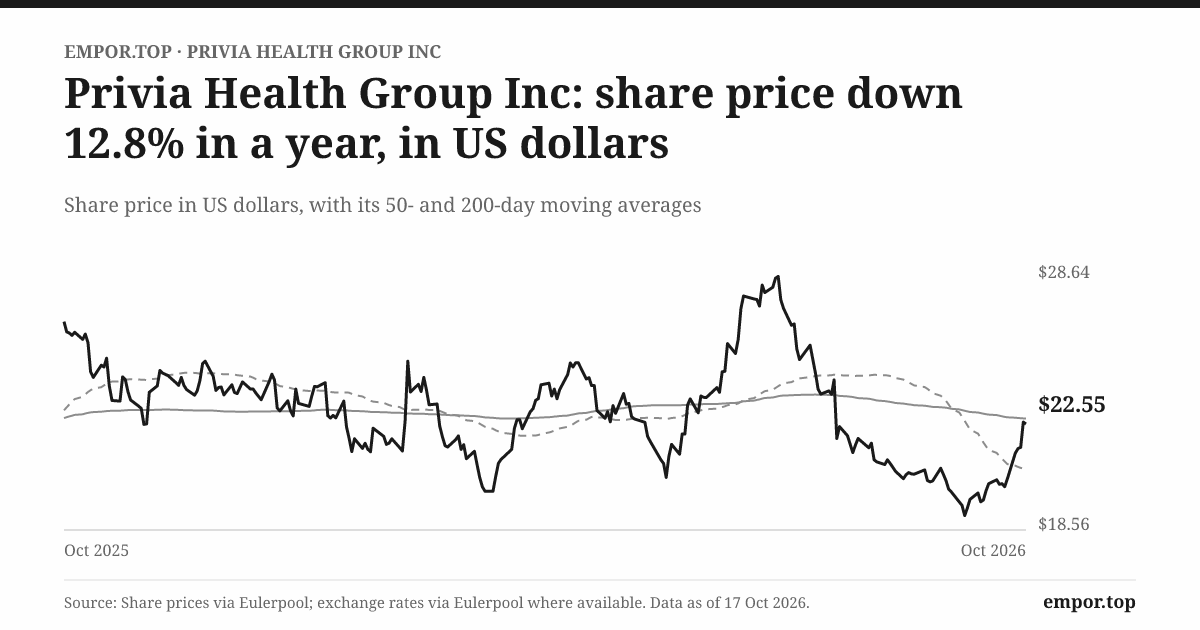
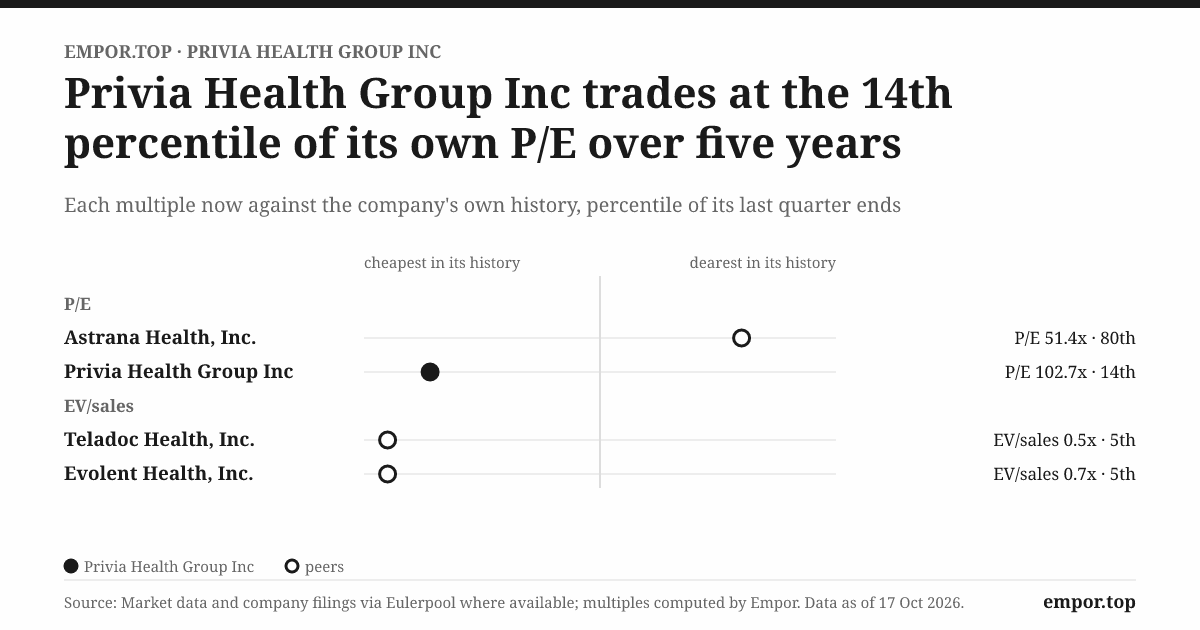
On October 17, 2026, Privia's shares closed at $22.55, about 20% below their 52-week high of $28.10 and above the low of $19.10.1 That price values the equity at about $2.8 billion. Netting out roughly $400 million of cash gives an enterprise value of around $2.4 billion.2 Against twelve months of revenue the stock trades at about 1.2 times sales. Against trailing GAAP earnings it trades at about 103 times, below its own five-year median of roughly 164 times but still high, because GAAP earnings are small.1 On management's preferred measure, the enterprise value is roughly 17 times 2025 Adjusted EBITDA.1 The market is not pricing Privia as a utility. It is pricing a growing platform whose current profits are small relative to what investors expect later.
The bull case starts with the network. Privia has more than 5,600 providers, adds several hundred a year organically, keeps more than 95% of them, and holds more than 1.6 million attributed lives.12 Its value-based business is weighted toward upside-only shared savings, which lets it share in lower medical spending without the downside that hurt full-risk peers. Its model needs almost no capital, so in principle each additional dollar of care margin can flow to the bottom line once the platform's fixed costs are covered. Management's long-term target is Adjusted EBITDA of 30% to 35% of care margin, up from about 27% in 2025.1[^16] If provider and life growth continue and that ratio rises, platform profits can grow much faster than revenue, and today's high P/E could look reasonable in hindsight.
The bear case uses the same facts. Three payers produce most of the revenue, and one of them is a federal agency that sets prices by rule.1 Capitation and shared savings sit downstream of Medicare Advantage rates, V28 risk adjustment and MSSP benchmark design, all of which can turn against the company without warning. Cash conversion is lumpy, dependent on growing provider float and on a CMS settlement that, in 2026, is running late. Stock compensation absorbs more than half of Adjusted EBITDA, so the "adjusted" earnings that justify the multiple are not entirely available to shareholders. And the 2025 acquisitions still have to earn their price. At 100 times GAAP earnings, the margin for error is thin.
Putting the two through the frameworks gives a clearer view of the moat. On Porter's five forces, buyer power is high, as the concentration of revenue and receivables shows. Supplier power, from physicians, is moderate: they can leave, but rarely do. Rivalry is real but local. Substitutes, mainly hospital employment, are persistent. Entry barriers are moderate, built on contracting credibility and local density more than capital. On Helmer's seven powers, Privia has switching costs supported by retention, plausible network economies at the metro level, and some scale economies in platform costs. Counter-positioning, the idea that incumbents cannot copy a model without hurting their own business, is a reasonable argument against hospital systems, which would undermine their employed-physician model by offering independence. Branding, a cornered resource and process power do not yet have evidence behind them. In short, the moat is real but narrow, and it rests on behavior, physicians choosing to stay, rather than on anything legally or technically locked in.
The peer comparison supports that reading. agilon trades at a much smaller enterprise value, about $1.6 billion, after medical-cost spikes damaged its full-risk model.10 Astrana, with a larger network, trades around 9 times forward Adjusted EBITDA.11 Privia's premium over both reflects the market's reward for having avoided the full-risk losses of 2023 to 2025. A premium earned by sidestepping a disaster has to be renewed by continued performance, and it can fade if the next policy cycle hurts upside-only models too.
AI belongs in the analysis, but in proportion. Management has described pilots of ambient documentation and coding tools that cut physicians' administrative time.[^5] Such tools could lower Privia's cost per provider and make the platform more attractive to doctors. They are also available to every competitor, including hospitals. Until the effect shows up in platform costs as a share of care margin, AI is a potential productivity tool, not a separate moat.
Three measures will decide most of the debate. The first is implemented-provider growth together with retention: about 5,644 providers at mid-2026, up from 5,380 at year-end 2025, with retention historically above 95%.12 The second is attributed-life growth together with shared savings per life, which shows whether new lives actually earn money. Lives grew about 23% in 2025, but Privia does not report savings per life directly.1 The third is Adjusted EBITDA as a share of care margin, about 27% in 2025 against a 30% to 35% target.1[^16] Alongside these, two cash checks matter: debtor days, now 69 and rising, and cash conversion once CMS has settled.1 And stock compensation as a share of platform contribution will show whether dilution eases as the business scales.
The downside risks are mechanical, not abstract. A cut in Medicare Advantage rates or a further tightening of risk adjustment reduces the money flowing to insurers and, through renegotiation, to Privia's capitated contracts. A change in MSSP benchmark rules can shrink the pool of shared savings for the same quality of care. A concentrated payer can delay payment or demand new terms. A new market or an acquisition can take longer to reach density than planned. None of these is hypothetical. Each has occurred somewhere in this industry within the last three years.
The balance sheet gives the company room to absorb those shocks. Privia has no funded debt, an undrawn $125 million revolving credit facility with Wells Fargo that runs to 2028, and no material contingencies reported in its filings.1 It operates entirely in the United States and reports in dollars, so currency is not a meaningful risk. That flexibility is real. It protects against a bad year, not against a structural change in how Medicare pays.
The answer to "why does Privia win from here" is therefore real but conditional. It wins if doctors keep joining, if acquired lives produce savings, and if the platform's fixed costs spread over a larger base, all without the company reaching back toward the risk it gave up. It falls short if policy squeezes the savings pools, if payers push back, or if cash keeps arriving later than the earnings that are supposed to back it. That bundle of conditions points to the lessons this company teaches.
IX. Playbook: Business & Investing Lessons
Go back to the spring of 2024, to the first-quarter call where a CEO less than a year into the job told the market that about $198 million of expected revenue was gone, deliberately, because the contracts behind it put too much medical risk on the company's books.5 Most growth companies would have kept that revenue and hoped the utilization surge eased. Privia gave it up. Two years later its revenue was growing more than 20% again, and some of the peers that kept their risk were rebuilding. The first lesson is the simplest: a good contract is worth more than a bigger headline. In a business where revenue can be bought by taking on someone else's risk, top-line growth is the easiest number to manufacture and the most dangerous to admire.
The second lesson comes from the internist in the two-doctor practice who signed with Privia and, like more than 95% of their peers, has not left.1 That retention is the strongest evidence the company has. It is also the only one of its advantages that has to be earned again every renewal cycle, because nothing stops a practice from walking out at the end of its term. A network is only a moat while its members choose to stay. Founders building platforms on the backs of professionals, doctors, lawyers, financial advisers, should note that the moat is the members' continuing judgment that the deal is fair, and that judgment has to be won again each year.
The third lesson belongs to the diabetic patient in Maryland who stayed out of the hospital in January and earned Privia a payment nineteen months later. In that gap sit $574 million of receivables, 69 debtor days, provider liabilities that swell whenever the company grows, and a CMS reconciliation that in 2026 may slip to November.12[^5] Cash is not earnings until you know who is waiting to be paid. When a business's operating cash flow far exceeds its profits for eight straight years, the useful question is not "how much cash" but "whose cash, and for how long."
The fourth lesson is the $100 million check for Evolent's ACOs and the 51% stake in Arizona.[^8]1 Each deal made the map bigger overnight. Neither will tell investors anything about its return for years. Acquisitions buy time and reach; they do not buy returns. The lives come with the contracts, but savings, retention and contribution have to be produced afterward, in the slow work of integrating practices into the care model.
The fifth lesson is the $71 million of stock compensation in 2025, more than half of the Adjusted EBITDA that management prefers investors to look at.16 Because it is non-cash, it disappears from the cash flow statement and from the adjusted profit figures. But shares issued to employees are shares that existing owners no longer own. Stock awards still have an owner. A platform that wants to be valued on adjusted profit has to show, eventually, that the adjustment shrinks.
X. Epilogue
Tonight, Privia sits in a waiting room of its own. Somewhere in CMS's offices in Baltimore, the 2025 Medicare Shared Savings Program reconciliation is being finalized. When the numbers are released, they will tell Privia, and anyone watching, how much its ACOs earned for a year of care that ended ten months ago. Management told investors in August that the results might not arrive until November and that it still expected most of the cash before year-end.[^5] Its free-cash-flow guidance of 70% to 80% of Adjusted EBITDA depends on that.[^5] If the cash comes in on time and matches the receivable, one of the bear case's main arguments loses force. If it slips into 2027, the company will report a weaker cash year for reasons it cannot control, and the question of what its cash flow really represents will get louder.
Meanwhile, the integration work continues. The Evolent ACOs have to show they can produce savings under Privia's care model, not just transfer over. Arizona has to build the local density that makes the platform work. New Jersey and other newer markets have to attract enough practices to become the kind of metro network that payers want to contract with. The measure to watch is not lives added but contribution earned: does each acquired or new market eventually look like the older Mid-Atlantic core, or does it stay a thinner, lower-margin satellite?
The margin target is the third test. Management aims for Adjusted EBITDA of 30% to 35% of care margin over the long term, from about 27% today.1[^16] Reaching it would mean the platform finally showing the operating leverage the bull case has always promised. AI documentation tools and workflow changes are part of management's case for how that happens.[^5] The evidence will be in the platform's cost line, not in the pilot announcements.
And there is Rubicon. Adam Boehler's firm owns 5% of the company and has said it wants to talk about strategic opportunities and partnerships.8 The 2027 nomination window will open in the coming months. A 13D amendment, a slate of directors or a concrete proposal would turn the conversation into something more. Management's response, whether it engages, what it concedes on capital allocation or pay, and whether it holds its ground, will reveal how it sees its own record.
Each of these moments returns to the central questions. Do doctors stay? Does value-based care pay without bringing back the risk? Does the cash arrive? Do the deals earn their price? None of them will be answered in a single quarter. Together, over the next year, they will decide whether Privia's growth turns into durable shareholder economics or remains a large flow of money that mostly passes through.
XI. Outro
Go back to the Virginia practice from the beginning. The waiting room is the same, the television still unwatched. The doctor still owns the practice, still makes the clinical calls, and still decides each renewal cycle whether the bargain is worth it. What has changed is everything around the office: the contracts, the data, the care managers calling patients, the settlement checks arriving months after the work. Privia is that invisible structure, now covering more than 5,600 providers and about $2.4 billion of annual revenue.12
Unlike an insurer, Privia does not want to own the medical risk. Unlike a clinic chain, it does not want to own the doctors. It is a bet that independent physicians can have the scale of a system without giving up their practices, and that the company in the middle can keep a growing share of the value it helps create. It will work only as long as the doctors keep choosing it, the payers keep paying it, and the cash keeps following the care.
References
-
2025 Annual Report on Form 10-K — Privia Health Group, Inc., 2026-02-27 ↩↩↩↩↩↩↩↩↩↩↩↩↩↩↩↩↩↩↩↩↩↩↩↩↩↩↩↩↩↩↩↩↩↩↩↩↩↩↩↩↩↩↩↩↩↩↩↩↩↩↩↩↩↩↩↩↩↩↩↩↩↩↩↩↩↩↩↩↩↩
-
Form 10-Q for the Quarter Ended June 30, 2026 — Privia Health Group, Inc., 2026-08-06 ↩↩↩↩↩↩↩↩↩↩↩↩↩↩↩↩↩
-
Form 424B4 IPO Prospectus — Privia Health Group, Inc., 2021-04-30 ↩↩↩↩↩↩
-
2024 Annual Report on Form 10-K — Privia Health Group, Inc., 2025-02-27 ↩↩↩
-
Q1 2024 Earnings Call Transcript — Privia Health Group, Inc., 2024-05-09 ↩↩
-
2026 Definitive Proxy Statement — Privia Health Group, Inc., 2026-04-02 ↩↩↩↩↩↩↩↩↩↩↩↩
-
2026 Annual Meeting Voting Results, Form 8-K — Privia Health Group, Inc., 2026-05-22 ↩↩
-
Schedule 13D — Rubicon Founders and Adam Boehler, 2026-09-08 ↩↩↩↩↩
-
CY 2026 Medicare Physician Fee Schedule Final Rule: Medicare Shared Savings Program Changes — CMS, 2025-10-31 ↩
-
2025 Annual Report on Form 10-K — agilon health, Inc., 2026-02 ↩↩↩
-
Company Profile and Operating Scale — Astrana Health, Inc. ↩↩↩
-
Privia CEO on Physician Enablement and Managing Risk — Vital Signs Podcast, 2024-10-22 ↩
 LinkedIn
 WhatsApp
 Reddit
 Hacker News
 Email
 Kindle
 RSS Feed
 Spotify
 Apple Podcasts
 Amazon Music
 Audible
 YouTube