ICRA Limited: The Rating Agency Inside Moody’s—and the Business It Is Trying to Become
I. The Growth That Came With a Question Mark
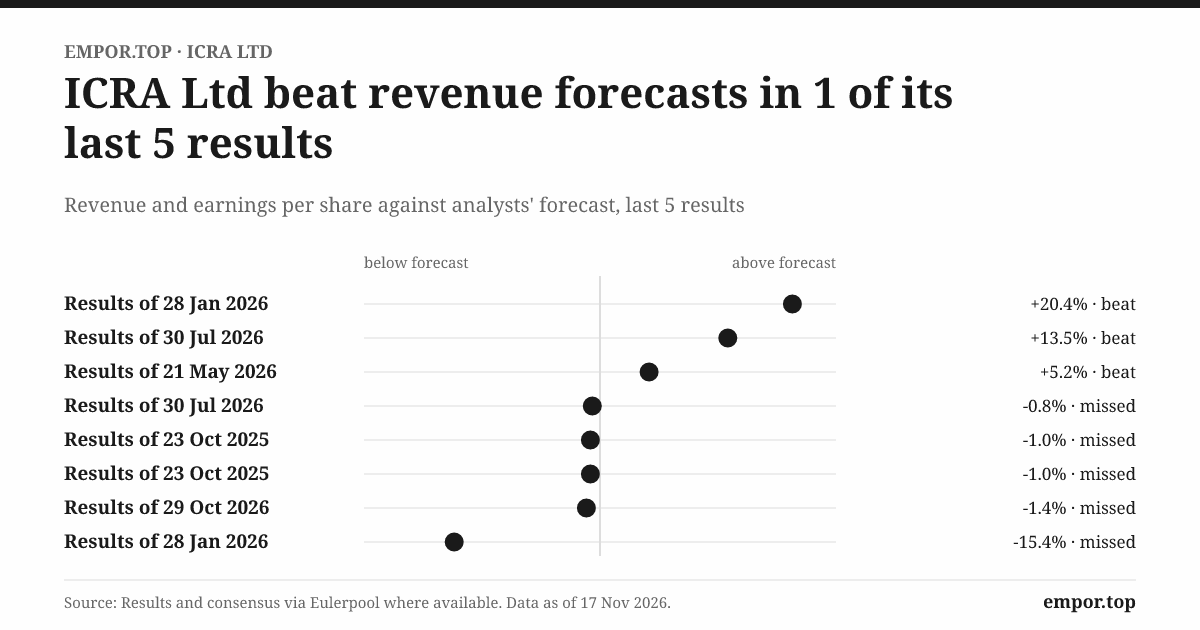
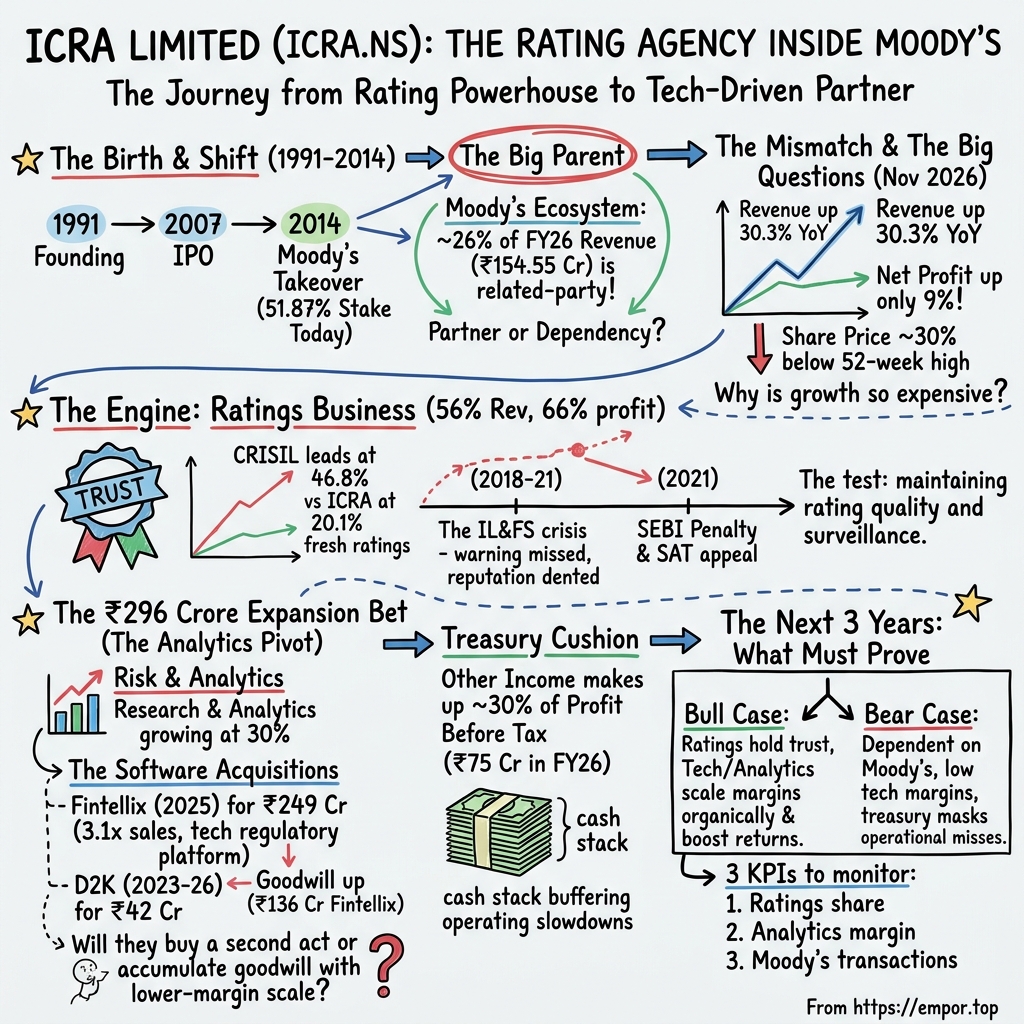
On the evening of 29 October 2026, ICRA Limited sent its September-quarter numbers to the stock exchanges, and at first glance they looked like the best news the company had delivered in years. Revenue was up about 30% on the same quarter a year earlier.1 For a business that spent most of the previous decade growing in single digits, and that actually shrank in four of the five years between FY2017 and FY2021, a 30% quarter is not a rounding error. It is a different company showing up in the same filing.2
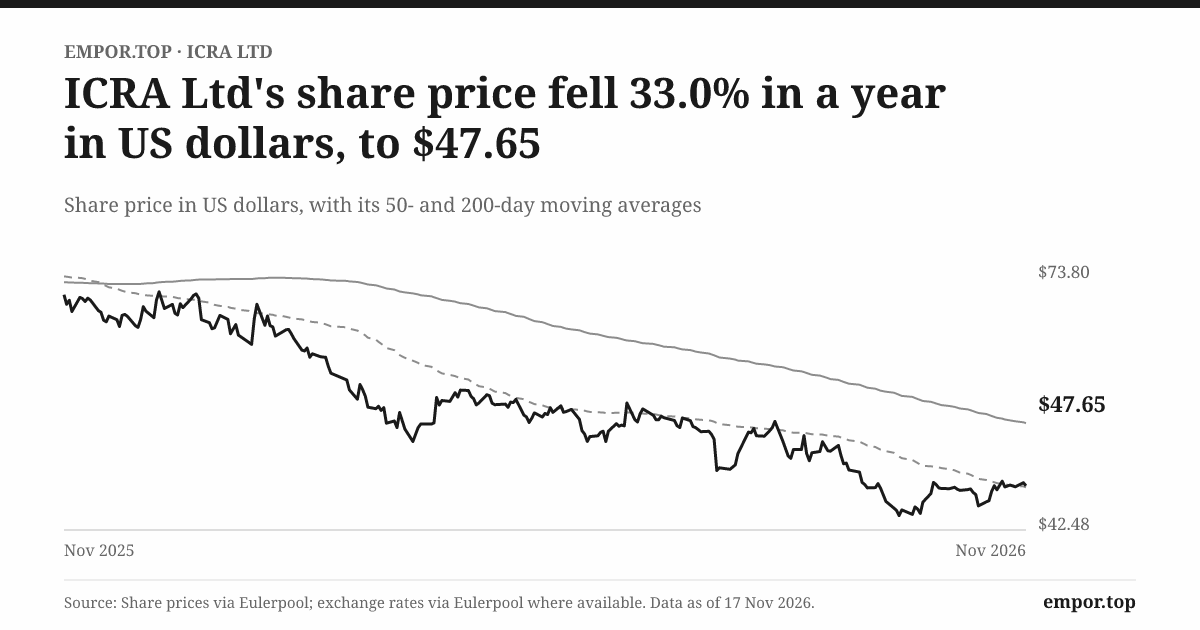
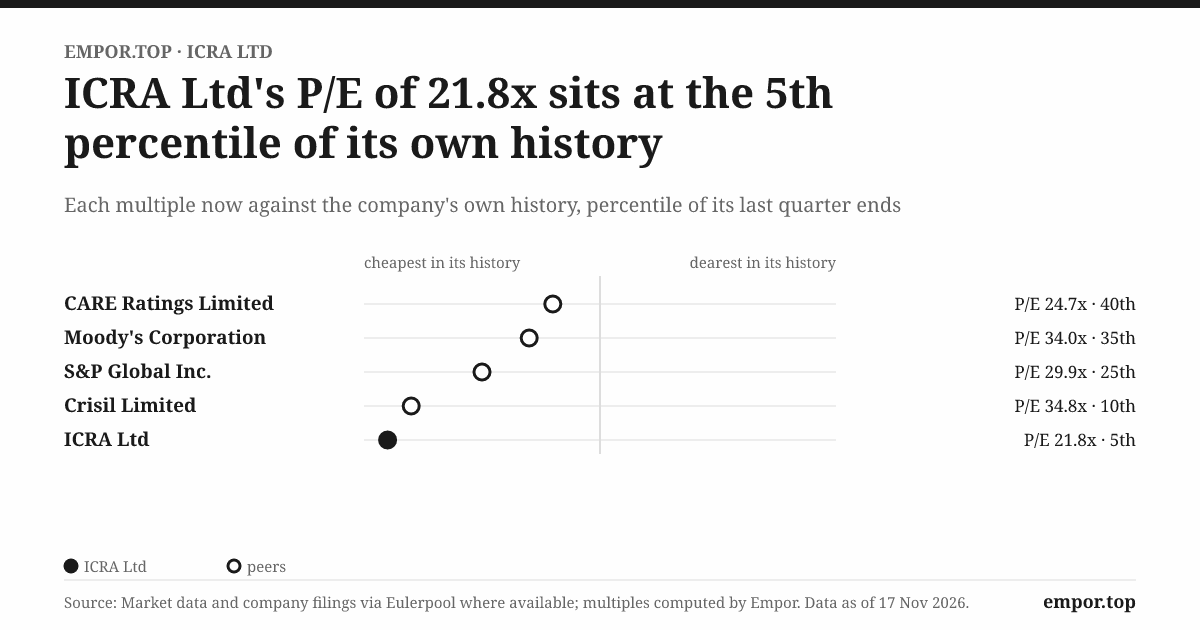
Then the eye travels down the page. Net profit grew about 9%.1 Operating margin slipped by about one and a half percentage points to roughly 31%, and net margin fell by almost six points to about 29%.1 The top line had sprinted; the bottom line had walked. And the stock market, which is paid to notice exactly this kind of gap, had already marked the shares down. In mid-November 2026 ICRA traded at about ₹4,454, almost 30% below its 52-week high of about ₹6,330, and at roughly 22 times trailing earnings against a five-year median closer to 33 times.
That mismatch is the doorway into this story. Something has changed inside ICRA, and the change is visible in the revenue line long before it is visible in profit. The quarter that looks so strong was not produced by the old ratings business suddenly winning a flood of mandates. A large share of it came from businesses ICRA bought, above all a Bengaluru software company called Fintellix, which closed in October 2025 and therefore sits inside this year's numbers but not inside last year's.3 Strip that out, and the growth story becomes more ordinary. Leave it in, and a different question appears: what is ICRA actually buying when it writes cheques for software platforms, and what will those platforms earn?
There is a second thread running through the same accounts, and it is less visible because it has been there for so long. In FY2026, services that ICRA's group provided to Moody's entities brought in about ₹155 crore, roughly a quarter of consolidated revenue.2 Moody's is not just a big customer. Through two holding companies, it owns about 52% of ICRA.4 The company's largest client and its controlling shareholder are, in effect, the same global group. That arrangement brings stable, long-dated work. It also means that a meaningful slice of the listed company's economics is set in conversations between a parent and its subsidiary.
So three questions sit on the table, and the rest of this story is an attempt to answer them. The first is whether the ratings franchise, the business that made ICRA's name, still has a real edge in a market where borrowers can choose among several regulated agencies. The second is whether the analytics acquisitions can earn their cost, or whether ICRA has bought revenue that comes with lower margins and a lot of amortisation. The third is how much the Moody's relationship shapes the economics, and what would happen if that relationship changed shape.
One boundary needs drawing before the story starts. This is the story of ICRA Limited, the company listed in Mumbai, and its consolidated subsidiaries: ICRA Analytics, ICRA ESG Ratings, D2K Technologies and Fintellix.2 It is not the story of Moody's Corporation, whose global ratings and analytics empire is many times larger and whose results do not flow into ICRA's accounts except through the services ICRA sells it and the dividends ICRA pays it. When this story says Moody's, it means the shareholder and the customer, not a business whose scale ICRA's investors can borrow.
The numbers that matter most are few. Revenue for FY2026 was about ₹600 crore.2 The ratings segment earned the larger share of the profit, the analytics segment produced most of the incremental revenue, and a large other-income line from the company's investment portfolio supported the reported profit before tax.2 Each of those facts will get its own scene. But they all lead back to one question about identity, and it is worth carrying through every section that follows: what kind of business did ICRA become when its largest shareholder became its controller?
 Subscribe on LinkedIn
II. From Indian Information Agency to Moody’s-Controlled Company
ICRA was born in 1991, the same year India opened its economy to the world.2 The timing was not a coincidence. A country that was dismantling licence controls and inviting private capital needed a way for lenders and investors to judge borrowers they had never dealt with before. Indian financial institutions and banks, led by the development lenders that had dominated long-term credit for decades, set up an agency whose original name described its job plainly: the Investment Information and Credit Rating Agency of India.2 It was to produce opinions on the creditworthiness of debt, in a market that was only beginning to learn why such opinions mattered.
It was not first. CRISIL, the agency that would become ICRA's lifelong rival, already existed and had a head start in mindshare. ICRA's role in the early years was to be the second serious voice in a young market, and the founding shareholders gave it the institutional credibility that a new rating agency could not have built on its own. Those early decades matter today mainly for one reason: they established ICRA as a domestic franchise with Indian roots, Indian analysts and Indian clients, long before it became part of a global group.
Moody's arrived in 1998, buying a minority stake and beginning a relationship that was, for years, a partnership between a global brand and a local operator.5 The arrangement gave ICRA access to methodologies, training and the reputational halo of an international name, while the company remained Indian in ownership and management. In 2007 ICRA listed on the stock exchanges, which put a market price on the franchise and gave its institutional shareholders a way out.2 For seven years after that, ICRA was a listed Indian company with a large foreign strategic shareholder, a configuration that preserved a degree of independence in both directions.
Then, in February 2014, Moody's moved to take control. It offered ₹2,400 a share in an open offer, a premium of about 51% to ICRA's closing price on the last trading day before the announcement and about 47% above the stock's all-time closing high.5 That was not the price of a minority investor topping up. It was the price of a buyer who wanted the keys. By June 2014, Moody's announced that its stake had risen from 28.5% to more than 50%, for a total outlay of about $86 million funded from its international cash.5 Raymond McDaniel, then Moody's chief executive, framed the deal as extending strong ties to serve India's domestic debt market.5
Today Moody's holds about 52% of ICRA through two entities: Moody's Investment Company India with about 31.7%, and Moody's Singapore with about 20.2%.4 The stake has been stable, and no pledge of those shares was reported in the September 2026 shareholding pattern.4 There is a small irony worth noticing in the price. Moody's paid ₹2,400 a share for control in 2014. In November 2026, more than twelve years later, the stock traded at roughly ₹4,450. That is a gain of under 90% before dividends, or about 5% a year, which is a modest compounding rate for a supposedly high-quality franchise with almost no debt. Control did not turn ICRA into a stock market rocket.
What control did change was the nature of the company. Under Moody's majority ownership, ICRA built out a business doing knowledge and data work for Moody's itself: research support, data outsourcing and technology services delivered from India for the parent's global operations.2 That business became the anchor of what ICRA now calls Risk & Analytics. Five years ago, Moody's accounted for about 80% of the revenue in ICRA's knowledge-services vertical; by FY2026, management said that share had fallen to about 49%.6 Even after the dilution, the parent remains by far the single largest customer of the analytics arm.
The annual report says these arrangements are on arm's-length terms, and transactions above materiality thresholds have gone to shareholders for approval.2 That is the legal protection. The economic question is different: when your controlling shareholder is also your largest customer, who really owns the growth?
Before answering that, the story has to go back to the business that made ICRA worth controlling in the first place, and to the episode that showed how fragile its central product can be.
III. The Rating Opinion That Wasn’t Revisited in Time
On 14 September 2018, Infrastructure Leasing & Financial Services failed to pay commercial paper and inter-corporate deposits that fell due that day.7 IL&FS was not an obscure borrower. It was a sprawling infrastructure financier with government-linked institutional shareholders, and its long-term debt had carried the highest rating an Indian agency could assign. Three days later it missed interest on its debentures, and it missed more payments on the 21st, 26th and 29th of the month.7 Mutual funds that had held IL&FS paper as near-risk-free took losses, and a shock moved through India's market for corporate credit.
ICRA was one of the agencies that rated that debt. In its later order, SEBI laid out the sequence with uncomfortable precision. ICRA reaffirmed a AAA rating on IL&FS debentures on 27 March 2018. It cut the rating to AA+ on 6 August 2018, to BB on 6 September, and to D, meaning default, on 17 September.7 In the regulator's words, the downgrade by rating agencies in the space of 43 days had completely changed the risk perception of the corporate bond market.7 A bond that had been described as among the safest in India became junk and then defaulted in a little over a month.
To understand why that mattered so much, it helps to understand how the business makes money. Credit rating in India, as in most of the world, runs on an issuer-pays model. The company that wants to borrow pays the agency to rate its bonds or loans. Investors, who never pay the fee, rely on the opinion to decide what to buy and at what price. The arrangement is a bit like a restaurant paying the critic who reviews it, with diners trusting the review. It works because the critic's reputation is worth more than any single restaurant's fee, and it breaks down whenever the critic forgets that.
SEBI's findings were about exactly that kind of forgetting. The regulator's adjudicating officer found that ICRA had relied too heavily on what IL&FS management told it, without independent confirmation of their claims.7 ICRA kept the outlook on IL&FS debt at Stable throughout the rating period, even as asset sales and debt reduction that the group had promised proceeded slowly.7 Most strikingly, when ICRA's rating committee met on 27 October 2017, it was presented with IL&FS's asset-liability position as of March 2017 rather than June 2017, and ICRA had not asked for the more recent figures.7 Over that single quarter, IL&FS's borrowings had risen from about ₹12,100 crore to about ₹13,100 crore, but the increase was neither shown to the committee nor disclosed in the rating rationale published on 3 November 2017.7
For a lender to infrastructure projects that funds long-term assets with shorter-term borrowing, the asset-liability schedule is the closest thing to a heart monitor. The adjudicating officer called the failure to seek it "glaring lack of prudence and due diligence," and observed that although ICRA's own rationales had voiced concern about deteriorating finances, the agency had not acted on those concerns by downgrading in time.7 Elsewhere in the order, the conduct was described as a "brazen failure" that defeated the purposes of investor protection.7 This was not hindsight from a journalist; it was a regulator's finding on the record.
The penalty story is almost as revealing as the findings. In December 2019, the adjudicating officer fined ICRA ₹25 lakh.7 SEBI's whole-time member G. Mahalingam reviewed that order and concluded the amount was too small for the gravity of the failure. In September 2020 he raised it to ₹1 crore, writing that had ICRA downgraded at the appropriate time and warned investors, the impact on those who had bought AAA-rated instruments could not have been so severe.7 ICRA contested the case throughout, arguing that the original order was erroneous, and it had already gone to the Securities Appellate Tribunal against the adjudicating officer's decision.7
Keep the scale in view. ₹1 crore is about half of one percent of ICRA's FY2026 net profit.2 As a financial event, the penalty was a parking ticket. As a credibility event, it was something else entirely. A rating agency sells exactly one thing: the belief that its letter grade means what it says, and that it will change when the facts change. IL&FS proved that ICRA's monitoring, at least in that case and in that era, did not work the way investors assumed. The fine did not hurt. What the fine documented did.
Does that settle the question of ICRA's rating quality today? It does not, and it would be lazy to pretend otherwise. IL&FS was a single, extreme case from 2017 and 2018, and much has changed in the agency and in its regulation since. The honest conclusion is narrower: the episode puts a hard limit on any claim that reputation or methodology alone makes the franchise unassailable. Whether ICRA has learned from it is a question for current evidence, such as how its ratings migrate before defaults and how it is treated by regulators who now measure exactly that.
That current evidence is about to become more consequential. The Reserve Bank of India has set a reset of bank capital rules, effective 1 April 2027, under which the risk weights banks assign to rated loans are expected to take account of the quality of the ratings themselves.6 On the Q2 FY2027 call, ICRA's chief business officer L. Shivakumar said that if the RBI proceeds as intended, ICRA "stacks up pretty well" and was "likely to gain," adding that the market had shown a clear preference for ICRA's ratings in recent quarters.6 He also said the gain could not be quantified, and the RBI's computation method was still awaited.6 That is management's claim. The regulator's numbers, once published, will be the test.
And that leads directly to the competitive market, because a rating agency's reputation is only worth something if borrowers have to come to it. In India, they do not. They can choose.
IV. The Market Where CRISIL Is Still Bigger
Picture a corporate treasurer in Mumbai preparing to raise money through a bond issue. Before the paper can be sold to mutual funds and insurers, it needs a rating, and in practice it often needs two. The treasurer can call CRISIL, ICRA, India Ratings, CARE or several smaller agencies, all registered with SEBI. The treasurer will weigh which agency investors respect, which one understands the sector, how quickly it moves, and, inevitably, what it charges. That phone call, repeated thousands of times a year across Indian borrowers, is the market ICRA competes in.
SEBI's own count of that market is the clearest scoreboard available. In FY2026, CRISIL received about 47% of fresh ratings for listed or proposed-to-be-listed securities. ICRA received about 20%, India Ratings about 19%, and CARE about 4%.8 ICRA is therefore a major player, roughly level with India Ratings, but CRISIL wins more than twice as many fresh listed mandates. The number has limits: it counts new ratings on securities, not bank-loan ratings, not surveillance of existing ratings, and not revenue. A large bond rating and a small one count the same. But as a signal of who issuers call first, it is hard to ignore.
It is also worth noticing what that scoreboard does not show. ICRA does not publish its win rate on competitive mandates, its client retention, the price it realises per rating relative to rivals, or its share by product. Without those figures, any claim that ICRA has pricing power or is gaining ground rests on management's word. And on the most recent call, management was asked directly. Kunal Thanvi of Banyan Tree Advisors put it bluntly: the ratings business had grown slower than peers and had lost market share, so what had happened?6
Ramnath Krishnan, the managing director and group chief executive, did not dispute the premise with numbers. He said the ratings business had grown about 15% in the first half of FY2027, that rating actions can fall in different quarters for different agencies, and that ICRA tracks market share "in the segments that we want to play in," adding: "So I'll leave it at that."6 That is a reasonable answer about timing noise. It is not an answer about share. An investor left that exchange knowing that ICRA chooses where to compete and believes it holds a healthy position there, but without the figures to judge either claim.
Here is how the money actually flows. Ratings revenue comes from initial rating fees, paid when a borrower first gets rated, and surveillance fees, paid every year the rating stays live and is monitored.2 That surveillance stream gives the business an annuity-like base: a borrower that issued a ten-year bond keeps paying for monitoring long after the issue. On top of that sit ancillary services. Research, data, analytics and software, on the other hand, have different rhythms: subscriptions are booked over the subscription period, software on acceptance or milestones, and period-based assignments over time.2 In FY2026, about ₹472 crore of the group's ₹598 crore of service revenue was recognised over time, with about ₹127 crore booked at a point in time.2 Roughly four-fifths of revenue, in other words, behaves like a stream rather than a series of one-off sales.
Demand for ratings moves with the credit cycle rather than with any simple measure of consumer volume. When companies borrow more, they need more ratings. The first half of FY2027 showed how mixed that can be. Bank credit grew about 21% while bond issuance grew only about 4%, as elevated bond yields pushed borrowers toward bank loans.6 An analyst from IIFL pointed out that bond ratings typically carry higher fees than bank-loan ratings, so a shift from bonds to loans tends to dilute growth for the whole industry, and particularly for an agency with relatively high exposure to the bond market.6 Krishnan acknowledged that it would, while noting that the effect also depends on the segments an agency serves.6
On pricing, the call offered one small, revealing window. Asked whether ICRA had followed a competitor in raising surveillance fees, group chief financial officer Venkatesh Viswanathan said ICRA's agreements include an enabling clause for surveillance pricing, but that fees are negotiated with clients on an ongoing basis, and "in some cases, we have seen some kind of traction there."6 That is the language of a seller that can ask for more but not insist. It fits the structure of the business: in an issuer-pays market with several qualified agencies, the buyer holds real bargaining power.
History says that this competition is not new, and that it can be sharp. ICRA itself publicly took on competitors over rating practices as long ago as 2011, a sign of how contested mandates already were.9 In 2017, Business Standard reported that intensified competition was hurting ratings revenues at CRISIL and CARE.10 The market has periodically been described in terms of fee pressure and rating shopping, with borrowers testing which agency will give them the outcome they want. That is the structural pressure the IL&FS case exposed from a different angle.
So what can ICRA's advantage actually be? There are four plausible candidates. Regulation keeps the number of competitors small, because becoming a SEBI-registered agency with institutional credibility takes years. Analytical reputation, damaged but not destroyed by IL&FS, still carries weight with investors. Coverage, the accumulated library of sector knowledge and existing rated borrowers, generates surveillance income and familiarity. And the Moody's link gives ICRA a global affiliation that some issuers value. Each of those is real. None of them, on the evidence the company publishes, proves pricing power, rising share or superior retention.
What the evidence does show is that ICRA has run this business very well financially. Between FY2021 and FY2026, management said, ratings revenue grew from about ₹187 crore to about ₹336 crore, a compound rate of about 12% a year, while the operating margin in ratings expanded from about 21% to about 38%.6 That is a large improvement, achieved partly by recovering from a subdued period around 2020 and 2021.6 It shows operating discipline and the leverage of a fixed analytical team serving a growing credit market. It does not show that ICRA is winning share from CRISIL, and the SEBI scoreboard suggests it is not.
The strategic distinction to carry forward is this. Ratings is the engine that pays the bills: higher margin, steady, and tied to India's credit growth. Risk & Analytics is the growth bet, the business management has spent the last few years and a few hundred crore building. And the single largest customer of that growth bet is ICRA's own parent.
V. Moody’s Is the Customer, Owner and Operating Partner
Turn to Note 39 of ICRA's FY2026 annual report, the related-party disclosure, and the Moody's relationship stops being an abstraction and becomes a ledger of invoices. Knowledge-services revenue from Moody's Investors Service came to about ₹106 crore. Knowledge-services revenue from Moody's Analytics was about ₹47 crore. Smaller amounts came from market-data services to Moody's Analytics and from Moody's Corporation itself.2 Add them up and the total is about ₹155 crore, which matches the company's separate disclosure that one customer group contributed more than 10% of revenue.2 That customer group accounted for about 26% of consolidated revenue in FY2026.
That number deserves a second look, because it is easy to underestimate. One rupee in every four that ICRA's group earned came from its controlling shareholder. ICRA does not publish the margin it earns on that work, the length of its contracts, or a history of how renewal terms have moved. The annual report says the related-party transactions are priced at arm's length, and the data-outsourcing, research and IT-support transactions of ICRA Analytics with Moody's exceeded 10% of the prior year's consolidated turnover and were therefore put to shareholders for approval.2 That is a governance process. It is not the same as proof that the economics would survive if Moody's could buy the same services from someone else and chose to.
The working-capital side tells the same story in smaller numbers. At the end of March 2026, ICRA's trade receivables included about ₹17 crore due from related parties, and the note separately listed about ₹6 crore recoverable from Moody's Investors Service.2 Those are not alarming amounts for a company with an investment portfolio worth many times more, and there is no sign of disputed parent balances. They do show that the relationship involves real credit extended to the parent, in a year when ICRA's overall debtor days rose from 39 to 48.2
What does the parent relationship look like from the inside? On the Q2 FY2027 call, analysts pressed management on exactly that. Balaji Subramanian of IIFL observed that, judging by the related-party disclosures, revenue from Moody's had been "largely flat," while ICRA's larger competitor had grown its engagement with its own global parent at about 20% a year.6 Why, he asked, was there no long runway in the Moody's account? Viswanathan replied that there was headroom, that different teams were pursuing opportunities, and that getting closer to Moody's was a priority.6 Shailendra Mruthyunjayappa, chief executive of the Risk & Analytics business, added something more revealing: with AI and automation, ICRA was delivering more efficiency to Moody's, and the increased level of engagement "may not directly reflect in revenues."6
Read that carefully. It is an honest description of a dynamic that should worry any investor in an outsourcing relationship. If ICRA's people become more productive through automation, the customer may capture the gain as lower cost rather than paying the same amount for more output. When the customer is also the controlling shareholder, the minority investor has even less leverage over how that gain is shared. Management framed the shift as deepening capabilities. The numbers, so far, show a flat account.
Management was more reassuring on stability. Krishnan said ICRA has ongoing conversations with Moody's throughout the year, and that because Moody's budgets on a calendar year while ICRA budgets on India's April-to-March year, ICRA gets about three months' advance view of the parent's plans.6 He described the engagements as "very long dated."6 Viswanathan added that 80% to 90% of the revenue in this business comes from dedicated, full-time-equivalent staffing arrangements that recur, with only 10% to 20% from projects.6 Asked how far the anchor client's contribution might yet fall, Viswanathan said margins on the anchor account had remained stable, and that "if there is any major role reduction in the future, that would be a different discussion."6
That last sentence is the honest bear case, spoken by the company's own CFO. The work is recurring, visible and stable, until the customer decides otherwise. Moody's is free to change how it sources research, data and technology support globally, and AI is precisely the kind of technology that encourages large information companies to revisit those decisions. ICRA would then face a choice between accepting less work or less price, without the ability to walk away from the relationship that its controlling shareholder dictates.
Geography adds a currency layer to the same exposure. About one-third of ICRA's FY2026 revenue, roughly ₹200 crore, came from outside India, and customers in the United States accounted for about ₹172 crore of that.2 Most of that is the Moody's relationship. At year end, ICRA carried about ₹33 crore of unhedged US dollar receivables, alongside unhedged contract assets in dollars, pounds and South African rand.2 A weaker rupee has been a tailwind, and Viswanathan said on the call that forex "has been positive."6 It will not always be.
The shareholder register shows how the market has been reading all this. Over the year to September 2026, foreign institutional holdings rose from about 6.9% to about 8.0%, while domestic institutions cut their stake from about 33% to about 28%, and domestic mutual funds from about 19.7% to about 16.6%.411 The number of shareholders rose from about 21,800 to about 27,700.11 Domestic professional money, in other words, was selling as the share price fell, while foreign investors and smaller holders were buying. Moody's, at 51.87%, did not move.4
So what is the verdict on the relationship? It is economically material, not a footnote. It supplies scale and steady demand and gives ICRA a seat inside a global information business. It also makes customer diversification and the terms of continuing work central, unanswered parts of the investment case. The figure that would settle the question is simple to describe and is not published: the margin ICRA earns on Moody's work, considered alongside contract duration and renewal history and set against the rest of the business. Until then, the cleanest evidence is the annual related-party total, and it has been flat. The rest of the analytics business has had to do the growing.
VI. The Ratings Business Pays the Bills; Analytics Gets the Growth Story
Lay ICRA's two segments side by side for FY2026 and the company's split personality becomes plain. Ratings and ancillary services brought in about ₹336 crore of revenue and a segment result of about ₹126 crore.12 Research and analytics, as the segment note labels it, brought in about ₹267 crore of revenue and a segment result of about ₹64 crore.12 Ratings, in other words, produced about 56% of revenue but about two-thirds of segment profit. For every ₹100 of revenue, ratings kept about ₹38 as segment profit. Analytics kept about ₹24.
Growth ran the other way. Ratings revenue grew about 15% in FY2026; analytics revenue grew about 30%, helped by the first months of Fintellix.12 That is the core tension of the business mix. The segment with the higher returns grows steadily; the segment with lower returns grows fast. Every rupee of mix shift toward analytics pulls the group margin down unless analytics margins rise. The September quarter showed the same pattern.1
Management has a different way of telling this story, and the difference is worth noticing. On the Q2 FY2027 call, Krishnan said Risk & Analytics had grown from about ₹115 crore five years earlier to about ₹313 crore in FY2026, and that it now represented about 50% of group revenue, "the sort of mix that we as a management team would like to have."6 The audited segment note puts the same business at about ₹267 crore and about 44% of revenue.12 Management did not explain the difference on the call; it likely reflects a broader internal measure of the business than the audited segment boundary. For an investor, the audited figure is the one to track, and on that measure the rebalancing is well advanced but not complete.
Inside Risk & Analytics are three businesses that do not share a margin profile. KnowTech is the tech-enabled data and research work for global enterprises, mostly Moody's. BankTech sells risk, regulatory and supervisory software to banks and lenders, the domain of D2K and Fintellix. CapTech provides market data, valuation and investment intelligence to capital-market clients.6 By management's account, KnowTech still produces about 60% of Risk & Analytics revenue, with BankTech and CapTech together about 40%.6 Krishnan described KnowTech as the business that "used to be the dominant business and relatively speaking, a higher margin-generating business," and BankTech and CapTech as having "slightly lower margins."6
That admission is the key to the margin puzzle. The strategy deliberately shifts revenue from the higher-margin vertical, the one dependent on Moody's, toward lower-margin verticals that serve many clients. Krishnan was unusually direct about the consequence. Was margin compression expected as the mix changes? "The answer is absolutely yes." Was it in the budget? "Absolutely yes." And then: "We're not surprised by it. We're not disturbed by it."6 He called diversification away from a single revenue stream a more sustainable model and a conscious choice.6
Analysts on the same call were less serene. Thanvi noted that while non-ratings businesses had grown to about half of revenue, their share of profit had fallen from about 50% in 2022 to about 36% on the half-year run rate, and asked what that meant for the return on the Fintellix acquisition.6 He also observed that the non-ratings segment had been stuck at roughly ₹80 crore a quarter since the acquisition, with no sequential growth.6 Viswanathan answered that KnowTech had shown "muted growth," that BankTech sales had moderated in the first half, and that the second half of the year has typically been stronger.6 Mruthyunjayappa added that most BankTech renewals fall in the first quarter, so the second quarter is naturally flat sequentially.6
Those are plausible explanations of seasonality. They are also explanations, not numbers. When Abhijeet Sakhare of Kotak Securities asked for organic growth rates of D2K, Fintellix and the rest of the business, Viswanathan replied: "We don't give any guidance. I think we have been consistent on that."6 The company did volunteer one helpful figure: Risk & Analytics segment profit before depreciation and amortisation grew about 35%.6 Management's point was that the flat-looking segment profit is depressed by amortisation of acquisition and technology investments, rather than by weak operations.
That argument has real substance. Depreciation, amortisation and impairment across the group rose from about ₹16 crore in FY2025 to about ₹28 crore in FY2026, with the increase concentrated in Risk & Analytics.2 Amortisation of acquired customer relationships and software is a genuine accounting cost, but it does not consume cash each year the way salaries do. Mruthyunjayappa argued that current margins are "not a true reflection" of steady-state economics, and listed operating leverage, a rising share of recurring revenue and AI-driven productivity as future levers.6 He also said it was "too premature" to start pulling them.6 The case for patience, then, rests on margins that management expects but has not committed to.
AI deserves a moment here, because it cuts both ways for this segment. Management describes AI as a product opportunity and is investing in what it calls "agentic capabilities," with ambitions to become an "intelligence as a service" provider.6 It also acknowledges, in its annual report and on the call, that AI can substitute for traditional research and data services.26 KnowTech, the business built on skilled people doing research and data work for Moody's, is the most exposed. That is part of why its growth is muted, and part of why management wants to lean on software instead.
ESG ratings and newly launched platforms belong in this picture too, but only in proportion. ICRA ESG Ratings is a separate subsidiary inside the consolidated group, and its chief executive is Shivakumar, the same executive who runs business development for ratings.6 Neither ESG ratings nor any new platform is large enough to move the segment economics yet. They matter only if they become durable revenue and segment profit, which on the current disclosures they have not.
The verdict on this section is straightforward. Ratings remains the economic core of ICRA. Analytics is already material to revenue and has genuine strategic potential, but its lower margin and acquisition-driven growth make profitable scaling the test still to be passed. And the largest single step in that scaling was a cheque written in 2025.
VII. The ₹249 Crore Bet on Fintellix
In June 2025, ICRA told the stock exchanges that it had agreed to buy Fintellix Solutions, a Bengaluru company that builds software banks use for regulatory reporting, credit-risk management and supervision.13 It was the largest acquisition in ICRA's history. In October 2025, the deal closed, with ICRA paying cash for nearly all of the company.3 Remaining shares followed in the first quarter of FY2027.14 By the time the dust settled, total consideration was about ₹249 crore.133
The strategic logic was easy to state. Indian banks live under a dense web of RBI reporting requirements, and every new rule on capital, liquidity or credit risk creates demand for software that collects data and produces compliant reports. Fintellix sold exactly that. ICRA, for its part, had relationships with almost every significant lender in India through its ratings business, and an existing analytics operation that wanted more software and less people-intensive services. Fintellix brought, in Mruthyunjayappa's words, "technology, delivery capabilities, and a mature operating model."6 ICRA brought a client base that should, in theory, make Fintellix's products easier to sell.
Now look at the price the way a buyer would. ICRA paid about ₹249 crore for a business whose turnover in FY2025 was about ₹82 crore.13 That is about three times sales. The acquisition presentation cited an EBITDA margin of about 20%, which implies roughly ₹16 crore of EBITDA and therefore a price of about 15 times EBITDA before adjustments.13 Those multiples are not obviously extravagant for a regulatory-software business. But ICRA did not publish a set of comparable transactions to justify them, and comparing them with listed companies' price-to-earnings ratios would be mixing apples with orchards. There is no sound basis to call the price cheap.
The more uncomfortable clue sits in Fintellix's own history. Its reported turnover was about ₹88 crore in FY2023, fell to about ₹76 crore in FY2024, and recovered to about ₹82 crore in FY2025.13 That is not the trajectory of a fast-growing software platform. It is the trajectory of a business that shrank and then partly recovered. A buyer paying three times sales would ordinarily expect a business that grows; this one was smaller in the year before the deal than two years earlier. The strategic rationale, then, depended on ICRA doing something with Fintellix that Fintellix had not done on its own.
In its first months under ICRA's ownership, the numbers looked respectable. ICRA included about six months of Fintellix's results in its FY2026 consolidated accounts, during which it contributed about ₹52 crore of revenue, about ₹14 crore of EBITDA and about ₹7 crore of net profit.2 Annualising those figures would be tempting and wrong: software revenue in this business is lumpy and seasonal, with renewals bunched in particular quarters, and six months tell little about a full year. What they do suggest is that the business was not losing money on an operating basis in the period ICRA owned it.
The goodwill tells you what ICRA expects. Of the purchase price, about ₹136 crore was recorded as goodwill, the premium over the fair value of identifiable assets.2 In plain terms, more than half of what ICRA paid was for future earnings that do not yet sit on the balance sheet as anything more concrete than an expectation. Goodwill is tested for impairment each year, and that test is one of the clearest signals investors will get about whether management still believes the deal case.
The Q2 FY2027 call produced the sharpest challenge to that case. Ravi Purohit of Securities Investment Management said that, between them, D2K and Fintellix had reported a loss at the net profit level of about ₹25 crore for FY2026, and that Fintellix alone had lost about ₹20 crore the previous year.6 Those figures do not sit easily beside the roughly ₹7 crore profit ICRA's consolidated accounts attribute to the six months it owned Fintellix.2 The difference could reflect pre-acquisition months, accelerated depreciation on technology investments inside the acquired companies, and how acquisition accounting allocates costs, but management did not reconcile the numbers on the call. Purohit's broader point was that ICRA's reported profits were understated by the acquired businesses' losses, and he asked when they would become earnings-accretive.
Krishnan's answer was firm in tone and empty of figures. Bottom-line accretion was "extremely important" and "a very critical deliverable," he said, and the company had "a clear path in terms of by when we expect to do it."6 The plan was reviewed internally and shared with the board.6 When pressed for a timeline, he said: "Will I be able to share with you whether it's going to be X or Y by 2027-2028? I'm afraid we will not be able to provide that kind of guidance."6 Investors, in other words, are asked to trust a plan they cannot see.
What has management delivered on integration? Mruthyunjayappa said the operational integration of D2K and Fintellix had been "a 9-month intense integration activity," completed by the end of September 2026.6 The combined business now works across legal entities as three divisions, with one product road map and a unified customer-service organisation, and further legal-entity simplification is planned.6 He also offered the cross-selling evidence the deal depends on: in India, most of the group's banking customers use one of its products, while the portfolio contains five.6 That is a real opportunity, and also a confession that it has not been captured yet.
So did ICRA buy an attractive platform at a sensible price? The honest answer is that it bought a capable but uneven business at a defensible multiple, and that the evidence for the deal's success lies almost entirely in the future. The things to watch are not hard to name. Recurring software revenue as a share of Fintellix sales, customer retention through the integration, organic growth after the first full year, and contribution margin once amortisation is set aside. If those improve, the price will look reasonable. If they do not, the goodwill will tell the story eventually. And Fintellix was not ICRA's first acquisition. That one started smaller, and it is now in its fourth year.
VIII. D2K, Cash and the Cost of Growing
In October 2023, ICRA announced its first step into banking software: the purchase of a 60% stake in D2K Technologies, a firm building regulatory and workflow software for financial institutions.15 The two founders stayed on as minority shareholders. Krishnan later described it as "a deliberate call" to "start small."6 The idea was to learn the banking-software business with limited capital before deciding whether to go further.
The learning was slower than the press release implied. In the first half of 2026, ICRA bought the remaining 40% of D2K for about ₹32 crore, bringing total consideration for the company to about ₹42 crore.14 On the call, Krishnan explained why the investments D2K needed had waited. With only 60% ownership and two founders who had run the business for two decades still invested, ICRA was "somewhat constrained" in how quickly it could drive change, and "reluctant to make those investments till we got 100% control."6 Full control came, he said, only four or five months before the call.6
That explanation is candid, and it raises its own question. Purohit pointed out that D2K had been loss-making in each of the three years ICRA had owned it, and that its losses had widened in the most recent year.6 A staged acquisition is supposed to reduce risk by letting the buyer learn before committing more. In this case, ICRA spent three years as majority owner of a loss-making company it felt unable to fix, then paid about three times as much for the last 40% as it had paid for the first 60%. Seen kindly, that is a buyer paying up for control once it knew what it wanted to do. Seen skeptically, it is a staged deal that did not produce the evidence a staged deal is meant to produce, followed by a much larger cheque for Fintellix.
Put the two together and ICRA committed about ₹296 crore to software acquisitions in roughly three years. Compare that with what it spends on its own physical and technology assets. FY2026 capital expenditure was about ₹15 crore, or about 2.5% of revenue, down from about ₹19 crore the year before.2 This is not a company pouring concrete. It is a company buying capabilities. Reported capex alone therefore badly understates how much ICRA is investing in its future; the real investment sits in the acquisition line, and in the amortisation that follows it.
Krishnan described the logic of that investment in candid terms. Ratings is a regulated business, and "what we can do is entirely dictated by how the regulatory framework evolves."6 To grow beyond it, ICRA had to expand in risk analytics, partly organically and partly through acquisitions, "partly to use some of the liquidity that we typically sit on."6 He described a framework for evaluating targets: adjacency, complementarity, scale, and present and expected profitability, with board approval before due diligence.6 That is a reasonable checklist. It is also the kind of language that every acquirer uses, and the test of a framework is not its existence but its results.
Cash flow puts the decision in perspective. In FY2026, ICRA generated about ₹157 crore of cash from operations against profit after tax of about ₹191 crore and profit before tax of about ₹250 crore.2 The gap is mostly explained by about ₹64 crore of taxes paid and working-capital movements, with depreciation and amortisation adding back about ₹28 crore.2 Acquisition payments of about ₹246 crore ran through investing cash flow, not operating cash flow, which is the correct treatment.2 They are not a recurring operating cost. They are a capital allocation decision, and the company's cash and short-term investments fell noticeably over FY2026 as a result.2
That is the heart of what a skeptical shareholder would ask. ICRA had a large pile of cash invested in financial assets, earning market returns. It chose to move a substantial piece of that pile into software companies with uneven histories, whose losses or thin profits now weigh on reported earnings. The alternative, returning more cash to shareholders, would have been simpler and certain. The acquisitions are only the better choice if they eventually earn more than the cash would have earned sitting in the portfolio, and management has not published the return threshold it uses.
On the call, management signalled a pause rather than an acceleration. Viswanathan said no specific amount is earmarked for further acquisitions and that the current priority is to "absorb this, try to integrate this."6 Mruthyunjayappa, however, described international expansion in Europe, the United States and the Middle East through "both organic and inorganic" routes.6 The two statements can coexist, but they leave the door open to more deals before the first two have proven themselves.
The verdict here is about sequence. This is acquisition-led expansion, not a capital-heavy buildout, and the capital at stake is modest relative to ICRA's balance sheet. The past record does not yet show that the deals have earned their keep: D2K has lost money under ICRA's control, and Fintellix's first full year is still being written. Goodwill impairment tests, segment margins and management's commentary over the next few years will show whether the original strategic rationale survives contact with the numbers. Meanwhile, much of the reported profit those acquisitions are diluting comes not from rating or analytics at all, but from the cash ICRA did not spend.
IX. The Treasury Income Behind the Earnings Multiple
There is a line in ICRA's income statement that most readers skip, and it is one of the most important in the accounts. In FY2026, other income came to about ₹75 crore, against profit before tax of about ₹250 crore.2 Roughly 30% of the company's pre-tax profit, in other words, did not come from rating bonds or selling analytics. It came from investing the company's cash.
Look inside that line and the character of the income becomes clearer. About ₹15 crore was interest income. About ₹35 crore was net gains on financial assets measured at fair value, meaning the rise in market value of investments ICRA still held. About ₹20 crore came from gains on selling such assets.2 Interest is reasonably predictable. Fair-value and realised gains are not. They depend on what bond and fund markets did that year, and in a year when markets fall, they can shrink or reverse. A meaningful part of ICRA's reported earnings is therefore market-sensitive, even though the company has almost no debt.
The comparison of operating profit and profit before tax shows why that matters. ICRA's operating margin in FY2026 was about 31% of revenue, which on about ₹600 crore of revenue means operating profit of a little under ₹190 crore.2 Profit before tax was about ₹250 crore. The difference is largely treasury income. A company with modest borrowings can still report earnings well beyond its operations, because it holds a substantial portfolio of cash and investments. In ICRA's case, the market value of the company exceeds its enterprise value by roughly ₹800 crore, a rough measure of how much net cash and investments sits inside the share price.
The longer-run record of converting profit into cash is reassuring. Over ten years, ICRA's cash from operations grew about 9.6% a year, slightly faster than net profit at about 9.1%.2 That does not mean every year converts neatly: FY2026's operating cash flow fell short of profit after tax because of taxes and working capital. But over a decade, profits have turned into cash at a consistent rate. The caution is different. Cash from operations and free cash flow are not the same thing as recurring earnings quality when a large part of profit comes from an investment portfolio. The operating business converts well. The treasury gains are real money, but they are not a franchise.
How ICRA returns cash matters too. Over FY2015 to FY2026, dividend payout ranged from about 21% to about 84% of net profit, with a median of about 31% and about 32% in FY2026.2 The 84% year, FY2024, stands out: cash dividends that year were roughly four times the level of the preceding years, a one-off jump the company has not repeated.2 Outside that year, ICRA has paid out about a third of profit and kept the rest, much of it in the portfolio and, more recently, in acquisitions.
On the Q2 FY2027 call, Sakhare asked the question many shareholders were thinking: given the cash and the share price, was a buyback or special dividend under consideration? Viswanathan said the company was "evaluating all these proposals," that "all these options are on the table," and that dividends had been gradually raised over the last three or four years.6 No decision was announced. For a company whose controlling shareholder owns more than half the shares, any large distribution also flows mostly to Moody's, which may shape how the board weighs it.
Now set the valuation against that earnings base. That multiple sits well below ICRA's five-year median of about 33 times. Its closest listed peers trade higher: CRISIL at about 35 times and CARE Ratings at about 29 times.1617 On enterprise value, which strips out the cash, ICRA trades at about 17 times operating profit and about 12 times EBITDA. Those are descriptive facts, not proof of undervaluation. The lower multiple may reflect the market's view that earnings are diluted by acquisitions, propped up by treasury income, and dependent on a parent's sourcing decisions. Or it may reflect a market that has become too pessimistic. The numbers alone cannot say which.
What they can do is define the test. Earnings deserve a higher multiple only if the operating business grows profit and operating cash flow without leaning on acquisition consolidation or investment gains. The figure to watch is operating profit excluding treasury income and acquisition effects, alongside operating cash flow excluding working-capital swings. If that grows, the treasury income becomes a bonus. If it does not, the treasury income becomes a mask. And the people responsible for deciding between cash in the portfolio and cash in software companies are worth looking at closely.
X. The People Paid to Make the Pivot
In January 2022, ICRA's management presented five strategic priorities to the board and to investors: grow the ratings business and expand its margins; grow Risk & Analytics and rebalance the revenue mix; invest in people; build technology; and pursue inorganic growth.6 Nearly five years later, on the November 2026 call, Ramnath Krishnan opened not with the quarter's numbers but by walking through those same five pillars one by one. "These priorities have not changed," he said.6 It was a deliberate choice, and it tells you something about how he wants to be judged: by consistency of direction over years, not by any single quarter.
Krishnan has been managing director and group chief executive since 2021, and his tenure covers the entire pivot from D2K to Fintellix and the expansion of Risk & Analytics.2 His public style on calls is distinctive: he tends to pose the analyst's question back as a series of rhetorical yes-or-no questions and answer each one, "The answer is yes," without offering the underlying number. It projects confidence and control. It also leaves investors with conviction rather than data, and on the latest call that pattern appeared repeatedly, on margins, acquisitions and turnaround timelines.6
On his own scorecard, Krishnan claimed delivery. "We have delivered with respect to whatever expectations that we had set for ourselves," he said, citing ratings margins, group revenue that more than doubled over five years, and the reduced dependence on the anchor client.6 Several of those claims are verifiable and true. Ratings margins rose substantially, and the Moody's share of knowledge-services revenue fell. What the scorecard leaves out is that the analytics business's share of profit has fallen even as its share of revenue rose, that D2K has lost money for three years, and that the share price remained well below its high.
The pay record is proportionate rather than egregious. In FY2026, Krishnan received about ₹6.5 crore, of which about ₹2.7 crore was variable pay.2 His remuneration rose about 8% while consolidated net profit rose about 7%.2 Key managerial personnel as a group saw pay increases of about 9%, against about 8% for the median employee, and the CFO's pay rose about 14%.2 One year of pay data cannot tell you whether incentives are well designed. It does show that executive pay has moved broadly in line with profit rather than running far ahead of it.
There is one older governance note worth placing in context. When Krishnan's reappointment and pay came up for shareholder approval in 2024, at least one mutual fund's proxy-voting analysis flagged that the measures and caps for long-term incentives were not clearly disclosed, while still voting in favour.18 That is a concern about transparency, not evidence of shareholder revolt, and it should not be read as current dissent. The better question is whether the current variable-pay measures reward the things this story has identified as decisive: acquisition returns, analytics margins and ratings share. The company describes its remuneration framework but does not tie variable pay publicly to those specific measures.
The board composition reflects who controls the company. In FY2026, three of eight directors were independent, with Moody's nominees among the non-independent directors.2 A non-executive, non-independent director resigned in November 2026.19 The structure is legally compliant and typical of a controlled subsidiary. It also means the independent directors carry the full weight of protecting minority shareholders on related-party matters, the single most important governance issue in this company.
Leadership in the analytics business has also turned over. The executive who presented the Risk & Analytics strategy on the November 2026 call was Shailendra Mruthyunjayappa, introduced as chief executive of ICRA Analytics.6 He framed the business as an "intelligence as a service" provider, a phrase that is more ambition than description at this stage.6 A new leader at the centre of the growth bet brings fresh energy, but it also means the people who will be judged on the acquisitions' results are not entirely the same people who chose them.
The behaviour on the call is the most useful evidence of all. Management quantified ratings growth, the anchor client's share of knowledge services, and the 35% growth in Risk & Analytics profit before depreciation and amortisation.6 It declined to quantify organic growth by acquired business, the timeline to profitability, the size of future acquisitions, customer-engagement sizes, and the effect of the RBI risk-weight reset.6 "We don't give any guidance" was said plainly by the CFO.6 That is a legitimate policy, but it shifts the burden of proof onto future results.
The skeptic's question remains: why should cash-rich ICRA buy software businesses rather than return more cash? Management's answer is that ratings growth is capped by regulation and that diversification makes the company more resilient. That is a coherent answer, and it has led management to commit capital to a coherent expansion. Whether it was the right answer depends on returns the company has not yet shown and a threshold it has not disclosed. The next three years will supply the evidence.
XI. What the Next Three Years Must Prove
On the November 2026 call, analysts kept circling back to the same handful of questions: why was the ratings business losing ground, why was the analytics segment flat, when would acquisitions stop diluting profit, and how deep was the dependence on Moody's?6 Those questions map almost exactly onto the investment case. To weigh it fairly, it helps to state both sides at full strength before testing them.
The bull case begins with the franchise. ICRA is one of a handful of regulated rating agencies in a large and growing credit market, with a durable, profitable number-two ratings business.86 It has a large installed base of rated borrowers paying annual surveillance fees, a recognised research brand, and a global affiliation. The acquisitions, in this telling, add products that can be sold into the same banks ICRA already knows, and integration was finished. If cross-selling lifts the typical bank client from one product toward several, and the RBI risk-weight reset rewards agencies with better rating quality, the business could grow faster and more profitably than at any time in its history. And the stock traded well below its own historical multiple and its peers'.
The bear case is just as specific. CRISIL wins more than twice as many fresh listed ratings, and analysts said ICRA had been losing share.86 The IL&FS episode is a documented credibility scar from a regulator.7 About a quarter of revenue came from the controlling shareholder, an account that had been flat and that management said may not grow with AI-driven efficiency.26 Risk & Analytics earns less on each rupee of revenue than ratings, and its growth comes heavily from acquisitions whose losses analysts estimated at about ₹25 crore in FY2026.6 Treasury income is also a material part of pre-tax profit.2 On this view, the lower multiple is not a mistake but a fair price for a business whose best years of margin expansion are behind it.
Michael Porter's five forces help frame which side has the better of it. The threat of new entrants is low: regulation, the need for investor acceptance, and the time it takes to build a ratings history keep the number of credible agencies small. That supports the bull case. Buyer power is high: in an issuer-pays model, borrowers pay and choose, and surveillance-fee increases have to be negotiated.6 That supports the bear case. Rivalry is intense, as CRISIL's share of fresh listed ratings makes visible. Supplier power, mainly skilled analysts and engineers, is moderate. And the threat of substitutes is growing in the analytics business, where AI can replace parts of research and knowledge services, the very work ICRA does for Moody's.26
Hamilton Helmer's seven powers sharpen the moat question. Is there a cornered resource? Regulatory registration is valuable but shared with several rivals. Is there counter-positioning? Not obviously. Switching costs are real in BankTech, where regulatory software embedded in a bank's reporting is painful to replace, and modest in ratings, where borrowers can add or change agencies. Network economies are weak. Scale economies favour CRISIL in ratings more than ICRA. Process power may exist in ICRA's analytical methods but is difficult to measure from outside. Brand is the most important power in this industry, and the IL&FS record shows how a brand can be damaged. On balance, ICRA has some of these powers in moderate form, but none decisively, and the strongest one, brand, has a documented weakness.
What does history say about the most important bull claim, that the ratings franchise has a durable edge? The evidence narrows it rather than rejecting it. Margin expansion over five years shows operating discipline and the leverage of a growing credit market. The SEBI scoreboard and the analyst challenge on share suggest that the edge does not extend to winning business away from the leader. The claim survives in a smaller form: ICRA is a durable, profitable number-two player in a regulated oligopoly, not a franchise with pricing power. The RBI risk-weight reset and subsequent fresh-rating shares will confirm or falsify even that narrower claim.
The most important claim about analytics, that it will become a second engine, is unproven rather than rejected. The rising revenue share is real; the falling profit share is equally real. Management said the margin dilution was planned and would reverse with scale, but gave no target or timeline. The evidence that would confirm the claim is organic growth with rising segment margin; the evidence that would falsify it is flat segment profit even after amortisation fades.
There are honest limits to what anyone outside the company can know. ICRA does not publish rating contract renewal rates, client retention, relative pricing, detailed margins by business or by customer, or a set of comparable acquisition multiples. Those gaps are the company's, and they mean the investment case will be judged by a small number of reported figures over the next few years.
Three measures carry most of the weight. The first is ratings share and transition performance: ICRA's share of fresh listed ratings and how its ratings migrate before defaults, the measure the RBI reset will make more consequential.8 The second is Risk & Analytics organic growth together with segment margin, against the higher margin in ratings.12 The third is Moody's-linked revenue and receivables as a share of the total, which accounted for about 26% of revenue in FY2026 and was flat in absolute terms.2 The direction of those three figures will say more about ICRA than any management presentation.
None of this produces a target price, and none should. The valuation already reflects a market that is uncertain about the operating earnings beneath the treasury income. A higher multiple would be earned only if operating profit and operating cash flow grow without help from acquisitions or investment gains. A lower one would follow if the anchor client shrinks, analytics margins stay compressed, or ratings share slips further. That is where the story's lessons begin.
XII. Lessons from a Company That Sells Confidence
Go back to the October 2017 rating committee and the IL&FS failure that followed.7 That moment is the first lesson, and it belongs to ICRA more than to anyone. In a trust business, one missed turn in the rating cycle can outlive years of routine surveillance. The fine was a rounding error; the regulator’s findings were the point. Founders building any business that sells judgment rather than goods should note what that order shows: the product is not the opinion on the day it is given, but the willingness to change it on the day the facts change.
The second lesson lives in the segment note: Risk & Analytics is growing faster than ratings, but earns a smaller share of profit.126 Management has called that compression planned and undisturbing. Investors can accept the plan without forgetting the arithmetic. A fast-growing segment is not a second engine until it earns a second engine's returns. That is the rule for every company that tries to buy its way out of a mature core: the growth rate tells you what management chose, and the margin tells you whether it worked.
The third lesson sits in Note 39: Moody's invoices account for about a quarter of revenue.2 When your biggest customer is also your controlling shareholder, the relationship is both an advantage and a dependency. It brings stable, long-dated work and a seat inside a global business. It also gives the customer a say in the terms on both sides of the table. ICRA's CFO has said a major role reduction would be "a different discussion."6 For minority investors anywhere, the takeaway is that related-party revenue is not bad revenue, but it is revenue whose price you do not control.
The fourth lesson comes from the Fintellix cheque and D2K's staged purchase.1326 A staged acquisition only reduces risk if the first stage produces evidence. Buying a second act is an act of faith until the second act pays for its own ticket, and ICRA's has not yet done so.
Taken together, ICRA's story is not simply that of a rating agency adding analytics. It is a trust business trying to broaden its growth while remaining tied to its owner, and trying to prove that acquisitions can earn what the cash they replaced was earning in the portfolio.
XIII. Epilogue
Tonight, ICRA stands at a strange point for a company that has just reported a 30% quarter. Its integration work is finished, its ratings business is growing in the mid-teens, its acquired platforms are fully owned, and the market has priced it at roughly two-thirds of its own historical multiple. The company has said what it wants to become. The next few reporting dates will show whether it can.
The first decision point is the second half of FY2027. Management told analysts that second halves are typically stronger for BankTech and CapTech, and that the flat quarterly run rate in Risk & Analytics reflects the timing of renewals.6 The December and March quarters will test that explanation directly. If segment revenue breaks above the roughly ₹80 crore-a-quarter plateau analysts described, the seasonality story holds. If it does not, the question of organic growth in the acquired businesses becomes much harder to answer.
The second is 1 April 2027, when the RBI's reset of bank capital risk weights is due to take effect.6 Shivakumar told investors ICRA was likely to benefit, because the reset rewards rating quality.6 If he is right, it will show up in mandates: ICRA's share of fresh ratings and, eventually, the price it can charge. If ICRA's share does not move, the claim that it "stacks up pretty well" will have met the one audience that cannot be persuaded by a call.
The third is the FY2027 annual report, expected in mid-2027, the first to contain a full year of both D2K and Fintellix as wholly owned businesses. That report will carry the goodwill impairment test, the segment margins after a full year of integration, and another Note 39 setting out the year's Moody's transactions. Investors will be able to see, for the first time, whether Fintellix's revenue holds after client transitions, whether D2K's losses narrow under full control, and whether the Moody's account is still flat.
Watch, too, whether the language converges. Management's prepared remarks speak of five pillars, clear paths and plans shared with the board. Analysts ask for organic growth rates, profitability timelines and capital allocation thresholds. On the latest call, those two conversations barely met. A company confident in its acquisitions would eventually begin to give the numbers that show it.
And then there is the question that will not be settled in any single filing. ICRA was founded to give India's credit markets an independent judgment, and it was bought by Moody's because that judgment had value. Today a quarter of its revenue comes from the buyer, and its growth comes from software businesses that have yet to prove their returns. Can ICRA use Moody's reach and still build a business whose economics stand on their own?
XIV. Outro
A bond investor in Mumbai opens a rating report and reads a single grade. It looks like the simplest thing in finance: a letter or two, an outlook, a rationale. Behind it sits a regulator that once called the same agency's failure brazen, a larger rival that wins more than twice as many new mandates, a global parent that owns the majority and buys a quarter of the output, and a newly acquired software platform that the agency hopes will one day matter as much as the grade itself.
ICRA sells a judgment the market must trust, while trying to turn that trust into a broader technology and analytics business. Revenue can grow 30% in a quarter. The story still turns on the same three things it did on the evening those results were filed: who supplied the growth, what it earns, and whether the trust behind the rating holds.
References
-
Unaudited Consolidated and Standalone Financial Results, Q2 and H1 FY2027 — ICRA Limited (NSE filing), 2026-10-29 ↩↩↩↩
-
Annual Report 2025–26 — ICRA Limited, 2026 ↩↩↩↩↩↩↩↩↩↩↩↩↩↩↩↩↩↩↩↩↩↩↩↩↩↩↩↩↩↩↩↩↩↩↩↩↩↩↩↩↩↩↩↩↩↩↩↩
-
Fintellix Acquisition Completion Disclosure — ICRA Limited (NSE filing), 2025-10-17 ↩↩↩
-
Shareholding Pattern as on 30 September 2026 — ICRA Limited (NSE-filed pattern via SRE), 2026-09-30 ↩↩↩↩↩
-
Moody's Secures Majority Equity Ownership Stake in ICRA — Moody's Corporation, 2014-06-19 ↩↩↩↩
-
Half Yearly FY27 Investor and Analyst Conference Call Transcript — ICRA Limited, 2026-11-04 ↩↩↩↩↩↩↩↩↩↩↩↩↩↩↩↩↩↩↩↩↩↩↩↩↩↩↩↩↩↩↩↩↩↩↩↩↩↩↩↩↩↩↩↩↩↩↩↩↩↩↩↩↩↩↩↩↩↩↩↩↩↩↩↩↩↩↩↩↩↩↩↩↩↩↩↩↩
-
Order under Section 15-I(3) of the SEBI Act in the Matter of ICRA Limited — Securities and Exchange Board of India, 2020-09-22 ↩↩↩↩↩↩↩↩↩↩↩↩↩↩↩
-
SEBI Annual Report 2025–26, Chapter on Credit Rating Agencies — Securities and Exchange Board of India, 2026-08 ↩↩↩↩
-
Intensified Competition Hurts Ratings Revenues of Crisil, CARE — Business Standard, 2017-05-17 ↩
-
Q4 FY2026 Results and Segment Information — ICRA Limited (NSE filing), 2026-05-21 ↩↩↩↩↩↩
-
Fintellix Acquisition Disclosure — ICRA Limited (NSE filing), 2025-06-12 ↩↩↩↩↩↩
-
Q1 FY2027 Results: D2K Final Stake Acquisition and Fintellix Balance Purchase — ICRA Limited, 2026 ↩↩
-
CARE Ratings Share Price and Valuation — Samco, 2026-11-17 ↩
-
Proxy-Voting Report, FY2024–25 — Aditya Birla Sun Life Mutual Fund, 2025 ↩
 LinkedIn
 WhatsApp
 Reddit
 Hacker News
 Email
 Kindle
 RSS Feed
 Spotify
 Apple Podcasts
 Amazon Music
 Audible
 YouTube