Haypp Group: The Online Snus Seller That Went to America
I. The Merger That Made Haypp
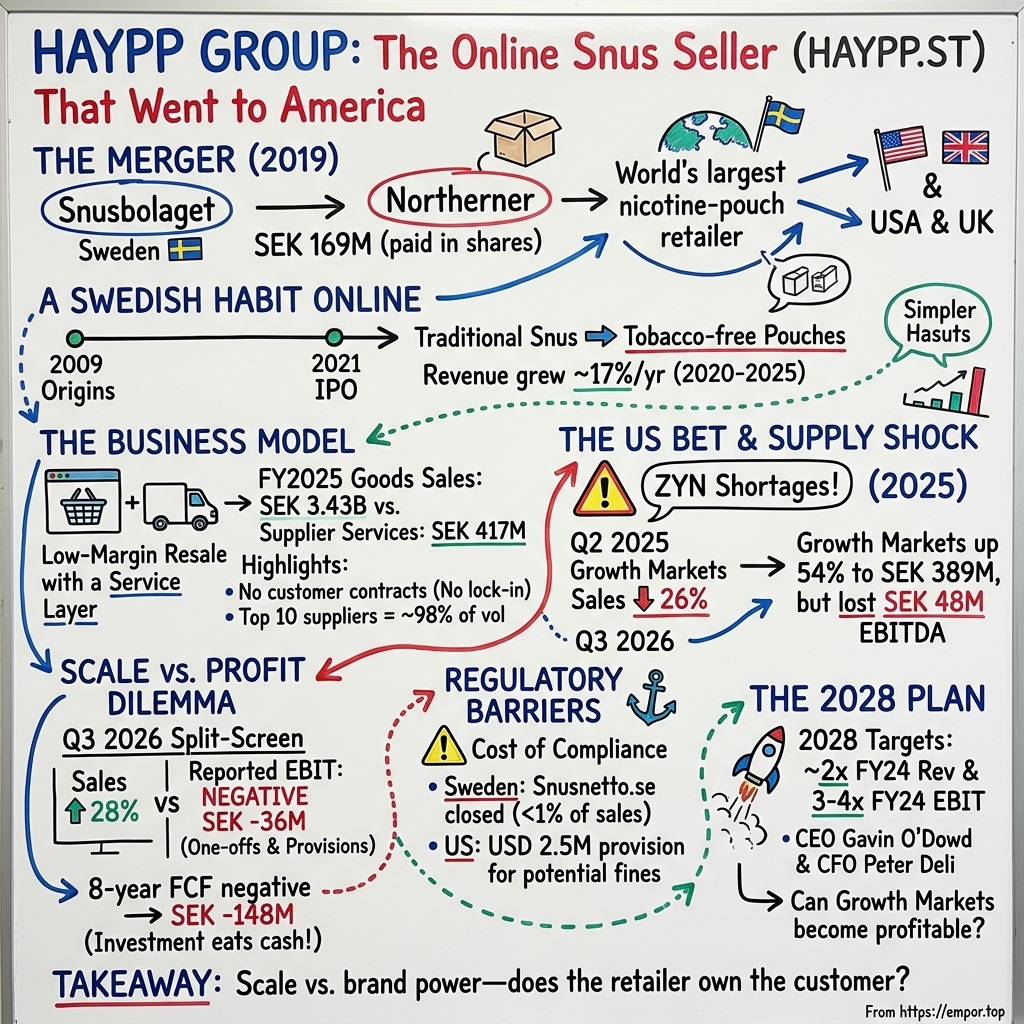
On the morning of September 26, 2019, two Swedish websites that had spent years competing for the same customers announced they were joining forces. One was Snusbolaget, a domestic online seller of snus, the moist tobacco that Swedes tuck under the upper lip. The other was Northerner, a Swedish-run seller that had pushed further abroad and had a storefront for American buyers. The combined business got a new name, Haypp Group, and it described itself as the world's largest retailer of nicotine pouches.1 The Swedish business press that covered the deal put the global market for tobacco-free pouches at roughly EUR 300 million, growing at 150% to 250% a year.1 A small market growing that fast is exactly the kind that tempts a regional retailer to think much bigger.
The title of "world's largest" sounded grand, but it described something modest. In 2019 the nicotine pouch was a young product, the American market for it was just starting, and the group making the claim was a pair of e-commerce operators whose revenue, by later standards, was small. What the merger really announced was an ambition. Snusbolaget had learned to sell a familiar Scandinavian habit to Scandinavians over the internet. Northerner offered a way to sell the next version of that habit, the white, tobacco-free pouch, to the much larger American market.
The price for that bridge was SEK 169 million, and Snusbolaget's owners paid none of it in cash. The whole consideration was settled in newly issued shares of the combined group.2 That detail matters more than it first appears. A cash buyer must convince itself that a target is worth the money leaving its bank account. A buyer paying in shares makes a subtler bet: that the combined company will be worth more per share than the old one, even after the sellers get their slice. In Haypp's case the sellers stayed on as part-owners, and a holding company bearing the Northerner name still held almost a tenth of the group in September 2026.3
Was SEK 169 million cheap? The honest answer is that nobody outside the deal can say. The 2021 IPO prospectus discloses the price and the form of payment, but it does not give enough financial detail on Northerner as a standalone business to calculate a reliable multiple of sales or profit, or to compare the deal with others in the industry.2 What the public record does show is the effect on the group's size. Revenue grew by about three-quarters in 2019 and then more than doubled in 2020, the first full year with Northerner inside the accounts.2 The deal plainly made Haypp bigger. Whether it made Haypp better is the question this story keeps coming back to.
It helps to be clear about what is being studied. Haypp Group AB is the Swedish parent company, listed on Nasdaq First North Growth Market in Stockholm, and its consolidated accounts include its operating subsidiaries, among them the American business, Northerner Scandinavia Inc.4 When this story talks about Haypp's revenue, losses or cash, it means that whole group. When it talks about the United States, it means a segment inside that group, one that management now reports under the name Growth Markets.
The stakes of the 2019 merger have grown with the company. Today Haypp runs local e-commerce sites across several European markets, the United States and, since the third quarter of 2026, Saudi Arabia.5 It sells a regulated product it does not make, to consumers who are free to buy it elsewhere, under rules that change country by country and sometimes city by city. Its pitch to investors is that scale and know-how in regulated online retail can become a lasting advantage. Its challenge is that every one of those advantages has to be proven again in each new market, often against suppliers far larger than itself.
So the story of Haypp is a test of a single idea. Can a retailer that owns none of the brands, and has no contracts locking in its customers, turn size and regulatory skill into durable economics? And can its expensive push into America and Britain earn back what it costs? To answer that, it helps to go back to where the habit began: a Swedish lip, a tin of snus, and a customer who decided it was easier to order online.
 Subscribe on LinkedIn
II. A Swedish Habit Moves Online
Snusbolaget started in 2009 with a simple observation about its customers.2 Snus users are among the most predictable shoppers in consumer goods. They tend to use the same product, in the same strength, from the same brand, every day, and they run out on a schedule. A product like that does not need to be discovered in a shop. It needs to be delivered before the last tin is empty. If a retailer could make buying snus online as easy as buying it at the corner shop, and a little cheaper, it could win a customer for years without much further persuasion.
That was the bet, and it worked well enough to make Snusbolaget a meaningful player in its home market. Sweden was a natural laboratory. Snus has a legal and cultural standing there that it lacks in most of Europe, so a domestic seller had a large, settled base of daily users to serve. An online specialist also had something a convenience store could not easily match: a deep range. The corner shop might stock the dozen most popular tins. A website could stock hundreds, which mattered to customers loyal to a particular brand or strength.
Then the product began to change underneath the retailer. Over the past decade, Scandinavian sales of oral nicotine shifted from traditional tobacco snus toward the nicotine pouch, a small white bag of plant fibre, flavouring and nicotine with no tobacco leaf inside.6 For Haypp, that shift was both a gift and a warning. The gift was growth: pouches were the fastest-growing part of the category, and by the third quarter of 2026 they made up more than 72% of the volume Haypp sold.5 The warning was that the brands driving the shift belonged to some of the largest tobacco companies in the world. Haypp sells those products. It does not own them, and its portfolio of storefronts is a set of shops, not a set of brands.7
This is the first place where the story needs a clear distinction. A great many headlines about nicotine pouches are really about the companies that make them, whose margins on a can of pouches resemble those of a premium consumer brand. Haypp's economics are those of a retailer. It buys cans from manufacturers, marks them up modestly, and earns its living on volume, efficiency and the extra services it sells to the same manufacturers. When pouch demand grows, Haypp benefits. When a brand owner changes its pricing, its distribution policy or its supply, Haypp has to adapt.
The Northerner deal in 2019 turned the Swedish shop into an international retailer, and the company's next big moment came two years later in the public markets. In October 2021, Haypp listed its shares in Stockholm. The offering combined 2,272,727 new shares, which brought the company expected proceeds of about SEK 150 million before costs, with 5,632,404 existing shares sold by shareholders who were cashing in part of their stakes.2 That mix tells its own story. The company raised money for growth, while some early owners took money off the table. It was a financing event and an ownership event at the same time, and it set the share register that still governs the company: two large holders, GR8 Ventures and Patrik Rees, each with between about 11% and 13% as of September 2026, and neither close to control.3
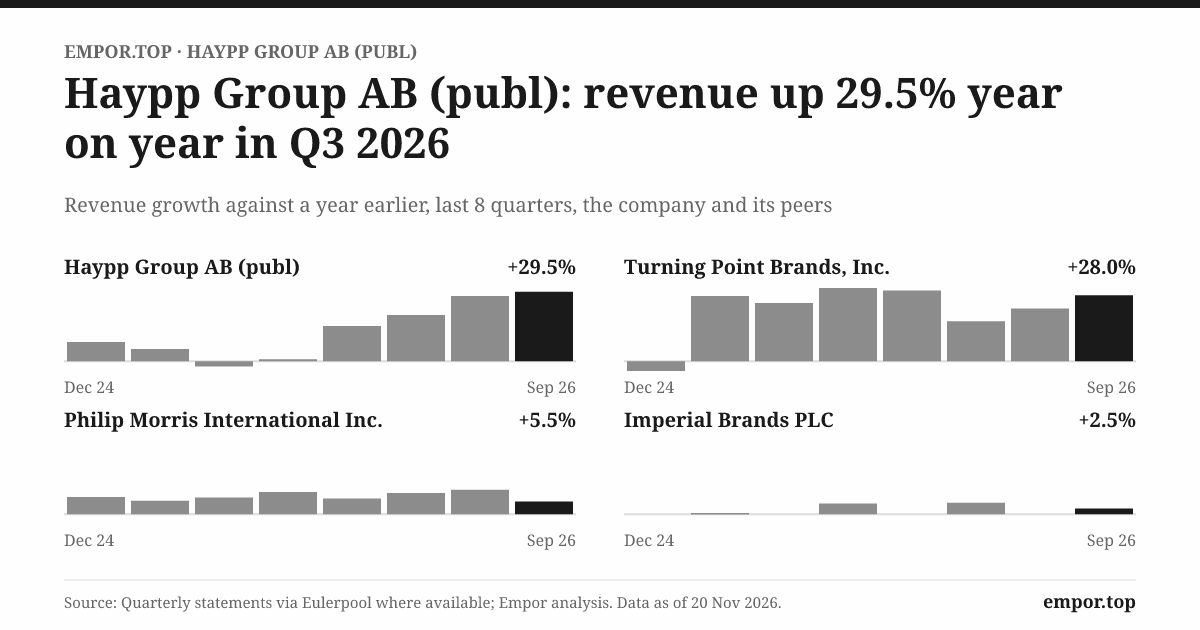
From there the growth record looks impressive at a distance. Haypp's revenue grew at about 17% a year in Swedish kronor between 2020 and 2025, driven, in management's account, by new customers, more frequent orders and bigger baskets.4 For a retailer selling a product that is restricted, taxed and frequently debated by regulators, that is a strong run. But a five-year average hides a sharp curve. Growth slowed to just 4.6% in 2025, and then rebounded hard in 2026, when sales in the first nine months rose 25% as reported and 26% organically.43
The slowdown is the more interesting part of that record, because it tests the original idea. If Haypp's advantage were simply that it had perfected online nicotine retail and could carry that skill into any market, its growth should have been steadier. Instead, 2025 showed that its results can swing with forces it does not control: which brands it can stock, which products a country allows and how a regulator decides to treat online sales. The home market gave Haypp operating experience, a loyal customer base and a cash-generating core. It did not automatically give it a moat abroad.
Which leaves the question that every later chapter of this story inherits. Does the know-how built in Sweden travel, so that each new country becomes cheaper and easier to win? Or does every market bring a fresh fight over regulation, assortment and the cost of finding customers? To answer that, it is worth following a single order from the moment it is placed.
III. The Store Is a Website, but the Business Is Retail
Picture an evening order. A customer in Manchester or Minneapolis opens a Haypp site on a phone, scrolls past a dozen flavours, and orders several cans of a favourite pouch brand. On the screen it looks like software. Behind the screen it is a physical, regulated retail operation. Haypp has to have bought those cans from the manufacturer, stored them in a warehouse, confirmed that the buyer is old enough to purchase them, checked that the product is legal at that address, packed the parcel and paid someone to deliver it. Every one of those steps costs money, and some of them can go wrong in ways that end up in a courtroom.
Do that about 15,000 times a day and you have Haypp. In the twelve months to September 2026, the group processed 5.647 million orders at an average value of SEK 712.3 That average is a useful anchor: a typical order is a handful of cans, not a single tin, which fits a customer who buys in bulk and comes back when supplies run low.
Most of the money comes from simply reselling those products. In 2025, sales of goods brought in SEK 3.432 billion of the group's SEK 3.849 billion revenue.4 The remaining SEK 417 million came from what Haypp calls other services, chiefly marketing, research and analytics sold to the very suppliers whose products it stocks.4 Inside the company this business goes by the name Media & Insights, and in the third quarter of 2026 it reached 12.2% of net sales.5 The idea is straightforward. Haypp sees what millions of nicotine users buy, switch to and abandon, and brand owners will pay for that information and for prominent placement in front of those users. Management told analysts that these agreements are usually contracted for a year at a time, with the step-up in new contracts typically falling between the fourth and first quarters.5
That supplier-services layer is why Haypp's gross margin, the share of each sale left after paying for the goods, is higher than a pure reseller's might be. In the third quarter of 2026 the group's gross margin hit a record 19.7%.5 Put plainly, out of every SEK 100 a customer spends, Haypp keeps about SEK 20 after paying the manufacturer, and part of that SEK 20 comes not from the customer at all but from suppliers buying media and data. The rest of the business has to run on that SEK 20: warehouses, delivery, staff, technology, marketing and compliance. In the same quarter, Haypp's adjusted overhead costs took about SEK 15 of every SEK 100 of sales, up from about SEK 13 a year earlier.5 That leaves a thin slice, and it is why small shifts in pricing or costs move Haypp's profits so violently.
The drivers of the business are easy to name and harder to control. Revenue depends on how many active customers Haypp has, how often they buy, how big each basket is, what mix of products they choose, what those products cost and how much of the category's spending moves online. Some of those levers belong to Haypp. It can improve the website, add products, offer subscriptions and run loyalty and referral schemes, which management says are growing.5 Others belong to someone else. When manufacturers cut prices in the United States in early 2026, Haypp's average order value fell, and the company passed those cuts on to consumers.8 Management described the related promotions as "driven by manufacturers" and "margin neutral" for Haypp.8 That is reassuring about margin, but it is also a reminder of who is setting the price.
Supplier-funded promotions are the hidden plumbing of this business. A brand that wants to win share pays the retailer to discount its product or feature it prominently. The retailer passes the discount to the customer, keeps its margin, and often earns a media fee on top. It is a good arrangement when brands are fighting for shelf space, as they are in nicotine pouches today. It is a dependent one, because the funding can shrink when a brand decides it has won, or when it prefers to send its budget to physical retail.
What scale actually buys
The best argument for Haypp's model is that scale makes each order cheaper to serve. There is evidence that it does. In the first quarter of 2026, fulfilment costs grew 17% while volume grew 23%, which means each unit shipped cost a little less to handle.8 Haypp has invested in warehouse automation, including plans to automate its British warehouse during the summer of 2026.8 Spread across millions of orders, that kind of efficiency matters. So does assortment: a big retailer can carry the long tail of flavours and strengths that a smaller one cannot afford to stock. And a retailer operating in many jurisdictions builds a library of regulatory knowledge, from age-checking processes to product registrations, that a new entrant would have to assemble from scratch.
The harder question is whether any of that keeps customers from leaving. Haypp's customers sign no contracts. There is no subscription lock-in, and the company does not disclose what share of its revenue is recurring, how long customers stay, or what fraction return each year.4 It does cite a record Net Promoter Score of 82 in the fourth quarter of 2025, a measure of how willing customers are to recommend a service.9 That is a strong reading, and it suggests customers like the experience. But liking a shop is not the same as being unable to leave it. A pouch user who finds the same can a little cheaper elsewhere faces few costs in switching, beyond typing a different web address.
The competitive map makes the point. Haypp's earlier market materials named Snusdirect as one of its online rivals in Scandinavia.2 Physical retail, from supermarkets to petrol stations, remains the default channel in most markets and a direct alternative for any customer. And the manufacturers themselves have enormous leverage. In the period before its listing, Haypp's top ten suppliers accounted for about 98% of its product volume.2 The group does not publish comparable market-share data across all its countries, which makes it hard to say precisely how large its lead is in each one.
There is a financial footprint of this dependence too. Because the big tobacco companies are both Haypp's suppliers and the buyers of its media services, they also owe it money. At the end of 2025, a limited number of these supplier-customers accounted for 72% of Haypp's trade receivables.4 Haypp argues that the two-way relationship lowers credit risk, since it can net what it owes a supplier against what that supplier owes it, and credit losses in 2025 were negligible.4 Still, receivables more than 90 days overdue rose to SEK 8.0 million from SEK 3.6 million a year earlier.4 That is small against the group's revenue, but it is the kind of number worth watching in a business whose biggest debtors are also its most powerful suppliers.
One newer threat sits at the edge of the picture. Shopping is beginning to move toward artificial-intelligence assistants that search, compare and buy on a user's behalf. If that becomes the norm, a retailer's website could matter less than its visibility to the machines. Management argues that age-restricted, jurisdiction-specific products are unlikely to be bought by AI agents any time soon, but it also acknowledges that product discovery is shifting toward large language models, and says it has worked on the problem for about three years.5 That is a sensible answer. It is also an admission that the front door of online retail may be moving.
So what kind of business is this? Mainly a low-margin resale operation, with a valuable layer of supplier services on top. Repeat purchasing gives it a predictable rhythm, scale is making fulfilment more efficient, and the regulatory library is real. But the core sources of pricing power, the brands, the supply and the rules, sit mostly outside Haypp's walls. Nowhere did that become clearer than in America in 2025, when one brand disappeared from the shelves.
IV. The US Bet Meets a Supply Shock
In the spring and summer of 2025, Haypp's American customers went looking for the most popular pouch brand in the United States and could not find it on the company's site. The leading US brand, ZYN, was in short supply, and the constraints hit Haypp's Growth Markets segment just as it was building for expansion.104 At the same time, tobacco-product restrictions and sales closures in some states cut off parts of the market.10 For a retailer whose whole American thesis rested on riding the boom in pouches, it was the worst kind of interruption: demand for the category was fine, but the product customers wanted most was not on offer.
The second-quarter figures show the damage. Growth Markets sales fell 26% from a year earlier, and the number of active consumers in the segment dropped by 34%.10 A third of the customer base, gone in a year. If you were looking for proof that Haypp's customers were loyal to the shop rather than the brand, this was the opposite. When the brand they wanted disappeared, a large share of them stopped buying from Haypp.
But there was another number in the same presentation that told a more hopeful story. On a like-for-like basis, nicotine pouch volume grew 40% in the quarter, even as reported volume fell.10 In other words, among the products and markets that were still available, customers were buying a lot more. The underlying category was growing quickly. What had broken was Haypp's access to the part of it that mattered most. That distinction is the heart of the American bet: Haypp can ride a wave of demand, but it cannot conjure the supply.
The interruption shaped the whole year. Over the first three quarters of 2025, the brand constraints depressed Growth Markets sales, and the leading brand only returned to Haypp's American assortment in the fourth quarter.4 For the full year, the segment's earnings before interest, tax, depreciation and amortisation, a rough measure of operating cash profit, came to a loss of SEK 51.6 million.4 It was a hard year to judge an expansion by, because the expansion had been hobbled by a supply shock. That gave management a plausible explanation. It also gave investors a reason to be careful about which parts of the explanation they accepted.
The rebound and its bill
When ZYN came back, so did the customers. On the fourth-quarter call in February 2026, management reported that American volume had grown 95% in the quarter and about 120% in January 2026, with new consumers up almost 200% in the quarter.9 Some of that was customers coming back after the shortage. CFO Peter Deli was candid about how hard it was to separate the effect: many consumers who had switched to other brands while ZYN was missing switched back once it returned.9 There was also a quieter accounting effect that showed how closely Haypp's American numbers are tied to its suppliers' commercial choices: supplier-funded discounting in the United States reduced reported sales growth by about 2.6 percentage points against the fourth quarter of 2024.9 The Growth Markets segment lost just SEK 4.4 million in EBITDA in the fourth quarter, which CEO Gavin O'Dowd called "exactly the pattern we expected."9 He also set out a principle: "we will never ration the U.S. in order to drive growth in the emerging segment."9
The recovery gathered pace through 2026. In the first quarter, Growth Markets sales rose 41% as reported and 58% at constant currency, while the segment's EBITDA loss widened to SEK 23 million, which management described as expected.8 By the third quarter, the picture had become a striking split. Group revenue grew 28%, with Growth Markets up 54% and nicotine pouch volume in the segment up 63%.3 Core Markets, the established European business, generated SEK 832 million of sales and SEK 104 million of EBITDA. Growth Markets generated SEK 389 million of sales and lost SEK 48 million of EBITDA.3 A year earlier, that segment's loss had been about SEK 12 million.5
Saudi Arabia deserves a sentence of its own, because it shows how the expansion keeps widening. The kingdom is a long way from Haypp's Scandinavian roots and from its American thesis. Management said early sales there were slow but growing and that it expected no meaningful near-term contribution.5 In other words, Haypp has opened another front before the American one has started paying for itself. That may prove far-sighted if pouches catch on in the Gulf. It also means the list of markets still in their loss-making phase has just grown longer.
Put those two segments side by side and the shape of the business comes into focus. Core Markets keeps roughly SEK 12 of EBITDA from every SEK 100 of sales. Growth Markets loses about the same amount. The established business is funding the new one, and the faster the new one grows, the more funding it currently needs. Management attributed the bigger loss to an expanded organisation, heavier American and British marketing, and about SEK 4 million of initial investment in Saudi Arabia, which launched at the start of the quarter.5
The comparison across calls is revealing. In the summer of 2025, management's story was about a temporary supply interruption that disguised strong underlying demand. That story was borne out: when supply returned, volumes surged. By early 2026, the story became one of reinvestment, of spending to capture share while the market was growing and the regulatory climate in Washington was loosening. Management pointed to 39 marketing granted orders from the US Food and Drug Administration since May 2026 as evidence of that shift, while acknowledging to analysts that some of the 68 new products Haypp launched in the third quarter were still awaiting such orders.5
When an analyst from Barclays asked on the third-quarter call when Growth Markets would break even, the answer was telling. Growth would remain the priority, profitability would follow scale, and American profitability was "not expected to change materially" over the next few quarters.5 That is an honest answer. It is also a reminder that, more than seven years after the Northerner merger, the American business has not yet shown it can stand on its own feet.
This is where the claims need weighing. The rebound is real, and it confirms that Haypp can attract American customers quickly when it has the right products. The 2025 episode also proves the converse: a large share of those customers follow the brand, not the store, and one manufacturer's supply chain can erase a third of the customer base in a year. Management's account of the shock has been consistent and largely vindicated. Its account of the payoff, that scale will bring profitability, remains a forecast. What would settle the bet is not another quarter of fast growth. It is sustained organic growth after supply has normalised, together with a Growth Markets EBITDA margin that moves steadily toward zero rather than away from it.
That question, whether growth can pay its way, is not confined to the American segment. In the third quarter of 2026, it showed up in the group's headline numbers too.
V. Scale Has to Pay for Itself
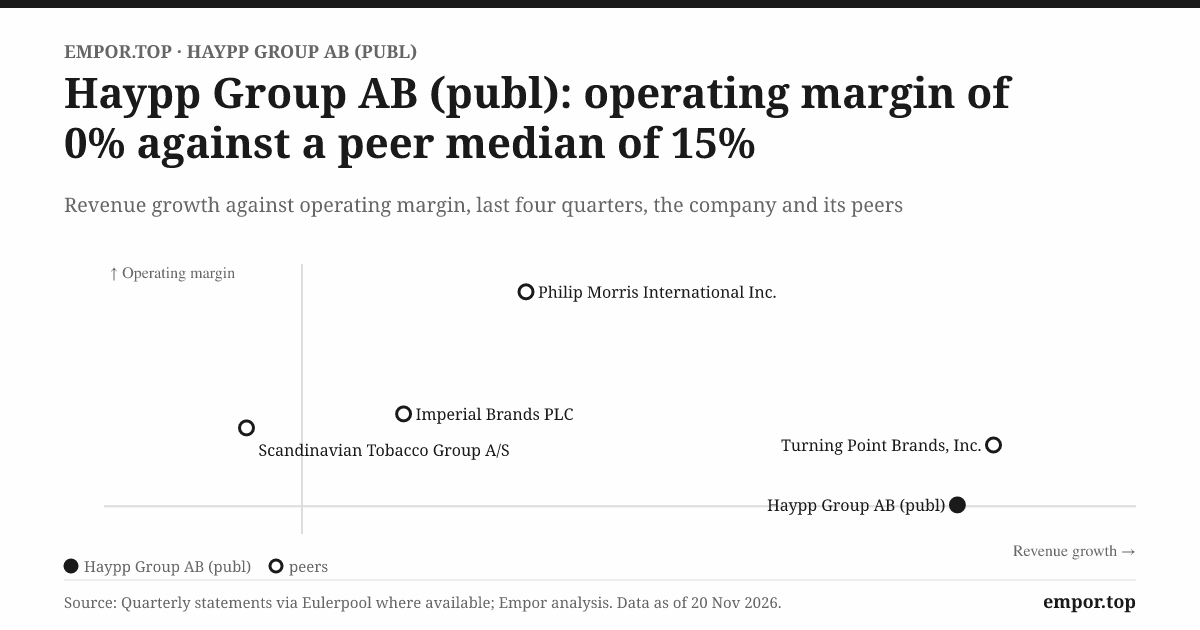
On November 6, 2026, Haypp's third-quarter report delivered a split screen. On one side, sales up 28%, the fastest growth in years, and a record gross margin of 19.7%, up from 18.8% a year earlier.3 On the other side, a reported operating loss of SEK 36 million.3 For a company that had promised investors that scale would make it more profitable, it was an awkward picture: the business was growing faster and keeping more of each sale, yet the bottom of the income statement had turned red.
Management's preferred measure told a gentler story. Adjusted EBIT, which strips out costs the company considers one-off, came to SEK 26 million, a margin of 2.2%, down from SEK 33 million and 3.5% a year earlier.5 The difference between the adjusted and reported figures was mostly a set of items affecting comparability, which added up to a charge of SEK 53 million in the quarter.3 Over the first nine months of 2026, such items totalled SEK 65.8 million.3 They included one-off bonuses, restructuring and severance costs, and the provision for a potential American regulatory fine.3
Investors have learned to be wary of adjustments, and for good reason. A cost can be one-off once. When adjustments recur, quarter after quarter, they start to look like the cost of running the business. Haypp's adjustments have plausible explanations. Severance follows reorganisation; a legal provision follows a dispute. But a company that operates in a heavily regulated industry and is spending to expand should expect some legal and restructuring costs as a normal part of life. The fairer way to judge Haypp is to watch both measures: the adjusted figure for the direction of the underlying business, the reported one for what shareholders actually earn.
Even on the adjusted measure, the trend in 2026 has been downward. For the full year 2025, Haypp's adjusted EBIT margin was 3.9%, up from 3.7% the year before.4 Its reported operating margin was lower, about 2.8%.4 Then, in the first quarter of 2026, adjusted EBIT margin fell to 2.5% from 5.2%, which Deli said was "fully aligned with our investment plan."8 By the third quarter it was 2.2%. Management expects margins to recover in 2027 and 2028 as the benefits of scale come through, and it has warned that the Saudi launch will reduce group margin by about 0.35 percentage points in coming quarters.85
So where is the money going? The cost lines answer that. Gross margin rose by about one percentage point in the quarter, but adjusted overheads rose by about two points as a share of sales, and marketing alone went from about 1% of sales to 3.2%.5 Product gross profit grew about 27%, which management described as a deliberate reinvestment in prices and range rather than a squeeze.5 In plain terms, Haypp earned more on each order, then spent more than all of that extra on marketing and organisation to win the next order. That is a defensible choice in a fast-growing category. It is also exactly the choice that has to earn a return later.
Following the cash
Profits are one lens; cash is another, and over the long run it is the one that matters. Here Haypp's record looks better at first glance than it does on a closer look. Over the eight years from 2018 to 2025, the company generated about SEK 358 million of cash from operations, against cumulative net profit of just SEK 22 million.42 A business that produces sixteen times as much operating cash as accounting profit sounds like a cash machine.
It is not, and the reason is worth understanding. Operating cash flow adds back non-cash charges, chiefly the depreciation and amortisation of past investment, and it is lifted or depressed by working capital, the money tied up in inventory and owed by customers, less what the company owes its suppliers. Haypp invests steadily in its platform, software and warehouses, and that investment does not appear in operating cash flow. Once capital spending is subtracted, free cash flow over the same eight years was negative SEK 148 million.42 Over its life as a group, Haypp has consumed more cash than it has produced. None of that gap has been available to shareholders as surplus, and the company has never paid a dividend.4
The latest year shows the same pattern in miniature. In 2025, operating cash flow was SEK 140 million against net profit of SEK 42.5 million, while investment in tangible and intangible assets came to SEK 89.5 million, about 2.3% of sales.4 What was left after that investment was modest for a business of Haypp's size.
The first nine months of 2026 flattered cash flow in a different way. Working capital released SEK 112.8 million, mainly because inventory fell and deferred revenue rose.3 Inventory dropped to about SEK 315 million by September.5 Meanwhile, investment in tangible and intangible assets came to SEK 97.6 million over the nine months, including SEK 68.7 million in intangibles, largely capitalised development, and SEK 27.4 million in tangible assets.3 A one-time fall in inventory is useful cash. It is not repeatable cash: inventory cannot fall forever in a business that is growing at 28%.
The balance sheet benefited. Cash reached SEK 174.1 million at the end of September 2026, and net debt fell to SEK 96.3 million, about 0.4 times the last twelve months of adjusted EBITDA.3 In July 2026, Haypp replaced a SEK 170 million overdraft with a SEK 400 million revolving credit facility, of which SEK 150 million was drawn at the end of the quarter.3 Management noted that the remaining net debt is effectively made up of lease obligations, since cash more than covers the drawn bank debt.5 That is a comfortable position for now. It also shows that the company has bank backing to fund its expansion without returning to shareholders for equity.
The verdict is mixed rather than negative. Sales are growing, gross margin is improving and the balance sheet is sound. But the claim that Haypp can turn growth into durable profit and free cash flow remains unproven. The test is concrete: full-year free cash flow after normalised working capital and investment, judged alongside reported EBIT rather than only the adjusted version. Haypp has been here before, in the sense that it has been asking investors to fund growth in exchange for future profits since the day it paid for Northerner in shares. That deal, and the way Haypp has allocated capital since, deserves a closer look.
VI. The Acquisition Was Paid in Shares
Go back to the merger, but this time look at it as a capital allocator would. The Northerner deal was Haypp's largest disclosed acquisition, paid for in shares.2 For a young company with little cash, issuing shares was the obvious way to pay. It preserved cash for operations, and it kept the sellers invested in the group's success. But a share-funded acquisition is not free. It spends ownership instead of money, and every existing shareholder gives up a slice of the future in exchange.
It was not Haypp's first deal. In 2018, the group bought Snuslageret.no, a Norwegian online seller, for NOK 1 million in cash, SEK 4 million in shares and an earn-out tied to future performance.2 The two deals are not comparable in scale. Snuslageret was a bolt-on that bought Haypp a foothold in Norway. Northerner was transformational, giving the group its American platform and much of its international reach. Together they show a pattern: Haypp has built its geographic footprint partly by buying existing storefronts rather than starting from scratch.
The temptation is to grade these deals by the price paid. The record does not allow it: the IPO prospectus lacks enough information for a defensible valuation.2 Any claim that Northerner was cheap, or overpaid, would be a guess. Later acquisitions do not add much to the picture. The 2025 annual report records purchases of legal entities in 2024, but on the evidence it provides, those do not amount to a major new operating acquisition.4
What can be assessed is how Haypp has spent its own money since. The company describes a consistent reinvestment policy: its e-commerce platform, its enterprise resource planning system, middleware connecting its sites, digital tools for customers, marketing and warehouse automation.4 It does not report research and development as a separate expense.4 Average full-time employees rose to 304 in the third quarter of 2026 from 261 a year earlier, a slower increase than the 28% growth in revenue.43 That is a sign of operating leverage in headcount, though marketing has absorbed the savings and more.
The payout record frames the choice. It has continued to pay no dividends.4 Management said on the fourth-quarter 2025 call that no dividend was planned through the 2028 target period.9 Haypp has made no share buyback or rights issue since listing. New shares have been issued, but in small amounts, mostly linked to employee incentive programs: new share issues totalled SEK 10.7 million in 2025, and the 2025 long-term incentive program issued 1.2 million C shares, with maximum theoretical dilution estimated at about 3.8%.4 Shareholders, in other words, are being asked to forgo cash today so that the company can invest in growth, without being asked for new capital. On the fourth-quarter call an analyst raised the idea of a US listing, given how much of the growth now lies there; management said there were "no plans at this point in time" and that it would revisit the question in 2027.9
There is a logic to that policy. A company that believes it can earn high returns on new investment should reinvest rather than pay out. The weakness of the logic is that it depends on the returns materialising. The return on Haypp's largest investment still depends on Growth Markets becoming profitable.
And there is a second hidden cost that does not appear on any acquisition invoice. Expanding into the United States meant expanding into its patchwork of local rules. That has already cost Haypp real money, and in the same week as its third-quarter report it cost a little more.
VII. The Company's Promise and the Cost of Compliance
On the evening of November 5, 2026, at seven o'clock Stockholm time, Haypp put out a short announcement. Its American subsidiary, Northerner Scandinavia Inc, was booking a provision of USD 2.5 million for potential fines over alleged violations of local regulations in an unnamed US city.11 The company said it was in "confidential constructive communication" with the authority, was working toward a "mutually acceptable settlement," and believed its current practices complied with the city's ordinances, so future sales there were not expected to be affected.11 The next morning, the third-quarter report arrived with the provision inside its comparability items.3
Around the same time, a different regulatory story was ending in Sweden. Haypp's Swedish tobacco-sales permit had been revoked earlier, and the news had knocked the shares down.[^12] The dispute was still under appeal when the 2025 annual report was published.4 After the third quarter, the Supreme Administrative Court declined to hear a further appeal in a Swedish case linked to age verification, and Haypp responded by discontinuing sales through one of its Swedish sites, Snusnetto.se.3 The company said Snusnetto represented less than 1% of group sales, and on the third-quarter call management said it expected no material impact.35
These are two different cases, and it matters not to blur them. The Swedish matter concerns licensing and age-verification practices, and its consequence was the closure of a small channel. The American matter concerns alleged violations of a city's local rules, and its consequence so far is a provision, not a finalised fine. Gavin O'Dowd told analysts he expected a settlement "over the next quarter or so," but declined to say which city was involved, what the alleged violations were, or whether they related to flavours, labelling or sales channels, citing confidentiality.5 When a Pareto analyst pressed on why the company was so sure sales would be unaffected, O'Dowd described the engagement with the authority as "rock-solid."5 Investors are left to take that on trust.
Neither case is large on its own. But each comes with a precedent. In 2025, Haypp settled a case in San Francisco at a total cost of SEK 18.1 million, with no further commitments expected.4 Add the new American provision, worth roughly SEK 25 million at recent exchange rates, and Haypp has now set aside or paid more than SEK 40 million on American local enforcement in two years. For a retailer whose reported operating profit for all of 2025 was around SEK 110 million, those are not rounding errors.4 They are a material tax on a thin margin.
The mechanism is worth spelling out. Selling nicotine online means proving, at every step, that the buyer is an adult and the product is legal where it is delivered. That means age checks at the point of sale and sometimes at delivery, product rules that differ by country and city, and permits that can be suspended. The company says it has invested in biometric age verification for parcel lockers in Sweden, which is live at smaller sites and set to roll out to larger ones.5 Every such system costs money and adds friction, and every rule change can remove products or whole markets. Haypp exited Austria at the end of June 2026 when the country moved nicotine sales into a national monopoly, a market worth less than 1% of group sales.9 It ceased its British vape business in the fourth quarter of 2025.9 Management estimated that these exits, Austria and the British vape and heated-tobacco lines, cut about two percentage points from group revenue growth in the third quarter.5
Britain shows how regulation can cut both ways. The Tobacco and Vapes Act received royal assent at the end of April 2026, introducing age restrictions and a sampling ban that took effect at the end of October, with marketing restrictions expected from June 2027.85 Management expects the rules to cap nicotine strengths at about the level Haypp already applies itself, and estimates that ultra-strong products make up about 20% of the British market.8 If consumers of those products move to compliant ones, a careful retailer could gain. If they move to illicit sellers, as critics of such caps warn, the legal market shrinks.
This is why "regulatory expertise" is best treated as a qualified advantage. It is real. A company that has learned to navigate rules across Sweden, Norway, Britain, the United States and now Saudi Arabia has knowledge that a general online retailer would hesitate to acquire, and that knowledge probably deters some entrants. But expertise did not protect Haypp from a lost Swedish permit, a San Francisco settlement, a new American provision or a forced exit from Austria. It narrows the risk; it does not remove it. The regulator, not the retailer, decides what is allowed.
One reassurance is narrow but real. PwC's audit opinion on the 2025 accounts was unmodified, with no emphasis-of-matter paragraph and no reported material weakness.4 That means the auditors were satisfied that the accounts fairly represented the business. It does not, and cannot, assure investors about future compliance.
The contrast between the prepared remarks and the questions on the third-quarter call says something about how management handles uncertainty. The presentation dwelled on growth, gross margin, the FDA's loosening stance and the 2028 targets. The analysts spent much of their time on the provision, on marketing cuts and on when Growth Markets would break even. Management's answers were direct on strategy and guarded on the legal matter. That is defensible given the confidentiality constraint, but it places a great deal of weight on the credibility of the people giving the answers.
VIII. The People Who Have to Deliver the 2028 Plan
When Gavin O'Dowd presented the third-quarter results in November 2026, he did so with the calm of someone who had spent his career on the other side of the table. Before he became Haypp's chief executive in 2017, O'Dowd ran British American Tobacco's Swedish business and chaired the boards of BAT Sweden and Fiedler & Lundgren, the snus maker BAT owned.12 Born in 1978 and trained as an accountant at Waterford Institute of Technology in Ireland, he is an Irishman who learned the Scandinavian snus trade from inside one of the world's largest tobacco companies.12 He brought that knowledge to a retailer whose fortunes depend on exactly the kind of company he used to run.
The team around him has a similar flavour. Peter Deli, born in 1981 and educated at Corvinus University in Budapest and Jönköping International Business School, became chief financial officer in 2023 after serving as BAT's commercial finance controller for Europe and North Africa.12 Markus Lindblad, head of legal and external affairs since 2018, previously sat on the boards of BAT's Swedish entities.12 The newest addition breaks the pattern. Jonas Kolehmainen, born in 1975, became chief operating officer and deputy CEO in 2026, coming from the chief executive's job at PostNord TPL, the logistics arm of the Nordic postal group.12
That mix tells you how Haypp sees itself. A leadership team drawn heavily from a tobacco multinational understands supplier economics, regulation and the industry's politics intimately, which is valuable when the suppliers are the most powerful players in the chain. Bringing in a logistics executive as deputy CEO signals that the next challenge is operational: moving more parcels, more cheaply, across more countries. The open question is whether people trained to think like brand owners can build a retailer with power of its own.
On alignment, O'Dowd has meaningful skin in the game. As of October 2026 he held 896,506 ordinary shares, 100,000 C shares and 100,000 warrants.12 At the November 2026 share price of SEK 144, the ordinary shares alone are worth roughly SEK 130 million, about twenty-four times his total compensation for 2025.413 Deli held 36,815 ordinary shares, 67,500 C shares and 100,000 warrants.12 O'Dowd's stake gives him a strong reason to care about the share price over years, not quarters.
The wider shareholder register adds another layer of accountability. Haypp had about 3,849 shareholders in September 2026, and its five largest holders together owned roughly half the company: GR8 Ventures with 12.62%, Patrik Rees with 11.68%, Fidelity Investments with 9.87%, Northerner Holding AB with 9.63% and the American investment firm Robotti & Company with 5.41%.3 The two largest have trimmed their positions modestly since 2023, when GR8 held 14.5% and Rees 12.2%.4 No one controls Haypp, but a handful of concentrated owners could, if they chose, make their views on capital allocation felt quickly. The presence of the Northerner sellers' holding company among the largest owners is also a living reminder of the 2019 deal: the people who sold the American platform are still betting on it with Haypp shares.
The incentive structure is built around shareholder-approved warrant and C-share programs, the latter a common Swedish device that converts into ordinary shares when performance conditions are met.14 O'Dowd's 2025 compensation came to SEK 5.3 million including social costs, made up of SEK 3.0 million in salary, SEK 1.1 million in variable pay and a pension contribution, up from SEK 4.0 million in 2024 while net profit was broadly flat.4 The third-quarter 2026 report adds a detail worth noticing: part of the year's comparability charges were one-off bonuses intended to facilitate eligibility for the long-term incentive program.3 Paying cash bonuses so that executives can participate in a share program is not unusual, but it is a cost shareholders bear, and its classification as one-off flatters the adjusted earnings that management asks investors to focus on. The board was re-elected at the May 2026 annual general meeting; the company reported no vote counts or breakdown of dissent.15
Promises against outcomes
The best way to judge a management team is to compare what it said with what happened. The central promise is the 2028 target, set out at a capital markets day in April 2025: revenue growing at 18% to 25% a year from 2024 at constant currency, and an adjusted EBIT margin of 5.5%, plus or minus 1.5 percentage points, by the end of the period.9 O'Dowd translated that on the first-quarter 2026 call: "We target to approximately double our 2024 revenue by 2028 and increase our 2024 EBIT by three to 4x."8 The goal came with a qualifier, that it was "subject to the investment opportunities which remain at that time," which gives management room to reinvest rather than hit the margin.8 It is worth remembering that Haypp had already laid out an earlier strategic agenda at a capital markets day in November 2023.16
The first test came almost immediately. The 2025 targets were announced in a year when growth slowed to 4.6%. Management explained the slowdown as the result of the American supply problem and a narrower customer base, and the subsequent rebound has largely supported that account.94 That is to its credit. A team that names a specific cause for a miss, and then sees the miss reverse when the cause is removed, has earned some trust.
On marketing, the record is less tidy. On the fourth-quarter 2025 call in February 2026, O'Dowd said, "We have no intent of pushing hard on marketing expenses at this point in time," noting that growth had come with minimal marketing and that the company would revisit the question in the middle of the year.9 By the first-quarter call in May, Deli said the company would invest "most probably even heavier during the second half of this year."8 By the third quarter, marketing had roughly tripled as a share of sales, and management was already telling analysts it was trimming lower-funnel spending, such as search and shopping ads, because many of those customers would have found the site anyway.5 Each step had a reason. Taken together, they show a team adjusting its spending quarter by quarter, which is reasonable in a fast-moving market but makes the path to the 2028 margin target harder to forecast.
Through all of it, management has said Haypp is "on track" for its 2028 targets.85 On revenue, that looks plausible: nine-month 2026 growth of around 25% sits inside the target range. On profit, the evidence points the other way for now. Adjusted EBIT margin has fallen through 2026, Growth Markets losses have widened, and reported EBIT turned negative in the third quarter. The target needs margins to roughly double from their current level within two years. That may happen as marketing normalises and scale builds. But the strongest evidence against treating the guidance as assured is the company's own recent record, and investors should treat the targets as an ambition, not a forecast.
IX. Analysis & Bear vs. Bull Case
Step back and look at Haypp's position from above. A large online retailer sits between some of the most powerful consumer-goods companies in the world and millions of consumers who can switch stores with a few taps. Above it, the brand owners decide what products exist, how they are priced and how much they will spend promoting them. Below it, customers who like the service but are bound to it by nothing stronger than habit. Around it, regulators in every market who can change the rules. And on the stock market, its shares trade at a valuation that looks extreme on trailing earnings.
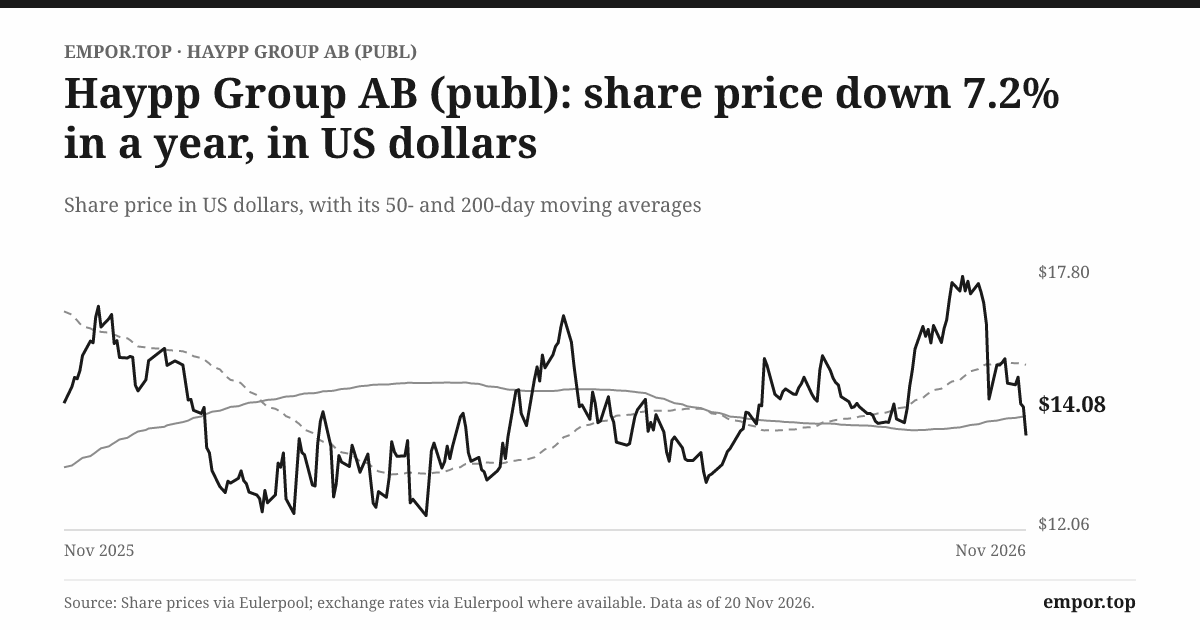
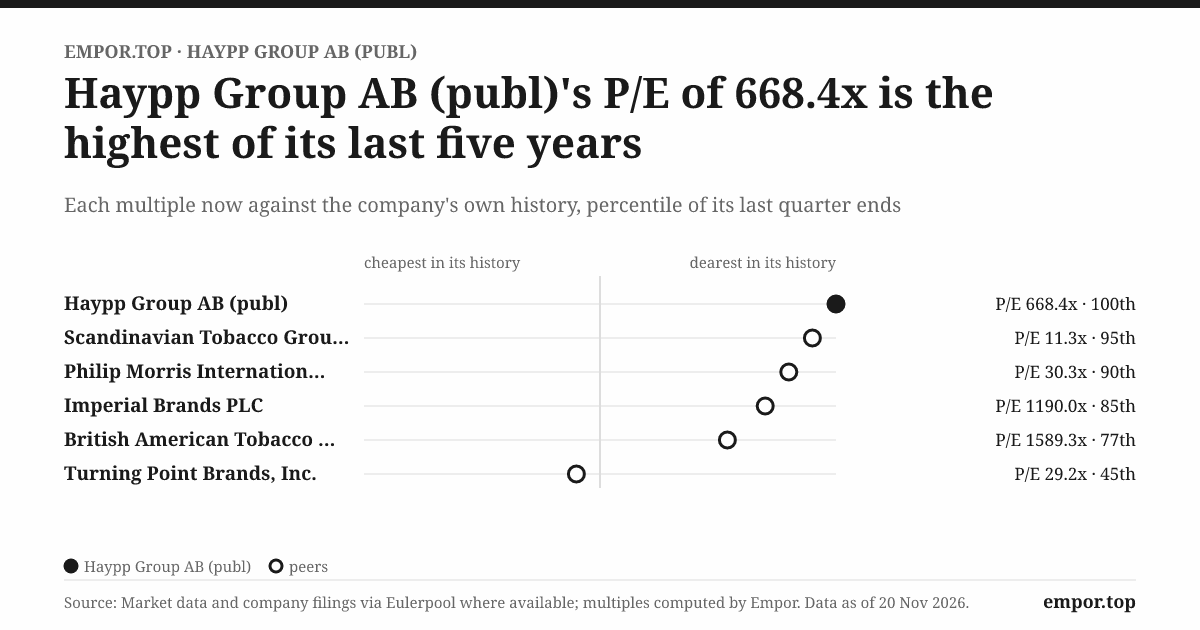
Haypp reported SEK 3.849 billion of revenue in 2025.4 At a share price of SEK 144 on November 20, 2026, the market valued the company at about SEK 4.7 billion, and its enterprise value, including debt and leases less cash, was about SEK 4.8 billion, roughly one times sales.13 On trailing earnings, the price-to-earnings ratio is about 668 times, against a five-year median of about 117 times. Over the last twelve months, earnings per share have actually been negative, which makes that ratio mechanically meaningless. The enterprise value is about 30 times trailing EBITDA.13 The shares fell almost 70% at their worst point over the last five years, and they sit about 17% below their 52-week high.13
Does scale make a moat?
The moat argument deserves to be made once, carefully. Haypp's best-supported strengths are its portfolio of local storefronts across multiple countries, its order volume, its experience in the nicotine category and its ability to navigate local rules.73 These may support better assortment, cheaper logistics, more efficient marketing and a richer media business. How do they hold up against the classic tests of competitive advantage?
Start with Michael Porter's five forces, the standard way to ask who holds the power in an industry. The bargaining power of suppliers is the dominant force in Haypp's world. Before its listing, the top ten suppliers accounted for about 98% of product volume, and the 2025 ZYN shortage showed what happens when one of them cannot or will not supply.24 The bargaining power of buyers is high in a different way. No single customer accounts for more than 10% of revenue, so there is no concentration risk, but individual consumers face low switching costs and can compare prices easily.4 The threat of substitutes is real: physical retail remains the main channel in most markets, and consumers can also switch between product types as regulations shift. The threat of new entrants is moderated by regulation, since a newcomer would need to build age verification, product compliance and permits in each market, but it is not eliminated, and brand owners could choose to sell directly. Rivalry among existing online sellers, including Snusdirect in Scandinavia, appears manageable but is not well documented across all markets.2 On balance, the five forces describe an industry in which most of the profit pool sits with the manufacturers, and the retailer earns a fee for distribution.
Hamilton Helmer's seven powers, a framework for durable competitive advantage, offers a second lens. Scale economies are Haypp's most credible power: falling fulfilment cost per unit, warehouse automation and the ability to spread compliance and technology costs over more orders.8 But scale economies only become a moat when rivals cannot match them, and the brand owners have far more scale than Haypp. Network economies are weak; one customer's purchase does not make the service more valuable to another, although Haypp's data does become more valuable to suppliers as its customer base grows. Counter-positioning, a business model incumbents cannot copy without hurting themselves, might apply to physical retailers that cannot easily build online operations, but it does not apply to manufacturers. Switching costs are low. Brand, in the sense of a retail brand customers would pay more for, has some support in the Net Promoter Score but little evidence of price premiums. Cornered resources, such as exclusive supply contracts, are not disclosed. Process power, the hard-to-copy operational know-how, is perhaps Haypp's second most credible power, in the form of its regulatory and logistics library.
The honest summary is that Haypp has evidence of scale and of a regulatory operating capability, but limited proof of customer lock-in or pricing power. The record narrows the moat claim rather than rejecting it: Haypp has an advantage in operating a complex, regulated online business across borders, but that advantage did not protect it when its main American supplier ran short, and it has not yet translated into profits in its newest markets.
The bull and the bear
The bull case starts with demand. Nicotine pouches are growing fast, and in Britain management estimates that about 70% of current pouch users entered the category within the past two years, with the market growing roughly 40% a year.5 The shift from physical to online retail has room to run in many markets. American supply has normalised, and the FDA's authorisations suggest the regulatory climate there is easing.5 If marketing returns improve as management trims the less productive spending, Growth Markets could move toward breakeven while Core Markets continue to fund the expansion. Media & Insights, at more than 12% of sales and growing, could keep lifting gross margin.5 In that world, the arithmetic of management's 2028 targets becomes interesting. Doubling 2024 revenue would put sales somewhere around SEK 7 billion, and a 5.5% adjusted EBIT margin on that would imply operating profit of roughly SEK 400 million, against an enterprise value today of about SEK 4.8 billion. That is a calculation of what the targets would mean, not a forecast that they will be met.
The bear case starts with dependence. A product or supplier interruption like the 2025 ZYN shortage could recur. Tougher rules could remove products or close channels, as they did in Austria and Sweden. Marketing costs could stay high as competitors fight for online customers. Adjusted earnings could keep diverging from reported ones, and Growth Markets could remain loss-making for years. Receivables from the big supplier-customers, already the bulk of the balance, could become a credit or bargaining issue.4 In that world, Haypp ends up as a large retailer with little durable pricing power, valued as though it will one day earn margins it never quite reaches.
A skeptical activist would focus on three things. First, the gap between adjusted and reported earnings, and in particular the treatment of bonuses paid to facilitate incentive-plan eligibility as one-off. Second, the capital allocation in the United States: a market entered more than seven years ago through a share-funded deal that still loses money. Third, disclosure. The company does not publish customer retention, the share of revenue that is recurring, or how concentrated its supply has become since the IPO, which makes it hard for outsiders to test the moat claim.
The valuation is best read with care. The P/E ratio of over 600 times is a product of nearly zero earnings, not a sign that the market expects extraordinary growth. A ratio of about one times sales, and about 30 times EBITDA, says the market is paying for a recovery in margins. The free cash flow yield of under 1% says that recovery has not yet appeared in cash. None of these figures proves the shares cheap or expensive. They show that the valuation is unusually sensitive to whether profits recover.
Three numbers will settle the case. The first is organic sales growth by segment, which in the third quarter of 2026 was 26% for the group and about 53% for Growth Markets, and which needs to stay healthy now that the supply-shock comparisons are behind it.35 The second is the Growth Markets EBITDA margin, which in the third quarter was about minus 12%, worse than about minus 5% a year earlier, and which needs to turn toward zero.35 The third is reported free cash flow after investment, which over Haypp's eight-year history has been negative, and which needs to turn positive without the help of shrinking inventory.
X. Playbook: Business & Investing Lessons
Every company's story teaches something, but Haypp's lessons are specific to the strange position it occupies: a retailer of a regulated, habit-forming product, competing in markets where the brand owners hold the power and the rules change without warning. From the share-funded Northerner deal in 2019 to the summer of 2025 when ZYN vanished from its American shelves, and on to the third quarter of 2026 when sales jumped 28% and reported profit fell below zero, Haypp keeps returning to the same question about the value of scale.
The first lesson is that a retailer can own the checkout without owning the product. The 2025 ZYN shortage exposed that dependence.10 For founders building marketplaces and retailers, the lesson is blunt: convenience earns loyalty only until the thing customers actually want is missing. For investors, it is a reminder to ask, of any retailer, which brand on its shelves it could not survive without.
The second lesson is that a share-funded acquisition saves cash, but it still spends ownership. The share-funded Northerner deal gave Haypp its American platform, whose return remains unproven.2 Paying in shares made the deal easier to do; it did not make it cheaper. Every share issued is a claim on the future, and the bill comes due in the form of the returns the acquired business does or does not generate. Investors evaluating any acquisition paid in stock should ask the same question they would of a cash deal: what return does this buy, and when?
The third lesson is that growth is only a strategy when the new segment can pay its way. In the third quarter of 2026, growth came disproportionately from the loss-making segment.3 That can be a sound investment, if the losses buy durable market share. It can also be an expensive habit, if the market share disappears whenever the subsidies stop. The test is not how fast the new segment grows, but whether its losses narrow as it gets bigger.
The fourth lesson is that in regulated retail, compliance is part of the product. Haypp's customers are not just buying a can of pouches; they are buying the confidence that the seller has checked their age, follows the local rules and will still be operating next month. Haypp's recent regulatory setbacks showed that compliance is a running cost of its business model.3911 Founders entering regulated markets should budget for compliance as a core operating cost, not a contingency. Investors should treat legal provisions in such businesses as recurring, whatever label they carry.
Underneath all four lessons is a single discipline the next chapter demands. Haypp's expansion must be measured by its reported returns, not by the speed of its sales. Fast growth is the easy part of the story; it is what happens when supply is good and marketing is generous. The hard part is the part Haypp has not yet shown: profitable growth in the markets it entered to become more than a Swedish online shop.
XI. Epilogue
Tonight, on November 21, 2026, Haypp stands at an odd moment. Demand is back. After the American supply shock of 2025, sales are growing faster than they have in years, the gross margin is the highest the company has reported, and the balance sheet has room to spare.3 And yet the new growth engine, the American and British business the company has been building since 2019, is losing more money than it was a year ago, and the group as a whole reported an operating loss in its latest quarter.3
The next moments that will decide the story are already on the calendar. The fourth-quarter report, due in early 2027, will show whether the marketing trim management described on the third-quarter call slows the losses in Growth Markets without slowing customer acquisition.5 It will also show whether the inventory release that flattered 2026 cash flow reverses as the business grows. Somewhere in the next few months, the American city matter should reach a settlement, which management expects "over the next quarter or so."5 If it settles near the provision, the episode will become a footnote. If it does not, it will raise new questions about how well the company understood its exposure.
Further out, the tests become sharper. In Britain, marketing restrictions are expected from June 2027, and Haypp will learn whether stricter rules hand share to careful operators or push consumers toward illicit sellers.5 In the United States, the FDA's authorisation pace will determine how many of the products Haypp stocks it can market confidently.5 In 2027, management will revisit the idea of a US listing.9 And all of it rolls toward 2028, when the targets of roughly doubling 2024 revenue and tripling or quadrupling 2024 EBIT will either be met or explained away.8
There is also a quieter test inside the Media & Insights business. Management told analysts that the step-up in annual supplier contracts tends to come between the fourth and first quarters, and that a new sensory panel would roll out through 2027 as a source of insights revenue.5 If the brand owners renew and expand those contracts, it will be the clearest sign yet that Haypp's customer data has value the suppliers cannot easily replicate. If they hold back, it will suggest that the most powerful companies in the chain see Haypp as a useful channel, but not an indispensable one.
What would change the verdict? A Growth Markets segment that reaches profitability without relying on exceptional working-capital inflows or one-off adjustments to flatter the numbers. That would show that Haypp's scale can be converted into returns, and that the Northerner bet has paid off. What would confirm the skeptics' view? Another year in which revenue grows fast, the adjusted figures look good, and the reported figures and the cash flow fail to follow.
The tension that remains is simple to state and hard to resolve. Strong demand has returned before the new growth engine has shown it can sustain a profit. Haypp has proven it can sell nicotine online across borders. It has not yet proven that doing so at scale earns more than it costs.
XII. Outro
Go back to that evening order: a familiar pouch, bought from a specialist website, shipped through a maze of age checks, product rules and local ordinances to a doorstep in Gothenburg, Manchester or Minneapolis. The customer barely notices the maze. Haypp lives inside it. Every one of those parcels carries a promise that the company knows the rules, has the stock and can deliver the order.
Seven years after the merger, Haypp’s map reaches from Stockholm to Saudi Arabia. The proof the next chapter demands is whether that map can produce durable profit. Because the defining question about Haypp was always the one hidden inside that first announcement: when the customer can switch and the supplier controls the brand, what exactly does the retailer own?
References
-
The merger of Snusbolaget and Northerner creates Haypp Group — Haypp Group, 2019-09-26 ↩↩
-
Invitation to acquire shares in Haypp Group AB (publ) — Haypp Group, 2021-10-04 ↩↩↩↩↩↩↩↩↩↩↩↩↩↩↩
-
Interim Report January–September 2026 — Haypp Group, 2026-11-06 ↩↩↩↩↩↩↩↩↩↩↩↩↩↩↩↩↩↩↩↩↩↩↩↩↩↩↩↩
-
Annual Report 2025 — Haypp Group, 2026-04-28 ↩↩↩↩↩↩↩↩↩↩↩↩↩↩↩↩↩↩↩↩↩↩↩↩↩↩↩↩↩↩↩↩↩↩↩↩
-
Transcript: Haypp Group Audiocast Q3 2026 — Inderes, 2026-11-06 ↩↩↩↩↩↩↩↩↩↩↩↩↩↩↩↩↩↩↩↩↩↩↩↩↩↩↩↩↩↩↩↩↩↩↩↩↩
-
Cross-Sectional Study on Oral Nicotine Product Sales Trends in Scandinavia From 2018 to 2025 — JAMA Network Open, 2026 ↩
-
Haypp Group Q1 2026 earnings call transcript — Stock Analysis, 2026-05-07 ↩↩↩↩↩↩↩↩↩↩↩↩↩↩↩
-
Haypp Group Q4 2025 earnings call transcript — Stock Analysis, 2026-02-13 ↩↩↩↩↩↩↩↩↩↩↩↩↩↩↩
-
Haypp Group provisions USD 2.5 million for potential fines by its US subsidiary — Haypp Group, 2026-11-05 ↩↩↩
-
Report from Annual General Meeting — Haypp Group, 2026-05-20 ↩
-
Capital Market Day 2023 presentation — Haypp Group, 2023-11-28 ↩
 LinkedIn
 WhatsApp
 Reddit
 Hacker News
 Email
 Kindle
 RSS Feed
 Spotify
 Apple Podcasts
 Amazon Music
 Audible
 YouTube